The Measure of Three Hours
This is the story of Clara Bennett, an unassuming museum archivist whose modest and solitary life is upended when she is named the sole beneficiary of Judith Carroway, an eccentric heiress she sat beside on a snowbound train for three hours five years ago. Compelled to travel to a sprawling estate in the Hudson Valley to claim the bequest, Clara must navigate the venomous scrutiny of Judith’s disinherited relatives, untangle the profound private sorrow that shaped Judith’s life, and discover why a chance conversation between two strangers in the dead of winter became the deciding moment in a fortune worth millions.
Chapter I: The Certified Letter
The radiator in Clara Bennett’s fourth-floor walkup possessed only two modes: an iron groan that produced dry, lung-scorching heat, or an absolute, arctic silence. On the second Tuesday of November, it chose silence. Clara sat at her kitchen table wearing a thick moss-green cardigan with frayed cuffs, her fingers curled around a mug of instant coffee that had already gone tepid, reviewing accession sheets for the municipal print archive where she had worked for seven years.
Her life was measured in centimeters, rag-paper weights, and acid-free folders. She was thirty-four years old, possessed good posture, brown hair that she kept pinned back with tortoiseshell combs, and an instinctive aversion to sudden noises. If anyone had asked Clara whether she was happy, she would have replied without hesitation that she was occupied, which she considered far more durable than happiness.
When the doorbell buzzed—a harsh, abrasive rattle that set the neighbor’s spaniel into frantic barking down the hall—Clara did not move immediately. She checked her watch. It was half past eight in the morning. Parcel carriers rarely climbed to the fourth floor; visitors were entirely unheard of.
She opened the door to find a courier in a high-visibility nylon vest, breathing hard, a digital clipboard tucked beneath his arm.
"Clara Bennett?" he asked, squinting down at a manifest.
"Yes."
"Certified. Signature required. From Holloway, Crane & Finch, Counselors-at-Law."
Clara took the plastic stylus, her heart offering a dull, irregular thump. Her first thought was debt; her second was municipal litigation. When her father had died four years earlier, he had left behind three unpaid fuel-oil bills and a disputed boundary fence on a clapboard house in New Hampshire that had ultimately been sold for the balance of its liens. She signed her name with a stiff, careful hand.
The envelope was made of cream-colored laid stock, heavy enough that it did not bend under its own weight. In the upper left corner, embossed in black ink that stood proud of the paper, was the address of a firm on Madison Avenue. Inside were two sheets of watermarked paper and a business card belonging to one Arthur Vance Crane, Senior Partner.
Clara leaned against the closed door, the deadbolt resting cold against her shoulder blades, and read:
Dear Ms. Bennett,
We have been instructed by the Executors of the Estate of Judith Eleanor Carroway, late of High Ridge Manor, Dutchess County, New York, to inform you of her passing on October 14th last.
Pursuant to the Last Will and Testament of the deceased, dated February 18, 2019, and admitted to probate without preliminary caveat in the Surrogate’s Court of Dutchess County, you are named as the primary and residuary legatee of her entire estate, both real and personal.
We request your attendance at our offices at your earliest convenience to review the instruments of transfer and discuss the provisional arrangements required by the decedent's testamentary instructions.
We recognize that this communication may come as an unexpected development. Our firm is prepared to facilitate your travel to Manhattan and provide any documentation necessary to confirm our authority.
Yours most sincerely, Arthur V. Crane
Clara lowered the letter. The kitchen was cold. Down on the street, an oil truck clattered over a loose iron manhole cover.
Judith Eleanor Carroway.
She said the name aloud. It fell into the quiet room like a dropped coin.
She did not know a Carroway. There were no Carroways in New Hampshire, where she had grown up among the spruce swamps and saltboxes; there were none in her university records, nor among the donors whose prints she indexed under low-UV bulbs in the basement of the archive.
Then she read the date of the will: February 18, 2019.
A sharp, vivid image pierced her mind with the suddenness of an electric shock: a small silver tin of candied ginger sliding across a scuffed Formica fold-down table, vibrating with the shudder of an idling locomotive engine; the smell of damp wool, freezing rain drumming like dried peas against a double-paned window, and a woman with hair like unpolished pewter, wearing an impeccably tailored navy greatcoat, looking out into a whiteout of upstate snow.
Five years ago. A stalled commuter train between Albany and Penn Station. Three hours of stillness on a siding in the marshland south of Hudson.
Clara dropped the letter onto the accession sheets. Her hands were trembling.
Chapter II: The Siding at Stockport
The memory had never been lost to Clara; it had simply been filed away in the manner of things that are beautiful and complete in themselves, requiring no sequel.
It had been a Sunday in early February. Clara had traveled to Saratoga Springs to examine a private collection of late-nineteenth-century botanical lithographs that the owner had offered to donate to the archive. The owner, an elderly man who smelled of menthol cigarettes, had changed his mind while Clara was standing in his parlor, deciding instead that his niece might want them for her guest bathroom. Clara had accepted the rejection with her usual mild resignation, caught an afternoon regional train south, and settled into an aisle seat with an apple and a paperback book on Dutch copperplates.
Three miles south of the Stockport Creek bridge, an overhead catenary wire had snapped under the weight of an ice storm. The train had glided to a stop amid an expanse of gray reeds and tidal ice, the electric lights had flickered three times, and then the auxiliary batteries had engaged with a soft, mournful chime. The interior heating had diminished to a faint, lukewarm sigh.
The car had been half-empty. In the seat across the narrow aisle from Clara sat an older woman who had boarded at Hudson.
She had seemed out of place among the students with their canvas rucksacks and the salesmen smelling of damp trench coats. Her navy coat was made of Melton wool so dense it seemed to drink the meager light. Around her throat was a scarf of charcoal-gray cashmere, pinned with an unadorned platinum bar. Her luggage consisted of a single, well-traveled pigskin satchel that sat on the floor between her boots—oxblood leather, unscuffed, with low stacked heels. Her face was long, spare, and severe, dominated by eyes of an unclouded, glacial blue that seemed to look through the train’s vinyl seatbacks into whatever lay ten miles beyond them.
For the first forty minutes of the delay, neither of them had spoken. The conductor had made two uninformative announcements about emergency crews and the state of the line. The temperature in the carriage had begun its slow, inexorable drop. Passengers had grumbled, made phone calls that dropped mid-sentence as the rural cell towers buckled under the storm, and finally subsided into that surly, collective misery peculiar to stranded travelers.
Clara had pulled her woolen scarf tighter around her neck, tucked her cold hands into her armpits, and continued reading by the yellowish emergency lights.
"The Dutch had no sentimentality about tulips," the woman across the aisle had remarked suddenly. Her voice was low, resonant, and remarkably dry, like dried leaves scraped across flagstones.
Clara had looked up, startled. "I beg your pardon?"
The woman had nodded toward Clara’s open book. "The Dutch. In the seventeenth century. People imagine it was all romantic devotion to color. It was speculation. They traded bulbs before they were out of the earth. They traded paper notes for flowers that had never bloomed, and when the market collapsed, they went back to herrings and salt beef without weeping. They understood that wanting something beautiful doesn't make it a moral virtue."
Clara had looked down at the illustration of a striped Semper Augustus, its red-and-white flames frozen in zinc etching. "I think that’s why the prints are so precise," she had replied, her voice cautious. "They weren't trying to make art. They were making inventories of property. Precision is what you use when you don't trust the thing you love."
The woman had turned her head. For the first time, her glacial eyes had focused directly on Clara. They were terrifyingly sharp. "What is your name?"
"Clara Bennett."
"I am Judith Carroway." She had reached into her satchel, produced a small, oval silver tin, and thumbed it open. "Do you take ginger, Miss Bennett? It does nothing for the cold, but it prevents one from being bored by one’s own discomfort."
Clara had taken a piece of the amber root. It burned her tongue with a clean, hot fury. "Thank you."
"Why Saratoga?" Judith had asked.
"Prints that weren't there."
"And you traveled five hours on a Sunday for an absence?"
"It’s my job," Clara had said, feeling suddenly defensive. "I preserve things that other people have stopped looking at."
Judith Carroway had smiled then—a thin, ironic line that did not soften the severity of her face, but illuminated it from within. "A melancholy trade. Or a cowardly one. Looking at what has already been judged safe by history spares one the bother of judging the present."
"That’s unkind," Clara had said, before she could remind herself that one does not reprimand elderly women in Melton wool coats.
"It is entirely unkind," Judith had agreed placidly. "The truth is rarely polite. My sister, for example, has spent forty years being exquisitely polite, and she is the most vicious creature between here and the St. Lawrence River."
From that moment, the conversation had slipped its anchor. It did not proceed by the usual polite inquiries of strangers—where do you live, what do you do for the holidays, do you have children. Instead, they spoke with the reckless candor that is only possible between two people who know with absolute certainty that they will never see each other again.
Judith had talked of her father, a man who had built three factories and a bank and had treated his daughters like ornamental cornices on an office building; she spoke of a house she lived in alone, where sixty-two rooms looked out over the frozen gray spine of the Hudson, and where she kept sixteen grandfather clocks, none of which were wound to the same hour because she found unison "an insult to the irregularity of the human mind."
Clara, astonished at her own looseness of tongue, had found herself speaking of her mother’s slow, gentle drift into dementia in a small house that smelled of boiled potatoes; of the boy she had thought she would marry at twenty-two, who had left her for a woman who laughed louder and played tennis; and of that strange, persistent feeling she carried that her own life was something taking place in the next room, behind a closed door she had never learned how to unlock.
"You have made yourself small so no one will throw stones at you," Judith had said, looking out into the swirling white gloom. "It is an ancient strategy. Hares do it. Gray moths do it. But hares are eaten, Miss Bennett, and moths end up pinned beneath glass by men who don't care how quiet they were."
"Not everyone wants to make a noise," Clara had countered, looking down at her scuffed winter boots.
"A noise? No. Noise is vulgar. But an impact—that is different. You have eyes that notice whether an engraver used a burin or an etching needle, yet you behave as if your own presence in this carriage were an apology to the upholstery."
Judith had checked a small gold watch pinned inside her lapel. "Two hours and twenty minutes we have sat here. My family believes I am in New York meeting with an investment committee. In truth, I took the morning train to Hudson to look at an orchard I sold thirty years ago. I wanted to see if the man who bought it had cut down the russet trees."
"Did he?"
"Every one of them," Judith had said, her voice dropping into a register of cold, magnificent disdain. "He put in a gravel pit. Men are extraordinarily industrious when it comes to turning shade into mud."
At nine o'clock, the lights had surged with a sudden, triumphant hum. The diesel engine far ahead had roared, the air brakes had released with an almighty hiss that shook the snow from the carriage roof, and the train had lurched forward onto the cleared track.
They had reached Penn Station shortly before midnight. On the crowded platform, amidst the steam and the roar of the city, Judith Carroway had extended a gloved hand. Clara had taken it. The leather was supple, smelling faintly of cedarwood and bitter almonds.
"Goodbye, Miss Bennett," Judith had said. "Remember that precision without courage is merely bookkeeping."
"Goodbye, Mrs. Carroway."
"Miss Carroway," she had corrected with a slight twitch of her eyebrow. "I never found a man whose silences were more interesting than my own."
She had turned and walked toward the Seventh Avenue exit, her pigskin bag swinging easily at her side, her back as straight as an iron rail. Clara had taken the subway back to her apartment, drunk a glass of water, and slept for nine hours.
Now, sitting at that same table five years later, Clara held a letter stating that the woman on the train was dead, and that everything she had possessed was now Clara’s.
Chapter III: The Firm of Holloway, Crane & Finch
The law offices occupied the thirty-eighth floor of a limestone tower on Madison Avenue that smelled of beeswax, wet umbrellas, and antiquity. The reception area was paneled in American walnut that had darkened to the color of molasses.
Arthur Crane was a man of seventy with eyes like gray river stones, silver hair parted with geometric exactness, and a three-piece suit of charcoal flannel that looked as though it had been tailored during the Eisenhower administration. He received Clara not with the effusiveness one might expect when handing over an empire, but with the weary, forensic gravity of a surgeon delivering a complex diagnosis.
"Please sit down, Miss Bennett," he said, gesturing to a leather armchair opposite a desk that held neither a computer nor a single stray scrap of paper. Only a thick, cloth-bound docket lay between them.
Clara sat. She had worn her only good wool skirt and an ivory silk blouse that she had pressed three times the night before. She felt like an impostor in a drawing room.
"I imagine," Crane began, leaning back and resting his fingertips together, "that you have spent the last forty-eight hours wondering whether you are the victim of a sophisticated fraud."
"I have," Clara said simply. "I also wondered if this was a case of mistaken identity. My name is not uncommon."
"There is no mistake," Crane said. He opened the docket and turned a page. "Clara Elizabeth Bennett. Born May 4, 1990, in Keene, New Hampshire. Daughter of the late Thomas and Sarah Bennett. Archivist at the Municipal Graphic Arts Foundation of New York since 2017. Residing at 414 West 121st Street."
He looked over his spectacles. "Is that you?"
"Yes."
"Then Judith Carroway knew precisely who you were. She retained this firm forty-eight hours after your journey on Amtrak Train 244 on February 16, 2019. She provided your name, your place of employment, and an accurate description of your appearance. She instructed me to draft a revised will revoking all prior testaments, codicils, and trusts, and to name you as her sole universal legatee."
Clara swallowed. The room seemed very quiet, the muffled roar of Manhattan traffic twenty floors below sounding like nothing more than the sea against distant rocks.
"Why?" The single syllable felt thin, almost pathetic.
Arthur Crane sighed. It was the first human sound he had made. He took off his spectacles and polished them with a square of chamois. "Miss Bennett, I represented Judith for thirty-two years. My father represented her father. If I could explain to you why Judith did anything she did, I would be a theologian, not an attorney. She was a woman of ferocious intellect and total emotional autonomy. She despised sycophancy above all other vices, and unfortunately for her relations, her family consists entirely of sycophants."
He paused, letting the silence settle before continuing.
"High Ridge Manor is situated on six hundred acres of prime riverfront property in Rhinebeck. The main house contains forty-two thousand square feet of living space, constructed in 1888 by McKim, Mead & White. The portfolio includes municipal bonds, timber holdings in the Pacific Northwest, and a significant collection of nineteenth-century American and European drawings. The gross value of the estate, prior to federal estate tax and the New York State estate levy, is approximately forty-eight million dollars."
Clara’s breath hitched. Her hand tightened on the strap of her handbag until the leather bit into her palm. "That’s impossible. That belongs to a family. She had a sister—she told me she had a sister."
"Marian Carroway Thorpe," Crane said, his voice dropping into something resembling distaste. "And a nephew, Julian Thorpe. They are aware of the will."
"And they aren't contesting it?"
"They have already filed a notice of appearance through their attorneys, Messrs. Biddle & Sedge," Crane replied evenly. "They allege lack of testamentary capacity and undue influence."
"Undue influence?" Clara’s voice rose, cracking slightly. "I saw her once! For three hours! We were stuck in a snowstorm! I never spoke to her again. I never received a letter, an email, a phone call. I didn't know she was dead until your courier came to my apartment!"
"Precisely," Crane said, a ghost of an appreciative smile touching the corners of his mouth. "Which makes their claim of undue influence an absurdity that will be laughed out of the surrogate’s court in fifteen minutes. As to lack of capacity: on February 18, 2019, before signing this will, Judith submitted herself to an exhaustive neuropsychological evaluation conducted by two independent department heads from Columbia-Presbyterian. Both certified her as possessing an intellect several standard deviations above the mean, with zero evidence of cognitive impairment."
He tapped the docket. "She knew precisely what she was doing. She knew her sister would sue, and she constructed an iron box around this bequest. But there is a codicil, Miss Bennett. One specific condition precedent."
Clara leaned forward. Her mouth was dry. "What is it?"
"You must take up residence at High Ridge for ninety consecutive days, beginning not later than December first of this year. During that time, you are required to personally examine and catalogue the contents of the library and the print room. You may not sell, lease, or alter any part of the real estate during those ninety days. If you fail to meet this condition, the entire residuary estate passes to the Adirondack Nature Conservancy, and you receive five thousand dollars."
Crane closed the docket with a dull thud.
"She wanted you to see it," Crane said softly. "She wanted you to live in it. Not as a visitor, but as the person who holds the keys. Now, Miss Bennett: will you accept the provisional executorship, or shall I telephone the Conservancy?"
Clara looked at her reflection in the polished walnut desk. She saw her modest woolen coat, her pale face, her hands that spent their days handling other people’s masterpieces with white cotton gloves so her skin would leave no mark on the margins. She thought of her cold apartment, the radiator that refused to speak, the years rolling out ahead of her like an endless corridor of gray archival boxes.
Precision without courage is merely bookkeeping.
"I will go," Clara said.
Chapter IV: High Ridge
The gravel driveway was a mile long, winding through an avenue of colossal sugar maples that had dropped their leaves, leaving their black limbs clawing at a leaden November sky.
The taxi driver who had picked Clara up from the Rhinecliff train station had spent the entire ten-minute ride craning his neck in the rearview mirror. "You kin to the old lady?" he had asked as they turned off the state highway.
"No," Clara had replied, looking out at the low stone walls that marked the boundary of the property.
"Didn't think so. Didn't look like them. The nephew drives a yellow sports car that sounds like a lawnmower with an attitude. Comes up here summers, raises hell at the boat club, leaves his trash everywhere."
When the house finally appeared through the trees, Clara felt an involuntary tightening in her ribs.
It was vast, imposing, and astonishingly austere. Built of rough-hewn granite and dark red Roman brick, High Ridge rose three stories above a high bluff overlooking the Hudson River, its slate roofs broken by massive stone chimneys and a square corner tower that seemed designed to withstand an artillery siege. There were no decorative fretworks, no whimsical Victorian turrets; it possessed the somber, self-assured weight of a fortress built by people who believed their dynasty would outlast the granite hills themselves.
Waiting at the base of the wide stone steps was a man in a quilted wax jacket and heavy corduroy trousers. He stood with his hands behind his back, his cap held in one fist, his silver hair cropped close to a skull that seemed carved from driftwood.
"Miss Bennett," he said as the taxi door clicked shut. His accent was difficult to place—a trace of the mid-Hudson valley flattened by decades of maritime gravel. "I’m Simon Croft. I keep the grounds and the boilers."
"Mr. Croft," Clara said, extending her hand. He took it after a fractional hesitation, his palm dry and calloused as oak bark.
"Mr. Crane said you’d arrive on the four-fifteen. Your bags?"
"Just this one," she said, indicating her canvas suitcase.
Croft looked at the single, unremarkable bag with an expression that might have been surprise or quiet approval. "I’ve opened the library and the south bedchamber. The rest of the house is under dust sheets. Miss Judith didn't use more than four rooms these last ten years."
"She lived here alone?"
"Her and me," Croft said, turning toward the heavy oak doors. "And Mrs. Gable from the village who comes Mondays and Thursdays to do the linen. Come inside. The wind off the water carries teeth this time of year."
The entrance hall was cavernous. A double staircase of dark, carved chestnut rose toward a gallery hung with tapestries whose colors had softened into the hues of moss and old tea. The floor was laid with slabs of Belgian bluestone, polished by a century of footfalls until it reflected the dim light of an iron chandelier that hung from a vaulted timber ceiling.
There was no dust. The air was cool, dry, and smelled intensely of seasoned beeswax, dried lavender, and the faint, sweet smoke of applewood burning somewhere deep within the structure.
Croft led her past silent, paneled doors to a small library at the rear of the house. Here, a fire was crackling in a fireplace framed by deep green tiles. Two wingback chairs sat before the hearth, and between them was a low mahogany table. On the table sat a silver tray holding an enameled teapot, a single porcelain cup, and an oval silver tin.
Clara stopped in her tracks. Her eyes fixed on the tin.
"She told me to leave that out," Croft said, his back to her as he set her suitcase by the door. "Three days before the ambulance took her down to Poughkeepsie. She sat right there in that left-hand chair. She said, 'Simon, when the young woman with the archival hands arrives, make sure there’s ginger on the table. She thinks she doesn't belong here, and she needs something to keep her spine straight.'"
Clara pressed two fingers against her lips. A strange, sharp heat bloomed behind her eyes. "She remembered."
"Miss Judith didn't forget things," Croft said, turning around. His gray eyes met Clara’s with an intensity that made her catch her breath. "She had a mind like an iron trap, Miss Bennett. People thought she was cold. She wasn't cold; she just had no patience for rubbish. If she left this house to you, it wasn't a whim. She didn't have whims. She had designs."
"Did she talk about me?"
"Never said your name once until the week she died," Croft replied bluntly. "Then she gave me a list of instructions. You’re to have the south room because it gets the morning sun. You’re to use the small study off the print room for your work. And you’re not to let Mr. Julian past the front hall without Mr. Crane present."
As if summoned by the name, the gravel outside crunched with the heavy, urgent arrival of a vehicle driven at speed.
Chapter V: The Heirs at the Gate
The doorbell did not ring; the heavy brass knocker struck the front door with three rapid, imperious blows that echoed through the stone hall like hammer strikes.
Croft did not hurry. He smoothed his corduroy trousers, picked up an iron key from the mantelpiece, and walked toward the entrance hall with the deliberate cadence of a sentry who had seen many armies come and go. Clara followed him, staying in the shadow of the chestnut gallery.
When Croft swung the heavy door open, two figures stood framed against the gray twilight.
The first was a woman in her late sixties, wrapped in a mink coat that fell to her ankles. Her face was an expensive, fragile construction of powder, tinted hair, and cosmetic surgery, beneath which her natural features—a sharp, hawk-like nose and thin, down-curving lips—fought their way to the surface. She possessed Judith’s height, but none of Judith’s stillness; she shifted her weight from one heel to the other, her gloved fingers clutching an alligator-skin handbag like a weapon.
Beside her stood a man in his late twenties or early thirties, wearing a camel-hair overcoat over an open-collared cashmere sweater. He had the handsome, slightly puffy features of an athlete who had stopped training five years ago but continued to drink at the same pace.
"Where is she, Simon?" the woman demanded, stepping across the threshold without waiting for an invitation. Her voice was higher than Judith’s, brittle and cultivated, with that flat, transatlantic vowel system common to certain precincts of the Upper East Side and Greenwich.
"Good evening, Mrs. Thorpe," Croft said, not moving from the center of the hall, his bulk effectively blocking the path to the inner rooms. "Mr. Crane informed me you were not expected until Friday."
"Don't give me your insolence, Simon," she snapped. "I am Judith’s sister. This is my family’s house. I do not require an appointment to enter property that my grandfather built with his own capital."
"Actually, Mother," the young man said, his eyes scanning the cavernous hall with a calculation that was almost naked, "it was Great-Grandfather. And technically, the title is currently held in probate."
He turned his gaze up toward the gallery and caught sight of Clara.
He smiled—a wide, practiced flash of white teeth that did not reach his eyes. "And this must be the miraculous Miss Bennett. The girl from the train."
Marian Thorpe swung around, her mink coat swishing against the bluestone floor. When she saw Clara standing on the lowest riser of the staircase, her expression hardened into something so venomous that Clara felt an instinctive urge to retreat up the stairs.
"Look at you," Marian whispered. The words were not loud, but they carried with horrifying clarity in the vaulted space. "Look at you. A little mouse in a five-and-dime skirt. Did you think you were clever? Did you think you could sit next to an old woman whose mind was rotting and whisper sweet nothings into her ear until she wrote your name down?"
"Mother," Julian murmured, though he made no move to stop her.
"I said nothing to her about money," Clara said. Her voice surprised her; it did not shake. It was the voice she used when explaining to an irate researcher that an eighteenth-century map was too fragile to be handled without supervision. "I did not know who your sister was, Mrs. Thorpe. I did not know she had a house, or a fortune, or a family."
"Do you take me for an idiot?" Marian took two steps forward, her rings flashing in the dim light of the chandelier. "Judith was eighty-two years old! She had been alienated from this family for twenty years because of her impossible, paranoid temper! She was incapable of managing her own affairs, and you—you little opportunist—preyed upon her vulnerability!"
"Mrs. Carroway was not vulnerable," Clara said, her voice dropping lower, colder. "She was the least vulnerable person I have ever encountered in my life."
"My sister was a lunatic!" Marian shrieked, the veneer of Park Avenue poise cracking completely. "She lived here with dust and dead paper and paid this old man to keep the world away while she lost her senses! And now some clerk from the city thinks she’s going to step into sixty million dollars of Carroway property? We have filed our papers, Miss Bennett. We have affidavits from her physicians, from her former housekeepers, from everyone who knew her before she went mad. You will not see a single brass cent. You will spend the next five years in court until every penny you have is gone to lawyers, and then you will go back to whatever basement you crawled out of!"
"That will be enough, Marian," a dry, measured voice sounded from the open doorway.
Arthur Crane stood on the threshold, carrying a leather briefcase, his overcoat unbuttoned, his silver hair ruffled by the Hudson wind.
Marian turned on him like an animal. "Arthur! Did you tell her? Did you tell this woman that we are serving her with a restraining order?"
"I told Miss Bennett the exact legal reality," Crane said, stepping into the hall and allowing Croft to take his hat. "Which is that the will has been admitted to probate, the temporary letters of administration have been issued to her by Judge Van Ness, and that until such time as a court of competent jurisdiction rules otherwise, she is the lawful custodian of this house and everything within it."
He walked to the center of the hall, his leather-soled shoes clicking with dry authority.
"Furthermore, Marian, as you well know, paragraph fourteen of Judith’s will contains an in terrorem clause of the most stringent design. If you or Julian take any formal action beyond the preliminary caveat already dismissed, you forfeit the entirety of the three-million-dollar trust Judith established for your benefit in 1995."
Julian Thorpe blinked. His smile vanished. "Wait. What trust?"
"You didn't tell him, Marian?" Crane asked, his eyebrows rising in mild, cruel amusement. "Judith did not leave you destitute. She left you a trust that generates approximately one hundred and forty thousand dollars annually, payable on the condition that you do not interfere with the administration of her residuary estate. If you proceed with your contest, Julian’s allowance ceases immediately."
Julian turned to his mother, his face suddenly pale beneath his sun-lamp tan. "Mother? Is this true?"
"It’s an insult!" Marian spat, though her voice had lost its shrill momentum. "A pittance! Three million dollars out of an estate worth fifty? She threw it at us like bones to dogs!"
"It is nonetheless three million dollars more than you would have had under the 1990 will, which left you five dollars and a family Bible," Crane said smoothly. "Now, unless you have business that pertains to the physical safety of the premises, I must ask you to leave. Miss Bennett has had a long journey, and she has duties to attend to."
Julian stood looking at Clara for a long moment. The anger in his face had curdled into something colder, more dangerous: curiosity.
"We’ll see how long you last up here, Miss Bennett," he said softly, putting an arm around his mother’s trembling mink-clad shoulder. "It’s very quiet in the winter. And Judith left ghosts in every single corner."
They turned and walked down the stone steps. The heavy door swung shut behind them, its latch engaging with the finality of a portcullis.
Chapter VI: The Print Room
The true scale of Judith Carroway’s solitude became apparent to Clara only after three days had passed.
The house was not neglected, but it was preserved in a state of suspended animation that bordered on the monastic. In the grand drawing room, furniture sat beneath white cotton shrouds like frozen snowdrifts; in the formal dining room, a table that could seat thirty stood empty beneath a crystal chandelier wrapped in protective muslin. But in the private apartments on the south side of the second floor, Judith had lived with an austere, functional intensity.
Her bedroom contained an iron bedstead, a single mahogany chest of drawers, and a desk that looked out over the river. On the desk were three things: a brass desk set, an ivory paper knife, and an unread copy of The Art Bulletin from September 2023.
Clara’s duties began in the print room, which occupied the entire third floor of the north wing.
When she first unlocked the double doors with the brass key Croft had given her, she had expected to find the chaotic, dust-choked accumulation typical of wealthy eccentrics—piles of unsorted portfolios, foxed engravings tossed into drawers, prints glued to acidic cardboard by incompetent framers.
Instead, she found a sanctuary of professional-grade conservation.
The room was climate-controlled, the hum of an industrial dehumidifier providing a steady, rhythmic background to the silence. Along the perimeter stood forty-eight flat-file cabinets of gray enameled steel, each drawer labeled with a typed index card inside a brass holder. In the center of the room was an eight-foot conservation table surfaced with self-healing cutting matting, illuminated by balanced daylight lamps.
Clara approached the first cabinet. She pulled open Drawer A-1.
Inside, resting between sheets of acid-free glassine, was a suite of seventeenth-century Dutch etchings: landscapes by Hercules Seghers, drypoints by Rembrandt, and four small, immaculate plates by Jan van de Velde. Each was mounted in a 100-percent rag mat, accompanied by a provenance card written in Judith’s sharp, spidery hand.
Clara pulled out her magnifying loupe from her cardigan pocket, adjusted the lamp, and leaned down.
The work was flawless. Judith had not merely collected; she had curated with the ruthless, exacting eye of a scholar who had no need to publish her findings to impress a faculty committee. Every acquisition was cross-referenced in a set of heavy, leather-bound ledgers that stood on a shelf above the desk.
Clara opened the first ledger. The entries went back to 1968.
March 14, 1968. Acquired at auction, Parke-Bernet. Lot 42. Callot, Jacques. 'Les Misères et les Malheurs de la Guerre.' Complete set of eighteen plates. Condition: fair to good, minor foxing on plate 3. Paid $1,200. Father remarked that the subject was 'unsuitable for a young woman's sitting room.' I informed him that war does not consult the sensibilities of young women before occurring.
Clara turned the pages, mesmerized. It was not merely an inventory; it was the secret history of an extraordinary mind fighting for air within the suffocating confines of a patrician family.
Her father, Alexander Carroway, had viewed art as an asset class and a marker of status; Judith had viewed it as a language of radical independence. Between the lines of provenance and condition reports, Clara read the progressive estrangement between Judith and her world.
October 12, 1974. Marian married Robert Thorpe today. A man whose conversation consists entirely of the tax advantages of municipal bonds and the quality of his backhand. Marian wore four yards of lace that belonged to Grandmother. She looked like an expensive cake that had been left out in the rain. I gave them two silver candlesticks and left before the cake was cut. Came home and spent four hours remounting the Dürer woodcuts.
And later, in 1988, after the death of their mother:
Marian has suggested we divide the collection. She wants the Italian drawings because 'they match the dining room draperies in Southampton.' I offered her the entire value of the portfolio in cash, mortgaging the timber holdings to do so. She accepted without reading the schedule. She would sell the bones of our ancestors if she could find an auctioneer willing to handle them in lots of twelve.
Clara worked for hours, the light outside shifting from the dull pewter of afternoon to the black glass of a winter night. She forgot her tea; she forgot the cold that crept up through the stone foundations; she forgot that she was an interloper who had spent her life on a salary of forty-two thousand dollars a year.
Here, in this room, she was in total communion with the woman on the train. She understood every pencil mark, every choice of paper, every dry, contemptuous note in the margins.
At eight o'clock, Croft knocked on the door and brought her a tray with a bowl of potato-leek soup and two thick slices of brown bread.
"You work like she did," he said, setting the tray on the corner of the desk, well away from the prints. "She’d go twelve hours without moving from that stool. Used to drive the maids mad."
"Mr. Croft," Clara said, looking up from a folder of French architectural plates. "Did Judith ever have students? Did she ever teach?"
"Teach?" Croft let out a short, dry bark of laughter. "Miss Judith wouldn't have lasted ten minutes in a school. She couldn't stand fools, and she thought modern education was an elaborate conspiracy to make people think their feelings were as important as facts. She used to say, 'Simon, the world is full of people who are passionate about things they haven't taken the trouble to understand.'"
He paused, resting his hands on the back of the work stool. "She went down to New York once a month. Just to walk around the print room at the Metropolitan, or sit in the back of the auction houses and watch the dealers make fools of themselves. That’s what she was doing that day she got stuck on the train with you. She hadn't been on an Amtrak train in twenty years. Her driver had the flu, and she refused to wait for him to get better. Said she wasn't going to let an assistant’s runny nose dictate her schedule."
Clara looked down at her hands. "She was angry that day."
"She was always angry about something," Croft said. "That’s what kept her going. Anger is a very clean fuel, Miss Bennett, if you know how to burn it without smoking out the room. Her family thought she was bitter. She wasn't bitter. She was just entirely finished with their nonsense."
"And me?" Clara asked softly. "What was I to her?"
Croft looked at her for a long, quiet moment. In the bright white light of the conservation lamps, his weathered face looked ancient.
"You were someone who didn't want anything from her," he said simply. "In eighty-two years, Miss Bennett, that was the rarest thing Judith Carroway ever saw."
Chapter VII: The Letter in the Clock
By the end of December, the river had frozen from shore to shore, turning the Hudson into a jagged, blinding waste of white ice that groaned and cracked during the night with sounds like distant cannon fire.
Clara had completed the inventory of the first twenty cabinets. Her life had settled into an austere, monastic routine that felt strangely natural. She woke at dawn, walked the perimeter of the grounds with Croft through the crusty snow, spent eight hours in the print room, and spent her evenings reading by the fire in the library.
She had stopped checking her bank account. She had stopped answering the emails from her former supervisor at the archive, who had written three times with escalating hysteria, demanding to know when she was returning to work, before finally accepting her formal resignation with an icy note wishing her "success in her unexpected endeavors."
The Thorpe family had not returned in person, but their presence was felt like a persistent drop in barometric pressure. Twice, Crane had driven up from the city to deliver updates: Julian had attempted to subpoena Judith’s medical records from her private physician; Marian had given an interview to a society columnist in which she described her late sister as "a tragic recluse whose final days were clouded by predatory acquaintances."
"Let them talk," Crane had said, sipping black coffee in the library while the snow fell against the tall windows. "Julian’s debts are catching up with him. A gaming club in Mayfair has filed a claim against his domestic assets, and his mother’s apartment is mortgaged to the eaves. They are making noise because noise is the only asset they have left. The surrogate will issue his final decree of distribution in February. After that, this house is yours to keep, sell, or burn to the ground as you see fit."
"I don't want to burn it," Clara had said, looking out at the hemlocks heavy with snow. "I don't think I even want to sell it."
Crane had looked at her over his spectacles, that same dry, enigmatic expression on his face. "Judith thought you might say that."
It was on the second of January, while cataloguing the small sitting room that opened off Judith’s private bedroom, that Clara found the clock.
It was an English bracket clock from the 1780s, made of ebonized pearwood with brass spandrels and a silvered chapter ring, signed by Ellicott of London. Like all the clocks in High Ridge, it had run down years ago, its pendulum hanging motionless between its brass pillars.
Clara was dusting the case with a goat-hair brush when she noticed that the rear brass plate did not fit flush against the wood. There was a tiny slot beneath the winding arbor—not a keyhole, but a spring catch.
She pressed it with the tip of her ivory paper knife.
The rear panel clicked open, revealing not only the brass pendulum bob and the bell, but a shallow, velvet-lined cavity behind the movement. Tucked inside was a folded sheet of heavy cream vellum, sealed with red wax.
On the front was written, in that sharp, uncompromising hand:
For Clara Bennett. To be opened only when she has begun to wonder if she should run away.
Clara sat down on the floor, her back against the baseboard, the dust cloth still in her left hand. Her fingers were cold. She broke the red wax with a dull snap.
My dear Clara,
If you are reading this, you have survived five or six weeks of High Ridge, you have met my sister Marian and discovered that she possesses the moral breadth of a vinegar eel, and you are presently wondering whether forty-eight million dollars is worth the burden of living in another woman’s museum.
I owe you an explanation. Not an apology—I have never apologized to anyone in my life, and I do not intend to begin from the grave—but an explanation.
When I boarded that train in Hudson five years ago, I had just made a decision. I had spent the morning walking through the gravel pit that had once been my father’s favorite orchard, and I realized that everything my family had touched had turned to gravel. We did not build; we accumulated. We did not preserve; we possessed. My sister Marian has spent sixty years turning capital into jewelry, and her son will spend another twenty turning it into racehorses and bad gin.
I had decided that day to leave High Ridge to the state, to be turned into a public park where people would throw plastic bottles into the marsh and hold corporate retreats in my library. It seemed a fittingly contemptuous end for a family that had produced nothing of durable value.
Then you sat across from me with your apple and your Dutch prints.
You did not know who I was. You did not look at my coat to see if the fur was real; you did not lower your eyes when I spoke to you with my customary unpleasantness. And when I mocked your trade, you told me that precision is what one uses when one does not trust the thing one loves.
I have thought about that sentence every single day for five years.
I spent eighty years being precise because I trusted nothing and no one. I hoarded those prints because they could not betray me; I kept the clocks running at different hours because I could not bear to admit that time was passing and that I had lived my life behind a stone parapet, watching the river freeze and thaw, while outside people were loving, dying, and making glorious, unforgivable mistakes.
You were different, Clara. You were small, yes, and you were frightened—do not think I didn't see how your hands shook when you opened that tin of ginger—but you had an eye for the true thing. You looked at that Dutch tulip and you didn't see money, and you didn't see an ornament; you saw an engraver working in the cold with an iron tool, trying to capture something that would die before the week was out.
I do not give you this house as a reward for being polite on a train. I give it to you as an instrument. A hammer to break your own cage.
Do not become like me. Do not spend thirty years indexing what other people have done. If you want to sell this place and buy a print shop in Florence, do it. If you want to turn this hall into an academy for girls who have nothing but an eye for drawing, do it. But do not stay here out of guilt, and do not leave out of fear.
Julian will threaten you. He is a coward; offer him a hundred thousand dollars in cash and he will sign any document you put before him and spend the rest of his life drinking it away in the Bahamas. Marian will weep and tell you about her delicate health; tell her to take up gardening. She has never done an honest day’s labor in her life, and it would do her liver a world of good.
The keys to the strongbox in the library floor are behind the volume of Vasari’s Lives on the third shelf. Inside you will find three hundred thousand dollars in gold sovereigns. My father put them there during the bank holiday of 1933. Use them if you need cash that doesn't pass through Crane’s ledgers. He is an honest lawyer, which means he is occasionally tedious about forms.
Live, Miss Bennett. You have spent enough time in the dark.
Judith Eleanor Carroway
Clara folded the letter. She did not weep. The feeling inside her was not sorrow; it was an immense, terrifying lightness, as if the ceiling of the room had been pulled away, exposing the winter stars.
Chapter VIII: The Encounter on the Ice
In the third week of January, Julian Thorpe returned alone.
Clara was walking along the riverbank path, where the snow had been packed hard by Croft’s small tractor. The afternoon sun was a cold, blinding disc hanging over the Catskills, casting long, purple shadows across the ice.
She heard the crunch of boots behind her before she saw him.
He was wearing a heavy down parka and dark glasses, his hands jammed into his pockets. He had walked down from the carriage house, where he had left his sports car by the gate.
"Miss Bennett," he said, catching up to her. His breath came in white, ragged puffs. He smelled of tobacco and expensive cologne.
"Mr. Thorpe," Clara said, stopping. She kept her distance, five paces between them on the narrow path. "You are trespassing. Mr. Crane has made the terms of the temporary injunction quite clear."
"Crane isn't here," Julian said, taking off his glasses. His eyes were red-rimmed, the skin beneath them bruised with exhaustion. "And I don't give a damn about the injunction. We need to talk."
"I have nothing to discuss with you."
"Listen to me," he said, stepping closer. His voice had lost its smooth, drawling arrogance; it was tight, desperate, and vibrating with an edge of real panic. "You think you’ve won. You think you’re going to sit up here like the Queen of Sheba while we get tossed out into the street. My mother is seventy-one years old. She’s lived on Park Avenue her whole life. The co-op board is moving to force a sale of the apartment because the maintenance is six months in arrears."
"Your mother has an income of one hundred and forty thousand dollars a year from your aunt’s trust," Clara said.
"That doesn't even cover the interest on the bridge loans!" Julian shouted, his voice cracking against the frozen quiet of the river. "I owe people, Miss Bennett. People who do not take installment plans. People who do not care about probate courts."
Clara looked at him. She saw the tremor in his lower lip, the slight shine of sweat on his forehead despite the sub-zero wind. She remembered Judith’s letter: Julian will threaten you. He is a coward.
"How much?" she asked.
Julian stopped. He blinked, as if he had run into an invisible glass wall. "What?"
"How much do you owe?"
"What business is that of yours?"
"You came down here to threaten me," Clara said, her voice completely even, steady as the granite bluffs behind them. "Or to plead with me. Which is it, Julian? Because if it’s a threat, Mr. Croft is standing on the terrace with a twelve-gauge shotgun that he uses for river coyotes, and he has very little affection for your family. If it’s a plea, state the figure."
Julian glanced up toward the house. On the high stone terrace, three hundred yards away, a dark silhouette was indeed visible against the snow, motionless as an iron statue.
Julian swallowed. His shoulder twitched. "Two hundred and eighty thousand. To a syndicate in Queens. If I don't have it by the first of February, they’re going to take my car, my watch, and my kneecaps."
Clara looked out at the ice. A barge was inching its way north through the navigation channel, its steel prow grinding against the floes with a sound like tearing tin.
"Judith left something for you," Clara said.
Julian’s face transformed with sudden, pathetic hope. "She did? A codicil? Another trust?"
"No," Clara said. "A settlement. You will sign a complete and irrevocable waiver of all claims against this estate. You will sign a general release of all rights to contest the probate, prepared by Mr. Crane. You will sign an agreement never to set foot on this property again without my written permission."
"And the money?" he asked, his hands twitching in his pockets.
"Two hundred and eighty thousand dollars. In gold sovereigns, valued at the current spot price. You will receive them the moment Crane receives the stamped release from the Surrogate’s Court."
Julian stared at her. His mouth worked, but no sound came out for several seconds. "Gold? Where the hell did you get gold?"
"Your great-grandfather put it in the floor," Clara said. "Judith thought you might need it for your debts. She knew you better than you knew yourself, Julian."
He stood on the path, his handsome, ruined face twitching between humiliation and greed. In the end, as Judith had predicted, greed won without a struggle.
"Get Crane to draw up the papers," he said, his voice flat, dead, devoid of whatever dignity he had possessed when he arrived.
He turned and walked back toward the gate, his boots slipping slightly on the packed snow, his shoulders hunched against the Hudson wind.
Clara watched him go. She felt no triumph, only a clean, cold clarity. She turned back toward the river and continued her walk, the ice groaning beneath the gray winter light.
Chapter IX: The Ninety Days
The winter broke with sudden, violent magnificence in the second week of March.
The temperature rose forty degrees in three days; the river ice splintered into vast, roaring plates that tumbled over one another in the brown flood tide, rushing south toward the sea with the roar of an avalanche. On the hillsides, the snow vanished, revealing the black, saturated earth and the first pale green spikes of snowdrops pushing through the dead leaves beneath the maples.
On the ninety-first day, Arthur Crane arrived at High Ridge in a town car.
He did not bring a docket. He brought a single, flat red morocco box and a fountain pen.
They sat in the library, where the windows were thrown open for the first time that year, letting in the smell of wet moss, warmed pine needles, and the wild, clean current of the river.
"The surrogate signed the final decree yesterday afternoon," Crane said, placing the box on the mahogany table between them. "The period for filing objections has expired without appearance. Julian’s release was filed and docketed three weeks ago; I understand he has decamped to Marbella, where he is currently losing what remains of his gold at the baccarat tables."
"And Marian?" Clara asked.
"Marian has moved to an apartment in Sarasota," Crane replied, a rare, genuine smile touching his old lips. "It has two bedrooms and a view of a golf course. She tells everyone she meets that she abandoned High Ridge because the winters were bad for her sciatica. She has taken up bridge and is universally disliked by the local club committee. In short, she is entirely in her element."
He pushed the red morocco box across the table.
"These are the master keys to High Ridge Manor," Crane said. "The deeds have been recorded in your name at the Dutchess County Clerk's office in Poughkeepsie. You are no longer the provisional administrator, Miss Bennett. You are the sole owner of this house, the collections, the timber holdings, and thirty-four million dollars in cleared liquid assets."
Clara did not touch the box immediately. She looked out through the open window. Down on the lawn, Simon Croft was clearing fallen branches from the winter storms, his movements steady, unhurried, part of the eternal cycle of the place.
"What will you do now, Clara?" Crane asked. It was the first time he had used her Christian name.
Clara smiled. It was a smile that would have looked entirely familiar to Judith Carroway—thin, precise, and containing an iron core of resolve.
"The print room needs three new conservators," she said. "I am establishing a foundation—the Judith Carroway Institute of Graphic Arts. We will bring four fellows a year up from the city. People who have an eye for the true thing, but no money to pay for the credentials. They will live here, study the collection, and learn how to restore rag paper without destroying the plate marks."
Crane nodded slowly, his gray eyes shining with something that looked remarkably like satisfaction. "And you?"
"I am going to Florence in May," Clara said. "Just for two weeks. To look at some drawings by Pontormo that I have only ever seen in books."
"And the house?"
"The house is going to have its clocks wound," Clara said, standing up. "All of them. But not to the same hour. Unison is an insult to the irregularity of the human mind."
Arthur Crane laughed aloud—a sharp, clear sound that startled a robin from the windowsill.
Chapter X: The Measure of Three Hours
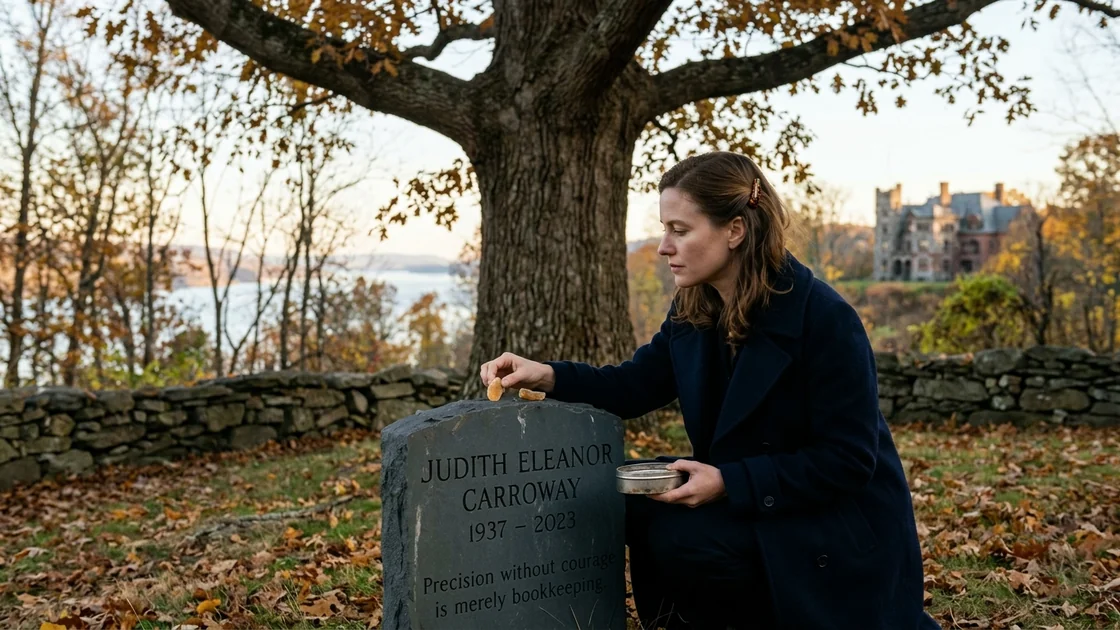
A year after the certified letter had arrived at her cold apartment in Manhattan, Clara Bennett walked down to the small cemetery that sat on a knoll half a mile east of the house, surrounded by a low wall of dry-laid fieldstone.
The Carroway monuments were grandiose: granite obelisks, marble angels with eroded wings, and a neo-classical mausoleum with bronze doors where Alexander Carroway slept beneath three tons of Vermont marble.
Judith had refused the mausoleum. She lay outside, under the shade of a magnificent white oak that was already old when the house was built.
Her headstone was a simple slab of local slate, carved with her name and her dates:
JUDITH ELEANOR CARROWAY 1937 – 2023 Precision without courage is merely bookkeeping.
Clara knelt beside the stone. The autumn leaves were falling, spinning down through the crisp, wine-colored light of October, settling upon the green turf like golden coins.
She took from her pocket a small, oval silver tin, identical to the one that still sat upon the library table. She opened it, took a single piece of candied ginger, and let its clean, hot fury burn across her tongue.
She laid the second piece upon the top of the slate stone, where it caught the low afternoon sun like a droplet of amber.
"We were on time, Judith," Clara whispered to the stone, to the river, and to the vast, indifferent sky. "The train was late, but we were precisely on time."
She stood up, adjusted the collar of her wool coat—navy Melton wool, cut long and straight, that did not bend in the autumn wind—and walked back toward the great stone house that was now, finally, and without apology, her home.