The Long Way West
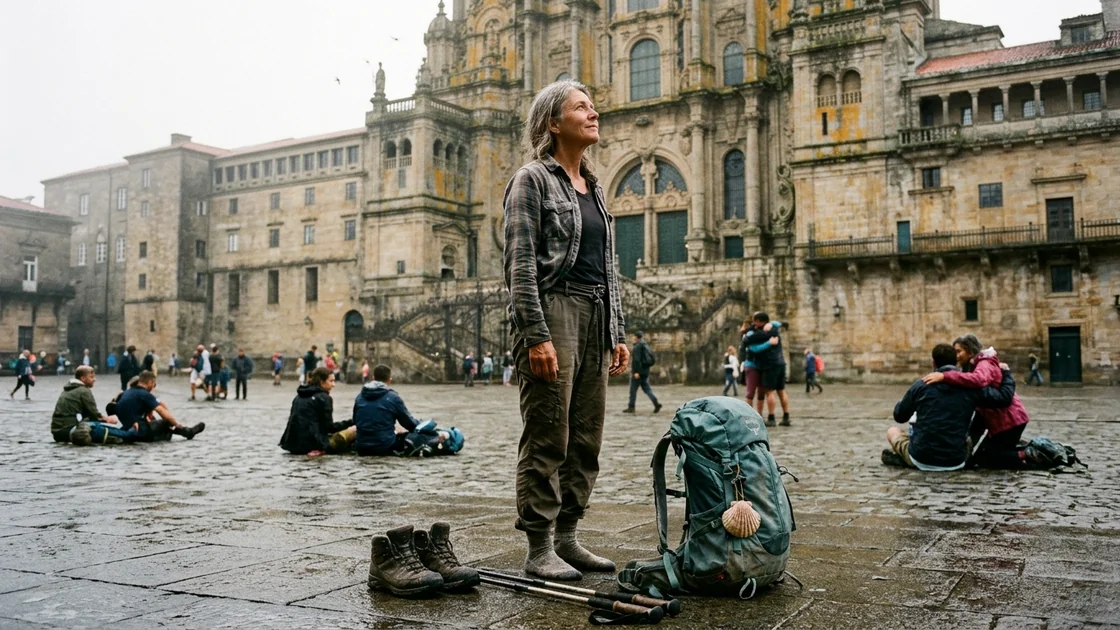
When Eleanor Vance is blindsided by her husband’s request for a trial separation on the evening of their twenty-fifth wedding anniversary, she finds herself stranded in the quiet cavern of an empty suburban nest. Desperate to escape the stifling condolences of friends and the suffocating stillness of her home, she travels to the foothills of the French Pyrenees with a backpack she barely knows how to adjust and sets out to walk the five-hundred-mile Camino de Santiago alone. Across mountain passes, the scorched silence of the high Spanish plains, and the ancient stone paths of Galicia, Eleanor confronts physical exhaustion, blistering pain, and the ghosts of the life she thought she was building. Through unexpected companionships and the austere rhythm of the trail, she embarks on an arduous pilgrimage of self-reclamation, ultimately discovering what remains of a woman when every title she once wore has been stripped away.
Part I: The Silver Year
The restaurant Robert had chosen for their twenty-fifth anniversary was the sort of establishment that insulated its patrons from the coarse realities of the world with heavy linen, triple-paned leaded glass, and three waiters per table who moved with the hushed efficiency of undertakers. It was called Le Marais, situated in a restored mill just north of town, where the dark river slipped beneath an illuminated weeping willow.
Eleanor wore silver. It had seemed clever when she bought it—a slip dress of heavy silk that caught the amber light of the votive candles, paired with a shawl she had draped around her shoulders to conceal the soft, crepe-thin skin at the hollow of her collarbones. Robert had given her silver earrings on their tenth anniversary; she wore those, too. They hung against her neck, cold at first, then warming to the temperature of her blood.
Robert was already seated when she arrived from the school where she had spent her final afternoon finishing the spring inventory for the community arts council. He looked handsome. At fifty-three, his hair had silvered only at the temples, leaving the rest a thick, dignified slate grey. His tailored navy blazer made his shoulders look broad, unburdened.
"You look lovely, Nora," he said, standing to kiss her cheek. His breath smelled of bourbon and clove.
"Twenty-five years," she said, sitting down and smoothing the napkin across her lap. "Chloe called from Chicago at noon. She said to tell you she sent something that requires refrigeration, so we shouldn't open it until Sunday. Sam left a voicemail between shifts at the clinic. He sounded exhausted, poor thing, but he remembered."
Robert smiled, but the smile did not reach his eyes. It was a practiced, lawyerly expression, one Eleanor had seen him use when an associate brought him an inadequate brief.
"They’re good kids," Robert said. "We did well by them."
"We did," she agreed, smiling back. She touched the stem of her water glass. "It feels strange, doesn't it? Our first anniversary without anyone knocking on the bedroom door or burning toast downstairs."
The waiter arrived, bearing a bottle of champagne they hadn't ordered. "Compliments of the house, Mr. and Mrs. Vance. Happy anniversary."
The cork popped with a discreet, velvety thud. Bubbles rose in slender, frantic chains. When the waiter retreated, Robert reached across the table, took Eleanor's hand, and then—almost immediately—let it go to adjust his butter knife.
"Nora," he said softly.
There was a tone in his voice she had heard only twice before: once when his father died in the ICU in Hartford, and once when Chloe, at age seven, had fallen from the backyard maple and snapped her collarbone. It was the tone reserved for structural collapse.
"I’ve leased an apartment on Elm Street," he said.
Eleanor looked down at her champagne. A single bubble broke against the surface. "An apartment? For the firm?"
"No," Robert said. He was looking at her directly, unflinchingly, with the terrible courage of a man who had rehearsed his lines in front of a mirror until all the tremor was gone. "For me. I think we need a trial separation, Nora. Starting next month."
The restaurant continued around them. Four tables over, a woman laughed—a high, silver arpeggio of genuine delight. A waiter shaved truffles over handmade pasta, the dark flakes fluttering down like dead leaves.
"A trial separation," she repeated. Her voice was flat, carrying no more resonance than dry cardboard.
"We haven't been happy, Nora. Not for a long time."
"We were happy yesterday," she said. "We went to the farmers market. You bought the sourdough bread."
"That isn't happiness," Robert said, his voice dropping to a low, patient whisper that made her feel suddenly, violently ill. "That's domestic inertia. The children are gone. Chloe is twenty-four; Sam is twenty-two. For twenty-five years, our marriage has been a project we worked on together, an enterprise of carpools and college funds and yard work. But the enterprise is finished. And when I look across the kitchen table now, I don't see my wife. I see a partner in an LLC that has reached liquidation."
Eleanor felt the air leave her lungs in a long, cold draft. "Is there someone else?"
"No," Robert said, and she believed him. It would have been cleaner, she thought, if there had been some perfume-soaked junior partner, some obvious cliché she could hate with righteous, fiery vulgarity. "It’s not about someone else. It’s about who I am when I am not sitting in that house, waiting to grow old."
"And who am I?" she whispered.
Robert looked down at his silver fork. "I think you need to figure that out, too."
The dinner was served. Eleanor did not touch the duck. Robert ate with measured, polite efficiency, as if consuming braised fowl while ending a quarter-century of mutual life were simply another item on his executive calendar. They split the bill—Robert paid with his corporate card, Eleanor watched—and they drove home in his Audi through the rainy Connecticut dark, the windshield wipers squeaking rhythmically across the glass like a metronome marking down the seconds of a dying era.
For three weeks, Eleanor lived in the Westchester house like a ghost haunting its own estate.
Robert moved out on a drizzly Tuesday while she was at the grocery store. When she returned, his closet was empty, the wooden hangers clattering together in the breeze from the open window he had forgotten to close. He had taken his books—the biographies of Lincoln and Churchill, the leather-bound treatises on tort law—leaving clean rectangles of unfaded wallpaper on the mahogany shelves. He had left the furniture, the silver, the garden tools, and the golden retriever mix, Buster, who died three years ago and whose ashes remained in a small wooden box on the mantelpiece.
Her daughter Chloe called three days later. "Mom, Dad called me. Are you okay? Do you want me to fly home for the weekend?"
"No, darling," Eleanor said, scrubbing a non-existent spot on the quartz countertop. "You have your presentation on Monday. I’m fine. Your father and I just... need some space to think."
"He said you were being very reasonable," Chloe said, her voice laced with the anxious irritation of youth confronted by parental frailty.
Reasonable. The word was an insult. A tombstone.
Her son Sam called from Seattle. He was on his lunch break, the clatter of a hospital cafeteria behind him. "Mom, it’s bullshit. He’s having a midlife crisis. Don't let him push you into selling the house. You love that garden."
"I do love the garden," Eleanor said.
After she hung up, she went into the back yard. The peonies were coming up, reddish-green shoots thrusting through the wet mulch like arthritic knuckles. She stood by the garden wall, her hands buried in the pockets of Robert’s old barn coat, which he had left hanging in the mudroom. It smelled of motor oil, damp canvas, and cedar.
She could not stay in this house. The quiet was not peaceful; it was acoustic poison. Every room possessed an echo that mocked her. Here was the landing where she had sat up all night when Sam had croup; here was the dining table where they had hosted sixteen Thanksgivings in a row, Eleanor rising every six minutes to check the gravy or clear a plate, never once sitting long enough to eat her turkey while it was warm.
She went upstairs to the guest bedroom, which had once been Robert’s study before he moved his work entirely to the firm. On the bottom shelf of the bookcase, wedged between a 1998 atlas and a book on New England stonewalls, she found a book with a bright yellow cover: A Pilgrim's Guide to the Camino de Santiago by John Brierley.
She pulled it out. The spine cracked. Inside, written in blue ballpoint ink on the title page, were the words: Someday. With Nora. 1999.
They had bought it in an independent bookshop in SoHo when the children were small and the idea of walking across Spain was a romantic abstraction, a fantasy whispered in bed after an exhaustingly happy vacation day. Robert had read the introduction out loud to her while she nursed Sam, painting pictures of Roman bridges, field poppies, and cold Spanish wine.
Someday, the ink said.
Eleanor closed the book. She walked downstairs to the kitchen, opened her laptop, and booked a one-way flight to Paris, a connecting train to Bayonne, and a local link to Saint-Jean-Pied-de-Port. She did not consult Robert. She did not call her sister in Bethesda. She went online to an outdoor outfitter and ordered a thirty-four-liter backpack, two pairs of quick-dry hiking trousers, four pairs of merino wool socks, and a pair of mid-weight hiking boots one size larger than her normal shoe size, as the internet forums advised.
When the boots arrived three days later, she laced them up, put on Robert’s canvas barn coat, and walked six miles through the manicured lanes of her suburban neighborhood. The neighbors’ sprinklers hissed across the lawns. A Labrador barked from behind an electric fence. Mrs. Gable, pruning her hydrangeas, waved with an arched, curious eyebrow.
Eleanor did not wave back. She kept her head down, feeling the stiff soles of the new boots striking the asphalt, hard and foreign and entirely hers.
Part II: The Ascent of Saint-Jean
The train from Bayonne was small, consisting of two orange-and-silver cars that smelled of diesel and damp wool. It rattled through the lush green valleys of the Basque country, past white-washed farmhouses with oxblood timber framing and sheep grazing on slopes so steep they looked as if they might slip and tumble into the Nive River below.
Saint-Jean-Pied-de-Port was crowded with pilgrims, though Eleanor felt entirely separate from them. They were Germans with carbon-fiber trekking poles and quadriceps like braided rope; they were gap-year university students from Melbourne with dreadlocks and tin cups dangling from their packs; they were elderly French couples dressed in matching fluorescent Gore-Tex.
Eleanor felt ridiculous. Her pack, an Osprey Sirrus in muted teal, sat against her spine like an iron stove. She had weighed it at the airport: nine and a half kilos, including two novels she couldn't bear to leave behind, a jar of cold cream, three bottles of ibuprofen, and a small, smooth granite stone she had picked up from the edge of her Connecticut driveway the morning she locked the front door.
She found the Pilgrim Office on the Rue de la Citadelle, halfway up a street paved with cobblestones worn slick by centuries of hooves and boots. The air was cool, smelling of roasting pork and wet slate.
Inside, an elderly French volunteer with silver spectacles perched on the tip of his nose took her passport.
"Name?" he asked in English.
"Eleanor Vance."
"Country?"
"United States."
"Why do you walk, Eleanor? Spiritual, cultural, or physical?"
Eleanor hesitated. Through the open doorway, the narrow medieval street was framed by grey stone archways. Above them, the Pyrenees climbed into the mist, their peaks invisible, smothered in clouds that promised cold rain.
"I don't know," she said honestly.
The volunteer looked up over his spectacles. His eyes were milky around the irises, gentle with the ancient indifference of those who see ten thousand strangers a year parade through their lives.
"That is the best reason," he said softly. He pressed a large wooden stamp onto a fresh, cream-colored accordion card: her Credencial, the pilgrim’s passport. The red ink showed the seal of the Collegiate Church of Roncesvalles. "Take care tomorrow on the Route de Napoléon. The wind in the pass is very cruel. If the clouds come down, you do not follow the grass. You follow only the yellow arrows. Buen Camino, Eleanor."
She spent that night in an albergue on the Rue d'Espagne. It was her first night in a dormitory since her sophomore year at Mount Holyoke. There were sixteen bunk beds jammed into a room with low oak beams and a single, shuttered window. The room hummed with the symphony of communal transit: the crinkle of nylon stuff sacks, the hiss of zippers, the sharp snap of Velcro, and the low murmur of Dutch, Italian, and Spanish.
Eleanor lay on the top bunk, separated from an unknown man’s rhythmic breathing below her by only a thin piece of foam and a disposable paper sheet that rustled every time she swallowed. Her phone sat on her chest.
She unlocked it. There was an email from Robert regarding the lawn service contract. Nora, I told Henderson we’d renew through October. Let me know if you want to alter the hedging schedule.
No mention of where she was. She had sent both children an email three days ago: Taking some time to walk in Spain. I have my phone and will check in when there is Wi-Fi. Love you both immensely. Chloe had responded with four exclamation marks and an article about women traveling alone over fifty. Sam had replied: Badass, Mom. Send pics of the food.
Robert had not replied at all.
She switched off the screen. Through the cracks in the wooden shutters, she heard the church bells of Notre-Dame-du-Bout-du-Pont strike eleven. A donkey brayed somewhere across the valley, a raw, strangled sound that tore through the mountain night like silk ripped from a bolt. She pulled the synthetic sleeping bag up to her chin, curled her toes inside her wool socks, and wept until the paper sheet beneath her cheek dissolved into damp flakes.
At five-thirty in the morning, the dormitory woke without an alarm.
There was no talk, only the heavy, shared business of packing. Pilgrims moved in the yellow beam of headlamps like miners entering a pit. In the communal bathroom, Eleanor brushed her teeth alongside an Austrian woman whose shoulders were covered in freckles and who smiled at her in the mirror, her toothbrush foaming white around her lips.
By six, Eleanor was through the Spanish Gate, walking out into the black country road that ascended toward Huntto.
The climb began immediately. It did not negotiate. The asphalt rose at an angle that forced Eleanor’s head down, her boots biting into the slick surface. Within twenty minutes, the sweat was running down the groove of her spine, soaking the waistband of her trousers. Her lungs, accustomed to the gentle gradients of suburban parks, felt as though they were being raked with dry thorns.
"Step, breath," she muttered to herself. "Step, breath."
Behind her, the valley of Saint-Jean slowly filled with light. It was not the yellow light of dawn, but a pale, pewter wash that revealed the Atlantic fog rolling over the crests from the Bay of Biscay. The beech forests dripped. Cattle with wide, lyre-shaped horns stood in the pastures, their bells clanging with a hollow, brassy resonance that drifted across the ravines.
By noon, the road had given way to an earth track, and the trees had shrunk to stunted, wind-scoured shrubs. The fog caught her near the refuge of Orisson. Within ten minutes, the world shrank to a circle of five paces. The temperature plummeted. The wind, coming unchecked from the northwest, drove droplets of ice-cold mist through her waterproof jacket until the fleece beneath was sodden.
Her shoulders were screaming. The pack, which had felt manageable in the living room, had become an instrument of torture. The load-lifter straps pulled her backward; the hip belt bruised the sharp points of her iliac crest. Every twenty steps, she had to stop, leaning her forehead against the damp cork handle of her hiking poles, her heart hammering against her ribs like a bird trapped in a chimney.
"Need a hand, sister?"
The voice came through the grey murk. A man stepped out of the fog behind her. He was perhaps sixty, with a beard trimmed close to his jawline, silver-white, and a pair of eyes the color of washed slate. He carried an ancient canvas rucksack patched with duct tape, and his boots were battered leather, stained dark with years of trail oil.
"I'm fine," Eleanor gasped, her breath frosting.
"You're not fine," the man said cheerfully in a dry, British accent. "You’re walking like a crab with lumbago. Your pack is sitting on your arse instead of your hips. Unbuckle it."
Eleanor was too tired to be indignant. She stood still while the stranger yanked at the nylon webbing, hauling the heavy base of the bag up onto her pelvis and cinching the thick strap until she had to suck in her stomach. He adjusted the sternum strap across her chest and shortened her trekking poles by two inches.
"Try that," he said.
She took two steps. The weight had not vanished, but the agonizing pull on her trapezoids had abated.
"Thank you," she managed.
"Name's Dirk," he said. "Structural engineer from Sheffield. Retired, or redundant, depending on whether you ask me or my former board of directors. You’re American."
"Eleanor. Connecticut."
"Well, Eleanor from Connecticut, don't stop moving. If you stop here in this pass, the wind will have your core temp down before you can say 'Santiago.' Keep those sticks moving. Look for the red-and-white stripes on the rocks. We've got another four miles to the monastery."
He didn't wait for her, but he didn't outpace her either. He stayed five paces ahead, his battered green jacket a steady, bobbing beacon in the white soup. Eleanor kept her eyes on the scarred heels of his boots. Right, left, plant. Right, left, plant.
Her mind, usually crowded with twenty-five years of domestic logistics—dentist appointments, gutter cleanings, the color of the curtains in the guest bedroom, whether Robert had remembered his statin—emptied until it contained only the next rock, the next slick patch of sheep dung, the next yellow arrow painted on a fence post.
At three in the afternoon, the path peaked at the Col de Lepoeder. For three seconds, the wind tore a hole in the clouds, and Eleanor saw Spain.
It was not the sun-drenched plain of her imagination. It was an oceanic wilderness of dark, slate-roofed beech forests plunging down into the Navarre valley, the mountains rolling away to the south like waves of green iron beneath a violet sky. The sheer scale of it struck her with the force of a blow. It was vast, ancient, and utterly indifferent to Eleanor Vance, her silver dress, and her broken living room.
She stumbled down the steep, knee-shattering descent through the forest of Roncesvalles, her quadriceps trembling uncontrollably. When she finally hit the gravel apron of the massive, grey-stone Augustinian monastery, her boots were caked in white mud, her fingers were swollen into sausages from the altitude and the poles, and her hair was plastered to her temples with dried sweat and salt.
Inside the pilgrim reception, a young volunteer handed her a paper ticket for a bunk.
"First day?" the girl asked gently.
Eleanor nodded. She tried to speak, but her vocal cords seemed rusted shut.
"You survived the Pyrenees," the girl said, pressing the ink stamp into her Credencial with a solid, reassuring thump. "The hardest day is behind you."
Eleanor looked at the fresh purple ink: Real Colegiata de Roncesvalles. She touched the paper. Her fingers were shaking, but as she walked down the long, vaulted stone corridor to find her bunk, she realized with a strange, feral jolt that she had carried herself over a mountain range with nothing but her own two feet and the air in her chest.
Part III: The Clay and the Vine
If the Pyrenees had been a physical assault, the valleys of Navarre were a slow, grinding negotiation.
By day four, Eleanor’s body had entered open rebellion. Her heels were covered in water blisters that burst inside her wool socks, turning them into stiff, crusty bandages. Her shins radiated a dull, throbbing heat that made descending even the gentlest curb in Zubiri feel like stepping into a bear trap.
She fell into the routine that governs all Camino life: the four-thirty rustle of plastic bags; the cold wash in the dim light of communal sinks; the morning application of petroleum jelly to raw skin; the first bitter cup of café con leche in a stone bar smelling of stale tobacco and freshly fried churros.
She began to notice the others, the regular cast of the moving pageant.
There was Dirk, who appeared every afternoon at the same pace, smoking small Dutch cigars outside the albergues. There was Henri, a French chef from Lyon who had gone bankrupt during the pandemic and walked with an enormous wooden walking staff he had cut from a chestnut tree in Burgundy. There was Rosa, a twenty-two-year-old girl from Madrid who cried every evening on the stone steps while talking to someone named Mateo on her phone, her small shoulders shaking beneath an oversized fleece.
Outside Pamplona, where the path climbed toward the Alto del Perdón, Eleanor caught up with Henri. He was sitting on a low limestone wall, examining a blister on his big toe with the critical eye of a butcher inspecting a cut of veal.
"Madam Eleanor," he called out, waving a small sewing needle threaded with blue cotton. "You have the look of a woman whose feet are planning an insurrection."
"My feet have already overthrown the government," Eleanor said, sinking onto the wall beside him. Her knees cracked like dry kindling.
"It is the price," Henri said, calmly pushing the needle through the blister, leaving the thread behind to drain the fluid, an ancient trail trick he performed with theatrical precision. "In France, I had eighty covers a night and three sous-chefs who stole my butter. Here, I have only my two feet and six kilos of bad decisions in my rucksack. It is simpler, no?"
"Did you leave someone behind?" Eleanor asked before she could stop herself.
Henri pulled his sock back on. His face, weathered and creased like an old saddle, softened into a wry, Gallic grin. "My wife, she left me when the second restaurant failed. She said she could endure a poor man, or an angry man, but she could not endure a man who had become a ghost in his own kitchen. And she was right. I was already dead. I am walking to see if my soul wants to catch up with my body."
He stood, offered her a hand, and pulled her to her feet with surprising strength. "Come. Let us go see where the wind crosses the stars."
At the summit of the Alto del Perdón, a series of life-sized sheet-metal silhouettes marched across the crest of the ridge: pilgrims from different centuries—some on horses, some with walking staffs, some with dogs—all cut from rust-colored iron, facing west toward the Atlantic. Overhead, the giant white blades of modern wind turbines whooshed through the low clouds with a rhythmic, oceanic sigh.
On the base of the monument, an inscription was carved into the stone: Donde se cruza el camino del viento con el de las estrellas. (Where the path of the wind crosses that of the stars.)
Eleanor stood beside the iron figures. The wind here was violent, tearing at her hair, whipping her jacket against her ribs. Below her, the valley of Navarre dropped away toward the vineyards of La Rioja, a vast mosaic of green wheat fields, red clay terraces, and distant, dusty villages clustered around yellow church towers like chicks around a hen.
She pulled her phone from her pocket. She had service for the first time in two days.
There was a text from Robert: Received the insurance settlement for the storm damage to the garage roof. Deposited your half into your personal checking account. I hope your travels are productive.
Your half.
They had held a single, joint bank account for twenty-four years. She remembered the day they opened it, sitting across from a bank manager in an office that smelled of commercial carpet, Robert laughing as they ordered checks printed with Robert Vance and Eleanor Vance in an elegant, italic script.
She looked out over the vast, red-earthed basin of Spain. The wind was so loud it obliterated the sound of her own breath. She did not feel angry; she felt a vast, terrifying emptiness, as if someone had taken an eraser and gently, systematically rubbed out the lines that defined her edges.
She tapped out a reply: Thank you. Please have the gutters cleaned before the heavy rains start.
Then she turned off the phone, dropped it into the bottom of her pack beneath her damp towel, and walked down the rocky, treacherous scree toward Puente la Reina.
In Estella, she bought a pocketknife—a simple Spanish folding knife with an olivewood handle—and a block of hard sheep's cheese from an old woman in a market square. In Los Arcos, she drank wine from the free pilgrim fountain at the Bodegas Irache, the sour red vintage splashing over her fingers and staining her sleeve like dried blood.
Her body was changing. The sharp, inflammatory agony of the first week was dulling into a deep, muscular throb. The swelling in her ankles had subsided; the skin of her heels had hardened into pale, fibrous armor. She had lost five pounds—her hiking trousers now required the belt to be pulled to the second notch—and her face, reflected in the small, cracked mirrors of church restrooms, was acquiring a dark, wind-burned bronze that seemed foreign to her.
She had forgotten about her silver dress. She had forgotten about the lawn service.
Her world had narrowed to the physical laws of the trail: One liter of water equals one kilogram. Don't walk past a fountain without drinking. Never trust a flat rock in a river crossing. If your heel begins to burn, stop immediately; five minutes of prevention is worth three days of limping.
On the eighth day, outside Logroño, she met Dirk at a dusty rest area shaded by olive trees. He was sitting on a wooden bench, peeling an orange with his thumb.
"Sit, Vance," he commanded.
She sat. He handed her three sections of orange. The juice was shockingly cold and sweet against her parched tongue.
"You're walking too fast," he said.
"I’m trying to keep up with the stages in the guidebook," she said defensively.
"Brierley is a mystic who walks four miles an hour and sleeps in fields," Dirk said with a snort. "This isn't a commute, Eleanor. You’re not trying to beat the traffic on the M25. Why are you rushing?"
"I don't know what else to do," she said, looking down at her dust-caked boots. "If I stop, I think."
"Ah," Dirk said. He popped an orange slice into his mouth and chewed slowly. "The thinking. Deadly business. What are we thinking about? The fellow who let you go?"
Eleanor stiffened. "I didn't tell you about him."
"You didn't have to," Dirk said mildly. "You carry yourself like a woman who’s been dropped from a great height and is checking her limbs to see which ones are still working. I recognize the posture. My wife left me for an osteopath six years ago. Took the Labrador, the Volvo, and the garden shed."
"Did it get better?" she asked, her voice cracking slightly.
Dirk looked up through the twisted, silver-green branches of the olive trees toward the bleached blue sky. "No," he said. "Not really. You just get used to the room being larger. And then, after a while, you realize you can arrange the furniture however you bloody well please."
Part IV: The Great Emptiness
They reached Burgos on the fourteenth day.
The city rose like a Gothic mirage out of the dry northern plateau. The cathedral spires, pierced with limestone lace, seemed to pierce the sky like frozen lightning. Eleanor spent three hours inside the gloom of the nave, sitting before the golden retablo, listening to the murmurs of Spanish tourists and the clink of coins in the candle racks.
For the first time since she left Connecticut, she did not pray for her children, nor did she pray for Robert to come to his senses. She did not know what to pray for. She simply sat, allowing the cold stone of the pillar behind her to press through her flannel shirt, anchoring her to five hundred years of human grief and human endurance.
Beyond Burgos lay the Meseta.
Every guidebook, every blog, every veteran pilgrim Eleanor had met spoke of the Meseta with a mixture of reverence and dread. It was the high tableland of central Castile—two hundred kilometers of flat, treeless, cereal plains sitting at three thousand feet above sea level, stretching between Burgos and León. In June, it was an oven; in November, an Arctic tundra. In May, it was an endless sea of green and yellow wheat rolling under an immense, domed sky that seemed to crush the traveler with its sheer geometric indifference.
Many pilgrims skipped it. They boarded air-conditioned buses in Burgos and woke up two hours later in León, having bypassed the psychological trial of the plains.
Eleanor did not take the bus.
She left Burgos at five in the morning, her boots striking the asphalt through the industrial outskirts, past warehouses and logistics hubs, until the factories ended abruptly and the dirt path plunged into the wheat.
The silence of the Meseta was not the silence of an empty house. It was an active, ringing silence, vast as the ocean. There were no trees to rustle, no streams to chuckle over stone. There was only the wind moving through billions of stalks of wheat, a soft, dry shhh-shhh-shhh that sounded like the earth breathing in its sleep.
The path ran straight as an arrow across the landscape, disappearing over low, subtle swells in the earth that took two hours to climb and two hours to descend. There was no shade. The sun rose at Eleanor's back, huge and orange, and by ten o'clock it was a blinding, white eye directly overhead, burning away the shadows until Eleanor’s only companion was a small, dark pool of grey that huddled beneath her boots.
In this landscape, time ceased to function.
She walked for five hours without seeing a village. The path stretched ahead, an ochre line bisecting the green wheat, static as a painting. She felt as though she were on a treadmill; she walked and walked, yet the horizon remained precisely the same distance away.
The Meseta became a screen upon which her memory projected twenty-five years of domestic cinema.
She remembered the small things. The things that had no place in legal briefs or divorce negotiations.
She remembered Robert in 2004, kneeling on the kitchen floor with a towel, trying to catch a bat that had flown down the chimney, laughing so hard he could barely hold the broom.
She remembered the summer Sam had mononucleosis, Robert sitting by his bed reading The Hobbit out loud, his voice dropping into a guttural rumble for Gollum, night after night, until his throat was raw.
She remembered the evening—it was three years ago, perhaps four—when she had come downstairs at midnight and found Robert standing in the dark dining room, looking out the French doors at the empty driveway. She had asked him what was wrong, and he had said, Nothing, Nora. Just looking. But his face had been pale, his eyes wide with a strange, feral panic that she had dismissed as fatigue.
He was already leaving then, she thought, her boots thudding rhythmically against the dry clay. He was already standing on the shore, watching the boat pull away, and I was in the kitchen worrying about whether we needed more laundry detergent.
A tear slipped down her cheek, instantly dried by the desert wind, leaving a tiny streak of salt.
The anger came then. Not the sharp, petulant irritation of an argument, but a deep, subterranean rage that had been buried beneath twenty-five years of pleasant compromises.
She had given up her position at the gallery when Robert was made junior partner, because someone had to be home when the plumber came, someone had to drive Chloe to cello lessons, someone had to manage the contractors when the septic tank failed. She had spent two decades being the grease that allowed the machinery of Robert’s life to run without friction. She had curated his social calendar; she had bought his mother’s birthday gifts and signed his name to the cards; she had smoothed over his coldness with the children, translating his emotional distance as "stress from the firm."
"You coward," she said out loud to the wheat.
The sound of her own voice startled a lark from the furrow. The bird burst into the sky, singing a brief, crystalline burst of melody before vanishing into the blue.
"You goddamned coward," she shouted, louder this time.
The wind took the words and scattered them across three hundred square miles of barley. There was no echo. The Meseta did not care. It absorbed her rage as easily as it absorbed the rain and the sheep bones.
She walked twenty-two miles that day. When she reached the tiny village of Hontanas—a cluster of stone dwellings hidden in a fold of the plateau so completely that one did not see it until one was literally looking down onto its church roof—she did not speak to anyone.
She checked into an albergue run by an Italian brotherhood. She declined dinner. She climbed into her lower bunk, turned her face to the bare stone wall, and slept for eleven hours without shifting her weight.
Part V: The Crucible of the Plains
Two days later, on the long stretch between Castrojeriz and Frómista, the heat reached thirty-five degrees Celsius.
Eleanor was walking alone. Dirk had fallen behind to nurse a swollen Achilles tendon; Henri had stayed an extra day in Carrion de los Condes to bake bread with a parish priest who had once been a missionary in Gabon.
The trail was an unyielding ribbon of white limestone gravel that reflected the sun back into her eyes like a mirror. Her water bladder had run dry two miles back, and her throat felt as though it were lined with sand. Her left foot had developed a deep, bone-bruise sensation beneath the metatarsal that sent a jolt of fire up her calf with every third stride.
She came upon a wooden cross planted at the edge of a track that led to an abandoned Romanesque church: the ruins of the Convent of San Antón.
The trail passed directly through the center of the ruined church, passing beneath two massive, soaring stone arches that spanned the road like the ribcage of an ancient whale. The roof had fallen centuries ago, but the thick walls still threw a deep, cool shadow across the dirt track.
Eleanor staggered into the shadow and collapsed onto a stone bench built into the foundation.
She leaned her head back against the cold limestone. Her vision was speckled with dark spots; the sound of her own pulse was a wet, heavy thrum in her ears.
"Can't," she whispered.
The word was small, pathetic. It hung in the cool air between the Gothic arches.
I am fifty-one years old, she thought. I am a mother whose children are gone. I am a wife whose husband does not want her. I am sitting in the dirt in northern Spain with three blisters on my heel and a bruised bone, five thousand miles from anyone who knows my middle name. What am I doing here?
She reached into her pocket and pulled out the stone she had carried from Connecticut.
It was an ordinary piece of granite, grey with flecks of pink feldspar and black mica, smoothed round by thousands of years of glacial drift. She had picked it up from the garden border where she had planted Robert's favorite hydrangeas. It felt heavy—ridiculously, absurdly heavy. It weighed less than four ounces, but in her hand it felt like an anchor forged from lead and old regrets.
She had carried it over the Pyrenees; she had carried it through the mud of Navarre; she had carried it across the wine fields of La Rioja.
"Why am I carrying you?" she said to the stone.
"Because you think you deserve the weight," a voice said.
Eleanor started, nearly dropping the stone.
Sitting twenty feet away, in the deeper recess of the portal where the old monastery door had once hung, was a woman she hadn't noticed. She was Spanish, perhaps seventy years old, dressed in a faded black dress with an apron tied around her waist. She was shelling dried beans into an earthenware bowl, her brown, arthritic fingers moving with the mechanical grace of a loom.
"Pardon?" Eleanor said in broken Spanish. "No entiendo."
The old woman didn't stop shelling. She spoke slowly, in the heavy, rhythmic Castilian of the plains.
"The stone," the woman said, pointing a curved finger at Eleanor's hand. "Todo el mundo lleva una piedra. Algunos llevan una montaña. Everyone carries a stone. Some carry a mountain. But the Camino is not for carrying, señora. The Camino is for throwing away."
Eleanor looked down at the granite.
"My husband," she said in English, not caring whether the woman understood. "He doesn't want me anymore."
The woman looked up from her beans. Her eyes were dark, wet, and ancient, set deep in a network of wrinkles that looked like the cracked earth of the Meseta in August. She did not offer sympathy. She did not offer a homily. She merely nodded once, a brief, sharp dip of the chin that acknowledged the fact of pain the way one acknowledges the fact of winter.
"El amor pasa," the old woman said softly. "La tierra se queda."
Love passes. The earth remains.
She picked up another pod, cracked it with her thumbnail, and let the dried, white beans drop into the bowl with a sharp clack-clack-clack.
Eleanor sat in the shadow of the arches for another hour. She drank half a cup of water from a small copper tap the old woman pointed to behind the altar. She did not throw the stone away—not yet. She placed it back in her pocket, but she moved it from the deep, hidden interior of her pack to the hip-belt pocket, where she could touch it with her thumb as she walked.
When she stepped out from beneath the arches of San Antón back into the blinding Castilian light, the heat had not diminished, and her foot still burned. But something had shifted in her center of gravity. Her shoulders had relaxed. She was no longer fighting the trail; she was simply allowing the trail to wear away the unnecessary parts of her, one mile at a time.
Part VI: The Iron Cross
By the time she reached Astorga, three weeks after leaving Saint-Jean, the landscape had begun to break again.
The flat golden sea of the Meseta dissolved into red-earthed hills covered in scrub oak and wild thyme. In the distance, rising like a wall of blue slate against the western sky, were the Montes de León—the final mountain barrier separating the arid interior of Spain from the wet, Celtic green of Galicia.
The trail began to climb toward the village of Foncebadón, an ancient ghost town perched at five thousand feet.
The climb was different from the Pyrenees. Eleanor was no longer the soft, frightened woman who had gasped for breath on the road to Huntto. Her legs were sinewy now, the calves carved into hard, functional relief. Her lungs took the thin, cold mountain air and used it without panic. She walked with a steady, rhythmic stride that had the mechanical persistence of an engine.
Foncebadón was a ruin of black slate houses, their roofs collapsed, their yards overgrown with nettles. The wind whistled through the empty window frames with a lonely, piping sound. The only signs of life were two pilgrim hostels and a pack of semi-feral dogs that lay in the dust, watching the travelers with sleepy indifference.
Eleanor did not stop in the village. She pressed on, another mile up the gravel ridge through low heather and dwarf juniper, until she saw it: the Cruz de Ferro.
It was not an imposing monument. It was simply a slender wooden trunk, weathered grey by centuries of mountain storms, about thirty feet high. At the top sat an unassuming iron cross, no larger than a dinner plate, silhouetted against the scudding grey clouds.
Around the base of the pole was a mound.
It was a mound of stones, thirty feet wide and twelve feet high—hundreds of thousands of stones, brought by pilgrims from every corner of the earth over more than a thousand years. There were river rocks from Ireland, red pebbles from Australia, jagged pieces of marble from Greece, bits of brick from destroyed homes in Ukraine, and slate from Welsh quarries.
Each stone represented a burden, a grief, an apology, or a person left behind.
Eleanor stood at the base of the mound. The wind here was freezing, smelling of pine needles and snow from the distant peaks of the Teleno range.
She was alone. For ten minutes, no other pilgrim appeared on the path.
She reached into her pocket and pulled out the piece of Connecticut granite.
She had carried it for four hundred and twenty miles. Her skin had warmed it; the sweat of her palm had seeped into its microscopic pores.
She looked at it. She thought of Robert sitting in his Elm Street apartment, eating takeout sushi from a plastic container, reading his law journals in the clean, silent space he had bought for himself. She realized, with a sudden, piercing clarity that nearly knocked her to her knees, that Robert was not a monster. He was simply a man who was terrified of dying, and who had looked at her and seen his own mortality reflected in her eyes.
He had not wanted to hurt her; he had simply wanted to escape the inevitable decay of their shared youth. And in doing so, he had cast her out into the world.
She felt a strange, absurd surge of gratitude.
If he had been kind, if he had been slightly more patient, if he had stayed out of duty or pity, she would still be in Westchester, checking the hedging schedule, dusting the silver frames containing photographs of children who no longer lived there, slowly, politely suffocating behind double-glazed windows.
"I release you, Robert," she said.
Her voice was barely a whisper, but it sounded clear and steady in the mountain air.
"I release you from twenty-five years of being my horizon. And I release myself from being your archive."
She stepped onto the mound of stones. The rocks shifted beneath her boots with a dry, clattering crunch. She climbed six paces up the slope until she reached the base of the wooden pole.
She laid the granite stone down on a small ledge between an oyster shell from Brittany and a photograph of a young man in an army uniform, laminated in plastic and faded by the sun.
She took her hand away.
She did not feel a sudden rush of angelic music. She did not feel an ecstatic burst of light.
She simply felt five ounces lighter.
She turned and walked down the mound, picked up her trekking poles from the gravel, and began the long, rocky descent into the valley of El Bierzo.
Part VII: The Celtic Green
Galicia greeted them with rain.
It was not the dramatic, theatrical thunder of Connecticut summers, but a soft, persistent, ancient mist that the locals called orballo. It settled on Eleanor’s eyelashes, on the wool of her gloves, on the bracken ferns that lined the sunken stone paths (corredoiras).
The world had turned emerald. The red dust of Castile was gone, replaced by ancient forests of oak, chestnut, and towering eucalyptus trees whose leaves filled the wet air with a sharp, medicinal sweetness. The villages here were made of dark, moss-encrusted granite, with raised stone granaries—hórreos—standing on pillars like small temples to maize.
The trail was crowded now. At Sarria, the final town where one could begin walking and still receive the Compostela certificate, hundreds of new pilgrims had joined the path: Spanish school groups with matching yellow hats, church groups singing hymns, tourists carrying daypacks while their luggage was transported ahead in vans.
A month ago, Eleanor would have felt annoyed by their noise, their clean boots, their unblistered gaiety.
Now, she felt only an amused, maternal affection. They were on their own journey, however short. She walked among them like a veteran soldier returning from a distant front: her clothes were faded by the sun, her boots were scuffed to the grey under-leather, and her pace was the unhurried, rhythmic lope of someone who had learned that the destination is an illusion designed to get you out the door.
Near Portomarín, she was reunited with Dirk and Henri.
They found each other at an outdoor table beneath the stone arcades of the town square, drinking Galician Ribeiro wine from small white ceramic bowls and eating pulpo á feira—octopus boiled in copper cauldrons, sliced with scissors, and dusted with coarse sea salt and smoked paprika.
"Look at her," Dirk said, holding his bowl aloft. "She’s turned into an Iberian insurgent. Where is the nervous woman from Connecticut who wouldn't touch the albergue blankets?"
"She died somewhere between Hontanas and Boadilla," Eleanor said, laughing. She took a piece of octopus with a wooden toothpick. It was tender, rich with oil and smoke. "The coroner’s report concluded death by wheat."
"You look ten years younger, Nora," Henri said, leaning across the table with genuine tenderness. His face, too, had changed; the bitterness that had pinched the corners of his mouth had smoothed out, replaced by the easy humor of a man who had rediscovered his appetite. "Your eyes are clear. In Saint-Jean, your eyes were like windows in an abandoned house. Now, there is a fire inside."
"There is," she acknowledged.
They walked the final three days together, a strange, mismatched triumvirate: the English engineer with his duct-taped pack, the French chef with his wooden staff, and the American mother with her silver-streaked hair blowing free in the Galician rain.
They walked through the eucalyptus groves of Palas de Rei; they shared a loaf of dense rye bread outside the church in Melide; they climbed the gentle, green rise of Monte do Gozo on the thirty-second morning.
From the top of Monte do Gozo—the Mount of Joy—Eleanor stopped.
Three miles to the west, through a break in the rolling green hills, the twin Baroque towers of the Cathedral of Santiago de Compostela rose above the grey stone roofs of the city, sharp and grey against a sky the color of wet slate.
Dirk stood beside her. He reached out and took her hand. His skin was rough as sandpaper, calloused from his walking sticks.
"Well, Vance," he said quietly. "There she is."
Eleanor looked at the spires. She did not cry. Her eyes were dry, clear, and steady.
"Yes," she said. "There she is."
Part VIII: The Square of Gold
They walked into the city at noon through the Porta do Camiño.
The streets of the old quarter were narrow, paved with massive granite slabs that shone like dark mirrors in the intermittent rain. Bagpipes were playing. A Galician busker stood in the dark archway beneath the Bishop's Palace, the drone and chanter of the gaita echoing off the stone walls like a battle hymn from the thirteenth century.
Eleanor walked through the archway of the Arco del Palacio and stepped into the Praza do Obradoiro.
The square was vast, bordered by the ancient hospital of the Catholic Monarchs, the neoclassical town hall, and the soaring, monumental facade of the cathedral. Hundreds of pilgrims were already there. They lay on their backs on the wet granite stones, their packs beneath their heads, staring up at the towers where swallows darted between the Baroque carvings of Saint James. Some were weeping; some were laughing; some were kissing; some were simply sitting in silence, staring at their boots as if unable to believe they had carried them here.
Dirk let go of his rucksack. It hit the stones with a heavy, wet thud. He threw his arms around Henri, kissing the chef on both cheeks in the French fashion, both men laughing like boys who had broken out of school.
Then Dirk turned to Eleanor. He didn't say anything. He simply pulled her into a long, crushing bear hug. He smelled of rain, tobacco, and the ancient, damp wool of his sweater.
"Good girl," he whispered in her ear. "You made it home."
Eleanor took off her pack. She did not drop it. She laid it down carefully on the stones of the square, took off her boots—her poor, faithful, scarred boots—and stood in her wool socks on the cold, wet granite.
The stone was cold against her soles, an honest, clean chill that traveled up her shins and settled into her marrow.
She looked up at the facade of Saint James. The stone was covered in yellow and orange lichen, glowing with a soft, internal warmth even under the grey sky. For eight hundred years, women had stood on this exact square of stone. Widows, mothers, queens, beggars, nuns, and runaway wives. They had carried their dead, their sins, their griefs, and their broken promises across Europe, and they had laid them down on these stones.
The cathedral did not belong to the Church; it belonged to the feet that had walked to it.
Later, she stood in the nave during the Pilgrim's Mass.
The air was dense with the smell of wet wool, candle wax, and five hundred miles of human effort. High above the altar, eight men dressed in crimson robes—the tiraboleiros—began to pull on a thick, hemp rope that extended from the ceiling.
The Botafumeiro, a silver thurible the size of a man’s torso, rose slowly from its stand.
The men pulled with coordinated, rhythmic lunges, their bodies rising and falling like rowers in a galley. The thurible gained momentum. It began to swing through the transept, an enormous pendulum of silver and charcoal, rising higher and higher with every sweep until it was grazing the vaulted ceiling fifty feet above, traveling at forty miles an hour, trailing a vast, white plume of incense through the gloom.
The smell of frankincense rolled over the congregation in waves—sharp, resinous, clean, and ancient.
Eleanor looked up as the great silver vessel swung directly over her head, its silver skin reflecting the light of a thousand candles.
I am not broken, she thought as the wind of the thurible touched her forehead. I was only emptied so that I could be filled with this.
Part IX: The Edge of the World
Three days later, Eleanor sat on the black granite cliffs of Cape Finisterre—the place the Romans called Finis Terrae, the End of the Earth.
She had taken a local bus to the coast, leaving Dirk and Henri in Santiago celebrating their certificates with three-hour lunches and copious amounts of Galician cider. She had needed to see the ocean.
She sat on a flat rock sixty feet above the Atlantic. The sea was vast, wild, and dark indigo, the swell rolling in from the west to break against the cliffs with a low, cannon-like roar that shook the stone beneath her thighs.
The wind was clean. It tasted of pure salt, without the scent of wheat, or sheep, or damp earth.
Beside her, on the rock, was a clean pad of blue writing paper she had bought at a stationer's in the town of Cisterne. Her phone sat next to it, fully charged.
She looked at the screen.
There was a message from Sam: Chloe showed me the photo you sent from the square. You look incredible, Mom. Like an explorer. Love you.
There was a message from Chloe: Mom, Dad wants to know when your flight gets into JFK. He said he can pick you up.
There was a message from Robert, sent four hours ago: Nora. I hope you are well. I’ve been thinking about what you said before you left. Perhaps we were too hasty. The apartment on Elm Street is... quiet. If you want to talk when you return, I’m open to discussing counseling. Henderson took care of the roof. Let me know your flight details.
Eleanor read the words three times.
A month ago, those words would have been a life raft thrown to a drowning woman. She would have caught them with both hands, weeping with gratitude, and allowed herself to be hauled back aboard the ship of her old life, bruised and apologetic, willing to spend the next twenty years pretending she was content with the crumbs of Robert's comfortable indifference.
She felt no anger toward him now. She felt only a gentle, profound sadness for the man who was sitting in his quiet loft on Elm Street, terrified of his own silence, looking for his archivist to come home and resume her duties.
She picked up the pen.
She did not write about counseling. She did not write about the garage roof.
She wrote:
Dear Robert,
The Atlantic is very blue here. In the afternoons, the fog sits on the water like wool until the sun burns it off.
I am not coming back to Westchester next week. I’ve rented a small room in a guesthouse in Santiago for the month of June. A friend of mine—a chef from Lyon named Henri—is opening a small kitchen near the market, and I’m going to help him organize the pantry and the dining room.
Sell the house, Robert. Hire the real estate agent with the red hair who did the Gables' place; she’s very efficient. Take your half, put my half in the checking account, and buy yourself the boat you’ve been looking at since you were forty.
You were right on our anniversary. The enterprise is finished. But it wasn't a liquidation, Robert. It was a completion. We built two wonderful children, and we kept each other company for twenty-five years, and that is not a failure. It is simply done.
I’m not angry with you. I hope you find whatever it is you are looking for in the quiet rooms of your life. I am going to see what I can find in the noisy ones.
With my genuine affection, Eleanor
She folded the paper once and slipped it into an envelope. She did not lick the flap; she simply weighted it down with a piece of dark sea glass she had picked up from the beach below.
She stood up.
Her legs were strong. Her shoulders were set. The silver hair at her temples caught the afternoon sun, shining like fine, bright wire against her tanned skin.
She turned her back to the ocean and looked east, toward the mountains she had crossed, toward the long, yellow path that stretched five hundred miles back into the heart of the old world. Then she picked up her pack, swung it easily onto her shoulders, cinched the hip belt with a single, practiced tug, and began walking down the hill toward the town, her boots striking the ancient stone with a clear, steady, unhurried beat.