The Light of the Forgotten Rose
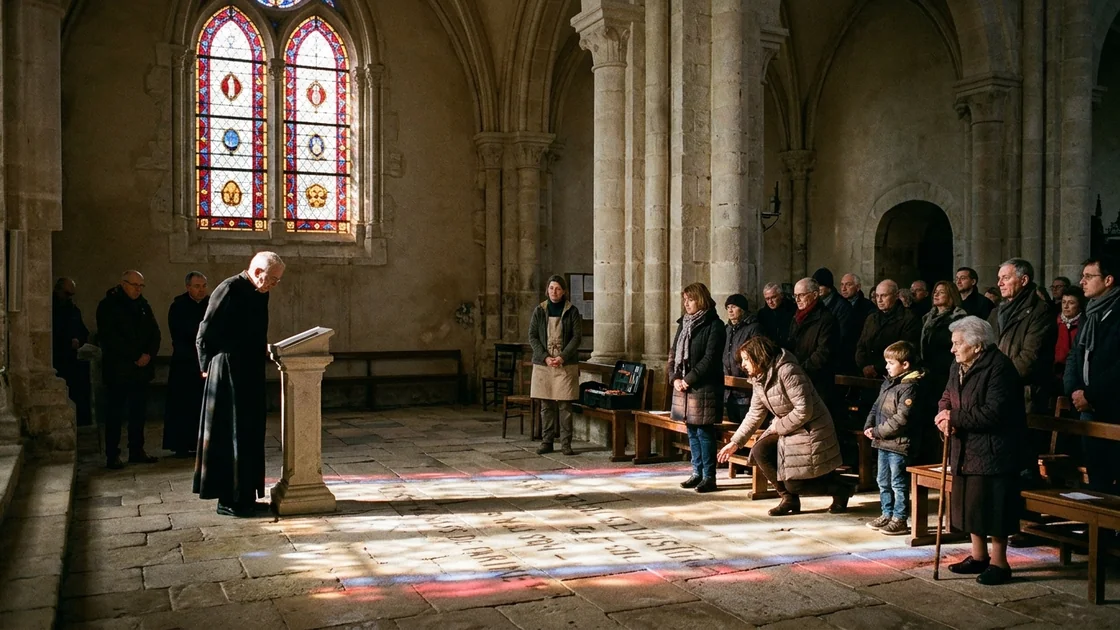
When a violent autumn squall shatters the south transept window of an eleventh-century church in the remote Sarthe village of Saint-Loup, master stained-glass restorer Laurence Vidal is called from Paris to salvage what remains of the historic lancets. Working alone in the cold stone nave amidst centuries of dust and lead shavings, Laurence discovers that the window is not merely a reconstruction of medieval iconography, but an intricate, multilayered palimpsest installed shortly after the Liberation. As she cleans soot and corrosion from the hand-blown antique glass, Laurence identifies deliberate anomalies in the lead came, anomalous acid-etchings on the flashed ruby draperies, and botanical symbols that deviate from traditional Christian martyrdom. Assisted by an elderly local archivist and the daughter of a vanished village baker, Laurence decodes a clandestine visual cipher revealing the identities, safe houses, and perilous courier routes of six local women who sustained the regional Resistance network known as the Circuit des Alouettes. The restoration transforms from a solitary technical repair into a race against the winter damp to resurrect the forgotten sacrifices of women whose names were deliberately omitted from the parish war memorial, culminating in an unveiling that forever alters the village memory.
Chapter I: The Shattered Saint
The call had reached Laurence Vidal’s studio in the rue des Cascades on a Tuesday morning in late October, when the rain in Paris tasted of coal smoke and diesel exhaust. The voice on the crackling line belonged to Abbé Chenier, the parish priest of Saint-Loup-sur-Sarthe, an agricultural commune tucked into the limestone folds where Normandy gives way to the river plains of the Maine.
Two nights earlier, a freak squall—the tail of an Atlantic depression that had uprooted poplars along the riverbanks—had driven the branch of an ancient walnut tree straight through the south transept lancet of the Église Saint-Loup. The aperture was dedicated to Saint Radegund, the sixth-century Thuringian princess turned monastic foundress who had fled an abusive Frankish king to establish the Abbey of the Holy Cross.
"It is not thirteenth-century glass, Madame Vidal," the Abbé had explained with the hurried precision of a man accustomed to having his requests dismissed by the regional heritage directorate in Le Mans. "The nave lost its medieval panels during the Huguenot raids in 1562, and whatever remained was pulverized in August 1944 when the retreating Wehrmacht shelled the crossroads. But the panel in the south transept was remade just after the war. It was consecrated in the autumn of 1948. And now... there is an opening the size of a hay wagon in the wall. The rain is blowing across the flagstones, soaking the choir stalls, and the pigeons have already begun to nest in the vaulting."
Laurence had packed her Peugeot van before the noon siren sounded: three rolls of archival foam, two dozen shallow wooden collection trays cushioned with clean rag-felt, a grozing iron, horsehair dusting brushes, glass-cutting oil, heavy cotton tape, a diamond-tipped scribe, and her father’s brass-bound lath rule, its boxwood blackened by sixty years of linseed oil and tallow.
Saint-Loup-sur-Sarthe proved to be a town built of cold, grey-yellow Jurassic limestone, clustered around a single wide lane that petered out into rye-grass fields and apple orchards. The church sat upon a low knoll above the Sarthe, surrounded by a sodden churchyard where rusted wrought-iron crosses leaned among wild nettles.
Inside, the smell was immediate and unmistakable: the damp chill of subterranean cellars, the alkaline tang of rotting plaster, and the sharp, mineral smell of broken glass.
Laurence dropped her tool kit onto an oak bench. The floor of the south transept was a field of caltrops. Fragments of flashed ruby, cobalt pot-metal, pot-metal amber, and silver-stained clear glass lay scattered across the wet paving stones like the spilled contents of an apothecary’s chest. The walnut bough, thick as a bull’s thigh and still bearing clusters of bitter green husks, lay across the stone altar of Saint Joseph, cradling in its splintered crook the severed head of a haloed queen.
"A disaster," Abbé Chenier murmured, emerging from behind the sacristy screen. He was seventy at least, wrapped in a threadbare cassock covered by a quilted nylon vest, his knuckles swollen from arthritis. "The commission told me it might take three years to get a surveyor out from Angers. By then, the frost will have gotten into the mortar joints of the lancet surround, and the whole stone arch will shift."
Laurence knelt, pulled off her goatskin gloves, and picked up a piece of the queen’s mantle. It was a fragment of flashed ruby glass—clear glass coated while molten with a paper-thin skin of intense copper-red. The surface was not smooth like modern machine-drawn float glass; it possessed the undulating, pocked texture of cylinder glass blown by mouth, full of elongated air bells and striations that caught the weak autumn light and bent it into liquid movement.
"The commission is wrong about one thing," Laurence said softly, holding the shard between thumb and forefinger against the daylight entering through the gash in the stone. "This isn't ordinary post-war reconstruction glass. In 1948, the studios in Chartres and Le Mans were using mass-produced Saint-Gobain sheet glass or salvaged domestic stock because the furnaces were short of potash and soda. But this... this is mouth-blown antique glass from the Saint-Just glassworks. The red was dipped twice. It is artisan glass of the highest order."
She turned the shard over. Along the edge where the lead came had held the piece in place, there was a deposit of old glazing putty—a mixture of boiled linseed oil, whiting, and lampblack. But there was something else. Underneath the crust of soot, where the lead flange had shaded the glass from the sun for seventy years, Laurence noticed a line that had not been drawn by a horsehair brush or etched by hydrofluoric acid.
It was a scratch. Thin as a spider’s silk, cut into the glass with a glazier’s diamond before the piece had been fired in the muffle kiln. It was not a maker’s mark, nor the assembly number glazier workshops used to match glass pieces to the master cartoon.
It was a capital letter M, followed by a series of four minute, distinct points, like the tracks of a field mouse in fresh lime.
Chapter II: The Rubbing on the Table
For three days, Laurence lived in the church. She stayed at the Auberge du Cheval Blanc down by the weir, but her days began at dawn, before the bells of Saint-Loup struck Prime, and ended long after the oil heater in the nave had sputtered out of kerosene.
Her first task was triage. Glazing restoration does not begin with fire or molten lead; it begins with the floor.
Armed with a draftsman’s camel-hair brush, a mason’s trowel, and twenty shallow wooden trays, Laurence mapped the debris field on graph paper. She divided the transept floor into square meters, labeling each quadrant with chalk: A-1 through D-6. Every fragment larger than a hazelnut was retrieved, dry-brushed of bird lime and moss, and assigned to a numbered cardboard envelope corresponding to the grid square where it had fallen.
When the floor was clean, she turned her attention to the aperture itself. The window was a two-light lancet with a central mullion of pale tufa stone, topped by a trefoil tracery light. The left lancet, depicting Radegund clothing the poor of Poitiers, had taken the direct impact of the bough and was two-thirds gone. The right lancet, showing the Queen refusing the crown of Clothar while surrounded by her nuns, remained hanging in its stone reveal, but it was dangerously bowed. The bronze tie-rods—the saddle bars that bridged the stone jambs to steady the panels against the wind—had buckled inward like softened tallow.
Laurence erected an aluminum scaffolding tower, climbed to the transom level, and examined the right-hand panel from six inches away.
"Look at the came," she whispered to the empty stone nave.
The lead came used to hold stained-glass together is an H-shaped channel of extruded lead, consisting of a heart and two flanges. Medieval lead was cast in flat molds and shaved with a hand tool called a rabot; modern restoration lead was milled through a hand-cranked vice with toothed wheels that left herringbone tracks inside the channel. The lead in Saint-Loup was curious: the flanges were narrow—scarcely four millimeters across—which gave the composition an extraordinary, delicate graphic quality, more like a pen-and-ink drawing than a heavy ecclesiastical window.
With a thin spatula, Laurence cleared the lime wash from the lead joints along the border.
The borders of ecclesiastical windows are usually standard decorative stock: acanthus scrolls, diapered patterns of stylized fleur-de-lis, or meandering vines of ivy and grapes. The border of the Saint Radegund window appeared, at first glance, to follow the standard Gothic Revival convention: a vine of dogwood leaves and wild roses alternating with square rosettes.
Laurence took out a roll of heavy drafting vellum, taped it across the intact lower register of the right lancet, and brought out a block of cobbler’s wax.
As her hand moved rhythmically over the paper, the black wax caught the raised ridges of the lead-lines. The image transferred itself to the vellum with mechanical honesty: the lower hem of Radegund’s mantle, the rush-strewn pavement of the convent, the sandals of the novices. But as the wax passed over the outer border, Laurence’s stroke slowed.
The wild roses were not symmetrical.
In standard workshop practice, a glazier creates a single cartoon for a border motif, transfers it to card, and cuts twenty or thirty identical pieces of glass using the same pattern. But every single rose in this border had been cut individually. Some had five petals; some had six. In three of the rosettes, the thorn on the left side of the stem was hooked upward, while the thorn on the right was cut off cleanly at the base, like a dead branch pruned with shears.
"Who made you?" Laurence muttered.
She climbed down the tower and walked into the vestry, where Abbé Chenier was sorting through baptismal registers.
"Abbé, who was the glazier in 1948?"
The old priest looked up, blinking over his wire-rimmed spectacles. "The parish council hired a workshop from Le Mans, I believe. The firm was Caron Frères. The elder brother, Henri Caron, died in Germany during the occupation—STO, forced labor in the chemical works at Leuna. His younger sister, Mathilde, took over the atelier after the war. She held the studio together until the mid-fifties, when the big Paris studios began eating up all the cathedral contracts. She died in an almshouse in Laval thirty years ago."
"Did she work alone?"
"I couldn't say," the priest sighed. "The archives from the reconstruction period are kept in the attic of the presbytery, but they are mice-eaten, Laurence. Most of the receipts were audited by the Ministry of Reconstruction in 1952 and taken to Paris. All I know is what my predecessor, Father Martin, told me when I arrived in sixty-eight. He said the south window was our atonement."
"Atonement for what?"
"He never elaborated," the Abbé said, his voice dropping into the quiet cadence of the confessional. "In this valley, Madame Vidal, people do not like to open the cupboards of forty-four. If you open a cupboard in the Sarthe, you do not find skeletons; you find receipts, grain sacks that were never declared, and letters sent to the sub-prefecture with no signature at the bottom."
Chapter III: The Anatomy of a Lancette
By the end of the second week, Laurence had transformed the northern side-aisle of the church into an operating theater.
Six wooden trestle tables, salvaged from the village harvest hall, were covered with marine-plywood boards and white cotton sheets. Upon these tables, the fragments of the broken left lancet were laid out like the bones of an uncataloged dinosaur.
To restore a church window that has suffered catastrophic mechanical impact, one must proceed backward through time. First comes the mechanical cleaning: using distilled water and denatured alcohol applied with cotton swabs to remove sixty years of greasy candle soot, stove smoke, and the calcified deposits left by bat urine. No chemical solvents, no acids, no abrasive soaps; stained glass is essentially a low-melting-point soda-silicate glaze fused over an iron-and-sand matrix, and its painted surface—the grisaille—is fragile as the dust on a moth’s wing.
Laurence sat on a draftsman’s stool under a high-intensity halide lamp, wearing an apron of oiled leather. She held a fragment of Radegund’s sleeve in her left hand, a swab moistened with ethanol in her right.
The sleeve was painted in grisaille: an iron-oxide pigment ground with powdered soft glass and gum arabic, painted onto the surface and fired at 650 degrees Celsius until it vitrified and bonded forever with the glass. Mathilde Caron had been an extraordinary draftsman. Her brushwork did not use the heavy, blunt tracing lines common among commercial church decorators of the post-war era; she had used a fine putois—a badger-hair stippler—to produce gradations of shadow that seemed to dissolve into the natural flaws of the antique glass.
As Laurence worked the swab across the fold of the queen’s linen cuff, the soot lifted, revealing a passage of paint that made her breath catch in her throat.
Underneath the heavy grisaille wash that formed the shadow of the cuff, someone had used a quill or a pointed bone stylus to scratch through the wet paint before it was fired—a technique known to glaziers as enlèvement.
Conventionally, enlèvement is used to highlight strands of hair, the weave of cloth, or the gleam of light on a sword blade.
Here, it was script.
The letters were less than two millimeters high, hidden within the cross-hatching of the sleeve:
C.F. — 14.07.43 — Sablé-sur-Sarthe — 42 sacs de farine.
Laurence pulled her binocular loupe down over her eyes. She turned the fragment under the cold white beam of the lamp. The letters were unmistakable. They were not Latin. They were French, executed in the neat, cramped, slanted hand of a village schoolmistress.
She reached for her notebook and a freshly sharpened 4B pencil. She recorded the catalog number: SL-W03-B14.
Next, she took up a shard of the blue background that surrounded Radegund’s shoulder. It was pot-metal cobalt of deep, twilight intensity. Along its outer contour, where the lead flange had covered three millimeters of the glass edge, the surface was cloudy.
Laurence took an agate burnisher and lightly scraped the gray lead-carbonate powder from the margin.
Another inscription:
G.V. — 03.11.43 — La Noue — 3 caisses boulons rail.
"Three boxes of rail bolts," Laurence said aloud. Her voice bounced back from the rib-vaulting above.
She set the blue shard down, her hands shaking slightly. A cold draft crept across the limestone floor, smelling of the Sarthe River down below the bluffs, of wet willow roots and mud.
This was not decorative repair work. The lancet had not been designed simply to honor a Merovingian queen who defied an emperor. It was an inventory. It was a clandestine calendar of sabotage and supply lines, executed in the only medium that could survive exposure to the elements for a century without fading, peeling, or surrendering its secret to a casual glance from the pews fifteen feet below.
Chapter IV: The Baker's Ledgers
The village of Saint-Loup did not have an archivist, but it had Madame Vasseur.
She lived in a low stone house three doors down from the former bakery, which had closed its doors in 1982 when the bypass to Sablé was completed. The house smelled of dried marjoram and floor wax. Madame Vasseur was eighty-two, with ears that missed nothing and blue eyes that were milky around the irises from cataracts but sharp as shoemaker’s awls in the center.
"Mathilde Caron?" the old woman said, setting down a chipped faïence teapot covered in painted blue cornflowers. "Of course I knew Mathilde. She had hands like a blacksmith and she wore men’s trousers under her work smock. When she was working on that window in forty-seven, she slept in the choir. People said she was mad. The war had killed her brother Henri, you see. He went out on the train to Leuna and he came back in a zinc canister the size of a lard tub. She never spoke to the curé. She only spoke to the women."
"Which women, Madame Vasseur?"
The old woman took a slow sip of tea, her hand steady despite her age. "The ones who were left. You see, Madame the restorer, everybody talks about the maquis in the forest of Perseigne. The boys with their Sten guns and their armbands who came out of the woods on the twenty-second of August and had their pictures taken in front of the sub-prefecture in Mamers. Very fine, very brave. But who carried the batteries for their wireless sets in their butter crates? Who stole the ration stamps out of the safe in the mairie when the secretary went to the lavatory? Who knew how much rye flour was being hidden behind the false wall in the mill at Beaumont?"
She pointed a crooked finger toward the window that looked out on the church spire.
"The boys were in the brush. If a boy was seen on the road between Saint-Loup and La Flèche during the daylight hours, the Feldgendarmerie would have him against the wall of the dairy within twenty minutes. But a woman with a milk can on her bicycle? A woman with an infant in a wicker basket on the luggage rack? They stopped them, yes. They made them show their Ausweis. But an officer from Bavaria doesn't think a girl in wool stockings is carrying sixty rounds of nine-millimeter ammunition under her cabbage leaves."
Laurence reached into her shoulder bag and pulled out the graphite rubbings she had made from the shards in tray D-4.
"Does the name C.F. mean anything to you? Sablé-sur-Sarthe. July fourteenth, nineteen forty-three."
Madame Vasseur pushed her spectacles up her nose and peered at the tracing. Her breath whistled through her dry lips. For a long moment, the ticking of the Comtoise clock in the corner of the kitchen was the only sound in the room.
"Cécile Forestier," she said, her voice dropping into an octave that felt ancient and heavy. "She ran the flour depot at Sablé. Her father was an invalid from the Great War—his lungs were rotted out by mustard gas at the Chemin des Dames. Cécile took over the distribution. In forty-three, the Germans were requisitioning eighty-five percent of the flour for the garrisons at Brest and Saint-Nazaire. The village was eating bread made of ground clover and sawdust. Cécile altered the waybills. Forty-two sacks... yes. She diverted an entire wagonload from the rail siding behind the station into the carts of the charcoal burners from the forest. It was distributed to twelve parishes between here and Loué to feed the refractaires—the boys hiding in the hedgerows to escape the STO."
"What became of her?" Laurence asked.
"She was denounced in January forty-four," Madame Vasseur said, looking not at Laurence, but through the lace curtains toward the gray sky. "Not by a German. By a cousin who wanted the depot permit. She was taken to the prison in Angers, then to Romainville, then to Ravensbrück. She came home in June forty-five, but she weighed twenty-nine kilos. She died before the first snow fell that winter. She was twenty-three years old."
The old woman reached across the table and touched Laurence’s wrist. Her skin was dry as parchment, but her grip was surprisingly firm.
"The window was Mathilde’s monument to them," Madame Vasseur whispered. "Father Martin wanted a window to celebrate the peace. He wanted Saint Radegund because she brought peace between the Frankish kings. Mathilde said she would do it for the cost of the materials alone. She said she would charge the diocese nothing for her labor. And Father Martin, who was cheap as a peasant from lower Brittany, jumped at the bargain. He didn't know what she was putting into the furnace."
"How many were there?"
"Six," Madame Vasseur said. "Six women in this valley. We called them the Circuit des Alouettes—the Skylarks. Mathilde was the seventh, but she survived. And when the village council voted in forty-six to put the names of the dead on the war memorial in the square, they refused to include Cécile."
"Why?"
"Because she was not a soldier," the old woman said, the bitterness in her voice as fresh as if the council meeting had taken place the previous night. "They said she was a civilian who died of typhus in Germany. They said her name belonged in a churchyard, not on the bronze tablet next to the boys who fell at the Meuse in fourteen. Mathilde told them nothing. She simply went into her shop, locked the doors, and built the lancet."
Chapter V: The Coded Cartoons
Back in the church, Laurence worked under the green glow of an oil lamp she had brought from the inn.
The rain had resumed, drumming against the temporary plywood hoarding she had nailed over the empty lancet opening. Outside, the village was dark; at eight o'clock in November, Saint-Loup drew its shutters and turned its back on the river.
Laurence had moved the broken glass of the queen’s figure to the primary assembly board.
Stained-glass restoration requires an intimacy with another artisan’s decisions that borders on the voyeuristic. To take apart a window is to dismantle the mind of its creator. You see where their hand grew tired; you see where the glass cutter slipped and they disguised the fracture with an extra line of grisaille; you see where they ran out of high-grade copper ruby and substituted an inferior pot-metal that had an orange cast under the sky.
Mathilde Caron had not slipped. Every lead line was intentional.
Laurence laid a large sheet of tracing paper over the intact right lancet and, using a plumb-bob and a steel square, began to measure the geometry of the border panels.
In ecclesiastical art, geometric frameworks typically rely on the golden ratio, equilateral triangles, or circles representing the Trinity. But as Laurence plotted the centers of the rosettes along the border of the Saint Radegund panels, the geometric logic refused to conform to traditional ratios.
She stepped back. The points she had marked on the grid did not form a circle or an ellipse.
They formed a line. A broken, jagged line that descended from the top left border of the left lancet, crossed through the central mullion at the level of the Queen’s heart, and continued down the right lancet toward the bottom right corner.
She pulled out her Michelin map of the Sarthe department, scale 1:200,000, and laid it beside the drawing.
"It’s not geometry," she breathed.
It was the secondary railway line from Caen to Tours, which passed through Alençon, Beaumont-sur-Sarthe, and La Hutte-Colombiers.
The rosettes were not placed at regular intervals of fifteen centimeters, as any glazier would have placed them to maintain the structural integrity of the lead matrix against wind pressure. They were spaced according to the kilometers between railway culverts and grade crossings.
Laurence looked at the blue shard she had cataloged earlier: G.V. — 03.11.43 — La Noue — 3 caisses boulons rail.
She found La Noue on the Michelin map: a tiny hamlet three kilometers south of Vivoin, where the railway embankment crossed an arm of the Sarthe over a three-arch stone viaduct.
On November 3, 1943, a freight train carrying tank chassis from the Renault factories in Billancourt toward the workshops at Le Mans had derailed at the La Noue viaduct. The official German report, preserved in the departmental archives, had blamed a fractured axle box.
Laurence leaned over the blue shard. Under the loupe, within the deep cobalt field, she looked at the painting of the foliage. Mathilde had used a technique called enlevage à la pointe—scratching out tiny flecks of grisaille with a needle to create the texture of moss on a stone.
The flecks were not moss.
They were dots and dashes.
· · · — — — · · · was not there—that would have been too obvious. Instead, there was a string of characters:
G-E-R-M-A-I-N-E
"Germaine Vasseur," Laurence said.
She remembered the old woman’s kitchen, the tea with blue cornflowers, and the hands that had rested on the table. Madame Vasseur was eighty-two now; in 1943, she would have been twenty-one. Her family had lived at the mill at La Noue. The three boxes of rail bolts had not been stolen by an invisible team of saboteurs from London; they had been unthreaded one by one, over the course of three weeks, by a miller’s daughter who worked with an adjustable monkey wrench wrapped in wool socks to deaden the sound of the iron against the ties.
Laurence felt a shiver run down the nape of her neck. The church was freezing; her breath plumed out in front of her like silver lace in the beam of the lamp.
She turned to the second tray of blue shards. If Germaine was the cobalt of the border, who were the others?
Chapter VI: The Six Women of the Sarthe
For three weeks, the restoration became an excavation.
Laurence developed a system. She worked in twelve-hour cycles: six hours of glass cleaning, edge-bonding, and lead stabilization; six hours of transcription and cross-referencing with the parish rolls and regional resistance archives, which Abbé Chenier retrieved for her in boxes from the basement of the diocesan library in Le Mans.
The window was a roster of six names, each attached to an emblem hidden within the traditional iconographical attributes of Saint Radegund:
First was the Crown at the Queen’s Feet.
In Christian tradition, Radegund’s discarded crown signifies her renunciation of worldly power for the humility of Christ. But in Mathilde Caron’s glass, the gold crown was decorated not with emeralds and pearls, but with stylized belladonna leaves and seven-pointed stars.
The inscription, hidden in the acid-etched flash glass of the velvet lining:
M.L. — Pharmacie de l’Orme — 1942-1944.
This was Marcelle Lelièvre. She was the village pharmacist in Fresnay-sur-Sarthe. Laurence found her name in a dog-eared police dossier from the Vichy administrative council. Marcelle had provided the local network with cyanic acid, morphia for Allied airmen hidden in the haylofts with broken limbs, and hundreds of vials of synthetic insulin used to forge medical exemptions for young men designated for labor deportations.
She had been arrested by the Gestapo in May 1944 following the interception of an encrypted message to the SOE's Headmaster network. She had swallowed her own store of potassium cyanide in the back of a Citroën traction-avant on the road to the Gestapo headquarters at the Villa d'Hauterive in Le Mans. Her body had been dumped in an unmarked ditch near the forest of Spay.
Second was the Book of the Gospels.
Radegund was depicted holding an open codex bearing the Latin text of the Magnificat: Deposuit potentes de sede et exaltavit humiles—"He hath put down the mighty from their seat and exalted the humble."
Under the microscope, Laurence examined the illuminated capital D. The red illumination was painted over silver stain—a compound of silver nitrate applied to the back of the glass that, when fired, turns clear glass an indelible, glowing lemon-yellow.
Within the miniature foliage of the capital letter, Mathilde had microscopic pen-strokes depicting an address:
12, rue de la Herse, Mamers — A.R. — Les encres.
Agnès Renaud. The daughter of an engraver who had worked for the cadastral office in Alençon. Using her father’s copperplate presses and sheets of watermarked ledger paper stolen from the sub-prefecture, Agnès had manufactured over twelve hundred identity identity cards, baptismal certificates for Jewish children hidden in the convent schools of the Sarthe, and forged movement permits (Ausweise) bearing the forged stamp of the Kreiskommandantur.
She had survived the war, but her fingers had been crushed during interrogation with an iron hinge-press. She had died in 1951, living alone in an attic room, her hands so crippled she could not button her own dress.
Third was the Loaf of Bread in the Queen’s apron.
This belonged to Cécile Forestier, the baker's daughter whose forty-two sacks of flour had kept fifty young men alive in the scrub of the Coëvrons hills.
Fourth was the Altar Cloth.
In the lower right panel, Radegund was shown spreading a white linen shroud over the sarcophagus of a child. The linen was rendered in clear antique glass with a delicate pattern of damask roses.
Hidden in the cross-strokes of the linen’s fringe:
T.B. — La Croix de Fer — Le signal.
Thérèse Bisset. A twenty-eight-year-old widow who ran an isolated poultry farm on the ridge above the Sarthe valley known as the Iron Cross. The farm sat on the high plateau between the German radar installations at Mayet and the airfield at Le Mans-Arnage.
Thérèse had operated an SOE-supplied B-2 suitcase transmitter from the stone chimney of her smokehouse. For fourteen months, her Morse transmissions—signed with the operational handle Merlette—had guided RAF Lysanders to clandestine landing fields in the hayfields of Saint-Ouen and arranged parachute drops of munitions into the Saint-Loup woods.
She was arrested in March 1944 after a German goniometric truck tracked her signal during an emergency transmission confirming the drop of three British liaison officers. She died at Bergen-Belsen two weeks before the camp was liberated by the British Eleventh Armoured Division.
Fifth was the Spindle.
In the left panel, behind the figures of the poor waiting for alms, an elderly woman stood in the doorway of a stone hovel, holding an ash-wood distaff wound with raw gray wool.
The wool was not painted; it was modeled by scratching through a heavy wash of umber grisaille with the tooth of a comb.
The inscription:
V.P. — 1941-1944 — La Bergerie — Douze enfants.
Valentine Pichon. A shepherdess and smallholder who lived in a sod-walled cottage in the wild heathland between Saint-Loup and Sougé-le-Ganelon. Valentine, illiterate and sixty years old in 1942, had harbored twelve Jewish children smuggled out of Paris by the social workers of the Union Générale des Israélites de France.
She had kept them hidden in the sheepfolds and dry-stone lime kilns on her land for over eighteen months, moving them by night from one gorse-patch to another whenever the gendarmerie conducted house-to-house searches for unregistered butter. All twelve children survived the war. Valentine died in 1949 of heart failure while carrying a bundle of firewood through the snow; her funeral had been attended only by the priest and three neighbors.
Sixth was the Rosary of Iron Links.
Around Radegund’s waist was a girdle made not of gold or silk cords, but of heavy iron links—an emblem of her monastic penance.
On each link of the chain, Mathilde had written a name, a date, and a place. The sixth woman was:
Mathilde herself.
The final link, positioned directly over the Queen’s hip where the lead came converged in an intricate five-way joint, was stamped into the lead came itself using a steel punch:
M.C. — Le Mans — Pour celles qui se sont tues.
"For those who kept silent."
Chapter VII: The Lead and the Flame
By the first week of December, the technical restoration of the glass had reached its most critical phase: the releading.
A stained-glass window is an organic composite. The glass may endure for seven centuries, but lead is a soft, malleable metal that creeps, stretches, and fatigues under the constant assault of thermal expansion and wind load. After seventy years, the lead came in the Saint-Loup lancet had oxidized to a brittle, granular gray; its flanges were split, and the putty inside had turned to dry white dust that no longer kept out the autumn gales.
Laurence worked on the large workbench in the nave. She had laid out the rubbed cartoon of the Saint Radegund window, secured to the board with copper brass-headed tacks.
Around her, the tools of the glazier lay arranged with military order: the stopping knife with its crescent blade for trimming came; the lathekin—a wedge of dense boxwood used to open the flanges of the lead channels; the small brass-faced glazier’s hammer; and the electric soldering iron, its heavy copper bit smoking faintly as it rested on an iron cradle.
She had made a fundamental ethical decision, one that every conservator must make when confronted with an ideological artifact: she would not replace the original lead where the inscriptions were stamped.
"Standard conservation protocol from the Ministry requires us to strip all lead that has lost its structural modulus," said Monsieur Delmas, the regional inspector from the Direction Régionale des Affaires Culturelles (DRAC), who had driven out from Nantes that morning to inspect her progress.
Delmas was a dry, thin man in a loden coat who smelled of menthol cigarettes and wet gabardine. He leaned over the bench, squinting through a linen tester at the lead came that framed the Queen’s girdle.
"This came is fatigued, Madame Vidal. It has lost its antimony content. If you leave it in place, the panel will buckle under a sixty-knot gust within fifteen years."
"If I replace it," Laurence said, not looking up from her came-bender, "I destroy the document."
"It is not a document," Delmas replied, tapping his finger on the drawing. "It is an ecclesiastical window of late post-war manufacture. The DRAC does not list this window as an historical monument. It has no heritage classification. Our mandate is simply to secure the building against water infiltration before the freeze sets in."
"Look at this, Monsieur Delmas," Laurence said. She picked up the blue shard bearing the Morse code of Germaine Vasseur’s sabotage. She set it on the light-box she had built from an old soda crate and an incandescent bulb.
Delmas bent down. His menthol-tinged sigh condensed on the cold glass.
He looked at the tiny dots, the scratches in the grisaille, the date: 03.11.43.
"Is that...?"
"The train at La Noue," Laurence said. "And here, in the sleeve: forty-two sacks of flour from Sablé. And here, in the golden crown: the belladonna leaves that Marcelle Lelièvre gave to three downed American navigators so they would not talk when their legs were set without ether. These women were never decorated. They were never given pensions. When the municipality struck its medal for the dead in 1947, the mayor gave them to the men who had seized the post office three hours after the Americans had already crossed the bridge at Spay."
Delmas stood upright. He took off his glasses and cleaned them with the edge of his woolen scarf.
The nave was cold; high up in the lantern tower, a family of jackdaws was arguing with the wind that shrilled through the louvers.
"If you retain the original lead," Delmas said slowly, his bureaucrat’s voice losing its sharp edge, "you must reinforce the reverse with copper saddles. You will have to solder copper wires directly to the heart of the original came and tie them off to three-eighths-inch bronze round bars anchored six inches deep into the limestone jambs. That will cost four hundred hours of unbilled bench time. The regional envelope will not cover it."
"I have the time," Laurence said.
Delmas looked around the vast, shadowy church, where the tarp covered the altar and the rain hissed against the slate roof.
"The ministry," he murmured, "sees only what is submitted on the inventory forms, Madame Vidal. If you write that the came was consolidated in situ using reversible historical techniques, I will countersign the report."
He put his glasses back on, nodded once with formal stiffness, and walked down the aisle. His leather soles clicked against the flagstones until the heavy oak door thudded shut behind him.
Chapter VIII: The Solder and the Salt
For ten days, Laurence did not leave the church except to sleep four hours a night at the Cheval Blanc.
Releading a window while preserving sixty percent of its historical lead is a delicate, agonizingly slow surgical operation.
Every piece of glass must be eased out of the corroded channel using the horn tip of a spatula, without chipping the delicate edge-work or lifting the friable grisaille paint. Where the original came had split from the stress of the walnut limb’s impact, Laurence did not discard the lead; she bridged the fractures using pure lead wire, fusing it with a micro-flame torch fueled by butane and oxygen, using tallow as a flux.
Tallow—mutton fat rendered down until it is clear and yellow as birch syrup—is the oldest flux known to glaziers. When the hot copper bit of the soldering iron touches the came, the tallow boils with a smell that is thick, ancient, and farm-like: the smell of sheep paddocks, cold kitchens, and old candles. It leaves no corrosive residue, unlike modern zinc chlorides that eat through antique lead over decades.
Piece by piece, the Queen returned to her form.
Laurence assembled the left lancet on the bench. First, the lower register: the boots of the beggars, the stones of the monastery gate, the hem of Radegund’s mantle.
Then came the middle register: the hands of the Queen reaching downward. Laurence had spent forty hours edge-bonding the Queen’s left forearm, which had shattered into nineteen pieces. She used an optical epoxy resin—Hxtal NYL-1—which has the same refractive index as antique cylinder glass (1.52). When the resin cured between the fractured edges, the cracks disappeared into the light, leaving only the faintest capillary silver lines visible under raking light.
As she soldered the final lead joint on the left-hand panel—the joint where the date of Cécile Forestier’s death in Ravensbrück met the root of the wild dogwood vine—she heard footsteps behind her.
It was Germaine Vasseur.
The old woman had walked up the hill from her house, leaning on a hazel-wood stick, her head wrapped in a black knitted shawl against the December mist. She stood by the trestle table, her old eyes reflecting the blue glow of Laurence’s work light.
She did not look at the whole window. Her gaze went straight to the lower right-hand corner of the panel: to the blue shard with the Morse code scratches.
She reached out with a thumb that was knotty from decades of scrubbing flagstones and kneading dough. She touched the cold glass.
"She put me next to the water," Germaine said.
"What?" Laurence asked, setting the iron on its stand.
"Mathilde," the old woman whispered. "She asked me once, when she was measuring the stone frames in forty-seven, what I remembered most about those nights at the railway viaduct. I told her I remembered the sound of the Sarthe running under the arches. It was so cold that the spray froze on the weeds. Every time a bolt came loose, I dropped it into the river so the patrol wouldn't hear it hit the gravel. Plop. Plop. Like water rats slipping off the bank."
Germaine bent down until her face was three inches from the glass.
"She made this piece from the blue of the river at midnight," she said. "She told me she had to fire it three times to get the color of the ice on the stones."
"Did anyone else know?" Laurence asked. "In the village?"
"Nobody who wanted to live in peace," Germaine replied. She straightened her back with a dry click of her vertebrae. "When the war ended, Madame Laurence, people wanted to forget the taste of rutabagas and the smell of the charcoal burners. They wanted to forget who had sold butter to the Kommandantur and who had walked on the other side of the street when the gendarmerie took the doctor’s wife away. If we had told them that the window in the church had their names in it... they would have broken it themselves. They would have come with stones in forty-eight and said it was an insult to the Church."
"And now?"
The old woman looked toward the altar, where the Christ on the cross hung in the shadows, his plaster limbs scarred by old damp.
"Now," she said, "the ones who would have thrown the stones are all lying out there under the nettles. And their sons don't care. Their sons are in Le Mans selling farm insurance or watching the television."
She pulled an envelope from her apron pocket and laid it on the wood beside Laurence’s box of tallow.
"What is this?"
"The photographs," Germaine said. "Mathilde gave them to me before she left for the hospice in Laval. She said: When the window falls down, Germaine, someone will come who knows how to look through glass. Give them the faces."
Chapter IX: The Faces Behind the Lead
That night, in her room at the Cheval Blanc, Laurence spread the contents of Germaine Vasseur’s envelope across the counterpane.
There were six small, square prints, their edges cut with the scalloped pinking shears common in the 1940s. They were not formal portraits; they were contact prints made from 35mm film, probably exposed with a covert Leica or a miniature Kodak camera hidden in a tobacco tin.
The first was Marcelle Lelièvre: standing in front of the carboys of her pharmacy in Fresnay, wearing a starched white linen coat, a pencil tucked behind her ear, her face severe and intelligent, with dark, deep-set eyes that stared into the lens without a trace of hesitation.
The second was Agnès Renaud: seated at a small deal table in a cellar, surrounded by small glass pots of printer’s ink, holding an engraver’s burin in fingers that were stained black to the knuckles. She looked tired; there were dark smudges under her eyes, but her mouth was curled in a faint, defiant smirk.
The third was Cécile Forestier: taken from the rear of a high-wheeled flour wagon. She was holding a fifty-kilo burlap sack on her shoulder with the effortless balance of an athlete, her hair tied back in a patterned headscarf, smiling broadly at whoever held the camera, her arms white with flour to the elbows.
The fourth was Thérèse Bisset: sitting on the stone well-curb of the Iron Cross farm, a black sheepdog at her knee, an aerial wire clearly visible running from the roof of the smokehouse behind her into the lower branches of an ancient cedar tree.
The fifth was Valentine Pichon: standing in the gorse-scrub of the Sougé hills, wrapped in a coarse frieze cape, her skin weathered like an old shoe, her arms encircling three young girls with dark hair and oversized wool coats who leaned against her as if she were an oak trunk.
And the sixth was a photograph of two women: Mathilde Caron and a younger woman Laurence did not recognize, standing in the courtyard of the Caron workshop in Le Mans. Mathilde was tall, broad-shouldered, with her glazier’s apron tied around her waist with hemp twine, holding a broad-bladed lead knife in her right hand. The other woman was holding a cartoon rolled into a cylinder—the cartoon of Saint Radegund.
On the back of the double portrait, Mathilde had written in her angular hand:
Mathilde et Hélène. Atelier Caron, juin 1946. Nous avons mis les pierres dans le ciel.
"We have put the stones into the sky."
Laurence turned the photograph over and over.
The phrase was an old glazier’s proverb from the Ile-de-France. In the Middle Ages, when the cathedrals of Chartres and Bourges were being raised, the glaziers did not call their work glass-making. They called it mettre les pierres dans le ciel—suspending stone in the air, transforming the cold, opaque, heavy ballast of the earth into colored light that had no weight.
Mathilde Caron had not simply recorded names. She had taken the heaviest, most brutal reality of her life—the arrests, the denunciations, the silence of the cattle trucks rumbling east toward the Polish marshes—and transformed it into an instrument of daily, luminous revelation.
Every morning, when the sun rose over the hills of the Sarthe, its rays would strike the south transept of Saint-Loup at an angle of forty-five degrees. The light would pass through the flashed ruby of Cécile’s flour sacks, through the cobalt of Germaine’s river water, through the silver stain of Marcelle’s belladonna, through the clear damask of Thérèse’s landing signals.
For sixty years, the people of Saint-Loup had stood in the nave, their heads bowed, looking at the Queen of the Franks, while the blood, the water, and the names of the women who had saved their children were painted across their coats in pools of crimson and azure light.
And they had never known it.
Chapter X: The Putty and the Mastic
The final stage of restoration is masticage—the sealing of the panels.
A window newly leaded is not weatherproof. The glass rattles in the came channels like dry seeds in a gourd; the wind will whistle through the gaps, and the first winter squall will drive rain through the corners of the leads.
On a Thursday morning, with the temperature outside hovering at two degrees above freezing, Laurence prepared the mastic in an iron bucket.
The recipe was the one her grandfather had used at Notre-Dame de Chartres after the First World War: three parts chalk whiting from the Champagne quarries, one part boiled linseed oil, two tablespoons of pure turpentine to accelerate drying, and a handful of dry lampblack to darken the paste to the leaden color of storm clouds.
Laurence knelt over the panels on the trestle tables, wearing rubber gloves over her woolen mittens.
She took a fist-sized ball of the oily, black paste and rubbed it with circular motions across the entire surface of the glass, forcing the mastic deep into the channel under the lead flanges. It was heavy, back-breaking labor. The mastic must fill every void between the glass and the came heart, leaving no pocket where water could collect and freeze.
When the joints were packed, she sprinkled dry plaster powder—pure calcium sulfate—over the entire face of the panel.
The plaster acted as an absorbent sponge, pulling the excess linseed oil from the surface of the antique glass. Then, using a stiff brush made of natural pig bristles, she scrubbed the glass, working the paste away from the borders, polishing the facets until the flashed ruby cleared and the blue pot-metal regained its glassen depth.
As her brush swept across the Queen’s halo, Laurence noticed something she had overlooked during the cleaning.
In the halo, Mathilde had used an ancient technique called verre doublé—two thin plates of glass, one clear, one yellow, placed back-to-back within the same lead came channel to produce a three-dimensional illusion of depth.
Between the two plates of glass, sealed away from the air by the lead flanges, lay a flat object no thicker than an autumn leaf.
Laurence laid her pig-bristle brush aside. She brought her lamp close.
It was not glass.
It was a piece of parchment. A circular strip of parchment cut from the margin of an old antiphonal, upon which Mathilde Caron had written a single column of names, followed by their operational designations in the network:
1. Marcelle — L’Ombre.
2. Agnès — La Plume.
3. Cécile — Le Pain.
4. Thérèse — L’Oiseau.
5. Valentine — Le Refuge.
6. Germaine — Le Fer.
7. Mathilde — Le Feu.
The Shadow, the Pen, the Bread, the Bird, the Shelter, the Iron, the Fire.
Laurence did not unlead the halo to extract the parchment. To do so would be an act of desecration, not conservation. The parchment had lived within the glass for seventy years, protected from moisture by the lead and the linseed mastic; it was meant to stay there until the church itself returned to the lime from which it was quarried.
She dipped her brush into the dry plaster powder, gave the halo a final, brisk polish until the yellow glass gleamed like honey held against an autumn dawn, and then turned the panel over to mastic the reverse.
Chapter XI: The Raising of Saint Radegund
The hoisting of the restored panels took place on the third Sunday of Advent.
A cold, dry wind had chased the Atlantic damp from the valley, leaving the sky above Saint-Loup a high dome of winter cobalt, brilliant and pale as skimmed milk.
To lift three hundred kilograms of stained glass twenty feet into the air without an electric hoist requires the simple mechanical logic of ancient builders: two double-sheave wooden blocks, two hundred feet of manila rope, a stout gin-pole lashed to the transept roof-timbers, and four men who know how to keep their boots planted on wet scaffolding.
Abbé Chenier had recruited three men from the parish: the blacksmith’s nephew, who worked at the tractor depot in Loué; a young dairy farmer named Michel; and the postman, who had served in the marine infantry in Chad.
"Smoothly," Laurence commanded from the staging platform at the transom level. She wore her harness clipped to an iron ring anchored in the jamb. "No jerking on the line. When the panel reaches the stone sill, I will guide the lower came into the rebate. Michel, keep the bottom edge clear of the masonry. If you chip an edge-leaf, we have to pull the entire panel down to the bench."
The central panel of the left lancet—the Queen’s torso, bearing the hidden ledgers of flour and sabotage—rose from the transept floor like an enormous, colored moth emerging from a chrysalis of canvas and foam.
Down below, at the foot of the scaffold, a dozen villagers had gathered. Word had drifted through Saint-Loup that the restorer had finished her work before the frost. They stood in their Sunday wool coats, their hands in their pockets, looking up into the shadows of the vaulting.
Madame Vasseur was there, sitting in the front pew of Saint Joseph’s chapel, her hands folded over the horn handle of her walking stick.
"Ease off on the fall," Laurence called out. "Two inches. Hold it there."
With her gloved hands, she grasped the lead came along the lateral flanges. The panel was cold as ice, but the glass hummed under her palms, vibrating with the draft that entered through the gap.
She guided the lower edge into the oakum-cushioned stone groove of the lancet sill. With a dull, heavy clunk, the panel seated itself.
Next came the bronze saddle bars. Laurence took the copper ties she had soldered to the back of the panels, wrapped them twice around the heavy bronze rods that spanned the window frame, and twisted them tight with a pair of long-nosed pliers.
The panel did not bow. It stood true, plumb, and stiff against the wind that swept across the plains from the Sarthe riverbeds.
By one o'clock in the afternoon, the left lancet was sealed. The scaffolding was dismantled, its aluminum tubes clattering as they were loaded into Laurence’s van in the churchyard.
Laurence remained alone in the church with Abbé Chenier.
The nave was swept. The smell of mutton tallow, linseed oil, and pulverized lime hung in the air, mixing with the winter incense that lingered from the morning Mass.
The Abbé stood in the center of the transept crossing, his hands behind his back, looking up.
"It is brighter than it was," he said simply.
"It is clean glass, Monsieur l'Abbé," Laurence said, wiping her pliers with an oily rag. "Sixty years of coal dust makes everything look like gray flannel."
"No," the priest murmured, squinting through his thick lenses. "It is not just the cleaning. The Queen... she doesn't look like an icon anymore. She looks like someone who lived in this valley."
He pointed toward the hem of Radegund's mantle, where the winter sun, now descending toward the western woods of the Coëvrons, struck the flashed ruby glass at a raking angle.
On the pale flagstones of the transept floor, the light did not fall in an amorphous smudge of red.
Because of the precise thickness of Mathilde Caron’s acid-etching and the narrowness of the lead flanges, the shadows formed a sharp, crystalline projection upon the limestone pavement.
Lines of lead and scratches of light intersected across the stones.
To a casual observer, it was an intricate carpet of Gothic knotwork, a maze of thorns, leaves, and convent floor-tiles.
Laurence walked over to the pool of light.
She stood in the center of the transept. Where the red ray struck the stone between two grave-markers of eighteenth-century priors, the scratches in the grisaille cast tiny, distinct bars of shadow across the yellow limestone.
C.F. — 42 SACS DE FARINE.
G.V. — LA NOUE.
M.L. — 1944.
The script was projected onto the floor of the church, six feet wide, sharp as if it had been carved into the paving with a mason’s chisel.
Abbé Chenier looked down at his shoes. One of the red projections lay directly across the toe of his leather boot:
M.C. — POUR CELLES QUI SE SONT TUES.
The old priest did not move. He did not speak. He stayed frozen in the center of the crossing, watching the red letters shift slowly eastward across the stones as the earth turned toward the winter solstice.
"Did you know?" Laurence asked quietly from the shadows of the choir screen.
The Abbé took off his glasses. He closed his eyes and rubbed the bridge of his nose where the wire had left two red indentations.
"Father Martin told me before he died," he whispered. "He was ninety. He was in the home at Sablé. He sent for me to hear his confession. But when I sat by his bed, he did not confess his own sins. He told me about the winter of forty-seven."
He looked at Laurence, his eyes bright in the dimming nave.
"He told me that Mathilde Caron came to him with her drawings. He told her that what she wanted to do was against the canons of the Church. He said: You cannot put the names of Communists, Protestants, and suicides into the halo of a saint. Because Marcelle had taken poison, you see? In the eyes of the Church in forty-seven, she was damned. Her soul was forfeit."
"And what did Mathilde say?"
"Mathilde told him that if he refused her the window, she would take the story to the newspapers in Paris," the Abbé said with a faint, sorrowful smile. "She told him she would publish the names of every member of the parish council who had sold oats to the German cavalry depot at Mamers while the children of the valley were dying of croup. She told him that either the window went into the south wall, or the whole Sarthe would learn who had signed the letters that sent Cécile Forestier to the camp."
The priest looked down again at the letters on the stone, which were beginning to stretch, blur, and dissolve as the sun dipped behind the line of poplars along the river.
"Father Martin was a coward," Chenier said softly. "But he was an intelligent coward. He let her build it. And then he spent the rest of his life praying that the walnut tree would never fall down."
Chapter XII: The Unveiling
On the following Wednesday, which was the feast day of Saint Lucy—the bringer of light—the Église Saint-Loup was fuller than it had been for twenty years.
There had been no notice in the Maine Libre. There had been no announcement from the pulpit on Sunday.
Madame Vasseur had simply walked to the post office on Monday morning. She had spoken to the woman who sold stamps; she had spoken to the butcher’s wife; she had spoken to the driver of the school bus that took the children to the collège at Beaumont.
They began arriving at three in the afternoon, half an hour before the winter sun reached its azimuth in the south transept.
They were mostly old people, but there were also middle-aged couples who had taken the afternoon off from the dairy cooperatives, and a few teenagers on motorbikes who stood at the back of the nave, their crash helmets tucked under their arms, looking around the church with the awkward curiosity of foreigners who had entered a museum by mistake.
Laurence Vidal stood at the back of the church, near the font, her tool kit packed and resting on a bench beside her van keys. Her work was done. The DRAC forms were signed; her check from the diocesan building fund was folded in her pocketbook; the Peugeot was loaded with her trestles and foam.
Abbé Chenier did not wear his vestments. He wore his black cassock, clean and brushed for the first time in months.
He walked to the lectern in the transept, beneath the towering lancet of Saint Radegund. The glass was burning now: the copper ruby was an intense, incandescent blood-orange; the cobalt was the blue of the deep sea under a midday gale; the silver stain of the halo glowed like an open kiln.
The priest did not open the lectionary.
He looked at the crowd gathered in the crossing: thirty people, forty perhaps, standing shoulder-to-shoulder in the damp chill of the stone aisles.
"In the Gospel of Saint Luke," Chenier said, his voice carrying clearly into the rafters without an amplifier, "it is written that there is nothing hidden that will not be revealed, nor anything secret that will not be made known and come to light."
He did not preach. He did not read a homily about Merovingian queens or the duties of parish charity.
Instead, he reached into his sleeve and pulled out a sheet of white paper—not an old parchment, but a clean, modern carbon copy of Laurence Vidal’s conservation catalog.
"In this parish," the priest said, looking directly at the young people standing near the font, "we have six names that are not written on the granite pillar in the square."
He paused. The only sound was the breathing of the villagers and the distant rumble of a gravel truck crossing the bridge on the department road.
"Marcelle Lelièvre," he read. "Agnès Renaud. Cécile Forestier. Thérèse Bisset. Valentine Pichon. Germaine Vasseur."
He lowered the paper.
"And Mathilde Caron, who gave them their light."
The priest stepped back from the lectern. He did not say Amen. He did not make the sign of the cross.
He simply pointed toward the transept floor.
The sun had reached the angle.
Across the worn limestone flags, the shadows of the lead-lines fell with terrifying, geometric clarity. The names, the dates, the numbers of the flour sacks, the coordinates of the rail switches, the drops in the forest—they lay across the floor like an open map, sixty feet square, painted in liquid gold, cinnabar, and sapphire.
A woman in a blue quilted coat—she could not have been more than forty, the granddaughter, perhaps, of the blacksmith—knelt down on the stone.
She did not kneel to pray. She knelt to place her bare palm over the red letters that spelled out the name Cécile.
A young boy, perhaps ten years old, wearing yellow rubber boots, walked slowly through the pool of blue light. As he moved, the dots and dashes of the Morse code from the La Noue viaduct passed over his woolen sweater, across his forehead, across his open eyes, before settling on the stone plinth of Saint Joseph’s altar behind him.
No one spoke. In the Sarthe, people do not weep in public; they do not shout or embrace in the aisles of churches.
They simply stood together in the colored light, watching the floor as if they were waiting for a train that had been delayed for seventy years to finally arrive at the platform.
Germaine Vasseur did not move from her pew.
She sat with her hands resting on her walking stick, her face turned up toward the Saint. The blue light from the river glass caught the edge of her cheekbone, turning her paper-thin skin the color of twilight over the weir.
Her mouth was closed, but her jaw was set, square and hard as an iron railway tie.
Chapter XIII: The Road to Chartres
Laurence Vidal left Saint-Loup-sur-Sarthe before the sun had completely set.
She did not attend the reception that the mayor, hastily summoned from his tractor shed, had organized at the mairie. She did not wait for the reporter from the Maine Libre who was driving out from Le Mans in a red Simca.
She had loaded her van, checked the oil, and turned the Peugeot south toward the river road that led to the national highway.
The road followed the curves of the Sarthe, between rows of pollarded willows that stood in the gray flood-water like ancient sentries. The evening was crisp, clear, and bitter; the puddles in the ruts of the tractor trails were already skinning over with black ice.
On the front seat beside her lay her father’s brass-bound lath rule and a small cardboard box containing the fragments of glass that had been too small to reinstall in the window—chips of ruby and clear antique no larger than apple seeds, swept from the bench after the releading was finished.
She reached into the box at a stop sign near the La Noue viaduct and pulled out a single shard of clear glass.
It was three millimeters thick, blown by mouth at Saint-Just in the summer of 1947.
When Laurence held it between her thumb and forefinger against the yellow glare of her headlights, she could see a single letter etched into the edge, where the lead flange had kept it safe from sixty years of winter wind and church incense:
An S.
Not for a saint. Not for a martyr who had died in Rome or Poitiers twelve hundred years ago.
For Silence.
Laurence put the shard into her coat pocket, shifted the van into second gear, and drove out onto the highway.
Behind her, on the hill above the dark water of the Sarthe, the single lancet of the Église Saint-Loup caught the last reflection of the winter twilight. It burned for a few seconds longer against the darkening sky—a tiny, sharp rectangle of violet and rose, small as a keyhole in an iron door, holding the cold stones of the church in the air, without falling, without fading, until the night took the valley.