The Letters in the Lining
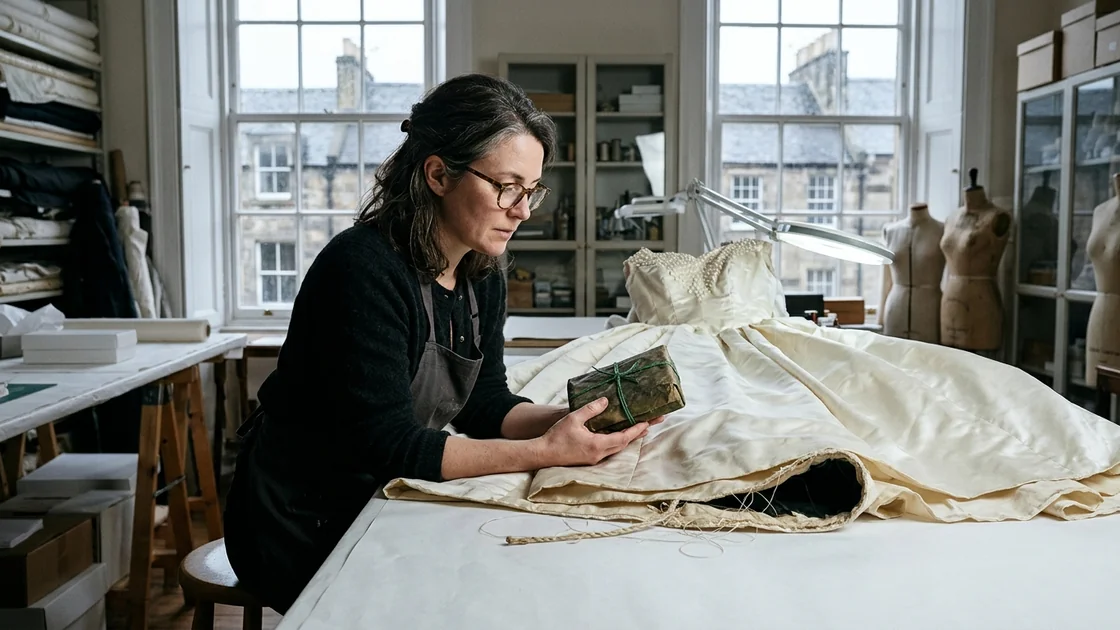
At forty years old, an Edinburgh textile conservator named Maren Ross purchases an unclaimed vintage wedding dress from an estate sale in the New Town, hoping to restore its exquisite mid-century duchesse satin. While carefully releasing the heavy hem to steam out decades of creasing, she discovers a hidden pocket sewn between the stiff horsehair braid and the silk lining, concealing a bundle of unsent love letters written in the autumn of 1952. The letters, penned by a young botanist named Thomas Gallagher to a woman named Clara Sinclair, reveal an illicit romance, an impending forced marriage, and a desperate plan to escape aboard a night train to the Highlands. Driven by an intense kinship with the unknown bride and an urge to shake the quiet stagnation of her own life, Maren embarks on an archival journey through Edinburgh's forgotten paper trails, cemeteries, and coastal outskirts, ultimately unearthing the bittersweet truth of what became of Clara, Thomas, and the vows that were never spoken aloud.
The rain over Edinburgh did not fall so much as it drifted, suspended in the chill October air like pulverized slate. It clung to the stone cornices of Heriot Row, turned the cobblestones into dark mirrors, and settled in tiny bright beads upon the wool of Maren Ross’s collar. She had turned forty three weeks ago without ceremony. Her sister had offered to host a dinner in Glasgow; two colleagues from the National Museum had proposed drinks at the Café Royal; she had declined both, choosing instead to spend the evening re-lining an eighteenth-century waistcoat with unbleached habotai silk while listening to the wind rattle the sash windows of her flat on Great King Street.
Forty was neither young nor old, but it possessed a strange weight, like a bolt of wet velvet. For fifteen years, Maren had made her living by tending to what other people left behind: preserving christening gowns, stabilizing liturgical vestments, cleaning moth-chewed tapestries for historic trusts. She knew the tensile strength of linen, the brittle heartbreak of aged viscose, and the peculiar way human sweat oxidized upon silk after half a century in an attic. She was comfortable with the past because it made no sudden demands. It stayed where it was pinned.
The estate sale was taking place in a ground-floor flat with soaring ceilings and peeling distemper. A retired physician’s widow had died without direct heirs, leaving behind seventy years of accumulated possessions: mahogany chiffoniers, boxes of unread theological treatises, mismatched Worcester china, and trunks smelling of dried lavender and naphthalene. The auctioneers had tagged the lots with callous yellow stickers, reducing a long human life to numerical values.
Maren had come looking for lace. Often, these old New Town apartments harbored remnants of Honiton or Brussels tucked into sewing baskets, forgotten treasures she could use for conservation patches. But as she moved through the damp morning crowd—dealers with magnifying loupes, curious neighbors shaking damp umbrellas—she saw the dress hanging from a picture rail in the shadowy corridor between the drawing room and the pantry.
It hung inside an unzipped canvas garment bag, glowing faintly in the dim hallway.
Maren stopped. Her hand, trained by decades of habit, rose before she could check herself.
The gown was not the billowy, synthetic tulle of the late 1950s, nor the fragile, drop-waisted chiffon of the twenties. It was a masterpiece of post-austerity couture, dated by Maren’s instant calculation to roughly 1950 or 1952. The fabric was heavy ivory duchesse satin, woven with a density that modern looms rarely achieved. The bodice was sculpted with tiny, hand-set darts that met at an impossibly narrow waist, descending into a sweeping bell skirt constructed from five separate gored panels. Along the high boat-neck collar, clusters of tiny seed pearls were sewn in the shape of rowan berries, each one anchored by three invisible stitches of waxed thread.
She stepped closer, leaning in until the scent of the garment reached her: cold silk, the faint dry musk of cedarwood, and behind it, something sharp and metallic, like old coins.
"Lot forty-two," a man’s voice said behind her. It was the junior clerk from the auction house, carrying a clipboard. "Bridal ensemble, mid-twentieth century. Unidentified maker. A bit of damp spotting along the train, I’m afraid."
"It isn't an unidentified maker," Maren said quietly, her finger hovering an eighth of an inch above the pearl work. "Look at the overcast seams and the way the pearl stays are reinforced with silk organza. It was cut by someone trained in Paris, probably worked in one of the private salons on George Street. Madame De Courcy or Alison Gray."
The clerk shrugged, entirely indifferent to the ghost of Scottish haute couture. "Reserve is fifty pounds. Goes on the block at eleven."
Maren did not need a wedding dress. She had never married; her one serious engagement had dissolved eight years earlier with a quiet, mutual exhaustion that left fewer scars than an empty hollow in her chest. She lived alone with two rooms full of dressmaker’s dummies and flat-file cabinets. Buying a wedding dress at forty felt dangerously close to a cliché, the sort of eccentric acquisition that would make her sister sigh over the telephone.
Yet when the hammer fell thirty minutes later, she was the sole bidder. For fifty-five pounds, including the buyer’s premium, the heavy canvas bag was transferred into her arms.
It was heavier than she expected. Much heavier.
Maren’s workshop occupied the back half of her flat, facing north toward the Firth of Forth. The light was clean, diffuse, and honest; it did not flatter, which was precisely what historic textiles required. Two large trestle tables, covered in acid-free blotter paper, dominated the floor. Along the walls, rolls of Melinex, cotton twill tape, and spools of Gutermann silk thread were arranged in glass-fronted cabinets.
She laid the gown upon the central table and turned on the overhead daylight lamps.
In the brilliant white illumination, the condition of the garment revealed itself. The duchesse satin had held up remarkably well; the silk had not shattered, a common fate for fabrics weighted with metallic salts. But there were anomalies. The hem was filthy—not with the dust of an indoor ballroom, but with deep, embedded granules of dark soil and coal grit, as if the wearer had walked through a winter garden or an unpaved mews.
Even stranger were the closures. Down the back, twenty-four satin-covered buttons ran from nape to waist. None of the silk loops were torn, but the bottom two had been roughly cut away with a small blade, their severed edges fraying slightly.
"Someone left in a hurry," Maren murmured to the empty room.
She put on white cotton gloves and began her initial survey, noting the dimensions in her conservation logbook: waist sixty-one centimeters, bust eighty-six, length from shoulder to hem one hundred and forty-two. She checked the interior construction. The dress was fully lined with fine silk habotai, finished with horsehair braid inside the lower hem to give the skirt its sweeping, architectural bell shape.
It was when she lifted the front left gore of the skirt, testing the weight of the hem facing, that she felt the resistance.
The horsehair braid was stiff, but at the hip—just below the waistband on the left side, nestled between the satin outer shell and the habotai lining—there was a thickness that should not have been there. It did not have the supple drape of an interior pocket or the soft give of a pad. It was flat, rectangular, and rigid.
Maren paused. She pressed her fingertips against the satin. The faint, brittle crackle of parchment answered her.
Her breath hitched. She had seen dresses with hidden pockets before—seamstresses occasionally stitched small sprigs of dried heather, silver sixpences, or written blessings into bridal linings for good luck. But this was too large, too dense. It felt like an entire ledger.
Taking a surgical scalpel from her tool roll, she bent over the table. The habotai lining had been hand-stitched to the seam allowance with minute whipstitches. Under a ten-power magnifying lamp, she saw that these stitches were different from the rest of the dress. The rest of the gown had been sewn with immaculate, uniform tension by a professional seamstress using ivory silk thread. Here, over a span of about five inches, the thread was thicker, slightly grayish, and the stitches were uneven, hurried, and pulled too tight, puckering the fine silk.
"You did that yourself," Maren whispered.
Carefully, her hand steady with the muscle memory of twenty years, she slipped the tip of the blade beneath the first gray loop. Snip. Then another. Snip.
With micro-forceps, she drew the severed thread out. Using her fingers, she parted the lining from the satin.
Inside the dark space between the two layers of silk lay a packet. It had been wrapped in a square cut from an oilskin map, folded neatly and bound tightly with a strand of dark green waxed twine—the kind used by horticulturalists to tie up young carnations.
Maren set the scalpel down. Her heart was beating against her ribs with an uncharacteristic, drum-like rhythm. She lifted the bundle. The oilskin was cool and slightly waxy, preserving whatever lay within from the moisture that had darkened the bottom hem of the gown.
She carried the packet to the clear side of the table, stripped off her cotton gloves, and washed her hands with scentless soap. Paper required bare, clean hands; gloves diminished tactile sensitivity and could tear brittle edges.
Returning to the table, she carefully loosened the green twine. The knot was a fisherman’s knot, tied with decisive strength. When it yielded, the oilskin opened like four petals.
Inside were nine envelopes. They were addressed in black fountain-pen ink, in a hand that was vigorous, slightly angular, and undeniably masculine.
The recipient was the same on every envelope:
Miss Clara Sinclair
Care of The Gardener’s Cottage
The Royal Botanic Garden
Inverleith, Edinburgh
None of the envelopes bore postage stamps. None of them had passed through the Royal Mail. They were hand-delivered, or meant to be. And on the back flap of each envelope, sealed with a drop of dark maroon wax bearing the imprint of a fern frond, was a date.
The first date was September 14, 1952.
The last date was November 3, 1952.
Maren sat down on her wooden stool. Outside, the dusk was falling rapidly, turning the Firth of Forth from slate to ink. The city lights of Leith began to blink through the mist. She reached for the first envelope, the one dated September 14, and saw that the wax seal had already been broken long ago.
With thumb and forefinger, she drew out the folded sheet of watermarked bond paper.
September 14, 1952
Clara,
I am writing this from the glasshouse potting shed while the rain drums against the high panes. The smell of wet earth and winter jasmine is everywhere, but I cannot concentrate on repotting the alpines. My hands are shaking as I hold this pen, and you know well that my hands do not shake, even when I am making cross-sections of the smallest mosses.
I saw your father’s motorcar leave the East Gate an hour ago. He did not look toward the beds where I was working, for which I suppose I should be grateful. Mr. Macreadie told me this morning that the Sinclair estate in East Lothian has been heavily mortgaged since your grandfather died, but I already knew why he comes here, why he confers with the trustees, why he looks through me as if I were made of conservatory glass. He is selling you to Arthur Drummond.
Arthur Drummond has three thousand acres in Berwickshire, two coal pits, and teeth like a row of gravestones. He is forty-eight years old, Clara. He looks at you the way a factor looks at prime heifer stock at the Haddington market. When you walked down the central path yesterday in that blue linen coat, pretending not to see me kneeling among the hostas, I saw the bruise on your wrist where someone—your father, or him?—had gripped you.
Do not tell me it is your duty. Do not tell me that a family name must be purchased with your life. You came to the herbarium three days a week all through the spring not because you cared about the classification of Scottish ferns, but because you wanted to breathe air that hadn't been weighed and measured by your mother’s tea-room friends.
I have six pounds and four shillings in the post office account. By November, when the propagation season ends, I shall have fourteen. It is nothing to Drummond’s wealth, but it is clean. It carries no blood from the pits, and it comes from work that honors God’s earth.
I will leave this under the third stone urn on the terrace, beneath the trailing ivy, as we agreed. If you take it, leave a leaf of the silver birch in the crevice. If I find nothing tomorrow morning, I will know that you have surrendered.
Yours in all seasons,
Thomas
Maren let out a breath she hadn't realized she was holding.
The ink was slightly faded, turning from true black to that deep, sepia-tinted umber that iron gall ink assumes after seventy winters, but the urgency on the page was as vivid as if the words were being spoken into the quiet of her room.
She looked from the letter to the ivory gown on the table.
The dress was exquisite, expensive, and clearly made for a wedding of high standing. Madame De Courcy’s salon had dressed the daughters of judges, shipping magnates, and landed gentry. Clara Sinclair was not the daughter of a gardener; she was the daughter of the house, visiting the Royal Botanic Garden under the guise of intellectual cultivation—a common enough pursuit for upper-class young women of that era. And Thomas Gallagher had been an under-gardener or a botanical assistant, working the soil while she watched him from beneath a parasol.
Maren picked up the second envelope, dated September 22.
Clara,
When I found the silver leaf this morning, I thought my heart would crack the ribs right out of my chest. The rain had soaked it, but you had tucked it so deep into the mortar that the underside was dry.
You say they have already ordered the silk. From France, through a house in London. Your mother talks of nothing but the cathedral, the guest list of three hundred, the reception at the Roxburghe. You say you cannot fight them because your brother’s commission in the regiment depends upon Drummond’s goodwill. Drummond has a cousin at the War Office.
Let your brother buy his own commission, or let him work a spade as I do. What kind of brother demands his sister’s soul as the purchase price for a red sash and a pair of brass spurs?
I walked past the seamstress’s shop on George Street last night after dark. The blinds were drawn, but the gas lamps were lit inside, and I could see the shadows of women moving with shears and tape. Is that where they are making the shroud? For that is what it is, Clara. A shroud of white silk to bury you alive in Berwickshire.
Come to the glasshouses on Thursday at five. The public is locked out by then, but I have the key to the boiler entrance behind the rhododendrons. I need to see your face. I need to know that your eyes are still the eyes that looked at me across the press-sheets of Pteridophyta and told me, without a single spoken word, that you loved me.
T.
Maren leaned back, rubbing her temples. Her fingers smelled of paper dust and ancient ink.
She had spent forty years being careful. Her life had been defined by a quiet, deliberate caution: careful choices of study, a careful mortgage on a tenement flat that required manageable maintenance, a careful end to a relationship that had ceased to nourish her, without screams or recriminations. She was a woman who stabilized fraying threads with micro-stitches so tiny they could only be detected with a microscope.
Yet here, laid out on her table, was the record of an incandescent, catastrophic recklessness.
She reached for the remaining letters, opening them in sequence, her eyes devouring the post-war script.
Through October, the letters grew shorter, more frantic. Clara had visited the boiler house. There were whispers of meetings in the Dean Cemetery, among the marble angels and Victorian obelisks, where they could walk without being seen by New Town acquaintances. Thomas wrote of his plans: he had applied for a post at the botanical station near Fort William, at the base of Ben Nevis. A small stone cottage went with the post. Three rooms, a hearth, a garden sloping down to the loch.
October 19, 1952
The post is mine, Clara. Old Professor Balfour gave me the recommendation himself. He asked why I wanted to leave Edinburgh just as the winter collections are being cataloged, and I told him I needed to see trees that hadn't been planted by an act of the Town Council. He laughed, but he signed the paper.
We have a home, if you will take it. It has no electricity—only oil lamps and peat fires—and the wind off the loch will howl through the door all January. But no one will look at you with cold, calculating eyes. You will be Clara Gallagher. Not Mrs. Drummond of the coal pits. Not the sacrifice on the Sinclair altar.
The night train leaves Waverley at 10:15 every Tuesday and Friday for the north. November 4th is a Tuesday. The wedding is set for the 8th, is it not? On the Tuesday, your house will be full of deliveries, relatives from Argyll, luggage, madness. You can walk out the kitchen door into the lane while they are dressing for dinner. I will have the tickets. I will have a carriage reserved at the front of the train.
Tell me you will come. Put the sprig of rowan in the urn if you mean to live.
Maren’s heart pounded. She turned to the final envelope, the one dated November 3, 1952. The wax seal on this one was different; it was crushed, as if it had been closed in violent haste.
Inside, the paper was not watermarked bond. It was a torn scrap of heavy brown wrapping paper, written in pencil.
Clara,
I received your note through the boy from the chemist. You say you cannot run away in an old coat, that they watch the doors, that your mother sleeps across the hall with her door ajar.
You say you will wear the dress because it is the only way you can leave the house on the morning of the rehearsal without suspicion—that you told them you were going to Madame De Courcy for the final fitting of the train, and that the car is to drop you at the corner of Charlotte Square.
My darling, my fierce, mad girl. If you come to me in that white dress, I will take you as you are. I will wrap you in my wool blanket and we will board that train, and let all Edinburgh talk until their tongues rot. The train leaves tomorrow night. But if you cannot get away until the morning, I will wait at the station every hour from dawn until midnight.
If you do not come by the strike of twelve on Tuesday night, I will know they caught you, or that your courage failed. And if it failed, Clara, do not hate yourself. Only know that every tree I ever plant in the north will have your name hidden in its roots.
I love you. Beyond the silk, beyond the stone, beyond the grave.
Thomas.
Maren let the brown paper fall onto the blotter.
Silence settled over the workshop, broken only by the rhythmic hum of the small dehumidifier in the corner and the distant, lonely wail of a tugboat out on the Firth.
The packet of letters had been found inside the dress.
The dress had been completed. The hem was soiled with coal dust and garden soil. The bottom two button loops had been slashed away with a knife.
And yet, the dress had been found seventy years later in an estate sale on Heriot Row, in the home of an elderly woman who had died alone with a house full of untouched antiques.
Did Clara run? Did she make it to Waverley Station, or had she been intercepted on the cobblestones of Charlotte Square? Why were the letters hidden inside the lining?
If Clara had run with Thomas to Fort William, she would have taken the letters with her, or she would have left the dress behind. Why would the letters be sewn into the hem of the very gown she despised?
"Unless," Maren said aloud, her voice trembling slightly in the quiet, "she wore them as armor. Or she was forced to wear it, and this was the only way she could keep him with her."
She looked at the gown. The ivory duchesse satin seemed to glow in the cold LED light, mysterious, stubborn, and mute.
Maren stood up. She walked to the window and looked out over the rooftops of Edinburgh. The city rose in dark, dramatic tiers of volcanic rock and Georgian ashlar, a city built on vaults, wynds, and secrets buried beneath centuries of respectability.
For forty years, Maren had lived within the neat margins of her life. She had repaired other people’s memories, preserved other people’s weddings, mended the moth holes in other people’s dreams.
She looked at her reflection in the dark glass of the window: a woman with streaks of silver running through her dark brown hair, sharp hazel eyes behind tortoiseshell spectacles, a mouth that had forgotten how to laugh without self-consciousness.
"No," she said.
She turned back to the table. She gathered the letters, placed them into acid-free conservation folders, and slipped them into her leather satchel.
She was going to find out what happened to Clara Sinclair.
The National Library of Scotland on George IV Bridge smelled of old paper, floor polish, and the damp wool of scholars hiding from the Edinburgh drizzle.
Maren sat at a wooden desk on the second floor, a mountain of microfilms and bound street directories stacked beside her. Across the desk, Hamish Campbell, a senior archivist with wild gray hair and a knitted waistcoat that looked as though it had survived several minor explosions, adjusted his glasses.
"Sinclair," Hamish said, tapping his pencil against a legal pad. "It’s a common enough name in Midlothian, Maren. But if they had money—or had the appearance of money—they’ll be in the Post Office Directories and the Social Registers."
"The father was an associate of the Botanic Gardens," Maren said, leaning forward. "He had business with the trustees around 1952. And there was talk of an estate in East Lothian, heavily mortgaged. A brother in the army. And a suitor named Arthur Drummond, who owned coal pits in Berwickshire."
Hamish’s eyes brightened. "Ah, well now, Drummond of Berwickshire! That narrows the field considerably. That would be Arthur Drummond of Blackadder Mains. His family owned the collieries near Tranent and Ormiston before nationalization in '47. Filthy rich, deeply litigious, universally disliked by the local miners. Let me pull the society pages from the Scotsman, November 1952."
While Hamish vanished into the depths of the stacks, Maren scrolled through the microfiche of the Edinburgh Post Office Directory for 1952. Under Sinclair, she found:
Sinclair, Major Archibald, late Royal Scots. 14 Heriot Row.
Maren froze.
14 Heriot Row.
The estate sale where she had bought the dress was held at 14 Heriot Row.
She took a sharp, shallow breath. The dress hadn't traveled across the city through secondhand shops or antique dealers. It had never left the house. For seventy-two years, it had remained within the walls of the four-story Georgian townhouse on the north side of the New Town.
Why?
"Here we are," Hamish’s voice broke through her shock. He dropped a heavy, cloth-bound volume of newspapers onto the table with a thud that earned him a stern glare from a woman reading nineteenth-century parish records two desks away. "November 1952. Let’s see what Mr. Drummond was up to."
He turned the yellowed pages carefully, the paper whispering like dry leaves.
"The 8th of November was a Saturday," Hamish murmured, his finger tracing down the social announcements. "Marriages... Forthcoming Marriages... Here. Look."
Maren leaned over his shoulder.
A marriage has been arranged, and will take place on Saturday, November 8, at St. Giles’ Cathedral, between Arthur James Drummond, Esq., of Blackadder Mains, and Clara Margaret, only daughter of Major Archibald Sinclair and the late Mrs. Sinclair, of 14 Heriot Row, Edinburgh.
"Now look at the paper for Monday, November 10," Maren whispered.
Hamish flipped the pages. Monday’s edition had reports on the Korean War, a train derailment near Carlisle, an advertisement for winter coats at Jenners on Princes Street.
They turned to the society page.
There was no photograph of a bride. There was no account of a reception at the Roxburghe.
Instead, in the bottom corner of page four, tucked beneath a notice regarding the sale of highland bullocks, was a three-line retraction:
The marriage arranged between Mr. Arthur Drummond and Miss Clara Sinclair will not take place.
Hamish let out a low whistle. "Good God. In 1952? That was social suicide. In the New Town, you didn't cancel a wedding at St. Giles forty-eight hours before the bells rang unless someone had died, or worse."
"What was worse?"
"A scandal. A flight. A madness." Hamish looked up at her, his brows knit. "Who was she, Maren? Why are you looking for her?"
"I bought her dress," Maren said softly. "And I found her heart inside it."
She didn't elaborate. Hamish knew her well enough to recognize the quiet, stubborn fire that occasionally possessed conservators when an artifact refused to remain an object.
"If the wedding was canceled," Maren said, "what happened to her? Does the Scotsman say anything else?"
Hamish searched through the rest of November and December. Nothing. Clara Sinclair had simply vanished from the public record.
"Try the Valuation Rolls," Maren suggested. "Who lived at 14 Heriot Row after 1952?"
It took another hour of winding through microfilm reels. The records showed Major Archibald Sinclair listed as head of household until 1958, when he died of heart failure. After that, the house passed to a Captain Hector Sinclair, the brother whose military commission Clara was supposed to have saved. Hector lived there with his wife until the late 1970s.
"And then?" Maren asked.
"Then the property was divided into two flats," Hamish read from the ledger. "Ground floor and basement sold in 1981 to... Miss C. M. Sinclair."
Maren stared at him. "She came back?"
"She never left, or she returned," Hamish said. "She’s listed as the owner of Flat 1, 14 Heriot Row, from 1981 until... well, until this past August, when the property was scheduled for executor’s sale."
Maren’s hands gripped the edge of the desk.
The woman who died in the flat—the woman whose estate sale Maren had attended, whose unread theological treatises and mahogany tables had been sold off to strangers—was Clara.
Clara had not died on a train. She had not died in 1952. She had lived to be ninety-two years old, sleeping in the very rooms where her father had commanded her to marry a monster, with the ivory dress hanging in a garment bag in the drafty hall, holding Thomas Gallagher’s letters in its hem for more than half a century.
"She stayed," Maren whispered, the realization settling over her like a suffocating blanket. "She didn't run. She stayed in that house."
A heavy, aching sorrow filled her chest. All that passion, all that fiery defiance in the damp potting sheds and cemetery shadows, had ended in a cancellation notice in the Scotsman and a long, solitary life behind heavy velvet curtains on Heriot Row.
"Hamish," Maren said, her voice strained. "What about the other name? Thomas Gallagher. Can you search the death registries for him?"
"Where was he from?"
"He was an under-gardener at the Botanics in '52. He took a post near Fort William. The botanical station at the foot of Ben Nevis."
Hamish sighed, taking off his spectacles. "Maren, the Highland records for that period are scattered across three regional archives. If he died up there, it could take days to track down the certificate. But we can check the staff records for the Royal Botanic Garden. They keep excellent archives of their apprentices and staff. You should talk to Donald Macleod at the Botanics library. He knows the history of every spade that ever turned turf in Inverleith."
Maren stood up, packing her satchel. "Thank you, Hamish."
"Maren," he called after her as she turned toward the stairs. She stopped, looking back. The archivist looked at her with a gentle, searching gaze. "Be careful. You spend your life looking at things that have survived the fire. Sometimes, the fire wasn't romantic. Sometimes it was just cold ashes."
"I know," she said.
The Royal Botanic Garden was shrouded in low cloud when Maren arrived that afternoon. The great glasshouses, Victorian marvels of curved iron and glass, rose like luminous crystal ships out of the green lawns. The smell of wet loam, pine needles, and decaying beech leaves hung in the autumn air—the exact smells Thomas had described to Clara seventy-two years ago.
She walked along the gravel paths, her boots crunching softly. She passed the rock garden, where alpine plants huddled against gray schist, and found the terrace of stone urns outside the old herbarium.
She stopped before the third urn.
It was weathered, coated in pale green lichen, its carved stone garlands worn smooth by nearly a century of northern rain. Creeping ivy still grew thick around its base, its dark, leathery leaves clinging to the mortar.
Maren knelt down in the damp grass.
She did not care that the moisture soaked through the knees of her corduroy trousers. She reached out with her bare fingers and parted the ivy leaves at the rear of the pedestal, where the stone met the terrace flagstones.
The crevice was there. A narrow, dark fissure in the lime mortar, sheltered from the downpour by the lip of the urn.
She looked into the opening. It was full of dead moss, a few empty snail shells, and spiderwebs. There was no silver birch leaf, of course. Time had swept away the tokens of that frantic autumn. But touching the cold stone, Maren felt an electric shock of reality. This was not a story written in a book; it had happened here. A boy with soil beneath his fingernails had knelt on these very stones at dawn, praying to find a leaf that meant a girl had chosen him over an empire of coal.
"Can I help you, madam?"
Maren looked up. A young gardener in green waterproofs was standing on the gravel path, holding a rake and looking at her with polite curiosity.
"I’m looking for the library," Maren said, rising and brushing the dirt from her knees. "Mr. Macleod."
"Administration building," the young man pointed toward the low, modern brick structure hidden behind a stand of Scots pines. "Second floor."
Ten minutes later, Maren was sitting in an office that smelled intoxicatingly of dried plant specimens and cedar. Donald Macleod was seventy, bald as a turnip, with large, hairy ears and the calm, unhurried demeanor of a man who measured time in the growth rings of sequoias.
"Gallagher," he repeated, tapping his lip as he looked at the handwritten list Maren had provided. "Thomas Gallagher. Yes, I remember seeing that name when we were cataloging the post-war apprentice logs for our centenary volume."
He pulled down a long, blue buckram-bound ledger labeled Staff & Trainees: 1946–1955.
The pages were ruled in red ink, filled with neat, clerical copperplate.
"Here he is," Macleod said, running an ink-stained thumb down the column. "Gallagher, Thomas Francis. Born 1928, Glasgow. Appointed Junior Botanical Assistant, March 1949. Resigned... November 4, 1952."
Maren’s pulse leaped. "Resigned on November 4th? That was the Tuesday. Does it say why?"
"Remarks column," Macleod read aloud. "Left service to take up appointment with the Forestry Commission, West Highland Division, Fort William."
"So he went," Maren said, half to herself. "He took the train."
"Aye, looks like it," Macleod said, turning the page. "Wait, there’s an annotation here in pencil. Added later by Professor Balfour. 'Subject awarded the Campbell Memorial Medal for Botanical Illustration, 1964. See Herbarium accession files.'"
"He was an illustrator?"
"Many of the field men were," Macleod said, his interest piqued. "You couldn't lug heavy camera equipment up the side of a mountain in the 1950s. You had to be able to draw what you saw—every stamen, every bract, every root-hair. Let’s see what we have in the accession files under Gallagher."
They went down a narrow spiral staircase into the climate-controlled vaults of the herbarium. Long rows of metal compactor units slid open with a low mechanical groan. Macleod led her to the section marked Non-Vascular & Alpine Studies: 1950–1970.
He pulled out a flat archival portfolio box covered in gray buckram.
When he opened it on the viewing table, Maren drew in a sharp breath.
Inside were dozens of botanical illustrations executed in pen-and-ink and watercolor. They were breathtaking. The lines were as delicate as cobwebs, yet executed with terrifying scientific precision: the veining of saxifrage petals, the tiny, translucent cups of lichen, the intricate, branching architecture of mountain ferns.
Each plate was signed in the lower right-hand corner: T. F. Gallagher.
Maren looked closely at the signatures.
Underneath the artist’s name on every single plate, from 1953 until the final drawing dated 1988, there was a tiny, stylized symbol, barely two millimeters across, drawn in the same black ink.
It was not a fern. It was not a flower.
It was a rowan berry, surrounded by three tiny dots.
The exact design of the pearl clusters embroidered onto the boat-neck collar of the wedding dress.
"He never stopped," Maren whispered, her eyes burning.
"What’s that?" Macleod asked, leaning down to inspect the tiny mark through his loupe. "Ah, the mark? We always wondered what that was. Thought it was his personal seal, a mason's mark of sorts. He submitted over four hundred plates from the Lochaber area over thirty years. Lived out his days in a stone house on the shores of Loch Eil. Never married, as far as the records show. Lived alone with three collies and a garden full of wild primroses."
"When did he die?" Maren’s voice was barely audible.
Macleod turned to the index sheet at the back of the box.
"October 1994," he said. "Buried in the old churchyard at Kilmallie, looking across the water to the hills. Left his entire collection of plant presses and field journals to the Garden."
Maren touched the edge of the paper, where Thomas’s hand had rested as he painted a tiny alpine forget-me-not in the summer of 1960. He had sat in a stone cottage three hundred miles north, looking at the rain sweep across Loch Eil, signing Clara’s pearl berries onto the margins of science for forty years.
He had waited. And he had remembered.
"Why didn't she go?" Maren cried out in her heart, the agony of it striking her with the force of a physical blow. "Why did she stay on Heriot Row?"
The rain had stopped by the time Maren left the Botanics, replaced by a raw, bitter wind that smelled of the North Sea. Instead of catching a bus, she walked back toward the city center, crossing the bridge over the Water of Leith and climbing the steep slope of Dundas Street into the New Town.
The Georgian terraces stood like cliffs of soot-blackened stone against the violet evening sky. She walked along Heriot Row until she reached number 14.
The sale was over; the yellow signs had been removed. The tall windows of the ground floor were dark, the rooms stripped bare of the mahogany tables and the Worcester china.
Maren stood on the pavement across the street, looking up at the high drawing-room windows.
What had Clara’s life been? A prisoner of her brother’s respectability? A spinster aunt living in the basement flat after the house was divided, listening to the footsteps of other people’s children running overhead?
And why had she kept the dress?
If she had betrayed Thomas out of cowardice, if she had simply backed away from the cold reality of a peat fire and a gardener’s wages, she would have burned the dress. She would have sold it, or given it away to a charity shop. A woman does not keep the monument to her greatest failure hanging in her corridor for seven decades.
Unless the dress was not a monument to failure.
Maren turned away from the house and walked down the hill to the corner of Howe Street, where she knew a small, dusty firm of solicitors had their offices: Macfarlane, Ross & Soutar.
It was five minutes before five. She pushed open the brass-handled door. A bell chimed in the back.
A middle-aged woman with silver-framed glasses looked up from behind a massive wooden desk. "Can I help you?"
"I’m looking for the executor of the estate for Miss Clara Sinclair," Maren said, taking out her museum credentials and placing them on the desk. "My name is Maren Ross. I am a textile conservator. I purchased an item from the house at the estate sale, and I have discovered personal documents that belong to the family."
The woman looked at the card, then up at Maren with sharp, appraising eyes. "One moment."
She disappeared through a paneled door into an inner office. After a brief murmur of voices, the door opened fully, and a tall, thin man with stooped shoulders and a shock of white hair stepped out.
"Miss Ross?" he said. His voice was dry, resonant, and remarkably gentle. "I am David Macfarlane. I was Clara Sinclair’s solicitor for the last twenty-five years of her life. Come in, please."
The inner office was lined from floor to ceiling with black tin deed-boxes bearing the names of dead aristocrats and long-defunct Edinburgh trusts. Macfarlane offered Maren a leather armchair across from his desk and sat down, steepling his fingers.
"You say you found documents?" he asked. "The auctioneers were instructed to clear the property completely. I thought we had removed all personal papers."
"They were hidden," Maren said. She opened her satchel, took out the folder containing the nine envelopes, and set it on the green leather blotter between them. "They were sewn inside the hem of the wedding dress. Between the duchesse satin and the lining."
Macfarlane did not reach for the folder immediately. He stared at it for a long moment, his expression unreadable. Then, slowly, a faint, melancholic smile touched the corners of his mouth.
"So that’s where they were," he murmured.
Maren leaned forward, her hands bracing the arms of the chair. "You knew about them?"
"I did not know where they were," Macfarlane said, looking up at her. "Clara never told me that. But she spoke of them before she died. She told me: 'David, when they carry me out of this house, they’ll sell the chairs and they’ll sell the silver. But my real life is sewn into the hem of the white dress. If whoever buys it has eyes to see, they’ll find it. If not, it will be buried in someone else’s dark wardrobe, which is just as well.'"
Maren felt a chill trace down her spine. "She knew someone would find them."
"She hoped," Macfarlane corrected softly. "Clara was a woman of formidable intellect, Miss Ross. And formidable courage. Do not look so tragic. You think she was a victim, don't you? You think she sat in that flat for seventy years weeping over a broken heart, regretting that she didn't get on the train to Fort William."
"Didn't she?" Maren asked, her voice cracking. "She canceled the wedding, but she didn't go to him. He lived alone on Loch Eil until 1994, drawing rowan berries under his name. And she died alone on Heriot Row."
Macfarlane sighed. He stood up, walked to a deed-box labeled Estate of C. M. Sinclair, unlocked it with a small brass key, and drew out a slender, leather-bound diary with a brass clasp.
"Clara did not fail to go to the station because her courage failed," Macfarlane said, holding the book in his hands. "She didn't go because on the morning of Tuesday, November 4th, when she walked out of the house in that dress under the pretense of going for a final fitting, her father was waiting for her on the pavement with two constables."
Maren gasped.
"Her brother Hector had found one of Thomas’s earlier notes in the greenhouse," Macfarlane explained, opening the diary. "He brought it to the Major. They knew everything. They didn't lock her up; they did something far crueler. The Major told her that if she took one step toward Waverley Station, he would have Thomas Gallagher arrested under the Malicious Damage Act for the destruction of botanical specimens at Inverleith—he had already arranged for false depositions from two of the senior trustees—and Drummond would ensure that Thomas spent seven years in Peterhead Prison."
"My God," Maren breathed.
"Drummond had the judges in his pocket," Macfarlane said grimly. "In 1952, a working-class Glasgow boy accused of theft and sabotage by two decorated war heroes and a coal baron didn't stand a chance in an Edinburgh courtroom. He would have been broken in prison. Clara knew that. She knew Thomas’s spirit would not survive a cell."
Macfarlane turned the yellowed pages of the diary.
"This is her entry from the night of November 4th, 1952," he said, and read aloud:
“I cut the buttons from the back of the gown with the kitchen shears so I could breathe. I took Thomas’s letters from the biscuit tin under my bed. I took a needle and gray thread. I opened the facing of the hem, and I laid his words against the stiffening. If I cannot have him beside me, I will have his mind wrapped around my feet wherever I am forced to walk.
I told Arthur Drummond this evening in the drawing room, before my father and my brother, that if he forced me to the altar on Saturday, I would tell the Dean of St. Giles, before three hundred guests, precisely what he does to the girls in his colliery cottages in Ormiston. I had the names. I had the dates. Old Mary from the scullery had given them to me.
Drummond’s face went the color of curdled milk. He called me a viper. He left the house within five minutes.
My father struck me across the face and swore that as long as he drew breath, I would never leave this house, never receive a penny of my mother’s settlement, and never speak that gardener’s name again.
I told him: 'I will stay here until you die, Father. And then I will buy the ground you are buried in, so I can walk on your head every morning.'
Thomas will be at the station tonight. He will watch the clock strike twelve. He will think I was a coward. He will think I chose the silver teapots and the silk. That is the price I pay to keep him free. Go to the mountains, my Thomas. Plant your trees. I will keep the watch here.”
Macfarlane closed the diary.
The silence in the room was so profound that Maren could hear the ticking of the grandfather clock in the corner, a slow, relentless pulse: tick, tock, tick, tock.
Tears, hot and sudden, spilled over Maren’s eyelashes and ran down her cheeks. She did not wipe them away.
Clara had not surrendered. She had stood in that Georgian drawing room in her half-unbuttoned wedding dress, an unarmed girl of twenty, and had broken a coal baron and defied her father to save the man she loved from prison.
"Why didn't she contact him later?" Maren whispered through her tears. "After her father died in 1958?"
"She tried," Macfarlane said softly. "In 1959, after Major Sinclair died, she traveled to Fort William. She took the train to Loch Eil. But when she reached the cottage, she saw him through the window. He was sitting at his work table, drawing by the light of an oil lamp, looking peaceful, whole, untainted by the venom of Edinburgh. She stood by the gate in the rain for an hour."
Macfarlane looked at Maren, his eyes full of a wisdom that had seen too many human wills and testaments.
"She realized that if she entered his life again, she would bring the shadow of the past with her. Seven years had passed. He had found peace in his solitary work. She told me: 'David, love isn't always claiming a person. Sometimes love is leaving someone in the garden they built, even if you have to walk in the dark outside the fence.' She came back to Heriot Row. She became a scholar of Scottish social history. She wrote three books under a male pseudonym. She funded scholarships for working-class girls at the University of Edinburgh. She lived a full, ferocious, independent life."
"And the dress?"
"She kept it," Macfarlane said, "because it was her armor. It was the only battle she ever fought where she won everything that mattered: his freedom, and her own soul."
It was dark when Maren left the solicitor’s office. She did not take the bus. She walked through the cold, clearing night, her satchel pressed against her side.
The clouds had been swept away by the sea wind, leaving the Edinburgh sky a deep, crystalline indigo, dusted with a thousand stars. High above the city, the Castle sat upon its crag of basalt, floodlit in amber, ancient and immovable.
When she reached her flat on Great King Street, she did not take off her coat immediately. She went straight into the workshop.
The daylight lamps flickered on, banishing the shadows.
There lay the dress.
It was no longer just a vintage garment of mid-century silk. It was a standard carried into battle. It was a monument to a sacrifice so vast, so silent, that the world had walked past it for seventy years without seeing it.
Maren took off her coat and washed her hands.
She picked up her needle, threaded it with fine, unbleached silk thread, and sat down on the stool.
Carefully, reverently, she opened the oilskin packet once more. She did not read the letters again; she did not need to. Their words were burned into her memory.
She smoothed the acid-free tissue paper around the envelopes, preserving them against decay, light, and time. Then, using strips of archival cotton tape, she secured the bundle back into its original shape.
She took the packet and slipped it back into the secret pocket between the duchesse satin and the habotai lining.
Then, with minute, invisible stitches, her needle dipping into the seam allowance with the precision of a surgeon, Maren began to close the hem.
In, out. Loop. Tighten.
She did not sew it with the hurried, desperate stitches of a frightened twenty-year-old girl in a dark bedroom. She sewed it with the deliberate, masterly craft of a woman who understood the sacred duty of preservation.
She repaired the two slashed button loops at the back of the bodice, using matching silk cord, restoring the garment to wholeness.
When she drove the final stitch home and knotted the thread, she did not cut it with the scalpel. She cut it with the small, silver-handled scissors her grandmother had given her when she was twelve years old.
She stepped back.
The gown hung upon the mannequin, luminous, proud, and complete. Its secrets were safe inside its lining, held fast against the world.
Maren turned off the lamps.
In the dark room, with the moonlight from the window painting the floor in silver squares, she stood looking at the silhouette of the dress.
Forty years.
For forty years, she had believed that her life was small because it had been quiet. She had thought that love was something that arrived with trumpets and ended with rings, and that without those things, a woman was only an observer, an archivist of other people’s joys.
Clara Sinclair had never worn that ring. She had never lived in the cottage on Loch Eil. But she had loved with a fierce, magnificent totality that had outlived empires, coal mines, and family dynasties. She had left her heart in the fabric of her life, hidden where only someone who truly cared to look would ever find it.
Maren walked to the window and pushed the sash open.
The cold air rushed in, clean and sharp, smelling of pine needles from the gardens and salt from the Firth.
She thought of the churchyard at Kilmallie, three hundred miles to the north, where a man slept beneath the shadow of Ben Nevis with rowan berries carved into the memory of his hands.
And she thought of Clara, resting now in Dean Cemetery, free at last from Heriot Row, walking through whatever garden lay beyond the stars.
Maren took a deep breath. For the first time in many years, her chest did not feel tight. The weight of forty was no longer wet velvet; it was the steady, grounding weight of duchesse satin, rich with history, tough enough to withstand the winter, and carrying within its hidden seams the courage to begin again.
Tomorrow, she would contact the National Museum. She would offer the dress to the costume collection, on one condition: that it be displayed not as a bridal gown, but as a garment of historical resistance, with Clara Sinclair’s name written in gold upon the plaque, and the story of the botanist’s letters recorded for all who passed by to read.
And after that?
Maren looked at her train timetable on the desk.
The train to Fort William left Waverley Station at 10:15.
She closed the window, turned the key in the latch, and began to pack her bag.