The Ledger of Penmarrow House
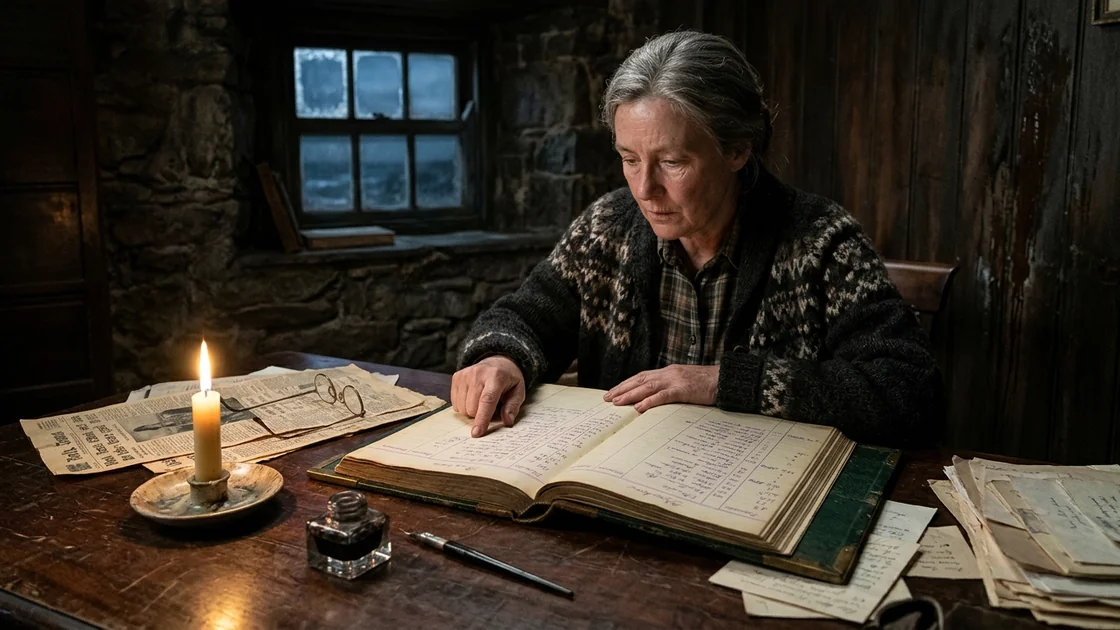
This is the story of Eleanor Vance, a fifty-two-year-old woman recovering from a sterile divorce who leaves London behind after inheriting a crumbling clifftop inn in Cornwall from her estranged grandmother, Morwenna Trevithick. Arriving at the desolate, wave-beaten headland of Penmarrow House, Eleanor expects to clear the property for a quick sale, but the house resists her haste. Inside a salt-rotted bureau hidden beneath the scullery floor, she unearths a private register containing decades of guest records with no departure dates, accompanied by cryptic annotations in her grandmother's hand. As Eleanor investigates the identities of these vanished visitors, she unravels a forgotten history of sanctuary, desperation, and retribution along the jagged Cornish coast, ultimately confronting the true cost of her inheritance and discovering her own capacity for survival.
I. The Salt Road
The rain began in earnest past Bodmin, shedding the gentle pretense of drizzle and turning into a violent, sideways deluge that slapped against the windshield of Eleanor’s dented estate car. The wipers groaned, their rubber split from a summer of baking idle against the curb outside her former home in Blackheath.
That house was gone now. Or rather, it remained where it was, occupied by Julian and his immaculate collection of modern British lithographs, his architectural journals, and his new domestic reality—a junior curator named Chloe whose laugh, Eleanor had noted during their final joint meeting with the solicitors, sounded like small spoons dropped into empty china cups.
Eleanor was fifty-two. For twenty-six of those years, she had been Julian’s wife, an efficient arranger of dinners, an editor of his rambling essays on municipal brutalism, a woman who had softened the hard edges of his vanity until she realized she had worn her own fingers down to the bone doing so. The divorce had been bloodless, civil, and devastatingly swift. When the papers were signed, she had packed two suitcases, three boxes of books she had never found time to read, and her grandmother’s iron key ring, which had arrived by registered post six weeks earlier from a legal firm in Truro.
Mrs. Morwenna Trevithick, the accompanying letter had stated with dry formality, has passed away at the age of ninety-four. As her sole surviving descendant of the direct line, the title and chattels of Penmarrow House, Porthkerris, are devised wholly to you.
Eleanor had not seen her grandmother since she was eight years old. Her memories of Morwenna were not memories of affection, but of textures: the coarse scrape of gray wool against a child’s cheek, the pungent vinegar smell of kelp drying behind the kitchen stove, and two pale, fiercely watchful eyes that seemed to look right through skin and bone to see whether one was made of brittle glass or granite. Eleanor’s mother, dead ten years now, had refused to speak of Cornwall, dismissing her childhood home as "a miserable heap of wet stones inhabited by a woman who preferred gulls to human beings."
Now, Eleanor turned the car off the main road and onto a lane barely wider than a wheelbarrow, flanked on both sides by ancient, sod-topped stone hedges that pressed against the fenders like the walls of a trench. Gorse bushes, their yellow blooms bruised by the October wind, scratched at the mirrors. The road rose steadily, winding upward toward the high Atlantic cliffs where the earth gave way to gray sky.
When she reached the headland, the Atlantic revealed itself not as a postcard panorama, but as a thundering, pewter-colored beast. At the lip of the bluff, crouched low against the gale like a dog expecting a blow, sat Penmarrow House.
It was larger than she had imagined from her mother’s bitter recollections. Built of dark, iron-stained slate and rough granite moorstone, the inn rose three stories above the turf, its steep roofs bristling with crooked chimney stacks. Salt crust coated the seaward windows, turning them opaque and white, like cataracts over old eyes. A leaning wooden sign swung above the porch on rusted iron hinges, shrieking with every gust: The Penmarrow Inn – Good Lodging & Stabling. The paint had blistered and peeled until the letters looked like ancient runes.
Eleanor cut the engine. The silence inside the car was immediate, followed an instant later by the roar of the sea below—a rhythmic, concussive boom that vibrated through the floorboards. She sat for a long moment, her hands resting on the steering wheel. Her knuckles were red and stiff from the cold.
"Well, Nora," she whispered to herself, using the pet name Julian had always hated. "Here is the rest of your life."
She took the heavy brass key from the passenger seat, stepped out into the wind, and let the Atlantic take her breath away.
II. The Bones of the House
The lock fought her. It was choked with three seasons of brine and grit, but when Eleanor leaned her shoulder against the warped oak door and turned the key with both hands, the tumblers gave way with a sound like a pistol shot.
She pushed inside and closed the door against the storm.
The air in the front hall was cold, thick with the smell of damp plaster, wood ash, and the mineral sharpness of the sea. Penmarrow House had not been heated since Morwenna had taken to her bed in the spring, and the cold had seeped deep into the masonry. Eleanor switched on the flashlight she had brought from London. The beam cut through the gloom, revealing a wide entrance hall paneled in blackened pine. To her left lay the public parlour: three low tables, benches with horsehair poking through split leather, and an enormous hearth choked with soot and dry bird feathers. Above the mantel hung an oil portrait so darkened by coal smoke that only the subject’s hands—long, pale, and clasping a bone-handled knitting needle—remained visible.
To the right was the private parlor, and beyond it, the staircase, curving up into darkness like the spine of a beached whale.
Eleanor carried her luggage into the kitchen, which was vast, flagged with uneven blue slate, and anchored by a massive cast-iron range that looked capable of smelting ore. On the long scrubbed-pine table sat an empty milk bottle, a cracked teacup with a dried circle of brown at the bottom, and a yellowed calendar from 1982 hanging from a rusty nail. The passage of time in this place seemed not to have proceeded in a straight line, but to have gathered in stagnant eddies, catching rubbish and relics alike.
She spent the remaining hour of daylight wandering the upper corridors. There were eleven guest rooms on the first and second floors. Each room was a monument to austerity: a narrow iron bedstead, a horsehair mattress rolled tight and tied with string, a washstand supporting a crazed ceramic pitcher, and a small deal wardrobe that opened with a shuddering creak. There was no electricity on the top floor; small tin brackets for oil lamps were screwed directly into the wainscoting.
Standing in the corner room on the second floor, Eleanor looked down through a clean patch on the window. Far below, the cliffs dropped sheer into the surf. The water did not break upon sand, but against a jagged shelf of black reef known locally as the Trowels. Even from this height, the surge was terrifying—white foam boiling over the rocks, retreating, and smashing back with primordial fury.
She shivered. The house was not merely old; it was hollow. It felt like an abandoned shell picked clean by the tides. Why had her grandmother stayed here alone for forty years after Eleanor’s grandfather had drowned in the bay? Why had she kept the doors unlocked to guests long after the railway branch line had closed and the holidaymakers had moved on to the sandy beaches of Newquay and St Ives?
By seven that evening, Eleanor had managed to coax a sullen fire out of the kitchen range using a bucket of coal she found in the scullery. She boiled water in a copper kettle she had scrubbed three times with salt, made herself a cup of black tea, and ate a dry sandwich from the service station.
Her cell phone had no signal. The screen displayed only the time, 19:42, and a cruel little notice: No Service. In London, Julian was likely pouring a dry Riesling for someone, discussing the subtle geometries of housing estates. Here, the only sound was the wind scouring the slate roof and the slow, rhythmic tick of a longcase clock in the hall that had somehow started running again when she shut the front door.
Eleanor pulled her woolen cardigan tight around herself and set about exploring the room behind the kitchen—a cramped, windowless chamber that had served as Morwenna’s office.
III. The Hidden Bureau
The office was colder than the rest of the ground floor. A damp draft came up through the wide floorboards, smelling faintly of seaweed and deep stone. The room was furnished with a single Windsor armchair, a cast-iron safe that stood wide open and empty, and a monumental partner’s desk made of mahogany, scarred by spilled ink and the burns of forgotten cigarettes.
On the desk lay the mundane debris of an old woman’s final months: utility bills stamped FINAL NOTICE in faded red, a packet of peppermints turned soft and translucent with age, and a brass pair of spectacles with one cracked lens.
Eleanor sat in the armchair. It was surprisingly comfortable, molded by decades of use to the shape of an unbending spine. She opened the center drawer. Nothing but dried-up nibs, a ball of hemp twine, and several boxes of matches. The side drawers yielded receipts for paraffin, tins of paraffin wax, and tins of ship’s biscuits dating from the mid-1970s.
She sighed, leaning her forehead against the cool mahogany. Her plan, such as it was, had been simple: spend two weeks clearing the house, contact an estate agent in Penzance, accept whatever modest sum the ruin would fetch, and use the money to rent a flat in Bristol or Bath where she might find work as an archivist or copyeditor. She was sensible; she was educated; she had survived the sudden amputation of her marriage with her dignity intact.
Yet as she sat in Morwenna’s chair, an irrational resentment stirred in her chest. Julian had always praised her for being unflappable—a word she had come to despise. It meant she did not cause scenes; it meant she absorbed neglect without curdling; it meant she was easy to leave.
"Damn you, Julian," she said aloud to the dark room.
Her right heel, kicking back in small, involuntary frustration, struck the kneehole of the desk. Instead of the dull thud of heavy timber, the wood produced a hollow, sharp clack.
Eleanor frowned. She pulled the chair back and dropped to her hands and knees, shining the flashlight into the recessed space beneath the desktop.
The back panel of the kneehole was not tongue-and-groove like the sides, but a single sheet of pine, held in place by two small wooden toggles that had been blackened to match the shadows. One of the toggles had slipped, dislodged by her shoe.
Heart beating with a sudden, sharp rhythm, Eleanor reached in. She turned the second toggle. The panel dropped forward with a sigh of displaced dust, revealing a shallow cavity built into the dead space between the desk drawers and the stone wall behind it.
Inside lay an object wrapped in oilcloth.
Eleanor pulled it out. The oilcloth was brittle, smelling of linseed and paraffin. She peeled back the stiff folds at the desk. Within lay a large, heavy book bound in dark green morocco leather, its corners protected by brass caps that were green with verdigris. On the front cover, embossed in gold leaf that had faded to a dull mustard, were the words:
THE PENMARROW GUEST BOOK – 1938 to 1994
Eleanor smiled faintly. A guest ledger. It was hardly a pirate’s treasure or a dark family will. Still, her historical training—she had taken a good degree in modern history at UCL before she had set it aside to manage Julian’s office—made her turn the cover with careful reverence.
The opening pages were conventional enough. Written in a neat, clerkish hand that belonged, presumably, to her grandfather Samuel Trevithick, the entries recorded the visitors of the late 1930s:
Aug 4, 1938. Rev. H. C. Willoughby & wife. St. Jude’s, Exeter. Room 4. Dep. Aug 11. Paid 4 guineas. Sept 12, 1938. Miss Enid Cloutier. Bristol. Room 2. Dep. Sept 18. Paid 2g 10s.
The handwriting continued through the war years—officers from the radar station at Predannack, coastal defense inspectors, a few families displaced by the Plymouth blitz. But in the spring of 1944, the clerkish hand vanished abruptly. Samuel Trevithick had gone out in his dory to check his crab pots one morning in April and had not returned.
Beginning in June 1944, the ledger was kept in Morwenna’s hand.
Morwenna’s writing was unmistakable: tall, lean, with ferocious, hook-like crossbars on the ts and capital letters that resembled jagged sea cliffs. Her early entries were brisk and businesslike. But as Eleanor turned the pages into the late 1940s and 1950s, the character of the register changed.
The standard columns—Name, Residence, Date of Arrival, Room Number, Date of Departure, Amount Received—began to display strange irregularities.
On page 112, dated October 14, 1952, she found the first entry that made her stop:
Marcus Vance, Esq. London. Room 7. Arrival: 14 October. Departure: —
The departure column was empty. In the space where the bill should have been calculated, Morwenna had written a single, tidy mark in purple ink: a small, inverted triangle inside a circle, followed by the letters C.S.
Eleanor turned the page. Two weeks later:
Clara Elizabeth Bell (Mrs.). Bath. Room 3. Arrival: 2 November 1952. Departure: — Notation: Retained. (G.T.)
Eleanor flipped forward through the years. The normal entries—fishermen, commercial travelers, hikers walking the coastal path—gradually dwindled as the decades advanced. But the other entries, the ones without departure dates, continued with strange regularity. There were three in 1958. Five in 1963. Two in 1971. One in 1984.
Every one of them lacked a departure date. Every one had a notation in her grandmother’s sharp, purple script:
Thomasine Day. London. 14 July 1953. [Left no track.] David L. Hemmings. Cardiff. 9 Jan 1961. [Under the swell.] Sister Mary Beatrice (born Teresa Higgins). Dublin. 22 Oct 1967. [Taken by the gray.] Arthur Finch. Birmingham. 11 Nov 1968. [Paid to the bottom.] Marion Croft. Southampton. 4 Aug 1976. [Given over.] Julian Vance? Eleanor blinked, her heart lurching. No, not Julian. The name was Julian Reed, entered in 1982, with the notation: No more words.
Altogether, Eleanor counted forty-seven names across fifty years. Forty-seven people who had walked through the heavy front door of Penmarrow House, climbed the stairs to one of the eleven drafty rooms, and had never, according to the book, checked out.
The grandfather clock in the hall struck nine, its chime muffled and hoarse, like an old throat clearing itself before speech.
Outside, the Atlantic threw a wave against the base of the cliffs with such violence that the water in Eleanor’s teacup trembled, sending ripples across the dark surface until they broke against the porcelain rim.
IV. The Morning Harbour
Eleanor slept poorly in her grandmother’s bed, troubled by dreams of water rising through floorboards and the sound of someone knocking methodically with a small, hard stone against the foundation of the house.
When dawn broke, the wind had dropped to a stiff breeze, though the clouds remained low, scudding across the sky like gray rags. Eleanor stood by the bedroom window with a wool blanket wrapped around her shoulders. From here, she could see the narrow track that led down from the headland into Porthkerris, the small fishing village that nestled in a cleft of the cliffs half a mile to the east.
She needed milk, bread, and kerosene. More than that, she needed to see human faces that were not bound between the covers of a dead woman’s register.
She walked down the cliff path. The air was sharp with the scent of wild thyme, salt, and decaying bladderwrack. Below her, the harbour of Porthkerris was little more than a crescent of granite boulders protecting half a dozen bright blue and red crabbers from the Atlantic swell. A cluster of whitewashed cottages with slate roofs clung to the steep hillside like barnacles.
In the center of the harbour slipway sat the post office and general store, its bow window crammed with tins of soup, postcards of fishing boats, and balls of parcel twine. A bell jangled sharply as Eleanor pushed open the door.
Behind the counter stood a woman in her late sixties with iron-gray hair cropped short and eyes as dark and sharp as sloe berries. She was slicing ham with an immense, broad-bladed knife, the rhythmic shhk-shhk of the steel against the board stopping the moment Eleanor crossed the threshold.
"Good morning," Eleanor said, conscious of her London cadence, which suddenly sounded absurdly precious in the small shop.
The woman set the knife down, wiped her hands on a coarse white apron, and looked Eleanor over with an appraisal so thorough it seemed to measure her height, weight, and the quality of her boots.
"You've got Morwenna’s brow," the woman said simply. Her voice was low, carrying the broad, singing cadence of the West Cornwall coast. "And Samuel’s jaw, God help you. You’ll be the granddaughter."
"Eleanor. Eleanor Vance."
"Lowenna Pascoe," the woman replied, nodding once. "We heard you’d come. Jack saw the smoke from your chimney last night when he was bringing the Boy Billy round the point. Most folks thought you’d put the place straight into the hands of the agents in Truro."
"That is my intention," Eleanor said, approaching the counter. "Eventually. There is a great deal to sort out first."
"Aye," Lowenna said, leaning against the counter. "I imagine there would be. Morwenna wasn't one for throwing things away. A hard woman, your grandmother. Kept her own counsel. People hereabouts didn't go up to the headland much after Samuel died."
"Why not?" Eleanor asked, picking up a tin of tea and setting it on the counter. "My mother always said she was difficult, but I assumed it was ordinary family discord."
Lowenna made a small, noncommittal sound in the back of her throat. She pulled a tin of condensed milk from a shelf without being asked and set it beside the tea. "Your mother was a soft creature. Couldn't stand the salt. Ran off to London first chance she had and never looked back. But Morwenna... Morwenna was different. She had an understanding with this coast. There’s some families here that are just rooted deeper than the stone, and the Trevithicks are one of them. Though people wondered."
"Wondered about what?"
Lowenna picked up the heavy knife again, turning it slowly in her hands so the light caught the honed edge. "About who was staying up there. In the old days, after the war, and through the sixties. Cars would turn up the lane in the middle of the night—taxis from the station at Gwinear Road or cars with London plates. People would go up to Penmarrow with bags, but nobody ever saw them take the bus back down. My father used to say your grandmother ran an inn for ghosts."
Eleanor felt a cold prickle of gooseflesh along her forearms. "Did anyone ever... ask her about them?"
Lowenna laughed, a dry, rattling sound like shingle drawn back by a wave. "Ask Morwenna Trevithick what wasn't your business? You might as well ask the sea why it drowns a boat. The sergeant from Helston went up there once, back in sixty-three. Somebody had gone missing from Plymouth—some bank clerk who’d walked out with five hundred pounds of the union’s money. The police thought he’d come this way."
"And?"
"The sergeant came back down three hours later, pale as lard. Said Morwenna had given him tea, showed him every room in the house, and let him search the cellars. Not a soul there. Just the wind through the eaves and her sitting by the fire, knitting those gray stockings of hers. He told my father he’d never go back up Penmarrow lane if he lived to be a hundred. Said there was a coldness in that house that got into the marrow of his legs."
Lowenna began wrapping two slices of ham in greaseproof paper. "You staying long, then, Miss Vance?"
"Just Eleanor, please," she replied. She reached into her pocket for her purse, her fingers brushing against the rough paper where she had scribbled three names from the ledger before leaving the house. "Mrs. Pascoe, did you ever know anyone named Thomasine Day?"
Lowenna stopped wrapping. Her fingers, thick-knuckled and stained with brine, remained motionless on the brown paper. She looked up, her dark eyes narrowing.
"Where did you hear that name?"
"I found an old guest book in the office," Eleanor said, keeping her tone light. "A ledger from the fifties. Her name was in it."
Lowenna stared at her for a long moment before finishing the fold on the greaseproof paper. She sealed it with a piece of sticky tape and pushed it across the counter.
"Thomasine Day was my mother’s second cousin," Lowenna said quietly. "She was nineteen years old. She married a butcher from Redruth who used to beat her until she couldn't stand upright. One night in July 1953, she walked out of his house in her nightgown and a mackintosh. Her husband came down here with an iron bar, swearing he’d find her and finish it. He went all through the village, breaking doors."
"Did he go to Penmarrow?" Eleanor breathed.
"He went up the lane," Lowenna whispered. "I was only eight, but I remember him shouting at the gate. My father followed him up with two men from the harbour, thinking there’d be murder. But when they reached the garden, there was nobody there but Morwenna. She was standing by the well with a shotgun across her arm—the old ten-bore Samuel used for geese."
"And Thomasine?"
"Her husband never found her. He went back to Redruth, drank himself to death within five years. As for Thomasine, her coat was found three days later caught on the reef at the Trowels. People said she’d thrown herself off the cliff rather than let him take her back." Lowenna leaned forward, her face inches from Eleanor’s. "Is that what it says in that book of yours? That she jumped?"
Eleanor swallowed hard, remembering the purple ink and the jagged hand.
Thomasine Day. London. 14 July 1953. [Left no track.]
"It just has her name," Eleanor lied softly. "Just her name and the date she arrived."
V. The Silent Arrivals
By afternoon, the rain had returned, sweeping in from the west in long, gray curtains that erased the horizon. Penmarrow House sat wrapped in cloud, its gutters overflowing, spouting water onto the gravel path with a rhythmic, hollow drumming.
Eleanor did not unpack her remaining boxes. Instead, she laid the green morocco ledger open upon the kitchen table, flanked by three candles stuck into saucers and a notepad she had bought at the post office.
Beside the ledger, she placed a pile of yellowed newspaper clippings she had discovered in a tin biscuit box beneath Morwenna’s wardrobe during a midday search of the master bedroom. The clippings were small, cut with surgical precision from the West Briton, the Western Morning News, and the Cornish Guardian.
She matched the first clipping to an entry in the ledger:
Ledger: Arthur Finch. Birmingham. 11 Nov 1968. [Paid to the bottom.]
The Western Morning News, Nov 18, 1968: > POLICE SEARCH FOR MISSING ACCOUNTANT. Inquiries continue for Mr. Arthur Finch, 48, of Solihull, whose car was discovered abandoned on the cliff road near Porthkerris on Thursday morning. Mr. Finch, who was due to appear before magistrates on charges of gross indecency, has not been seen since Tuesday. Coastguard teams have searched the coves between Black Head and Penmarrow without success. Foul play is not suspected; police believe the missing man may have entered the water.
Eleanor set the clipping down. Gross indecency. In 1968, that meant Finch had loved the wrong person in a country that treated his existence as a crime. He had driven his car to the edge of the world, abandoned it, and walked up the lane to Penmarrow House.
She found another:
Ledger: Clara Elizabeth Bell (Mrs.). Bath. 2 Nov 1952. [Retained. (G.T.)]
The Bath Chronicle, Nov 10, 1952: > MYSTERY DISAPPEARANCE OF HEIRESS. Concerns grow for the safety of Mrs. Clara Bell, 34, following her abrupt departure from her home in Lansdown Crescent. Mrs. Bell, who has suffered from nervous exhaustion following the death of her second child, left her residence without luggage or funds. Her husband, Major G. Bell, has offered a reward of £100 for information leading to her whereabouts.
There was no follow-up article for Clara Bell. The trail ended there.
Eleanor sat back, her tea growing cold. Forty-seven names.
She turned the pages again, looking closer at the strange glyphs and notations. Left no track. Retained. Paid to the bottom. Under the swell. Given over.
What did they mean?
Were these the records of a sanctuary, or were they the balance sheet of an executioner?
The thought arrived with sudden, sickening weight. Her grandmother had been an isolated, bitter woman, estranged from her only daughter, living on an inhospitable headland where bodies dropped into the sea were routinely swept out to the Atlantic by the fierce bottom-currents of the Trowels. It would be so easy. A lonely traveler arriving at dusk, desperate, friendless, carrying the cash they had withdrawn to start a new life, or fleeing the police, or fleeing a violent spouse. Who would look for them here? Who would care if an old woman living above a chasm took what they had and tipped them over the edge?
"No," Eleanor said aloud, her voice trembling in the empty kitchen. "No, that’s madness."
Yet the house seemed to lean closer around her. The floorboards above her head creaked with the shifting of the wind, sounding horribly like the slow, deliberate footsteps of someone pacing the corridor of the first floor.
She thought of Julian. When she had discovered his infidelity—not with Chloe, who was merely the final, decorative symptom, but with a succession of women stretching back across fifteen years—his response had not been anger or remorse. It had been a cool, logical dissection of her own shortcomings. You make yourself invisible, Eleanor, he had said across the polished kitchen island in Blackheath, cutting an apple into four perfect quarters. You cannot blame a man for looking past a woman who has spent half her life erasing her own margins.
Had Morwenna erased these people? Or had they asked to be erased?
Eleanor picked up the flashlight and the heavy brass key ring. She had explored the bedrooms, the parlours, and the office. But there was one door on the ground floor she had not yet opened: the low, iron-studded door beneath the scullery stairs that led down into the cellars.
VI. The Sea-Vault
The cellar stairs were carved directly out of the living slate, damp and slick with a film of gray slime. Eleanor descended slowly, one hand pressed against the cold stone wall, the flashlight beam dancing over rough-hewn rock and dripping stalactites of lime.
The air here was not merely cold; it moved. A steady, rhythmic respiration pushed up from the depths, bringing with it a deafening roar that made her teeth buzz in their sockets. Penmarrow House had been built directly over a zawn—a deep, narrow sea chasm carved into the granite by hundred-thousand-year tides.
At the bottom of the steps lay a vast, vaulted chamber. The floor was partly flagged with slate and partly natural rock. Thick pillars of dry-stone masonry supported the heavy beams of the house above.
At first, the beam of her flashlight revealed only the ordinary furniture of a nineteenth-century cellar: dozens of empty salt-pork barrels, racks of moldering wine bottles covered in webs, a stack of broken lobster pots, and a great pile of sea-coal that had slumped against the western wall.
Then she turned the light toward the seaward end of the vault.
There, where the natural cave narrowed into a dark fissure that dropped down into the churning water of the chasm, the rock had been smoothed and leveled.
Sitting upon long benches made of driftwood planks were dozens of suitcases.
Eleanor froze. Her breath caught in her throat, a sharp, ragged gasp.
There were leather portmanteaus with brass buckles; battered fiberboard cases tied with hairy string; canvas haversacks from the Second World War; elegant vanity cases with peeling vanity-cloth; and cheap tin trunks painted brown to imitate wood grain.
They were arranged with terrifying neatness, lined up in chronological order, each one tagged with a strip of linen tied to the handle.
Eleanor stepped forward, her boots crunching on grit. She reached out with a trembling hand and lifted the linen tag of the nearest case—a small, blue leather valise with rusted chrome clasps.
Written on the linen in Morwenna’s unmistakable purple ink:
Clara Elizabeth Bell. Nov 2, 1952.
Beside it sat a canvas rucksack with leather straps:
Arthur Finch. Nov 11, 1968.
Further down the bench:
Thomasine Day. July 14, 1953.
Eleanor dropped the tag. The valises were not empty. She could tell by the sag of the leather, the tautness of the buckles. These were not the discarded husks of travelers who had unpacked their clothes and moved into a new room. These were the packed belongings of people who had arrived with everything they owned in the world and had never opened them again.
"What did you do?" Eleanor whispered into the booming darkness of the cellar. "Grandmother, what did you do to them?"
She knelt before Thomasine Day’s small case. The locks were corroded, but with a sharp pull, the decayed leather around the hasps gave way. Eleanor opened the lid.
Inside, neatly folded, lay a lavender cotton summer dress with small pearl buttons. A pair of worn leather shoes, their soles thin as paper, was tucked into the side pockets. Beneath the dress were two pairs of cotton stockings, a horn hair comb with three teeth missing, a small Bible with Thomasine from her mother, 1944 inscribed on the flyleaf, and an envelope containing three pounds and four shillings in old paper notes.
Everything a nineteen-year-old girl would take if she were running for her life in the middle of a July night.
Eleanor opened Arthur Finch’s rucksack. A change of woolen trousers. Three white shirts, laundered and starched with pathetic precision. A silver shaving kit. A leather-bound edition of the poems of A. E. Housman. Tucked inside the book was a photograph of two young men standing in punts on the River Cam, laughing in the brilliant sunlight of a forgotten summer.
Why would they leave these things behind?
If they had been murdered, why keep their suitcases arranged like museum exhibits in the cellar? Why label them with such meticulous, bureaucratic care?
If they had jumped from the cliffs, why would they walk down into the cellar first, carefully stow their luggage on a bench, and leave their money and their bibles behind?
Eleanor stood up. As she turned the flashlight beam around the perimeter of the sea-vault, she saw something else—a low opening in the masonry wall that she had missed in her first survey. It was an archway, barely four feet high, that had once been bricked up, but the bricks had been cleared away, leaving an open passage that sloped downward toward the sound of the ocean.
A draft blew through the archway, smelling of salt spray and something sweet—the sickly, resinous scent of dried gorse and bog-myrtle.
Eleanor ducked her head and stepped through.
VII. The Registry of the Lost
The passage was short, a natural tunnel through the granite that had been widened by picks. It ended abruptly on a narrow ledge of black stone overlooking the interior of the chasm.
Eleanor shone her flashlight downward. Twenty feet below, the Atlantic surged into the cave through a submerged sea-arch. The water was not black, but a phosphorescent, churning turquoise, heaving upward with terrifying power before sinking back with a hollow, sucking roar that dragged the air from her lungs.
On the rock ledge beside her stood a table.
It was an altar of sorts, though entirely devoid of Christian emblems. It was a flat slab of granite resting on two dry-stone pillars. On the slab lay a heavy wooden box made of ship’s timber, bound with copper bands that had turned deep turquoise from the sea-damp.
Beside the box lay a stack of thick, slate tablets, each about the size of a roof slate.
Eleanor approached the slab, her heart pounding against her ribs like a trapped gull. She shone her light on the first slate.
Carved into the stone with a mason’s chisel were words:
MARCUS VANCE BORN AT PECKHAM, 1912 CAME TO PENMARROW OCT 14, 1952 DEPARTED INTO THE DEEP STREAM MAY THE WATER BE GENTLER THAN THE LAND
Eleanor dropped her light onto the next slate:
THOMASINE DAY BORN AT REDRUTH, 1934 CAME TO PENMARROW JULY 14, 1953 CROSSED OVER TO CORK ABOARD THE ‘TRUE INTENT’ MAY SHE WALK WITHOUT FEAR OF THE FIST
Eleanor’s hand flew to her mouth. She read it again, the carved words swimming before her eyes.
Crossed over to Cork aboard the ‘True Intent’.
She picked up a third slate:
ARTHUR FINCH BORN AT SOLIHULL, 1920 CAME TO PENMARROW NOV 11, 1968 DEPARTED FOR THE WESTERN PORTS A MAN OF GENTLE NATURE, HUNTED BY WOLVES SAFE AT SEA
And another:
CLARA ELIZABETH BELL BORN AT GLOUCESTER, 1918 CAME TO PENMARROW NOV 2, 1952 DIED OF HER EXHAUSTION NOV 8, 1952 BURIED BENEATH THE CARN IN THE HEATHER AT REST FROM HER HUSBAND’S WILL
Eleanor sank down onto the cold rock of the ledge, her knees giving way beneath her. The flashlight fell from her hand, its beam pointing toward the ceiling of the cavern, illuminating the dark, weeping granite where tiny drops of water gathered and fell, one by one, like salt tears into the sea below.
She began to laugh—a strange, breathless sound that was half a sob.
They were not victims.
They were not guests who had been murdered for their pocket watches and tea money.
Penmarrow House was not an inn. It was an escape hatch.
For fifty years, Morwenna Trevithick had sat on this desolate headland, operating an underground terminus for the broken, the hunted, the desperate, and the doomed. Those who could run—like Thomasine Day, or Arthur Finch—she had hidden in the cellar until a sympathetic crabber or a French onion-boat or an Irish coaster could slip into the chasm at dead of night and carry them away under new names, with new clothes and empty histories.
Their luggage had been left behind because a traveler arriving in Cork or Boston or Brest with a suitcase full of English identity was a traveler who could be found. They had stripped themselves clean in this cellar, shedding their skins like cicadas, leaving their old lives on the benches for Morwenna to guard.
And those who could run no further—like Clara Bell, whose mind had been shattered by loss, or those whose spirits were simply finished—Morwenna had sheltered until their end, burying them in secret beneath the gorse on the headland, or watching them walk into the surge of the Trowels, refusing to let their bodies become the property of the courts or the men who had driven them to the edge.
Left no track. Retained. Paid to the bottom. Under the swell.
The notations in the ledger were not the ledger of a monster. They were Morwenna’s accounts with the Atlantic.
Eleanor reached out and opened the copper-bound box on the slab.
Inside lay dozens of small manila envelopes, each one labeled with a name. She opened the one marked Arthur Finch.
Inside was a letter, dated December 1974, mailed from Wellington, New Zealand:
Dear Mrs. Trevithick, I am writing this from my garden. The hydrangeas are enormous here, blue as the bay below your house. I have a small bookshop near the quay. No one here has ever heard of the Solihull magistrates, and no one asks why an old bachelor lives alone with his books. You gave me twenty years of peace that the law would have stolen from me. Every November eleventh, I pour a glass of gin into the sea and think of your kitchen hearth. Yours in enduring debt, Arthur (now Robert Campbell).
Eleanor held the thin paper against her chest. The ink was faded, but the warmth of the living human hand that had penned it cut straight through the cellar damp, reaching deep into the cold place that had settled inside her own ribs during the long, humiliating months of her marriage’s slow death.
Julian had told her she had erased her margins.
Morwenna had spent half a century helping people erase theirs—not out of weakness, but because the world was full of men who built cages and called them homes.
VIII. The Knocking
The storm reached its fury at midnight.
Eleanor was back in the kitchen, the ledger open before her, surrounded by the letters she had brought up from the sea-vault. She had built a great fire in the range with drift-logs she found in the scullery, and the old iron radiated a deep, dry heat that filled the room with the smell of cedar and salt.
She was reading Thomasine Day’s letter—mailed from Baltimore in 1961, containing a photograph of a smiling woman with three dark-haired children on the porch of a clapboard house—when she heard it.
A sound distinct from the wind.
Distinct from the boom of the sea in the chasm.
Three heavy, deliberate blows against the thick oak of the front door.
Eleanor froze. Her heart surged into her throat. She looked at the longcase clock in the hall: 00:15.
No one came to Penmarrow at midnight. The road from the village was dangerous in daylight; in a south-westerly gale, with rain turning the sod hedges to mud and the headland winds capable of overturning a delivery van, it was almost impassable.
The knocking came again. Not frantic, but measured, heavy, with the weight of someone who knew the door was thick and had no intention of leaving until it opened.
Eleanor stood up. She reached for the heavy iron poker that leaned against the hearth. Her hands were no longer shaking. A strange, cold clarity had settled over her—the same unyielding calm that had allowed her to pack her entire life into five boxes in London while Julian watched from the doorway with his tea.
She took the flashlight, walked into the dark front hall, and stopped before the door.
"Who is it?" she called out.
Her voice sounded small against the gale outside, but the wind dropped for an instant, leaving an eerie, vacuum-like silence in its wake.
A voice answered through the oak. A woman’s voice, hoarse, shaking with cold, and strained by tears:
"Please. They said in Penzance... an old man at the station said if there was nowhere else, to come to the house at the end of the stone road."
Eleanor did not pull the bolt immediately. "Who sent you?"
"Nobody," the voice cried, cracking on the wind. "I have my little girl. She’s soaking wet. He’s looking for the car... he followed us from Exeter. Please. Just let her get warm."
Eleanor looked down at her hands.
In her left hand, the iron poker. In her right, the brass key to Penmarrow House.
She thought of the eleven empty rooms upstairs with their narrow iron bedsteads and rolled horsehair mattresses. She thought of the fifty years of letters in the sea-vault, and of Clara Bell who had found rest beneath the gorse, and of Thomasine Day who had lived to see her children grow in the American sun.
She thought of Julian, who had told her she was nothing more than an empty room waiting for someone else to furnish it.
Eleanor set the poker down on the hall bench.
She slid back the heavy iron bolts—top and bottom. They moved smoothly; Morwenna had kept them oiled, even at ninety-four.
She turned the brass key and pulled the heavy door inward.
The wind tore through the hall, blowing out the candle in the kitchen and sending a flurry of dry oak leaves across the floorboards. On the threshold stood a young woman, perhaps twenty-four or five, wearing a soaked yellow raincoat that was missing half its buttons. Clutched against her chest was a small child of three or four, wrapped in a woolen car-rug, its face hidden against its mother’s wet neck.
The woman looked up, her face white, her lip split and swollen, her eyes wild with the primal terror of a hunted animal that has reached the cliff edge and found nowhere left to jump.
She looked at Eleanor, waiting for the door to be shut in her face.
Eleanor looked at her. She reached out with both hands, took the woman by the sodden shoulders of her coat, and drew her across the threshold into the shelter of the house.
"Come inside," Eleanor said, her voice steady and clear above the roaring of the Atlantic. "You're at Penmarrow. You're safe now."
She shut the heavy door behind them, turned the key, and threw the bolts.
IX. The Fire in the Range
The kitchen was soon filled with the steam of wet wool and the sharp smell of boiling milk.
The child, a girl named Maisie, sat on the hearthrug wrapped in Eleanor’s own oversized lambswool sweater, eating bread and honey with the ravenous, silent intensity of a child who had missed three meals. Her mother—who said her name was Beth—sat at the scrubbed-pine table, her shaking hands cradling a mug of hot tea that Eleanor had laced with a generous tot of brandy from Morwenna’s private cupboard.
"He took the keys to my car at the service station," Beth whispered, her eyes darting constantly toward the dark windows that looked out onto the lane. "I had to run through the fields to the bus stop. I had fifty pounds in my shoe. An old man in a cap at the bus stop in Penzance looked at my face—looked at this—" she touched her bruised cheekbone with two fingers, "—and he told me to get a taxi as far as the lane and walk to the cliffs. He said an old woman lived here who didn't hold with men who used their fists. He said she’d keep us."
"My grandmother," Eleanor said quietly, setting down a bowl of warm water and a clean flannel. "Her name was Morwenna."
"Is she... is she upstairs?" Beth asked, glancing up at the ceiling.
"She passed away in the spring," Eleanor replied. "I arrived two days ago."
Beth’s face collapsed. The fragile relief that had sustained her across the threshold dissolved, leaving only terror. She set the mug down so hard the tea slopped onto the table. "Then we have to go. If he tracks the taxi to the bottom of the lane... he knows people in the police in Plymouth, he’ll tell them I’ve abducted Maisie, he’ll—"
"Beth."
Eleanor’s voice was not loud, but it had a ring of iron in it that made the younger woman stop instantly.
"Look at me," Eleanor said.
Beth looked up through her tangled, greasy hair.
"No one is taking you from this house," Eleanor said. Her gaze was level, steady, completely unburdened by the hesitation that had plagued her whole adult life. "No one is coming through that door. If a car turns into that lane tonight, it will find the gate chained and three miles of Atlantic wind in its teeth. And tomorrow... tomorrow we will see about getting you where you need to go."
"Where can I go?" Beth cried softly, the tears finally breaking through. "I don't have anywhere. My parents are dead. He has all the accounts. He told me if I left, he’d find me wherever I went and make sure I never saw Maisie again."
Eleanor walked over to the desk. She picked up the green morocco ledger and brought it to the table, setting it down beside Beth’s tea.
She opened it to the very last page.
The last entry in Morwenna’s hand was dated March 14, 1994—a woman from Swansea named Megan Rhys, with the notation: To the northern valleys. Free.
Beneath that entry, thirty blank lines stretched down the page.
Eleanor took a bottle of purple ink from the desk stand and dipped an old steel nib into the well.
"What is that?" Beth asked, staring at the thick cream paper.
"This," Eleanor said, "is the registry of this house. For fifty years, women and men who had nowhere left on this earth came up that lane. Some of them stayed until they were strong. Some of them were put on boats to Ireland or America. Some of them stayed here forever."
She looked at Beth. "My grandmother kept their names. She kept their suitcases. But she never gave them back to the people who were hunting them. Not once."
Eleanor held the pen out to the young woman.
"Write your name," Eleanor said softly. "Write where you came from, and write today’s date. But leave the departure column empty."
Beth took the pen with trembling fingers. Her knuckles were white. For a moment, the steel nib hovered above the page, a drop of purple ink gathering at the tip like a dark pearl.
Then, with a ragged breath, she pressed the nib to the paper:
Elizabeth Miller & Maisie. Plymouth. 24 October.
She set the pen down.
Eleanor took the book. In the column marked Departure, she did not write a date.
Beside the name, in the neat, precise script of an archivist who had finally found the work she was born to do, Eleanor wrote:
Arrived in the storm. Retained.
X. The Keeper of Penmarrow
Two weeks later, the Atlantic had settled into a quiet, winter rhythm. The sea was no longer the bruised gray of the October storms, but a cold, crystalline blue that reflected the pale November sun.
Eleanor stood on the low stone terrace at the back of Penmarrow House, leaning against the granite wall. She wore a thick navy-blue fisherman’s jumper she had bought from Lowenna Pascoe, corduroy trousers tucked into heavy work boots, and an old pair of leather work gloves.
Below her, in the sheltered hollow between the cliffs where the gorse grew thick and low, Maisie was running in circles, chasing a pair of pied wagtails with joyous, breathless squeals.
Near the scullery door, Beth was hanging a basket of clean, white sheets on the line. Her face was still thin, and a faint yellow shadow lingered along her jaw, but her shoulders were no longer hunched. When the wind caught a sheet, billowing it out like a ship’s sail, Beth laughed—a clear, ringing sound that carried across the headland.
Yesterday, an estate agent from Truro had driven up the lane in a shining German saloon car. He had walked through the rooms with a clipboard, making clicking noises with his tongue, talking of "redevelopment opportunities," of knocking through the pine-paneled walls to create "boutique holiday apartments with sea views," of asphalt for the front gravel to make a car park.
Eleanor had let him talk for twenty minutes.
Then she had taken him into the office, shown him the front door, and said:
"The house is not for sale, Mr. Gidley. It will not be for sale while I am drawing breath."
He had looked at her with the mild, condescending pity men of his class reserved for unmarried women of a certain age living alone in the country. "My dear Mrs. Vance, you cannot possibly maintain a structure of this scale on your own. The roof alone requires ten thousand pounds of work. The winter gales will tear the slates clean off."
"Then I will nail them back on," Eleanor had replied, and shut the door.
That morning, she had walked down to the harbour.
She had gone into the general store and spoken with Lowenna Pascoe. She had told Lowenna about the slate tablets in the sea-vault, about Thomasine Day’s letter from Baltimore, and about the forty-seven suitcases waiting in the dark.
Lowenna had listened without interrupting, her brine-stained hands resting on the counter. When Eleanor had finished, the older woman had stood silent for a long minute, looking out through the bow window at the blue crabbers rising and falling with the tide.
"My mother always knew," Lowenna had said at last, her voice thick. "She told me once, before she died, that Thomasine wasn't in the sea. She said Morwenna had a way through the water."
Lowenna had reached beneath the counter and brought out a small, heavy ledger of her own—the accounts of the Porthkerris Fishermen’s Benevolent Fund.
"There’s six thousand pounds in this fund, Eleanor," Lowenna had said, looking her straight in the eyes. "Money left by the old men who died without kin. It’s supposed to be for harbor works. But a house on the cliff that keeps the wind off people who need it... that’s harbor works of a kind, isn't it?"
By afternoon, two young men from the village—Lowenna’s nephews—had arrived at Penmarrow in an old Bedford truck loaded with two tons of Delabole slate, three barrels of lime mortar, and a crate of seasoned timber. They had not asked about Beth, nor had they looked twice at the little girl playing in the yard. They had simply touched their caps to Eleanor, climbed their ladders onto the high roof, and set to work.
Now, as the sun began to dip toward the western horizon, turning the sea into a vast sheet of hammered gold, Eleanor walked back into the office.
The partner’s desk was clear. The bills had been paid; the dried nibs had been replaced; the open safe now held four hundred pounds in cash, two spare passports, and three train tickets to Glasgow that had no names written on them.
The green morocco ledger lay in the center of the desk, flanked by the inkwell and a clean steel pen.
Eleanor sat in the Windsor armchair. It no longer felt like her grandmother’s chair; it felt like her own. Her spine was straight; her hands, resting on the mahogany, were broad, tanned by the salt wind, and steady.
She opened the ledger to the first page, where her grandfather’s neat clerkish hand recorded the summer guests of 1938.
She turned the pages slowly, watching the history of the house unroll through the years—the war, the long silence of the fifties, the desperate fugitives of the sixties and seventies, the steady, unyielding watch kept by Morwenna Trevithick upon this high, lonely rock.
Then she turned to the final page.
Beneath Beth’s name, there was empty space.
Eleanor picked up the pen, dipped the nib into the purple ink, and turned back to the inside front cover of the book, where the title had been embossed fifty years ago.
Beneath the words THE PENMARROW GUEST BOOK, Eleanor wrote two lines in her own clear, unwavering hand:
Maintained by Eleanor Vance. The door remains open to the sea.
She set the pen down, rose from the desk, and walked out into the hall to light the lamp above the porch before the dark came in from the Atlantic.