The Latent Light of 1978
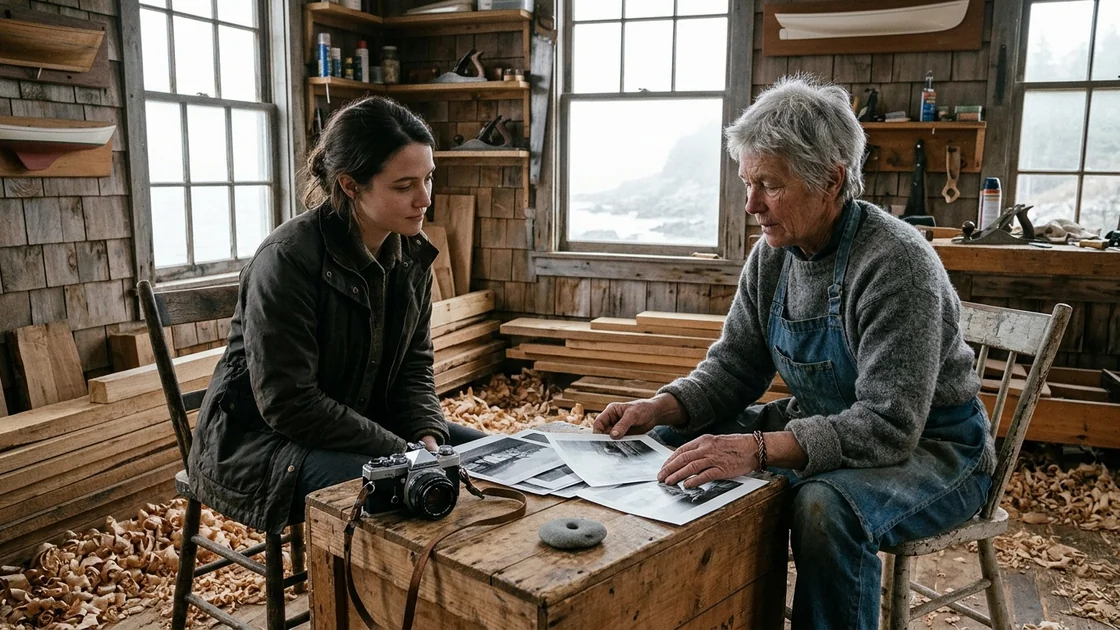
When Clare found the forgotten Olympus OM-1 tucked beneath yellowing quilt tops in her deceased mother's cedar chest, she did not expect to find thirty-six unexposed frames waiting inside its brass-trimmed belly. Developing the long-expired roll in a rented downtown darkroom, Clare watched as shadowy silver salts bloomed into the documentation of a coastal commune along the rocky margins of Maine during the sweltering summer of 1978. What began as a daughter's private mourning became an excavation of her mother's hidden youth, a season marked by an enigmatic woman named Julian, an act of quiet defiance against a respectable life, and a choice whose echoes fundamentally reshaped everything Clare thought she knew about her family, grief, and forgiveness.
I. The Weight of Dry Goods
The house in Greenfield, Massachusetts, smelled permanently of steeped pekoe and drying floor wax, an aroma that Clare had come to think of not as a scent, but as an architectural feature. It was a tall, sensible Victorian with narrow dormers that squinted out across a lawn choked by dandelions and ground ivy. For twenty-six years, Eleanor Vance had inhabited this structure with a quiet, frictionless routine that seemed almost scientific in its avoidance of disturbance. When she died of an uncomplaining cardiac failure in an armchair by the radiator, she left behind four matching blue tea towels, neatly mended at the hems; nine linear feet of modern European history monographs; three coats in the hall closet; and an absence so neat it seemed almost intentional.
Clare spent the second week of June moving between the rooms with cardboard boxes and a broad black marker. She was thirty-four, an art restorer at a regional conservation lab down in Amherst, trained in the patient reversibility of time. She knew how to coax varnish off old oil boards with ethanol swab sticks; she knew how to humidify brittle wood-pulp paper until the fibers relaxed enough to lie flat between sheets of blotter. But she did not know how to pack up a mother who had left virtually no friction in the world.
Her father, Arthur, had been dead twelve years, having passed away with the same tidy lack of theatricality that had characterized their twenty-year marriage. In the basement, Clare found her father’s tool bench, where every screwdriver was traced in silhouette on a sheet of pegboard in peeling white enamel. If Arthur took down the six-inch flathead, the void remained behind to demand its return.
Her mother’s effects possessed none of that rigid system, yet they were equally impenetrable. Eleanor’s bureau drawers held no hidden sachets, no ticket stubs, no pressed wildflowers between the pages of books. Eleanor had been a cataloger at the public library, a woman who understood that everything in the world belonged to an established category, and that to leave loose ends was to invite a slow and shameful rot into the margins of an institution.
It was on the fourth afternoon, while sorting through the cedar trunk at the foot of Eleanor’s bed, that Clare found the anomaly.
The trunk held four heavy wool quilts pieced in the log-cabin pattern by Clare’s grandmother, their colors faded to the dusty hues of dried kitchen herbs—mustard, sage, madder red. Beneath the fourth quilt, wrapped in an unbleached linen tea towel pinned shut with a large brass diaper pin, rested a camera.
Clare recognized the silhouette before the cloth fell fully away. It was an Olympus OM-1, a compact 35mm SLR from the early 1970s. The body was small, dense, and finished in satin chrome, with black textured leatherette around the midriff. Her father had owned an automatic plastic camera in the 1980s that whirred like a dentist’s drill whenever it spat out a flash-blinded snapshot of Clare beside a birthday cake. This camera was not Arthur’s. It was mechanical, heavy as a river cobble, and entirely analog.
Clare turned it over in her hands. The leather neck strap was supple, worn soft and dark where it had rested against the nape of a neck. The lens was a 50mm Zuiko f/1.4, its aperture ring clicking with dull, buttery precision as she turned it.
She checked the film-advance lever. It was locked midway through its stroke. She glanced at the small circular window on the top plate: the frame counter rested squarely on the number 36.
The camera had not been rewound.
Clare sat back on the floor, the cedar boards pressing hard against her shins through her denim trousers. Her heart took up a strange, syncopated knocking behind her ribs.
In her line of work, latent objects were dangerous. A sealed amphora could contain vinegar or wine; a folded sheet of vellum could crumble into ash if opened under the wrong humidity. But film was different. Film was a chemistry of suspended patience. Inside that camera, wrapped tight around a plastic spool in pitch-black exile, thirty-six small rectangles of cellulose triacetate carried the invisible impressions of photons that had bounced off faces, clouds, walls, and water decades ago. They were waiting in the silver halide crystals like salt crystals waiting for rain.
If the rewind crank had never been turned, the film was still extended across the shutter gate. If she opened the back now, out of reflex or curiosity, light would spill across the emulsion like fire across parched hay, scouring away every trace of whatever was there.
Clare set the camera down on the linen towel with extraordinary care. She tilted the baseplate toward the sunlight drifting through Eleanor’s lace curtains.
There was a small silver clutch button on the bottom plate—the rewind release. Beside it, stamped into the metal, was the serial number: 218402. But it was the film rewind knob on the top left shoulder that drew her attention. She turned the small collar beneath it from R back toward its neutral resting notch, then flipped the tiny crank up from the knob’s recessed top.
She didn't rewind it yet. She needed to know what was inside first. Through the small memo holder on the camera’s back door, she saw no torn cardboard box-end, the common way photographers reminded themselves what they were shooting. The camera kept its own counsel.
Clare walked down the stairs to the kitchen, carrying the Olympus against her chest with both hands. The refrigerator hummed its lone, monotonous tone. She took a roll of blue painter’s tape from her toolbox, tore off two neat strips, and sealed the camera’s back seam and latch release so that no stray thumb could pop the door open.
Then she sat at the kitchen table, took out her notebook, and wrote: Found in trunk. Olympus OM-1. 36 frames exposed. Rewind lever cocked. No notes.
Beneath that, she wrote: Mother never took pictures.
II. The Bath of Phenidone
The darkroom Clare rented was situated in the basement of an old cotton mill in Florence, four miles west of Northampton. It was run by an aging, sour-faced commercial lithographer named Miller who spent his afternoons smoking unfiltered Pall Malls beside an exhaust fan in the loading bay.
The basement smelled of damp concrete, iron pipes, and the sharp, vinegar tang of glacial acetic acid. It was a subterranean world that felt older than the mill itself, lit only by low-wattage amber and deep-red safelights that cast long, velvet-edged shadows across the duckboards.
"You don't know what it is?" Miller asked, squinting through thick, grease-filmed bifocals as Clare set the Olympus on his clean bench.
"I know it was loaded in the seventies or early eighties," Clare said. "The camera went out of production around then, or at least this particular version of the chassis did. The rewind is stiff. I don't want to snap the leader."
Miller grunted, his fingers thick and scarred by years of plate trimmers, but surprisingly delicate as he touched the Olympus’s rewind crank. "If it’s been sitting wound around the take-up spool for forty years, the base is going to have curl like a clock spring. It’ll want to crack if you horse it. Go into the dark. Don't use the crank if it resists. Open the door in total black, cut the tail at the spool, and guide it into a Paterson reel by hand. Don't force the feed."
Clare took a plastic Paterson tank, two plastic spirals, a pair of blunt-tipped scissors, and an old church-key bottle opener into the changing labyrinth—a double-baffled entryway that smelled of light-trapped felt and dusty felt gaskets.
She stood in the absolute blackness until her eyes stopped manufacturing phantom constellations.
The world contracted to the pad of her fingers and the sound of her own breath. She peeled the blue painter’s tape off the camera’s body. She lifted the rewind knob until she felt the internal fork disengage, then lifted it further, feeling for the mechanical pop of the latch.
The door yielded with a faint, rubbery sigh. The foam light-seals had disintegrated into sticky, tar-like crumbs—she could feel them smear against her knuckle—but inside, the camera body was dry and cool.
Her fingertips explored the film channel. The ribbon of acetate was rigid, stiff as dried birch bark. Slowly, click by click, she guided the film backward onto the cartridge spool, her fingers monitoring the tension. When it reached the end, she didn't yank it from the take-up slot; she clipped it cleanly with the shears.
Loading forty-year-old film onto a plastic spiral in the dark is an exercise in tactile faith. The emulsion side, curved inward for four decades, resisted the plastic ball bearings of the Paterson reel. It hitched, buckled, and popped. Clare closed her eyes—an absurd gesture in the ink-black room—and imagined the microscopic layers: gelatin, halide crystals, anti-halation backing, all brittle as dried leaf veins. She coaxed the film millimeter by millimeter until the reel gave a soft, rhythmic snick-snick-snick and the tail vanished into the core.
She dropped the reel into the tank, jammed the center column down, twisted the light-tight lid until it clicked, and breathed.
Outside the maze, under the dim incandescent work lamp, Miller looked up from an issue of an offset-printing trade journal.
"Get it on?"
"It’s in the can," Clare said. "What should I stand it in? If it’s Tri-X, it’s lost three stops of speed to age, and the fog is going to be thick as chowder."
"Don't push it with hot soup," Miller advised, pointing with the stem of his unlit pipe toward a shelf of brown glass Boston rounds. "Rodinal. One to fifty. Cold—sixty-five degrees. Let it sit forty minutes. Give it two inversions at the start, two at twenty minutes, and let the rest happen by gravity. The bromide drag will be hell, but you won't tear the emulsion off the acetate with violent agitations."
Clare measured the chemicals. The Rodinal was the color of weak amber tea. She tempered the water bath with small splashes of cold well water from the basement tap, checking the dial of her metal stem thermometer until the needle hovered at precisely sixty-five Fahrenheit.
She poured the developer into the center hole of the tank. The sound was a hollow, thirsty gurgle.
She set the mechanical timer. The ticking of the clockwork mechanism filled the corner of the mill, loud and dry against the distant thrum of the river outside the foundation walls.
Forty minutes.
Clare leaned against the stainless steel sink, her hands damp. Her mother had lived eighty-one years. Forty minutes was nothing—a speck of lint on the edge of a wool skirt. Yet as she watched the luminous red second hand sweep around the clock face, she felt an unbearable vertigo, as though she were standing on the lip of a granite quarry looking down through hundreds of feet of clear, cold water at something pale and metallic wedged between two boulders at the bottom.
When the timer chimed, she dumped the developer. It came out murky, tinged with a dirty, purplish-gray effluent—the dye couplers and age-fog of the seventies washing into the drain.
Stop bath: thirty seconds of pungent vinegar smell.
Fixer: eight minutes. The sodium thiosulfate did the work of permanence, clearing the unexposed halides, making the shadow transparent and the highlights dense and black.
She opened the tank under the running wash tap.
Clare drew the plastic reel out of the water. The spiral was dark. She found the outer end of the strip with her thumb, slipped it free from the guide, and pulled out the first twelve inches.
She held the wet strip up toward the overhead fluorescent tube.
The base was deeply stained, a dark, bruised lavender-gray. But there, stamped in sharp, inverted black silhouettes across the margins, were clear frame numbers and the tiny, neat lettering of the manufacturer: KODAK SAFETY FILM 5063. Kodak Plus-X Pan.
And inside the rectangles, pale against the dark silver, were images.
"Well?" Miller called from his stool.
Clare did not answer. She could not.
The first three frames were blurry abstractions—a thumb over the corner of the frame, the corner of an iron woodstove, the blur of a yellow dog’s tail swinging across a porch floor. But frame four was sharp.
It was Eleanor.
Her mother was standing on an unpainted wooden wharf with a salt-bleached rail behind her. She was perhaps twenty-five or twenty-six years old—the age Clare had been when she had finished her apprenticeship in Hartford. But she was unrecognizable.
In Clare’s life, Eleanor Vance had worn skirts of pleated navy wool, cardigans buttoned to the collarbone, and short, perm-set hair the color of wet sand, kept immobile with lacquer.
The woman hanging on the wet film strip wore oversized canvas trousers rolled to the shins, held up with a piece of hemp twine. Her feet were bare, long-toed and caked with dark silt. Her hair was long—falling in thick, unruly waves over her shoulders, whipped across her cheek by a sea wind—and she was laughing with an open, unchecked ferocity that showed a chipped left incisor Clare had never once seen in her mother’s mouth.
Beside her, Eleanor’s left hand was caught in the act of dropping a rusted iron shackle into a wooden bucket. On her forearm was a dark, jagged smudge—either tractor grease or creosote.
Clare pulled the strip further from the reel.
Frame seven: A low, sprawling salt-marsh farmhouse with cedar shingles warped like scales on an old fish. Lupines, tall and pale in the negative, choked the ditch along a rutted dirt road.
Frame twelve: Two women sitting on an overturned dory. One was Eleanor. The other was taller, leaner, with a severe, handsome face, dark cropped hair, and ears that stuck out slightly like those of an alert terrier. She wore a men’s work shirt with the sleeves ripped off at the armpits, showing long, sinewy shoulders. She was looking not at the lens, but at Eleanor. The look was not the polite regard of a neighbor; it was an act of intense, unshielded gravity.
Frame nineteen: An interior. Sunlight cutting through a multi-paned window, illuminating a table strewn with mason jars, bread loaves wrapped in checked linen, and an open ledger.
Frame thirty: Eleanor asleep on an iron cot beneath a rough blanket, a single hand curled near her chin, her throat long and exposed to the light.
Frame thirty-five: A battered pickup truck, an International Harvester with one white fender and one black one, idling in a gravel driveway, exhaust caught in the low morning light like a white cloud.
Frame thirty-six: A hand holding a small, smooth stone out toward the lens, the background a blur of salt meadow and distant water. The stone had a hole worn straight through its middle—a hag stone.
Clare held the dripping strip by its edges, her fingers trembling until the shadows danced against the mill's water-stained ceiling.
"Miller," she said, her voice thin. "Where do you keep the negative sleeves?"
III. The Map of Salt and Lupine
By midnight, Clare was sitting in her small rental apartment on Elm Street, surrounded by resin-coated contact sheets that were still slightly tacky to the touch.
With an eight-power loupe pressed against her eye, she moved from frame to frame across the light box. The quality of the light in the photographs had an oceanic sharpness, the kind of raking, diamond-bright luminescence found only north of Boston in midsummer, where the sky seemed larger because the land was broken into a million granite shards by the sea.
In the background of frame eight, behind the low salt-marsh house, a weathered wooden sign was nailed to a spruce post. Clare adjusted the loupe’s focus ring until the silver grain resolved into sharp, pebble-like clusters.
The lettering on the sign was painted in uneven, rustic capitals: CAPE BROKEN CO-OP / J. ST. CLOUD & G. MORIN / POULTRY, ICE, CEDAR.
Beneath that, in smaller letters: JERICHO BAY.
Clare straightened her back, her spine cracking in the quiet kitchen.
Jericho Bay was in Maine, halfway between the Kennebec River and Mount Desert Island, a region of drowned valleys, tidal ledges, and black spruce forests where the fog lived for weeks at a time like an unwanted tenant.
Eleanor Vance had never mentioned Maine. In Clare’s memory, the family’s summer holidays had consisted of five-day trips to a motel outside of Lake George, New York, where Arthur insisted on eating breakfast at the same Howard Johnson’s every morning because he liked the predictability of the fried eggs, and Eleanor sat on the balcony with a library book, wearing large sunglasses and an enormous straw hat that shielded her entire face from the sun.
"Your mother doesn't care for the water," Arthur had told Clare once, when Clare had asked why they didn't go to the Cape like the other children from her school. "She had an ear infection when she was a girl. Sensitive drums. The salt air makes her head ache."
Clare looked down at frame fourteen through the glass.
Eleanor was standing waist-deep in dark, brackish water, hauling on the painter of a skiff. Her head was thrown back, her throat corded with effort, her face wet with salt spray, her teeth bared in an exultant grin.
Clare turned the contact sheet over. She took out her mother’s high school and college transcripts, which she had found in the Greenfield bureau the day before.
Eleanor had graduated from Mount Holyoke in May of 1977 with a degree in classical languages. According to the standard family mythology, she had spent the following year caring for her own ailing mother in Pittsfield before taking her first library position in Greenfield in the autumn of 1979, where she met Arthur Vance at a church social for young professionals.
There was an entire year unaccounted for. Twelve months between the death of grandmother Vance in June of 1977 and Eleanor’s appearance in the Pioneer Valley in the late fall of 1978.
Clare went to her desk and opened her laptop. She searched for Cape Broken Co-op Jericho Bay Maine.
Nothing came up under that exact title except a 2004 land conservation easement filing by the state of Maine: Jericho Bay Land Trust: Acquisition of the Cape Broken Tract (formerly St. Cloud Farmstead), 114 acres of coastal headland and salt marsh.
She found a county historical society page with a scanned index of small agricultural communes from the late 1960s and 1970s. The Back-to-the-Land movement had flooded the Maine coast with college dropouts, anti-war activists, draft resisters, and idealistic weavers who believed they could live on parsnips and goat milk through a Downeast January. Most of the co-ops had collapsed within three years under the weight of frozen plumbing, black flies, and ideological splits over who was supposed to clean the grease traps.
Under the listing for Jericho Bay, there was a single entry:
Cape Broken Commune (1974–1981). Founded by Julian St. Cloud and Genevieve Morin. Boat repair, market gardening, artisanal shingle-splitting. Dissolved after the fire of November 1981.
Julian St. Cloud.
Clare bent back over the contact sheet.
Frame twenty-two was a portrait of the tall woman with the cropped hair. She was sitting on the wooden steps of the farmhouse, an adze resting between her knees, a spiral of fresh wood shaving curled over the toe of her boot. She had an intensity that seemed almost modern—a direct, challenging gaze that went straight down the barrel of the Zuiko lens and through the forty intervening years. She didn't look like a commune hippie; she looked like an apprentice shipwright, lean-jawed, her collarbones sharp as gulls’ wings beneath her gray work shirt.
And on her left wrist, she wore a bracelet made of three strands of twisted copper wire.
Clare felt her breath catch.
She rose, walked into her bedroom, and fetched the small mahogany jewelry box that had sat on Eleanor’s dresser for as long as Clare could remember. It had contained only three items: Eleanor’s plain gold wedding band, an enameled silver pin in the shape of a dogwood flower that Arthur had given her for their tenth anniversary, and, in the bottom velvet trough, tucked beneath a cotton pad, a bracelet made of three strands of twisted copper wire, darkened with age to a deep, chocolate brown.
Clare had asked about it once, when she was twelve.
"A souvenir," Eleanor had said, closing the box with a click that signaled the end of the inquiry.
"From where?"
"From a trip I took once, before I settled down. It’s not valuable, Clare. It’s just industrial scrap."
IV. Route 1 North
The highway turned from four lanes to two north of Brunswick, narrowing into a gray asphalt ribbon bordered by scrub pine, rusted metal roofs, and endless wooden shacks advertising LIVE LOBSTER and NATIVE BLUEBERRIES.
Clare drove her ten-year-old Volvo wagon with the driver’s side window half-down, letting the heavy, cool salt air fill the car. In the passenger seat lay a cardboard portfolio containing eight-by-ten enlargements she had printed that morning before leaving Miller’s shop: Eleanor on the wharf; the two women on the dory; the tall woman, Julian, holding the adze; and the 36th frame—the hand offering the hag stone.
Jericho Bay did not appear on the official state highway map. It was an indentation between two peninsulas that jutted out into the Atlantic like the broken tines of an iron fork. To get there, she had to follow a series of unnumbered county roads that grew progressively narrower until the tarmac gave way to packed gravel and crushed clam shells.
The town—if it could be called that—consisted of a post office operating out of the corner of an oil-company garage, a general store with an idle gas pump out front, and a municipal wharf where four fiberglass lobster boats swung at their moorings in the falling tide.
Clare parked outside the general store. The sign over the porch said G. L. PEABODY: PROVISIONS & TACKLE.
A bell made from a cut-down brass artillery shell clanged against the doorframe as she entered. Inside, the shop was dark, smelling of oilcloth, cedar shavings, smoked herring, and cold coffee. Behind the counter sat a man with skin like sun-cured moose hide, wearing a faded red flannel vest despite the July warmth. He was using a pocketknife to scrape the carbon from the bowl of an applewood pipe.
"Help ye?" he said, not looking up immediately.
"I hope so," Clare said. She took one of the photographs from her bag—the one of the low farmhouse with the lupines in the ditch—and laid it flat on the counter between a display of lead sinkers and a glass jar of pickled eggs. "I’m looking for this place. I was told it was out on the Cape Broken tract."
The old man stopped scraping his pipe. He reached into his shirt pocket, pulled out a pair of wire-rimmed reading glasses with one ear-wire repaired with electrical tape, and leaned over the print.
He looked at it for a long time. His thumb, broad and blunt as an axe head, touched the edge of the paper, taking care not to smudge the emulsion.
"Haven't seen that porch in thirty years," he said softly. "House burned in eighty-one. Chimney stood for another five or six winters until the frost tipped it into the cellar hole. What’s your business with it?"
"My mother was there," Clare said. "In seventy-eight."
He looked up from the photograph. His eyes were a pale, watery blue, the color of skimmed milk, but sharp. He looked at Clare’s hairline, the line of her nose, the way she stood with her hands half-tucked into her jacket pockets.
"You’re an Ellis," he said.
"Vance," Clare corrected. "My mother was Eleanor Ellis before she married."
"Aye," the man said, nodding slowly. "That’s what I said. You’ve got her eyebrows. Straight across, like someone took an ink line to you. She was the one who could read the Greek."
Clare felt her stomach hollow out. "You knew her?"
"I’m George Peabody," he said, extending a hand that felt like dry drift-oak. "I sold 'em their oats and salt pork when they had money, and didn't chase 'em when they didn't. They was an odd bunch out on the Point, but they paid their bills when the shingle boat come down from Rockland. Your mother spent five months out there that summer. July through November. She used to come in here on an old three-speed Raleigh with two wicker baskets on the back, full of wild blackberries she’d trade for lamp oil."
"Is anyone still there?" Clare asked. "The woman who ran it—Julian St. Cloud?"
George Peabody took his glasses off and let them hang from their lanyard against his chest. He looked out the grease-filmed window toward the harbor.
"Julian don't live on the Point no more. The state took the land for the birds after the fire. She lives out on the Gut, three miles down the point road. Old schoolhouse behind the fish-drying racks. You’ll know it by the pile of boat timber in the front yard. If the gate’s shut, don't go in. If it’s open, she’s either in the shop or down on the mud flats."
He slid the photograph back toward Clare.
"Your mother die?" he asked.
"Six weeks ago," Clare said.
George nodded once, a quick, downward jerk of his chin. "She was a fierce little thing that summer. Didn't look like she belonged out here—had soft hands when she arrived, like she’d never picked up anything heavier than a butter dish. But by September she was splitting cedar shingles with a froe and an iron mallet like she’d been born in a lumber camp. Julian thought the sun rose out of her pocket."
He paused, his thumb tapping the edge of the counter.
"We figured she’d come back," he added. "Julian waited two years before she let the place go slack. Then the fire happened. Julian stayed, though. Don't know where else she’d go. Some people ain't fit for places with sidewalks."
V. The House on the Gut
The road to the Gut was little more than two bare tire tracks running through a tunnel of stunted spruce and dwarf tamarack. The fog had begun to push in from the open ocean, rolling across the ledges in long, gray tendrils that tasted of cold iodine and wet fern.
The old schoolhouse stood on a granite shelf thirty feet above the high-tide mark. It was small, clad in weathered cedar shakes that had turned the color of pencil lead, with four tall, multi-paned windows facing the water. In the front yard, stacked in neat cribs on granite blocks, were thousands of board-feet of boat-building lumber: white oak crooks for knees, long clear planks of cedar, and salt-seasoned hackmatack.
The wooden gate was wide open, pinned back against the fence by a rusted iron anchor stock.
Clare got out of the car. The silence was immense, broken only by the rhythmic, hollow clunk-thump of a wooden halliard slapping against a flagstaff somewhere down near the shore, and the distant, low groan of the whistle buoy on the ledge three miles out.
She walked up the gravel path, her boots crunching softly. As she approached the side door of the schoolhouse—a Dutch door with the top half swinging slightly in the wind—she heard the rhythmic, dry rasp of a hand plane: shhh-shhh-shick. Shhh-shhh-shick.
She reached the door and looked inside.
The interior was one large room, lit by the high windows and two hanging kerosene lamps, though an electric cord ran across the ceiling to a single modern task light. The floor was covered with a six-inch carpet of pine and oak shavings that curled like golden butter ribbons. The air was warm, smelling of pine pitch, beeswax, and woodsmoke.
Working at an eight-foot bench was a woman.
She was old now—her hair entirely silver, cut short and bristling around her ears like frost on lichen. But the profile was unmistakable: the high, predatory bridge of the nose, the lean jaw, the long, muscular neck. She was wearing a faded denim work apron over a gray wool sweater, her sleeves pushed up to reveal forearms corded with muscle, though the skin was spotted with liver spots and pale scars.
On her left wrist, she still wore three strands of twisted copper wire.
Clare stood on the threshold, her hand resting against the door jamb. The wood was cold under her palm.
The hand plane stopped.
The woman didn't turn around immediately. She blew a long, gentle breath across the wood she was dressing, sending a cloud of fragrant cedar dust into the beam of the task light.
"Peabody called from the store," the woman said. Her voice was low, gravelly, with the flat, clipped cadence of maritime New England. "Said there was a girl driving Eleanor’s face around in a Swedish automobile."
Julian St. Cloud set the wooden bench plane down on its side so as not to dull the iron. She turned around.
Her eyes were dark gray, set deep beneath heavy, weathered brows. She wiped her hands on her apron, her gaze traveling over Clare with a steady, clinical intensity that made Clare want to pull her shoulders back.
"You look like her," Julian said. "Around the mouth. But you’ve got someone else’s chin. The father, I expect."
"Arthur," Clare said. "His name was Arthur Vance."
"Arthur," Julian repeated, testing the name as though it were a piece of doubtful joinery. "The clerk from Pittsfield."
"He was an accountant," Clare said. "From Greenfield."
Julian gave a faint, humorless twitch of her lips. "He was a clerk when he wrote her those letters that summer. Blue paper. Smelled like department-store soap. He wrote twice a week, telling her about the interest rates on building-and-loan mortgages and how his mother was clearing out the second-floor linen press for her."
She stepped away from the bench, walked to a small iron woodstove in the center of the room, and lifted the kettle. It was cold. She set it back down.
"She’s dead, then?" Julian asked.
"Six weeks ago," Clare said. "Her heart."
Julian stood very still for several seconds. Her hands, large and scarred, rested against the front of her apron. She didn't drop her head or cover her face; she simply looked through one of the tall windows toward the water, where the fog was turning the horizon from silver to dull lead.
"Eleanor had a good heart," Julian said quietly. "Too good for her own comfort. That was always the difficulty. Sit down, Clare. Don't stand in the draft. It makes the bones ache."
VI. The Camera in the Linen
There were two chairs in the room, both hand-made from green ash with seats woven from flat hickory splints. Julian sat in one and pointed Clare toward the other. Between them stood an upturned shipping crate that served as a table, upon which sat a glass jar containing several dried seedpods and an iron spike from an old coaster.
Clare reached into her bag, took out the prints and the Olympus OM-1, and laid them on the crate.
When Julian saw the camera, her hand moved out quickly, almost instinctively, then stopped two inches from the satin-chrome top plate. Her fingers curled slightly into her palm.
"I thought she threw it off the ferry," Julian said, her voice dropping an octave.
"It was in her cedar trunk," Clare said. "Under four quilts. The film was still inside. It had never been rewound."
Julian reached out again, her fingers touching the camera’s leatherette with the extreme, delicate tenderness of a surgeon. She touched the rewind crank, the shutter button, the lens rim.
"She didn't develop them?"
"Never," Clare said. "I did it two days ago. In a darkroom in Florence."
Julian looked down at the pile of photographs. She took the top one—Eleanor on the wharf, her bare feet muddy, laughing at whoever stood behind the lens.
A long, ragged sigh escaped the older woman’s chest. Her thumb traced the edge of the print, where the lavender-gray fog of forty years had softened the deep blacks into charcoal.
"She bought it in Boston," Julian said. "In May of seventy-eight. She had eighty dollars left from her graduation money. She came up on the bus to Rockland with a canvas duffel bag, two pairs of shoes, and this machine around her neck. She told me she was going to write a monograph on the marine vocabulary of the Maine coast—the old terms for the tides, the gear, the timber. She had a little notebook with marbled covers."
"How did she find Cape Broken?" Clare asked.
"Her cousin was Genevieve Morin," Julian said. "Genevieve was my partner then. We were trying to build a world that wasn't rotten at the edges. We’d bought the farm for six thousand dollars back taxes in seventy-four. We had two workhorses, eight sheep, a wood-splitter, and twenty acres of hay. We were going to build dories and live without the draft, without the banks, without the men in gray suits who spent their days figuring out how to turn trees into paper napkins and boys into meat."
She looked at Clare, her gray eyes hard and bright.
"We were fools, of course," Julian said. "Arrogant, righteous fools. We thought winter could be defeated with enough firewood and good intentions. But that summer—that summer Eleanor came—it wasn't winter yet."
She laid the photograph down and picked up the next one: the two of them on the dory.
"She wasn't like the rest of us," Julian continued, her voice softening into memory. "The rest of the kids who came drifting through from Goddard or Marlboro were loud. They had theories about Mao and organic compost, and they played the guitar badly by the stove until two in the morning. Eleanor was quiet. She would sit in the corner of the kitchen with her Greek texts and her dictionary, copying out nouns for the wind. Aura. Zephyrus. But she noticed things. She noticed when the sheep were bloating before Genevieve did. She noticed that the sills on the north barn were settling into the mud. One morning she just put her books away, braided her hair, and asked me how to use a drawknife."
"She stayed five months," Clare said.
"Five months and four days," Julian said. "From the middle of June to the twenty-third of October."
"What happened?" Clare asked.
Julian turned the photograph of herself with the adze over, face down on the crate, then turned it face up again.
"What happened is that we fell in love," Julian said simply. "Not the kind of love they have in the novels she kept in her satchel. It was like two pieces of white oak being bent around the same frame under hot steam. It wasn't polite. It didn't have a future that anyone in Greenfield or Boston could give a name to without wanting to spit or call the sheriff."
She leaned back in her chair. The hickory splints creaked under her weight.
"In seventy-eight, a woman didn't just walk out of the world she was born to," Julian said. "Not unless she was prepared to have no family, no references, no safety, no children. Eleanor wanted those things. She wanted them with an ache that made her sit on the edge of the wharf and stare at the water until her eyes were red. She wanted her mother’s blessing; she wanted a home where people didn't whisper through the screen doors; she wanted to be normal. She thought normality was a form of grace."
"And you?" Clare asked.
"I didn't give a damn about normality," Julian said with a sudden, sharp flash of her old teeth. "I hated it. I’d grown up in a parsonage in Bath. I knew what lay behind the parlor curtains in sensible New England houses: cold soup, closed accounts, and people who died by inches because they were terrified of making a stain on the carpets. I told her that if she went back to Arthur Vance, she would be buried alive."
"That was cruel," Clare said, the daughter’s loyalty rising unbidden in her throat.
"It was true," Julian said, looking Clare directly in the eye. "Look at the pictures, Clare. Look at her face."
Clare looked.
In frame thirty, Eleanor lay asleep on the iron cot. The window was open behind her; the curtains were blowing inward, thin as gossamer. The light caught the soft curve of her cheek, the salt-tangled curl of her hair, the total, unguarded surrender of her posture.
There were no pictures like this of Eleanor Vance in Greenfield. In Greenfield, Eleanor had slept in a high mahogany four-poster with a ruffled dust skirt, her hair held in place by a pink mesh net, her body wrapped in high-collared flannel or crisp poplin, lying perfectly straight on her side of the mattress as though Arthur had chalked a boundary line down the ticking.
"Who took this one?" Clare asked, her finger hovering over the sleeping portrait.
"I did," Julian said. "She was teaching me how to use the focus. I had wood-pitch on my fingers; she had to wipe the lens with the hem of her slip because I’d left a smudge on the glass. She told me the camera was like an eye that never forgot, even after you closed it. She said she was going to keep a record of everything we did that summer so that when we were eighty, we could look at the prints and prove to ourselves that we’d been alive."
"Then why didn't she rewind it?" Clare asked. "Why leave it inside the dark for forty years?"
Julian stood up. She walked to the window and pressed her forehead against the glass. Outside, the fog had completely swallowed the bay; the water was invisible now, only a pale, milky void from which the sound of the tide came up like a lung filling and emptying.
"Because of the telegram," Julian said.
VII. The Frost on the Pumpkin
"Her father died in sixty-nine," Julian said, her back still turned to Clare. "It was just her mother, Gertrude, down in Pittsfield. In September, Gertrude had a stroke. Not a fatal one—a warning. Arthur sent the telegram. It arrived at the general store on a Monday morning. George Peabody brought it out in his truck. I was down at the slipway, caulking the bottom of a twenty-foot dory with oakum and pine tar. Eleanor was in the orchard, picking Duchess apples for cider."
Julian’s shoulders rose and fell.
"She came down to the shore holding that yellow piece of paper like it was a hornet. Her face was gray. She didn't cry. She just said, 'My mother needs me, Julian.'
"I told her Gertrude had two sisters in Lenox who didn't do anything all day except play bridge and eat peppermint drops. I told her Arthur was using her mother to pull the choke-chain. I said, 'If you get on that bus, Eleanor, you’ll never get off it again. You’ll be in that parlor with the lace doilies until they carry you out in a box.'
"We fought for three days. Not with shouting. With silence. That’s the worst way women fight. We moved around each other in that low kitchen like two dogs in a pen. She’d pack her duffel bag; I’d take it off the bench and throw it into the woodshed. She’d go get it; I’d go out to the barn and split wood until my palms were bleeding through my mittens."
Julian turned back into the room. Her face had aged ten years in the space of ten minutes, the hollows beneath her cheekbones dark as slate.
"On the fourth morning, it was October twenty-third," Julian said. "The first real black frost of the year. The ground was hard as iron. The dory was sitting on the stocks, ready for the water. Eleanor came out of the house wearing her gray woolen coat—the one she’d arrived in. Her hair was pulled back into that neat, sensible bun she used to wear. She had her bag. And she had the Olympus around her neck."
Julian walked back to the crate and looked down at the thirty-sixth print: the hand holding the hag stone.
"We walked down to the road where George Peabody was going to pick her up to take her to the bus in Rockland," Julian said. "We didn't speak the whole half-mile. The puddles were skimmed with ice that cracked like window glass under our boots. When we reached the turn-off, she took the camera off her shoulder. She held it out to me. She said, 'Take it. It belongs here.'
"I wouldn't take it. I was so angry, Clare. My God, I was so full of bile. I told her that if she was going to go back to that dry-goods life, she should have the decency to take the ghost with her. I told her I wasn't going to keep her shrine for her while she went and played house with a clerk who didn't know the difference between white pine and spruce.
"She looked at me. She didn't get angry. She just reached down into the gravel by the ditch, found that stone with the hole through it—we’d found a dozen of 'em on the beach that August—and she held it out to me. She said, 'Look through the hole, Jules. Tell me what you see.'
"I didn't look. I snatched the camera out of her hands, wound the lever until the counter hit thirty-six, and I pointed it at her hand. I said, 'I see someone who’s afraid of her own blood.' And I tripped the shutter."
Julian stopped. Her breath came with a small, whistling sound in her throat.
"Then what happened?" Clare whispered.
"The truck came," Julian said. "George pulled up in that old International with the two-colored fenders. Eleanor got in. She left the camera sitting on top of the fence post. I took it back to the house. I was going to throw it into the harbor. I went down to the wharf with it three times that week, but I couldn't do it. Every time I looked at it, I knew her breath was inside it. The air she’d breathed when she loaded the spool was trapped inside that little metal box."
"How did she get it back?"
"I mailed it to her," Julian said. "A year later. In the winter of seventy-nine. I heard through Genevieve that she’d married Arthur. That she’d taken the job at the library in Greenfield. I didn't send a letter. I didn't rewind the film. I just wrapped the body in an old towel, put it in a wooden lard tub, and sent it to the library by parcel post. I wanted her to have to look at it. I wanted her to know that the summer didn't disappear just because she’d bought a new tea kettle and a hat with a veil."
Julian sat down again, her fingers resting lightly on the camera’s cold chrome.
"I thought she’d develop them," Julian said, her voice barely louder than the hum of the stove. "I thought she’d put them in an album, or maybe burn them in the backyard incinerator when Arthur was at the office. I never thought she’d just... leave it. Thirty-six frames, waiting in the dark for forty years."
"She didn't burn them," Clare said. "She kept them in her cedar chest. Under her grandmother’s quilts."
Julian gave a strange, small smile that was more painful than a sob.
"That was Eleanor," she said. "She couldn't live with them, but she didn't have the heart to kill them. So she put them in a coma."
VIII. The Hag Stone
They sat in the schoolhouse as the fog turned from gray to twilight blue, and then to the flat, velvet black of a Maine coast night. Julian lit the second kerosene lamp. The yellow light threw their shadows high against the cedar walls, mingling them with the silhouettes of hanging saws, timber gauges, and half-hull models of working dories.
Julian had made tea—strong, black, and bitter, brewed in a battered tin pot directly on the woodstove. They drank it from heavy white ceramic mugs with chips around the rims.
"Why didn't you go after her?" Clare asked.
Julian held her mug with both hands, her long fingers curved around the porcelain to draw the heat.
"Go where? To Greenfield?" Julian laughed, a harsh, dry sound. "Can you see me on Elm Street, Clare? Standing on the sidewalk in my boots with timber pitch under my nails, calling up to the second floor of a clapboard duplex? Arthur Vance would have called the police, and he would have been right to do it. That wasn't my world. My world was here, on the mud flats. If she couldn't stay here, she couldn't have me at all. We were all or nothing in those days. We didn't believe in compromises. We thought compromises were what made people like our parents—empty, dry, and polite."
"She wasn't empty," Clare said.
Julian looked up sharply.
"She wasn't," Clare repeated, her voice steadying. "She wasn't wild like she was here. She never ran barefoot, and she never chipped a tooth. But she was kind. When I was small, if I was sick, she’d sit by the bed and translate the Odyssey for me into English that sounded like poetry. She knew every bird that came to the feeder by its call. She kept our house so quiet because she said the world was too loud to hear what people were actually thinking."
Clare looked down at the photograph of Eleanor asleep on the cot.
"She loved him, Julian," Clare said. "Not the way she loved you. But she loved my father. When he died, she sat in the kitchen for three weeks with his work gloves in her lap. She didn't cry in front of people, but she didn't put them away either. She was faithful to the life she chose."
Julian was silent for a long time. The wind had shifted to the east, bringing the smell of the outer islands—cold, wet kelp and spruce bark. The sound of the whistle buoy seemed closer now, its low, rhythmic mournfulness pulsing through the floorboards like a heartbeat.
"I know," Julian said at last. "I know she was. That was why it hurt so much. If she’d been a coward, I could have hated her. It’s easy to hate a coward. It’s very hard to hate someone who is just trying to do what she thinks is her duty, even when it’s tearing the skin off her ribs."
She stood up, walked to a small pine cabinet beside the bench, and opened the door.
From a shelf behind several jars of copper rivets and tins of marine glue, she brought out a small, flat wooden box made of clear white pine, its lid sliding in a grooved channel.
She slid the lid back. Inside, resting on a bed of dry wood shavings, was a stone.
It was gray basalt, about the size of a plum, worn smooth and flat by thousands of years of tide on the Jericho Bay ledges. Straight through its center was a hole three-quarters of an inch wide, bored by some long-dead mollusk or the patient, circular grinding of granite grit in an eddy.
Julian picked it up and held it out to Clare.
"The thirty-sixth frame," Clare said.
"She dropped it," Julian said. "When she got into George’s truck. It fell out of her pocket into the gravel. I went back after the truck turned the corner at the creek and I found it. It was still cold from the ditch."
Clare took the stone. It was smooth as silk under her fingers, dense and heavy for its size. She held it up to her eye and looked through the hole.
Through the aperture, illuminated by the yellow glow of the kerosene lamp, she saw Julian’s face—the silver hair, the dark, deep-set eyes, the line of the mouth that had held Eleanor Vance’s name for forty-four years without ever saying it to anyone who could understand.
"What do you see?" Julian asked, her voice dropping to a whisper, quoting Eleanor across the chasm of time.
Clare lowered the stone.
"I see my mother," Clare said. "Both of her."
IX. The Latent Image
They spent the morning working in the shop.
Clare did not leave at dawn as she had planned. Instead, she took off her woolen overshirt, borrowed a heavy canvas apron from a hook behind the door, and helped Julian carry eight-foot cedar planks from the seasoning stacks into the shop.
Her hands, usually accustomed to the delicate, chemical balance of restoration solvents and horsehair brushes, grew red and rough against the raw wood. She learned the weight of white oak—how it differed from the airy, spongy lightness of northern white cedar. She learned how to sight down the edge of a board with one eye closed to see if the crown had twisted in the drying racks.
They didn't talk about Eleanor again until midday, when they sat on the granite shelf below the schoolhouse, eating bread and sharp white cheddar cheese they had cut with Julian’s pocketknife.
The fog had finally burned off under a high, crystalline sun. Jericho Bay lay before them like a sheet of hammered pewter, broken here and there by the dark, spruce-crowned humps of the uninhabited ledges. A lobster boat was working two miles out, its diesel engine a faint, rhythmic chug-chug-chug that drifted over the water like the click of a distant clock.
"What will you do with them?" Julian asked, looking back toward the schoolhouse where the prints lay on the crate.
"I’m an archivist," Clare said. "I know how to preserve them. Acid-free sleeves. Mylar enclosures. Cold storage at thirty-eight degrees. They’ll last two hundred years without fading."
Julian shook her head slowly.
"That’s not what I asked, Clare."
Clare looked at her sandwich, then down at the water lapping against the rock weed at her feet.
"I don't know," she admitted. "When I found the camera, I was angry. I thought she’d lied to me. I thought her whole life—the library, the blue tea towels, my father, our Christmases with the artificial tree—was just an act. A performance she put on because she didn't have the nerve to be who she really was."
"She was who she was," Julian said gently. "People aren't just one thing, Clare. That’s the mistake we made back then. We thought you had to choose: you were either a revolutionary or a slave; you were either free or you were dead. But your mother wasn't a slave, and she wasn't dead. She just had more than one room in her house. She chose to live in the front room where the family was, but she kept the back door locked, not because she was ashamed of it, but because she knew if she opened it, the wind would blow the lamps out."
Julian took a small sip of cold water from a tin cup.
"Give me the negative," she said.
Clare turned her head. "Which one?"
"The thirty-sixth," Julian said. "The hand. You keep the rest. Keep Eleanor on the wharf, keep her in the dory, keep her sleeping on the cot. Show them to your children, if you have them. Tell them their grandmother was a wild creature for one summer before she became a librarian. But the hand belongs to me. It’s my hand."
Clare looked at Julian for a long time. The silver hair was blowing across the woman’s forehead in the noon breeze, catching the sunlight like strands of clean aluminum.
"All right," Clare said.
They walked back up the granite path to the shop.
Clare took her negative carrier and her shears from her leather kit bag. With extreme precision, cutting squarely through the clear acetate space between frames thirty-five and thirty-six, she separated the final rectangle of film from the strip.
She placed it in a small glassine envelope and laid it on Julian’s bench plane, right beside the wooden handle.
Through the translucent paper, the inverted image was clearly visible: the small dark hand, the white circle of the stone’s center, the gray blur of the Maine road behind it.
Julian didn't pick it up. She simply looked down at it, her hands resting flat on the workbench on either side of the tool.
"Thank you, Clare," she said.
"Thank you for teaching her how to split cedar," Clare said.
Julian gave her small, crooked smile. "She was terrible at it at first. She hit her thumb with the beetle three times the first afternoon. She didn't drop the mallet, though. She just cursed in Latin and started on the next billet."
X. The Return to Elm Street
Clare drove south that afternoon.
The light followed her down Route 1, changing from the hard, diamond-bright clarity of the coast to the softer, amber-filtered haze of southern New Hampshire and Massachusetts. She did not stop at the lobster shacks or the antique barns. She drove with the window down, her left arm resting on the door sill, feeling the heat of the road against her skin.
She reached Greenfield at nine in the evening.
The Victorian house was dark. It stood among its dandelions, tall and silent, its windows reflecting the yellow streetlamp on the corner of Elm Street. For the first time since her mother had died, the house did not feel empty to Clare. It felt inhabited by things that had no need of speech—by shadows that had settled into their corners with a vast, patient relief.
Clare went inside. She did not turn on the hall light.
She walked through the kitchen, where the refrigerator still hummed its lone note, and went up the stairs in the dark, her boots finding the familiar creaks in the fourth and seventh risers.
In Eleanor’s bedroom, the cedar chest stood open, its quilts pulled back from where Clare had left them two days ago.
Clare set the Olympus OM-1 down on the small mahogany nightstand beside Eleanor’s reading lamp.
She took the prints from her portfolio. There were seven of them now.
She did not put them back into the cedar trunk. She walked to Eleanor’s small oak desk—the one where her mother had sat every Sunday evening with her checkbook, her ledger, and her fountain pen, balancing the family accounts to the exact cent.
Clare took four brass thumbtacks from the desk drawer.
Above the desk hung a small, framed print of a Dutch interior—a woman in a white cap peeling an apple by a window, clean and quiet and endlessly still.
Clare took the Dutch interior down.
In its place, she pinned the photograph of Eleanor on the wharf.
Her mother was laughing, her bare feet black with mud, her canvas trousers tied with string, the salt wind blowing her hair into a tangled halo around her face. Her hand was forever mid-stroke, dropping the rusty iron shackle into the dory’s bilge, her chipped tooth white against the sun.
Clare stepped back.
The room was cool. The smell of cedar and floor wax was still there, but beneath it now, faint as the memory of a wave, Clare could smell something else: the sharp, cold iodine of salt rock, the resinous tang of green pine shavings, and the ghost of forty-year-old developer, doing its long, slow work in the dark.
She reached into her coat pocket and took out the hag stone.
She set it on the desk, directly beneath the photograph, where the morning sun would hit it first when it came up over the Massachusetts hills.
Clare turned out the desk lamp. She stood in the doorway for a moment, her hand on the switch, looking at the gray shape of the paper against the wallpaper’s faded roses.
"Good night, Eleanor," she said.
The house made no answer, but from the open window at the end of the hall, the night air came in—cool, restless, and smelling faintly of the river running west toward the sea.