The Late Show at the Strip Mall
Elena Vance is a thirty-eight-year-old mother of two living in an affluent Connecticut suburb whose predictable life unravels and rebuilds when an accidental set at a dingy New Haven comedy club reveals an undeniable comedic gift. Balancing bake sales, soccer carpools, and an emotionally distant husband with late-night sets in smoky basements, Elena adopts a stage persona that tells the unvarnished truth about domestic life, ultimately forcing her to confront what she truly wants from her marriage, her family, and herself as her double life collides with reality.
The minivan smelled eternally of sour milk and oxidized apple slices, a perfume Elena had come to accept as the foundational scent of modern motherhood. It was a 2017 Honda Odyssey, silver, with a permanent scuff on the rear passenger panel where Arthur had clipped a stone retaining wall during the Blizzard of 2019 and never gotten around to buffing out. Arthur believed in functional sufficiency. If the door slid open and the engine turned over, cosmetic perfection was an indulgence for people who didn’t carry two mortgages and a 529 college savings plan.
Elena sat in the driveway with the engine idling, watching the motion-sensor floodlight above the two-car garage click off, leaving her in the cool blue dusk of late October. Inside the house, the upstairs windows glowed like amber lantern slides. In the left bedroom, her fifteen-year-old daughter, Chloe, was undoubtedly curating a video of herself staring impassively at a smartphone screen, participating in some global teen ritual of silent, melancholic vanity. In the right bedroom, ten-year-old Leo was likely lining up his plastic insect terrariums by genus, terrified that a single misplaced stag beetle would disrupt the delicate order of his universe. And downstairs, in the kitchen with the quartz countertops they had spent five weekends selecting in Danbury, Arthur would be rinsing a single fork, placing it in the dishwasher with hydraulic precision, and preparing to review contracts for a commercial real estate trust until eleven o’clock sharp.
Elena took a breath, turned off the ignition, and listened to the engine tick as it cooled.
She had spent twelve years as an auxiliary unit to these three people. She was the one who remembered that Leo could not tolerate socks with toe seams; she was the one who tracked Chloe’s orthodontist appointments across three color-coded Google calendars; she was the one who bought the organic almond butter Arthur preferred because conventional almond butter used palm oil that contributed to deforestation in Sumatra. She did not mind the duties—she loved them, fiercely and protectively, in the way a soldier loves the repetitive maintenance of a rifle—but somewhere between her thirty-fifth birthday and this cold October evening, Elena had become invisible to herself. When she looked in the mirror while brushing her teeth, she saw a woman who looked like someone’s capable aunt, a woman whose hair was cut into a sensible, shoulder-length bob that required five minutes with a round brush and promised nothing reckless to the world.
Her phone buzzed in the cup holder. It was her younger sister, Marlo, who lived in an apartment near Wooster Square in New Haven and worked as an archivist for Yale’s rare book library.
Are you still coming down to drop off Mom’s silver service? Marlo texted. If you don’t bring it tonight, she’s going to hold it hostage over Thanksgiving.
Elena sighed, looking up at the warm, quiet house. She hadn’t even taken her coat off. She tapped back: Backing out of the driveway now.
The drive down Route 34 toward New Haven was thirty minutes of dark, winding asphalt bordered by skeletal maple trees and the occasional gas station glowing like an offshore oil rig in the fog. Elena kept the radio off. She preferred the low, humming thrum of the tires against the road; it was the only thirty minutes of her day where nobody asked her where the extra paper towels were stored.
She arrived at Marlo’s brick walk-up at eight-fifteen. Marlo met her at the curb, bundled in an oversized thrift-store trench coat, her hair a wild nest of curls that Elena secretly envied.
"You look exhausted," Marlo said, hauling the velvet-lined mahogany box of flatware into her arms like a rescued animal.
"I’m not exhausted," Elena said, automatically defending her vitality. "I’m efficient. Efficiency looks like fatigue to people who have leisure time."
Marlo snorted. "Come have a drink with me. Just one. I’m meeting a guy at that hole in the wall behind the old tire warehouse. Crown Street."
"I have to pack lunches, Marlo. Leo’s field trip to the fish hatchery is tomorrow. He can’t have mustard because of the vinegar smell, which he says reminds him of embalming fluid."
"Elena, he’s ten. He can eat an un-mustarded turkey sandwich that his father makes for once. Come on. Ten minutes. I need a wingwoman to tell me if this guy’s mustache makes him look like an ironist or a predator."
Elena hesitated. She smelled the damp river air, the distinct salt-and-asphalt odor of New Haven, so different from the damp mulched peat of Woodbridge. A strange, rebellious twitch pulled at the corner of her jaw. "One drink. Club soda with lime. And I am leaving at nine."
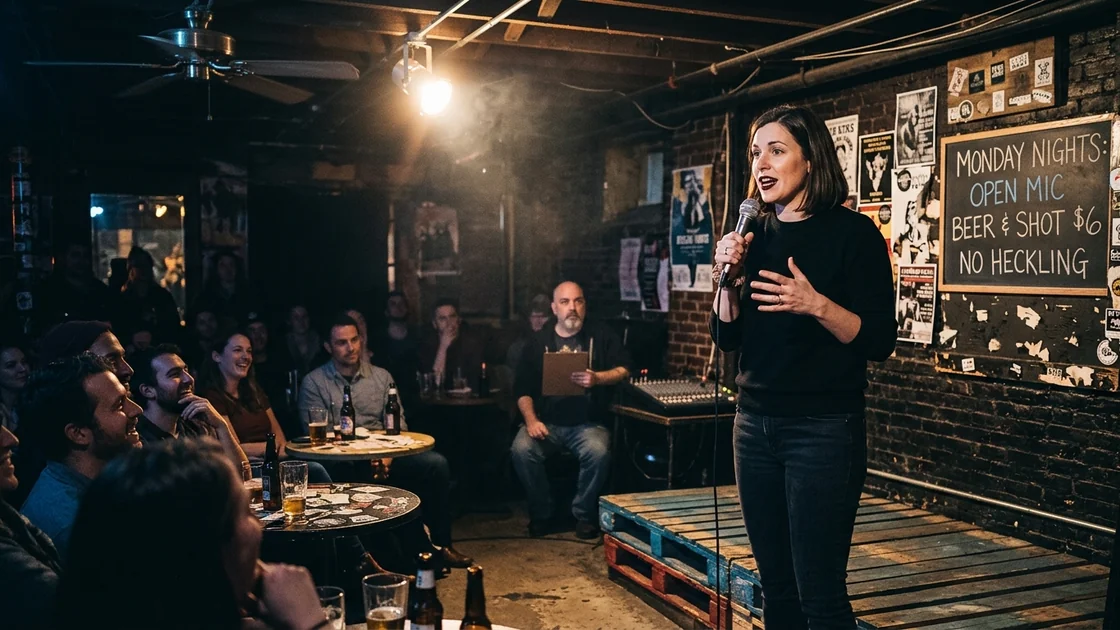
The bar was called The Black Dog, tucked into a subterranean pocket down three concrete steps slick with beer and rainwater. It was long, narrow, and smelled of decades of spilled draft beer, clove cigarettes, and industrial floor cleaner. A chalkboard out front announced: MONDAY NIGHTS: OPEN MIC / BEER & SHOT $6 / NO HECKLING OR WE TAKE YOUR COAT.
Elena followed Marlo through the heavy door, her eyes adjusting to the dim, amber-stained gloom. It was half-empty. A cluster of twenty-somethings in denim jackets huddled around the pool table, while at the far end of the room, on a riser made of three painted shipping pallets, a solitary woman in her twenties stood before a chrome microphone, talking into the dark about her roommate’s irritable bowel syndrome.
Nobody was laughing. A ceiling fan rotated with a rhythmic, metallic squeak that provided the only steady tempo in the room.
"He isn't here yet," Marlo said, scanning the bar. "Sit. I'm getting us two gin and tonics."
"I said club soda—"
"You're thirty-eight, Elena, live dangerously. Have some tonic water with alcohol in it."
Elena sat on a barstool with a cracked vinyl cushion that exhaled a puff of ancient dust when she settled onto it. She watched the stage. The girl with the microphone finished her set with an awkward, muttered, "So, yeah... follow me on TikTok," and scuttled off the pallets to polite, scattered claps from four friends near the bathrooms.
A man with a shaved head and a graying beard, holding a clipboard and wearing an apron over a faded punk t-shirt, stepped onto the riser. He looked like an auto mechanic who had been sentenced to manage bohemians as part of a parole agreement.
"Alright," the emcee muttered, his voice dry and flat through the cheap speaker. "Next up on the sheet... uh, we have Dave Miller. Dave? Is Dave here?"
Silence. The pool balls clacked in the corner.
"Dave bailed," someone called from the back.
The emcee sighed, rubbing his forehead with the back of his hand. "Great. Awesome. Who’s next? Marcus? Marcus, you ready, or are you still outside smoking weed by the dumpster?"
"Give him five minutes!" a voice shouted from the back door.
The emcee shook his head. "Look, we got five minutes of dead air unless somebody wants to jump up here and say something. Anybody? Come on, you bought the six-dollar shot, you might as well inflict your thoughts on people."
Marlo was at the far end of the bar, talking animatedly to a tall man in a leather jacket who did, in fact, have a highly suspicious mustache. She had completely forgotten Elena was there.
Elena looked down at her hands. Her knuckles were dry from washing dishes; her cuticle oil had worn off around two in the afternoon. On her wrist was a hair tie she had worn since 2016 in case Chloe needed a ponytail during soccer practice. In her purse was half a pack of spearmint gum, three expired coupons for Greek yogurt, and a small plastic dinosaur that Leo had handed her three weeks ago with the solemn instruction: Keep this safe, Mom, it's the last Ankylosaurus.
A sudden, hot, illogical electric current surged up her spine. It was not courage; it was the peculiar irritation of a woman who has spent fifteen years being spoken over at dinner parties by men who explain the mortgage crisis using baseball metaphors.
Before she could process the sheer stupidity of the impulse, Elena slid off the cracked vinyl stool, walked down the narrow aisle between the tables, and stepped onto the wooden pallets.
The emcee blinked at her. He smelled like clove cigarettes and stale coffee. "You on the list?"
"I am now," Elena said, her voice surprisingly level.
"What's your name?"
"Elena."
"Just Elena?"
"Elena Vance."
The emcee handed her the microphone. It was surprisingly heavy, cold as an iron pipe, and smelled vaguely of someone’s recent beer. "Five minutes, Vance. Light flashes from the soundboard when you have sixty seconds. Don't touch the cable, it buzzes."
He stepped down. Elena stood alone under a spotlight that was actually a halogen shop light clamped to an exposed ceiling joist. The bulb buzzed with a 60-cycle hum that vibrated right behind her eyes.
The room did not stop what it was doing. The pool players lined up a bank shot. Two bartenders whispered behind the taps. Marlo had her hand on the mustache-guy’s arm.
Elena brought the microphone to her mouth. She had never spoken into a microphone in her life, not even at her wedding, where Arthur had insisted on doing all the toasts because his speech class at Amherst had supposedly made him an expert in public address.
"My son has an emotional relationship with his socks," she said.
The sound of her own voice through the PA was shockingly loud, a disembodied, chest-rattling boom that made the bartender look up. Elena didn't wait for them to care; she just kept talking, because if she stopped, she would realize she was thirty-eight years old, standing in a dive bar on a school night, wearing a quilted J.Crew vest.
"He’s ten. And if the horizontal seam at the tip of the sock touches his small toe at anything more than an eighty-five-degree angle, he looks at me like I have personally fed his hamster to a snowblower. He will sit on the stairs and weep—not cry, weep, like an Italian widow in an opera—for twenty-five minutes while the yellow school bus sits outside our house, idling, spewing diesel fumes into our hydrangeas, costing the taxpayers of New Haven County roughly forty-two dollars a minute in wasted municipal fuel."
A guy sitting alone at a small round table near the front, sipping a dark beer, let out a single, sharp snort of laughter.
It was like a strike of flint against steel. Elena felt the spark hit dry tinder.
"My husband doesn't understand this," she continued, her delivery settling into a flat, dry cadence that she had used for years to keep herself from screaming in the cereal aisle. "My husband believes that everything can be solved through the application of a spreadsheet. He has a spreadsheet for our marriage. He doesn't call it that. He calls it our Strategic Domestic Plan. It has a tab for lawn care, a tab for gutter cleaning, and a tab called Intimacy Logistics. Do you know what’s on that tab? Neither do I, because it’s password protected, and the password is the date we bought our water heater."
Three more people laughed, louder this time. The pool players paused, cues resting on the green felt, their faces turned toward the platform.
Elena gripped the microphone tighter. She could see Marlo now, mouth half-open, staring at her sister like Elena had just sprouted a second head that was singing German lieder.
"People tell you that motherhood is about unconditional love," Elena said, pacing two steps to the left, testing the tether of the black cable. "That’s a lie invented by greeting card companies to keep women from jumping into quarries. Motherhood is thirty percent love and seventy percent logistics management for tiny terrorists who have no concept of time or personal hygiene. My daughter is fifteen. She communicates entirely in sighs that register on the Richter scale. Yesterday I asked her if she wanted chicken or fish for dinner, and she looked at me with the kind of pity you usually reserve for dogs with three legs who are trying to climb stairs. She said, 'Mom, your energy is very mid right now.' Mid. I don't know what that means. I looked it up on the internet, and it means 'mediocre.' I spent eleven hours in labor with her, without an epidural because the anesthesiologist was stuck in an elevator behind a cart of linens, and my return on investment is being told my energy is mid by a child whose bedroom smells like a combination of strawberry vape juice and untreated anxiety."
The room erupted. It wasn't a polite chuckle; it was a loud, jagged, room-filling burst of genuine bark-laughs from the bar, the pool table, and the tables in between.
The emcee, leaning against the soundboard, raised an eyebrow. He didn't look bored anymore.
Elena felt something inside her chest crack open—not like something breaking, but like a hatch being unbolted after thirty years of marine rust. The air in the room tasted different. It didn't taste like stale beer anymore; it tasted like high-voltage ozone.
She talked about the Tupperware cabinet—the impossible, geometrical nightmare of matching lids to bases, a task so spiritually demoralizing that she was convinced it was how they sorted souls in purgatory. She talked about the social politics of the third-grade bake sale, where gluten-free brownies were treated with the tactical seriousness of non-proliferation treaties. She didn't exaggerate; she simply told the cold, architectural truth about the domestic machine that ate women alive and spat out carpool schedules.
A small red light began flashing from the sound booth. The sixty-second warning.
She hadn't prepared an ending. She hadn't prepared a beginning. She just stopped pacing, looked directly at a young man in the second row who looked like he hadn't spoken to his mother in six months, and said:
"Anyway. If anyone finds a lid for an eight-cup rectangular Pyrex dish with the blue rim, it’s mine. Don't throw it out. My husband will make an audit."
She dropped the mic into its stand, stepped down from the pallets, and walked straight toward the door.
The applause hit her back like a wave of warm water. It wasn't thunderous—there were only twenty-two people in the bar—but it was solid, rhythmic, and real. Someone whistled through their teeth.
"Hey!" Marlo yelled, breaking away from the mustache man and scurrying after her. "Elena! What the hell was that?"
Elena didn't stop until she hit the wet, cold air of Crown Street. Her knees were trembling so violently she had to lean one shoulder against the brick wall of the alleyway. Her breath came in short, white puffs.
The emcee pushed through the heavy metal exit door, letting out a wedge of amber light and jukebox bass. "Hey. Lady."
Elena turned, defensive, clutching her purse to her ribs. "I'm sorry if I went over five minutes—"
"You did four forty," he said. He had a pencil behind his ear. "You got twenty minutes of material?"
"What?"
"Material. You got more of that?"
"I... I have a grocery list," Elena said, her voice shaking.
The emcee gave a short, dry hack that passed for a laugh. "My name's Sal. We do this every Monday. Sign-up’s at seven, we start at eight. If you want ten minutes next week, you got it."
"I have children," Elena said, as if this were an insurmountable legal disqualifier.
"Most people do," Sal said. "Most of 'em aren't funny about it. Next Monday. Don't suck."
He let the metal door slam shut.
Elena stood in the drizzle, her purse clutched in both hands, her heart hammer-beating against her sternum like a bird trapped in an attic. Beside her, Marlo was staring at her with wide, uncomprehending eyes.
"Elena," Marlo whispered, "who the fuck are you?"
The Vance household operated on a system of mutual, non-aggression treaties that Arthur referred to as "family harmony."
Arthur Vance was a partner at a mid-tier firm in Hartford specializing in commercial zoning and environmental variances. He was forty-one, with hair that had receded gracefully at the temples in a way that gave him the appearance of perpetual, judicious concern. He wore gray wool trousers that never seemed to wrinkle, even after three hours on the Metro-North, and he owned four different types of shoe trees.
"The merger with the Stamford office is going to require three nights in the city next week," Arthur said the following evening, cutting his pork chop with the steady, sawing motion he used for all proteins. "I told Miller we could absorb their real estate group if they take on our paralegal deficit."
Elena sat across from him, watching the small, triangular piece of meat move from the plate to his mouth. "That's good, Arthur."
"It's practical," he corrected, chewing methodically. "It provides redundancy in the back office. Redundancy is security."
"Right. Redundancy."
Across the table, Chloe had her phone propped against the salt cellar, her thumb flicking rhythmically across the screen.
"Chloe," Arthur said without looking up from his plate. "Screens at the table. Rule four."
"I'm checking my history assignment," Chloe said, not looking up either. Her tone was so flat it sounded synthesized.
"Your history assignment does not require a six-second video of an Australian teenager doing a choreographed dance in an elevator," Arthur noted.
"He's not Australian, Dad, he's from Auckland, and it's an interpretive project on late capitalism."
"Phone away," Arthur said, his voice dipping into the courtroom baritone that usually settled disputes before they reached arbitration.
Chloe rolled her eyes with such physical exertion that Elena half-expected to hear the clicking of optic nerves. She slapped the phone face-down on the linen place mat.
"Mom," Leo said, his voice tight and high. He hadn't touched his pork chop. His green beans were lined up in parallel rows of decreasing length, like an organic barcode. "The bus driver had the radio on the station with the talk people again."
"Did you put your noise-canceling headphones on, honey?" Elena asked, leaning forward.
"The cushion on the left ear has a tear," Leo said, his eyes welling with the specific, terrifying despair of the overstimulated child. "The foam was touching my tragus. The tragus is the little flap of cartilage, Mom. It felt like a moth was dying against my skull."
"Okay," Elena said softly. "After dinner, we'll get the gaffer tape from the basement and we'll fix the skin on the cushion. Two layers. Smooth. Okay?"
Leo took a slow, shivering breath and nodded, his fork hovering over bean number four.
Arthur wiped his mouth with his cloth napkin. "You pamper the sensory things, Elena. The world is not going to tape down its rough edges for him. When he gets to boarding school—"
"He's ten, Arthur," Elena said, her voice dropping into a register that made Arthur pause. It wasn't her usual placating tone—the Yes, dear, I'll see to it tone that had greased the wheels of their life since they bought the house on Orchard Way. It had an edge, like a paring knife drawn across a sharpening stone.
Arthur looked at her, his eyebrows slightly raised. "I'm merely observing that resiliency is a trained behavior."
"Resiliency is what you develop after you survive having your tragus assaulted by disintegrating polyurethane," Elena said.
Chloe let out a sudden, involuntary snort from behind her water glass.
Arthur frowned at his daughter, then back at Elena. "Is there something different about the pork?"
"It's pork, Arthur. It came from a pig that died without an opinion on the Stamford office."
Arthur stared at her for two seconds, clearly searching for the legal precedent for this response, found none, and returned his napkin to his lap. "I'll be in the study until nine. Don't forget the recycling goes out tonight. They're doing the yard waste collection tomorrow."
"I won't forget," Elena said.
Later, when the kitchen was silent and the quartz counters were wiped down to their sterile, white-flecked gleam, Elena went to the junk drawer by the refrigerator. Behind the three rolls of scotch tape, the expired Bed Bath & Beyond coupons, and the dead AAA batteries, she found a small, spiral-bound reporter's notebook that Marlo had left behind three Christmases ago.
She carried it to the kitchen island, pulled out a black gel pen, and sat down.
The house was completely still. In the basement, the water softener clicked through its regeneration cycle—a mechanical, rhythmic heartbeat that had scored Elena's nights for thirteen years.
She opened the notebook to the first blank page.
Setups and Observations:
- Arthur’s shoe trees. Why do shoes need trees? Are they going to run away into the forest if they aren't weighted down with cedar? Does he think his loafers have an inner life that yearns for the wild?
- The school drop-off line is the fifth circle of hell. It’s Dante, but with women in Patagonia vests driving three-ton GMC Yukons who don't understand how a zipper merge works. A zipper merge requires trust. Nobody in Woodbridge trusts anyone who doesn't use the same landscaper.
- Chloe’s sigh: It isn't just an exhale. It’s an eviction notice for my relevance.
- Leo's tragus. I spend forty percent of my waking hours thinking about my son's ear cartilage.
She wrote for two hours. Her handwriting, usually neat and round—the penmanship of a woman who had once been president of her sorority’s philanthropy committee—devolved into a sharp, angular scrawl. Lines crossed out lines. Arrows pointed to punchlines. She didn't write stories; she wrote indictments disguised as dinner conversation.
At eleven-fifteen, she heard Arthur’s socks padding down the stairs.
Elena slammed the notebook shut and slid it under the stack of glossy mailers from the Audubon Society before he reached the bottom landing.
"You're still down here?" he asked, holding an empty mug. He was wearing his gray flannel pajama bottoms and the faded Dartmouth sweatshirt he had owned since 2004. He looked safe, solid, and utterly incapable of imagining that the woman standing across the quartz island had spent the last two hours analyzing the sexual subtext of his lawn aeration schedule.
"Just finishing the recycling," Elena said, her voice smooth, the mask snapping back into place with the precision of a magnet.
"Good girl," Arthur said, patting her hip as he passed her to rinse his mug in the sink. "Don't stay up too late. It's supposed to frost tonight."
"I won't," Elena said.
She stood very still until the stairs creaked their rhythmic descent into sleep, then took the notebook, slid it into the inside pocket of her quilted vest, and walked out into the cold, frosted night to drag ninety gallons of plastic containers to the curb.
The transition from a woman who told jokes into a comic who worked sets happened with the quiet, terrifying velocity of an avalanche.
On the third Monday of November, Elena lied for the first time.
"Marlo’s having an emotional crisis," she told Arthur over the sound of the dishwasher. "Her ex-boyfriend from Montreal showed up at the library. She needs me to sit with her."
Arthur, who considered Marlo an unstable bohemian whose lifestyle choices were an ongoing insult to the Connecticut General Statutes, didn't even look up from his iPad. "Take the Honda. The BMW has low tire pressure in the right rear."
"I’ll be back late," Elena said.
"Leave the porch light on," he murmured.
Thirty-five minutes later, Elena walked through the heavy door of The Black Dog.
The air was thicker tonight, dense with the smell of wet wool and cheap fryer oil. There were thirty people in the room, mostly students from the drama school and local degenerates who liked the cheap draft.
Sal was behind the soundboard, his glasses hanging from a greasy cord around his neck. When he saw her, he didn't smile—Sal didn't seem to have the facial muscles for it—but he tapped the clipboard with his pen.
"Vance. You're fifth."
"Fifth?" Elena asked, her stomach performing a slow, greasy loop. "Last time I was just... whenever."
"Last time was an open mic. Tonight is the showcase overflow. You got seven minutes. If you run the light, I cut the house sound and play the theme from The Price Is Right."
"Understood," Elena said.
She went to the bathroom. The lock was broken, replaced with a hook-and-eye latch that looked like it had been salvaged from an outhouse. Elena stood before the cracked mirror under the flickering fluorescent tube. She took off her quilted vest, balled it up, and shoved it into her tote bag. Underneath, she was wearing a plain black crewneck sweater and dark jeans. She looked less like a suburban mother and more like a woman who had arrived to repossess a vehicle.
She pulled her hair back into a tight, severe knot at the base of her skull. She applied a fresh coat of red lipstick—not the sheer, polite gloss she wore to school board meetings, but a deep, brick-red matte she had bought at a pharmacy on the way into town.
"You're Elle Vance," she whispered to the glass. "You don't care about their feelings."
When Sal called her name, the applause was thin, the standard courtesy claps of people waiting for their own friends to go up.
Elena took the stage. The halogen shop light was still there, buzzing its 60-cycle song.
She didn't start with the socks this time. She adjusted the stand down three inches—the comic before her had been a six-foot-two graduate student who had done nine minutes on his vasectomy—and leaned into the mic.
"My husband bought a smart thermostat," she said, her voice low and conversational, perfectly timed against the clinking of bottles at the bar. "He spent eight hundred dollars to automate our climate. It has machine learning. Do you know what the machine learned? It learned that my husband will divorce me if the living room reaches sixty-nine degrees before December first."
A wave of laughter rolled through the front tables.
"The app sends a notification to his phone every time I touch the dial. It says: Elena has requested 70 degrees. Do you authorize this transaction? I'm thirty-eight years old, I have an advanced degree in art history from Middlebury, and I need a two-factor authentication from an attorney in Hartford to keep my toes from turning into cocktail sausages."
The laughter was louder now, fuller, coming from the back corners of the room.
"He told me sixty-eight degrees builds character. I told him we live in Connecticut, not an 1840s whaling brig. We aren't hunting the white whale, Arthur. We’re watching The Crown on a sofa that costs more than my first three cars combined."
She leaned in, dropping her voice an octave, drawing the audience into the conspiracy.
"And then there's the group chat. The suburban mothers have a group chat. It’s called The Orchard Way Watch. It’s supposedly about neighborhood safety, which means it’s four hundred messages a day about a squirrel that looked at someone’s nanny with an aggressive attitude."
She pulled out the notebook mentally, hitting every beat she had worked out over the kitchen island while the water softener cycled. She gave them the school drop-off line: the sociopathy of the woman in the Tesla who thinks the laws of physics do not apply to her child’s cello case. She gave them the bake sale non-proliferation treaty. She gave them her own mother, who called every Sunday at four to ask if Elena had considered using a night cream with peptides because 'Arthur’s line of work brings him into contact with many younger women who don't have that graying look around the clavicle.'
When the red light flashed from the soundboard, Elena was in the middle of a bit about Leo’s soccer team, a squad of eleven ten-year-olds who were so emotionally fragile that the league had banned scoring, resulting in ninety minutes of twenty-two boys running aimlessly around a muddy field while their fathers screamed ambiguous encouragement like, Find the space, Tyler! The space is your friend!
"Tyler doesn't want the space," Elena deadpanned. "Tyler wants a Juice Box and a therapist who can explain why his dad wears wrap-around sunglasses during an overcast morning in November."
She looked at Sal. The light was steady red.
"I’m Elle Vance," she said. "Turn your heat up. Your husbands are lying to you."
She walked off the pallets to an explosion of cheers and table-slapping. It was twice as loud as the week before. A young woman with a nose ring reached out and touched Elena’s sleeve as she passed. "You're fucking brilliant," the girl hissed.
Elena didn't say thank you. She nodded, grabbed her tote bag from behind the bar, and slipped out the back door into the alley before Sal could corner her.
Her hands were shaking so hard she dropped her keys twice in the gravel beside the Honda. When she finally got the door open, she sat in the dark, her heart pounding against her ribs, the red lipstick burning on her mouth like an open wire.
She looked at the digital clock on the dash. It was 9:42 PM.
If she drove fast, she could be home by ten-fifteen, wash the red off her face with cold water, pull her hair back down into its sensible bob, and be folding the laundry before Arthur finished his third document review.
She hit Route 34 at eighty miles an hour, the Honda’s V6 engine roaring against the dark Connecticut hills.
By January, the double life had developed its own internal logistics, as rigid and demanding as Arthur’s spreadsheets.
Elena had acquired three regular spots: Monday nights at The Black Dog, Wednesday nights at a comedy basement under an Irish pub in Stamford called McNally’s, and an occasional Saturday midnight showcase at a club in South Norwalk that paid twenty-five dollars cash and two drink tickets.
She had a second phone—a cheap prepaid burner she bought at a Target three towns over—which she kept hidden in the bottom of the hamper in the master bathroom, wrapped in a pair of wool socks that Arthur never wore because they weren't cedar-treated. Sal was her primary contact, but now there was a guy named Derek in Stamford and a woman named Moira who ran a female-forward night in Brooklyn once a month.
Her stage name was Elle Vance. She never used the Honda for the Stamford runs; she took the Metro-North from the Bridgeport station, sitting in the quiet car with her reporter’s notebook, writing jokes in a tiny, cramped hand between stops.
The suburban kitchen is a panopticon, she wrote one snowy Tuesday while Arthur was at a dinner in Manhattan. It is designed so that no matter where you are standing, a child can see you attempting to eat a single square of dark chocolate in peace and immediately demand that you explain where the solar system ends.
She began to observe her life not as a participant, but as a spy gathering intelligence from behind enemy lines.
Every micro-aggression of the suburban ecosystem became grist for the mill. When her neighbor, Brenda, stopped her at the mailbox to ask, with dripping faux-concern, if Elena had noticed that Arthur’s car was often gone before six in the morning—"He's just working so hard, isn't he, dear? One hopes the firm appreciates it"—Elena didn't feel the old, cold stab of insecurity. Instead, she thought: Tag for the neighborhood gossip bit: Brenda doesn't have an inner life, she has an external surveillance apparatus disguised as an Ann Taylor loft wardrobe.
"He’s very dedicated," Elena had told Brenda, smiling with teeth that were slightly too bright.
"Of course he is," Brenda had purred.
That night at McNally’s, Elena killed with a six-minute riff on the passive-aggressive geometry of the cul-de-sac.
"The cul-de-sac was invented by the French," she told forty drunken commuters in Stamford. "It means 'bottom of the bag.' That's what it is. It's a bag where you throw four four-bedroom colonials and eight people who monitor your lawn aeration with the intensity of the East German Stasi."
The room had roared, and Elena had stood there, bathed in the amber glare of the spotlight, feeling the strange, divine detachment of the satirist. She was no longer just the woman who ironed Arthur’s shirts; she was the cartographer of his ridiculous world.
But the machine at home was beginning to slip its gears.
"You're not here," Arthur said one Sunday in February.
They were in the kitchen. Snow was falling outside, thick and heavy, piling against the quartz-ledged bay window. Arthur had his laptop open, surrounded by three different folders of environmental impact statements.
Elena was packing lunches for Monday. "I'm right here, Arthur. I'm slicing cucumbers."
"You're not," he repeated, looking up. His eyes were tired, the skin beneath them bruised with the gray fatigue of fifty-hour weeks and constant lateral maneuvers at the firm. "You're... abstracted. You haven't checked the shared calendar since Thursday. Leo had an evaluation with the school occupational therapist on Friday afternoon, and you didn't send me the summary."
Elena paused, the knife resting against the skin of an English cucumber. "The summary was that Leo is ten and doesn't like the texture of industrial clay. We don't need an intervention, Arthur. He needs to not be forced to make pinch pots."
"The school recommended three sessions," Arthur said, his tone cooling into the familiar, litigious firmness. "We follow the protocol. That's why we pay forty thousand dollars in property taxes, Elena. For the protocols."
"The protocols are nonsense designed to keep administrators employed," Elena said, the words slipping out before she could run them through the domestic filter.
Arthur blinked. He took off his glasses and set them on the quartz. "Since when do you have an opinion on district administrative structures?"
"Since I started watching them process our son like an Amazon package with a dented corner," she snapped.
Arthur looked at her for a long moment. It was the longest he had looked directly into her face in three years. He seemed to be searching for the woman who had spent forty-five minutes with him in 2018 debating whether Benjamin Moore's Revere Pewter was too assertive for the foyer.
"Marlo is having a bad influence on you," he said finally, reaching for his glasses. "All this time you're spending in New Haven. What is she doing down there? She’s thirty-two years old and lives above a bakery."
"She lives above a dry cleaner, Arthur. Get the zoning right."
"It's the same demographic instability," he muttered, returning to his PDF. "Just... make sure the evaluation is scheduled. We have to file the insurance waiver before the end of the quarter."
Elena looked down at the cucumber. Her heart was beating fast, not with fear, but with that same electric irritation that had pushed her onto the pallets at The Black Dog.
She wanted to tell him.
The urge was so sharp it made her throat ache. She wanted to say: I don't go to Marlo’s. I go to basements where men who smell like sour beer pay six dollars to hear me tear our domestic life into little paper strips and set fire to them. And they love it, Arthur. They laugh so hard their faces turn purple. They think the way you fold your undershirts is the funniest thing that has happened in western Connecticut since the revolution.
Instead, she sliced the cucumber into twelve identical disks, slid them into a BPA-free container, and said, "I'll call them tomorrow."
The crisis came from the daughter, not the husband.
Chloe was fifteen, an age where daughters possess the tactical radar of naval destroyers. They do not look at you, they do not speak to you, but they know precisely when your internal defenses are down by half a knot.
It happened on a Thursday in late March. Elena had returned from an early set at The Black Dog—she had done a tight eight minutes at eight-thirty and raced home to be in bed before Arthur got back from Hartford on the eleven-ten train.
She was in the upstairs bathroom, scrubbing the matte brick-red lipstick off her mouth with an oil-based cleanser, when the door swung open without a knock.
Chloe stood in the frame, wearing an oversized hoodie that had belonged to a boy whose name Elena was not allowed to know.
Elena didn't jump, but she dropped the cotton round into the wastebasket. "Chloe. Knock, please."
Chloe didn't apologize. She stepped in, leaned against the marble sink, and crossed her arms. Her eyes were fixed on Elena’s mouth, where a faint, bloody smear of red pigment still clung to the vermilion border of her upper lip.
"You're not going to Aunt Marlo's," Chloe said.
Elena reached for the moisturizer, her movements slow, deliberate. "Your aunt is going through a transition, Chloe. She needs support."
"Aunt Marlo was in Montreal all week," Chloe said, her voice dropping into a register that was chillingly mature. "She posted a story from a vintage market on Saint-Laurent three hours ago. She was eating poutine with a guy who has a septum piercing."
The silence in the bathroom was absolute, broken only by the hum of the heated floor system that Arthur had installed two autumns ago.
Elena looked at her daughter in the mirror. Chloe wasn't angry; she was curious, with a hard, appraising squint that looked terrifyingly like Arthur’s courtroom gaze, but stripped of the bureaucratic politeness.
"You're having an affair," Chloe said. It wasn't an accusation; it was an audit.
Elena turned around slowly, leaning her lower back against the edge of the sink. She felt a strange, cold bubble of laughter rise in her chest. Of course that was what a fifteen-year-old would think. The culture only provided one narrative for a mother who disappeared into the dark with red lipstick on her mouth: she was meeting a man in an airport hotel.
"I am not having an affair," Elena said.
"Dad's an idiot," Chloe continued, ignoring the denial with the ruthless efficiency of youth. "He thinks you're at the library or whatever. But you smell like smoke. Like... nasty smoke. Not weed. Old people smoke. And your makeup is different. You look like... you look like somebody else."
Elena closed her eyes for three seconds. She thought of the reporter’s notebooks hidden in the hamper. She thought of the red light flashing at Sal’s. She thought of the twenty-five-dollar cash envelopes tucked into the lining of her jewelry box under her grandmother’s pearl necklace.
The lie was too small. It couldn't hold the weight of what she was doing anymore.
"Sit down," Elena said.
Chloe looked startled, but she dropped the defensive posture and sat on the closed lid of the toilet, pulling her knees up into her hoodie.
Elena reached into her tote bag, which was hanging from the back of the door, and pulled out the small, spiral notebook. She handed it to her daughter.
Chloe looked at the battered cardboard cover, then up at Elena. "What is this? Your diary? Gross, Mom, I don't want to read your—"
"Read page twelve," Elena said.
Chloe hesitated, then flipped the notebook open. Her eyes moved across the sharp, angular handwriting. Elena watched her face.
For the first thirty seconds, Chloe’s expression was the standard teen mask of contemptuous boredom. Then, her left eyebrow twitched. A second later, the corner of her mouth pulled back.
"Wait," Chloe whispered. "Is this... are you writing about Mrs. Gable?"
"Read it," Elena said.
Chloe read aloud, her voice wavering slightly: "'Mrs. Gable has spent eleven thousand dollars on an invisible dog fence, but her golden retriever has realized that pain is temporary, while the rotisserie chicken on our patio table is forever. The dog takes the shock like an Irish prizefighter, doesn't even blink, just marches through the perimeter with his teeth bared, looking for saturated fats.'"
Chloe let out a sound that Elena hadn't heard from her in three years: a pure, uncurated, child’s giggle that made her shoulders shake.
"Mom," Chloe said, looking up, her eyes wide. "Did you write this?"
"I do it on Monday nights," Elena said, her voice steady now, the secret finally finding air. "And Wednesdays. In New Haven. In Stamford."
"Do you... do you stand on a stage?"
"Yes."
"With a microphone?"
"With a microphone."
"Do people... do they laugh?"
"Usually," Elena said. "Sometimes they don't. Sometimes they stare at me like I'm an insurance adjuster who just told them their roof isn't covered. But usually, they laugh."
Chloe looked down at the notebook again, turning the pages with fingers that were no longer dismissive. She was looking at the architectural blueprints of her mother’s secret mind.
"Does Dad know?" Chloe asked, her voice dropping into a whisper.
"No."
"He'd freak," Chloe said simply. "He’d tell you it doesn't align with the family brand. He'd want to hire a brand consultant from Hartford to review your set."
Elena let out a short, real laugh that mirrored her daughter's. "He would. He’d want to make it an LLC."
They sat in the quiet bathroom for another minute. The heated floor hummed. Outside, the wind rattled the double-hung windows.
"Are you good?" Chloe asked. It was the first time she had asked her mother a question about Elena’s competence that didn't involve the location of clean sports bras.
"I don't know," Elena said honestly. "Sal says I have a point of view. He says my point of view is 'suburban gothic.' He says I sound like a woman who is one Tupperware lid away from arson."
Chloe looked at her mother for a long, quiet moment. Then she handed the notebook back. "You shouldn't wear the J.Crew vest on stage. It makes you look like you're about to sell someone a horse."
"I take it off," Elena said. "I wear the black crewneck."
"The black crewneck is okay," Chloe allowed, standing up and heading for the door. She paused on the threshold, her hand on the brass knob. "You need better lipstick, though. That red is too orange for your skin. It makes you look like a 1950s flight attendant."
"What should I wear?" Elena asked, her voice small.
"MAC Diva," Chloe said without turning around. "It’s what the theater girls wear when they want people to think they have trauma. I’ll leave it on your dresser."
The door clicked shut.
Elena stood alone in the bright, clinical light of the bathroom, holding her notebook against her ribs, feeling the house shift around her like a ship that had just changed its heading by three degrees in the middle of a fog.
By May, the Stamford club had offered her a featured weekend spot: opening for a comic named Bobby Vance—no relation, though they joked on the flier that they were going through a bitter mediation—who had three appearances on late-night television and a half-hour special on Comedy Central.
It paid two hundred dollars.
It was scheduled for a Saturday night at eight-thirty.
The problem was not the material; Elena had twenty-five minutes of polished, lethal domestic observation that she had road-tested across six different dive bars between Bridgeport and Waterbury. The problem was that Saturday was the annual dinner for the New Haven County Bar Association at the Omni Hotel, an event Arthur treated with the religious solemnity of an investiture.
"The senior partner is retiring in September," Arthur told her on Wednesday morning, adjusting his silk tie in the hallway mirror. "They’re announcing the executive committee assignments at the dinner. It’s critical that we have a presence."
Elena was buttering toast for Leo. "A presence, Arthur?"
"A unified presence," he corrected, turning to let her inspect his collar. "The firm values domestic stability. In corporate litigation, stability at home suggests an absence of erratic personal liabilities. When Miller sees that we're solid, it reinforces my positioning."
Elena looked at his collar. There was a tiny stray thread near the left point. She reached up and pulled it gently, snapping it between her fingernails.
"I have a commitment on Saturday night," she said.
Arthur froze. His hands remained poised on his lapels. He looked at her through the mirror, his brow furrowed in genuine, uncomprehending shock.
"A commitment?" he repeated, as if she had used a word in ancient Aramaic. "On Bar Association night?"
"Yes."
"What commitment could you possibly have that takes precedence over the executive committee announcement?"
Elena felt the room narrow. In the breakfast nook, Leo was carefully scraping the crust off his bread with a butter knife, his small shoulders hunched against the rising tension. Upstairs, Chloe’s door remained shut, but Elena knew her daughter was listening through the floorboards.
"I have a performance," Elena said.
Arthur turned around fully. He dropped his hands to his sides. "A performance? What are you talking about? Are you doing something with the historical society?"
"I’m doing stand-up comedy, Arthur. At the Comedy Zone in Stamford. I’m the feature act."
The sentence hung in the air between them, absurd, heavy, and completely impossible to integrate into the architecture of the house on Orchard Way. A crow called from the lawn outside, harsh and loud against the spring morning.
Arthur didn't laugh. He didn't even smile. His face settled into the gray, cautious mask he used when an opposing counsel made a motion that was so legally bizarre it suggested mental incompetence.
"Stand-up comedy," he said, the words flat and slow.
"Yes."
"In Stamford."
"Yes."
"Since when do you do stand-up comedy?"
"Since October."
Arthur took a slow breath through his nose. He looked at the floor, then at the ceiling, then at the kitchen island, as if checking to see if the quartz had survived this revelation.
"You've been going to comedy clubs instead of helping Marlo?"
"Marlo didn't need help, Arthur. Marlo was eating poutine in Montreal."
"So you lied to me."
"Yes," Elena said, her voice dropping into the steady, unadorned tone she used on stage. "I lied to you twice a week for seven months."
Arthur’s mouth tightened until his lips were a pale, bloodless line. "Why?"
"Because if I told you, you would have explained to me why it wasn't a cost-effective use of my time. You would have told me that the mileage on the Honda didn't justify the return on investment. You would have made a spreadsheet called Stand-up Logistics and password-protected it with the date we bought the microwave."
"That is unfair," Arthur said, his voice rising, the baritone cracking slightly at the edge. "I manage our resources, Elena! I ensure that this family has an infrastructure!"
"I don't want an infrastructure, Arthur! I wanted to say something that didn't have to be approved by the school board or the zoning commission or the executive committee!"
From the breakfast nook, there was a sharp, plastic clatter.
Both of them turned. Leo had dropped his butter knife onto his plate. His face was pale, his eyes wide, his hands clamped over his ears, pressing so hard his fingers were white.
"The frequency," Leo whispered, his voice trembling. "Your voices are at the bad frequency."
Elena was across the kitchen in three strides. She dropped to her knees beside his chair, pulling his hands away from his ears gently, holding his wrists. "I'm sorry, baby. I'm sorry. We're done. We're using our normal voices now."
Leo was shaking, his breath coming in fast, shallow gasps. "The Omni Hotel is boring. The rolls are hard. They have seeds on them. I don't like the seeds."
Elena looked up at Arthur. He was standing by the refrigerator, looking down at his son with an expression that was a terrible, heartbreaking mixture of bewilderment and defeat. He looked like an engineer whose bridge had just developed a structural crack during a mild rainstorm.
"We will discuss this tonight," Arthur said, his voice quiet, controlled, and utterly drained of authority.
He picked up his leather briefcase from the hall table, opened the front door, and walked out into the pale May sunlight without saying goodbye.
The argument did not resume that night, because Arthur did not come home until after midnight, and when he did, he slept in the guest room on the third floor—the room where they kept the extra luggage and the NordicTrack nobody had used since 2017.
On Friday, they spoke only in logistical memos passed through the children: Tell your father the dry cleaner had his gray suit ready. Tell your mother I have a breakfast meeting in White Plains.
On Saturday afternoon, Elena stood in the kitchen, packing her stage bag.
The black crewneck. The dark jeans. A pair of ankle boots with a low, solid heel that didn't creak on the wooden platforms. And the tube of MAC Diva that Chloe had left on her vanity with a note that said: Don't choke.
She was zipping the bag when Arthur came down the stairs.
He was already dressed in his tuxedo. He looked handsome in the way men who go to Ivy League law schools always look handsome in black tie: classic, unchallenging, like a stock photograph of an attorney attending a gala.
He stood by the kitchen island, watching her hands.
"The car is coming for me at six," he said.
"The Stamford train leaves at six-forty," Elena said.
Arthur looked at his cufflink—a small, square piece of onyx she had given him for their fifth anniversary. "Miller asked me this afternoon if you'd be sitting at his table. His wife wanted to talk to you about the land trust committee."
"What did you tell him?"
"I told him you had a prior engagement." Arthur looked up, his eyes direct, wounded, and unusually clear. "He assumed it was charitable. I didn't correct him."
"Thank you," Elena said quietly.
"I’m not doing it for you," Arthur said, his voice tight. "I'm doing it because I don't know how to explain to the managing partner of a seventy-person firm that my wife is spending her Saturday night in a strip mall basement telling strangers that our marriage is an administrative failure."
Elena stopped zipping the bag. She looked at him across the quartz that had witnessed twelve years of their polite, low-friction coexistence.
"Is that what you think I do?" she asked.
"Isn't it? Chloe told me some of it. She thinks it's hilarious that you think I'm obsessed with the thermostat." Arthur’s voice dropped, the hurt finally breaking through the professional polish. "I care about the thermostat because my father went bankrupt when I was fourteen, Elena. We lived in a house in Danbury where the pipes froze twice every winter because he couldn't pay the oil company. I track the heat because I promised myself my family would never sit in a cold room and wonder if the lights were going off tomorrow."
The kitchen became very quiet.
Elena looked at him, seeing—truly seeing—the terrified fourteen-year-old boy inside the forty-one-year-old corporate partner with the shoe trees and the environmental impact folders.
"Arthur," she said softly, taking a step toward him.
He held up a hand, stopping her. His jaw was set. "I'm not asking for an apology. I’m just saying... you think you're the only one who had to make adjustments to live here. You think you're the only one who became somebody else so this house wouldn't fall down."
He checked his watch—a gold mechanical watch that had belonged to his grandfather, the only thing his family hadn't sold in 1996.
"The town car is outside," he said. "Have a good show, Elena."
He walked out the front door. The heavy mahogany clicked into the latch with its smooth, hydraulic silence, leaving Elena standing in the kitchen with her tote bag in her hand and Arthur’s grief ringing in her ears like a struck bell.
The Stamford Comedy Zone was not a dive bar; it was a real room.
It sat in the basement of a commercial plaza between an upscale sushi restaurant and a high-end cycling studio. It held two hundred and fifty people, seated at long, narrow tables with tiered red banquettes. The sound system didn't hum; the spotlight was a motorized, computer-controlled follow-spot that tracked the stage with silent, lethal accuracy.
Backstage was a green room with a mini-fridge containing three kinds of seltzer, an assortment of deli meats that had curled at the corners, and a mirror surrounded by forty-watt vanity bulbs.
Elena sat on a faux-leather couch that had several cigarette burns from the era when comedians were still allowed to ruin their lungs indoors. Across from her, Bobby Vance was eating almonds out of a plastic bag. He was fifty, with a face that looked like an unmade bed and the relaxed, predatory calm of a man who had done three thousand sets in forty states.
"You're the local?" Bobby asked, tossing an almond into the air and catching it in his mouth.
"I am," Elena said. Her hands were ice-cold.
"Sal said you're dry. He said you don't do the mommy stuff like the girls from Long Island. No wine-mom bullshit."
"I don't drink wine," Elena said. "Wine gives me a migraine. I drink seltzer with lime and I think about mortality."
Bobby chuckled, a low, gravelly sound. "Good. The Long Island girls kill me with the 'Rosé all day' crap. Nobody cares that your toddler threw up on your lululemons. Tell 'em something that hurts. If it doesn't hurt a little bit, it's just advertising."
The stage manager poked his head through the door. "Elle. Five minutes. House is packed. Tech firm from Norwalk bought out the first three rows. They're four drinks deep and ready to yell."
Elena stood up. She walked to the vanity mirror.
She took out the tube of MAC Diva. She uncapped it, looking at her reflection.
She didn't look like an aunt anymore. She didn't look like a woman who could be silenced by a school administrator or an executive committee announcement. The lipstick was dark, the color of dried cherries, severe and adult. Her hair was pulled back so tight her cheekbones looked sharp enough to slice bread.
She thought of Arthur standing in his tuxedo by the quartz island, talking about the frozen pipes in Danbury.
She thought of Leo’s small hands over his ears.
She thought of Chloe’s cynical, protective giggle in the bathroom.
"Tell 'em something that hurts," she whispered to the mirror.
When the emcee called her name—"From right here in Fairfield County, the hilarious, the dangerous, Elle Vance!"—the applause was loud, professional, the noise of two hundred and fifty people who had paid thirty dollars a ticket and wanted to be entertained before the prime rib settled.
Elena walked into the light.
The glare was so bright she couldn't see the tables; she could only see the silhouettes of heads, the glint of drink glasses, and the faint, red glow of the exit signs.
She took the mic out of the stand. She didn't lower it this time; she held it at her mouth, letting the cable drop in a clean, straight line down her body.
"My husband has four different kinds of shoe trees," she said.
The laugh came immediately, warm and expectant.
"He has cedar for the loafers, mahogany for the oxfords, and two plastic pairs from the Container Store for the running shoes he hasn't worn since Obama’s first term."
She paused, letting the silence work for her. She had learned how to use the empty space—the beat between the observation and the incision.
"He thinks that if he doesn't weight them down, they will return to the wild. He thinks the shoes have an instinct for freedom that must be suppressed through the application of dead wood."
Another laugh, bigger this time.
"We live in a house that costs more than my father earned in his entire career as a high school Latin teacher. It has five bathrooms. Do you know what happens when you have five bathrooms? You spend eighty percent of your adult life checking the water pressure in rooms you haven't entered since Thanksgiving."
She moved across the stage, the follow-spot sliding with her, smooth as oil.
"We are terrified of cold," she said, her voice dropping, the comedy sliding into something sharper, stranger. "My husband tracks our thermostat from an app on his phone. If the house drops to sixty-seven degrees while he's in Hartford, he gets an alert that looks like a missile launch warning from NORAD. Warning: Living room approaching ambient New England temperature. Initiate auxiliary heating protocol."
The audience laughed, but Elena didn't let them off the hook. She pushed deeper.
"He does that because when he was a boy, his family lost their house. The pipes froze. The water expanded inside the copper, and when the spring came, the walls melted from the inside out."
The laughter died down, replaced by a tense, listening quiet. Elena held the room in her fist.
"So now, he buys quartz. He buys redundant servers for his law firm. He buys four-hundred-dollar noise-canceling headphones for our son so the world won't scrape against his small ears. He built a fortress out of spreadsheets and insurance riders, and then he put me in it to make sure nobody left a wet glass on the wood."
She looked out into the darkness, past the lights, toward the back of the room where the silhouettes were thickest near the bar.
"And I hated him for it," she said, the words falling like lead weights onto the stage. "I hated him because the fortress was so safe that nothing could grow in it except my own quiet, polite resentment. I spent ten years thinking he was the jailer. But he wasn't the jailer."
She paused. The room was utterly still. Even the bartenders had stopped clinking bottles.
"He was the night watchman," she said. "He was standing on the wall in his gray wool trousers, freezing his ass off, making sure the ice didn't get into the basement. And I was inside, complaining that the room service was mid."
A single, sharp laugh erupted from the middle tables, followed by a low, rolling murmur of recognition that swept through the couples in the audience.
Elena brought the microphone close to her lips.
"We’re all running from the freeze," she said, her delivery sliding back into the dry, rhythmic punch of the stand-up. "Some of us do it with spreadsheets. Some of us do it with three-thousand-dollar road bikes that we ride three times a year while wearing spandex that makes us look like over-stuffed bratwursts."
The tech workers in the front row exploded with laughter.
"And some of us," she concluded, looking straight into the center of the spotlight, "sneak out of the house on Monday nights with twenty-dollar lipstick in our purses to tell strangers about our plumbing."
The applause started before she even lowered the mic.
It wasn't the thin, scattered claps of The Black Dog or the drunken table-slapping of McNally’s. It was the sustained, roaring approval of a full house that had seen something real—something that wasn't just jokes, but a public autopsy of the life they were all living thirty miles from Manhattan.
Bobby Vance was standing in the wings, his arms crossed, nodding with a slow, professional respect that made Elena’s chest ache.
"Elle Vance, everybody!" the emcee shouted, jumping back onto the stage.
Elena walked off into the wings, her heart hammer-beating, the sweat cold on her collarbones. She handed the mic to the stage manager, grabbed her towel, and walked into the dark hallway behind the green room to catch her breath.
She leaned her forehead against the cool, painted cinderblock.
"Your timing on the shoe trees was slightly fast," a voice said from the shadows near the emergency exit.
Elena spun around, her shoulder hitting the wall.
Arthur was standing there.
He was still in his tuxedo, though he had unbuttoned the collar of his pleated shirt, and his black bow tie was hanging loose around his neck like two velvet ribbons. He was holding a wet cardboard coaster from the bar in his right hand, turning it over and over between his fingers.
Elena stared at him. "The Omni Hotel is fifty miles from here."
"I left after the soup," Arthur said. His voice was quiet, hoarse, stripped of all the Hartford resonance. "Miller’s wife started talking about the land trust, and I... I realized I didn't care about the land trust. I realized I didn't care about the executive committee."
Elena couldn't move. "How much did you hear?"
"All of it," Arthur said. "I got here at eight-thirty. I stood by the service door behind the ice machine."
Elena looked down at her boots—the boots with the heels that didn't creak. She felt naked, more exposed than she had ever felt on stage, even under the halogen glare.
"Arthur, I'm—"
"Don't," he interrupted, stepping closer. In the dim light of the exit corridor, the gray at his temples looked silver, like frost. "Don't apologize. Comedians shouldn't apologize for their sets. It ruins the rhythm."
Elena let out a ragged, half-strangled laugh that was closer to a sob. "Where did you learn that?"
"I looked it up on the train," Arthur said, his mouth twitching with the faintest ghost of a smile. "On Reddit. There’s a forum called StandUpComedy. The logistics are quite complex. The open mic tier system is remarkably inefficient, from an organizational standpoint."
Elena looked at him, her vision blurring with sudden, hot tears that threatened to ruin Chloe’s expensive mascara. "Arthur."
Arthur looked down at the coaster in his hand, then reached out and took Elena’s left hand in his. His palm was warm, dry, and familiar—the hand that had held hers during thirty-six hours of induced labor, the hand that had signed the deed to the house on Orchard Way, the hand that had checked the oil in the Honda every three thousand miles without being asked.
"The part about the night watchman," he said, his voice dropping so low she had to lean in to hear it over the bass from Bobby Vance’s set on the other side of the cinderblock. "Was that true?"
"Yes," Elena said.
Arthur nodded slowly. He didn't let go of her hand. "The shoes don't want to run away, Elena. They’re just... they're very expensive to replace."
"I know, Arthur."
"And the thermostat—"
"Sixty-eight is fine," she whispered, smiling through the wetness on her cheeks. "Sixty-eight is a good number. It builds character."
Arthur looked at her mouth—at the dark, severe cherry pigment that belonged to Elle Vance, the woman who had made two hundred and fifty people scream with laughter about his life.
"The lipstick is... aggressive," he noted, his thumb lightly brushing the corner of her lower lip, catching a trace of the red.
"Chloe picked it out," Elena said.
Arthur paused, his eyebrow lifting. "Chloe has an opinion on your stage presentation?"
"Chloe thinks I look like a flight attendant without it."
Arthur gave a short, quiet snort that sounded remarkably like the one his daughter had made at the dinner table three weeks ago. He looked toward the heavy door that led back to the club, where the roar of Bobby Vance’s punchline vibrated through the steel hinges.
"We have to be back by twelve," he said, checking the gold watch. "Leo’s insect terrarium needs to be moved to the basement tomorrow morning. He says the humidity in his bedroom is causing the stag beetles to become lethargic."
"We can take the highway," Elena said. "The Honda’s fast if you don't use the eco-mode."
"I took an Uber," Arthur said. "The town car was contracted for the Bar Association only. I couldn't authorize the variance."
Elena laughed—a real, full, ringing laugh that echoed down the cinderblock hall. She reached out, took the loose ends of his bow tie, and pulled him two inches closer.
"Come on, counselor," she said, her voice dropping into the low, confident cadence of Elle Vance. "I’ll drive. But if you touch the climate control on the way home, I’m putting it in the next twenty minutes."
Arthur looked at her, his gray eyes reflecting the small, green light of the exit sign, steady and unblinking.
"Authorized," he said.
The minivan still smelled of sour milk and old fruit, but by June, the glove compartment contained three extra tubes of MAC Diva, five spiral-bound reporter’s notebooks, and a laminated map of the comedy clubs of the greater tri-state area.
Elena still packed the lunches every morning at seven. She still sliced the cucumbers into identical rounds; she still ensured that Leo’s socks were washed inside out with a specialized organic softener that eliminated the friction on the toe seams; she still attended the third-grade exhibitions and the high school track meets where Chloe ran the four-hundred-meter hurdles with an expression of icy, aristocratic contempt.
The house on Orchard Way did not fall down.
The quartz countertops remained white-flecked and clean; the lawn was aerated on the second Tuesday of May by the landscaper Brenda approved of; the water softener cycled through its mechanical regeneration at eleven-fifteen every evening.
But on Monday nights, the silver Odyssey backed out of the driveway at seven o'clock sharp.
Sometimes Chloe sat in the passenger seat, working her eyeliner in the vanity mirror and offering brutal, structural notes on Elena’s five-minute transitions. Sometimes Arthur sat there, his laptop balanced on his knees, reviewing zoning permits under the interior dome light while Elena rehearsed a new bit about his collection of specialty screwdrivers.
"The screwdriver bit lacks a clear punchline," Arthur would say, not looking up from his legal brief as they hit the turnpike toward New Haven. "You need to emphasize that the torque on the Robertson head is superior for deck construction. That's the humor. The Robertson head is Canadian."
"Nobody cares about the torque, Arthur," Elena would say, her eyes on the road, her hand steady on the wheel. "The joke is that you have four different tools designed to tighten a screw that hasn't moved since 1974."
"It's a preventative tool," Arthur would murmur, turning the page. "Preventative maintenance is the basis of civilization."
"Tag," Elena would say, tapping the steering wheel. "Preventative maintenance is the basis of civilization, which is why my husband carries a multi-tool to his own colonoscopy."
Arthur would pause, his pen hovering over the margin of the contract. He would stare out the window at the dark trees rushing past on Route 34, his mouth twitching for three seconds before he allowed the corner of his lips to rise.
"That's acceptable," he would say. "You may use that."
And Elena would step on the gas, the Honda’s high-beams cutting through the cool Connecticut fog, carrying them both toward the basement on Crown Street, where the microphone was heavy, the light was buzzing, and the truth was waiting to be told in five-minute increments.