The Green Anatomy
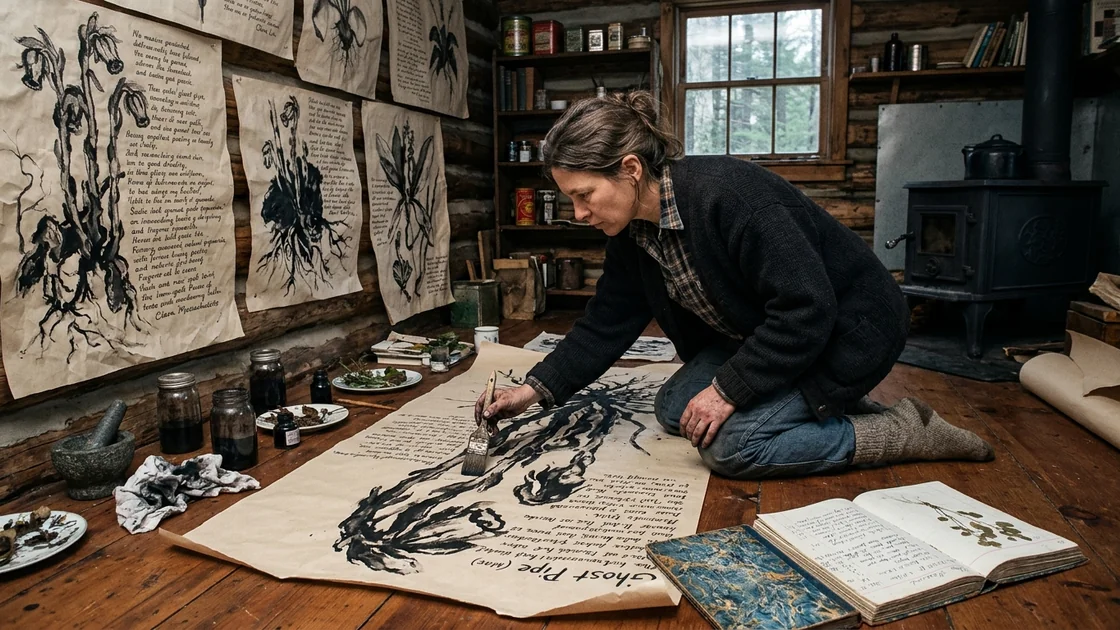
After a ruinous professional scandal at the National Botanical Institute strips illustrator Clara Lin of her career and reputation, she retreats to an off-grid timber cabin in the hemlock forests of western Massachusetts. Intending to abandon her art entirely, Clara instead uncovers a collection of radical, unpublished notebooks hidden beneath the floorboards by Ruth Holland, a pioneering feminist poet who vanished from the literary world in the late nineteen-sixties. As Clara transcribes Ruth’s fiery writings on female autonomy, bodily sovereignty, and the unyielding cycles of the natural world, the poet’s forgotten voice sparks a mutual resurrection, driving Clara to invent a bold new visual language that rejects sterile scientific orthodoxy and transforms her exile into an act of creative defiance.
I. The Ash on the Paper
The silence of the Berkshire hollow had weight, like uncarded fleece or wet slate pressed against the chest. For the first four days, Clara did not unpack her brushes. They remained rolled in their split-bamboo mat inside her hard-shell portmanteau, three dozen miniature sable hairs—Kolinsky rounds, sizes zero through five, each tipped with a protective quill of clear plastic—sleeping alongside her porcelain slants and cakes of gum arabic.
Whenever her fingers drifted toward the latches of her luggage, a phantom sensation caught her behind the collarbone: the dry, air-conditioned snap of the Linnean Hall at the National Botanical Institute; the hiss of seventy pairs of dress shoes turning on parquet; the low, cultured voice of Dr. Alistair Vance leaning toward the podium microphone to say, A regrettable instance of visual interpolation. In our discipline, Miss Lin, enthusiasm can never be permitted to masquerade as morphology.
He had smiled as he said it. That was what woke her at three in the morning, here in the damp, wood-smoke reek of the cabin. Vance had smiled because he had already removed the comparative plate she had drawn of Isoetes appalachiana, the fragile mountain quillwort he had insisted was merely a stunted ecotype of Isoetes lacustris. Clara had dissected forty-two specimens under a stereomicroscope to prove the distinct trilete megaspore sculpturing; she had rendered the tuberculate reticulations with four-zero rapidograph pens and sepia washes so delicate they looked like breath on cold copper. But Vance had needed the monograph to confirm his forty-year-old thesis, and when she had refused to withdraw her illustration, he had simply told the review board that she had fabricated the diagnostic ridges to justify her own aesthetic whim.
A botanical illustrator who invents her morphology is not an illustrator at all. She is a liar. She is an unstable woman seeing lace in the mud. Within seventy-two hours, the commission for the eastern fern atlas was rescinded; within a fortnight, her adjunct appointment at the university herbarium was quietly dissolved.
The cabin had belonged to Clara’s great-aunt’s second husband, an attorney who had used it twice a year for deer season and then let it rot into the hemlocks. It stood at the dead end of an unpaved logging road four miles outside a dying mill town whose main street offered only a redemption center, a hardware store with cloudy windows, and a diner that closed at two in the afternoon. The house was built of creosoted rough-pine timber, its low eaves bearded with gray-green lichen (Usnea strigosa), its small windows rattling whenever the April wind tore through the gorge.
Outside, the spring was late and cruel. Snow lay in rotten, grey drifts along the north-facing ledges, honeycombed with dirt and spruce needles. There was no internet; electricity arrived through a single wire strung along crooked poles that hummed in the rain like a low-pitched cello.
Clara spent her mornings hauling deadwood from the forest edge to feed the cast-iron Jotul stove that sat in the corner of the main room. The wood was punky, wet hemlock and silver birch that popped angrily and threw thick, acrid smoke into the rafters until the flue grew hot enough to draw. Her hands, which for fifteen years had known only the velvet drag of 300-pound Arches hot-press watercolor paper and the dry cool of brass dividers, grew red, chapped, and scored with resin.
By the fifth afternoon, the rain had turned into a steady, freezing drizzle that slicked the slate path between the porch and the rusted pump handle. Driven indoors, Clara sat at the raw pine kitchen table with a tin mug of scorched black tea. The house smelled of damp wool, creosote, and the sour ghost of decades of wood ash.
She pulled out her notebook—not her good cold-pressed sketchbook, but an ordinary grid-ruled composition pad she had bought at the gas station on the turnpike. She uncapped a cheap ballpoint pen. She looked down at the paper.
She tried to draw the cross-section of a pine needle: the two resin ducts, the single vascular bundle wrapped in its protective endodermis, the rigid hypodermis like a wall of tiny bricks. But her hand seized before the tip touched the line. Her pulse thudded in her ears, mimicking Vance’s measured, patrician timbre. An illustrator must be an unclouded mirror, Clara. When you project yourself into the stamen, you corrupt the species.
She dropped the pen. It rolled off the table and clicked against the floorboards.
Clara bent down to retrieve it. Beneath the table, where the shadows gathered against the stone base of the chimney, the floorboards were laid irregularly. Unlike the tongue-and-groove fir planks that covered the rest of the room, the boards flanking the hearth were wide, rough-sawn chestnut—salvage timber from an older structure, likely felled before the blight had cleared the ridge seventy years ago.
Between two of the chestnut boards, near the mortar of the chimney, something caught the gray light from the window. Not the metallic glint of a lost nail, but the dull, greasy sheen of black oilcloth.
Clara knelt on the cold grain. The draft coming up through the floor smelled of cellar dirt, cellar rot, and ancient dry leaves. She touched the board. It was loose; the square iron cut-nails that had once anchored it to the hemlock joists beneath had rusted through at the shanks.
With the flat blade of her camp knife, she pried at the edge. The wood groaned, shedding flakes of reddish fiber, and then lifted with a dry, splintering sigh.
Beneath it lay a cavity between two floor joists, entirely dry, lined with mouse-chewed yellow pages of The Atlantic Monthly from the autumn of 1963. And nestled into that paper nest, wrapped in a square of waxed canvas tied with black twine, sat three oblong books.
II. The Drawer Beneath the Joists
They were ledger notebooks of the sort once used by country stationers: binding of stiff pasteboard covered in marbled blue and ochre paper, corners tipped with sheepskin that had dry-rotted into red powder.
Clara lifted the package out. It was shockingly heavy, as if the damp of sixty winters had condensed inside the leaves into something resembling lead. She carried it to the table, wiping her gray-smudged thumbs on her denim trousers.
When she untied the twine, it snapped like dry straw.
The top ledger was labeled on its cover with an adhesive label, the gum yellowed to the color of earwax:
RUTH HOLLAND HIGH HOLLOW / 1962 The Anatomy of Seed and Spore
Clara paused, her fingers resting on the cracked sheepskin spine. The name struck a low, forgotten bell in the attic of her memory. Ruth Holland. Not a botanist. In her undergraduate days at Sarah Lawrence, Clara had spent two semesters haunting the twentieth-century poetry shelves in the old library. There had been a slender, blood-red spine, issued by a tiny, long-defunct press in Gloucester: The Bone Garden, 1958. Clara remembered a photograph on the dust jacket—a woman with cheekbones like sheared granite, hair hacked off at the jawline with kitchen shears, staring into the lens not with the coquettish melancholy expected of female poets in that decade, but with the flat, unblinking glare of an owl perched on an iron fence.
And then she had vanished. Anthologies from the mid-sixties sometimes footnoted her as a contemporary of Plath and Sexton who had "retreated into rural domestic obscurity." One critical survey had dismissed her as an "unsettling talent who mistook the raw viscera of female alienation for the architecture of myth."
Clara opened the first notebook.
The paper inside was heavy, faintly ruled, and filled with black fountain-pen ink—water-soluble pelikan black that had bitten deep into the wood pulp. The hand was not the polite, looping copperplate of the mid-century women’s academy. It was furious, angular, the ascenders of the t’s and d’s slashed across like miniature scalpel strokes.
On the frontispiece, beneath the title, Ruth had written:
May 14, 1962. I have abandoned Thomas’s linen sheets. I have abandoned the mahogany sideboard that smelled of lemon oil and three generations of Boston compliance. Let the department have him; let the graduate students listen to him balance the virtues of Dryden against the sins of Donne until their blood turns to paraffin. The roof here leaks over the stove. A brown stain spreads across the plaster like an ovary. Good. If I must be enclosed by walls, let them look like something that can bleed.
Clara sat back, her breath catching in her throat.
She turned the page. Pasted directly onto the paper with strips of yellowed cellophane tape was the pressed leaf of an early meadow-rue (Thalictrum dioicum). It had degraded into a pale, translucent membrane, its delicate, scalloped margins like lace drowned in vinegar. Beside it, Ruth had written:
The male flower is all show—a spray of pendulous stamens, yellow and vain, trembling at the slightest draught, begging to drop its dust. But look at the pistillate plant. It stands four feet back in the shadow of the ledge, purple-stemmed, sullen, retaining its stigmas like clenched teeth. Thomas used to say that my verses lacked ‘classical proportion.’ By that he meant they did not scan like an afternoon in an Oxford garden. He wanted me to write of hydrangeas as if they were old aunts taking tea. He did not want to hear that the soil makes them blue through the ingestion of raw aluminum, or that the flower is sterile, a deformed cluster of sepals screaming to be touched by an insect that never arrives.
Clara turned another leaf, and then another. The ledger was not merely a diary; it was a terrifying hybrid of journal, naturalist’s daybook, and poetic manifesto. Interspersed between long, muscular drafts of poems were field observations of the High Hollow woods—precise, clinical, yet shot through with a wild, feral anger.
June 2, 1962. Found the white baneberry (Actaea pachypoda) in flower along the brook. The locals call it Doll’s Eyes, but there is no child’s play in it. The pedicels thicken after fertilization; they turn a swollen, violent magenta, holding aloft those cold white porcelain globes with their solitary black dots. One berry contains enough cardiogenic glycoside to still the heart of an adult man in twenty minutes. I thought of Alistair today while scraping the soot from the lamp chimney. Not because he was cruel in the way that leaves bruises, but because he was clean. His fingernails were always filed into neat white crescents. When he touched the nape of my neck, it felt like an inspection for mites.
Clara started. Her hands jerked so violently that the edge of the ledger nearly slipped from the pine table.
Alistair.
She re-read the line four times. Alistair. It could not be. Alistair was a common enough name among the Northeast academic elite. But Ruth had mentioned Thomas—Thomas Holland, presumably, her husband. Who was Alistair?
She flipped forward through the leaves. Her eye caught names, fragments of dates: Harvard Herbarium, August 1963; the Linnaea Club dinner; the small office on the third floor behind the glass cases of pressed mosses.
The hair on Clara’s forearms stood up.
Dr. Alistair Vance had not begun his career as the towering, silver-crested patriarch of North American botanical taxonomy. In 1963, he would have been thirty-one years old: an ambitious junior curator at Harvard, protégé of the great fern specialists, a man with impeccable manners, a razor-parted side, and an appetite for order that brooked no deviation.
Clara pulled the lamp closer. The rain drummed against the cabin glass with an insistent, rhythmic tapping, like knuckles demanding entrance.
III. The Architecture of the Stamen
For forty-eight hours, Clara did not leave the cabin except to draw water from the pump. She ate stale soda crackers from her emergency tin and drank bitter coffee, sitting wrapped in a woolen car-rug by the light of a kerosene lantern she had found in the pantry and cleaned with vinegar.
The three ledgers spanned seven years: from the spring of 1962, when Ruth Holland had fled her marriage to Thomas Holland—a professor of English at Harvard—until the late autumn of 1968, when the writing abruptly ceased.
Through the pages, the story of those years emerged not as a narrative of defeat, but as a deliberate, systematic stripping away of every ornament the world had demanded of her.
Ruth had come to High Hollow with two trunks: one of books, one of woolens. She had brought forty pounds of plain typing paper, four bottles of Higgins waterproof ink, and a brass-barreled Swift student microscope she had stolen from her husband’s study.
In the second ledger, dated Spring 1964, Clara found the core of the wound:
April 19, 1964. The young man from the Gray Herbarium came up on the milk train to Greenfield. Alistair. He carried his vasculum over his shoulder like an infantryman’s satchel. Thomas sent him, of course. Thomas believes that if I will not speak to him, I might at least be coaxed down from the mountain by one of his bright young disciples. Alistair sat in the chair by the hearth, refusing to unbutton his mackintosh. He smelled of tobacco and the carbolic acid they use to kill dermestid beetles in the storage cabinets. He looked at my manuscripts on the kitchen table with that particular, condescending pity the young man of science reserves for the woman who writes. ‘You have real descriptive gifts, Mrs. Holland,’ he told me. ‘It is a pity to waste them on private hyperbole. If you were disciplined, you could assist us with the descriptive keys for the new Pteridophyte handbook. There is an opening for an artist who can follow instructions.’ I asked him if he had ever seen the gametophyte of a sensitive fern (Onoclea sensibilis). He smiled his thin, church-goer’s smile. ‘Of course,’ he said. ‘A heart-shaped prothallus, green, photosynthetic, bearing antheridia on the lower surface.’ ‘No,’ I told him. ‘It is a wet lung that breathes in the dark. It is the only part of the fern that knows how to desire. The plant you see in the sun is merely the spore-bearing corpse it throws up afterward to escape the mud.’ He set his tea down without drinking it. He told me that Thomas was deeply concerned for my sanity. He said that a woman who cannot tell the difference between a reproductive organ and a human lung is in need of rest, not poetry.
Clara closed her eyes. Her breath came fast and shallow in the quiet room.
She knew that tone. She had heard it across fifty years. Vance had used the exact same cadence when he had summoned her to his office three weeks before the exhibition: ‘You have an undeniable facility with the sable, Clara. But you are attempting to invest these structures with an emotional autonomy that simply does not exist in nature. Plants do not struggle, my dear. They merely execute physiological imperatives.’
She looked down at her own hands. The fingers were curved, stiff from disuse.
Beside the ledger, her drawing gear sat in its black case like a set of embalmer’s tools. For fifteen years she had operated under the iron rule of the Institute: no personal line, no atmospheric perspective, no expressive cross-hatching. The specimen must be rendered in pure, high-key illumination—an impossible, shadowless white space where every leaf is turned at an angle that reveals its venation, where every petal is spread like a corpse on an autopsy slab.
The Linnean ideal was an art of erasure. It erased the dirt in which the plant had fought for light; it erased the slug-chewed margin; it erased the fungal rot that lived in the root-nodules; it erased the painter who had spent eighteen hours hunched over a lens, her eyes watering, her spine aching, her menstrual blood soaking through her skirt while she rendered the micro-hairs on an anther.
Clara reached out. Her fingers touched the bamboo roll.
She unbuckled the straps.
She took out a single sheet of heavy Fabriano paper, fifteen inches by twenty. She pinned it to her drawing board with four brass thumb-tacks.
Then she opened the third ledger.
IV. The Chthonic House
The third volume was different from the first two. By 1966, Ruth’s ink had changed from black to a deep, iron-gall purple she appeared to have manufactured herself from oak galls and copperas. The handwriting was larger, fiercer, stretching across the unruled pages like root systems breaking through shale.
Pasted between the entries were not merely pressed plants, but fragments of returned envelopes, rejection slips from Boston and New York, and carbon copies of her own replies.
July 11, 1966. Returned today from The Hudson Review: seven poems. The editor writes: ‘There is an unseemly violence in your imagery, Mrs. Holland, which undermines the domestic authority of your voice. One feels you are straining for masculine vigor at the expense of lyric grace. We should prefer to see more of the nature lyrics in the vein of your earlier work—the thrush, the orchard, the quiet garden.’ The quiet garden. They want the woman to remain the hedge, never the thorn. They want her to be the flower that waits for the bee, never the pitcher plant that digests the fly in its own sweet, acidic stomach.
Beneath this entry, Ruth had drafted a poem that Clara read three times aloud to the empty room, her voice shaking at first, then steadying until it rang against the rough-pine walls:
I am not your orchard. I am the chokecherry that rots upon the stone, the black knot that swells the branch until the bark splits into horn. Do not come here with your shears, your grafting wax, your little names. The root does not answer to Latin. The root drinks what the rock provides, and it remembers nothing of your gardens.
On the facing page, Ruth had begun an index. She had titled it: A Flora of the Exiled.
It was a list of sixty-four plants native to the High Hollow ridge, arranged not by the Linnean sexual system, nor by the modern Engler-Prantl taxonomic order, but by their physiological strategies of survival, defense, and self-propagation:
- Plants that poison the soil to kill their neighbors (Juglans nigra, Kalmia latifolia).
- Plants that feed on the dead without yielding green (Monotropa uniflora, Corallorhiza maculata).
- Plants that mimic the scent of decaying meat to deceive the fly (Symplocarpus foetidus).
- Plants whose seeds require fire to crack their skins.
Clara stared at the list. A strange, cold prickle began at the base of her neck and crept across her scalp.
This was not madness. It was an alternative botany—a taxonomy built not from the outside by a gentleman collector with a drying press and a pair of brass calipers, but from the inside, by someone who understood what it meant to exist as an organism under siege.
Clara stood up. She pulled on her heavy rubber boots, her wax-cotton jacket, and took her brass trowel and collecting tin from the corner shelf.
She went out into the rain.
The woods were steaming. The late-April mist drifted through the hemlocks in long, ragged banners, catching in the dark boughs like torn wool. The ground was saturated; every step produced a sucking gulp from the moss-thick humus.
Clara climbed the ridge behind the cabin, following a deer path that wound through the granite boulders. Her eyes, trained by a decade and a half of field study, searched the leaf litter with a hunter’s precision.
She did not want the showy things—not the Dutchman’s breeches or the yellow violets that tourist painters loved to splash across greeting cards.
She wanted the things Ruth had indexed.
Near the base of a rotting birch stump, half-buried under decayed oak leaves, she found it: Monotropa uniflora. Ghost pipe.
It was not yet fully emerged, but its crooked white neck had already shoved aside the frozen mulch. It was entirely devoid of chlorophyll—translucent, corpse-pale, scaled with tiny, degenerate leaves that looked like fish scales. It did not borrow energy from the sun. It was an epiparasite, its subterranean root ball tangled into the mycorrhizal threads of Russula fungi, siphoning the sugars that the ancient hemlocks had manufactured fifty feet above in the light.
In the Institute’s manuals, Monotropa was always drawn as a curious, limp monstrosity, usually depicted isolated on a white plate, its ghostly white stem rendered with pale gray washes of Payne’s gray and dilute sepia, looking weak, sickly, an embarrassment to the green kingdom.
Clara knelt in the wet leaves. She did not use her trowel immediately. She brought her face within three inches of the stem.
Under the mist, the plant was not limp. It was turgid with moisture, dense, crystalline as paraffin. It had shoved its way through two inches of half-frozen gravel and decaying wood by the sheer hydraulic force of its cells. It was not a victim of the dark; it was a master of it. It had found a way to rob the grandest trees in the forest through a subterranean alliance with an invisible rot.
Clara drove the trowel into the dirt, well back from the stem, lifting the plant with its entire root-cluster and the black, fungal-webbed soil that cradled it.
She carried it back down the mountain like a monstrance.
V. The Breaking of the Plate
In the cabin, Clara set the specimen on a white porcelain plate under the north window.
She pulled her chair to the table. She opened her watercolor box: Windsor & Newton pans, thirty years old, their surfaces dry and cracked like old varnish. She reached for her sable brushes, but her fingers stopped.
She did not pick up the number-two Kolinsky round.
She picked up an old, stiff-bristled utility brush she had used for cleaning mortar off the hearth. She took a bottle of Higgins waterproof black ink, unscrewed the bakelite dropper, and dumped a pool of it into the porcelain well of her slant.
Then she looked at the Fabriano paper.
For fifteen years, her first step had been an outline in 4H pencil—a line so light it was almost invisible, a line that could be erased without bruising the sizing of the paper. A line that apologized for itself.
Clara dipped the utility brush directly into the raw black ink.
She did not sketch. She planted her left hand flat on the paper—her thumb scarred from the firewood, her knuckles red from the cold—and with her right hand she drove the stiff bristles across the white sheet.
The sound was like an animal scurrying through dry reeds: scritch, scritch, hiss.
She did not draw the plant as a collection of clinical parts. She drew it as an eruption. She painted the heavy, swollen hook of the flowering shoot as an iron wedge splitting the grain of the paper. She did not omit the fungal threads; she mixed ground bistre with gum arabic and slashed it across the bottom of the plate in long, dripping tendrils that looked like torn sinew.
When she came to the scale-leaves, she did not paint them with polite washes of Chinese white. She took her camp knife, dipped the point into the ink, and scored the paper directly, gouging the cotton rag so that the black ink pooled in the wounds, ragged and burred.
Her breath came hard. Sweat ran down her temples, stinging her eyes, mixing with the smell of the damp wool blanket over her knees and the wild, sharp scent of the wet humus on the plate.
When the ink was still wet, she opened Ruth’s third ledger to page ninety-two.
She read the entry Ruth had made on October 4, 1967:
They believe that because I do not scream, I am reconciled. They believe that because I live in this hollow with two cats and a bin of potatoes, I have become an old woman who talks to the squills. They do not see the work. They do not know that every night I am disemboweling their grammar. I am taking their nouns—their clean, Latinate, property-holding nouns—and soaking them in the swamp until the skin slips off. When I am finished, their language will not be a fence to keep the forest out. It will be the rot that lets the forest in.
Clara took her finest pen—the one Vance had told her to use only for diagnostic seed sculpturing—and beneath the black, gouged roots of the Monotropa, she wrote Ruth’s lines directly onto the plate, weaving the letters through the fungal hyphae until the text and the root were indistinguishable, until the words became the mycorrhizal network that fed the pale, murderous stem.
She worked until the kerosene lamp sputtered and died, leaving the room illuminated only by the faint, orange grin of the stove door.
She did not go to bed. She sat at the table with her head resting on her forearms, her fingers stained black to the second knuckle, and slept the dreamless, heavy sleep of someone who has survived an explosion.
VI. The Correspondence
The summer did not arrive gently; it broke over the mountains like a green wave. By June, the hemlock hollow was suffocatingly lush. The ferns—interrupted fern, cinnamon fern, marginal wood fern—unfurled their croziers until they stood shoulder-high along the logging road, their spores ripening into rusty, velvety carpets on the undersides of their pinnae.
Clara’s life had assumed a fierce, monastic rhythm.
Every three weeks she walked the four miles down to the mill town with an empty canvas rucksack. At the post office, she picked up her meager bank draft—the small trickle of savings she had left—and a handful of circulars she dropped into the trash can by the door.
At the general store, she bought oats, salt pork, tins of sardines, lard, and five-pound bags of flour. The storekeeper, an elderly man with cataract-milky eyes named Mr. Peake, never asked her what she was doing on the mountain. He knew the cabin had belonged to old man Lin; he assumed she was an eccentric niece waiting out a divorce.
"Found some papers up there, did ye?" he asked one morning as he tied a bundle of salt fish with brown twine.
Clara paused, her hand hovering over her coin purse. "What do you mean?"
Peake snorted, wiping the counter with a greasy rag. "That poet woman. Holland. Used to come down here in a man’s flannel shirt with her hair all over. Never spoke to nobody unless she wanted paraffin. People said she was crazy. My mother said she was just sour because her man had left her."
"She wasn't sour," Clara said. Her voice sounded strange to her own ears—raspy, deeper than it had been in New York, stripped of the polite, musical lilt she had once used to mollify Vance and the herbarium trustees.
Peake glanced up, his white eye twitching. "Maybe not. But she went off all the same."
"Where did she go?"
"Nobody knows," he said, turning back to his shelves. "One November she just wasn't on the milk train. State police went up there. House was open. Stove was out. Not a scrap of writing in the place. They figured she’d walked down to the Westfield River and jumped in, but they never found nothing. Just her clothes in the closet and two trunks of dead leaves."
Clara carried the rucksack back up the mountain under a blazing noon sun. The heat in the hemlock gorge was heavy, smelling of damp resin and decaying granite.
Not a scrap of writing.
Ruth had not left her notebooks to be found by the state police, or by Thomas Holland, or by Alistair Vance. She had lifted the loose chestnut boards by the hearth. She had lined the joists with mouse-chewed magazines. She had wrapped her life in waxed canvas and tied it with twine that would last sixty years, and then she had walked away.
When Clara reached the cabin, she did not unpack the groceries.
She went to the hearth. She lifted the loose board again.
She reached her arm into the cavity, further than she had before, her fingers brushing the rough granite foundation stones where the joist met the sill.
Her nails scraped against metal.
She drew it out: a flat, galvanized tin dispatch box, ten inches by twelve, sealed around the seam with black friction tape.
Clara sat on the floor, the box across her knees. The tape had oxidized into a tacky, tar-like substance that left black gum on her fingers. She peeled it away with her knife.
Inside were letters.
Not letters Ruth had received, but the ones she had never sent: unsent drafts addressed to Thomas, to her sister in Baltimore, to editors at The Nation and Partisan Review. And at the bottom of the stack, a thick, manila envelope addressed to:
Dr. Alistair Vance Curator of Pteridophytes The Gray Herbarium, Harvard University Cambridge, Massachusetts
The envelope was unsealed. Clara drew out the contents.
It was a manuscript—forty-eight pages of typed verse, titled: THE GREEN ANATOMY: A Monograph on the Female Genus.
Attached to the first page was a letter, dated October 12, 1968:
Alistair, I send you this because you are the most dangerous man I have ever known. Thomas was merely weak; he wanted an ornament that would also manage the laundry. But you want something far worse: you want the world to be clean. You believe that by assigning four Latin syllables to an orchis, you have conquered its mystery. You believe that when you press an organism between two sheets of blotter paper under eighty pounds of strap-pressure, you have preserved its truth. You have preserved only its carcass. You have created an index of your own terror. You told me once that nature has no voice, only mechanics. You told me that my metaphors were ‘the hysteric projections of an unoccupied mind.’ Look at these plates. I did not draw them with your rapidographs. I drew them with soot, with the bile of a porcupine I found dead in the road, with the juice of the elderberry and the iron water from the swamp. If you publish your manual without them, you are publishing a lie. But you will publish your manual without them, of course. You will become a full professor. You will receive medals from societies in London and Stockholm. And you will die in a clean room smelling of formaldehyde, wondering why you were never once, in all your seventy years, terrified by a leaf.
Clara held the letter in her lap.
Outside, the cicadas had begun their high, mechanical whine in the oak crowns—the sound of the heat turning the summer toward its decline.
She remembered Vance’s office on the day she had been dismissed.
The walls had been lined with mahogany cabinets containing two hundred thousand pressed plants. The room had been climate-controlled: fifty-five degrees, forty percent relative humidity. Vance had sat behind his broad oak desk, wearing a knitted cashmere waistcoat over his immaculate shirt.
On his desk had sat a brass presentation box, given to him on his seventieth birthday by the International Association of Plant Taxonomists.
He never threw anything away, Clara thought. He kept every index card, every offprint, every administrative memo from 1959 to the present.
Did he remember Ruth Holland?
Did the name sit inside one of those green steel filing cabinets under the heading Correspondence: Unsolicited / Eccentric?
Or had he burned it?
VII. The Living Plate
By August, Clara’s hands had changed entirely.
The tremor that had plagued her in Boston—the slight, spastic twitch of the third finger of her right hand that had made her fine cross-hatching impossible—was gone. In its place was an authority that frightened her.
She had abandoned the Fabriano paper. She had found, in the town dump behind the hardware store, three bundles of heavy rag butcher paper from the nineteen-fifties, discarded when the old meat market had closed. The paper was rough, unbleached, thick as cardboard, with a faint tooth that caught the pigment like sharkskin.
She worked on the floor of the cabin, on her knees, the large sheets laid out across the chestnut boards.
She did not use watercolors from little pans. She manufactured her own pigments, following the notes in Ruth’s second ledger:
She boiled the bark of the black oak (Quercus velutina) in an iron pot to produce a luminous, sulfurous yellow that smelled of tannin and vinegar.
She gathered the green husks of the shagbark hickory, crushed them in a stone mortar, and steeped them in wood-ash lye to create a rich, oily walnut-brown that bit into the rag paper like an acid.
She collected the soot from her own lamp chimney and ground it with stale egg yolk and a drop of clove oil—the old egg-tempera method, but raw, thick, applied with palette knives and horsehair brushes she had fashioned herself from the tails of dead deer she found along the highway.
She was no longer illustrating specimens. She was illustrating Ruth’s poems.
For the poem on the Actaea pachypoda—the Doll’s Eyes—she drew a four-foot-tall plate. She did not render the plant in its polite, decorative entirety. She rendered only the fruiting raceme, enlarged twenty diameters, until the white berries looked like blind human eyeballs impaled on swollen, carmine fingers. The veins beneath the white skin were not delicate; they were purple, gorged with blood-poison.
Around the base of the pedicel, she inscribed Ruth’s lines in black gesso:
I will not look at you with your mother’s eyes. I have grown eight new pupils from the stone. Every one of them is blind to your forgiveness.
She worked fourteen hours a day. Her clothes were stiff with grease and dried egg. Her fingernails were permanently rimmed with black oak tannin. When she looked in the small, spotted shaving mirror above the sink, she did not see the quiet, humiliated technician who had wept in the taxi on the way from Linnean Hall.
She saw a woman with sun-blackened forearms, hair tangled into an oily knot, eyes wide and clear as the lens of a dissecting scope.
One afternoon in early September, as the first yellow leaves of the white birches were drifting down onto the cabin roof, a blue sedan bumped its way up the logging road.
It was an old Volvo, its muffler rattling, its fenders coated in white dust from the limestone quarries down the valley.
Clara stood on the porch, her camp knife in her right hand, an oily rag in her left.
The car stopped beside the pump. The engine diesled, sputtered, and died.
The door opened, and a woman stepped out.
She was fifty, perhaps fifty-five, wearing a rumpled linen jacket over an untucked silk blouse. Her silver-streaked hair was tied back with a leather thong. She wore round, tortoiseshell spectacles that had slipped half-way down her nose.
She looked at the cabin, then at Clara.
"Clara Lin?" the woman asked.
Clara did not move. "Who are you?"
The woman reached into her car and pulled out a leather briefcase. "My name is Dr. Marian Vance. I am the associate director of the Gray Herbarium."
Clara’s jaw tightened. "Alistair’s daughter."
"His niece," Marian corrected. Her voice was not like Alistair’s; it was dry, husky from tobacco, with an ironic New England edge that sounded more like the docks than the faculty lounge. "He didn't have daughters. Daughters require an acknowledgment of biological contingency that Alistair was never quite prepared to make."
Clara did not invite her onto the porch. "How did you find me?"
"Your great-aunt’s probate records," Marian said, leaning against the warm hood of the Volvo. "It took three weeks. Alistair doesn't know I’m here. Alistair is currently in a nursing facility in Concord. He has vascular dementia. He spends most of his afternoons classifying his plastic dinner forks into genus and species."
A cold wind blew down the gorge, carrying the smell of wood smoke and dry fern.
"What do you want?" Clara asked.
Marian Vance sighed. She reached into her briefcase and pulled out a heavy, cloth-bound volume with gold lettering on the spine:
THE PTERIDOPHYTES OF NORTH AMERICA A REVISIONARY TAXONOMY Vance, Lin, et al.
She held it out toward the porch.
"The board approved the errata slip," Marian said. "We found your original dissections of Isoetes appalachiana in his private safe behind the herbarium office. Along with three hundred other sheets he had ‘quarantined’ over the last thirty years. He hadn't destroyed them. That was his particular neurosis—he couldn't bear to let them be seen, but his scientific conscience wouldn't let him burn them."
Clara looked at the gold letters on the spine. Her name was there, stamped in twenty-four-carat leaf, right beside the man who had crushed her.
Six months ago, she would have fallen on her knees. She would have wept into the cloth binding. She would have traded five years of her life to have that book in her hands, to have the errata slip mailed to every botanical library from Kew to Tokyo, to hear Vance’s peers murmur that the Lin girl had been right after all.
Now, the gold lettering looked to her like the dry tracks of bark beetles on a dead pine.
"Take it away," Clara said.
Marian Vance froze, her hand still extended. "Clara. You don't understand. The Institute wants you back. We have the funding for the Southern Appalachian monograph. We can offer you the senior illustratorship. Full tenure on the technical staff. A laboratory with three assistants."
Clara looked past Marian, into the dark, tangled understory of the hemlocks.
She saw the ghost pipe, withered now into black, woody skeletons, standing stiff in the moss like iron nails. She saw the wild ginger (Asarum canadense), whose dull brown, three-lobed flowers bloomed flat against the mud, hidden beneath their own kidney-shaped leaves, pollinated by fungus gnats that crawled through the leaf litter.
She thought of Ruth’s handwriting: The root does not answer to Latin.
"Come inside," Clara said.
VIII. The Exhibition of the Exiled
Marian Vance stepped over the threshold and stopped.
The main room of the cabin had ceased to be a domestic dwelling. The furniture had been pushed against the back wall; the kitchen table was covered in glass jars of raw pigment, drying racks made of chicken wire, pestles, mortars, and bundles of dried herbs hung from the rafters by blue binder twine.
And pinned to the walls—nailed directly to the rough-pine logs with cut-iron shingle nails—were the plates.
There were thirty-six of them.
They were massive, four feet by three, the brown butcher paper buckled and cockled by the wet glazes. They did not look like the illustrations in the Pteridophytes of North America. They looked like the flayed skins of mythological creatures.
On the north wall hung the Symplocarpus foetidus—the skunk cabbage. Clara had not painted it as the squat, vulgar thing of early spring ditches. She had painted the spathe as an open, hooded mouth of mottled liver-purple, inside of which the spadix sat like a burning coal. Around the base, she had rendered the internal metabolic furnace of the plant—the chemical heat that allows it to melt through two feet of frozen mud and snow, its temperature twenty degrees higher than the surrounding air. The steam rising from the spathe was rendered in gold leaf and wood ash, and within the steam, written in copperas ink, were Ruth’s words:
I do not wait for your April. I make my own summer from my own rot. I burn through the ice because I must breathe.
Marian Vance walked slowly into the center of the room. Her briefcase slipped from her hand, hitting the chestnut floorboards with a dull leather thud.
She did not touch her spectacles. She stood before the skunk cabbage for a long time, her chest rising and falling, her mouth slightly open.
Then she turned to the south wall, where Clara had hung the Kalmia latifolia—the mountain laurel.
In botanical texts, Kalmia is always shown as a sweet, pink-and-white shrub, the emblem of New England innocence. Clara had painted only the stamens. She had enlarged them until they looked like ten miniature catapults locked into the pockets of the corolla under terrifying mechanical tension. She had drawn the insect’s foot touching the hair; she had drawn the stamen springing free with violent, explosive elasticity, slamming eighty grains of toxic pollen into the bee’s soft underbelly like buckshot.
Beneath it, the text read:
Do not mistake my beauty for an invitation. Every petal is an engine of assault. Touch me, and I will strike you with my seed.
Marian Vance took a shaky breath. She took off her glasses, wiped them on the hem of her silk blouse, and put them back on.
"My God," she whispered.
"Ruth Holland lived here," Clara said from the doorway. "For seven years. After she left Thomas."
Marian turned around sharply. "Ruth Holland? The poet? Thomas Holland’s wife?"
"She was not Thomas Holland’s wife," Clara said. "Not here."
Clara walked to the table. She lifted the three marbled ledgers, the galvanized dispatch box, and the manuscript of The Green Anatomy.
"Alistair came here," Clara said. "In nineteen-sixty-four. He told her she was hysterical. He offered her a job drawing ferns if she would learn to follow instructions."
Marian Vance closed her eyes. A look of old, familiar weariness washed over her face—the look of a woman who had spent thirty years cleaning up the quiet, administrative wreckage left by great men.
"He never spoke of her," Marian said. "Except once. When I was a doctoral student. I was working on the taxonomy of the Ericaceae, and I mentioned that some of the older common names had a poetic accuracy that the formal keys lacked. He took his glasses off and told me that poetry was an infection of the rational intellect. He said he had known a woman once who had destroyed herself because she couldn't accept that a flower was merely a mechanism for the transmission of germ-plasm."
"She didn't destroy herself," Clara said.
She laid the manuscript on the table before Marian.
Marian reached out with a trembling hand. She turned the yellowed pages of onionskin, reading the typed verses, the hand-drawn anatomical keys, the annotations in iron-gall ink.
"Where is she?" Marian asked.
"She’s dead," Clara said simply. "Or she’s somewhere else. It doesn't matter. She left the seeds."
Marian looked around the room—at the thirty-six massive, terrifying plates, at the jars of crushed hickory and black oak bark, at the woman standing before her with resin on her fingers and soot on her collar.
"The Institute won't publish these, Clara," Marian said quietly. "They can't. It’s not science. It’s... it’s an insurrection."
"I know," Clara said. "I didn't paint them for the Institute."
"Then what will you do with them?"
Clara looked through the open door, out toward the logging road where the hemlocks stood against the September sky. The wind was rising, turning the undersides of the leaves silver.
"There is an old print shop in Greenfield," Clara said. "A woman there has an 1880 Washington hand press. She prints broadsides for the anti-war committees and the farm workers. She told me last week that if I bring her the plates on zinc, she will help me pull two hundred copies."
Marian Vance stared at her. "You have no money."
"I have enough for ink and paper," Clara said. "That’s all Ruth had."
Marian Vance stood still for several minutes. The only sound was the clock ticking on the mantel—an old brass Seth Thomas that Clara had oiled with lard—and the dry rustle of the birch leaves against the windowpanes.
Then, slowly, Marian reached into her leather briefcase again.
She did not pull out another contract, or another botanical atlas. She pulled out a small, brass-bound magnifying loupe—an old triplet, ten-power, its barrel worn down to the bare yellow metal by forty years of thumb-pressure.
She set it on the table beside the ledgers.
"It was Alistair’s," Marian said. "He gave it to me when I passed my qualifying exams. He told me it had belonged to Asa Gray. It’s the best glass in Cambridge."
She looked at Clara.
"Use it," Marian said. "Dissect the bastards."
IX. The Seed and the Stone
The first snow came on the twelfth of November.
It did not come with wind; it fell in huge, wet flakes that settled silently on the unharvested squash in Clara’s small garden plot and bowed the hemlock boughs until they touched the forest floor.
Inside the cabin, the Jotul stove was roaring. The smell of burning birch mixed with the oily tang of printer’s ink and the clean, bitter scent of turpentine.
Clara sat at the pine table.
Before her lay the first finished volume: THE GREEN ANATOMY, by Ruth Holland and Clara Lin.
It was bound in heavy pasteboard covered in rough, unbleached linen she had bought from a dry-goods store in Holyoke. It contained thirty-six lithographic prints, pulled by hand on rag paper, each accompanied by Ruth’s verses and Clara’s anatomical analyses.
It did not look like an academic monograph. It looked like an ancient codex—a field guide for a world that had not yet been tamed into lawns and arboretums.
Beside her, on the corner of the table, sat a letter she had received two days before from the secretary of the Linnean Society in London. Dr. Alistair Vance had died in his sleep at the home in Concord. There would be a memorial service at the Memorial Church in Harvard Yard; contributions could be made to the Vance Endowed Chair in Systematic Botany.
Clara did not read the obituary. She used the paper to light the kindling in the stove.
She opened the book to the final plate.
It was the Isoetes appalachiana—the little mountain quillwort that had started her ruin.
She had drawn it again. But this time she had not drawn it to Vance’s specifications. She had not drawn it as a stunted, imperfect version of something else.
She had drawn the quillwort as it lived: submerged in the acidic, freezing waters of a high-altitude tarn, rooted in sterile granite gravel where no other vascular plant could survive. She had drawn its corm—a swollen, three-lobed mass of white tissue, tucked into the silt like a fist—and its quill-like microphylls rising toward the grey water, each one bearing at its base a single, massive sporangium.
And beneath the dissection of the megaspore, with its delicate, tuberculate ridges that Vance had called an ‘erratic interpolation,’ she had set the last entry from Ruth’s third ledger:
Do not weep for the plant that lives in the dark. Weep for the gardener who believes that light is the only truth. The spore does not need the sun to wait. It can lie fifty years beneath the ice, holding inside its three-walled shell the memory of the swamp, the architecture of the lung, the patience of the stone.
Clara closed the book.
She stood up and went to the window.
The gorge was white now, completely transformed. The logging road had disappeared; the boundary walls of stacked granite that the old settlers had built were nothing more than soft, rounded mounds under the drifts.
There were no tracks in the snow.
Clara took her coat from the peg—her old coat, the one with the wool lining frayed at the wrists, stained with walnut juice and black iron gall.
She did not take her boots. She sat on the bench by the door, pulled on her thick woolen stockings, and stepped out onto the porch in her slippers.
The cold hit her face like an open hand—clean, shocking, smelling of nothing at all.
She walked to the edge of the porch. She looked up at the ridge, where the old birches stood white against the dark wall of hemlocks.
Somewhere under that snow, four inches beneath the leaf litter, the Monotropa was waiting. The quillwort was breathing beneath the ice in the high tarn. The seeds of the chokecherry were hardening their coats in the frozen gravel, waiting for the frost to crack them open so the embryo could taste the acid of the mountain.
Clara held out her hand.
A single snowflake landed on the center of her palm.
She did not use the brass loupe to inspect its symmetry. She did not count the six rays, nor did she classify it according to the international system of hydrometeors.
She watched it melt against the dark, calloused skin of her thumb—dissolving into a single drop of clear, living water that caught the low, grey light of the winter sky, and then sank into the grain of her hand until it was gone.