The Grammar of Mending
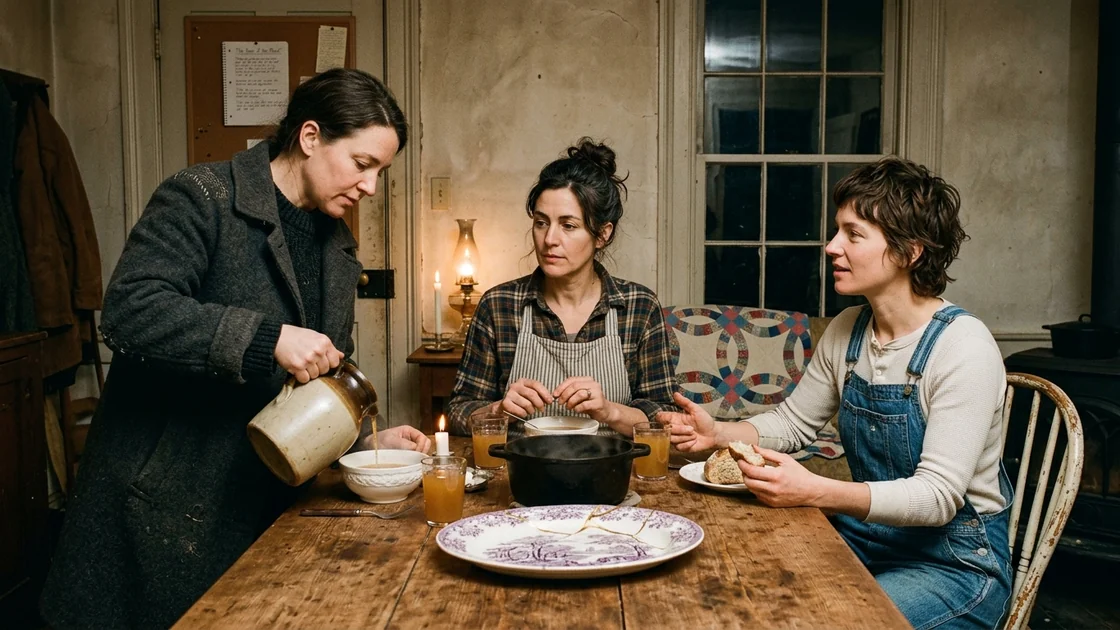
Clara Vance began her year of buying nothing on a bitter Tuesday in January after an avalanche of unopened cardboard boxes toppled in her hallway, exposing the hollow center of her grief and the distance between herself and her two sisters. Over the twelve months that followed, as the machines, garments, and furniture of her drafty family home began their inevitable descent into disrepair, she was denied the modern mercy of replacement and forced to learn the deliberate, difficult arts of restoration. In seeking the skills and tools she lacked, she had no choice but to knock on the doors of Maeve, whose precision with needle and thread she had long mocked as petty fussiness, and Nell, whose rough-hewn carpentry and stubborn self-reliance had once driven Clara out of their shared childhood rooms. What began as a stubborn experiment in domestic austerity gradually became an excavation of their mutual grievances, transforming broken chairs, unraveling coats, and cracked ceramics into the very instruments of their reconciliation.
I. The Vow of January
The front hall of the Harrow Road house had smelled of wet wool, cedar shavings, and cold river damp for three generations, but by the first week of January, it smelled primarily of corrugated cardboard and packing tape.
Clara stood in the narrow corridor, her breath condensing in the unheated stairwell. At her feet lay an unopened box containing a Swedish linen tea towel she did not need, delivered three days after Christmas. Beside it sat another box containing a brass paperweight shaped like an artichoke, and beside that, a stack of padded mailers holding various skin serums, an enameled butter dish, and a pair of shearling-lined slippers whose rubber soles had begun to separate before she even pulled them from the tissue.
Her credit card statement had arrived that morning on paper—a deliberate, cruel choice she had made during an ill-conceived attempt to make her finances feel real. The minimum balance due was a number that made her jaw ache.
Two years had passed since Eleanor Vance died in the corner bedroom upstairs, but the house remained cluttered with Eleanor’s half-finished projects and Clara’s desperate, uncurated acquisitions. Whenever the house felt too large, or the winter wind rattled the loose counterweights in the sash windows, Clara had opened her laptop in bed, her thumb moving over the trackpad like a worry stone, purchasing small, bright, finished things that arrived forty-eight hours later in tidy brown containers. They had been her insulation. They had kept the draft from her ribs.
She kicked the box with the artichoke paperweight. It skittered across the floorboards and struck the baseboard with a dull hollow thud.
"Enough," she said aloud. The house did not answer. It merely absorbed the syllable into its horsehair plaster walls.
She went into the kitchen, where a single bulb dangled from a yellowed cloth-wrapped cord. She took a spiral notebook from the junk drawer—a notebook her sister Maeve had bought for their mother's medication log five years earlier, three-quarters of its pages still blank—and a ballpoint pen with a chewed cap.
At the top of the first clean sheet, she wrote: The Year of the Mend.
The rules she set down were neither philosophical nor romantic; they were the desperate strictures of a woman running out of credit and dignity:
- Nothing new enters the house. No clothes, no furniture, no gadgets, no textiles, no decorative objects, no books.
- Consumables are restricted to simple staples: flour, beans, oil, salt, milk, seasonal produce, fuel, soap, and medicine.
- If something breaks, it must be repaired by hand.
- If it cannot be repaired, it must be repurposed.
- If it cannot be repurposed, Clara must do without.
- The term is 365 days, beginning midnight, January seventh.
She pinned the sheet to the corkboard beside the back door, using a bent upholstery tack she found under the radiator.
The house seemed to take this as a declaration of war.
The first casualty occurred forty-eight hours later. It was four o'clock in the afternoon, the light already dying over the bare lilac hedges in the yard. Clara was pulling on her wool greatcoat—a heavy, charcoal-colored melton wool coat that had belonged to Eleanor in the nineties and which Clara had worn since college—when her left arm met a sudden, vicious resistance.
There was a dry, ripping sound, like old sails catching a gale.
Clara froze, half-submerged in the coat. She withdrew her arm carefully. The entire lower quadrant of the armscye had torn away from the body of the garment, leaving a gaping, frayed crescent through which the stiff horsehair canvas interfacing and the greasy black acetate lining spilled out like entrails. The wool itself had degraded along the seam, the fibers brittle from years of road salt and radiator heat.
She stood in the freezing kitchen, the coat dangling from one hand like a dead animal.
Her immediate instinct—the electrical impulse carved into her neural pathways by fifteen years of consumer habit—was to reach for her phone. She would open an app. She would search for charcoal wool tailored overcoat women's size medium. She would filter by wool content: 100%. She would click Buy Now with One Click. The replacement would arrive on Thursday, smelling of factory starch and polyethylene bags, and this torn relic would be stuffed into a black contractor bag and hauled to the textile recycling bin at the municipal transfer station.
Her hand hovered over the phone on the counter.
Then her eyes moved to the corkboard. Rule 3: If something breaks, it must be repaired by hand.
Clara looked at the rip. The seam had not simply popped; the cloth itself had surrendered. If she took a needle and pulled the raw edges together, the thread would simply cheese-wire its way through the rotten weft the moment she reached for a jar on a high shelf.
She did not know how to fix it. She knew how to file probate notices; she knew how to format an index for an architectural review; she knew how to steam clean an oven. She did not know how to reinforce the internal architecture of a tailored shoulder.
There was only one person within fifty miles who did.
Clara laid the coat flat on the kitchen table. She stared at it until the blue dusk turned black outside the glass. Then she picked up her phone, navigated past her shopping apps, and scrolled through her contacts until she found the name she had not dialed since the reading of the will sixteen months ago: Maeve.
II. The Grain of the Thread
Maeve lived three miles away, in an old railroad cottage tucked behind the lumber yard, where the air perpetually tasted of sawdust and coal smoke. Her porch was hung with drying bundles of tansy and sage, and the front parlor was entirely surrendered to three vast wooden trestle tables, two cast-iron Singer sewing machines that smelled of mineral oil, and stacks of linen organized by weight and provenance.
When Maeve opened the door, she did not smile. She was forty-one, three years older than Clara, with the same sharp, prominent nose and dark irises, but her hands were thick-skinned and scarred with needle pricks along the thumbs, while Clara’s were smooth from keyboard work.
"You're not carrying a lawyer's letter, are you?" Maeve asked, leaning against the door jamb. Her apron was made of unbleached mattress ticking, with a large pocket across the belly holding three horn-handled snips.
"It’s twenty degrees out, Maeve," Clara said, her breath plume-like.
"I know what temperature it is. I split two logs twenty minutes ago." Maeve looked down at the bundle under Clara’s arm, wrapped in an old pillowcase. "What's that? You selling off Mother’s linens behind our backs again?"
The old venom rose in Clara’s throat, hot and familiar. At the probate meeting, Maeve had accused Clara of liquidating their mother’s house before the grass was even flat on the grave; Clara had countered that someone had to pay the outstanding balance on Eleanor’s hospice care while Maeve was off spending four hundred dollars on hand-dyed Belgian linen for an art exhibition nobody saw.
"It's not linen," Clara said, forcing her teeth together. "It's the charcoal coat. Mother's coat."
Maeve went very quiet. Her eyes dropped to the bundle. She stepped back into the house, leaving the door open. "Wipe your boots on the coir mat. Not the rag rug."
Inside, the cottage was suffocatingly warm, heated by an iron woodstove that ticked as its metal expanded. Maeve cleared a corner of the longest table by pushing aside a bolt of heavy indigo-dyed hemp.
"Unwrap it," Maeve commanded.
Clara pulled the pillowcase away and laid the coat out. Under the harsh, cool light of Maeve’s drafting lamp, the damage looked worse than it had in the kitchen. The lining was greasy along the collar; the armscye was an open wound of shredded wool and disintegrating buckram.
Maeve did not touch it immediately. She bent over the cloth, her glasses sliding down her nose, her fingers tucked into her apron pocket. She inhaled once through her nose—a dry, clinical sound.
"You tore it putting it on with a thick sweater," Maeve said.
"How do you know that?"
"Because you always were clumsy with your shoulders," Maeve said matter-of-factly. "You never could stand the restriction of a proper armhole. You buy cheap oversized things that fall off you, and then when you put on a coat that was actually tailored to a body, you pull it like a draft horse."
"Can you fix it?" Clara asked, swallowing the retort that tasted like copper on her tongue.
Maeve looked up, her graying eyebrows arched. "Can I fix it? No. I have eighteen custom ecclesiastical vestments due in March for the diocese of Saint Jude. I don't have twenty hours to rebuild the shoulder of an off-the-rack coat from nineteen ninety-four."
"Then I'll throw it away," Clara lied, testing her.
Maeve’s eyes flashed with real fury. "You throw that wool in the trash and I will come to Harrow Road and throw you down the cellar stairs, Clara. You don't pitch wool like that. That’s twenty-four-ounce melton from an English mill that closed twenty years ago. You couldn't buy cloth like that today if you sold your car."
"I can't wear it like this! The wind cuts straight through to my ribs!"
Maeve pulled her snips from her pocket and snapped them twice in the air. "I said I wasn't going to fix it. I didn't say it couldn't be fixed."
"What does that mean?"
"It means you’re going to sit in that chair," Maeve pointed to a low ladder-back chair with a rush seat that looked distinctly uncomfortable, "and you’re going to learn what a stabilizing patch is. And then you’re going to learn the blind stitch. And if your stitches look like dog teeth, you’re going to pick them out with a bodkin and do them again until the thread lies into the nap of the cloth."
"Maeve, I have work tomorrow."
"Then you’d better pay attention," Maeve said, turning her back to rummage through a wooden cabinet labeled Interfacings: Hair & Linen. "Or you’ll be walking to your little office with your coat pinned together with rusty safety pins like a madwoman."
That night lasted six hours.
Maeve did not give Clara a cup of tea. She did not ask about Clara’s mortgage or the state of the garden. She treated Clara with the brisk, unforgiving efficiency of a master tailor dealing with an exceptionally dim apprentice.
First came the deconstruction. Maeve made Clara sit with a curved surgical scalpel, cutting the rotten threads that held the lining to the wool, exposing the coat's interior skeleton.
"Look at that," Maeve ordered, tapping the inside of the lapel with her shears. "That’s pad-stitching. Mother did that by hand when she bought the coat in London. See how the canvas is slightly shorter than the wool? That’s what creates the roll. You think clothes are just two-dimensional shapes stuck together with glue? A coat is an engine, Clara. It works against gravity. When you move your arm, the strain doesn't stay in the seam; it runs through the whole back panel down to the opposite hip."
Clara looked at the tiny, chevron-shaped stitches, regular as the teeth of a comb, executed in faded silk thread. She remembered her mother sitting beneath the parlor lamp on Harrow Road, her spectacles balanced on her nose, the television murmuring some forgotten courtroom drama while her fingers moved with hypnotic, rhythmic precision. Clara had always considered it an eccentric hobby—an affectation of frugality from a woman who could have easily bought new coats at the department store.
"Why did she do it?" Clara asked quietly, her fingers touching the stiff canvas.
"Because she didn't want to be at the mercy of cheap manufacturers," Maeve snapped, dropping a scrap of heavy black twill into Clara's lap. "And because she knew that if you don't take care of the structural integrity of your life, the whole thing sags around your knees. Now take this scrap. We have to make an under-patch. We can't seam the torn edges; they’re too thin. We have to anchor them to a new foundation."
Maeve taught her how to hold the needle—not between the tips of the fingers like a pen, as Clara had done since grade school, but driven by the side of the middle finger, capped with a heavy brass tailor’s thimble that smelled like old coins.
At first, Clara’s stitches were lumpy, erratic things. The needle slipped, plunging into the flesh beneath her thumbnail, drawing a bright red bead of blood that she quickly blotted on her sleeve so as not to ruin the wool.
"Keep your tension even," Maeve murmured, not looking up from her own work across the table. Her Singer machine chattered like a machine gun, then stopped. "You’re pulling too hard. You always pull too hard when you’re frightened. If you tighten the thread too much, the wool puckers, and everyone can see where the wound was. You want the mend to hold the cloth together, not strangle it."
"I am not frightened," Clara muttered, her fingers cramping around the small steel shaft.
"You've been terrified since the day she took to her bed," Maeve said, her voice completely neutral over the whir of the bobbin winder. "You thought if you bought enough new sheets from the mail-order catalog, she wouldn't die on the old ones."
Clara’s hand stopped. The needle hung suspended between the patch and the coat. The silence in the room became absolute, save for the rhythmic hiss-click of the iron stove.
"That isn't fair," Clara whispered.
"I didn't say it was fair. I said it was true," Maeve replied. She didn't look at Clara. She picked up a wooden pressing ham and set it on the table with a dull clack. "Turn the seam allowance under. Eighth of an inch. And watch your grainline. If you cross the grain, it will twist the first time it gets wet."
They worked until two in the morning. By the time Maeve finally inspected the sleeve, Clara’s neck was locked in a spasm of fatigue, and her right thumb was tender to the touch.
Maeve ran her fingers over the repair. The patch was visible—a slightly darker shade of black wool sitting beneath the torn margins, held fast by a dense grid of microscopic, diagonal stitches that pulled the frayed edges down without distorting the shape of the sleeve. It looked like an old scar on an arm: noticeable if you searched for it, but solid, quiet, and strong.
"It's ugly," Clara said, her voice thick with exhaustion.
"It's not ugly," Maeve said, hanging the coat on a heavy wooden hanger and striking the shoulder with the flat of her palm to settle the wool. "It’s honest. It says the coat has been lived in, and it says somebody cared enough not to throw it on the rubbish heap. Take your coat, Clara. And don't wear it over that stupid acrylic sweater again. The friction will eat the new thread in a month."
Clara took the coat. As she stood on the porch, zipping her boots in the freezing air, she looked back through the open doorway. Maeve was already sweeping the thread trimmings from the floor with a small horsehair hand broom, her shoulders hunched against the chill that entered through the door.
"Maeve?"
"What?"
"Thank you."
Maeve didn't stop sweeping. "Next time you need something mended, bring your own thread. Gutterman silk, number forty. Don't come around here using up my good stock for nothing."
The door shut with a heavy, positive click.
III. The Broken Spindle
February arrived with two weeks of blue, iron-hard frost that turned the mud in the driveway into stone ruts that jarred the chassis of Clara's old station wagon.
Inside the house, the rule held, but it began to exert a strange, abrasive pressure on Clara’s daily routines. Without the release valve of the digital marketplace, her evenings became long, silent stretches of domestic archaeology. She found herself noticing things she had spent years ignoring: the way the kitchen floor sloped three-quarters of an inch toward the pantry; the small, water-stained circle on the ceiling above the sideboard; the fact that three of the six dining chairs—the ones their father had assembled from a kit in the late seventies—had begun to wobble with a dry, clicking protest whenever anyone sat on them.
The third chair gave way on a Sunday evening while Clara was eating a bowl of oatmeal by the light of a single candle to save on electricity.
There was no dramatic cracking sound. The mortise-and-tenon joint where the front right leg met the seat rail simply slipped its glue, the dry, forty-year-old animal hide adhesive turning to dust in an instant. Clara tipped sideways, catching herself against the edge of the table just in time to avoid the floor, while the bowl of oatmeal inverted itself into her lap.
She sat on the floor among the cold oats and the scattered fragments of yellow pine, her heart hammering in her throat.
"Fine," she hissed to the empty room. "Fine."
She gathered the pieces. The tenon was intact, but it was smooth as a river stone; the mortise hole in the underside of the seat was wallowed out, oversized from decades of people tilting back on two legs. If she simply squeezed some hardware-store white glue into the cavity and jammed the leg back in, it would hold for three days and then fail catastrophically under the weight of a guest.
To fix it properly, the joint had to be wedged, or the old glue had to be scraped clean to the bare wood, or the mortise had to be plugged and re-drilled.
She possessed a rusty claw hammer, a flathead screwdriver with a chipped handle, and a pair of kitchen shears.
She did not possess a wood rasp, a set of bevel-edge chisels, a bottle of proper hide glue, or a bar clamp long enough to span the seat of an oak dining chair.
The next morning, Clara loaded the three separated components of the chair into the back of her station wagon and drove out toward the river bottoms, where the paved road gave way to gravel, and the houses grew farther apart, separated by stands of scrub oak and rusted farm machinery.
Nell lived in what had once been a four-bay apple barn, half of which she had converted into living quarters, while the other half remained a cathedral of fragrant sawdust, iron machinery, and leaning stacks of air-drying lumber.
Nell was thirty-four—the youngest of the three sisters—and lived alone with two deaf blue heeler dogs that barked at the sound of Clara’s tires on the gravel before they saw her car.
When Nell emerged from the shop, she was wearing leather work boots caked in yellow clay, denim overalls over a thermal shirt, and safety glasses pushed up into her short, grease-streaked brown hair. She carried a heavy framing square in one hand like a weapon.
"Car trouble?" Nell asked, not coming down the wooden steps of the shop apron.
"No," Clara said, stepping out of the wagon. "Domestic trouble."
Nell looked at Clara’s coat—the sleeve now showing the small, neat grid of Maeve’s repair—and then at the back of the car. "Did Maeve send you here?"
"Maeve doesn't know I'm here. Maeve thinks I'm at work."
Nell descended the steps slowly, her boots heavy on the packed earth. She peered through the rear glass of the wagon. Her expression was hard, guarded by years of being treated as the family’s erratic child—the one who hadn't gone to college, the one who had spent her inheritance on a band saw and a flatbed trailer instead of an index fund.
"The spindle chair," Nell said, her voice softening slightly. "Dad built those. The birch ones."
"The right leg dropped out while I was eating dinner," Clara said. "I need to borrow some glue and a clamp."
Nell let out a short, bark-like laugh that startled the heelers. "You need to borrow a clamp? Clara, you don't even know how to set the jaw on a Jorgensen clamp without stripping the screw. You think you're just going to squirt some Elmer’s in there and clamp it with your hands?"
"I am trying," Clara said, her voice rising despite herself, "not to buy a new chair. I am trying to fix the things we have."
Nell walked around to the tailgate and opened it. She picked up the detached leg, ran her thumb over the dried, crystalline crust of the old joint, and sniffed it.
"PVA glue," she said. "Dad used yellow carpenters' glue from a plastic bottle. Garbage. It doesn't adhere to itself once it cures, so you can't just put fresh glue over the old crust. It won't bond. It’s like trying to stick tape to dirt."
"So what do I do?"
Nell looked at Clara, her gray eyes clear and cold beneath the bill of her cap. "You don't do anything. We do it. And you’re going to run the scraper until your palms have blisters on them, because I am not doing your labor while you sit on the bench and look at your wristwatch."
The inside of Nell’s workshop was freezing, smelling of green walnut, mineral spirits, and damp concrete. A cast-iron potbelly stove stood in the corner, but Nell hadn't lit it; she worked in three layers of wool and kept her blood moving with heavy timber.
She laid the chair parts on a massive workbench made of four-inch-thick beech slabs, pierced with round holes for holdfasts.
"Take this," Nell said, thrusting a thin, rectangular piece of steel into Clara's hand. It had burred edges that caught on the skin of her fingers. "It's a card scraper. Hold it with both thumbs in the middle, tilt it forward at seventy-five degrees, and push. Don't gouge the tenon. You take off the yellow glue, but you don't take off the wood. If you reduce the diameter of the tenon by even a thirty-second of an inch, the joint will be sloppy and we’ll have to turn a whole new spindle on the lathe, and I don't have the time to turn birch for you today."
Clara stood before the bench, her coat laid over a sawhorse. She set the steel edge against the dried yellow crust on the tenon and pushed.
The scraper chattered and skipped, leaving an ugly, white scratch on the wood.
"Don't fight it," Nell said, leaning against the drill press with a cup of cold chicory coffee. "You're stiffening your wrists like you’re trying to murder it. The tool wants to cut, Clara. You just give it the angle. Mother always said you handled a kitchen knife like you were trying to kill a snake."
Clara set her jaw. She didn't look at Nell. She adjusted the pressure of her thumbs, leaned her weight forward from the balls of her feet, and pushed again.
This time, the scraper caught. A thin, translucent ribbon of dried glue curled away from the steel edge, followed by a tiny shaving of white wood that smelled faintly of old forest.
"Better," Nell grunted. "Now do the other side. And don't touch the shoulder. If you round the shoulder, it won't seat flush against the rail, and the chair will always have a list to it."
They worked in silence for forty minutes, broken only by the dry shick-shick-shick of the scraper and the distant caw of crows in the corn stubble outside.
As Clara worked, the tension in her shoulders began to change. It was no longer the sharp, acidic knot of the office or the suffocating panic of the unpayable bills; it was a dull, muscular ache born of repetitive resistance. Her hands grew warm despite the cold air in the shop.
"Maeve told me you called her," Nell said suddenly, picking up an old drawknife and testing the edge against her thumbnail.
Clara paused, her thumbs resting on the scraper. "She did?"
"She called me on Tuesday. Wanted to know if you were broke."
"I am not broke," Clara said quickly.
"She said your coat looked like it had been through a threshing machine and that you were white as an onion." Nell walked over to the bench, picked up the chair leg, and inspected Clara's scraping. She blew away a drift of fine wood dust. "She thought you were having some kind of breakdown. Like the time you didn't leave the apartment in Chicago for two months after you dropped out of the master's program."
"That was twelve years ago, Nell."
"A breakdown’s a breakdown," Nell said, setting the leg down with a firm thack. "You don't change your nature, Clara. You just change the things you buy to cover it up."
"I am trying to change my nature," Clara said, looking directly into her younger sister's face. "That’s the whole point of this. I bought things because I couldn't bear the way the house felt without her. Every time I bought a rug, or a lamp, or a set of copper pans, I thought: There. Now it’s a home. Now it doesn't belong to a ghost. But the stuff just sat there, looking like it belonged in a showroom, and the walls were still cold, and you two still wouldn't come over for Sunday dinner."
Nell took off her safety glasses and wiped her face with the sleeve of her thermal shirt. The skin around her eyes was pale compared to her windburned cheeks.
"We didn't stay away because of the house, Clara," Nell said, her voice dropping into a register that made Clara’s stomach hollow out. "We stayed away because of you."
"What did I do?"
"You managed her," Nell said, stepping closer. "From the day the doctor told us it was Stage IV, you took out your legal pads and your spreadsheets and your little organizational apps, and you managed her like she was a bankrupt retail chain. You decided who sat with her from two to four. You decided what soup she was allowed to swallow. You wouldn't let me bring my dogs into the yard because you said their barking agitated her blood pressure. You wouldn't let Maeve sing those old Methodist hymns because you said the theology was morose."
"I was trying to keep us sane!" Clara cried, the scraper clattering from her hand onto the bench. "Maeve was weeping into the laundry every twenty minutes, and you were out behind the garage smoking weed and cutting up cedar posts! Somebody had to call the oxygen company! Somebody had to verify the insurance codes so they wouldn't take the house from us! Do you have any idea what that hospice cost? Do you have any idea how many hours I spent on hold with the state department of revenue?"
"Yes," Nell said, her eyes dead level. "I do. Because I saw the receipts after she died. But you didn't hold her hand, Clara. You sat in the hallway with your laptop, ordering things from Sweden, while she asked Maeve three times if you were still in the county."
The words hung in the cold shop air between them, sharp as the drawknife on the bench.
Clara felt the heat leave her face. She looked down at the workbench—at the birch chair leg, forty years old, scarred by time, its joinery exposed, stripped of its old glue, raw and vulnerable.
"She didn't want me to hold her hand," Clara whispered, her voice cracking. "She looked at me and all she saw was her own death coming, because I was the one who had the pill schedule. Every time I walked into that bedroom, I had a syringe or a cup of water or a form for her to sign. I didn't know how to stop being the executor, Nell. If I stopped being the executor, she was just... she was just dying, and I couldn't stop it."
Nell looked at Clara for a long moment. She didn't offer a hug; the Vance women did not hug when they were bleeding. Instead, she reached under the bench and pulled out an iron glue pot with an electrical cord.
"Plug that in," Nell said, her voice rough. "Over there by the compressor. It takes twenty minutes for the pearl hide glue to melt."
Clara took the cord. Her hands were shaking so hard she had to try three times to line up the prongs with the outlet.
When the glue was hot—smelling rich, earthy, like boiled bone and old leather—Nell brought over two long bar clamps made of black iron.
"Hide glue is different from modern glue," Nell explained, her fingers moving swiftly as she swabbed the amber liquid into the mortise with a coarse hog-bristle brush. "Modern glue sets by drying out; hide glue sets by cooling, and then it cures. It forms a chemical bond with the wood fibers. And the best part about it is this: it's reversible. Fifty years from now, if this leg comes loose again, whoever owns this chair just has to apply a little steam and vinegar, and the joint will release without tearing the wood. You can fix it again. It doesn't throw a tantrum because it failed once."
She jammed the tenon into the mortise. A small bead of hot amber glue squeezed out around the collar.
"Clamp," Nell ordered.
Clara brought the heavy iron clamp. Working together, their bodies moving in a synchronized, unspoken rhythm that belonged to their childhood—to building treehouses in the swamp, to hauling firewood up the cellar bulkhead—they set the wooden pads against the chair frame and turned the screw until the joint seated home with a wet, satisfying thwack.
Nell wiped the squeeze-out with a damp rag.
"Leave it in the clamps until tomorrow afternoon," Nell said, not looking up. "Don't touch it. Don't sit on it. Let the beast set."
Clara stood by the bench, rubbing her thumbs where the card scraper had left two red, throbbing dents. "What do I owe you for the glue?"
Nell looked at her with pure disgust. "You don't pay your sister for half a cup of glue, Clara. Don't be vulgar."
She picked up her framing square and turned back toward the dark interior of the shop.
"Come back tomorrow at five to help me unload a truck of red oak," Nell called over her shoulder. "My helper quit because he said the work was too hard. If you want your chair back, you’re on the other end of the lumber."
IV. The Season of Friction
By April, the house on Harrow Road had developed a new vocabulary of sounds.
Without new purchases arriving to distract her, Clara became intimately acquainted with the house’s mechanical failures. The bronze ball-cock in the upstairs toilet tank had worn through its threads, resulting in a thin, continuous hiss that wasted six gallons of water an hour. The sash cord on the western window of the parlor had snapped during a spring squall, sending the sixty-pound glazed frame crashing down onto the sill, cracking two panes of wavy cylinder glass and jamming the lower rail into the casing.
In her former life, she would have hired a contractor—a man with a white van who would have recommended replacing the entire original window unit with a double-paned vinyl insert that would have lasted ten years before the gas seal failed.
Instead, Clara walked down to Maeve's cottage on a Saturday morning with three mason jars of pickled green tomatoes she had found in the cold cellar—canned by their mother in the final autumn of her health.
Maeve received the jars without comment, setting them on the shelf next to her herb vinegar.
"The window cord is braided cotton, size eight," Maeve said, examining a broken scrap Clara had brought in her pocket. "You can't buy nylon; nylon stretches under the weight of the cast-iron counterweights, and then the window won't stay open at the top. I have a hundred feet of waxed linen sash cord left over from the church steeple project. But you’re going to need to scrape the paint out of the pulley channels, or the cord will fray again in six months."
"I don't have a heat gun," Clara said.
"Nell has two," Maeve said, cutting a thread with her teeth. "And tell her to give you the Linbide scraper with the tungsten blade. The ones with the carbon steel blades are useless on old lead paint; they dull every ten minutes."
"You two talked?" Clara asked.
Maeve looked up, her expression inscrutable. "She came by on Thursday to borrow my heavy pinking shears for some leather gaskets she was cutting. She said your hands look less like cold veal than they used to."
"High praise," Clara murmured.
"From Nell, it's a love poem," Maeve replied.
The work of fixing the sash window took three days and three women.
It was impossible for one person to do alone; the heavy weights hung inside the wall cavities by cords that had to be threaded over small cast-iron pulleys while the sash was balanced horizontally on the sill.
Nell arrived on Saturday afternoon in her pickup, bringing the tungsten scrapers, two wooden sawhorses, and a tub of linseed-oil glazing putty that smelled like flax and chalk. Maeve walked up the hill twenty minutes later, carrying a roll of heavy cotton drop cloths and a box of antique glass points she had salvaged from an outbuilding twenty years ago.
It was the first time the three of them had been in the parlor of Harrow Road together since the afternoon of the funeral.
The room felt different now. The boxes were gone, broken down and stacked behind the garage to be used as sheet mulch for the garden. The dining chair, its leg firmly anchored by hide glue, stood back in its place at the table, its scar visible but clean.
They worked in near silence at first, the parlor windows open to the damp spring breeze that carried the scent of wet loam and emerging wild garlic.
Nell took the sash out into the yard, setting it across the sawhorses to strip the cracked, crumbling old putty from the glass rebates. Maeve sat on the parlor floor with a bucket of warm water, vinegar, and a stiff horsehair brush, scrubbing eighty years of coal soot and nicotine from the internal pulley housings. Clara stood on a stepladder, vacuuming the mouse nests and plaster dust from the weight pockets inside the window jambs.
"Look at this," Nell shouted from the yard.
Clara and Maeve went to the porch. Nell was pointing with her chisel at the bottom rail of the sash, where the wood had begun to turn soft and punky near the joint from forty years of condensation.
"Dry rot," Nell said. "If this was a contractor, he'd tell you the whole frame is scrap."
"Can it be saved?" Clara asked, her stomach tightening.
"We don't replace old-growth white pine if we don't have to," Nell said scornfully. "You can't buy timber with rings this tight anymore. It grew in a virgin forest two hundred years ago. It’s got natural resins that modern two-by-fours don't even dream about."
"So how do we fix it?" Maeve asked, coming down the steps, her apron blowing in the wind.
"We gouge out the dead wood until we hit healthy fiber," Nell said, tapping the rail with the butt of her chisel. "Then we soak it with raw linseed oil cut with turpentine to feed the thirsty wood. Then we build up a Dutchman patch—a piece of matching old pine, cut to fit the void, glued in with epoxy or hide glue, and planed flush."
"I have some scraps from the old pantry shelves in the barn," Maeve said. "Same vintage. Same grain density."
"Go get them," Nell said. "And bring your small low-angle block plane. Mine’s got a nick in the iron from that oak pallet."
By five in the afternoon, the yard looked like a joinery shop. The smell of boiling linseed oil and hot animal glue drifted across the lawn, mingling with the scent of Maeve’s tea.
Clara knelt beside Nell on the grass, holding a small block of old white pine steady while Nell marked the mating angles with a striking knife.
"Hold it firm," Nell muttered, a pencil between her teeth. "Don't let it drift. A sixteenth of an inch here means the window will rattle every time a coal truck goes by on the road."
"I’m holding it," Clara said. Her knees were wet through her denim, cold from the earth, but she didn't move. Her fingers were pressed hard against the grain, feeling the microscopic ridges of the summer and winter growth rings laid down before the Civil War.
Maeve sat on an overturned milk crate nearby, carefully rolling balls of glazing putty between her palms until they were warm and pliable, soft as dough.
"Mother hated this window," Maeve said softly, her hands continuing their rhythmic rolling. "Remember? In eighty-six, during the big blizzard, the snow drifted right through the meeting rail and left a ridge of ice on the carpet."
"She didn't hate the window," Nell said without looking up from her cut. "She hated that Dad wouldn't take forty minutes to replace the weatherstripping. He always said he’d do it in the spring, and then in the spring he was down at the marina working on other people’s outboards."
"He was avoiding the house," Clara said.
Both sisters stopped. Nell’s saw paused in its kerf; Maeve’s hands hovered over the gray putty.
Clara looked up, her face flushed from the work. "He was, wasn't he? He couldn't stand how much the place demanded. It was always leaking, or peeling, or settling. Every time he fixed one thing, two other things broke. He felt like he was drowning in it."
"He didn't drown," Maeve said, her voice dropping into a quiet, hard space. "He just left. He walked out to the garage one day and didn't come back until she was already in the ambulance with her first stroke."
"And then you two blamed each other," Clara said, her voice shaking slightly. "Maeve blamed Nell for being too much like him—always out in the shop, hiding behind timber and tools. And Nell blamed Maeve for being like Mother—judging everyone from behind a sewing machine and keeping score of every penny."
Nell slowly pulled the saw from the wood. She blew away the sawdust. The cut was straight and true as a plumb line.
"And what were you, Clara?" Nell asked, her eyes gray and steady as a lake under clouds. "Where did you fit into the holy family trinity?"
"I was the customer," Clara said, the truth tasting bitter and clean in her mouth. "I sat in the middle and pretended I didn't belong to any of it. I thought if I just bought my own things, paid for them with clean money from an office, and kept everything looking pretty and frictionless, I wouldn't have to inherit the damage."
Maeve looked at the ball of putty in her hands. She pressed her thumb into the center, leaving a clear, deep print of her whorls and scars.
"You can't buy your way out of your blood, Clara," Maeve said softly. "It doesn't wash off with linen spray."
"I know," Clara said. She reached out and touched the Dutchman patch Nell had cut. It slipped into the mortised void in the sash with a tight, sucking sound—wood against wood, grain matching grain, perfect to within the thickness of a leaf. "I'm learning that."
Nell didn't say anything. She picked up the wooden mallet and tapped the patch home.
V. Kintsugi and the Well
July arrived with a heavy, yellow heat that sat in the valley like wet wool. The grass died back to brittle yellow bristles, and the old well beneath the kitchen floor began to groan.
The Vance house did not draw its water from the city mains; it was hooked to a shallow dug well in the back garden, sixty feet deep, lined with fieldstone laid without mortar in the nineteenth century. On the fourteenth of July, the cast-iron Goulds jet pump in the basement gave a high, whistling shriek and began to pump brown, silt-laden water that smelled of iron and stagnant river mud.
Clara turned off the breaker, stood in the damp basement among the stone foundations, and began to cry.
It was ninety-two degrees. Her body smelled of sweat; her clothes were stiff with dirt; her garden was wilting in the afternoon sun; and she had no water.
Under the old rules, she would have called the pump service. They would have told her the jet pump was obsolete, the pressure tank had a ruptured bladder, and the entire system needed to be replaced with a submersible pump and four hundred feet of poly pipe: estimate, four thousand two hundred dollars.
Instead, she climbed the stairs, drank three inches of warm water left in a kettle, and walked down to the bottom of the garden where Nell was working on a timber-frame woodshed for a neighbor.
Nell didn't even look up from her mortise when Clara explained the problem.
"Foot valve," Nell said, driving a corner chisel with a two-pound wooden mallet. "The leather gasket in the foot valve at the bottom of the well has rotted out. It's letting the prime slip, and the pump is sucking the muck off the bottom of the casing."
"Can we fix it?"
"We have to pull sixty feet of two-inch galvanized iron pipe out of a stone hole by hand in ninety-degree heat," Nell said, wiping her neck with a bandana. "You got three people?"
"I have two," Clara said.
"Then go get Maeve," Nell said. "And tell her to bring her leather punch and that side of oil-tanned harness leather she keeps under her cutting table. Modern rubber gaskets don't last five years in that sulfur water. Mother’s harness leather lasted thirty."
The pulling of the well pipe took five hours of the most grueling, terrifying physical labor Clara had ever experienced.
The iron pipe was unimaginably heavy, slick with cold black slime and green slime from sixty feet beneath the sun. Nell rigged an old oak tripod over the wellhead with a block and tackle she had salvaged from an abandoned granary. Maeve manned the brake line on the tackle, her hands wrapped in thick welder’s gloves, while Clara and Nell stood over the dark, cold mouth of the stone hole, their arms locked around the greasy iron pipe, hauling it upward inch by agonizing inch, clamping it with a heavy pipe wrench at every stroke so it wouldn't slip from their wet fingers and plunge back down into the dark, smashing the stone lining to pieces.
The smell of the well was ancient—the smell of cold slate, drowned earth, and iron.
"Heave!" Nell roared, her face purple with exertion, the veins in her neck standing out like thick ropes. "Don't let it slip, Clara! If that wrench lets go, it'll take your fingers with it!"
Clara pulled. Her back felt as if it were being torn apart along the spine; the iron pipe bit into the flesh of her chest through her shirt; her boots slid on the wet boards over the well pit. But she didn't let go. She clamped her arms around the cold metal, tasting iron and salt on her lips, her eyes locked with Nell’s.
"Set the wrench!" Maeve screamed from the tripod.
Nell kicked the heavy steel jaw of the pipe wrench around the collar. The teeth bit with a dry, metallic scream. The pipe held.
They collapsed onto the dry grass, panting, their chests heaving, their clothes black with grease and well-silt.
Lying there on her back, looking up through the dusty leaves of the old walnut tree at the pale, hot sky, Clara began to laugh. It started as a dry, wheezing cough in her throat and turned into an uncontrollable, hysterical bray that made her ribs ache.
Nell turned her head, her face smeared with black grease, and stared at her. Then Nell started laughing too—a loud, barking shout that sent the blue heelers into a frenzy of tail-wagging.
Even Maeve, sitting on her milk crate with her gloved hands resting on the tackle rope, let out a dry, reluctant chuckle that softened the bitter lines around her mouth.
"Look at us," Maeve said, shaking her head. "Three middle-aged spinsters wrestling sixty feet of rusty pipe out of the dirt like ditch-diggers. If Mother could see you now, Clara, she’d have an apoplexy. You've got well-grease in your eyebrows."
"Mother would have told us to pull faster," Clara gasped, wiping her eyes with a filthy forearm. "She would have told us we were wasting daylight."
"She would have," Nell agreed, sitting up and spitting a bit of grit into the grass. "She was a tyrant about daylight."
They pulled the final twenty feet an hour later. At the bottom of the pipe hung the foot valve—a massive, green-corroded brass cylinder cast in Syracuse in 1922.
Nell unscrewed the cage with two massive wrenches, her muscles straining until the brass threads yielded with a sharp clack. Inside lay the valve flapper: a circle of leather, once three-eighths of an inch thick, now worn down to the thinness of a wet postage stamp, frayed and torn around the brass washer.
Maeve knelt by the tool box. She laid the old flapper on a piece of thick, dark brown oil-tanned steer hide she had brought from her shop. With a brass scratch-awl, she traced the circle.
"Give me the heavy arch punch," Maeve said to Nell.
Nell handed her the tool—a heavy, hollow steel cylinder with a ground circular edge. Maeve positioned it on the leather, over a lead beating block, and struck it once with Nell’s two-pound mallet.
The steel cut through the thick leather with a clean, wet crunch. Maeve held up the new gasket: perfect, round, resilient, smelling of tallow and birch bark.
"That will hold twenty pounds of head pressure for forty years," Maeve said, handing the disk to Nell.
"Forty years," Clara said, touching the thick, oiled leather. "We’ll all be dead."
"The pump won't care," Nell said, threading the brass cage back together with white lead paste. "A good machine doesn't care who turns the handle, Clara. It just cares that the tolerances are right."
That evening, after the pipe was lowered back into the cold dark—a process that took only twenty minutes with gravity on their side—and the jet pump had caught its prime, sending a cold, sweet, crystalline stream of water pulsing through the brass faucets of the kitchen sink, the three of them sat on the back porch of Harrow Road.
The sun was dropping behind the ridge, turning the dust in the air to a haze of copper and rose.
Clara brought out an old stoneware pitcher filled with well water and three glasses. Beside them, on a wicker tray, she carried a plate of biscuits she had baked that afternoon from flour, lard, and salt.
The plate was an heirloom: an English ironstone platter with a mulberry transfer-print design that had belonged to their great-grandmother.
It was also broken.
In the middle of the plate, running from the scalloped rim straight through the center of an idealized pastoral village, was a jagged, lightning-bolt fracture. The plate had dropped onto the slate hearth three years ago during the chaotic week after their mother’s diagnosis, when Nell had kicked a wood basket in frustration.
Clara had kept the two halves wrapped in newspaper in the pantry, unable to throw them out, unable to look at them.
The week before the well failed, she had spent four evenings at Maeve's table, learning the art of kintsugi—not the modern tourist version that uses quick-setting epoxy mixed with craft-store mica powder, but the ancient, difficult, poisonous technique using genuine Japanese urushi lacquer and pure gold dust.
Maeve had studied the process during a textile conservation workshop in Boston years ago. The lacquer, made from the refined sap of the poison oak tree, had to be cured in a warm, humid chamber—a wooden box lined with damp linen—taking weeks to polymerize into a natural plastic that was heat-resistant, water-resistant, and food-safe.
The platter now sat on the wicker table between them.
The jagged crack was no longer an absence; it was an artery of bright, burnished gold. The repair did not hide the fracture; it celebrated it, raising the seam slightly above the cool white glaze of the porcelain, catching the dying light of the sunset like a strand of fire.
Nell looked at the plate for a long time. Her rough, calloused finger—the nail blackened from an old hammer blow—reached out and traced the gold line from the rim down to the base.
"You fixed it," Nell said quietly.
"Maeve fixed it," Clara said. "I just mixed the lacquer and held the clamps."
"Clara did the burnishing," Maeve said, taking a sip of the cold well water. "She used an agate stone. You have to have a very light touch to burnish gold leaf without stripping it from the lacquer base. I don't have the patience for it. My hands are too heavy from the shears."
"It looks... stronger than it was before," Nell said.
"It is stronger," Maeve said. "The urushi forms a cross-linked polymer chain. If you drop that platter again, it will break somewhere else. It won't break along that seam."
Nell pulled a biscuit from the plate, split it with her thumbs, and ate it in two bites.
"The biscuit’s dry, Clara," Nell said, but her voice was thick with an emotion she couldn't swallow.
"I know," Clara said, smiling into her glass. "The lard was old. I didn't want to buy fresh."
They sat together as the dusk gathered in the yard, watching the bats drop from the eaves of the barn to hunt over the garden, drinking the water they had pulled from sixty feet under the earth, their bodies smelling of the same grease, the same rust, the same blood.
VI. The Autumn Splicing
October arrived with a sharp, smelling frost that turned the pumpkin leaves to black slime and brought the first skeins of geese down from the Arctic, their calls thin and high over the chimney bricks.
By the tenth month of the vow, Clara’s relationship with the material world had undergone a profound, quiet inversion.
When she walked through a department store—which she did only once, to cut through from the municipal parking garage to the county clerk’s office—the racks of mass-produced garments, the displays of plastic gadgets, the towers of scented candles in heavy glass jars felt not enticing, but offensive. They seemed flimsy, haunted by their inevitable obsolescence. She looked at a display of modern wool-blend coats and saw only the loose, chain-stitched seams that would part after three months of wear; she looked at the mahogany-stained dining sets and saw only the hollow-core particleboard beneath the paper veneer, incapable of holding a tenon or receiving a Dutchman patch.
She had lost nine pounds. Her shoulders were broader, her skin tougher, her hands marked by small, pale scars from slipped chisels and needle pricks. Her credit card balance was zero. For the first time in her adult life, she had three months of savings sitting in the local credit union—money that had not been siphoned off into the digital ether for small, comforting parcels of manufactured domesticity.
The house, too, had changed. It no longer looked like an estate sale in waiting.
The sash windows moved smoothly in their channels, weighted by their balanced iron counterweights, insulated with hand-sewn strips of felted wool Maeve had cut from old army blankets. The kitchen floor no longer groaned by the pantry; Nell had spent a Saturday in the crawlspace, driving white-oak wedges between the joists and the carrying beam, silencing the dry friction of eighty years.
The true test of the year arrived on the twenty-fourth of October, during the first major northeaster of the season.
The wind had been rising since noon, driving a cold, stinging rain sideways against the eastern face of Harrow Road. By ten o’clock that night, the gale had reached sixty miles an hour, shrieking through the tops of the sugar maples and tearing branches from the dying elms along the fence line.
Clara was sitting in the parlor, reading an old library book by the light of an oil lamp—she had kept the electrical consumption to a minimum since August—when she heard a sharp, heavy thud from the driveway, followed by the sound of breaking glass and a long, metallic groan.
She pulled on Eleanor’s coat—the shoulder repair now softened by months of wear, moving with her body like a second skin—and stepped onto the porch with a heavy waterproof flashlight.
A sixty-foot limb from the old silver maple had sheared off in the wind.
It had missed the corner of the house by six feet, but its heavy crown had landed squarely across the bed of Nell’s pickup truck, which was parked in the drive—Nell had stayed late to help Clara brace the bulkhead doors against the storm surge—crushing the cab’s roof and smashing the windshield into a thousand sparkling crumbs.
Nell was already out there, standing in the mud in her undershirt and boots, her face pale in the driving rain.
"The roof," Nell shouted over the wind. "The A-pillar’s buckled. The glass is gone."
Clara ran to her side. The rain was freezing, plastering their hair to their foreheads. The maple limb was three feet thick, its bark slick with lichen, pinning the crushed truck to its axles.
"Can you clear it?" Clara yelled.
"Not alone!" Nell cried. "My big Stihl chainsaw is in the back under the limb. The bar’s pinched. If I try to pull it out, the timber will roll and take out the gas tank!"
"Wait!" Clara shouted.
She ran back to the house, grabbed her keys, and ran down the road to Maeve’s cottage, her boots splashing through six inches of standing water in the ditches.
Ten minutes later, the three of them were in the driveway. Maeve had brought two heavy come-alongs—hand-operated ratchet winches—and a hundred feet of steel cable she used for tensioning her heavy quilting frames.
Working in the howling dark, illuminated only by the headlights of Clara’s station wagon, they began the salvage.
It was dangerous, desperate work. The limb was under tremendous tension, stored energy that could snap like a steel spring if cut incorrectly. Nell directed them with short, vicious barked commands: Maeve on the come-along anchored to the trunk of an oak tree across the drive; Clara holding the snatch block to redirect the pull; Nell with her small backup hand saw, cutting relief kerfs into the underbelly of the fallen trunk.
"Clear!" Nell roared.
Maeve cranked the ratchet. The steel cable sang—a high, terrifying ping that made Clara’s teeth ache—as it took the forty-ton strain.
The massive maple limb shifted with a dull, wet groan, lifting two inches off the truck’s crushed cab.
"Now!" Nell yelled, diving beneath the suspended trunk to yank the pinched chainsaw free by its handle.
She rolled clear just as Maeve released the pawl. The timber came down with a shuddering crash that shook the mud under their boots, but Nell was on her feet, the chainsaw in her hands, her face wild with adrenaline and rain.
She pulled the cord. The saw roared to life with a two-stroke scream that tore through the sound of the gale, spitting a rooster-tail of blue smoke and wet chips into the dark.
They worked until three in the morning, cutting the limb into stove-length rounds, rolling them into the wood shelter, clearing the glass from the cab, and stretching a heavy canvas tarpaulin over the truck's crushed roof, lashing it down with Maeve’s sash cord until it was drum-tight against the wind.
When they finally came into the kitchen, the storm was beginning to pass, the rain slackening to a dull, rhythmic patter against the north windows.
They stripped their soaking coats in the back hall. The three coats—Eleanor’s charcoal melton with Clara’s stitched patch; Maeve’s canvas chore coat with its leather-reinforced pockets; Nell’s battered oilskin jacket with its three generations of brass rivets—hung together on the cast-iron hooks, dripping a steady, synchronized rhythm into a tin tray on the floorboards.
Nell sat on the kitchen floor, her back against the warm radiator, her hands shaking with fatigue. Her left arm was bruised from her wrist to her elbow where a branch had clipped her.
Maeve went to the pantry without a word. She came back with an old brown bottle of apple brandy their father had put up in nineteen ninety-one, two years before he left, and three mismatched glasses.
She poured three fingers into each glass and handed them around.
"To the truck," Nell said, her voice hoarse from shouting over the saw.
"To the come-along," Maeve said, clinking her glass against Nell’s.
Clara looked at her sisters. Their hair was matted with wet sawdust and mud; their knuckles were raw; their eyes were sunken with the terrible, beautiful exhaustion of women who had worked together against the dark and won.
"To the things that hold," Clara said.
They drank. The brandy was hot, fiery, tasting of old wood, sugar, and smoke. It burned the cold out of Clara’s throat and settled in her belly like a coal.
Nell lowered her glass. She looked around the kitchen—at the clean floorboards, at the repaired chair by the window, at the kintsugi platter sitting on the dresser, at the heavy cast-iron kettle singing softly on the stove.
"You didn't sell the house, Clara," Nell said, her voice very low, barely audible over the hum of the kettle.
Clara looked down at her glass. "I wanted to. In the beginning. I thought if I sold it, I could buy an apartment in the city where everything was concrete and glass. Where nothing was older than five years. Where nobody knew who my father was, and nobody remembered what she looked like when she couldn't speak."
"Why didn't you?" Maeve asked, her needle-scarred fingers resting flat against the oilcloth table cover.
"Because the house wasn't the problem," Clara said. "The house was just keeping the score. We were the ones who were broken, Maeve. We were the ones who had our joints pulled out and our seams rotted through. If I had sold the house, I would have just taken the rot with me into a smaller room."
Maeve looked down at her hands. The room was very quiet now, save for the ticking of the grandfather clock in the hall—a clock Nell had leveled and oiled two weeks ago, its pendulum swinging with a steady, reliable tock... tock... tock.
"I have something for you," Maeve said, standing up stiffly.
She went to her canvas satchel by the door and brought back a package wrapped in brown butcher paper, tied with a bit of hemp twine. She set it on Clara’s lap.
"The year isn't over," Clara said, looking at the twine. "Rule one: nothing new enters the house."
"It isn't new," Maeve said, her voice defensive, her cheeks coloring slightly under the dirt. "Open it, or I'll take it back and cut it up for quilt batting."
Clara untied the twine.
Inside lay their mother’s wedding quilt—a Double Wedding Ring pattern made of scraps of calico, gingham, and chambray from the nineteen-fifties.
It had been in Maeve’s cedar chest for five years, unfinishable, because forty of the interlocking rings had frayed into ribbons of cotton lint, the stitching rotten from having been stored in a damp cellar during their parents' divorce.
Clara pulled the quilt from the paper.
The rings were whole again. But Maeve had not used modern reproduction fabrics to patch them. She had used scraps from their own lives: a square of blue chambray from Nell’s first work shirt; a scrap of yellow sprigged cotton from Clara’s high school graduation dress; a piece of charcoal wool from Eleanor’s greatcoat; a strip of heavy linen from the church vestments.
The quilt was an encyclopedia of their family's friction and survival, spliced together with tens of thousands of microscopic, invisible stitches that held the fragments into a single, cohesive, unbreakable plane of cloth.
Clara buried her face in the fabric. It smelled of Maeve’s cottage—of tansy, cedar, and woodsmoke—and of Harrow Road—of old plaster and rain.
She did not weep. The grief had changed its form; it was no longer an open wound that demanded the anesthetic of new purchases. It was a scar—dense, tough, burnished with gold, fully integrated into the architecture of her life.
"It will keep you warm," Maeve said, turning her back to rinse her glass at the sink. "The bedroom over the porch has always had a draft from the north."
"We’ll fix the draft next month," Nell said from the floor, her eyes already half-closed with sleep. "I've got some oak stop-beads in the barn. We’ll pull the casing and pack it with sheep's wool."
"All right," Clara said, pulling the quilt around her shoulders. "Next month."
VII. The Grammar of Mending
The thirty-first of December was still and clear, the temperature hovering just below freezing, the sky a vast, pale arch of robin’s-egg blue that turned to lilac over the bare ridges at four o’clock.
Clara stood in the parlor of Harrow Road, setting the table for dinner.
The room was warm, heated by the woodstove Nell had helped her line with new firebrick in November. The sash windows were dark mirrors now, reflecting the amber light of four tallow candles set in heavy brass candlesticks Clara had polished with vinegar and rottenstone until the metal glowed with the soft, rich luster of century-old butter.
On the table sat the six birch chairs. Every one of them was solid; not one wobbled or clicked when pressed.
The table was set with the mulberry ironstone plates, their gold-filled veins gleaming in the candlelight like constellations. Beside them lay the heavy bone-handled forks their grandmother had carried from Vermont, their tines straight, their pins reset with hide glue and brass wire.
At five o'clock, the back door opened, letting in a gust of cold, cedar-scented air and the sound of boots stamping snow from their treads.
Maeve and Nell came into the kitchen together. Maeve carried a cast-iron Dutch oven containing a venison stew she had simmered for eight hours with root vegetables from Clara’s cold cellar; Nell carried an armload of dry hickory splits for the stove and a wooden trencher filled with sourdough bread she had baked in her shop's small wood oven.
They took off their coats, hanging them in the hall.
There was no awkwardness now. The silences between them were no longer defensive walls; they were the quiet pauses of artisans working on the same bench, who did not need to speak because they knew the grain of the wood and the direction of the cut.
They sat down at the table.
Clara ladled the stew into the mended ironstone bowls. The steam rose between them, smelling of bay leaf, iron, red wine, and meat, carrying the warmth of the summer's garden into the dark heart of midwinter.
"Well," Nell said, raising her glass of cider. "It’s seven o'clock. You've got five hours left, Clara. You haven't bought a shoelace. You haven't bought a paperclip. You haven't clicked a button."
"She’s got five hours to buy a sports car on the internet," Maeve said, breaking a piece of bread with her strong thumbs. "Don't tempt her."
Clara looked around the table—at the bread, at the gold veins in the plates, at the Double Wedding Ring quilt folded neatly across the settee by the stove, at the faces of her two sisters.
Her mind moved back over the twelve months: the agony of the torn sleeve in the January cold; the dry dust of the card scraper beneath her thumbs in Nell’s freezing shop; the terrifying weight of sixty feet of iron pipe hanging over the dark well; the cold rain of the October gale; the thousands of tiny, deliberate choices to repair rather than replace, to endure the friction rather than pay for the illusion of smoothness.
She understood now what her mother had known, and what their consumer culture had spent seventy years trying to make them forget:
That to buy something new is to declare oneself a stranger to it. It is to accept an object that has no history, no memory, no relationship to the hands that hold it, designed to die at the first failure of its cheapest component so that the cycle of acquisition may begin again.
To mend a thing, however, is an act of deep, subversive intimacy.
It requires that you study the flaw. It requires that you understand how the wood grew, how the thread was spun, where the strain was greatest, and why the joint surrendered. It forces you to touch the brokenness with your own fingers, to sit with it in the cold, to admit that time and use have taken their toll, and to believe that through patience, skill, and material honesty, the broken thing can be made not only whole again, but more resilient, more expressive, and more beautiful than it was when it was pristine.
And what was true of the wool, the white pine, and the ironstone was true of them.
They had been broken by their mother’s death because their joints were dry, their seams strained by decades of unspoken resentment, their architecture neglected while they each pursued their separate escapes. If Clara had continued to buy her way out of the grief, they would have drifted into the modern condition: three women who shared a surname and an inheritance, sending polite, sterile text messages on holidays, while the house rotted into a teardown and their shared past turned to dust in a landfill.
Instead, they were here.
Their joints were wedged; their seams were reinforced with heavy silk; their gold-filled cracks were exposed to the light of the candles, unashamed.
"I don't want a sports car," Clara said, raising her glass.
"What do you want?" Nell asked, her eyes softening beneath her cap.
Clara looked at the ceiling above the sideboard, where the small water stain still marked the plaster—the next repair, scheduled for the first dry week of April, when the three of them would climb into the attic with bundles of cedar shingles and tubs of roofing tar to patch the valley over the kitchen.
"I want tomorrow to be January first," Clara said.
Maeve looked across the table, her glass held high, the candlelight catching the brass thimble she had forgotten to take off her middle finger.
"And then what?" Maeve asked.
Clara smiled. She reached out and touched the gold line running through the center of the bread trencher.
"And then," Clara said, "we fix the roof."
They clinked their glasses together. The sound was clear, high, and true—the sound of good glass, well-struck, that does not shatter because it is held by hands that know how to gather the pieces.