The Grain of Cremona
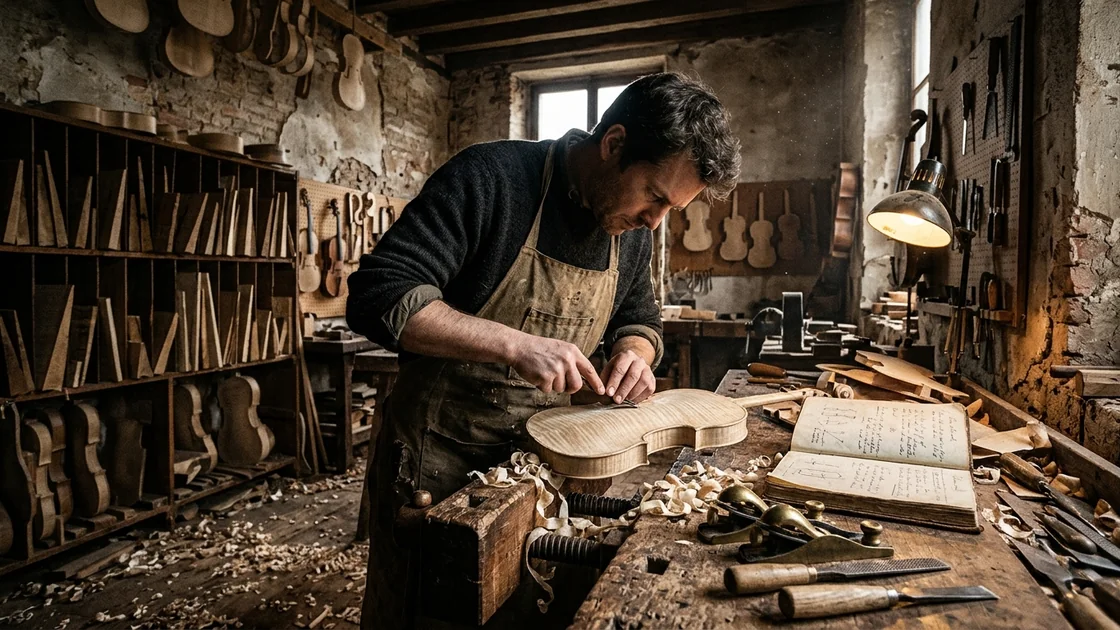
Julian Graves, an English violin maker struggling with creative paralysis and the loss of his mentor, travels to the historic workshops and humid cellars of Cremona in search of a legendary billet of alpine maple. His search leads him to an eccentric lumber merchant and an uncataloged eighteenth-century journal hidden within a hollowed seasoning block. Through the journal and forgotten workshop ledgers, Julian uncovers the life of Alessandra Donati, a master luthier's daughter who defied guild prohibitions during the golden age of Cremonese instrument making. Working by candlelight while her father succumbed to tremors and failing sight, Alessandra secretly carved and voiced the masterwork that saved her family from ruin, only for her contribution to be erased by the guild. Julian tracks the surviving sister-billet of that sacred tree and the instrument itself, finding both the technical truth of Cremonese resonance and the courage to carve his own masterpiece.
The chisel was not dull, but Julian’s wrist refused the final turn. For three weeks in his damp, lime-washed workshop overlooking the canal in Southwark, the unfinished belly of a spruce top plate had sat clamped in the bench vise, its grain fine as ledger paper, its arching half-formed. When he tapped it with his knuckle, it did not answer with the clear, ringing fifth his master, Arthur Phelan, had taught him to listen for; it muttered like wet wool.
Arthur had been dead six months, taking with him sixty years of sensory memory—the smell of mastic and spike lavender, the callused thumb that could measure five-tenths of a millimeter by pinch alone, and the unwritten geography of European forests where the great wood still slept. In Arthur’s ledger, under the final entries made in shaky iron-gall ink, Julian had found a single cryptic note: Moretti. Cremona. The 1735 winter felling, San Pellegrino valley, Val di Fiemme and the Balkan backs. Ask for the timber that heard the river freeze.
There was nothing left for Julian in London. His commissions were dwindling, suffocated by the slick, identical precision of modern factory violins that flooded the teaching academies, and by his own creeping suspicion that he had become a joiner of parts rather than a summoner of voices. He packed his canvas apron, his favorite Lie-Nielsen scrapers wrapped in oiled leather, three brass finger planes with curved soles, and took the train across the continent.
He arrived in Cremona in the middle of a November drizzle that turned the brick facades of the Piazza del Comune the color of dried liver. The city did not present itself as a museum; it smelled of diesel exhaust, roasted espresso, wet limestone, and, if one tilted one’s nose toward the alleys branching off the Corso Matteotti, the bitter, unmistakable scent of seasoned walnut and hide glue boiling in double pots.
Giancarlo Moretti’s yard did not occupy the gleaming modern districts near the railway station. It sat wedged between an ancient brick monastery wall and a slow, muddy canal that fed into the Po. A painted wooden sign, bleached by eighty summers of Lombard sun, swung on a single rusted hinge: Moretti e Figli — Legnami di Liuteria — Dal 1888.
Julian ducked beneath a low archway hung with strings of drying garlic and entered the sheds. The temperature dropped instantly. The air was thick with the scent of tannic acid, resin, and the dry, powdery dust that rises when ancient timber sits undisturbed in darkness. Racks reached fifteen feet into the gloom, stacked with triangular wedges of Picea abies—Norway spruce—and thick, quartersawn planks of Acer pseudoplatanus—the sycamore maple whose undulating grain luthiers called flame, or marezzatura.
"You walk like a man who expects the planks to fall on him," a voice croaked from behind a barricade of Balkan flitches.
A man emerged from the shadows, wiping his spectacles with the corner of a grease-spotted wool vest. He was eighty if he was a day, his spine curved like the upper bouts of a cello, his fingers thick, yellowed at the nails, and scarred across the knuckles by decades of band-saw bites and drawknife slips.
"Signor Moretti?" Julian asked in halting Italian. "I am Julian Graves. From London. Arthur Phelan’s pupil."
The old man stopped. He adjusted his spectacles, staring at Julian’s hands rather than his face. "Arthur. Arthur was a stubborn mule. He always wanted the maple that grew on northern limestone cliffs where the soil was so thin the roots had to drink mountain mist. He never paid on time, either." Moretti spat into the sawdust. "He died, didn't he?"
"In May," Julian said.
"Then you are the one he left with the debt."
"I am the one he left with his tools."
Moretti grunted, turning back toward the labyrinth of timber. "Tools are iron and bone. They belong to whoever holds them. Wood, on the other hand... wood belongs only to the mountain, and for a little while, to the man who knows how to keep it from rotting. Come."
Julian followed the old man deep into the belly of the storehouse. They passed racks tagged with dates from the 1970s, the 1950s, the 1920s. The wedges grew darker, their surfaces oxidized to a deep, honey-gray patina, their ends sealed with crumbling wax or tar to prevent checking. The air here was still and cool, preserved by walls three feet thick that had once belonged to the cellars of a Franciscan convent.
"Arthur wrote to me three years ago," Moretti said, his boots crunching over drifted pine shavings. "He said the world had gone deaf. He said everyone was carving their plates to mathematical templates, using digital micrometers and laser gauges, making instruments that screamed like scalded cats in the high registers and had no throat in the low. He wanted the maple from the lower cellars. The wood my grandfather bought when the old workshop of Casa Balestrieri was broken up during the cholera year."
"Did you sell it to him?" Julian asked, his heart quickening.
"Sell it to an Englishman through the post?" Moretti gave a short, barking laugh. "Arthur could have sent me ten thousand pounds and I would have sent him firewood. Wood like that does not go into a shipping crate to be thrown around by railroad porters. You inspect it with your fingers. You hold the flame to the light. You drop it on the stone floor to hear its bell."
Moretti reached a locked iron grille at the rear of the vault, set directly into the damp Roman-brick foundation. He took a heavy brass key from his waistcoat, turned the stiff tumblers with a groan of iron, and pushed the gate inward.
The room within was no larger than a horse stall. The floor was covered in clean, dry river sand. On a raised platform of cedar balks sat four dozen wedges of maple, stacked two by two in crossed pairs, separated by laths of ash. They were thick, broad-shouldered cuts, wide enough for a one-piece back of a large violin or even a small viola. The bark clung to the outer curved edges, thick and scaly, covered in pale lichen that had dried two centuries ago.
"Look," Moretti whispered. The cynicism had evaporated from his voice, replaced by the hushed reverence of an altar servant.
Julian stepped forward. He pulled off his woolen gloves and reached for the nearest wedge. The surface was rough from the two-man pit saw, gray with ancient soot, but where a borer beetle had grazed the corner, the exposed wood beneath gleamed like watered silk.
"Not that one," Moretti said softly. "The stack in the corner. Behind the chimney pier. Those came out of the Bellini estate when the last descendant died in an asylum in Mantua."
"Bellini?" Julian frowned. "I know the name from the guild rolls. Pietro Bellini, working in the shadow of Guarneri del Gesù in the 1730s. But his instruments are rare. Most experts consider them uneven. Brilliant varnishes, but erratic modeling."
"Experts," Moretti sneered, waving an dismissive hand through the dust motes. "Academics who weigh paper in glass jars. Look at the wood."
Julian knelt on the sand. Behind the brick pier sat three wedges, bound together with an ancient hempen cord that was so dry it looked ready to crumble into flax dust. As Julian leaned closer, his sleeve brushed against the stack. The top wedge shifted, tipping slightly on its ash runners. A shower of fine, powdery wood-dust fell away, revealing an opening behind the pier where the masonry had cracked and spalled.
Inside the hollowed-out space behind the brickwork, tucked away like a dead swallow in an attic eave, lay an object wrapped in greasecloth.
"What is that?" Julian asked, pointing.
Moretti narrowed his eyes, squinting into the gap. "The wall settled after the flood of '66. I thought the brick had simply dropped. I haven't reached behind that pier in forty years."
With slow, deliberate care, Julian worked his fingers into the narrow crevice. His knuckles scraped against the rough lime mortar. He caught the corner of the bundle. The fabric was stiff with mutton tallow and beeswax, brittle to the touch, but it had protected whatever lay within from the humid cellar air.
He withdrew it and set it down upon an upturned block of walnut. Moretti leaned over his shoulder, his breath smelling of chicory and tobacco. Julian turned back the stiffened folds of cloth.
Inside was no violin. It was an oblong book, roughly eight inches by five, bound in stained calfskin that had shrunk around its cardboard boards. Beside it lay a small chisel with an ash handle, its blade forged not from factory steel, but hand-hammered iron tipped with a sliver of hard steel at the cutting edge, ground to a low, sweeping curve—an arching gouge, stamped near the tang with a tiny, five-petaled wild rose.
Julian touched the blade. It was still sharp enough to pare a shaving from his thumbnail.
"Open it," Moretti said, his voice barely audible.
Julian opened the leather cover. The front flyleaf had been pasted down with wheat starch, long since eaten by silverfish into a lace of white holes. But the next page was intact. Written across the cream-colored rag paper in an elegant, rapid, sloping cursive—the script of an educated woman, far more refined than the rough tallies of timber-buyers or guild registers—was a single inscription in iron-gall ink that had turned the color of dried chestnut hulls:
Questo libro appartiene a me, Alessandra Donati, allieva senza nome nella bottega di Mastro Pietro Bellini. Cremona, l'anno della grande gelata, 1738.
"This book belongs to me," Julian translated under his breath, "Alessandra Donati, nameless apprentice in the workshop of Master Pietro Bellini. Cremona, the year of the great frost, 1738."
Moretti drew in a sharp breath. "Donati. Old Pietro had no apprentices registered with the Guild of San Luca. The guild forbade it after the edict of 1720—no master who was more than three months behind in his dues could register a garzone. Bellini was broke his entire life. He died in the hospital of the incurables."
"He had no apprentices," Julian said, turning the leaf with trembling fingertips, "on paper."
The rain outside intensified as evening fell, drumming against the high clerestory windows of the timber shed with the steady rhythm of a wet rasp. Moretti brought an iron brazier into the workshop office, filling it with glowing beech charcoal, and set an enameled moka pot on a small gas burner. The office smelled of old ledger bindings, lamp oil, and the dry, medicinal scent of Moretti’s liniment.
Julian sat under the cone of light cast by a single green-shaded bulb, a magnifying loupe pressed to his right eye, slowly translating the dense, eighteenth-century northern Italian prose. His Italian was conversational, but the technical jargon of the ancient craft—terms for resins, bending irons, scrapers, and anatomical measurements—required constant cross-referencing with an old technical dictionary Moretti pulled from a shelf behind his desk.
The journal was not merely a diary; it was a workshop ledger, an acoustic diary, and a confession.
14 November 1738, the first long entry began.
The frost has come over the Po with such sudden venom that the water in the soaking vats behind the San Sigismondo gate froze to the depth of three fingers before terce. My father’s right hand has begun its winter dance again. Today, as he attempted to cut the mortise in the neck-block for the violoncello ordered by the canon of the cathedral, the iron slipped from his thumb. It tore through the willow block and entered the meat of his left palm. He cried out—not from the pain, for he has burned and cut himself forty winters—but because the canon stood by the door, tapping his silver cane upon the flags.
'A man who cannot hold his gouge,' the canon said, 'should not charge eight silver ducats for an instrument of prayer. If the cello is not voiced by the feast of the Epiphany, I take the down payment back, and the guild will have your bench.'
My father wrapped his hand in a dirty linen rag soaked in oil of turpentine and wept into the shavings after the priest departed. He cannot see the fine grain by daylight, and by candlelight the shadows make the arching look three millimeters higher than it lies. His eyes are milky, clouded by the cataracts that took his brother. If the guild knows he is blind and palsied, they will declare the workshop bankrupt and seize the seasoned Bosnian backs my grandfather brought over the sea.
Tonight, after the curfew bell sounded and the watchman passed our shutters on the Contrada Coltellai, I went down to the bench. The brazier was nearly dead. I blew upon the embers until they set the dry spruce curls alight. I took up his roughing gouge. My palms are too narrow to seat the pommel against my shoulder as he does, so I must brace the handle against my breastbone, using the weight of my torso to drive the edge. It is hard, stubborn wood, cut from an alpine sycamore that grew on an eastern slope above the Adige. It has the flame of molten brass, but its rings are tight—twenty to the inch—and it fights the iron like bone.
I leveled the back of the canon’s violoncello before the dawn bell.
Julian looked up from the page, his eyes burning in the dim light. "She was carving the plates herself."
Moretti poured two small cups of thick, black coffee. "The Guild of San Luca in Cremona was the most jealous corporation in Lombardy. Women were permitted to wind strings from sheep gut, to boil bones for the glue pot, to polish ribs with horsetail rush, and to prepare the varnishes—because the varnish was toxic, stank of turpentine and sulfur, and frequently caught fire. But to touch a gouge? To sign a label? If an unregistered daughter was caught carving a top plate, the master was fined twenty gold lire and barred from the timber market for three seasons. It would have destroyed them."
Julian turned back to the journal. The entries spanned three years, tracing a desperate, clandestine partnership between a failing master and a daughter whose hands possessed what the father had lost: absolute spatial intuition and a supernatural ear.
2 February 1739.
Father cannot plane the joint of the back. A joint between two halves of a maple back must be truer than a mirror. If there is a gap the thickness of an onion skin, the tension of the strings will split the seam in ten summers. He tried twice today; each time, when he held the two wedges to the candle flame, the light bled through the center like a yellow eye.
'The plane is warped,' he cursed, throwing the great try-plane across the floor. It nicked the doorframe.
It was not the plane. His left arm drops as he pushes through the stroke; he favors his bad knee. When he slept, snoring heavily from the sour wine he drank to quiet his hand, I retrieved the plane. I flattened its sole on the marble slab with powdered glass and oil until it hissed across the stone with no hollows. Then I clamped the maple wedges in the bench screw.
The secret is not strength. The secret is the speed of the breath. If you breathe out as the iron enters the wood, your shoulders stay level. One long, continuous ribbon of wood rolled from the throat of the plane—thin as the wing of a cicada, curling around my wrist like a pale ribbon. When I took the halves and pressed them together against the lantern, there was no light. None. They seized each other by the mere perfection of their flat surfaces, sticking together without a drop of glue, held only by the vacuum between them.
I mixed the hide glue fresh—pellets made from the ears of young calves, soaked three hours in river water, then heated until the liquid fell from the brush in a single, clear thread, neither too thick like honey nor thin like broth. I rubbed the joint together until the glue bit, then set it in the rope clamps.
This morning, Father inspected the back. He touched the seam with his thumb, blinking his milky eyes against the morning sun. He said nothing. He did not ask how the wood had been joined. He merely reached out and laid his callused palm against my cheek for a moment, then went to the corner to sharpen his scrapers. We do not speak of it. To speak of it would make the sin real, and he is a man who must take confession every Friday.
Julian turned page after page, caught in the intimacy of her voice. Alessandra described the geography of the ancient workshop with the microscopic clarity of someone whose entire universe was bounded by four walls of timber and stone. She recorded the formulas for ground coats—not the mystical alchemical concoctions of later romantic myths, but pragmatic mixtures of slaked lime, potassium silicate washed from wood ash, and a golden earth pigment brought by pack mule from the quarries of Verona.
The wood must not drink the oil directly, she wrote in March 1739. If the raw maple absorbs the oil of the varnish, it turns brown and sullen, like wet cardboard. Its flame dies in the darkness of the grain. First, the wood must be closed. I wash the plates with a liquor of fine quartz dust suspended in water that has soaked in the ashes of vine-cuttings. It enters the pores and crystallizes there like tiny diamonds when it dries. When you strike the plate then, it does not sound like wood; it sounds like a silver dish. Only then does the oil go on—walnut oil boiled with Venice turpentine and sandarac, colored with the tears of dragon’s blood and root of madder.
Julian stood up, pacing the narrow space between the racks of spruce. "Signor Moretti, the wedges I saw back there... the three wedges behind the chimney. What did you say they were?"
Moretti rubbed his stubbled chin. "The Bellini timber. The wedges that were tied with hemp."
"Let us bring them here," Julian said. "Now."
Moretti looked at him for a long moment, then nodded. "Get the lantern."
They carried the three wedges to the office bench, brushing away the centuries of soot with a badger-hair bench brush. The wood was miraculous. Julian had held timber in London that cost five hundred pounds a billet, timber from the Swiss cantons that had been seasoned for thirty years, but this was of another order.
The maple had been split along the medullary rays, not sawn, following the natural grain of the trunk from bark to pith. The flame was wild, deep, and regular, dipping across the triangular cross-section in shimmering ribbons that seemed to move under the light of the electric bulb like heat shimmering above an August road.
Julian took his small brass thumb-plane from his waistcoat pocket, set the iron to take a shaving less than two-hundredths of a millimeter thick, and made a single, exploratory pass across the bark edge of the center wedge.
The iron sang. The shaving curled out, translucent, pale as skimmed milk, smelling of dried mushrooms and cold stone. And there, revealed on the fresh wood beneath the blackened rind, was an ink mark stamped into the grain: a circle containing an anchor, and beneath it, carved with the tip of a fine knife, the initials: A. D.
"Not Bellini," Julian whispered. "Her mark. She marked the timber she kept for herself."
"Look at the other side," Moretti said, his finger trembling as he pointed to the end-grain.
Written in the same iron-gall ink as the journal, partly effaced by time but still legible, was a date and an inscription: Compagno del violino per l'Infante. 1740.
"Companion to the violin for the Infante," Julian translated. "The Infante of Spain? Philip of Parma?"
Julian scrambled back to the journal, his fingers flying through the pages until he reached the winter of 1739 and the spring of 1740. The handwriting there grew tighter, faster, scarred by blotches where tears or sweat had thinned the ink.
11 November 1739.
A courier from the court of Milan arrived today, his horse steaming in the courtyard of the Three Kings. He brought an order bearing the seal of the Spanish regency. Don Philip, the young Infante, is to take up residence in the Duchy of Parma. The court requires an instrument of the highest order—a violin that possesses not only the sweet, flute-like cantabile of the old Amati models, but the dark, savage roar that Giuseppe del Gesù has begun to draw from his broad-waisted boxes. They offer one hundred and twenty gold ducats.
It is enough to clear all of Father’s debts to the Guild. It is enough to buy back our house on the Contrada Coltellai from the moneylender Moroni. It is enough to secure a dowry for my sister Maddalena.
Father took the parchment into his hands and stared at the red wax seal for an hour. Then he laid his head down upon the bench and wept like a child. 'I cannot do it, Bettina,' he whispered. He has called me Bettina only when his heart is broken. 'Look at my thumb. It jerks like an eel on a hook. If I attempt to cut the channel for the purfling, the knife will wander into the center of the plate. I will ruin the wood, they will mock me in the piazza, and the court will throw me into the debtors' tower.'
I knelt beside him. I took his poor, twisted hands in mine. The skin was like old parchment, spotted with the yellow liver-marks of age.
'You will take the commission, Father,' I told him. 'You will sign the contract before the notary at the Palazzo Comunale tomorrow morning. You will sit by the window with your spectacles on your nose and your drawknife in your lap when the townspeople pass. But when the night watchman cries three hours after dark, you will go up to your bed, and you will leave the lamp lit for me.'
Julian felt a cold shiver run from the nape of his neck down through his spine. He read through the night while Moretti slept in his wicker armchair, his chest rising and falling in shallow wheezes.
The entries for the creation of the Infante violin read like a masterclass preserved across three centuries. Alessandra described every stage of the process with an acute, tactile intelligence that surpassed any modern treatise on acoustics.
She did not use thickness calipers with dials; she used the flexure of the wood between her fingers and its acoustic response when tapped at specific nodal points:
3 January 1740.
The spruce for the top is from the high forest of Paneveggio. It has thirty rings to the inch at the center, broadening to fifteen at the flanks. It is light as thistle-down, but when I flex it across the grain, it resists like spring-tempered brass. That is what gives the voice its core.
Tonight I tuned the back plate. A plate must not be carved to a uniform thickness, as the German copyists do in their workshops in Mittenwald. The wood is not uniform; how then can the arching be uniform? The wood has memories of wind; the northern side of the tree is denser than the southern side. One must carve with the ear pressed close to the gouge.
I hold the plate by the upper bout, between the tip of my thumb and index finger, at the point where the nodal line passes through the wood—two fingers from the edge, three from the top. Then I strike the lower bout with the soft meat of my ring finger. It answers in D-sharp. But when I tap the center, where the soundpost will stand, it must speak a fifth higher, in A-natural. If the interval is wider than a fifth, the instrument will be nasal and dry; if it is narrower, the voice will break under the bow like an uncastrated boy.
Three shavings I took from the inner lung of the right lower bout tonight—no more than the weight of a dry bay leaf. I tapped it again. The tone cleared instantly, blooming like an almond bud in April. The whole room seemed to ring with it; the copper kettle on the hearth answered with a sympathetic hum.
Julian set the book down, his breath shallow. This was the lost secret that had driven nineteenth-century theorists mad—the relationship between the plate tap-tones, the Chladni patterns formed by dust on vibrating bellies, and the localized flexibility of the arching. Modern makers spent years with spectrum analyzers trying to reproduce what Alessandra had achieved by blowing bone dust onto an unvarnished wedge of maple while humming the note of the cathedral organ.
28 February 1740.
The purfling is set. Three strips: two of boiled pearwood dyed black with logwood and copperas, and one of white poplar between them. The channel is less than one millimeter wide, cut into the edge with a two-pointed knife I ground from an old lancet. My father stood over me while I cut it. The morning light was good. His hand was steady enough to hold the candle, though his eyes filled with tears.
'You have the hand of your grandfather, Bettina,' he murmured. 'No... you have the hand of no one who ever carried the Bellini name. God has put a silver wire in your fingers.'
'Then let me sign it, Father,' I said. The words leaped from my mouth before I could choke them down.
He went white, as if I had struck him across the mouth with a piece of firewood. He looked at the window, terrified that someone in the street might have heard.
'Are you mad?' he hissed, dropping the candle. 'Do you want the syndics of the guild to tear the roof from this house? Do you want them to burn our benches in the square and throw me into the canal? You are a woman! You have no legal person before the Podestà! If a woman’s name appears on a violin label, the instrument is forfeit, the master is disgraced, and the buyer will spit upon it as an unclean thing. The label is printed: Petrus Bellini Cremonensis Fecit Anno 1740. It is already dry on the press.'
I said nothing. I picked up the fallen candle. I bowed my head and blew the soot from the purfling groove.
He went out to the tavern to drink his white wine. When he was gone, I took the small gouge—the one with the wild rose stamped upon the iron—and I turned the top plate over, so its inner face lay exposed to the light. There, beneath the place where the bass-bar would be glued—where no eye could ever see it unless the belly were ripped from the ribs with a hot knife—I carved three words into the soft spring-wood of the spruce:
Alessandra me fecit.
Julian read the final entry in the journal three times. It was dated 12 October 1740, six months after the instrument had been delivered to the Spanish court envoy:
The courier returned today from Parma. He did not bring complaints. He brought twenty gold sequins over the agreed price, and a silk purse containing a gold medal stamped with the profile of the Infante. The court master of music, Signor Sanmartini, wrote that the instrument has 'the voice of an angel who has known the sorrows of purgatory.' They call it 'Il Tesoro'—The Treasure.
Father took the purse. He paid the guild dues for three years in advance. He bought a new wool coat with silver buttons and two casks of Chianti for the cellar. Tonight he feasts with the elders of the corporation at the Sign of the Golden Horn.
I remain in the workshop. The stove is cold. I have swept the bench until not a shaving of the Infante's maple remains upon the boards. On the rack above my head sits the sister wedge—the split half of the same tree, waiting for an instrument that will never be born under my name. My father told me today that he has arranged my betrothal to Bernardo Rota, the timber factor’s nephew. Bernardo does not like the smell of varnish; he says it gives him the megrim. He has told my father that after the wedding, I must sell my gouges to pay for household linens.
I will not sell them. Tonight, before the watchman turns his glass, I will wrap my rose gouge and this book in tallowed cloth. I will hide them behind the flue where the brick has rotted. If God gives me a daughter who can hear the wood sing, perhaps she will find them. If not, let the lime eat them both.
The journal ended there. The remaining sixty leaves of rag paper were blank, white, and silent as snow.
Julian did not sleep. When dawn broke over the rooftops of Cremona, painting the river mist with pale lilac light, he was standing at the washbasin in Moretti’s office, splashing cold water onto his face.
Moretti woke with a start, coughing into his handkerchief. He looked at Julian, then at the open book on the desk.
"You read it all?" Moretti asked.
"Where is the instrument?" Julian demanded. "The Infante violin. Did it survive?"
Moretti sighed, pushing himself up from the chair with a creak of his arthritic joints. "The Spanish court collection was scattered during the Napoleonic wars. Half of the royal instruments were taken by French marshals; some were destroyed during the sack of Madrid. But the inventory... the old inventories exist. Come, Julian. If you want to chase ghosts, there is only one woman in Cremona who knows where the dead violins are buried."
An hour later, they were walking toward the Palazzo Raimondi, the elegant Renaissance palace that housed the Department of Musicology of the University of Pavia. The fog had lifted, revealing a sky the color of polished pewter.
Dr. Elena Viterbi did not look like an archivist. She was forty, with sharp, dark eyes, hair cut in an uncompromising architectural bob, and hands that moved with rapid, surgical precision. Her office was stacked to the ceiling with conservation files, x-ray radiographs of antique instruments, and dendrochronological charts that looked like the seismograph traces of earthquakes.
She listened to Moretti’s story without interruption, her fingers laced beneath her chin. When Julian placed Alessandra Donati’s journal on the desk before her, she did not immediately open it. She looked at the binding, smelled the calfskin, and examined the tallowed wrapping Julian had brought in a plastic envelope.
"A female apprentice in the bottega of Pietro Bellini," she said, her voice dry and measured. "There have been rumors for two centuries, Graves. You are not the first to suspect that Bellini’s late work was not his own. The Hill brothers of London noted it in their 1902 monograph on the Guarneri family. They wrote that Bellini’s work between 1738 and 1742 showed 'an unaccountable elegance of concept and an extraordinary delicacy of edge-fluting entirely absent from his earlier, somewhat clumsy productions.' They assumed he had employed one of the young Bergonzi boys, or perhaps an illegitimate son of Giuseppe del Gesù."
"It wasn't a Bergonzi," Julian said. "It was his daughter."
Elena opened the journal. For forty minutes, the room was silent except for the rustle of the ancient paper. Her skeptical expression shifted through curiosity, astonishment, and finally settled into a profound, fierce stillness.
"The Infante," she said, looking up, her eyes wide. "The 1740 Bellini known as Il Tesoro."
"You know it?" Julian leaned forward, his knuckles pressing into the mahogany desk.
"Every serious luthier in Europe knows it," Elena said. "It is not in Spain. It was purchased in 1880 by a textile magnate from Biella. In 1954, it was bequeathed to the civic collection of Mantua. It sits in a climate-controlled glass case on the piano nobile of the Palazzo Te, twenty-five miles from where we are sitting right now."
Julian felt the room tilt slightly. "Is it intact? Has the belly ever been removed?"
Elena clicked her tongue, turning to her computer terminal. She typed with rapid, rhythmic keystrokes. "The Mantua collection was conserved in 1982 by Sacconi’s students. Let me see the restoration log." She scrolled through a digitized register, her eyes scanning the Italian text.
"Here," she murmured. "Accession number M-40-B. Pietro Bellini, Cremona, 1740. Label: Petrus Bellini Cremonensis Fecit Anno 1740. Condition: Exceptional. Original neck lengthened at the heel during the nineteenth century to modernize the pitch; original bass-bar replaced in Paris by Vuillaume in 1865. No internal cracks to the back; one minor wing-crack repaired at the treble soundhole."
She stopped. Her finger hovered over the trackpad.
"What is it?" Julian asked.
"Vuillaume’s workshop notes from 1865," Elena translated slowly. "Vuillaume was an obsessive note-taker. He wrote: 'Upon opening the Bellini of 1740, found the interior execution of an incomparable sweetness. The linings are willow, bent without burning. Beneath the original bass-bar, on the soft grain of the spruce, there appears an inscription in iron-gall ink or dark pigment, mostly effaced by moisture and old glue, seemingly in a woman’s hand. Regarded it as an ancient owner's graffito or prayer; cleaned the wood with warm water and glued the new bar directly over the area.'"
Elena looked up from the screen. Her eyes were burning with the same fire Julian had felt in the cellar. "Vuillaume saw it. He didn't understand what he was looking at. He thought it was a prayer to the Virgin."
"Can we see it?" Julian asked. "Can we inspect the instrument?"
Elena picked up her desk telephone. "I am the scientific consultant to the Mantua museum. If I tell them we need to verify a dendrochronological anomaly on the treble rib before the international catalog goes to press next month, they will unlock the case."
The drive from Cremona to Mantua along the SS10 followed the low, flat embankments of the Po valley. The landscape was melancholic and vast: vast fields of dry maize stubble, poplars standing in rigid lines like skeleton soldiers through the river mist, and ancient farmsteads of dark red brick where pig-slaughtering kettles still steamed in the courtyards.
Julian held his tool roll on his lap. Inside, nestled against his scrapers, was Alessandra’s little arching gouge with the wild rose mark. Moretti had refused to let him leave it in the shop. "The tool wants to see the work," the old man had muttered before sending them off.
The Palazzo Te rose out of the Mantuan plain like a dream of Roman grandeur dropped into a swamp. They walked through the echoey, frescoed halls, past Giulio Romano’s writhing, terrifying giants tumbling beneath cracked stone arches, until they reached the small, jewel-like room where the civic musical instruments were kept.
Il Tesoro rested on a plinth of black velvet within a freestanding vitrine of laminated glass.
Julian stopped five feet away, unable to take another step.
The instrument did not look like a museum piece; it looked alive. The varnish was a blaze of golden-amber, shifting to deep ruby-orange where the light caught the flanks of the bouts. The flame of the maple back—the sister wedge to the one Julian had left on Moretti’s bench—swirled downward from the central joint in waves that seemed three inches deep. It was not the cold, symmetrical beauty of modern production; it had a slight, thrilling asymmetry—the left f-hole sat one millimeter lower than the right, cut with an open, relaxed sweep that gave the face of the violin an expression of profound, watchful melancholy.
The museum curator, an elderly gentleman with white cotton gloves and a key ring the size of a saucer, unlocked the side panel of the case. With practiced, agonizingly slow movements, he lifted the violin from its cradle and placed it upon a velvet-lined examination tray on the center table.
"You have thirty minutes, Dottoressa Viterbi," the curator said softly. "No metal tools near the varnish."
Elena nodded. She drew an illuminated flexible endoscope from her leather bag—a long, slender fiber-optic tube tipped with a high-resolution lens, connected to a digital tablet.
"Julian," she whispered. "Hold the neck. Gently. At the pegbox."
Julian’s hands were shaking as he touched the wood. The neck was modern, but the scroll was original. He looked at the volute—the spiral carving that capped the pegbox. It was exquisite. The final turn of the eye did not end abruptly; it melted into the hollow of the throat with an organic softness that reminded Julian of the curve of a human ear.
Elena introduced the slender black tip of the endoscope through the right f-hole, angling the lens toward the upper bouts, where the bass-bar ran parallel to the lowest string beneath the spruce top.
The screen of the tablet flickered. The interior of the violin leaped into magnified view: the rough, gouged surface of the spruce belly, yellowed by time; the clean, chalk-white spruce of Vuillaume’s 1865 bass-bar; and the tiny, square blocks of parchment the French restorer had glued along the center seam as reinforcement cleatings.
"Turn the light forty-five degrees," Julian whispered, his voice cracking. "The raking light will show the tool marks."
Elena adjusted the fiber-optic lead. The light skimmed across the spruce beside the bass-bar.
There, partially obscured by the shadow of the modern pine bar, the wood bore the unmistakable, shallow impressions of a narrow, curved iron. The tool had cut three tiny strokes into the soft grain before the ground coat had been applied—strokes that formed a five-petaled flower no larger than a grain of wheat.
"The rose," Elena breathed.
Julian leaned closer to the screen. "Slide the lens toward the upper block. Vuillaume said he washed it, but iron-gall ink doesn't wash out of raw spruce; the acid bites deep into the lignin."
Elena shifted the probe a fraction of a millimeter. The camera swept across the golden-brown expanse of the inner belly.
Beneath a layer of dried fish-glue that had smeared when Vuillaume clamped the new bar, the faint, purplish-gray ghost of eighteenth-century script appeared on the pixelated display. It was broken, fragmented by the grain of the summer wood, but the lower loops of the letters were unmistakable:
...lessandra me...
Elena let out a long, shuddering breath. "My God."
The curator leaned over their shoulders, squinting at the screen through his bifocals. "What is that? That is not Bellini’s hand. Bellini was semi-illiterate; his contracts in the Mantuan archives are signed with a crude cross and his name written by the notary."
"It is the hand of the maker," Julian said. He reached into his pocket, took out the little iron gouge wrapped in linen, and laid it on the velvet beside the violin. The sweep of the blade matched the three tiny curved incisions beside the bass-bar with the precision of a key turning in its lock.
"Her name was Alessandra Donati," Julian said, his eyes fixed on the amber varnish of the belly. "She was twenty-two years old. And she gave this city the greatest voice it ever possessed."
They returned to Cremona in silence as the winter night settled over the Lombard plain. The fog had returned, thick and white, rolling off the Po to swallow the streetlights and the brick campanile of the Torrazzo.
Moretti was waiting for them in the timber yard. He had moved the sister wedge of maple to the center of his workbench, beside an ancient cast-iron stove that threw a red, pulsing warmth into the chilly shed.
When Elena laid the digital photographs on the bench—the clear images of the wild rose mark and the hidden signature beneath the bass-bar—the old lumber merchant did not speak for several minutes. He took off his spectacles, laid them upon the table, and buried his face in his hands.
"All these years," he whispered into his scarred fingers. "My grandfather told me the Bellini wood was cursed. He said every maker who bought a piece of it ended up dissatisfied with his own work, because they could never match the sound of the 1740 instrument. They thought it was the varnish. They thought it was the secret salt from the Venetian lagoons."
He stood up and looked at Julian. "It wasn't a secret salt. It was a woman who had to pour her whole life into three instruments because she knew the world would close the door on her when the sun came up."
Moretti reached down and picked up the sister wedge—the split half of that sacred, singing tree that had seasoned in the dark for two hundred and eighty years.
"Take it," Moretti said, pushing the wood into Julian’s chest.
Julian stepped back, his hands open. "Signor Moretti, I cannot pay you for this. This wood is priceless. It belongs in a museum, or with one of the master luthiers of the consortium—"
"The consortium!" Moretti barked, his old fury flashing back into his eyes. "The consortium is forty men in business suits who argue about trademark registrations and brand names! Did you hear what she said in that book? 'The wood has memories of wind.' Arthur was right about you, Graves. You have the hands, but you have the brain of a frightened clerk. Do you want to spend the rest of your life setting bridge-heights for orchestra students in Southwark?"
The old man took Julian’s hands and closed them around the rough, bark-covered flanks of the maple. The wood felt warm, despite the coldness of the room. It had a lightness, an eager, resonant liveliness that seemed to hum against his palms like a resting hawk.
"You carve it," Moretti said, his voice dropping to a gravelly murmur. "You carve her violin. Not Pietro Bellini’s violin. Hers. You use her tap-tones. You tune the lung of the lower bout to her fifth. And when you stick your little paper label inside through the f-hole, you write the truth."
Julian did not return to London.
He rented a small, high-ceilinged room at the top of an old brick palazzo in the Via Sicardo, three doors down from where the workshop of the Guarneri family had once stood. The room had a single large skylight facing north, pouring the cold, steady light of the winter sky across a bench he constructed from two thick planks of seasoned beech he bought from Moretti.
Elena came three evenings a week. Together, they transcribed every page of Alessandra Donati’s journal, preparing a monograph for the Rivista Italiana di Musicologia that would systematically dismantle two centuries of guild-sanctioned erasure.
Julian worked through the short, foggy days and the long, freezing nights. He did not use his electric strip-heaters or his digital dial calipers. When he split the maple wedge down the center to make the two-piece back, he used an ancient froe and a wooden mallet, listening to the grain tear along its medullary path with a clean, dry thwack that sounded like ice cracking on a pond.
He planed the center joint by hand. He stood with his feet planted wide upon the sawdust-strewn tiles, breathing out as the iron entered the wood, feeling his shoulders level, his heart slowing to the rhythm of the stroke. When he held the two halves to the north light, no light passed through. They held together by their own perfection.
He did not use the Guarneri templates he had brought from London. Instead, he took the proportional coordinates Alessandra had recorded in the margins of her journal—proportions based not on arbitrary measurements of millimeters, but on the sacred geometry of the circle and the golden section, derived from the string-length of the monochord.
The gouge with the wild rose mark became an extension of his arm. When he drove the low-curved iron through the flame of the Balkan maple, the wood did not chip or tear. It yielded in long, shimmering curls that smelled of vanillin and dried mountain soil. He carved the arching not to a dead template, but to the flexure of the wood, pinching the flanks between his thumb and middle finger, feeling where the tree wanted to bend and where it wanted to resist.
In late January, the deep cold came over Cremona. The Po froze along its edges, and the fog turned to rime on the iron balconies of the Via Sicardo.
On the night before he was to glue the top plate to the ribs, Julian sat alone by the light of three beeswax candles. The workshop was silent save for the occasional pop of spruce bark in the little cast-iron stove.
He took the maple back plate, suspended it between the callused tips of his fingers at the nodal points Alessandra had marked in her drawings, and tapped the lower bout with the soft meat of his ring finger.
The wood spoke.
It was not a dull knock. It was a clear, dark, sonorous D-sharp that hung in the chilly air of the garret for four seconds, vibrating through his fingers and into the bones of his forearm. He tapped the center, where the soundpost would sit.
A-natural. A true, ringing fifth.
Julian set the plate down upon the bench. His eyes filled with tears, hot and sudden, dripping onto the clean, white pine shavings that carpeted the floor. For six months he had lived in the shadow of Arthur’s death and the cold, terrifying certainty that his own hands were empty—that the modern world had become too loud, too coarse, too rushed for the ancient magic to find a way through the iron.
He took up a quill he had cut from a goose feather he found by the river, dipped it into iron-gall ink he had brewed according to Alessandra’s own recipe—oak galls, green vitriol, and river water—and prepared the label.
He did not write his own name. He did not write Pietro Bellini’s name.
On a slip of heavy rag paper torn from the blank flyleaves at the back of her journal, he wrote in clear, upright Roman letters:
Alessandra Donati Cremonensis me fecit anno 1740.
Julian Graves me perfecit anno moderni.
He glued the label to the inner face of the maple back, directly beneath the left f-hole where the light of the sun would fall upon it whenever the instrument was held to the shoulder of a player.
Then, taking Alessandra’s rose gouge, he walked to the window. He looked out over the sea of pantiled roofs, past the great dark tower of the cathedral, toward the south where the river ran through the freezing mist toward the sea.
He took the top plate of spruce—Paneveggio wood that had seasoned for eighty winters in Moretti’s cellar—and turned it over. Beneath the place where the new bass-bar would run, he cut the tiny five-petaled rose into the soft wood with three turns of his wrist.
In May, the courtyard of the Palazzo Raimondi was filled with the scent of blooming wisteria. The purple clusters hung from the stone loggias like swarms of sleeping bees, humming softly in the warm Lombard breeze.
The auditorium of the musicology department was packed to the doors. In the front row sat the elders of the Consorzio Liutai, their gray heads bowed over the exhibition program, their faces a study in defensive curiosity and uneasy fascination. Beside them sat Moretti, dressed in an ill-fitting black wool suit that smelled powerfully of camphor, his spectacles polished until they shone like mirrors.
Elena Viterbi stood at the lectern. Behind her, projected onto a ten-foot screen, were the high-resolution radiographs of the 1740 Tesoro of Mantua, side by side with the digitized pages of Alessandra Donati’s journal.
She spoke for an hour without notes. She laid out the historical record with the cool, merciless precision of a prosecutor: the civic tax records showing Pietro Bellini’s insolvency; the court records of his sudden, unexplained wealth in the autumn of 1740; the physical evidence of the wild rose gouge marks inside the soundholes; the chemical analysis of the ground coat showing the unique silica-ash wash described in the journal; and the infrared scans revealing the ghost-signature beneath the bass-bar: Alessandra me fecit.
When she concluded, there was no applause. The room sat in a stunned, heavy silence—the silence of men who have been told that the ground beneath their feet has shifted three inches to the left.
Then, from the wings of the stage, a young woman stepped forward. She was a student from the Milan Conservatory, her violin case held in her left hand.
She did not carry the Mantua instrument. The museum had refused to let Il Tesoro leave its glass case without an act of the regional parliament.
She carried the violin Julian had finished three weeks before.
Its varnish was still tender, smelling faintly of spike lavender and drying walnut oil, glowing with the deep, fiery gold of the sister maple back. Julian sat in the rear row, his arms crossed over his chest, his knuckles white against his sleeves.
The violinist raised the instrument to her chin. She did not tune it; Julian had set the pegs that morning in the quiet of his garret.
She drew the bow across the open G string.
The sound did not leap from the f-holes like a modern violin; it seemed to rise from the floorboards, blooming outward from the center of the stage in a deep, guttural, velvet roar that hit the listeners in the center of their chests. It had the weight of ancient wood, the dry, aristocratic resonance of an instrument that had been singing for centuries, but with an underlying, fierce vitality that belonged entirely to the morning.
She played the Chaconne of Bach.
As the variations unfolded—from the solemn, marching architecture of the theme into the soaring, crystalline arpeggios of the major section—the violin seemed to expand beyond its small physical dimensions. In the higher registers, on the E string, the voice did not thin into that shrill, glassy brightness that Julian had hated in the modern instruments; it retained a round, reedy throatiness, singing like a boy soprano whose voice stood poised on the very edge of manhood.
Julian closed his eyes.
He did not see the auditorium. He saw the cold, brick-walled shop on the Contrada Coltellai in the winter of 1738. He saw a young woman with sawdust in her hair, her fingers reddened by chilblains, leaning her breastbone against the butt of an ash-handled gouge as the watchman called three hours past midnight through the empty streets. He saw her blowing the white spruce dust from the channel of the purfling, her breath misting in the freezing air, her ear pressed to the maple plate as she struck the lower bout with the soft meat of her finger, listening for the fifth that would outlive her father, her city, and the silence of three hundred years.
When the final D-minor chord died away, the reverberation hung beneath the timber ceiling of the Palazzo Raimondi for three full heartbeats.
The silence broke not with polite academic clapping, but with a sudden, roaring wave of sound as two hundred people rose to their feet.
In the front row, Moretti did not stand. He sat with his hands resting on his knees, his chin lifted, looking up at the high Renaissance ceiling where the painted angels played their plaster trumpets, his lips curved into a slow, victorious smile that showed every gap in his teeth.
Julian did not wait for the crowd to surge toward the stage. He slipped through the heavy leather curtain at the back of the auditorium and stepped out into the quiet sunlight of the Corso Garibaldi.
The air was clean, washed by a brief morning shower. The smell of the city—diesel, stone, coffee, and seasoned pine—drifted through the alleys. Julian reached into his coat pocket. His fingers touched the ash handle of the rose gouge, its iron cool and smooth against his palm.
He did not feel the weight of Arthur’s death anymore. He did not feel the terror of the blank bench.
He turned toward the river, his stride long and easy, walking toward the timber yard where three thousand wedges of maple were waiting in the dark to hear their voices named.