The Glass Sanctuary of Oakhaven
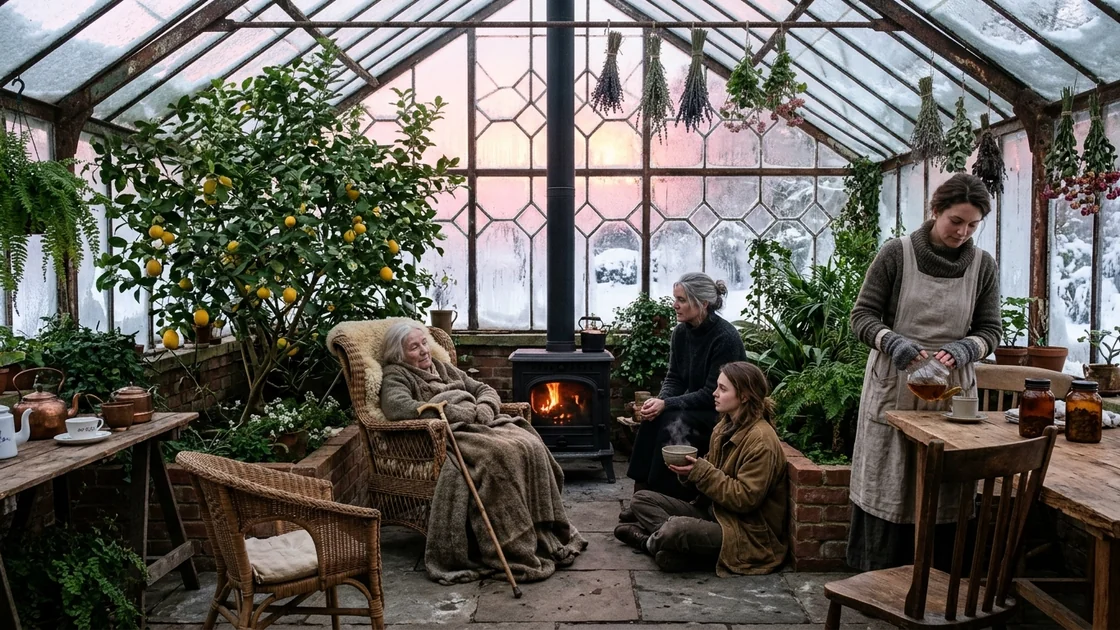
When Clara Finch purchased the abandoned Halstead conservatory on the northern rim of Oakhaven, the townspeople assumed she was simply another eccentric outsider with money to burn on ruined iron and shattered glass. Over the course of three months, working through the bone-chilling damp of late autumn, Clara cleared the strangling briars, reglazed hundreds of diamond-shaped panes, and revived the ancient brick hypocaust beneath the flagstones. Instead of cultivating rare orchids, however, she opened a winter tea room, filling the humid, verdant space with rough-hewn cedar tables, mismatched porcelain, and copper kettles that hummed over low gas flames. As the first killing frost turned the surrounding meadows to silver, the greenhouse became an accidental haven where three generations of local women found themselves sheltered from the biting wind. Across small pots of smoked black tea, sweet chamomile, and winter jasmine, the stoic matriarchs who had buried their grief, the exhausted mothers who had shelved their dreams, and the restless daughters who feared their inherited silence finally began to speak the truths that had remained buried beneath decades of small-town decorum.
Chapter 1: The Skeleton of Glass
The estate agent had refused to step past the iron threshold. He had stood in the overgrown drive, his collar turned up against the sleet, waving a manicured hand at the structure as though shooing away a bad omen.
"The late Mr. Halstead lost his mind here after the frost of seventy-six," the man had said, his teeth chattering behind a thin smile. "Left the boilers to freeze and split wide open. If you take my advice, Miss Finch, you will bring in a bulldozer, level the ground, and sell the acreage to the timber company down by the canal."
Clara had not answered him. She had pushed through the rusted gate, her boots sinking deep into three decades of rotted leaves, and walked into the cathedral of green glass. It was forty paces long, twenty wide, with a central lantern that rose like an inverted galleon into the grey sky. Half the panes were missing, their vacant frames whistling in the wind, while others were choked with dark, velvety lichen that turned the daylight into underwater gloom. Yet, in the center, defying thirty years of neglect, a single Meyer lemon tree grew wild and tangled, its branches laden with heavy, fragrant fruit that glowed against the shadow of winter.
She had laid her bare palm against the trunk of the lemon tree. The wood had been cold, but deep inside the heartwood she felt the stubborn, slow pulse of life that refused to yield to the frost.
Clara had spent her previous thirty-four years in a city apartment above a railway terminus, cataloging archival records for a municipal library that smelled of vinegar and crumbling rag paper. She had possessed a fiancé who was polite, punctual, and ultimately terrified of her quiet intensity; when he left her for a woman who laughed louder and demanded less, Clara felt not heartbreak, but a vast, drafty relief. The money had come from her aunt, a woman who had never married, never apologized, and died with a ledger full of sovereign bonds and a note that read simply: Spend it on something that cannot be folded into an envelope.
By the end of October, Clara owned the conservatory, the two acres of stony hillside, and the small caretaker’s stone cottage that sat thirty yards behind it.
The physical labor was punishing. Clara woke before sunrise, wearing fingerless woolen gloves and two sweaters, to sweep the glass shards into galvanized buckets. She learned how to cut float glass, scoring the brittle sheets with a diamond wheel and snapping them along clean edges. She hired an elderly mason named Arthur, whose knees creaked like dry hinges, to inspect the flues beneath the floor.
"Old Halstead knew what he was doing before he went soft in the head," Arthur grunted, peering down into the soot-stained intake with a torch. "He built a Roman hypocaust. Fire down here, hot air runs through the brick channels under your boots, vents up the walls. Keeps the earth warm even if the frost sits two feet thick on the grass."
They spent two weeks clearing the soot, hauling out bucketfuls of bird nests and dried pine needles. On the ninth of November, Clara touched a match to a bundle of dry birch twigs in the subterranean furnace. For an hour, nothing happened; the air smelled only of cold chimney soot. Then, slowly, almost miraculously, a faint tremor of warmth rose through the slate flags beneath her boots. The damp smell of peat, dormant moss, and old brick shifted. The air softened. The frost clinging to the lower panes turned to clear beads of condensation and began to weep silently down the glass.
Clara did not bring in tables from modern department stores. Instead, she scourged the clearance auctions in the valley, buying heavy oak trestles, gate-leg tables whose tops bore the scars of a hundred family suppers, and wicker armchairs that creaked invitingly. She strung brass wire along the cast-iron ribs of the roof, hanging bunches of drying lavender, silver sage, and bundles of scented geranium leaves she had salvaged from the wild garden.
She did not hang a painted sign at the roadside. She merely set a weathered wooden board at the end of the gravel lane with five words carved into the grain: The Glass House. Hot Tea.
Chapter 2: The Scent of Bergamot and Woodsmoke
The first visitor arrived not out of curiosity, but out of suspicion.
Her name was Mabel Vance, though she was known in the butcher’s shop and the post office simply as "Old Mrs. Vance." She was seventy-eight years old, stood five feet tall in her heavy rubber-soled boots, and wore an olive-drab mackintosh that had belonged to her husband before he died during the second year of the new millennium.
It was mid-November, the afternoon temperature hovering barely two degrees above freezing. The sky was the color of a bruised oyster.
Clara was standing beside the woodstove she had installed in the center of the conservatory, watching a cast-iron kettle approach a boil, when the heavy latch on the outer door lifted with a sharp clatter. The cold gust that rushed into the greenhouse made the hanging bundles of mint sway and shudder.
Mabel Vance stood on the threshold, leaning on an ash-wood cane with a brass pheasant for a handle. Her eyes, pale blue and watery behind thick wire frames, raked the glass rafters, the neatly arranged tables, the lime trees in wooden half-barrels, and finally Clara herself.
"You're the Finch girl," Mabel said. Her voice sounded like two gravel stones being ground together.
"I am Clara Finch," Clara said, wiping her hands on her linen apron. "Good afternoon. Please, shut the door behind you. The lemon tree doesn't care for the wind."
Mabel clicked her tongue, but she pulled the heavy timber door shut until the latch dropped into place. She did not take off her coat. She walked slowly into the center of the conservatory, her cane tapping rhythmically on the slate: clack, thump, clack, thump.
"Halstead was a fool," Mabel said, stopping three paces from the woodstove. "He thought he could grow pineapple here in the north. He lost two hundred pound of fruit in the big freeze of fifty-four, and he sat right there where that iron bench is and wept like a scoured calf."
"I am not growing pineapples," Clara said.
"What are you doing, then? Arthur down at the timberyard said you were selling boiled grass to lunatics."
A small smile touched Clara’s lips. "I am making tea. Would you like a cup?"
"I don't hold with fancy teas," Mabel replied immediately, her chin jutting forward. "Perfumed twigs that taste of soap. A person needs black tea. Indian leaf. Strong enough to trot an iron mule across."
Clara nodded without arguing. She turned to the low wooden counter where dozens of dark amber jars sat in tidy rows. She unscrewed a heavy glass lid, measuring out two generous spoons of an unsmoked Assam, blended with a pinch of broken leaf from the Nilgiri hills and three dried juniper berries crushed between her thumb and forefinger. She warmed a brown earthenware pot with boiling water, emptied it, dropped the leaves into the belly of the vessel, and poured the water directly from the whistling kettle.
"Sit down, Mrs. Vance," Clara murmured, gesturing toward a deep wicker chair padded with an old sheepskin rug. "The flagstones are warm, but your joints won't thank you for standing."
Mabel stared at the chair as if it might snap at her ankles. Then, with a slow, dry groan that she tried unsuccessfully to swallow, she lowered herself into the sheepskin. Her cane rested against her knee like a sentry's rifle.
For five minutes, neither of them spoke. The only sounds were the soft, rhythmic roar of the woodstove, the rustle of the wind buffeting the high lantern panes, and the steady tick of water dripping from the condensation channels into the zinc troughs Clara had cleaned out.
Clara set a round tin tray on the low table beside Mabel. On it sat the brown pot, a thick stoneware cup, and a small jug of whole milk from the dairy farm at the bottom of the hill.
"There is no sugar on the table," Mabel observed critically.
"I have raw sugar if you need it," Clara said. "Try it first. The juniper cleans the tongue."
Mabel looked down at the cup. Her hands were swollen at the knuckles, the skin papery and freckled with age, the veins standing up like blue mountain ranges. With great care, she poured the dark, copper-colored liquid into the cup. A plume of fragrant, malty steam curled into the cool air of the greenhouse. She added a splash of milk—watching it marble through the dark brew—and lifted the cup to her lips with both hands.
She drank. She swallowed. She closed her eyes.
For a long moment, the harsh, defensive lines around the old woman’s mouth seemed to loosen, just by a fraction. A faint sigh escaped her nostrils, smelling faintly of camphor and wool.
"My mother had a plant like that," Mabel said softly, her eyes remaining shut. She pointed her chin toward a trailing vine with dark, heart-shaped leaves that Clara had trained up a rusted support pillar. "She kept it in the scullery window. She used to wash the leaves with milk every Saturday night. When she died, my father threw it out on the dunghill before the vicar had even left the front parlor. Said he wouldn't have anything in the house that didn't earn its keep."
Mabel opened her eyes, and the sharpness returned instantly, as if she had caught herself committing an indecent exposure. She set the cup down with a sharp click against the saucer.
"It’s passable," she snapped. "Needs more leaf. But it's hot."
"You are welcome to come back tomorrow," Clara said evenly, picking up her pruning shears. "I have some black Keemun arriving from the docks. It smells of dried plums and tobacco."
Mabel grunted, fished two worn copper coins from her pocket, and laid them on the table. She did not say goodbye, but as she reached the door, she turned her head slightly.
"The window on the north corner," she muttered. "The putty's perished. You'll lose your heat when the gale comes off the moor on Thursday."
The door opened, slammed shut, and Mabel Vance was gone into the twilight.
Chapter 3: The Gathering of Stems
By December, the town of Oakhaven had slipped into the long, iron-grey sleep of winter. The sheep pastures were rimmed with hoarfrost that did not melt even at noon, and the chimneys along High Street puffed thick, sulfurous coal smoke that hung low between the eaves.
Word of the heated glass house had spread, not through advertisements, but through the subterranean networks of women who met at the parish hall, the school gates, and the dry cleaner’s counter. They came at first out of curiosity, then out of necessity.
There was something about the greenhouse that made it distinct from the tea shops in town. In the town shops—like The Copper Kettle on Market Street—the tables were small, the lace runners were easily soiled, and the waitress was usually the niece of someone who sat on the district council. In The Copper Kettle, one’s posture was watched; one’s choice of scone was noted; one’s companion was reported to churchwardens by four o’clock.
The greenhouse was different. It stood outside the town boundary, perched between the edge of civilization and the wild, stony common. Inside, the light was strange and diffuse, falling through weathered glass and emerald fronds of fern. The soil under the flagstones breathed out an ancient, humid dampness that smelled of creation rather than domesticity.
Clara did not hover. She stayed behind her slate counter, drying cups with linen cloths, grinding spices with a heavy stone pestle, or tending the seedlings she had started in shallow cedar flats. She provided hot tea, fresh sourdough bread toasted over the coals of the stove, and dark crocks of salted butter. She asked no questions.
It was during the second week of December that Ruth Miller began coming.
Ruth was Mabel Vance’s daughter, though she carried none of her mother’s outward iron. She was fifty-two, with fair hair threaded with silver that she wore pinned back in a sensible, hurried knot that was always coming loose at the nape of her neck. She was the deputy headmistress at the primary school, a role that required her to mediate disputes between enraged parents, weary teachers, and a headmaster who spent his afternoons practicing his golf swing into an umbrella stand in his office.
Ruth came at four o’clock, just as the winter dusk was drowning the hillside. She sat at a corner table beneath an overgrown fig tree that Clara had pruned into an umbrella shape.
"Just peppermint," Ruth said on her first visit, her voice thin and breathy, like an engine running out of petrol. "Or whatever is quickest. I only have twenty minutes before I have to check on Mother, and then my husband will be home for his tea."
Clara did not bring her peppermint. She brought a heavy pot of chamomile flowers, whole dried rosebuds, and a strip of dried tangerine peel that she had steeped in water just off the boil.
"Chamomile is for sick children," Ruth protested mildly, staring down at the pale yellow liquid.
"This is not for a child," Clara said. "Smell the peel."
Ruth hesitated, then lowered her head over the steam. Her shoulders, which were hunched up toward her ears like defensive ramparts, dropped two inches. She closed her eyes.
When she looked up, her eyes were wet.
"My daughter is leaving," Ruth whispered. The words came out before she could catch them; she looked around quickly, terrified that someone had heard, but the greenhouse was empty save for the quiet wind outside.
"Tess?" Clara asked gently. She knew the name from Mabel, who had mentioned her granddaughter twice with a mixture of pride and venom.
"She’s come back from university," Ruth said, her fingers clutching the handle of the earthenware cup so hard her nails turned white. "She was supposed to sit her civil service exams in the spring. Her father has arranged an interview for her at the Ministry of Works. A secure post. An apartment in the city. Everything we... everything I never had."
Ruth looked down at the table. A single tear fell onto the cedar grain, darkening the wood.
"She won't take the train back," Ruth said, her voice dropping to a rough murmur. "She won't take the interview. She sits in her bedroom with the curtains drawn, staring at the wallpaper. When her father speaks to her, she doesn't even look at him. She looks through him. As if he were made of greaseproof paper."
"And you?" Clara asked.
"I hate him for being angry with her," Ruth said, the truth tumbling out like stones from a broken wall. "And I hate her for having the nerve to stop. I have worked thirty-one years without stopping. Thirty-one years of marking exercise books, washing grease from frying pans, driving Mother to the chiropodist, making sure his shirts have starch in the cuffs. I have never stopped for a single hour. And Tess just... she just sat down on her bed and ceased to move. And all I want to do is shake her until her teeth rattle, and then lie down on the floor beside her and never get up again."
Clara did not offer comfort. She did not say that things would look brighter in the spring, or that daughters always went through difficult passages. She merely poured more hot tea into Ruth’s cup, the pale liquid swirling with orange oils that caught the lantern light.
"Drink," Clara said. "The table doesn't need your papers marked, Mrs. Miller. The chairs don't care about your husband's shirts."
Ruth stayed not twenty minutes, but an hour. She sat until the woodstove burned down to cherry embers, watching the shadows of the lemon leaves dance against the glass roof. When she stood up to go, her face was still tired, but the desperate, fluttering panic in her throat had quieted.
Chapter 4: The Third Generation
Tess Miller arrived three days later, not with her mother, and certainly not with her grandmother.
She came on foot, walking up the steep lane through an icy drizzle that had soaked her oversized corduroy jacket until it was nearly black at the shoulders. She was twenty-two, with her grandmother’s pale blue eyes and her mother’s fine, straight hair, cut unevenly at the level of her collarbones as if she had taken scissors to it herself in a bathroom mirror.
She stood inside the door of the greenhouse, her wet canvas rucksack slung over one shoulder, dripping water onto the threshold.
"We don't open until noon on Saturdays," Clara called out from the back, where she was repotting a tray of sweet basil seedlings into terracotta bowls.
"My mother told me not to come here," the girl said.
Her voice had neither the gravel of Mabel’s nor the breathless flutter of Ruth’s. It was flat, clear, and utterly hollowed out, like an empty cistern.
Clara stopped her work and stood upright, wiping the rich black loam from her fingers with an old towel. "Your mother was here on Thursday. She sat under the fig."
"She said you were an enabler," Tess said, stepping forward. She walked with a strange, unhurried gait, like someone who had forgotten why people walked quickly. "She said you were running a place for women who wanted to shirk their lives."
"Is that what you want to do?" Clara asked.
"I’ve already shirked mine," Tess said. She dropped her rucksack onto the flagstones with a dull thud. "I walked out of my terminal exams. Just stood up in the Great Hall, left my pen on the desk, and walked out the double doors. I left all my books in my room. I didn't even take my winter coat. My mother thinks I’m having a nervous breakdown."
"Are you?"
Tess looked around the greenhouse. She looked at the high iron ribs, the diamond panes weeping with moisture, the hanging gourds and drying herbs, the kettle purring on the iron ring.
"No," Tess said, her voice dropping into a register that was almost frighteningly calm. "A breakdown implies that something was working before it broke. I wasn't working. I was just... continuing. Like a clockwork mouse someone wound up and pointed down an alleyway."
She walked to the nearest table—the one beneath the lemon tree—and sat down without taking off her wet coat.
Clara did not ask her what tea she wanted. She went to the jars and selected a dark, earthy Shou Puerh, thick with the scent of forest floor, fallen oak leaves, and petrichor. She added a single clove and a sliver of dried ginger root. She brought the tea in a handleless clay cup that was thick enough to hold the heat without burning the fingers.
Tess wrapped both hands around the clay. Her skin was marbled with purple from the freezing rain outside.
"My father wants to sue the university," Tess said, looking into the dark, opaque surface of the tea. "He thinks someone insulted me. Or that I’m taking drugs. He can't conceive of a world where someone simply doesn't want the prize he spent forty years wishing he’d been offered himself."
"The tea is hot," Clara said. "Small sips."
Tess took a sip. Her face twisted slightly at the bitterness, the deep, mossy weight of the fermented leaves, but she did not pull away. She took another, deeper drink.
"I found a letter," Tess said, her eyes fixed on the lemon tree’s roots. "Last summer. In the attic. It was in an old tea tin behind the water cistern."
Clara leaned against the cedar post, listening.
"It was addressed to my grandmother," Tess continued. "From nineteen-forty-seven. Not from my grandfather. It was from a man named Julian. He was an apprentice stonecarver who worked on the restoration of the cathedral after the bombing. It was three pages long. He told her that he had bought two tickets on a steamship to Canada. He said he would wait for her at the railway station in Bristol until midnight on the first of August."
Tess looked up at Clara, her pale eyes wide and searching.
"She didn't go," Tess said. "On the first of August, nineteen-forty-seven, my grandmother married my grandfather in the village church. She was eighteen years old. My mother was born nine months later. And Julian’s letter was tucked inside a tin of Earl Grey, underneath a bundle of dried lavender that had turned to dust."
"Why did you look for the letter?" Clara asked.
"I didn't look for it," Tess said, her voice trembling for the first time. "I was looking for old photograph albums for a school project. But once I read it, I couldn't un-read it. Every time my grandmother snaps at my mother, every time she tells her she's weak, or that she doesn't know what duty is, I don't hear my grandmother. I hear a woman who stood on a platform and didn't get on the train. And then my mother did the same thing. She wanted to study botany at Kew. Did she tell you that?"
"No," Clara said softly.
"She had a scholarship," Tess said, a bitter edge cutting through her flat tone. "Kew Gardens. She had the paperwork signed. And then my grandfather had his first stroke, and my grandmother looked at her across the kitchen table and said: A daughter who leaves her father to strangers is no daughter of this house. So my mother tore up the scholarship, took a teaching certificate at the local polytechnic, and married a man who doesn't even know the difference between an ash tree and an alder."
Tess set the cup down. The dark liquor was half gone.
"They want me to take the train," Tess whispered. "They want me to go into that ministry building, sit in an office with green linoleum floors, and file reports on culverts and drainage ditches for forty years until I get a silver carriage clock and an indexed pension. They think because they sacrificed their lives, I am obligated to spend mine in the same grey room."
"And if you don't?" Clara asked.
"Then I am the monster," Tess said simply. "I am the one who proved that their sacrifice wasn't holy. It was just a waste."
Chapter 5: The Gathering of the Frost
The Solstice was due on the twenty-first of December.
A week before the shortest day, the weather turned vicious. The gentle, damp grey skies were swept away by a screaming wind from the northeast that brought dry, powdery snow from the Siberian steppes. It was the kind of cold that did not merely sit on the skin; it hunted for bone marrow. It found the gaps in the window sashes, the keyholes, the spaces between doorframes, and laid down needles of ice that grew longer with every hour of darkness.
The town of Oakhaven shrank into itself. The shops closed at three in the afternoon. The roads were deserted save for the council gritter, which threw red salt onto the main arterial road before retreating to the municipal depot.
Yet the conservatory remained alive.
Arthur, the mason, came up twice a day with an old tractor, dragging a trailer of dry split ash and seasoned oak logs for the furnace.
"You're mad, miss," he shouted over the howling wind, his woolen cap pulled down to his bushy eyebrows. "Glass houses weren't meant for December! You’ll crack the roof if the drift gets heavy on the leeward side!"
"Then I’ll shovel it!" Clara shouted back, handing him a lidded tin of hot tea infused with black pepper, cloves, and molasses.
The mason drank it in three gulps, wiped his whiskers, and shook his head. "They're talking about you down at the Legion. Saying you've got some kind of spell up here. Women who haven't spoken a pleasant word to their families since the coronation are walking up that hill in the blizzard."
"Tea isn't a spell, Arthur," Clara said.
"Depends on what you put in the pot, girl," Arthur said, clambering back onto the iron tractor seat. "Keep that fire roaring tonight. The bottom's dropping out of the glass."
Inside the greenhouse, the temperature hovered at a steady sixty degrees. The warm air rising from the floor flues met the freezing glass of the ceiling, creating an almost perpetual soft mist that drifted among the rafters. The Meyer lemon tree had opened three new blossoms—pure white, star-shaped flowers that filled the moist space with a wild, intoxicating citrus perfume that had nothing to do with the howling wasteland beyond the glass.
It happened on the afternoon of the Solstice Eve.
Clara was trimming the wick of a brass paraffin lantern when the outer door was flung open with such violence that the iron latch struck the timber frame like a pistol shot.
A woman stumbled into the porch, half-covered in snow, dragging another figure behind her.
It was Ruth Miller, her wool coat white from shoulder to hem, her face blotched with cold and terror. Clinging to her arm was Mabel, whose ash-wood cane was missing and whose right boot was caked in frozen slush. Behind them, stepping through the doorway like a pale ghost, was Tess, carrying her grandmother’s cane in one gloved hand and an old canvas duffel bag in the other.
"The power went out," Ruth gasped, her teeth chattering so violently she could barely shape the syllables. "The lines are down... on the ridge road. Mother’s storage heaters... they went stone cold by noon. Her pipes burst in the kitchen. She wouldn't come to our house... she refused to get in the car... and then the car slid into the ditch at the lane corner..."
"Be quiet, Ruth!" Mabel barked, though the bark ended in a wet, rattling cough that bent the old woman double. She was trembling from head to foot, her lips a faint, terrifying shade of lavender. "I told you... I told you I wasn't going into that modern box of yours... with that electric hum and your husband’s whining..."
"Mother, you were freezing to death!" Ruth screamed. It was not her deputy-headmistress voice; it was the raw, primal cry of a child who had reached the absolute end of her endurance. "You were sitting in your parlor with your coat on, watching your breath freeze on your glasses! Would you rather die of frost than spend an evening under my roof?"
"Yes!" Mabel spat, though she had to catch herself against the doorpost to keep from collapsing onto the flagstones. "At least my parlor is mine! At least I don't have to listen to you pretending to be happy when everyone in the valley knows George hasn't looked at you since the girl was seven years old!"
The words hung in the warm, humid air of the greenhouse, vibrating like struck wires.
Tess stood behind them, her face dead white, holding her grandmother's cane like an executioner's rod.
Clara did not hesitate. She crossed the greenhouse, caught Mabel by the elbow—the old woman’s arm felt as thin and brittle as a dried hazel branch—and pulled her firmly inward.
"Inside," Clara said, her voice dropping into a tone of quiet, absolute authority that cut through the wind and the hysteria. "Both of you. Tess, shut that door and drop the iron bar across it."
Chapter 6: The Anatomy of Thaw
Clara led Mabel directly to the wide wicker chair beside the woodstove. She did not ask permission; she unbuttoned the soaked mackintosh, peeled it from the old woman’s frail shoulders, and dropped it onto the slate floor. She pulled off the sodden boots, revealing wool socks that were wet through at the heels.
"Tess," Clara commanded without looking back. "There is a wooden chest behind the counter. Bring the wool blankets. The thick grey ones. Ruth, take off your coat and hang it on the drying rack near the flue. Then sit down."
Ruth did not sit down. She stood in the center of the greenhouse, her arms wrapped around her ribcage, staring at her mother with a mixture of hatred and desperate, suffocating love.
"Why do you do it?" Ruth whispered, tears cutting clean channels through the road-dirt on her cheeks. "Why do you have to poison everything? I walked two miles through a drift to get to your cottage. I ruined the clutch on the Austin trying to get up your hill. And the first thing you do is spit in my face."
Mabel sat huddled in the chair, her small feet tucked beneath her, shivering so hard the wicker creaked. Clara wrapped three layers of coarse Welsh wool around the old woman’s shoulders and tucked a fourth over her knees.
"Don't speak," Clara told Mabel. "Your blood is too thin for an argument. Wait."
Clara went behind the slate counter. This was not an occasion for delicate floral infusions or subtle green teas. This was an emergency of the soul as much as the body.
She took down an iron pot, heavy and black with decades of use. Into it, she threw broken pieces of dark, brick-pressed tea from Yunnan—ancient leaves that had been aged in mountain caves until they smelled of wet bark, leather, and smoke. She added three thick slices of fresh ginger root, two cinnamon sticks crushed with the flat of a cleaver, six dried black cardamoms, and a handful of coarse dark sugar that smelled of cane juice and molasses. She filled it with water and set it directly onto the glowing iron top of the woodstove.
The greenhouse grew quiet, save for the howling of the blizzard against the glass above.
Outside, the world had disappeared. The diamond panes were completely plastered with a crust of wind-driven snow, turning the interior into a glowing, isolated cavern of green and iron. The paraffin lanterns cast long, amber shadows that swayed gently as the draft caught the vents.
Within ten minutes, the pot on the stove began to mutter, then to boil. A thick, pungent steam rose into the air—spicy, hot, and dark with the ancient smell of mountain forests and scorched sugar.
Clara poured the dark, boiling decoction into three heavy bowls of coarse stoneware. She brought the first to Mabel.
"Drink," Clara said. "Both hands on the bowl. Don't sip. Swallow it down."
Mabel’s hands were shaking so badly that the tea slopped over the rim, but Clara held the base of the bowl, steadying the old woman’s grip until she got the rim to her mouth. Mabel drank. She choked slightly on the ginger, coughed, and drank again. A deep, shuddering gasp went through her frame. Her pale, greyish cheeks began to show two faint spots of crimson.
Clara gave the second bowl to Ruth, who took it numbly, sitting on a low cedar bench three feet away from her mother.
The third bowl went to Tess, who sat on the floor, her back against the brick base of the raised lemon bed, her knees pulled to her chest.
Clara took a fourth bowl for herself, pulled a three-legged stool into the circle around the stove, and sat down.
"We cannot leave tonight," Clara said quietly. "The drift across the lane is already four feet deep. The telephone line to the cottage is down. We have wood for two days, water from the cistern, and tea in the jars."
She looked at the three women—grandmother, daughter, granddaughter.
"There is no one here to see you," Clara said. "There are no school governors. There are no churchwardens. There are no husbands who need their dinner. There is only the glass, the snow, and the fire."
Silence fell again. The only movement was the rising steam from the four bowls, mingling with the lemon blossoms above.
Chapter 7: The Unspoken Forty-Seven
It was Mabel who broke first, though not in the way Ruth expected.
The heat from the ginger and the Yunnan tea had found its way into the old woman’s core, melting the frozen stiffness in her jaw. She held the empty bowl against her chest, staring not at Ruth, but down at the floor flues where the heat shimmered invisibly through the iron grates.
"Julian had red hair," Mabel said. Her voice was not loud, but in the enclosed warmth of the greenhouse, it sounded as distinct as glass breaking.
Ruth jerked her head up, frowning through her dried tears. "What?"
"Julian," Mabel repeated, her pale eyes wide and distant. "You didn't know him, Ruth. He died in a quarry accident in Ontario in nineteen-fifty-three. But in nineteen-forty-six, he had hands that smelled of damp sandstone and linseed oil. He could take a block of Portland stone and find an angel inside it in two days."
Ruth looked from her mother to Clara, utterly bewildered. "Mother, what are you talking about? Are you feverish?"
"Let her speak, Ruth," Tess said from the floor. Her voice was quiet, but it had an edge of steel that made her mother flinch. "Tell her about the train, Grandmother."
Mabel slowly turned her head toward the girl. There was no anger in her face now, only an immense, terrible weariness that made her seem eighty years older than she had that morning.
"You found the letter," Mabel said. It was not an accusation; it was a simple statement of fact.
"Yes," Tess said.
"I knew you would, one day," Mabel murmured. "I put it in the tea tin because I wanted someone to find it after I was in the churchyard. I wanted someone to know that I wasn't always this... this dried-up husk of a thing."
"Who was Julian?" Ruth demanded, her voice rising in panic. She stood up, the bowl trembling in her hands. "Mother, who was he? You married Father. You were married for fifty-two years!"
"I married your father because he owned four hundred acres of arable land and his father was the churchwarden," Mabel said, her words falling like cold lead weights onto the flagstones. "And because my father told me that if I went to Bristol with a stonecutter, he would turn my mother out into the lane."
The greenhouse fell dead quiet. Even the wind outside seemed to drop for a brief, breathless moment.
"What did you say?" Ruth whispered.
"My father had debts," Mabel said, looking directly into her daughter's eyes for the first time in twenty years. "He had lost five hundred pounds on the winter wheat in forty-six. Harold Miller—your father’s uncle—held the mortgage on our home. My father came into my bedroom the night Julian gave me that letter. He sat on the edge of my bed. He didn't shout. He didn't hit me. He just wept. He said: If you go, Mabel, Harold forecloses on Michaelmas. Your mother has the dropsy. She won't survive the winter in the workhouse."
Mabel pulled the Welsh blanket tighter around her shoulders. Her face was grey, but her eyes were burning with an old, cold fire.
"So I stayed," Mabel said. "I went down to the station at midnight, but I didn't get on the platform. I stood behind the signal box in the rain and watched the train pull in. I saw him standing by the third-class carriage, looking up and down the platform with his collar turned up. He had two wicker bags and a tool roll wrapped in leather. The whistle blew. He got on. The train went out around the curve toward Bath, and I walked home along the canal path in the dark."
Ruth stared at her mother, her mouth open, her face draining of all color. "You never... you never said a word. Not once. All those years..."
"What should I have said?" Mabel's voice cracked, rising into a harsh, bitter laugh. "Should I have told your father that every time he touched me, I was thinking of a boy who was carving gravestones in Canada? Should I have told you that every time you cried for a ribbon or a new pair of shoes, I remembered that I traded my whole life so that my mother could die in a bed with clean sheets?"
Mabel leaned forward, her knuckles white where she gripped the blanket.
"I hated your father," she whispered. "He was a good man. He never struck me. He gave me a housekeeping allowance every Monday morning, and he went to church twice on Sundays. And every time he sat down in his armchair and opened the evening paper, I wished he would drop dead on the carpet."
Chapter 8: The Soil and the Seed
Ruth staggered back two steps, her knees hitting the rim of the raised lemon bed. She dropped the stoneware bowl; it hit the slate flags and cracked cleanly into two halves, the dregs of the dark tea pooling around her boots like old blood.
"You hated him," Ruth said, her voice shaking with an unbearable, mounting horror. "And you made me spend my whole life trying to make him proud of me. You made me sit at that dining table for three hours every evening doing Latin conjugations because Father wanted a clever girl. You made me give up Kew!"
Ruth was screaming now, her hands clenched into fists at her sides, her chest heaving against her woolen sweater.
"I had the scholarship!" Ruth cried, her face purple with rage and grief. "I had the letter from the Director! He said I had the finest botanical eye he’d seen in ten years! And you told me Father’s heart couldn't take the shock of me living in London alone! You told me it would kill him if I left the valley!"
Mabel did not look away. She sat in the wicker chair, small and merciless as an ancient idol.
"It would have killed him," Mabel said coldly.
"No!" Ruth shouted. "It wouldn't have killed him! It would have killed you! You couldn't bear it! You couldn't bear to watch me get on the train that you didn't have the courage to take!"
The accusation struck Mabel like a physical blow. The old woman’s chin dipped, her eyes widening in sudden, sharp agony. For five long seconds, she looked not like a matriarch, but like a struck child, small and defenseless in her oversized wool.
"Yes," Mabel whispered at last. The word was barely audible above the hiss of the woodstove. "Yes. That is the truth of it, Ruth. I looked at you with your satchel and your dried specimens and your silly, bright face, thinking the world was going to open its gates for you... and I felt sick. I thought: Why should she have her gardens? Why should she run off to London and leave me here in this damp valley with a man who smells of pipe tobacco and damp flannel?"
Mabel closed her eyes, two large, slow tears squeezing out from beneath her wrinkled lids.
"I was a coward," Mabel said. "And I made you a prisoner because I didn't want to be the only one sitting in the cell."
Ruth fell to her knees among the lemon leaves, her face buried in her hands. The weeping that came out of her was terrifying—it was not the polite, quiet crying of a disappointed woman; it was the loud, ugly, animal wail of thirty years of stolen life, torn out of her chest in great, jagged sobs that shook her entire body.
Tess did not move from her place against the wall. But she looked at her mother, and then at her grandmother, and the flat, dead look in her pale blue eyes began to crack.
The silence returned slowly, punctuated only by Ruth’s shuddering gasps and the steady, dry roar of the fire beneath the floor.
Clara stood up. She did not speak words of reconciliation. She picked up the two broken halves of Ruth’s bowl, laid them quietly on the counter, and took down a fresh earthenware pot.
She reached for a jar of dark, needle-like leaves—a rare mountain Oolong from the Wuyi cliffs, known as Da Hong Pao, Big Red Robe. A tea that grew from bushes rooted in sheer rock faces, surviving on mist, mineral water, and the brutal mountain frost. A tea that had to be scorched over charcoal to release its sweetness.
She brewed it strong, the water hitting the leaves with a sharp hiss. She poured three fresh cups and set them between the three women.
"Drink," Clara said. Her voice was steady, calm, and utterly unyielding. "You have spent seventy years lying to each other in nice parlors. If you are going to bleed to death, you might as well do it where there is soil to catch it."
Chapter 9: The Daughter's Ledger
Tess reached out and took her cup. She did not drink immediately; she held it between her palms, looking at her mother, who was still kneeling on the slate, her forehead pressed against the damp earth of the lemon bed.
"I'm not going back, Mother," Tess said.
Ruth did not lift her head. Her shoulders continued to heave, her voice muffled by the dirt and her sleeves. "You have to. You can't... you can't throw it away. Not after everything."
"After everything what?" Tess asked, her tone surprisingly gentle now, stripped of its earlier venom. "After everything you gave up? Mother, your sacrifice doesn't buy my ticket. It just buys another set of chains."
Ruth lifted her head slowly. Her hair had come completely undone, hanging around her face in grey-streaked strands. Her eyes were red and swollen, her skin smeared with black peat.
"I wanted you to have a life," Ruth choked out. "A real life. Not a life where you have to ask a man for five-pound notes to buy winter stockings. Not a life where you spend forty years waiting for someone to notice that you're dying inside."
"Then why did you try to force me into George's ministry?" Tess asked.
Ruth flinched at the use of her husband's Christian name. "Because it was safe! Because if you have your own pension, if you have your own salary, no one can tell you to stay! You could walk out whenever you wanted!"
"You had a salary," Tess pointed out softly. "You've been deputy head for fifteen years. You have your own pension waiting. Why didn't you walk out?"
Ruth stared at her daughter as if Tess had spoken in an ancient, forgotten language.
"Because..." Ruth started, then stopped. Her hands fluttered uselessly in the air, grasping at arguments that had evaporated like steam. "Because... where would I go?"
"Anywhere," Tess said. "Kew is still there, Mother. They still have glass houses. They still have gardens. They have women who are sixty years old cataloging mosses in the herbarium."
"I’m fifty-two," Ruth said, her voice dropping into a register of hopeless absurdity. "My hip hurts when it rains. I don't know how to live alone. I don't know how to exist without a bell ringing every forty minutes to tell me where I’m supposed to stand."
"And you thought I would know?" Tess asked. "You thought because you sent me to university, I would magically possess the courage you didn't have? Mother, when I sat in that hall for my exams, I looked down at the paper, and I realized that every single choice I had made since I was five years old was designed to make you smile at the breakfast table."
Tess leaned forward, her eyes locked onto her mother's.
"I didn't want the civil service," Tess said. "I didn't even want the history degree. I took history because Father said it was respectable and you said it would lead to administrative posts. I don't give a damn about administrative posts. I wanted to build things. I wanted to work with wood. When I told Father that when I was sixteen, he laughed. He asked me if I wanted to be a joiner’s mate and smell of sweat and turpentine."
Tess turned her head and looked at Mabel, who was watching her with an expression that was almost terrifying in its stillness.
"You traded your life for your mother's bed," Tess said to the old woman. "And my mother traded her life for your peace of mind. And both of you stood at the back of my room and waited for me to sign the same contract."
"Tess," Mabel whispered.
"No," the girl said, rising to her feet. She was not tall, but in the amber light of the greenhouse, standing beneath the arching iron ribs and the tangled lemon boughs, she looked immense. "I am not going to Bristol. And I am not going to the Ministry. And I am not going to marry a sensible man from the parish and spend the next fifty years hating him while he reads the evening paper."
She looked at Clara.
"Can you teach me how to cut glass?" Tess asked.
Clara did not answer with words. She walked to the back bench, picked up the small diamond-tipped scoring wheel, a brass rule, and a scrap piece of horticultural float glass. She brought them to the table and laid them before the girl.
"The trick," Clara said, her voice cutting through the humid warmth like a clean blade, "is not to press too hard. If you press too hard, the glass shatters along internal stresses you cannot see. You must make a single, continuous line. You must listen for the hiss. If it hisses like a snake, the score is true."
Tess picked up the wheel. Her fingers were still red from the cold, but they did not shake. She laid the brass rule against the glass, positioned the diamond wheel, and pulled it toward her chest in one smooth, unwavering stroke.
A sharp, clear zzzzzt sang out in the quiet greenhouse.
Tess laid the wheel down, placed her thumbs on either side of the scored line, and flicked her wrists.
The glass parted with a clean, bell-like ping. Two perfect rectangles lay on the cedar table.
Mabel Vance looked at the two pieces of glass. Then she looked up at her granddaughter, and for the first time in thirty years, the corners of the old woman’s mouth curled into something that was not a sneer, not a defense, but a small, jagged, genuine smile.
"Julian had a wheel like that," Mabel said softly. "He kept it in an oiled rag in his waistcoat pocket."
Chapter 10: The Longest Night
The blizzard peaked at two in the morning.
The wind hit the northern face of the conservatory with the force of a locomotive, making the entire iron framework groan and shudder. In the dark heights of the lantern, several panes rattled violently against their lead cappings, and a drift of fine, dry snow sifted through an imperfect seal, falling through the warm air like silver dust before vanishing into vapor.
None of them slept.
Clara kept the subterranean hypocaust fed with heavy billets of oak, descending the stone steps into the brick cavern every two hours to stoke the orange heart of the furnace. When she returned to the floor above, the air smelled of dry warmth, rich peat, and the sweet, lingering perfume of the Da Hong Pao.
They had drawn their chairs into an intimate circle around the woodstove. Mabel remained in the wicker chair, wrapped in her Welsh blankets, her old feet resting on a flat, heated firebrick Clara had wrapped in flannel for her. Ruth sat beside her on the bench, not touching her mother, but no longer pulling away. Tess sat on the floor between them, her head resting back against the edge of Mabel’s chair, her eyes watching the shadows dance across the snow-plastered glass above.
"Your father will be having a fit," Ruth said quietly into the dark. It was the first time she had mentioned her husband in three hours, but there was no panic in her voice now. It was merely an observation.
"The roads won't be cleared until tomorrow afternoon," Mabel said, her eyes half-closed. "Let him have his fit. It will do his liver good. He hasn't had to wonder where his breakfast was coming from since nineteen-eighty-four."
Ruth let out a short, quiet laugh. It was a strange sound—rusty, uncertain, like a hinge that hadn't turned in twenty years, but it was real.
"He doesn't know how to boil an egg," Ruth said. "He honestly doesn't. He thinks eggs have to go into cold water and stay there until the kettle screams."
"A helpless man is an invention of an idle woman," Mabel muttered, though there was no malice in it now. "I taught your father how to iron his own collars when we were first married. He burned two, ruined a linen shirt, and then sat on the stairs until I took the iron out of his hand. I thought I was being a good wife. I was just being an idiot."
Tess reached up her hand and laid it over her grandmother’s swollen, arthritic fingers where they rested on the wool blanket. Mabel did not pull away. Her dry, papery fingers closed over the girl's strong young hand, holding it tight.
"You're not going to Canada, are you?" Mabel asked softly.
"No," Tess said. "Canada is too far. And Julian is dead, Grandmother."
"Aye," Mabel sighed. "He died in the quarry. A block of limestone slipped from the crane. Crushed his chest before he could yell. His sister wrote to me. Nineteen-fifty-three. The same month you were teething, Ruth. You had a fever that wouldn't break, and I had to sit up with you three nights running with cold cloths on your head. Every time you cried, I thought: Julian is under six feet of Canadian gravel, and this baby has three teeth coming through her gums, and the washing has to be done on Monday."
Mabel looked down at Ruth’s hand, which was resting on the cedar table.
"I didn't hate you, Ruthie," the old woman whispered. The diminutive name sounded strange and ancient on her tongue, like an artifact dug out of the bog. "I hated the world. But I loved you. Even when I was shouting at you about the Latin. Even when I tore up that paper from London. I thought... I thought if you stayed where I could see you, nothing could fall on you. I thought the stone couldn't slip if you were in the valley."
Ruth reached over and laid her hand on top of Mabel’s and Tess’s. Three generations of hands—one spotted and twisted with time, one rough from chalk and red grading pens, one calloused from the glass wheel and the cold.
"It fell anyway, Mother," Ruth said, her voice dropping into a register of profound, quiet peace. "The stone fell on me forty years ago. It just didn't kill me all at once."
"Then push it off," Mabel whispered.
Ruth looked up at the glass lantern, where the dark was beginning, almost imperceptibly, to thin. "I don't know how."
"You ask the Finch girl," Mabel said, nodding her head toward Clara, who stood by the counter, setting clean cups in a wooden rack. "She left whatever she had in the city. Look at her. She looks like a nun who’s run off with a circus. But she has warm flagstones, and she knows how to brew a leaf so it doesn't taste of despair."
Clara looked over at them and smiled. She did not speak. She did not need to.
Chapter 11: The Solstice Dawn
The storm died an hour before sunrise.
The wind ceased with a sudden, eerie finality, as if a great iron valve had been turned shut in the heavens. The rattling of the lantern stopped. The heavy silence of deep snow descended upon the hillside, thick, muffled, and immense.
Inside the greenhouse, the light began to change.
The thick crust of snow on the eastern roof began to warm from within, heated by the rising air of the hypocaust. With a low, soft rumble, a great slab of snow slid from the glass, crashing into the drift below.
A single shaft of pink, winter-solstice dawn cut through the clear diamond pane, piercing the green depths of the conservatory. It struck the Meyer lemon tree, illuminating the glossy leaves, the heavy yellow fruit, and the tiny white blossoms in a blaze of cold, pure light. It hit the slate floor, setting the iron flues smoking with morning dew, and fell across the four women who sat together around the dying woodstove.
Mabel leaned her head back against the sheepskin. Her face was pale, lined with seventy-eight years of small regrets and heavy silences, but her mouth was relaxed. She was breathing deeply, evenly, sleeping for the first time without the tight, protective grip on her pheasant-headed cane.
Ruth sat beside her, her eyes open, watching the light move across the flagstones. Her face was clean of tears now, though it bore the hollowed-out look of a field after harvest. She looked down at the broken halves of the stoneware bowl on the counter, then over at Clara.
"Can you teach two people to cut glass?" Ruth asked in a whisper.
Clara walked over, carrying a wooden board with four thick slices of sourdough bread, still hot from the small oven she had built into the furnace flue, and a pot of dark plum jam.
"I can teach as many as have the hands for it," Clara said.
Tess stood up and stretched her arms toward the glass lantern, her young body catching the pink light of the morning. She looked out through the cleared section of the glass. The valley below was buried under three feet of clean, unbroken white, the road invisible, the town of Oakhaven hidden beneath a blanket of pure, silent snow.
"The gritter won't be up here until noon," Tess said.
"Good," Ruth said. She reached out, took a piece of the hot bread, broke it in two, and laid half on her mother’s lap for when she woke. "We have time for another pot."
Clara smiled. She did not reach for the Yunnan, nor the Da Hong Pao, nor the bitter juniper.
She went to a small, unlabeled ceramic jar on the top shelf. She took out a handful of white tea buds—Silver Needle—picked in the high mountains before the first spring rain, dried only by the sun and the mountain wind. Leaves that looked like downy silver spears, delicate, pale, and entirely untouched by smoke or fire.
She dropped them into a clear glass pot.
When she poured the hot water, the silver needles did not sink. They stood upright in the clear liquid, suspended between the bottom and the surface, pointing straight up toward the morning light like hundreds of green and silver arrows, waiting for the thaw.
"What is that?" Ruth asked, watching the leaves rise.
"It doesn't have a name that matters," Clara said, carrying the glass pot to the cedar table. "It just tastes like things that haven't happened yet."
Mabel Vance stirred in her blankets. Her pale blue eyes opened, catching the sun on the lemon tree. She did not reach for her cane. She reached for the cup.
"Pour it," the old woman said, her voice clear and steady in the clean morning air. "And don't be stingy with the water."
Outside, high above the valley on the ridge of the common, the great glass house sat like a lantern on the snow, glowing with an internal, stubborn heat, while the three women sat inside, watching the light climb higher through the mended panes, learning to speak the language of the living.