The Ghosts of Rue Saint-Benoit
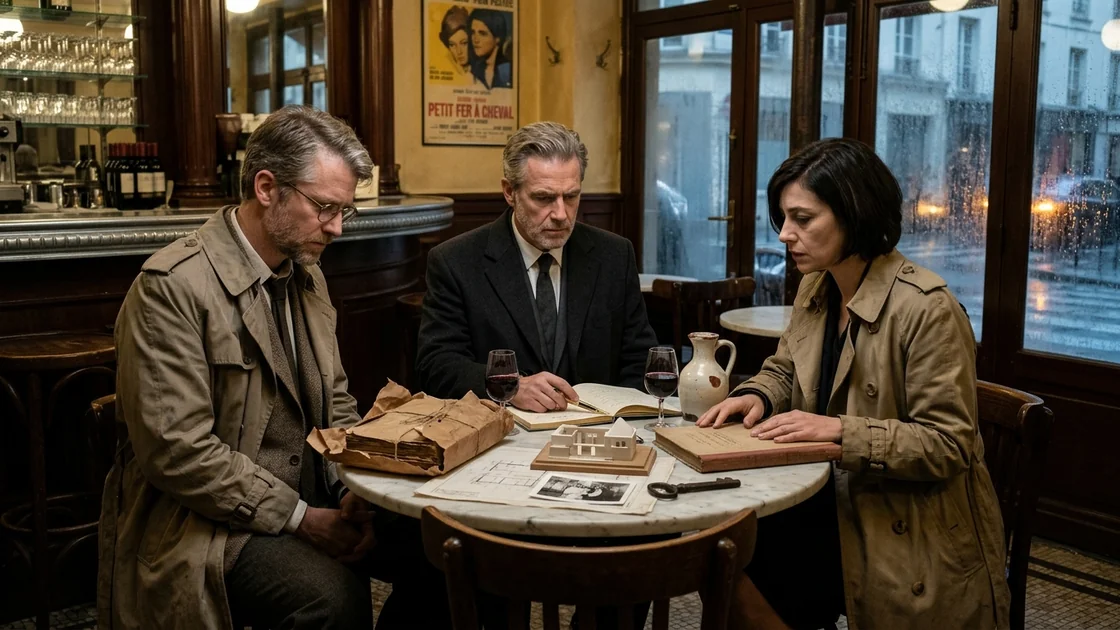
Twenty years after graduating from Columbia University, three former roommates gather at a dimly lit corner bistro in Paris to honor a pact made in the flush of youth, awaiting the arrival of their charismatic and vanished fourth companion. As the hours slip away and an empty chair stands between them, Julian, Marcus, and Beatrice are forced to peel back two decades of accumulated success and polite evasion, ultimately confessing the distinct, devastating betrayals each committed against the absent friend who had defined their youth. Through their interlocking admissions, they discover that their stellar careers were built entirely upon the wreckage of his stolen brilliance, only to realize that their final reunion was not an act of nostalgia, but a meticulously engineered reckoning designed by the ghost they had spent their entire adult lives trying to forget.
I. The Zinc Counter
The brass clock mounted above the mirrored back-bar of Le Petit Fer à Cheval had lost ten minutes sometime during the Mitterrand administration and had never been corrected. It was four in the afternoon on the third Thursday of October, and the light over the Rue Saint-Benoît had begun to bruise, turning the color of wet slate and crushed damson plums. Outside, an autumn drizzle was slicking the cobblestones, turning the reflection of passing headlights into long ribbons of watery amber.
Julian Thorne arrived forty-five minutes early. He did this not out of enthusiasm, but out of a chronic, suffocating dread that had attended every scheduled event of his adult life. He was forty-two years old, though the hair at his temples had gone the color of salt-bleached cedar, and his shoulders carried the permanent, defensive hitch of a man who spent forty hours a week examining rare manuscripts through a jeweler’s loupe. His trench coat, purchased five years ago on Savile Row to commemorate his appointment to the Chair of Architectural History at Cambridge, felt damp around the hem.
He did not sit at the small round marble table in the alcove near the rear, not yet. Instead, he stood at the horseshoe-shaped zinc counter, his fingers curling around the small porcelain cup of espresso he had ordered simply to purchase the right to stand there.
"Monsieur attends someone?" the barman asked. He was an older man with the flattened nose of an amateur pugilist and a blue linen apron dusted with flour from the morning’s baguettes.
"Three people," Julian answered in his precise, slightly archaic French. "We had an appointment. Made in May of two thousand and four."
The barman did not smile, but one of his heavy gray eyebrows rose by a millimeter. "Twenty years. Americans?"
"Three Americans. One Englishman." Julian touched the breast pocket of his coat. Beneath the heavy wool lay a small, black Moleskine notebook, its elastic band frayed to a spider’s silk, its oilcloth cover warped by two decades of varying climates. "We lived together in New York. On the fifth floor of a brownstone on West 114th Street."
"And you believe they will come?"
"I believe two of them will," Julian said softly. He set down two euro coins on the zinc. "The fourth is the question."
He took his cup and walked to the back of the café. The alcove table sat beneath a framed, yellowing poster for a 1968 Godard retrospective at the Cinémathèque. It was a corner that invited conspiracy, shielded from the front windows by a mahogany pillar and the low hum of an ancient refrigeration unit. Julian sat with his back to the wall, facing the glass-paned doors that led out to the street.
Twenty years. In May of 2004, they had stayed up until the sunrise broke over Morningside Heights, drinking warm supermarket gin from jelly jars and smoking stale Gauloises that David had bought from a bodega on Broadway that didn't check identification. They were twenty-two. The future was not a country they intended to visit; it was an empire they intended to sack.
It had been David’s idea, of course. Everything of consequence had been David’s idea.
“October seventeenth, twenty-twenty-four,” David had said, leaning precariously out of the five-story window, the Hudson wind tossing his wild, soot-colored hair across his forehead. “Four o’clock in the afternoon. Café on Rue Saint-Benoît. If you’re dead, send an emissary. If you’re rich, buy the wine. If you’re a failure, come anyway so we can make fun of you.”
Julian closed his eyes. In the darkness behind his lids, he could still see David Ward’s hands: long-fingered, scarred across the knuckles from a chisel slipped during his sophomore studio, permanently stained with Higgins Black India ink. David had been the sun around which their small, dysfunctional solar system rotated. Julian, with his pedantic genealogies of Palladian arches; Marcus, with his frantic, calculating hunger for the markets; Beatrice, with her razor-blade sentences and cynical ambition. They had been three cold planets, warmed only by the unholy, terrifying brilliance of the boy who lived in the hall closet because he couldn't afford a full room.
A gust of cold air cut through the bistro.
Julian opened his eyes. The door had swung wide, admitting a man who seemed to take up twice the space he occupied.
Marcus Vance had not grown old so much as he had grown compressed. In college, he had been sprawling and clumsy, a scholarship kid from an industrial town in Ohio whose shirts never quite tucked into his trousers. The man standing on the threshold of Le Petit Fer à Cheval was an artifact of late-stage private equity: slim, silvered, encased in a charcoal cashmere topcoat that had never seen the inside of an overhead bin. His face had the tight, burnished patina of a man who worked out with personal trainers in Manhattan penthouses and paid people to ensure he never caught the common cold.
He spotted Julian immediately. There was no hesitation, no polite squinting across the dim room. Marcus walked straight to the corner alcove, his leather-soled shoes clicking with military precision against the black-and-white hex tiles.
"You're gray," Marcus said without greeting. He did not extend a hand. He pulled off his leather gloves, one finger at a time, and tossed them onto the table. "You look like an etching of an assistant professor."
"And you look like an institutional prospectus," Julian said, his voice level. "Sit down, Marcus."
Marcus looked at the wooden chair across from Julian, then at the two empty chairs flanking it. He pulled out the one to the right, sliding into it with a suppressed grunt that betrayed the stiffness in his lower back.
"I have forty minutes," Marcus said, checking an absurdly thin platinum watch that sat beneath his cuff. "My driver is circling the boulevard. We have a dinner at Laurent with the sovereign wealth guys from Abu Dhabi at eight, and my team needs me to run the deck before we sit."
"You came all the way to Paris for forty minutes?"
"I was in London for the sovereign bond conference," Marcus said quickly. Too quickly. "I took the Eurostar down this morning. I’m taking the six-thirty back tomorrow. It was efficient."
"Efficiency was never your hallmark in Hartley Hall," Julian murmured. "You used to spend three hours calculating how to pirate a four-dollar textbook."
"That was thirty pounds and fifty million dollars ago, Julian." Marcus signaled the pugilist barman with two raised fingers. "Bring us a bottle of the '82 Léoville-Las Cases if you have it. If not, whatever Saint-Julien you have that doesn't taste like sheep dip."
The barman didn't move. He stared at Marcus with flat, unimpressed eyes from across the room.
"A carafe of the house red," Julian called out gently. "And two glasses, s'il vous plaît. For now."
The barman nodded once and turned to the barrel beneath the counter.
Marcus exhaled, a sharp, hiss of steam. "Still a provincial town. It’s charming, really. How do they keep the lights on?" He looked around the room, his eyes scanning the cracked moldings, the patrons hunched over their saucers, the condensation dripping down the glass panes. "Where is she?"
"She'll be here," Julian said. "Beatrice is never late for an autopsy."
"And David?"
The question hung between them, sudden and toxic. The hum of the refrigerator seemed to swell, filling the silence. Julian turned his espresso cup by its miniature handle, rotating the cracked rim against the saucer.
"Have you heard from him?" Julian asked.
"No," Marcus said. He looked down at his own manicured nails, pressing a thumb into the cuticles. "Not since May of two thousand and nine. The morning he cleared out of the Brooklyn loft."
"That's fifteen years, Marcus."
"I know how to count, Thorne. I run a seven-billion-dollar fund. I know precisely how long fifteen years is." Marcus shifted in his seat, the fine wool of his trousers swishing against the chair leg. "I assumed you kept tabs on him. You were his disciple. You wrote your entire doctoral thesis on the conceptual framework he invented over cold pizza in the communal kitchen."
Julian’s jaw tightened. "David wasn't something you kept tabs on. He didn't have an address. He didn't have a phone that stayed connected for more than six weeks. The last time I saw him was in Berlin. Twelve years ago. He was living in an abandoned shoe warehouse near the canal, painting canvases eight feet high with road tar and bone meal."
"Did he look..." Marcus hesitated. "Did he look well?"
"He looked like someone who had survived his own execution," Julian said. "He asked about you, Marcus. He asked if you had bought your soul back yet."
Marcus let out a dry, rattling laugh that had no humor in it. "He always was a dramatic son of a bitch. A visionary without an income statement is just a lunatic with an audience of three."
"Four," a woman’s voice cut in from the shadows of the entry. "There were four of us, Marcus. Don't flatter yourself by rounding down."
II. The Scars of the Scribe
Beatrice Hall did not take off her coat. It was an old Burberry trench, dark with rainwater across the yoke, the belt tied in a careless, savage knot at the front. Her short, dark hair was cut in an asymmetric bob that showed the angular architecture of her cheekbones and the three silver rings pierced into the cartilage of her left ear. She had bags beneath her eyes that no amount of cosmetic discipline could hide, the deep, violet-tinted hollows of an investigative reporter who lived on black tea, Ambien, and the terror of looming litigation.
She dragged the fourth chair out, scraping its iron-shod legs loudly against the tile, and sat down between them. She looked at Marcus, then at Julian, her mouth curving into a thin, ironic crescent.
"The academic and the robber baron," she said, her voice smoky, rasping from decades of unfiltered cigarettes. "My God. We look like a cautionary tale from an alumni magazine."
"You look tired, Bea," Marcus said, his tone softening by an imperceptible fraction. In college, he had been terrified of her; he still was, but now he had enough capital to hire firms that could sue her publications into non-existence.
"I’ve spent the last six months in the archives of the Ministry of the Interior in Rome, looking at money-laundering operations through agricultural real estate," Beatrice said. She reached into her coat, pulled out a battered pack of Gauloises, looked at the ‘No Smoking’ sign pinned above the bar, and shoved the pack back into her pocket with a grimace. "Tired is my baseline. Who ordered the swill?"
The barman arrived with a chipped ceramic carafe of purple-black wine and three thick-rimmed glasses. He placed them on the table without ceremony, his gaze lingering on Beatrice’s damp hair before he grunted and walked away.
"I ordered it," Julian said. "Or rather, I mediated between Marcus’s vanity and the barman’s pride."
"Marcus always did have the palate of a golden retriever," Beatrice remarked. She poured her own glass, filling it to the brim, and took a long, reckless swallow. She closed her eyes, shuddering slightly. "Cheap tannin and sulfur. Perfect. It tastes like twenty-two."
"To the class of 2004," Marcus said, raising his empty glass toward the carafe.
Neither Julian nor Beatrice moved their glasses.
Marcus let his arm drop, his expression hardening. "Fine. Let's not pretend we’re sentimental. We all have things to do. I have a dinner. Beatrice has a conspiracy to uncover. Julian has some dead Italian to deconstruct. We're here because of David's joke. So let's tell the joke and get it over with."
"It wasn't a joke," Beatrice said. Her dark eyes fixed on Marcus with terrifying focus. "David never joked about the future. He didn't believe in the future. He thought time was an accordion that had already been folded."
"He was twenty-two and completely insane," Marcus retorted.
"He was the only one of us who was real," Beatrice said softly. "The rest of us were just career strategies with legs."
Julian leaned forward, his hands flat on the cool marble. "Why are we really here, Beatrice? You didn't come from Rome on an overnight train through the Simplon Tunnel just to drink bad Gamay and tell Marcus he's a Philistine."
"I took the train because I don't fly if I can help it," she said. "And I came because I received a letter."
The café seemed to drop in temperature. Marcus stopped rotating his watch. Julian’s breath caught in the back of his throat.
"When?" Julian whispered.
"Three weeks ago," Beatrice said. She reached into the interior breast pocket of her trench coat. Her movement was deliberate, almost ritualistic. From the pocket she withdrew an envelope. It was not modern parchment; it was heavy, deckle-edged watercolor paper, folded into thirds and sealed with a lump of brittle, scarlet wax that had been impressed with the base of a brass door key.
The paper was aged, slightly yellowed along the creases, but the handwriting across the front was unmistakable. It was written in a dark, sepia-toned walnut ink, the strokes slashing and architectural, the letters formed with the precision of an engraver who had lost his patience.
For the Third Estate, it read. Rue Saint-Benoît. Bring what you took.
"He sent you that?" Marcus asked. His voice had lost its metallic corporate veneer; it sounded thin, high, like the boy who used to double-check his checking balance at the ATM outside the campus bookstore. "From where? What was the postmark?"
"There wasn't one," Beatrice said. "It was slipped under the door of my flat in the Trastevere. In Rome. On a Sunday morning while I was making coffee. I heard the paper brush the floorboards. By the time I reached the lock, the stairwell was empty. Four flights of stairs, completely silent."
Julian reached into his own coat. He didn't pull out the Moleskine. Instead, he pulled out an identical envelope, folded from the same heavy, deckle-edged paper, sealed with the same red wax, stamped with the same hollow iron key.
"Mine came to the department office in Cambridge," Julian said. "Two weeks ago. Inter-departmental mail. No stamp. Just my name and the same instruction: Bring what you took."
They both turned to Marcus.
The financier did not reach into his pocket. His hand remained on the marble table, but his knuckles had turned the color of lard. His jaw worked, the muscle ticking beneath his smoothly shaven skin.
"Marcus?" Beatrice said. Her voice was predatory now, the reporter scenting the rupture in the source's defense. "Where is yours?"
"I don't keep trash like that," Marcus whispered.
"You got one," she stated.
"I found it on the seat of my car," Marcus snapped, his voice rising enough to make the old man at the zinc counter look back over his shoulder. "In the garage under my building on 72nd Street. A secure facility, Julian. Biometric access. Three security guards who are paid six figures a year to ensure that not a single unauthorized leaf enters that concrete basement. It was sitting on the leather passenger seat of my Mercedes. I didn't open it. I ran it through the shredder in my study."
"You didn't shred it," Beatrice said with cold certainty. "You memorized it. What did it say?"
Marcus closed his eyes. For a moment, the forty-two-year-old titan of private capital looked extraordinarily small, like a child who had been caught hiding behind the sofa with jam on his fingers.
"Bring what you took," Marcus recited, the words tasting like gravel in his mouth. "Or I will give it away for you."
The three of them sat in the dim light of the café. Outside, the rain was coming down harder now, drumming against the awning with the sound of distant, irregular applause.
"He isn't coming, is he?" Julian said. His voice was hollow, an empty room in an abandoned house. "He never planned to come. This was never a reunion."
"No," Beatrice agreed, staring into her glass of dark wine. "It’s an audit."
III. The Blueprint in the Hearth
"You first, Julian," Beatrice said. She didn't look at him; she was watching the rain stream down the windowpane, distorting the neon sign of the pharmacy across the street into a bleeding red cross. "You were the one who always talked about his 'ethics.' Let's hear about your scholarship."
Julian’s hand drifted toward his collar, fingering the top button of his shirt as if it were choking him. "My work has been thoroughly vetted. I’ve published three books with Oxford University Press. I am the fellow of—"
"Stop it," Marcus cut in, his voice harsh with an unexpected, bitter venom. "Don't recite your curriculum vitae to us, Julian. We were there. We know what you were before David pulled you out of the stacks. You were a nervous stammerer who couldn't formulate a single original thesis to save his life. You spent three years cataloging the laundry receipts of seventeenth-century Venetian stonemasons."
"It was serious archival work!" Julian said, a flush of dark, furious red climbing his neck.
"It was clerical work," Beatrice said simply. "Tell us about the Venice Pavilion, Julian."
Julian went completely still. Even his breathing seemed to suspend itself. In the back of the café, the refrigeration compressor gave a long, rattling groan and fell silent, leaving only the sound of the rain and the dull thud of Julian’s fingers against the edge of the table.
"He never wanted to build it," Julian whispered.
"That wasn't your decision to make," Beatrice said.
Julian leaned forward, his elbows digging into the marble, his voice dropping into that frantic, rhythmic cadence that scholars use when they are defending a disputed attribution before a hostile board of trustees.
"You remember the spring of our senior year," Julian said, his eyes darting between Marcus and Beatrice. "David hadn't slept for three weeks. He was living on ephedrine and tap water. He had covered the entire living room of the 114th Street flat with heavy rag paper—tacked it to the baseboards, pasted it over the wallpaper, nailed it into the window casings. He had drawn the entire spatial projection for a floating pavilion on the Canale della Giudecca. Not just the drawings—the structural loads, the tidal calculations, the specific density of the Istrian stone he wanted to use for the sub-aquatic pilings. It was... it was impossible. It was the work of an architect fifty years ahead of his time."
"It was his graduate thesis," Marcus noted. "The one he never turned in."
"He didn't turn it in because he had a psychotic break," Julian hissed. "He took a five-gallon bucket of kerosene from the basement and he poured it across the floor. He was standing there with a box of kitchen matches in his hand. Do you remember that night, Marcus? Beatrice? You were at the library. Marcus was at an interview with Goldman Sachs. I was the only one there."
"And you saved him," Marcus said dryly. "What a hero."
"I didn't save him!" Julian’s voice cracked, a small, ragged sound that drew another glance from the barman. Julian shrank back into the corner, lowering his head. "I didn't save him. I tackled him. We rolled into the hall. The match went out. He was weeping, babbling about the weight of the air, saying that if the pavilion were built, it would sink the whole city, that the stones were screaming at him."
"And the drawings?" Beatrice asked. Her voice was steady, flat, clinical.
Julian swallowed. His mouth felt dry, coated in copper and ash. "He passed out. I carried him to his mattress in the closet. I came back into the living room. The kerosene hadn't ignited, but the fumes were so thick you could barely see through the air. The sheets were soaking it up. The ink was running in the corners. I didn't think about his career. I thought... this cannot simply disappear. It was the most beautiful thing I had ever seen. The way he reconciled the tension between Palladio’s ratios and modern marine engineering... it was poetry. It was divinity."
"So you saved them," Beatrice said.
"I peeled them off the walls," Julian whispered. He was looking at his hands now, the fingers slightly trembling. "I spent four hours with a razor blade, cutting the rag paper away from the molding. I carried them down the fire escape, bundle by bundle, in the rain. I took them to my uncle's storage unit in Queens."
"And then?" Marcus leaned in, his eyes glittering with a predatory, vindictive curiosity. "What did you tell David the next morning?"
Julian closed his eyes. The memory was fifteen years old, but it had the sharp, serrated edge of a fresh surgical incision.
"I told him the fire had caught," Julian whispered. "I told him the fire department had come. I told him the landlord had thrown everything into the dumpster on 113th Street and the sanitation trucks had already crushed it."
"Jesus Christ, Julian," Marcus breathed, though there was an undercurrent of genuine admiration in his voice. "You convinced him he had burned his own masterpiece."
"He believed me," Julian said, tears of shame bright in the corners of his eyes. "He looked at his blistered fingers, he looked at the blackened baseboards where the kerosene had stained the pine, and he believed me. He wept for an hour, like a child who had killed a pet. And then... he stopped talking about architecture. Entirely. He switched his major to comparative literature two weeks before graduation. He never drafted another elevation as long as he lived."
"And what did you do with those drawings, Julian?" Beatrice asked, though she already knew the answer. Every person in the room knew the answer. The international architectural community knew the answer, even if they didn't know the provenance.
"I waited five years," Julian said, his voice barely audible above the rain. "Until I finished my doctorate. I published them as 'The Anonymous Giudecca Folio.' I claimed I had discovered them in an uncatalogued trunk in the basement of the Querini Stampalia library in Venice. I wrote the critical commentary. I decoded the structural formulas. I explained to the world what the drawings meant. That paper made me. It won the Pevsner Prize. It got me the tenure-track position at Princeton. It got me the chair at Cambridge. I built an entire academic dynasty on the lie that those drawings belonged to an eighteenth-century disciple of Piranesi."
"And the originals?" Beatrice asked.
Julian touched his briefcase, which rested on the floor between his shins, wedged securely between his boots.
"They're here," he said. "In the portfolio. Restored, de-acidified, backed with Japanese mulberry silk. I spent fifty thousand pounds of my own money to conserve them. I have carried them with me for twenty years like an iron ball chained to my ankle. Every award I ever received, every review that praised my 'unmatched interpretive genius,' I could smell the kerosene. I could smell the damp wood of that fifth-floor apartment."
Marcus let out a low whistle, shaking his head. "The pure, high-minded scholar. You didn't just steal his work, Julian. You stole his reason for being. You castrated him so you could write a monograph about his balls."
"And what did you do, Marcus?" Julian snapped, his voice suddenly vicious as he turned his shame outward. "Do you think you’re clean? Do you think David’s letter was sent to you because he admired your return on equity?"
Marcus’s smirk vanished. The mask of smooth, corporate invulnerability dropped back over his features, but it was thinner now, stretched tight across bone and sinew.
IV. The Architecture of Bankruptcy
The bistro was beginning to fill with the evening crowd. A pair of students in wet wool scarves sat three tables away, arguing in rapid-fire French about a film they had just seen at the Saint-Germain cinema. The barman was wiping down the beer taps with a gray cloth, his eyes occasionally drifting toward the corner table where the three foreigners sat like figures in a wax museum.
Marcus did not touch his wine. He took out his gold pen, unscrewed the cap, screwed it back on, and repeated the motion three times with rhythmic, neurotic compulsion.
"David had an inheritance," Marcus said quietly.
"David didn't have a cent," Beatrice said. "His father was an Episcopal priest who died of liver failure in a parish house in New Hampshire. His mother lived in a subsidized apartment in Portland."
"His grandfather," Marcus corrected her. "On his mother’s side. Old Maine lumber money. It wasn't vast, not by New York standards. But it was real. It was held in a spendthrift trust that became accessible to David on his twenty-fifth birthday. Two million dollars. Not enough to retire on, but enough to never have to work for a firm. Enough to buy space, buy materials, buy time. Enough to live like an artist for forty years without asking anyone for permission."
"He never mentioned it," Julian said, bewildered. "He lived on day-old bagels and canned black beans. He wore coats he found in the street."
"Because he didn't care about it," Marcus said, his voice flat, drained of cadence. "He hated the family. He thought the money was dirty. He told me about it in the summer of two thousand and six, when we were sharing that rat-hole in Bushwick after you went off to Oxford, Julian. I was an associate at Lehman. I was twenty-four years old, working ninety-hour weeks, pulling seventy grand a year and watching guys three years older than me make two million on synthetic credit default swaps."
Marcus stopped. He unscrewed the gold cap of his pen again.
"Go on, Marcus," Beatrice urged, her pen resting on her own open palm. "Tell us about the mechanics."
"I was running my own book on the side," Marcus said, his gaze fixed on the mahogany table. "Unregistered. Personal trading account using leverage through an offshore vehicle in Grand Cayman. I had a thesis on the subprime mortgage tranches. I was early. I was dead right, but I was eighteen months too early. In two thousand and six, the market was still irrational. The spreads were widening against me every single day. The broker was calling for margin every twelve hours. If I didn't post collateral, I was going to be liquidated, banned from the street, and probably indicted for violating my employment covenants."
"How much did you need?" Julian asked.
"One point eight million," Marcus said. "I went to David. I didn't lie to him about what the trade was, but I lied about the risk. I told him it was an arbitrage play on municipal utilities. Completely safe. Triple-A underlying paper. I told him that if he pledged his trust assets as a collateral guarantee for my credit line in George Town, I would return his principal in ninety days with a twenty percent return. I told him he could use the profit to build a studio in Red Hook."
"And he gave it to you?" Beatrice’s voice was tinged with genuine disbelief. "David? The man who wouldn't sign a lease because he didn't believe in the concept of private property?"
"He didn't give it to me for the money," Marcus whispered, and for the first time, his voice cracked with something that resembled grief. "He gave it to me because he thought I was his friend. He looked at me—I had lost twenty pounds, my skin was gray, I was vomiting every morning in the subway station from pure stress—and he said, 'Marcus, if you need the paper to keep them from killing you, take the paper.' He signed the power of attorney on a napkin at the diner on Bedford Avenue."
"And then?" Julian asked.
Marcus swallowed. "Bear Stearns happened. But before that, in November of two thousand and six, the Cayman fund had an unexpected liquidity freeze. The counterparty exercised their right of seizure on the collateral assets. The trust was swept. Every nickel. Two million dollars of Maine timber shares, liquidated at fire-sale prices to cover a margin call on a swap that went to zero three months later."
The rain outside seemed to slacken, the heavy drops turning into a fine, ghost-like mist that clung to the windows.
"What did you tell him?" Beatrice asked.
"I didn't tell him," Marcus said. His hands were flat on the table now, his thumbs pressed against each other until the skin turned white. "I couldn't. I packed my things while he was out walking along the East River. I moved to a sublet in Murray Hill. I changed my number. I told our mutual acquaintances that David had become unstable, that he was using heavy drugs, that they shouldn't give him my new office address if he came looking for me."
"You made him into a pariah," Julian said, his voice rising in outrage. "You stole his entire safety net, and then you poisoned the well so he couldn't even confront you."
"I was trying to survive!" Marcus snarled, his eyes flashing with a sudden, desperate fury. "You think Wall Street gives a damn about a friendship? If that default had hit my U-4 regulatory filing, I would have been finished. I would have been managing a branch of Enterprise Rent-A-Car in Akron! Instead, I survived the crash. I bought the distressed assets when the floor fell out in two thousand and eight. I made forty million dollars before I was thirty. I gave five million of it to the Bowery Mission! I gave two million to Columbia’s financial aid fund!"
"Did you give it to David?" Beatrice asked. Her voice was quiet, a scalpel slipping between ribs.
Marcus slumped back in his chair. The fury drained out of him, leaving behind only the gray, hollow exhaustion of an aging man who had bought everything he ever wanted and found it tasted like dry paper.
"I looked for him," Marcus muttered. "In two thousand and ten. After the fund launched. I hired an investigative firm. Kroll. They spent three months looking for him. They tracked him to a flophouse in New Orleans, then to a fishing boat in Ensenada, then the trail went cold. They found an arrest report for vagrancy in Tucson, but the fingerprints didn't match. He had disappeared. He had completely erased himself."
Marcus reached into his pocket and pulled out a certified bank draft. It was drawn on J.P. Morgan, made out to David Ward, in the amount of four million six hundred thousand dollars. The date on the draft was three weeks ago.
"I brought it," Marcus said, laying the check on the marble next to his gold pen. "Just like the letter said. Bring what you took. I brought the principal. I brought the interest. I brought eight percent compounded annually. It's all there. But who the hell am I supposed to hand it to?"
"You can't pay your way out of this, Marcus," Beatrice said coldly. "You can't buy an indulgence from a dead man."
"You don't know he's dead!" Marcus said, his voice rising in panic. "Neither of you knows that! That letter... that handwriting... it was his!"
"Was it?" Beatrice asked. She reached for her glass, her fingers steady, and took another drink of the sour red wine. "Julian, you're the manuscript expert. You looked at the ink. You looked at the ductus of the lettering. Was that David's hand?"
Julian hesitated. He remembered the stroke of the T in Estate, the way the horizontal bar tilted downward at an angle of seven degrees, the peculiar, truncated tail of the R.
"It was his hand," Julian said reluctantly. "Or it was someone who spent ten years studying the way his muscles moved."
"It was him," Marcus insisted, his eyes wide, looking between them like a trapped animal. "He's alive. He's here in Paris. He’s going to walk through that door, and I’m going to give him this check, and Julian is going to give him his drawings, and we’re going to be done with this. We’re going to be square."
"We will never be square, Marcus," Beatrice said. She set her glass down with a sharp clink against the marble. "Because neither of you has heard what I did."
V. The Tangier File
Julian and Marcus both turned to look at her.
Beatrice Hall had always been the most dangerous of them. In college, she had possessed a terrifying, almost inhuman clarity of purpose. While Julian was lost in the Renaissance and Marcus was calculating spreads, Beatrice had understood that power was not held in buildings or in balance sheets, but in the narrative that society agreed to tell itself about them. She was a journalist who didn't care about scoops; she cared about leverage.
"You didn't take his work," Julian said, his brow furrowing. "And you certainly didn't take his money. You lived on three hundred dollars a month in the East Village writing obituaries for the Village Voice."
"I took something worse," Beatrice said. She reached into her bag—not the pocket of her trench coat, but a battered leather courier bag that rested against her chair. From it, she pulled a slim, typewritten manuscript bound with a heavy brass fastener, its cover sheet gray with age.
"David didn't vanish in two thousand and nine, Marcus," she said, looking directly at the financier. "He didn't go to Ensenada. And he wasn't a vagrant in Tucson."
"Where was he?" Marcus asked, his voice barely a breath.
"He was with me," she said.
The silence that followed was different from the others. It was not the cold silence of shame, but the heavy, suffocating silence of an ancient, unsuspected betrayal.
"With you?" Julian stared at her. "You told us you lost touch with him after the loft was cleared out. You told me you hadn't seen him since graduation."
"I lied," Beatrice said simply. "In the spring of two thousand and eight, David came to my apartment on East 7th Street. He was broken, Marcus. Not just poor—broken. He knew what you had done with the trust, even if he didn't know the financial terminology. He knew you had used him as a human shield. And he knew about Julian."
Julian flinched as though he had been struck with an iron rod. "He... he knew?"
"Of course he knew, Julian," Beatrice said, her voice dripping with scorn. "Did you really think he was that blind? He read your article in the Journal of the Warburg Institute. He bought the issue at the Strand for fourteen dollars. He sat on my kitchen floor, reading your brilliant translation of his own architectural marginalia, and he laughed until he threw up in my sink."
Julian buried his face in his hands. A low, ragged groan escaped his chest. "Why didn't he say something? Why didn't he sue me? Why didn't he destroy me?"
"Because he loved you," Beatrice said, her words cold and sharp as obsidian. "He thought you were a tragic, pathetic little creature who couldn't bear your own mediocrity. He told me, 'Julian needs those drawings to believe he has a soul. I can always make more.' But he couldn't make more, could he? Because you had taken his confidence, and Marcus had taken his independence."
"So what happened?" Marcus demanded, his face dark with a mixture of guilt and sudden jealousy. "Why was he with you?"
"We went to Tangier," Beatrice said, looking past them at the dark rain. "He had four hundred dollars left from selling his grandfather's gold watch. I had a grant from the Nation Institute to write about post-colonial literary networks in the Maghreb. We rented a white-washed room on the Marshan, overlooking the Strait of Gibraltar. We lived there for eighteen months."
"You were lovers," Julian said from behind his hands.
"Don't be banal, Julian," Beatrice snapped. "We were something much more dangerous than lovers. We were collaborators. David had stopped drawing, and he had stopped designing buildings. But he started writing. In that room, with the wind coming off the Atlantic and the smell of roasting lamb and kif drifting up from the socco, he wrote a book."
She tapped her fingers against the typewritten manuscript on the table.
"He called it The Mechanics of the Fall," she said. "It was... I have read everything from Augustine to Cioran, and I have never seen anything like it. It was a roman à clef, but it was also an anatomy of our entire generation. He wrote about the three of us with a precision that was terrifying. He documented Marcus’s financial cannibalism—he predicted the two-thousand-and-eight collapse down to the month, using the metaphors of parasitic biology. He documented Julian’s intellectual theft, treating it as an allegory for how the old world consumes the young to preserve its own dead institutions. And he wrote about me."
"What did he write about you?" Marcus asked, his eyes narrow.
"He wrote that I was the most dangerous of all," Beatrice said, her voice dropping into a register so low it was almost drowned by the rain. "Because I didn't steal for money, and I didn't steal for prestige. I stole for the pleasure of exposure. He wrote that I was a ghoul who walked behind armies, waiting to strip the boots off the dying."
"Is that why you kept it?" Julian raised his head, his eyes bloodshot, his face pale.
"I didn't keep it," Beatrice said. "I published it."
Marcus blinked. "I never saw a book by David Ward. No one has ever heard of that title."
"They didn't hear of it under his name," Beatrice said. She pulled the cover sheet back. Beneath it was the title page of an internationally acclaimed non-fiction work that had won the National Book Award in 2011—a book that had launched Beatrice from a freelance contributor at small left-wing journals to a staff writer at The New Yorker and an internationally recognized cultural critic.
The name on the title page was not David Ward.
It was Beatrice Hall.
"You took his book," Marcus said, a slow, incredulous smile spreading across his face—the smile of a damned soul discovering that the priest in the cell next to him had murdered his own mother. "You didn't just take an idea. You took his entire manuscript. You put your name on it."
"I edited it," Beatrice said, her voice rising in a sudden, defensive cadence that mirrored Julian’s earlier panic. "David didn't want it published! He was terrified of it. In the winter of two thousand and nine, he started having visions again. He was walking out onto the cliffs of Cap Spartel in the middle of the night, staring at the lights of Tarifa, saying that the words were catching fire in his head. He wanted to burn the manuscript. Just like he wanted to burn the Giudecca drawings."
"So you saved it," Julian mocked, his voice thick with bitter irony. "Just like I did. For the good of humanity. For the preservation of art."
"I made it readable!" Beatrice hissed. "His draft was nine hundred pages of unpunctuated madness! It was a labyrinth of rage and paranoia! I spent two years restructuring it, cutting away the delirium, sharpening the critique, turning it into a work of cultural analysis that the world could actually comprehend! Without me, it would have rotted in a damp cedar chest in a Moroccan attic!"
"And what happened to David?" Marcus asked. "When the book came out? When you were on Charlie Rose? When your face was on the front of the New York Times Book Review?"
Beatrice looked down at the table. Her fingers traced the brass fastener of the manuscript.
"He was gone," she whispered. "He left Tangier three weeks before I finished the final draft. He woke up one morning, took his passport and his sketchbook, and walked down to the ferry terminal. He didn't take a suitcase. He didn't leave a note. The only thing he left behind was a slip of paper on the kitchen table, held down by a small piece of sea glass."
"What did it say?" Julian asked.
Beatrice’s voice was barely a murmur, a dry rustle of leaves against concrete.
"'Keep the skin,' it said. 'I have already grown another.'"
The three of them sat in the alcove, their respective sins laid out between them like tools on an operating tray: the portfolio of stolen elevations resting against Julian’s shins, the four-million-dollar draft lying beside Marcus’s gold pen, the yellowed manuscript bearing Beatrice’s name resting beneath her trembling hands.
The bistro had grown quiet. The students had left. The old men at the bar had paid their tabs and departed into the Paris night. The pugilist barman was wiping down the mahogany tables with a damp rag, his movements slow, rhythmic, indifferent to the three ghosts sitting in his corner.
It was ten minutes past six.
"We killed him," Julian said softly. He was looking at the empty fourth chair. "Between the three of us, we dismantled him. Marcus took his survival. I took his intellect. Beatrice took his voice. We picked his carcass clean and we used the bones to build our lives."
"He's not dead," Marcus repeated, but the assertion had lost all its force; it sounded like an incantation recited by an atheist in a storm. "The letter. The letters brought us here. He wanted us here."
"Why?" Beatrice looked around the room, her eyes wide, scanning the dim mirrors, the yellowed cinema posters, the zinc counter. "To watch us confess? To an empty room? There’s no one here, Marcus. There are no cameras. There's no dramatic reveal. There’s just an old French barman who wants us to pay for our wine and leave."
As if summoned by her words, the barman paused in his wiping. He tossed the damp rag over his shoulder, reached beneath the zinc counter, and picked up a heavy, rectangular package wrapped in brown butcher paper and tied with rough hemp twine.
He walked across the black-and-white hex tiles, his heavy work shoes clicking in the quiet room. He stopped at the head of their table, looking down at the three Americans with his flat, rheumy eyes.
"Messieurs. Madame," he said.
Julian’s heart surged into his throat. "Yes?"
The barman set the heavy package down on the marble table, directly in front of the empty chair.
"A gentleman left this," the barman said. "This morning. At seven o'clock, when I was unlatching the iron shutters."
Marcus lunged forward, his hands grasping the edge of the table. "What gentleman? What did he look like? Was he tall? Dark hair? Scars on his fingers?"
The barman considered the question for a moment, his brow furrowing with the effort of recollection. "He was not tall. An older man. Very quiet. He wore an overcoat of gray wool, quite old, but very clean. His hair was white, like the crest of a wave. He had the hands of a man who works with lime and sand. A mason, perhaps. Or a plasterer."
"White hair?" Beatrice breathed. "David's hair was black as pitch."
"Twenty years, Madame," the barman said with a slight shrug of his heavy shoulders. "Twenty years is a great deal of weather."
"Did he leave a message?" Julian asked, his voice shaking so violently he could barely form the syllables. "Did he say anything to you?"
The barman nodded once. He reached into the pocket of his blue apron and pulled out a small brass object, setting it down with a soft clack against the marble.
It was an old, heavy iron key, its bit cut into three distinct, stepped notches, its bow stamped with the numeral 4.
"He said," the barman recited carefully, "that the rent had been paid for twenty years. And that it was time for the tenants to inspect the property."
VI. The Key to the Courtyard
The package did not tick. It did not smell of kerosene. It smelled of beeswax, cold river silt, and the dry, alkaline dust of hydrated lime.
Marcus’s hand reached out, his fingers hovering over the rough hemp twine. "Should we... should we open it?"
"We didn't come to Paris to look at the paper," Beatrice said. Her professional detachment had completely shattered; her face was pale, her lips dry, her dark eyes fixed on the twine with the terrified fascination of an anatomist unlacing a shroud.
Julian took his penknife from his pocket. The small steel blade clicked open with a tiny, precise sound. He slipped the blade beneath the twine, severed it with a single upward pull, and laid the hemp strings to one side.
He folded back the brown butcher paper, layer by layer.
Inside lay three distinct objects, resting atop a large, bound portfolio of heavy vellum.
The first object was an architectural model, no larger than a cigar box, executed in plaster of Paris and pearwood. It was a model of a building that did not exist—or rather, a building that existed only in the margins of the drawings Julian had stolen. It was a small, octagonal pavilion, its walls pierced by high, narrow arches, its floor suspended over a hollow basin designed to catch the rising tide. On the roof of the pavilion, carved into the plaster with microscopic precision, was an inscription: Julian Thorne — Scribe.
Julian let out a sharp, strangulated breath. He reached out to touch the plaster, but his finger stopped an inch from the surface, trembling.
The second object was a ledger. It was a standard leather-bound account book from the early twentieth century, its marbled edges faded to a dull sepia. Marcus opened the cover. The pages were filled with columns of figures, entered in the same fierce, architectural handwriting that had penned the letters.
It was not a record of the lumber trust. It was an account of every dollar Marcus had made since the collapse of Bear Stearns. The dates, the tickers, the profit margins, the shell companies in the Caymans, the holdings in Luxembourg, the residential real estate in Palm Beach. Across the bottom of the final page, beneath the total of Marcus's current liquid net worth, was written a single line:
Received in full. The balance is zero.
Marcus stared at the page, his face slack, the color draining from his cheeks until he looked like a dead man sitting in a bespoke suit. "He knew," Marcus whispered. "He knew every trade. He didn't need the Kroll agency. He was watching the clearing houses."
The third object was a photograph.
It was a silver-gelatin print, four by six inches, processed by hand on fiber paper that smelled faintly of acetic acid and hypo. It showed a small whitewashed room in Tangier, the light of the morning sun cutting through an open window that looked out over the blue expanse of the Strait.
On the table in the photograph lay a typewriter, a stack of blank rag paper, and an empty chair. In the background, reflected in a small shaving mirror hung from a nail in the plaster, was the silhouette of David Ward. He was not looking at the camera; he was looking down at his own open hands, which were empty.
Pinned to the back of the photograph with a small brass staple was a clipping from the New York Times Book Review, dated November 14, 2011. It was the review of Beatrice’s book, featuring a photograph of her looking formidable and intellectual in a black turtleneck. Across her face, David had written two words in red ink:
Good editing.
Beatrice dropped the photograph. It fluttered down onto the marble table, landing face up between the carafe of sour wine and Marcus's certified check. She pressed her knuckles against her teeth, her shoulders shaking with silent, dry sobs that did not bring any tears to her eyes.
"He was there," she whispered. "He was in the audience. At the 92nd Street Y. When I gave the keynote lecture. I remember... there was a man in the back row, standing by the exit in a gray coat. I thought it was an usher. My God... he was watching me."
Julian did not look at the model, the ledger, or the photograph. His hands had moved to the bound vellum portfolio that lay beneath them.
He untied the black silk ribbons that held the covers together. He lifted the heavy vellum flyleaf.
Inside were not the elevations of the Venice Pavilion. They were not the pages of David’s lost architectural thesis.
They were plans. Modern plans, drawn with blue ink on heavy drafting film, bearing the stamp of the Préfecture de Police de Paris and the Direction des Affaires Culturelles, dated March of the previous year.
They were the blueprints for the building they were currently sitting in.
VII. The Landlord of Rue Saint-Benoît
Julian leaned back in his chair, his head striking the mahogany pillar with a dull thud. He began to laugh. It was a dry, terrible sound, the rattling laugh of a man who had reached the bottom of a dry well and found an armchair waiting for him.
"What is it?" Marcus demanded, his voice cracking with hysteria. "Julian, what the hell is it?"
"The bar," Julian gasped, tears finally spilling over his eyelids, running down through the gray stubble on his cheeks. "The café. Look at the title block, Marcus. Look at the ownership declaration."
Marcus pulled the vellum sheet toward him. Beatrice leaned over his shoulder, her dark hair falling across the drafting film.
At the bottom right corner of the sheet, in the small, standardized rectangle reserved for the property owner and the licensed architect of record, was a name and a corporate entity:
Société Civile Immobilière du Fer à Cheval
Gérant: D. Ward, Architecte
14, Rue Saint-Benoît, 75006 Paris
"He bought the building," Beatrice said, her voice entirely flat, drained of all inflection. "He bought the café."
"He bought it twenty years ago," Julian said, his fingers pointing to the transfer dates recorded in the small, crabbed print of the Parisian land registry. "May eighteenth, two thousand and four. Three days after we graduated. With the first disbursement from his grandfather's trust. The money you thought you lost in Cayman, Marcus? He only pledged the remainder. He took the first two hundred thousand dollars and he bought the freehold of this building through a French holding company."
Marcus shook his head violently, refusing the reality of the paper. "No. That's impossible. Two hundred thousand dollars wouldn't buy a closet in Saint-Germain in two thousand and four."
"It would buy a twenty-year leasehold with an option to purchase the equity," Julian said, his architectural expertise reading the French legal notes with ease. "A distressed commercial property with an ancient rent-controlled tenant on the ground floor. A pugilist who didn't want to leave his zinc bar. David didn't care about the market. He didn't buy it as an investment. He bought it as a stage."
"A stage for what?" Marcus asked, looking around the room as if the walls were about to collapse inward.
"For us," Beatrice said. She stood up, her legs unsteady, her trench coat hanging loose around her thin frame. "For tonight. He knew we would come. He knew that Julian couldn't resist the scholarship. He knew that Marcus couldn't resist the debt. He knew that I couldn't resist the story."
She walked to the zinc counter. The old barman was still there, slowly polishing an espresso cup with a clean linen cloth. He looked up as she approached, his face entirely devoid of surprise.
"Where is he?" she asked him in French. "Where is Monsieur Ward?"
The barman did not look away. He set the cup down on the wooden shelf behind him, next to three dozen identical cups.
"Upstairs," the barman said.
Marcus was on his feet instantly. "Upstairs? There’s an upstairs?"
"There are four floors," the barman said, pointing a thick, calloused finger toward a small, paneled door behind the refrigeration unit—a door that Julian had assumed led to a broom closet or a beer cellar. "He has lived there since the virus. Since the year of the masks. He does not go out very often. His chest is weak. The dust from the quarries, you understand."
Julian picked up the brass key from the table.
It was heavy, cold, smelling of old iron and machine oil. The numeral 4 was cold against the pad of his thumb.
"Did he tell you to give us the key?" Julian asked.
"He told me that when you had finished the wine, you would need to settle the account," the barman replied. He picked up another cup and his linen cloth. "The door is not locked. But the stairs are dark. Monsieur should mind his footing."
VIII. The Fourth Floor
The stairwell smelled of horsehair plaster, linoleum wax, and sixty years of Gauloises smoke.
It was a spiral staircase, narrow and steeply pitched, its wooden treads worn down in the center by a century of boots until they dipped like the shallow basins of Roman fountains. Julian climbed first, carrying his leather portfolio and the brass key. Marcus followed, his cashmere coat brushing against the raw plaster of the walls, leaving gray streaks of lime on the fine charcoal wool. Beatrice brought up the rear, her hand sliding along the iron handrail, her breath coming in ragged, irregular gasps.
They passed the second floor: a closed door with a brass plate that read Dr. P. Renard, Psychanalyste.
They passed the third floor: a landing that smelled of boiled leeks and floor polish, a pair of muddy children's wellingtons sitting outside a door painted dark green.
The fourth floor was different.
The landing had been stripped to the raw stone. The seventeenth-century timber framing—heavy, adze-hewn beams of French oak—had been exposed, sandblasted clean of three hundred years of paint and wallpaper. The light here was not the amber gloom of the lower flights; it was a clear, neutral gray that fell from an open glass skylight cut into the pitch of the slate roof.
There was only one door. It was made of unfinished pine, its grain wide and raw, without a lock, without a brass plate, without a knocker.
In the center of the pine door, held by four steel carpet tacks, was a single sheet of paper.
It was a page from the Columbia University commencement program of May 19, 2004. The names were arranged alphabetically by department.
A red line had been drawn through Julian Thorne, Department of
Art History and Archaeology.
A red line had been drawn through Marcus Vance, Department of
Economics.
A red line had been drawn through Beatrice Hall, School of General
Studies.
The fourth name on the page had not been struck through. It had been circled with a single, steady loop of India ink:
David Ward, Department of Architecture (Withdrawn).
Julian did not use the key. He reached out and pushed the pine door with the flat of his palm.
It swung inward without a sound.
The room was not an apartment. It was a workshop, forty feet deep, running the entire length of the building from the Rue Saint-Benoît to the interior courtyard behind the church.
The ceiling had been removed, opening the space all the way to the ridgepole of the roof, twelve feet above. The south-facing wall was entirely glass: large industrial steel casements that looked out across the chimney pots of the Sixth Arrondissement toward the lead roof and flying buttresses of Saint-Germain-des-Prés.
The room was cold. There was no radiator, no stove, only a small electric kettle sitting on an unpainted table beside a tin of tea and a box of sea salt.
In the center of the room sat four large drafting tables, arranged in an open square.
Each table was illuminated by a single, counter-weighted architect's lamp hanging from the rafters by a black cloth cord.
Three of the tables were empty, their green vinyl mats scrubbed clean, their parallel rules locked in the down position.
The fourth table was covered with work.
Julian walked toward it, his boots sounding hollow on the bare, unvarnished fir floorboards. Marcus and Beatrice stayed in the doorway, their shoulders touching, huddled together like refugees entering an interrogation room.
On the fourth table lay hundreds of drawings.
They were not architectural elevations. They were portraits.
There were portraits of Julian: Julian standing at a lectern in Cambridge, his hair graying, his shoulders hitched, his face tight with the misery of a fraud who knew he was being watched. Julian sitting in an archive in Bologna, his eyes narrowed over a document, looking terrified that an archivist would ask him a question he couldn't answer. Julian at thirty, Julian at thirty-five, Julian at forty.
Beside them were portraits of Marcus: Marcus on the floor of the New York Stock Exchange, screaming into a telephone with his tie undone; Marcus sitting alone in the leather booth of a steakhouse in Midtown, staring into an empty martini glass; Marcus looking at his thin watch in the back of an idling town car in London, his skin the color of tallow.
And Beatrice: Beatrice at a press conference in Geneva, her notebook held like a shield against her ribs; Beatrice sitting on a stone bench in the Protestant Cemetery in Rome, smoking an illegal cigarette with her head buried in her collar; Beatrice on a television screen in an appliance store window, her smile brilliant, aggressive, and entirely dead behind the eyes.
David had not simply vanished. He had followed them. Not with private detectives, not with corporate agencies, but with the patient, predatory, infinite attention of an artist who had given up his own work to become the historian of their decline.
"David?" Julian called out into the cold room. His voice did not echo; it was absorbed by the dry plaster and the stacks of paper. "David, we're here."
No one answered.
From behind the bank of drafting tables, in the shadow cast by the high brick chimney breast, a man was sitting in an old Windsor chair.
He did not rise. He did not turn his head.
Julian stepped around the drafting table, his breath catching in his throat, a cold spike of panic driving through his diaphragm.
"Marcus," Julian whispered. "Beatrice. Come here."
They walked across the floorboards, their shoes dragging, their breath white in the cold air of the unheated studio.
The man in the Windsor chair was dead.
He had been dead for perhaps three days. He was sitting with his legs crossed, his hands resting in the lap of an old gray wool overcoat that was clean, threadbare, and several sizes too large for his shrunken frame. His hair was entirely white, fine and soft as goose down, falling across a forehead that was smooth, pale, and cold as Carrara marble.
On his knees rested a small wooden drawing board, held by a strip of masking tape.
Taped to the board was a single sheet of watercolor paper.
It was an elevation of a small, four-story building on the Rue Saint-Benoît. At the ground floor was a bistro with a horseshoe-shaped zinc counter. At the top floor was a studio with a skylight facing the roof of Saint-Germain-des-Prés.
In the alcove of the bistro, four figures were drawn around a small round table. Three of them were sitting down, their heads bowed over papers, checks, and manuscripts.
The fourth figure was standing up, his back turned to the table, walking toward the door that led out into the street.
Beneath the drawing was written a single line of text, dated October 14, 2024:
The work is complete. The materials have been returned to their owners.
IX. The Inventory of the Dead
They did not call the police. Not immediately.
Marcus stood by the glass casement, looking out over the wet slate roofs of Paris. The rain had finally stopped, and the clouds were breaking up over the Seine, revealing a cold, violet sky pricked by the first evening stars. He had his phone in his hand, the screen glowing with thirty-seven unread emails from his sovereign wealth team, twelve missed calls from London, and two text messages from his driver asking if he should keep the engine running on the boulevard.
He reached down, his thumb sliding across the screen, and turned the device off. He dropped it into his coat pocket, where it hit the certified check for four million dollars with a dull, heavy thud.
Beatrice was on her knees beside the Windsor chair. She was not crying now. Her face had the terrifying, stony composure of an ancient priestess performing the final lustration of a sacrificial victim. She reached out with her bare hand, her fingers touching David’s right wrist.
The skin was cold, stiff as dried parchment, but beneath the index finger, along the outer knuckle, was the blue-black smudge of Higgins India ink that had never washed out in forty years.
"He died of heart failure," she said, her voice clinical, flat. "His ankles are swollen. The fingers are clubbed. Pulmonary edema. He probably went to sleep on Tuesday night and didn't wake up."
"He knew he was going to die," Julian said. He was standing at the fourth drafting table, looking through the hundreds of drawings. "He didn't send the letters to bring us to an account. He sent them because he didn't want the work to be thrown into a dumpster by the city bailiffs."
"He didn't give us the work, Julian," Beatrice said, looking up from the dead man’s lap. "He showed us the work. Look around you."
Julian looked up.
Around the perimeter of the room, tacked between the Sandblasted oak timbers at intervals of precisely two feet, were three hundred envelopes.
Each envelope was made of the same heavy watercolor paper. Each envelope was addressed to a different institution:
The Master and Fellows of Trinity College, Cambridge.
The United States Securities and Exchange Commission, Division of
Enforcement.
The Board of Trustees of the National Book Critics
Circle.
The Faculty of Architecture, Columbia University.
The Editors of The New York Review of Books.
The United States Attorney for the Southern District of New
York.
Julian walked to the nearest timber. He reached out and touched an envelope addressed to the Vice-Chancellor of Cambridge University.
Through the translucent paper, he could see what was inside: a high-resolution photographic negative of the original 2004 drawings for the Giudecca Pavilion, accompanied by a notarized deposition signed by David Ward in the presence of a French magistrate in January of that year, detailing the precise circumstances under which Julian Thorne had removed the drawings from the apartment on West 114th Street.
Beside it, an envelope addressed to the SEC contained the complete banking records of the Cayman vehicle from 2006, along with the napkin signed at the Bedford Avenue diner and a forensic analysis of Marcus Vance’s trading allocations.
And beside that, addressed to Beatrice’s publisher at Farrar, Straus and Giroux, was the original, handwritten draft of The Mechanics of the Fall, dated Tangier, 2008, every page signed by David Ward and witnessed by the British Consul in Morocco.
None of the envelopes were stamped.
None of them had been mailed.
On the central drafting table, beside the plaster model of the pavilion, lay a small, brass-handled sealing wax stamp, a half-burned stick of red wax, and a single sheet of instructions addressed to the three of them.
Julian picked up the paper.
"You have twelve hours," it said. "The barman has instructions to deliver these packages to the central post office on the Rue du Louvre tomorrow morning at eight o'clock, unless the three of you take them yourselves."
Marcus turned from the window, his eyes wild, his jaw working. "We can burn them. We can take them now. There's a hearth in the corner. We have matches. Julian, your penknife—we can shred every single one of them in twenty minutes."
"And then?" Beatrice asked. She stood up from the floor, her knees cracking in the silence of the room. She looked at Marcus with a disgust so complete, so total, that it seemed to include the sky, the city, and the air they were breathing. "And then what, Marcus? We burn these, and we go back to our hotels? You go to your dinner at Laurent? Julian goes back to his college chapel? I go back to Rome to write another essay about the ethics of transparency?"
"We survive!" Marcus shouted, his voice cracking, reverberating against the rafters. "We keep what we have! We worked for it, Beatrice! Yes, he was a genius, yes, he gave us the seed—but we built the trees! You think an idea is enough? An idea is nothing! An idea is just a ghost until someone puts capital behind it, until someone gives it distribution, until someone sells it to the world!"
"He didn't want it sold," Julian said.
He was looking at the plaster model of the pavilion. The tiny arches, the delicate pearwood struts, the hollow basin for the sea.
"He didn't want the world to have it on our terms," Julian said. "He wanted us to choose."
"Choose what?" Marcus hissed, lunging toward the timber, his hand grasping the envelope addressed to the SEC. "There is no choice! If this gets to New York, I’m indicted within forty-eight hours! The Department of Justice will freeze every account I own! My wife... my children... they’ll take the house in Greenwich! They’ll take the apartment on 72nd Street! I will be bankrupt, Julian! Truly bankrupt, not the kind you write off—the kind where you go to Allenwood for five years!"
"And I will be stripped of my chair," Julian said, his voice strangely calm, almost peaceful. "The university will revoke my doctorate. The books will be pulped. The monographs will be removed from the libraries. I will be an unperson in the only world I have ever known."
"And I will be the woman who stole her masterpiece from a madman in a garret," Beatrice said. She reached out and touched David’s cold hair, smoothing a single white lock back from his forehead. "Which is, after all, precisely what I am."
They stood in the studio, three hundred envelopes surrounding them like the jury of a court that had already passed sentence and was simply waiting for the executioners to assemble their tools.
Outside, the bells of Saint-Germain-des-Prés began to toll.
Seven o'clock.
The sound was deep, resonant, vibrating through the glass casements and the wooden floorboards, shaking the dust from the sandblasted oak beams.
Marcus stood with the envelope in his hand. His fingers were curled around the edge, the watercolor paper bending beneath his grip. He looked at Julian. He looked at Beatrice. He looked at the dead man in the Windsor chair.
"I can't do it," Marcus whispered. His hand began to shake. "I can't go back to Ohio. I can't be nobody."
He reached into his pocket for his lighter. A small, gold Dunhill. He flicked the wheel. A tiny, yellow flame leaped into the cold air of the room.
"Marcus," Beatrice said, her voice warning, sharp as broken glass.
"No, Bea," Marcus sobbed, a single, fat tear finally breaking from his eye, running down into the corner of his mouth. "I can't. I won't. He's dead! He doesn't need his name! The dead don't need attribution!"
He held the flame to the corner of the envelope addressed to the SEC.
The heavy watercolor paper did not catch immediately. It browned, curling back from the heat, a thin plume of sweet-smelling woodsmoke rising toward the skylight.
Julian did not move. He stood by the central table, his hands resting on the edge of the drafting film, watching the paper char.
Beatrice did not move either. She stayed beside the dead man, her hand resting on his cold wool sleeve, her dark eyes watching Marcus with a cold, terrifying pity.
The flame reached the seal.
The brittle red wax did not burn. It melted, turning into a thick, dark liquid that dripped onto the floorboards with a soft, sizzling sound.
Marcus waited for the paper to flare. He waited for the fire to consume the record of his ruin.
Instead, as the outer layer of watercolor paper burned away, it revealed what was inside.
It was not a legal deposition. It was not a bank statement.
It was a blank sheet of paper.
Marcus dropped the burning scrap. He stamped it out with his bespoke leather shoe, then lunged to the next timber. He ripped open the envelope addressed to the United States Attorney.
Blank.
He ran to the third envelope, addressed to the New York Review of Books. He tore it open with his teeth, spitting paper fibers onto the floor.
Blank.
Julian walked to the timber beside him. He pulled down the envelope addressed to the Master of Trinity College, Cambridge. He tore the top with his thumb.
Inside was a single sheet of heavy white rag paper, completely unwritten, bearing only the watermark of a French paper mill in the Vosges.
Every envelope was empty.
Three hundred envelopes. Three hundred blank sheets of paper.
Marcus fell to his knees among the scraps of charred vellum, his hands digging into his hair, his breath coming in high, animal squeals. "Why? Why did he do this? What the hell was he doing?"
Julian looked from the blank paper in his hand to the dead man in the chair.
The room was nearly dark now. The blue light from the skylight had turned to indigo, and the single lamps hanging above the drafting tables cast long, architectural shadows across the floorboards.
"He didn't want to destroy us, Marcus," Julian said softly. He dropped the blank sheet onto the pile of torn envelopes. "Destruction would have been an ending. Destruction would have allowed us to be victims. It would have given us a catastrophe to survive."
"Then what is this?" Marcus wept, his face pressed against the unfinished pine of the floor. "What did he want?"
"He wanted us to know," Beatrice said.
She walked to the fourth drafting table, where the three items from the bistro were still lying beside the plaster model: the account of Marcus's net worth, the Giudecca elevations, the manuscript of The Mechanics of the Fall.
"He left the evidence with us," she said. She picked up the manuscript, holding its heavy weight against her chest like an infant. "He didn't send it to the world. He gave it back to the thieves. He’s making us carry it ourselves. For the rest of our lives. Knowing that we have it. Knowing that every time someone praises Julian’s scholarship, Julian will see that empty chair. Knowing that every time Marcus looks at his portfolio, he will know the balance was zeroed by a dead man in a garret. Knowing that every time someone quotes my book, I will know whose voice they are actually hearing."
She looked at the Windsor chair.
In the dim, violet twilight that filled the studio, David Ward seemed almost to be smiling—a faint, ironic curve of the cold lips, the eternal amusement of the boy who had leaned out of the fifth-floor window on 114th Street and told them that time was an accordion that had already been folded.
"He didn't report the theft," Julian whispered, his fingers touching the plaster pavilion one last time. "He made us the curators of his absence."
X. The Morning on Rue de Rennes
By eight o'clock the following morning, the rain had completely cleared from the valley of the Seine.
A sharp, autumnal frost had settled over the city, turning the gray slate roofs into mirrors of pale silver and freezing the puddles along the gutters of the Boulevard Saint-Germain into thin sheets of crystalline glass. The chestnut vendors were lighting their charcoal braziers outside the church, the blue smoke rising straight up into the cold, windless air.
Three people walked out of the pine door of Le Petit Fer à Cheval.
The barman was already at work, unlatching the green iron shutters with a long iron hook, his breath rising in white plumes against the dark stone of the facade. He paused as they emerged, his flat, pugilist’s eyes taking in their rumpled coats, their gray, unshaven faces, the hollow circles around their eyes.
He did not ask about the man upstairs. A private physician from the Rue Bonaparte—an old friend of David’s who asked no questions and charged no fee—had already arrived, signed the certificate of natural death, and notified the municipal mortuary at the Cimetière de Montparnasse. The body would be cremated on Tuesday. There would be no service. There would be no notice in the Le Figaro or the Times.
Julian carried the portfolio beneath his arm. The ribbons were tied securely. The drawings of the Venice Pavilion were inside, along with the plaster model, wrapped in butcher paper and packed into his leather bag. He would not burn them. He would not publish them again. He would keep them in his rooms in Cambridge, locked in an iron safe behind his desk, an anchor of stolen stone that would drag down every sentence he would ever write until his own heart gave out in the stacks.
Marcus Vance stood on the curb of the Rue Saint-Benoît. His driver, who had spent the entire night parked beside the curb of the Café de Flore with the engine idling at thirty-minute intervals, stepped out of the black Mercedes, holding the rear door open.
Marcus looked at the car. He looked at the leather interior, the small reading lamps, the darkened glass that separated the passenger from the street.
He reached into his pocket, pulled out the certified bank draft for four million six hundred thousand dollars, and looked at it for a long moment. Then he folded it into quarters, then into eighths, and pressed it into the pocket of his coat.
"Marcus?" Julian said.
Marcus did not turn his head. "I have to catch the Eurostar," he said, his voice flat, dead, an automated recording from an empty office. "The sovereign wealth fund expects an answer by noon. If I’m not there, the partners will assume something is wrong."
He got into the car. The driver closed the door with a heavy, pneumatic clunk that shut out the sound of the street. The car pulled away from the curb, turning left onto the Boulevard Saint-Germain, its red taillights disappearing into the stream of morning traffic heading toward the river.
Beatrice did not have a car. She stood beside Julian, her trench coat buttoned to the chin, her courier bag heavy against her hip.
"Where will you go?" Julian asked her.
"Rome," she said. "The archives are still there. The agricultural real estate. The money-laundering." She looked down at her hands, which were gray with lime dust from the stairs. "I have an article due on the fifteenth. Five thousand words on the collapse of accountability in public institutions."
"Will you write about him?"
Beatrice looked back at the four-story building behind them. At the top floor, the glass skylight caught the first rays of the morning sun, blazing with a bright, blinding flash of gold against the gray zinc of the roof.
"No," she said. "I won't write about him. David wasn't a story, Julian. He was the only person who ever saw through the story."
She leaned in, her cheek brushing against Julian’s. Her skin was cold, smelling of stale Gauloises, damp wool, and the bitter vinegar of the dark wine they had drunk the night before.
"Goodbye, Julian," she whispered. "Don't write to me."
She turned and began walking south, toward the Metro station at Saint-Germain-des-Prés, her boots clicking with a slow, deliberate rhythm against the frost-covered stone. She did not look back. Her figure grew smaller among the crowds of students, commuters, and deliverymen, until her dark coat was swallowed completely by the gray light of the boulevard.
Julian stood alone on the corner of the Rue Saint-Benoît.
The barman had finished opening the shutters. He stood in the doorway of the café, wiping his hands on his blue linen apron, watching the Englishman with his flat, incurious eyes.
"Monsieur desires a coffee?" the barman asked. "The machine is hot now."
Julian looked at his watch. The hands pointed to eight-fifteen. In Cambridge, the mist would be rising off the Cam, drifting across the lawns of Trinity and King's, curling around the stone balustrades of the bridges. His students would be gathering outside the lecture hall on Sidgwick Avenue, their notebooks ready, waiting for him to explain the proportions of the Renaissance, waiting for him to tell them how the great masters had learned to hold the light.
He looked at the small iron key that still rested in his palm, its three notches cold against his skin.
"Yes," Julian said, his voice quiet, clear, steady in the morning frost. "A coffee. At the counter, please."
He pushed open the door and stepped back inside the empty room, where the brass clock above the mirror was still waiting for a time that had already passed.