The Geometry of Second Chances
This is the story of Eleanor Finch, a cautious widow who spent four years retreating from the world after her husband died, only to be jolted out of her safe Connecticut solitude by the sudden death of her eccentric lifelong friend, Beatrice Callahan. Leaving behind an unhinged six-part checklist labeled with impossible deadlines, Beatrice demands that Eleanor confront the terror of living before her sixtieth birthday arrives. Beginning in the smoky, nocturnal dance halls of Buenos Aires where she must master the Argentine tango without apologizing for taking up space, Eleanor embarks on an unexpected pilgrimage across continents and emotional barricades, discovering that grief is not a permanent shelter and that growing older can be an act of wild defiance.
Chapter I: The Weight of Fine Bone China
The letter smelled of turpentine, clove cigarettes, and lavender water—a signature fragrance Beatrice had once described as "the exact scent of an immortal Victorian courtesan falling down an elevator shaft."
Eleanor sat at her mahogany dining table in Stonington, Connecticut, with a cup of Earl Grey that had gone cold twenty minutes earlier. Outside, an October rain was stripping the red maples down to their wet, black bones. Inside, the house was immaculate, silent, and dead. For four years, ever since David’s heart had given out on the third green of the Wadawanuck Club on a blindingly sunny Tuesday, Eleanor had devoted herself to the cultivation of absolute harmlessness. She kept the brass polished. She answered the telephone on the fourth ring so as not to seem eager. She volunteered at the historical society on Thursdays, cataloging the ledgers of nineteenth-century whalers whose lives had been brief, salt-cured, and tidy.
Then Beatrice had gone and ruined everything by dying.
Beatrice had not died tidily. She had died of an unexpected aneurysm in the middle of an argument with a greengrocer in Marseille over whether a cantaloupe possessed a soul. Two months had passed since that chaotic funeral in Provence—a ceremony that featured an accordionist who only knew sea shanties and a eulogy delivered by a retired circus acrobat—and Eleanor had assumed the noise had finally subsided.
Then the parcel arrived.
It was wrapped in brown butcher paper, tied with green garden twine, and contained a cloth-bound sketchbook with water-buckled pages. Tucked into the front cover was a thick sheet of cream vellum, bearing Beatrice’s looping, left-handed scrawl:
Nora,
If you are reading this, I am currently somewhere across the Styx, loudly criticizing Charon’s stroke rate. Do not dare look mournful. You have spent forty-eight months using David’s ghost as an excuse to turn into an heirloom teapot. You polish yourself, you sit on the shelf, and you wait for someone to break you. It is disgusting.
You will be sixty years old on the fourteenth of April. You have one hundred and eighty-two days. Inside this notebook are six things you must do before you turn the corner into your seventh decade. I did not make them easy, because you are infuriatingly capable when you aren't busy shrinking into the wallpaper.
If you fail to do them, I swear to whatever gods are lounging about that I will return and haunt your spice rack. I will switch your marjoram with your cumin. I will unbalance your ceiling fans. I will make sure every beige cardigan you own shrinks by three inches in the torso.
Turn the page.
Love,
Bea
Eleanor let out a sharp, ragged breath that sounded half like a sob and half like a cough. "Idiot," she whispered to the empty room. "Selfish, ridiculous woman."
Her fingers trembled as she turned the heavy cream paper. On the first page of the sketchbook, Beatrice had drawn a frantic, charcoal illustration of a couple locked in a dramatic, angular posture: legs entwined like clematis vines, chins lifted at lethal angles, their feet kicking up little clouds of dust. Beneath the drawing, written in purple fountain-pen ink, was Item Number One:
1. Travel to Buenos Aires. Go to a milonga in San Telmo. Dance the tango until the sun comes up, and do not apologize when someone steps on your foot—or when you step on theirs. You must hold a stranger’s ribcage against your own and remember that you possess lungs.
Eleanor stared at the page. "I am fifty-nine years old," she said aloud. "I have arthritis in my left index finger. I do not speak Spanish. I wear orthopedic inserts."
The grandfather clock in the hall ticked with oppressive regularity. Tick. Tock. Late. Late.
She looked at her living room: the cream wool upholstery, the pristine linen curtains, the small silver bowl where David used to drop his cufflinks. It was a museum dedicated to a life that had ended while she was still breathing inside it. She had sixty years behind her, or nearly so, and she could see the next twenty stretching out before her with the dreadful clarity of a freshly paved, sun-bleached highway. Book clubs. The historical society. Mild complaints about property taxes. Mild tea.
Eleanor stood up. Her knees made a faint popping sound in the quiet house.
She walked to the desk, pulled her laptop from beneath a stack of unpaid bills and alumni magazines, and typed: Flights to Buenos Aires, Argentina.
Chapter II: The Cobalt Twilight of San Telmo
The heat hit her like a wet wool blanket when she stepped out of the terminal at Ezeiza International Airport. It was late spring in the Southern Hemisphere, and Buenos Aires smelled of burnt diesel, espresso, damp brick, and the faint, sweet decay of jacaranda blossoms falling in purple drifts across the gutters.
Eleanor had packed sensible clothing: three pairs of beige linen trousers, four breathable cotton blouses, two pairs of walking shoes with rubber soles, and a light cardigan for drafty museums. Standing in the lobby of the Hospedaje San Telmo—a narrow, three-story townhouse with high ceilings, wrought-iron balconies, and floorboards that groaned like galleon timbers—she realized with a jolt of panic that she looked like an escaped librarian.
The proprietress was a woman named Doña Mirasol, whose silver hair was wound into an architectural bun secured with two long knitting needles. Mirasol took Eleanor’s passport, looked at the photograph, looked up at Eleanor, and raised an eyebrow drawn with pencil in the approximate shape of a question mark.
"Señora Finch," Mirasol said, her English flavored with a heavy, Italian-tinged Porteño cadence. "You are here for the architecture?"
"I am here," Eleanor said, clearing her throat twice, "to learn how to dance."
Mirasol did not laugh. She merely laid the passport flat on the glass counter and drummed her manicured fingers upon it. "You have shoes?"
"Shoes?" Eleanor glanced down at her sensible beige walkers.
Mirasol made a sound between a snort and a death rattle. "Those are for gardening, Señora. Or for running away from wolves. In Buenos Aires, we do not run away. We stand on heels and we let the floor know we are there." She reached under the counter, pulled out a tarnished brass key with a red tassel, and handed it to Eleanor. "Room four. Top of the stairs. Take a cold bath. At eight o'clock, go to the corner of Calle Defensa and Pasaje San Lorenzo. Look for the green door with the rusted handle. Ask for Mateo. If he is sober, he will say no. If he is not sober, he will say no anyway. Do not leave until he changes his mind."
"I beg your pardon?" Eleanor said. "Is there not an academy? With brochures?"
"Brochures are for people who want to look like postcards," Mirasol said, waving a hand in dismissive dismissal. "You do not look like a postcard. You look like someone whose house has burned down and is still looking for the teapot. Go take your bath."
Two hours later, Eleanor stood before the green door on Pasaje San Lorenzo. The sun had dropped below the flat roofs of the city, leaving the sky an astonishing, bruised cobalt. The cobblestones were slick with water from an afternoon hose-down, reflecting the yellow glow of wrought-iron lanterns. From behind the door came a sound that Eleanor felt first in the soles of her feet: the wheezing, melancholic, violent breathing of a bandoneón.
It did not sound like music she had ever heard. It sounded like an argument between two people who loved each other too much to be polite, played on an accordion that had caught a chest cold.
Eleanor raised her fist. She looked at her knuckles. They were pale, dry, dotted with three tiny sunspots near the thumb. You don't have to do this, David’s voice whispered in her head—calm, sensible David, who had always preferred that they stay in the hotel dining room when they traveled because the food was safer. We can go home, Nora. We can plant the winter bulbs.
The hell you will, Beatrice barked back from the charcoal-stained pages of memory. Touch the door, you coward.
Eleanor knocked.
The door swung open almost instantly, pulled inward by a man whose face appeared to have been constructed entirely out of dried figs and cigarette smoke. He was wearing a threadbare waistcoat over a collarless shirt, and his spectacles hung from a black shoelace around his neck. He was not tall, but he held his shoulders with a strange, predatory stillness.
"We are closed," he said in Spanish.
"Habla inglés?" Eleanor asked, her voice cracking slightly.
The man sighed, a long release of air that smelled strongly of yerba mate. "I speak English. I am also closed. The sign says nothing because there is no sign, which means go away."
"Doña Mirasol sent me," Eleanor said, holding her purse with both hands like a shield. "She told me to ask for Mateo."
Mateo looked at her purse. Then he looked at her beige trousers. Then he looked at her beige walking shoes. His mouth twitched downward in an expression of profound, almost theological sorrow.
"Mirasol is an anarchist," he said gently. "She sends me tourists because she wishes to see me have a stroke. I am seventy-one years old, Señora. I do not have enough strokes left in my life to waste them on North American schoolmistresses."
"I was not a schoolmistress," Eleanor said, a sudden prickle of heat rising into her cheeks. "I was an archivist."
"Worse," Mateo said. "You spend your time looking backward at paper. In tango, if you look backward, you break your neck."
He began to close the door. Eleanor, acting on an impulse that had never once visited her in sixty years of orderly existence, shoved her rubber-soled shoe into the jamb.
The heavy wood cracked against her toe. It hurt fiercely, but she did not pull back.
"My best friend died eight weeks ago," Eleanor said, her voice dropping into a register she didn't recognize—hard, low, and stripped of the pleasantries she had used all her life to smooth over uncomfortable silences. "She left me a list. This was the first thing. If I do not do it, she is going to haunt my spice rack. I have traveled four thousand miles with an extra suitcase full of sensible trousers that I already hate. I am not leaving this doorway, Mateo, so you might as well tell me how much you charge by the hour."
Mateo stared at her foot wedged in his door. Slowly, his gaze traveled up the beige trousers, past the pearl-buttoned blouse, to her eyes.
"Three hundred pesos," he said after a long beat. "And you must buy proper shoes before tomorrow, or I will throw you into the street with my own hands. Enter."
Chapter III: The Architecture of the Embrace
The studio was not a studio; it was an abandoned carriage house behind a bakery. The air smelled of sweet yeast and old dust. The floor was made of pine boards worn so smooth by eighty years of leather soles that they gleamed like butter under the naked light bulbs hanging from frayed cords. In the corner sat an old phonograph, a battered upright piano with three missing keys, and a collection of mismatched wooden chairs.
"Take off your shoes," Mateo ordered.
"My shoes?"
"Your shoes are thick. They are like walking on mattresses. How can you know what the earth is doing if you wear two inches of plastic on your heels? Off."
Eleanor took off her walking shoes. She stood on the cool pine in her thin nylon socks. She felt instantly diminished, shorter, defenseless.
"Now," Mateo said, pacing around her with his hands clasped behind his back like an inspector examining a suspicious bridge. "Walk."
"Just... walk?"
"No, do not 'just walk.' Walk like you have an appointment with someone who owes you money."
Eleanor took three steps forward.
"Stop!" Mateo yelled, clutching his temples. "Mother of God. Why do you walk like you are apologizing to the floorboards? Did you offend the wood? Did you murder the cedar tree from which they were cut?"
"I am merely walking," Eleanor said, stiffening.
"You are sneaking," Mateo corrected. "You are trying to take up no space. You think if you are very quiet, the world will forget you are an old woman and let you stay in the corner. In tango, you cannot sneak. The abrazo—the embrace—is not a hug. It is not two people leaning on each other because they are tired. It is an axis. You have your spine. I have my spine. We meet in the middle, and between us, we create a third thing."
He stepped in front of her. Up close, Eleanor could see the fine web of broken capillaries on his cheekbones and the fierce, watery clarity of his hazel eyes. He was not young, he was not handsome, but he had an absolute, terrifying presence.
"Put your hand on my shoulder," he said.
Eleanor reached out. Her fingers hovered an inch above his black wool waistcoat.
"Don't hover!" he snapped. "A touch that hovers is a lie. Touch me or don't touch me. Decide."
Eleanor pressed her palm against his shoulder. His muscle was like cured leather under the wool.
"Now," Mateo said, placing his right hand firmly against the small of her back. The heat of his palm burned through her cotton shirt with the intensity of an iron. "Do not lead. Do not guess where I am going. American women always want to know the destination. 'Where are we going, Mateo? Are we going to the supermarket? Are we going to the bank?' We are going nowhere. We are only here, in this step. If I step, you receive the step. But you do not receive it like a beggar. You receive it like a queen receiving a tribute. Chest up. Do not look at your feet. Your feet are not going anywhere without the rest of you."
He moved.
He stepped directly into her space—a movement so sudden and forward that Eleanor’s instinct was to recoil, to pull her hips back, to soften her ribs to avoid the collision.
"No!" Mateo barked, stopping instantly. His face was three inches from hers. "You pull away. Why do you pull away?"
"You walked into me!"
"I walked toward you. If you pull your chest away, you break the connection. The chest must stay. The heart must stay forward, even when the feet are retreating. This is the first law of tango: your feet may go backward, but your intention must never retreat."
Eleanor stood frozen on the smooth pine floor. Outside, the muffled roar of a bus grinding its gears on Calle Defensa rattled the dirty windowpanes.
Your feet may go backward, but your intention must never retreat.
She closed her eyes for a second. She thought of David’s hospital room, the sterile beige curtains, the doctors who spoke in hushed, regretful tones, and how she had spent four years slowly, politely, inch by inch, stepping backward out of her own life so as not to cause a scene. She had backed away until she was pressed flat against the wall of her house, dusting porcelain figurines that didn't matter, drinking tea she didn't enjoy, waiting for her sixtieth birthday to arrive so she could officially surrender to the long winter.
"Again," Eleanor said.
Mateo looked at her. The harsh line of his mouth softened by the width of a needle.
"Again," he agreed.
They danced—if it could be called dancing—for three hours. It was not the dramatic, theatrical tango of television shows, with rose petals between teeth and acrobatic flips. It was an agonizing, microscopic study of balance. It was learning how to shift five ounces of weight from the ball of the foot to the heel. It was the discovery that Eleanor’s core muscles had gone to sleep sometime in 1998 and had to be shaken awake with sharp curses in Spanish.
By eleven o'clock, the soles of Eleanor’s feet were black with floor wax, her blouse was damp with sweat, and her hair was escaping its neat tortoiseshell pins in wild, silver wisps.
Mateo stopped the phonograph. The needle made a rhythmic shhh-shhh-shhh against the inner groove of the vinyl.
"You have heavy bones," he said, wiping his neck with a gray towel.
"I am sorry," she gasped, leaning against the upright piano.
"I did not say you are fat," Mateo said crossly. "I said you have heavy bones. It is a compliment. Light women dance like paper; a gust of wind blows them into the orchestra. Heavy bones have gravity. Gravity is useful. Tomorrow morning, you go to Calle Suipacha. There is a shop called Comme Il Faut. You buy shoes with a seven-centimeter heel. Not six. Not eight. Seven."
"I have never worn a seven-centimeter heel in my life," Eleanor said. "I will break my ankles."
"Then you will die with pretty feet," Mateo said, turning off the lamps one by one until only the streetlamp outside cast long, yellow rectangles across the floor. "Ten o'clock tomorrow. Do not be late. And Eleanor?"
It was the first time he had used her name.
"Yes?"
"Stop holding your breath when I touch your back. I am not an executioner. I am merely an old man who has nothing better to do than teach a stone how to roll."
Chapter IV: The Scarlet Leather of Calle Suipacha
The shop on Calle Suipacha was hidden inside an unremarkable apartment building. Eleanor had to ring a brass buzzer and ride an elevator with an iron accordion gate that looked like a birdcage.
When the door opened, she found herself in an apartment lined from floor to ceiling with velvet-lined shelves, upon which sat hundreds of tango shoes like exotic, predatory birds. They were made of snakeskin, emerald suede, gold lamé, and scarlet calfskin. They had thin straps, open toes, and heels that looked like slender glass icicles.
The salesgirl was nineteen, with skin like dulce de leche and an expression of cool appraisal.
"For you, Señora?"
"Yes," Eleanor said, clutching Beatrice’s notebook against her chest like an amulet. "Seven centimeters. Something... not beige."
Twenty minutes later, Eleanor was sitting on a velvet ottoman with her right foot encased in a shoe made of crimson suede with a thin gold strap that crossed her arch like a ray of light. Her foot looked unrecognizable. It did not look like the foot of a widow from Stonington who pruned roses on Saturdays. It looked arched, dangerous, and shockingly alive.
She stood up.
Her balance shifted instantly. Her pelvis tilted, her chest was forced forward, and her calves engaged with a sharp, tight pull. She took three steps across the Persian rug. The shoes did not allow for hesitation; to hesitate in seven-centimeter heels was to fall over sideways. The only way to remain upright was to move with absolute, arrogant certainty.
"They suit you," the girl said, leaning against the counter. "The color is called sangre de toro."
"Bull's blood," Eleanor translated softly.
"They make you look taller," the girl added.
"I am already tall," Eleanor said, catching her reflection in the full-length gilded mirror.
She looked at the woman in the glass. The silver hair was still messy from the wind on Avenida de Mayo. The linen trousers were crumpled. But the shoes—the scarlet shoes changed the entire geometry of her frame. They turned her from a column of gray mist into an exclamation point.
"I will take them," Eleanor said.
She did not ask the price. She handed over her credit card, took the satin bag containing the shoes, and walked back down Calle Suipacha with her head held so high that her neck ached.
Chapter V: The Geometry of Surrender
For three weeks, Eleanor’s life was reduced to a brutal, beautiful rhythm.
Mornings were for blisters. She sat on the edge of her iron bed in the Hospedaje San Telmo, puncturing fluid-filled sacs on the balls of her feet with a sewing needle sterilized in gin, then covering them with moleskin and medical tape. Doña Mirasol would bring her small cups of black coffee that tasted like burnt asphalt and plates of medialunas—sweet, sticky croissants that left butter on the pages of Beatrice’s sketchbook.
Afternoons were for walking. Eleanor walked miles through the city, breaking in the scarlet shoes on the uneven tiles of the Avenida de Mayo, through the green shade of Parque Lezama, past the brightly painted tin houses of La Boca where stray dogs slept in the sun and men played dominoes on upturned fruit crates.
Evenings were for Mateo.
The carriage house was no longer quiet. Mateo invited musicians: a violinist named Hernán whose fingers were swollen with gout but who could make his instrument weep like a widow, and an eighteen-year-old bandoneonist named Camilo who played with his eyes closed and his mouth slightly open, as if he were receiving dictation from a ghost.
Mateo did not praise her. Praise, he insisted, was for poodles. But he stopped shouting.
"The tango," he told her one night while rain drummed against the tin roof with the force of thrown pebbles, "is not about passion. The Americans think it is about passion because they see movies with roses and flashing eyes. Idiots. Tango is about sorrow. It is the music of immigrants who came to a swamp at the end of the world, who left their mothers in Genoa or their lovers in Warsaw, and who realized they would never, ever go home."
He took her into the embrace. By now, the touch was no longer foreign. Eleanor did not hover. She placed her left hand on the nape of his neck, her fingers resting lightly on the coarse gray hairs that curled over his collar. Her chest met his with a firm, steady pressure.
"When you step," Mateo whispered, his voice vibrating directly against her collarbone, "you are not walking on the floor. You are walking on the memory of everything you have lost. You do not push it away. You slide your foot through it. Smooth. Like an iron smoothing out a dirty sheet."
They moved. Camilo pulled a long, low, sobbing chord from the bandoneón.
Eleanor did not look down. She felt Mateo’s weight shift half a millimeter to the left; her hips answered before her brain could intervene. He pivoted; her right leg collected itself, sweeping close to her left ankle before extending outward in an arc—an ocho—her scarlet shoe drawing a smooth, invisible circle on the pine boards.
For the first time in sixty years, Eleanor Finch was not thinking about what came next. She was not thinking about the leaky gutter on the north side of the garage in Stonington. She was not thinking about whether she had remembered to turn off the coffee maker. She was not even thinking about David’s pale, kind face as he lay in the emergency room, or Beatrice’s wild, red-painted mouth laughing over a bowl of bouillabaisse.
She was only the hinge of her hip, the drag of her toe, and the pressure of a ribcage against her own.
When the music stopped, Mateo did not release her immediately. They stood in the center of the room, breathing in unison, two old animals who had run a long way up a steep hill.
"Tonight," Mateo said, stepping back and straightening his waistcoat.
"Tonight?"
"The Milonga Parakultural at Salón Canning," he said, not looking at her. "Midnight. Do not wear beige."
Chapter VI: The Midnight Milonga
The Salón Canning was cavernous, loud, and entirely devoid of charm. The walls were painted a utilitarian cream, illuminated by harsh fluorescent tubes that were thankfully dimmed after one in the morning. Tables were jammed against the perimeter of the room, leaving a vast, polished rectangle of wood in the center.
At the tables sat the nobility of Buenos Aires tango: old men in immaculate three-piece suits with brilliantined hair; women of indeterminate age with sharp collarbones, wearing backless silk dresses that revealed shoulder blades like folded wings; young dancers from Japan, Germany, and France, their faces tight with ambitious concentration.
Eleanor sat at a small table near the kitchen door, where the air smelled of fried empanadas and cold beer.
She had spent two hours getting dressed in her small room at the hospedaje. She had bought a dress from an antique shop on Calle Balcarce: black silk jersey, with a boat neckline that showed her collarbones and a skirt that fell to mid-calf, slit up the side to allow the legs to move without hindrance. Her silver hair was swept up into a severe, elegant chignon, secured not with tortoiseshell, but with an old silver fork that Beatrice had once bent into a hairpin during a drunken dinner in Florence.
Her heart was beating with such violence that she could feel it in her teeth.
Mateo was nowhere to be seen. He had told her he would not sit with her. "If I sit with you, men will think I am your husband or your pimp," he had told her with characteristic delicacy. "Neither is good for business. You must sit alone. If a man looks at you, you do not smile. Smiling in a milonga is what tourists do. A smile says, 'Please be nice to me, I am stupid.' You do not want him to be nice. You want him to dance."
"How do I say yes?" she had asked.
"The cabeceo," Mateo had replied. "A man looks at you from across the room. He catches your eye. He tilts his head toward the floor—just a millimeter, like this. If you want to dance, you nod once. Just once. Then he walks to your table. If you do not want to dance, you look away. You look at your glass. You look at the ceiling. You look at the wall. You do not look back. It is the only civilized system ever invented by human beings."
Now, midnight had come and gone. The floor was packed with dancers moving in the ronda—the counter-clockwise circle that flowed like a slow, dark river around the room.
Eleanor watched them. The density of the floor was terrifying. There were sixty couples moving in a space no larger than a tennis court, their bodies separated by inches, heels flicking through the air like switchblades, yet no one collided. It was an ecosystem of shared navigation, held together by mutual respect for the line of dance.
She felt tiny. She felt like an imposter who had snuck into a royal court wearing a costume.
What are you doing here, Nora? the sensible voice asked. You are an archivist from New London County. You belong in a garden club. Look at these people. They were born with this music in their blood.
Nonsense, Beatrice whispered from the empty chair beside her. Nobody is born with anything except an empty stomach and an inclination to scream. Look at that man by the pillar. The one with the broken nose. He’s been staring at your neck for ten minutes.
Eleanor looked.
Standing by a fluted column near the bar was a man in his late sixties. He had broad, carpenter's shoulders, a square jaw that had seen several hard landings, and hair the color of iron shavings. He was wearing a dark blue suit that was clean but showed wear at the cuffs.
As she looked, his eyes met hers.
Eleanor’s breath caught in her throat. Her first instinct—honed by sixty years of Anglo-Saxon decorum—was to look down at her lap, to blush, to apologize for being caught looking.
She didn't.
She gripped the stem of her wineglass. She remembered Mateo’s hand burning through her blouse: Your feet may go backward, but your intention must never retreat.
She held the man's gaze.
For three seconds, neither of them moved. The room roared with music—an old D'Arienzo track, fast, rhythmic, aggressive, the piano hammering out the accents like a machine gun.
The man tilted his chin. It was barely a gesture at all—just a slight, questioning elevation of the jaw.
Eleanor did not smile. She kept her face completely still, and she gave a single, firm nod.
The man pushed himself off the pillar. He did not rush. He walked with the leisurely, unhurried gait of someone who had all the time in the world, weaving through the crowded tables until he reached her side.
He extended his hand. He did not speak. In a traditional milonga, you did not speak until the dance was over; words only ruined the architecture.
Eleanor stood up. The crimson shoes carried her smoothly onto the floor.
As she entered the ronda, the man turned to her. He was half a head taller than she was. He smelled of almond soap and dry tobacco. He held out his left arm, and Eleanor placed her hand in his. His palm was rough, calloused, and dry.
Then he stepped into the embrace.
He did not hold her like Mateo held her. Mateo held her like a teacher holding an unruly pupil—demanding, correcting, testing. This man held her like someone leaning against a stone wall after a long journey. The contact was total: chest to chest, their ribs aligning with a terrifying, intimate weight.
The bandoneón surged.
He stepped.
Eleanor did not think. She did not anticipate. She let her hips drop back, her left leg reaching through the space he created, her scarlet shoe sliding across the polished floor with the hiss of silk on silk. He turned her into an ocho, his lead clear and heavy as water flowing down a pipe.
At the second turn, another couple drifted dangerously close. The woman’s heel flicked backward, missing Eleanor’s calf by less than an inch.
Eleanor’s old instinct flared: Pull away. Say sorry. Make yourself small.
Instead, she remembered the notebook. She leaned harder into the embrace. She planted the ball of her right foot with the solid, immovable authority of an oak tree, holding her space in the river of bodies. Her partner felt the decision; his arm tightened around her back, a subtle, silent acknowledgment of approval.
They did not speak for four songs—a complete tanda. They moved through the melancholic melodies of Carlos Di Sarli, slow, walking tangos that felt less like dancing and more like two people sharing an umbrella in a hurricane. Eleanor felt the rhythm not in her ears, but through the vibration of his breastbone against her own.
When the music finally faded into the cortina—the short burst of non-tango music signaling the end of the set—the man stepped back.
He did not smile, but his dark eyes were bright with a fierce, quiet pleasure.
"Muchas gracias, Señora," he said, bowing his head slightly.
"Gracias," Eleanor said.
Her voice was steady. It was not the voice of an archivist. It was the voice of a woman who had just crossed an ocean on a pair of scarlet heels and had not drowned.
She turned and walked back to her table. In the shadow near the exit, she saw Mateo standing against the wall, his arms crossed over his waistcoat. As she passed, he did not say a word. He merely took his hands out of his pockets, touched the brim of an imaginary hat, and nodded once.
Eleanor sat down. She pulled Beatrice’s velvet notebook from her purse, took out a pen, and opened it to page one.
Beneath the charcoal sketch of the tangled dancers, she drew a single, thick, black line through the first task.
Beside it, she wrote: I didn't apologize. Not once. And my feet are covered in blood and satin, Bea. You would have loved it.
Chapter VII: The Peculiar Inventory
The morning after the milonga, Eleanor woke at noon. The light filtering through the louvered shutters of the hospedaje was the color of melted butter. Her muscles ached in places she hadn't known had names—the small of her back, the arches of her feet, the tendons behind her knees—but it was an honest, clean ache, the kind that comes from labor rather than decay.
She sat on the edge of the bed, wearing a cotton wrapper, and opened Beatrice’s sketchbook.
There were five items remaining. Eleanor had deliberately avoided reading them all at once, fearing that the sheer weight of Beatrice’s madness would send her scuttling back to Connecticut on the next available flight. But now, with the taste of strong coffee on her tongue and the scarlet shoes sitting on the nightstand like two conquered trophies, she felt a dangerous, humming curiosity.
She turned to page two.
The sketch was of a vast, flat landscape dominated by a single, colossal tree with branches that looked like a tangle of exposed roots reaching toward a sky full of violently swirling stars. Beneath it, written in Beatrice’s sharp hand:
2. Go to the desert where the earth looks like the moon. Find the salt flats of Jujuy. Hire an old car—preferably something that rattles—and drive until there is nothing left to look at but white. You must sleep one night entirely alone under the sky without a tent. If you get cold, build a fire of thorn-bushes. If you are afraid, tell the stars to go bother someone else.
Eleanor turned to page three.
3. Buy an antique that has no practical purpose whatsoever. It must cost more than a month’s supply of groceries, it must be too heavy to carry comfortably, and you must give it away to a complete stranger before you leave the country. You must not explain why you are giving it to them. Just hand it over and walk away.
Page four:
4. Eat a meal cooked by someone whose language you do not understand, in a room that is not a restaurant. You must drink whatever they put in front of you, even if it looks like pond water. You must tell them three secrets you have never told anyone alive. They will not understand the words, but the walls will hear, and that is what matters.
Page five:
5. Climb something that makes your knees shake. A tower, a mountain, a crumbling bell-gable. When you reach the top, you must shout your own name—not David’s wife, not your father’s daughter—just Eleanor. Shout it until the birds take off.
And finally, page six.
There was no drawing on the final page. There was only a date: April 14. Her sixtieth birthday.
Beneath it was a single sentence:
6. Arrive at the edge of the world with clean hands and a dirty dress, and forgive yourself for surviving.
Eleanor sat motionless for a long time. The street sounds of San Telmo drifted up through the window: a vendor crying ¡Naranjas, naranjas dulces!, the rhythmic scrape of a broom on the sidewalk, the distant bark of a dog.
"Forgive yourself for surviving," she read aloud.
The words had the heavy, cold ring of an iron bell.
She had never admitted it to anyone—not to the rector who had visited her with casseroles after the funeral, not to David’s sister who called every Sunday with brittle, anxious sympathy, not even to Beatrice. But in the four years since David had collapsed on that pristine lawn, Eleanor had felt a secret, curdling guilt that she was still here, digesting food, watching the seasons turn, while David—meticulous, brilliant, cautious David—was nothing but a box of gray powder beneath an inscribed slate marker in the cemetery behind the Congregational church.
She had made herself small because being small felt like penance. She had worn beige because beige was the color of dust, and dust did not offend the dead.
Eleanor closed the book with a sharp snap.
"All right, Bea," she said to the room. "The salt flats. Let's see about the salt flats."
Chapter VIII: The Salt of the Earth
The bus ride from Buenos Aires to San Salvador de Jujuy took twenty-two hours.
Eleanor could have flown. She had the money; David had left her with a comfortable portfolio of municipal bonds that produced a steady, respectable income. But flying felt like cheating. Flying was what people did when they wanted to arrive without having to experience the distance.
She watched the green, fertile ocean of the Pampas give way slowly to scrubland, then to dry, red clay, and finally to the brutal, vertical majesty of the Andes. The mountains here were not like the soft, folded green hills of New England. They were raw, stripped-down skeletons of earth, striped with sulfur yellow, copper green, and hematite red, as if the planet had been flayed alive and left to bake in the sun.
In the small town of Purmamarca, beneath the Seven-Colored Mountain, Eleanor walked into a shop that rented transport.
The proprietor was a man with teeth like corn kernels and an ancient felt fedora. Behind him sat three battered pickup trucks and a 1984 Renault 4 that appeared to be held together primarily by prayer and silver duct tape.
"The small one," Eleanor said, pointing at the Renault.
The man looked at her gray hair, her black sunglasses, and her newly purchased canvas boots. "The Renault, Señora? The road to the Salinas Grandes goes over the Lipán Pass. Four thousand two hundred meters above the sea. The car has no breath. It will cough like an old donkey."
"I am used to old donkeys," Eleanor said. "Does it have a spare tire?"
"It has two," the man said, crossing himself. "You will need both."
The road up the Cuesta de Lipán was an engineering nightmare of switchbacks that clung to the mountain walls like a fraying string. The Renault groaned in second gear, its tiny four-cylinder engine whining a high-pitched lamentation that smelled of overheated radiator fluid.
Eleanor drove with her knuckles white on the thin plastic steering wheel. She did not look over the edge, where the drop was two thousand feet of sheer air down to dry creek beds that looked like scratches on a rock.
Whenever the panic rose in her chest—that cold, fluttering dread that had kept her inside her house for four years—she slammed her foot harder on the accelerator. "Come on, you miserable little tin can," she growled at the dashboard. "Beatrice did not send me to South America to die in second gear."
And then, suddenly, the road leveled out.
The mountain pass fell behind her, and the world opened into an impossible, blinding expanse.
The Salinas Grandes.
It was not earth. It was a white mirror, two hundred square miles of ancient, dried salt flat, sitting under a sky so deep and violently blue that it looked almost purple. The horizon simply vanished; there was only the white below and the blue above, colliding at the edges of vision in a shimmering haze of heat and crystal.
Eleanor drove off the asphalt and onto the salt. The crust crackled under the tires like dry bone china.
She drove for five miles, ten miles, until the highway was nothing more than a black thread in the distance, and then until the thread disappeared altogether. She turned off the engine.
The silence was absolute.
It was not the quiet of her house in Stonington, which was full of the mechanical hums of refrigerators and oil burners. This was a cosmic, pre-human silence. The sound of a planet that had forgotten what trees were, that had never heard of roads or clocks or insurance policies.
Eleanor stepped out of the car.
The glare was so intense it felt like a physical blow against her cheekbones. The salt was patterned into vast, hexagonal plates, created by the contraction of the drying crust, stretching in every direction with the mathematical precision of a frozen honeycomb.
She pulled an old wool poncho—bought from an indigenous woman in the market that morning—tighter around her shoulders. The air was thin, cold, and razor-sharp. Every breath tasted of mineral and sun.
She waited.
The sun did not set gently here. It plunged toward the western peaks like an iron weight. As it hit the rim of the mountains, the white salt turned pink, then apricot, then a deep, bruised violet that made Eleanor feel as if she were standing on the surface of Neptune.
And then the cold arrived.
It was an instantaneous, vicious cold that dropped the temperature by thirty degrees in twenty minutes. Eleanor gathered the dried thorn-bushes she had collected in a sack by the side of the road, piled them on the salt, and struck a match.
The wood was resinous; it caught with a sharp crackle, throwing up small, aromatic plumes of gray smoke that drifted straight up into the still air.
She sat on an old horse blanket she had taken from the back of the car, her back against the Renault’s rusted front fender, and looked up.
She had never seen the night sky.
She had seen the sky from Connecticut, of course—diluted by streetlights and coastal fog, a modest dome with the Big Dipper and a few faint smudges of light.
This was not a dome. This was an abyss.
The stars were not dots; they were thick, creamy clouds of fire, so dense and bright that they cast faint, pale shadows on the salt flat. The Milky Way—the Mayu, as the Quechua people called it, the celestial river—cut across the zenith like a torn strip of diamond gauze. The Southern Cross stood upright, sharp and geometric, like a surveyor's mark pinned to the dark.
Eleanor looked up into that terrifying, magnificent emptiness.
She felt tiny. She felt no larger than a grain of salt on the infinite crust.
And for the first time since David had died, the tininess did not feel like an insult. It felt like a release.
"I am small," she said into the cold. Her breath blossomed in front of her like white smoke. "I am sixty years old, my knees hurt, my husband is gone, and I am standing on an ancient lake of salt at the end of the world."
She waited for the grief to crush her, as it always did when she acknowledged the void.
It didn't.
Instead, a strange, low sound rose from her throat. She tried to swallow it, but it escaped—a dry, raspy chuckle that bounced off the metal of the Renault and died on the salt. She laughed again, louder this time, the sound rolling out into the desert until she was laughing so hard her ribs ached and tears froze on her cheeks.
"You lunatic, Beatrice," she yelled at the sky. "You absolute, meddling, impossible lunatic!"
The stars did not answer. They simply burned, indifferent and brilliant, reflecting themselves in the salt beneath her boots until Eleanor Finch felt as if she were suspended in the center of the universe, anchored to the earth by nothing more than the weight of her own heavy, living bones.
Chapter IX: The Bronze Griffin of San Antonio
Task number three required an antique that was useless, heavy, and expensive.
Eleanor found it two weeks later in the colonial city of Salta, in a dusty junk shop run by a German expatriate who looked like an owl that had spent too much time in an attic.
It sat in the darkest corner of the shop, half-buried under a pile of horse bridles and silver-plated soup tureens. It was a griffin cast in solid bronze, eighteen inches high, weighing at least twenty-five pounds. It had the head of an eagle, the body of a lion, and wings that looked as if they had been sharpened on a whetstone. Its right paw rested on a broken sphere.
"What was this for?" Eleanor asked, wiping a century of dust from the creature's beak.
The German shrugged. "It was the base of an architectural lamp from a theater that burned down in 1912. Or maybe an ornament from an iron stove. It does nothing now. It just sits. It is very heavy."
"How much?"
"Eight hundred US dollars," the man said, naming an absurd figure intended to start an afternoon of haggling.
"I will take it," Eleanor said.
The German blinked, looking alarmed. "Señora, it weighs twelve kilos. You cannot put this in a suitcase."
"I am not putting it in a suitcase," she said.
She carried the griffin out of the shop in both arms, wrapped in a coarse burlap sack. It was savagely heavy. The bronze edges dug into her forearms through her linen sleeves, and after three blocks her back was screaming with the effort.
She walked down the Calle Caseros toward the main plaza. It was two in the afternoon, the height of the siesta. The streets were nearly deserted, shimmering with dry heat.
Sitting on the steps of the Church of San Francisco was a young woman. She was perhaps twenty, with long black braids and an infant wrapped in a striped woven sling across her chest. In front of her was a small cardboard box containing handmade cloth dolls, each with a yarn face and a miniature felt hat.
No one was buying dolls. The girl looked exhausted, her head nodding forward against the stone steps, her feet bare and calloused against the hot pavement.
Eleanor stopped.
She looked at the girl. She looked at the griffin in her arms.
It has no practical purpose whatsoever, Beatrice’s note had specified. Give it to a stranger. Do not explain.
Eleanor stepped up to the church steps. The shadow of her body fell across the girl’s lap.
The young woman startled awake, her eyes wide with that instant, defensive wariness common to people who are used to being told to move along by shopkeepers and police.
"No tengo cambio, Señora," the girl murmured automatically, reaching to protect her dolls.
Eleanor did not speak.
She knelt—her knees cracking like dry twigs on the church stone—and set the heavy bronze griffin down on the steps beside the cardboard box. She unwrapped the burlap sack, revealing the dark, polished metal, the fierce eagle eyes, the sharp, magnificent wings arching toward the colonial facade of the church.
The girl stared at the griffin. Then she stared at Eleanor.
"Para qué es esto?" the girl asked, her voice hushed. What is this for?
Eleanor looked at her. She thought of explaining—about Beatrice, about the notebook, about the sixty-year horizon, about the absurdity of carrying twenty-five pounds of theater scrap through the streets of northern Argentina.
Instead, she simply laid her hand flat on the cool bronze head of the beast, then drew her hand back.
"Es tuyo," Eleanor said. It is yours.
She stood up. Her arms felt strangely light, almost floating, as if the release of the metal had altered her personal gravity.
"Señora!" the girl called out, scrambling to her feet, holding her baby with one arm while the other hovered over the griffin. "Espere! No puedo... qué hago con esto?" What do I do with this?
Eleanor did not turn around. She kept walking down Calle Caseros, her canvas boots clicking against the pavement with a steady, unhurried rhythm.
"Sell it," she whispered under her breath, a smile tugging at the corners of her mouth. "Melt it down. Use it as a doorstop. Or teach your baby that birds can have claws."
She did not look back. Not once.
Chapter X: The Three Secrets in the Smoke
The fourth task led her into the Yungas—the cloud forest that clings to the eastern slopes of the Andes like a damp, green fleece.
Eleanor had hired a guide to take her to a remote hot spring, but the guide’s truck had broken an axle three miles outside a village called Valle Grande. While the guide hitchhiked back to the junction for parts, Eleanor had wandered down a footpath lined with giant ferns and wild begonias, drawn by the smell of woodsmoke and roasting maize.
At the end of the path was a house made of river stones and clay, with a roof of corrugated zinc covered in moss.
An old woman was sitting under a porch made of bamboo poles, stirring a large black iron pot that bubbled over an open hearth. Her face was a map of eighty years of high-altitude sun, her skin the color of walnuts, her eyes half-hidden behind folds of weathered lid.
She looked at Eleanor. Eleanor looked at her.
"Tengo hambre," Eleanor said simply. It was nearly all the Spanish she had left.
The woman did not smile, but she pointed with her wooden paddle to a low stool carved from a single block of cedar.
Eleanor sat.
The woman scooped a thick, yellow stew into a clay bowl and handed it to her, along with an iron spoon that was worn down to an oval on one side. The stew was made of dried corn, pumpkin, and scraps of goat meat, thick with grease and seasoned with wild herbs that tasted of mint and turpentine. Beside the bowl, the woman set a cracked ceramic mug filled with a pale, cloudy liquid that looked like dishwater and smelled of fermenting grain.
Chicha.
Eleanor took the spoon. She ate.
It was hot, salty, and strange, but it warmed the center of her chest like a coal. She picked up the mug of chicha and took a long swallow. It was sour, fizzy, and hit the back of her throat with the force of vinegar, but beneath the acid was the deep, sweet taste of maize.
The old woman sat across from her on an upturned wooden crate, smoking a cigarette rolled in corn husk, watching Eleanor with the patient, unblinking curiosity of a hawk.
The cloud forest dripped around them. A fine, silver mist was settling through the tree ferns, muting the world until there was only the hiss of the hearth fire, the bubbling of the pot, and the smell of wet earth.
You must tell them three secrets you have never told anyone alive.
Eleanor set her bowl down on the dirt floor between her boots.
"My first secret," Eleanor said in English, her voice quiet against the dripping leaves, "is that I was relieved when David died."
The old woman took a drag of her cigarette. The tip glowed orange in the gray twilight. She did not understand the words, but she leaned forward slightly, her head tilted, listening to the music of the confession.
"I loved him," Eleanor continued, her fingers tightening around the cracked mug. "I loved him for thirty-four years. He was kind, he was faithful, he never once raised his voice to me. But living with him was like living in a room where all the windows had been painted shut so the drafts wouldn't disturb the curtains. Everything had to be moderate. Everything had to be safe. And when the doctor told me his heart had stopped on that golf course, my very first thought was not how will I live? My first thought was: now I don't have to keep the porch light on."
A tear escaped her eye and ran down the side of her nose. She did not wipe it away.
"My second secret," she said, looking straight into the old woman's dark, milky eyes, "is that I was jealous of Beatrice. Every single day of our lives."
The old woman blew a stream of smoke toward the zinc roof. A drop of water fell from the moss and sizzled in the hearth.
"She was loud and she was clumsy and she left a mess wherever she went," Eleanor whispered. "She had three husbands, all of them disasters, and she spent all her money on vintage scarves and Italian pottery she didn't need. But when she walked into a room, the light changed. People looked at her and they knew she was there. I spent my whole life being invisible so nobody would criticize me. And I hated her for being so brave that she didn't care if people laughed."
She took another drink of the sour chicha. Her hands were no longer shaking.
"And the third secret," Eleanor said, her voice dropping so low it was almost lost in the crackle of the wood, "is that I am fifty-nine years old, and I have never once in my entire life believed that I was beautiful. Not on my wedding day. Not when I was twenty. Never."
She stopped.
The silence returned, deep and green and absolute.
The old woman looked at Eleanor for a long moment. Then she stubbed out her corn-husk cigarette against the stone of the hearth, reached into a fold of her wool skirt, and pulled out a small, dried orange.
She did not use a knife. She used her thumb—short, broad, with a nail like horn—to split the skin of the fruit, peeling it back in four neat segments like the petals of a flower.
She reached across the hearth and pressed one of the segments into Eleanor’s palm.
"Come," the old woman said in Spanish. Her voice was like two river stones grinding together. "Come, mujer. La vida es corta para llorar sobre la ceniza." Eat, woman. Life is too short to weep over ashes.
Eleanor put the orange into her mouth.
The juice burst across her tongue—sweet, sharp, wild, and cold.
Chapter XI: The Bell of San Gerónimo
Task number five: Climb something that makes your knees shake.
In the village of Iruya, pinned like an eagle's nest to the vertical cliff walls of a canyon in the extreme north of Salta, there is a chapel that was built before the republic was born. Its bell tower is constructed of sun-dried adobe bricks, accessible only by an external ladder made of eucalyptus poles lashed together with rawhide strips that have dried and split under seventy years of mountain sun.
The ladder hung over a drop of eight hundred feet down to the dry riverbed of the Rio Iruya.
Eleanor stood at the foot of the ladder. The wind was howling down the gorge, carrying the scent of dry thyme and snow from the five-thousand-meter peaks that boxed in the town like stone prison walls.
Her knees were not merely shaking; they felt as if they were made of damp sand.
"You are fifty-nine," she told herself. "You have had two root canals and a meniscus repair. If you fall off this ladder, your body will have to be collected in a laundry basket."
Up you go, Nora, Beatrice’s voice said, sounding thoroughly bored with her hesitations. Don't look at the riverbed. Look at the rungs.
Eleanor reached out. Her fingers closed around the first eucalyptus pole. The wood was rough, weathered gray by the ultraviolet light, splintery and cold.
She climbed.
First rung. Second rung.
At the fifth rung, the rawhide lashing creaked—a long, dry groaning sound that vibrated straight through her boots into her shinbones. The ladder swayed six inches to the left, caught by a gust of wind that whistled through the canyon.
Eleanor froze.
Her face was pressed flat against the sun-baked adobe wall. The mud bricks smelled of straw and ancient horse manure. Her heart was hammering against her ribs like a trapped bird trying to break its way out through her breastbone.
Don't stop, she commanded herself. Intention must never retreat.
She reached for the next rung.
Her knuckles were bleeding where she scraped them against the rough adobe, but she didn't stop. She climbed past the seventh rung, the tenth, the twelfth, until her head rose above the parapet of the bell tower.
She hauled herself over the low wall and collapsed onto the stone platform, her chest heaving, her fingers hooked into the cracks between the floor flags.
Above her hung the bell.
It was green with verdigris, cast in bronze three hundred years ago in Potosí, its rim chipped and scarred. Through the open arches of the belfry, the entire world was visible: the red clay roofs of Iruya tumbling down the mountain like a box of spilled tiles, the vast shadow of the canyon walls slicing the valley in half, and above them, the infinite, blinding blue of the Andean sky.
Eleanor stood up.
The wind hit her full in the face, whipping her silver hair loose from its pins until it flew around her head like a halo of wire.
She looked out over the void.
For sixty years, she had been Eleanor Finch. David's wife. The archivist. The quiet woman who lived in the white house with the green shutters. The woman who apologized when someone else stepped on her foot.
She took a deep, jagged breath that filled every corner of her lungs with the thin, freezing mountain air.
She opened her mouth.
"ELEANOR!"
The sound was terrible and loud and cracked. It did not sound like the voice of a lady from Stonington. It sounded like an animal shouting from a cliff.
"ELEANOR!" she screamed again, leaning out through the stone arch, her hands gripping the cold bronze of the bell. "ELEANOR ELIZABETH FINCH!"
From the cliffs across the gorge, a flock of Andean condors—disturbed by the noise—launched themselves from their roosts. Their vast, black wings caught the thermal updraft, wheeling into the sunlight with five-foot spans of feather that glinted silver against the rock.
The echo came back from the mountains, bouncing from stone wall to stone wall, distorted, multiplied, triumphant:
...Eleanor... Eleanor... Eleanor...
She stood there in the belfry, her throat burning, her hands covered in dust and blood, laughing until the tears dried on her cheeks in the cold Andean wind.
Chapter XII: The Edge of the World
The fourteenth of April arrived with a sky the color of zinc.
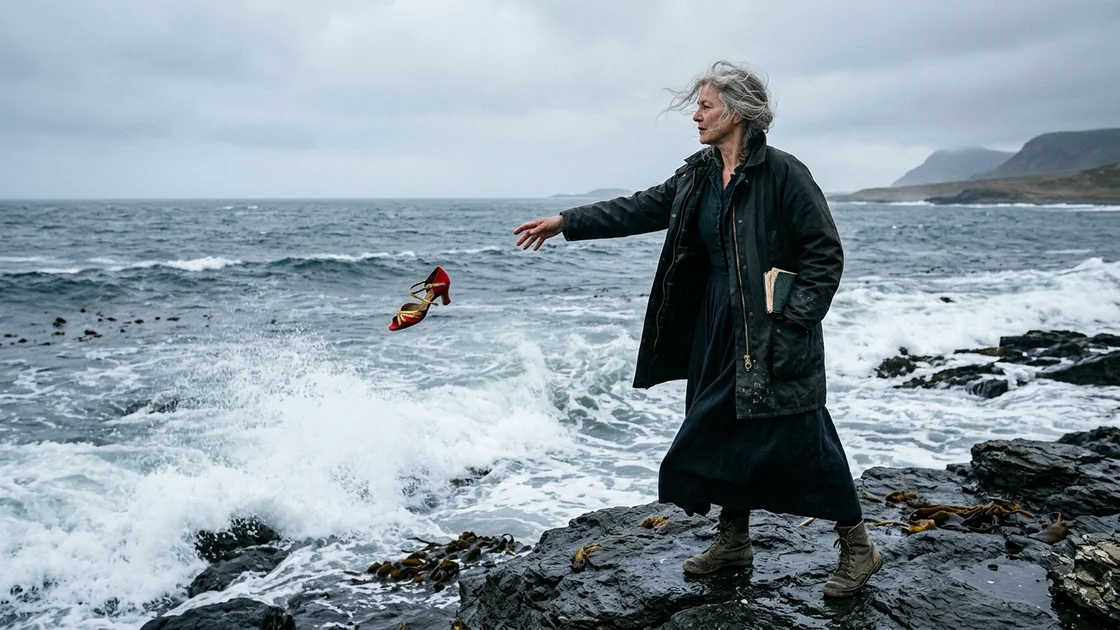
Eleanor sat on a flat, black rock at the end of the world: Cabo San Diego, the easternmost tip of Tierra del Fuego.
Behind her lay five thousand miles of continent—the salt of Jujuy, the dust of Salta, the red clay of the Pampas, the asphalt of the Pan-American Highway, and the midnight floorboards of San Telmo.
In front of her lay the Le Maire Strait, a roaring, vicious stretch of ocean where the Atlantic and the Pacific met in a froth of gray foam, forty-foot rollers, and icy spray that tasted of the Antarctic ice shelf.
She had arrived two days earlier on an old supply ketch that serviced the light station at the end of the peninsula. Her canvas boots were ruined, their rubber soles peeling away from the cloth. Her black coat was stiff with dried salt spray. Her fingernails were broken, and the skin of her face was burned by wind and frost into a tough, ruddy bronze that would never again look like porcelain.
She pulled Beatrice’s sketchbook from inside her oilskin coat.
The book was battered. The corners were rounded, the cloth cover was stained with grease from the empanadas in Salta and red dust from Purmamarca.
Eleanor opened it to the final page.
6. Arrive at the edge of the world with clean hands and a dirty dress, and forgive yourself for surviving.
Beside her on the rock sat the scarlet shoes.
They were hopelessly out of place here, perched on the black shale among the kelp and the sea-lion bones. The suede was water-spotted, the gold straps were tarnished, and the seven-centimeter heels were scarred from the cobblestones of Buenos Aires.
Eleanor reached down and picked up the left shoe.
She remembered the night at the Salón Canning: the man with the iron-gray hair, the smell of tobacco and almond soap, the absolute stillness of the embrace, and the discovery that her body was not an ornament to be preserved, but an instrument to be played until the strings snapped.
She thought of David.
For the first time in four years, the thought of him did not come with that sharp, hollow pang of guilt. She remembered his hands—his clean, white, surgeon-like hands—and the way he used to line up his fountain pens on his blotter every night before going to bed.
"You would have hated this place, David," she said softly to the roaring sea. "You would have told me the salt air was bad for my joints. You would have insisted on booking a cabin with central heating."
She smiled. It was a gentle, affectionate smile, completely stripped of bitterness.
"I loved you," she told the gray waves. "I loved you very much. But I am not going to sit on the shelf anymore."
She looked at the scarlet shoes.
Part of her wanted to keep them—to put them in a glass case in the living room in Connecticut, an eccentric souvenir of the six months when Eleanor Finch went mad.
Don't you dare, Beatrice’s voice said. Relics are for churches, Nora. You aren't a church.
Eleanor stood up.
Her joints ached, but her spine was straight. Her axis was true.
She took the left shoe, drew her arm back, and hurled it with all the strength left in her sixty-year-old shoulders out into the Le Maire Strait.
The crimson suede turned over and over in the gray air, a bright, shocking flash of blood against the storm clouds, before it hit the foam and was sucked under by a black swell.
She picked up the right shoe.
"To Beatrice," she shouted into the wind. "May your spice rack always be disorganized, you miserable, wonderful old witch."
She threw the second shoe. It flew higher than the first, catching the gale for half a second like a tiny, crimson bird, then vanished into the surf.
Eleanor stood on the rock, her hands empty, her dirty dress whipping around her ankles in the sub-polar wind.
She was sixty years old today.
She had no husband. She had no best friend. Her house in Connecticut was six thousand miles away, full of dead paper and furniture that didn't matter. She had an extra suitcase full of beige linen trousers that she was going to burn in the yard of the lighthouse as soon as the tide went down.
She took out her pen.
On the final page of the sketchbook, beneath the six tasks, Eleanor Finch did not draw a line.
Instead, she turned the page to the first blank sheet of cream paper.
The wind tried to rip the book from her hands, but she held it firm against her hip. She pressed the point of the pen into the paper and wrote:
1. Tomorrow morning, take the boat back to Ushuaia. Buy a
motorcycle.
2. Learn how to ride it.
3. Go north until the road runs out.
She closed the book, slipped it into her pocket, and turned her back on the sea.
Her feet were cold, her boots were wet, and she had an enormous, terrifying amount of living to do before dinner.