The Geometry of Departure
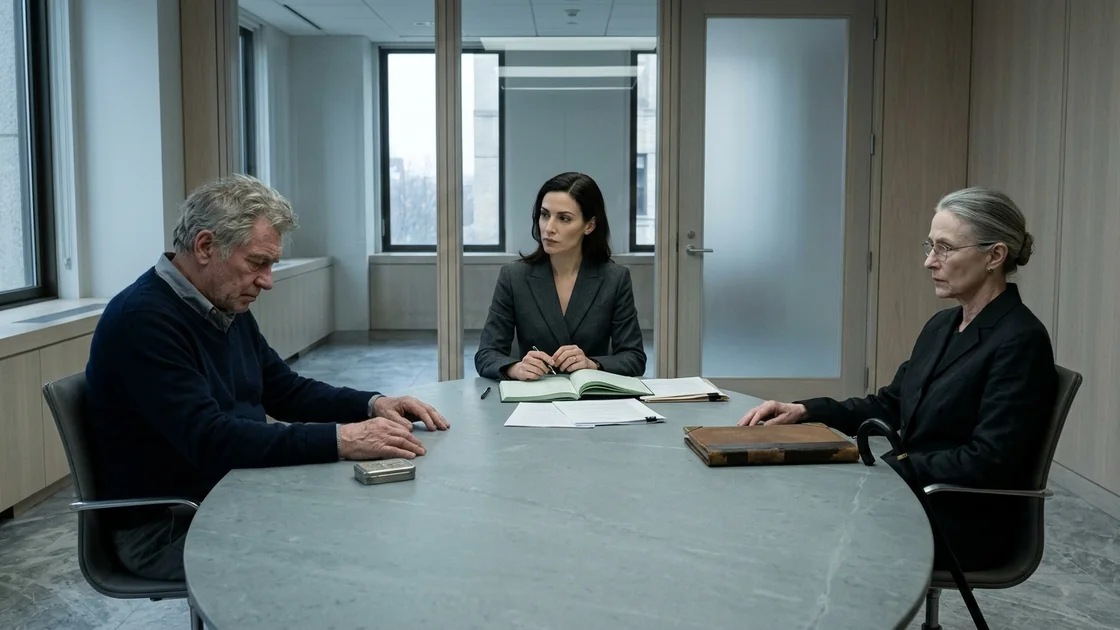
This is the story of Clara Mercer, an elite divorce mediator whose career was built upon an unyielding commitment to emotional detachment, and what happened when Arthur and Eleanor Vance entered her conference room to dissolve their forty-two-year marriage. Clara had spent her adult life studying the architecture of human estrangement, believing herself completely immune to the grief of strangers because she had long ago processed her own origins through clinical documentation. But Arthur and Eleanor were not ordinary clients; they were the biological parents who had surrendered her in a closed adoption during the winter of 1984 before marrying four years later and building an enviable life together. Over the course of five intense mediation sessions concerning the division of four decades of shared land, art, and silence, Clara is forced to balance her strict professional ethics against the overwhelming temptation to understand why she was cast aside, discovering in the process that the clean fractures she sought in legal contracts do not exist in the human heart.
I. The Science of the Table
The seventh floor of the Mercer Resolution Center smelled of freshly unrolled vellum, distilled water from the humidifiers, and cold marble. Clara Mercer had designed the space herself, working alongside an acoustic engineer who specialized in sound dampening for embassies. The walls were paneled in bleached white oak, backed by four inches of mineral wool that rendered the sirens of downtown Boston as distant as the hum of insects outside a screened porch.
There were no sharp corners in Room 7A. The table was an ellipse cut from a single slab of honed Pietra di Cardoso stone, pale slate-gray and matte beneath the diffuse LED fixtures. An ellipse possessed two focal points; mathematically, any sound originating from one focus was reflected directly to the other, but Clara sat deliberately along the minor axis, equidistant from both, existing in the acoustic dead zone she had measured with an electronic decibel meter on the day the office opened.
"Our objective today is not reconciliation," Clara said. Her voice was pitched at fifty-four decibels—a measured, maternal alto that lacked both judgment and warmth. "Reconciliation is the work of priests and psychiatrists, and I am neither. Our objective is an equitable inventory. We are here to catalog what was built, determine what can be divided, and establish a framework for what must be liquidated."
Across from her, sitting precisely six feet apart as the chairs had been positioned before their arrival, sat Arthur Vance and Eleanor Callow Vance.
Clara did not look at Arthur’s hands, though she had noted them ten minutes earlier when he took off his coat: long, spade-tipped fingers with prominent knuckles, the right index finger stained at the lateral edge with dried sepia ink from the vintage fountain pens he still used to draft architectural elevations. She did not look at Eleanor’s earlobes, which lacked piercings and curled upward in a distinctive, cartilaginous notch that Clara had seen in her own bathroom mirror every morning of her adult life.
She looked, instead, at the intake docket resting squarely between her palms.
Case No. 24-0988-DM. Vance, Arthur M. v. Vance, Eleanor C. Subject: Dissolution of Marriage; Asset Allocation; Disputed Real Property.
"Mr. Vance," Clara continued, turning her eyes to the white sheet. "You have indicated through your filing attorney that you wish to retain the house in Blue Hill, Maine. Mrs. Vance, your preliminary statement requests an immediate sale on the open market, with proceeds placed in escrow pending the valuation of the studio archives. Is that an accurate summary of your opening postures?"
"It is," Eleanor said.
The voice was like an instrument Clara had heard through a closed door for forty years. It was dry, slightly clipped at the sibilants, cultured in the particular cadence of northern New England academia—the vowels rounded but unhurried. It was a voice that belonged to a woman who had spent four decades lecturing on the morphology of lichen and alpine flora at Colby College.
"He cannot keep Blue Hill," Eleanor added, without looking at her husband. Her gaze was fixed on the frosted glass pane behind Clara’s shoulder. "He doesn't keep things, Clara. He occupies them until they require structural maintenance, and then he looks for someone to blame for the rot."
"Eleanor," Arthur said. His tone was not angry; it was merely worn down, like a piece of drift chalk rolled in the surf. "Let’s not perform for the mediator. Miss Mercer has four other couples waiting to hate each other in comfort today."
"It is Dr. Mercer," Clara corrected gently, without an edge. "And my afternoon is entirely reserved for the two of you. We have four hours. We will use all of them, or we will use forty minutes, depending entirely on your willingness to treat this balance sheet as an arithmetic problem rather than a moral trial."
She opened the green ledger on her desk.
Clara had known who they were for eleven days.
The initial conflict check had arrived on her desk on a Tuesday morning, forwarded by her paralegal, David. In a typical month, Clara rejected twenty percent of the referrals sent to her by the family court judges of Suffolk and Middlesex counties. She rejected cases involving physical abuse; she rejected cases where one party was demonstrably sociopathic; she rejected cases where the emotional temperature was so volatile that the participants required bailiffs rather than a mediator.
When the names Arthur Michael Vance and Eleanor Mary Callow had appeared on the digital intake screen, the internal software had flagged no conflict. She had never represented either of them; she had never served on a board with Arthur, who was an emeritus professor of urban design at Harvard, nor had she crossed paths with Eleanor at the Arnold Arboretum, where Clara occasionally spent her Sunday mornings walking among the lilacs.
The system had seen no conflict because the system had no access to the thin, cream-colored envelope kept in the safety deposit box at the Provident Bank on Boylston Street.
That envelope, unsealed by Clara when she turned thirty under the provisions of the Maine Vital Records Access Act of 2014, contained three documents: an amended birth certificate issued in Bangor; an original certificate of live birth naming the child Baby Girl Callow; and an unsigned four-paragraph social history typed on an IBM Selectric by a casework supervisor named Mrs. H. Arbuthnot.
The casework supervisor had written:
The biological mother, age 21, is currently completing her junior year of undergraduate study in the biological sciences. The biological father, age 22, is an apprentice draftsman at an architectural firm in Portland. The parties are unmarried. Both families have expressed an absolute unwillingness to countenance a domestic union under current economic circumstances, and the mother’s father, a clergyman of the Congregational faith, has made it a condition of her continued tuition that the confinement remain private. The mother is of sound constitution, dark hair, grey eyes, showing high intellectual aptitude. The father is tall, fair-skinned, prone to periods of introspection, with no family history of hereditary disease. The parties surrendered the child directly from the nursery at Eastern Maine General Hospital at forty-eight hours post-partum. They did not request to hold the infant.
Four years after that document was filed in the archives of Penobscot County, Arthur Vance and Eleanor Callow had married in a garden ceremony in Castine, Maine. There had been an announcement in the Bangor Daily News. Clara knew this because, eight years ago, on an evening she had never repeated, she had sat with a glass of club soda in the microform room of the Boston Public Library and scrolled through the spring of 1988 until she found them standing on a lawn of salt hay, both of them laughing, their arms linked around the trunk of a mountain ash.
They had gone on to have no other children.
Clara had verified this through the standard public records searches she conducted on every client. There were no heirs. There were no secondary trusts established for minors. There were only forty-two years of joint tax filings, seven published books between them, a home in Cambridge, a seasonal compound on the coast of Maine, a significant collection of post-war American prints, and three rescue terriers, all of whom had died in the previous decade.
She could have recused herself. It would have taken thirty seconds. A single click in the practice management software: Conflict identified; non-waivable. The file would have defaulted to Marcus Levin down the hall, who would have split their assets with the blundering, hearty bonhomie of a retired hockey coach, charging them seven hundred dollars an hour for the privilege.
Instead, Clara had confirmed the appointment.
She had told herself that she was the best mediator in the commonwealth, which was true. She had told herself that Arthur and Eleanor deserved someone who would not be swayed by their prestige, their academic laurels, or the subtle, patrician cruelty with which they dismantled each other's dignity, which was also true.
She had not told herself that she wanted to see the two people who had declined to hold her in December of 1984, sitting five feet from her, begging for her permission to leave each other.
II. The Inventory of Blue Hill
"The house cannot be sold," Arthur said, leaning his elbows on the Pietra di Cardoso. He wore a navy wool sweater over an unironed Oxford shirt; he had the careless, rumpled elegance of men who had achieved tenure before the age of thirty-five and had not been required to consider their appearance since. "It isn't an asset in the liquidity sense, Clara. The framing is hand-hewn tamarack. I built the library wing myself in nineteen-ninety-one. If we list it with an agent in Ellsworth, some private equity partner from New York will gut the interior and paint the exterior spruce charcoal gray."
"It has four bedrooms," Eleanor said coldly. "And a leaky foundation that you haven't inspected since the Obama administration. What are you going to do with four bedrooms, Arthur? Are you going to walk through them with a kerosene lantern looking for your youth?"
"I work there."
"You sleep there. You sleep in the afternoon with an open book on your stomach, and then you wake up at seven and complain that the tide made too much noise." She turned her face toward Clara, and for the first time, Clara met her eyes directly.
Eleanor’s irises were not purely gray; they were the color of wet river slate, with tiny flecks of pale amber near the pupil—the exact pigmentation Clara saw when she leaned within three inches of the magnifying mirror to apply her eyeliner. Clara did not blink. She had trained herself through twelve hundred hours of contested custody hearings to maintain a dead, polite focus that gave nothing back.
"Let us look at the appraisal," Clara said, her fingers skimming the tabs of the Vance file. "The Blue Hill property was assessed in October at one point four million dollars. There is no mortgage. It is held jointly with rights of survivorship. Mrs. Vance, if Mr. Vance were to buy out your interest in that parcel, the cash requirement would be approximately seven hundred thousand dollars, less the standard adjustments for deferred maintenance and transfer taxes."
"He doesn't have seven hundred thousand dollars," Eleanor said.
"I have my retirement account from Harvard," Arthur countered.
"Which is already pledged to offset the equity in the Cambridge townhouse," Eleanor snapped. "You cannot spend the same dollar twice, Arthur. You taught that to graduate students for thirty years; you might try applying it to your own insolvency."
Arthur let out a low, breathy sound that was halfway between a laugh and a groan. He pulled a silver cigarette tin from his pocket, realized where he was, and laid it on the stone table with a quiet click.
"She has an answer for everything," he said, speaking directly to Clara as if his wife had vanished from the room. "She has kept a ledger of my deficits since the year we were in graduate school. Did you know that, Dr. Mercer? Some women keep wedding albums. Eleanor keeps an indexed catalog of every promise that failed to materialize within ninety days of its utterance."
"Mr. Vance," Clara said, her voice dropping two semitones into that smooth, immovable register that judges across Boston envied. "The ledger that matters today is the one on this desk. If we cannot reach an agreement on the valuation of the Blue Hill house, the court will appoint a special master to sell it at public auction. A special master does not care about tamarack framing. A special master cares about the clearance of title and the swift distribution of funds to the county registry. Is that the outcome you prefer?"
Arthur sank back into his chair. He looked suddenly older than his sixty-six years; the skin beneath his cheekbones was thin, webbed with the fine, broken capillaries of a man who spent his winters in the wind off Blue Hill Bay.
"No," he muttered. "That is not what I prefer."
"Then we will shelve the disposition of the real property until Session Three," Clara said, making a clean, black pencil mark on the docket. "We will turn now to the personal property. Specifically, the contents of the studio at Brimmer Street."
Eleanor moved her shoulder slightly, a sharp, defensive tuck of the linen jacket she wore. "The studio contains my research specimens. Four thousand sheets of pressed herbarium specimens from the coastal islands between Mount Desert and Machias. They are non-negotiable. They belong to the state herbarium upon my death, under a deed of gift I executed in twenty-eighteen."
"The deed of gift was executed without my signature," Arthur said, his voice rising slightly.
"You were in Berlin, Arthur. As you usually were when something required an adult decision."
"I was delivering the Gropius Lecture!"
"You were having dinner at the Borchardt with an assistant curator who was twenty-six years old, and you forgot to return the notary forms I sent via international courier."
Clara did not look up from her notes. Her pencil moved across the paper with a steady, rhythmic scritch.
Item: Herbarium Collection (approx. 4,000 sheets). Contested: Yes. Basis of claim: Sole intellectual property (Wife); Marital asset under Mass. Gen. Laws ch. 208, § 34 (Husband).
"The Gropius Lecture was twenty-two years ago," Clara observed, her tone devoid of irony. "Mrs. Vance, does the herbarium collection carry a monetary valuation independent of its academic utility?"
"The New York Botanical Garden offered eighty thousand dollars for the coastal lichens in nineteen-ninety-nine," Eleanor said. "We declined."
"We declined," Arthur repeated with quiet bitterness. "Notice the pronoun, Dr. Mercer. When there was an honor involved, or an offer of preservation, it was we. When the tax bill for the climate-controlled storage arrived every June, it was you."
He turned his head toward Eleanor. There was no theatrical rage in him; it was something far worse—the deep, calcified exhaustion of two people who had spent forty years constructing an elaborate maze only to find that both of them were trapped in the dead center of it.
"Why are we doing this?" Arthur whispered. "Eleanor. Why are we sitting in this gray room with this young woman, talking about dried moss?"
"Because you wanted a divorce," Eleanor said. She did not raise her voice. She did not turn to face him. "You told me in July, on the terrace, that you could no longer bear the sound of my breathing while you were trying to read. Those were your exact words. 'The sound of your breathing, Eleanor, is like sandpaper on soft pine.' Do you deny you said that?"
Arthur looked down at his ink-stained fingers.
"The air was very dry that day," he said.
Clara felt a strange, cold flutter in the hollow of her diaphragm. It was not pity. She had mediated divorces where husbands had burned down horse barns to spite their wives; she had mediated divorces where wives had systematically poisoned forty-year-old bonsai trees with bleach before handing over the keys.
This was different. This was the steady, microscopic attrition of two lives that had been glued together with an adhesive that was never meant to hold the weight of four decades.
They had stayed together. That was the fact that sat in Clara’s throat like an unswallowed stone.
They had given her away—a four-pound, eight-ounce scrap of red-faced inconsequence in a bassinet in Bangor—because they were young, because they were unready, because their parents were clergymen and respectable citizens who could not endure the scandal of an early winter baby. And then, having cleared the deck of her, having scrubbed the record clean and consigned her to a couple from Orono who ran an auto-parts warehouse and smelled of kerosene and church suppers, Arthur and Eleanor had turned around and married each other anyway.
They had lived the life they had purchased with her absence.
They had gone to Berlin; they had bought the tamarack house; they had built the library; they had preserved the moss.
And now, at the end of it, they were bickering over eighty thousand dollars of dried weeds and the sound of each other's lungs in a quiet room.
"We will take a ten-minute recess," Clara said.
She did not wait for their assent. She rose from the table, her dark gray skirt falling into perfect, unwrinkled lines, and walked out of Room 7A into the corridor, her low heels clicking against the marble with the precision of a metronome.
III. The Architecture of Separation
In her private office, three doors down from the conference rooms, Clara kept a single photograph on her credenza.
It was not a picture of Helen and David Mercer, the two good, simple people who had raised her in a clapboard house near the Penobscot riverbank, who had bought her the upright piano she never learned to play and paid for her tuition at Tufts by mortgaging their inventory three separate times. David had died of an aortic aneurysm during Clara’s second year of law school; Helen had lingered in a nursing home in Brewer, her mind gradually dissolving until she believed Clara was her own younger sister, dead since the Korean War. Clara had loved them with a conscientious, dutiful love that had left no scars. When Helen died, Clara had handled the probate herself, filing every document within sixty days, selling the small house to a young mechanic and his pregnant wife, and transferring the modest balance into an index fund without a single tear.
The photograph on the credenza was an aerial view of the Quabbin Reservoir, taken in 1938 just after the Swift River Valley was cleared of its four towns.
It showed the raw, graded earth where Dana and Enfield had once stood: the cellar holes filled with clean gravel, the roads terminating abruptly at the new waterline, the cemeteries dug up and moved to higher ground. It was an image of absolute, bureaucratic obliteration conducted in the name of public utility. Clara looked at it whenever she felt the dangerous prickle of empathy behind her eyelids.
The Quabbin had drowned four towns so that Boston might drink clean water. It was a fair trade, historically speaking. Most human arrangements were simply a matter of deciding which valley to flood.
There was a tap at her door. David, her twenty-four-year-old paralegal, leaned in with a cardboard tray holding two tall paper cups from the coffee shop across the square.
"Eleanor Vance asked for hot water with lemon," David said. "Not tea. Just water and a single slice of lemon, which she specified should not be more than a quarter-inch thick. The man—Arthur—said he didn't want anything, then asked if we had ginger ale in cans. I gave him a seltzer."
"Thank you, David."
"How are they?"
"Standard," Clara said, her voice smooth and level. "Two academics who have run out of things to teach each other. The husband is sentimental and passive-aggressive; the wife is punitive and meticulous. We will finish the personalty today and move to the Maine property next week."
David lingered by the doorframe, his thumb worrying the edge of his clipboard. "Judge Callahan’s clerk called while you were in there. He wanted to know if you had capacity for the Henderson matter. The high-asset one with the vineyard in Dartmouth."
"Tell him yes," Clara said. "I’ll take it starting the second week of next month."
"You already have twelve active files, Clara."
"Work expands to fill the hours allotted to it, David. Confirm with Callahan."
When the door clicked shut, Clara turned back to the Quabbin photograph. Her hands were cold. She held them over the steam rising from her own black coffee, watching the skin tighten across her knuckles.
She had Arthur’s hands.
She had discovered this three years ago, during the COVID lockdown, when she had spent an absurd, humiliating weekend studying photographs of him on the Harvard Graduate School of Design website. He had been photographed receiving an honorary medallion from the French government in 2016. In the high-resolution image, his right hand was resting on the lapel of his dinner jacket. The lunula—the pale half-moon at the base of the thumbnail—was unusually wide, almost triangular, with a slight ridge that ran down the center of the nail bed toward the cuticle.
Clara looked down at her own right thumb. The same pale triangle. The same slight ridge, like the seam left in a plastic toy by a split mold.
She had spent forty years believing she was a self-generated object. The Mercers had been short, heavy-set people with broad, peasant faces from Swedish lumber stock; Clara was five feet ten, thin-boned, with a sharp, aquiline nose and a high forehead that seemed built for cold weather. As a child, she had imagined that she was the daughter of an itinerant Danish sailor, or perhaps an Italian diplomat who had visited Bar Harbor on a yacht. She had constructed a dozen ridiculous, romantic genealogies to explain why she felt so little when her mother wept over television commercials, why she could not bear to be hugged for longer than five seconds, why she had organized her school notebooks with color-coded index cards before she was ten.
Then she had read the social history from the Penobscot County archives.
The biological mother... high intellectual aptitude. The biological father... prone to periods of introspection.
No sailors. No diplomats. Just two college students who had panicked, handed their mistake through an open window to the state of Maine, and then walked down the street together to have a sandwich.
She took a sip of the coffee. It was too hot; it scalded the tip of her tongue, a sharp, clean pain that restored her balance.
She smoothed the front of her skirt, picked up her Montblanc pen, and walked back into Room 7A.
IV. The Second Session: The Margin of Error
By the second week of November, the trees along the Commonwealth Avenue mall had dropped their leaves, leaving the black branches stark against the pale, salt-bleached sky.
Arthur Vance arrived twenty minutes early for the second session. Clara found him standing in the reception area, his hands clasped behind his back, examining the framed architectural drawings she had hung along the hallway—elevations of nineteenth-century textile mills in Lowell.
"Good morning, Mr. Vance," she said.
He turned, startled. He wore a heavy tweed jacket with suede patches at the elbows—patches that were genuinely worn through, not decorative additions from an upscale haberdasher.
"These drawings," he said, pointing with his chin toward a cross-section of the Boott Cotton Mill. "The draftsmanship is magnificent. Look at the shading on the turbine pit. That was done with a crow-quill pen and dilute India ink. If you made a mistake on the wash, you had to scrape the paper with a razor blade until the fiber lifted, then burnish it with an agate stone before you could lay down another line."
"A high cost for an error," Clara said.
"Everything had a cost then," Arthur said. He turned his gray eyes on her. Up close, in the bright morning light from the clerestory windows, he looked fragile. His hair, which had been dark in the newspaper clipping from 1988, was now the color of salted lard, combed back from his forehead with water that had already dried, leaving it flyaway and wild. "Now you simply hit Control-Z. You undo the stroke. You can undo twenty strokes in three seconds. My students don't understand that a line on paper is a permanent commitment. Once you cut the fiber, the paper remembers."
"Please come in," Clara said, stepping aside.
He walked into Room 7A, but he did not sit down. He walked around the slate table, trailing his fingers along the edge of the stone as if testing its bevel.
"Eleanor is coming from the herbarium," he said. "She will be six minutes late. She has an assistant named Timothy who drives her when she has an attack of sciatica, but Timothy drives like an undertaker. I told her thirty years ago that she should have had the hip replaced, but she thinks surgery is a personal failure. She believes that if you endure pain with sufficient intellectual rigor, it ceases to exist as physical reality."
"Pain is often difficult to quantify on a balance sheet," Clara said, sitting in her neutral chair along the minor axis.
Arthur stopped opposite her. He looked at her with a curious, tilted intensity, his head cocked like an old retriever listening for a whistle two fields away.
"You have a very strange name, Dr. Mercer," he said.
Clara’s heart gave a single, hard thump against her ribs, but her pen did not waver. "It was my grandmother’s name."
"Clara," he repeated, rolling the vowels around his tongue. "It’s late-Victorian. Very clean. But your eyes... are you from Maine?"
"I grew up in Penobscot County," she said, keeping her tone light, flat, and professional. "A small town near Bangor."
Arthur nodded slowly. "We lived in Orono for a year. In eighty-three. Eighty-four. A terrible winter. That was the year the Penobscot froze clear to the docks in Searsport. Ice three feet thick. You could hear it groaning in the night like iron plates buckling on a freighter."
"I was an infant then," Clara said. "I don't recall the ice."
"No," he said, his voice dropping into a register that was almost private. "Of course you wouldn't. Why would you?"
The heavy oak door swung open, and Eleanor Vance entered.
She was leaning heavily on a blackthorn cane, her face pale and drawn around the mouth, but her back was rigid. She carried a leather portfolio under her arm—a battered, pigskin case with brass corners that looked as though it had survived three expeditions to the Arctic.
"Arthur," she said, nodding once to her husband. "Dr. Mercer."
"Mrs. Vance," Clara said. "We were just discussing the schedule for today. We have the appraisal for the print collection from Skinner’s, and the preliminary report on the intellectual property rights for your three volumes on alpine flora."
Eleanor sat down, placing the blackthorn cane across her knees like a barrier. "The prints are simple. He may have the Marin etchings. I will keep the Baskin woodcuts."
Arthur sat down heavily. "I bought the Baskins, Eleanor. I bought the Dead Crow in Northampton when we were still living on cabbage and day-old bread from the bakery in Florence."
"You bought it with the check my mother sent for my twenty-fifth birthday," she said, her voice dry as dead straw. "The check was made out to me, Arthur. You intercepted the mail, took it to the Northampton National Bank, and signed my name on the back. You didn't even attempt to forge my hand; you simply wrote 'Eleanor Callow' in that ridiculous, looping architectural lettering you picked up at the Rhode Island School of Design."
Arthur stared at her. "That was forty-one years ago."
"It was forty-one years ago in May," she said. "The ink was blue. You used a Parker ballpoint."
Clara leaned forward slightly. The room was cold; the air handling system was cycling on, its low 60-hertz hum filling the silence between them.
"The Baskin woodcut," Clara said, her voice slicing cleanly through the rising tension, "is currently valued at four thousand two hundred dollars. Mrs. Vance, if you retain it, Mr. Vance will receive a credit of two thousand one hundred dollars against the miscellaneous household furnishings. Do you agree to that allocation?"
Eleanor didn't look at Arthur. "Yes."
"Mr. Vance?"
Arthur waved a hand dismissively. "Let her have the bird. She’s lived with dead things for forty years; it would be cruel to separate them now."
"Arthur," Eleanor said, and for the first time, Clara heard something other than irritation in her voice—a faint, ancient tremor of grief that had nowhere to go. "Don't say that."
"Why not?" he said, turning to her. "You have spent the last decade treating this marriage like a botanical specimen. You have dried it, pressed it between sheets of blotting paper, labeled it with its Latin binomial, and filed it in an oak drawer where it cannot cause you any inconvenience. The only difference between me and your coastal lichens is that the lichens have the decency not to ask for a cup of coffee in the morning."
Eleanor set her jaw. Her knuckles, whitened where she gripped the blackthorn cane, showed the same prominent, spade-like joints as Arthur’s, the same dry, papery skin that time visited upon people who spent their lives indoors with books and specimens.
"I kept the house running," she whispered. "I kept the accounts. I answered the letters from your publishers while you were having your nervous collapses in the barn. When you couldn't get out of bed in the winter of ninety-six, who took the ferry to Rockland to get your lithium? Was it your assistant from the department? Was it the women who wrote you letters about your essays on urban space?"
She leaned forward, her face inches from the stone table.
"It was me, Arthur. I stood on the slip in the sleet with the salt water freezing on my coat, waiting for the mail boat to bring the parcel from the pharmacy. And when I brought it home, you threw the bottle against the chimney because the pills were the wrong shape."
Arthur looked away, toward the frosted glass pane. His chin trembled—just once, a tiny, involuntary spasm of the mentalis muscle that he immediately suppressed by pressing two fingers hard against his lips.
"We were never supposed to be this," he said to the wall. "We were supposed to be... something else."
"We were never supposed to be anything at all," Eleanor said. Her voice had gone completely flat again. "We were an accident that occurred in a dormitory in Orono during a snowstorm, and we spent forty years pretending we were an architectural monument."
Clara sat entirely motionless.
Her left hand was under the table, pressed flat against her thigh. Her fingernails were digging through the wool of her skirt into the meat of her leg, hard enough that she knew there would be four purple crescents there by evening.
An accident that occurred in a dormitory.
She was the accident. Not the marriage; the marriage had been the repair job, the desperate, mortified attempt to assemble an edifice over the hole where she had been. They had stayed together not in spite of surrendering her, but because of it. To separate in 1988, or 1995, or 2002, would have been to admit that the sacrifice had been for nothing. If they were not a great, enduring intellectual partnership—if they were not Arthur and Eleanor Vance, the brilliant urbanist and the distinguished botanist—then they were simply two frightened, selfish children who had left a baby in a county hospital and run away to Cambridge.
They had stayed together forty-two years to justify the erasure of Clara Mercer.
And now, having run out of justifications, having reached the age where the future was merely a short, downhill walk toward an open hole, they were breaking the contract anyway.
"We will turn," Clara said, her voice emerging from her throat with a terrifying, synthetic perfection, "to the Blue Hill house. Mr. Vance, you submitted an estimate from a contractor in Surry regarding the foundation work. Let us examine the figures."
V. The Caucus
In divorce mediation, the caucus is the weapon of last resort.
When the two parties have reached an impasse that threatens to dissolve into pure retaliation, the mediator separates them into different rooms, shuttling between them like a diplomat between warring border states. It is in the caucus that the truth usually surfaces—not because people are more honest in private, but because they are more frightened.
By the fourth session, in the first week of December, the Vance mediation had stalled completely on the library in Blue Hill.
The library was an octagonal addition, twenty-four feet across, lined with floor-to-ceiling shelves of white pine. Arthur had designed it; Eleanor had cataloged the four thousand volumes it contained. Neither of them would surrender it. Arthur claimed it was his primary architectural legacy; Eleanor claimed that three-quarters of the volumes had been purchased with funds from her maternal grandmother’s estate.
"We are going to caucus," Clara announced at two o'clock.
She moved Eleanor into Room 7B—a smaller space with an upholstered armchair and a view of the brick alleyway behind the building—and left Arthur at the great slate ellipse in Room 7A.
She began with Eleanor.
Clara entered 7B carrying only a yellow legal pad and her Montblanc pen. She sat not in the desk chair, but on the small, low stool typically used by attorneys reviewing documents. It was an old mediation tactic: place yourself lower than the client to reduce their sense of being cross-examined.
Eleanor had taken off her glasses. Without them, her face looked strangely bare, the skin around her orbits dark and hollowed out. She was rubbing the bridge of her nose with her thumb and forefinger.
"He will die in that house, you know," Eleanor said, before Clara could speak. "He has an irregular heartbeat. He doesn't take his digitalis because it makes his vision slightly yellow, and he says he cannot draft if the whites don't look clean. If he stays in Blue Hill alone, he will have an episode in January, fall down the cellar stairs, and Timothy will find him three days later when the oil delivery driver notices the tank hasn't clicked."
"Is that why you want the house sold?" Clara asked. "To protect him from the cellar stairs?"
Eleanor let out a sharp, ragged sound that might have been a snort of contempt.
"I don't want to protect him, Dr. Mercer. I have protected Arthur Vance for half a century, and it has left me with an empty house in Cambridge and an office full of dead plants. I want the house sold because I cannot bear the thought of him sitting in that library, looking out at the bay, believing that he was the one who suffered."
"What did he suffer, Mrs. Vance?"
Eleanor looked at her sharply. Her gray eyes, naked without the lenses, narrowed until the tiny amber flecks seemed to merge into a single, dull ring.
"Why do you ask that? That isn't an accounting question."
"Mediation is rarely about accounting," Clara said, holding her gaze with steady, professional neutrality. "Money is simply the language people use when they aren't allowed to throw plates. You have given up the prints, the retirement differential, the royalties from the MIT Press monograph. You are fighting over eight hundred square feet of pine flooring in Hancock County. You are fighting over something else."
Eleanor turned her face toward the window. Down in the alley, a delivery truck was backing up, its warning beeper a dull, rhythmic intrusion through the soundproof glass.
"We had a child," Eleanor said.
The sentence fell into the small room like a lead weight dropped into an engine block.
Clara did not move. Her fingers did not twitch on the yellow pad. She did not take a breath. She held herself so completely still that she could hear the tiny, mechanical click of her own wristwatch—the Omega Seamaster she had bought herself when she made partner, ticking away the half-seconds.
"I see," Clara said. Her voice was an empty room.
"You don't see," Eleanor said, her voice falling into a low, flat monotone that sounded as though it had been rehearsed ten thousand times in the dark. "Arthur doesn't like to remember it. He has rewritten the narrative, you see. In his version, we were two helpless victims of our parents’ puritanism. We were young; we had no money; we did what the social workers told us to do. But that isn't how it happened."
Clara waited. The yellow pad remained blank.
"I wanted to keep her," Eleanor said.
The words were not loud, but they had the density of spent uranium.
"I had her in December," Eleanor continued, still looking at the brick wall across the alley. "It was twenty-two below zero outside the hospital. I could hear the snowplows scraping the asphalt on State Street. My father had come down from Dover-Foxcroft; he sat in an armchair in the corner of the room with his Bible on his knees, not reading it, just holding it like an identification card. And Arthur... Arthur was in the corridor, sitting on a radiator, weeping. He couldn't come into the room because my father had forbidden him to see me until the papers were signed."
She paused. Her hand went to the notch in her left earlobe, touching it with an unconscious, repetitive gesture that Clara knew intimately.
"The social worker was a woman named Arbuthnot," Eleanor said. "She had three silver ballpoint pens in her purse, all tied together with an elastic band so they wouldn't rattle. She laid the surrender form on the tray table over my legs—one of those hospital tables with the fake wood-grain laminate that peels at the corners. She said, 'Eleanor, if you sign this now, you can register for the spring term at the university on Monday. The state will pay the lying-in charges, and your father will settle the physician’s account.' And Arthur... Arthur came to the door then. He didn't come in. He just stood in the doorway with his scarf trailing down his coat, and he looked at me."
"What did he say?" Clara asked. The words came out of her mouth before she could stop them—not the words of Dr. Clara Mercer, the premier mediator of the Suffolk County bar, but the words of an abandoned five-pound infant who had spent forty years wondering why the room was cold.
"He didn't say anything," Eleanor whispered. "He shook his head. Just once. Side to side. Like a child who has been offered a bitter medicine and is begging his mother not to make him take it. He didn't want the burden, you see. He wanted to be an architect. He wanted to go to Rome. He wanted to walk through the Piazza Navona with a sketchbook under his arm, and you cannot walk through the Piazza Navona with a sketchbook if you are buying infant formula in Bangor on seventy-five dollars a week."
She turned back from the window. Her eyes were dry, but they had a terrible, glassy sheen, like water standing on an oil slick.
"So I signed," she said. "I signed my name, and then Mrs. Arbuthnot used one of her three silver pens to blot the line, and then they took her away through the fire door at the end of the hall. We never saw her. We never held her. They told us it was better that way—that the maternal instinct was a chemical reaction that would subside within seventy-two hours if there was no physical contact."
She let out another of those short, dry, bark-like laughs.
"Seventy-two hours," she said. "It has been fifteen thousand days, Dr. Mercer. Does that seem like seventy-two hours to you?"
Clara sat with her hands clasped in her lap.
She thought of the casework supervisor’s note: The mother... showing high intellectual aptitude. The father... prone to periods of introspection.
She thought of her adoptive mother, Helen Mercer, standing at the kitchen stove in Orono, stirring a pot of cream of mushroom soup with a wooden spoon that had been worn flat on one side from thirty years of scraping the bottom of aluminum pans. Helen had not possessed high intellectual aptitude. Helen had left high school at sixteen to work in a dry-cleaning plant; she had misspelled Clara’s middle name on the insurance forms; she had never read a book thicker than a Reader’s Digest condensed novel.
But Helen had held her. Helen had held her every night when Clara had the whooping cough at age four, sitting in a rocking chair in the steam-filled bathroom with the hot shower running until the wallpaper peeled off the plasterboard in long, curling ribbons.
"Why did you marry him?" Clara asked.
The question was a massive ethical violation. It had no place in a mediation caucus. It had no bearing on the disposition of the library in Blue Hill, or the allocation of the Maine debt, or the division of the retirement assets. It was an intrusion so gross that had Marcus Levin or Judge Callahan been in the room, they would have been within their rights to report her to the Board of Bar Overseers for gross professional misconduct.
Eleanor didn't seem to notice. She looked at Clara with a strange, weary curiosity, as if Clara were simply another woman in a waiting room who had asked about an obvious scar.
"Because he was the only other person who knew the room was cold," Eleanor said simply. "Who else could I have married? A man who thought I was whole? A man who didn't know that every December twenty-first, at three in the morning, I would wake up with my breasts leaking milk for a child who didn't have a name? Arthur knew. Arthur would get out of bed, go down to the kitchen, and bring me a warm cloth without saying a word. We stayed together because we were the two people who had killed the same thing. You don't leave your accomplice, Dr. Mercer. It isn't safe."
She picked up her glasses from the table and slipped the wire frames back over her ears.
"Tell Arthur he may have the house," Eleanor said, her voice regaining its crisp, collegiate authority like a coat being buttoned to the chin. "He may have the tamarack beams. He may have the library. I will take the apartment in Cambridge, the Skinner valuation for the prints, and three hundred thousand dollars from his Harvard annuity. If he agrees to that today, I will sign the decree before five o'clock."
VI. The Counter-Weight
Clara did not go directly to Room 7A.
She went to the private washroom adjoining her office, locked the door, and leaned over the porcelain sink. She turned the cold water tap until it shrieked in the pipes, splashing the freezing municipal water against her cheeks, her temples, and the hollow at the base of her throat.
She looked up into the mirror.
There it was. The notch in the left earlobe. The high, thin nose with the slight deviation to the left near the bridge. The amber flecks in the gray irises—flecks that Arthur Vance did not possess, because Arthur’s eyes were the pale, washed-out blue of a winter pond.
I wanted to keep her.
Forty years of clinical distance, of balance sheets, of sound-dampened rooms and bleached oak paneling, had been built on a single, load-bearing assumption: that she was the unremembered residue of two people who had forgotten her before they reached the highway. She had told herself that story in law school; she had told it to herself when she spent Thanksgiving alone in her flat on Beacon Hill, eating roasted chicken from a plastic tray while reading treatises on equitable distribution. She was the one who walked away clean because no one had ever held her tightly enough to leave a mark.
It was a lie.
She was not the unremembered residue. She was the ghost that had sat between Arthur Vance and Eleanor Callow at every breakfast table they had ever shared. She was the reason Eleanor had spent forty years cataloging dead moss on the cold rocks of Maine, and the reason Arthur had had his nervous collapses in the barn, weeping into the tamarack shavings because he couldn't undo a line he had drawn in 1984.
She turned off the tap. She dried her face with a lint-free linen towel from the wicker basket by the wall.
She picked up her yellow pad, crossed the corridor, and opened the door to Room 7A.
Arthur was sitting where she had left him, but he had opened the silver cigarette tin. He had not lit one—the smoke detectors in the building were sensitive enough to detect a strike-anywhere match—but he was holding an unlit Camel between his thumb and middle finger, rolling it back and forth until the dry tobacco shed tiny brown flakes onto the slate table.
"She’s going to take the house, isn't she?" he said, without looking up. "She’s going to make me sell it to some hedge fund partner who will turn the studio into a sauna."
"No," Clara said.
She sat down along the minor axis. She did not place herself on a low stool this time; she sat straight, her spine pressed against the ergonomic mesh of her five-thousand-dollar chair, her hands folded over her docket like a judge at an arraignment.
"Mrs. Vance has conceded the real property," Clara said. "She will execute a quitclaim deed transferring her entire interest in the Blue Hill parcel to you, subject to an equity equalization payment of three hundred thousand dollars, payable over six years from your university retirement distributions."
Arthur stopped rolling the cigarette. He looked up, his jaw slack, his watery blue eyes blinking against the LED light.
"She... what?"
"She has surrendered her claim to the house," Clara repeated.
"Why?"
"She did not provide an architectural rationale, Mr. Vance. She simply stated that she was prepared to conclude the matter today."
Arthur let out a long, ragged exhale that smelled faintly of stale peppermint and cold stone. He dropped the unlit cigarette back into the tin and snapped the lid shut.
"She’s giving it up," he murmured. "Just like that."
"It is not 'just like that,'" Clara said, her voice dropping into a register so cold, so sharp, that Arthur flinched as if he had been struck with a ruler. "It is three hundred thousand dollars, which represents forty-two percent of your liquid net worth. You will be living on a reduced pension in a house with forty-two hundred square feet of uninsulated space, twenty-two miles from the nearest emergency room, with an oil burner that was manufactured during the Carter administration."
Arthur stared at her, his mouth slightly open. "You sound like her."
"I sound like an attorney who is trying to ensure that her client does not enter into an unconscionable agreement that will result in his bankruptcy before he is seventy," Clara said, though her heart was hammering against her ribs like a bird caught in a chimney.
"She always did that," Arthur said, his voice trailing off into that distant, self-pitying cadence that Eleanor had described with such murderous accuracy. "She makes the grand gesture. She gives up the prize, and then she spends the next twenty years making you feel like a thief for accepting it."
He leaned his face into his hands, his long, ink-stained fingers spreading across his forehead.
"I didn't want to leave that child," he said to the stone.
Clara stopped. The world seemed to contract until there was nothing in the universe except the grain of the slate beneath her palms and the sound of this old man’s breath.
"Mr. Vance," she said, her voice trembling by a fraction of a percent—an error so small only a digital meter could have caught it. "We are discussing the settlement agreement."
"I know what we’re discussing," he said, his voice muffled by his hands. "We’re discussing forty years of trash. But you sit there with your clean notebooks and your gray suits, Dr. Mercer, and you think we’re just two spiteful old monsters who can't share a garden. We weren't monsters. We were twenty-two years old."
He dropped his hands. His eyes were red-rimmed, wet, and desperate.
"Her father was a monster," Arthur whispered. "The Reverend Callow. He came to my room in Orono with two of his deacons. He told me that if I didn't sign the waiver, he would have me expelled from the design program. He said he had spoken to the dean—that an unmarried father with a bastard on the county rolls would never hold an apprenticeship in New England. And Eleanor... Eleanor was so sick. She had a kidney infection; she had a fever of a hundred and three. She looked at me from that bed like I was the devil himself for putting her there."
"You shook your head," Clara said.
The words were out. There was no retrieving them. They hung in the air of Room 7A like a flare fired over an open ocean.
Arthur froze. His gaze locked onto hers with a sudden, terrified lucidity.
"What did you say?"
Clara felt the floor tilting beneath her. The acoustic dead zone had failed; the sound was bouncing from focus to focus, multiplying, amplifying, reverberating with the weight of forty years of buried water.
"You shook your head," she repeated, her voice dead and flat as an iron plate. "When she looked at you from the bed. You stood in the doorway with your scarf trailing on your coat, and you shook your head because you wanted to go to Rome."
Arthur stood up.
He did not rise smoothly; he lurched, his knee striking the underside of the Pietra di Cardoso table with a dull, hollow thud that shook the water carafes. He backed away from the table, one step, two steps, until his shoulders hit the white oak paneling.
"Who are you?" he whispered.
Clara did not stand. She sat in the minor axis, her hands flat on the green docket.
"I am the mediator assigned to Case Number twenty-four-zero-nine-eight-eight," she said.
"No," Arthur said. His chest was heaving beneath the navy wool sweater. He pointed a trembling, spade-tipped finger at her face—at her nose, her forehead, the gray eyes with the amber rings. "No. Eleanor had a great-aunt named Clara. Clara Callow. From Machias. She died in the influenza in nineteen-eighteen. Eleanor had a tintype of her on her desk in the herbarium."
He took another step forward, his eyes wide with a horrific, dazzling comprehension that seemed to peel twenty years from his face, leaving him raw and naked under the fluorescent light.
"December," he whispered. "Eastern Maine General. The snow was thirty inches deep on the turnpike."
"Mr. Vance," Clara said, and for the first time in her twelve years of practice, her voice cracked. "Sit down."
"It was you," he said. He didn't shout it; it was a prayer or a curse, spoken with the absolute certainty of a mathematician who has finally balanced an impossible equation. "You were the girl. The baby in the blue blanket with the paper tag around her wrist."
He reached out a hand—a long, spotted hand with the pale triangle on the thumbnail—as if he intended to touch her cheek, to verify that she was made of meat and bone rather than cold river fog.
Clara stood up.
She did not back away, but she drew herself up to her full five feet ten inches, her shoulders square, her jaw set with the terrible, unyielding rigidity she had inherited from Eleanor Callow’s father.
"Do not touch me," she said.
Arthur stopped. His hand hovered four inches from her sleeve, trembling so violently that the cuff of his tweed jacket rattled against his watch.
"We looked for you," he wept. The tears were running freely now, carving clean paths through the grey stubble on his cheeks. "In ninety-six. When the Maine law changed. We hired an investigator in Portland. He told us the records were sealed by a judge in Bangor because the adoption had been finalized through a private agency that burned down in eighty-nine. He said there was no trail. He said you might have been taken to California, or Canada, or..."
"I was in Orono," Clara said. Her voice was steady now, hard as the slate between them. "I was four miles from your department. I went to the high school behind the athletic fields. I used to buy drawing pads at the university bookstore with the money I made bagging groceries at the Hannaford on Union Street. You were lecturing on the morphology of urban space three hundred yards from where I was eating lunch from a brown paper bag."
Arthur sank into his chair. He did not cover his face this time; he simply sat there, his mouth open, his chest hitching with those dry, terrible, old-man sobs that sound like wood splitting in the cold.
"My God," he whispered. "My God, Clara."
"I am Dr. Mercer," she said.
She picked up her Montblanc pen. She capped it with a clean, metallic snap.
"We have two options, Mr. Vance," she said, looking down at him from the minor axis. "Option One: I recuse myself immediately. I file a notice with Judge Callahan stating that a conflict of interest has emerged during the caucus. The file will be reassigned to Marcus Levin. You and Mrs. Vance will begin the process again from Day One. You will pay another twenty thousand dollars in retainer fees. You will sit in Marcus Levin’s office and explain to him why you want the tamarack beams and why she wants the dead crow."
Arthur looked up at her through his tears, his face crumpled like an old envelope.
"And Option Two?" he asked.
"Option Two," Clara said, her voice dropping into a register of absolute, terrifying clarity, "is that you sign the quitclaim agreement Mrs. Vance has offered. You take the house in Blue Hill. You pay her the three hundred thousand dollars from your annuity. You take your dead prints, and she takes her dried moss, and you leave this office at four-thirty with your marriage dissolved and your dignity intact."
"And you?" Arthur asked, his voice cracking on the pronoun. "What do you do?"
"I take my fee," Clara said. "And I never see either of you again."
VII. The Decree of Dissolution
The final joint session lasted twelve minutes.
Eleanor sat in Room 7A, her blackthorn cane resting against the slate table, her pigskin portfolio zipped shut. Arthur sat opposite her, his eyes swollen and pink, but his hair had been combed back with water again, and he had buttoned his tweed jacket to the top hole, giving him the appearance of an old soldier standing for an inspection he knew he would fail.
Clara laid the four copies of the Separation and Property Settlement Agreement between them.
The documents were thirty-eight pages long, bound in the blue covers required by the Commonwealth of Massachusetts. They contained seventy-two distinct clauses, six schedules of personal property, four waivers of pension interest, and an addendum regarding the disposition of family papers to the Harvard University archives.
"The terms have been reviewed by your respective independent counsel," Clara said. Her voice was entirely normal. It was the voice that had presided over twelve hundred dissolutions—the voice that judges praised for its 'exceptional restorative balance.' "If you are prepared to execute the instrument, please sign your full legal names above the red seals on page thirty-seven."
Eleanor took a gold fountain pen from her bag. She did not hesitate. She signed Eleanor Callow Vance in a sharp, clear, botanical script that had not changed since she was an undergraduate at Orono.
She passed the pen to Arthur.
Arthur held it for three seconds. He looked at Eleanor—really looked at her, seeing for the first time in forty years not the girl in the snowy hospital room, nor the adversary across a breakfast table, but an old woman who was preparing to live alone in an apartment near the Charles River with three thousand sheets of dried lichen and a cane.
"Eleanor," he said.
"Sign the paper, Arthur," she said softly.
She did not say it with malice. She said it with the quiet, devastating mercy of a surgeon who knows that the leg cannot be saved and that the only remaining task is to saw through the bone before the gangrene reaches the heart.
Arthur signed.
His hand shook on the Vance, the crossbar of the A trailing off into a long, descending line that looked like a bird dropping through a gray sky.
Clara took the documents. She did not look at either of them. She applied her notary seal to each copy with a heavy, brass embosser that made a dry, crunching sound as it deformed the paper, leaving the state seal—the arm holding the sword, the motto about peace under liberty—pressed permanently into the fiber.
Burnished with an agate stone, she thought. Once you cut the fiber, the paper remembers.
"You are resolved," Clara said.
She stood. Both of them stood with her, Arthur leaning heavily on the table, Eleanor resting her weight on the blackthorn cane.
Eleanor extended her hand across the stone. "Thank you, Dr. Mercer. You have been very... efficient."
Clara took the hand. It was cold, dry, and light—the hand of a scholar who lived on tea and toast and didn't spend enough time in the sun. For five seconds, Clara held the flesh from which she had been cut forty years ago. She felt the pulse ticking in the radial artery at Eleanor’s wrist—the same seventy-two beats per minute that Clara had counted in her own chest during the long nights of law school.
"I wish you good health, Mrs. Vance," Clara said.
Eleanor turned and walked toward the heavy oak door. She did not look back. Her cane struck the marble of the corridor with a hollow, rhythmic tock... tock... tock... that faded slowly as she reached the elevators.
Arthur remained.
He stood by the minor axis of the slate table, his coat buttoned, his hat held between his long, ink-stained fingers.
"Clara," he whispered.
"The elevators are to your left, Mr. Vance," she said. She was gathering the blue-bound agreements, aligning the edges with three sharp taps against the stone.
"Is that all?" he asked. The tears were rising in his eyes again, but he did not move toward her. He knew the boundary was there; he knew that if he crossed it, the world he had inhabited for seventy years would simply collapse into the cellar hole. "Is that really all there is?"
Clara looked at him.
She looked at his wild, lard-colored hair, his rumpled tweed, his soft, defeated mouth that had never learned to say the difficult thing when the room was cold. She felt no hatred for him. She felt no love for him. She felt only the vast, terrifying neutrality of the Quabbin Reservoir—the clean, deep water that covers the foundations of Enfield and Dana, keeping the surface smooth so that the people downriver might not know what was drowned to give them life.
"You have the house, Arthur," she said gently. "Go home and fix the foundation."
He stared at her for a moment longer, his chest hitching once, twice. Then he turned, his shoulders curved inward like the ribs of an old skiff left high on the rocks, and shuffled through the door into the bleached light of the hallway.
VIII. The Geometry of the Clean Line
Clara stayed in Room 7A until six o'clock.
The cleaning crew arrived at five-thirty—two women from Cape Verde who pushed a heavy industrial vacuum with an orange cord that snaked through the corridors like an artery. They nodded to Clara through the frosted glass, and Clara nodded back, remaining at her desk with the blue folders stacked neatly in the center of the slate.
At six-fifteen, David came in to turn off the humidifiers.
"They signed?" he asked, leaning against the doorframe.
"They signed," Clara said. "The Vance estate is settled. Prepare the closing letters for Judge Callahan’s signature tomorrow morning."
"You did that in four sessions," David said, shaking his head with genuine admiration. "Levin said they’d be in trial until twenty-twenty-six. He had five hundred dollars on Arthur firing his attorney before Christmas."
"Marcus Levin doesn't understand the geometry of the table," Clara said, her voice dry and steady. "When people want to leave each other, David, you don't give them an argument. You give them an inventory. The inventory does the work for you."
David smiled, clicked his tongue, and pulled the door shut.
Clara sat alone in the sound-dampened room.
The acoustic dead zone was absolute now. The city outside was moving through its evening rush—the green line trolleys screeching around the curve at Boylston, the commuters crowding into the station with their damp coats and their evening papers, the wind coming off the harbor with the smell of salt and cold diesel.
None of it penetrated Room 7A.
She reached into her briefcase, which rested on the floor beside her chair, and pulled out the green ledger.
From the inside pocket of the ledger, she removed the cream-colored envelope from the Provident Bank. She took out the three documents: the Bangor birth certificate, the live birth record for Baby Girl Callow, and Mrs. H. Arbuthnot’s four-paragraph social history.
She unfolded the social history.
The biological mother... high intellectual aptitude. The biological father... prone to periods of introspection.
She took her Montblanc pen from her pocket. She uncapped it.
At the bottom of the page, below Mrs. Arbuthnot’s tight, clerical signature and the purple ink stamp of the Penobscot County Probate Court, Clara wrote three lines in her clean, upright, unyielding hand:
Session One: Personalty. Session Two: Real Property. Session Three: Dissolution confirmed.
She did not sign her name. She did not write Arthur or Eleanor.
She blotted the ink with a clean sheet of legal paper, folded the documents twice along their original creases, and slipped them back into the envelope.
Then she took her coat from the brass hook behind the door—a long, dark coat of heavy gray wool, with a collar that turned up against the wind—and walked out into the corridor, her heels clicking with absolute, mathematical precision against the marble, until the sound was lost in the vast, indifferent humming of the street below.