The Geometry of Cold
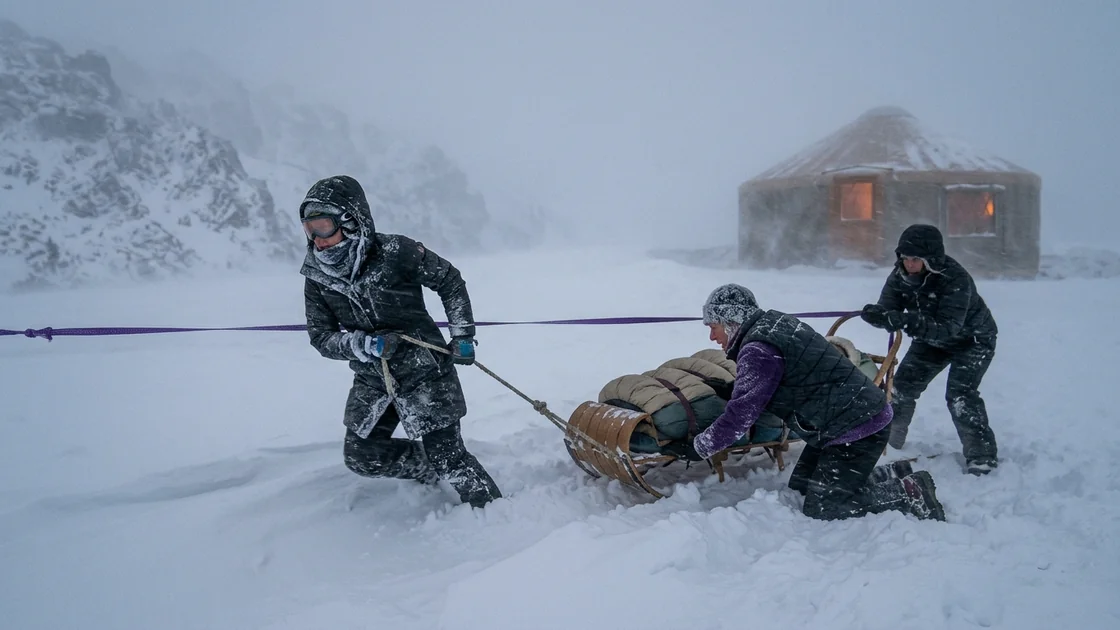
When five strangers traveled up the treacherous switchbacks of Cloudbreak Mountain to attend Julian Mercer's celebrated Solstice Awakening retreat, they expected five days of bespoke spiritual renewal, detoxifying teas, and guided transcendence. Instead, waking on the third morning to the howl of a record-breaking blizzard, they discovered their charismatic host had vanished down the access road with forty thousand dollars of their nonrefundable fees, the master keys, and the retreat center's satellite modem. Cut off from civilization without electricity, central heat, or cell service as temperatures plummeted inside the minimalist glass sanctuary, the five women were forced to strip away the curated illusions they had brought to the mountain and rely on one another to survive both the freezing elements and the bitter humiliation of having been conned.
I. The Bell at Dawn
The singing bowl did not chime at five thirty.
To Maya Lin, whose internal clock had been conditioned by twelve years of forensic accounting in midtown Manhattan, the silence was louder than the bowl’s brass ring. For the past two mornings, Julian Mercer—barefoot, draped in raw unbleached linen that billowed artfully around his sinewy frame—had padded down the polished bamboo corridors of the sanctuary, striking a nine-inch Tibetan alloy bowl with an elk-hide striker. Awaken the vessel, he would whisper into the dim dawn. The vessel is the breath.
Maya lay in her platform bed under a single duvet stuffed with ethically sourced kapok fibers. Her breath plumed white in the gray square of her bedroom.
The radiant floor was cold.
She pushed herself upright, shivering immediately as the air struck her collarbones. The thermostat on the slate wall was completely dark. No amber digits. No faint hum of the geothermal heat exchange unit buried in the granite bedrock beneath the structure. Through the floor-to-ceiling panoramic window, the world had ceased to possess color or depth. There was only a thrashing, furious white. Snow hit the triple-glazed glass not in flakes, but in crystalline sheets, hissed against the panes like handfuls of coarse salt thrown by an angry hand.
"Terrific," Maya muttered. She dragged on her thermal leggings, a thick wool sweater she had smuggled past Julian’s strict "Natural Vibrational Fibers Only" dress code, and her heavy boots.
When she stepped into the communal gallery, she found Sutton Vane standing in the center of the vast open space, holding her gold-cased iPhone high above her head like an ancient priestess offering a sacrifice to the clouds. Sutton was thirty-two, possessed eighty thousand followers on a platform dedicated to high-end holistic travel, and had spent the first forty-eight hours of the retreat complaining that Julian’s rules prohibited handheld electronics outside of personal sleeping quarters.
"It’s not just zero bars," Sutton said without turning around. Her voice had lost the lilting, smoky warmth she used for her sponsored stories; it was flat, nasal, and sharp. "The entire network is gone. Emergency SOS isn’t even registering. Did the generator fail?"
"The floor’s freezing," Maya said, walking toward the grand kitchen. "No lights, no heat. And Julian missed the bell."
"Maybe he overslept," Sutton offered, lowering the phone and rubbing her forearms. She was wearing cashmere loungewear that looked stunning but had approximately the thermal resistance of wet tissue paper. "He did that two-hour breathwork transmission last night. He said his astral sheath was completely depleted."
"Julian doesn't oversleep," a third voice said from the pantry doorway.
Beatrice Holloway was already sixty-four, with knees that clicked when the barometric pressure plunged and a crown of un-dyed steel hair cut into a neat, no-nonsense bob. A retired trauma nurse from Denver, Beatrice had been gifted this five-thousand-dollar weekend by her well-meaning daughters after her husband passed away in the spring. Unlike the rest of them, Beatrice had not bought into the linen tunics; she wore faded purple fleece, shearling slippers, and a quilted hunting vest with deep pockets.
In her hands, Beatrice held a stainless steel kettle. "Stove's off. Gas line is dead. There’s a master solenoid valve on the propane tank outside, and if the main system loses current, it trips shut unless somebody overrides it manually."
"Where is the manual override?" Maya asked.
"In the maintenance shed behind the yurt," Beatrice said, setting the kettle down on the stainless steel counter with an echoing clink. "Except Julian isn’t in the yurt. His door is hanging wide open, banging against the post. Snow’s drifted halfway to the bed."
Maya felt a small, prickling sensation in the hollow beneath her ribs—the same sensation she got when an executive's balance sheet showed forty distinct shell entities registered in the Cayman Islands with identical corporate addresses.
"Did you look inside?" Maya asked.
"I walked out on the covered deck," Beatrice replied calmly. "I called his name. Nothing. His Land Rover is gone from the turnaround."
"His car is gone?" Sutton stepped forward, her voice rising an octave. "In this? The weather service sent an amber alert yesterday afternoon! They said Cloudbreak Pass would be closed by midnight! He wouldn't just drive down the mountain."
"Someone check the office," another voice muttered.
It was Jesse Ortiz. Jesse had spoken perhaps forty words since Friday afternoon. She was twenty-seven, broad-shouldered, with scarred knuckles, ink-black hair shaved close at the temples, and eyes that held the hard, flat wariness of someone who had spent her youth bouncing between state foster homes and seasonal logging contracts in Idaho. She had come on an "equity scholarship" that Julian loudly touted on his website—a marketing gesture that had allowed him to claim his retreat was accessible to all walks of life, though Maya had quickly noticed that Jesse was assigned kitchen clean-up duty three times a day while the rest of them were guided through "Pranic Cleansing."
Jesse was holding a battery-powered Coleman lantern she had evidently scavenged from the laundry room. "Office door was unlocked," Jesse said. Her breath puffed in tiny, rhythmic bursts. "Computer’s gone. Wall safe is open. The modem from the roof dish is unhooked. Wires were cut with shears, not unplugged. Clean snip."
The silence that followed was broken only by the shriek of the gale outside, tearing at the cedar shingles of the eaves.
"What do you mean, the safe is open?" Sutton demanded, her face pale. "Our passports. Our emergency deposits. He insisted we put our wallets and identification in the sanctuary vault so we could 'sever the tether to our transactional identities'!"
"Your transactional identity," Maya said, her voice dropping into the cold, clinical register of an auditor about to ruin someone's life, "is currently halfway to Salt Lake City or Vancouver."
"No," a soft, trembling voice wailed from the hallway.
They all turned. Clara Hensley stood framed against the arched pine corridor. Clara was forty-one, fragile as spun sugar, her skin nearly translucent from months of raw juices and profound grief. Her seven-year-old daughter had died of leukemia fourteen months prior, and Clara had spent the intervening year liquidating her retirement funds in search of mediums, bio-resonance healers, and, finally, Julian Mercer’s promise of "Cellular Transmutation of Loss." She had paid the maximum tier: fifteen thousand dollars for private, direct-energy transmission sessions.
Clara was clutching her linen shawl to her chest, her eyes wide and wet. "No. Julian wouldn't leave us. He loves us. He... he took my wedding ring last night to cleanse the residual trauma of the hospital. He put it in the altar box. He told me it would be consecrated by morning."
Jesse lowered the lantern so its beam illuminated the floor between them. "I checked the altar box, lady. There's three sticks of dried sage and a handful of driveway gravel in it."
II. Inventory of the Con
The architecture of the Pinnacle Sanctuary was an exercise in deceptive luxury. It was eighty percent glass, designed by a celebrated Seattle firm to bring the rugged majesty of the Cascades directly into the living space. In July, bathed in the soft amber glow of high-altitude summer sunsets, the structure undoubtedly felt like a temple floating upon the clouds.
In late November, at seven thousand feet during a blizzard with sustained winds of sixty miles per hour, the structure was a giant glass freezer.
"First thing," Maya said, taking charge by reflex. She found a legal pad and a promotional wooden pen in the lobby drawer. "We don't panic. Panic burns calories, and calories are heat. We need an audit. Jesse, Bea, help me take stock of the physical plant. Sutton, take Clara into the tea room. Wrap her in every blanket you can strip from the guest suites. Do not touch the fireplace in the lounge yet."
"Why not?" Sutton snapped, her teeth already chattering. "We’re freezing!"
"Because," Jesse said, pointing the lantern toward the chimney flue above the suspended blackened-steel hearth, "the damper is motorized. If the power's dead and the battery backup didn't kick on, that damper is shut tight. You light a fire in there right now, you fill this entire room with carbon monoxide in fifteen minutes."
Sutton stepped back, looking at the black metal cone as if it were a bomb. "Oh God."
"Go get the blankets," Maya ordered. "Every down quilt, every wool throw. Pile them in the interior library. That room has no exterior windows and only one door. That’s our base camp."
While Sutton guided a weeping Clara toward the residential wing, Maya, Beatrice, and Jesse headed down the narrow utility stairs into the basement. The air down here smelled different—less like cedar and lavender, more like damp concrete, stale diesel, and grease.
Jesse moved directly to the mechanical room. Her lantern swept across an impressive bank of deep-cycle marine batteries and a commercial-grade Cummins standby generator.
"Well?" Maya asked.
Jesse knelt beside the generator, tracing a copper fuel line with her thumb. She didn't speak for a full minute. When she looked up, her expression was carved from slate.
"Fuel tank's empty," Jesse said.
"Did it run out during the night?" Beatrice asked, adjusting her glasses.
"Nope. The drain cock at the base of the tank is backed out two full turns. Look at the floor." Jesse swung the lantern. A dark, iridescent stain covered the concrete, leading toward the sump pump drain in the corner. "He opened the valve before he took off. Emptied eighty gallons of diesel straight into the drainage pit. He didn't just abandon us. He made sure the heat died behind him."
Maya felt a cold, metallic rage rise in her throat. She had seen corporate raiders loot pension funds; she had watched partners at white-shoe firms bill seventy hours a week while sunbathing in Antigua. But this was visceral. This was biological sabotage.
"Why?" Maya whispered. "If he had the cash, if he had the cars, why dump the fuel?"
"Time," Beatrice said softly. The retired nurse was leaning against the concrete wall, her face shadowed. "If the generator stays on, the wifi dish stays powered. If the wifi stays powered, one of us wakes up at two in the morning, sees he’s packed his car, and calls the state troopers down in Marblemount. The sheriff puts a spike strip across Route 20 before Julian hits the valley floor. But if the power cuts out at midnight, the dish dies instantly. The roads drift over. We don't realize he’s gone until daylight, and by then, the storm has locked the mountain down tighter than a drum. Nobody comes up. Nobody goes down. By the time the county plows clear the pass on Tuesday or Wednesday, he’s in Mexico with five new passports."
Jesse stood up, wiping her diesel-smeared fingers on the thigh of her canvas pants. "He took the master tools, too. Socket sets, crescent wrenches. Left an empty pegboard."
"What about food?" Maya asked.
They moved to the commercial pantry. Julian’s retreat had promised an "Organic Micro-Nutrient Immersion." The shelves were lined with glass jars of chia seeds, vacuum-sealed bags of raw cashews, jars of fermented turmeric paste, and crates of powdered spirulina. There were eighty bottles of artisanal cold-pressed mineral water from an aquifer in Oregon, but the main water line ran through an electric pump tied to an underground well. Maya tried the brass spigot over the prep sink. It gave a dry, hollow cough.
"Pipes will freeze by noon if we don't drain them," Jesse noted.
"I have something," Beatrice said quietly.
Both women looked at her.
The older woman offered a wry, slightly guilty smile and reached into her quilted vest, pulling out a plastic bag containing four sticks of beef jerky, three Snickers bars, and a half-empty sleeve of saltines. "My daughter warned me that Julian’s menu was mostly filtered ditch water and pulverized leaves. I stopped at the gas station at the foot of the grade."
"Bea," Maya said, feeling the first genuine smile of the morning touch her mouth, "you might be the only sane person who signed up for this trip."
"I’m an old nurse, honey. Never trust a man who wears linen pants in November and refuses to tell you where he went to high school."
III. The Council of the Conned
By ten in the morning, the interior library had become the only habitable space in the three-thousand-square-foot compound.
It was a windowless, ten-by-twelve-foot room lined with built-in cedar shelves containing Julian’s personal collection of spiritual texts: leather-bound copies of the Bhagavad Gita, translations of the Tibetan Book of the Dead, and seventy-five pristine, unsold copies of his own self-published book, The Unbound Orbit: Dismantling the Prison of Self.
They had sealed the single door with duct tape found in the laundry room, leaving only a six-inch flap at the bottom for ventilation. On the floor, Jesse had constructed a raised platform out of three wooden pallets she had hauled up from the dry-storage cellar, covering them with four layers of foam yoga mats and eight heavy down duvets. In the center sat two glass hurricane lamps burning paraffin oil, their small yellow flames providing a pitiful five degrees of warmth and a flickering, dancing light that threw their shadows high against the cedar walls.
The five women sat shoulder to shoulder, their knees pulled to their chests, bundled in layers of wool, fleece, and down.
Clara was wrapped like a mummy in a gray cashmere throw, clutching an unlit pillar candle. Her weeping had stopped, replaced by a dull, hollow catatonia.
"He told me my daughter was stuck in the bardo," Clara whispered, her voice barely louder than the hum of the paraffin wick. "He said her soul couldn't untangle from my physical grief because I was holding onto her earthly artifacts. That's why he wanted the ring. My husband gave it to me the night after her first chemo treatment. He told me it was a seal. A promise that we were unbreakable."
Sutton buried her face in her hands. The influencer’s pristine makeup had smeared into dark, bruised circles beneath her eyes. Her manicured nails, painted a pale milky quartz, were chipped. "He told me he was going to make me the face of his European expansion. He wanted twenty thousand dollars for the regional media licensing rights. I wired it on Thursday from the airport in Seattle. I used my emergency tax reserve."
Maya let out a short, humorless bark. "Did he give you an invoice?"
"He said paper contracts were low-frequency transactions," Sutton said, a sob catching in her throat. "He said true partnership exists in the vibrational field of mutual intent."
"He was an ex-felon from Ohio named Donald Klump," Jesse said, tossing a laminated card onto the quilt between them.
Maya picked it up. It was a faded, water-damaged commercial driver's license from Cuyahoga County, issued six years ago. The face staring out from the plastic was unmistakably Julian Mercer, minus the flowing salt-and-pepper beard and the serene, half-lidded gaze. In the license photo, Donald Klump had a receding hairline, a broken nose, and the tight, mean mouth of a carnival barker.
"Where did you find this?" Maya asked.
"Taped to the underside of the water heater in the utility crawlspace," Jesse said. "Must’ve dropped it behind the insulation years ago when he bought this place and forgot about it. He had a record for wire fraud in Cleveland back in 2014. Time-share schemes targeting widows."
Clara let out a small, wounded sound and pulled the blanket over her head.
"The question," Maya said, her voice cutting through the rising tide of self-pity, "is not how stupid we were. We can litigate our gullibility when our toes aren't turning purple. The question is how we stay alive until the county clears forty miles of forest service road."
"It’s just snow," Sutton said defensively, looking around the room. "People get snowed in all the time. The plow will come tomorrow."
"Sutton," Beatrice said gently, placing a hand on the younger woman’s knee. "Look at me. I worked thirty years in emergency medicine in Colorado. This isn't a ski weekend delay. This is an atmospheric river colliding with an arctic high-pressure system. The barometric pressure dropped forty millibars in six hours. The drift outside the kitchen door is already seven feet high. If the wind stays like this, the pass won't be cleared until Thursday at the earliest. That's four days."
"Four days without heat," Maya calculated aloud. "The ambient temperature outside is four degrees below zero. With the wind chill, it’s twenty below. Glass loses R-value faster than canvas. Within twenty-four hours, the main gallery will be twenty degrees. Within forty-eight, it will match the outside air. If we stay in this room, five bodies generate about five hundred watts of heat. It's not enough to stop hypothermia once our core temperatures start slipping."
"We have to light the hearth," Sutton insisted.
"I told you," Jesse said, "the damper is shut."
"Then we open it!"
"It’s an electric worm-gear motor, Sutton!" Jesse snapped, her voice cracking the small room like a whip. "It’s buried inside thirty feet of double-walled insulated flue pipe welded inside a decorative granite sleeve! Unless you’ve got a cutting torch in your designer purse, we can’t reach the actuator. You build a fire under a closed steel plate, and we die in our sleep from smoke."
"Then what do you suggest, Jesse?" Sutton screamed back. "We just sit here and eat Beatrice’s Snickers bars until our fingers freeze off and fall into our laps?"
"Shut up!" Maya’s voice was like ice cracking on a lake.
Both women froze.
"Jesse," Maya said evenly. "You know engines. You know buildings. What works?"
Jesse leaned her head back against the cedar boards, closing her eyes. She inhaled slowly through her nose. "The woodstove in Julian’s yurt."
IV. The Crossing
The realization struck them with the force of an avalanche: Julian’s personal residence—the detached round cedar yurt perched on a granite outcropping fifty yards behind the main lodge—was entirely off-grid. Unlike the glass-and-steel showpiece built to dazzle wealthy clients, the yurt had been constructed for simple, rugged living. It had a traditional cast-iron Jotul woodstove, a gravity-fed rainwater barrel, and a woodpile stacked four cords deep under a heavy vinyl tarp.
The problem was the fifty yards.
Between the sanctuary's rear fire door and the yurt’s deck lay an open expanse of alpine meadow, completely unprotected from the gale. The snow was already waist-deep, swirling in blinding, disorienting whiteouts that erased the horizon ten feet from the glass.
"You can get lost five steps outside that door," Beatrice warned, her medical pragmatism asserting itself. "You lose your bearing, you walk six feet to the left, you step off the north ledge. It’s an eight-hundred-foot drop into the canyon."
"We use a guideline," Jesse said.
She had already stripped the braided nylon cords from the studio’s suspension-yoga apparatus. She sat on the library floor, splicing five fifteen-foot lengths of heavy purple webbing together with neat, double-threaded climber's knots.
"We tie off to the structural steel column inside the back door," Jesse explained, not looking up from her work. "One person goes out. Anchored at the waist. She carries the lantern and a second anchor line. When she hits the yurt post, she secures the line. Then we pull ourselves across along the rope. Nobody walks free. Nobody steps off the line."
"I'll go," Maya said.
"No," Jesse said, pulling a knot tight with her teeth before testing it with a savage jerk. "I'm going. I’ve worked rigging in blizzard conditions in the Bitterroots. You don't know how to read drift crust. You step on a wind-slab over a hollow, you blow an ACL before you make twenty yards. I go first."
"I’m coming behind you," Maya insisted. "You can't carry enough firewood back by yourself, and we can’t move Clara and Sutton across until we know the yurt is heated and the chimney isn't choked with ice."
Jesse looked up, her dark eyes evaluating Maya with the cold precision of an engineer checking structural tolerances. Maya didn't blink. She had faced down federal prosecutors, hostile boards of directors, and an ex-husband who had tried to hide four million dollars in offshore trusts; she was not about to be dismissed by an Idaho mechanic.
"Fine," Jesse said. "Put on your boots. Put plastic trash bags over your socks before you step into the leather. If the snow gets in over the cuffs, your feet stay dry. Wet feet are dead feet."
Ten minutes later, the rear door of the sanctuary swung open.
The mountain roared into the corridor. The wind was a physical wall, an icy fist that knocked Maya back two paces and ripped the breath from her lungs. Snow instantly coated her eyelashes, blinding her.
Jesse was already down on all fours on the deck. The purple nylon webbing was looped through her harness, disappearing into the white fury.
"Stay low!" Jesse screamed over the shriek of the storm. "Don't stand up! The wind has twenty knots more punch three feet off the deck! Crawl!"
Maya dropped to her knees on the ice. The cold hit her chest like a heart attack. Through two pairs of wool leggings, her knees felt the jagged bite of the frozen boards. She gripped the trailing nylon cord with gloved hands, watching Jesse’s orange rain jacket disappear into the swirling gray murk just eight feet ahead.
Step by step. Knee by knee.
The world vanished. The sanctuary behind them was gone in three seconds, swallowed by the howling white void. There was no sky, no ground, no horizon—only the stinging needle-blast of ice crystals driving sideways into the exposed sliver of skin between Maya’s scarf and her snow goggles.
Every breath tasted of raw frost. It burned her larynx, settling like broken glass in the bottom of her lungs.
Suddenly, the line went slack.
Maya stopped, her heart hammering against her ribs like a trapped bird. "Jesse!" she shouted, but the wind tore the sound from her lips and scattered it into the roar.
She hauled herself forward along the slack line, inch by inch, her mittens slipping on the iced nylon.
Her hand hit something soft and heavy.
Jesse was face-down in a drift, her right leg wedged between two granite boulders that marked the edge of the path. The snow around her was already drifting high against her flank.
Maya scrambled forward, grabbing Jesse’s shoulder and hauling her upward with a desperate, adrenaline-fueled heave. Jesse rolled over, her goggles fogged with ice, her mouth open in a soundless gasp. She reached down, clutching her lower calf.
"Trapped?" Maya screamed into her hood.
Jesse shook her head violently, pointed forward, and then thrust her thumb downward.
Maya squinted through the blinding squall. Five feet ahead, barely visible through the churning white, rose the dark cedar post of the yurt’s covered entry. They had made it across the meadow. But Jesse’s boot was wedged deep in the crevice between the rocks, pinned by a fallen limb that had snapped from an ancient fir above under the weight of the wet snow.
Maya didn't think. She threw her entire weight against the cedar branch, using her hip and shoulder as a lever. The frozen wood groaned. Jesse wrenched her leg backward, the rubber of her boot tearing with a wet rip, but her foot popped free.
Together, crawling on their bellies like soldiers under wire, they dragged themselves up onto the low deck of the yurt and slammed their bodies against the heavy plank door.
It was unlocked.
They tumbled inside, kicking the door shut against the howling gale, and threw the heavy oak drop-latch into place.
V. The Sanctuary of Donald Klump
Inside the yurt, the storm suddenly sounded distant, muffled by four layers of felted wool and heavy architectural canvas.
The air was bitterly cold, but it was still.
Jesse sat on the floorboards, holding her ankle, breathing in jagged, shuddering gasps. Maya stripped off her fogged goggles and looked around.
The yurt was nothing like the airy, minimalist zen-monastery aesthetic Julian had cultivated in the main building. There were no brass bells, no linen tapestries, no framed quotes from Rumi.
This was the private lair of Donald Klump.
A deep leather recliner sat in the center of the room, facing a fifty-inch flat-screen television mounted to an interior partition. On a folding card table sat an empty bottle of twelve-year-old single malt scotch, a jar of cheap peanut butter with a spoon stuck in it, and three cartons of Marlboro Red cigarettes.
In the corner, squat and magnificent, sat the Jotul cast-iron stove. Beside it was a basket filled with dry birch bark, kindling, and seasoned split maple.
"He... he didn't even drink the kombucha," Maya whispered, staring at an empty bag of Doritos crumpled beneath the card table.
Jesse let out a ragged laugh that turned into a wheezing cough. "The guy spent his evenings drinking scotch and eating chips while we were in the dome chanting in Sanskrit on five hundred calories a day."
Maya knelt by the stove. Her hands were shaking violently—partly from the residual adrenaline of the crossing, partly from the deep, insidious cold that was now settling into her joints. She opened the heavy iron door of the Jotul. The firebox was clean, dry, and cold.
"Draft first," Jesse instructed from the floor, leaning back against the frame of the recliner. "Check the pipe. Reach inside and feel for the plate."
Maya reached up into the dark iron throat. Her fingers hit the steel butterfly damper. She turned the cast-iron handle on the side of the pipe. A faint, hollow rattle echoed through the flue.
"It’s open," Maya said.
"Good. Birch bark on the bottom. Finger-thick sticks on top. Don't crowd it. Give it air. Use the lighter on the card table."
Two minutes later, a yellow tongue of flame licked through the white curls of birch bark. The paper-thin wood hissed, curled, and caught with a sudden, joyous crackle. The blue smoke rose obediently up the flue, drawn by the fierce natural draft of the wind sweeping across the chimney cap outside.
Maya fed three sticks of dry maple into the belly of the stove. The flames flared, illuminating the circular room with a deep, pulsating orange glow. Within five minutes, the cast-iron sides of the stove began to radiate that ancient, dense, uncompromising heat that only burning hardwood can produce.
Maya held her raw hands inches from the black iron. She could feel the skin of her knuckles prickle as the capillaries dilated, a sensation so intensely pleasurable it made her dizzy.
"The line," Jesse said, her voice tightening as the adrenaline drained away, leaving her pale and shivering. "We have to bring the others."
Maya looked at Jesse’s ankle. It was already swollen, puffing against the torn leather of her boot. "You can't walk back."
"I don't need to," Jesse said. "We left the line tied off to the post out there. I stay here, keep this stove roaring, and get water melting on the top plate. You go back along the rope. You bring Bea and Clara first. Then Sutton."
Maya looked at the small window in the door. Outside, the white tempest was darkening into a bruised, slate twilight. The storm was entering its second, more violent phase.
"Can you stand?" Maya asked.
"I can hop to the woodbox," Jesse grunted, dragging herself up onto the edge of the leather chair. "Go. Before the drift swallows the rope entirely."
VI. The Extraction
The journey back was easier only because the rope was already taut.
Maya pulled herself hand-over-hand through the waist-deep drifts, using the tension of the purple webbing to keep her feet beneath her. When she hit the rear glass door of the sanctuary, Beatrice was standing on the other side, her face pressed against the pane, her breath leaving greasy ovals of condensation on the glass.
Beatrice hauled Maya inside, and the two of them slammed the door shut against the howling draft.
The temperature in the main lodge had plunged dramatically in the forty-five minutes Maya had been gone. It was already colder inside the building than it had been in the basement that morning. The indoor fountain in the atrium had frozen solid, a grotesque sculpture of cracked green slate and suspended ice droplets.
"The stove works," Maya gasped, leaning against the wall, her lungs burning. "The yurt is warm. But Jesse’s hurt. We have to move now."
They ran to the library.
Sutton was sitting on the yoga mats, rocking Clara in her arms. The two women had abandoned their previous roles—the glamorous influencer and the grieving mother had merged into a single shivering heap of gray fleece and terrified whimpers.
"Get up," Maya commanded.
Sutton looked up, her lips distinctly blue. "We can't go out there. We’ll freeze to death."
"You stay here, you will freeze to death," Maya said, her tone brook no argument. "The yurt is eighty degrees right now. There's dry wood, shelter, and a stove. But you have to crawl fifty yards through a drift."
"Clara can't do it," Sutton whispered. "She’s barely conscious. Her hands are like ice."
Beatrice knelt beside Clara, peeling back the woman's eyelids with practiced, clinical efficiency. "Moderate hypothermia. She’s sliding into apathy. If she stops shivering, her core is dropping below ninety degrees. Maya's right. If we stay here tonight, Clara doesn't wake up tomorrow."
"We use the sled," Beatrice said suddenly.
"What sled?" Maya asked.
"The decorative wooden toboggan in the entrance hall," Beatrice said, her eyes flashing behind her wire-rimmed glasses. "The one Julian piled with dried pine cones and organic gourds for the 'Autumn Equinox Abundance Display.' It’s solid ash. Five feet long. It has a hemp pull-rope."
Three minutes later, they had dumped the dried pine cones across the polished bamboo floor.
They laid Clara onto the toboggan, wrapping her in four down duvets like an oversized cocoon, and lashed her to the ash slats using the remaining yoga straps.
"Here’s the drill," Maya said, tying the lead rope of the toboggan around her own waist. "Beatrice, you take the front right of the line. Sutton, you take the rear. You hold the toboggan steady so the wind doesn't flip it. If you slip, do not let go of the purple guideline. It is the only thing connecting us to the yurt. If you lose the line, you die. Understand?"
Sutton swallowed hard. The terror in her eyes was absolute, stripped of all vanity, all curation, all performance. She nodded once.
"Open the door," Maya said.
They stepped out into the teeth of the monster.
The second crossing was a nightmare of friction and ice. The wind had shifted fifteen degrees to the north, hitting them broadside as they dragged the heavy ash toboggan through the drifts. The sled acted like an anchor, sinking into the powdery snow, threatening to roll every time a gust caught Clara’s down-wrapped form.
"Keep it straight!" Beatrice yelled, her voice shredded by the gale. The older woman was down on her knees, driving her boots into the crust with mechanical, rhythmic fury.
Halfway across, Sutton slipped.
Her feet went out from under her on a hidden shelf of granite. She fell hard on her side, her mitten slipping from the purple guideline.
"Maya!" Sutton screamed.
The wind seized her immediately, sliding her three feet down the slope toward the dark drop of the north rim before her knees caught in a drift.
Maya stopped, the toboggan rope cutting viciously into her diaphragm. "Hold the sled, Bea!" she screamed, dropping down and reaching backward along the line.
Sutton was sliding. The snow beneath her was soft, wind-scoured powder offering no resistance. Her fingers were clawing uselessly at the ice crust. "I can't reach it! Maya!"
Maya unclipped her carabiner from the main line, anchoring herself by wrapping her left arm twice around the purple webbing. She stretched her right leg out down the slope, extending her heavy snow boot toward Sutton’s flailing arms.
"Grab my boot!" Maya roared. "Grab the heel! Don't look down! Grab the heel!"
Sutton lunged. Her mittens locked around Maya’s thick Vibram sole.
The strain hit Maya’s shoulder like an electric shock. The purple webbing groaned, tightening around her left bicep until her arm went numb. With a guttural, feral scream that came from the deepest, oldest part of her belly, Maya pulled. She engaged her core, her glutes, her back—every muscle she had neglected during twelve-hour days at her Manhattan desk—and dragged Sutton back up the slope two inches at a time until the younger woman’s hands found the frozen fibers of the main guideline.
Sutton hauled herself up, sobbing, gasping, her face caked in white crust. She locked both hands around the rope and didn't let go.
"Keep moving!" Maya shouted, her voice breaking. "Don't stop! Keep moving!"
They hit the deck of the yurt in a tangle of limbs, snow, and rope.
The door flew open. Jesse stood balanced on one foot in the doorway, bracing herself against the jamb, grabbing the front of the toboggan and hauling Clara inside with one mighty, one-armed pull.
Maya, Beatrice, and Sutton tumbled in behind, collapsing onto the warm floorboards as the heavy door slammed shut and the drop-latch clicked into place.
VII. The Iron Heart
The heat inside the yurt was thick, redolent of pine sap, scorched iron, and dry wood.
For ten minutes, nobody spoke. The only sounds were the furious, muffled bellow of the storm outside and the ragged, desperate panting of five women lying on the floorboards, their bodies steaming as the ice on their clothes met the eighty-degree air.
Beatrice was the first to move.
The nurse pushed herself up onto her knees, crawled over to the toboggan, and began slicing through the yoga straps with Julian’s abandoned kitchen shears. "Help me get her out of these wet layers," Beatrice ordered. "Sutton, strip her socks. Maya, find a dry towel."
They stripped Clara down to her base layer. Her feet were waxy and dead-white, her fingers stiff as tallow candles.
"Is she..." Sutton couldn't finish the sentence.
"She’s alive," Beatrice said, feeling the side of Clara’s neck. "Pulse is slow, sixty beats, but regular. Core temperature is around ninety-two. We don't rub the skin—that causes tissue damage. We warm her passively. Jesse, is there water?"
Jesse pointed to a five-gallon cast-iron pot sitting on top of the Jotul stove. The snow inside it had melted down to three inches of steaming water.
"Fill two of those empty scotch bottles with warm water," Beatrice directed. "Wrap them in wool socks. We tuck them under her armpits and between her thighs. That warms the femoral and brachial arteries directly."
Working together with a seamless, wordless rhythm that none of them could have anticipated six hours ago, they transformed the yurt into a field hospital.
Maya tended the fire, carefully sliding seasoned splits of maple into the belly of the stove, monitoring the draft so the pipe didn't glow red. Sutton sat on the floor with Clara’s head in her lap, gently smoothing the damp hair away from the older woman's forehead, murmuring quiet words of encouragement that had nothing to do with vibrational frequencies or cellular light, and everything to do with simple, human survival.
"You're safe, Clara," Sutton whispered, her voice cracked and small. "You're inside. We got you. The stove is hot. We're right here."
Slowly, the waxy pallor of Clara’s cheeks gave way to a faint, mottled pink. Her eyelids fluttered. She let out a long, shuddering sigh and curled her body toward the radiating heat of the cast-iron stove.
"She’s through the worst of it," Beatrice murmured, sitting back on her heels and wiping her brow with the back of her wrist. "Thank God."
Jesse let out a low whistle from the recliner. "Don't thank God. Thank Maya. If she hadn't held that anchor line when the drift gave way, Sutton was off the ledge."
Sutton looked across the room at Maya. The influencer’s eyes were bloodshot, her face raw from windburn, her designer cashmere ruined by soot and sweat.
"Thank you," Sutton said.
Maya looked down at her hands. The skin across her knuckles was split and black with charcoal from the stove door. Her shoulder throbbed with a deep, dull ache where the strap had bitten into her muscle.
"We don't leave people behind," Maya said simply. "Even when Donald Klump does."
Jesse reached into the pocket of her canvas jacket and pulled out a small, heavy velvet pouch she had picked up from the floor of Julian’s bedroom when she searched the yurt. She tossed it onto the quilt in front of Clara.
Clara reached out a trembling hand and loosened the drawstring.
A platinum wedding band rolled out onto the wool, catching the amber light of the Jotul stove. Beside it lay Sutton’s passport, Maya’s driver’s license, and Beatrice’s gold watch.
"Found it in his dirty clothes hamper under a pile of synthetic gym shorts," Jesse said, spitting into an empty tin can beside her chair. "He didn't consecrate anything. He just didn't have room for the heavy stuff in his briefcase."
Clara picked up the ring. She didn't cry. She stared at it for a long, quiet moment, then slid it slowly onto the fourth finger of her left hand.
"It’s not consecrated," Clara whispered.
"It is now," Beatrice said.
VIII. The True Confessions
By midnight, the blizzard had reached its zenith.
The wind didn't come in gusts anymore; it was a continuous, shrieking locomotive that shook the stout frame of the yurt until the canvas walls bowed inward against the lattice. But the Jotul held the center. The cast-iron belly glowed a deep, comforting cherry red, keeping the interior at a steady seventy-five degrees.
They had pooled their resources on Julian’s card table.
Beatrice’s Snickers bars and jerky had been supplemented by two cans of black beans, a jar of salsa, and a box of saltines Jesse had unearthed from the crawlspace beneath the floorboards. Maya had boiled the beans on the stove plate, mashing them with the salsa into a hot, dense porridge that they ate in turns from two ceramic mugs using Julian’s souvenir silver spoons.
It was, they all agreed, the finest meal any of them had ever tasted.
"I spent twenty-two thousand dollars to come here," Sutton said, staring into the dark dregs of her mug. She had borrowed an oversized flannel shirt from Julian’s closet, her legs tucked under a heavy army blanket. "I had to take out an advance on my agency contract. My metrics were falling. The algorithm shifted in August, and my engagement dropped forty percent. All the young girls on the platform are twenty-two, and they do these seven-minute cold plunges in alpine lakes without shivering, and they talk about trauma integration like it's a skincare routine."
She gave a small, bitter laugh.
"I was terrified that if I didn't come back with content from Julian Mercer’s mountain, nobody would look at my page anymore. I thought if I didn't have the light, I’d disappear."
"You wouldn't disappear, child," Beatrice said softly, paring the skin from a bruised apple she had found in the pantry. "You’d just have to be a person instead of a photograph."
"What about you, Bea?" Maya asked, leaning back against the woodbox, her legs stretched out toward the hearth. "You didn't need Julian's light."
Beatrice chewed her slice of apple slowly. The shadows from the fire played across the deep lines etched into the corners of her mouth.
"My daughters were worried," Beatrice said. "Robert died in April. We were married forty-one years. When someone’s sick for three years, your whole house becomes a hospice. You track oxygen levels, you track urine output, you learn how to change a fitted sheet with a two-hundred-pound man lying on it without waking him up. And then one morning he stops breathing, and the paramedics take the bed away, and the house is just... quiet."
She looked down at her work-hardened hands.
"My girls thought I was depressed. I wasn't depressed. I was just tired. Bone-tired. But they kept buying me books on grief stages. Then they bought this ticket. I came so they would stop looking at me like I was a broken vase they didn't know how to glue back together."
"He told me I had an energetic blockage in my throat chakra," Jesse said from the recliner. She had elevated her swollen ankle on an empty wood crate, wrapped in a wet towel filled with packed snow.
Maya looked at her. "Julian said that?"
"Yeah. During my 'scholarship intake interview.'" Jesse shook her head, a smirk playing across her lips. "Told me I was holding onto generational poverty because my spirit was vibrating at the frequency of scarcity."
"What did you tell him?" Sutton asked.
"I told him my spirit was vibrating at the frequency of twelve dollars an hour at Jiffy Lube," Jesse deadpanned. "I only came because my probation officer said six days of residential wellness looked good on the community rehabilitation report. I needed thirty hours of community engagement to get my license back after an unpaid ticket warrant."
A stunned silence fell over the yurt.
Then Maya started to laugh.
It began as a low, dry chuckle in the back of her throat, but within three seconds it had bubbled up into a helpless, full-bellied roar that shook her shoulders.
Sutton looked at her, shocked, and then a snort escaped her nose.
Within thirty seconds, all five of them were laughing—hysterical, exhausted, cleansing laughter that filled the round room, drowning out the shriek of the gale outside. They laughed until Clara had to hold her ribs, until Beatrice took off her glasses to wipe the tears from her eyes, until Jesse was pounding the arm of the recliner with her good hand.
"The frequency of twelve dollars an hour!" Sutton howled, tears cutting clean tracks through the soot on her cheeks.
"A broken vase!" Beatrice wheezed.
"Forty thousand dollars," Maya gasped, clutching her knees to her chest. "Forty thousand dollars for a three-day course in basic plumbing and municipal fraud."
Clara looked around the circle, her face softer than it had been since the moment Maya had first seen her in the lodge. She held up her tea mug, filled with melted snow water.
"To the Aperture Method," Clara said solemnly.
"To Donald Klump," Maya toasted, clinking her tin spoon against Clara’s mug. "May his transmission blow in the middle of Idaho."
IX. The Thump on the Deck
The storm died between three and four in the morning.
It did not fade gradually. The wind simply exhausted itself, dropping from a sixty-mile-per-hour roar to a dead, ringing silence that woke Maya more effectively than a gunshot.
She sat up. The Jotul was still glowing, radiating a steady, sleepy warmth. The red coals through the draft vent cast a geometric grid of orange squares across the yurt floor.
Jesse was awake too, sitting upright in the recliner, her head tilted toward the heavy plank door.
"You hear that?" Jesse whispered.
Maya held her breath.
Through the heavy wood of the door came a faint, rhythmic sound.
Thud.
Thud.
Scrape.
It was not the wind. It was the heavy, dragging impact of something moving across the drifts on the rear deck.
Beatrice stirred under her duvet, her eyes opening instantly with the sharp, reflexive alertness of an ER nurse. "What is it?"
"Something's on the porch," Maya murmured.
Jesse reached down beside the woodbox and lifted Julian’s splitting maul—a eight-pound wedge of forged steel on an ash handle that had been leaning against the wall. She handed it to Maya.
"Take it," Jesse said softly. "Stand behind the hinge side. If it’s a bear that caught the smell of the jerky, it’ll hit the jamb first."
"Bears are hibernating," Beatrice whispered, slipping out of her blankets.
"Not if they're hungry," Jesse replied.
Maya gripped the hickory handle. The steel head was cold and heavy, balancing easily between her palms. She stepped softly across the floorboards, taking up her position in the shadow behind the door.
Thump.
A heavy weight hit the outside of the door, slumping against the planks with a wet groan.
Then came a voice.
It was not a bear. It was a thin, reedy, pathetic croak, choked with frost and terror.
"Please," the voice wheezed through the keyhole. "Please... let me in. The car... the car died. Please."
Sutton sat up, pulling the blanket to her chin. Her eyes were huge in the amber gloom. "Julian?"
Maya looked at Beatrice. Beatrice looked at Jesse.
Jesse’s face was an unreadable mask of cold iron. "Open the latch, Maya. But keep the maul up."
Maya reached out with her left hand, lifted the heavy oak drop-latch, and pulled the door inward six inches.
A heap of snow and wet down tumbled over the threshold, collapsing onto the yurt floor in a shivering, groveling heap.
It was Donald Klump.
X. The Master at the Altar
Julian Mercer—or Donald, as Maya now thought of him—was barely recognizable.
His signature linen trousers were shredded, soaked with black, greasy slush from his knees to his ankles. He had lost his right boot somewhere in the drifts; his foot was wrapped in a plastic grocery bag secured with duct tape that had torn open, exposing toes that were the distinct, waxy color of eggplant. His face was gray-white, his flowing beard caked with heavy icicles, and his lips were split and bleeding from the wind.
Clutched to his chest with both frozen hands was a heavy aluminum briefcase.
He lay on the floorboards, shivering so violently that his teeth clicked together like castanets. He didn't look at any of them. His eyes were glazed, rolling back into his head, fixed only on the radiant red heat of the Jotul stove.
"The... the pass," he stammered, his voice bubbling with fluid. "The drift... at the switchback. Car went into the ditch. The heater... the heater stopped three hours ago. I walked... I crawled back up the grade... please... the fire... please..."
Nobody moved.
For sixty seconds, the five women stood in a semicircle around the fallen guru, looking down at him.
The silence in the yurt was absolute. There was only the crackle of the maple in the stove and the wet, rattling sound of Donald’s breath.
Maya still held the splitting maul. Her knuckles were white on the ash wood. She looked at the briefcase clutched in his arms—the case that held Sutton’s emergency tax reserve, Clara’s fifteen thousand dollars, the cash Julian had systematically extracted from desperate people over six months of pre-retreat marketing.
She could see the path clearly.
They could take the briefcase. They could push him back out onto the deck. In this temperature, without heat, he would be unconscious in twenty minutes and dead before dawn. The county plow wouldn't find his car until Wednesday; they could claim he never made it back up the mountain. Nobody would ever know. It would be a clean, natural verdict: death by exposure, the mountain claiming the grifter who tried to outrun its fury.
Maya looked at Beatrice.
The retired nurse had already stepped forward.
Beatrice didn't look at Donald's face. She didn't look at the briefcase. Her expression was completely devoid of anger, devoid of pity, devoid of reverence. It was the flat, clinical face of a woman who had spent four decades treating drunk drivers who had just killed families, gang members who had shot children, and billionaires who had overdosed in penthouse suites.
"Jesse," Beatrice said, her voice dropping into the command tone of an operating theater. "Get the shears. Cut that plastic bag off his foot before the gangrene sets in."
Maya lowered the splitting maul.
"Sutton," Beatrice continued, "get another bottle of hot water. Clara, move the duvets back. We need him on the floor, away from direct heat so we don't send him into thermal shock."
Donald reached out a claw-like hand toward Beatrice’s ankle, his eyes watering. "Beatrice... thank you... the universe... the divine light..."
"Shut up, Donald," Beatrice said without looking at him, her thumbs already probing the swollen, blackened flesh of his frozen toes. "If you talk, you waste oxygen, and I don't feel like doing chest compressions on you before breakfast."
Maya walked over to where he lay. She reached down, took the handle of the aluminum briefcase from his stiff, unresisting fingers, and pulled it free.
Donald made a small, pathetic whimpering sound as the case left his grip, but he lacked the strength to fight her.
Maya set the briefcase on the card table. She popped the latches.
Inside, neatly banded in ten-thousand-dollar stacks, sat ninety-two thousand dollars in cash, sixteen certified bank drafts, a dozen velvet pouches containing jewelry, three burner phones, and two Canadian passports bearing the name David Vance.
"Sutton," Maya said.
Sutton stepped forward. Her hand was steady as she reached into the case and plucked out her cashier's check.
"Clara."
Clara took her envelope containing her cashier's check for the "Cellular Transmutation" sessions.
Maya took her own refund, down to the last single dollar. She counted out fifteen thousand dollars in crisp hundred-dollar bills and laid them on the table in front of Jesse.
"What’s that for?" Jesse asked, squinting from the recliner.
"Consulting fees," Maya said. "Master mechanic, mountain guide, and high-altitude rigging specialist. You bill at five grand a day. Seems fair to me."
Jesse looked at the green paper, then looked at Donald groaning on the floorboards as Beatrice wrapped his foot in clean wool. A slow, broad grin spread across Jesse’s face.
"Fair enough," Jesse said, pocketing the cash.
XI. The Mountain Breaks
The dawn did not come with a bell.
It came with a blade of gold light that sliced through the yurt’s single east-facing window, striking the cedar planks with such brilliant, blinding intensity that Maya had to shield her eyes.
She pulled on her boots, unlatched the heavy door, and stepped out onto the deck.
The storm was entirely gone.
The sky above Cloudbreak Mountain was a dome of pristine, polished turquoise, so clear and sharp that the jagged granite peaks forty miles to the north looked close enough to touch. The snow lay over the landscape like three feet of sculpted porcelain, unbroken by a single footstep, glowing pink and gold in the horizontal rays of the rising sun.
The air was fifty degrees colder than the yurt, but it was still. Crisp, pure, and completely devoid of deceit.
Behind her, the floorboards creaked.
Sutton stepped out onto the deck, wearing Julian’s oversized red hunting jacket, her bare hands thrust deep into the pockets. She didn't have her phone. She stood beside Maya, looking out over the vast, silent valley where forty miles of forest service road lay buried under five feet of powder.
"Look at that," Sutton whispered.
"No filters," Maya said.
"None," Sutton agreed. A tiny, genuine laugh caught in her throat. "The lighting is actually terrible for skin tone. Too much blue bounce."
Down the switchback, three miles below the sanctuary’s gate, the faint, metallic drone of a heavy diesel engine broke the mountain’s silence.
Maya shaded her eyes.
A massive yellow state rotary plow was crawling up the grade, throwing a rooster-tail of white snow fifty feet into the pine trees as it carved a clean, black asphalt trench through the drifts. Behind it, their red and blue strobe lights flashing silently against the blinding white snowbanks, came two four-wheel-drive Chevy Suburbans of the Skagit County Sheriff’s Search and Rescue unit.
"They're coming," Sutton said.
"They are," Maya said.
Inside the yurt, Donald Klump let out a low, pathetic moan as Beatrice peeled off another layer of frozen gauze.
"Keep still, Donald," they heard Beatrice snap from within. "The law is five minutes away, and I’d prefer you were still conscious enough to sign the property recovery release before they put the handcuffs on you."
Clara walked out onto the deck, holding a steaming mug of black tea. Her face was pale, her skin windburned, but her shoulders were straight. She walked to the railing, looking down at the valley below, then looked down at the platinum band on her finger.
She didn't take it off. She turned it once around her knuckle, feeling the solid, heavy reality of the metal against her flesh.
"How do you feel, Clara?" Maya asked gently.
Clara took a sip of the hot tea, her breath mingling with the morning frost, turning into a small white cloud that rose toward the clear blue sky.
"I feel cold," Clara said, and for the first time since Maya had met her, the woman's voice was clear, grounded, and steady. "I feel freezing. But I'm awake."
Maya nodded. She leaned her forearms against the cedar rail, feeling the bite of the frost through her wool sleeves, watching the yellow plow chew through the final turn below the meadow.
The retreat was over. The guru was broken. The money was recovered.
And up here, seven thousand feet above the chatter of the world, in the cold, clean geometry of the snow, the five of them were finally, undeniably whole.