The Geography of Unspoken Things
When Nora Kelly discovered four thousand dollars in rolled cash, a one-way bus ticket to Astoria, Oregon, and a twenty-year-old newspaper clipping hidden beneath the floorboards of her daughter’s bedroom, she realized the fragile sanctuary she had spent eighteen years constructing was about to collapse. Maya had not applied for summer internships at the university marine lab as she had claimed; instead, she had methodically mapped an overland journey to find Julian Vance, the father Nora had buried under a generation of careful, protective lies. Over the course of twenty-four hours, as the departure time on the ticket drew near, Nora was forced to confront the violent truth of the past she had fled, the terrifying maturity of the daughter she still viewed as a child, and the realization that the only way to save Maya from walking into an emotional wilderness was to finally dismantle the ghost story that had kept them safe.
Act I: The Hollow in the Heart pine
The smell of Nora’s house was always the same on Tuesdays: lemon oil, damp salt brought in from the tidal flats of Cape Neddick, and the faint, bitter tang of hide glue warming in its brass pot on the back of the woodstove. She restored seventeenth- and eighteenth-century pine chests for dealers down in Portsmouth and Boston, spending her days with scrapers, horsehair brushes, and beeswax, coaxing rot out of drawer-runners and leveling legs that had been warped by centuries of uneven settler hearths. She understood wood. She understood that if you sealed damp timber too quickly beneath a coat of shellac, the interior would sour, turn punky, and collapse from the marrow outward while the surface still gleamed with the false health of lacquer.
It was ten in the morning. Maya was supposed to be at the town library three miles away, cataloging microfilm for her summer work-study grant. She had left at eight, wearing her faded denim jacket and her canvas deck shoes, her dark, unruly curls pulled back in a tortoiseshell clip Nora had bought her for her sixteenth birthday. She had kissed Nora’s cheek at the kitchen island, smelling of spearmint gum and toast, her skin cool from the morning marine layer that clung to the cliffs.
"Back by four, Mom," Maya had said, her hand resting momentarily on Nora’s shoulder. Her fingers had lingered there—longer than usual, heavy and warm through Nora’s flannel shirt. "Don't skip lunch. You always get a headache if you forget the chowder."
"I have two side drawers to clamp before noon," Nora had murmured, squinting through her bifocals at a split dovetailed join. "Take the umbrella. The radio said the fog’s going to turn to spit by noon."
"I will," Maya had said.
She hadn't taken the umbrella. Nora found it half an hour later hanging from the brass knob of the pantry door, its crook dry, its nylon ribs tightly rolled.
Nora had gone upstairs not to snoop, but because the rain had indeed begun to tick against the eastern dormer, and Maya’s bedroom window was an old double-hung sash with a broken sash-weight; if it was left unlatched, the wind from the Atlantic would drive rain across the yellow painted floorboards and soak into the ceiling plaster of the kitchen below.
The bedroom was neat—too neat for an eighteen-year-old who had spent her adolescence surrounded by half-filled sketchbooks, charcoal stubs, and heaps of second-hand thrift-store flannels. Maya’s desk was entirely clear, save for her brass gooseneck lamp and an empty porcelain jar that had once held pens. Her bed was made with hospital corners, the faded blue patchwork quilt pulled taut over the mattress.
Nora crossed to the window, took hold of the lower rail, and shoved it down until the brass latch clicked into place. The glass was beaded with fine gray drizzle, blurring the dark spruce trees that stood like sentinels between the cottage and the roaring rocks of the cove.
When she turned around, her stockinged foot came down on a board near the closet door. It didn't squeak; it yielded.
In an old house, every joist and plank has an individual voice. Nora knew this floor better than her own joints. She had scrubbed these wide-plank pumpkin pines on her hands and knees with lye soap when she bought the dilapidated saltbox eighteen years ago, pregnant, broke, and bleeding from the terror of her escape across seven states. That specific board, near the framing of the closet jamb, had been nailed down with cut-iron square nails in 1840. It had never yielded before.
Nora knelt. Her knees made a dry, popping sound in the silence of the second floor.
The head of one iron nail had been sheared off cleanly, likely worked back and forth with a pair of needle-nosed pliers until the metal fatigued. The wood around the hole was pale and scarred by fresh scratches. Nora set her thumb against the end of the plank and pressed. The board seesawed upward half an inch, exposing the dark, woolly void of the dead space between the second-floor joists and the kitchen lath.
Inside the cavity lay an olive-drab canvas bank bag, zippered shut, and a flat, rectangular bundle wrapped in brown butcher’s paper and bound with kitchen twine.
For a long, hollow minute, Nora did not breathe. The ocean below the cliffs grumbled, a low, percussive thud that vibrated through the foundation of the house and up into her shins. A cold draft breathed out of the floorboards, smelling of lime plaster, mouse droppings, and ancient hemlock sawdust.
She reached in and lifted the canvas bag. It was surprisingly heavy. When she unzipped it, she didn't find the trinkets of an adolescent girl—no dried prom boutonnieres, no silver rings bought at summer craft fairs, no silver foil packets of birth control pills.
It was packed with cash.
Hundreds of bills, bound not with professional paper wrappers, but with the thick red rubber bands Nora used for bundling bundles of lavender in the garden. Tens, twenties, fifties. Nora’s fingers shook so violently that she dropped a roll; it struck the pine boards and uncurled like a dead leaf, revealing crisp fifties. She counted quickly, mechanically, her mind refusing to construct the narrative her hands were assembling: four thousand, two hundred and sixty dollars.
Maya worked fifteen hours a week at the town library for twelve dollars an hour. She had told Nora she was putting her earnings into a state university savings account. Every deposit slip Nora had ever seen had been printed on the home computer—neat, orderly tables showing modest balances of four or five hundred dollars.
Those slips were forgeries. Maya had been skimming. She had been hoarding every nickel, every cash tip from her weekend shifts bussing tables at the Lobster Shack last summer, every twenty-dollar bill Nora’s older sister Clara had sent in birthday cards since Maya was fourteen.
Nora laid the money beside her knee and picked up the paper-wrapped package.
Her name was written on the twine in Maya’s clear, deliberate architect’s hand: For the trip.
Beneath the twine, folded carefully inside the butcher paper, was a blue-and-white Greyhound itinerary:
Departure: Bangor Intermodal Transportation Center – 05:45 AM,
Wednesday, June 14.
Transfer: Montreal, QC – Ottawa – Sudbury – Winnipeg – Calgary –
Vancouver.
Destination: Port Angeles, Washington, via ferry to Victoria,
connecting south to Neah Bay.
Wednesday, June 14.
Nora looked at the small silver watch on her wrist. It was Tuesday, June 13. Ten-forty in the morning.
Nineteen hours.
Beneath the bus ticket lay a laminated nautical chart of the Strait of Juan de Fuca and a torn, yellowed clipping from the Spokesman-Review, dated September 14, 2004. Nora didn't need to read the headline; she had spent twenty years running from the man pictured in the smudged black-and-white print.
There he was. Julian Vance.
He was standing on the deck of an unauthorized salmon tender in the waters off the Makah reservation, his long, dark hair whipped across a forehead that bore the identical widow's peak Maya had inherited. He was grinning with that feral, radiant certainty that had once made Nora believe he could pull stars out of the Pacific tide pools with his bare hands. The article was about an ecoterrorism indictment—a federal warrant issued for the destruction of a commercial logging weir near the Hoh River. Julian had vanished before the marshals could serve it.
Beneath the clipping was a handwritten letter, unfolded, written on heavy, deckle-edged watercolor paper. The handwriting was not Maya’s. It was jagged, frantic, written with an old fountain pen that had sputtered black ink across the margins like spider legs.
Little bird, the letter began.
If you’ve got your mother’s hands, you know how to build a skiff that won’t take on water. If you’ve got mine, you know that safety is just another word for dying slow in a room with no view. The cove is at the end of the gravel spit past the cannery ruins in Neah Bay. Look for the black cedar post with three copper nails driven into the top. I’m still here. I never left the salt. Bring your sketchbooks. We have nineteen years of tides to account for.
—J.
Nora sat on the yellow floorboards, her knees pressed into her chest, the butcher paper crackling in her lap. The rain against the glass had turned harder now, tapping like a multitude of small, frantic fingers demanding entrance.
"No," Nora whispered to the empty room. The sound was thin and dry, swallowed instantly by the heavy insulation of the attic walls. "No, no, no."
She had told Maya that Julian Vance had died in an industrial accident in the copper mines of Montana before Nora even knew she was pregnant. She had told the story so many times, with such steady, unblinking eyes, that she had almost come to believe the ghost herself: Julian, the quiet, tragic young surveyor who had fallen into a ventilation shaft; Julian, whose family was all gone; Julian, who had left nothing behind but an old silver compass and a pair of wool socks that Nora had thrown into the Boston Harbor during her first trimester.
Maya had grown up putting wild columbine on an empty patch of grass behind the church every Memorial Day, believing her father was ash scattered over the Rocky Mountains.
And now, here was this letter. Here was the money.
Maya hadn't just discovered the lie. She had investigated it. She had tracked him through the deep, wet forests of the Olympic Peninsula, through the old warrants, through the forgotten names, until she had hooked him like an old, deep-sea monster from the black water.
And tomorrow at dawn, while Nora slept down the hall, Maya intended to slip through the front door, walk three miles down Route 1 in the gray light, catch the early coastal feeder bus to Bangor, and vanish into the continent.
Act II: The Specimen Jar
Nora did not scream, and she did not weep. In her line of work, panic was the thing that ruined the mahogany. If you slipped with an eight-gauge gouge because your hand was trembling, you took out seventy years of natural patina in an eighth of a second. You had to breathe through your nose, keep your elbows close to your ribs, and evaluate the grain.
She carefully set the letter, the bus ticket, and the money back into the floor cavity. She smoothed the butcher paper. She took a pair of small brass pliers from her apron pocket—she always carried them for pulling upholstery tacks—and bent the sheared iron nail back down so the board rested flush with the rest of the floor. She swept two stray fibers of brown butcher’s twine from the threshold with the palm of her hand and put them into her pocket.
Then she went downstairs, walked into the workshop behind the kitchen, and sat down on her tall wooden stool.
Her hands were completely steady, but her skin felt like tallow. She looked at her workbench: the jars of powdered pigments—burnt umber, raw sienna, lampblack—standing on the shelf above her head like the internal organs of a dissected life.
How had Maya found him?
Nora looked back through the last two years, picking through the domestic sediment of their life for the fault lines she had missed.
Maya’s sixteenth year had been normal: track meets, a brief, sullen obsession with Sylvia Plath, a drawer full of silver rings, hours spent sketching the gulls from the rocks at Perkins Cove. But seventeen had been different. Last autumn, Maya had insisted on taking an advanced genealogy project for her high school honors biology class. Nora had flatly refused to provide a saliva sample for the mail-order DNA kits that the other parents were buying.
“We don't need strangers in California owning our genetic markers, Maya,” Nora had said, scrubbing potatoes at the sink, her voice crisp and dismissive. “We know who we are. We're Irish on my father's side, French-Canadian on my mother's. Julian’s people were Scotch-Irish from Pennsylvania. That's all there is.”
“Everyone else is doing it,” Maya had argued, leaning against the doorframe, her gray eyes—Julian’s eyes, terrifyingly wide and bright—studying Nora with that terrible, quiet penetration that Nora had dreaded since the girl learned to talk. “Sarah found out she has three second cousins in Norway. Don't you even want to know if Julian had sisters? What if I have aunts, Mom? What if I have cousins who have my nose?”
“He was an only child of only children,” Nora had lied, her voice hardening. “They are dead, Maya. It’s just us. It has always been just us.”
Maya had dropped the subject. Or rather, Nora had assumed she had dropped it.
Now, sitting in the cold workshop with the smell of horsehide glue turning sour in the pot, Nora understood. Maya hadn't dropped it; she had simply stopped asking Nora. Maya had taken her own sample. She had sent it off under an alias or through a friend’s account. And somewhere in the vast, electronic web of modern genealogical databases, some distant Vance cousin, some third-tier aunt in Spokane or Seattle, had popped up as an eighty-cM match.
From there, a girl with eighteen years of quiet, stubborn curiosity and unlimited internet access at the town library wouldn't take long to find the court records. The indictments. The old newspaper photos.
And Julian.
Julian was never hard to find if you knew what to look for, because Julian Vance was incapable of total silence. He was a creature of declarations. He was the kind of man who left manifestos pinned to fence posts with gutting knives.
Nora closed her eyes.
She remembered the last time she had seen him, in November of 2004. They had been living in a cedar shake cabin without electricity outside of Forks, Washington, three miles up an unpaved logging spur that turned to thick, red pudding whenever the rains came off the ocean. She was four months pregnant, though she hadn't told him yet. Her body had been a landscape of sickness and terror. Julian had come home at three in the morning, smelling of gasoline, wet cedar, and stale beer, his clothes soaked through to his ribs.
He had dumped three industrial pipe wrenches and an empty five-gallon jerrycan into their small zinc sink.
“The weir is down,” he had whispered, his teeth chattering with an ecstasy that wasn't religious or political, but purely destructive. He had grabbed her by the shoulders, his thumbs leaving greasy black crescents on her nightgown. “Nora, you should have heard the timber snap. It sounded like an elk breaking through an ice shelf. The water’s running clean all the way down to the estuary. The fish are going to run tomorrow.”
“The marshals were in town, Julian,” she had said, shivering against the rough cedar wall. “Clara called from the post office. They know your truck.”
“Let them come,” he had laughed, pressing his wet, icy forehead into the hollow of her neck. “Let them bring their little clipboards into the woods. The trees know me. They don't know those sons of bitches.”
That was his sickness. He believed he was an element—like salt or nitrogen—exempt from the friction of human law, exempt from the consequences of hunger, debt, or cold. He didn't care about salmon; he cared about the drama of the rupture. He loved the clean, terrible snap of something expensive being torn apart in the dark.
Two weeks later, Nora had found his notebooks. In them, Julian hadn't just documented his sabotage; he had documented his plans for her. When the baby came, they wouldn't register the birth. They would move north, across the Dixon Entrance into the Alaskan archipelago, live off the grid in a wall tent on Prince of Wales Island. He had written it out in his beautiful, spidery script: “A child born without a state number is the only truly free animal left on this continent. She will never be cataloged. She will belong to the cedar.”
Nora had looked at the damp, mold-spotted canvas of their cabin, looked at her own thinning wrists, and felt an animal terror that was completely cold. He was insane. A brilliant, charismatic, magnetic lunatic who would feed both of them to the timber wolves if he thought it made a good enough line in an epic poem that nobody would ever read.
She had waited until he took his skiff out into the strait to check his illegal crab pots.
She had taken two hundred dollars from his tobacco tin, her winter coat, and a pair of dry boots. She had walked three miles through the hemlock slush to Highway 101, flagged down a timber truck heading south toward Aberdeen, and never looked back.
She had changed her name from Eleanor Vance back to her maiden name, Nora Kelly. She had cut her hair to the scalp in the restroom of a Greyhound station in Missoula. She had bled through three pairs of trousers on the bus from Chicago to Boston, terrified she was losing the pregnancy, praying to a God she didn't believe in: Let her live, and I will make her small. I will make her quiet. I will keep her so far from the woods that she won't even know what pine tastes like.
She had failed.
The house in Maine was full of pine. Her daughter’s hands were stained with wood charcoal and salt.
And now Maya was going back to the cedar.
Act III: The Shadow Dance
At four-fifteen that afternoon, the gravel in the driveway crunched.
Nora was at the kitchen sink, peeling parsnips for a pot roast she had no intention of eating. Her knife moved with steady, geometric precision, paring away the tough, white skin in ribbons that curled into the enamel basin like wood shavings.
The back door clicked open.
"Mom?" Maya’s voice was bright, carefully modulated.
"In the scullery," Nora called out. Her voice sounded strange to her own ears—too low, like a cello string tuned three steps down.
Maya stepped into the kitchen. She took off her denim jacket and hung it on the hook behind the door. She was wearing a faded yellow sweater that Nora had knit for her two winters ago. Her hair was damp around her temples from the rain.
"Library was dead," Maya said, leaning against the counter, picking up a parsnip end and tossing it into the compost crock. "Mr. Abernathy let me leave early, so I walked down to the breakwater to watch the tide come in over the black rocks. The surf is huge today. There’s a low-pressure system coming off the Banks."
"Is there?" Nora asked, not turning around. "You shouldn't stand on the breakwater when the swell is over six feet, Maya. You know how those rogue sets come out of the slot."
"I was careful," Maya said. She paused. "You're cutting those parsnips awful thin, Mom. They're going to turn to mush in the pot."
Nora stopped. The knife blade was resting against her left index finger, pressing just hard enough to whiten the flesh beneath the nail.
"Your father liked parsnips," Nora said.
The silence that dropped into the kitchen was immediate and total. It wasn't the natural silence of an old house; it was the suffocating vacuum that occurs when lightning strikes fifty yards from an open window.
Behind her, Nora heard the soft rustle of Maya’s woolen sleeve as her daughter’s arm stiffened.
"Did he?" Maya asked. Her voice was remarkably steady, but it was three shades colder than it had been ten seconds before. "You never told me that."
Nora turned around slowly, holding the paring knife loosely in her right hand. She leaned back against the rim of the porcelain sink, crossing her ankles.
"I didn't think it mattered," Nora said. "He liked them roasted with butter until the edges were black. He said the sugar only came out when you burned them."
Maya was standing three feet away, beside the old walnut dining table. Her eyes were fixed on Nora’s face, searching it with the fierce, diagnostic intensity of a surgeon looking for an inoperable mass.
"Why are you talking about him?" Maya asked quietly.
"I don't know," Nora lied, looking out the rain-streaked window toward the dark spruce line. "The weather, maybe. He always smelled like wet wool and woodsmoke on days like this. You look like him today. Around the forehead."
Maya didn't flinch. She pulled a chair out from the table—the third chair, the one nobody ever sat in—and sat down, resting her forearms on the scrubbed oak.
"What was his middle name?" Maya asked suddenly.
"Thomas," Nora said instantly. "Julian Thomas Vance."
"Where did he go to school?"
"He didn't. He read books he stole from public libraries in Spokane. He had an old army field manual on bridge engineering that he knew by heart."
"Did he love you?"
The question was not delivered like a challenge; it was delivered like an arrow shot from behind a stockade.
Nora looked at her daughter. She saw the girl’s knuckles—white where her hands gripped the edge of the table. She saw the minute twitch in Maya’s throat, the frantic pulse beating beneath the collar of the yellow sweater.
"He loved me the way an offshore squall loves an open dory," Nora said, her voice dropping into a register she hadn't used in twenty years. "He wanted to fill me until I sank, Maya. He wanted to make sure there was no dry wood left in me anywhere. He didn't want a wife. He wanted an echo."
Maya’s jaw tightened. A dark, ugly flush rose from her collar, creeping up her throat to her ears.
"You make him sound like a monster," Maya said, her voice trembling slightly now. "You always make him sound like some kind of natural disaster. He was a person, Mom. He had a family. He had people who remembered him."
"Did he?" Nora took two steps forward, setting the paring knife down on the table with a sharp, dry tink. "Who told you that, Maya? The people in the library archives? Or the ones who write letters from Neah Bay?"
Maya went completely white.
For three seconds, neither of them moved. Even the house seemed to hold its breath; the grandfather clock in the hall ticked with an enormous, metallic violence: once, twice, three times.
Maya stood up so fast the wooden chair tipped backward, striking the pine floorboards with a hollow crash that sounded like a gunshot.
"You went through my room," Maya hissed.
"I closed your window," Nora said, her voice dropping lower, colder, steadying itself on the ballast of sheer, desperate terror. "I stepped on the board. You didn't countersink the cut nail, Maya. If you're going to hide four thousand dollars in a house owned by a woodworker, you don't leave the head of an iron square nail sheared off on the heart pine. You should have known better."
"It’s my money!" Maya shouted, her voice breaking into the cracked, shrill register of an injured child. "I earned it! Every single goddamned dollar! I didn't steal it from you! I didn't steal anything!"
"I didn't say you stole it," Nora said. "I want to know why you have a bus ticket to Neah Bay dated tomorrow morning."
"Because he’s alive!" Maya screamed. The tears came then—not gentle, sad tears, but furious, hot spatter that she wiped away with the back of her forearm with such violence that she left red smears across her skin. "He’s alive, and you lied to me for eighteen years! You told me he died in a mine shaft! You made me pick wild daisies and put them on a stranger’s grave in the cemetery! You made me an orphan!"
"I made you safe," Nora said.
"You made me a prisoner!" Maya took a step toward the hall door, her hands curled into fists at her sides. "He’s my father. He’s my father, and I have his hands, and I have his face, and you cut him out of my life like he was an infection! You didn't have the right, Mom. I was eighteen three weeks ago. You don't own me anymore. The law doesn't let you own me."
"The law?" Nora let out a short, jagged bark of laughter that sounded almost inhuman. "You think Julian Vance cares about the law? Maya, the feds have had a paper on him since before your teeth came in. If they catch you within fifty feet of him, you're not his daughter—you're an accessory to three federal counts of conspiracy and domestic terrorism. Do you know what an indictment under the Patriot Act does to an eighteen-year-old girl?"
"He's an old man!" Maya yelled, her chest heaving. "He lives in an abandoned cannery! He paints watercolors of cedar roots! Look at his letter, Mom! Look at the handwriting! He's not a terrorist—he's an old, lonely man whose wife took his baby while he was out on the water and ran across the country to hide in the fog!"
Nora felt the room tilt. The walls of the saltbox, the yellow cabinets she had built with her own planes and saws, the copper kettle, the pots of dried lavender—everything seemed to turn paper-thin, like a stage set about to be kicked over by an actor who had broken through the script.
"He wrote you," Nora whispered. "How many times?"
Maya didn't answer. She stood in the doorway, her breathing ragged, her eyes wild and wet, looking at Nora not as her mother, not as the woman who had held her hair back when she had the croup, but as her jailer.
"How many times, Maya?"
"Since November," Maya whispered, her chin coming up in that stubborn, fatal angle that Julian used to have when he was about to set fire to a bridge. "I found his brother through a lab in Eugene. His brother gave me an address in Port Angeles. I sent a letter with my picture. It took him four months to answer, but he answered."
She reached into the pocket of her jeans and pulled out a small, flat silver object.
It was an antique surveyor’s compass, the brass casing worn down to the white nickel at the corners, the glass face cracked across the south-southeast quadrant.
"He had two of these," Maya said, her voice dropping into a lethal, steady whisper. "He gave you one when you were in Oregon. You told me you bought yours in a junk shop in Bangor when you were twenty-two. You lied about the compass. You lied about the mine. You lied about everything."
Nora looked at the compass. Her heart felt like a dead bird in her ribs.
"Maya," she said, reaching out a hand. "Listen to me."
"No," Maya said. She stepped back into the dark corridor of the hall, her boots loud on the floorboards. "The bus leaves at Bangor at five-forty-five. I’m going to be on it. If you lock the doors, I'll go out the scuttle onto the roof. If you take my money, I'll hitchhike. If you call the cops, I'll tell them you're crazy and I’m eighteen and I’m leaving."
She turned and sprinted up the stairs, the sound of her heavy canvas shoes shaking the ceiling above Nora’s head until the bedroom door slammed shut with a concussive shudder that rattled the pewter mugs on the dresser.
Then came the sharp, unmistakable sound of the brass slide-bolt engaging on the inside of the door.
Act IV: The Inventory of 1999–2004
The pot roast burned.
Nora did not move from the kitchen table to take it off the flame until the smell of scorched iron and charred meat had filled the scullery. She turned off the burner, lifted the heavy Dutch oven with her bare hands—ignoring the bite of the hot cast iron against her palms—and set it on the cold hearth.
Outside, the marine layer had fully resolved into a coastal nor’easter. The wind was coming out of the east-northeast at thirty knots, driving sheets of salt water against the shingles. The old house groaned, its white-oak framing flexing against the pressure of the sea.
She sat down at her workbench in the dark. She did not turn on the brass lamp.
In the drawer beneath the scrapers lay her own silver compass. She pulled it out and set it on the oilcloth beside Maya’s severed butcher twine.
She had met Julian Vance in June of 1999 at a roadside cedar mill outside of Port Townsend. She was twenty-one, an art school dropout from Vermont who had bought an ancient Volkswagen bus and driven west until she hit salt water, looking for something massive enough to drown the quiet, suffocating respectability of her family.
Julian had been twenty-six, six feet two inches of sinew, pitch, and furious, brilliant conversation. He was a timber faller who spent his evenings reading Spinoza and writing radical broadsheets about the destruction of the old-growth temperate rainforests. He had looked at her with those gray, slate-colored eyes, handed her an alder burl that looked like an owl’s skull, and said, “You have the eyes of someone who wants to see something burn down so you can draw the embers.”
She had fallen in love with him in two hours. Not because he was kind—he was never kind—but because he was an engine. He lived with an intensity that made everyone else look like they were walking through their lives in greasepaint.
For three years, it had been a wild, clean adventure. They had lived on beach drift, traded smoked salmon for sacks of pinto beans, slept in the back of his Ford pickup with the smell of wet dogs and chainsaw oil. She had believed they were soldiers in an invisible, holy war against the corporations that were turning the ancient hemlock valleys into gravel pits.
Then the anger had turned sour.
It happened when the timber sales went through anyway. Julian stopped writing essays; he started buying ammonium nitrate. He stopped laughing; he started sitting by the kerosene lamp until four in the morning, cleaning his Winchester 30-30 with an oily rag, muttering about the "lethal sanitation" that the woods required.
He had started watching her with suspicion. If she went into town to buy flour and stayed twenty minutes too long, he would meet her at the gravel spur, his hand resting on the butt of the knife in his belt, asking who she had spoken to at the co-op, what names she had given, why she was looking at him "like an informant."
The first time he hit her wasn't in rage; it was with a terrifying, philosophical calm.
They had been arguing about a logging road he intended to spike with six-inch bridge nails. She had told him that the truck drivers were just local boys from the high school who didn't own the timber companies—that if a tire blew on the switchback, an eighteen-year-old kid from Clallam Bay would go over the cliff and die in the rocks.
Julian had stood up, walked across the cabin, and struck her across the cheek with the back of his open hand with the weight of an axe-helve.
She had fallen against the woodbox, her lip split against the cedar bark.
He had stood over her, his eyes dead and clear.
“A tree that takes eight hundred years to grow doesn't give a damn about an eighteen-year-old kid from Clallam Bay, Nora,” he had said, his voice flat, conversational. “You have to choose whether you belong to the machine or to the dirt. If you’re with the machine, you don't belong in this bed.”
He had apologized an hour later, weeping into her lap, kissing her torn mouth, calling her his salt-flower, his little compass, his only root.
And she had stayed. Because she was twenty-four, two thousand miles from home, with no money, no pride left, and the terrifying, addictive conviction that she was the only ballast keeping this magnificent, broken man from capsizing into the abyss.
Then she had missed her period.
She remembered the three days she had kept the secret to herself in that cabin, listening to the drip of hemlock water from the eaves: drip, drip, drip. She had looked at the bruised skin over her ribs, looked at Julian cleaning his rifle by the window, and realized with the cold, absolute clarity of an arctic morning: He will kill this child.
Not with a knife. He would kill her with his world. He would make her live in the damp rot until her lungs failed; he would make her an outlaw before she could write her name; he would feed her to the timber companies and the state troopers as a monument to his own magnificent, righteous martyrdom.
She had run.
She had spent nineteen years keeping Maya small. She had discouraged her from taking risks; she had kept her away from boats; she had forbidden her from joining the high school debate team when Maya showed a terrifying, natural talent for rhetorical violence. She had tried to breed the storm out of the girl through piano lessons, church choirs, and the quiet, steady sanding of eighteenth-century pine.
And yet, here it was.
The storm wasn't in the environment; it was in the marrow. It was in the shape of Maya’s skull. It was in the four thousand dollars hoarded in the dark beneath the floorboards.
Nora stood up.
She walked out of the workshop, through the dark kitchen, and mounted the stairs.
The house was cold. The wind was shrieking through the spruce tops outside, throwing dead twigs against the clapboards.
She stopped outside Maya’s door.
Inside, she could hear the small, precise sounds of a life being packed into a thirty-liter canvas rucksack: the metallic zipping of nylon, the thud of heavy hiking boots being dropped onto the floor, the rustle of sketchbooks being wrapped in plastic bags to keep out the Pacific rain.
Nora lifted her hand. Her knuckle hovered half an inch from the white pine panel.
She didn't knock.
"Maya," Nora said through the wood.
The sounds inside stopped.
"Go away, Mom," Maya’s voice came back. It was muffled, coming from the foot of the bed. "I’m not opening it. I’m leaving at four. I have my ticket. I have my shoes. Don't make this ugly."
"I’m not going to lock you in," Nora said.
No answer.
"I have something to show you," Nora said. "Downstairs. On the bench."
"I don't care about your antiques, Nora."
The use of her first name went through Nora’s diaphragm like a three-cornered file. She had to lean her forehead against the cool, painted doorframe to keep her shins from giving way.
"It’s not an antique," Nora said. "It’s his file."
A beat. A floorboard groaned inside the room.
"What file?" Maya asked, closer to the door now.
"The one the marshals left with me in Aberdeen when they found my trailer in 2005," Nora lied, her voice dropping into an even, gravelly monotone. "The one with the photographs from the logging spur in Forks. The one you didn't find on your library computer."
Silence.
Nora turned and walked back down the stairs, leaving the bedroom door locked behind her.
Act V: The Anatomy of a Splice
She didn't have a marshal’s file, of course.
What Nora had was an old cedar cigar box she kept inside the hollow plinth of the eighteenth-century tallboy she had been working on for six months. Dealers from Newburyport were paying her seven thousand dollars to restore it, and they had no idea that the base had a secret compartment originally designed to hide Continental paper dollars from British foraging parties during the revolution.
Nora pulled the drawer, tripped the spring on the false back, and lifted out the box.
Inside were the relics she had never had the stomach to burn:
Her old Washington State driver's license with the name Eleanor Vance and an address that didn't exist anymore; Julian’s field notebook from the Hoh River project, its pages covered in chemical formulas for stump-rot accelerant and sketches of logging machinery with red X’s through the hydraulic lines; and three photographs.
One photograph was of Julian and Nora, sitting on the driftwood at Rialto Beach in July of 2002. They were both barefoot, their hair matted with salt spray, their faces browned by the rare northern sun. Julian was looking at the camera with that wild, predatory radiance, his arm thrown over Nora’s neck like a hunter displaying a prize pelage. Nora was looking at Julian—not at the lens—her face thin, hollow-eyed, her smile tight and desperate, like a hostage trying to convince the camera that she was there by choice.
The second photograph was Julian’s mugshot from the Clallam County jail, 2001—disorderly conduct and resisting arrest after a bar fight in Port Angeles. His lip was swollen, his left eye purple and weeping, his beard crusted with dried blood. He was smirking at the booking officer.
The third photograph was of Nora’s left forearm.
It had been taken by an ER nurse in the municipal clinic at Aberdeen on the night Nora left him. It showed four parallel, greenish-black bruises where five fingers had clamped down hard enough to crush the subcutaneous muscle against the ulna, along with a circular burn mark the exact diameter of a Coleman lantern valve.
Nora laid the three photographs on the workbench beneath the cone of the gooseneck lamp.
Beside them, she set her own cracked silver compass.
Beside the compass, she laid Julian’s field notebook, open to the page dated October 12, 2004.
The stairs creaked.
Maya came into the workshop. She had changed into her travel clothes: heavy corduroy trousers, a black wool watch cap pulled down over her curls, her oilskin slicker held over her left arm. Her rucksack was downstairs now, sitting by the kitchen door like a large, gray hound waiting to be let out into the rain.
She looked eighteen. She looked forty. She looked so much like Julian Vance that Nora’s throat closed up with an old, cold terror.
Maya walked to the bench, her boots scuffing the shavings on the floor. She looked down at the cone of light.
She didn't pick up the mugshot. She didn't pick up the notebook.
She looked at the photograph of the bruised arm and the lantern burn.
The silence lasted for two minutes. Outside, the nor’easter tore a loose cedar shingle from the workshop roof; it went skittering across the tar paper with a dry, scratching rattle like claws.
"What is that?" Maya asked. Her voice was flat, but the air had gone out of it.
"That's November third, 2004," Nora said. She didn't look at Maya; she looked at the brass screw on her vice. "You were ten weeks along inside me. I was twenty-four. I had three hundred dollars and a quarter-tank of gas in a station wagon with a cracked head gasket."
Maya did not move. Her gaze stayed anchored to the circular burn.
"You said he fell," Maya whispered.
"I said he died," Nora corrected her. "Because if I told you he was alive, you would have spent your whole life doing exactly what you've spent the last six months doing. You would have looked for him. You would have believed that if you only loved him enough, if you were only smart enough, quiet enough, fierce enough, he would turn into the father you drew in the margins of your notebooks."
"He told me he never touched you," Maya said.
The words dropped between them like lead sinkers.
Nora looked up. Her vision flared at the edges.
"He told you?" Nora asked. "When?"
Maya’s mouth worked, but no sound came out for several seconds. She reached into the pocket of her slicker and pulled out a three-page letter, written on blue airmail paper, postmarked from Victoria, British Columbia, two weeks ago.
"I asked him," Maya said, her voice dropping into a register so thin it was almost shredded by the rain against the glass. "When I found the warrant... I asked him why you left. I asked him if he hurt you."
"And what did he write, Maya? Read it to me. Read me the poetry."
Maya looked down at the blue paper in her trembling fingers. She didn't need to unfold it; she had memorized it.
"'Your mother was an artist who wanted to live in a gallery,'" Maya quoted, her voice shaking so hard the words seemed to rattle in her teeth. "'She couldn't stand the smell of the grease. She wanted a man who worked from nine to five and bought insurance policies. When she realized I belonged to the country, she panicked. She took you because she wanted something small she could keep in a box where the wind couldn't get at it.'"
Nora listened. The words were Julian’s—pure, unadulterated Julian. The rhythm was biblical; the self-pity was monumental; the absolute erasure of any reality other than his own glorious, tragic exile was complete.
"Read the rest," Nora said softly.
"There isn't any more," Maya whispered.
"Turn the page over, Maya. Did he tell you about the camp in the Hoh Valley? Did he tell you what he planned to do with you after you were born?"
Maya stared at her mother, her gray eyes huge, dark pools in the harsh white light of the workbench lamp.
Nora reached over and flipped the yellowed field notebook toward her daughter.
"Page seventy-two," Nora said. "His handwriting. You know it by now, don't you? He has that nice, old-fashioned script. He learned it from an old Jesuit at a mission school in Idaho."
Maya looked down.
Her eyes tracked the spidery lines of black ink:
“...the child must not be registered with the county. Eleanor thinks we can take her to the clinic in Port Angeles. She is weak. Her blood is full of shopkeeper fear. If she tries to take the girl south to her sister, I will cut the steering linkage on the wagon. Better that we all go into the river than let another generation be processed by the timber-beasts. The child will belong to the cedar. She will learn the trails before she learns the alphabet...”
Maya stopped reading.
She didn't turn the page. Her hand came off the paper as if the wood pulp were hot.
"He didn't mean that," Maya said, but the assertion had no marrow in it. It was a plea, small and wet, delivered to the dark corners of the workshop. "People write things when they're angry. You write things in your journals, Mom. You write about wanting to throw your chisels through the window when you're tired."
"I don't cut steering linkages, Maya," Nora said.
The girl took a step back from the bench. Her heels struck the base of the tallboy. She looked trapped between the seventeenth-century pine and the sixty-year-old mother who was systematically, ruthlessly tearing the horizon out from under her feet.
"Why didn't you show me this when I was twelve?" Maya cried, the fury returning now, hot and defensive, the desperate anger of someone who has invested everything in a holy city only to find it is a heap of salt. "Why did you let me grow up with a ghost? If you had told me he was crazy, if you had shown me the bruises, I wouldn't have spent five years looking for him! I wouldn't have saved my lunch money! I wouldn't have worked forty hours a week at the Shack until my shins had splints! Why did you lie to me?"
"Because I was ashamed," Nora said.
The word was small, but it hit the workshop floor with the weight of an anchor.
Maya froze.
"Ashamed of what?"
"Of having loved him," Nora said. Her voice was flat, dead, completely shorn of the protective maternal tone she had used for eighteen years. "I was ashamed that I let a man hit me four times before I left. I was ashamed that I thought he was magnificent while he was burning other people's trucks. I was ashamed that I had his taste in my mouth, and that every time I looked at your jaw, every time you threw a tantrum when you were six years old because your blocks wouldn't balance, I saw him standing in the middle of our kitchen."
Nora stood up from the stool. Her knees popped again in the damp cold.
She walked across the small space between them until she was standing six inches from her daughter. She had to look up now; Maya had two inches on her, Julian’s long, lean spine, Julian’s wide, balanced shoulders.
"I wanted you to have a father who was clean," Nora whispered. "A dead man can't do any damage, Maya. A dead man stays in the cemetery. A dead man doesn't write letters from Neah Bay telling you that you belong to the woods and that your mother is a coward."
Maya’s face crumpled.
The eighteen-year-old adult who had four thousand dollars and an itinerary to Vancouver vanished. In her place was the girl who used to get sea-sick on the ferry to Monhegan, the girl who had cried when her pet rabbit was taken by an osprey, the girl who had sat on the yellow floorboards of her room and dreamed of a giant in the western forest who would understand why she never felt like she fit into this small, gray house by the sea.
"I already bought the ticket," Maya said, her voice dropping into a hopeless, broken whisper. "The bus leaves in six hours, Mom."
"I know," Nora said.
"He’s waiting for me at the cannery."
"He’s waiting for an audience, Maya," Nora said gently. "He’s seventy years old now. He’s lived alone in the spruce for twenty years, drinking rainwater and hating the world that forgot him. He doesn't want you. He wants Julian Vance back. And he thinks he can get him back if he can just teach you how to hate me as much as he does."
Maya looked down at the floorboards, her boots motionless among the curls of white-pine shavings. Outside, the rain beat its frantic, uneven tattoo against the cedar shingles, the wind roaring through the cove like an empty train.
Act VI: The Geography of the Road
At two in the morning, the wind shifted from east to northwest, bringing the dry, cold air down from the Canadian shield. The rain stopped abruptly, leaving the eaves dripping and the night sky over Cape Neddick clear, vast, and black, salted with millions of cold, uncaring stars.
Nora was in the kitchen. She had not slept.
The Dutch oven sat in the sink, soaked in cold water to loosen the charred meat. Maya’s rucksack was still by the back door, its canvas straps dark in the moonlight that slanted through the pantry window.
The floorboards in the hall creaked.
Maya came down the stairs. She was still wearing the corduroy trousers and the yellow wool sweater, but she had taken off the watch cap. Her hair was loose, tumbling over her shoulders in dark, tangled curls.
She didn't look at the kitchen table. She walked to the window, leaned her forehead against the cool glass, and looked out toward the mouth of the cove where the white water was breaking over the ledges in the dark.
"I can't stay here," Maya said.
Her voice wasn't angry now; it was exhausted, hollowed out by twelve hours of crying, by the violent, sudden death of her father and the terrifying, flawed humanity of her mother.
Nora set down her mug of tea.
"I know," Nora said.
Maya turned around, her face pale in the moonlight.
"What do you mean, you know? You just spent the whole night showing me his madness. You want me to stay here, don't you? You want me to go to the community college in Wells, take three classes in graphic design, and marry an accountant from Kennebunk."
"No," Nora said. She stood up, walked to the pantry hook, and took down her own heavy canvas barn coat. "I wanted that when you were eight. When you’re eight, you think safety is something you can build with two-by-fours and a deadbolt. But you're eighteen, Maya. You have four thousand dollars in a bank bag. You have his eyes. You have my hands. If I keep you in this house now, you'll hate me until I’m seventy, and you'll go looking for another broken man in another spruce swamp because you think that’s what love looks like."
Maya stared at her.
"What are you doing, Mom?"
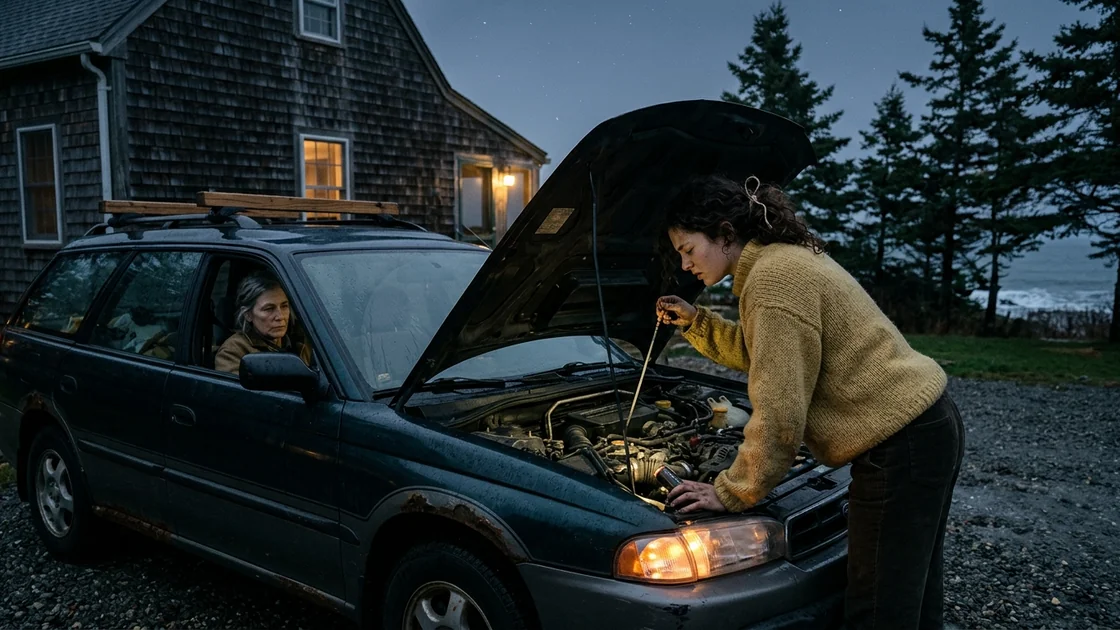
Nora reached into her pocket and pulled out the keys to her old Subaru wagon—the one with two hundred and ten thousand miles, the rusted rocker panels, and the wood racks on the roof.
"Bangor is seventy miles," Nora said, her voice completely calm, practical, and clear. "The coastal feeder bus takes three hours because it stops at every fish pier between here and Rockland. If you take the bus, you’ll be sitting in the terminal in Montreal with three drunks and a wet ceiling by noon."
"Mom—"
"Get your bag," Nora said.
"You're driving me to the bus?"
"No," Nora said, setting the keys on the oak table. "I’m driving you to Bangor. But we're not buying a ticket to Neah Bay."
Maya’s throat worked. "Where are we going?"
"We're going to Port Angeles," Nora said.
Maya stepped back, her mouth open, her hand catching the edge of the kitchen counter.
"You said he was crazy," Maya whispered. "You said he would destroy me."
"He will," Nora said, "if you go to him like a beggar. If you go to him like a lost puppy who thinks he’s going to give her a name and an identity, he will eat you alive, Maya. He will fill your head with twenty years of poison, and you will spend the rest of your life trying to prove to him that you’re wild enough to be his daughter."
Nora picked up the keys. She walked over to the kitchen door, picked up Maya’s heavy rucksack by its canvas handle, and stepped out onto the granite threshold into the cold, salt-scented night air.
"We are going to find him together," Nora said, looking back over her shoulder into the dark kitchen where her daughter stood frozen in the moonlight. "We're going to take the car. We're going to take five days to drive across this country. We're going to stop at the mine in Montana where I told you he died, so you can see what an open pit looks like. We're going to stop at the cabin in Forks, so you can see where the roof rotted in after I left. And then we are going to Neah Bay."
"And then what?" Maya asked, her voice cracking in the wind.
"And then you are going to look at him," Nora said. "Not through his letters. Not through a photograph from 2004. You are going to look at an old, bitter man who lives in the salt and cuts steering linkages because he doesn't know how to keep a woman from walking out of a room. You are going to look at him until you see that he is just a man. And then, Maya, you can decide whether you want to stay in the woods, or whether you want to come home."
Maya stood in the open doorway. The cold wind off the Gulf of Maine came through the screen, smelling of bladderwrack, wet granite, and the long, deep highway that ran three thousand miles west into the dark.
She looked at her mother.
She saw the gray hair escaping from Nora’s tortoiseshell clip, blowing across a face lined by thirty years of salt winds, wood chisels, and the terrible, daily labour of keeping a lie alive. She saw the scar on Nora’s left forearm, visible where the flannel sleeve was pulled back—the faint, circular shadow of the lantern valve, eighteen years faded, but still there, etched into the skin like an unalterable maker’s mark.
Maya looked down at the silver compass in her own palm.
She didn't put it in her pocket. She walked over to the kitchen table, picked up Julian’s letter, picked up the bus ticket to Montreal, and laid them both beside the cold hearth.
Then she walked out the door, took the heavy rucksack from her mother’s hand, and threw it into the back of the station wagon.
"Move over," Maya said, her voice low and steady as she reached for the driver's side door handle. "I have my license. And you always get a headache if you drive before the sun comes up."
Nora stood in the gravel for three seconds. The ocean below them was dark, roaring with the immense, indifferent weight of the ebb tide, pulling thousands of tons of cold Atlantic water out through the slot between the black rocks.
"Check the oil first," Nora said, her voice rough with salt. "The seal on the main crank has a slow leak. You have to keep your eye on it every four hundred miles."
"I know," Maya said, popping the hood with a clean, metallic snap that broke through the roar of the surf. "I’ve been watching you do it since I was ten."
Nora walked around to the passenger side, opened the door, and got in.
The interior smelled of old cedar shavings, damp dog from three years ago, and peppermint gum. Nora pulled her barn coat tight around her shoulders, settled her bifocals into her pocket, and watched her daughter through the smeared windshield.
Maya was leaning over the radiator, her long, dark curls tied back with a piece of butcher’s twine she had found on the seat, her hands black with engine oil as she pulled the dipstick, wiped it on her trousers, and held it up to the cold starlight to check the level.
Her face was Julian’s.
Her hands were Nora’s.
And between them, the road was three thousand miles of unvarnished timber, waiting to see what kind of join could be made from the split.