The Geography of Paper and Salt
For three years, Clara Morse has sustained her emotional life through an anonymous correspondence organized by the classifieds desk of a dwindling literary journal, sharing her grief, her mundane days, and the lingering wounds of her past with a stranger known only as The Glassblower. When an offhand memory concerning a rusted copper weather vane and an heirloom tin of cardamom appears in her correspondent forty-second letter, the illusion of distance shatters, revealing that the confidante to whom she has confessed her deepest guilt and loneliness is her estranged younger sister, Julianne. Having severed all contact eight years prior amidst the bitter distribution of their mother estate, Clara is forced to confront how thoroughly they have come to know each other under the protective veil of darkness, and whether the forgiveness they discovered on paper can survive the light of their shared history.
I. The Chicago Routing Desk
The postmarks never lied, though they told only a single, deliberate half-truth. Every envelope Clara Morse received arrived bearing the round, purple ink-stamp of the Chicago General Sorting Facility, followed by the small, discreet imprint of The Marginalia Review: Department of Literary Exchange, Box 404.
The magazine itself was an anachronism, a thick, uncoated quarterly printed in Minneapolis and distributed to a readership of barely three thousand university libraries, independent bookstores, and retired classicists. At the very back of each issue, nestled between the advertisements for hand-bound journals and translation fellowships in Lisbon, sat "The Blind Exchange." The rules were printed in eight-point Garamond: Submissions must not contain surnames, precise geographic coordinates, municipal landmarks, or verifiable institutional affiliations. The editors reserve the right to excise references to living persons that might compromise total anonymity. Forwarding envelopes must be furnished with standard domestic postage. Patience is required; the transit of thought is not an emergency.
Clara had placed her initial notice in the autumn following her thirty-second birthday, during the wet, relentless November that had nearly broken her. She had been living alone for five years in the saltbox cottage her father had once used as a net-mending shed on the outer edge of Cape Ann. She worked four miles down the coast at the public library in Rockport, repairing the spines of water-damaged paperbacks and shelving local histories that smelled of moldering hemlock. Her life was quiet to the point of calcification.
Her initial listing had been brief, written on the back of an overdue slip for a volume of George Herbert’s poems:
Turnspit (F, 32). Maritime New England. Preoccupied with structural permanence, archival glue, mending torn leaves, and the problem of carrying things without dropping them. Desires dialogue with someone who understands that silence is not empty, but merely dense. No collectors.
Two months later, the first manila envelope forwarded from Box 404 arrived on her draining board. Inside was a single folded sheet of seventy-pound laid paper, watermarked with a crane in flight, written in a disciplined, slightly back-tilted cursive with walnut-colored ink.
Turnspit, the letter began. You call yourself a kitchen dog, but your vocabulary belongs to an undertaker of paper. I am not a collector. I work with high heat, silica, and breath, which means I spend my days attempting to convince liquid to freeze before it remembers gravity. We may speak of permanence if you wish, though you should know from the outset that in my trade, everything that is beautiful has survived an argument with cold air that it will eventually lose. Let us call me The Glassblower. If we are to write, tell me what you left behind in the room you are most afraid to re-enter.
Clara had kept the letter on her nightstand for three weeks before replying. She had never been a woman given to casual revelation; her natural defense had always been a retreating stillness. Yet there was something in the stranger’s cadence—the mixture of defensive arrogance and an underlying, shivering weariness—that felt like an acoustic match to her own interior walls.
When she finally replied, she did not describe her mother’s deathbed, nor the violent, petty argument over the split-rail fence and the mahogany linen press that had sundered her from her only sibling eight years ago. Instead, she wrote of the small conservatory behind a house she no longer owned, where geraniums had been left to freeze against the glass until their stems turned to black gel.
To The Glassblower, she had typed on her portable Smith-Corona, careful to use standard ribbon on plain bond. The room I am afraid of contains nothing supernatural. It is merely full of cupboards that were shut before they were cleaned. When I was eleven, I believed that if I didn't look at an open drawer, the objects inside would dissolve into gray ash. Now I am older, and I know they simply stay there, growing heavier under the weight of their own names.
Thus began the long, rhythmic exchange. Over three years, thirty-nine letters traveled back and forth across the blind Chicago hub. In an era when the world had reduced itself to the frantic, instantaneous buzz of glass screens, their conversation moved with the deliberate, oceanic pace of a nineteenth-century correspondence. A letter mailed in mid-March would return its echo in late April.
They spoke of their work with tactile precision. The Glassblower wrote of the furnace’s hum, the terrifying viscosity of hot soda-lime, the smell of charred cherrywood blocks used to shape the molten gather, and the strange, monastic fraternity of the workshop floor. Clara wrote of bone folders, wheat-starch paste, the grain of linen thread, and the specific melancholia of discovering handwritten annotations in the margins of nineteenth-century parish records—shopping lists penciled alongside deaths from consumption.
Gradually, as the seasons turned and the pile of cream-colored envelopes grew in the tin biscuit box under Clara’s bed, the scaffolding of their daily trades began to support heavier timber.
They never traded names. They never exchanged photographs. They followed the journal’s ordinances with a quasi-religious fidelity, referring to the people in their lives only by archetypes: The Landlord, The Apprentice, The Pale Woman, The Doctor.
I don't believe in balance, The Glassblower wrote in the winter of their second year. Balance is a trick practiced by people who have never had to carry anything heavier than a tray of tea. What we have is compensation. We tilt our bodies against the wind until we are walking at an angle that would look absurd in a photograph, simply to avoid being blown off the pier. Tell me: when you walk, which shoulder is lower? Mine is the left. It has been pulled down by the weight of things I was too stubborn to set down on the road.
Clara had read those lines sitting beside the radiator in the library’s basement, while outside, sleet had turned the harbor into a boiling cauldron of gray froth. She had touched her own left collarbone, feeling the hard, familiar knot of muscle that had seized up during the terrible summer of their family’s final collapse.
My left, too, she had written back. Though I think mine is pulled down by the ghost of a hand that let go of my wrist when I was twenty-four. I used to think that when someone abandons you, they take their weight with them. It isn't true. They leave their exact displacement behind, like lead poured into the hollow they used to occupy.
Who was it? The Glassblower had asked in the next letter, dated six weeks later. A lover?
Clara had stared at the typewriter for two full days before answering. No, she wrote. Not a lover. Someone who shared my blood and none of my silences.
The reply from Box 404 had been unusually short, arrived on paper that bore the faint, ghostlike smudge of charcoal on the upper margin:
Silences are inherited, The Glassblower wrote. Just like bad teeth and a predisposition to gout. If she did not share yours, it was because she had to make enough noise to keep from hearing the rafters creaking above her head. You ought to forgive her that much, Turnspit. Noise is very frightening to people who live in libraries, but it is often the only thing that keeps the barn roof from caving in on the horses.
Clara had wept over that letter, sitting in the dark of her porch with a blanket pulled over her knees, feeling simultaneously stripped bare and mysteriously absolved by a stranger who worked glass somewhere in the vast, indifferent center of the continent.
II. The Salt and the Cardamom
The unraveling of their world did not occur through a dramatic confession, but through a kitchen utensil and a tin of Scandinavian spice.
The winter of the third year was brutal along the North Shore. The pipes in Clara’s cottage froze twice in January, and the road to the library was frequently impassable, buried under drifts of coarse, gray beach sand and hard-packed snow. Clara spent her evenings wrapped in a heavy wool cardigan, reading by the yellow glow of an oil lamp to conserve electricity, her correspondence box open on the drop-leaf table.
Letter Forty-One arrived during the second week of February.
The Glassblower had been sick with a persistent lung congestion—"the inevitable gift of an intake fan that failed during a twelve-hour melt," she had written—and her cursive was less upright than usual, wavering slightly like tall grass in a draft.
I have been confined to this narrow room for nine days, the letter said. Living on hot water, lemon, and memory, which is the worst possible diet for a person of my temperament. My landlord brought me a bowl of broth yesterday, but he made it with turnips, which I loathe; they taste of soil and disappointment. When we were small, my sister and I had a governess—well, not a governess, that makes us sound like people with portraits in the hallway, she was really just an aunt with nowhere else to sleep—who believed that any fever could be cured by boiling dried pears with brown sugar and three crushed pods of green cardamom in a copper pan.
Clara stopped reading.
A log shifted in her small cast-iron stove, sending a soft shower of orange sparks against the mica glass. The wind rattled the loose sash in the south window, a sound like dry fingers drumming on pine.
She read the sentence again.
...boiling dried pears with brown sugar and three crushed pods of green cardamom in a copper pan.
Clara’s heart did not race; it did something far more terrible. It seemed to stop entirely, falling through her ribs like a dropped lead sinker into cold water.
The recipe was not in Fannie Farmer. It was not in any regional cookbook. It was the frantic, idiosyncratic invention of Aunt Magda—their father’s eccentric sister from Gotland, who had spent four years living in the back bedroom of the family farmhouse outside of Exeter, New Hampshire, after her second divorce. Magda had kept dried pears in blue glass jars in the pantry and had ground the cardamom with the back of an old brass door handle because she claimed stone mortars stole the essential oils.
Clara laid the letter flat on the table. She smoothed the paper with the palm of her hand, feeling the small, raised ridges where the pen nib had bitten into the fiber.
It is a coincidence, she said aloud to the empty room. Her voice sounded thin, strange, like dry paper tearing.
The culinary habits of Baltic immigrants were not unique. There were thousands of families in New England, in Wisconsin, in Minnesota, who used cardamom with fruit. It was a common northern European combination. The Glassblower could be in Duluth. She could be in Door County. She could be an elderly German woman who worked stained glass in an artisanal studio in Milwaukee.
She picked up the page again, her fingers suddenly cold.
She used to tell us, the letter continued, that the steam from the cardamom was the breath of the mountain spirits, and if we didn't inhale it deeply, our lungs would turn into wet sponges. My sister, who was older and thought herself a junior philosopher before she had even grown her adult molars, used to argue that the spirits were only steam, and that steam had no soul. God, she was an exhausting child. She had a little brass notebook with a tiny pencil tucked into the spine, and she would record every time someone made an assertion that could not be proved by the physical sciences. She called it 'The Ledger of Follies.' I stole it once and threw it into the rain barrel behind the sheep shed. She didn't speak to me for twenty-two days. I remember counting them. On the twenty-third day, she walked into my room, set a dead robin on my pillow, and said, 'Now we are even.' We never spoke of the notebook again.
Clara stood up so abruptly that her chair scraped against the bare pine floor with the screech of an injured gull.
She backed away from the table until her shoulders hit the doorframe of the kitchen.
The tin biscuit box under the bed. The forty-one letters. Three years of weekly, bi-weekly, monthly intimacy. The confession about the fear of the dark. The confession about the abortion she had endured alone at twenty-six in a clinic in Portland, which she had told no one—no one—in the living world, because she could not bear the look of pitying revulsion in her mother’s eyes. The Glassblower’s confession about her own wild, self-destructive affairs, her terror of turning forty, her hatred of their mother’s portraits.
Our mother’s portraits.
Clara lunged forward, seized the tin box from beneath the bed, and dumped its contents onto the patchwork quilt. The cream-colored envelopes spilled out like a shattered deck of cards.
She fell to her knees on the braided rug, her hands shaking violently as she sorted through the dates, her nails catching on the paper.
Letter Eighteen. July of their second year.
She found the page, her eyes scanning the paragraphs with a desperate, forensic urgency that felt like drowning.
I lost my mother six years ago, The Glassblower had written. She was an artist, though if you saw her paintings you would have called her a demolitionist. She worked with a palette knife the size of a trowel and used to leave dried oil skins all over the kitchen table. When she died, she left the house to my sister and me with the explicit instruction that we were not to sell it until the orchard had produced a good crop of Russets. The orchard hadn't produced a good crop since 1974. It was her final, spiteful little riddle. We sold it anyway, of course. My sister wanted the money for something safe and gray—treasury bonds or some other instrument designed for people who expect the world to end on a Tuesday afternoon. I wanted to use my half to buy a furnace. We had an argument in the gravel driveway that ended with her throwing a brass carriage clock through the rear window of my station wagon.
Clara dropped the page.
The room seemed to tilt on its axis. The familiar smells of the saltbox—the dry wood smoke, the damp wool, the lingering scent of lavender soap—suddenly vanished, replaced by the choking, metallic memory of hot gravel on an August afternoon in New Hampshire, the sound of safety glass imploding into ten thousand diamond-shaped pebbles, and Julianne’s face, red and contorted with an animal fury, screaming through the shattered tailgate:
"You are an empty shell, Clara! You are just like her, only without the courage to pick up the brush! You just sit there and curate the wreckage!"
Clara curled forward, her forehead pressed against the edge of the mattress, the rough wool of the quilt scratching her cheek.
Julianne.
It was not a stranger in Chicago. It was not a sixty-year-old artisan in Duluth. It was the girl who had shared her trundle bed until she was twelve; the girl whose scuffed knees she had cleaned with witch hazel; the woman who had spat on their mother’s coffin as it was lowered into the sandy loam of the Exeter cemetery while the minister looked away in miserable confusion.
The Glassblower was Julianne.
III. The Architecture of the Shadow
For five days, Clara did not leave the cottage. She called in sick to the library, telling Mr. Henderson that she had contracted a severe case of influenza. Her voice was so hollow, so drained of its usual brisk efficiency, that he did not even question her, merely urging her to drink hot cider with rum and stay away from the drafty stacks until Monday.
She did not drink cider. She lived on black tea and dry toast, pacing the narrow perimeter of the saltbox like a creature confined to a holding pen.
On the third night, she lined the letters up along the floor in chronological sequence, from the first brief inquiry in November to the devastating revelation of the cardamom pods. She moved between them on her knees, reading them not as the musings of a kindred spirit, but as an interrogation.
Now that the blindfold had been stripped away, the evidence was everywhere, staring at her with terrifying clarity. How had she been so utterly blind?
The handwriting: Julianne had always written with that peculiar, left-slanting stroke, the result of their father’s clumsy attempts to force a natural left-hander into right-handed compliance when she was in the second grade. Julianne had eventually returned to her left hand, but the slant had remained permanently inverted, like trees growing on a wind-scoured bluff.
The cadence: That sharp, defensive irony that could pivot in a single semicolon into a devastating, almost embarrassing vulnerability. It was the exact emotional rhythm of Julianne at sixteen, sitting on the bulkhead behind the barn with a stolen cigarette, talking about how she wanted to run away to an iron foundry in Pittsburgh because "metal doesn't pretend to care about your feelings before it burns you."
Why didn't she know? Clara wondered, her knuckles pressed against her teeth. Did she know? Has she known all along?
She went back to her own letters, pulling her carbon copies and rough drafts from the lower drawer of the desk. She read her own words through Julianne’s eyes.
She had called herself Turnspit. She had never mentioned her town. She had spoken of her work in terms so deliberately abstracted—"the conservation of dead thought," "the stabilization of deteriorated surfaces"—that Julianne might easily have assumed she was an assistant curator at a museum in Philadelphia or an academic bookbinder in Chicago.
And Clara had hidden her domestic life entirely. She had never mentioned their father’s name, nor their mother’s. She had referred to her family only as "the estate to the north," describing it as if it were an institutional ruin rather than a clapboard farmhouse with four cords of seasoned ash rotting behind the woodshed.
No. Julianne did not know.
If Julianne had known, the letters would have been impossible. Julianne was incapable of sustained deception; she was an emotional arsonist, not a spy. If she had suspected for an instant that the person on the other end of Box 404 was the older sister she had accused of emotional cowardice and financial theft, she would have either burned the letters in her furnace or sent an envelope filled with vitriol and crushed coal.
She didn't know. Julianne was speaking into what she believed was the void.
Clara sat back on her heels amidst the sea of paper.
For three years, her sister had been telling her the truth. Not the curated, defensive truth of sisters who share a childhood and a set of silver spoons, but the terrifying, unvarnished truth that one only dares to speak to a shadow.
She picked up Letter Twenty-Four. It had been written thirteen months ago, on a sheet of thin, cheap newsprint.
Turnspit, it read. I had that dream again last night. The one where I am walking through the house in Exeter, only all the doors have been rehung three feet off the floor, so that to enter any room you have to climb over a sill that catches you right in the groin. In the front room, my sister was sitting at the tea table with her back to me. She was wearing that awful brown coat she bought with her first paycheck from the bindery. I wanted to touch her shoulder, but I knew that if I did, her head would turn around and her eyes would be made of those little lead weights they use to balance window sashes. I woke up with my jaws clenched so hard that my molars were aching.
I wonder where she is tonight. Probably in some tidy little room with all her pencils sharpened to identical points, thinking that she was the only one who suffered through that woman’s decline. She always thought she had a monopoly on endurance because she was the one who kept the checkbook. She never understood that watching someone go mad through the lens of bookkeeping is a choice. You can hide behind numbers just as easily as you can hide behind gin. I hate her for being so clean. But God, Turnspit, sometimes I would give five years of my life to have her tell me, just once, that the house was too cold for both of us.
The paper trembled in Clara’s fingers.
She remembered the brown coat. It had been wool, bought from an outlet in Portsmouth for forty dollars. She had worn it to their mother’s funeral because she couldn't afford to buy a black one after paying the outstanding fuel oil bills that Julianne had ignored for seven months.
You can hide behind numbers just as easily as you can hide behind gin.
The accusation hit Clara with the force of an open hand. She had spent eight years congratulating herself on her sanity, on her reliability. She had been the daughter who stayed, the daughter who negotiated with the nurses, who cleaned the paintbrushes that Sylvia had abandoned in the sink to stiffen into stone, who had endured the old woman’s venomous, senile lucidities while Julianne had been off in Providence or Seattle, blowing glass and sleeping with married sculptors.
Clara had felt righteous. She had wrapped herself in that righteousness like a shroud, using it to justify every cold word, every refusing silence, every legal letter sent through her attorney during the probate fight.
And yet, over the last thirty-six months, she had poured her heart out to this very woman. She had told The Glassblower things she had never told a living soul.
She had confessed to The Glassblower that she still kept their mother’s cracked horn-rimmed glasses in her jewel case because she couldn't bear to throw away the shape of her face.
She had confessed that sometimes, when she walked along the breakwater at sunrise, she was seized by a desire so violent it made her sick: the desire to scream until her vocal cords bled, simply to prove to the gulls that she was not made of dry paper.
And The Glassblower had answered: I know. I know the feeling of the throat closing up. It is the salt in your lungs, Turnspit. Let it out. Don't let it turn into stone inside your belly. If you don't scream, you'll crack from the center out, the way a vase does when you set it down too hard on a granite slab.
They had been mothering each other. They had been forgiving each other. They had been doing through an anonymous post office box in Chicago what they had been utterly, catastrophically incapable of doing across a four-foot kitchen table.
IV. The Pretense of Ignorance
The sun rose on Saturday with a pale, arctic brilliance that made the frozen harbor look like a sheet of hammered pewter.
Clara stood at her desk. Her typewriter sat before her, its black keys waiting with their circular, nickel-plated rims. Beside it lay the blank response form for The Marginalia Review, stamped with the forwarding code for The Glassblower.
She had two choices.
The first was silence. She could simply drop out of the Exchange. It was not uncommon; the editors warned participants that correspondences often withered without warning, terminated by illness, change of address, or the natural exhaustion of interest. She could box the letters, slide them back under the bed, and let Julianne wonder why The Turnspit had suddenly stopped answering. Julianne would eventually assume that her correspondent had died or grown bored. The secret would remain intact. Clara could preserve the fiction of their clean, permanent estrangement. She would never have to look into Julianne’s eyes and admit that she had read her sister’s soul in walnut ink.
The thought made Clara’s chest contract with such acute physical pain that she had to brace herself against the desk.
To kill the correspondence was to murder the only Julianne who had ever loved her without armor. It would be a second abandonment, colder and more cowardly than the first.
The second choice was to shatter the glass. To write back: Julianne, it is Clara. I know about Aunt Magda’s pears. I know about the carriage clock. Stop this ridiculous game.
She imagined Julianne receiving that letter. The horror. The sense of total, humiliating violation. Julianne had written about her lovers, her abortions, her deepest terrors, her petty jealousies—believing she was speaking to an empathetic stranger who existed only as an abstract mind three hundred miles away. To discover that every word had been received by the sister she despised, the sister whose judgment she feared above all else, would not produce a reconciliation. It would produce a catastrophic revulsion. Julianne would feel hunted, trapped, exposed. She would retreat behind an impenetrable wall of rage, and the fracture between them would become absolute.
There was a third path, but it was narrow as a razor’s edge, and it required a degree of emotional courage that Clara had never possessed.
She could write back. She could maintain the pretense for one more letter. But she could introduce a clue so unmistakable, a detail so uniquely theirs, that the realization would dawn on Julianne not as an ambush, but as an invitation.
She had to allow Julianne to discover it for herself.
Clara sat down in her chair. She rolled a sheet of the heavy cream bond into the platen of the Smith-Corona. Her hands had stopped shaking; they were cold, steady, the hands of an archivist preparing to mend an irreplaceable folio that was split down the gutter.
To The Glassblower, she typed.
Her fingers paused over the keys.
Your Aunt Magda was right about the cardamom, she wrote, her mind moving with a strange, lucid calm. Though she omitted the most important detail: the pears must be Bosc, not Bartlett, and they must be peeled with the little knife that had the split cherry handle, otherwise the juice turns bitter against the steel.
She paused. She took a slow, deep breath, smelling the cold ribbon of the typewriter.
I have been thinking about what you said regarding the noise people make to keep the barn roof from falling. You were right to rebuke me. I have lived so long among silent things that I forgot that timber creaks before it breaks. I forgot that when a beam groans, it is not complaining; it is merely trying to hold up the sky.
You asked me once what I did with the things I inherited that could not be repaired with paste or thread. I told you I had buried them. That was a lie.
I kept them. I kept the blue glass bottle that had the salt from the summer we went to Monhegan. I kept the small brass carriage clock with the cracked bevel, the one whose spring was wound so tight it would only tick if you held it sideways in the palm of your hand.
And I kept the memory of the August afternoon when the glass broke in the driveway. I did not throw the clock because I was angry about the house, Glassblower. I threw it because I knew that if I did not throw something heavy, I was going to reach out and pull you back by your hair, and I was terrified that if I touched you, you would see that I was shaking.
We have been speaking in the dark for three years. It is very warm in the dark, and very safe. But the editors in Chicago are growing old, and paper is subject to damp rot, and sooner or later, someone has to turn the lamp on to see if the room is still there.
I am not in Philadelphia. I am not an archivist of great things. I am forty-four miles from where we were born, sitting in a house where the fog smells of dead mackerel and cold granite. If you still have the station wagon, the muffler probably needs replacing. It always did in the damp.
Yours,
She did not type Turnspit.
For the first time in thirty-nine letters, she signed it with the name their father had given her, the name that had not been spoken by a member of her family for nearly a decade:
Clara.
V. The Void of the Transit
The Chicago routing desk was not built for haste.
Clara walked to the post office at the end of the harbor on Saturday morning. The sky had darkened to the color of wet slate, and a heavy, wet snow was beginning to fall, the flakes hissing as they touched the black surface of the tide.
She dropped the envelope into the blue iron collection box outside the door. The clank of the spring-loaded lid sounded like a trap snapping shut.
Once the letter was gone, a terrible, flat silence settled over her life.
In the past, the waiting had possessed a gentle, domestic rhythm. She would mail a letter and know that for seven days it would travel west; that for two or three days it would sit in Box 404 while an unpaid graduate student sorted the submissions; that it would spend another week traveling to wherever The Glassblower lived; that The Glassblower would keep it on her table, perhaps for a week, perhaps for two, before replying. The cycle took a month, sometimes six weeks. Clara had learned to inhabit that delay as a form of architecture.
Now, the delay was an agony.
She returned to the library on Monday. Mr. Henderson was solicitous, offering her lozenges and asking after her chest. She worked with a feverish, mechanical intensity, re-backing eighteenth-century town ledgers with Japanese tissue and wheat-starch paste, her bone folder moving across the leather with rhythmic, merciless pressure.
Every time the mail carrier entered the building with the morning delivery, Clara’s vision narrowed to a pinprick. She watched his leather satchel with an intensity so feral that the poor man, a harmless veteran named Arthur who had delivered mail in Rockport for thirty years, began to look at her with nervous apprehension.
"Nothing from Illinois today, Miss Morse," he said on Wednesday of the second week.
"I didn't ask," she replied, her voice sharper than she intended.
"No," Arthur said mildly, setting a stack of catalog cards on her desk. "You just look like a woman waiting for a court martial."
Two weeks became three. Three became four.
February gave way to the gray, sleety misery of early March. The snow along the roads turned to the color of soot, and the harbor was full of dirty pancake ice that ground against the pilings with a sound like teeth chewing gravel.
Clara began to lose sleep. She would wake at three in the morning, her heart hammering against her ribs, convinced that she had made the most monstrous mistake of her life.
She isn't going to write back, Clara thought, staring at the water stains on her bedroom ceiling. She received it. She saw what I did. She felt the trap close, and she threw it into the furnace. She will never write again.
The thought of Julianne burning the letter was worse than the thought of her rage. If Julianne burned it, it meant that the three years had been erased. It meant that the sanctuary they had built out of paper had been contaminated by the reality of Clara’s existence, turned into something shameful and obscene that had to be incinerated.
By the middle of March, Clara had prepared herself for the end.
She took the tin biscuit box from beneath the bed and brought it down to the sitting room. She placed it on the hearth beside the wood stove. She did not open it. She simply let it sit there, cold and heavy, a memorial to a three-year conversation with a sister who had ceased to exist twice.
On the twenty-first of March, the equinox arrived with a torrential northeaster that stripped the shingles from the fish shacks along the pier and flooded the library’s basement. Clara spent the entire day in rubber boots, hauling boxes of nineteenth-century tax records out of the rising water, her back screaming with fatigue, her hands raw and smelling of stagnant harbor brine.
When she finally returned to the cottage at six in the evening, the rain had stopped, replaced by a low, suffocating sea fog that obliterated the road.
Her boots were heavy with mud as she climbed the granite steps to the porch.
Sitting on the top step, sheltered from the drip of the eaves by the overhang of the roof, was a woman.
VI. The Glassblower on the Porch
She was wearing a men’s surplus mackinaw coat of dark green wool, entirely too large for her, the sleeves turned back to reveal wrists that were scarred with the pale, circular marks of glass burns. Her boots were unlaced at the top, crusted with the gray road salt of an interstate journey. She had a canvas kit bag between her feet, and she was smoking a thin, brown cigarillo that smelled of licorice and damp tobacco.
Her hair, which had been bright copper when Clara had last seen her in the gravel driveway eight years ago, was now threaded with coarse streaks of silver at the temples, cut short and jagged, as if she had taken a pair of kitchen shears to it in front of a mirror without bothering to check the back.
She did not stand up when Clara reached the gate. She merely tapped the ash of her cigarillo onto the wet granite.
Clara stopped six paces away, her wet canvas apron still tied over her sweater, her wool mittens dripping rainwater onto her boots.
The fog drifted between them, tasting of salt and wood smoke.
For a long time, neither of them spoke. The sound of the buoy bell out on the reef drifted across the marsh, two notes—flat, discordant, mournful.
"The routing desk doesn't exist anymore," Julianne said. Her voice was lower than Clara remembered, roughened by furnace fumes and tobacco, but the cadence—that sharp, downward tilt at the end of each phrase—was the exact cadence that had inhabited the cream-colored pages for thirty-six months. "The journal went into receivership in January. The English department at Northwestern bought the subscription list, but they threw the classifieds files into a recycling bin. Some twenty-two-year-old adjunct with a beard told me they were 'discontinuing the non-academic features.'"
Clara swallowed. Her throat was so dry it felt as though she had been swallowing sand.
"How did you get the address?" Clara asked.
Julianne took a long drag from the cigarillo, the red coal illuminating the hollows of her cheeks, the deep, permanent lines etched between her eyebrows.
"I didn't get it from the desk," she said. "I went to Chicago. I drove thirty-two hours from Bloomington with a bad alternator. I found the kid with the beard in his office. I told him that if he didn't dig the forwarding ledger out of the basement for Box 404, I was going to take the brass paperweight off his desk and put it through his monitor." She let out a short, harsh bark of laughter that ended in a cough. "He believed me. He had soft hands. The kind of hands that have never touched anything hotter than an espresso machine."
She dropped the butt of the cigarillo into the mud beside the step and ground it out with the heel of her boot.
"You're thinner," Julianne said, looking up at her through the gloom. "You look like an umbrella that’s been left out in the yard all winter."
"You have silver hair," Clara said.
"It’s glass dust," Julianne said defensively, though her hand rose involuntarily to touch her temple. "It gets into the scalp. It stays there."
She picked up her canvas bag and stood up. She was shorter than Clara by three inches, but she had the wide, solid shoulders of someone who swung five-pound steel blowpipes eight hours a day. She stood with her weight shifted heavily to her right side—compensating, Clara noticed with a sudden, painful lurch of memory, for the left shoulder that hung lower than the other.
"Well?" Julianne said. Her voice had lost its defensive edge; it was suddenly small, thin, trembling with an uncertainty so profound that she looked like a child standing on the wrong platform at a train station. "Are you going to leave me out here until my boots freeze to the stone, or are we going to see if the room is still there?"
VII. The Inventory of the Parlor
Clara unlocked the door.
The saltbox was cold, smelling of the ash in the stove and the damp wool of Clara’s coat. She lit the two kerosene lamps on the sideboard with fingers that felt like wood, her back turned to her sister. She could hear Julianne behind her—the heavy thud of the kit bag being dropped onto the braided rug, the wet rustle of the mackinaw being peeled off, the deep, shuddering sigh of someone who has been holding her breath since western Massachusetts.
When Clara turned around, Julianne was standing in the middle of the low-ceilinged room, staring at the drop-leaf table.
The tin biscuit box sat there, open. Around it, arranged in neat, overlapping rows, were forty-one letters, their cream-colored paper catching the amber light of the lamp.
Julianne walked over to the table. She did not touch the letters. She looked down at them with a strange, clinical detachment, like a surgeon examining an incision that had healed into an ugly, necessary scar.
"You kept them all," Julianne said.
"Of course I kept them," Clara said. "They were the only clean things in my house."
Julianne reached out and picked up Letter Seven. She looked at the handwriting—her own left-leaning, angular script.
"I told you about David," Julianne whispered. Her face had gone completely white under the weather-beaten tan of the workshop. "In this one. I told you he left me in that motel in Idaho with forty dollars and a broken fuel pump."
"Yes," Clara said.
"And you wrote back..." Julianne’s voice hitched, a dry, catching sound. "You wrote back that men who leave women in motels are not monsters, they are just small creatures who have realized they are in a room with something too large for them to eat."
"I remember what I wrote," Clara said softly.
Julianne dropped the letter. She turned around, her face twisted in a spasm of grief and humiliation so violent that she looked almost grotesque in the lamplight.
"How could you do it?" she cried, her voice cracking against the low rafters. "How could you let me write those things to you? For three years! You knew how much I hated you! You knew what I thought of you!"
"I didn't know!" Clara stepped forward, her voice rising to match her sister’s for the first time in eight years. "I didn't know until the cardamom! I didn't know until the letter about Aunt Magda’s pears! Do you think I would have survived reading those things if I had known they were from you? Do you think I am that cruel?"
Julianne stared at her, her chest heaving under her flannel shirt.
"You didn't know?" she whispered.
"Not until February," Clara said, her voice dropping into a desperate, pleading whisper. "Not until you wrote about the dead robin. Not until you told me about throwing the notebook in the rain barrel. I swear to you, Julianne. On our father’s grave. On whatever is left of that house in Exeter. I thought you were an old woman in Wisconsin. I thought you were someone who had never seen my face."
Julianne sank slowly into the Windsor chair beside the table. She buried her face in her scarred, calloused hands, her shoulders shaking with silent, rhythmic convulsions.
Clara did not move. The instinct of eight years of estrangement—the habit of emotional distance, of protective numbness—screamed at her to remain where she was, to offer a glass of water, to find a towel, to retreat into the kitchen and make tea. To be clean. To be safe.
Instead, she crossed the floor.
She knelt down on the braided rug beside the chair, the cold dampness of her trousers soaking through to her knees. She did not reach out with the delicate, hesitant touch of an archivist. She put both arms around her sister’s ribs, burying her face into the rough, smoky wool of Julianne’s shirt, holding her with a fierce, clumsy desperation that smelled of harbor rain and ancient ash.
Julianne did not pull away. After a terrible, rigid second, she collapsed sideways against Clara, her hands gripping Clara’s shoulders with the terrifying strength of a glassmaker, her fingers digging through the sweater into the bone, sobbing into Clara’s hair with the raw, ragged fury of an animal that has finally reached the end of the woods.
"I was so lonely, Clara," she wept, the words muffled against Clara’s neck. "God, I was so lonely. Everything I made broke. Every time I opened the furnace, I just wanted to put my arm into it so I wouldn't have to go back to that room alone."
"I know," Clara whispered, her own tears finally breaking, hot and salt-bitter against her cold skin. "I know. You told me. You told me in August."
"I didn't want it to be you," Julianne sobbed. "I wanted it to be anyone else in the world. I wanted to hate you forever."
"I know," Clara said, rocking her slightly on the floor, feeling the hard, knobbed vertebrae of her sister’s spine through the flannel. "It was easier to hate me. It kept the roof from falling."
VIII. The Geography of the Garden
They did not sleep that night.
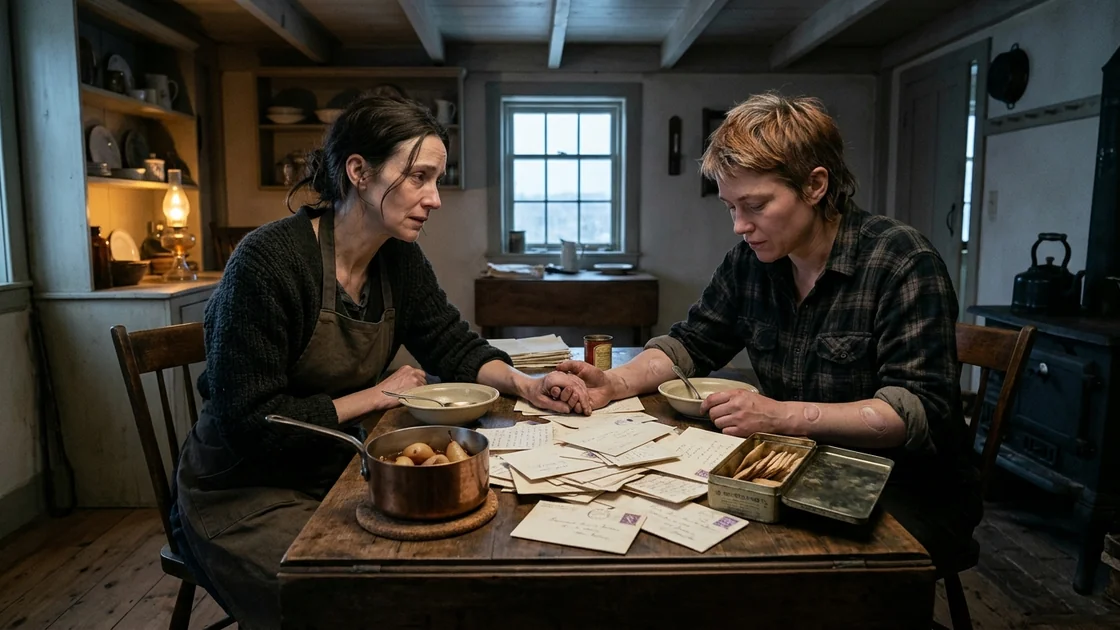
They moved from the floor to the kitchen table. Clara built up the fire in the cast-iron stove until the iron glowed a dull cherry-red in the shadows, driving the damp chill from the room. She boiled water, but she did not make tea; she found a jar of dried plums, some brown sugar, and an ancient, unopened tin of cardamom that had sat at the back of her cupboard since she had moved to the coast.
She crushed the green pods with the handle of a heavy kitchen knife, the sharp, citrus-and-camphor scent filling the small room, cutting through the smells of kerosene and wet wool.
Julianne watched her from the Windsor chair, her eyes red-rimmed and swollen, a mug of hot water cradled between her scarred palms.
"The knife had a split handle," Julianne said softly.
"It did," Clara said, watching the steam rise from the small copper pot on the stove. "Father mended it with copper wire, but it always pinched your thumb if you held it too close to the blade."
"You remember that?"
"I remember everything," Clara said, turning around to lean against the counter. "That was my problem, Julianne. You forgot everything because you were moving too fast to look behind you, and I couldn't forget a single split rail or a single unwashed saucer. I was carrying the whole house in my head, and I blamed you because you wouldn't help me hold the weight."
Julianne looked down at her hands, turning them over to inspect the scars on her palms.
"I didn't run because I didn't care, Clara," she said, her voice barely louder than the hum of the stove. "I ran because when I looked at Mother, all I saw was a version of myself that had run out of canvas. She had that same fire in her belly—that terrible, hungry thing that wanted to eat everything in the room—and she turned it on us because she couldn't get it onto the wall. I knew that if I stayed in Exeter, if I stayed in that house with her and with you, I was going to turn into her. I was going to start screaming at the horses. I was going to start breaking things just to hear the noise."
She looked up at Clara, her amber eyes clear and steady in the lamplight.
"You were so quiet," Julianne said. "You were so damn good. You could sit in that room while she was raving about the lawyers and the neighbors, and you would just turn the page of your book. You never flinched. I thought you didn't feel it. I thought you were made of slate."
"I was made of salt," Clara said. "If I had moved, I would have dissolved."
She brought the copper pot to the table, setting it on a cork mat between the scattered letters. She ladled the hot, spiced syrup into two shallow bowls, the steam rising between them like an ancient, domestic incense.
Julianne picked up her spoon. She tasted it, closing her eyes as the heat touched her tongue.
"It’s too sweet," she said, though a faint, crooked smile touched the corner of her mouth.
"Aunt Magda always used too much sugar," Clara replied, sitting down across from her. "She said bitterness was a moral failing."
They ate in silence for a few minutes, the wind outside beginning to drop as the tide turned, the rhythmic wash of the ocean against the granite ledge settling into a low, steady murmur.
Julianne set her spoon down. She touched the corner of Letter Forty-One—the letter about the cardamom.
"What do we do now?" she asked.
The question hung in the warm air of the kitchen, heavy and real.
The blind exchange was dead. The magazine was gone. The three years of anonymous communion could not be continued; the veil, once dropped, could never be re-hung. They were no longer The Turnspit and The Glassblower, two disembodied minds communing across an idealized middle ground of grief and literature.
They were Clara and Julianne. Two women in their late thirties with bad backs, an abandoned orchard in New Hampshire, thirty-six months of confessions between them, and eight years of legal documents and cold silence behind them.
"I don't know," Clara said honestly. "The cottage has two rooms. The spare room doesn't have a stove, but the chimney passes through the wall, so it stays dry if you leave the door open."
Julianne looked around the small kitchen—at the neatly arranged spice jars, the scrubbed pine shelves, the iron hooks where Clara’s copper pans hung in a descending row by size.
"I have a shop in Bloomington," Julianne said slowly. "Well, not a shop. A corner of an old carriage barn that leaks when it rains from the east. The rent is two hundred dollars a month, and the landlord is ninety and thinks I’m his niece from Terre Haute."
"Do you like it there?" Clara asked.
Julianne shrugged, a quick, jerky motion of her shoulders.
"The clay is good for the annealer," she said. "The people leave me alone. But the water tastes like lime, and in August the air doesn't move. It just sits on your chest like a wet dog."
She reached out and took Clara’s hand across the table.
Her fingers were rough, calloused, the skin thickened by decades of handling iron and fire. Clara’s fingers were smooth, slightly stained at the tips with the violet and brown inks she used for paper restoration.
They sat like that for a long time, their hands joined over the forty-one letters, while outside the window, the sea fog began to lift under the first cold gray light of the dawn.
"We have to go back to Exeter," Julianne said quietly. "Just once."
Clara stiffened slightly, then let her breath go.
"The people who bought the house tore down the sheep shed," Clara said. "They put up a three-car garage with an asphalt turnaround."
"I don't care about the shed," Julianne said. "I want to see the orchard."
"It’s dead, Julianne. I told you. It hasn't borne fruit since we were children."
Julianne squeezed her hand, her grip tight, hard, unmistakable.
"You don't know anything about orchards, Turnspit," she said, the old moniker slipping out not as a disguise, but as a title of endearment earned through three years of ink and salt. "Apple trees don't die just because you stop picking them. They just go wild. They send up suckers from the rootstock. The fruit is small, and it’s sour enough to take the enamel off your teeth, but it’s there."
She smiled—a real smile this time, the one that Clara remembered from their eleventh summer, when they had jumped from the hayloft into the sweet-scented darkness of the mow.
"We’ll go in October," Julianne said. "We’ll take two baskets and that awful split-handled knife. If the fruit is sour, we’ll boil it with cardamom until we can stand it."
Clara looked down at their joined hands—the glassblower and the archivist, the fire and the glue.
"All right," Clara said, feeling something hard and tight in her chest finally give way, not with a crack, but with the slow, yielding surrender of old paper being softened by steam. "All right. But we’re taking the train. I’m not riding in that station wagon with a bad alternator."
Julianne laughed—a clear, ringing sound that filled the saltbox, startling a herring gull that had been roosting on the chimney pot into the pale morning sky.
"The alternator is fine," Julianne said, though she didn't let go of her sister’s hand. "I kicked it in Springfield. It’ll last until winter."