The Evening Bell
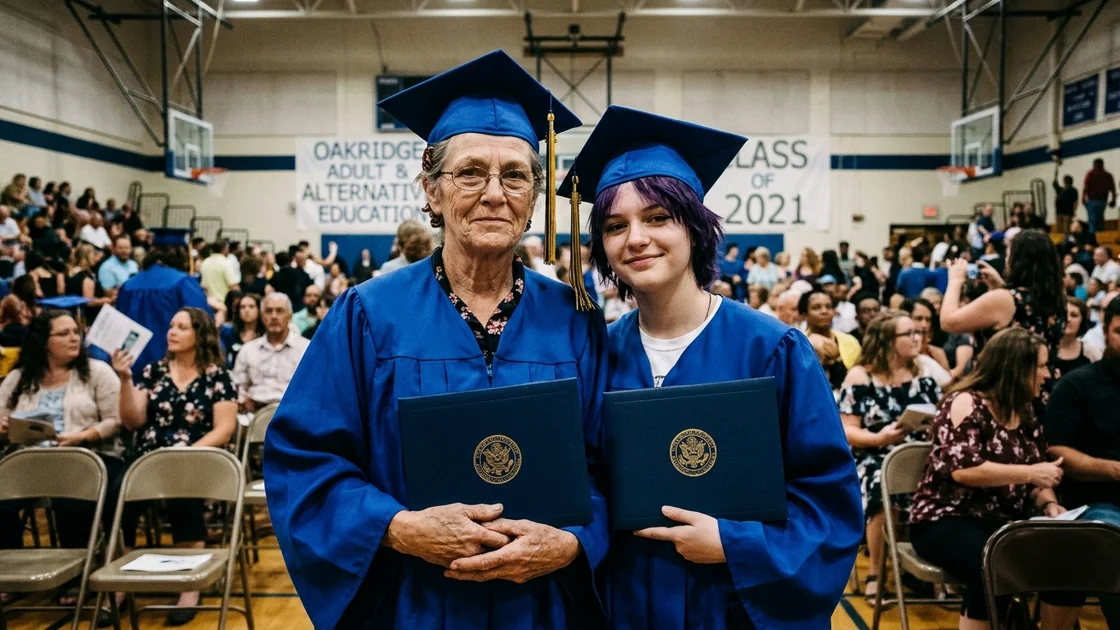
When a kitchen fire in an adjacent duplex leaves her estranged daughter severely injured and her rebellious sixteen-year-old granddaughter Chloe homeless, sixty-year-old Martha Vance takes the girl into her modest home in the fading mill town of Pine Ridge. Facing truancy court and the threat of state custody, Chloe is given one final chance to salvage her education through Oakridge Community High School's evening credit-recovery program. Haunted by her own regret of dropping out in 1978 to support her dying father, Martha makes a sudden and terrifying pact: she will enroll alongside Chloe as an adult student, pursuing the high school diploma she abandoned forty-two years prior. Across nine grueling months of night classes, fractured algebra equations, shifts at the industrial laundry, hospital visits, and mutual resentment, grandmother and granddaughter discover that the hardest lessons have nothing to do with textbooks, eventually transforming their shared legacy of generational hardship into a hard-won victory of love and renewal.
Chapter 1: Ash and Iron
The smell of smoke did not wash out of clothes in a single cycle. It clung to polyester blends and quilted coats like a film of grease, stubborn as rust on an axle.
Martha Vance pulled a basket of damp sheets from the front-loading drum at Miller’s Creek Commercial Laundry, her knuckles aching with the familiar morning stiffness that sixty winters in the foothills had carved into her joints. She was a woman built of straight lines and graying hair pinned tight against her scalp with tortoise-shell combs. For thirty years, she had watched white linen whirl behind round glass portholes, steam rising into the tin rafters, the hiss of the pressers masking the quiet erosion of her days.
When the telephone on the supervisor's desk rang at ten past eleven, Martha did not turn around. Personal calls were docking offenses. But Ed, whose hair looked like it had been combed with an oily rag, emerged from his glassed-in booth and pointed a yellow pencil straight at her chest.
"Martha. County hospital."
Her daughter, Andrea, had never possessed the art of staying out of trouble, but she had usually managed to stay out of the burn unit.
The fire had not started in Andrea’s kitchen; it had started in the downstairs unit where a retired boilermaker had fallen asleep with an unpinned heater next to a pile of circulars. But Andrea’s apartment had taken the brunt of the draft, sucking black plastic fumes up through the floorboards while Andrea slept off a double shift at the parts warehouse. When the volunteer fire department finally kicked the door off its frame, Andrea was unconscious on the linoleum, her bronchial tubes scorched and two ribs broken under the weight of a collapsed joist.
Chloe had not been home. Chloe had been two miles out on the bypass behind the abandoned lumberyard, sitting on the tailgate of an unregistered pickup with three boys who smelled of ditch weed and cheap cologne, throwing gravel at road signs.
"She can’t go into no foster placement, Martha," the hospital social worker, a woman named Mrs. Kendrick whose badge was crooked against her knit cardigan, said three hours later in the hallway outside the intensive care ward. "The county’s maxed. If you don't sign the temporary kinship papers, she goes to the group intake down in Raleigh until Andrea’s stabilized. And the girl’s got an active truancy warrant out of the district court."
Martha sat on a low plastic chair that squeaked against the floor. Through the double glass doors, she could see her daughter’s face under an oxygen tent, pale as tallow, surrounded by the rhythm of monitors that sounded like a slow grandfather clock ticking down an unpaid debt.
"How bad's the warrant?" Martha asked. Her voice was flat, dry as pine shavings.
"Sixty-one unexcused absences since September," Mrs. Kendrick said. "Failing four subjects. Insubordination, two suspensions for leaving campus without leave. Judge Miller gave Andrea thirty days to show cause back in November. Then this happened."
Martha looked down at her own hands. The skin across the knuckles was rough, scarred from hot dryer doors and lye soap. "Where is she?"
"Sitting in the lobby by the vending machines. Deputy brought her in from the bypass. She hasn't said three words."
Martha stood up. Her knee gave an audible click. She smoothed the skirt of her denim jumper—the one she wore over her work slacks so the laundry chemicals wouldn't rot the seams of her trousers—and walked down the corridor.
Chloe sat with her knees drawn up against her chest, her combat boots planted square on the vinyl seat of an armchair. Her hair was dyed the color of a bruised plum, black at the roots, cut jagged around her ears as if she had taken poultry shears to it in front of a cracked mirror. She was sixteen, with her mother’s high cheekbones and her grandfather’s hard, set jaw—a jaw Martha had not seen in the flesh since 1982, when her husband had walked out the screen door with his tools in an army duffel and never sent a postcard.
Chloe had her earbuds shoved deep into her ears, the faint tinny buzz of percussion leaking out into the sterile air.
Martha stood over her until the girl's shadow merged with hers. She reached down, took the cord dangling from Chloe’s left ear, and pulled it free.
"Hey!" Chloe snarled, her head snapping up. Her eyes were rimmed with cheap black liner that had smeared into the creases of her lower lids, dark as river mud. "Give it back."
"Get your bag," Martha said.
"My bag’s in a pile of wet charcoal on Division Street."
"Then you’ve got nothing to carry," Martha said. "Stand up. We’re going to the courthouse to sign for you, and then you’re coming home."
Chloe didn't move. She stared at Martha with a cold, theatrical defiance that trembled just slightly around the corners of her mouth. "I’m staying here until Mom wakes up."
"Your mother isn’t waking up until tomorrow afternoon, the doctor said, and when she does, she won’t need to see you looking like a wet stray on a church bench. Move your boots."
For three seconds, the girl measured the distance between them—the gap of forty-four years, two generations of bad choices, and five inches of height. Martha didn't flinch. She had stared down drunken mill foremen and bank collectors who wanted the deed to her house after the second layoff; she was not about to be out-stared by ninety-eight pounds of sullen bone and purple hair.
Chloe dropped her feet to the floor with a hard thud. She stuffed her music player into the pocket of an oversized army jacket that smelled intensely of stale ash.
"This is temporary," Chloe spat. "The second Mom gets a bed on the convalescent floor, I’m getting my own place."
"On what?" Martha asked, already walking toward the automatic sliding doors. "Paper-route money?"
They walked out into the gray January drizzle without another word between them.
Chapter 2: The House on Maple
Martha’s house was a four-room clapboard bungalow set back on an unpaved lane three blocks behind the old railway depot. The trains didn't stop there anymore; they just blew their horns once at the crossing on Route 9 and rattled the jelly jars in Martha’s pantry before barreling on toward the freight yards in Greensboro.
The spare room had been Martha’s sewing room since Andrea had moved out at seventeen to live with an auto-body apprentice whose name Martha had made it a point to forget. It contained a Singer treadle machine converted to electric, three boxes of patterns from the 1980s, a folded iron cot with a striped tick mattress, and a shelf of canning jars filled with green beans from two summers back.
"Sheets are in the hall press," Martha said, standing in the doorway while Chloe leaned against the doorframe, chewing on the skin beside her thumbnail. "Bathroom’s at the end of the hall. Hot water takes two minutes to run up from the cellar. Don't leave the space heater plugged in when you aren't in the room. House was wired in fifty-six and it doesn't like surprises."
Chloe surveyed the room like an inmate being shown a solitary cell. She walked over to the small sash window that looked out onto the woodpile and the neighbor’s chicken wire.
"There's no Wi-Fi," Chloe said. It wasn't a question; it was a verdict.
"The telephone is on the wall by the refrigerator," Martha said. "It has a cord. If you want to talk to somebody, you can call them, provided it’s not long distance. Supper’s at six. Stew beef and cabbage. You can wash your face first."
"I’m not hungry."
"You don't have to be hungry to sit at the table," Martha said, turning on her heel. "You just have to sit there."
The stew was hot, thick with flour and black pepper, but Chloe merely stirred it with her fork, moving the potatoes from the left side of the bowl to the right like checkers on a board. The silence between them was not the silence of strangers; it was the dense, pressurized silence of blood relatives who knew precisely which words would cut through bone.
"They had a hearing set for you yesterday," Martha said after she had finished half a slice of skillet cornbread.
Chloe didn't look up. "Judge Miller’s an old goat."
"He may be an old goat, but he signs the papers that put girls in the detention annex down in Stanly County. Mrs. Kendrick told me the truant officer’s coming to see me on Monday morning before my shift."
Chloe dropped her fork with a sharp clatter against the stoneware. "Let him come. What do I care? High school is a joke anyway. It’s four hundred rednecks and three teachers who haven't read a book since Jimmy Carter was president. None of it means anything. You work at a laundry, Mom works a packing line. What did high school do for you?"
The words landed in the kitchen like a dropped kettle.
Martha did not raise her eyes from her plate. Her jaw worked slowly over a bite of beef. She chewed thirty times, swallowed, and picked up her water glass.
"I wouldn't know," Martha said softly.
Chloe paused, her eyes narrowing with suspicion. "What?"
"I wouldn't know what high school did for me," Martha said, setting the glass down with a dull tap. "Because I never had it."
The girl stared across the table. For the first time since she had been pulled out of the hospital waiting room, her slouch diminished by an inch. "You didn't graduate?"
"Nineteen seventy-eight," Martha said. Her voice was flat, matter-of-fact, stripped of any bid for sympathy. "My father had his second stroke in October of my junior year. He couldn't turn himself in bed. My mother was already gone with the cancer. There wasn't any money coming in except his union disability, which didn't pay for the coal, let alone the kerosene. The principal told me I could take a six-month leave. By the time six months were up, my daddy was in his grave and the tax man was on the porch. I went to work at the spinning mill on third shift. Sixty hours a week. By the time I had your mother, there wasn't no time to go back. By the time your mother was walking, your grandfather had run off to Florida with a girl who sold tickets at the drive-in."
Chloe looked away, out the dark window where the drizzle was turning to sleet against the glass. "Well. You survived."
"I survived," Martha said, standing up and clearing her bowl. "And I’ve spent forty-two years taking orders from men who weren't half as smart as me because they had a little piece of cardstock with a gold seal on it and I didn't. I spent forty-two years lying on every job application between here and Charlotte, sweating through my dress every time somebody asked for my transcript, praying Ed wouldn't look up my file when the mill closed down and the laundry bought the equipment."
She turned the cold water tap on and let it run over the iron pot.
"You’ve got a mind, Chloe," Martha said over the rush of the pipe. "You got your mother’s stubbornness, but you got your own head. If you throw it in the ditch because you’re mad at her for having bad taste in apartments, you’re a fool."
Chloe didn't answer. She slipped from the chair, her socks whispering against the worn linoleum, and closed the bedroom door behind her. A moment later, the low, rhythmic rattle of bass through her headphones vibrated through the lath and plaster of the old wall.
Chapter 3: The Summons
On Monday morning, the truant officer did not come alone. He arrived in a state-issued sedan accompanied by Mr. Henderson, the vice principal of Pine Ridge High School—a man whose polyester suit was the exact color of an overcast sky and whose briefcase looked as though it had been chewed by a terrier.
They sat around Martha’s kitchen table, their coats still on because the oil burner was set to sixty-two degrees to save fuel. Martha had set out three mugs of instant coffee, black, which neither man touched.
Chloe sat in the corner on the wooden telephone stool, her hands jammed into her jacket pockets, her hood pulled up so far only the tip of her purple fringe was visible.
"It’s not just the absences, Mrs. Vance," Mr. Henderson said, tapping a red folder with the flat of his fingernail. "It’s the state testing threshold. Under the revised accountability standards, if Chloe misses three more days before the March inventory, the school loses its allocation for her seat, and she is automatically dropped from the rolls. At that point, the juvenile court takes over the file. Judge Miller does not grant continuances for students who have been dropped."
"Where would they put her?" Martha asked.
"Youth Development Center in Concord," the truant officer said bluntly. He was a thick-necked man named Gentry who looked like he had spent twenty years writing parking citations before they gave him the school beat. "Fenced perimeter. Mandatory vocational training. Eight to five locked down."
Chloe’s boots shifted against the baseboard. The sound was small, like a mouse behind the wainscoting.
"She’s not going to Concord," Martha said.
"Then she attends Pine Ridge five days a week from seven-forty-five to three-fifteen, starting tomorrow morning," Henderson said. "No excuses except a physician’s note with a state medical license number."
"I can't go back there," Chloe muttered into her collar.
Henderson sighed, the sound of an administrator who had heard every variation of the song since the Carter administration. "Chloe, your feelings about the social dynamic of the campus are not our concern. The law—"
"They don't teach anything!" Chloe flared, her head coming up, her eyes bright with a sudden, vicious heat. "They sit us in rows and give us photocopied packets from ten years ago while Mr. Dobbins looks at fishing boats on his tablet. The girls in fourth period called the police on my locker because they said I had pills—I didn't have anything, and the dog tore my coat! I’m not going back there to be treated like an animal while Mom’s hooked up to an iron lung!"
"It’s an oxygen concentrator," Henderson corrected wearily. "And if you don't attend, you leave us no legal option."
Martha stood up. She was not a tall woman, but when she straightened her shoulders, there was an immovable weight to her, like an old oak stump that had survived three clear-cuts.
"Is there another way?" she asked.
Henderson frowned. "Mrs. Vance, we’ve discussed alternative education. Pine Ridge doesn't have an in-district night program. The only other option in the county is the Oakridge Center over in Albemarle. But that’s twilight school. It’s primarily for adult learners, twenty-one and older, and credit-recovery cases who have already aged out of standard funding."
"Does it count?" Martha asked.
"Does it count for what?"
"For the court. For the state."
"If a student completes thirty-two units of competency and passes the high school equivalency or adult standard diploma battery before July first, yes. The court will stay the warrant. But Oakridge is self-directed. There are no buses. There is no cafeteria. It’s four nights a week, six to nine-thirty. Most kids Chloe’s age don't last three weeks. They don't have the discipline without parents sitting on them."
Martha looked at Chloe. The girl had pulled her hood down slightly, watching the adults with a raw, cornered expression that Martha recognized from her own reflection in 1978—the look of a creature that knew the trap was springing and was already calculating whether to chew off its own foot.
"How much does it cost?" Martha asked.
"For students under eighteen referred by the court, the tuition is waived," Henderson said. "For adults... it’s seventy-five dollars a semester for lab fees and books."
Martha took a slow breath. Her fingers curled into the pockets of her jumper, where her fingers touched the folded pay stub from the laundry. Ed had cut her overtime last week; the hospital parking garage was three dollars an hour; Andrea’s landlord was already demanding the salvage fee for the burnt carpet.
"Give me two application forms," Martha said.
Henderson blinked. "Mrs. Vance?"
"Give me two," Martha repeated, her voice dead level. "One for her. And one for me."
The room went so quiet that the hum of the old Frigidaire sounded like an airplane engine idling in the lane.
Chloe’s jaw dropped. "What are you talking about?"
"You heard what the man said," Martha told her, not looking down. "He said kids your age don't have the discipline without somebody sitting on them. Well, I’m sixty years old, and nobody’s sat on me since nineteen seventy-nine. I have four credits to finish from when Nixon was in his first term. If I’m driving twenty-two miles to Albemarle every night after eight hours on the ironer, you’re going to be in the desk beside me, and I’m going to be in the desk beside you."
"Are you insane?" Chloe cried, rising from the stool. "You’re an old lady! You can’t go to school!"
"Watch me," Martha said. She looked Henderson square in his spectacles. "Does the state care how old I am, Mr. Henderson?"
The vice principal hesitated, his hand hovering over the red folder. He looked from the grandmother’s iron-gray hair to the granddaughter’s violet fringe, his eyes flickering with something that looked suspiciously like bewilderment, perhaps tinged with a small, reluctant drop of respect.
"No, ma'am," Henderson said quietly. "The State of North Carolina does not place an upper age limit on the adult high school diploma."
"Then write the referral," Martha said. "And leave the paperwork on the table."
Chapter 4: The Twilight Center
Oakridge Adult and Alternative Education Center was housed in what had been the county’s colored high school prior to integration in 1969—a single-story brick structure with long, rectangular windows and an exterior painted the color of wet cardboard. It sat between an auto salvage yard and an electrical substation, its asphalt parking lot potholed and illuminated by two sodium-vapor lights that hummed like angry hornets.
The first Tuesday of February was twenty-eight degrees. Martha’s 2004 Buick Century took three turns of the key to catch, coughing blue exhaust into the frozen pine needles behind her kitchen before settling into a rough, shivering idle.
Chloe sat in the passenger seat with her knees pressed against the glove box, wearing three layers of sweatshirts under her oversized jacket. She had refused to eat the baloney sandwich Martha had packed in a bread sack.
"People are going to laugh at you," Chloe said, staring out at the gravel flying against the undercarriage as they turned onto the two-lane state highway.
"Let 'em," Martha said. "I’ve been laughed at by better people than go to night school in Albemarle."
"I mean it, Grandma. It’s weird. It’s pathetic. You’re sixty. Why do you even care? What are you gonna do, go to college? Get an office job where you wear pantyhose?"
Martha didn't take her eyes off the centerline. The headlights of the oncoming log trucks were blinding in the winter dark, huge yellow eyes sweeping over the frozen ditches.
"When your grandfather died," Martha said, her tone level and flat, "the social security people sent me five different forms. Three of 'em had words in 'em I couldn't pronounce without a dictionary, and two of 'em had questions about his work history that I had to ask the preacher to explain to me. The preacher was twenty-four years old and had softer hands than a baby. He looked at me like I was a mule that had learned how to walk on its hind legs."
She reached down and clicked the Buick’s heater fan up a notch. It blew air that smelled of ancient dust and dry leaves.
"I’m tired of looking at things I don't understand because somebody else decided I didn't need to know 'em," she said. "Now check the map in the glove box and tell me which road we take after the water tower."
Room 104 smelled of floor wax, damp wool, and the peculiar vinegar tang of cheap dry-erase markers.
There were seventeen desks in the room, the old-fashioned kind with the wooden writing surface attached to the chair by an iron arm, designed for sixteen-year-old hips. Martha had to turn sideways to slide herself into the seat in the third row, her winter coat bunching up behind her kidneys. Chloe took the absolute furthest desk in the back corner, near the fire exit, her body slumped so low her collarbone was nearly level with the pencil groove.
The teacher was a man named Arthur Harrison. He was forty-five, perhaps fifty, with thinning brown hair cut short like a soldier’s and sleeves rolled up over forearms that showed faint blue tattoos of naval anchors. He wore a knitted tie tucked into a gray cardigan with leather buttons, one of which was missing.
"All right," Harrison said, shutting the classroom door with a sharp click that echoed in the quiet hall. "This is Module Three: Integrated English and American Institutions. If you are here for General Math or Welding Safety, you’re in the wrong wing. Welding is in the shop behind the boiler room."
Nobody moved.
Martha looked around the room. There was a young Black man in the front row wearing a high-visibility road-crew vest, his heavy work boots caked with red clay; a woman in her late thirties with three silver rings in each ear who was frantically writing in a spiral notebook while bouncing an infant’s pacifier on her knee; two teenage boys in track jackets who looked as though they had just come from the same juvenile court intake as Chloe; and a middle-aged Hispanic man who sat with his hands folded neatly over a Spanish-English dictionary so worn the tape had peeled from the spine.
Harrison picked up a piece of chalk, turned to the green slate board—the old kind, real slate, salvaged from the sixty-year-old construction—and wrote three words in tall, clean script:
THE SOCIAL CONTRACT
"Most of you are here because somebody told you that you had to be," Harrison said, not turning around until he had dotted the final letter with a firm strike. "A judge, an employer, an intake officer, or your own bad conscience. I do not care which one it was. What I care about is that between now and May twenty-first, you will read four hundred pages of text written by men who have been dead for two hundred years, and you will explain to me in clear English sentences why they were either right or full of garbage."
He turned, leaning against the teacher’s table, crossing his ankles. His gaze moved across the desks, lingering for half a second on Chloe’s purple hair, then resting directly on Martha’s gray braid.
"Mrs. Vance?" he said.
Martha straightened her spine against the curved wooden slats of her seat. "Yes, sir."
"You were enrolled at North Stanly High School in nineteen seventy-seven?"
"Yes, sir. Left in March of seventy-eight."
"You have twenty-eight credits on your archived transcript from the old county ledger," Harrison said, tapping a manila folder on his desk. "Your literature requirement is incomplete. Your United States history requirement is incomplete. Your junior algebra is marked as a withdrawal."
Chloe let out a tiny, nearly imperceptible snort from the back row.
Harrison didn't look at Chloe. He kept his eyes on Martha. "Can you read a balance sheet, Mrs. Vance?"
"I’ve balanced my checkbook for forty years without an overdraft," Martha said, her voice carrying through the small room with the resonance of an iron frying pan. "And I’ve counted the laundry inventory down to the last pillowcase every Friday night for Ed Miller."
"Good," Harrison said. "Because the State Department of Public Instruction thinks you don't know the difference between an integer and an apple pie. We’re going to prove they’re mistaken. Open your binders to page twelve. Mr. Reyes, will you read the first paragraph of the Declaration of Independence aloud, please?"
The room went still except for the dry rustle of cheap paper.
Beside her, Chloe had not opened her binder. Her arms were folded across her chest, her chin buried in her scarf.
Martha reached across the aisle between their desks. Without taking her eyes off Mr. Harrison, she reached into Chloe’s open bookbag, pulled out the green plastic three-ring binder, set it on Chloe’s desk, and flipped it open to page twelve with a single flick of her thumb.
"Read," Martha whispered, the sound no louder than the wind under the door, but carrying the full weight of sixty years of unyielding iron.
Chloe looked at the open page, then at the side of her grandmother’s head. For five seconds, she did not move. Then, with an aggressive, trembling sigh, she pulled a stubby pencil from her pocket and stabbed it into the margin.
Chapter 5: The Weight of Unknowns
The algebra was worse than the history.
History, at least, was made of people, and Martha had known enough stubborn, dishonest, or desperate people in her life to understand why they had started wars or signed treaties they had no intention of keeping. When Harrison talked about the Reconstruction treaties or the mill strikes of 1929, Martha had smelled the lint in the air; her own great-uncle had had his teeth knocked out on the picket line outside the Loray Mill in Gastonia.
Algebra had no teeth, no blood, and no mercy. It was an abstraction that lived entirely behind Mrs. Gable’s bifocals.
Mrs. Gable was sixty-eight, retired from the county system four years earlier, but returned to Oakridge because, as she told the class, "My husband watches golf on the television eight hours a day, and if I have to listen to another putt roll across Bermuda grass, I will set fire to the curtains."
She was small, shaped like a pear, with white hair that stood up in little puffs around her ears like dandelion seeds. She did not use chalk; she used an overhead projector that blew hot, oily-smelling air from its fan and cast a blinding yellow rectangle onto the white roll-down screen at the front of the room.
"X," Mrs. Gable announced on their third Monday night, her grease pencil squeaking as she drew a large, spindly letter on the transparency, "is not a letter. Do not think of it as a letter. If you think of it as a letter, you will want it to spell something, and it refuses to spell anything. It is an empty box. It is a hole in the ground where somebody dropped a sack of meal, and your job is to tell me how much the meal weighed without digging up the dirt."
Martha stared at the screen.
\[3x + 14 = 2\left(x - 5\right) + 32\]
Her hand shook slightly as she tried to copy the symbols onto her ruled paper. The three looked too small; the parenthesis looked like an ear; the equals sign seemed like a fence she could not climb over.
Across the room, Chloe was working on a small, five-question diagnostic sheet Mrs. Gable had handed out at the start of the hour. Chloe’s pencil was moving with a rapid, jerking rhythm. She wasn't struggling; she was bored.
Martha looked down at her own paper. Her head felt hot, a dull pressure building behind her temples like the steam in the dry-cleaning press when the exhaust valve stuck. She wrote:
\[3x + 14 = 2x - 10 + 32\]
She paused. Did the two multiply the five? Why was it minus ten? If you had a negative five and you took two of them, did you have less than nothing, or twice as much of nothing?
"Mrs. Vance," a voice said at her elbow.
It wasn't Mrs. Gable. It was Chloe.
The girl had gotten up to sharpen her pencil at the hand-crank machine by the door and had stopped on her way back to her corner. She looked down at Martha’s notebook with a faint, sour twist to her mouth.
"You didn't combine your like terms on the right," Chloe whispered.
Martha didn't look up. "I’m working it."
"You’re doing it backwards," Chloe said, her voice dropping lower as Mrs. Gable turned to replace her yellow grease pencil with a red one. "The minus ten and the thirty-two. That’s just twenty-two. Write twenty-two."
"I don't need your help," Martha hissed through her teeth.
"Fine," Chloe said, stepping back. "Sit there and drown. See if I care."
She walked back to her desk and dropped into her seat, staring out the darkened window at the salvage yard.
That night, the drive home was silent until they reached the crossroads at Red Cross. The sleet had started again, small white beads bouncing off the Buick’s hood like grains of salt. The windshield wipers made a rhythmic, rubbery screech: whack-slap, whack-slap.
"Where did you learn to do that?" Martha asked, her eyes fixed on the gray strip of road ahead.
"Do what?"
"The numbers. You did that sheet in eight minutes."
Chloe leaned her forehead against the cold passenger glass. "Eighth grade. Mr. Packett. He was the only teacher who didn't smell like cigarettes and old gym bags. He had these plastic tiles that were red on one side and blue on the other. He said positive and negative numbers were just like debt. If you owe somebody five dollars and you borrow another five, you don't have ten dollars. You just have a deeper hole."
Martha’s hands tightened on the plastic steering wheel. Her knuckles were white against the imitation leather.
"I had to drop out before we got to the negatives," Martha said quietly. "In seventy-eight, they didn't teach algebra until tenth grade, and if you were in the general track—the mill track—they just gave you shop math. Figuring board feet. Interest on a car note. They didn't think we needed the rest of it."
Chloe didn't say anything for three miles. Then, without looking away from the dark woods rushing past:
"It’s not that hard," Chloe said. "The X is just... whatever’s missing. You just move everything else to the other side of the fence until it’s standing by itself."
"Nothing’s that simple," Martha said.
"It is if you don't fight it," Chloe said.
When they reached the bungalow, Martha did not take off her coat immediately. She went straight to the kitchen table, set down her oilcloth bag, and turned on the sixty-watt bulb hanging from the brass chain. She pulled out the mimeographed worksheet Mrs. Gable had given her—the one with the four red question marks in the margin.
She sat down, her boots still wet with slush.
Chloe stood in the doorway between the kitchen and the sewing room, her army jacket unbuttoned, holding a mug of cold tap water. She watched her grandmother’s gray head bend over the paper, watched the old, swollen fingers struggle to keep the yellow pencil between the knuckle and the thumb.
"Give it here," Chloe said.
Martha didn't move.
Chloe set the mug down on the counter with a sharp clink, walked over, and pulled the chair out opposite her grandmother. She didn't take off her gloves; she just cut the fingertips off an old wool pair with the scissors from the sewing basket so her thumb and forefinger were bare.
"Look," Chloe said, snatching the pencil from Martha’s hand with an impatient jerk. "The equal sign is a scale. Like the one at your laundry that weighs the sheets. If you put five pounds on that side, you gotta put five pounds on this side, or the whole damn thing falls over."
"Don't swear in this house," Martha said automatically.
"Then don't be stupid," Chloe shot back, her eyes flashing. "Watch the pencil."
For forty-five minutes, under the yellow light of the single bulb, the sixteen-year-old girl with purple hair drew small squares and arrows across the cheap gray paper, her voice sharp, sarcastic, and unrelenting, while the sixty-year-old woman leaned forward, her brow furrowed into deep, shadowed ravines, nodding slowly as the empty boxes began to fill with names.
Chapter 6: The Glass Partition
On the third Sunday in March, the sky broke open with a thin, watery sunlight that smelled of damp red clay and thawing manure.
The burn unit had transferred Andrea to the sub-acute rehabilitation wing on the fourth floor of the regional hospital in Concord. The room had two narrow beds separated by a floral curtain that looked like it had been chosen by a committee that hated flowers. Andrea’s roommate was an eighty-year-old woman who slept continuously with her mouth open, emitting a dry, rattling wheeze that sounded like dry leaves being crushed in an apron.
Andrea sat in an armchair beside the window. Her neck and the lower half of her left jaw were wrapped in compression bandages, pink and smooth, designed to keep the hypertrophic scars from thickening into cords. Her hair had been shorn close to the scalp to allow the doctors to graft skin behind her ear.
"You look like a plucked pullet," Martha said, setting a plastic container of homemade chicken salad on the rolling bedside table.
"Thanks, Ma," Andrea rasped. Her voice had lost its high, ringing quality; the hot gases had pitted her vocal cords, leaving her with a whispery growl that made her sound fifty years older than thirty-five. "Always know how to make a girl feel pretty."
Chloe hung back near the door, her fingers hooked into the belt loops of her jeans. She hadn't seen her mother in two weeks—not since the bandages had come off the face.
Andrea looked past Martha at her daughter. Her eyes, pale blue and slightly yellowed from the painkillers, softened into something raw and desperate.
"Come here, bug," Andrea whispered.
Chloe took two slow steps forward, then stopped, her boots planted on the green tiles. "Does it hurt?"
"Only when I laugh," Andrea said, attempting a smile that pulled horribly on the fresh grafts near her lip. "Which doesn't happen much around here. The nurses are all Baptists."
Martha pulled the single wooden armchair toward the bed and sat down with a groan from her left hip. "The truant officer signed off on the stay last Friday."
Andrea’s eyes shifted to her mother. "Henderson called me. On the room phone. Said you were going with her."
"I am."
"Ma... you don't have to do that. That’s crazy. You’re sixty."
"I know how old I am," Martha said. "I don't need my daughter or my granddaughter to keep reminding me of the calendar. I was there when the days happened."
"She’s actually doing it, Mom," Chloe said, her voice dropping into an odd, defensive rhythm that Martha hadn't heard before. "She does three hours of homework every night after her shift. She almost beat Mr. Harrison in an argument about the Whiskey Rebellion last week. Harrison had to go look it up in the big book in the library."
Martha felt a sudden, strange warmth behind her ears, like she had taken a sip of blackberry wine too fast on an empty stomach. She smoothed her skirt over her knees. "The man didn't know that the tax was on the still-capacity, not the gallons sold. Any fool who ever had an uncle in Wilkes County knows that."
Andrea looked between the two of them—the old woman in the denim jumper and the girl in the oversized army coat. A single tear, slow and thick, leaked out of her right eye and caught on the edge of the compression bandage.
"I’m sorry, Chloe," Andrea whispered. "I lost the apartment. Everything in the closet was gone. Your baby pictures... the little silver cup your granddaddy sent before he died... all of it was just grease on the rafters."
Chloe walked to the edge of the bed and picked up her mother’s hand. The skin of Andrea’s fingers was dry and cool, untouched by the fire, but limp, without the twitchy energy that usually drove her mother through three jobs and four boyfriends.
"It doesn't matter," Chloe said. "It was all junk anyway."
"It wasn't junk," Martha said firmly. "It was what we had. But things burn. People don't have to."
She reached into her canvas tote bag and pulled out a blue paper folder with a clear plastic spine.
"Your midterm report came from the alternative school yesterday," Martha said, laying it across Andrea’s lap.
Andrea looked down at it.
Chloe Vance: Module 1 English — 88 (B+)
Chloe Vance: Module 1 Algebra — 94 (A)
Chloe Vance: Module 1 Social Studies — 81 (B)
Below it, clipped with a brass fastener, was a second sheet from the adult division:
Martha Vance: Adult Standard Lit — 84 (B)
Martha Vance: Adult Standard Alg I — 76 (C)
Martha Vance: Adult Standard Civics — 91 (A)
Andrea ran her fingers over the two names, her thumb lingering on the seventy-six. A faint, wheezing laugh came from her throat.
"A seventy-six, Ma? You always told me if I got a C, I’d spend eternity pulling weeds in the churchyard."
"A seventy-six in Mrs. Gable’s room is an eighty-six anywhere else," Martha said, her jaw tightening. "The woman is a tyrant. She thinks an integer is a gift from God Almighty."
"She’s getting better," Chloe said, not looking at Martha. "She doesn't cry when she sees an exponent anymore."
"I never cried," Martha said.
"You had tears in your eyes on Tuesday night, Grandma. You said the page was blurry."
"The light in that room is terrible," Martha said, but she didn't pull her hand away when Chloe’s shoulder brushed against hers beside the bed.
Chapter 7: The Break
April brought the pollen.
In the Carolina foothills, the loblolly pines blossomed all at once, turning the sky into a yellow haze and coating every surface—the hoods of cars, the porch rails, the leaves of the rhododendrons—with a fine, sulfurous flour that tasted like turpentine.
At the laundry, the work doubled. With the spring thaw came the opening of the motels along Interstate 85, and the trucks from Charlotte arrived twice a day piled to the tailgates with dirty sheets, stained mattress covers, and grease-spotted tablecloths from the convention centers.
Martha worked nine hours on her feet every day, the steam from the pressers turning the yellow pollen on her skin into a sour, yellow paste. By four o'clock, her ankles were swollen over the rims of her orthotics, the veins behind her knees throbbing like thick ropes.
On the third Thursday of the month, she drove the Buick up the unpaved lane at four-thirty to find the front screen door standing open, banging against the weather-stripping in the spring breeze.
"Chloe?"
The house was empty.
On the kitchen table, Chloe’s green binder was closed, held shut by a rubber band. Beside it lay an empty packet of cigarettes and a scrap of cardboard torn from a cereal box.
Can't do this anymore. Went to Charlotte with Jason. Don't call the truant guy.
Martha did not sit down. She did not take off her apron. She walked into the sewing room; the iron cot was stripped of its quilt, and the small canvas bag Chloe had salvaged from the fire was gone from the floor.
The telephone on the kitchen wall had a dial that whirred as it returned to zero. Martha picked it up and called the only person whose number she knew by heart who had a car with good tires.
"Ed," she said when the laundry manager answered. "I need your truck."
"Martha, my shift ends at six—"
"I don't need your shift. I need the four-wheel drive. The Buick’s got a bad tie rod and it won't do eighty on the interstate."
Ed was silent for five seconds. "Is it the girl?"
"Bring the keys to my lane," Martha said, "or I won't be on the line tomorrow to sort the resort linens, and you can explain to the regional vice president why four hundred pounds of bedspreads are sitting in the lye vat."
She hung up before he could answer.
Jason Miller was nineteen, had dropped out of North Stanly two years before Chloe, and lived in a double-wide trailer behind an abandoned go-kart track on the county line. Martha knew his people; his grandfather had run illegal whiskey out of a dairy barn in the sixties, and his father had spent five years in Central Prison for receiving stolen farm machinery.
When Ed’s red Ford F-150 pulled into the dirt yard behind the go-kart track twenty minutes later, the dust was still settling from another car’s departure.
A black Pontiac with a rusted-out rocker panel was idling by the propane tank, its trunk tied down with yellow polypropylene twine. Jason Miller, a tall, stringy boy with a goatee that looked like it had been applied with charcoal dust, was leaning into the trunk, trying to wedge a plastic milk crate between a spare tire and a sub-woofer.
Chloe stood on the trailer’s wooden stoop, holding her canvas bag, her face pale in the yellow pollen light.
Martha climbed down from the truck. She did not hurry. Her knees hurt, and she walked with the slow, deliberate tread of an ox that had spent forty years pulling a plow through stony ground.
"Get in the truck," Martha said, stopping six feet from the stoop.
Jason turned around, wiping his hands on his jeans. "Who the hell are you?"
"I’m her grandmother," Martha said, not looking at him. "And if you don't take your hands off that twine, I’ll call the state police from the booth at the Texaco and tell 'em you’ve got two underage runaways and three stolen chainsaws in that trunk."
Jason squinted at her, his mouth hanging slightly open. "She’s sixteen. She can do what she wants."
"She’s sixteen, she’s a ward of the Stanly County Juvenile Court, and her mother is in the county hospital," Martha said. "The warrant for her arrest was stayed on my signature. Which means until midnight on June thirtieth, she belongs to the state, and the state gave her to me. Get your bag, Chloe."
Chloe didn't move. Her jaw was set in that old, hard line, but her eyes were wild, shifting between the rusted Pontiac and her grandmother’s iron-gray hair.
"I’m sick of it!" Chloe shouted, her voice cracking across the dirt yard. "I’m sick of the school! I’m sick of Mrs. Gable and Mr. Harrison and the laundry smell on your clothes! I’m sick of being poor, Grandma! Jason’s got a job at a warehouse in Gastonia. He’s got an apartment with his brother. We can just live!"
Martha looked at the boy. "What’s the warehouse pay, son?"
Jason blinked. "Nine-fifty an hour. Start on third shift."
"Nine-fifty," Martha repeated. She turned back to Chloe. "You know what nine-fifty an hour is after they take the state and the federal out? It’s three hundred and ten dollars a week. Rent on a two-room flat in Gastonia is six hundred a month. Power is a hundred and twenty if you don't use the air conditioner. Gas to get back and forth on the bypass is forty dollars every time you fill the tank. If you buy three bags of groceries at the discount store, you’re down to twelve dollars to buy shoes, medicine, and toilet paper."
She stepped closer to the stoop. The yellow pine dust settled on her shoulders like ash.
"You think this is living?" Martha asked, her voice dropping lower, vibrating with a fierce, quiet rage that made the boy take half a step backward toward his bumper. "You think moving into a trailer with a boy who can't afford to fix his own muffler is an escape? It’s the same ditch, Chloe! It’s the same ditch your mother fell into when she was seventeen, and it’s the same ditch I spent forty years crawling out of on my hands and knees!"
She reached out her hand. It was not open in an invitation; it was a command, steady as an iron bar.
"I am sixty years old," Martha said. "My back feels like somebody took a hammer to the base of my spine every morning at five o'clock. I spent last night until twelve-thirty reading three chapters of the Federalist Papers because I don't know what the third amendment means and I’m too proud to let Harrison think I’m ignorant. I’m not doing that so you can run off to Gastonia and sell cigarettes at a gas station."
Chloe looked down at her boots. A tear broke through her smeared mascara, carving a clean, pale line through the yellow pollen on her cheek.
"I can’t pass the state test," Chloe whispered. "The practice test on Tuesday... I missed eleven on the reading comprehension. Henderson said if we don't pass the state battery on the first try, they don't do retakes until November. I’ll be seventeen. Mom’s disability check won't cover the rent on a new place. I’ll have to drop out anyway."
Martha stood there for three seconds. Then she walked up the three wooden steps, reached out, and took the canvas bag from Chloe’s hand. It was light—hardly anything in it except two changes of clothes and a pair of cheap sneakers.
"You missed eleven," Martha said.
"Yeah."
"I missed fourteen," Martha said.
Chloe’s head came up.
"Harrison didn't tell you?" Martha asked, her face completely expressionless. "I got a fifty-eight on the essay portion. He said my thesis had no support and my handwriting looked like a chicken had dipped its feet in ink and walked across the paper."
A tiny, involuntary snort escaped Chloe’s nose, half sob, half laugh.
"He told you that?"
"He wrote it in red pen right across the title," Martha said. "Then he told me if I didn't learn how to write a five-paragraph outline by next Tuesday, he was going to make me read Patrick Henry’s speech to the Virginia Convention aloud in front of the whole class until my dentures rattled."
She turned and started down the steps with the bag.
"Come on," Martha said over her shoulder. "Ed’s truck uses three gallons of gas every time it idles for ten minutes, and we’ve got forty pages of the Reconstruction amendments before six o'clock."
Chloe stood on the porch for five seconds. She looked at Jason Miller, who was leaning against his rusted fender with his arms crossed, looking thoroughly useless in the yellow afternoon light.
"See you around, Jason," Chloe said.
She jumped down from the stoop, her boots kicking up two small puffs of red dirt, and climbed into the passenger side of the red Ford.
Chapter 8: The Kitchen Table Academy
May came in with temperatures in the eighties, turning the attic of Martha’s bungalow into an oven that pushed the heat down through the ceiling boards until the rooms felt like the inside of a proofing box at a commercial bakery.
The dining room table had ceased to be a place for food.
It was covered from edge to edge with open volumes: a battered 1998 copy of The American Pageant, three different editions of Holt Algebra I, a rhyming dictionary Martha had bought for fifty cents at the library discard sale, and hundreds of three-by-five index cards held together by rubber bands.
Every night from nine-forty-five—when they returned from Oakridge—until one in the morning, the yellow bulb burned over their heads.
"Point-slope form," Chloe said, tapping a card with the end of her pencil. She had cut her purple hair even shorter, so that it stood up in small, sharp tufts, revealing the pale, stubborn curve of her neck.
"\[y - y_1 = m(x - x_1)\]," Martha recited, her eyes closed, her fingers pressing into her temples.
"What’s the m?"
"The slope."
"What’s the slope?"
"The rise over the run," Martha said. "The vertical change divided by the horizontal change. Like the ramp for the hand-trucks behind the loading dock."
"Good. If the line goes down from left to right, is it positive or negative?"
"Negative."
"If the line is straight up and down, like the wall?"
Martha hesitated. Her brow furrowed. "Zero?"
"Undefined!" Chloe barked, her voice mimicking Mrs. Gable’s sharp classroom snap so accurately that Martha’s eyes flew open. "How many times do I have to tell you? You can't divide by zero! The universe explodes! If you write zero on Tuesday, Mrs. Gable will come to your funeral just to spit on the flowers."
"Don't you be disrespectful," Martha muttered, but she scribbled UNDEFINED = VERTICAL on the corner of her legal pad three times in heavy, dark strokes.
"Now do mine," Chloe said, shoving her literature notebook across the oilcloth. "Harrison’s essay questions. Number four."
Martha adjusted her glasses, which were five-dollar reading magnifiers from the variety store, held together at the bridge with a tiny strip of adhesive tape.
"Explain the symbolism of the green light at the end of Daisy’s dock in The Great Gatsby," Martha read. She looked over the top of the plastic frames at Chloe. "Well? What is it?"
"It’s just a light," Chloe groaned, dropping her head onto her arms so her voice was muffled by the wood. "He’s rich, he’s got a big house, he looks across the water at his ex-girlfriend’s dock. It’s green because water lights are green so boats don't hit the wood in the dark."
Martha took off her glasses and set them down on the open textbook. She reached across the table, took Chloe by the chin, and pulled the girl’s face up until their eyes met.
"You think that’s all that man was writing about?" Martha asked softly.
"It’s what it says."
"It’s not what it says; it’s what it means," Martha said. "You remember that house we passed every Sunday when you were little? The one out on the old golf course road with the white pillars and the brick driveway with the iron gates?"
Chloe blinked, her eyes clearing of sleep. "The one with the horses?"
"That’s it," Martha said. "Your granddaddy worked on that roof for two weeks back in seventy-five. Came home every night with his shirt smelling of copper and tar. He used to sit on the back porch with a Schlitz and look toward the ridge where that house was. You couldn't see the house from our lane, but you could see the red light on the radio tower right behind it."
She looked out the small kitchen window into the black night.
"He never said it," Martha whispered. "He didn't have the words for it because he left school in the eighth grade to dig footings for the county. But he looked at that red light like it was something that had been stolen from him before he was born. Like if he just worked hard enough, or bought the right truck, or had the right kind of smile, somebody was going to come down that lane and say, 'Henry Vance, you can come inside now. We got a place set for you at the big table.'"
She turned back to Chloe. Her fingers were still rough, scarred by the chemicals, but her touch on the girl’s chin was steady as an altar stone.
"Gatsby wasn't looking at a light bulb, Chloe," Martha said. "He was looking at the thing he couldn't have because of where he started. He thought money could buy back the years he spent being nobody. But you can't buy 'em back. You can only earn 'em with your own hide."
Chloe sat motionless, the fatigue in her face melting into an expression that was vast, quiet, and strangely solemn. She picked up her pencil.
"He was reaching for it," Chloe wrote in the margin of her paper, her hand steady now, the letters clean and rounded. "Because he thought the past was something you could repeat if you were brave enough to pay the bill."
Martha watched the pencil move. She picked up her five-dollar magnifiers, set them back on her nose, and turned to the next index card.
"All right," Martha said, her voice gruff to hide the catch in her throat. "Explain the difference between a direct democracy and a representative republic, and don't quote the internet."
Chapter 9: The Crucible
The state examination was administered over three consecutive evenings in the second week of June, in the gymnasium of the consolidated high school in Albemarle.
The gym was vast, the maple floor marked with red, blue, and yellow lines for sports Martha had never played. Two hundred folding tables had been arranged in precise, military ranks, three feet apart in every direction, each with a single number taped to the corner and two number-two pencils lying in the groove.
The air conditioning had broken down at noon. Four industrial drum fans stood in the four corners of the hall, their blades roaring like aircraft engines, merely circulating the eighty-six-degree air until the room smelled of sweat, floor wax, and the dry, powdery dust of hundreds of eraser tips.
Martha Vance sat at Table 114.
Her cotton blouse was stuck to the small of her back by five-fifteen. Her hands were cold despite the heat, her fingers stiff as dried beef.
Chloe sat three rows ahead and four tables to the left, at Table 78. From behind, all Martha could see was the small, defiant tuft of purple hair and the sharp angle of her granddaughter’s shoulder blades under her white t-shirt.
"You have three hours for Section One: Quantitative Reasoning and Mathematical Applications," the chief proctor announced through a bullhorn that whistled with feedback. He was a state official from Raleigh who wore a short-sleeved nylon shirt and a plastic badge that said DIVISION OF ACCOUNTABILITY. "You may use the approved formula sheet provided in your packet. You may not use a calculator with graphing capability. When you finish, place your answer sheet inside the test booklet and sit in silence until the bell is rung. Break the seals now."
The sound of two hundred people tearing paper seals at the same moment was like a sudden gust of wind through dry corn husks.
Martha opened the book.
Question 1: An industrial boiler consumes 450 gallons of fuel oil every 18 hours of continuous operation. If the fuel tank has a capacity of 2,400 gallons and is currently three-quarters full...
Martha’s eyes blurred. The numbers seemed to lift off the page, floating like tiny black gnats above the white paper. Her left knee gave a sharp, throbbing twinge that radiated down into her shin.
I am sixty years old, the voice inside her head whispered—the old voice, the voice that had lived with her since the morning she had watched her father’s ambulance pull out of the lane in 1978. You belong at the presser. You belong with the lye soap and the ironers. You don't have the right to be in this room with these children.
She closed her eyes.
The scale, Chloe’s voice came back to her, sharp and sarcastic across the kitchen table. The damn scale, Grandma! If you take forty from that side, you gotta take forty from this side, or the whole thing falls over.
Martha opened her eyes.
She did not look at the clock on the gym wall. She took her number-two pencil, licked the dry tip with her tongue, and wrote in the margin:
\[2,400 \times 0.75 = 1,800\text{ gal}\]
\[1,800 \div (450 \div 18) = \text{hours}\]
She worked slowly, methodically, her tongue pressed against the roof of her mouth.
When she reached Question 24—a coordinate geometry problem involving the intersection of two lines—she paused. The graph was small, the grid lines faint gray.
She looked up.
At Table 78, Chloe was leaning back in her chair, her arms stretched over her head, her pencil tucked behind her ear. She was finished with the first section with forty minutes to spare. As if feeling the weight of Martha’s gaze, the girl turned her head slightly to the left.
Their eyes met across the three rows of folding tables.
Chloe did not smile. She did not wave. She simply raised her right hand, formed an O with her thumb and forefinger, and then pulled her hand down in a short, sharp tug—the gesture they used in the kitchen when the water had reached the boil.
Pull the cord.
Martha turned back to Table 114. She laid her ruler against the coordinate grid, found the intersection at \[(4, -2)\], and filled in the small round bubble labeled C until it was black as coal.
Chapter 10: The Third Shift
The state results did not come by computer. For the adult program, they were delivered in official manila packets to the Oakridge center office, to be handed out in person by Mr. Harrison on the final Friday of June.
Martha worked her regular shift at the laundry from six in the morning until two in the afternoon.
The plant was ninety-five degrees by eleven o'clock. A shipment of four thousand hospital draw-sheets from the university clinic had arrived sour from two days in a closed trailer, and Martha spent four hours feeding them into the heavy-duty ironer, her forearms red from the steam, her apron soaked through with sweat.
At two-fifteen, Ed stopped her by the time clock.
He had a paper cup of water in one hand and a brown envelope in the other.
"The girl’s outside," Ed said, nodding toward the loading dock. "She’s been sitting on the concrete bumper since one-thirty. Wouldn't take a soda from the machine."
Martha punched her card. The clock made a heavy, iron CLUNK that shook the wall mounting.
"Is the truck running?" she asked.
"Truck’s fine," Ed said. He looked down at the envelope in his hand. "Martha... the regional office called me this morning about the floor supervisor position on second shift. The one Jackson left when he took the pension."
Martha stopped with her hand on her purse strap.
"They need somebody who can certify the chemical manifests for the EPA," Ed said, not looking her in the eye. "It’s four dollars more an hour. Full medical. But the state requires a secondary credential on file with the regional director. Company policy since the merger."
Martha looked at the greasy linoleum between them. Forty-two years she had worked under that tin roof. She knew every pipe, every valve, every fuse in the junction box by its smell and its rattle.
"I’ll let you know on Monday, Ed," she said.
"They need an answer by five, Martha."
"Then they’ll have to wait until Monday," she said, her voice dropping into that cold, iron register that admitted no dispute. "Because I have an appointment in Albemarle at three o'clock, and I don't intend to be late."
She walked out onto the loading dock.
Chloe was sitting on an empty wooden pallet, wearing her good jeans—the ones without the holes in the knees—and a clean white blouse that Martha had ironed for her the night before. Her purple hair had been combed back behind her ears, held with two steel bobby pins.
Beside her on the pallet was a small cardboard box from the hospital pharmacy.
"Mom got her release papers," Chloe said as Martha came down the concrete steps. "They’re moving her to the outpatient clinic next week. She can walk thirty feet without the concentrator."
Martha stopped at the bottom of the steps. The sun was blinding off the gravel lot. "Did you go by the room?"
"Yeah," Chloe said. She stood up, dusting the splinters from the seat of her jeans. "She told me to tell you that if you flunked Civics, she’s not going to let you sign her housing lease."
"Your mother always had too much mouth for her own good," Martha said. "Let’s get in the car."
Chapter 11: The Green Folders
The Oakridge Center was quiet. The regular day classes had ended a week before, and the long hallways were empty, the locker doors standing open like rows of black teeth.
Mr. Harrison sat in Room 104 with his sleeves rolled up, a box of glazed doughnuts from the supermarket sitting open on the corner of his desk. Nobody had eaten any.
He had two green cardboard folders lying side by side on his blotter, each bearing the round gold seal of the North Carolina State Board of Education.
When Martha and Chloe came through the door, Harrison did not get up. He took off his reading glasses and let them hang from the cord around his neck.
"Mrs. Vance," he said. "Chloe."
The two of them stood in front of his desk like prisoners waiting for a sentence from the bench. Chloe’s fingers were hooked into the seam of her trousers; Martha had her hands clasped over her black pocketbook, her feet set four inches apart on the linoleum.
"The state testing division had a computer glitch with the social studies module," Harrison said, his voice flat and administrative. "They had to rescore forty-two thousand tests by hand in Raleigh. That’s why the packets were late."
"We know," Martha said. "The man on the radio said so."
Harrison reached out his hand and turned the first green folder around so the label faced the front.
CHLOE ELIZABETH VANCE
He flipped the cover open.
COMPLETION STATUS: SATISFACTORY
COMPOSITE PERCENTILE: 89th
MATHEMATICS: 96th
READING COMPREHENSION: 82nd
CIVICS & ECONOMICS: 88th
"You have met the requirements for the North Carolina Adult High School Diploma," Harrison said, his eyes flicking to the girl. "The court was notified by facsimile at one o'clock this afternoon. Judge Miller signed the order dismissing the truancy petition twenty minutes later. You are free and clear of the juvenile division, Chloe."
Chloe did not shout. She did not jump.
She reached out with one finger and touched the gold seal in the center of the paper—the seal with the two women representing Liberty and Plenty, and the state motto: Esse Quam Videri. To be rather than to seem.
A small, shiver ran through her shoulders, so faint that Harrison did not see it, but Martha felt it through the air between them.
"Thank you, sir," Chloe whispered.
Harrison nodded once, his expression solemn. Then he turned the second green folder around.
Martha did not look at the numbers.
She looked at the top of the page, where her name was written in mechanical, computerized type—type that did not care that she had dropped out of North Stanly in 1978, type that did not know about the spinning mill, the lye burns on her wrists, or the forty years of lying on applications:
MARTHA LORRAINE VANCE
Below it was the line she had looked for every day of her adult life:
REQUIREMENTS FOR GRADUATION: COMPLETED
She slowly reached into her pocketbook, took out her reading magnifiers, and set them on the bridge of her nose.
MATHEMATICS: 71st PERCENTILE
READING & LITERATURE: 86th PERCENTILE
AMERICAN INSTITUTIONS: 94th PERCENTILE
"A ninety-four," Harrison said quietly, the corner of his mouth twitching with the ghost of a smile. "You beat the county average by fourteen points, Mrs. Vance. The only person who scored higher in American Institutions in the whole twilight program was a retired postal inspector who took the exam in Salisbury."
Martha stared at the paper. The gold foil was real; it had little serrated edges that caught the fluorescent light, bright as a newly minted dime.
Her eyes did not fill with tears. Tears were for weddings and funerals, and this was neither. This was an account that had been balanced after forty-four years of interest had piled up on the principal.
"The seventy-one in math," Martha said, her voice dry.
"It’s a pass, Mrs. Vance," Harrison said. "State standard is sixty. You cleared it with eleven points to spare."
"Chloe said I missed the vertical line problem."
Harrison sighed, leaning back in his swivel chair. "You put undefined, Mrs. Vance. The state key had it as no slope. It was a contested item. The state board allowed both answers."
Chloe let out a sharp, triumphant bark of laughter that bounced off the green slate blackboards. "I told you! I told you it was undefined!"
"Don't gloat," Martha said, but she didn't take her eyes off the paper. She ran the rough pad of her thumb over her own name, feeling the slight indentation where the printer had struck the cardstock. "It’s unseemly."
"Commencement is tomorrow evening at seven," Harrison said, standing up and extending his hand across the desk. "County auditorium in Albemarle. Caps and gowns are ten dollars rental from the office, or you can wear your own Sunday clothes. Most of the adult candidates just wear a nice shirt."
Martha took his hand. Her grip was firm, dry, and calloused from forty years of steam and iron.
"We’ll take the gowns," Martha said.
Chapter 12: The Royal Blue
The county auditorium smelled of old floor oil and summer honeysuckle blowing through the emergency exit doors that had been propped open with wooden wedges.
There were sixty-four graduates in the twilight class of 2021.
They did not look like the graduating class of Pine Ridge High School. There were no white sports coats, no rented limousines in the parking lot, no mothers with diamond earrings taking photographs with expensive cameras.
There were men with gray in their beards and the oil of machine shops still dark under their fingernails; women whose children sat in the third row waving paper flags; young men who had spent six months in county orange before getting their credits together; and two girls who were eight months pregnant, their gowns tented over their bellies like royal blue sails.
Martha Vance stood in the second rank of the procession in the hallway behind the stage.
The gown was royal blue polyester, stiff and light as tissue paper, smelling faintly of the plastic warehouse in Ohio where it had been stamped out by the thousands. The cap was slightly too small for Martha’s head, perched atop her gray braid and held in place by four black bobby pins Chloe had driven in with merciless precision in front of the hallway mirror.
Chloe stood directly in front of her.
Her gown had been hemmed two inches with safety pins because she was short, and her mortarboard was tilted back slightly so her purple fringe showed like a slash of violet against the blue.
On the other side of the auditorium, in the fourth row of the center section, Andrea sat in a folding wheelchair the clinic had loaned her. She had a blue silk scarf tied around her neck to hide the compression collars, and her hands were clasped in her lap, her knuckles white as she watched the stage curtains swing.
The organ—an old electric Hammond that had two keys that stuck in the lower register—began to grind through Pomp and Circumstance.
"Grandma," Chloe whispered over her shoulder, not turning her head.
"Hush," Martha said. "The line’s moving."
"My zipper’s stuck at the neck," Chloe muttered. "It’s choking me."
Martha reached out with her rough, scarred fingers, found the tiny plastic slide at the base of Chloe’s throat, and gave it a sharp, practiced jerk. The teeth engaged with a soft click.
"There," Martha said. "Stand up straight. Don't look at the floor. You aren't hunting for pennies."
"Are you nervous?"
"I’m sixty years old," Martha said. "I’ve had a child, lost a husband, buried my people, and worked forty years on third shift. I am not going to be scared by eight steps and a school board member."
They walked out into the light.
The auditorium was packed to the back walls. The audience was loud—not the polite, golf-clap audience of the morning ceremonies, but a crowd that hollered names, blew air horns, and whistled through their teeth as their brothers, mothers, uncles, and daughters came down the center aisle.
When Martha Vance’s name was called by the superintendent forty minutes later, the voice echoed through the high, tin rafters:
"Martha Lorraine Vance. Adult Standard Diploma."
Martha walked across the stage. Her hip gave its small, familiar click on the third riser, but she did not limp. She walked with her head up, her back straight as an iron lintel, her blue polyester gown swishing against the tops of her black Sunday shoes.
The superintendent—a man with teeth so white and even they looked like bathroom tiles—handed her the dark blue padded folder with both hands.
"Congratulations, Mrs. Vance," he said into the microphone. "It is never too late."
Martha took the folder. She did not smile for the county newspaper photographer whose flash went off two feet from her nose, leaving a green spot in the center of her vision.
"It’s not late," Martha said to the superintendent, her voice carrying clearly into the first four rows. "It’s right on time."
She walked to the end of the stage and stood beside the wooden rail to wait for the next name.
"Chloe Elizabeth Vance. High School Diploma."
Chloe came across the boards with her quick, light, slightly feral step, her gown billowing behind her like a cape. When she took her folder, she didn't look at the superintendent; she looked straight at Martha.
As she passed her grandmother on her way down the side steps, Chloe reached out and caught Martha’s sleeve—the rough blue polyester—and squeezed it with all the strength in her small, thin hand.
They walked down the wooden steps together into the crowd.
Chapter 13: The Road Home
The sleet was long gone, the yellow pollen was washed away into the ditches, and the Carolina summer had settled into the foothills like a heavy, warm quilt.
They sat on the front porch of the bungalow on Maple Lane at eleven o'clock that night.
The gowns were hung over the back of the settee in the parlor, but they had left the mortarboards sitting on the kitchen table beside the index cards and the algebra books.
Andrea was asleep in the sewing room, her breathing steady and deep, untroubled by the sound of the crickets that thrummed in the weeds behind the woodpile.
Martha sat in the wicker rocker that had been her mother’s, a glass of cold well water in her hand. The night air was seventy-four degrees, smelling of sweet clover and the faint, sulfurous tang of the paper mill fifteen miles to the south.
Chloe sat on the top step, her back against the porch post, her knees drawn up under her chin. She had taken off her boots, and her bare toes were curled over the edge of the gray painted floorboards.
"Ed called while we were changing," Martha said.
Chloe looked around. "What’d he want?"
"Wanted to know if I was coming in at six on Monday to train on the second-shift supervisor desk."
Chloe tilted her head against the post. "What’d you tell him?"
"I told him I’d be there at five-thirty," Martha said. "Because if you don't check the lye valves before the steam comes up, the whole second-floor run gets scorched, and I don't intend to let some boy with twenty years less sense than me ruin my manifests."
Chloe smiled—a slow, real smile that had no sarcasm in it, no defense, no theater. It made her look very young, like the photographs that had burned in the apartment on Division Street.
"Community college registration starts on the fifteenth," Chloe said, looking out at the dark lane where the fireflies were rising from the grass like small, green sparks.
"I know," Martha said.
"They have a program in physical therapy," Chloe said. "Working with burn people. Like Mom. The lady at the clinic told me about it. It’s two years. You have to have a high school transcript with three credits in science."
"You have four," Martha said.
"I know."
The silence settled over the porch again—not the pressurized silence of January, but the easy, open silence of two people who had stood in the same river and reached the other bank with their shoes on.
From down by the crossing on Route 9 came the long, low horn of the freight train, blowing for the secondary road. The sound rolled through the pines, deep and lonesome, rattling the screen door once as the engine took the grade toward Greensboro.
Martha took a slow sip of her water.
"It’s a good school," Martha said into the dark.
Chloe leaned her head back against the post and closed her eyes. "Yeah," she said. "It’s all right."
Behind them, through the open screen door, the kitchen bulb burned over the table, illuminating the two blue folders lying side by side on the oilcloth, the gold seals catching the light, steady and bright, as the train horn faded into the hills and left the night to the crickets and the stars.