The Dial Tone of Memory
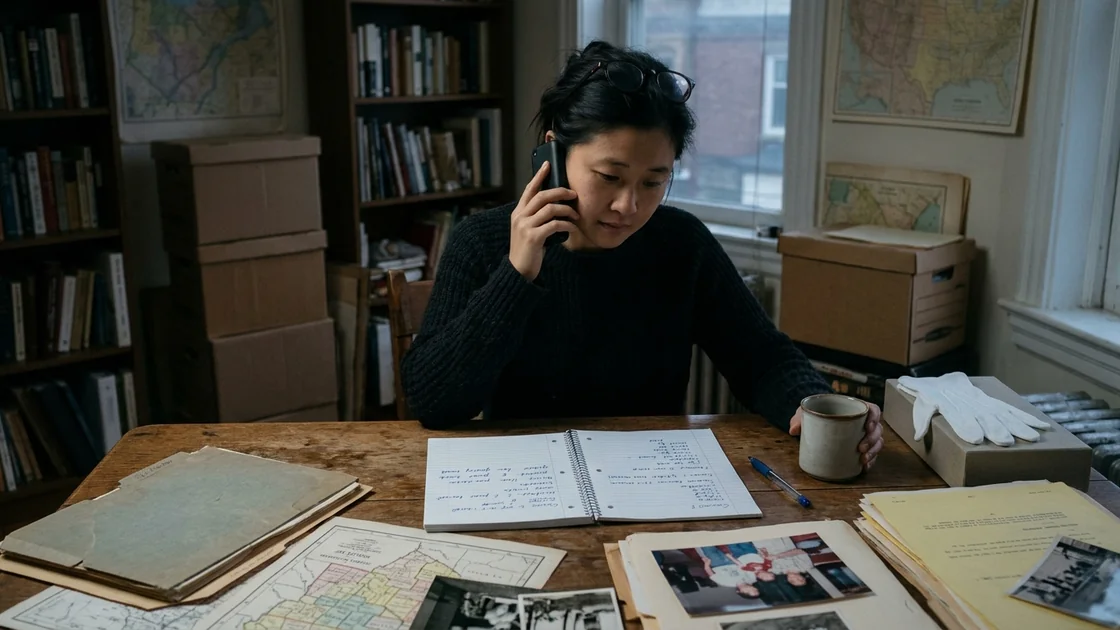
This story follows Maya Lin, an archivist who purchases a refurbished phone and begins receiving weekly voicemails from an elderly woman named Martha, who believes she is speaking to her estranged daughter, Cassandra. Rather than discarding the messages, Maya is drawn into Martha's fading world and embarks on a patient search through forgotten records and distant towns to locate Cassandra, ultimately bridging years of silence before time runs out.
Chapter One: The Remnant Number
The handset cost thirty-two dollars at a strip-mall electronics repair shop wedged between a dry cleaner and an all-night laundromat. It was a matte-black slab with a hairline fracture along the upper casing, scuffed around the charging port from years of someone else’s impatient thumbs.
Maya Lin did not buy it for games or social feeds. Her work as a conservation technician at the county historical repository was methodical, slow, and demanded long hours under dust masks and cotton gloves, handling fragile velum, crumbling ledgers, and silver-halide prints that smelled of vinegar. She needed a dedicated line for estate liquidators, municipal clerks, and church deacons who only phoned between nine and eleven on Tuesday mornings. She did not want those cold calls on her personal device, where she guarded her quiet evenings with fierce jealousy.
The young clerk with chipped black fingernails and a silver eyebrow barbell had handed her the activation slip without looking up from his tablet.
"Area code 419," he had muttered, tapping the receipt against the counter. "Recycled pool number. Hasn’t been active in three months. That’ll keep it clean from spam for a while."
He was mistaken.
The phone sat on Maya’s kitchen table in the center of a pale ring left by a forgotten mug of tea. She had plugged it into an extension cord, set the ringtone to a flat, utilitarian chime, and turned her attention to a bundle of tax assessments from 1912 that needed humidification and flattening. The apartment was quiet except for the periodic rumble of the cross-town bus shifting gears on the boulevard two stories below.
At 4:18 on that first Friday afternoon, the little black phone did not ring. It simply pulsed twice, a dull vibration against the oak table, and displayed a single icon in the corner: a spool of tape, the universal sign for a missed recording.
Maya wiped her hands on her apron, pushed her reading glasses up into her dark hair, and leaned over the device. The caller ID showed an unlisted local landline, its digits trailing off into an exchange that Maya recognized from the older, western quadrant of the city—a district of post-war bungalows and aging brick duplexes built for foundry workers who had long since retired or died.
She tapped the screen, brought the receiver to her ear, and entered the four-digit pin she had set an hour prior.
The carrier’s automated voice spoke with its synthetic, cheerful cadence: You have one new message. First voice message. Received today at four seventeen p.m.
A soft click followed. Then came the unmistakable sound of a receiver shifting against cloth, accompanied by the shallow, rhythmic rattle of breath that belongs to someone who has lived eight decades or more.
"Cassie?"
The voice was thin, like wet tissue paper stretched across a wire, but there was an unmistakable undercurrent of rehearsal in it, as if the speaker had spoken the sentence half a dozen times to an empty wall before lifting the handset.
"Cassie, honey. It’s your mother. I’m calling from the sunroom because the nurse—the little girl with the braided hair, I think her name is Brenda, though she wears a nametag that says Brenna—she told me the fog might roll in before dinner and make the reception go fuzzy. I just wanted to tell you that the pear tree in the corner yard is dropping its fruit early this year. The wind took down three big branches on Wednesday night. I looked out the window and thought of that yellow pinafore you had when you were seven, the one with the honeybee on the bib. You fell out of the lower fork and tore the hem, and you wouldn't let me wash the grass stain out because you said it made you look like an explorer."
A pause. A long, shuddering inhalation that took several seconds to settle. In the background, the faint chime of an institutional meal cart echoed down a hallway, followed by the muffled laughter of two orderlies.
"I know you don’t like me calling this late in the week. I know your work keeps you on your feet. But I kept the music box on the dresser, Cassie. The one with the brass swallow on the lid. The spring is loose, but it still plays the first four bars of the lullaby if you give it half a turn. If you’re coming through town for the solstice, you don’t have to stay here. I know the halls smell like boiled potatoes and floor wax. You could just sit on the bench out front by the hydrangeas. Ten minutes is plenty. Just so I can see how you’re wearing your hair."
Another long silence fell. Maya held her breath, her fingers tightening around the edge of the phone. She felt an instinctive, prickling guilt, the feeling of a stranger who has walked through an unlocked front door into an unlit hallway and caught a family mid-argument or mid-prayer.
"Well," the old woman whispered, her voice dropping lower, slightly frayed around the vowels. "The tea is getting cold. Brenna says I shouldn't let it sit or it upsets my stomach. Call me back when the shift ends, darling. I have the same number. I’ll keep the ringer on high."
A sharp, metallic clunk signaled the receiver being returned to its cradle. Then the dial tone buzzed, followed by the carrier prompt: To delete this message, press seven. To save, press nine.
Maya stared at the screen. Her thumb hovered over the seven. It was an administrative error. A recycled number, a mother with a notebook full of outdated scribbles, a daughter who had changed carriers, moved across the state, or simply walked away into another life. It had nothing to do with her. Maya’s life was built on strict borders: the past belonged in acid-free boxes, buffered with alkaline tissue; the present belonged in her quiet two-room apartment with her cat and her monographs on mid-century municipal architecture.
Her thumb moved to the right. She pressed nine.
Message saved, the mechanical voice replied.
Chapter Two: The Tuesday Log
By the third week, Maya had bought a spiral-bound stenographer’s notebook.
She did not intend to become an investigator. Her career was defined by passive stewardship; archivists do not change the provenance of an artifact; they document its condition, arrest its decay, and index its origin so that someone else—a historian, a relative, an attorney—can make sense of the human wreckage left behind.
Yet the calls arrived with the punctuality of a lighthouse lamp. Every Tuesday at ten in the morning, and every Friday at quarter past four.
The second message had arrived four days after the first:
"Cassie? It’s me. Brenda—she says her name is Brenna again, but she laughs when I call her Brenda, so I don't think she minds—she brought me the elderberry jam from the market on 4th Street. You always said it had too many seeds, but your father used to put it on saltines when his back was acting up. My knees have been stiff with the damp coming off the creek. If you still have those wool socks with the green heels, don’t wash them in hot water. You always shrank your woolens. Give my love to... well, I suppose you’re on your own now. I forget sometimes. It’s quiet here today. Call when you get a minute."
The third message, a week later:
"Cassandra. It’s your mother. Mrs. Gable passed on Monday. You remember Mrs. Gable from the piano studio? She had the spaniel that used to nip at bicycle tires. They held a service in the chapel downstairs. Very few flowers. Just some white carnations that looked tired. I wore the navy suit with the bone buttons. You always told me that suit made me look like an admiral, but it was the only one that still fits across the shoulders. I sat in the third row. I looked for your car in the visitor lot, but there was only the laundry van and the doctor’s Buick. I know it’s a long drive from the junction. I don’t expect you to take time off. But if you have that photograph from the beach in 1994—the one where your father is holding the spade and you have sand on your chin—bring it next time. I can’t find mine. The drawers in this dresser don’t pull out all the way. They stick on the runners."
Maya sat at her kitchen counter with a pen between her teeth. She had transcribed each call, line by line, on the narrow blue rules of the notebook.
Beside the text, she began making marginal notes:
- Location: A facility near a creek; likely institutional; sunroom; visitor lot visible from third-row chapel windows; orderlies named Brenna; chapel on site.
- Family names: Father deceased (referenced in past tense, back trouble, saltines); daughter Cassandra ("Cassie"); family dog or neighbor's dog (Mrs. Gable’s spaniel).
- Artifacts: Music box with brass swallow; navy suit with bone buttons; photograph from 1994 (beach, spade).
- Geography: Mentions "the junction," "4th Street market," "creek damp."
On the fourth Tuesday, Maya did not wait for the message to save. As soon as the vibration buzzed against her worktable, she picked up the phone, waited two seconds, and pressed the green button.
"Hello?" Maya said, her voice sounding unnaturally loud in the empty room.
Silence answered her. A soft, electric hum. Maya could hear the room tone on the other end—the hollow resonance of a corner room with linoleum flooring and tall, old-fashioned sash windows.
"Hello?" Maya repeated, softer this time. "Ma'am? I think you have the wrong number. This isn't Cassandra."
A sharp catch in the breath. A trembling hand tapped the microphone twice.
"Cassie?" the woman said, her voice pitched with a desperate, sudden brightness that made Maya’s chest ache. "Is that you, darling? You sound so distant. Are you in a tunnel? You always used to cut out when you drove past the quarry."
"No," Maya said firmly, trying to balance professional distance with the gentleness one uses when speaking to a child near a ledge. "I’m sorry. My name is Maya Lin. I just got this phone number three weeks ago. It used to belong to Cassandra, but she must have changed it. I’ve been getting your voicemails."
There was a long pause. The sound of a spoon clinking against a saucer.
"The girl with the braid," the voice murmured, talking not to Maya, but to the plaster corner of some distant room. "She told me the digits were seven-two-four-one. She wrote them on the cardboard from the hosiery. I have it right here under the lamp."
"Ma'am, seven-two-four-one is my number now," Maya explained. "The phone company gives numbers away when people stop using them. Cassandra hasn't had this number for at least three months. Maybe longer."
"She had it in May," the woman insisted, though her voice lacked conviction; it was the frail stubbornness of someone trying to hold dry sand in a fist. "She called me when the lilacs were in bloom. She told me the rain was washing the blooms off the bushes down by her road. She said she’d come when the ground dried out."
"Did she leave an address? A different number?"
"She’s my daughter," the woman said, as if that fact alone constituted a physical map of the world. "She wouldn't give her number to a stranger. Why do you have her number? Who gave you permission to hold her telephone?"
"I bought it at a shop on Lincoln Avenue," Maya said gently. "I didn't choose the digits. They just assigned them to me. Look, what is your name? If you tell me where you are, maybe I can help you find her."
A sudden coolness entered the frail voice. It was the defensive wariness of an elderly person who has been warned repeatedly by pamphlets and social workers about predators on the wire.
"I’m not supposed to give my name to people who ask from numbers I don't know," she said, her voice shaking slightly with the effort of composure. "Brenna put a sticker on the phone. It says: Do not give bank details. I don’t have bank details anyway. The trust handles the maintenance."
"I don’t want your money," Maya said, but the line went dead before she could finish the sentence. The sharp, mechanical clack of the cradle cut her off.
Maya held the phone away from her ear. She looked at her notebook, then out the window. Down in the street, an elderly man in a brown mackinaw was walking an old golden retriever, their paces matched in stiff, arthritic solidarity.
She turned a fresh page in the stenographer’s pad. At the top, she wrote: May. Lilacs. Quarry road. Trust fund.
Chapter Three: The Index of the Displaced
In Maya’s line of work, people rarely disappeared completely; they simply settled into the lower strata of documentation, like silt at the bottom of a canal. A person might shed a lease, a driver’s license, a library card, and three distinct surnames over forty years, but they almost always left an anchor somewhere in the county records: a deed of transfer, a small-claims judgment, an obituary for an aunt, or a voter registration card signed in blue ink that had faded to slate gray.
On Thursday morning, Maya took her fifteen-minute break from the repository’s basement reading room and went upstairs to the local history annex.
The annex smelled of floor wax and decaying buckram bindings. The clerk on duty was Harold Vance, an eighty-year-old volunteer who had spent thirty years in the city water department and knew every sewer line and plat map drawn between 1890 and the present day.
"Harold," Maya said, leaning against the wooden counter behind which rows of city directories stood like soldiers in blue and green jackets. "Where were the flower nurseries that grew lilacs within five miles of a quarry?"
Harold didn't look up from his crossword. "Limestone or slate?"
"Limestone."
"Western edge of the county," he said immediately, his pencil hovering over five-across. "Out near the old Medusa works. The quarry pit filled up with spring water back in seventy-six. Kids used to dive off the aggregate bins until the sheriff fenced it off. There were three commercial farms out there. The Griersons had orchards. The Cloughs grew perennials. And the Davis place had twenty acres of cut flowers and nursery stock."
Maya felt a slight quickening in her pulse. "Davis?"
"Martha Davis and her husband, Arthur," Harold said, squinting through the thick lower half of his bifocals. "Arthur died twenty years ago. Heart stopped while he was sitting on his tractor in the middle of the lower field. Tractor kept going until it nosed into the ditch and stalled out against a culvert. Martha stayed on for a while, but you can’t run twenty acres of nursery with hired boys who don’t know a root ball from an onion. She sold off the road frontage in ninety-eight. Some developer put up those vinyl-sided ranches with the two-car garages."
"Did they have children?"
"A girl," Harold said without hesitation. "Cassandra. Cassie. She was a few years behind my youngest at St. Jude's. Sharp girl. Won the state ribbon for 4-H poultry three years running. She played the cello, too. Used to carry that big black case onto the school bus, took up half the seat. People didn't like it on rainy days."
"What happened to her?"
Harold finally laid down his pencil. He looked at Maya with the watery, perceptive eyes of a man who spent his life watching small towns contract into suburbs.
"Why are you asking, Maya? Somebody looking for a title deed on the old nursery?"
"No," Maya said. "I have her old phone number. Her mother keeps calling it."
Harold’s expression softened, the cynicism draining from his weathered face, replaced by that heavy, familiar resignation common to old men who have outlived their neighbors.
"Martha’s out at Pine Creek Manor," he said quietly. "Down off River Road. She’s been there four or five years now. My sister’s sister-in-law is in the dementia wing there. It’s clean enough, but it’s where people go when their houses get too large and their memories get too small. If Martha’s calling that number, she probably doesn't know she’s dialing into the wind."
"And Cassandra?"
"Cassie left," Harold said simply. "Must have been ten, twelve years back. Right around the time Arthur’s estate finally settled. There was bad blood between her and the cousins over the equipment sales, and Martha... well, Martha was always a difficult woman when she had her wits about her. Demanding. The kind of mother who measures the hem of your skirt with a wooden ruler and checks your fingernails before Sunday dinner. Cassie took a job out of state. Oregon, maybe. Or Washington. Somewhere with trees that didn't look like Ohio. I don’t think anybody around here has seen her since Arthur’s marker went into the ground at Oak Hill."
Maya wrote Pine Creek Manor on the back of an index card.
"Does she have an address?"
"Cassie?" Harold shrugged. "Try the state licensing boards for landscape architects or plant nurseries. If you grow up with dirt under your nails like Cassie Davis, you don't end up sitting behind a desk typing numbers into a box. She’ll be somewhere with green things."
Chapter Four: The Sunroom on River Road
Pine Creek Manor did not look like a place of tragedy; it looked like an oversized dental clinic built during the Carter administration. It had a low, gravel-aggregate roof, brick facades painted an institutional beige, and an asphalt turnaround circular driveway with three concrete planters containing petunias that had surrendered to the first frost.
Maya took a Friday afternoon off from the repository. She wore her work clothes—a pleated wool skirt, sensible leather oxfords, and a trench coat that had seen too many damp autumns. Under her arm, she carried a brown paper sack containing half a pound of dry butter cookies from the German bakery on High Street.
The smell inside was precisely what the voice on the telephone had promised: floor wax, overcooked starch, and the faint, citrusy tang of industrial air freshener.
At the front desk, a young woman with a long, intricate braid resting over her left shoulder looked up from a clipboard. Her plastic nametag read: Brenna, STNA.
"Can I help you?"
"I’m here to see Martha Davis," Maya said.
Brenna’s eyebrows rose slightly. She had round, freckled cheeks and the tired, patient eyes of someone who worked double shifts for sixteen dollars an hour.
"Family?"
"A friend," Maya said carefully. "A friend of the family."
Brenna glanced down at a worn, three-ring binder behind the laminate counter. "Well, she doesn't get many. None, actually, except for the volunteer from the Methodist church who reads the large-print magazines on Tuesdays. She’s in the solarium right now. End of the B wing, turn right past the ice machine. If she’s asleep, just leave the cookies on the side table. Don’t leave them open or the ants get in from the courtyard."
"Brenna?" Maya paused, resting her hands on the counter. "Does she still have her phone?"
The nurse sighed, a tiny sound of exasperation mixed with sympathy. "We had to disconnect the long-distance line six months ago. She was getting bills from operators in Canada for five hundred dollars because she kept dialing random digits trying to reach her daughter. Now it’s just an internal line with local service. She has the old rotary that she brought from home. We plugged it into the wall jack so she feels like she can still reach out. Does she call you?"
"Yes," Maya said. "She calls me."
"She’s got a list," Brenna said, tapping her own temple with a pen. "Her mind is like an old radio dial where the string broke. Sometimes she’s right on the station, clear as a bell, talking about seventy-four like it was yesterday morning. Other times she’s just static between the bands. If she thinks you’re Cassie, don’t argue with her too much. It just gets her heart rate up, and then she won't eat her supper."
The hallway in B Wing was silent except for the low drone of an air handler and the occasional muffled bark of a game-show host from a wall-mounted television behind an open door.
The solarium was at the end of the corridor, where the building met a small, fenced courtyard containing three white plastic chairs and a desolate birdbath filled with gray rainwater. The room was warm—too warm—heated by long baseboard radiators that ticked like clocks.
In the corner, sitting in a wingback chair upholstered in green vinyl that had begun to split along the seams, sat Martha Davis.
She was smaller than her voice had suggested. She seemed almost weightless, an assemblage of fine, dry bones wrapped in a lilac cardigan that was missing its top button. Her white hair was brushed back from her forehead and pinned with two metal bobby pins that didn't match. On her lap, she held a large, black plastic landline phone with a coiled cord that trailed across the linoleum and plugged into a low wall socket near the baseboard.
On the small table beside her sat an empty tea mug, a plastic glass of water with a bent straw, and a piece of cardboard cut from a box of support hose. On the cardboard, written in the shaky, bold strokes of a blue felt-tip marker, were seven numbers: 555-7241.
Maya stood in the doorway for a long moment, watching the old woman’s chest rise and fall. Martha’s eyes were open, staring through the double-paned glass at the brown stalks of the hydrangeas outside. Her fingers, knotted at the knuckles with arthritis, stroked the telephone receiver as if it were a sleeping cat.
Maya tapped lightly on the doorframe. "Mrs. Davis?"
Martha did not startle. She turned her head slowly, her chin trembling with an intentional, measured effort. Her eyes were a very pale, washed-out blue, like denim that had been through the laundry a thousand times.
"Brenda?" she asked, her voice cracking slightly on the first syllable.
"No," Maya said, stepping into the room and setting the paper bag on the low windowsill. "My name is Maya. We spoke on the phone yesterday."
Martha looked from Maya’s face down to the black telephone on her lap, then back up again. A tiny flicker of calculation moved behind her eyes, the instinctive defense of an old mind trying to cover its tracks.
"You’re the girl who took Cassie’s number," she said. It was not an accusation; it was a statement of profound, weary recognition. "The girl with the flat voice."
"I’m Maya," she repeated gently. "I brought some butter cookies from High Street. The ones with the almond on top."
Martha looked at the brown paper bag. She didn't reach for it, but her mouth tightened in a memory of dignity.
"Arthur always bought those for my birthday," she said. "The baker used to put them in a tin with a picture of a windmill on the lid. Now they just use paper. Everything comes in paper or plastic. When you throw it away, it doesn't even make a sound in the bin."
Maya pulled a light wooden chair from against the wall and sat down three feet away, keeping her hands open in her lap.
"You have a nice view of the yard," Maya offered.
"The yard is dead," Martha said flatly. "They don't prune the hydrangeas right. You have to leave the old wood until the spring shoots show themselves, otherwise the frost gets down into the crown and kills the root. I told the man with the mower—the boy with the orange cap—I told him he was butchering them. He just smiled and put his earphones back in. Nobody listens to an old woman who doesn't own the dirt under her feet."
"I listened to your messages," Maya said.
Martha turned her gaze back to the window. Her hands remained flat on the black plastic of the handset.
"They weren't for you. You had no business keeping them."
"I know," Maya admitted. "At first, I was going to delete them. But they were... they were very specific. You remembered the yellow dress. And the pear tree."
Martha’s lower lip quivered. She pressed her thumb against the seam of the telephone receiver, her nail pale and ridge-lined.
"She doesn't call back," the old woman whispered, the hardness vanishing from her tone as quickly as it had appeared, leaving behind a raw, naked bewilderment. "I wait every Tuesday. I make sure I’m sitting right here by nine-thirty so the cart doesn't block the hallway. And then the bell doesn't ring. Sometimes I pick it up just to see if the dial tone is still there. The dial tone is always there. It’s the only thing that doesn't stop."
"Mrs. Davis," Maya said, leaning forward slightly, "when was the last time you saw Cassandra?"
Martha looked up at the ceiling tiles, counting something only she could see among the water stains and fluorescent tubes.
"She had that blue station wagon," Martha said softly. "The one with the rust around the wheel wells. She came to the kitchen door. She had her cello in the back seat under an old quilt. She said, 'Mother, I can't stay here while you sell Arthur’s things to the people from the auction.' I told her the auction was none of her concern. I told her if Arthur wanted her to have the disc harrow, he would have written it in the book. He didn't write it in the book. He left everything to me because he knew I’d keep the taxes paid."
She stopped. A tear, slow and viscous, tracked through the deep creases beside her nose and hung at the corner of her lip.
"She didn't take her coat," Martha whispered. "The green wool one. It was still hanging behind the pantry door. I kept it there for five years until the moths got into the sleeves. Why would she leave her coat if she wasn't coming back for supper?"
Maya looked down at her own hands. In her work, she often found letters tucked into the backs of diaries—letters written during the Civil War, letters from young men in France in 1918, letters that ended with write soon, write soon, the post is slow. The people who wrote them were dust; the people who failed to answer were dust. The silence between them had become permanent, preserved in ink and linen paper.
But Martha Davis was still breathing, her heart ticking along in the dry heat of B Wing, waiting for a three-digit extension to connect her to a life that had moved five hundred miles away.
"Do you know where she lives, Martha?"
Martha shook her head, a slow, miserable oscillation. "She sent a postcard once. From a place with mountains. The picture had trees that were too tall. I couldn't read the postmark because the mailman had dropped it in a puddle. It was smeared with blue mud. I put it in my bible, but when they moved me out of the house, the bible went into a carton with the lampshades. Brenda says the carton is in the basement here, but the basement is locked. Only the men with the laundry keys can go down there."
Maya stood up. She reached out and placed her hand over Martha’s cold, knotted fingers where they rested on the telephone. The skin felt like parchment—dry, paper-thin, carrying the faint, persistent chill of old age.
"I’m going to look for her, Martha."
Martha did not look up. Her eyes remained fixed on the plastic buttons of the dead telephone.
"Tell her," Martha said, her voice dropping so low Maya had to bend down to hear it over the rattle of the radiator, "tell her I still have the music box. I didn't let the auction men take it. I hid it in the vegetable crisper until they were gone."
Chapter Four: The Scent of Pine and Solder
Finding a person in the digital age should be easy, but the world is full of people who do not wish to be found by algorithms, people who live behind cash transactions, small proprietorships, and state borders that do not readily share tax rolls.
Maya spent her evenings at the local library, using the commercial genealogical databases and public record terminals.
The trail for Cassandra Davis went cold in 2011 in Toledo, where she had surrendered her Ohio driver's license. There was no record of marriage under her name in Ohio, Michigan, or Indiana. There was no property deed in her name in the state of Ohio.
Maya returned to Harold Vance’s desk on Monday morning.
"Harold," she said, setting a thermos of black coffee on his blotter. "Did Arthur Davis have brothers?"
Harold looked up, sniffed the steam from the thermos, and nodded toward a row of bound county probate indices.
"Arthur had a brother named Julian," Harold said. "Julian went down to Kentucky in the seventies to work for the railway. But Arthur’s sister, Clara, married a man named Vance—no relation to me, different branch from up near Sandusky. Clara had three boys. One of them, Gary, runs an equipment dealership out near Port Clinton. He was the one who handled Arthur’s farm sale."
Two hours later, Maya was driving north on State Route 2, the sky above Lake Erie the color of wet slate. The wind off the water was sharp and smelled of dead shad and diesel fuel.
Gary Vance’s dealership was a sprawling gravel yard filled with lime-green tractors, red combines with twelve-row headers, and rows of rusty implements lined up like discarded iron teeth.
Gary was sixty, wearing an insulated Carhartt vest and a cap that said DeKalb Seeds. He had the thick, square hands of a mechanic and the skeptical squint of a man who dealt with bank repossession agents on a regular basis.
"Cassie?" he said, wiping grease from his thumb with a red shop rag. "Why the hell are you asking about Cassie? She ain't been to a family reunion since Arthur’s funeral."
"Her mother is at Pine Creek," Maya said, bracing herself against the cold lake breeze. "She’s ninety-one, Gary. She doesn't have much time left. She calls her daughter’s old number twice a week."
Gary looked out across the gravel lot, where the wind was whipping a yellow plastic pennant against a fence post. He spat into the stone dust.
"Martha Davis was a terror," he said, not unkindly, but with the brutal honesty of rural kin. "She drove Arthur into an early hole with her nagging. Nothing was ever clean enough; nothing was ever good enough. Arthur would work fourteen hours in the muck, and she’d make him take his boots off outside on the gravel porch even if it was twenty below zero. And Cassie... Cassie was just like Arthur. Quiet. Liked her plants. Liked her music. When Arthur died, Martha told Cassie she was an ungrateful bitch because Cassie wanted to keep Arthur’s old International pickup instead of letting Martha sell it to pay for new carpet in the parlor."
"Do you know where she went?"
Gary folded the rag carefully, pressing it into his back pocket.
"She went to Michigan first," he said. "Worked for a wholesale nursery near Kalamazoo. Then she went out east. New York state. Some place up near the finger lakes. She had a partner for a while—a woman named Miller who did floral design for weddings. They had a shop together."
"Do you have an address?"
"I don't keep an address book for people who don't want to be found, miss," Gary said. He looked at Maya’s worn trench coat, her unpainted nails, the serious, patient set of her jaw. "Look. Cassie ain't hiding from the law. She’s hiding from that house on River Road. You go dragging her back here, you might not be doing her any favors. Martha Davis made her bed. She made it with starch and hospital corners, and now she’s got to lie in it."
"She’s ninety-one," Maya repeated. "And she has the music box in her room."
Gary stopped. His jaw worked for a second, a muscle twitching beneath his graying stubble.
"The one with the bird?" he asked.
"Yes. The brass swallow."
Gary looked down at his boots. He kicked a piece of loose gravel toward the shop door.
"Cassie used to wind that thing until the spring clicked when she was five years old," he muttered. "Arthur bought it at the fair in Lucas County. Cost him six dollars back when six dollars was a day's work with a ditching spade."
He turned and walked into the warmth of the service bay. Maya followed him. The shop smelled of hydraulic fluid, welding gas, and scorched iron.
Gary reached behind an old parts manual on a metal shelf and pulled out a grease-stained desk calendar from three years ago. He flipped through the back pages where phone numbers were scrawled in lead pencil alongside serial numbers for John Deere alternators.
"She called me," he said, not looking at Maya. "Three years back. When Arthur’s brother Julian died down in Bowling Green. She wanted to know if Julian had any of Arthur’s old pocketknives. She didn't want money. Just wanted the knife Arthur used for grafting pear stock. The one with the bone handle."
He pointed a thick, calloused finger at a line of writing: C. Davis. Trumansburg. 607.
"That’s upstate New York," Gary said. "Near Ithaca. She was working for an heirloom orchard outfit. Grafting old stock. Apples and pears from before the war. That’s all I know. If you tell her I gave you that number, I’ll tell her you’re a liar."
Chapter Five: The Seven-Hour Line
Maya did not call the 607 number.
She was an archivist; she knew that some documents, once committed to paper, cannot survive the violence of being read over an electronic circuit. A telephone call is too easy to drop. A thumb can tap a red circle and extinguish thirty years of unsaid things before the lungs have even drawn in air for the second sentence.
She rented an economy sedan from the agency near the bus depot on Saturday morning. It was a white hatchback that smelled of ozone and cheap upholstery cleaner.
The road east across the top of Ohio and through the narrow chimney of Pennsylvania was flat, gray, and flanked by leafless hardwoods that stood against the sky like frayed wire brushes. Maya drove with the radio off. In the passenger seat, resting on top of her leather satchel, was the black plastic telephone from the electronics shop, its battery fully charged, its memory bank holding the seven recordings she had refused to delete.
She crossed into New York state in the early afternoon. The landscape buckled into long, rolling drumlins, the valleys filled with black soil and vineyards where the vines were tied to wires like row after row of barbed wire.
Trumansburg was a village of Greek Revival farmhouses and wide streets lined with sugar maples that had dropped their leaves weeks ago. The village had two groceries, a tavern with neon beer signs in the window, and a hardware store with an old wooden floor that groaned underfoot.
At the hardware store, Maya bought a paper map of Tompkins County and an apple that tasted of cellar dust.
"The heirloom nursery?" the clerk said, an elderly man wearing an apron with pockets full of brass wood screws. "You mean the Indian Creek place? That’s out on the ridge road. Five miles north. Follow the creek until you see the gray barn with the cedar shakes. You can't miss it; they got the espaliered pears along the highway fence."
Maya drove north along the ridge. The air here was cooler than in Ohio, smelling of sulfur from the shale gorges and the rich, wine-like rot of fallen cider apples.
The nursery was marked by a hand-painted wooden sign: Indian Creek Heritage Fruitlands – Stock & Scionwood.
The barn was nineteenth-century timber frame, weather-silvered and massive, surrounded by acres of young trees in nursery rows, each small whip tied to a bamboo stake with strips of green rubber.
A woman was working in the open shed beside the barn.
She wore a heavy brown canvas barn coat, mud-caked knee boots, and a knitted wool cap pulled down over her ears. She was working at a long wooden bench, her bare hands red from the cold, using a small, curved grafting knife to notch scionwood into rootstock with quick, decisive strokes.
Maya parked the rental car beside an old green pickup truck that had an Ohio inspection sticker from 2004 peeling in the corner of its windshield.
As Maya stepped out into the gravel, the woman at the bench didn't look up immediately. She finished three cuts, bound the union with wax-dipped twine, and set the small tree into a bucket of damp sawdust before wiping her blade on her thigh.
When she lifted her head, Maya felt a strange, internal jolt of continuity.
The woman had Martha’s pale, washed-out blue eyes. But where Martha’s chin was frail and trembling, this woman’s jaw was broad, set with the quiet, stubborn density of someone who had spent thirty years working alone against weather and soil. Her hair, tucked under the cap, was streaked with gray, but her eyebrows were dark and fierce.
She was fifty, perhaps fifty-two.
"We’re closed for retail sales until the spring," the woman said. Her voice had the same low, resonant timber that Martha’s had possessed before the air handler at Pine Creek had dried it out. "If you’re looking for scionwood, you need to order through the catalog."
Maya walked across the crushed shale toward the shed. The wind caught the hem of her trench coat, flapping it against her calves.
"I’m not looking for trees, Cassandra."
The knife in the woman’s hand stopped moving toward the next whip of rootstock. Her body went very still, the muscle along her neck tightening beneath the canvas collar.
"Who are you?"
"My name is Maya Lin. I came from Miller's Creek."
Cassandra Davis looked at Maya’s coat, her sensible shoes, her dark hair pinned behind her ears. She did not look like an attorney; she did not look like a cousin.
"Did she die?" Cassandra asked.
The question came without drama, without tears. It was a question that had clearly sat on a shelf in the back of her mind for a decade, waiting to be pulled down like an old jar of preserves.
"No," Maya said. "She’s at Pine Creek Manor. Room 114."
Cassandra let out a long breath that turned white in the cold air of the shed. She laid the curved knife on the wooden bench, beside a block of paraffin and a box of labels.
"Gary gave you my name," she said, her voice dropping into a register of cold, protective exhaustion. "Gary always was a meddler. He thinks because he sells tractors he knows how families ought to work."
"Gary didn't want to tell me," Maya said. "He told me your mother made her bed."
"She did," Cassandra said. She turned her back on Maya, picking up a bundle of twigs tied with raffia. "She made it forty years ago. If you drove six hours to tell me she’s old, you wasted your gas. I know she’s old. She was old when I was twelve."
"I didn't come to tell you she was old," Maya said.
She reached into her satchel and pulled out the small black phone. She set it on the clean end of the grafting bench, between a jar of grafting compound and a wooden mallet.
"I came because of this."
Cassandra looked at the scuffed plastic slab. "What is that?"
"It’s my phone," Maya said. "I bought it three weeks ago. They gave me your old number. The one you had when you lived on Lincoln Street."
Cassandra frowned, her eyes narrowing as she looked at the device. "I gave that number up four years ago. I couldn't pay the long-distance plan, and every time the damn thing rang, I thought... I thought it was someone from the bank telling me they were bulldozing the barn."
"She calls it every Tuesday," Maya said. "At ten o'clock. And every Friday at four."
Cassandra stood motionless, her red fingers curled around the bundle of scions.
"She’s ninety-one, Cassandra. She sits in the solarium with an unplugged rotary phone on her lap, and she tells you about the pear tree. She tells you about the yellow dress with the honeybee on the bib."
Cassandra flinched. It was small—just a tightening around the corners of her mouth—but Maya saw it.
"She has dementia," Cassandra said, her voice rising slightly, defending the perimeter she had built around her life with hundreds of miles of asphalt. "She doesn't know who she’s talking to. She’s just reciting scripts. She’s been reciting those scripts since 1985. You don't know her, miss. You didn't live with her. You didn't have to listen to her tell your father that he smelled of the barn every time he sat down to eat a sandwich. You didn't watch her give away his tools to the auctioneer because she wanted sixty dollars to buy curtains with scalloped edges."
"She kept the music box," Maya said.
Cassandra stopped. The wind caught a piece of loose paper on the bench, rustling it against the wood.
"What did you say?"
"She kept the music box," Maya repeated, her voice level, carrying the patient weight of an archivist who has verified the provenance of an original document. "She hid it in the vegetable crisper so the auction men wouldn't take it. She has it on the small table beside her bed at Pine Creek. The spring is broken. She says it only plays the first four bars of the song if you turn it half a turn."
Cassandra turned around slowly. Her eyes were wide, the denim-blue irises dark with a sudden, unbearable pressure.
"The brass swallow?" she whispered.
"The brass swallow," Maya said.
Cassandra looked down at her hands, at the dark earth under her fingernails, at the small, white scars along her knuckles where grafting knives had slipped over the years. A tremor started in her wrists and moved up through her shoulders.
"She told me she sold it," Cassandra said, her voice cracking, breaking apart into the small, wounded cadence of the girl who used to carry a cello onto a school bus in the rain. "She told me she sold it to a dealer from Cleveland for forty dollars because she needed the money for the milk bill. We had an argument in the driveway. I told her I’d never come back to that house as long as she was breathing. I took the station wagon and I drove until the gas ran out."
She leaned her weight against the heavy workbench, her canvas coat sagging.
"She kept it?"
"It’s sitting next to her water glass," Maya said. "Beside a piece of cardboard from a pair of support hose with your old number written on it in marker."
Maya stepped forward, reached out, and pressed the play button on the black telephone.
The synthetic voice filled the cold, apple-scented shed: First saved message. Received Friday, October twelve.
A pause. The sound of the meal cart in the distance. The rattle of old lungs.
"Cassie? Honey. It’s your mother. I’m calling from the sunroom..."
Cassandra covered her face with her hands. The dirt on her fingers smeared across her temples, mixing with the tears that came suddenly, silently, shaking her whole frame as the voice of the woman she had spent twenty years running from spoke into the empty spaces of the barn.
"...I looked out the window and thought of that yellow pinafore you had when you were seven, the one with the honeybee on the bib. You fell out of the lower fork and tore the hem, and you wouldn't let me wash the grass stain out because you said it made you look like an explorer."
Cassandra dropped her hands. Her face was red, her mouth open in a soundless, ragged gasp for air.
"She remembered the explorer," she sobbed, her knuckles pressed against her teeth. "I told her that sixty years ago. She called me a tomboy and made me stay in the pantry until supper."
"She’s ninety-one, Cassandra," Maya said, her own voice thick now, the professional mask slipping away into the cold afternoon. "She doesn't have the pantry anymore. She just has the solarium."
Chapter Six: The Turn South
They left the Indian Creek Heritage nursery at five o'clock that evening.
Cassandra had not packed a suitcase. She had gone into the small, wood-heated apartment above the barn, washed her hands with lava soap at the kitchen sink, and returned with a heavy wool coat—a charcoal duffle with wooden toggles—and an old leather satchel that smelled of beeswax.
"I’m riding with you," she told Maya, locking the side door of the shed with an iron key. "The green truck won't make four hundred miles without throwing a belt."
They drove into the darkness.
The white rental car hummed along the interstate, its headlights cutting through the sleet that had begun to fall over the high ground of the Allegheny Plateau.
For the first two hours, Cassandra said nothing. She sat with her knees pressed together, her hands folded over the satchel in her lap, staring through the sweep of the windshield wipers at the red taillights of the semi-trucks ahead of them.
Near Erie, where the lake-effect wind began to shake the car’s light frame, Cassandra spoke.
"She was twenty-two when she had me," she said, her voice dry, scraping against the darkness of the car’s interior. "She was the prettiest girl in the county. Arthur told me she had hair like red clover before the sun bleached it out. But she was terrified of the dirt. She grew up in town, with a father who worked in the bank and had three pairs of shoes. Then she married Arthur, and Arthur brought her to twenty acres of heavy clay that stuck to your boots like glue from March to June."
Maya shifted her hands on the wheel. "Why did she stay?"
"Because Arthur was her husband," Cassandra said simply. "In those days, you didn't leave because the cellar was damp. You stayed and you scrubbed the linoleum until the pattern wore off. She scrubbed that kitchen floor every Saturday night on her knees with lye soap. By the time I was ten, her hands looked like ginger roots. She hated those hands. She’d hide them under her apron whenever people from the church came to call."
Cassandra turned her head to look at Maya.
"Did she sound... did she sound like she was in pain?"
"She sounded like she was waiting," Maya said. "Every message ended the same way. Call when you get a minute. I have the same number."
Cassandra let out a small, bitter laugh that died in her throat.
"I memorized that number when I was six," she said. "Arthur made me repeat it three times every morning before I got on the bus. Seven-two-four-one. He said if the bus ever broke down in the snow, I was to find a house with smoke coming out of the chimney, ask for the telephone, and tell Martha that Arthur’s girl was standing by the road. I knew those four digits before I knew the multiplication tables."
She leaned her head against the cold glass of the passenger window.
"I let the bill go because I couldn't bear to look at the paper," she whispered. "Every month it came in the mail with her area code on it. It felt like a subpoena."
"Documents don't judge," Maya said softly, thinking of the hundreds of tax ledgers and estate inventories she had handled in her basement room. "They just record what happened. People do the judging."
"Are you an archivist, Maya?"
"Yes."
"Then you know how things rot if you don't keep the air to them," Cassandra said. "That’s what happened to us. We kept the windows shut too long."
Chapter Seven: The Room with the Hydrangeas
They arrived at Pine Creek Manor at nine o'clock on Sunday morning.
The light was pale, filtered through a high, white overcast that made the concrete of the parking lot look like bone. The rain had stopped, leaving behind a sharp, clean chill that smelled of early winter.
Maya walked through the double doors first, her boots squeaking on the rubber mat.
Brenna was at the desk, wearing purple scrubs printed with small cartoon cats. She had a cup of coffee in one hand and was checking an insulin chart with the other.
When she saw Maya, her eyes shifted to the woman standing half a step behind her—the tall woman with the weathered skin, the charcoal duffle coat, and Arthur Davis’s broad, unhurried shoulders.
Brenna set her coffee down on the laminate counter. Her eyes widened slightly, her mouth forming a silent oh.
"She had a bad night," Brenna said, her voice dropping into a professional whisper that didn't quite hide the tremor in it. "Her oxygen dipped around three. We had to put the nasal cannula on her. She’s in the solarium. She wouldn't stay in the bed. She told the night aide she had an appointment at ten."
Cassandra stood frozen in the center of the lobby, her leather satchel hanging from her fingers. She looked down the long, beige corridor of B Wing, where the meal cart was already beginning its slow, rattling journey from the kitchen.
"Cassandra," Maya said, touching her elbow. "Come on."
The walk down the hall seemed to take an hour.
With every doorway they passed, Cassandra’s steps grew heavier, more deliberate, like a person walking into an oncoming current. She looked into the open rooms—at the hospital beds, the walkers with tennis balls stuck on the legs, the framed prints of pastoral landscapes that had never existed—and her jaw worked with that silent, fierce resistance.
At the entrance to the solarium, Maya stopped. She took Cassandra’s satchel from her hand.
"Go in," Maya said.
"Will you...?"
"No," Maya said gently. "This isn't an archive. Go in."
Cassandra stood in the doorway for three seconds, her shoulders square, her hands shoved deep into the pockets of her duffle coat. Then she stepped across the threshold.
Martha was sitting in the green vinyl wingback chair.
She looked smaller than she had on Friday. The clear plastic prongs of an oxygen cannula were looped over her ears and tucked into her nostrils, the thin green tube trailing down to a small, pulsing regulator beside her feet. The black telephone was not on her lap today; it was resting on the table beside the water glass, right next to the brass music box.
Martha’s head was tilted toward the window. Her breath came in short, dry puffs that made a faint whistling sound against the plastic tubing.
"Mother?" Cassandra said.
It was not loud. It was the voice of a fifty-year-old woman who had suddenly become eight years old again, standing on the threshold of a kitchen with mud on her knees.
Martha did not move for a long moment. Then, with that agonizingly slow, calculated effort, she turned her head.
The pale blue eyes looked across the linoleum. They traveled from the muddy knee boots to the charcoal coat, up to the broad jaw, and finally settled on the dark, fierce eyebrows.
Martha did not cry out. She did not raise her arms. Her face remained still, but the corners of her mouth drew in, the deep lines around her lips trembling as if she were trying to whistle in the dark.
"You’re late," Martha whispered, her voice like leaves scraping across concrete. "The boy with the mower... he cut the hydrangeas all wrong."
Cassandra dropped to her knees on the linoleum.
She did not care about the floor wax; she did not care about the orderlies passing in the hall. She brought her heavy, work-scarred hands up and laid them over Martha’s tiny, cold ones where they rested on the black plastic of the dead telephone.
"I know, Mother," Cassandra said, her forehead coming down against Martha’s lilac cardigan, right over the missing button. "I know. He butchered them."
Martha’s hand lifted. It was a slow, heroic effort, the fingers hovering in the air for an instant before they settled onto Cassandra’s knitted cap. She pulled the cap off, tossing it aside with that old, familiar dismissiveness, and buried her crooked, ginger-root fingers into her daughter’s gray-streaked hair.
"You didn't wash your face," the old woman murmured, her pale eyes looking out over Cassandra’s shoulder at the gray Ohio sky. "You’ve got sand on your chin, Cassie. You always were an explorer."
Chapter Eight: The Last Record
Maya did not stay for the conversation.
She walked out through the double doors into the sharp morning air. She stood by the circular turnaround, beside the concrete planter where the petunias had died, and looked across the road toward the creek.
The water was high, swollen by the autumn rains, running brown and muscular between the willow trees. On the far bank, the limestone bluffs of the old Medusa quarry rose above the tree line, gray and ancient, carrying the scars of half a century of blasting.
She reached into her coat pocket, pulled out the thirty-two-dollar phone, and unlocked the screen.
The carrier information still read: Area code 419. Number: 555-7241.
Maya opened the voice mailbox.
You have seven saved messages, the machine told her. To listen to your messages, press one.
Maya did not press one.
She looked down at the screen, her thumb resting on the cold glass. She thought of the stenographer’s notebook on her kitchen counter, with its lists of pear trees, music boxes, and wool socks with green heels. She thought of Harold Vance and his crossword puzzles, Gary Vance and his greasy shop calendar, and the two women sitting in the dry, baseboard-heated air of Room 114, holding onto an unplugged rotary phone like it was an anchor in thirty fathoms of water.
The work of an archivist is not to keep everything.
If you keep everything, the repository fills with dust until the floor joists buckle and the light cannot get in through the windows. The work of an archivist is to decide what must be remembered, and what has finally accomplished its task and can be permitted to dissolve.
Maya pressed three.
To delete all messages, press nine.
Her thumb moved without hesitation. She pressed nine.
All messages deleted, the synthetic woman said, her cadence as cheerfully indifferent as the wind coming off the limestone quarry. You have no messages.
Maya Lin powered the phone down, slipped it back into her satchel, and walked across the gravel lot toward the white car to begin the long drive home.