The Deep End of the Dale
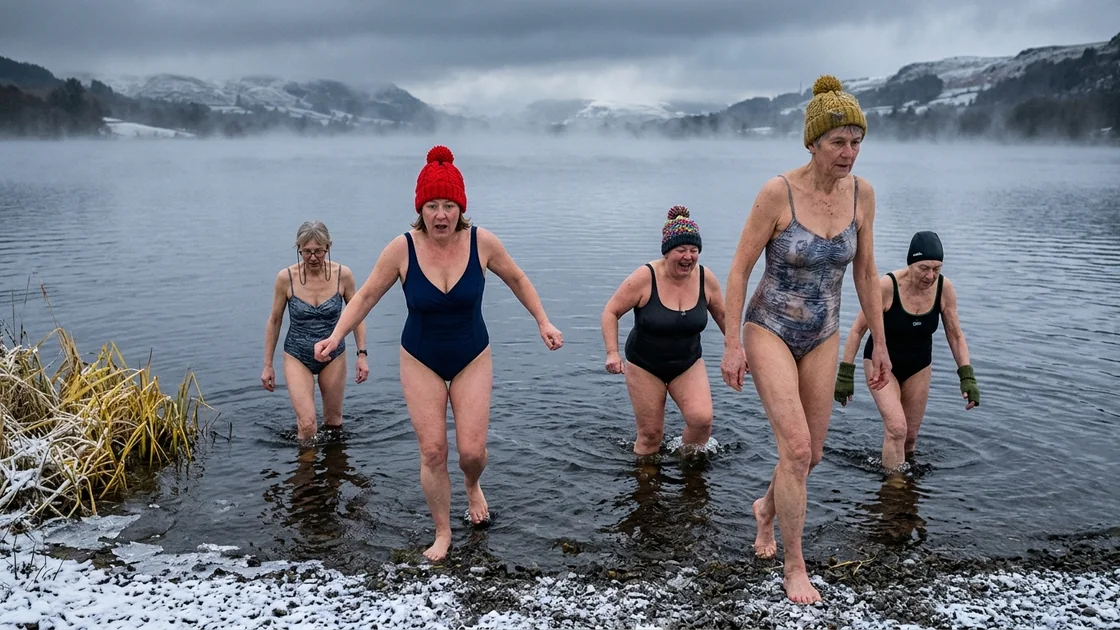
This is the story of Martha Finch, a fifty-two-year-old widow living in the shadow of the Yorkshire Dales, whose paralyzing terror of deep water has dictated the narrow borders of her existence since a childhood mishap on the Leeds and Liverpool Canal. When grief and isolation threaten to swallow her whole in the damp stone silence of Kettlewell, Martha impulsively answers a hand-scrawled notice in the village post office and falls in with a pack of eccentric, foul-mouthed, and fearless older women known as the River Hags. Through the biting frost of autumn, the bone-aching chill of mountain tarns, and the fierce, unadorned fellowship of women who refuse to apologize for their aging bodies, Martha is forced to confront the dark silt of her memories, learning that courage is not the absence of the gasp reflex, but the decision to kick toward the light when the cold takes your breath away.
I. The Margin of the Puddle
Martha Finch was a woman who stepped around puddles. She did not merely avoid them for the sake of her shoes; she skirted them with a vigilance that bordered on liturgy. When the heavy November rains drummed down from Great Whernside, turning the gutters of Kettlewell into churning brown chutes, Martha stayed indoors behind double-latched sash windows, checking the kettle’s whistle before it reached a shriek, keeping her tea in mugs she never filled more than two-thirds of the way to the rim.
Water, in Martha’s estimation, was an aggressive element. It possessed weight, mass, and a terrible, blind patience. It waited in pipes to burst; it seeped through the cellar lime-wash in dark, spreading maps; it hung in the valley wool-mists until your woollen coat grew sodden and smelled like sheep carcase. Most of all, it waited in rivers. The River Wharfe ran scarcely two hundred yards from the back wall of her cottage, a constant, low-frequency grumble over limestone cobbles that sounded, in the dead of winter nights, like a crowd of people muttering terrible things just outside her garden gate.
Arthur had understood this without ever having to make an issue of it. For thirty years, Arthur had been her embankment. When they walked the dogs along the Dales Way, he walked on the river side, his broad tweeded shoulder between Martha and the sliding emerald current. When they crossed the bridge at Grassington, he took her elbow and talked loudly about silage yields or cricket scores until the wooden planks gave way to solid tarmac once more.
Then, fourteen months ago, Arthur’s heart had stopped behind the wheel of his tractor while idling in the barn. He had not suffered, they told her. He had simply tipped forward onto the steering column like a man falling asleep over his dinner.
The silence Arthur left behind was not dry; it was damp. The cottage, built of Millstone Grit in 1780, seemed to draw moisture out of the very earth. Without Arthur’s boots kicking against the scullery door, without the steady draw of the coal stove he tended with almost military precision, the walls began to weep. Mildew bloomed in the corner of the pantry in velvet scabs. Martha sat by her two-bar electric heater with her hands tucked beneath her thighs, listening to the Wharfe, feeling the valley floor slowly liquefying beneath her slippered feet.
The phobia had a date, of course: August 14th, 1978. A lock gate on the Leeds and Liverpool Canal near Skipton. Martha had been seven, wearing orange terry-cloth shorts and plastic sandals that made a sucking sound against hot stones. Her cousin had shoved her—not out of cruelty, but out of that abrupt, thoughtless momentum children possess—and she had gone over the timber beam into seven feet of opaque, diesel-slicked barge water.
She remembered the color first: not green, not blue, but the brown of wet horse dung. She remembered the taste: canal weed, rust, and the oily bile of engine grease. But what had remained lodged in her sternum for forty-five years was the feeling of her chest locking up—the cold fist that clamped around her trachea before her mouth could even close, the terrible realization that air was miles above her, separated from her mouth by a shimmering, immovable ceiling of grease. They had fished her out with a boat hook caught in the waistband of her shorts within forty seconds, but those forty seconds had colonized the rest of her life.
She did not bathe; she took swift, nervous showers with her eyes clamped shut, keeping her chin angled up so the spray never hit her mouth directly. She had never seen the sea from closer than the promenade railings at Scarborough.
The postcard had been tacked to the cork noticeboard in the Kettlewell village store, sandwiched between an advertisement for a second-hand sheep dip and a plea for information regarding a lost border collie.
WILD WOMEN, COLD WATER, it read in black felt-tip ink that had bled at the edges. Dales Dippers & Ghyll Hags. Tuesdays and Saturdays at dawn. We do not do lanes. We do not do costumes with tummy-control panels. We do not give a damn about the weather. Meet by the red gate at Loup Scar. Bring a flask and your own nerve. Ask for Bronwyn.
Martha had stared at the card while waiting for Mrs. Metcalfe to weigh out four ounces of boiled mints. The handwriting was erratic, jagged, and unapologetic.
"Daft besoms," Mrs. Metcalfe had remarked, following Martha’s gaze with a sniff. "Sixty-odd years old, some of 'em, stripping off down to their shifts in the middle of October. You can hear 'em screeching all the way down from Conistone. Bronwyn Rhys ought to know better at her age. A retired magistrate, mind you. Now she’s paddling about in the Wharfe like an old otter with no shame."
Martha had taken her mints, paid her two pounds forty, and walked home. But that night, as she lay in the iron bedstead with three blankets weighed down by an old eiderdown, the phrase stayed lodged behind her eyelids like grit. Bring a flask and your own nerve.
She had the flask. Arthur’s green Stanley thermos was sitting on the larder shelf, bulletproof and dented from a hundred days on the fells. As for the nerve—she had none. Her nerve had been drown-dead in the Skipton canal four decades ago. Yet she felt a peculiar, prickling outrage at Mrs. Metcalfe’s dismissive tongue. Daft besoms. The word besom meant a broom of birch twigs; it meant an unruly woman, a nuisance, an old thing that swept the world according to its own bristles.
On Tuesday morning at six o'clock, long before the sun had cleared the ridge of Kilnsey Crag, Martha Finch stood in the darkness of her scullery, dressed in three layers of wool, her waterproof cagoule zipped to her chin, clutching Arthur’s thermos like a truncheon.
She told herself she was merely going for a walk. A sensible, dry walk along the raised bridleway, six feet clear of the riverbank. She would look at them from behind the hawthorn bushes, verify that they were indeed insane, and then return home to make dry toast.
II. The Red Gate
The morning air smelled of rotting alder leaves and sheep manure. It was four degrees above freezing. The mist lay across the dale in heavy, horizontal bolts, so thick that the drystone walls appeared and disappeared like gray ribs through a ripped sheet.
When Martha reached the red gate below Loup Scar, where the Wharfe cut through a miniature gorge of white limestone, she heard them before she saw them.
"I told him, if you think I’m spending another Christmas listening to your sister talk about her gallstones, you’ve got another think coming. Pull your knickers up, Rita, you’re dropping elastic into the nettles."
"It isn't elastic, it’s my knee support. And it's rotting from the river peat."
"Everything rots, darling, that’s no excuse to leave it behind."
Martha stopped behind a gnarled hawthorn. Her boots sank an inch into the greasy dale mud.
Through the white fog, four figures were silhouetted against the chalky pallor of the limestone cliffs. They looked less like nymphs and more like four distinct breeds of troll. They were wrapped in massive, shapeless toweling robes—some bright orange, some faded purple—and their heads were crowned with ridiculous woollen bobble hats. Beneath the hems of the robes, eight pale, blue-veined legs ended in thick neoprene boots.
One of them was already standing at the water’s edge. The river here pooled deep and slick between two shelves of limestone, the surface black as stout under the overcast sky.
"Who's that skulking by the thorns?"
The voice was gravel mixed with sea salt. Martha froze.
A tall, angular woman turned around. She was perhaps seventy, with a shock of iron-gray hair cropped like an hedge around a face that looked as though it had been carved out of turnip and then left outside for the winter. She had a cigarette unlit between her teeth and a silver safety pin holding the collar of her dressing gown together.
"I’m—I’m just walking," Martha squeaked. Her voice sounded thin, like dry paper tearing.
"Nonsense," the gray-haired woman said, marching up the slope with an easy, rolling gait. "Nobody walks this path at six-thirty unless they’re sheep-stealing or looking for us. You’re Martha, aren't you? Arthur Finch’s widow from Church Gate."
Martha took a step back, her spine meeting the rough bark of the hawthorn. "How do you know that?"
"I was on the bench for twenty years, my dear. I know every face in this dale, and if I don't know the face, I know the sheep they keep. I’m Bronwyn. Come here out of the briars; you look like an overgrown wren."
The other three had turned. Martha felt their eyes on her with the clinical, unbothered assessment common to countrywomen of a certain age.
There was Rita: short, barrel-chested, with the thighs of an Olympic shot-putter and a round, pink face framed by lemon-yellow hair that had clearly seen a home-perm kit within the last forty-eight hours. Beside her stood Hester, a woman so frail and long-necked she resembled a heron in an oversized cardigan, her spectacles attached to her neck by a beaded cord that swayed in the breeze. The fourth, sitting calmly on an upturned plastic bucket while greasing her feet with what looked like mutton fat, was Connie. Connie was eighty-two, possessed no teeth to speak of, and wore a black neoprene balaclava that made her look like an elderly North Sea saboteur.
"She’s got no kit," Rita observed, squinting at Martha’s tweed skirt and stout walking shoes. "She’s fully upholstered."
"She’s terrified," Hester said softly, her voice melodic and high, like an elocution teacher who had retired to breed bees. "Look at her hands, Bronwyn. She’s white about the knuckles. Don’t bully her."
"I don't bully," Bronwyn snorted, removing the unlit cigarette and tucking it behind her ear. "I invite. The world does the bullying; the water just tells the truth. Martha Finch, do you want to get into this river or do you want to stand there until you turn into peat?"
"I can't," Martha said. The words came out before she could smooth them over with social grace. "I don't swim."
"Neither does a stone," Rita said cheerfully, "and it gets along down the bottom very nicely."
"I don't mean I can't swim well," Martha said, her heart hammering against her ribs with such violence she could feel it in her teeth. "I mean I can't. I haven't been in water deeper than a sink since 1978. I have a condition."
"Ah," Connie said from her bucket, not looking up from her greased toes. "She’s got the canal sickness. My sister had that after she fell off the ferry at Goole. Wouldn't look at a teapot without shuddering for two years."
"It’s not a joke," Martha whispered. A sudden, hot prickle of tears threatened her eyes, humiliating her. "I don't know why I came down here. I’m sorry to have interrupted you."
She turned to retreat toward the gate, but Bronwyn’s hand came out. It was not a rough grip, but it was solid—the fingers long and dry, spotted with liver spots, gripping Martha’s woollen sleeve with the authority of the West Riding Constabulary.
"No one is making fun of you, Martha," Bronwyn said. Her voice had dropped its bark; it was level now, low and steady. "Look at that pool. What does it look like to you?"
Martha looked, despite herself. The river Wharfe slid through the notch of limestone. Where it left the shallows, the color changed from pale amber over pebble to an impenetrable, oily bottle-green. A small foam raft—the froth of decaying vegetation—spun slowly in the back-eddy under the rock wall. It looked heavy. It looked deep enough to swallow a tractor. It looked like the end of breath.
"It looks like an open grave," Martha said.
"Aye," Bronwyn nodded, untying the cord of her dressing gown with her free hand. Beneath it, she wore an extraordinary one-piece swimsuit patterned with tropical hibiscus flowers, faded by age into an eerie pastel. Her skin was the color of skimmed milk, puckered by cold, marked by a long appendectomy scar that curved like a sickle across her belly. She stood there, nakedly seventy, with her shoulders back and her collarbones protruding like timber framing.
"It does," Bronwyn agreed. "Until you’re in it. Then it just feels like being alive. You don't have to get in today, Finch. But you have to take your boots off."
"My boots?"
"Off with 'em," Rita barked, already dropping her orange toweling to reveal a navy-blue tank suit that looked as though it could have stopped shrapnel. "You can't meet a beck with your feet in leather. It’s bad manners."
Ten minutes later, Martha Finch was sitting on a cold shelf of limestone with her woollen stockings balled up inside her walking boots. Her trousers were rolled up past her knees. Her legs, which had not seen daylight since the heatwave of 1995, looked shockingly thin and translucent, the skin cross-hatched with pale creases.
Beside her, the three women had entered the water.
They did not dive; they did not plunge. They went down a natural shelf of rock one step at a time, making a series of sharp, rhythmic hisses through their teeth that sounded like an engine yard releasing steam.
Hssss-t. Hssss-t. Hssss-t.
"Jesus, Mary, and Joseph," Rita muttered, her shoulders vanishing beneath the dark green surface. "That’s sharp today. That’s got some teeth on it."
"Six degrees," Hester said, floating onto her back with the slow grace of a water-lily. Her glasses were still perched on her nose. She looked up at the gray morning sky with an expression of ecstatic vacancy. "Perhaps six and a half by the gravel spit. Delicious. Like liquid mint."
Connie had simply waded in up to her chest, her black rubber balaclava gleaming like a seal's head, and begun a steady, mechanical breaststroke across the pool, her dentures left behind in a plastic cup on the rock shelf next to Martha’s boots.
Bronwyn stood waist-deep, looking up at Martha. Her hands were spread out on the surface of the river, her fingers paddling gently against the flow.
"Put your feet in, Martha," she said.
"I—"
"Just the soles. Let the Wharfe have your heels."
The panic was already there, a thick, greasy lump in Martha’s throat, tasting faintly of iron. Her toes were curled tightly against the cold limestone. If you touch it, it will draw you down. The weight of it will pull your bones.
"Take a long breath out," Bronwyn commanded. "Don't hold it. When you hold it, the chest thinks it’s already drowning. Blow it out like you’re cooling your tea."
Martha blew. Her breath trembled out over the dark water in a white plume.
She lowered her right heel.
The water was so cold it didn't feel like wetness at all; it felt like a band of iron clamped instantly around her ankle, studded with carpet tacks. Martha gasped—the instinctive, sharp inhale she had dreaded for forty years.
"Blow it out!" Bronwyn snapped. "Don't keep it! Blow!"
Martha forced her lungs empty. Psssshhh.
Her left foot followed. The river took them both. The current here, right at the margin of the rock, was gentle—scarcely a tug—but it was cold enough to make the bones in her shins ache with a sudden, vicious throb. It felt as though someone had scraped the marrow out of her legs with a chilled spoon.
"Keep looking at me," Bronwyn said. "Don't look down at the silt. Look at my hat. It’s got a pom-pom. It’s an absurd pom-pom. Look at it."
Martha fixed her eyes on the woollen ball atop Bronwyn’s head. It was dirty yellow, knitted from scrap wool.
For thirty seconds, Martha Finch sat on the edge of the limestone ledge, her feet suspended in five feet of peat-dark river water, her body shaking so hard that her teeth rattled in her gums. She was waiting for the canal to come back—waiting for the green weed and the diesel stench and the suffocating roof of grease.
It didn't come.
There was only the cold. It was terrifyingly simple. It did not have a personal grudge; it did not have an agenda. It was just four-degree water running down from the fells toward the Ouse, indifferent to whether she was seven or fifty-two, whether she was Arthur’s widow or a nameless creature on a rock.
"That's enough," Bronwyn said after a minute. "Out."
Martha hauled her feet back onto the stone. The air, which had felt freezing moments before, now felt strangely thick and warm against her dripping shins. Her feet were bright, lobster red. They burned with a dry, prickling heat that made her gasp again, this time with surprise.
"Dry 'em quick," Rita shouted from the middle of the pool, where she was treading water with massive, churning strokes. "Wool straight on the skin! Don't let the heat get off into the clouds!"
Martha reached for her rough towel with fingers that felt like wooden pegs. Her heart was still hammering, but the sound of it in her ears had changed; it no longer sounded like a trap closing. It sounded like an engine turning over in the frost.
III. The Architecture of Cold
Wild swimming, Martha learned over the subsequent three weeks, had almost nothing to do with swimming.
It was an elaborate, semi-religious ritual composed largely of swearing, heavy layers of second-hand knitwear, and the strategic consumption of ginger cake.
She did not tell anyone in the village what she was doing on Tuesday and Saturday mornings. Kettlewell was too small; if Mrs. Metcalfe knew that Martha Finch was standing on the river gravel at Loup Scar in her petticoat, it would be discussed in the tea rooms before the post arrived. So Martha moved like a smuggler, leaving her cottage in the half-light with Arthur’s old rucksack packed with wool socks, two hot water bottles filled from the morning kettle, and an ancient toweling dressing gown she had unearthed from the bottom of the spare-room ottoman.
She bought a swimsuit at the charity shop in Ilkley—a sensible, navy-blue affair with wide straps that smelled faintly of someone else’s lavender soap. The first time she tried it on in her bedroom, looking at her reflection in the full-length wardrobe mirror, she had felt an overwhelming surge of ridiculousness.
Her body had lost its architecture over the years. Her middle had thickened; her thighs were veined with blue deltas; her breasts, once modest and high, sat heavily against her ribs. She looked like an unbaked loaf of bread.
"Stop looking at yourself like you’re an ornament," Bronwyn told her on her third Saturday, as Martha stood shivering under the alders, clutching her towel to her chest like a shield. "You're not an ornament, Martha. You're a mammal. Mammals are waterproof. Strip off."
The group had moved their location three miles north to a stretch of the river near Starbotton, where the Wharfe widened out over a bed of flat limestone flags before dropping into a dark, peaty pool known as the Black Dub.
The water here was darker than at Loup Scar, tinted by the heather bogs of Buckden Pike until it looked like weak tea poured over copper pennies.
"Today," Rita said, adjusting her goggles—which were large, round, and gave her the appearance of a demented deep-sea diver—"we do the knees."
"I can't do the knees," Martha whispered. Her teeth were already chattering, though she hadn't yet taken off her boots. The memory of the canal had been waiting for her all morning, lurking behind the smell of the damp earth.
"You can do the knees," Connie said. Connie was already in, up to her collarbones, floating serenely on her back while holding an orange plastic float between her arthritic hands. "The knees don't have brains. They don't know they're supposed to be frightened. It’s the head that makes the mess of it."
Hester knelt beside Martha on the gravel spit. Hester smelled of lavender oil and damp wool. She took Martha’s right hand in her own; her fingers were surprisingly warm, despite the frost on the grass.
"Martha, dear," Hester whispered, her pale blue eyes magnifying behind her water-spotted glasses. "Cold-water shock is simply the autonomic nervous system being impolite. It thinks you’re dying. It screams at your heart to pound and your throat to shut. But you aren't dying. You're just visiting. You have to explain that to your ribs. Tell them: I am just visiting."
"My chest locks," Martha said, her voice shaking. "I can't get the air."
"Because you fight the gasp," Hester said. "When you step in, the body wants to pull in half the sky. Don't fight it. Take the gasp, and then let it out in a long, soft whistle. Like you’re blowing a dandelion clock. Can you blow a dandelion clock?"
"Arthur used to do that," Martha murmured, her eyes fixed on the brown, sliding current. "To tell the time. He said they were sheep-clocks."
"Well, Arthur was right," Hester said gently. "Now come on. Let’s go find what time it is."
Martha dropped her dressing gown onto the stones. The air was five degrees; a light sleet had begun to drift down from the fells, melting as soon as it touched her bare skin. She felt naked in a way that went far beyond the lack of clothes; she felt peeled.
Bronwyn took her left elbow; Rita took her right. They did not drag her; they simply formed a frame, their solid, heavy bodies flanking her like two old draft horses.
"Step," Bronwyn said.
Martha’s bare foot touched the water.
The first shock was familiar now—the needle-stab in the sole, the bone-cold ache in the shins. But then they moved forward. The water rose.
It hit her calves. The ache doubled, climbing her shins like lead weights.
"Step," Rita said.
The water reached her knees.
It was as if an iron band had snapped shut around her joints. Martha stopped. The panic, which had been crouching at the back of her brain, sprang forward with the roar of a furnace. Her throat closed. Her ribs compressed until she felt she was being squeezed in an iron vise. The Leeds and Liverpool Canal rose up before her—the dark, slimy wall of the lock gate, the green weeds wrapping around her ankles, the total, suffocating blindness of the bottom.
"I can't!" she choked out. The sound was a strangled croak. "Bronwyn—no—I’m going under—"
"You're not going under," Bronwyn’s voice was right in her ear, loud, harsh, and utterly steady. "Look down, Martha! Look at your feet!"
Martha looked down through her panic.
The water was amber, clear as glass despite its peat stain. She could see every pebble beneath her toes—white limestone, dark chert, pinkish gritstone. She could see the tiny air bubbles clinging to the pale hairs on her shins. She was not in the canal. There was no barge grease. There were no lock gates. There was only the bed of the Wharfe, clear and clean and ancient, five inches below the surface of the pool.
"Dandelion," Hester called from the bank. "Blow the clock, Martha!"
Martha shut her eyes. She imagined the round, white head of a dandelion held in Arthur’s thick, grease-stained thumb. She blew.
Fssssssssssss.
Her ribs shuddered. The iron band around her chest loosened by a fraction of an inch. A tiny wedge of air found its way into her lungs, cold and clean and tasting of snow.
"Again," Bronwyn ordered. "Blow the clock."
Fssssssssssss.
The cold water was lapping against the bottoms of her thighs now, small, freezing tongues of river licking at her flesh. The pain was extraordinary—an electric, burning cold that seemed to peel the top layer of sensation from her nerves. But underneath the pain, there was something else.
A silence.
For the first time in fourteen months, the muttering voice in Martha’s head—the voice that cataloged Arthur’s empty coats, the bills on the dresser, the mildew on the larder wall, the slow, gray dread of growing old alone in a sinking valley—went completely quiet. It was silenced by the absolute, urgent reality of four-degree water against her thighs. There was no room for grief; there was no room for dread. There was only the river, the stones, and the breath leaving her lips.
"She’s there," Rita whispered, her face breaking into a wide, gap-toothed grin. "Look at her. She’s not even blue yet."
"Enough for today," Bronwyn said, turning Martha gently toward the shore. "Out you come, girl. You've broken the seal."
When Martha stepped out onto the gravel, her legs were so numb she could not feel the sharp edges of the stones beneath her soles. Rita threw the orange toweling robe over her shoulders like a prize-fighter's cloak; Hester shoved the green thermos into her hands; Connie, who had emerged from the pool without a single shiver, knelt down and began rubbing Martha’s calves with a coarse woollen rag until the skin looked like scalded pork.
Martha took a gulp of the tea. It was scalding hot, sweet and thick with condensed milk, Arthur’s favorite mix. The heat hit her tongue at the same moment the "after-drop" hit her core—that peculiar phenomenon where the cold blood from the extremities returns to the heart, causing a violent, bone-rattling shudder that shook her from her teeth to her hips.
She stood on the riverbank, shaking so violently that the tea slopped over the rim of the cup, laughing.
It started as a hitch in her breath—a sound Hester mistook for a sob—and then it broke through her ribs, loud and ragged and completely unladylike. She laughed until her nose ran and her ribs ached worse than the cold had made them.
"Look at her," Rita cackled, lighting a damp woodbine with a yellow plastic lighter. "Another one gone soft in the head. We’ll have her in Semerwater by Christmas."
"God forbid," Martha managed to wheeze, wiping her eyes with the sleeve of the toweling robe. "God forbid."
IV. The Parliament of Hags
By the end of November, Martha Finch had ceased to be an observer and had become, by some strange process of peat-curing, a Hag.
The transformation was marked by physical evidence. Her fingernails, normally kept trimmed and filed to neat, invisible ovals, were often rimmed with a faint greenish-gray silt from the riverbed. Her skin, which had been dry and papery like onion skin for the last decade, had developed a ruddy, wind-scoured luster that no cream from the chemist could have produced. Her front hall no longer smelled of furniture wax and damp coats; it smelled of drying neoprene, lanolin, and the peculiar, mineral tang of wet limestone.
Every Wednesday evening, the group met in the back room of the Red Lion in Burnsall.
It was not an official club. They had no constitution, no minutes, and no fees, but they had a booth near the coal fire that was universally recognized by the locals as sovereign Hag territory. Even the dales farmers, men whose conversation was usually confined to tups and silage, gave the corner a wide berth when the four of them were in residence.
Martha sat between Bronwyn and Hester, a half-pint of bitter in front of her. A year ago, the thought of sitting in a public house with a half-pint would have filled her with a vague, inherited dread of vulgarity; now, she drank it with relish, feeling the alcohol warm the hollow place behind her collarbones.
"The secret," Bronwyn was saying, using a salted peanut to map out a bend in the river on the beer-stained oak table, "is not to fight the boil. If you get into the boil below Linton Falls, you don't swim against it. You go limp. You let it spit you out into the eddy."
"You tell that to a woman who wouldn't put her big toe in a puddle three weeks ago," Rita snorted, spearing a pickled egg with the point of a pocketknife. "Martha’s not ready for the Falls. She’s still swimming like a dog that’s fallen out of a dinghy."
"I don't swim like a dog," Martha protested, though she knew Rita was right.
Her current technique, developed over four weeks of agonizing progress at Loup Scar, consisted of a desperate, high-chested breaststroke that kept her chin tilted so far back her neck muscles seized up after ten yards. She could stay in for four minutes now—four minutes measured on Hester’s waterproof stopwatch—but she remained rigidly vertical, her eyes wide with the constant, prickling expectation that something cold and slimy was about to take her by the heel.
"You swim with your shoulders in your ears," Connie said without looking up from her knitting. She was producing an immense, mustard-colored woollen tube that looked as though it were intended to insulate a boiler. "You look like you're trying to keep your pearl necklace dry. Let the water have your chin, girl. The water doesn't want your chin; it’s got plenty of chins."
"It’s the silt," Martha said quietly, staring into her beer. The pub was loud around them—the hum of the television in the public bar, the clatter of glasses, the wind rattling the heavy leaded panes of the window. "When my feet leave the bottom... when there’s nothing under me except that black soup... I feel like it’s forty-five years ago. I feel the lock gate."
The table went quiet for a moment. Hester reached over and laid her thin, blue-veined hand over Martha’s knuckles.
"Do you know why the water is dark, Martha?" Hester asked.
"Because it’s deep," Martha whispered.
"No," Hester smiled. "It’s dark because of the heather. The rain falls on the moors, miles up above us on the moss. It filters through thousands of years of old ling and peat. It’s not dirt. It’s tea. You’re swimming in an ancient brew of heather and cloud. There are no lock gates up here. There are only sheep and stone."
"And the occasional dead tup," Rita added, chewing her egg.
"Shut up, Rita," Bronwyn said mildly. She looked at Martha, her gray eyes sharp and clear beneath her ragged brows. "The fear isn't about the canal, Martha. You know that, don't you?"
Martha looked away, toward the small coal fire glowing in the grate. "What else would it be about?"
"It’s about Arthur," Bronwyn said bluntly.
A sharp, painful jolt went through Martha’s stomach. "Arthur looked after me."
"Aye," Bronwyn said. "He looked after you so well he kept you in a glass jar. You were twenty-one when you married him, weren't you? He made the fires, he drove the car, he talked to the bank, and he stood between you and the beck. And then he died, as men have an inconvenient habit of doing, and you found out you didn't have any skin of your own. You were living in his tweed coat."
The words were cruel, but Bronwyn’s tone was entirely without malice. It had the dry, functional objectivity of an invoice.
"He loved me," Martha whispered.
"Of course he loved you," Bronwyn said, leaning back and reaching for her tobacco pouch. "Arthur Finch was the best churchwarden this parish had for fifty years. But he’s dead, Martha. And the river isn't. You can't spend the next thirty years sitting by an electric bar fire waiting for your shins to turn into lard. On the solstice, we're going to Semerwater."
Martha felt the cold return, not from the river, but from within her own bones. "Semerwater? That’s—that’s a lake. That’s three miles long."
"We’re not swimming the length of it," Rita laughed. "We're not the bloody Navy. We’re going to the old ruins on the south shore. Dawn on the shortest day. A full circuit of the bay. No wetsuits. No boots. Just the skin and the water."
"I can't," Martha said, her voice rising slightly. "I can't swim where I can't touch. You know I can't."
"You've got three weeks to learn," Bronwyn said, rolling her cigarette with deft, yellowed fingers. "And you will learn, Finch. Because if you don't, I’m going to come down to your cottage every Tuesday morning at five and play the bagpipes on your scullery step until you come out."
"You don't play the bagpipes," Martha said, desperate.
"I bought a set at an estate sale in Hawes," Bronwyn said with a grim smile. "I can't play a tune, but by God, I can make a noise like an ox being strangled. Drink your bitter."
V. The Chemistry of Panic
The first heavy frost arrived on the second of December.
The dale changed overnight. The soft greens and drabs of the fells were wiped out, replaced by a brutal, stark landscape of white limestone and black scree. The sheep moved slowly, like gray stones with legs, their fleeces stiff with rime. Along the margins of the Wharfe, a shelf of "frazil ice"—that strange, greasy slush that forms before the river freezes solid—crept out three feet from the banks, tinkling like broken chandeliers whenever the current surged.
They stood at the foot of Redmire Force, where the river dropped over four distinct terraces of limestone in a roar of amber water and white foam.
"This is madness," Martha said. She was wearing two woollen hats, one pulled down over her eyebrows and the other perched on top of it like a second roof. "The water is freezing. Literally freezing. Look at the ice!"
"The water isn't freezing," Hester said, kneeling by the pool with a glass thermometer she had stolen from a laboratory in Leeds forty years ago. "It’s three point two degrees. Water doesn't freeze until zero, Martha. Three point two is practically tropical compared to what we’ll get if the wind comes round from the east."
"You have to let go of the bottom today," Bronwyn said. She was stripping off her oilskin coat with an efficiency that made Martha’s stomach turn to water. "If you don't take your feet off the gravel today, you won't do it at Semerwater. And if you don't do it at Semerwater, the canal wins. It stays in your belly until they plant you in the churchyard."
"Why does it matter to you?" Martha’s voice broke. The wind was whipping down the ghyll, carrying with it a spray so cold it felt like handfuls of salt thrown in her face. "Why do you care if an old widow is frightened of water? It doesn't hurt you!"
Bronwyn stopped. Her dressing gown was half-off, revealing one pale, freckled shoulder. She looked at Martha with an intensity that had once made hardened sheep-rustlers weep in the dock at Northallerton.
"Because you're boring, Martha," she said.
Martha gasped as if she had been struck.
"You're boring yourself to death," Bronwyn continued, her voice cutting through the roar of the waterfall. "You sit in that stone box thinking about Arthur and thinking about the canal and thinking about your poor, nervous chest. It’s an indulgence. Fear is the most boring thing in the world. It’s the same record playing over and over on an old gramophone that’s got stuck in the groove. We're sick of the tune. Aren't we, girls?"
"Sick to death," Rita agreed, already down to her navy tank suit, her massive pink calves steaming slightly in the freezing air.
"Right," Connie nodded, her rubber balaclava pulled down tight over her ears. "It’s an awful din."
"So," Bronwyn said, stepping out of her slippers onto the frost-rimed rock, "you can either come into this dub and kick your feet out behind you like a Christian, or you can walk back down the road to Kettlewell and spend the rest of your life dusting Arthur’s brass carriage clock. But don't you dare tell me you can't."
She turned and walked into the pool. She didn't pause at the knees; she didn't hiss. She walked until the amber water hit her waist, then leaned forward with a single, long grunt and began an easy, wide-armed breaststroke toward the spray of the falls.
Martha stood on the gravel.
She hated Bronwyn Rhys. She hated her with a fury that made her knuckles burn. An indulgence. Arthur had called her delicate. Arthur had said her nerves were like fine porcelain. Martha’s sensitive, he would tell his cousins at Christmas. She doesn't care for the rough weather.
He didn't make you porcelain, a voice said from deep inside her coat—a voice that didn't sound like Arthur, but didn't sound like her old, fearful self either. He just liked you in the cabinet where you couldn't fall.
With trembling fingers, Martha pulled the yellow cord of her cagoule. She unzipped it. She kicked off her boots. She didn't fold her clothes; she dropped them into a heap on the frost-bitten grass—the tweed skirt, the lambswool jumper, the two pairs of socks.
She stood in her navy charity-shop suit, her skin instantly breaking out into huge, violent goosebumps that looked like grit under the flesh. The wind hit her back like a frozen towel.
"Martha," Hester said, her voice soft now, devoid of the previous sharpness. "Remember the clock."
Martha didn't answer. She walked down the gravel spit.
The frazil ice crunched beneath her bare feet like broken sugar. When her toes entered the water, she didn't feel the needle-stab anymore; the pain was too immediate, too total for individual needles. It was a sledgehammer of cold that took her by the ankles and drove upward through her femurs into her hips.
She didn't stop at the shins. She didn't stop at the knees.
Boring, she thought, her teeth grinding together with a sound like gravel in a mixer. I am not a boring woman.
The water reached her crotch—a sensation so violent it made her vision blur at the edges with red sparks. She took the gasp.
HA-A-A-H.
"Blow it!" Hester screamed from the bank. "Martha, blow the clock!"
Fssssssssssss.
She stepped forward again. The shelf of limestone fell away beneath her right foot.
There was nothing there.
Her foot swung through empty, freezing space. Her stomach leaped into her throat; the old canal smell—the thick, rotten silt of forty-five years ago—exploded in her nostrils like a puff of sulfur. Her body tried to jackknife, to claw its way back to the gravel, to pull her head down toward her knees in the fetal crouch of the drowning.
No.
Martha Finch kicked.
It was not a pretty kick; it was a convulsive, spastic frog-kick with her right leg, followed by an equally desperate thrash with her left. Her hands, which had been clenched into fists, flew out in front of her, slapping the amber surface of the Black Dub with flat, stinging palms.
Her chin dipped into the river.
The cold water washed over her lower lip, into her mouth. She tasted the Wharfe—not diesel, not mud, but the cold, sharp mineral purity of mountain limestone and ancient ling. She did not sink.
The water, which had seemed like an executioner, held her.
It was not Arthur’s arm; it was not a wooden railing; it was the simple, indifferent buoyancy of the river. Her lungs, filled with that long, dandelion-blowing breath, acted like twin bladders. Her legs, kicking with the blind fury of an animal that refused to be slaughtered, pushed her body forward through the foam.
She was swimming.
She was five feet out from the rock shelf. Beneath her, the bottom dropped away into eight feet of green-black darkness where the river trout lay tucked under the limestone ledges. Ten feet. Twelve feet.
She looked up. Bronwyn was five yards ahead of her, treading water with easy, circular motions of her hands, her head bald of its yellow pom-pom hat, water dripping from her long, hooked nose.
"You're splashing like a wounded duck, Finch," Bronwyn shouted through the spray.
"I’m swimming, you old hag!" Martha screamed back. The sound was wild, unhinged, torn out of her throat by the roar of the falls and the blinding, searing agony of three-degree water against her chest. "I’m swimming!"
"Then turn round and swim back," Bronwyn said, a slow, magnificent grin splitting her wet face. "Before your arse freezes to your kidneys."
Martha turned. She did not know how she turned; she simply hauled on the water with her left arm and kicked with her right, feeling the river yield to her, feeling the mass of it slide along her ribs like silk. She sighted the white gravel spit where Hester stood with an open towel, looking like a tall, woollen angel in spectacles.
Three strokes. Four strokes. Her toes touched the limestone shelf.
She scrambled out on all fours, her palms scraping on the sharp chert, her knees blue and bleeding where she knocked them against the stone. She did not care. She fell forward onto the towel Hester spread before her, her forehead pressed against the freezing grass, her breath coming in great, ragged, triumphant sobs that smoked in the winter air.
Rita dropped down beside her, throwing her massive arms around Martha’s shivering shoulders, her own wet skin pressing against Martha’s with the heat of an engine.
"You did it, you daft bird," Rita bawled into her ear. "You left the bottom! You left the bloody bottom!"
Connie handed her the Stanley flask. Martha’s fingers could not grip it; her hands were curled into rigid, red claws that shook uncontrollably. Hester held the cup to Martha’s lips.
The tea was sweet. The air was freezing. The water was behind her.
And the canal was gone.
VI. The Legend of the Sunken City
The week before the winter solstice, the weather turned from hard frost to that peculiar, brooding stillness that precedes heavy snow in the high dales.
The sky hung over Wharfedale like an unwashed fleece—gray, swollen, and so low that the tops of the fells were entirely blotted out. The sheep were brought down from the high pastures into the intake fields, their bells making a lonely, hollow clinking through the lane behind Martha’s cottage.
Martha spent the days in a state of high, nervous tension that felt remarkably like love.
She could not sit still. She cleaned her cottage from scullery to garret, scrubbed Arthur’s brass carriage clock until the plates shone like butter, and then, finding herself still humming with a strange, feral energy, walked three miles up to Conistone and back in the teeth of a north-westerly gale.
Her skin felt different. It was thicker, more resilient; the draft that whistled under her scullery door no longer made her draw her shawl tight. She found herself opening the window while the kettle boiled, leaning her forearms on the stone sill to breathe in the damp, iron-scented air off the river.
On Friday night, the eve of the solstice, they gathered at Bronwyn’s cottage in Arncliffe.
Bronwyn lived in an ancient, low-ceilinged farmhouse that smelled of woodsmoke, wet terriers, and twenty years of legal files. The walls were lined with books on geology, local history, and botany, interspersed with dried bundles of meadowsweet and rowan berries hanging from the oak beams.
A vast cast-iron pot of mutton stew was bubbling on the range, and an empty gallon jar of cider sat on the dresser.
"Semerwater," Connie said, leaning over the hearth with a long clay pipe that smelled atrocious, "is not the Wharfe."
"We know it’s not the Wharfe, Connie," Rita said, slicing through a loaf of brown bread with a bread knife that looked like a scythe. "The Wharfe has got a bottom you can see. Semerwater has got two hundred feet of black muck and an entire village that didn't pay its rates."
Martha looked up from her stew. "A village?"
"The drowned city," Hester said, her eyes gleaming behind her spectacles with the enthusiasm of an old schoolmistress. "It’s an old tale, Martha. A wanderer came to the valley on a snowy night like this, asking for food and shelter. He went to every house in the town—it was a rich town, they say, full of proud folk with brass in their pockets—and every door was shut in his face. Until he came to a poor hovel on the hillside, where an old couple gave him a crust of oat-cake and a cup of sour beer."
Hester took a sip of her cider, pausing for dramatic effect. The firelight flickered against the oak beams.
"And when the morning came," Hester continued, "the wanderer stood on the hill and looked down at the proud town, and he said:
Semerwater rise, Semerwater sink,
And swallow the town all save this house
Where they gave me meat and drink."
"And it did," Connie muttered through her pipe smoke. "Down it went. Church, alehouse, butcher's shop, and all the proud folk with their Sunday hats on. You can hear the bells ringing down in the weeds when the ice breaks in the spring."
"Load of old church-pap," Bronwyn snorted, pouring three fingers of whiskey into Martha’s mug. "It’s a glacial lake formed by a terminal moraine blocking the valley of the Raydale Beck during the last ice retreat. Ten thousand years old if it’s a day. The only things under that water are pike and sheep-bones."
"The bells are there," Connie insisted, squinting into the fire. "My grandmother heard 'em in ninety-two. Sounded like cracked kettles."
Martha held her mug with both hands, feeling the heat seep into her palms. A month ago, Hester’s story would have filled her with a sick, superstitious terror—the thought of an entire village rotting under two hundred feet of dark water, the chimneys choked with weeds, the churchyard drowned in mud. It was the Leeds and Liverpool Canal multiplied by a thousand.
"How cold will it be?" she asked.
Bronwyn looked at her over the rim of her glass. "Cold enough to make your ancestors sit up and take notice. Three degrees at the surface. Maybe two if the frost holds tonight. It’s wide, Martha. When you look out from the south spit, you don't see the other bank; you just see gray water and gray sky until they meet in the mist. It feels big."
"And if I panic?" Martha asked. The question was quiet, dropped into the space between the snapping of the ash logs.
Rita set down the bread knife. "You won't panic," she said.
"How do you know?"
"Because we're not going to let you," Rita said simply. "You think you're the only one who’s been down in the silt, Martha? Connie lost two boys in the mines at Lofthouse. Hester’s sister went into the asylum at High Royds and never came out. And Bronwyn—well, Bronwyn’s been locking up bastards who deserved hanging for forty years until her heart was like an old turnip."
"Thank you, Rita," Bronwyn said dryly. "Your sensitivity is an ornament to the dale."
"It’s true," Rita said, unbothered. "We're all drowned women, Martha. One way or another, life has shoved every single one of us off the lock gate into the muck. The only difference between us and the women sitting in the tea rooms in Grassington is that we know we’re wet, and we’ve decided we quite like the swim."
Martha looked around the circle: Connie with her clay pipe and her toothless gums; Hester with her ink-stained fingers and her heron’s neck; Rita with her massive, dependable bulk; and Bronwyn, severe and straight-backed as an old pike in a deep pool.
They were not nymphs. They were not sirens. They were the Hags, the survivors, the un-drowned.
"What time do we leave?" Martha asked.
Bronwyn checked her pocket watch. "Four-thirty. We want to be at the water’s edge before the light breaks. The Raydale road will be frozen solid; we’ll have to take my Land Rover. If we slide into a drift, Rita can get out and push."
"I’ll push you into the ditch first, you old dragon," Rita grinned.
VII. Semerwater
The world at five o'clock on the morning of the winter solstice was made entirely of lead and iron.
The Land Rover, a thirty-year-old Defender that smelled of diesel and dog biscuits, groaned its way up the steep, narrow pass from Bainbridge into Raydale. The heater was broken; it blew a thin, spiteful jet of freezing air directly onto Martha’s shins. Outside, the drystone walls were plastered with horizontal snow that had fallen during the night—not a deep fall, but a fierce, hard dusting that had turned the fells into a monochrome desert.
When they crested the rise above the lake, Bronwyn cut the engine.
The silence that rushed into the cab was absolute. It was the silence of the high Dales in midwinter—a silence so vast and heavy that the tick of the cooling engine sounded like an insolence.
Below them lay Semerwater.
It did not look like water. It looked like a sheet of hammered pewter laid out between the white slopes of the hills. A fringe of reeds, stiff and yellow with rime, stood like iron needles along the southern shore. The mist was rising from the center of the lake in slow, ghostly spirals—the "lake-smoke" that appears when the water is slightly warmer than the freezing air above it.
It looked vast. It looked primeval. It looked like the place where the world had begun, or where it was about to end.
"Right," Bronwyn said, reaching into the back for her oilskin. "Let's go and pay our respects to the drowned city."
They dressed—or rather, undressed—in the shelter of a ruined sheepfold sixty yards from the water.
The wind was blowing from the north, straight down the length of the lake from Raydale House. It was three degrees below freezing. Martha’s fingers were numb before she had even unbuttoned her overcoat.
She had brought no neoprene today. She had left Arthur’s boots in the scullery. She wore only her navy suit, a fresh woollen bobble hat she had knitted herself—bright scarlet, visible from a mile off—and her thin toweling robe.
"No boots today, Finch?" Rita asked, stamping her massive feet into the snow. She was wearing her usual navy tank suit, her skin already mottling into shades of lavender and rose.
"No boots," Martha said. Her voice was steady. To her own surprise, her heart was not hammering. It was beating with a slow, heavy rhythm that felt like an iron bell swinging in a deep tower.
"Good girl," Connie mumbled. Connie had her rubber balaclava on, but she had added a pair of bright green woollen fingerless mittens, which she claimed kept her wrists from seizing up.
They walked down through the frozen reeds. The dead stems snapped beneath their bare soles with the sound of dry kindling.
At the water's edge, the lake did not lap; it heaved gently, a slow, heavy swell that broke against the stones with a faint, slushy hiss. A thin shelf of black ice extended two feet from the gravel, clear as glass, showing the gray pebbles beneath.
Bronwyn stopped. She turned to the four of them.
"Three minutes," she said. Her face was gray in the pre-dawn light, her eyes hooded like an eagle's. "No heroics. We swim to the old marker post and back. Keep your spacing. If anyone gets the claw, you shout. Hester, you have the whistle?"
Hester tapped a brass pea-whistle hanging around her neck by a greasy cord. "I have it."
"Then in we go," Bronwyn said.
She broke the ice with her heel. It shattered with a musical clink, the shards sliding over one another like sheets of mica.
She walked in.
Rita followed; then Connie; then Hester.
Martha stood on the stones.
The lake stretched out before her into the gray gloom. She could not see the marker post; she could see nothing but the leaden surface, the spiraling lake-smoke, and the white, ghostly hills rising on either side like the walls of a tomb.
The Leeds and Liverpool Canal.
The thought came, but it was thin now. It was a dry husk. It was a memory of an old coat she had discarded in a ditch.
Arthur.
"Arthur," she whispered into the freezing wind. "I’m going now."
She did not wait for the wind to answer. She stepped off the gravel.
The ice bit her ankles—a clean, sharp, surgical incision. Then the lake took her.
It was colder than the Wharfe. It was colder than Redmire Force. It was a cold that did not belong to the world of living things; it was the cold of deep space, of ancient ice sheets, of the dark stone at the center of the hills.
The gasp hit her like a punch to the solar plexus. Her mouth flew open. Her eyes widened until she felt the freezing air against her retinas.
HA-A-A-H.
Martha Finch did not look at Hester. She did not look at Bronwyn.
She looked at the sky—the vast, gray, indifferent Yorkshire sky that had hung over this valley for ten thousand years.
And she blew the clock.
Fssssssssssssssssssssssss.
She blew out the forty-five years of canal grease. She blew out the smell of Arthur’s damp tweed. She blew out the silence of the cottage in Kettlewell, the fear of the puddles, the shame of her aging flesh, the long, gray terror of being alone.
She blew until her lungs were empty, and then she leaned forward and fell into the lake.
The water closed over her shoulders. It rose up her neck; it washed over her chin; it filled her ears with the deep, booming roar of Semerwater.
She did not jackknife. She did not claw.
She kicked.
Her arms reached forward, cutting through the leaden water in a long, clean stroke. The cold was blinding; it was a white fire that wrapped around her muscles, turning her skin to marble, freezing the very breath in her throat. But beneath the cold, her blood was moving. Her heart was pumping like a forge-bellows, driving hot, red life into her shoulders, her thighs, her neck.
She was swimming in the deep end of the dale.
Beneath her lay the drowned city. Beneath her lay the two hundred feet of black peat and ancient timber. She did not care. She was not on the bottom; she was on top. She was skimming the surface of the world like a beetle on a pond.
She looked to her left. Rita was there, her yellow hair plastered to her skull, her massive shoulders rolling through the water like a porpoise. To her right was Hester, her spectacles gone now, her face lifted to the sky with that same expression of holy vacancy. Ahead of them was Connie’s green mittens, dipping and rising with the rhythm of an ancient water-wheel, and Bronwyn, leading them out into the dark like an old, gray-headed seal.
They reached the post—a black spar of bog-oak sticking out of the water sixty yards from the shore.
Bronwyn touched it. Rita touched it. Hester touched it.
Martha reached out her hand. Her fingers were white, bloodless, rigid as marble. She laid her palm against the wet, moss-slick wood of the post.
She had reached the center.
"Turn!" Bronwyn’s voice came across the water, thin and sharp as a gull’s cry. "Back to the stones!"
The swim back was through fire.
The "after-drop" was already starting in Martha’s arms; her strokes were growing heavy, her elbows dragging through the water like lead pipes. The cold had penetrated past the skin, past the fat, into the deep muscle of her back. Her ribs felt as though they were being bound with wet rawhide that was shrinking as it dried.
One. Two. Three. Four.
She counted her breaths. Each one was a dandelion clock. She was blowing the white seeds across the lake, hundreds of them, thousands of them, drifting over the drowned city, over the sheepfolds, over the whole wide, silent dale.
Five. Six. Seven.
Her knee struck something hard.
Stone.
She did not stop. She crawled forward on her hands and knees through the shattered frazil ice, the pebbles biting into her shins, the freezing water falling from her sides in sheets.
She reached the dry gravel.
She collapsed onto her side, her face pressed against the snow-covered stones.
Around her, the others were falling like wounded soldiers—Rita gasping and swearing a blue streak that would have curdled cream; Hester curling into a ball with her knees to her chest; Connie sitting upright, her green mittens held out before her as though she were waiting for someone to hand her a prize.
Bronwyn stood over them. She was swaying slightly on her long, knotty legs, her skin the color of skimmed milk with patches of violent purple around the hips. She had a bottle of dark rum in her hand.
She did not offer it. She simply tipped two tablespoons of it directly into Martha’s open, gasping mouth.
The rum was fire. The water was ice. Between the two of them, Martha Finch felt herself ignite.
She lay on the gravel of Lake Semerwater, fifty-two years old, a widow without a husband, a woman without a fence, naked to the wind except for a scrap of navy lycra and a scarlet woollen hat.
And then, as the first yellow slit of dawn broke through the clouds over Addlebrough, Martha began to sing.
It was not a hymn; it was not a carol. It was a daft, vulgar music-hall tune Arthur used to whistle when he was cleaning his boots in the yard:
Oh, the oak, and the ash, and the bonny ivy tree,
They flourish at home in my own country...
Rita joined in, her voice a cracked, bellowing alto that set the sheep running on the hillside. Then Hester, high and pure as a choirboy with a cold; then Connie, gumming the words through her toothless mouth; and finally Bronwyn, her voice like iron wheels on a gravel road.
They sang to the drowned city. They sang to the cold water. They sang to their own hard, stubborn, magnificent bones.
VIII. The Thaw
Spring does not come to the Yorkshire Dales with a flourish; it comes with a grind.
The snow melts slowly from the high gills, leaving long, dirty white tongues in the peat hags until late April. The beck runs high and brown with the "snow-broth," loud enough to drown the church bells at Sunday service.
Martha Finch stood in her garden behind the cottage at Church Gate.
The crocuses were up—sharp purple and yellow spears pushing through the black soil beneath the apple tree. The river Wharfe was roaring over the stones sixty yards away, swollen with the melt from Langstrothdale, its spray hanging over the bottom meadow in a fine, luminous haze.
She did not skirt the puddles on the path. She walked straight through them in her garden clogs, listening to the wet clop-slosh of the mud with satisfaction.
Her hall table was covered in strange gear: three different weights of neoprene socks; a bright yellow dry-bag containing a thermal flask, a tin of ginger biscuits, and a small brass compass; and two pairs of swimming goggles that she had learned to treat with baby shampoo so they wouldn't mist up when her face hit the water.
There was a knock at the scullery door.
It was not a tentative knock; it was three sharp raps delivered with the ferrule of a walking stick.
Martha dried her hands on her apron and opened the door.
Bronwyn stood there, wearing a battered tweed cape that looked as though it had been chewed by goats, her yellow pom-pom hat perched at an aggressive angle over her gray crop.
"The Wharfe’s at four feet on the gauge at Grassington," Bronwyn announced without greeting. "The lower eddy at Loup Scar has washed out. We're going up to Cray Gill. There’s a pool under the middle fall that’s deep enough to dive into if you don't mind the trout looking at you."
"I have bread in the oven," Martha said.
"Bring it with you," Bronwyn said. "Hot bread and cold water. It’s the only thing that keeps the liver from rotting."
Martha looked past Bronwyn’s shoulder toward the fells. Great Whernside was clear today, its limestone scars gleaming like white bone in the morning sun. The air smelled of wet moss, sheep-wool, and that deep, cold, living water that was running down from every gill and sike in the West Riding.
She thought of the cottage—the warm, dry, quiet cottage where Arthur’s clock was ticking on the mantelpiece, measuring out the minutes of a sensible, sheltered life.
She looked at Bronwyn.
"Give me two minutes," Martha said. "I have to find my red hat."
She turned back into the kitchen, reached for her basket, and did not look at the clock at all.