The Curated Life of Nora Vance
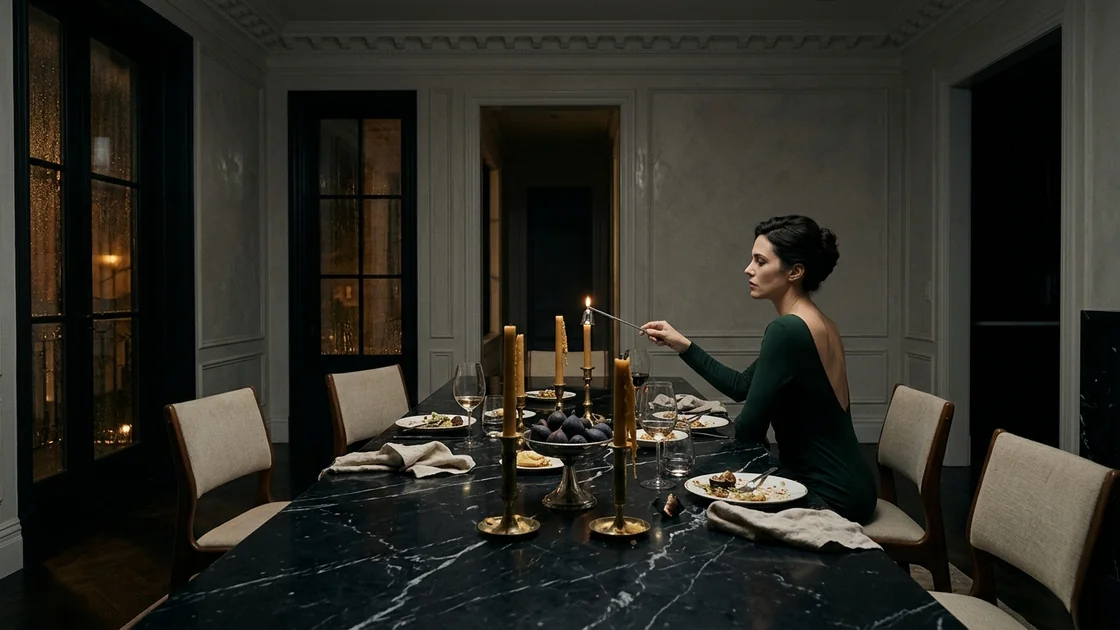
This is the story of Nora Vance, a celebrated Manhattan interior designer whose relentless pursuit of aesthetic perfection has shaped every facet of her career and her seemingly flawless seven-year marriage to Julian, a charismatic architectural historian. During an intimate dinner party hosted at their meticulously restored brownstone to celebrate Julian’s prestigious appointment to a historic preservation trust, the facade begins to crack. The arrival of an uninvited woman drenched from an autumn downpour shatters the evening, introducing a forgotten name and a suppressed history of fraud, stolen identities, and deliberate abandonment that systematically dismantles Nora’s illusions about the man she married and the home she built.
The light in the dining room had been calibrated to fall at exactly thirty-eight degrees against the Venetian plaster, skimming the hand-troweled lime finish so that the microscopic ridges cast infinitesimal shadows, giving the appearance of ancient, sun-baked vellum. Nora Vance had tested four separate dimmers before settling on the Lutron system concealed behind a pane of flush-mounted cerused oak. It was not vanity; it was discipline. To live without discipline, Nora often told her clients at the studio on East Sixty-Fourth, was simply to allow the world to happen to you, and the world, left to its own careless devices, was inherently vulgar, chaotic, and asymmetrical.
"Ten minutes, Julian," she called toward the hall, her voice pitched at the precise conversational baritone she used when negotiating with stonecutters in Carrara. It was firm, musical, entirely free of panic.
She adjusted a silver-plated compote filled with black mission figs, each one dusted with a bloom of natural pale yeast that echoed the slate veining of the Nero Marquina marble table. Around the perimeter of the room, eight mid-century dining chairs, reupholstered in unbleached Belgian linen that had cost four hundred dollars a yard, waited with military precision. The table was set for six. Four guests, plus the two of them. Marcus and Vivienne Sterling, whose foundation had just underwritten the expansion of the Hudson River Conservatory, and David Thorne, Nora’s oldest friend from Cooper Union, accompanied by his partner, Camille Ray, an archivist at the Morgan Library who spoke five languages and possessed the rare, merciful gift of listening when others were exhausting themselves with talk.
Julian emerged from the dressing room, still working the mother-of-pearl buttons of his cuffs. He was forty-two, though in the amber wash of the hallway sconces he possessed the timeless, unlined handsomeness of an Edwardian portrait. His hair, thick and dark, was silvering at the temples with an almost theatrical elegance, as though he had hired an illustrator to shade it. He wore a charcoal wool suit cut by a tailor in Naples who kept no telephone and took measurements on strips of brown butcher paper.
"You’ve outdone yourself, darling," Julian said, stepping behind her. His hands came to rest upon her shoulders, their weight familiar, warm, reassuring. "The figs are a masterstroke. Very Caravaggio. Very decadent without being ostentatious."
Nora leaned her head back against his chest for a second, feeling the steady, rhythmic cadence of his heartbeat beneath the crisp sea-island cotton of his shirt. "Vivienne noticed the dust on the baseboards at the benefit in May," she murmured. "I spent an hour on my knees with a microfiber cloth behind the radiator. If she finds a flaw tonight, it will have to be moral, because it won't be physical."
Julian laughed softly, the vibration traveling from his sternum into her shoulder blades. "Vivienne is a hawk whose only prey is other people’s wallpaper. Don't waste your energy on her. Marcus is completely behind the committee’s recommendation. By midnight, the formal nomination will be announced, and the board will confirm the directorship on Monday."
He was speaking of the St. Jude Heritage Trust, a century-old institution that controlled thirty million dollars in preservation grants across the Eastern seaboard. The directorship had been Julian’s white whale for four years. To secure it was not merely a matter of prestige or the generous six-figure stipend; it was an ascension to the permanent, untouchable patrician class that Nora had spent fifteen years designing rooms for, but never quite feeling native to.
Nora turned in his arms, her hands reaching up to straighten his knit silk tie. She loved this ritual. She loved the clean scent of his soap—vetiver, cedarwood, and the faint mineral trace of the fountain pen ink he always managed to smudge on his right index finger. He was, to her eye, the finest piece of architecture she had ever had the privilege to curate.
"I’m proud of you," she said, looking directly into his hazel eyes. They were wide, clear, and unclouded by the neurotic self-doubt that plagued every other man in their social circle. Julian was always still. In an age of fidgeting, of nervous glances at glowing screens, Julian possessed an archaic, motionless grace.
"We built this," he said, touching the edge of her jaw with the back of his thumb. "Every inch of it, Nora."
The intercom sounded—three muted, chime-like tones that vibrated discreetly from the recessed speaker near the butler’s pantry.
"Right on time," Nora said, stepping away and running her palms down the sides of her dress. It was a column of forest-green matte jersey, utterly simple from the front, with a low, scooped back that revealed the sharp, athletic ridge of her spine. "Remember: Marcus hates small talk about politics, and Vivienne has just abandoned wheat again. The tart is almond flour, so be sure to mention it casually when it's served."
"I am an instrument of pure diplomacy," Julian smiled, giving a slight, theatrical bow before turning toward the foyer.
Nora took one last, sweeping survey of the room. The candles—tall, dripless tapers of hand-dipped beeswax from a convent in Normandy—burned with steady, upright cones of gold. The air smelled of rosemary, slow-braised short ribs steeped in Barolo, and the damp, stony freshness of the rain that had begun to slick the cobbles of the mews outside. Everything was held in a delicate, exquisite equilibrium.
She stepped into the entrance hall just as the heavy oak door swung open, admitting Marcus and Vivienne Sterling in a swirl of cool, damp October air and the smell of expensive umbrellas.
"Nora, darling!" Vivienne cried, offering two dry, papery kisses that grazed the air four inches from Nora’s cheeks. She was wrapped in an architectural cocoon of black Issey Miyake pleats, her neck stacked with chunky amber beads that looked like petrified insect specimens. "The weather is completely catastrophic. Our driver took forty minutes just to get through the park. I told Marcus, we should have simply rowed a boat down Fifth Avenue."
"You look stunning, Vivienne," Nora said smoothly, taking the woman's cashmere-lined trench coat and hanging it in the concealed vestibule closet. "Marcus, good to see you."
Marcus Sterling, sixty-eight, with the square, heavy-jowled visage of a Roman emperor who had spent the afternoon reviewing quarterly earnings, gave Nora a vigorous, dry-palmed handshake. "The mews looks magnificent, Nora. That exterior lighting you did for the façade—dramatic without looking like a boutique hotel. Very rare."
"Coming from you, Marcus, that is high praise," Julian said, emerging from the coatroom with a tray holding four narrow flutes of dry Crémant de Jura. "Drink this. It has enough acidity to strip the city traffic right out of your system."
Within seven minutes, David Thorne and Camille Ray arrived, their entrance far more boisterous and accompanied by an apologetic David trying to wring out his umbrella without spraying the polished herringbone floors. Camille, glowing in a mustard-yellow silk jumpsuit, embraced Nora warmly, slipping a small, heavy jar into her hands.
"Quince paste," Camille whispered. "From the tree behind my mother’s house in Maine. I know you hate store-bought preservatives."
"I could weep," Nora said honestly, feeling the comforting warmth of Camille’s genuine affection. While the Sterlings represented the architecture of ambition, David and Camille were the stubborn, grounded masonry that had anchored Nora since her early twenties, when they had all shared five-hundred-square-foot walkups in Bushwick and eaten dry noodles out of chipped bowls.
The party moved into the double parlor, where the conversations stratified into familiar, well-rehearsed layers. Nora monitored the room with the heightened spatial awareness that made her one of the most sought-after designers in Manhattan. She noticed Marcus leaning in close to Julian by the bay window, their voices dropping into the confidential, gravelly register of shared power. She saw Vivienne inspecting an ink-wash landscape by an obscure eighteenth-century Japanese master that Nora had picked up at an estate sale in Zurich, her painted eyebrows twitching as she tried to calculate its provenance and cost.
"He's going to get it, isn't he?" David asked quietly, appearing at Nora’s elbow with his glass balanced between two fingers. He had the tousled, rumpled appearance of an academic who regularly forgot to look in the mirror before leaving the house, yet his blue eyes were sharper than anyone else's in the room.
"Marcus has the votes," Nora said, keeping her tone measured, though her throat tightened with the sudden, fierce anticipation of triumph. "They met for lunch at the Century Association on Tuesday. Marcus wouldn't have come down from Westchester in this storm if he intended to deliver bad news."
"It's incredible," David said, raising his glass slightly. "Director of the St. Jude. Think about it, Nora. From renovating midtown law offices to holding the keys to every Gilded Age mansion between Newport and Savannah. Julian was made for it."
"He worked for it," she corrected gently. "Every single day. He doesn't have the family money, David. He had to be smarter, better read, more articulate than all of them."
"I know," David said, his gaze drifting across the parlor to where Julian was gesturing animatedly, his profile thrown into sharp relief against the dark velvet draperies. "Sometimes I watch him and I wonder where he keeps the exhaust. Everyone else I know who runs at that speed looks like an engine about to blow a gasket. Julian doesn't even sweat."
"He has a center," Nora said, her voice dropping into an intimate register. "I don't think people realize how solid he is underneath the charm."
"To the rock, then," David said, tapping his flute against hers with a crisp, bell-like clink.
At eight-fifteen, Nora guided them into the dining room. The transition went off without a hitch. The short ribs, prepared over two days and resting upon a bed of celery-root puree that had been passed through a fine chinois three times, were received with the quiet, reverent murmurs usually reserved for cathedral vaults. Julian was at the head of the table, Nora at the foot, their guests arranged so that the conversation remained democratic, circling and looping between Marcus’s dry architectural anecdotes and Camille’s razor-sharp commentary on the international black market for rare manuscripts.
"The problem with the Newport cottages," Julian was saying, neatly dividing a baby heirloom carrot with the edge of his silver fork, "is that they were designed as monuments to insecurity. The Vanderbilts were so terrified that Europe wouldn't take them seriously that they imported entire châteaux, stone by numbered stone, and dropped them onto the Rhode Island grass. It’s magnificent theater, but it lacks the humility of true domesticity."
"Humility is vastly overrated in stone," Marcus grunted, though he was smiling. "If the Romans had been humble, we’d be admiring their mud huts. Men build to leave a scar on the horizon, Julian. You know that as well as I do."
"A scar is an injury, Marcus," Nora interjected, smiling with deliberate sweetness over the rim of her glass. "Julian believes in scars that heal into ornament. That’s why he’s a preservationist, not a demolition man."
Vivienne set her fork down with a tiny, sharp ring against the porcelain. "Speaking of scars, Julian, Marcus mentioned that you’re planning an extensive re-evaluation of the Mercer estate in Providence once you take over. Is that true? That place has been locked in probate since the late nineties."
Julian didn't blink, but Nora, who knew every micro-movement of his hands, noticed that his left index finger—the one resting on the damask napkin beside his plate—went entirely rigid. It was a fraction of a second, an imperceptible pause before he took a sip of his wine.
"The Mercer foundation has significant resources," Julian said smoothly. "It would be an honor to bring that house back into the public eye. But, of course, nothing is decided until the board meets on Monday."
"Oh, stop being modest, dear boy," Marcus barked, reaching across to wave a dismissive hand. "The board is a formality. The proxy votes came in this afternoon. The directorship is yours. I didn't want to bring it up until after we finished Nora’s spectacular short ribs, but frankly, I don't have the patience to sit on good news."
Vivienne raised her glass. David and Camille joined in with wide, genuine smiles.
"To Julian," Marcus declared, his gravelly voice filling the room. "The new Director of the St. Jude Trust. May you preserve the past without repeating its mistakes."
"To Julian," they chorused.
Julian looked down at his plate for a brief, theatrical moment of humility, then looked up, his eyes shining with an emotion so bright and seemingly transparent that Nora felt an ache in her chest. He met her gaze from across the length of the table, his mouth curving into that private, proprietary smile that belonged only to her.
"To all of us," Julian said, his voice deep and thick with gratitude. "And to Nora, who gave every room I live in a reason to exist."
The glasses met in a constellation of chiming notes, the beeswax candles flickering in the small draft created by their moving arms. Nora felt a swell of profound, settled contentment—the terrifying, ecstatic sensation of having finally, permanently, arrived.
Then, through the heavy walls of the brownstone, the front doorbell rang.
It was not the polite, rhythmic triple-tone of the interior intercom that connected to the tradesmen’s gate. It was the mechanical, brass bell mounted on the exterior masonry—a deep, jarring clang that cut directly through the warmth of the dining room.
The laughter died instantly.
"Expecting someone else, darling?" Vivienne asked, her eyes darting to Nora with an arch, inquisitive glint.
"No," Nora said, her brow furrowing slightly as she checked the slim platinum watch on her wrist. It was twenty minutes to nine. "Probably a courier from the printers. I’ll be right back."
"Sit, Nora, I’ll get it," Julian said quickly. He had already begun to push his chair back, his movements slightly more hurried than usual.
"Nonsense, finish your wine with Marcus," Nora replied, rising with a fluid motion that left her napkin draped neatly beside her plate. "If it's the specs for the East Hampton project, I need to check the seal anyway. Excuse me, everyone."
She walked down the long, dim corridor, past the framed piranesi etchings and the console table she had bought in an alley in Florence. The exterior bell rang again—longer this time, a heavy, impatient depression of the brass button that suggested not the perfunctory duty of a delivery person, but the frantic insistence of someone fleeing a disaster.
Nora stepped into the foyer, turned the deadbolt of the heavy inner glass door, and peered through the beveled sidelight of the grand oak entry.
Through the rain-streaked glass, distorted by the wet shadows of the streetlamp, stood a figure. A woman. She wore no hat, and the dark water of the autumn deluge had plastered long, matted strands of hair against her face and neck. She was wrapped in an oversized, waterlogged trench coat that had lost its belt, her hands shoved deep into its pockets. She was shivering with such violent intensity that Nora could hear the faint, wet rattle of her buttons against the wrought-iron security gate.
Nora hesitated, an icy needle of unease piercing the base of her neck. This was a private mews behind an electronic iron gate; casual vagrants did not wander here. A resident must have left the carriage gate unlatched.
She cracked the door two inches, keeping the security latch engaged. "Can I help you?"
The woman looked up. The light from the entryway sconce hit her face, and Nora felt her breath catch in her throat.
The woman was perhaps thirty-eight or forty, with features that might once have possessed a delicate, striking beauty, but were now hollowed out by grief, exhaustion, or something worse. Her skin had the translucent, gray quality of river stone, her cheekbones sharp enough to look dangerous beneath the wet skin. Her lips were blue-tinged from the cold. But it was her eyes that held Nora frozen—they were wide, dark, and utterly devoid of hesitation.
"Is he here?" the woman asked. Her voice was not loud, but it had a strange, raspy density, like paper dragged across stone.
"I’m sorry?" Nora said, keeping her hand flat against the heavy oak. "You have the wrong house. This is a private residence."
"Julian," the woman said. She didn't blink against the rain running down her forehead into her eyes. "Julian Miller. He’s here, isn't he?"
Nora went very still. "My husband's name is Julian Vance."
A terrible, mirthless smile curved the woman’s split, pale lips. It was a terrifying expression—part triumph, part pure, unadulterated ruin.
"Vance," the woman whispered, tasting the syllable as if it were a rare vintage she had spent a decade trying to find. "Of course. He took his mother’s maiden name. I should have known. He always hated his father's people." She took a step forward, leaning her wet face toward the gap in the door. "Tell him Clara is here. Tell him Arthur’s wife has come home."
The air in the foyer seemed to drop ten degrees in an instant.
"What did you say?" Nora’s voice was barely a whisper, the polished veneer of the hostess cracking down the center like dry porcelain.
Behind her, footsteps sounded on the parquetry. Julian’s voice drifted down the corridor, smooth, buoyant, filled with the easy warmth of a man at the height of his fortunes.
"Nora? Darling, who is it? If it's the courier, tell him we can't look at the proofs until—"
Julian stepped into the light of the entryway. He was holding his wine glass in his left hand, his face settled into a genial, curious smile.
The woman on the porch shifted slightly, stepping into the full wash of the lantern above the door.
Julian stopped.
Nora did not look at the woman; she looked at her husband. She had lived with this man for seven years. She had watched him handle hostile city zoning boards, catastrophic structural failures on job sites, the death of his mentor, and the volatile tantrums of billionaire clients. She had never seen him move a single muscle that was not deliberate.
Now, Julian Vance turned the color of damp chalk.
The wine glass did not slip from his fingers; he set it down on the console table with an agonized, robotic slowness, though the stem missed the coaster and rattled violently against the polished marble. His lower lip parted, his chest hitching in an inward gasp that produced no sound.
"Clara," he whispered.
The name was not a question. It was a confession, torn out of the bottom of a well that Nora had not known existed beneath their feet.
The silence in the entryway was so profound that Nora could hear the heavy, individual drips of rain falling from the hem of the woman’s coat onto the bluestone stoop.
"Julian," the woman—Clara—said. Her voice lost its frantic rasp and settled into something soft, intimate, and lethally calm. "You look extraordinary. You haven't changed at all. Perhaps a little thicker around the chin, but then, the food here must be very good."
Nora’s mind was racing, cataloging, trying to find a box, a drawer, an architectural niche to place what was happening. Arthur’s wife. Julian had no brothers. He was an only child, born in Boston, educated at Bowdoin and the Courtauld, his parents deceased in an automobile accident on Cape Cod when he was twenty-four. He had shown her the graves—two modest, dignified slabs of granite in a churchyard outside Yarmouth, overgrown with sea-thrift and wild roses.
"Julian," Nora said, her voice shaking slightly despite every ounce of will she possessed. "Who is this?"
Julian did not answer. He was staring at Clara with the wide, terrified gaze of a man watching an avalanche slide down a mountain toward his bedroom window. His throat worked, swallowing nothing.
"May I come in?" Clara asked. She didn't wait for permission. She reached out a raw, red hand and pushed the door.
Nora could have leaned her weight against it. She could have thrown the bolt, called the private security service whose number was programmed into the speed dial of her phone, or screamed for Marcus and David. But the paralysis that accompanies the absolute destruction of reality had settled into her limbs. She stepped back instinctively, her silk-clad shoulder brushing the wall.
Clara crossed the threshold.
The smell of her entered with her—not the scent of flowers or rain, but of wet wool that had dried and gotten wet again, cheap tobacco, stale bus interiors, and the metallic tang of unwashed skin. She stood on the magnificent silk-and-wool Persian runner that Nora had spent three months bidding on at Christie’s, water pooling around her scuffed, cracked leather boots.
"Nice place," Clara said, her eyes sweeping over the high plaster cornices, the minimalist modern console, the discreet recessed lighting. "Very clean. You always did hate clutter, Artie."
Artie.
The diminutive was a physical blow. Nora looked at Julian. The man was trembling. The legendary, unflappable Julian Vance, who could quell a room of screaming developers with a low, cultured turn of phrase, was visibly shaking, his hands half-curled at his sides as though he were awaiting handcuffs.
"How did you find me?" Julian’s voice was hollow, stripped of all its rich, melodic timbre.
"The newspaper," Clara said simply. She reached into the deep pocket of her coat and produced a soggy, folded piece of newsprint, which she held out between two fingers like an offering. "A tiny little piece in the back of the Times business section on Tuesday. 'St. Jude Heritage Trust to Name New Director.' With a photograph. It took me three days to get the bus fare from New Bedford. I had to ask a lot of people at the preservation offices before I found someone who knew where your private house was."
"New Bedford," Julian whispered.
"You remember it, don't you?" Clara’s smile was sweet, almost tender. "The triple-decker on Acushnet Avenue? The one where the kitchen pipes froze every January, and your father sat in his undershirt drinking Narragansett while you practiced drawing moldings in the margins of your library books?"
"Julian," Nora stepped between them, her voice rising in pitch, the polite hostess completely shredded. "What is she talking about? Who is she?"
Clara looked at Nora, her eyes softening with a pity that was more humiliating than any insult could have been.
"He hasn't told you anything, has he?" Clara murmured. "He never does. He just wipes the slate, paints over the mildew, and puts up fresh paper. That was always his specialty." She turned back to Julian. "Are you going to introduce us, Artie? Or are you going to leave your wife standing in the hall while your guests wait for dessert?"
Your wife.
The words hit Nora in the diaphragm, expelling the air from her lungs in a sharp, involuntary wheeze. She looked at Julian, her vision tunneling until she could only see his face—the elegant, patrician face she had kissed every morning for two thousand five hundred days.
"Julian," she choked out. "Tell me this is a sick joke. Tell me who this person is."
Julian closed his eyes. For five long seconds, he stood with his lids clamped shut, his chest rising and falling in shallow, jagged gasps. When he opened them, the cultivated warmth was completely gone, replaced by the flat, dead stare of a trapped animal.
"Her name is Clara," he said, his voice flat, deadened. "Clara Miller."
"Clara Cole," the woman corrected sharply. "Don't use your mother’s name to hide behind, Arthur. Arthur Cole. That’s what it says on the license in the town clerk’s office in Fall River. October twelfth, two thousand two. Twenty-two years ago, Artie. We never did get around to the divorce, did we? You were in such a hurry to catch that train to Chicago with the restoration fund money."
From the dining room down the hall, the sound of a burst of laughter carried through the air—Marcus Sterling’s hearty, booming guffaw, followed by the delicate, bell-like tinkle of Vivienne’s silverware against a dessert plate.
"Julian?" Vivienne’s voice floated down the corridor, high and playful. "Did you get lost in the cellar, darling? Marcus is threatening to drink the Port without you!"
The world of linen, beeswax, short ribs, and million-dollar trust funds sat twenty feet away, separated from this nightmare by a sheet of plaster and a set of double pocket doors.
Clara tilted her head toward the sound, her dark eyes flashing with sharp amusement. "You have company. How lovely. Are they important people, Artie? The kind of people who write checks? The kind of people who wouldn't want to know that the new Director of the St. Jude Trust is a bigamist and a thief who ran out on thirty thousand dollars of historic tax credit funds in Massachusetts fifteen years ago?"
"Shut up," Julian hissed, the cultured veneer finally dropping to reveal something coarse, desperate, and ugly. He lunged forward and grabbed Clara’s arm, his fingers digging into the wet wool of her coat. "Keep your mouth shut."
"Take your hands off me," Clara said, not raising her voice, but her tone had the cold, sharp authority of an iron bar. "You touch me again, and I’ll scream so loud those old fossils in your dining room will hear it all the way out on the avenue. Let go."
Julian let go as if he had been burned.
Nora looked between them. She felt outside of her own body, hovering somewhere near the twelve-foot ceiling, observing the clinical geometry of the disaster. She saw the puddle of dirty rainwater spreading across her antique rug. She saw the way the mud from Clara’s boots was drying into gray crusts against the hand-waxed floorboards. She saw her husband—a man named Arthur Cole—standing with his shoulders rounded, looking smaller, thinner, and utterly common.
"Come into the library," Nora said.
Her voice surprised her. It was level, devoid of tremor, carrying the absolute, non-negotiable weight of a surgeon who has just opened a patient’s chest and found nothing but black rot.
"Nora—" Julian began, reaching out toward her.
"Do not touch me," she said, her voice dropping into a register that made him flinch. "Do not speak to me. Both of you. Into the library. Now."
Clara smiled, a quick, feral flash of teeth, and stepped forward, trailing the wet, rank smell of the storm deeper into the house.
The library had been designed as Julian’s sanctuary. It was lined with custom floor-to-ceiling shelving in fumed white oak, filled with first editions of Ruskin, Palladio, and Viollet-le-Duc, interspersed with fragments of antique stone capitals and Roman brickwork mounted on blackened steel stands. A low chesterfield sofa in tobacco-colored leather sat before a fireplace of Belgian bluestone, currently cold and swept clean.
Nora shut the heavy pocket doors, the latch clicking into place with a sound like a small rifle shot.
"Sit," Nora said to Clara, pointing to an antique leather tub chair that had belonged to a nineteenth-century shipping magnate.
Clara did not hesitate. She dropped into the chair with a wet, heavy sigh, leaning her head back against the butter-soft leather, leaving a dark, saturated grease-stain against the hide. She pulled her wet hands from her pockets and placed them on her knees. Her fingernails were short, jagged, and lined with black grit.
Julian remained standing by the closed doors, his back pressed against the wood as if he were trying to merge with the joinery.
"Start talking," Nora said to him. She did not sit. She stood in the center of the room, her arms hanging straight at her sides, her forest-green dress catching the low library lights. "And if you tell me one syllable that is not the absolute truth, I will walk into that dining room right now, tell Marcus Sterling everything this woman just said, and call the police."
Julian looked at her with eyes that were hollowed out by terror. "Nora, please. You have to understand. It isn't—it isn't what it looks like."
"Don't start with that," Clara interrupted, leaning forward and resting her elbows on her knees. "Don't give her the poetry, Artie. Give her the dates. That’s what you were always good at, wasn't it? Memorizing dates so people thought you were smart."
Clara looked up at Nora. "His name is Arthur Cole. Born in Fall River, nineteen eighty-two. His father was a machinist at the textile finishing plant; his mother was a cashier at a discount department store. There was no family in Boston. There were no Vances. Vance was his mother’s maiden name, all right, but she wasn't from Beacon Hill; she was from a trailer park outside Woonsocket."
Every word was like an acid wash poured over a finished canvas, stripping away the varnish, the paint, the primer, until only the rough, raw burlap remained.
"We met when we were twenty," Clara continued, her voice level, matter-of-fact, carrying the terrible weight of documentation. "I was working at a diner near the harbor; he was taking classes at Bristol Community College. He was obsessed with old houses. Truly obsessed—I’ll give him that. He could walk down a street of rotting tenements and tell you what kind of cornice had been on the roof eighty years ago. He was brilliant. But he couldn't stand who he was. He couldn't stand the smell of the grease from his father’s boots. He used to scrub his hands until they bled."
Nora’s eyes flicked to Julian’s hands. The hands she had admired for their elegance, their clean, manicured nails, the way they moved across architectural plans.
"We got married at City Hall," Clara said. "We didn't have fifty dollars for a reception. We had two beers at a tavern across the street and split a meatloaf sandwich. Then he got a job with the Bristol Historical Commission. Just an assistant—filing papers, doing surveys. But Artie was clever. He started forging credentials. He made up an undergraduate degree from Boston University. He took some letterhead from an architect who had died five years earlier and wrote himself a glowing recommendation."
"It wasn't like that," Julian whispered, his face slick with sweat. "I knew the work. I knew more than the men with the degrees. They were idiots—bureaucrats who didn't care about the history, who just wanted to stamp forms."
"You stole," Clara said bluntly. "You took thirty-two thousand dollars from the restoration escrow for the old custom house. You had access to the checks, you wrote them to a dummy vendor you registered in Rhode Island, and then you ran."
"Thirty-two thousand dollars," Nora repeated. The number was absurd. A single rug in her living room had cost more. A single marble slab for an island in a Tribeca penthouse cost more. "You threw your life away for thirty-two thousand dollars?"
"It was everything to him back then!" Clara spat, her eyes flashing with a sudden, vicious fire. "It was enough to buy a suit, change his name, and disappear into Chicago! And you know who was left with the police, Artie? Who was left with the detectives knocking on the door at six in the morning? Who had to move back in with her sister because the landlord seized the furniture for back rent?"
Julian covered his face with his hands. "I sent money," he choked out against his palms. "I sent five thousand dollars from Chicago six months later. Cash. In an envelope."
"Five thousand dollars!" Clara laughed—a short, barking sound that made Nora’s skin prickle. "Five thousand dollars after leaving me to face a grand jury! The only reason I didn't go to prison as your accomplice was because the state police realized I was too stupid to have figured out the scam. They thought I was just the dumb broad left behind. Which I was. I was twenty-four years old, Artie, and you destroyed my name before I even knew what it was."
"Why now?" Nora asked, her voice cutting through the rising heat between them. "That was fifteen years ago. Why are you here tonight?"
Clara looked at Nora, and the anger drained from her face, leaving behind a terrible, gray exhaustion.
"Because I have cancer," Clara said quietly.
The words fell into the room like stones dropped into a stagnant pond.
"Small cell," Clara continued, touching her sternum with those rough, dirty fingers. "In the lungs. Spread to the lymph nodes. The clinic in Fall River gave me six months in August. Maybe less now. I have eighty-four dollars in a savings account. My sister died three years ago. I live in a room above a laundromat that smells like bleach and damp dryer lint, and every time I cough, I taste blood."
She looked at Julian, who remained frozen against the door, his hands slowly dropping from his face.
"I didn't care where you were, Artie," she said, her voice dropping to a whisper. "I spent ten years hating you, and then I spent five years forgetting you. But then I saw your picture. Standing in a museum in a four-thousand-dollar suit, talking about preserving the past. And I thought about how I’m going to die in a charity ward with a plastic sheet under my back while you drink champagne with people who think your name is Julian Vance."
She leaned forward, her eyes locking onto Julian’s with terrifying clarity.
"You’re going to pay for my care," Clara said. "You’re going to get me an apartment with a window that opens to the air. You’re going to pay for the private nurses, the morphine, the hospice, and the burial. And if you don't, I will sit on the front steps of the St. Jude Heritage Trust on Monday morning with our marriage certificate in one hand and the arrest warrant from the Massachusetts State Police in the other."
The silence returned, heavier now, suffocating.
Nora looked at Julian. "Is there a warrant?"
Julian didn't look at her. He stared at the floor, his jaw working as if he were trying to chew through glass. "It was fifteen years ago," he whispered. "It was a misdemeanor embezzlement charge. The statute of limitations—"
"There is no statute when you flee the jurisdiction, you idiot," Clara said coldly. "The detective told me that before they closed the file. The warrant stays active until the body is identified or the suspect is arrested. They just stopped looking because they thought you were dead or in Canada."
"Julian," Nora said, her voice dropping dangerously low. "Did you commit bigamy?"
Julian looked up then, his hazel eyes wide with a frantic, desperate pleading that made Nora feel physically sick.
"Nora, listen to me," he stepped toward her, his hands outstretched, trembling. "We were married by an ordained minister in Maine. Our marriage—what we have—it’s real. It’s the only real thing I’ve ever done. I loved you from the second I saw you at the Cooper-Hewitt. I swear to God, Nora, I never loved anyone else."
"You did not answer my question," Nora said, her voice like ice over a deep pond. "Are you still legally married to this woman?"
Julian stopped. His arms fell to his sides. His face crumpled, the smooth, elegant lines collapsing into the petulant, terrified expression of a cornered child.
"I tried to find her," he muttered, his voice barely audible. "Ten years ago, before I met you. I hired an investigator. He said she had left the state, that she was off the grid. I couldn't file for a divorce without public notice in the Massachusetts papers. It would have flagged the old warrant. I thought—I thought she was gone. I thought it was dead."
"So you married me," Nora said. "Under a false name. With a forged identity. While already married to someone else."
"I am Julian Vance!" he burst out, his voice cracking with a sudden, bizarre passion that bordered on madness. "I made that man, Nora! I read the books! I learned the history! I built the career! Every project I ever touched was successful! Nobody gave me anything! I took an empty name and I filled it with knowledge, with taste, with work! Look at this house! Look at what we’ve done! What does it matter what some clerk in Fall River wrote down twenty-five years ago?"
Nora looked at him. Really looked at him.
She saw the bespoke suit, the handmade shoes, the perfect silvering hair. And beneath it, she saw the absolute, terrifying void. A man who had built himself out of decorative moldings and borrowed manners, an empty shell plastered over with the aesthetic markers of a class he despised and desperately yearned to inhabit.
And then, with a sickening lurch of her stomach, Nora realized what she was.
She was not his partner. She was his crowning achievement. She was the final, authenticating antique he had acquired to complete the room. Her pedigree—her clean, respectable Connecticut background, her design degree, her effortless social fluency—was the provenance he had needed to hang his forged portrait on the wall.
A knock sounded on the library door.
"Julian? Nora?"
It was Marcus Sterling. The knob rattled. The door was locked from the inside.
"Everything all right in there?" Marcus called, his voice laced with the slight, impatient irritation of a powerful man who is being made to wait. "The storm is picking up, and Vivienne wants to beat the flooding on the FDR. We should finish our toast."
Julian froze. He looked at the door, then at Clara, then at Nora.
Clara sat back in the leather chair, crossed her legs, and folded her arms across her damp chest. She said nothing. She didn't need to. The silence in the room was a loaded gun, and Clara held the trigger.
"Julian," Marcus called again, louder this time. "Nora?"
Julian looked at Nora, his eyes pleading with an agony so naked it was obscene. "Nora," he whispered, mouthing the words. "Please. Please, darling. Just get them out. Protect us. I’ll fix this. I swear on my life, I’ll fix it."
Nora stood in the center of the room she had designed.
She looked at the fumed white oak shelves. She looked at the Roman capitals. She looked at the woman dying of lung cancer sitting in her four-thousand-dollar antique chair, leaving water stains on the parquet.
"Step back from the door, Julian," Nora said.
"Nora—"
"Step back."
Julian retreated two paces, his hands trembling violently.
Nora reached out and slid the heavy pocket door open.
Marcus Sterling stood in the hallway, an unlit cigar in his hand, his brows drawn together in mild consternation. Behind him, Vivienne was draped in her coat, checking her lipstick in a small gold compact, while David and Camille stood near the dining room door, looking slightly bewildered.
"There you are," Marcus said, his gaze immediately traveling past Nora’s shoulder into the library.
His eyes landed on Clara.
He stopped. The cigar paused halfway to his pocket.
Vivienne lowered her compact, her sharp, hawk-like eyes narrowing as she took in the scene: the unkempt woman with the soaking hair and the cracked boots sitting in the antique chair, Julian standing against the wall with his tie askew and his face the color of skim milk, and Nora, standing erect, immaculate, and utterly devoid of color.
"Good lord," Vivienne murmured, her social radar immediately registering the catastrophic nature of the disruption. "Did someone have an accident?"
"Marcus," Nora said. Her voice was remarkably steady. It was the voice she used when informing a general contractor that fifty thousand dollars’ worth of imported limestone had been cut to the wrong dimensions and would have to be removed at his expense. "I apologize for the delay. We had an unexpected arrival."
David Thorne stepped forward, his eyes darting between Julian and Nora. He knew Nora better than anyone. He saw the microscopic rigidity in her jaw, the way her fingers were pressed tightly against the fabric of her skirt to stop them from shaking.
"Nora?" David asked quietly. "What's going on?"
Julian took a sudden step forward, the mask desperately trying to reconstitute itself over his shattered features. "Marcus, Vivienne, I’m so sorry. This is—this is an old acquaintance from an early preservation project in Massachusetts. She’s had a family emergency, and she came to me for assistance. I should have handled it in the study, but—"
"Her name is Clara Cole," Nora said.
The words cut across Julian’s explanation like a straight razor across silk.
Julian stopped talking. He looked at Nora with an expression of pure, uncomprehending horror.
"Nora, please," Julian breathed.
"Her name is Clara Cole," Nora repeated, looking directly into Marcus Sterling’s eyes. "She is from Fall River, Massachusetts. And she is Julian’s wife."
Vivienne’s gold compact snapped shut with a sharp, metallic clack.
Marcus stared at Nora, then slowly turned his heavy, leonine head toward Julian. "What did you say?"
"Nora has had a shock," Julian said, his voice rising into a thin, breathless panic. "She’s confused. Clara is—she’s a former colleague, Marcus. She’s mentally unwell. She arrived here tonight with threats, trying to extort—"
"Arthur Cole," Clara said, her raspy voice projecting effortlessly from the depths of the leather chair. She didn't stand up. She remained seated, looking out at the cluster of Manhattan aristocracy with a cold, amused contempt. "That’s his name, Mr. Sterling. If you call the Massachusetts State Police in Dartmouth and ask for Detective Sergeant Rourke—if he’s still alive, or whoever has the cold case files—they’ll give you the docket number for the thirty-two thousand dollars Arthur stole from the Bristol County Restoration Fund in two thousand nine."
She reached into her coat and produced a crumpled, damp piece of cardstock.
"And here’s the marriage certificate," she added, tossing it onto the low coffee table between two art monographs. "Signed by the clerk in Fall River. October twelve, two thousand two. We never got divorced. Which makes the beautiful lady standing in front of you his mistress, I suppose. Or his roommate. But she certainly isn't his wife."
Marcus Sterling did not move to pick up the paper. He didn't need to. He was a man who had spent forty years navigating the high-stakes intersections of philanthropy, politics, and old money. He could read the architecture of a collapse as clearly as Nora could read a floor plan.
He looked at Julian. The silence that followed was not the embarrassed hush of a social faux pas; it was the heavy, suffocating stillness that precedes the demolition of a public structure.
"Julian," Marcus said, his voice dropping into a flat, deadly bass. "Is this true?"
Julian opened his mouth, but nothing came out. The cultured vocabulary, the references to Ruskin and Palladio, the smooth, patrician cadences that had charmed boardrooms from Boston to Baltimore—all of it had deserted him. He looked like what he was: a boy from a mill town who had run away with the cash box and spent twenty years wearing another man’s clothes.
"Marcus," Julian croaked, tears finally spilling over his lower lids, carving ugly, wet tracks through the light sheen of sweat on his cheeks. "It was twenty years ago. I was twenty-two. I was poor. I had nothing. I made myself into someone who could do this work. I did the work, Marcus! The St. Jude—I can still run the trust. Nobody knows the nineteenth-century archives like I do. Nobody has the vision—"
"Stop," Marcus said.
The word was not spoken loudly, but it had the finality of a guillotine blade dropping into the grease.
Marcus turned to his wife. "Vivienne. Get your coat."
"Marcus," Julian lunged forward, catching Marcus by the sleeve of his charcoal overcoat. "Marcus, please! Talk to me in private. Don't do this here. Not in front of—"
Marcus pulled his arm away with a sharp, violent jerk that knocked Julian off balance. Julian stumbled, his hip striking the corner of the fumed-oak shelving, sending a Roman terra-cotta fragment crashing to the floor, where it shattered into three pieces against the herringbone oak.
"Do not touch me," Marcus said, looking at Julian with a disgust so absolute it seemed to strip the air of oxygen. "On Monday morning, I will accept your formal withdrawal from consideration for the directorship. If that withdrawal is not on my desk by eight o'clock, the board will convene an emergency session, notify the Massachusetts authorities, and refer your entire employment history to the district attorney for fraud."
"Marcus, no," Julian wept, falling to his knees among the fragments of ancient clay. "Please. It will kill me. It will kill me."
"You should have thought of that before you forged your references, Cole," Marcus said, using the name like an epithet. He turned to Nora. For a fraction of a second, his heavy face softened into something resembling pity. "Nora. I am deeply sorry. If you need legal counsel, call my office. Otherwise... good night."
Marcus took Vivienne by the elbow, and the two of them walked down the long, dim corridor toward the foyer. The heavy front door opened, admitted the wet roar of the rain, and slammed shut.
In the library, the four remaining people did not move.
Julian was still on the floor, his head bowed, his hands splayed across his knees, weeping with the ragged, ugly gasps of a man whose execution has just been carried out in public.
David Thorne walked slowly into the room. He looked at Clara, who remained in the tub chair, watching Julian with an expression that had shifted from triumph to a cold, hollow neutrality. He looked at the shattered terra-cotta on the floor. Then he walked over to Nora and stood beside her.
"Nora," David said softly. "Come with us. Camille and I will take you to our place. Leave everything here. Just get your coat."
Nora didn't look at him. She looked at Julian on the floor.
"No," Nora said. Her voice was flat, empty, bleached of all tone. "Thank you, David. Take Camille home."
"Nora, you can't stay here with him," David insisted, reaching out to touch her shoulder.
"Take Camille home, David," she repeated, turning her head to look at him.
David caught his breath. The look in Nora’s eyes was not grief. It was not rage. It was the terrifying, crystalline clarity of an artist who has just realized that the foundation of the house she has spent her entire life building was laid over an open sewer.
David looked at Julian, then at Clara, and finally nodded. "I’ll leave my phone on. Call me. Any time. Two in the morning, four in the morning. Just call."
"I know," Nora said.
David backed out of the room, took Camille by the hand, and led her out. A moment later, the front door closed again, the latch clicking with the quiet finality of a tomb being sealed.
The house was empty.
Only the three of them remained: the designer, the imposter, and the ghost who had brought the rain inside.
Julian remained on his knees, his shoulders heaving. Clara sat in the leather chair, her breath rattling slightly in her chest, a thin, wet cough catching in her throat every few seconds.
Nora walked over to the coffee table. She reached down, picked up the damp marriage certificate from Fall River, and looked at it.
It was real. The raised seal of the Commonwealth of Massachusetts was pressed into the cheap paper. Arthur Joseph Cole. Clara Lynn Mercer. October 12, 2002.
"Mercer," Nora murmured, reading the maiden name.
She looked at Clara.
"The Mercer Estate," Nora said, the realization clicking into place like the final tumbler of a lock. "Vivienne asked Julian about the Mercer foundation in Providence at dinner. That was your family?"
Clara let out a dry, rasping chuckle that ended in a cough. "My grandfather built cotton mills. He left a foundation that had three million dollars in it when I was a girl. By the time I was twenty, my uncles had stolen most of it and lost the rest in real estate. There was nothing left except the name. That’s why Artie married me. He thought he was marrying into the Providence Mercers. He thought he was getting an old-money ticket."
She looked at Julian, who was still weeping into the carpet.
"He didn't realize until two weeks after the wedding that the money was gone," Clara said. "The house was mortgaged to the eaves, and my mother was living on Social Security. That’s when he went to work for the Bristol Historical Commission. When he realized I was as poor as he was, he had to find another way to get his hands on the stone."
Nora let the paper fall back onto the table.
It was so simple. So disgustingly, banally simple.
There was no grand, tragic complexity here. No mysterious, tortured genius. Julian was simply a social grifter of the most ordinary, vulgar variety—a man who had spent his life shopping for pedigrees, discarding people the moment their financial or social utility was exhausted, and replacing them with better-curated specimens.
"Get up, Julian," Nora said.
Julian lifted his head. His eyes were red, swollen, his hair falling into his face in damp, tangled strands. "Nora... Nora, please. Don't leave me. We can go somewhere else. We can go to California. To Europe. I have savings—I have money in the private account—"
"You have nothing," Nora said. "The private account is in your name. Marcus will have the forensic accountants on it by dawn. Every grant you ever managed, every consulting fee you ever took will be subpoenaed. You’re going to spend the next five years of your life in courtrooms and depositions."
She turned to Clara.
"How much do you need for the clinic?" Nora asked.
Clara blinked, caught off guard for the first time since she had walked through the front door. "What?"
"How much is the treatment?" Nora’s voice was utterly clinical. "The private care. The hospice. How much does it cost?"
Clara looked at her hands, her jaw tightening. "The doctor in Boston said... forty thousand for the experimental protocol. And the hospice in Dartmouth is eight thousand a month."
Nora nodded once. "I will write you a check from my design studio’s operating account. Fifty thousand dollars tonight. Another fifty thousand on the first of next month. You will give me the name of your attorney in Fall River, and you will sign an affidavit stating that Julian deserted you fifteen years ago and that you have had no contact with him until tonight."
Clara looked at Nora, her dark, sunken eyes narrowing with a mix of suspicion and awe. "Why would you do that for me?"
"I’m not doing it for you," Nora said. "I’m doing it to buy the silence of the woman who destroyed the man I was stupid enough to marry. I don't want your name in the Times. I don't want my clients reading about Fall River in the architectural blogs. You will take the money, you will go to Boston, you will get your treatment, and you will die quietly without mentioning Nora Vance to a single reporter."
Clara stared at her for a long, agonizing moment. Then, slowly, she nodded. "Fair enough."
"Wait in the hall," Nora said.
Clara rose from the leather chair. She was unsteady on her feet, leaning on the arm of the chair for support as another fit of wet coughing racked her body. She looked down at Julian, who was staring up at Nora in stunned, mute disbelief.
"Goodbye, Artie," Clara said softly. "You really did do a nice job on the house."
She turned and shuffled out of the library, the sound of her wet boots fading down the long hallway.
Julian remained on his knees. "Nora... you saved me. You’re handling it. We can—we can weather this. Marcus is angry, but if Clara signs the affidavit, if we issue a statement—"
Nora walked over to the desk, pulled a heavy brass pen from its stand, and opened her personal checkbook. Her hand was completely steady. She wrote out the numbers with the same clean, legible drafting script she used on construction blueprints: Fifty thousand and 00/100.
She signed her name: Nora Vance.
"You aren't listening to me, Julian," she said, blotting the ink with a piece of heavy linen paper. "I am not saving you. I am cleaning my room."
She set the pen down.
"Get up."
Julian scrambled to his feet, his hands clutching at the lapels of his suit as if trying to hold himself together. "Nora, what are you saying?"
"I want you out of this house," she said.
"This is my house!" he cried, a flash of the old, arrogant desperation returning to his voice. "My name is on the deed!"
"Your forged name," Nora said, her voice dropping into a register so cold, so devoid of human warmth, that Julian flinched as though struck. "Arthur Cole’s name is not on the deed. Julian Vance doesn't exist. If you contest the ownership of this brownstone, I will hand your original marriage certificate, your real birth certificate, and the Massachusetts arrest warrant directly to the Manhattan District Attorney. You will not get half of this house, Julian. You will get an orange jumpsuit and a four-by-eight cell in a state facility."
Julian stared at her, his mouth falling open. He looked at the room around him—the white oak, the stone capitals, the leather books, the hand-troweled plaster that had taken three months to cure.
"Everything I have is here," he whispered, his voice cracking into a high, childlike whine. "My books. My clothes. My life."
"Take your clothes," Nora said. "Take two suitcases. You have forty minutes before I call the locksmith."
"Nora, please!" He lunged toward her, dropping to his knees again, reaching out to wrap his arms around her legs, burying his face into the green jersey of her skirt. "I love you! I love you! Everything else was a lie, but you—you were the truth! I swear to God, Nora, you were the only thing that was real!"
Nora looked down at him. She felt nothing.
No pity. No heartbreak. No grief.
She felt only the cold, revulsion-tinged detachment of a homeowner who has discovered a nest of termites behind the baseboards. She looked at the top of his head, at the expensive haircut, at the carefully cultivated graying temples that had once seemed so distinguished.
"Julian," she said softly.
He looked up, hope flaring wildly in his wet, ruined eyes. "Yes? Nora, yes?"
"You are not the truth," she said. "You were just the most expensive mistake I ever made."
She pulled her skirt from his grasp, stepped around him, and walked out into the corridor.
Clara was waiting by the front door, leaning against the wall, her breath coming in shallow, wheezing gasps.
Nora handed her the check.
Clara looked at the figure. Her rough, calloused thumb traced the ink, checking the numbers, checking the signature. A small, ragged sigh escaped her lips.
"He was good at it, wasn't he?" Clara whispered, folding the check and slipping it into the inner pocket of her coat, pressing her hand against her chest to hold it safe. "Making people believe he belonged."
"Yes," Nora said. "He was very good at it."
"You're better," Clara said.
Nora looked at the woman. "Why do you say that?"
"Because he believed his own lies," Clara said, reaching out to open the heavy glass inner door. "You knew it was theater the whole time. You just wanted the set to look nice."
The front door opened. Clara stepped out into the night. The rain had slowed to a steady, misting drizzle, the streetlamps casting long, amber halos across the wet cobblestones of the mews. Clara did not look back. She walked down the steps, her scuffed boots splashing through the puddles, and disappeared into the dark toward the avenue.
Nora shut the door.
She walked back down the corridor toward the dining room.
The candles were still burning. The beeswax had burned down three inches, the translucent wax forming thick, heavy tears that hung from the sides of the brass candlesticks. The table was still set. Marcus’s half-eaten short rib sat on his plate, the celery-root puree beginning to form a thin, leathery skin in the cool air of the room. Vivienne’s wine glass was still half-full, the pale gold Jura reflecting the flame of the tapers.
Julian was upstairs in the dressing room. Nora could hear the heavy, frantic thuds of his shoes against the floor, the drawers of the mahogany wardrobe opening and slamming shut, the metallic zipping of luggage.
She did not go up to watch him.
She walked to the head of the table—the seat where Julian had sat twenty minutes ago, toasting his future, smiling his charming, proprietary smile.
Nora pulled the chair out and sat down.
She looked at the plate before her. She picked up her silver fork. The metal was cool against her fingers, heavy, perfectly balanced. She reached out and took her wine glass, raising it slightly toward the empty chairs, toward the shadows that pooled in the corners of the room where the light did not quite reach.
From upstairs, the sound of the back staircase door clicking shut signaled Julian’s departure through the garden alley. He had not even come back down the hall to say goodbye. The imposter had slipped out the servant’s entrance, carrying two bags of Italian suits into the rain.
Nora took a sip of the wine. It was cold now, its crisp acidity sharp and bitter against the back of her throat.
She set the glass down precisely on its coaster.
She looked at the walls. The Venetian plaster, applied with such exquisite, obsessive care, had a hairline crack near the ceiling—a microscopic fissure that had probably been there for months, hidden behind the precise angle of the lighting, invisible to everyone who did not know where to look.
Nora looked at the crack for a long time.
Then, she reached out, took the silver snuffer from the table, and began, one by one, to put out the candles.