The Cost of Perfect Linen
Eleanor Vance called off her five-hundred-guest nuptials at St. Bartholomew’s Church three hours before the prelude began, trading her custom silk-faille gown for an oversized cashmere sweater and her high-society fiancé for her estranged, paint-spattered mother, Vivienne. Bound by twelve non-refundable travel vouchers and six bespoke luxury reservations across the Italian peninsula, the two women boarded an overnight flight to Rome in a fragile state of mutual shock. What followed was a three-week pilgrimage through the cliffside lemon groves of Ravello, the stone cellars of the Chianti hills, and the glassy shores of Lake Como, where Eleanor’s lifelong obsession with symmetrical beauty collided violently with Vivienne’s chaotic, unapologetic bohemianism. Over plates of bitter greens, stalled vintage automobiles, and long-delayed reckonings, the architect of other people’s perfect beginnings was forced to dismantle her own carefully curated life, discovering that grace cannot be scheduled and that the family she spent two decades trying to outgrow was the only compass she had left.
I. The Run-Sheet
The document was ninety-four pages long, spiral-bound in brushed-pewter wire, with laminated divider tabs color-coded to correspond to the floral installations: blush for the church vestibule, parchment for the Plaza terrace, and midnight-slate for the grand ballroom.
Eleanor knew, without looking, what was supposed to be happening at two-fifteen in the afternoon on the third Saturday in June.
At two-fifteen, the second assistant florist from L’Herbe Sauvage was scheduled to complete the misting of four thousand stems of imported Dutch sweet peas anchored along the nave. At two-eighteen, the brass quintet was slated to run a tuning check against the humidity in the sanctuary. At two-twenty-two, Julian’s best man, an associate partner at Goldman Sachs whose hair had been parted on the left since prep school, was meant to receive a lint-roller treatment from Eleanor’s lead coordinator, Maya, before being handed the platinum bands in a velvet case lined with acid-free tissue.
Instead, at two-fifteen, Eleanor was sitting on a cold marble step behind the chancel organ, her stockinged feet tucked beneath the hem of an oatmeal-toned cashmere travel sweater she had pulled from her carry-on suitcase forty minutes earlier.
The dress—a architectural triumph of double-faced silk faille by an atelier on the Rue Saint-Honoré, featuring seventy-two hand-covered buttons that took three people twenty minutes to fasten—hung from the brass rail of an antique coat rack four feet away. In the dim, dust-mottled light filtering through the stained glass of Saint Bartholomew, the dress looked less like a garment than an effigy. It possessed posture without a body. It had cost twenty-eight thousand dollars, not including the rush-alteration fees required to nip the waist an eighth of an inch closer to Eleanor’s ribs so that no shadow would break the unbroken plane of the bodice during the three-quarter turn at the altar.
"Eleanor," Julian had said through the mahogany door of the bridal holding room twenty minutes before she climbed the organ stairs. He hadn't raised his voice. Julian Sterling did not raise his voice; he managed risk through tone modulation. "The press representative from the Times style section is asking if we want to confirm the quote about the botanical garden endowment before the ceremony or at the reception. I told him we’d stick to the print deadline."
He hadn't asked if she was ready. He hadn't asked why her maid of honor had emerged with red eyes and an unzipped vanity kit. Julian assumed readiness the way one assumes the arrival of an elevator after pressing the call button: it was an engineering certainty, provided the current held.
"Julian," she had whispered through the brass grille.
"Yes?"
"I don't think you like me very much."
There had been a pause. Outside on Park Avenue, a tour bus had hissed its pneumatic brakes, the sound vibrating through the century-old stone.
"Don't do this now, El," he had said, his voice dropping into that smooth, conference-room baritone designed to placate institutional investors during a down quarter. "We’re forty minutes out from the prelude. The flowers alone are six figures. The governor is in pew four."
"You like the arrangement," she had said, her cheek pressed against the cool oak. "You like that I know which vintages of Montrachet are acceptable to serve to the partners who didn't make equity, and you like that my agency’s portfolio looks like a Ralph Lauren catalog from 1994. But when I had bronchitis in February, you slept in the guest suite because the sound of my humidifier irritated you."
"That was for the presentation to the municipal bond committee, Eleanor. You know that. Be reasonable."
"I have been reasonable for thirty-one years," she had told the door. "It is the single most exhausting thing I have ever done."
She had not opened the door. She had slid the deadbolt, taken her small leather weekend bag from the corner, unzipped the silk faille with one sharp, violent tug that popped two of the seventy-two buttons into the carpet, pulled on the trousers she had worn to the final walkthrough that morning, and exited through the choir vestry onto Fifty-First Street.
Now, sitting by the organ bellows, her phone buzzed in her palm with the relentless, vibrating persistence of an angry hornet.
Maya: Guests are seating. Churchwarden wants to know where the runner is. Julian: Eleanor. This is absurd. Call me immediately. Catering Lead: The lobster medallions have arrived from Hunts Point. Chef needs sign-off on the tarragon emulsion. Julian: Eleanor. Maya: El? Where are you? The organist is playing the Bach.
She slid the power toggle on the phone to off. The screen turned black, reflecting only the high, vaulted arch of the chancel above her and the pale smudge of her own unpowdered nose.
The silence that followed was terrifying. For eleven years, Eleanor Vance had lived in intervals of four minutes. She was the woman who had once sourced three gross of hand-dipped beeswax tapers from an abbey in Normandy within twenty-four hours because a hedge fund heiress had decided that ivory beeswax burned with a "more moral warmth" than white paraffin. She had repaired split tuxedo seams with dental floss behind marquees in Southampton; she had navigated drunken fathers-in-law into town cars with the diplomatic finesse of a Swiss attaché; she had built an enterprise on the single premise that chaos could be beaten into submission if one simply owned enough clipboards.
And yet, her own life had snapped like dry boxwood under the heel of a boot.
Her wallet was in her leather tote. Her passport was in the inside zippered pocket, tucked behind her international driver’s permit and six bespoke, velvet-bound itineraries printed by a small press in Gloucestershire: The Sterling Honeymoon: Rome to Cernobbio.
Every reservation was non-refundable.
She had booked them herself, using the direct, private-line concierge channels she guarded like trade secrets. The penthouse suite at the Belmond in Ravello; the private villa on the grounds of a working biodynamic vineyard in Montalcino; the corner terrace suite at the Villa d’Este on Como, where the waitlist was eighteen months long and secured only because Eleanor had directed the owner’s daughter’s wedding in Saint-Tropez two summers back. She had paid the deposits from her personal account, stubborn in her desire to contribute equally to the union, to prove that she was not a prize Julian had purchased, but a partner who had co-authored the spectacle.
Total spent: eighty-four thousand dollars.
Returnable: zero.
"You always did have magnificent exits," a voice said from the shadows near the choir stalls.
Eleanor did not startle. She knew the smoke-and-turpentine rasp of that voice the way a dog knows the whistle that only its own ears can register.
Vivienne Vance stood at the base of the winding cast-iron stairs, squinting up into the gloom. She was wearing an emerald-green silk kimono over a pair of wide-leg linen trousers that looked as though they had been laundered in an iron pot, and her silver-streaked hair was pinned haphazardly with what appeared to be an oxbone paintbrush. On her feet were cracked Moroccan babouches. She looked less like the mother of the bride at a society wedding and more like a retired stage actress who had wandered off the set of a Chekhov play to look for an ashtray.
"How did you get in here?" Eleanor asked, her voice hollow against the pipes.
"The side door by the columbarium was propped open with an empty seltzer crate," Vivienne said, ascending the stairs with a light, uneven step. "Typical of Episcopal churches. They trust God with the collection plate and the lock on the liquor cabinet, but nothing else. Why are you sitting in the dust, Eleanor? The boy in the charcoal morning suit looks like he’s about to have an aneurism on the sidewalk."
"I canceled it," Eleanor said.
Vivienne reached the landing, paused, and looked at the silk gown hanging like an abandoned skin from the coat rack. She touched the fabric between two paint-stained fingers—cerulean blue under the thumbnail—and let out a soft, dry whistle.
"Stiff," she remarked. "You’d have had blisters across your collarbones by the time they served the soup."
"It was silk faille," Eleanor said automatically. "Six-ply."
"It’s armor, darling. You aren't going to Agincourt; you were supposed to be going to the Harvard Club." Vivienne peered at her daughter through heavy-lidded hazel eyes that had once been painted by half the men who showed at the Cedar Tavern. "Is it off-off, or are we simply delaying until the canapés sour?"
"It’s off."
"Good," Vivienne said, sitting down directly on the dusty floorboards, tucking her legs beneath her with the fluid, careless ease of a woman who had never owned a pair of Spanx in her life. "He had the hands of an actuary. Very tidy, very bloodless. A man who cuts his fingernails on Sunday evenings and keeps a spreadsheet for his shirts. You’d have murdered him by thirty-five, or worse, you’d have turned into his mother, which would have been an unmitigated disaster for the family gene pool."
Eleanor felt a hot, sharp stitch of fury behind her eyes. "You don't know him. You met him once, for forty minutes, at the Union Club, and you spent the entire dinner telling the waiter about your gallstones."
"It was an infected gallbladder, Eleanor, and the waiter was an artist from Queens who actually understood the misery of an inflamed digestive tract when one is living on cheap oil. Julian told the sommelier that the Sancerre had an 'unacceptable mineral profile.' The boy was an idiot."
"He was my fiancé."
"He was an accessory," Vivienne said, leaning back against the wooden casing of the bellows. "Like those ridiculous silver shoes you wore when you were eight because you thought they made you look like a girl whose father lived in a house with a driveway. You’ve always had a terrible eye for things that aren't made of paper."
Eleanor closed her eyes. The church organ above them gave a faint, wheezing groan as the pressure in the pneumatic chambers settled. Downstairs, in the nave, she could hear the muffled sound of a raised voice—Julian’s father, likely, or the rector wondering what to do with five hundred orders of service hand-calligraphed on sheepskin parchment.
"The honeymoon starts tonight," Eleanor said to the knees of her trousers. "Flight 604 to Fiumicino. Eight-thirty. Business Class. Two seats."
"Can you get the money back?"
"No."
"Can you give it to Maya?"
"Maya has three children and an ex-husband who tracks her bank accounts through a court mediator. If she gets on a plane to Rome, she loses custody of the twins."
Vivienne reached into her large, shapeless carpetbag and produced a pack of small, unfiltered Dutch cigarillos. She looked at the organ, then at the stained-glass face of Saint Matthew, and thought better of lighting it, tucking it behind her ear instead.
"Well," the old woman said, brushing a speck of lint from her sleeve. "My passport is in my bag. I have three clean shirts, forty tubes of Old Holland oil, and absolutely nothing to do until the gallery in Chelsea evicts me on the thirtieth. Do they have good butter in Ravello?"
Eleanor stared at her. "You haven't left Manhattan since 2011."
"That was an administrative decision based on the quality of international rail beds," Vivienne said smoothly. "I am seventy-one years old, Eleanor. If I am going to watch you dismantle your life, I’d prefer to do it while drinking cold Campari on someone else’s terrace."
Eleanor looked down at her hands. The engagement ring—a four-carat emerald-cut diamond set in platinum with tapered baguettes—sat heavy and cold on her fourth finger. She twisted it twice, pulled it over the knuckle with a dry scrape of skin, and dropped it into the small leather change purse where she kept her dry-cleaning tokens.
"The car to JFK leaves from the corner of Park and Fiftieth in twenty minutes," Eleanor said.
"Then you’d better stand up," her mother said, not offering a hand. "You have dust on your behind, and I refuse to be seen in the Alitalia lounge with a woman who looks like she’s been swept under the stairs."
II. The Curated Descent
The flight across the North Atlantic was eight hours of suspended animation.
Eleanor sat in 2A; Vivienne sat in 2B. Between them lay the mahogany console of the Boeing 777, upon which Eleanor had neatly arranged her noise-canceling headphones, her travel mist, her moleskin notebook, and three separate mechanical pencils with 0.5-millimeter lead.
Vivienne had immediately consumed two glasses of prosecco, taken half a tablet of temazepam from an unlabeled plastic vial, wrapped herself in the airline’s quilted duvet like an eccentric pasha, and fallen asleep before the aircraft reached its cruising altitude over Nantucket. Her breathing was a steady, rhythmic rasp, occasionally punctuated by a soft, snorting whistle that caused the purser to cast nervous, apologetic glances in Eleanor’s direction.
Eleanor did not sleep.
She spent the three hours between Nova Scotia and the coast of Ireland cross-referencing her master itinerary with the notes she had compiled over eighteen months.
Item 4: Private launch from Naples port to Amalfi Marina. Captain: Gennaro. Note: Gennaro’s family has owned the dock since 1921. Cash tip of €200 to be presented in an unsealed cream envelope after the luggage is transferred.
Item 7: Dinner at Da Gemma. Reservation under Sterling. Special instruction: Table 4 on the terrace, away from the kitchen runner. Julian requires low-sodium preparations for the crudo.
She crossed out Sterling with three hard, black strokes of the pencil. The graphite tore the heavy rag paper.
She looked at her mother.
Vivienne Vance had not attended Eleanor’s graduation from Mount Holyoke. She had sent a telegram—an actual Western Union telegram, delivered to the dorm desk three days late—that read: TERRIBLY SORRY STOP BROKE MY WRIST MIXING PLASTER STOP THE BLUE YOU CHOSE FOR THE INVITATION WAS DREADFUL ANYWAY STOP LOVE V.
When Eleanor was twelve, Vivienne had lived for seven months in a commune outside of Spoleto, leaving Eleanor with an aunt in Shaker Heights who kept plastic runners over the carpets and served canned peach halves on iceberg lettuce for dessert. Eleanor had spent that entire autumn organizing her aunt’s spice rack by botanical classification, measuring the distance between the McCormick tins with a wooden school ruler until they sat in four identical, alphabetized ranks.
"You look like a tax auditor," Vivienne said without opening her eyes.
The plane had begun its descent through the cloud deck over the Tyrrhenian Sea. Below them, through breaks in the gray stratocumulus, the water was the color of lead shot, flecked with white foam where the tramontana wind was blowing down from the Apennines.
"I am checking the transfer windows," Eleanor said.
"You are performing control," Vivienne muttered, her voice thick with sleep as she sat up and pushed her hair out of her face with both hands. Her silver rings clicked against her teeth. "The plane will land when the pilot puts the wheels down. The boat will be there, or it won't be there. If it isn't there, we will sit on a crate and eat an orange. The world does not end because a man in a striped jersey is twenty minutes late with a wooden launch, Eleanor."
"It does if you’ve paid four thousand euros for the private transfer," Eleanor said, closing the notebook with a snap that made the passenger in 3A flinch.
"Then the four thousand euros was a mistake to begin with," Vivienne said cheerfully. "Only people who are terrified of their own thoughts pay that kind of money to avoid waiting twenty minutes for a ferry. Ferry rides are good for you. You smell diesel fuel, you see fat women with string bags full of leeks, you get sea spray on your glasses. It reminds you that you aren't an angel hovering over the earth in a vacuum tube."
When they emerged from the baggage hall at Fiumicino, the heat of the Roman summer hit them like a wet carpet dropped from a high window.
The driver, a young man named Marco whose black sign read STERLING in crisp, gold vinyl lettering, stood by the barrier with the resigned, slightly slumped posture of men who spend their mornings waiting for Americans.
Eleanor approached him. "I am Eleanor Vance. The reservation was made under Sterling."
Marco looked down at his clipboard, then at Eleanor—her linen trousers were creased from the flight, her hair pulled back into a knot so tight it pulled at the corners of her eyes—and then at Vivienne, who was carrying her carpetbag by one strap, the oxbone paintbrush still protruding from her hair, her kimono billowing behind her like the sails of an eccentric brigantine.
"Signora Sterling?" Marco asked tentatively.
"Signorina Vance," Eleanor corrected. "And Signora Vance. Mr. Sterling will not be joining us."
Marco blinked twice. In the Mediterranean, the absence of a man on a trip planned with such conspicuous wealth was either a tragedy or an embarrassment. He chose the neutral, professional sympathy of the Italian chauffeur.
"Benvenute," he said, bowing slightly. "The car is outside. Mercedes S-Class. The air-conditioning is running."
"Thank God," Vivienne sighed, brushing past him. "Marco, do you have a match? My daughter has spent eight hours treating me like a prisoner of war, and if I don't have three drags of tobacco before we hit the highway, I’m going to throw myself under an airport bus."
"Mother," Eleanor hissed, seizing the carpetbag before Vivienne could drop it on Marco’s polished shoes. "You can't smoke here."
"I am an old woman in an Italian parking lot, Eleanor. If there is a place on this earth where one is permitted to smoke, this is the geographic coordinates of it."
As Marco loaded their three bags into the trunk—Eleanor’s two matched Rimowa cases in matte black and Vivienne’s single, battered tapestry holdall that smelled faintly of linseed oil and dried lavender—Eleanor caught sight of their reflection in the tinted rear window of the Mercedes.
She looked like a woman who had arrived to conduct an audit of a bankrupt estate. Her mother looked like the ghost who had haunted it into insolvency.
"Ravello," Marco said, clicking his seatbelt into place. "Three hours. Maybe three and a half. The ring road is very bad today because of a strike by the tanker drivers."
Eleanor took out her pencil. She hovered it over Item 2: Arrival at Belmond Hotel Caruso, 14:00.
She erased the 14:00 and wrote 15:30.
Then she erased the 15:30 and wrote Unknown.
Her mother, already staring out the window at the scrubby pine trees and billboards for mobile phone companies along the Autostrada del Sole, began to hum a bar of something that sounded vaguely like Puccini, completely out of key.
III. Ravello: The Weight of Gilded Lemons
The Belmond Hotel Caruso occupies the highest point of Ravello, perched on an eleven-hundred-foot cliff that drops sheer into the blue bowl of the Gulf of Salerno. It was once an eleventh-century palace built by an exiled Roman patrician family; its colonnades were Romanesque, its gardens terraced with ancient olive trees, its silence maintained by fifty gardeners who appeared to prune the bougainvillea with manicuring scissors.
When they arrived, the concierge, an elegant gentleman named Signor Falcone who had the profile of a Renaissance cardinal, did not permit his left eyelid to flutter when Eleanor introduced Vivienne instead of the Julian Sterling whose passport copies had been forwarded by her New York office three weeks prior.
"The suite is prepared, Signorina Vance," Falcone said, leading them through the loggia. "The view from the terrace is particularly clear today. We have placed the champagne on ice, as requested."
"Remove the champagne," Eleanor said.
"Leave the champagne," Vivienne countered, stopping to poke the soil of a potted lemon tree with her thumb. "What kind is it?"
"Krug, Signora. Clos d'Ambonnay."
Vivienne gave another low whistle. "Leave two bottles, Falcone. My daughter has recently come into a great deal of free time and an enormous amount of emotional debt. We’ll drink it out of tumblers if you haven't got enough flutes."
"Mother," Eleanor said through her teeth as they followed the porter down a vaulted stone corridor cool as a tomb. "Could you please exercise an infinitesimal amount of restraint? This isn't a boarding house in Provincetown."
"No," Vivienne said, running her hand along the frescoed wall. "It’s much colder. Provincetown had bugs, but people laughed in the hallways. This place smells like church wax and expensive dry cleaning."
The suite was vast. It had two rooms under vaulted cross-arches, four sets of French doors opening onto a limestone terrace that hovered directly over the Mediterranean, and a bathroom lined with veined Carrara marble large enough to stable a polo pony.
On the table in the center of the sitting room was an arrangement of two hundred white garden roses—Eleanor’s signature flower, ordered through the hotel’s florist to match the stationery Julian had picked out for their personal correspondence.
Next to the flowers lay a silver tray containing two embroidered linen pillowcases that the hotel had prepared as a welcome gift: E & J.
Eleanor stood in the center of the room, her hands hanging by her sides.
The light off the sea was blinding, reflecting off the limestone flags outside until the white plaster of the arches seemed to vibrate with a cold, electric glare. She felt a sudden, terrible constriction in her windpipe, as if the silk faille gown she had left on the coat rack in Manhattan had followed her across the sea, invisible and suffocating, wrapping its sixty-ply threads around her throat.
"Julian hated the sun," Eleanor whispered.
Vivienne, who was already on the terrace unbuckling her babouches, looked back over her shoulder. "What?"
"Julian hated the sun," Eleanor repeated, her voice louder now, cracked at the edge. "He got sun poisoning if he sat by an umbrella for forty minutes. He wanted to go to Scotland. He wanted to play thirty-six holes of golf a day at Gleneagles in the mist, and I told him... I told him that Ravello was the only place in the world where the horizon didn't have any corners. I spent six months convincing him that he liked lemons."
She sat down on the edge of the sofa. It was upholstered in a heavy, cream-colored damask that didn't yield an inch under her weight.
"I don't even like lemons," Eleanor said. "They make my teeth hurt."
Vivienne came back inside, her bare feet leaving gray dust smudges on the travertine tiles. She walked over to the table, picked up the silver ice bucket containing the Krug, lifted the heavy, sweating bottle, and with a swift, practiced twist of her wrist that Eleanor hadn't seen since she was a child in the Soho loft, loosened the wire cage and popped the cork.
The sound was not the polite pffft taught in hospitality schools; it was a loud, vulgar thump that echoed against the eleventh-century stone.
"Here," Vivienne said, handing Eleanor a crystal goblet filled halfway with foaming gold.
"It’s not two o'clock," Eleanor said.
"It’s five o'clock in Moscow, and it’s yesterday in Honolulu," Vivienne said, slumping into the armchair opposite her with her glass balanced on her knee. "Drink the wine, Eleanor. You paid for it. Or Julian paid for it. Who paid for it?"
"I did."
"Then drink your eighty dollars a mouthful and shut up about Scotland. Scotland is full of sheep and Presbyterian guilt. You have enough of both."
Eleanor took a sip. The wine was cold, sharp, and tasted of brioche and sour pears. It was magnificent, and she hated every drop of it.
"Why didn't you come to my graduation, Vivienne?"
The question came out without warning, like a stone dropped down a dry well. Eleanor hadn't planned to ask it; it had been buried under nine years of client meetings, balance sheets, and place-card calligraphy, but here, in the cold white vault of the Amalfi palace, it surfaced with the jagged clarity of broken flint.
Vivienne looked at her over the rim of her glass. Her eyes, usually so mobile and mocking, grew very still.
"I told you," Vivienne said softly. "My wrist."
"Your wrist wasn't broken. Aunt Clara told me you were in East Hampton with that German who made the iron sculptures that looked like shipwrecks."
"Dieter was an idiot," Vivienne said, not looking away. "And Clara was an informer for the Shaker Heights Junior League. But she wasn't lying about East Hampton."
"Then why didn't you come?"
"Because," Vivienne said, setting her glass down on the silver tray, right on top of the embroidered E & J pillowcases, "you didn't want me there, Eleanor. You wanted a mother who wore a beige linen shirt from Talbot’s and sat in the third row with a gold signet ring on her little finger, crying into a lace handkerchief. You had spent four years scrubbing every trace of me off your shoes. If I had turned up with my paint under my nails and my sandals held together with wire, you’d have spent the whole afternoon apologizing for me to the dean."
"I wouldn't have," Eleanor lied, her voice dropping.
"You would have," Vivienne said, without rancor. "And you’d have been right to do it. You were building something, Eleanor. You were building this... this little white box where nothing smells bad and nobody ever raises their voice and the napkins are always twelve inches square. I was the dirt on the floor. You can't invite the dirt to celebrate the floor."
"You left me in Spoleto," Eleanor whispered.
"I left you in Ohio," Vivienne corrected. "I went to Spoleto because if I had stayed in that loft another winter with your father’s creditors coming to the door with court summonses, I’d have jumped off the Manhattan Bridge. I was twenty-eight years old, Eleanor. I was younger than you are right now. I didn't know how to be a mother to a girl who kept her socks in rows by color. You frightened me."
"I was twelve!"
"You were forty," Vivienne said, standing up and walking back to the French doors. "You were born forty. You came out of the womb looking for the manager."
She stood on the threshold, her silhouette black against the blinding dazzle of the sea.
"Now," the old woman said, her voice dropping into that rhythmic, iron tone she used when she was mixing ground lead into varnish. "Are we going to sit in this tomb and pick at our scabs until the sun goes down, or are you going to take me down to the water so I can find someone who knows how to fry a fish?"
IV. The Trattoria of Missing Silverware
The town of Minori lies two thousand steps below Ravello, down a zigzagging stone staircase that cuts through the terraced lemon groves like a dry aqueduct.
Eleanor had booked a car to take them down the corniche road—a black Mercedes van with tinted windows and a driver named Salvatore—but Vivienne had refused to get in.
"If I wanted to see the Amalfi Coast through five inches of German safety glass," she announced in the hotel driveway, "I could have stayed in New York and bought a calendar from the Metropolitan Museum. We’re walking."
"Mother, it’s twelve hundred vertical feet," Eleanor said, holding her clipboard like a shield. "You have an artificial hip."
"I have a titanium pin in my left femur, which is entirely different," Vivienne snapped, already striding toward the stone archway that led to the path. "And if I die on the stairs, you can leave me in an olive grove. It’ll save on the cremation fees."
By the four-hundredth step, Eleanor’s calves were burning with a sharp, iron ache she hadn't felt since her college rowing days. The heat was trapped between the dry-stone walls; it smelled of scorched wild fennel, dry goat manure, and the sour, fermented tang of lemons that had dropped into the netting and rotted in the sun.
Her mother did not look back. She walked with a strange, rolling gait, using a peeled hazel branch she had picked up near the cemetery as a walking stick, her kimono tucked into the waistband of her trousers to keep the hem out of the dust.
Every fifty yards, Vivienne would stop—not to catch her breath, though her ribs were heaving under the green silk, but to touch something. A lizard sunning itself on a tufa block; a clump of purple caper flowers bursting from a crack in the mortar; an old iron water pipe wrapped in rusted wire that dripped cold mountain water into a mossy trough.
"Look at that gray," Vivienne said, pointing the stick at the stone wall.
"It’s limestone," Eleanor said, wiping sweat from her forehead with the back of her wrist. Her immaculate linen shirt was sticking to her shoulder blades.
"It’s not limestone, you illiterate. It’s violet. It’s got raw umber and manganese violet in the shadows, and where the lichen has died, it’s the color of dried beef. If you tried to paint that with gray, it’d look like wet cardboard. You have to put the violet down first, then drag the yellow over it while it’s still tacky."
"I don't paint," Eleanor said.
"No," Vivienne said, starting down the stairs again. "You plan. Which is like painting, only without the pleasure of making a mess."
They reached Minori as the bells of Santa Trofimena were ringing for eight o'clock.
The town was not Ravello. There were no five-star hotels with private helipads; the seafront was a short, stony crescent of gray sand covered in blue-and-orange plastic paddleboats, where grandmothers in black aprons sat on folding chairs knitting in the evening cool while their grandsons chased soccer balls between the cafe tables.
Eleanor looked at her phone. Her service had returned.
There were forty-two text messages from Julian.
Julian: Eleanor, the catering deposit at the Plaza is disputed. They are holding my office responsible for the labor costs. Julian: Maya says you took the vouchers for the villa in Montalcino. Those were billed to my card initially, even if you reimbursed the agency account. We need to settle the ledger. Julian: My mother had to take two lorazepam before the rector would agree to dismiss the choir. This is an absolute circus.
She looked at the screen until the numbers blurred.
Settle the ledger.
She had spent three years settling Julian’s ledgers. She had reminded him of his sisters’ birthdays; she had sourced the specific 1960s Danish teak desks he wanted for his new venture-capital suites; she had curated his image so thoroughly that his partners had begun to compliment him on his "instinctive eye for contemporary restraint," unaware that Eleanor had spent seven hours on a Sunday morning selecting the exact shade of charcoal felt for his acoustic wall panels.
"Here," Vivienne said, stopping before a low-ceilinged doorway covered with a beaded plastic curtain that rattled like dry peas as she pushed through.
The place was called Trattoria da Otello. There was no terrace, no view of the horizon, and certainly no linen napkins. The tables were covered with squares of brown butcher paper held down with heavy glass ashtrays, and the walls were decorated with faded, autographed photographs of local soccer teams from the 1980s and an illuminated plastic clock advertising a brand of beer that was no longer manufactured.
An old man with a stained apron and an aluminum pencil behind his ear came out from behind the counter, looked at Vivienne’s hair, then at Eleanor’s creased city clothes, and raised his eyebrows.
"Due?" he asked.
"Due," Vivienne said, pulling out a chair whose metal legs screeched against the terrazzo floor. "And a jug of the white from the hill. Not the stuff in the bottle. The stuff from the barrel by the toilet."
"Mother," Eleanor groaned, sinking into the chair opposite her. "We have a table reserved at Da Gemma in Amalfi. It’s thirty minutes by boat. They have two forks for the fish."
"Da Gemma can give their fish to the Germans," Vivienne said, leaning her elbows on the brown butcher paper. "Look at this table, Eleanor. It’s glorious. It hasn't been styled. Nobody spent three days deciding whether the napkins should be folded into bishop’s miters or dropped carelessly across the pewter charger. It’s just a table. You sit at it, you eat, you leave grease on the paper, and then somebody rolls it up and throws it in the fire."
The old man brought a one-liter glass carafe filled with a pale, cloudy wine that smelled of sulfur and crushed grapes, along with two thick, tumblers that looked as though they had survived several small wars.
Vivienne poured without waiting. The wine hit the bottom of the glass with a sharp, yeasty froth.
"Drink," she commanded.
Eleanor took a drink. It was tart enough to make her jaw clench, bone-dry, and distinctly salty from the sea winds that blew across the vines above the town. It was the absolute antithesis of the oak-heavy, butter-smooth Meursault she had selected for the Plaza dinner at two hundred and forty dollars a bottle.
It was also, she realized with a strange, hollow dropping in her stomach, the first thing she had tasted in twenty-four hours that felt real.
The food arrived without their having ordered it: a bowl of small, wrinkled olives cured with orange peel and wild fennel; a plate of fried anchovies so hot the oil was still spitting on the earthenware; and a shallow dish of handmade scialatielli—thick, irregular ribbons of pasta tossed with garlic, olive oil, and tiny clams no larger than a child’s fingernail.
Vivienne ate with her fingers, dipping the fried fish into coarse salt before biting them in half, tossing the tails onto the paper.
"When your father died," Vivienne said between mouthfuls, her eyes fixed on the illuminated beer clock, "he left fourteen dollars in the chemical bank account and three hundred tubes of Winsor & Newton paint that had dried into solid lead."
Eleanor stopped her fork halfway to her mouth. Her mother never spoke of her father. Robert Vance had been an architect who didn't build buildings; he had drawn impossible, visionary cities on thirty-foot rolls of butcher paper—towers held up by tension cables, amphitheaters that floated on the Hudson—while Vivienne painted and the rent notices accumulated in the wicker basket by the radiator.
"I didn't know about the paint," Eleanor said.
"He bought them on credit from an art supply store on Tenth Street," Vivienne said, chewing thoughtfully on a clam. "He thought if he had the paint, he’d learn to be a painter after the architecture failed. But he didn't have the stomach for it. To be an artist, you have to be comfortable with being a monster, Eleanor. You have to be willing to watch your daughter cry in the kitchen because she doesn't have the shoes the other girls have, and you have to go back to the canvas anyway because the blue isn't right yet."
"Is that what you were?" Eleanor asked. "A monster?"
"Of course," Vivienne said simply. "I was an awful mother. Selfish, moody, completely unsuited for the domestic arts. I didn't want a child; I wanted to see what would happen if I put Prussian blue next to burnt sienna without a medium. But your father was worse."
"He was kind to me," Eleanor said, her voice small. "He used to draw me paper palaces."
"Yes," Vivienne said, her hazel eyes leveling on Eleanor with a gaze so sharp it felt like a cold needle through the skin. "He drew you paper palaces. And then he died of an overdose in a cold-water flat on the Bowery when you were fourteen, leaving me to clean up the shit and explain to your aunt Clara why there wasn't enough money to buy you an overcoat for the ninth grade."
The noise of the trattoria—the hiss of the fry basket in the kitchen, the clatter of the soccer game on the television above the counter, the shouting of two men at the door—seemed to recede, leaving only the sound of the old woman’s heavy, uneven breath.
"He left you with the mess," Eleanor said.
"He left me with you," Vivienne corrected. "And you looked at me every day as if I were the one who had pulled the trigger. You looked at my messy hair, and my dirty skirts, and the paint on the sink, and you decided that everything bad in the world came from people who couldn't keep their corners square."
Vivienne reached across the butcher paper, her thumb—still ringed with cerulean under the nail—pressing down on Eleanor’s knuckles. Her skin was dry and paper-thin, like the skin of an onion, but her grip was surprisingly hard.
"Julian Sterling was your father with an offshore trust," Vivienne said. "He was a man who drew pretty lines on expensive paper and let other people pay the butcher. You didn't run away from him yesterday because he didn't love you. You ran away because you finally realized that when the roof caved in, he’d be the first one out the fire door with the umbrella."
Eleanor looked down at her mother’s hand. The silver rings were scratched, the turquoise stone in the center cracked down the middle and repaired with what looked like clear epoxy.
She didn't pull her hand away.
Outside, in the alley, a motorcycle roared past, its headlight flashing against the beaded curtain, throwing a hundred dancing points of red and gold light across the brown paper between them.
V. The Tuscan Interlude: Oil and Dust
They left the coast two days later, not in the private launch Eleanor had booked to Salerno, but in a rented 1974 Alfa Romeo Giulia sedan that Vivienne had insisted on hiring from an ancient mechanic in Vietri sul Mare who had once, he claimed, worked as a pit technician for Tazio Nuvolari.
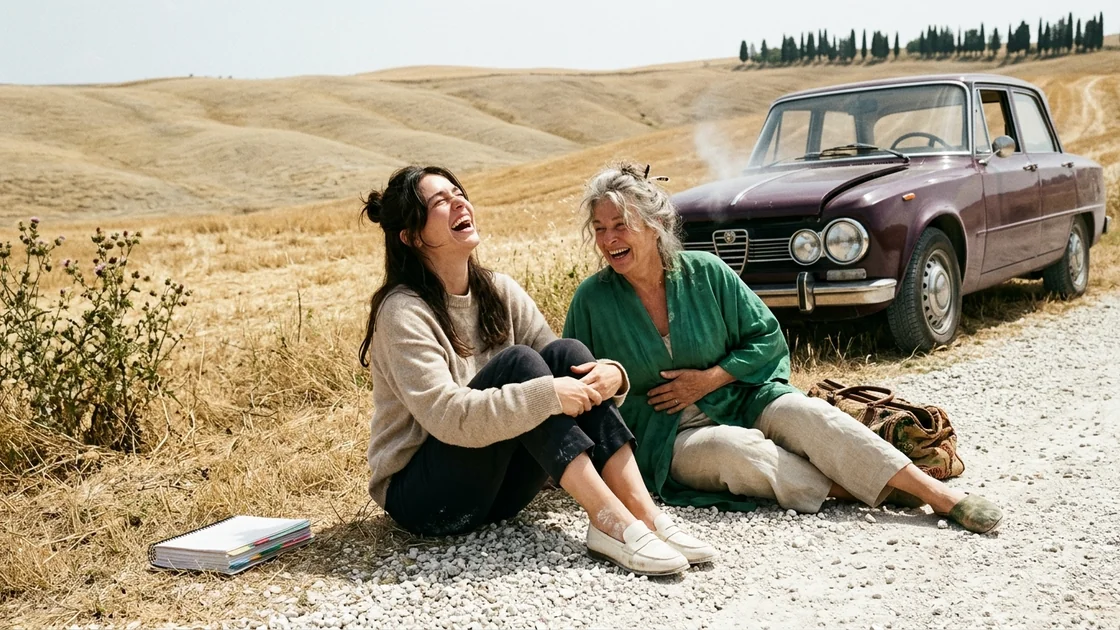
The car was the color of a bruised plum. Its gearbox sounded like two gravel buckets being shaken together, and the passenger side window was jammed three inches from the top with a piece of cardboard from a pasta box, but Vivienne drove it with a fierce, terrifying competence, her cigarette held out the vent window, double-clutching around the hairpins of the Chiantigiana with her jaw thrust forward.
Eleanor sat in the passenger seat with the Yorkshire-printed itinerary on her lap. It was now dog-eared, the corners softened by moisture, several pages covered in Vivienne’s spidery, illegible charcoal sketches of church towers and butcher shop fronts.
Item 14: Borgo Santo Pietro, Chiusdino. Three nights in the Grand Suite. Private garden, plunge pool. Rose-petal bath prepared upon arrival.
They did not reach the Borgo Santo Pietro.
Thirty miles south of Siena, on a white gravel road that ran through an endless ocean of yellow clay hills known as the Crete Senesi, the Alfa Romeo gave a sharp, metallic cough, shuddered through its entire plum-colored frame, and died in a plume of white steam that smelled powerfully of antifreeze and boiled radiator hose.
Vivienne steered the car onto the verge, pulled the handbrake with a loud, ratcheting scream, and switched off the ignition.
The silence that followed was total.
There were no lemon groves here, no cliffs, no sea. The Crete Senesi in late June was a landscape of lunar severity: naked, undulating ridges of gray-white clay that had been cleared of their grain weeks before, leaving only dry, golden stubble that whistled in the dry north wind. In the distance, three miles away across a sea of dust, a single row of black cypresses marched up a hill toward a fortified farmhouse that looked as though it had not seen an inhabitant since the Black Death.
The radiator gave a final, gurgling hiss, like an old dog settling down to die on a porch.
Eleanor looked at her phone.
No Service.
She opened the glove compartment. Inside was an empty tin of sardines, three rusty spark plugs, and a road map of Tuscany from 1982 that had split into three separate sections along the folds.
"Well," Eleanor said. Her voice was remarkably steady. A week ago, an event of this nature—an unscheduled breakdown on an unmarked road thirty miles from a five-star hotel with no cellular signal—would have induced in her a physiological reaction akin to an anaphylactic shock. Now, she simply felt a strange, light coolness in her chest, as if someone had opened a transom window in a room that had been sealed for forty years.
"The head gasket," Vivienne said, tapping the temperature gauge with her knuckle. "The old bastard in Vietri knew it was going. That’s why he made me pay the deposit in cash."
"We are three miles from the main road," Eleanor said, looking out at the shimmering heat rising from the gravel.
"Two miles," Vivienne corrected. "We passed an iron gate with two stone pineapples on the posts about ten minutes ago. There was laundry on the line behind the barn. Where there’s laundry, there’s an Italian with an adjustable wrench."
They got out into the dust.
The wind was hot and tasted of chalk. Eleanor looked down at her shoes—a pair of ivory leather loafers she had purchased on Madison Avenue specifically for "casual country travel." Within four steps, the white calfskin was coated in a fine, talcum-like powder that turned them the color of a wet cement bag.
Vivienne took her carpetbag from the back seat, slung it over her shoulder, and looked at Eleanor.
"Are you going to bring the binder?"
Eleanor looked at the brushed-pewter wire, the laminated tabs, the ninety-four pages of Julian Sterling’s domestic coronation.
She reached into the footwell, took the binder by its spine, walked to the dry irrigation ditch that ran beside the gravel road, and dropped it into the thistle bushes.
Vivienne watched her, the corners of her mouth twitching under her wrinkled skin. "A bit dramatic, don't you think?"
"It was heavy," Eleanor said.
They walked side by side along the white road, the wind blowing Vivienne’s green silk kimono around her knees like an unguided parachute.
After half a mile, Eleanor spoke. "Julian called me from the office yesterday morning. While you were down at the harbor buying those horrible little peaches."
"I knew he would," Vivienne said. "Men like that don't like missing inventory."
"He told me that if I came back before Sunday, we could tell the board that I had suffered an acute viral infection. He said his cousin has an estate on Fisher’s Island. We could have sixty people for an intimate service in July. He said it would look 'tastefully understated.'"
Vivienne snorted, kicking a white pebble into the grass. "He’s an artist of a different sort, isn't he? He paints in bullshit."
"I told him," Eleanor said, watching her dust-covered loafers move one after the other across the gravel, "that I had spent the last five years of my life making things look like they didn't cost anything, when they actually cost everything I had."
"And what did the actuary say to that?"
"He asked if I had kept the receipts for the church organist."
Vivienne stopped in the middle of the road. She began to laugh.
It was not a polite, society chuckle; it was a loud, braying, belly-deep laugh that startled three crows from a dead oak tree fifty yards away. She laughed until she began to cough, her shoulders shaking under the green silk, her hand coming up to press against her titanium hip as she bent double in the Tuscan sun.
"The organist!" she wheezed. "Oh, God... the Episcopal organist! They probably had to pay him double time to stop playing the Bach!"
Eleanor looked at her mother. She tried to remain stern; she tried to maintain the posture of the boutique wedding coordinator who had once made three junior designers cry in a single morning over the spacing of place-card calligraphy.
Then she felt it—a small, sharp hitch in her diaphragm, followed by an uncontrollable bubble of air that broke through her throat.
She began to laugh.
She laughed so hard her knees buckled, the dust puffing up around her loafers as she sat down directly on the white gravel of the Crete Senesi. She laughed until her ribs ached, until the mascara she hadn't washed off properly three nights ago ran down her cheeks in black, greasy gutters, until she was gasping for air with her forehead pressed against her knees.
They sat together on the edge of the road, the seventy-one-year-old bohemian and the thirty-one-year-old planner, two women in ruined clothes surrounded by fifty miles of empty, sun-baked clay, laughing like two escaped convicts who had just watched the prison burn down from the top of the hill.
VI. The Agriturismo of the Blind Pig
The stone farmhouse with the pineapples on the gate was not an agriturismo in the commercial sense. It was the home of an eighty-two-year-old widower named Renzo, who possessed six pigs, four hectares of sangiovese vines that looked as though they had been pruned with an axe, and a 1958 Fiat tractor with one front wheel made of solid cast iron.
Renzo did not have an adjustable wrench that would fit the Alfa Romeo’s head bolts, but he had a telephone connected to a party line, a half-wheel of pecorino cheese that smelled like an unventilated cellar, and a cellar full of five-gallon glass demijohns covered in dust and spiderwebs.
"The mechanic from Buonconvento comes tomorrow," Renzo announced in a dialect that sounded like stones rolling around in an iron drum. "Maybe ten o'clock. Maybe after lunch. It depends on whether his sister has her baby."
They slept in the granary above the wine press, on two iron cots with straw-filled mattresses that rustled like dry corn husks whenever they moved.
The window had no glass, only two heavy oak shutters that stayed open with pieces of string, framing a square of sky so black and thick with stars that Eleanor felt as though she could reach out and scrape the silver off the ceiling with her fingernails.
There were no rose petals. There was no Krug.
There was only the smell of warm sheep’s wool from the barn below, the dry, resinous perfume of the cypress needles baking in the night air, and the steady, rhythmic sound of Vivienne’s breath from the other cot.
Eleanor lay on her back, her fingers laced across her stomach.
For the first time since she was twelve years old, she did not have a list in her head.
Usually, the hours between midnight and dawn were the most dangerous. Her mind would construct elaborate, architectural run-sheets: Did Maya confirm the refrigeration truck for the butter sculptures? Did the letterpress in Maine use the 120-pound stock or the 80-pound? If it rains on the lawn at the country club, do we have twenty-four ivory umbrellas or twenty-six?
Tonight, there was only the sky.
"Eleanor?" her mother’s voice came from the darkness.
"Yes."
"Do you remember the loft on Broome Street? The one with the hole in the zinc ceiling where the rain came through?"
"I remember," Eleanor said. "You put an old zinc wash-tub under it, and you floated yellow water lilies in it."
"I didn't float them because they were pretty," Vivienne said, her voice unusually clear in the still room. "I floated them because the water was brown from the roof tar, and the lilies were five cents each from the Chinatown market. I was trying to keep you from seeing that the house was rotting over our heads."
Eleanor turned her head toward the other cot. In the faint, blue starlight, Vivienne looked small, almost fragile, stripped of the emerald kimono and the oxbone pin. Her gray hair lay spread across the ticking of the straw pillow like thistle down.
"I saw it anyway," Eleanor said.
"I know," Vivienne whispered. "You saw everything. That was your tragedy, El. You were the only person in that house who had any eyes."
A long silence fell between them, broken only by the stomping of a mule in the stalls below.
"Vivienne?"
"Hmm?"
"Why didn't you marry again? After Dad."
A soft, dry snort came from the straw. "Because men are like oil glazes, darling. They look brilliant when you first lay them down, but after twenty years, they turn yellow and crack the canvas underneath. I’d rather live with the bare linen."
Eleanor smiled into the dark. "The bare linen is very rough."
"It holds the paint better," Vivienne said, her voice trailing off into sleep. "It doesn't lie to you about the grain."
VII. Lake Como: The Grand Finale
They arrived at Lake Como six days later, by train from Florence.
The Alfa Romeo had been abandoned in Buonconvento with seventy thousand lire in greasy banknotes left on the mechanic’s workbench, its head gasket beyond the reach of local technology.
They took the regional trains—slow, three-car electrics that stopped at every village in the Val d'Arno, smelling of warm plastic, cheap pipe tobacco, and the wet umbrellas of commuters who boarded in the rain between Bologna and Milan.
By the time they reached Cernobbio, the summer heat had broken.
A low, gray front had moved down from the Swiss Alps, dragging long streamers of mist across the steep, dark green mountains that rose straight from the water. Lake Como did not have the sun-drenched, lemon-yellow theatricality of the south; it was a northern lake—somber, deep, aristocratic, its water the dark, oily green of antique jade, bordered by nineteenth-century villas that looked down into the depths with the blind, shuttered faces of old dowagers who had outlived their fortunes.
The Villa d'Este was Eleanor’s masterpiece.
She had spent two years securing this reservation: the Cardinal Suite, three rooms overlooking the floating pool and the lower terrace where the plane trees had been trained into high, green canopies along the lake edge since the days of Maria Theresa.
When they walked into the lobby, Eleanor was carrying her own bag.
Her linen trousers were permanently stained with the white clay of the Crete Senesi around the cuffs. Her hair was no longer pulled into that severe, architectural knot; it hung loose over her shoulders, dried by the mountain wind, streaked with salt from the sea and smelling of woodsmoke from Renzo’s chimney.
Her mother walked beside her, wearing an old trench coat she had bought from a secondhand stall in the market behind San Lorenzo in Florence, her oxbone paintbrush still pinned through her hair, her hands shoved deep into her pockets.
The assistant manager, a man named Umberto who had the silver hair and the glacial, terrifying elegance of a Swiss private banker, stepped from behind the reception desk.
He looked at the two women.
He looked at Eleanor’s dust-stained loafers. He looked at Vivienne’s carpetbag, from which the handle of an aluminum pepper mill she had taken from a cafe in Pienza was currently protruding.
"Signorina Vance?" he asked, his voice a masterclass in neutral, five-star skepticism.
"Yes," Eleanor said.
"We were... we had received a communication from the Sterling office in New York. A Mr. Henderson called on Tuesday to say that the booking was to be canceled under the emergency provisions."
Eleanor reached into her bag. She did not take out a clipboard. She took out a single, crumpled sheet of paper—the original booking confirmation, bearing the signature of the hotel’s managing director and Eleanor’s personal agency stamp.
"Mr. Henderson is an associate in Julian’s office," Eleanor said, her voice calm, level, and entirely devoid of the tight, anxious tremor that had characterized her professional speech for a decade. "He doesn't have the legal authority to cancel a contract signed by the principal. The payment was made from my account, Umberto. Check the routing number."
Umberto looked at the paper, then at the computer screen behind the mahogany desk. He tapped three keys.
His shoulders dropped a fraction of an inch—the international sign of an Italian courtier recognizing that he is outflanked.
"The Cardinal Suite is prepared," he said, bowing with an elegance that was now genuine. "We have, of course, maintained the arrangements for the arrival dinner on the veranda."
"Cancel the veranda," Eleanor said.
Umberto blinked. "Signorina?"
"We’ll have sandwiches," Eleanor said. "In the room. And a bottle of the local red. The one from the hills behind Sondrio that tastes like wet slate."
Vivienne, standing by the antique grandfather clock, looked over at her daughter and gave a slow, approving nod.
The suite was vast, dark, and filled with Empire furniture upholstered in emerald silk that matched Vivienne’s kimono with uncanny precision.
That evening, the rain began in earnest.
It was not a summer storm; it was the steady, cold, deliberate rain of the Alps, sweeping down the lake from Bellagio, turning the water into a sheet of beaten pewter and drumming against the heavy slate tiles of the roof with a sound like distant horses.
Eleanor stood at the window, watching the floating pool rise and fall with the gray swells of the lake.
Her phone, sitting on the mahogany writing desk, lit up.
It was not a text. It was an email.
From: Julian Sterling To: Eleanor Vance Subject: Settlement and Agency Transition
Eleanor,
I have instructed my attorneys to draft an agreement regarding the mutual release of claims related to the June 18th event. Given the public nature of the cancellation, it is in both our interests to ensure that no further statements are made to the press.
I have also spoken to Maya. She has expressed an interest in taking over the agency’s accounts for the autumn season. Under the circumstances, I assume you will not be returning to the Madison Avenue office. We can arrange for your personal effects to be delivered to a storage facility of your choosing.
I hope your mother is well.
Julian.
Eleanor read the email once.
She read it twice.
She looked for the pain. She looked for the cold, sick panic that had lived under her ribs for three years—the fear of being found lacking, the terror of an uncrossed t or an unfastened button, the dread of Julian’s quiet, modulated disappointment.
There was nothing.
The room was completely empty of him. The email was not an arrow; it was simply a series of black marks on a glowing glass rectangle, no more threatening than the laundry tickets she had left in the pocket of her wedding dress in Manhattan.
She clicked Reply.
Julian,
Maya can have the accounts. She knows where the keys are.
Keep the storage facility. Throw the rest in the river.
Eleanor.
She closed the laptop, walked over to the desk, took the power cord, wound it tightly around the machine, and set it outside the door of the suite in the corridor, like an empty room-service tray.
When she came back into the sitting room, Vivienne was standing by the fireplace, examining a large oil painting in a gilded frame that hung above the mantel.
It was a nineteenth-century landscape—a view of the lake under an approaching storm, dark, theatrical, and heavily varnished.
"Dreadful," Vivienne said, her nose three inches from the canvas. "Look at those trees. He used bitumen to get the darks. Within fifty years, the whole thing will look like an asphalt road on a hot afternoon. Complete lack of discipline."
"I like it," Eleanor said, coming to stand beside her. "It’s dramatic."
"It’s lazy," Vivienne countered, pointing a finger at the foreground. "He didn't want to draw the leaves, so he just slapped down a bucket of black and called it a storm. You have to draw the leaves, Eleanor. Even in the rain. Especially in the rain. Otherwise, nobody knows what’s being broken."
Eleanor looked at her mother. The old woman’s face was lined with deep, vertical trenches around the mouth, the skin under her eyes bruised with the exhaustion of seven days on the road, her silver hair coming loose from the oxbone pin in long, thin strands that hung across her cheeks.
"I’m sorry," Eleanor said.
Vivienne didn't look away from the painting. "For what?"
"For twenty years of clipboards."
Vivienne was quiet for a long moment. Outside, the rain lashed against the French doors, the sound of the lake slapping against the stone balustrade rising through the darkness.
"I didn't mind the clipboards, Eleanor," the old woman said, her voice dropping into that low, rasping register that sounded like autumn leaves being raked over gravel. "I minded that you thought you had to build a fortress to keep me from touching you. I was a terrible mother, but I wasn't smallpox. You didn't have to boil the sheets every time I came to town."
Eleanor reached out. She did not offer a polite, society cheek-kiss; she did not offer the cool, defensive hug of the estranged daughter.
She reached down, took her mother’s paint-stained hand—the fingers stiff with seventy years of turpentine and the chill of the northern rain—and brought it to her cheek.
The skin was cold and smelled of sulfur matches and cheap soap.
Vivienne did not move. For three seconds, her body remained rigid, like a piece of dry boxwood, then her fingers curled, her palm cupping Eleanor’s jaw with an ancient, fierce pressure that left a faint, gray mark of charcoal against the pale skin.
"Look at that," Vivienne whispered, her eyes still on the painting. "The idiot actually got the light on the water right. Just there, by the church tower. That’s lead white with a speck of yellow ochre. Not bad for a man who didn't know how to draw an oak leaf."
VIII. The Imperfect Hemline
The morning they were to leave for Milan to catch the flight home, the rain stopped.
The sky over Lake Como cleared into that rare, washed-clean blue that happens only after a northern tramontana has swept the valley, leaving the snow on the Swiss peaks looking so close and sharp that one felt one could touch them with a butter knife.
Eleanor woke early, before the hotel had begun to stir.
She walked down through the gardens, past the Roman statues with their noses eaten away by three centuries of frost, down to the floating pool that sat empty and still in the morning shadow of the mountain.
Her shoes were gone. She had left the ruined Madison Avenue loafers in the trash can of the room in Buonconvento; she was wearing a pair of ten-euro blue canvas espadrilles she had bought from a stall near the train station in Como, their soles made of rough, braided jute that scratched against the gravel.
She reached the edge of the stone jetty.
The water was crystal clear, revealing the green, moss-covered boulders fifteen feet below the surface, where small, silver fish darted between the shadows.
She reached into her pocket and took out the velvet-bound itinerary.
The cover was stained with red wine from the trattoria in Minori; the spine was broken; three pages had come loose and were held together with a bent brass paperclip she had found on the floor of the train.
She flipped to the last page.
Item 28: Departure. 09:00. Private launch to Como pier. Transfer to Malpensa by Mercedes S-Class. Ensure driver has the chilled towels and the English newspapers.
Eleanor looked at the words.
Then, with a slow, deliberate movement that had nothing of haste or anger in it, she tore the last page from the wire binding.
She folded it once, twice, into a small, tight square no larger than a matchbook, and dropped it into the green water between the jetty and the pool.
The paper floated for a moment, the gold-leaf lettering of The Sterling Honeymoon catching the first horizontal rays of the sun as it came over the ridge of the mountain, before the cold water soaked through the rag stock, turning the cream paper gray, then translucent, then drawing it down into the weed beds below.
"Eleanor!"
She looked back.
Vivienne was standing on the terrace of the Cardinal Suite, three stories above the gardens, leaning out over the stone balustrade. She was wearing the green kimono, her silver hair flying around her head like an unkempt halo, holding a white hotel coffee pot in one hand and waving a piece of dry toast with the other.
"The coffee is cold!" Vivienne shouted down through the silent plane trees, her voice bouncing off the stone walls of the palace with the magnificent, vulgar clarity of a fishwife in an opera house. "And they charged you twelve euros for two eggs that look like they were laid by a pigeon! Come up here and help me steal the silver spoons before the manager wakes up!"
Two gardeners, pruning the laurel hedge by the grotto, stopped their shears and looked up in horror.
Eleanor did not apologize.
She did not look down at her canvas shoes.
She took a deep breath of the mountain air—cold, wet, smelling of lake weed and snow—and she shouted back.
"Put the spoons down, Vivienne!" Eleanor yelled, her voice ringing across the water, clear and loud and entirely out of order. "I’m coming up!"
She turned and walked back through the gardens, her blue shoes leaving dark, irregular prints in the morning dew, her hemline dragging through the gravel, not caring in the least that she was eight minutes behind schedule.