The Conductor of Rust and Thunder
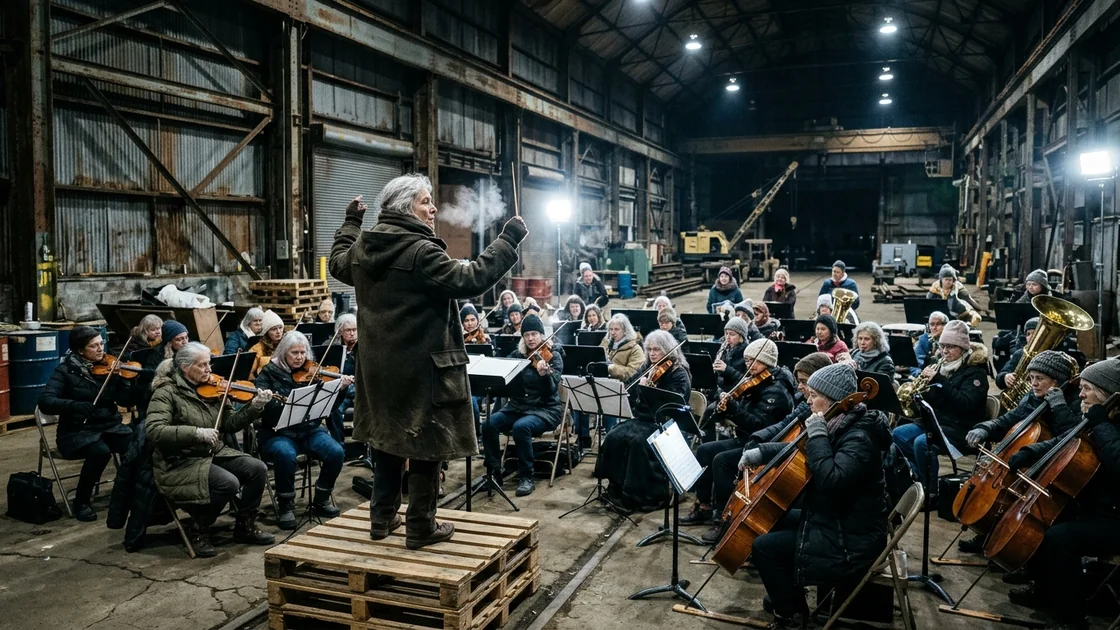
When sixty-four-year-old maestro Eleanora Vance is abruptly stripped of her podium at the prestigious Manhattan Sinfonia in favor of a youthful viral sensation, she refuses to retire quietly into the archives of classical music. Recognizing that the classical establishment systematically discards women as they age, Vance roams the boroughs to assemble an underground symphony comprised entirely of cast-off female virtuosos, from forgotten retirees to conservatory graduates overlooked by biased auditions. Rehearsing in a cavernous, decommissioned locomotive shed in the Brooklyn Navy Yard, this eighty-piece guerrilla ensemble mounts audacious, unannounced midnight performances across the city, transforming forgotten industrial spaces into acoustic cathedrals. As their anonymous rebellion captures the public imagination and threatens the moral standing of the elite musical aristocracy, Vance and her musicians prepare a final, unignorable acoustic siege against the very institution that cast them aside, proving that artistic genius does not dim with age, but gathers a terrifying, incandescent weight.
The baton did not slip from Eleanora Vance’s hand; it was extracted with the clinical efficiency of an embalmer’s instrument.
Arthur Pendelton, whose family name was chiseled into the limestone architrave above the grand foyer of Avery Hall, sat across from her in the ninth-floor executive suite. Between them lay a polished rosewood table so pristine it mirrored the overcast October sky hanging low over Central Park. On Arthur’s side rested a folder of heavy bond paper, pale cream, tied with a black grosgrain ribbon. On Eleanora’s side rested only her hands, square-palmed, short-fingered, the skin across her knuckles patterned with the dry, fine cross-hatching of six decades of cold winds, harsh stage lighting, and endless scores.
"Eleanora," Arthur said, leaning back, tenting his fingers. His cuff links were mother-of-pearl, catching the gray light. "Nobody is disputing the legacy. My God, thirty-two years. Two cycles of the Mahler symphonies. The entire Sibelius canon. You brought this orchestra into the twenty-first century with the discipline of a Prussian division."
"Then don't speak of me in the past tense, Arthur," she said. Her voice was an alto instrument, low and dry, seasoned by hours of whispering over double basses and shouting through the percussive squalls of Stravinsky. "The season program is printed. We begin rehearsals for the Shostakovich Eighth on Tuesday morning. I have already marked the parts for the contrabassoon."
Arthur smiled. It was the soft, liquid smile common among men who managed municipal endowments, a smile designed to convey sorrow while executing an eviction. "The board met on Thursday evening, Nora. An executive session. We feel—and I must emphasize this was a unanimous sentiment among the philanthropic committee—that the Sinfonia requires a realignment of its visual and cultural profile. We are operating in an ecosystem dominated by immediate visual engagement. We are bleeding subscriptions among donors under forty-five."
"Subscriptions are down because the patrons are dying of old age," Eleanora replied, her voice remaining level, flat as an iron plate. "Not because my tempos are sluggish. We sold ninety-six percent of the house for the Brahms Requiem in April."
"Brahms is safe," Arthur said, waving a manicured hand. "Brahms is heritage. But heritage does not drive the algorithm. It does not secure the streaming partnership with Medici.tv or the lifestyle sponsorship with the German automotive group." He nudged the cream folder forward two inches. "Julian Drake is available. His contract with the Scottish National Orchestra concluded early."
Eleanora did not look at the folder. She knew Julian Drake. He was twenty-nine years old. He had hair that fell across his forehead in cultivated, romantic disarray, two million followers across three social media platforms, and a habit of conducting without a score while swaying at the hips like a lounge singer. She had watched him butcher the metric shifts in The Rite of Spring at the Proms two summers ago, covering his rhythmic incompetence by leaping off the podium during the Danse sacrale to the delight of television cameras.
"Drake cannot subdivide a seven-eight measure without his concertmaster tapping her foot to keep him from drowning," she said softly.
"The public disagrees," Arthur murmured. "The board disagrees. We are prepared to offer you the title of Conductor Laureate Emeritus. You would retain an office in the annex. A modest stipend. A masterclass twice a year. We would commission a bronze bust for the promenade. A lovely bronze, Nora. By the sculptor who did the Bernstein memorial."
Eleanora looked at him. Really looked at him. She saw the silver stubble neatly trimmed along his jawline, the expensive wool of his bespoke suit, the total, unshakable conviction of a man who believed that culture was something you bought by the yard and discarded when the fringe began to fray. And beneath that conviction lay the unspoken, primordial truth of their world: an old man with gray hair on a podium was a maestro, a venerated patriarch, an oracle whose trembling hands were praised as the trembling of the divine spirit; an old woman with gray hair on a podium was simply an old woman in a tuxedo, an aesthetic inconvenience, an embarrassment to the lens.
"Keep the bronze," she said.
"Eleanora, be sensible. There is a press conference scheduled for noon tomorrow. We would very much prefer a joint release. A transition of mutual admiration. A passing of the flame."
She stood up. Her knees clicked, a dry, sharp sound like the striking of an orchestral woodblock. She was not a tall woman, barely five feet four, but her posture had been hammered into plumb by forty years of standing before eighty armed musicians. She placed her palms flat on the rosewood table, leaning her weight forward until Arthur instinctively drew back his shoulders against the leather of his chair.
"If you put Julian Drake on my podium," she whispered, "he will drop the baton during the allegro of the Eighth. And when he drops it, Arthur, do not send your interns to my apartment to ask where the cue lines were hidden."
She turned and walked out of the room. She did not take the cream folder. She did not take the silver pen that Arthur had set neatly beside it.
In her dressing room beneath Avery Hall, she packed her belongings. It took twenty minutes. A conductor does not accumulate many physical things in a house of sound. A leather briefcase containing her study scores of the Russian masters, their margins dense with her tiny, illegible annotations in red ink and 2B pencil. Three batons balanced by a woodturner in Vienna from aged hornbeam, their cork handles worn smooth and darkened by the sweat of her palms. A pair of flat, soft-soled leather shoes. A photograph of her mother, who had played third horn in the Cleveland Orchestra under George Szell until her pregnancy had made her continued presence on stage "visually untenable" according to the orchestra manager of 1958.
The security guard at the stage door, an old man named Sal who had worked the night shift since the Ford administration, looked at her cardboard box and looked at her eyes. He did not ask questions. He simply held the heavy brass door open and tipped his gray wool cap.
"Good evening, Maestro," he said.
"Good evening, Sal," she replied, stepping out into the cold rain of Broadway.
For three weeks, Eleanora Vance ceased to make sound.
She lived in a third-floor brownstone apartment on West 87th Street, where the ceiling was high enough to accommodate a grand piano and the walls were lined from floor to molding with cloth-bound scores. The silence of the apartment was not peaceful; it was necrotic. Without the daily friction of eighty people breathing, tuning, coughing, and scraping bowhair against sheep gut, her ears began to play tricks on her. She heard phantom overtones in the hum of the refrigerator. The whistle of the steam radiator resolved into an agonizingly sharp B-flat, hovering three cents above concert pitch, demanding a resolution that never arrived.
She did not turn on the radio. She did not read the arts section of the Times, though she caught sight of the Sunday magazine cover on a newsstand: Julian Drake, draped in a midnight-blue velvet dinner jacket, his eyes smoldering beneath the headline: THE REVOLUTIONARY: BRINGING GEN Z TO THE SYMPHONY.
On the twenty-second day of her exile, Eleanora went to the grocery store.
The rain had washed the leaves from the gingko trees, plastering them to the wet asphalt like yellow coins. As she crossed the corner of 72nd and Amsterdam, a sound cut through the drone of delivery trucks and yellow cabs. It was a cello, playing the sarabande from Bach’s C minor suite.
It was not busker playing. Buskers played the prelude from the G major suite, loud and fast, leaning into the open strings to maximize acoustic projection against the traffic. This was the fifth suite, played with an austere, bone-dry clarity, the scordatura tuning giving the lowest voice a guttural, tragic rasp. The intonation was immaculate. The shifts were invisible, liquid, executed with a classic, high-wristed Franco-Belgian technique that had virtually disappeared from modern conservatories.
Eleanora stopped. She turned toward the small concrete plaza outside an abandoned bank branch.
Sitting on a folding stool, huddled inside an oversized down coat with a knit cap pulled low over her ears, was a woman in her late fifties. Her instrument was not a cheap Chinese plywood box; it was an old German cello, perhaps late nineteenth century, its varnish bruised and crazed like the surface of an antique violin. Her fingers, red from the raw dampness of the November air, moved across the fingerboard with the unhurried authority of an aristocrat.
Eleanora stepped closer. A battered violin case lay open on the pavement, containing three one-dollar bills, a handful of quarters, and a promotional postcard from a local chamber music festival dated six years earlier.
The cellist finished the final cadence, letting the open G string die away into the noise of an idling cross-town bus. She did not look up immediately; she rested her forehead against the pegbox, breathing out a small plume of white vapor.
"Your fourth finger on the D-flat," Eleanora said quietly. "You’re anticipating the release by an eighth of a beat to save the bow."
The woman stiffened. Her head snapped up. Her face was lined around the mouth, the skin pale and tight, eyes the color of flint. For three seconds, disbelief registered in her pupils, followed immediately by a defensive, razor-edged pride.
"Maren," Eleanora said.
Maren Dahl had sat in the second chair of the Boston Symphony’s cello section for fourteen years. Eleanora had guest-conducted her in the Dvořák concerto in 2011. Then Maren had taken six months of medical leave for a bilateral tendon release in her wrists, followed by an agonizing custody battle that spilled into the local press. When she applied for reinstatement, the management had suggested—with great institutional delicacy—that her physical recovery was incomplete and that her place had been filled by a brilliant young fellow from the New World Symphony.
"Nora," Maren said, her voice dry. She made no move to stand. She laid her bow across her lap like a sceptre. "Come to check on the competition?"
"I heard you from the corner," Eleanora said. "You’re still using the Tourte copy."
"It’s the only thing the lawyers didn't take," Maren said. She looked down at the few coins in her case. "What are you doing here? Shouldn't you be at Avery, teaching Julian Drake how to beat five-four time?"
"I was retired," Eleanora said.
Maren laughed, a short, barking sound that had no humor in it. "Retired. What a lovely, civilized word. They put a gold watch on your wrist and shove you down the garbage chute. Welcome to the landfill, Nora. Down here, the acoustics are terrible, but nobody asks you to look pretty for the corporate donors."
Eleanora looked at Maren’s hands. The tendons in her forearms were ropy, scarred at the wrists by two neat, surgical white lines, but the fingers were long, muscular, and completely steady.
"Do you still have the Montagnana?" Eleanora asked.
"In a climate-controlled vault in Newark that costs four hundred dollars a month," Maren said. "I play this junker out here so the salt doesn't ruin the varnish. I haven't touched the Montagnana in two years. What would I play it for? The pigeons?"
Eleanora looked past her, into the mouth of the subway station, where hundreds of commuters were descending like gray sheep into the humid belly of the earth. She felt a sudden, electric sensation at the base of her skull—the same physical jolt she felt when, looking over an orchestral score, she suddenly realized the composer’s hidden structural architecture, the secret bridge between the opening motif and the final catastrophic resolution.
"Maren," Eleanora said, "how many of us are there in the city?"
"How many whats?"
"Women who can play the Sinfonia Domestica in their sleep, who are currently teaching Suzuki method to tone-deaf eight-year-olds or playing cocktail lounges in Midtown because their faces aren't right for the program covers?"
Maren stared at her. A truck rumbled past on Amsterdam, rattling the glass of the abandoned bank. "Dozens," she said slowly. "Maybe hundreds. Why?"
Eleanora reached into her coat, pulled out her leather gloves, and drew them on with deliberate care. "Pack your cello, Maren. We are going to have a drink."
The campaign did not begin with a manifesto; it began with an index card file.
In the second bedroom of Eleanora’s apartment—a room that had once held her guest bed and was now stripped bare save for a folding table and three folding chairs—she and Maren began the inventory. They worked through the late autumn nights, drinking black tea that grew cold in their mugs, scouring old programs, conservatory alumni directories, union rosters, and the forgotten margins of regional orchestra listings.
The criteria were absolute: Virtuosity of the highest institutional order, combined with an absolute, irreversible status as an exile.
"We don't want anyone who still hopes for a callback from the New York Phil," Eleanora said, tossing an audition resume into the wastebasket. "Hope makes people timid. Hope makes them look at their watches. I want musicians who have had the door slammed so hard their teeth still rattle."
First came Clara Reyes.
Clara was seventy-one years old. For twenty-eight seasons, she had served as the associate concertmaster of the Chicago Symphony, an iron-willed technician whose intonation could cut plate glass. When the music director had retired in 2018, the incoming German director had brought his own protege, an Austrian boy with golden curls and an aggressive vibrato. Clara had been offered a demotion to the seventh stand of the first violins. Instead of accepting the insult, she had walked out during the dress rehearsal of Mahler’s Fifth, never to return. She was currently living in a rent-stabilized walk-up in Astoria, Queens, surviving on a depleted pension and giving private lessons to the children of Greek shipping clerks.
When Eleanora and Maren knocked on her door, Clara opened it wearing a moth-eaten cardigan, her silver hair pinned up with an ebony crochet hook. She did not invite them in.
"I don't sign petitions," Clara said, leaning against the doorframe. "And if you’re collecting for Arthur Pendelton’s retirement fund, you can drown in the East River."
"I have the score of the Shostakovich Tenth," Eleanora said. "First violin part. The second movement. One hundred and seventy-six measures of unrelenting sixteenth notes at half note equals one hundred and forty-four."
Clara’s eyes, hooded by heavy lids, narrowed. "Nobody plays the second movement at one hundred and forty-four. It falls apart in the woodwinds."
"It won't fall apart," Eleanora said. "Not with the woodwinds I’m hiring."
Clara looked at Eleanora’s hands, then down at Maren’s cello case standing in the hallway. "Who is playing concertmaster?"
"You," Eleanora said. "Unless you think your wrist has softened."
Clara was silent for five seconds. A kettle began to shriek somewhere in the depths of her apartment. "Come inside," she spat. "Wipe your feet. The floor is pine."
Next came Sora Kim.
Sora was fifty-eight, an oboist and English horn player whose sound was legendary among orchestral musicians for its dark, brooding weight, like a charcoal drawing in a gallery of watercolors. She had spent twenty years with the Metropolitan Opera Orchestra, surviving seven hundred performances of Tristan und Isolde and Tosca, until a chronic inner-ear condition had caused an episode of vertigo during an act-two transition in Parsifal. She had dropped her reed. The management had cited "performance instability" and terminated her tenure under a clause originally written to purge players suffering from advanced dementia. The vertigo had cleared within three months, the result of a simple sinus infection, but the orchestra had already sealed the contract with an twenty-four-year-old oboist from the Curtis Institute.
They found Sora working the evening counter at a classical sheet music store on 48th Street, bagging scores for conservatory students who didn't know who she was.
When Eleanora spoke the name Lili Boulanger, Sora’s hands stopped on the register.
"Boulanger’s D’un soir triste," Sora murmured. "The English horn solo. It requires a low B-flat held through four measures of crescendo against muted brass. No one plays it. It’s too heavy."
"We will play it," Eleanora told her. "We will play it so heavy the floorboards splinter."
Then came the brass.
Finding the brass was the most difficult task, because the classical music establishment’s exclusion of women from the brass sections was not a recent pathology; it was an ancient, structural architecture. Blind auditions, introduced in the 1970s behind screens and carpeted runners, had increased the number of female woodwinds and strings, but brass remained a fortress of testosterone. A woman playing low brass was treated as a circus curiosity, an anomaly to be tolerated in summer stock but kept strictly off the stage of the majors.
They tracked down Beatrice Moreau in Philadelphia. Beatrice was forty-six years old, six feet tall, with shoulders like a dockworker and lungs that could inflate a tractor tire. She played the contrabass tuba. She had won four blind auditions at major American orchestras; in each case, when she emerged from behind the screen for the final interview, the audition committee had declared "no hire" and re-opened the search six months later. To pay her mortgage, she was playing sousaphone in a ten-piece brass band that performed at corporate retreats, beer festivals, and street fairs.
Eleanora met her in a diner outside Trenton. Beatrice took a bite of a pastrami sandwich, chewing slowly while she listened to the proposal.
"Let me get this straight," Beatrice said, wiping mustard from her lip with a paper napkin. "You want me to drag a four-valve York tuba into New York City, rehearse in the middle of the night in an unheated warehouse, for zero dollars, to play music that the public usually only listens to while wearing black tie and sleeping off their Chardonnay?"
"Yes," Eleanora said.
"And what happens when the cops show up?"
"We play louder than their sirens," Eleanora said.
Beatrice stared at her. A slow, terrifying grin spread across her face, showing a gap between her two front teeth. "You know what the hardest part of the tuba part in the Rite of Spring is, Vance?"
"The transition into the Glorification of the Chosen One," Eleanora answered without hesitation. "The rapid alternating octaves against the bass drums."
Beatrice slapped the Formica table with a palm that shook the coffee cups. "I’ll be there. And I’m bringing two horn players from Baltimore who were fired for getting pregnant within three months of each other. They’ve got chops that would peel the paint off your ceiling."
By late December, the roster was complete.
Eighty-four women.
The youngest was twenty-six: Maya Chen, a harpist of terrifying technical ferocity who had been rejected from three elite resident fellowships because, in the words of one prominent director captured on a hot mic, she "sat behind the instrument like an accountant rather than an angel." The oldest was Clara Reyes, seventy-one.
Between them lay five decades of institutional cruelty, unwritten blacklists, patronizing conductorial leers, aesthetic disqualifications, and the slow, grinding humiliation of being told that they were too old, too fat, too plain, too loud, too maternal, too independent, or simply too much for the delicate visual sensibilities of the modern concert hall.
They called themselves Disjecta. It was an abbreviation of Horace’s disjecta membra poetae—the scattered limbs of the poet.
Their cathedral was a corpse of the industrial age.
Tucked into the eastern corner of the Brooklyn Navy Yard, behind three tiers of chain-link fence and a rotting timber pier, stood Machine Shop 54. Built in 1917 to fabricate turbine casings for dreadnoughts, it was a colossal hall of corrugated zinc, rusted iron girders, and soot-blackened clerestory windows fifty feet above the cracked concrete floor. It had no heat. It had no plumbing. It had three working electrical circuits, patched together with industrial extension cords from a neighboring ship repair depot whose foreman was the brother-in-law of their second bassoonist.
What it had was volume.
Four hundred feet long, eighty feet wide, with a barrel-vaulted steel roof that caught the sound and tossed it back with a four-second acoustic decay. It was not the dry, padded, velvet-and-plaster acoustic of a modern concert hall, designed to protect the fragile ears of elderly subscribers. It was a concrete-and-steel canyon, hard-edged and resonant, an acoustic that amplified bass frequencies until they vibrated in the soles of your boots and turned high violin lines into long, searing ribbons of cold silver.
They began rehearsals on the second Tuesday of January, at eleven o'clock at night.
The temperature inside the shed was twenty-eight degrees. Eighty-four women arrived through the freezing drizzle, hauling double bass trunks, cello cases, timpani wrapped in moving blankets, and heavy brass instruments in canvas bags. They wore fingerless woolen gloves, down parkas, thermal underwear beneath work pants, and heavy wool hats pulled down to their eyebrows. Their breath rose into the iron rafters in great, rhythmic puffs of white steam, like the exhaust from the steam engines that had once been assembled on that very floor.
Eleanora stood on two stacked shipping pallets at the center of the hall. She did not have a podium. She did not have a tuxedo. She wore her old wool duffel coat, its collar turned up against the draft, and a pair of heavy leather work boots.
She did not tap her baton on a music stand. She did not have a stand. She had memorized the scores forty years ago.
She raised her hands.
The silence that fell over Machine Shop 54 was absolute. It was not the polite silence of an auditorium settling down after the lights dim; it was the predatory silence of a pack of wolves turning their heads toward a scent. Eighty-four pairs of eyes, bright beneath their knit caps, locked onto Eleanora’s fingers.
"We begin with the Boulanger," Eleanora said. Her voice did not echo; it cut. "Page one. D’un soir triste. It is 1918. Lili Boulanger is twenty-four years old. She is dying of tuberculosis of the intestines. She knows she has less than two months to live. This is not a lament. This is not a weeping woman looking out of a window. This is the wrath of an intellect that knows it is being murdered by its own body."
She looked at the double basses—six women standing over their massive instruments like executioners beside chopping blocks.
"Give me the low C-sharp," Eleanora commanded. "No vibrato. Like dry iron."
She dropped her right wrist.
The downbeat was not a flourish; it was a detonation.
The six double basses pulled their horsehair across the steel strings, and from the floor of the machine shop rose a sound so deep, so dark and physical, that the corrugated zinc walls of the building gave off a faint, sympathetic rattle. Then the cellos entered, Maren Dahl leading them with a stroke that had all the pent-up venom of her two years on the sidewalk, followed by Sora Kim’s English horn—a jagged, mournful cry that rose through the cold air like a hawk climbing a winter thermal.
For twenty minutes, they played.
There were mistakes. At measure forty-two, the second clarinets missed an entrance, their frozen fingers sluggish on the keys. At measure eighty, the horn balance was skewed, the Baltimore players overpowering the bassoons.
Eleanora stopped them. She did not raise her voice. She did not lose her temper. She was surgical.
"Clara, you are playing the triplets like Brahms. Stop sweetening the tone. This is not Vienna. This is Paris during the German bombardment. Strip the vibrato until the pitch hurts. Again. From measure thirty-eight."
They worked until three in the morning.
By two o'clock, the fingerless gloves had been discarded. The heat generated by eighty-four bodies exerting maximum physical effort had warmed the immediate perimeter of the orchestra by ten degrees. Sweat glistened on the back of Beatrice Moreau’s neck as she wrestled with the low pedal tones of the Boulanger, her massive shoulders heaving beneath her flannel shirt. Tessa Bell, a sixty-two-year-old timpanist who had spent thirty years being told she hit the drums "too aggressively" for regional opera, was striking the calf-skin heads with such vicious precision that the shockwaves ruffled the edges of the sheet music clipped to the surrounding stands.
When they finished the final, crushing chord of the Boulanger—a chord that hung in the frozen air of the turbine hall for four seconds before decaying into the distant hum of the Brooklyn-Queens Expressway—nobody moved.
Nobody packed their instrument.
Eleanora let her hands fall to her sides. She stood on the shipping pallets, her chest rising and falling, her heart slamming against her ribs with a cadence she had not felt since her thirties. She looked at Clara Reyes, whose eyes were wet with cold and fury. She looked at Maren Dahl, whose jaw was set like a vice. She looked at Beatrice Moreau, leaning against her brass monster, grinning like a pirate.
"Tomorrow," Eleanora said, her breath clouding between them. "Stravinsky. The Danse sacrale. If you cannot count eleven-sixteen in your sleep, do not show up."
"Try to lose us, Vance," Clara barked from the concertmaster’s stand.
A low, guttural murmur of agreement rolled through the orchestra—the tapping of wooden bows against music stands, the stamp of boots on concrete, the dark, metallic rumble of the brass.
The city did not know it was under siege until the third of February.
The first strike took place at 11:45 PM on a Friday night in the great hall of Grand Central Terminal.
It was the dead of winter. The concourse was populated by late-night commuters rushing for the Hudson Line, transit police officers drinking coffee by the information booth, and the city's unhoused curling up against the brass radiator grilles. Above them, the cerulean-and-gold ceiling depicting the constellations of the zodiac was illuminated by dim floodlights.
At 11:42 PM, three white commercial moving vans pulled up to the Vanderbilt Avenue taxi stand.
From the vans emerged forty women wearing long black wool coats, their collars turned up, their faces partially obscured by black knit beanies. They did not speak. They moved with the silent, terrifying coordination of a military engineering unit. They carried no chairs. They carried no stands. They carried only their instruments.
They took their positions around the four-sided brass clock atop the information booth, spreading out across the marble floor in an eighty-foot circle.
At 11:44 PM, a woman with silver hair stepped onto the brass base of the information booth. She wore a simple black overcoat. She carried a hornbeam baton in her right hand.
A transit police officer took two steps toward her, his hand resting on his utility belt. "Ma'am, you can't stand on the—"
Eleanora Vance did not look at him. She brought her arms up.
The opening bassoon solo of The Rite of Spring—that high, reedy, prehistoric squeal that Igor Stravinsky had wrenched from the very limits of the instrument’s range—broke across the marble cavern of the terminal like a crack in a frozen lake.
It was played by Marian Vance (no relation to Eleanora), a sixty-year-old woman who had been passed over for principal bassoon at three major orchestras in favor of younger men who "projected a more assertive executive presence." Marian’s tone was not polite. It was ancient, nasal, pagan, and raw.
The commuters stopped. A man dropping a nickel into a coffee machine froze, his finger suspended over the selector.
Then the strings entered.
The famous Dances of the Young Girls—that brutal, percussive, syncopated down-bow chord that had sparked a riot at the Théâtre des Champs-Élysées in 1913. But this was not forty polite string players in evening gowns swaying gently to avoid wrinkling their silk. This was forty furious, middle-aged women in heavy overcoats, sawing their bows across strings with the collective down-force of a freight train.
The acoustic of Grand Central Terminal was legendary: twelve million cubic feet of air enclosed by marble, granite, and Botticino stone. The sound did not bounce; it exploded. The rhythmic accents hit the massive arched windows like mortar rounds.
A crowd began to gather, not at a polite distance, but pressing inward in a tight, breathless ring. Smart phones were drawn from pockets, hundreds of small blue screens flickering to life in the dim light like fireflies.
Eleanora conducted with her whole body. She did not use the languid, cinematic gestures of Julian Drake. Her beat was compact, razor-sharp, terrifying in its economy. She signaled the metric shifts with micro-movements of her wrist, her eyes darting across the circle, pulling the complex polymetric machine together with the sheer, irresistible force of her will.
When they reached the Danse sacrale, the final sacrificial frenzy, Tessa Bell did not have her full set of timpani; she had two portable kettledrums strapped to an industrial dolly, her arms coming down like blacksmith's hammers, the skins roaring against the marble walls. Beatrice Moreau’s tuba roared beneath the floorboards, shaking the loose change in the commuters' pockets.
On the final, violent, ascending sixteenth-note sweep, Eleanora wrenched her right fist toward the starry ceiling, seizing the sound in her fingers, and dropped it into the floor.
Silence.
A second of total, breathless paralysis in the heart of Manhattan.
Then a scream went up from the crowd—a raw, uncultured roar of genuine shock and adoration.
Before the transit police could organize their radios, before the station managers could emerge from their offices, the eighty-four women had broken formation. They did not take a bow. They did not smile. They packed their instruments into their cases with the speed of combat troops breaking camp, melted into the crowd, descended the stairwells toward the subway platforms, and were gone.
By morning, the video footage had been viewed fourteen million times.
The classical music internet was in convulsions. The comments were a battlefield:
Who are they? Look at the concertmaster—that’s Clara Reyes! I’d know that bow stroke anywhere. She disappeared from Chicago five years ago! That wasn't Julian Drake’s tempo. That was Vance. That was Eleanora Vance’s tempo. Nobody else takes the Danse sacrale at that speed without the brass collapsing. Where was this? Why wasn't it announced? Look at their faces. They’re all women. They’re all over fifty.
Arthur Pendelton saw the video at 7:15 AM while sitting in his corner apartment on Fifth Avenue, eating half a grapefruit. His phone had already buzzed thirty-six times.
He watched the tiny video on his iPad screen. He saw Eleanora Vance standing on the brass ledge of the information booth, her duffel coat flying like a battle standard, her silver hair whipping across her forehead as she carved the air with her hornbeam baton.
Arthur set his silver spoon down. The grapefruit tasted suddenly of copper.
"Damn her," he whispered.
The second strike occurred twelve days later, inside the decommissioned dry dock at the Brooklyn Navy Yard itself, during a private, black-tie donor cruise organized by the Manhattan Sinfonia.
The Sinfonia had rented a luxury yacht—the Empress of New York—to take three hundred top-tier benefactors on a twilight cruise around the harbor, featuring an intimate chamber performance by Julian Drake and a select ensemble of young players. The tickets were five thousand dollars each, intended to fund the upcoming European tour.
As the yacht turned slowly in the East River, gliding past the dark, industrial silhouette of the Navy Yard, Julian Drake was standing on the aft deck, his hair artfully tossed by the river breeze, holding a glass of vintage Champagne while speaking into a microphone about his "vision for an inclusive, kinetic future for the symphonic tradition."
Across the water, six massive industrial floodlights mounted on the roof of Machine Shop 54 suddenly flickered to life, blazing through the freezing fog with the intensity of anti-aircraft batteries.
The floodlights did not illuminate an empty pier. They illuminated the dry dock.
The water had been pumped out decades before, leaving an enormous, terraced concrete chasm one hundred feet deep and five hundred feet long. Arranged along the stepped concrete tiers, standing like stone sentinels against the rusted iron walls, was Disjecta.
Eighty-four women.
They were not wearing black coats this time. They wore white painter’s coveralls, stark and spectral beneath the five-thousand-watt arc lights, looking like ghosts who had climbed out of the concrete floor of the republic.
Eleanora Vance stood on the edge of the caisson gate, eighty feet above the floor of the dry dock, her figure silhouetted against the Manhattan skyline across the river.
Over the water, carried by four massive directional stadium speakers that had been rented from an outdoor rock festival promoter and wired directly into the Navy Yard’s transformer station, came the opening bars of Shostakovich’s Tenth Symphony, second movement.
It was four minutes of the most concentrated, violent orchestral hatred ever committed to manuscript paper. Written as an acoustic portrait of Joseph Stalin—a relentless, galloping, mechanical monster of a movement that crushed everything in its path.
On the deck of the Empress of New York, the Champagne glasses ceased to clink.
Julian Drake stopped speaking. The microphone in his hand dropped an inch, picking up the low, terrifying rumble of six double basses and a contrabass tuba projecting across three hundred yards of open water.
The tempo was not modern. It was not polite. It was half note equals one hundred and forty-four.
Clara Reyes led the first violins in an assault of sixteenth notes so fast, so savage and uniform, that it sounded like a belt-fed machine gun firing across the waves. The woodwinds did not sweeten their shrieks; they screamed through their keys. And in the middle of it all, Eleanor’s baton did not beat time; it whipped the air, driving the tempo forward, refusing to let the musicians breathe, demanding every drop of marrow from their bones.
The donors on the yacht rushed to the starboard railing, their silk dresses and tuxedo jackets fluttering in the cold wind. Some of them took out their opera glasses—the very glasses they used to view the stage at Avery Hall.
Through the lenses, they saw their former concertmasters, their former principal cellists, the women who had taught their daughters, the women they had voted to push off the stage to make room for "fresh visual energy."
They saw Maren Dahl, her face contorted in ecstatic fury, her bow biting into the C-string of her Montagnana cello with a sound that could have sawed through the steel hull of the yacht.
They saw Sora Kim, her English horn sounding like a siren warning of an impending airstrike.
And they saw Eleanora Vance.
She was not smiling. She was not playing to the donors. She was looking past the yacht, past the East River, past the towers of Wall Street, her eyes fixed on the gray clouds rolling in from the Atlantic. She looked like a general commanding a siege against an empire that had already forgotten its own language.
When the Shostakovich ended with a final, brutal, fortississimo crash of the cymbals and a snap of the snare drum, the sound rolled across the water and hit the glass facade of Lower Manhattan, echoing back five seconds later like a dying thunderclap.
The floodlights cut out simultaneously.
Total darkness fell over the Navy Yard.
On the yacht, absolute silence reigned. Julian Drake stood by the brass railing, his mouth slightly open, the Champagne in his glass flat and dead. Beside him, Arthur Pendelton’s hand trembled so violently against his silver-headed walking stick that the ferrule rattled against the teak deck.
One of the oldest female donors on the board—a woman of eighty-five whose family had underwritten the Sinfonia’s woodwind chairs for half a century—lowered her opera glasses.
"Julian," she said, her voice clear and dry in the quiet night air, "can you do that?"
Julian Drake did not answer.
By mid-March, Disjecta was no longer a secret; it was a contagion.
They did not release an album. They did not create a website. They did not accept interviews from the music trade magazines that had ignored them for thirty years.
Instead, they struck without warning, always at night, always in spaces where acoustic volume met historical architecture:
They played Florence Price’s Symphony in E minor inside the cavernous, vaulted main reading room of the abandoned city archives in Long Island City, their sound bouncing off millions of yellowed tax records and land deeds.
They played Lili Boulanger’s Faust et Hélène inside the hollow brick rotunda of a decommissioned gasworks in New Jersey, the brass echoes lingering so long that the harmonies fused into an incandescent cloud of overtones.
They played the third movement of Louise Farrenc’s Third Symphony on the flat roof of an empty cold-storage warehouse in Red Hook at sunrise, while fifty tugboats idling in the harbor blew their diesel horns in a spontaneous, roaring ovation.
Every performance was captured on hundreds of phone cameras. The videos were not polished promotional clips; they were raw, shaky, wind-buffeted documents of acoustic terrorism. The public—not the five thousand elderly patrons who held subscriptions to Avery Hall, but hundreds of thousands of people who had never set foot in a traditional concert hall—began to hunt for them. Crowds gathered at night in industrial zones, waiting in the freezing dark on rumors whispered over messaging apps: Tonight at midnight. The old grain terminal. Bring warm clothes.
The classical music establishment was paralyzed.
The traditional critics, who had spent decades reviewing the same polite, predictable programs at Avery Hall, were forced to stand in the mud outside abandoned rail yards in their designer coats, writing their reviews by the light of their iPhones.
"What we are witnessing," wrote the chief music critic of the Boston Globe, "is not merely a novelty or a feminist protest. It is the violent restoration of acoustic truth. Disjecta plays with a terrifying, muscular authority that makes our premier subscription orchestras sound like music boxes wound with plastic keys. They possess what modern classical music has carefully, systematically sterilized: the sound of survival."
Meanwhile, inside Avery Hall, the atmosphere had become toxic.
Julian Drake had pulled a hamstring during a televised performance of Tchaikovsky’s Pathétique, his theatrical leap off the podium landing awkwardly on the monitor speaker. The box office reported a thirty percent drop in renewals for the following season. The comments sections on the Sinfonia’s social media posts were overrun by a single, repeated word:
DISJECTA.
On the last Tuesday of March, Eleanora Vance returned to her brownstone apartment to find Arthur Pendelton sitting on the bottom step of her stoop.
He was wearing an old camel-hair coat that looked too large for his shoulders. His face was gray, the skin under his eyes sagging into dark, purple pouches. He looked like an old man who had spent three months trying to extinguish a coal mine fire with a teacup.
Eleanora stopped on the sidewalk, her hands shoved into the pockets of her duffel coat.
"You’re trespassing, Arthur," she said.
Arthur looked up. He did not smile. The mother-of-pearl cuff links were gone; his sleeves were frayed at the wrists.
"The board held an emergency meeting this morning, Nora," he said, his voice hoarse. "Julian’s contract has been terminated by mutual agreement. He is returning to London to pursue... multimedia ventures."
Eleanora said nothing. A pigeon fluttered down from a brownstone cornice, pecking at a dried bagel crumb in the gutter.
"We want you back," Arthur whispered. "The podium is yours. A five-year contract. Full artistic directorship. Whatever repertoire you want. We will fire the public relations firm. We will double the pension fund for veteran players. We will hire back Clara. We will hire back Maren."
Eleanora took one step forward, looking down at him.
"You don't understand, do you, Arthur?" she said gently. "You still think this is an audition."
Arthur blinked, his mouth working silently for a moment. "Nora, be reasonable. You’ve proved your point. The city is listening to you. But you can't keep playing in rotting warehouses! You’re sixty-four years old! Maren Dahl has chronic arthritis. Clara Reyes is seventy-one! You are going to kill those women in those unheated barns. You belong in Avery Hall. The acoustic was built for you."
"Avery Hall was built for the people who bought the limestone," Eleanora said. "And the acoustic is dead, Arthur. It has been dead for forty years. It was dead when I took the job, and I spent thirty years pretending that if I worked hard enough, if I was disciplined enough, if I didn't cause trouble, you would let me make it live."
She leaned down, her face six inches from his.
"You didn't fire me because I was old, Arthur. You fired me because I was an old woman who knew more than you did. You fired me because I knew that your hall is a museum for dead money, and you wanted a boy who would dance on the coffin to make you feel young."
Arthur’s eyes filled with a sudden, humiliating moisture. "We have the Centennial Gala in two weeks, Nora. The Governor will be there. The Mayor. Every major foundation officer in the hemisphere. If the podium is empty, the endowment will collapse. We will be bankrupt by September."
Eleanora straightened her spine. She looked up at the pale blue sky above 87th Street.
"The podium won't be empty, Arthur," she said softly. "We will be there."
Arthur stood up, a desperate, pathetic spark of hope lighting his face. "You accept? You’ll conduct the gala?"
Eleanora looked at him one last time, her eyes clear, gray, and bottomless. "I didn't say we would play your program. I said we would be there."
She turned, unlocked her front door, walked inside, and shut the heavy oak panel in his face.
The Manhattan Sinfonia Centennial Gala was the premier social event of the North American cultural calendar.
On the evening of April twelfth, the plaza outside Avery Hall was transformed into an imperial corridor of red velvet carpets, brass stanchions, and bank-vault security. Black limousines and town cars stretched in an unbroken, idling line from 65th Street to Columbus Avenue. Women in couture gowns with trains of silk and taffeta stepped out into the mild spring air, escorted by men whose families had underwritten the American republic since the Civil War.
Inside the hall, the scene was incandescent. The great crystal chandeliers—faceted like diamonds, hanging fifty feet above the parterre—cast a warm, golden radiance over two thousand seven hundred people.
The orchestra on stage was terrified.
Without Julian Drake, and without a permanent replacement, Arthur Pendelton had hired a sixty-eight-year-old Swiss guest conductor named Heinrich Haas, a safe, reliable bureaucrat of the baton who had conducted every major orchestra in Europe without ever once provoking a single review that could not be summarized as "competent."
The program was Beethoven’s Ninth Symphony. Safe. Monumental. The universal solvent of institutional guilt.
At 7:55 PM, the house lights began to blink their traditional warning.
The audience took their seats, the rustle of programs and the hum of conversation dying away into that polite, expensive hush that cost three thousand dollars a chair.
In the wings, Heinrich Haas was checking his gold pocket watch.
Arthur Pendelton stood in the director's box on the first tier, his hands gripping the brass railing until his knuckles were white. He had hired forty extra private security guards. They stood at every door, every exit, every stairwell, wearing earpieces and dark suits. He had personally checked the backstage passes. No one had entered the building without a retinal scan and an employee badge.
He looked down at the empty stage door in the wings. Nothing.
Arthur let out a long, ragged breath. He had won. The old woman had been bluffing. She was an artist, after all; artists did not understand logistics. They did not understand security perimeters.
At 8:01 PM, the house lights went down completely.
A single spotlight illuminated the stage door. Heinrich Haas, looking dignified in his tails, stepped out onto the stage. The audience began their polite, rhythmic applause.
Haas ascended the podium. He bowed to the parterre. He bowed to the first tier. He turned to the orchestra.
He raised his baton.
He never brought it down.
From the ceiling—from the very center of the acoustic canopy sixty feet above the stage—came a sound that was not in the score of Beethoven’s Ninth.
It was an anvil.
A massive, cold-rolled block of forged steel, struck with an eight-pound sledgehammer.
CLANG.
The sound did not ring; it shattered the air. The crystal prisms of the chandeliers gave off a terrified, shivering chime. Several women in the front row cried out, ducking their heads.
Heinrich Haas froze, his baton suspended in mid-air like a dead twig.
CLANG.
A second strike, louder than the first, echoing down through the ventilation shafts like the hammer of Hephaestus.
Then, from the darkness of the fourth-tier promenade—the cheapest seats in the house, high under the roof, seats that had been blocked off by the box office as "restricted visibility"—a light flickered on.
It was not a theatrical spotlight. It was an industrial arc lamp, harsh, blue-white, and blinding.
It was mounted on the rail of the upper balcony, pointing down into the hall. And standing directly behind it, bathed in its cold glare, was Eleanora Vance.
She was not wearing tails. She was wearing her black overcoat, buttoned to the throat, her hornbeam baton held in her right hand like an iron spike.
Beside her, lining the entire crescent of the fourth tier—eighty-four women stood shoulder to shoulder.
They had not breached the backstage security. They had not touched the stage door. They had bought tickets three months ago, through sixteen different credit cards belonging to their nieces, their daughters, their former students, and their neighbors. They had entered the hall through the main lobby at 7:00 PM, wearing evening coats over their white painter’s coveralls, their instrument cases checked through the cloakroom as "personal luggage" under the names of deceased female composers: Boulanger, Farrenc, Price, Chaminade, Beach, Clarke.
They had assembled their instruments in the ladies' restrooms of the upper balcony between 7:30 and 7:50 PM.
Arthur Pendelton bolted upright in his box, his face turning the color of skim milk. "Security!" he screamed, his voice cracking like a dry reed. "Security, clear the balcony!"
Nobody moved.
The four security guards stationed in the fourth tier were standing against the back wall, their arms folded, their eyes wide. They were municipal guards, hired from an agency in Brooklyn. One of them had a sister who played third clarinet in the Brooklyn community orchestra; he looked at Clara Reyes, who was staring down at him with her violin resting on her shoulder, and he quietly reached up and turned off his two-way radio.
Eleanora Vance did not look at Arthur Pendelton. She did not look at Heinrich Haas, who was staring up at her from the stage with his mouth hanging open like a landed trout.
She raised both hands into the white beam of the arc lamp.
"Listen," she said.
Her voice was not loud, but she spoke into the acoustic focal point of the hall—the precise mathematical node where every whisper from the upper gallery was projected down into the stalls. It hit every ear in the room with the dry clarity of an autopsy report.
"For one hundred years," Eleanora said, "you have sat in those velvet chairs and listened to the music of men who have been dead for two centuries, played by musicians you treat like interchangeable parts in a music box."
She looked down at the board of directors, her gaze sweeping across the diamond necklaces, the satin lapels, the frozen, terrified faces of the American oligarchy.
"You told us we were too old. You told us our hands were stiff. You told us our faces did not suit your programs. You told us that when our youth was gone, our music had no value."
She stepped forward until her boots touched the very edge of the balcony rail.
"We are Disjecta," she whispered. "And this is the music you were afraid to hear."
She dropped her baton.
It was not Beethoven.
It was the opening movement of the Symphony in G minor by Louise Farrenc, composed in 1847—a work of such terrifying, structural architecture and furious, rhythmic drive that it made Beethoven’s Seventh sound like a polite garden party.
From the fourth tier, the sound did not travel downward; it descended like an avalanche.
The acoustic of Avery Hall had always been notoriously difficult for orchestras on stage, because the sound was trapped under the proscenium arch. But from the fourth tier, projecting directly into the parabolic curve of the ceiling, the eighty-four instruments spoke with an acoustic efficiency that was almost biblical.
The violins, Clara Reyes driving them with an iron wrist, sounded like a flight of brass arrows. The horns—the Baltimore outcasts—aimed their bells directly at the crystal chandeliers, their sound filling every cubic inch of the hall with a warm, terrifying roar of pure bronze.
On the stage below, the musicians of the Manhattan Sinfonia did not pick up their instruments to compete.
How could they?
They sat in their chairs, their violins in their laps, their flutes resting on their knees, looking up at the balcony in absolute, stunned wonder. Some of the older players—men who had sat beside Clara Reyes for twenty years, men who had played under Eleanora Vance for three decades—began to smile. The principal cellist of the Sinfonia, a fifty-year-old veteran who had fought the board over Vance’s dismissal, laid his bow down on his stand and slowly, deliberately, folded his arms across his chest.
Arthur Pendelton was hanging over the rail of his box, his face purple, his veins bulging against his stiff collar.
"Stop them!" he shrieked toward the stage. "Heinrich! Conduct! Play the Beethoven! Play something!"
Heinrich Haas looked at Arthur. Then he looked up at Eleanora Vance.
Haas slowly lowered his arms. He tucked his baton into his waistcoat pocket, stepped down from the podium, walked to the edge of the stage, sat down on an empty speaker monitor, and began to listen.
For twenty-eight minutes, Disjecta possessed the hall.
They did not play like an orchestra seeking approval. They played like women who had spent their entire lives preparing for this single, unrepeatable half-hour of acoustic judgment. They played the Farrenc with an unrelenting, ferocious momentum that shredded the polite conventions of the room. When they reached the development section, where the counterpoint became a dense, suffocating knot of chromatic fury, Eleanora drove the tempo forward, her body moving with a geometric precision that was terrifying to behold.
There was no youth in her performance. There was something infinitely more dangerous: seventy years of accumulated knowledge, stripped of all vanity, all hesitation, all desire to be loved.
It was the sound of authority without permission.
When the final movement surged toward its catastrophic, minor-key conclusion, Tessa Bell did not spare the calf-skins; she hit the drums with the full, downward weight of her torso, the low G rattling the diamond tiaras in the parterre, the sound waves vibrating the floorboards until the patrons could feel the cadence in their dental work.
On the final, crashing chord—a chord that hung in the air of Avery Hall like a blade suspended by a thread—Eleanora Vance held her hands high above her head.
Three seconds.
Four seconds.
Five seconds.
She closed her fists.
The silence that followed was not merely quiet; it was an acoustic vacuum. Two thousand seven hundred people sat in the dark, unable to draw breath, their hearts slamming in their chests, their ears ringing with the sheer, terrifying physical weight of what they had just endured.
Then, from the front row of the parterre, an old woman stood up.
She was eighty-five years old. Her family name was engraved on the brass plate of the sixth box. She did not look at Arthur Pendelton. She did not look at the board of directors.
She raised her frail, trembling hands, and she brought her palms together.
CLAP.
The sound was small, dry, and sharp in the vast hall.
CLAP. CLAP.
Beside her, another patron stood. Then another. Then the entire third row. Then the parterre. Then the first tier.
Within ten seconds, the entire hall was on its feet.
It was not the polite, mechanical standing ovation of a gala audience fulfilling a social contract. It was a roar—a primal, deafening, hysterical scream of collective catharsis that shook the plaster from the ceiling. Patrons were weeping. Men were tearing off their black ties. The musicians on the stage had stood up, facing the balcony, tapping their bows against their instruments, their cheers joining the thunder rising from the floor.
In the fourth tier, the eighty-four women did not take a bow.
They stood in the white glare of the arc lamp, their instruments at their sides, their faces pale, sweating, and completely calm.
Eleanora Vance lowered her arms. She looked down at Arthur Pendelton, who was slumped in his box like an empty sack of flour, his head buried in his hands.
She did not look at him with hatred. She did not look at him with triumph. She looked at him with the cold, absolute indifference of a mountain looking down at a shovel.
She turned her back on the hall.
"Pack the instruments," she said to Clara Reyes. "The truck leaves for Philadelphia in two hours."
They never returned to Avery Hall.
The board of directors met three days later in an emergency session that lasted until dawn. They voted unanimously to offer Eleanora Vance the lifetime post of Artistic Director and Chief Conductor, with a blank check for programming and the immediate, unconditional reinstatement of every musician who had been dismissed over the preceding decade.
The courier delivered the contract to the brownstone on West 87th Street at noon on Friday.
Eleanora did not open the envelope. She used it to light the small wood stove in her study.
Disjecta did not disband; they incorporated as a nomadic acoustic entity. They bought three retired interstate buses and an old flatbed diesel truck, painting the zinc bodies flat black. They had no home hall. They had no subscription season. They had no corporate sponsors.
They played where they chose:
In the cavernous limestone quarries of southern Indiana, where the stone for the Empire State Building had been cut, playing Bruckner’s Ninth Symphony against cliffs that reflected the horn calls for three miles across the cornfields.
In the empty grain elevators of Buffalo, turning the massive concrete cylinders into resonant chambers that made the strings of Lili Boulanger sound like the humming of a dying star.
In the rail yards of Chicago, playing Shostakovich while the freight trains rolled past on the main line, their diesel horns harmonizing with the contrabassoon in measure two hundred and twelve.
They were old. Their knees hurt in the damp air. Clara Reyes had to soak her wrists in hot water before every performance, and Maren Dahl took anti-inflammatory injections to keep her fourth finger from locking on the high registers.
They did not care.
They had found something that the classical music world had forgotten in its desperate, pathetic pursuit of youth and images: that music is not a picture of sound; it is the physical displacement of air by human will.
On a late October evening, one year after her dismissal, Eleanora Vance stood on the rear platform of their flatbed truck, parked on the edge of the Hudson River in an abandoned shipyard in Hoboken.
Across the water, the lights of Manhattan were blinking on in the violet twilight. Avery Hall was four miles away, bathed in its expensive, golden floodlights, where some young man with beautiful hair was undoubtedly swaying on the podium, conducting a polite, harmless performance of the Pastoral Symphony for three thousand people who were thinking about their parking validation.
Eleanora looked down at her hands. The skin was rougher now, scarred by the cold winds of the quarries, the nails trimmed short and blunt.
Behind her, eighty-four women were tuning.
It was not the gentle, polite A of an institutional orchestra. It was a massive, bronze column of pitch, sounding from seventy instruments simultaneously, vibrating the iron deck of the truck until it hummed like a tuning fork.
Clara Reyes stepped up beside her, holding her violin.
"The wind is coming off the river at twelve knots, Nora," Clara said, her silver hair whipping across her scarred temple. "The woodwinds are going to have to blow twice as hard to reach the piers."
Eleanora smiled. It was the first time in twelve months she had smiled, and the expression was sharp, clean, and terrifying as a razor.
She pulled her hornbeam baton from her coat pocket.
"Then tell them to blow twice as hard, Clara," Eleanora Vance said, raising her arms into the rising dark. "We have a great deal of noise left to make."