The Catch on the Reach
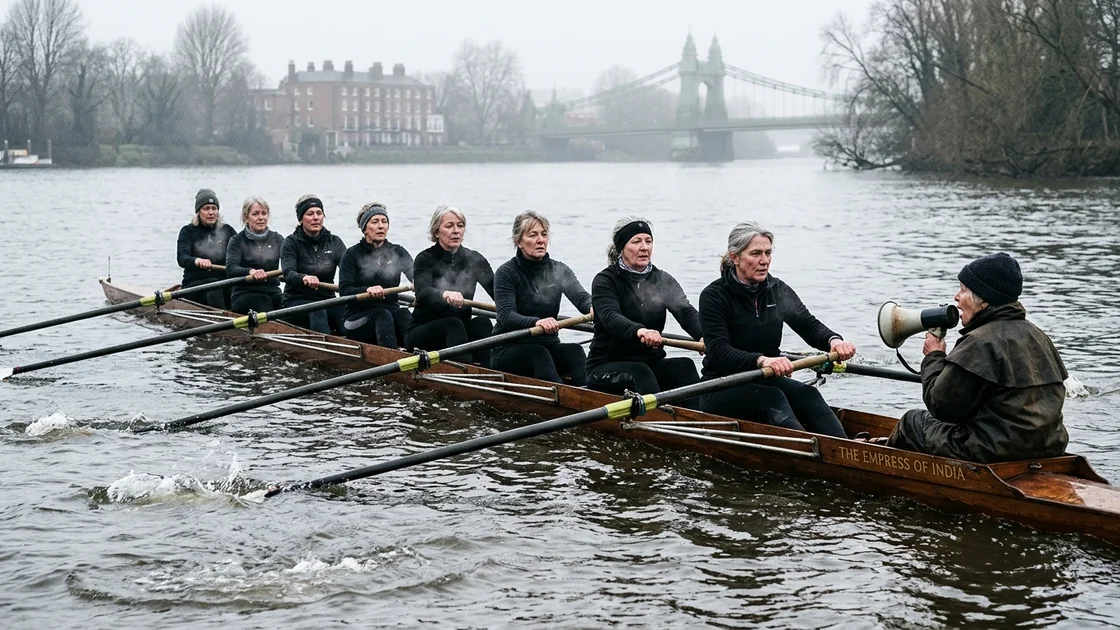
After the death of her husband leaves her adrift in an echoing house by the Thames, fifty-six-year-old Martha Finch places an advertisement on a battered boathouse noticeboard seeking eight women over the age of fifty to form an amateur rowing crew. What begins as a clumsy gathering of strangers burdened by estrangement, illness, bereavement, and the quiet erasure of middle age transforms into an unyielding athletic obsession as they train on the treacherous waters of the Tideway under the tongue of an exacting coxswain. Through the brutal physical discipline of the stroke, the blisters of winter mornings, and a fierce campaign toward the Masters Head of the River Race, the women discover that their unspoken sorrows cannot be comforted by sympathy, but can be burned as fuel against the pull of an unforgiving tide.
The card was three inches by five, salvaged from an unused packet of recipe index cards Martha had found behind a tin of caraway seeds in David’s pantry. She had written the notice in black waterproof drafting ink, using the architect’s pen he had left in the desk drawer beside his brass slide rule.
WANTED: Eight women over the age of fifty for a novice/intermediate sweep rowing crew. No competitive pedigree required; absolute punctuality and stubbornness mandatory. River Thames (Tideway reach). Sundays and Tuesdays at dawn. We will not be a support group.
Underneath, she had written her landline number and taped the card to the green baize noticeboard of the Sons of the Reach Amateur Rowing Club in Hammersmith, right between an advertisement for a second-hand sculling boat with a hairline crack in the saxboard and a yellowing flyer for a fungal foot spray.
The Sons of the Reach was not a grand club. It lacked the polished mahogany honour boards and crested blazers of Leander or London Rowing Club downstream at Putney. Its boathouse was a corrugated iron shed with peeling cream paint, smelling permanently of damp nylon, creosote, and the sulphurous low-tide silt that settled on the slipway twice a day. The young men who rowed there were broad-shouldered university dropouts and junior surveyors with violent moustaches who threw medicine balls against the brickwork and treated the river as an adversary to be beaten into submission. They nodded at Martha when she hovered by the racking, but it was the sort of nod reserved for the cleaning lady or a stray cat that occasionally sheltered behind the petrol tins.
Martha Finch was fifty-six years old. For twenty-eight of those years, she had lived inside the domestic weather system of David Finch, a civil engineer whose quiet precision had slowly contracted, over the final five years of his life, into the terrifyingly small perimeter of an electric hospital bed set up in the ground-floor library. When he died in mid-November, the house in Barnes did not feel peaceful; it felt evacuated, like an airlock had blown. The silence had a physical density that pressed against her eardrums until she could hear her own pulse thumping in her jaw.
She had rowed once, briefly, in 1987, at Newnham College, Cambridge. She had been the spare for the lightweight four, sitting on the frosty riverbank at Ely wrapped in an oversized woollen scarf, smelling the paraffin heaters and the linseed oil, watching eight women pull together until their backs were a single serrated line of muscle cutting the mist. She remembered the sound of the boat moving: not a splash, but a long, tearing hiss, like silk ripping down a seam.
The phone rang four days after she put up the card.
The first caller was Irene Vance. Her voice on the line was dry, clipped, and devoid of greeting. "Your card says no support group. Does that mean you won't be serving tea and asking us how our divorces are progressing?"
"Tea is for afterwards, if anyone has the energy," Martha said into the receiver. "The water doesn't care who left whom."
"Good," Irene said. "I am fifty-eight. I was a chancery barrister until my firm politely suggested I consult on an ad hoc basis from home. I have four hundred hours of unbilled rage a month. Where do I buy an all-in-one?"
By the following Sunday, seven more had answered. They did not come out of a shared love of water; they came because the suburbs of west London were full of women who had reached the middle of their sixth decade only to discover that the world had stopped looking at them.
They gathered on the hardstanding of the Sons of the Reach at six-fifteen on a November morning so cold that the mud between the river stones had frozen into glassy ridges. The tide was ebbing, pulling a brown, muscular swell out toward the North Sea, leaving a skirt of plastic bottles, bladderwrack, and slick Thames clay along the slipway.
Martha stood beside an ancient wooden eight-oared shell that the club captain, a retired timber merchant named Donald Mackintosh, had agreed to lease her for twenty pounds a week. The shell was named The Empress of India. She had been built of cedar skin in the late 1960s, heavy as a church bench, with scarred gunwales and brass swivel rowlocks that squeaked like gulls.
The women stood in the grey semi-dark, their breath pluming in the air like steam from eight small chimneys.
Beside Irene stood Beatrice Klein, fifty-two, who ran an event-floristry business in Kew and whose fingers were raw from handling wire and winter roses; her twin sister, with whom she had run the shop for thirty years, had died of an aggressive myeloma in August. Bea was wide-hipped and square-shouldered, wearing an orange high-visibility cycling jacket that screamed against the morning gloom.
Next was Pamela Hughes, sixty-one, a primary school librarian whose son had walked into an institutional rehab facility in Scotland two years prior and had not spoken to her since. She was small, sinewy, with iron-grey hair cut to her collarbone and a mouth that she kept tucked in at the corners, as if guarding against a sudden blow.
Then came Teresa Morales, fifty-four, an orthopedic theatre nurse with the forearms of a blacksmith, whose twenty-five-year marriage had quietly dissolved without an argument, ending in two solicitors' letters and an auction of their dining table; Joan Connolly, fifty-five, whose four children had all moved to Australia, Canada, and Singapore within eighteen months of each other, leaving her in a five-bedroom Victorian semi-detached in Ealing that echoed every time the central heating clicked on; Astrid Lind, fifty-one, a Swedish textile restorer whose small studio had been destroyed by an electrical fire in the spring, taking with it three years of commission work and her sense of equilibrium; and Helen Thorpe, fifty-nine, a former Department of Transport administrator who had finished her final cycle of radiation for breast cancer six months earlier and possessed the fierce, starved look of someone who had stared into a ditch and refused to jump.
The ninth woman was not waiting with the crew. She was sitting on an upturned plastic crate near the diesel tank, smoking a roll-up cigarette down to the yellow filter.
Her name was Sybil Cole. She was sixty-seven years old, four feet eleven inches tall, with a face like a dried medlar and eyes the colour of puddle ice. Sybil had been a coxswain on the Cam in the 1970s before anyone took women’s rowing seriously. She had steered national crews to humiliating defeats and minor glories, had been dropped when the governing bodies decided that only twenty-year-olds with sports science degrees could read a river, and had spent the last two decades coaching junior boys who didn't listen to her.
Sybil dropped her cigarette into a rusty bucket of water. It went out with a tiny fizz.
"Right, then," Sybil said, her voice sounding like gravel being churned in a cement mixer. "Let’s look at the cargo."
She walked down the line of them, her hands buried deep in the pockets of an oilskin smock that had seen the reign of three monarchs. She stopped in front of Pamela.
"You look like you weigh eight stone wet through. Can you push with your heels or do you just flutter?"
Pamela blinked. "I can push."
"We’ll see," Sybil muttered. She turned to Martha. "You’re stroke. You’ve got the longest back and you look like you don't sleep anyway, so you won't mind setting the rate. Irene, you're at seven. Keep your eyes on Martha's neck. If she moves, you move. If she dies, you finish the piece before you check her pulse. Bea, six. Astrid, five. Teresa, four. Joan, three. Pamela, two. Helen, bow. Don't look at the blades. Don't look at the water. Don't look at the bridge. If you look out of the boat, you'll see how old you are and you'll fall over."
"Excuse me," Bea said, her voice cheerful but tight. "Aren't we going to do some warm-up stretches? A bit of mobility for the hamstrings?"
Sybil turned her head slowly. "The stretch, darling, is when you reach for the oar. The mobility is not drowning when the ebb catches your fin. Hands on the saxboards. Number one to eight, lift together. On my call. Not before. Ready... up."
The timber groan of The Empress of India as she left the trestles was almost drowned out by the collective gasp of eight women realizing that a cedar eight weighs over one hundred kilograms. They stumbled down the greasy planks of the slipway, their trainers squelching in the mud, Sybil barking from behind like a sheepdog with an ulcer, until the cold water of the Thames rose over the soles of their shoes and the boat floated.
The first month was an exercise in humiliation.
Rowing is an unnatural act. It requires a human being to face backward, move toward an unseen destination, balance on a sliding seat six inches above the surface of deep, freezing water, and exert maximum physical violence through a nine-foot carbon-fiber or wooden lever while maintaining the delicate touch of a watchmaker.
For women in their fifties, whose joints had begun to whisper of calcification and whose sleep was broken by hot flushes and old ghosts, it was agony.
Martha’s hands were the first thing to surrender. The skin on her palms, softened by years of hand cream and domestic life, tore open within three outings. The blisters filled with clear fluid, broke, filled with blood, and then tore again until the grey carbon handles of the oars were spotted with rust-brown stains. Her lats—muscles she had not consciously engaged since her youth—clenched into iron knots that made turning her head to check the blind spot while driving her Volvo an ordeal of teeth-grinding pain.
"Squaring early, stroke!" Sybil would howl through her megaphone, sitting hunched in the stern with the rudder strings looped around her mittens. "You’re washing out at the finish! Drive the legs, Martha! Stop trying to pull it with your tits! Your arms are ropes! Ropes with meat on the end! Drive!"
The crew was dreadful. They caught crabs—the terrifying phenomenon where an oar blade slices into the water at the wrong angle, gets trapped by the roaring current, and levers the handle into the rower’s chest with the force of an uncoiling spring. On their third Tuesday, Astrid caught a crab off Chiswick Eyot that launched her out of her seat and nearly threw her over the gunwale into the freezing grey wash of an outbound tug.
They sat in the rain, drifting under the willow branches of the island, blades tangled like dry kindling, breathing hard, while Sybil swore at them with an inventive, nautical fluency that turned Irene Vance’s cheekbones crimson.
"We are not doing this to be picturesque," Sybil snapped, leaning forward until her nose was six inches from Martha’s. "If you want to be majestic older women finding their inner strength, go buy a ceramic kiln and take up pottery in Richmond. This is the Tideway. It has four knot tides, dead dogs, raw sewage, and three bridges with stone piers that will break this boat in half if you don't learn how to move as one body. Pick up your blades. Square. Go."
They did not speak to each other much after the outings. They stripped off their wet thermals in the unheated ladies' changing room—a room that smelled of mildew and iron pipes—dressing in silence with their backs turned.
It was too raw. In traditional rowing clubs, the camaraderie was forged in the bar over pints of bitter, with youth’s careless assumption that everyone had an endless expanse of life ahead of them. These women did not have that illusion.
One Tuesday in mid-December, as the rain turned into sleet that needle-pricked their faces, Helen Thorpe dropped her oar at the recovery. Her grip simply gave out. Her left shoulder—scarred and restricted by the lymph node dissection—locked up completely.
The boat lurched violently to port. The water sloshed over the saxboard, icy and black.
"Hold it up!" Sybil barked. "Hold water!"
The shell slid to a halt near the black iron pilings of Barnes Railway Bridge. The train to Waterloo rumbled overhead, a yellow blur through the murk, vibrating the timber hull under their feet.
Helen sat in the bow, her head hanging, her breath coming in ragged, whistling sobs. Her hands were tucked under her armpits.
"I can't," she whispered. The wind snatched the words, but they carried down the length of the shell. "I haven't got the leverage. My side... it doesn't have the muscle left."
Martha turned on her sliding seat, her fingers stiff on the handle. The proper discipline of a boat dictated that you never turned around; you kept your eyes fixed on the neck of the woman in front of you. But she turned anyway.
Behind Helen, Pamela Hughes reached out. She did not pat Helen’s shoulder. She did not say there, there. Instead, she gripped the rigger iron of Helen’s seat with one glove, steadying the shell, and said, "Look at the bridge pier, Helen."
Helen didn't move.
"Look at it," Pamela said again, her voice low and completely flat. "It’s been there since 1895. It doesn't care that your chest is scarred. It doesn't care that my boy is sleeping on a mattress on a floor in Glasgow and doesn't want my calls. It’s just granite. We aren't here because we’re whole. We’re here because we aren't dead."
A silence fell over the eight, broken only by the lap of the river against the cedar ribs and the rhythmic thump-thump of an electric commuter train receding toward Mortlake.
Helen raised her head. Her skin was grey-white, her eyes red-rimmed and fierce. She pulled her hands out from her armpits, gripped the varnished pine handle of the bow oar, and squared the blade against the wind.
"Ready, cox," Helen said.
Sybil watched them for three seconds through her squinted, watery eyes. She did not soften. She did not offer a word of grace.
"Half slide," Sybil called. "Attention... row."
The shift began in the deep freeze of January.
The Thames Tideway in winter is not the river of the summer regattas, where spectators in panama hats drink Pimm's on the lawns of Henley. It is an industrial estuary disguised as a parkland, brown and brooding, running between concrete walls and slippery ballast beds. The cold is a living thing; it creeps through the bottoms of neoprene boots, settles into the marrow of the shinbones, and turns the fingers into wooden pegs that cannot feel the leather collars of the oars.
They began meeting three times a week instead of two, adding Thursday evenings under the sodium floodlights of the club's rusty training bank.
The training bank was a static concrete tank filled with stagnant water, where four women sat on wooden benches and pulled fixed oars against the weight of the tank. It was brutally monotonous. It stripped away all the romance of the river. There was no gliding, no wind, no view of the stucco villas of Chiswick Mall. There was only the green-scummed water in the basin and the reflection of their own strained faces in the grimy perspex mirror opposite.
"Drop your shoulders, Bea," Martha would call out from the bench behind her. "You’re carrying your sister in your trapezius. Let her down."
Bea’s jaw would tighten, her breath blowing out through her nostrils like a draught horse. "Mind your own finish, Martha. You're clipping the water."
"Then don't let me," Martha would bite back. "Drive through me."
They began to row with a strange, collective ferocity. It was not the smooth, elegant power of twenty-year-old university blues with endless lung capacity. It was jagged, dense, and desperate.
In a rowing boat, the holy grail is swing. It is the moment when the eight individuals cease to be eight separate biological engines making independent calculations about their pain, and become a single physical pendulum. It is the elimination of the tiny microscopic hesitations—the split-second pause at the catch where one woman waits for another, the half-inch discrepancy at the extraction, the wobble of a feathering wrist. When a crew finds swing, the boat lifts out of the water. The wetted surface area decreases; the hull rides high on its keel, and the cedar skin makes a low, hummed vibration that you can feel through the soles of your feet and the base of your skull.
They found it for the first time on a Sunday morning in late January, on the reach between the bandstand at Duke’s Meadows and the brewery at Mortlake.
The river was dead flat, caught in the thirty-minute pause of the slack high water before the tide turned. The sky was a pale, washed oyster-shell grey.
Sybil had kept them at a low rate—eighteen strokes a minute. A paddle. A funeral pace.
"Long," Sybil chanted through the speaker, her voice rhythmic and devoid of its usual venom. "Reach through the toes. Find the water with the front edge of the blade. Don't hit it. Place it. Breathe."
Martha reached forward. Her sliding seat hissed along the brass runners. Her knees bent, thighs pressing against her ribcage, her arms extending fully into the cold air. She felt Irene’s shoulders behind her doing the exact same thing, moving in the identical millimeter of space.
Catch.
Eight blades dropped into the river at once. Not eight sounds, but one: clop.
Martha drove with her legs. Her quadriceps burned, but behind her, seven other pairs of legs were stamping down onto the footstretcher plates at the same fraction of a second. The boat didn't just move forward; it surged. It leaped through the slack water like an animal unleashed.
On the recovery, as they rolled forward on the slides, the boat stayed perfectly flat. No tilt to stroke side, no drag to bow side. The eight blades floated three inches above the surface of the Thames, parallel, silent, slicing the morning mist.
For two thousand meters, nobody spoke. Nobody coughed. Nobody missed a fraction of an inch.
Martha felt a heat rising through the center of her ribcage that had nothing to do with her thermals. It was the heat of an engine firing on all cylinders after years of sitting rusted in a barn. For three miles, she did not think of David’s medicine bottles, the blue plastic cups with the measured doses of morphine, or the smell of cold flannel in the back bedroom. She did not think of the silence waiting for her in Barnes. She was only the stroke. She was forty-two inches of reach, eight feet of carbon shaft, and seven women locked to the rhythm of her vertebrae.
When Sybil finally called, "Easy oar," the silence that fell over the river was different from the silence of Martha’s house.
It was the silence of eight bodies whose lungs were working at full capacity, their hearts hammering against their ribs in a wild, synchronized drumbeat, the water dripping from their spoons in bright, clear beads that hit the river like thrown needles.
Irene leaned forward, resting her forehead on Martha’s sweaty back. Her breath was hot against Martha’s spine.
"Jesus," Irene muttered, her voice shaking. "Jesus Christ."
Bea Klein let out a short, barked laugh from six, wiped her nose on the sleeve of her cycling jacket, and looked across the water at the bank where a solitary dog walker was watching them with his hands in his pockets.
"We aren't bad," Bea said, her voice husky. "Are we, Sybil? Tell us we aren't bloody bad."
Sybil took a tin of tobacco from her pocket, looked at the eight of them, and spat into the bottom of the boat.
"You're less repulsive than you were in November," Sybil said. "Now turn the boat. The ebb’s coming, and if we sit here looking pleased with ourselves, we’ll be in Brentford by lunchtime."
The registration form for the Vesta Veterans International Head of the River Race arrived on Donald Mackintosh’s desk in the first week of February.
The Veterans Head—known on the river simply as the Vets Head—was held the day after the main Head of the River Race, rowed on the Championship Course from Mortlake to Putney: four and a quarter miles of deep, curling Tideway water, through two road bridges, one rail bridge, past the gravel works, the islands, and the vast, indifferent expanse of London.
Crews came from Germany, Holland, America, and every corner of Britain. They were categorized by average age, from Masters A (twenty-seven to thirty-five) down to Masters J (eighty and older).
Martha stood in Mackintosh's office, which was an alcove partitioned off from the boat bays by sheets of dusty plywood, smelling of tea leaves and outboard oil.
Mackintosh looked over the top of his half-moon spectacles at the form Martha had laid before him. He was seventy-one, with hair like white wire and the hands of a man who had spent sixty years cutting seasoned spruce.
"Category F," Mackintosh said slowly. "Average age sixty to sixty-four."
"Fifty-five and eight months," Martha corrected him. "We qualify for Masters E. Just."
Mackintosh leaned back in his swivel chair, which shrieked in protest. "Martha. Have you looked at the start list from last year? Masters E Women isn't eight ladies from the parish council taking out a tub for an airing. It's the Thames Rowing Club veterans. It's Marlow. It's the Dutch national eight from the 1992 Barcelona Olympics who have been rowing together since they were sixteen and have thighs like Clydesdales."
"I know who it is," Martha said.
"You're in a cedar boat that was built when Harold Wilson was in Downing Street. She’s fifteen stone heavier than an Empacher carbon shell. If you catch a crab at Barnes Bridge on an ebb spring tide, you could wrap The Empress around the middle buttress."
"Then Sybil had better steer us straight," Martha said.
Mackintosh stared at her for a long time. His gaze was not unkind, but it was heavy with the skepticism of a man who had dragged dozens of drowned oars and fractured shells out of the river between Richmond and Wandsworth.
"Why?" he asked simply.
Martha looked through the greasy window into the dark boathouse, where the yellow ribs of The Empress of India hung from the iron slings like the skeleton of a small whale.
"Because if we don't race," Martha said, "we’re just old women pretending to exercise."
Mackintosh sighed, picked up his stamp, inked it on a dried black pad, and slammed it down onto the club affiliation box on the entry form.
"God help your coxswain," he said.
The crew did not take the news with celebratory cheer. They took it with an immediate, terrified intensification of their preparation.
Teresa Morales began bringing five-liter containers of electrolyte drink she mixed herself from clinical salts and orange squash, leaving them in the changing room with handwritten instructions on osmoregulation taped to the caps. Astrid Lind, whose fingers were permanently scarred from needlework, spent an entire Saturday afternoon taking apart the brass swivel rowlocks with kerosene and an old toothbrush, replacing the worn plastic washers with custom shims she had turned from brass rod in a friend’s metal shop.
Joan Connolly brought her husband’s industrial torque wrench from Ealing and checked every bolt on the riggers, her knees resting on an old piece of carpet on the cold concrete.
"If a rigger snaps at Mile Post," Joan told the room, her voice grim, "it won't be because my side of the boat was slack."
They were no longer eight women who met at dawn; they had become an engine with nine moving components. The personal lives that had previously defined them—the doctors’ appointments, the solicitors’ letters, the silence of adult children, the memory of David’s hand growing cold beneath the patterned duvet—retreated behind the urgent, immediate physical mathematics of the boat.
They learned each other’s physical limitations with the dispassionate accuracy of mechanics. They knew that Pamela’s lower back seized if she sat at the catch for more than two seconds before the drive; they knew that Bea Klein’s left leg was three-eighths of an inch shorter than her right, requiring a cork shim under her heel on the footplate; they knew that Irene Vance’s breathing went shallow when the rate went above twenty-six, and that Sybil had to scream her name specifically to force her diaphragm down into her pelvis.
The club members began to notice.
The broad-shouldered boys with the medicine balls stopped making jokes when the "Grandmothers’ Eight" carried their boat down the slipway. They watched from the balcony as The Empress cut through the brown water, her oars moving with a hard, square precision that lacked the athletic bounce of youth but had something far more dangerous: an absolute, mechanical refusal to yield.
Two weeks before the race, they had their final long-distance trial.
The river was running high and dirty, swollen with three days of heavy rain from the Cotswolds. The "flotsam"—the riverman’s polite term for tree branches, dead sheep, plastic oil drums, and city rubbish washed down from the urban ditches—was tumbling through the central arches of the bridges in thick, yellow rafts of scum.
They were doing a mock race piece from the University Stone at Mortlake down to the Sons boathouse.
Sybil was relentless. "Rate twenty-eight! Don't let the water push you! Hit it! Drive!"
Martha’s lungs were burning. Every intake of air tasted of cold river mud and diesel exhaust. Her vision was tunneling, the edges of her sight fringed with grey spots. Behind her, she could hear Irene’s breath coming in harsh, rhythmic gasps that sounded like canvas tearing.
Suddenly, twenty yards ahead of them, a submerged railway sleeper—black, waterlogged, and nearly invisible—rolled up into the trough of a wave.
"Obstruction!" Helen shouted from bow, her voice cracked with effort.
In an inexperienced crew, the bow rower would have stopped, or the stroke would have panicked, or the coxswain would have thrown the rudder hard over, flipping the shell or snapping an oar blade against the timber.
Sybil didn't touch the rudder strings. She didn't have room; an oil barge was coming up-river fifty yards to port, its diesel horn blaring a single, deafening warning note.
"Bow pair, hold water! Two strokes only! Stern pair, up!" Sybil screamed.
Helen and Pamela jammed their blades into the water, checking the forward momentum of the bow by two inches, while Martha and Irene drove their legs down with every ounce of gristle left in their hips.
The cedar shell heaved itself sideways, skimming past the black iron spikes of the submerged sleeper with less than three inches to spare. The tip of Bea’s blade clipped the timber, sending a shockwave up the carbon shaft that tore the skin off her palms and nearly wrenched the handle from her grasp.
Bea didn't drop the oar. She let out a roar—a sound so raw, so guttural, that it caused a flock of cormorants to lift off the Chiswick Eyot in terror—and ripped the blade back into the water, squaring it with a bloody fist.
"I’ve got it!" Bea screamed, her voice cracking into a shriek. "I’ve got it! Don't you dare stop, Finch!"
They didn't stop. They rowed through the barge wash, the boat slamming down into the troughs with bone-jarring impacts that threw sheets of grey Thames spray over Martha’s head, soaking her through her Gore-Tex to her sports bra. They rowed until they crossed the imaginary line at the club slipway, where Sybil finally called the wind-down.
As the shell drifted, rocking on the greasy chop, Bea Klein sat hunched over her knees, her hands dripping blood onto her lycra shorts, sobbing.
She was not crying because her palms were torn. She was crying with her mouth wide open, her face distorted into the terrible, naked mask of grief that she had kept hidden behind florist’s cellophane and sympathy wreaths for seven months.
Teresa Morales unclipped her feet from the shoes, stood up in the narrow, rocking boat with the balance of a tightrope walker, and reached across the gunwale to hold Bea’s head against her stomach.
Nobody said shh. Nobody said it’s all right.
It wasn't all right. Her sister was dead; the shop was empty; the world was cold and unfair.
Martha looked down at her own hands, white-knuckled and hooked around the oar handle like frozen meat. She felt a single tear roll down her cheek, mingling with the dirty river water and the salt of her sweat. She didn't wipe it away. She let it fall onto the cedar deck of the boat, right where David’s name would have been if she had been foolish enough to write it down.
Sybil leaned back in the stern, reached into her smock, pulled out her tin, and lit a cigarette with steady, blue-veined fingers.
"Good evasion," Sybil said quietly, blowing a thin streamer of smoke toward the London sky. "Now wash the blood off the gunwales. It attracts the gulls."
The morning of the Vesta Veterans Head arrived with a vicious, cutting northeast wind that drove whitecaps across the wide expanse of water at Putney.
Two hundred and forty crews were assembled along the Embankment. The river was a forest of carbon and wood. Eights were stacked three-deep on trestles along the road; rowers in blazers of every colour—dark blue for Oxford, light blue for Cambridge, scarlet for Molesey, green and white for the Dutch clubs—jogged along the towpath, checking their riggers, pinning cloth numbers to their backs, their faces taut with the specific, nauseating terror that precedes a four-mile head race.
The Empress of India looked like a ghost ship among the sleek, multi-thousand-pound carbon-fiber shells from Germany and Switzerland. Her varnish was dull, her cedar skin was pitted, and her crew had an average age of fifty-six years, four months, and two days.
They were boat number 184, starting in the middle of the Masters E division.
In the marshalling area above Chiswick Bridge, the boats were queued up in numeric order, drifting in the bitter wind for nearly an hour as the officials with megaphones sorted out the chaos of two thousand rowers fighting the ebb tide.
Martha sat at stroke, her teeth chattering uncontrollably. She wore three layers of thermal lycra, but the cold had long since penetrated them. Her feet were numb in the shoes. Beside them, boat 183—a crew of Dutch masters women in matching orange windbreakers with matching orange oars and the sleek, oiled shoulders of former world champions—looked at The Empress with frank, amused curiosity.
One of the Dutch women, a towering blonde with shoulders like an iron gate, smiled down at Martha.
"Nice boat," she said in perfect English. "Is she from a museum?"
Irene Vance turned her head slowly from the seven seat. Her chancery-court face was fully back in place: glacial, aristocratic, and lethal.
"She’s old enough to know how to stay afloat," Irene said. "Make sure you keep clear of our puddles, darling. We throw a great deal of wash."
The Dutch woman laughed, but she didn't look back.
"Ten minutes to your division, number 184," a marshal in a launch shouted through a bullhorn. "Get your kit off and get your heads in the boat."
They stripped off their splash-jackets and fleece pants, dropping them into the plastic bin bags that Sybil would leave with the shore crew.
Underneath, they all wore the same thing: simple, unadorned black all-in-ones that Martha had ordered from a supplier in Nottingham, with no crest, no club colours, and no names.
"Look at me," Sybil said. Her voice was not loud, but it cut through the wind and the slap of the water like a razor.
The eight women looked at her.
Sybil’s eyes were bloodshot, her face pinched blue with the cold, but her jaw was set like a vice.
"You’ve got four miles," Sybil said. "That’s roughly eight hundred strokes. Every single one of you has spent the last year thinking that the best part of your life is behind you. You’ve been being polite. You’ve been being patient. You’ve been sitting in empty rooms waiting for people to remember you exist."
She leaned forward, her small, gnarled hands tightening on the rudder cords until her knuckles were white.
"The river doesn't remember you. The river doesn't give a damn about your dead, your sick, your divorces, or your age. If you want this river to notice you, you have to tear it out of its bed. When I call for the push at the Eyot, I don't want your technique. I want your spite. Understand?"
"Understood, cox," Martha said.
"Numbers 182, 183, 184, move into the stream," the launch yelled.
"Light paddle, four and two," Sybil called. "Lengthen out. Bring her onto the line."
The boat moved out into the main current, beneath the concrete arch of Chiswick Bridge.
The starter’s boat sat anchored fifty yards downstream. A man with a red flag stood on the deck, his voice booming through an industrial PA system that echoed off the brick apartment blocks of Mortlake.
"Number 183... Dutch Masters... attention... Go."
The orange boat surged forward, its blades boiling the water into white foam.
"Number 184... Sons of the Reach... build it up..."
Martha looked at the back of Sybil’s neck. She felt Irene’s breath behind her, Bea’s presence behind Irene, the whole line of them stretching back to Helen in the bow like the links of an iron anchor chain.
"Half slide," Sybil whispered. "Three-quarter slide. Lengthen... Go!"
The flag dropped.
The first mile was fury.
They hit the water at thirty-four strokes a minute—a rate that Donald Mackintosh would have called suicide for women of their age. The cedar hull groaned, the riggers screamed under the torque, and the boat jumped into the middle of the Tideway.
The start of a head race is chaos. You are chasing the boat ahead of you while running from the boat behind, but you cannot see them; only the coxswain sees the course, the competition, and the wreckage.
"Settle!" Sybil yelled, watching the stroke watch strapped to her wrist. "Thirty-one! Find the rhythm! Don't rush the slide! Let the boat run! Let it run!"
Martha brought the rate down with her hips, lengthening her reach, driving her heels into the plate with a steady, rhythmic violence. Her stroke was long, heavy, and completely unhurried. Behind her, Irene matched her within the millisecond.
The orange boat—the Dutch masters—was sixty yards ahead, their blades flashing in the watery winter light. Behind them, boat 185, a crew of younger Masters D women from a prestigious club in Henley, was already bearing down on them, their carbon shell whistling through the chop.
"They're coming for your stern, bow pair!" Sybil yelled into her mic. "Henley is twenty yards back! They think you're old! They think you're furniture!"
"Let them try," Pamela Hughes muttered from two seat, her small teeth bared in an animal snarl as she drove her legs down.
They passed the Bandstand at Duke’s Meadows. The wind was quartering now, blowing off the Middlesex bank, throwing cross-chop across their washboards. The Empress was heavy, but her weight, which had been a curse on the trestles, became an asset in the rough water. While the lightweight carbon shells of their rivals bounced and skewed across the waves, the old cedar eight plowed through the chop like an iron wedge, her bow slicing the whitecaps and throwing them wide.
"You're holding them!" Sybil screamed. "Henley has stopped gaining! You're holding them on the reach!"
They approached Chiswick Eyot.
The Eyot is the graveyard of the Tideway race. The river bends sharply to the south, the channel narrows between the willow-covered island and the mall, and the current accelerates into a boiling funnel of tide and mud.
The Dutch boat ahead had taken a wide line to avoid the silt bank, leaving the inside lane—the dangerous, shallow water close to the willow branches—open.
"Sybil, no!" Martha gasped between strokes. "The depth!"
"Shut up and row, Finch!" Sybil roared. "Bea, Teresa! I want ten on the legs! We’re going inside!"
Sybil pulled her right rudder string with a vicious jerk.
The Empress of India veered toward the willows. The branches scraped against the riggers of stroke side with a sound like pistol shots; twigs and dead leaves rained down into Martha’s lap. The mud was so close beneath them that Martha’s blade came up brown and thick with river silt on the second stroke.
If they hit a deadhead here, the boat was destroyed.
"Ten strokes!" Sybil screamed, her voice rising to a cracked, demonic shriek. "For everything that didn't kill you! One!"
Martha drove. Her spine arched, her lats shrieking in agony.
"Two!"
Irene’s oar handle touched Martha’s chest on the finish, perfect, ruthless.
"Three!"
Behind them, Bea Klein was letting out short, barked grunts with every extraction, her face purple, her cycling jacket soaked with muddy spray.
"Four!"
They were drawing level with the Dutch boat.
The orange shell was thirty feet to their port side, fighting the heavier current in the middle of the channel. The Dutch stroke woman turned her head—a fatal, amateur mistake—and her eyes widened as she saw the battered wooden bow of The Empress erupting out of the willow branches like an old pike coming out of the reeds.
"Five!"
They were level.
"Six!"
Helen Thorpe, in the bow seat, was inches from the Dutch rudder. Helen did not look at them; her eyes were locked onto Pamela’s spine, her scarred shoulder working like a piston, the muscle she thought had been destroyed by radium and steel firing with an ancient, stubborn memory of strength.
"Seven!"
The Empress surged ahead. Her bow ball crossed the Dutch crew’s line of sight.
"They're done!" Sybil howled. "They're broken! They've lost their puddles! Now take the water! Take their water!"
Sybil threw the rudder to the left, cutting directly across the orange boat’s bow, forcing the Dutch coxswain to check his stroke side to avoid a collision. The wash from The Empress’s stern hit the Dutch riggers, swamping their cockpit with two inches of grey water.
They cleared the Eyot and came onto the long, straight reach toward Hammersmith Bridge.
Martha’s body had entered the state beyond pain.
Every athlete knows the room at the end of the hall. It is the room you enter when the glycogen is gone, when the blood has turned to vinegar, when the brain is screaming at the motor nerves to shut the system down before the heart ruptures. Most people spend their lives avoiding that room.
Martha threw the door open and stepped inside.
She did not feel her blisters. She did not feel the cold Thames wind freezing the sweat on her neck. She did not feel the weight of the eight-foot wooden lever in her hands.
She saw David’s face. Not the face from the hospital bed, yellow and slack with the morphine drip, but the face from 1989, standing on the slipway at Richmond, laughing as he handed her a dry towel while the rain ran off his nose.
I am here, David, she thought, the words hammering in time with the footplate. I am still here. You are gone, but I am still on the reach.
Beside her, Irene was whispering something. A name. Over and over, with every recovery, like a rosary: "Claire. Claire. Claire." The name of the daughter who had not written to her in four years, cast out into the river with every ounce of salt her lungs could muster.
Behind them, Joan Connolly was weeping silently, her face set like granite, her arthritic knees driving down onto the stops with a dull, sickening thud on every stroke.
They shot under the great green suspension chains of Hammersmith Bridge.
The roar from the bridge was deafening. Hundreds of spectators, leaning over the Victorian cast-iron parapets, were shouting down into the gorge of the river. The sound echoed off the water, amplified by the iron girders into a solid wall of noise.
"Two miles!" Sybil screamed through the megaphone, her voice completely hoarse now. "You have two miles left! Look at Fulham! Look at the reach!"
The river broadened out past the football ground at Craven Cottage. The wind here was ferocious, meeting the incoming tide in a boiling, chaotic wall of standing waves.
The Empress began to take on water. The cedar hull was low in the stream; every third wave broke over Helen’s shoulders in the bow, filling the bilges until the floorboards were floating.
"Bail!" Sybil yelled to no one, because no one could stop. "Keep your heads down! Henley is coming back!"
The Henley boat, lighter, more nimble in the waves, had recovered from their check at the Eyot and was moving up on their starboard side. Their blades were a clean, rhythmic white, flashing through the spray like knives.
They were half a length behind. Then a quarter length.
They were at the Mile Post.
Four hundred meters to the finish at Putney Pier.
"This is it!" Sybil screamed, standing up in her seat, holding the gunwales with her mittens, her face inches from Martha’s. "This is all you have! Everything you brought from home! Give it to the river! Now!"
Martha did not increase the rate. She couldn't; her arms were lead.
Instead, she increased the depth. She buried the blade three inches deeper into the black current, finding the solid, cold heart of the water, and pulled with her marrow.
Behind her, seven women followed her into the dark.
The boat did not lift; she was too full of water. But she held. She did not yield an inch.
The Henley crew came level with their six seat. Martha could see the stroke woman of the Henley boat—a girl of thirty, with the sleek, golden braid of a cross-country runner and eyes wild with disbelief that she could not pass an old wooden tub full of grey-haired women.
"Twenty strokes!" Sybil croaked, her voice failing. "Ten... nine... eight..."
The world shrank to the width of Irene’s spine.
Seven.
The sound of the river tearing against the cedar.
Six.
The smell of coal smoke and wet wool.
Five.
The roar of the crowd on the Putney hard.
Four.
David’s books, the empty shelves, the silent hallway.
Three.
The salt on her tongue.
Two.
The rigger screaming.
"One!"
Bang.
The gun from the timing launch at Putney Pier went off with a flat, smoky crack that flattened itself against the water.
"Easy oar!" Sybil screamed, dropping back into her seat and letting the rudder strings fall from her hands. "Easy all!"
The shell drifted three hundred yards past the finish line, caught in the wide, slack water off the London Rowing Club slipway.
Nobody moved.
Eight women hung over their oars, their foreheads pressed against the varnished timber handles, their breath coming in ragged, whistling gasps that sounded like a ward of dying animals.
The silence that settled over The Empress of India was absolute.
Martha sat with her eyes closed, listening to the water lapping against the cedar skin. It was three inches from her hip. A single inch higher and they would have foundered. Her legs were trembling so violently that her knees were knocking against the gunwale, a rhythmic, wooden rattle that sounded like a castanet.
Beside her, Irene Vance slowly sat up. Her black all-in-one was torn at the shoulder where she had brushed the bridge pier; her hair had escaped its pins and hung around her neck in grey, sodden hanks.
She looked at Martha.
Martha looked back.
Neither of them smiled. Rowing does not end in high-fives or cinematic embraces; it ends in the terrible, quiet intimacy of people who have shared an execution and survived it.
"Did we beat them?" Bea Klein croaked from six. Her face was smeared with black mud, blood from her hands, and snot. She looked grotesque. She looked magnificent.
Sybil Cole turned her head slowly and looked back up the reach toward the finish line, where the officials’ launch was posting the provisional times on a white magnetic board held up against the cabin window.
She reached into her smock, pulled out her glasses with one cracked lens, hooked them over her ears, and squinted through the grey drizzle.
"Masters E division," Sybil said, her voice completely level, completely flat.
The eight women held their breath.
"First place: Marlow Rowing Club. Twenty minutes, twelve seconds."
A beat.
"Second place: Sons of the Reach. Twenty minutes, fourteen seconds."
Another beat.
"Third place: Dutch Masters. Twenty minutes, sixteen seconds. Fourth place: Henley. Twenty minutes, seventeen seconds."
Sybil took off her glasses, folded them, put them back in her smock, and looked at Martha Finch.
"We missed the pennant by two seconds," Bea whispered, her voice cracking. "Two bloody seconds."
"We started thirty seconds behind them in the queue, you idiot," Sybil said. "We rowed through their wash for three miles. We were in a boat that weighs more than a dead horse."
She reached down, scooped a handful of Thames water from the bottom of the boat, and splashed it over her face, washing away the salt and the ash from her cheeks.
"You're the second fastest Masters E crew in northern Europe," Sybil said. "And you’re all completely hideous."
A sound started in the bow.
It was Helen Thorpe. She was laughing. It was a high, wild, breathless sound that started in her ruined chest and bubbled up through her throat until she was rocking the boat with it.
Then Pamela joined in, her small, guarded face opening into a wide, toothy grin that made her look twelve years old. Then Astrid, then Teresa, then Bea, until all eight of them were laughing—not with joy, but with the wild, hysterical relief of women who had looked into the grey mouth of the winter and spit down its throat.
Martha did not laugh.
She leaned over the side of the boat, dipped her blistered, bloody hand into the freezing, brown water of the Thames, and let the current run through her fingers.
The water was cold. It was dirty. It was ancient.
It had carried the Romans, the plague barges, the coal lighters, the dead, and the living. It had carried her sorrow for four miles and it had not sunk.
"Look at your blades," Martha said quietly.
The women stopped laughing. They looked.
The eight black carbon spoons, scarred and scratched, were resting flat on the surface of the river, perfectly balanced, perfectly level, holding the boat steady on the turning tide.
"Pick them up," Sybil said, her voice dropping into its old, familiar, gravelly cadence. "We have to paddle two miles back to Hammersmith to get the boat out of the water before the ebb runs out. And Martha?"
"Yes, Sybil?"
"You're still washing out at the finish."
Martha smiled—a small, sharp, private smile that she had not used in thirty years.
"Ready, cox," Martha said.
"Sit up," Sybil called. "Number one to eight, square blades. Attention... row."
The eight blades dropped together into the river, the cedar hull groaned its low, familiar note of complaint, and the old boat turned its bow toward the reach, cutting through the brown water toward the home slipway, leaving nothing behind it but a single, straight line of puddles that the Thames smoothed away before they had even reached the bridge.