The Carbon Record
When conservator Clara Vance inherits an eccentric collection of three hundred vintage typewriters from her late uncle, she treats the estate as a burdensome cataloging task until she discovers a hidden Olympia SG1 fitted with an intact single-strike carbon ribbon. As she examines the delicate spool of black polyethylene, she realizes the clear silhouettes punched into the wax preserve the complete, unedited final draft of a legendary lost American novel, along with a real-time record of the tragic secret that ended the author's life.
I. The Estate on River Road
The smell hit her before the silence did. It was an unmistakable marriage of petroleum distillate, dried tallow, deteriorating sponge rubber, and the alkaline starch of fifty-year-old bond paper. It was the scent of dead offices, of newsrooms long since converted into open-plan loft apartments, of clerks who had worn celluloid collars and died of coronary occlusions before the invention of the microchip.
Clara Vance stood in the front hall of her uncle Arthur’s house in Cold Spring, New York, holding a brass key that felt oversized and heavy in her palm. The late afternoon light came through the transom window in dusty amber quadrangles, illuminating a hallway lined on both sides by waist-high stacks of reinforced cardboard boxes. Each box bore a white adhesive label lettered in Arthur’s precise, drafting-table block script: ROYAL PORTABLES (1932–1948); UNDERWOOD NO. 5 REPLACEMENT SEGMENTS; PLATEN CORES / 10-INCH / RE-COVERED.
Arthur Vance had spent thirty-four years as a senior instrument technician for the Linotype Corporation in Brooklyn, followed by two decades of semi-reclusive retirement on the eastern bank of the Hudson. In those two decades, while the rest of the species migrated from cathode-ray monitors to flat screens and pocket glass, Arthur had waged a quiet, defensive war on behalf of the lever and the bell. When law firms, municipal courts, parish halls, and preparatory schools purged their basements of cast-iron machinery, Arthur had arrived with a dark green Dodge pickup and cash in ten-dollar bills.
"He wasn’t a hoarder, Clara," the estate attorney had insisted over the phone three days earlier, sounding slightly defensive on Arthur’s behalf. "A hoarder accumulates garbage. Arthur was a curator of obsolete kinetic energy. That was his phrase, not mine. ‘Kinetic energy waiting for an arm.’"
Clara set her overnight bag on the lowest step of the staircase and walked into the double parlor. The floorboards, pine tongue-and-groove under worn Persian runners, creaked under her boots.
The room had ceased to be a parlor sometime during the Nixon administration. Steel industrial shelving units, salvage from some decommissioned naval warehouse, ran the perimeter of the room and formed three central rows. Upon them rested the machines.
They sat row upon row, black enamel and gunmetal grey, crinkle-finished olive and sea-foam green, chrome carriage levers gleaming like surgical instruments under the slanting sun. An early Remington Standard No. 2 with its type basket suspended within a cage of brass rods; an Underwood No. 3 wide-carriage billing machine with its terrifying array of decimal-tabulation keys; a dainty, sea-green Hermes 3000 whose curved shell looked like an Italian motor scooter; a battery of pre-war Smith-Corona Silent-Supers, their maroon keys gleaming like cough drops.
There were hundreds of them. The sheer mass of cast iron and cold-rolled steel had visibly deflected the center of the floor, causing the braided rugs to slope gently toward the interior hearth like water drawing toward a drain.
Clara was thirty-six years old. For nine years she had worked in the paper and manuscript conservation lab at the Morgan Library in Manhattan, spending her days with micro-spatulas, wheat-starch paste, and baths of deacidifying magnesium bicarbonate. She knew the tensile strength of rag paper; she knew the fungal signatures of Aspergillus and the faint, sweet smell of lignin breaking down into vanillin. But her relationship with machines had always been secondary. Machines were the blunt instruments that damaged paper; they embossed fibers too deeply, they sprayed acidic ribbon inks across rag vellum, their feed rollers left tracks of greasy vulcanized rubber across clean margins.
Now, by virtue of an intestate death and a bachelor uncle’s affection for the only niece who had ever listened to him explain the difference between a basket shift and a carriage shift, she was the sole proprietor of approximately eleven tons of iron, steel, and celluloid.
She walked the central aisle of the parlor, her fingers trailing along the carriage rails. The machines were impeccably kept. There was no rust. Arthur had coated the exposed brightwork with microcrystalline wax; the segments were clean, free of the black gunk of kerosene and dust that typically seized abandoned typewriters. Each machine had a small manila luggage tag wired to its left ribbon spool spindle.
Smith-Corona Skyriter, 1954. Serial 4Y-118902. 11 pitch Elite. New feed rollers cast by Ames, June 2003. Tension spring adjusted to 4.2 ounces.
Adler Universal 39, 1968. Serial 10-99432. Pica 01. Carriage return clutch replaced; platen 92 durometer (needs re-grind).
She blew out a long breath that stirred the dust motes in the window light. The task before her was absurd. The local estate liquidators would offer fifty dollars a machine for the portables and leave the standards behind to rot because no one wanted to lift a forty-five-pound Royal KMM into the trunk of a Volvo. The private collectors from the online forums—she had browsed their message boards on the train ride up—were predatory and obsessively granular, willing to drive through a blizzard to harvest a single ribbon-cover screw from a 1939 Torpedo, but indifferent to the whole.
She turned toward the back of the house, where the kitchen opened into what had once been an attached woodshed and carriage barn.
This had been Arthur’s inner sanctum: the machine shop.
The air here was colder, smelling sharp and chemical—methyl ethyl ketone, mineral spirits, and sulfurous cutting oil. A South Bend metal lathe sat on a heavy maple bench, its chuck covered with an oiled chamois cloth. Above the bench, thousands of small clear plastic drawers—the kind used by watchmakers and radio repairmen—rose to the ceiling, labeled with microscopic neatness: Margin stops / Underwood 1920–35; Escapement pawls / Hermes Baby; Drawbands / gut / steel wire / nylon cord.
In the center of the shop stood an island workbench, illuminated by three adjustable green-enameled drafting lamps clamped to overhead joists.
Two machines sat on the bench. One was an Olympia Splendid 99, completely dismantled, its key levers lying in an orderly semi-circle on a felt pad like the ribs of a small mammal.
The other machine was not dismantled. It was inside a custom-built enclosure of three-quarter-inch marine plywood, painted dull workshop grey and secured with a heavy bronze Master Lock through a hasp on the front.
Clara paused.
Arthur had hundreds of typewriters out in the open. Some of them—the nickel-plated folding Coronas, the colorful Art Deco portables from the late twenties—were worth several thousand dollars to Japanese interior designers and Park Avenue collectors. None of them had been locked up. They had sat on their industrial shelves like honest tools on open display.
Why lock up a machine in a box of marine plywood?
Clara went to the small roll-top desk Arthur had used for his correspondence. In the third small pigeonhole, beneath a stack of blank index cards and a brass micrometer, she found a ring of small brass keys. The fourth key she tried slipped into the Master Lock’s keyway. The tumbler turned with a firm, oily snick.
She lifted the padlock, swung the hasp down, and opened the double doors of the wooden box.
Inside sat a machine of monstrous proportions.
It was an Olympia SG1, the legendary standard typewriter manufactured in Wilhelmshaven, West Germany, during the economic miracle of the 1950s. To the casual eye, it looked like a tank: vast, angular, painted in a low-luster hammered olive-drab crinkle coat that looked capable of repelling shrapnel. It weighed easily forty-five pounds.
Clara recognized the model; the Morgan had two of them in the registrar’s basement for typing acquisition cards. But this SG1 had been altered.
The standard SG1 was built to take standard two-color half-inch fabric ribbons on twin five-inch steel spools. This machine had been radically, elegantly retrofitted. The ribbon cups had been cut away with a jeweler’s saw and replaced with high-clearance, custom-turned aluminum pylons. Fitted to these pylons was an aftermarket sub-assembly: an early-sixties single-pass carbon ribbon carriage, likely salvaged from an IBM Executive or a high-end Adler, machined to fit the German escapement with jeweler’s precision.
Mounted on the supply spindle on the left was an empty spool—a wafer-thin disc of clear polystyrene.
Mounted on the take-up spindle on the right was a dense, heavy cake of ribbon.
It was not fabric ribbon. It was not the thick, ink-soaked cotton or silk that went back and forth until the letters turned from black to slate-grey to the faint violet ghost of legible language.
It was carbon ribbon. A continuous, wafer-thin band of black polyethylene film, five-sixteenths of an inch wide, coated on one side with a brittle, dry layer of microcrystalline wax and carbon black pigment.
Clara leaned in, her conservator’s eye instantly assessing the material.
Single-pass carbon ribbons were the holy grail of mid-century office clarity. When a typebar struck the carbon film against the paper, the impact sheared the carbon coating entirely off the plastic base, transferring a razor-sharp, pitch-black character onto the page. The ribbon did not reverse. It did not double-strike. The mechanical feed advanced the ribbon exactly one character width for every keystroke, including the spacebar.
Which meant that every character typed on this machine was permanently, perfectly, and chronologically punched out of the black coating.
The ribbon on the take-up spool was full. The left spool was barren, down to the notched core. The ribbon had been typed to its absolute, bitter end, threaded through the chrome vibrator prongs, and left precisely as the typist had finished it.
Clara reached into her pocket, withdrew her linen-tester loupe—an old brass habit she never went anywhere without—and unfolded its three square inches of glass and brass. She switched on one of the drafting lamps, aimed its conical beam directly at the taut strip of film suspended between the ribbon guides above the type segment, and peered through the lens.
The plastic was transparent where the hammers had hit. Through the loupe, illuminated from behind by the glare of the lamp, the ribbon was a tiny, luminous negative of an English sentence.
The clear, empty shapes in the wax read:
...ed into the grey basin of the yard, where no grass had ever had the courage to grow.
Clara held her breath.
She looked at the ribbon guide. Then at the take-up spool. The diameter of the wound plastic on the right spool was over four inches. At eight thousandths of an inch thickness per layer, that spool held nearly eighteen hundred feet of ribbon.
Eighteen hundred feet of continuous, un-overprinted, single-strike text.
She looked down at the paper table behind the platen. Arthur had taped a slip of acid-free cardstock directly to the carriage housing, just behind the margin scale.
On the card, in Arthur’s immaculate hand, were four words and a date:
Mercer. The last spool. August 14, 1965.
II. The Phantom of Phoenicia
Silas Mercer had published two novels before he went over the retaining wall of the Rip Van Winkle Bridge in an Austin-Healey Sprite on a fog-choked Sunday morning in the late summer of 1965.
The first, The Salt Margin (1954), had won the National Book Award when Mercer was twenty-six years old. It was an austere, breathtakingly disciplined novel about three generations of cod fishermen on the coast of Nova Scotia, written in prose so hard and salt-bleached it seemed to have been carved out of driftwood with an oyster knife. The second, A Division of the Night (1959), was longer, darker, and more ambitious: an account of the Manhattan project’s metallurgical labs in Chicago, written by a man who understood both quantum mechanics and human betrayal.
Then had come the silence. Six years of silence, punctuated by rumors in the Partisan Review and The Paris Review that Mercer had retreated to an old bluestone quarryman’s cottage near Phoenicia, in the Catskills, working on a manuscript that would dwarf his earlier work. It was tentatively titled The Bell-Wether Season, or sometimes, according to his editor at Harcourt, The Iron Meridian.
Mercer was known to be obsessive. He did not write drafts in longhand; he did not use secretaries. He typed on heavy manual machines, demanding a specific weight of paper and an uncompromising blackness of the strike. In a rare 1962 interview with an Albany radio station, he had snarled at the host: "If a word doesn't strike the sheet like a rifle bullet hitting an oak fence, the reader has no reason to believe you mean it. The machine is the governor of the language. It enforces silence between the consonants."
When Mercer died at thirty-seven, his car crushed against the rocks three hundred feet below the bridge, the trunk of the Austin-Healey was empty save for a spare tire and a rusted jack. The bluestone cottage in Phoenicia was found in a state of catastrophic devastation: the front windows were open, the August rains had swept through the study, and the cast-iron woodstove was choked with cold, sodden ash.
The literary world had assumed the worst: Mercer, in a final fit of alcoholic despair or clinical self-loathing, had burned the completed third novel before getting behind the wheel of the British roadster. For sixty years, The Iron Meridian had occupied that peculiar, ghost-haunted shelf in American literary history alongside the lost trunk of Hemingway’s Paris stories, the burned second half of Gogol’s Dead Souls, and the missing drafts of Sylvia Plath’s Double Exposure.
Clara knew the myth because her mother had been Mercer’s contemporary, and because Arthur, during Clara’s childhood visits, had possessed first editions of both Mercer novels on his otherwise bare mahogany bookshelves. They had been the only fiction in the house, wedged incongruously between The Starrett Machinist's Handbook and A History of the Escapement: 1850–1920.
She looked down at the Olympia SG1.
Mercer. The last spool. August 14, 1965.
Mercer had died on the morning of August 15, 1965.
Clara’s hands began to shake, a minute, involuntary trembling of the fingertips that she immediately quelled by pressing her palms flat against the cold maple edge of the workbench.
"Breathe," she told herself aloud. The sound of her own voice in the empty machine shop was small, flat, and sane.
She bent over the typewriter again.
Arthur had been an expert mechanic. He had known every serious writer, editor, and print shop owner within ninety miles of New York. Writers were particular about their machines; when an escapement skipped a tooth or a typebar bent from a violent strike, they did not send their livelihood to an anonymous office supply depot. They took it to men like Arthur, who treated tolerances of one-thousandth of an inch as an ethical matter.
Had Mercer brought the Olympia to Arthur on River Road the night before he drove to the bridge? Or had Arthur gone to Phoenicia?
Clara stepped back and looked at the ribbon again.
A carbon ribbon was not a book. It was an unwieldy, terrifyingly fragile strip of mylar—or worse, early polyethylene, which was notorious among archival plastics for its susceptibility to plasticizer migration and electrostatic cling.
In 1965, single-pass carbon ribbons were made of a thin base film coated with a formulation of carbon black, montan wax, and synthetic resin. Under the best conditions, that wax layer could dry out, turn crumbly, and flake off if flexed around a sharp radius. If she tried to advance the carriage—if she touched the platen knob or pulled the carriage release—she could snap the brittle film, or the teeth of the ribbon take-up pawl could chew through the sprocket holes, pulverizing sixty-year-old wax into useless black powder.
To read the ribbon, she could not run it through the machine.
She could not even pull it off the spool by hand. Unspooling eighteen hundred feet of five-sixteenths-inch mylar manually would create a tangle of static electricity that would fold the tape in on itself like a nest of black snakes. Once polyethylene folded face-to-face, the wax layers would weld themselves together under the Hudson Valley’s ambient humidity.
She needed an optical reader.
She looked around Arthur’s shop. In the corner, beneath a green canvas tarp, sat an ancient Craig 16mm movie film editing bench: two manual winding arms with geared spindles, a light box with a ground-glass pane, and a four-gang synchronizer.
Arthur had not just saved the typewriter.
He had built the altar, prepared the implements, and then—out of fear, or reverence, or some ancient, stubborn loyalty to a dead friend—had closed the wooden box, locked the brass padlock, and waited for someone with hands as careful as his own.
III. The Construction of the Rig
It took Clara forty-eight hours to prepare the shop.
She did not call the estate attorney. She did not call the Morgan. She called her supervisor and claimed two weeks of accumulated bereavement leave, her voice steady and neutral. When the woman offered condolences and asked if there was anything the library could do, Clara said, "Just the time. Arthur left a great deal of mechanical material that requires stabilization."
It was not a lie.
She spent Sunday cleaning the air. The shop was too dusty for conservation-grade work. She found an old industrial HEPA filter in Arthur’s basement storage, wiped down its housing, and set it running on low in the center of the room. She cleaned the Craig film rewinds with isopropyl alcohol, stripping off sixty years of gummy grease from the bronze gears and relubricating them with watchmaker’s synthetic oil that would not migrate or vaporize.
The ribbon was the immediate problem.
The feed spool on the Olympia was empty, but the end of the ribbon had not pulled free of the core; Arthur had secured the trailing leader with a tiny square of red paper tape—the very tape Mercer must have peeled off the fresh spool before threading it fifty-nine years ago.
The take-up spool was the treasure. It sat on its aluminum spindle, locked in place by a spring-loaded knurled cap.
Clara put on a pair of lint-free white cotton gloves, then thought better of it. Gloves deadened tactile feedback. In paper conservation, the current best practice was scrupulously washed, degreased bare hands. She washed her hands three times with non-ionic soap, dried them on unbleached linen, and approached the machine.
With a pair of curved micro-tweezers, she held the ribbon just below the vibrator. The plastic was terrifyingly light. When she gently tested its tension, it resisted with the crisp, dry springiness of an autumn leaf.
"Don't snap," she whispered. "Stay with me."
The carbon ribbon had to be transferred from the typewriter to the film editor without twisting. If the ribbon flipped, the negative impressions would be reversed, and the wax face would rub against the guide rollers, scraping the text into oblivion.
She designed a rig.
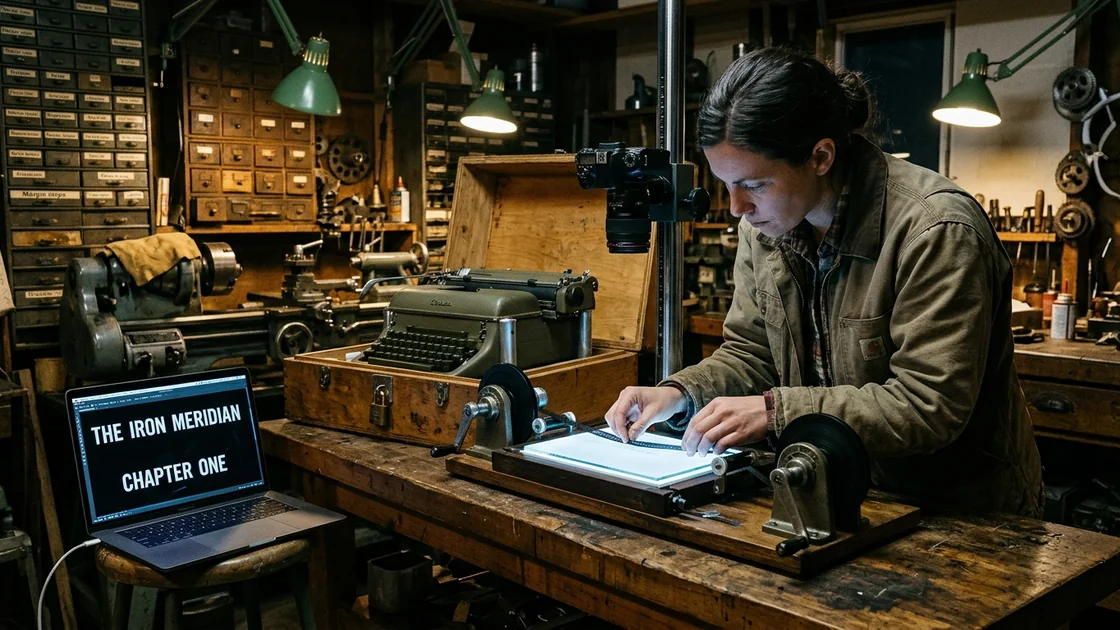
Using Arthur’s lathe and a block of high-density polyethylene from his scrap bin, she turned two stepped adapters that allowed the Olympia’s custom spools to fit onto the 16mm shafts of the Craig film rewind arms. Between the two arms, she mounted an angled surface: a twelve-inch piece of three-millimeter plate glass, sandblasted on the underside to diffuse light, beneath which she installed a low-heat, balanced-spectrum LED light strip Arthur had used for inspecting slide rules.
Above the glass, she mounted her digital camera—a full-frame Sony mirrorless with a 90mm macro lens—on a copy stand bolted directly to the maple bench.
The geometry was absolute. The ribbon would travel from the typewriter’s take-up spool (now acting as the supply spool), across a series of three polished PTFE teflon rollers she had machined to ensure there was zero drag, across the illuminated glass pane, and onto a clean 16mm film reel fitted with rubber core-spacers to prevent the tape from slipping.
The camera was tethered to Arthur’s old laptop, which she set up on a stool to the left.
Every frame would capture three inches of ribbon.
At three inches per frame, eighteen hundred feet of ribbon meant seven thousand two hundred exposures.
She could not use an automatic motor drive; the ribbon’s thickness was irregular where the hammer strikes had deformed the plastic substrate, and any sudden jerk from an electric motor could shear the tape. Every inch would have to be wound by hand, checked with the naked eye, and photographed under the cold, white eye of the macro lens.
At six o’clock on Monday morning, with the river outside running grey and flat beneath a low canopy of clouds, Clara turned the crank of the right-hand rewind arm for the first time.
The gears engaged with a soft, dry whisper. The take-up spool groaned once—a tiny, microscopic slip of plastic against metal—and then the ribbon moved.
It crept across the teflon rollers. It reached the glass plate.
Clara clicked the mouse. The LED light shone through the ribbon from beneath.
On the monitor of the laptop, the black ribbon bloomed into a brilliant, stark field of light and shadow.
The negative text appeared on the screen, three inches of black wax broken by clean, white characters:
T H E I R O N M E R I D I A N
C H A P T E R O N E
The locomotive had been standing in the cut since three o'clock, its fire banked, its belly ticking like a cooling kettle. Between the boiler and the frozen clay of the embankment there was only enough room for a man to lie flat on his side with his boots in the gravel and his jaw pressed against the frost.
Clara sat down hard on the wooden stool.
Her mouth was dry. She looked from the screen to the thin ribbon of black tape suspended over the glass.
The clarity was devastating.
Because Mercer had used an Olympia—with its hardened German steel typefaces and its massive, rigid segment—every letter was defined with razor-like sharpness. The serifs on the capital T were like surgical incisions. Where the period had been struck at the end of the first sentence, the hammer had punched completely through the plastic, leaving a tiny, perfect circular hole through which the LED light shone with blinding intensity.
Mercer had not destroyed the manuscript.
He had finished it. He had sat in the bluestone cottage in Phoenicia, or in Arthur’s back shop, and he had hammered the final draft through eighteen hundred feet of carbon ribbon.
And then he had burned the paper.
Clara touched the edge of the glass plate. The realization hit her with the cold finality of an iron door swinging shut.
Mercer had not wanted the paper to survive. The paper was what publishers took; the paper was what reviewers held in their ink-stained thumbs; the paper was what could be corrected, softened, negotiated, and sold.
Or perhaps he had wanted the act of writing to exist without the artifact.
No. Arthur’s card had said: The last spool.
Arthur had known. Arthur had kept the machine, kept the ribbon, and kept the secret for fifty-nine years.
Clara looked at the counter on the Craig rewind.
She had seven thousand one hundred and ninety-nine frames to go.
IV. The Transcription
For five days, Clara lived in the kingdom of the carbon tape.
She developed a rhythm that felt less like scholarship and more like rowing an endless boat through dark water. Left hand on the crank of the rewind, turning the handle five degrees; eye on the alignment marks she had scored on the glass plate; right hand on the remote shutter release: click-whirr. Check the screen. Verify focus. Check the ribbon tension with her left thumb. Turn five degrees. Click-whirr.
The prose of The Iron Meridian unrolled before her in fragments of twenty words at a time.
It was not like reading a book. When you read a printed page, the eye skips ahead, anticipates the cadence, skims the transitional phrases, and takes in the architectural whole of the paragraph.
Reading the carbon ribbon was an act of total, agonizing immersion in the process of thought.
Because the ribbon recorded every mechanical event, Clara did not just read the text; she saw Silas Mercer’s mind operating in real time across the keys.
When Mercer was confident, the spacing was relentless and rhythmic: seventy words a minute, the ribbon advancing with mathematical consistency, the clear letterforms marching across the polyethylene like soldiers on frozen ground.
Then the machine would hesitate.
A three-character gap—three blank advances of the spacebar:
.
Then a backspace. The ribbon would show a strikeover: Mercer had typed an e, realized his error, hit the backspace key, and struck an o directly over it. But because it was carbon ribbon, the two letters did not blend into an ink blot as they would on cloth; they remained distinct, superimposed clear templates—an e with an o cutting through its waist, a tiny ghost of human fallibility frozen in the wax.
On frame 412, at the beginning of the fourth chapter, the machine had gone wild.
The river did not know the name of the bridge. The river did not know the name of the bridge. The river did not know
Then five carriage returns in violent succession—the ribbon moving forward with no strikes, leaving a blank expanse of pure, untouched black gloss.
Then:
XXXXX XXXXX XXXXX XXXXX
Mercer had used the capital X as a sledgehammer, obliterating the entire paragraph before he even reached the end of the sheet. On the carbon tape, the Xs formed a row of open iron crosses, a barbed-wire fence of rejection cutting across the film.
Clara transcribed as she photographed. Every fifty frames, while the camera’s buffer cleared to the external hard drive, she sat at Arthur’s roll-top desk with her own modern laptop and typed the text into a clean document.
She was the first person to read the words in half a century.
The novel was extraordinary. It was not the cold, formalistic exercise that his critics had predicted Mercer’s next book would be. It was a savage, lyrical examination of an industrial family in the Hudson Valley during the construction of the West Shore Railroad in the 1880s—a story of immigrant labor, bluestone quarrying, dynastic greed, and the systemic destruction of the valley’s ecology.
The central figure was a surveyor named Nicholas Blackwood, a man who possessed an unnatural, almost terrifying precision of sight. Blackwood could look at a hillside and see the exact cut and fill required to balance the grade; he could look at a woman and see the precise degree to which her family’s debt had shortened the muscles of her neck.
He saw the world not as an arrangement of God’s mercy,
Mercer had typed on frame 1,104,
but as a problem in dead reckoning between two points of unstable slate.
By Wednesday night, Clara had reached frame 2,800. Her shoulders were locked into a knot of burning iron; her eyes felt as though someone had rubbed fine Hudson River silt beneath the lids.
She stood up from the bench, walked out into the overgrown yard, and let the cold night air fill her lungs.
The river was invisible down the hill, but she could hear it: a low, continuous hiss against the riprap of the railway line at the base of the bluff. A freight train went south toward Weehawken, four locomotives pulling eighty cars of mixed freight, their rhythmic clack-clack... clack-clack vibrating through the shale beneath her feet.
She looked back at the house.
The light from the machine shop windows was the only illumination on River Road. The neighbors were summer people or weekenders from the city who had already shuttered their houses for the autumn.
As she watched, a pair of headlights turned off the state route and began the slow descent down the gravel lane.
Clara stiffened.
The car was moving slowly, its high beams sweeping across Arthur’s overgrown hydrangeas and the weathered siding of the garage. It was a dark, nondescript domestic sedan—a Buick or an Oldsmobile, five or six years old.
The car stopped twenty feet from the machine shop doors. The engine cut out, leaving only the tick of cooling metal and the low hum of the idling freight train in the valley below.
The door opened, and a man stepped out into the yellow glare of the headlights.
V. The Visitor
He was in his late fifties, tall and lean, wearing a brown corduroy jacket with leather elbow patches that were genuinely worn, not decorative. He had thinning grey hair combed flat against a high, narrow skull, and he wore wire-rimmed spectacles with thick, round lenses that magnified his pale eyes into wet marbles.
He did not look like a burglar. He looked like an associate professor who had spent forty years being passed over for tenure.
"Miss Vance?" he asked. His voice was high, slightly breathy, with the nasal vowels of someone raised in Connecticut and educated in Massachusetts.
Clara did not move from the shadows beside the shop door. She kept her hands in the pockets of her canvas work jacket. Her right hand closed around a four-inch Starrett steel rule—a stupid, blunt weapon, but an instinctual one.
"The house is closed," she said. "The estate is in probate."
The man stopped, holding up both hands, palms out, in an exaggerated gesture of academic harmlessness.
"Of course. Forgive me. I didn’t mean to startle you. My name is Marcus Finch."
The name dropped into the cold air between them like a lead weight.
Clara did not react, but her mind surged.
Marcus Finch.
Finch was the author of The Salt and the Iron, the 1982 critical biography of Silas Mercer that had spent sixteen weeks on the Times bestseller list. He was the preeminent Mercer scholar in the country, the man who had tracked down Mercer’s college roommates, his mistresses, his tax records, and his bar tabs from Dublin to Key West. Finch had built an entire career on the missing manuscript; he was the primary architect of the "suicide by ash" theory, arguing in print for four decades that Mercer’s final act had been an ideological rejection of the American literary establishment.
"I’ve been watching the obituaries," Finch said, stepping closer, his voice dropping into a tone of conspiratorial intimacy. "When Arthur passed, I knew I had to come. I tried to reach him for fifteen years. He never returned a single letter. He hung up on me twice."
"My uncle didn't like academics," Clara said coolly. "He thought they used too many adjectives."
Finch laughed—a thin, dry bark that had no humor in it.
"He was right, usually. But your uncle was the last person to see Silas Mercer alive, Miss Vance. You know that, don't you?"
"My uncle was an instrument technician. He fixed machines."
"He fixed Mercer's machines," Finch corrected. He took another step toward the light of the shop door, his round lenses gleaming. "On the night of August 14, 1965, Silas Mercer was seen leaving the diner in Kingston with an older man in a green Dodge pickup. That was Arthur. Mercer’s cottage was searched forty-eight hours later. Everything was gone. Not just the manuscript—the typewriter was gone. Mercer’s Olympia SG1. The one he bought in Frankfurt in 1958. The one with the Senatorial typeface."
Finch leaned forward, his spectacles reflecting the amber interior of the shop.
"Arthur took it, didn't he?"
"Arthur was an honest man," Clara said, her voice dropping an octave, hard and defensive.
"I’m not calling him a thief!" Finch said quickly, his hands fluttering. "Good God, no. If Arthur took that machine, he took it because Mercer told him to. Or because he was saving it from the fire. Mercer had burned half his papers by midnight; the neighbors smelled the smoke. But the machine... Arthur wouldn't let a machine burn. That would be against his religion."
Finch’s eyes darted past Clara, through the open door of the shop, where the Craig film editing bench sat beneath the green drafting lamps, its LED light strip glowing like an emerald against the shadows.
"What are you working on in there, Miss Vance?"
"I am inventorying three hundred typewriters for an auction house," Clara said without hesitation. "And right now, you are trespassing on private property."
Finch did not look away from the shop. His nostrils flared slightly, as if he could smell the hot polyethylene and the sixty-year-old carbon wax across the gravel.
"He didn't just have the machine, did he?" Finch whispered. His voice had lost its academic smoothness; it was tight, greedy, vibrating with an obsession that had rotted in him for half a century. "The paper was gone. Mercer burned the drafts. But if he typed the final clean copy on that Olympia... Miss Vance, did Mercer use a carbon ribbon?"
"Goodnight, Mr. Finch."
"Listen to me!" Finch lunged forward two steps, his shoe crunching hard on the gravel. Clara drew the steel rule from her pocket, her thumb resting on its beveled edge. Finch stopped, looking down at the four inches of hardened steel in her hand, then looked up into her face.
"You don't understand the legalities," he hissed, his spectacles fogging slightly in the cold air. "If that manuscript exists—in any form, on paper, on film, on tape—it belongs to the Mercer Literary Estate. And do you know who controls the estate? The widow's foundation in New Haven. A board of three corporate trustees who haven't read a book since 1974. They will lock it in a bank vault. They will spend ten years litigating the tax basis. They will bury it to protect the market value of the first two novels!"
"And what would you do with it?" Clara asked.
"I would publish it," Finch said, his chest heaving under the corduroy jacket. "I would give it to the world. It’s the missing cornerstone of post-war American literature! It belongs to history!"
"It belongs to Arthur," Clara said quietly. "And Arthur left it to me. Now get in your car and drive back across the river, Mr. Finch. If you come down this road again, I will have the state police waiting at the bridge."
Finch stared at her for five long seconds. The wind came up from the river, rattling the dry locust leaves in the trees above the lane.
"You can't read it," Finch said, a cruel, triumphant smile twitching at the corners of his thin mouth. "Even if you have the ribbon. I know about those early mylar ribbons. The plastic degrades. It curls. The wax falls off. You'll destroy it just trying to thread the spool."
"Thank you for your professional assessment," Clara said. "Now get out."
Finch backed away slowly, his eyes never leaving the shop door until he reached the sedan. He got in, slammed the door, and backed up the lane with a violent spray of gravel. The red taillights vanished through the trees, leaving the valley in cold, absolute silence.
Clara turned, walked into the shop, closed the heavy double doors, and slid the iron barrel bolts into place at the top and bottom.
Her hands were shaking again, but not from fear.
From urgency.
VI. The Strikeovers
She did not sleep that night.
By two in the morning, the count on the Craig rewind had passed frame 4,500.
The novel had darkened. The surveyor, Nicholas Blackwood, had discovered that the railroad company was deliberately routing the tracks through an unstable shale formation above the town of High Falls—not out of engineering necessity, but because the company’s directors held the insurance policies on the bluestone mills below the bluff.
It was an architecture of premeditated catastrophe.
And then, at frame 5,120, the nature of the ribbon changed.
Until this point, the strikeovers had been occasional: typical typographical errors corrected by backspacing. But in Chapter Fourteen, the text became a palimpsest of mechanical trauma.
The ribbon showed that Mercer had begun to type, then backspaced repeatedly, striking new words directly over the old ones without advancing the carriage—deliberately using the typewriter’s manual ribbon reverse override, or holding the carriage with his left hand while his right hand hammered the keys into the same patch of carbon film.
Clara stopped the rewind.
She brought her loupe down to the illuminated glass.
The negative impression was not a line of clear English. It was a dense, jagged lace of white light—a thicket of intersecting lines where letters had been hammered into the wax four, five, six times.
To the naked eye, it was unreadable nonsense.
Clara did not move. She felt the conservator’s cold, methodical patience take over her nervous system.
At the Morgan, she had worked on the scorched fragments of the Coptic papyri from the Fayum; she had spent four months reconstructing a seventeenth-century Dutch maritime journal that had been soaked in seawater and iron-gall ink until the leaves were as brittle as potato chips.
Every typewriter has an escapement signature. When a typebar hits the platen, it does not strike the exact dead center of the letter’s allotment; there are microscopic variations in alignment caused by the wear of the segment guide, the play in the typebar linkage, and the angle of the individual type slug.
On the screen, Clara magnified the image by four hundred percent.
She opened an image-processing program, duplicated the layer, inverted the colors to black-on-white, and began the digital separation.
The first layer was easy to identify: it was typed with a heavy strike, the serifs deep and thick.
I did not leave the valley because of the stone.
Beneath that strike, faint and slightly shifted to the left by two-tenths of a millimeter, lay an earlier line, typed with a lighter, more hesitant touch:
Eleanor knew that Arthur had the keys.
Clara’s breath caught in her throat.
Eleanor.
Eleanor Vance. Arthur’s younger sister.
Clara’s mother.
Clara sat frozen in the silence of the shop.
She looked at the screen, her heart hammering against her ribs with the force of an un-cushioned typebar.
Her mother had died when Clara was twelve. Eleanor had always been a quiet, distant figure in the family history—a woman who had worked as a junior illustrator for the Saturday Evening Post in the late fifties, who had never married Clara’s father, who had lived in a small stone cottage near Woodstock until her lungs had failed in 1981.
Arthur had never spoken of Eleanor’s youth. When Clara had asked about her mother’s time in the Catskills, Arthur had only adjusted the tension on whatever machine he was rebuilding and said, "Your mother was too good for the people she met up there. That's all you need to know."
Clara adjusted the digital contrast on the monitor.
The strikeovers continued for three feet of ribbon—nearly forty frames of continuous, tortured revision where the novel’s narrative dropped away entirely, replaced by a raw, unshielded monologue.
Mercer had stopped writing The Iron Meridian.
He had begun writing to Arthur.
Arthur—
The car is outside. I can hear the valves ticking. You were right about the oil pressure; the pump is failing, but it will get me as far as the river.
She won't take the money from Harcourt. You have to take it. You have to tell her that it came from the sale of the press in Kingston. If she knows it's mine, she will throw it in the creek just as she threw the rings into the quarry.
The book is done. It is the only clean thing I have ever made, and because it is clean, it has no right to live in the same house with what we did to her.
You told me in June that iron remembers every blow. You said that if you bend a drawband past its yield point, it never goes back to true; it just waits for the third turn to snap. I am at the third turn, Arthur.
Take the machine. If you burn the ribbon, I will curse you from the mud. If you read it, you will know what you already know.
Give Eleanor the valley. I am taking the bridge.
Clara dropped her head into her hands.
The light from the LED strip shone through the gaps between her fingers, casting long, thin shadows across the workbench.
The myth of Silas Mercer—the grand, brooding American genius who had destroyed his masterpiece in a heroic, tragic protest against the commodification of the soul—was a lie.
There had been no ideological fire.
There had only been an Austin-Healey with a failing oil pump, a young woman whose life had been cracked across the knee of two men's arrogance, and an uncle who had carried the mechanical corpse of his friend’s guilt into an attic on River Road and spent fifty-nine years keeping it oiled.
Arthur had not preserved the ribbon because it was a masterpiece.
He had preserved it because it was a confession.
And he had locked it in marine plywood because the confession was signed with his sister’s name.
VII. The Spliced Line
At four in the morning, disaster struck.
Clara was on frame 6,840. The ribbon was near its end; the diameter of the supply spool had dwindled to less than an inch, the tape curling tightly as it approached the core where Mercer had first threaded it on that August afternoon.
She turned the crank of the Craig rewind.
There was a tiny, dry tick.
The tension on the left arm vanished.
The ribbon had snapped.
Clara’s hand froze on the crank. Her stomach dropped into an abyss of cold nausea.
"No," she breathed.
The broken end of the ribbon had whipped back against the teflon roller, its wafer-thin tail vibrating like a severed nerve in the draft from the heater. Because of the stored elastic tension in the tightly wound core, three feet of ribbon had sprung off the supply spool, uncoiling into a loose, tangled spiral that hovered inches above the oily maple bench.
If she moved too quickly, the static electricity from her wool sweater would draw the loose coils toward her sleeves, crumpling the film into an unrecoverable ball of black plastic.
She sat motionless for two full minutes, willing her pulse to slow, willing the adrenaline out of her fingers.
"You are a conservator," she said aloud, her voice flat, clinical, and empty of emotion. "This is simply substrate failure. This is mechanical repair."
She reached for the grounded anti-static wrist strap she used when handling early nitrocellulose negatives. She clipped it to the iron leg of the workbench, securing the elastic band around her left wrist.
She picked up her micro-spatula and a bottle of heptane solvent.
She could not use pressure-sensitive adhesive tape—no Scotch tape, no modern archival mending tissue—because the adhesives contained acrylic polymers that would dissolve the carbon black wax and bleed across the letterforms within forty-eight hours.
She needed to perform a film splicer’s butt-joint.
With the tweezers, she lifted the two broken ends of the ribbon onto a small block of polished white Delrin. Under the loupe, the break was clean—a tensile fracture across a character.
The letter that had broken was a capital A.
The left diagonal stroke remained on the supply side; the right diagonal and the crossbar were on the take-up side.
She trimmed the broken edges by one-hundredth of a millimeter using a fresh scalpel blade, ensuring the two ends met with absolute squareness. Then, from a roll of 35mm archival polyester splicing film—uncoated, two-thousandths of an inch thick—she cut a sliver of plastic no wider than a human hair.
Using a microscopic drop of high-viscosity cyanoacrylate applied with the tip of a tungsten needle, she tacked the polyester backing to the underside of the ribbon—the clear polyethylene side, opposite the wax.
She held the joint with the polished flat of the micro-spatula for ninety seconds.
She did not breathe. She heard the water pipes in the cellar groaning; she heard the wind outside die down as the dawn approached; she heard the distant whistle of an Amtrak train crossing the bridge at Poughkeepsie.
She lifted the spatula.
The splice held.
The joint was invisible to the naked eye. Through the loupe, the capital A stood reunited, its crossbar unbroken, a microscopic bridge of clear polyester holding fifty-nine years of memory together over the light.
Clara exhaled a long, shuddering breath that rattled against her teeth.
She wiped the sweat from her forehead with the back of her forearm, careful not to let her sleeve near the bench.
She re-threaded the ribbon through the teflon guides.
She turned the crank.
Frame 6,841.
The ribbon advanced.
VIII. The Clear Print
The novel ended at frame 7,180.
The final scene of The Iron Meridian was not a tragedy. It was a moment of extraordinary, terrifying stillness.
The railroad had been built. The cut had been blasted through the bluestone bluff. The surveyor, Nicholas Blackwood, stood on the platform of the new station at high noon, watching the first train pass through without stopping. The passengers were only faces behind the glass, blurred by speed and soot, indifferent to the three men who had died in the cut or the woman who sat in the stone cottage two miles up the creek, listening to the iron wheels shake the foundations of her cellar.
He looked down at his boots, Mercer had typed,
and saw that the stone dust had settled into the cracks of the leather like flour into the grain of an old board. It would never come out. You could grease the hide until it was black as lard, but the stone would remain, waiting for the oil to fail.
THE END
Beneath the words, Mercer had typed three rows of periods, thirty-two to a line, forming a solid, rectangular block of white light through the film.
And then, four inches of blank ribbon.
And then, at the very end of the spool, where the polyethylene was glued to the plastic core, three final lines typed with the ribbon advance locked:
Arthur.
Put the cover on.
It's cold.
Clara sat back.
The dawn was coming up over River Road. The light that came through the high windows of the shop was no longer the dusty amber of memory; it was the sharp, cold, blue-white light of a November morning in the Hudson Valley.
On the screen of her laptop, the complete manuscript of The Iron Meridian lay assembled: seventy-four thousand words, divided into eighteen chapters, complete with every revision, every hesitation, every strikeover, and every mechanical footprint of its creation.
It was an undeniable masterpiece. Even with its jagged, un-copyedited edges and the violent intrusions of Mercer's despair, it was a work that would reshape the understanding of mid-century American literature.
And beside her, on the Craig rewind, the ribbon sat wound upon the clean 16mm film reel: a tight, gleaming disc of black plastic, its wax intact, its secrets preserved in negative space.
There was a knock at the shop door.
It was not the frantic, greedy rattling of Marcus Finch.
It was a slow, heavy, institutional knock—three measured strikes against the pine boards.
Clara stood up. She did not feel tired. She felt the peculiar, cold clarity that comes at the end of a long surgical operation.
She walked to the door, slid back the heavy iron barrel bolts, and opened it.
Two men stood on the gravel.
One was a New York State Trooper, his grey Stetson straight, his hands tucked behind his gun belt.
The other was an older man with white hair, wearing an expensive camel-hair overcoat and carrying a battered leather briefcase. He had the unmistakable air of a senior partner from a white-shoe firm on Madison Avenue—the kind of lawyer who handled the estates of Rockefellers, Roosevelts, and dead novelists.
"Miss Vance?" the lawyer asked. His voice was quiet, polite, and completely devoid of Finch’s feverish heat.
"Yes."
"My name is Donald Vance. No relation, I’m afraid. I represent the firm of Vance, Holbrook & Sterling in Manhattan. We have represented the literary interests of Silas Mercer since 1952."
The trooper nodded to Clara—a neutral, professional acknowledgment—and stepped back toward his cruiser, leaving the lawyer on the threshold.
"Mr. Finch came to our offices yesterday afternoon," the lawyer said, looking past Clara into the shop with an expression of mild, civilized interest. "He was in a state of considerable agitation. He claimed that your late uncle had engaged in the theft of intellectual property, and that you were currently engaged in the destruction of that property."
"Mr. Finch is an idiot," Clara said.
"That has been our firm’s assessment since 1983," the lawyer agreed smoothly. He looked down at the gravel, then back at Clara. "However, the legal question remains. Silas Mercer’s will was quite specific. All literary papers, manuscripts, drafts, and revisions in progress at the time of his death were bequeathed to the Mercer Memorial Trust."
"There are no papers," Clara said. "There are no manuscripts. There are no drafts."
The lawyer tilted his head. "Mr. Finch indicated there was a machine."
"There is a machine," Clara said. "My uncle bought it from an office supply depot in Kingston in 1966. It is an Olympia SG1 standard typewriter. It is listed on the personal property inventory of Arthur Vance’s estate."
The lawyer was silent for a moment. He looked at Clara’s eyes—the dark circles, the steady, unblinking grey irises, the faint smudge of sixty-year-old carbon black across the heel of her left palm.
"And the ribbon?" he asked softly.
Clara stepped back and swung the shop door wide.
The morning light flooded the bench.
The Olympia SG1 sat on the maple table, clean, heavy, and silent. Its marine plywood box stood behind it, its doors open like the wings of a triptych.
Fitted to the machine was a fresh, half-inch black cotton ribbon on twin five-inch steel spools—the original configuration Arthur had carefully preserved in a box of oiled wax paper beneath the lathe.
The custom aluminum pylons were gone. The single-pass carbon carriage had been unbolted, cleaned, and packed into an archival storage box lined with polyethylene foam.
And beside the machine sat the digital camera, the laptop, and a single, heavy steel canister—an airtight 16mm film can, sealed around its rim with blue microcrystalline conservation tape.
On the lid of the canister, Clara had written with an archival pen:
THE MERCER RECORD
Carbon Polyethylene Film / 1965
Preserved and Transcribed by Clara Vance, Conservator
Presented to the Berg Collection, New York Public Library
In Memory of Arthur Vance and Eleanor Vance
The lawyer walked into the shop. He did not touch the typewriter; he did not touch the canister. He stood before the bench with his hands behind his camel-hair coat, reading the label on the steel can.
"You're giving it to the Berg?" he asked.
"I am giving the original ribbon to the Berg," Clara said. "Under the condition that it remain sealed for twenty-five years, accessible only for optical non-destructive research. The transcription—the complete digital record of the novel—will be released simultaneously to the trust and to the public domain through the Library of Congress."
The lawyer looked up at her, his pale eyes narrowing slightly behind his spectacles.
"The trust will not be pleased about the public domain, Miss Vance. They had hoped for a private auction. A limited edition with a university press."
"The trust didn't build the machine," Clara said. "The trust didn't turn the crank. And the trust didn't keep the confession quiet while my mother was alive."
The lawyer held her gaze for a long time. Outside, the state trooper was leaning against the hood of his car, smoking a cigarette in the cold blue air.
"Was it a good novel?" the lawyer asked.
The question was not legal. It was human—the faint, lingering curiosity of an old man who had spent forty years reading Mercer’s royalties statements and wondering what had died on the Rip Van Winkle Bridge.
Clara looked at the Olympia SG1.
The hammered crinkle paint seemed to absorb the morning light, neither reflecting it nor giving it away.
"It was the truth," Clara said. "Which means it’s too heavy for an auction."
The lawyer nodded once, slow and decisive. He reached into his overcoat, withdrew a heavy fountain pen, and laid his business card on the corner of the bench.
"Call my office when the Berg receives the shipment," he said. "I will inform the trustees that the legal situation has been... clarified."
He turned and walked toward the door. As he reached the gravel, he paused and looked back at the hundreds of typewriters lining the shelves of the double parlor, visible through the open back door of the house.
"Your uncle had quite a collection, Miss Vance."
"He had three hundred machines," Clara said.
"What will you do with the rest of them?"
Clara looked at the long rows of black and grey iron, at the gleaming chrome levers, at the keys that had not been struck since the world had decided that words should be weightless, silent, and easily deleted.
"I’m going to oil them," she said. "They have a great deal of work left to do."
IX. The Bell
Two weeks later, the house on River Road was quiet again.
The estate attorneys had signed the releases; the Berg Collection had sent an armored courier with a climate-controlled crate to take the steel film canister to Manhattan; the literary blogs and the Sunday book reviews were already screaming into the void about the "Miracle on the Hudson" and the rediscovery of Silas Mercer's final work.
Marcus Finch had published an eighty-page polemic in an online journal accusing Clara of archival vandalism, literary theft, and familial obstructionism. Clara had printed it out on a high-speed laser printer at the village library, read the first four paragraphs, and used the back of the paper to take notes on the proper clearance for a Remington portable escapement spring.
The house was cold. The oil burner in the cellar chugged with a steady, rhythmic heartbeat, keeping the temperature at a dry, stable fifty-eight degrees.
Clara sat at Arthur’s workbench.
The shop was clean. The HEPA filter hummed in the corner. The Craig film editor had been packed away in its green canvas tarp, its glass plate wiped clean of carbon dust and thumbprints.
On the bench sat the Olympia SG1.
It was no longer an instrument of historical revelation. It was just a machine—forty-five pounds of West German steel, its heavy carriage resting on its hardened roller bearings, its new cotton ribbon threaded through the chrome vibrator prongs.
Beside the machine sat a ream of twenty-four-pound Southworth cotton bond paper—pure rag, watermarked, with a hard, smooth surface that Arthur had bought thirty years ago and kept in a sealed tin box.
Clara took a single sheet of paper.
She inserted it behind the platen. She grasped the right-hand platen knob—the hard, black fluted plastic cold against her thumb—and turned it.
The rubber roller took the paper with a firm, deep shuck-shuck-shuck. The paper fingers held the sheet flat against the curve; the bail rollers snapped down with a sharp, clean clack.
She adjusted the paper guide. She set the margins: ten on the left, seventy-five on the right.
She had spent nine years repairing the past. She had spent nine years flattening wrinkles, bleaching foxing, and sealing the words of dead men between sheets of polyester film.
She looked down at the keys.
They sat in their four curved tiers, dark green with white lettering, dished slightly to receive the tips of human fingers.
She raised her hands.
Her fingers hovered half an inch above the home row: A-S-D-F... J-K-L-semicolon.
The room was silent. Outside, across the river, the mountains were turning purple in the late afternoon frost.
Clara brought her index finger down.
The typebar rose from the segment—a three-inch lever of cold-rolled steel swinging through an arc of seventy degrees, gathering speed, driven by the muscles of her forearm.
The steel type slug hit the cotton ribbon.
The ribbon hit the paper.
The paper hit the platen.
T H W A C K.
A single black character appeared on the clean white bond: sharp, deep, slightly embossed into the fibers of the sheet, permanent and uncompromising.
The carriage jumped one space to the left with a dry, mechanical clink.
The escapement caught. The tension held.
Clara smiled.
She struck the next key.