The Canvas Beneath the Ash
In the humid sub-basement vaults of the Morristown Institute of Fine Arts, an unassuming associate archivist named Arthur Finch spends his days cataloging neglected ephemera until an unsealed wooden crate of pigments and fragmented letters from the winter of 1888 uncovers a devastating truth: the luminous, career-defining Alpine landscapes universally credited to the Victorian luminary Julian Brand were systematically executed by his unacknowledged wife, Clara Brand née Vance, prompting a quiet, perilous campaign to rewrite art history before the museum's prized centenary exhibition permanently seals Julian's fraudulent legacy.
I. The Temperature of Paper
The sub-basement of the Morristown Institute smelled of things that had lost their water. It was not a rot, precisely, but the dry, chalky exhaustion of three hundred years of linen rag, animal glue, and oak-gall ink slowly resigning themselves to dust. The climate was kept at an unvarying fifty-five degrees Fahrenheit and forty-eight percent relative humidity, a mechanical compromise between the brittle needs of parchment and the supple stubbornness of vellum.
Arthur Finch wore fingerless wool mittens over his cotton inspection gloves, a habit born of twenty-four years in the stacks. He was forty-six years old, though his joints, particularly the middle knuckles of his index fingers, belonged to an older century. He spoke rarely enough that his vocal cords often required a small, scraping cough to clear before he answered the phone, which rang perhaps twice a week on the scarred metal desk behind the microfilm carrels.
Above him, through six feet of reinforced concrete and four floors of neoclassical marble, the city of Boston groaned under an early November sleet. Up on the second floor, in the Grand American and European Pavilions, school groups were being steered past the Hudson River School, their rubber boots squeaking against parquet like wet mice. But down here, beneath the drainage pipes and the pneumatic mail tubes abandoned since 1974, there was only the hum of the Carrier air-handling units and the rhythmic, papery whisper of Arthur turning folio leaves.
The Morristown was preparing its great triumph. In five months, on the first of April, the museum would open The Light of the North: Julian Brand and the Sublime Horizon, 1875–1898. It was to be the largest retrospective of Brand’s work mounted on the continent in sixty years, accompanied by a three-hundred-page catalog funded by the Brand Foundation and an endowment pledged by Julian Brand’s great-grand-nephew, a venture capitalist from Darien who had made forty million dollars in fiber optics and wished to buy himself an ancestor of unimpeachable taste.
Julian Brand was, to the board of trustees, a deity of the Second Tier—not Turner, not Friedrich, but the man who had brought their vaporous, pantheistic terror into the late Victorian parlor. He had been an associate of the Royal Academy, a friend of Ruskin until they quarreled over the price of a water-butt, and a painter whose landscapes seemed to have been executed not with bristle, but with cold mountain air itself. His clouds did not sit upon the canvas; they hung, condensations of slate-blue and sulfur-yellow that made viewers in the damp London galleries reach unconsciously for the collars of their ulsters.
Arthur’s role in this grand apparatus was humble. While Dr. Helena Graves, the Chief Curator of Nineteenth-Century Art, appeared on public radio to discuss Brand’s "unflinching dialogue with geological time," Arthur was tasked with cataloging "The Vance-Brand Bequest (Accession 2023-B.4)."
It was not a glamorous lot. The bequest had arrived four months earlier from a solicitor’s office in Lewes, Sussex, after the death of an unmarried great-niece who had lived in a vicarage with sixteen cats and a damp pantry. It consisted of fourteen tin-lined shipping trunks containing what the curatorial department had dismissed as "secondary household ephemera": laundry tallies, butcher books, coal chits, water-damaged Baedekers from the 1880s, and hundreds of bundles of receipts tied with rotted pink legal tape.
"Just verify the dates against Julian’s travel diaries, Arthur," Dr. Graves had told him, her heels clicking impatient staccato against the linoleum as she paused by his desk in September. She had smelled of espresso and very expensive wool. "We need the provenance of the 1889 Chamonix residency cleared. Julian’s bills from the Hotel des Alpes will establish that he was at the Mer de Glace during the equinoctial storms. It gives the catalogue essay some weather. You know what people like. Blood and blizzards."
"Yes, Dr. Graves," Arthur had said.
"And don't get bogged down in the wife's papers," she added, already checking an alert on her phone. "The family wants a full inventory of her dressmaker bills for some domestic-sphere display in the rotunda, but keep it brief. 'Clara Vance Brand: Life in the Master's Shadow.' Two paragraphs will do it. She was an invalid, wasn't she? Dropsy or nerves. Something Victorian."
"She died at forty-six," Arthur said softly. "In St. Moritz."
"Tragic," Dr. Graves said, not looking up. "The altitude was supposed to be curative. Clearly, it wasn't. Have the Chamonix receipts on my desk by Friday, would you?"
She had swept out, her coat flaring like a crow’s wing.
Arthur had not finished by Friday. He had not finished by the following Friday. For three weeks now, he had lived inside Trunk Nine.
Trunk Nine was not tin-lined. It was seasoned English elm covered in black vulcanized fiber, bound with brass strapping that had turned the color of dried thyme. Unlike the other trunks, which had been packed with the brisk efficiency of estate liquidators who wanted only to be done with old blankets and receipt books, Trunk Nine had been packed by someone who understood damp. Every bundle was wrapped in waxed cartridge paper, the joins sealed with mutton tallow that had hardened into white, waxy beads along the folds.
At the top of the trunk lay what appeared to be ledgers: tall, narrow accounts bound in marble-board with sheepskin spines.
Arthur turned the desk lamp down, angling the green glass shade so the light raked the surface of the paper at five degrees. Raking light was an archivist’s trick; it transformed flat ink into topography, revealing the bite of the steel nib, the swell of the downstroke, and the microscopic furrows left where an erasure had grazed the sizing off the linen fibers.
The ledger was open to October 1887.
Julian Brand’s handwriting was well known to Arthur. It was a bluff, swaggering, public school hand—the letters tall, upright, and widely spaced, with aggressive t-bars that slashed across the page like fencing foils. It was the hand of a man who wrote while standing at a mahogany desk with a whiskey within reach, confident that someone else would blot the margin.
Oct 14. To the White Lion. Pints and mutton for self & J. Hunt: 4s. 6d.
Oct 16. Windsor & Newton. Flake White (12 tubes), Smalt, Raw Umber: £1. 14s.
Oct 19. Rail to Keswick: 8s.
Arthur flipped back three pages, to August of that same year.
On August 12, 1887, Julian Brand had attended the annual grouse banquet at the Black Swan in Helmsley. Arthur knew this because the bill was pasted into the ledger, stained with what looked like port wine.
On August 13, there was no entry.
On August 14, an entry appeared, but the hand had changed.
It was tiny. It was compressed, slanted sharply to the left, written with an extremely fine mapping pen—perhaps a Gillott 303—that had dug into the paper with nervous, needle-point precision.
Aug 14. Doctor's fee (Mr. Teasdale, consulting). Venesection & mustard plaster to nape: £1. 1s.
Aug 15. Tincture of digitalis & spirits of nitre: 4s. 2d.
Aug 18. J. cannot close the three fingers of the right hand. The draughtsman’s spoon falls. He wept until tea.
Aug 21. Liniment of camphor. He cursed the light on the wall.
Arthur sat motionless. The air-handler coughed in its ducting, a soft, mechanical shhh that died against the acoustic ceiling tiles.
He reached for the standard biographical dictionary from the shelf above his desk: The Victorian Masters of Horizon: Julian Brand (1845–1899), by Sir Alistair MacCormack, published in 1924.
He turned to page 112:
"The late summer of 1887 was, for the Master, a season of profound spiritual consolidation. Retreating to the solitude of the North Riding moors, far from the petty politics of Burlington House, Brand entered upon that miraculous second manner which was to bear such majestic fruit in the 'Aethelgard' cycle. In these works, the somewhat dry linear precision of his earlier Dutch-influenced style gives way to an almost terrifying fluidity—a bravura of impasto and a freedom of the wrist that led Watts to exclaim that Brand painted not with earth, but with the north wind itself."
Arthur placed the leather-bound book beside the ledger.
He looked at the tiny, left-slanted hand: J. cannot close the three fingers of the right hand. The draughtsman’s spoon falls.
Arthur laid his gloved hand over the paper, feeling through the knit yarn the faint, dried ridges where an iron nib had pressed Clara Vance’s small grief into the pulp one hundred and thirty-seven years ago.
II. The Blue of Antwerp
The second trunk sat at the back of the bay, half-obscured by a stack of gray Hollinger boxes containing the museum’s correspondence from the 1939 World’s Fair.
Arthur did not call Marianne Talbot until he had finished the fourth ledger. It took him three days. He worked until ten each evening, past the departure of the cleaning crews, past the midnight shift change of the security guards who knew him only as a bald crown visible through the frosted wire-glass of the archive door. He drank lukewarm instant coffee from a thermos and ate dry water biscuits from a tin in his bottom drawer so he would not have to wash crumbs from his fingers.
The ledgers told a story that was not an art history; it was a clinical casebook.
Between August 1887 and February 1888, Julian Brand had suffered what the village doctor had recorded as a "paralytic seizure of the right side, with impairment of the tongue." The tongue had returned after seven weeks; he could swear, he could dictate, he could swallow his broth. But the right hand had contracted into what nineteenth-century physicians called the main en griffe—the claw-hand. The ulnar nerve was dead. The tendons had shortened until his fingers were curled against the palm like dried tobacco leaves.
And yet, according to the official exhibition records of the Royal Academy:
In May 1888, Julian Brand exhibited Morning on the Tarn at Aethelgard (Cat. No. 42). In December 1888, he exhibited A Frost on the Ure (Society of Painters in Water Colours). In May 1889, he unveiled the monumental The Pass at St. Gotthard, seven feet by ten feet of swirling slate, lapis lazuli, and bone-white spray, which had been purchased by the Earl of Rosebery for the staggering sum of twelve hundred guineas.
Arthur stood up from his desk. His knees clicked, sharp as dry kindling.
He walked down the narrow corridor to the conservation laboratories at the western end of the sub-basement. Unlike the archives, the conservation lab was modern, brightly lit by full-spectrum LED banks that cast an operating-theater glare over stainless steel sinks, fume extractors, and polarizing microscopes.
Marianne Talbot was scraping old mastic varnish off an eighteenth-century portrait of an alderman with a tiny, rounded scalpel. She was thirty-two, wore her dark hair twisted up with an old bone brush handle, and lived in a state of perpetual irritation with the curatorial department.
"I have three days to get this pig's fat off this pig's face," she said without looking away from the binocular eyepieces. "Tell me you don't have another box of damp watercolours, Arthur. If I smell another spore of Aspergillus niger, I'm going to set fire to the ventilation shaft."
"Marianne," Arthur said. His voice was lower than usual. "Are the Brand canvases for the retrospective already in the main holding bay?"
She stopped scraping. The scalpel remained poised three microns above the alderman’s lace jabot.
"The six from the Tate arrived Tuesday," she said, rotating the head of the microscope. "The Morristown's own three have been out of their frames since last month. Helena wants them cleaned with saliva and deionized water. She thinks the yellowed dammar makes the mountain peaks look 'indolent.' Her word. 'Indolent.'"
"Can you look at Winter over Aethelgard Tarn?"
"What about it?"
"The hand," Arthur said. "The brushwork."
Marianne straightened her spine, pulling off her magnifying loupes. She had dark circles under her eyes that matched Arthur's, but hers were sharper, bordered by the bright anger of someone who had spent seven years in graduate school only to be told by administrators that her job was to make oil paintings look like the postcards sold in the gift shop.
"Arthur, Julian Brand's brushwork is the whole reason we're spending four million dollars on this circus. It's the 'great masculine sweep.' Ruskin called it 'the stroke of an iron oar.'"
"Ruskin didn't see him paint it," Arthur said.
Marianne studied him. She knew Arthur Finch. She had known him since she was an intern patching torn Dutch prints in the print study room. Arthur was the only person in the building who did not complain about the temperature, did not leave empty plastic salad bowls in the staff sink, and did not claim to have discovered a lost Leonardo in the attic.
"What do you have?" she asked.
"Trunk Nine," he said.
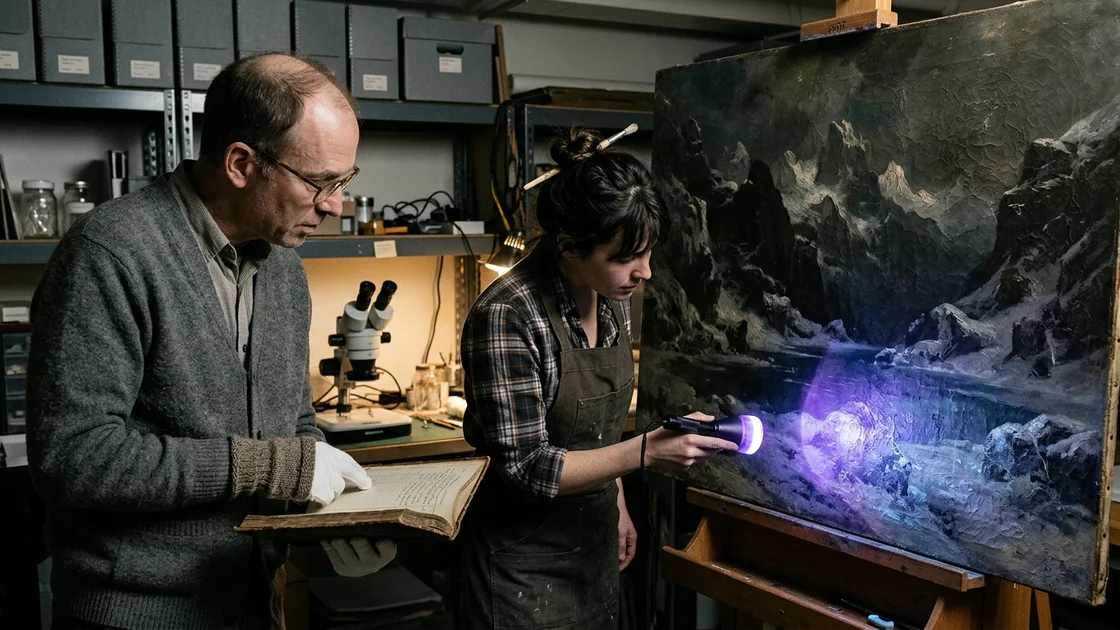
They stood together before Winter over Aethelgard Tarn in the darkened examination bay.
The painting was six feet across. Under the overhead halogens, it was a terrifying thing. The foreground was a shale slope, rendered in jagged strokes of asphaltum, burnt umber, and cold gray, that dropped precipitously into a black, ice-rimmed mountain pool. Beyond the water, the crags of Aethelgard rose like the teeth of a giant saw into an atmosphere that was neither cloud nor sky, but an iridescent, suffocating squall of white lead, verdigris, and what seemed to be crushed slate.
"Look at the lower right quadrant," Arthur said, holding the third ledger open under his arm like a prayer book. "The rocks. The ones beneath the water-line."
Marianne brought a portable UV lamp close to the surface. The purple glow washed over the aged varnish, turning the yellowed resin a milky, fluorescent green.
"Old mastic," she muttered. "Inconsistent thickness. Someone wiped down the center with an alcohol rag in the fifties, the barbarians. But look here..."
She leaned in until her forehead was six inches from the canvas.
"The stroke isn't down and across," she said.
"No," Arthur said.
"It’s pulled from left to right, rising. The drag of the pig-bristle trails toward the thumb side of a left hand." She tilted her head, her nose almost touching the crusted impasto. "Julian was right-handed. Every portrait of him shows him with that silver-handled mahlstick in his right fist, looking like a field marshal."
"He was right-handed until August 1887," Arthur said. "Then he wasn't anything."
"People relearn," Marianne said, but her voice had lost its defensive snap. She adjusted the UV lamp's frequency. "Artists have strokes. They switch hands. Lovis Corinth did it after his vascular accident. His line became looser, more expressive."
"Corinth didn't have his wife's handwriting in his ledger," Arthur said. He turned the pages of Trunk Nine's third volume to the inventory of supplies purchased from Roberson & Co., Long Acre, in November 1887.
He pointed a finger at the column:
To Mrs. Julian Brand:
3 Badger blenders (small)
1 tube Lapis Lazuli, extra fine (£2. 5s.)
1 quire Holland paper, watermarked 1884
1 bottle refined Poppy oil, bleached in lead
"Lapis," Marianne whispered. "Julian never used natural lapis after 1880. He wrote an essay in the Art Journal boasting that French ultramarine—the synthetic stuff, the guimet—was 'the democratic blue of the modern era.' He called natural ultramarine 'a medieval superstition for priests and women.'"
"Look at the lake," Arthur said.
Marianne moved the lamp.
In the depths of the tarn, beneath the surface ice that seemed to float three inches above the canvas floor, lay a blue that had no business in a Victorian painting. It was not the flat, chemically uniform violet-blue of French ultramarine. It was deep, granular, and slightly irregular, catching the oblique rays of the UV light with microscopic flecks of golden pyrite.
"Lapis lazuli," Marianne breathed. "Genuine lazurite. It's ground coarse. It hasn't been mulled with a machine; someone ground this on a porphyry slab with a glass muller for twelve hours to keep the crystals from fracturing into gray."
She lowered the lamp. The room went back to its clinical, yellow LED neutrality.
"Arthur," she said, looking at him with eyes that were suddenly very wide and very cold. "Who was Clara Vance?"
"She was twenty-two when she married him," Arthur said. His hands were tucked deep into his woolen pockets. "Her father was a drawing master at a girls' academy in York who died of the quinsy. Julian took her on as a copyist in '83. He needed someone to prepare the grounds—the rabbit-skin glue, the lead white imprimatura. He told his sister she had 'a neat, submissive hand and no ridiculous notions of genius.'"
"And after the stroke?"
"After the stroke," Arthur said, "she became his right arm."
III. The Architecture of Deceit
By the third week of November, Trunk Nine had revealed its secret drawer.
It was not an ornate spring-catch of the kind found in French cabinets. It was crude: a false bottom of three-eighths-inch pine, nailed down with headless brads and covered with a sheet of heavy green blotting paper that matched the lining of the trunk's lid.
Arthur had found it because the interior depth of the trunk was two inches shallower than its exterior measurement between the iron skids. He had worked the nails loose with a bone paper-knife, his heart beating with a heavy, wet rhythm against his ribs that frightened him. He was a man who did not like his pulse to make itself known.
Beneath the pine board lay seven sketchbooks.
They were bound in rough, unbleached linen, four inches by seven, the kind an artist could slide into the pocket of an oilskin coat. On the inside cover of the first, written in that fierce, left-leaning, needle-point hand:
C. V. B. Her Book. Begun at High Beck, September 1887. The silence is very great.
Arthur sat on the floor of the sub-basement between bays four and five, his back against the steel uprights of the shelving, the sketchbook resting on his aproned lap.
The drawings were not the loose, bravura scribbles of Julian Brand’s known studies—the charcoal smudges where a mountain was indicated by three violent strokes of the thumb and a spit-slicked eraser.
These were works of terrifying, crystalline patience.
They were studies of moss on millstone grit. Every cup of Cladonia, every hairline filament of black lichen was recorded with a graphite point so hard it had indented the paper like a steel punch. But beside each drawing were notes—not on botany, but on physics:
"The water in the tarn does not reflect the crag as an image; it receives the weight of it. The gray of the water must be laid first with bone-black and a little Naples yellow, then drawn up with the broad knife while the oil is fat. If J. speaks, I lose the count of the minutes. He sat in his chair by the window today from ten until four, watching the road for the post. His hand jumped on his knee like an unquiet bird. He said: 'The sky is too thin, Clara; you must give them more thunder for their money.' But the sky was not thin. It was like wet slate that has been walked upon."
Arthur turned the page.
A watercolor study: the root of a mountain birch, twisted among rocks like an arthritic knuckle. Above it, in Julian’s heavy, right-handed scrawl—shaky, the ink blotted where the pen had dragged across the paper without control:
NO. Too small. The public will not look at roots. They wish to see the peak.
Beneath it, Clara’s tiny, cold script:
The peak cannot stand without the root, you fool.
Arthur let his head rest back against the iron shelf. The metal was cold through his thin gray hair.
A hundred feet away, the museum's service elevator groaned, its heavy counterweights sliding through the shaft like iron coffins. A voice drifted down the corridor—Dr. Graves, escorting someone through the conservation suite.
"...absolutely exquisite preservation," she was saying, her voice carrying that bright, polished authority that brook no interruption. "The Brand retrospective will finally establish the American lineage of Northern Romanticism. When the Ambassador arrives for the gala on the fourth, we want the Aethelgard triptych positioned precisely in the rotunda vista. It’s about scale, you see. Brand had that enormous, imperial confidence. A man who looked at an Alp and saw his own spirit looking back at him."
"And the wife's papers?" a man’s voice asked—perhaps Christopher Vane, the junior curator for prints. "Anything for the vitrines?"
"Arthur is looking through them," Helena's voice faded slightly as they entered the print room. "Some household accounts, I believe. Old biscuit recipes. Perhaps a photograph of her in her invalid chair. People find the domestic misery rather touching. It sets off the grandeur of the work, doesn't it? The sacrifice of the hearth."
The heavy fire doors swung shut with a thud that sent a puff of hundred-year-old dust out from the base of Trunk Nine.
Arthur looked down at the sketchbook.
On the final leaf of the December 1887 book was an oil sketch, no larger than a postcard, laid down on heavy millboard. It was a study for the Earl of Rosebery’s painting: The Pass at St. Gotthard.
In the corner, where the signature would normally sit, were two letters scratched into the wet paint with the wood-end of the brush, so small they looked like the tracks of a spider:
C. V.
Over them, drawn in thick, dark, clumsy bitumen that had begun to wrinkle and craze with age, was the familiar, bold monogram that was stamped on every brass plate in the gallery above:
J. B. 1888.
IV. The Spectral Analysis
"If I do this," Marianne said, "Helena will have me blacklisted from every museum from here to the Getty."
She was sitting on a high stool in the radiography booth, her face illuminated by the green phosphor glow of an imaging monitor. On the heavy lead-shielded easel hung The Crag of the Raven, 1891. Value: four point two million dollars. Gift of the Vance-Brand Foundation, 1968.
"She won't blacklist you," Arthur said. He was standing with his arms crossed, his cardigan buttoned up to his chin. "She won't know until the catalog is pulled."
"Arthur," Marianne said, turning to look at him with a look that was half-pity and half-horror. "You don't pull a catalog four months before an international centenary. There are six thousand copies already at the printer in Verona. The Ambassador is speaking. The corporate sponsors have already paid for the wine."
"Look at the screen, Marianne."
She looked.
The X-ray tube behind the canvas hummed—a sixty-cycle vibration that tasted of ozone. On the monitor, the layers of the painting began to peel apart in shades of silver and gray, sorted by the atomic density of their elements.
Lead white, the heaviest pigment, showed as brilliant, opaque bone. Zinc white was a soft, translucent mist. Iron oxides—the umbers and siennas—were dark, water-like stains.
In the lower center of the canvas, beneath the heavy, swaggering foreground boulder that Julian Brand had purportedly painted with a twelve-inch house-painter’s brush to demonstrate his contempt for Pre-Raphaelite detail, the X-ray revealed something else.
It was a figure.
A woman, seated on an iron camp-stool, wearing an oilskin cap and a heavy woolen coat that was pinned at the throat with a safety-pin. Her back was to the viewer, but her left arm was raised. She was holding a palette knife, not like an instrument of conquest, but like an engraver's burin, her fingers tucked close to the steel blade, working the surface with tiny, rhythmic facets that resembled the scales of a herring.
Beneath the figure, written in white lead on the raw linen before the imprimatura had dried, were eight lines of verse.
Marianne adjusted the contrast filter. The letters sharpened, white and sharp as frost on a window-pane:
"The hand is dead that held the name,
The tongue is dry that claimed the praise;
I feed the lamp with bitter oil,
And paint his morning in my days.
Let Burlington its honors keep,
For fools that buy what liars sell;
The stone is silent in the moss,
And Clara knows the mountain well."
Marianne sat without moving for two full minutes. The only sound in the lead-lined room was the fan of the cooling system and the far-off, rhythmic clack-clack of the Boston subway rattling through the granite beneath the museum's foundations.
"My God," she said at last.
"She didn't just paint them," Arthur said. "He couldn't even stand by the easel without his legs giving way. In the winter of '91, he was in a bath-chair in the hall. The servants were told he was 'composing his motifs in spiritual seclusion.' He had a bell he rang when he wanted more coal. She was in the studio with the door locked from the inside. She painted fourteen hours a day by the northern skylight with three small stoves burning peat so the linseed wouldn't go gummy."
"How do you know that?"
"Her letters to her sister Beatrice," Arthur said. He reached into his coat pocket and withdrew a small bundle of cream paper, wrapped not in ribbon, but in an old bootlace. "Beatrice was eighteen. She was a governess in Dorset. Clara sent her ten shillings every month from the household purse to keep her mouth shut. Beatrice kept every letter. They were at the bottom of Trunk Nine, under the pine board."
"Why did she do it?" Marianne's voice had dropped to a whisper. She reached out and touched the glass of the monitor where the small, stubborn figure in the oilskin coat sat beneath thirty pounds of subsequent paint. "Why didn't she just walk out? She could have exhibited under her own name. Rosa Bonheur did. Elizabeth Thompson did."
Arthur gave that small, dry cough that was his habit.
"With what money?" he asked. "Under the Married Women's Property Act of 1882, she had some rights, yes, but her father had died in debt. Julian had paid the drapers; Julian had settled the apothecary's bills. And who would buy a seven-foot canvas of an Alpine crevasse from a five-foot-one woman with ink on her thumbs? The market didn't want a woman's sublime, Marianne. The market wanted Julian Brand. They wanted the heroic, square-jawed Yorkshireman who had climbed the Matterhorn in tweed and smoked shag tobacco while he painted the sunset."
"And Julian?"
"Julian was terrified," Arthur said. "Look at the letters from '93. He wasn't a monster; that’s the worst of it. He was a small, vain, frightened painter who had been told he was a giant until he believed it himself. When his arm died, his life was over. If he told the world, he was a pauper and a curiosity. So he made a bargain with her. Or she made one with him. In the letters, she calls him 'my child.' 'Julian wept today because his chop was cold. Then he sat by the fire and held the mahlstick between his knees while I finished the mist on the Schreckhorn.'"
Marianne turned off the X-ray tube. The monitor faded to black. The painting on the easel was once again just The Crag of the Raven—a masculine, violent, arrogant wedge of rock hanging over a Yorkshire dale.
"Helena will never let this out," she said.
"I know," Arthur said.
"The Brand Foundation will pull the endowment. The museum is four million in the red on the new wing. The trustees will fire you, Arthur. They'll fire both of us."
"I have thirty-two thousand dollars in the credit union," Arthur said. "And my mother's cottage in Saugus is paid for. I don't need very much."
"I do," Marianne said harshly. "I have student loans until I'm fifty. I have an apartment in Somerville that smells of cabbage and gas."
Arthur did not answer. He took a clean sheet of glassine from his pocket, laid it carefully over the face of the ledger he was holding, and closed the marble-board cover with a dry, papery snap.
V. The Interview in the Blue Room
The Curatorial Office on the third floor was everything the sub-basement was not. Its windows looked out over the Fenway; the walls were covered in sage-green silk; the moldings were gilded with twenty-two-karat leaf that had been salvaged from a Venetian palazzo before the First World War.
Dr. Helena Graves did not invite Arthur to sit down. She was standing at her long rosewood conference table, surrounded by proof sheets of the exhibition catalog.
"You're behind, Arthur," she said, without lifting her pen from the margin of an essay on Brand's use of scumbling. "The color plates have gone to Italy. The Vance-Brand vitrine needs its labels by three o'clock. Christopher says you haven't even cataloged the silver hairbrushes from Trunk Nine."
Arthur stood in the center of the Persian rug. He was wearing his best tweed jacket, which smelled faintly of cedar and mothballs, and he carried a flat, gray archive box tied with linen tape.
"There are no silver hairbrushes in Trunk Nine, Dr. Graves," he said.
Helena sighed, a sharp inhalation through the nose that conveyed forty years of dealing with difficult subordinates and obtuse collectors.
"Whatever was in the trunk, Arthur. The personal effects. The domestic detail. Give me forty words on her devotion to his convalescence. Mention that she read Wordsworth to him while he worked. People love Wordsworth."
"She didn't read to him," Arthur said. "She painted the Aethelgard cycle."
Helena’s pen stopped.
She did not look up immediately. She finished the stroke of a capital T, blotted it with a square of green rocker-paper, and then slowly, with the deliberate grace of an empress dealing with an insolent water-carrier, raised her head.
"I beg your pardon?"
Arthur laid the gray box on the rosewood table. He untied the linen tape with steady fingers. His knuckles did not click today. The air in the room was warm, eighty degrees at least, and the radiator under the window gave off a dry, metallic hiss.
"Julian Brand did not paint the canvases between August 1887 and his death in 1899," Arthur said, speaking with the clear, flat articulation of an auctioneer reading a lot number. "He had a right hemiplegia following an intracranial vascular event in Helmsley. He lost the functional use of the three radial digits of his right hand. The work was executed entirely by Clara Vance Brand. The materials, the underdrawings, the pigment chemistry, the left-handed brush dynamics, and the personal correspondence between Mrs. Brand and her sister Beatrice Vance establish this beyond any evidentiary doubt."
He took out the first folder: forty-two pages of pigment analysis, cross-referenced with the bills from Roberson & Co.
He took out the second folder: twenty-two eight-by-ten infrared reflectograms and X-ray plates showing the underlying inscriptions and the distinctive left-slanted underdrawing.
He took out the third folder: transcripts of thirty-six letters written between 1887 and 1898.
Helena did not touch the folders. She looked at them as though they were pieces of damp laundry that had been deposited on her lunch.
"Arthur," she said. Her voice was very low, very gentle, the voice she used when a donor was threatening to leave their collection to the Boston Public Library instead of the Morristown. "You've been in the basement too long. It happens. The isolation, the foxing—literally, the mold spores can have an effect on one's cognitive focus. We can arrange for a sabbatical. Three months at eighty percent pay. You could go to Maine."
"The Pass at St. Gotthard has her initials in the gesso," Arthur said. "Beneath the bitumen monogram. Marianne and I took the core sample on Tuesday morning at six. The cross-section shows three distinct layers of paint applied over a six-week period when Julian was in Torquay at the hydropathic establishment. His signature is on the hotel register every single day from October twelfth to November twentieth. He was having his bowels washed out with saltwater while the Pass was being laid down in Yorkshire."
Helena’s face did not pale; it seemed to tighten, the skin across her high cheekbones drawing back until her mouth was a pale, bloodless line.
"Marianne Talbot was involved in this?"
"I asked her for technical assistance," Arthur said. "She was acting under my direction as the archivist of record."
Helena pushed her chair back and stood up. She walked to the window, looking out at the bare, black branches of the willows against the leaden November sky.
"Do you know what this exhibition costs, Arthur?"
"Three point eight million dollars," he said.
"Four point four," she corrected him. "The insurance alone is six hundred thousand. The Brand Family Foundation has made their gift contingent on the catalog being the definitive work on the artist’s masculine genius. Their words. Julian Brand is their brand. They are not funding a retrospective of an unknown, hysterical Yorkshire girl who assisted her husband with his backgrounds."
"She didn't assist with the backgrounds," Arthur said. His voice was not loud, but it had a strange, resonant weight that seemed to fill the room like water. "She was the landscape. Julian couldn't paint a tree by 1890 without his left shoulder shaking so hard he had to sit on his hand. She is the only reason his name is in the textbooks."
Helena turned around. Her eyes were very cold, very blue, like the synthetic ultramarine Julian had praised in the Art Journal.
"No one cares, Arthur."
The words hung in the warm, dry air between them.
"I care," Arthur said.
"You are an associate archivist who has spent twenty-four years in a basement because you don't have the stomach for the profession," Helena said, her voice dropping into a register of quiet, clinical cruelty. "You don't understand the world. The world does not want its icons dismantled by a handful of dry receipts and some scribbles in an invalid's diary. If you publish this—if you so much as speak to a reporter from the Globe—the museum will sue you for breach of contract, for unauthorized use of archival materials, and for defamation of the Vance-Brand estate. You will lose your pension. You will lose your reputation. You will never set foot in an accredited library again."
She walked back to the table, gathered the three gray folders into a single pile, and placed them in her desk drawer. She turned the small brass key in the lock and dropped it into her pocket.
"Go home, Arthur," she said. "Take the rest of the week. Come back on Monday and finish the labels for the silver spoons. Or don't come back at all."
VI. The Winter Garden
Arthur did not go home to Saugus.
He walked down the marble staircase, past the Grand Gallery where two technicians on a hydraulic lift were hanging the great, sweeping expanse of The North Sea from Flamborough Head (1894). The canvas was seven feet long, a roaring vortex of emerald water and white foam that seemed about to crash through the gold frame and wash the hardwood floor clean of tourists.
He stood before it for a long time.
He knew that painting now. He knew that Clara had painted it while she had mustard plasters applied to her chest for the pleurisy that would eventually kill her five years later. He knew that Julian had sat behind her in an armchair wrapped in a red tartan blanket, throwing dried walnuts at the studio cat and complaining that the fishy smell of the cod-liver oil she was taking was ruining his appetite for mutton.
In the lower left corner, among the spray that seemed so wild, so accidental, so "masculine," Arthur saw the pattern: the small, crescent-shaped scoops of the palette knife, three millimeters wide, curved like a fingernail. The left hand. The patient, rhythmic work of someone who had learned to be silent because silence was the only room large enough to contain her work.
Arthur left the museum by the staff entrance on the Fenway.
He walked through the sleet to the subway station, his shoes squelching inside his galoshes. His hands were deep in his coat pockets. In the left pocket was his notebook. In the right was a small, brass-bound magnifying glass that had belonged to his grandfather, who had been a watchmaker in Waltham.
He rode the train to Harvard Square.
The building he sought was not an art museum. It was a narrow, three-story brick house on a side street off Brattle, the home of the New England Historical and Bibliographical Society, an organization so old and so poor that it could not afford to replace its steam boiler and was run by two eighty-year-old sisters named Cleary who spent their lives cataloging eighteenth-century shipping manifests from Salem.
Arthur had been a member since 1994. He paid twenty-five dollars a year for the privilege of a key to their basement library.
The Cleary sisters were not there; they went to ground at four o'clock on Thursdays to watch public television. Arthur let himself in with his brass key. The hall was dark, smelling of damp umbrellas, cold floor wax, and the dry, sweet vanilla of nineteenth-century book-glue.
He went down to the reading room.
He did not turn on the main lights; he switched on a single bronze student lamp on the corner table. He sat down and took out the fourth notebook from Trunk Nine—the one he had not shown Marianne, the one he had not put in the gray box for Dr. Graves.
It was the smallest of them all, bound in purple morocco that had faded to the color of a bruised plum.
On the title page:
Clara Vance Brand. Her Last Testament. St. Moritz, January 1899.
Julian had died in October 1898, choked on an oyster at a dinner party in Leeds. Clara had survived him by five months. She had gone to the Engadine, not to die of her lungs, but to paint without the smell of his shag tobacco.
Arthur turned to the final entry, dated January 14, 1899:
"The doctor says my right lung is quite gone and the left is no better than a sieve. It is very cold here, but the light is of an honesty that would have killed Julian on the spot. It has no theater in it. It does not ask to be admired.
Yesterday I walked as far as the larch-wood below the hotel. The snow had covered everything—the sheep-paths, the cairns, the rubbish-heaps of the builders. It was all one cloth. I thought of the eighty-two pictures I made for him. They are scattered now: three in the National Gallery, two in Manchester, one with that fat lord who smelled of stables. They have his name on their brass collars, like dogs that have been sold.
Sometimes I have been angry. When the frost was in my knuckles and he sat by the fire drinking claret and telling the young men from the Pall Mall Gazette about his 'conception of the infinite,' I could have run the palette knife through his throat and felt no more sin than in scraping a dirty stone. But then the light would come through the high leaded pane—that gray, clean, Yorkshire light that has no pity—and I would see the ridge of the crag take the sun, and I forgot him.
He was only the gatekeeper. A noisy, foolish man with an iron key. He let me into the kingdom because he was too stupid to know that it was mine.
I have left the small box of panels to Beatrice. She will know what they are. The rest I leave to the dust. The stones do not care who painted them. They were there before Julian Brand was born, and they will be there when his name is only a word written on an old paper that someone has forgotten to burn."
Arthur closed the purple book.
He sat in the bronze light of the student lamp for a long time, watching his breath form small, misty plumes in the cold air of the reading room. The steam boiler in the basement gave a long, shuddering groan, like an old dog turning over in its basket, and then fell silent.
VII. The Assembly of the Dead
On the fifteenth of January, three months before the opening of the retrospective, Arthur Finch submitted his resignation to the Morristown Institute of Fine Arts.
He cited personal reasons—the care of an aging relative, the fatigue of the eyes. Dr. Graves accepted it the same afternoon with an email that was five words long: Wishing you well, Arthur. H.
She did not ask for the keys to the Vance-Brand trunks; she had already had the locks changed on the sub-basement archive bays.
Arthur spent February in his mother's cottage in Saugus. The house was a four-room saltbox surrounded by overgrown privet hedges and gray snow that had drifted off the marshes. He did not own an automobile; he walked to the grocery store every three days with a canvas rucksack, his boots crunching on the salt that the town trucks had thrown over the ice.
He set up a trestle table in the kitchen, near the wood-stove that provided the only reliable heat in the house.
On the table he placed his portable Remington typewriter—a 1952 quiet-riter he had bought at an estate sale in Dorchester—and fifty reams of twenty-pound bond paper.
Beside the typewriter lay the photocopies he had made at the Harvard Square library before he resigned: four hundred and twelve pages of Clara’s notebooks, three hundred receipts from the color-men, seventy-eight high-resolution reflectograms that Marianne Talbot had left on an encrypted thumb drive in his mailbox the night after his interview with Helena, and the complete medical registers of the North Riding Infirmary for the autumn of 1887.
Arthur did not write an art history. He wrote a deposition.
He wrote with the dry, scrupulous neutrality of an ecclesiastical registrar recording the death of an ox. He did not use the word genius. He did not use the word injustice. He did not use the word misogyny. He knew that words like those were sponges that soaked up meaning until nothing was left but the emotional posture of the writer.
Instead, he used numbers:
"Item: On 12 October 1888, the firm of Roberson & Co. supplied to High Beck House, Yorkshire, twenty-four pounds of lead white, six badger-hair blenders, and forty yards of raw flax canvas.
Item: On the same date, Dr. John Teasdale, M.R.C.S., billed the estate of Julian Brand the sum of twelve shillings for 'catheterisation and the dressing of bed-sores on the sacrum.'
Item: On 15 November 1888, Julian Brand appeared at the York Institute of Art, supported by two footmen, to deliver an address on 'The Physical Requirements of the Great Horizon.' He did not raise his right arm above the level of his third waistcoat button.
Item: Between 1 October and 30 November 1888, the canvas now cataloged as 'The Great Ridge of the Helvellyn' (Morristown Inst. Cat. No. 1889-4) was executed in the northern studio at High Beck. The reflectography (Plate VII-a) reveals three separate stages of left-handed underdrawing in graphite, followed by an application of Prussian blue mixed with lead-tin yellow, a pigment combination which Julian Brand had explicitly denounced in his 1882 treatise 'On the Pure Palette' as 'the recourse of charlatans and foreigners.'"
He typed seven hours a day. His knuckles, warm from the proximity of the wood-stove, did not ache. His mind felt extraordinarily clear, like a pane of glass that had been washed with vinegar and dried with newsprint.
When he had finished three hundred and forty pages, he took them to an offset printer in Lynn. He paid eleven hundred dollars from his credit union account to have five hundred copies printed on sixty-pound acid-free stock, bound in plain gray card covers with no title, only a date and an ISBN number he had purchased himself for eighty dollars.
On the title page:
THE MOUNTAIN AND THE HAND: A Documentary Record of the Studio at High Beck, 1887–1899. Compiled by A. Finch, Sometime Associate Archivist at the Morristown Institute.
He did not send a copy to Dr. Helena Graves.
He sent twenty-five copies to the members of the Association of Art Historians in London. He sent fifty copies to the departments of art history at Oxford, Cambridge, the Courtauld, Yale, Harvard, and Berlin. He sent one copy to the editor of the Burlington Magazine, one copy to the art critic of the Guardian, and one copy to the Brand Family Foundation in Darien, Connecticut, addressed to the venture capitalist with the forty-million-dollar fiber-optic fortune.
Then he went back to Saugus, swept the crumbs off the kitchen table, and began to prune the privet hedges with an old pair of shears.
VIII. The Evening of the Third
The gala was scheduled for seven o'clock on the third of April.
The weather had cleared. A high, cold high-pressure system had rolled down from Quebec, leaving the sky over Boston a pale, porcelain blue that faded to lemon-yellow behind the neoclassical pediment of the Morristown Institute.
Arthur sat on a wooden bench in the park across the street, his hands inside his overcoat sleeves, his breath rising in a thin, vertical thread.
He watched the black cars arrive.
They were long, sleek town cars with tinted windows, their tires crunching softly on the pea-gravel that had been spread over the driveway. Men in black tie and women in satin stoles that caught the light of the gas torches mounted on the marble balustrade climbed the wide stairs. A red carpet had been laid down, vibrant as arterial blood against the white stone.
Above the main portico, a banner sixty feet wide had been suspended from the Corinthian capitals:
THE LIGHT OF THE NORTH
JULIAN BRAND: THE CENTENARY RETROSPECTIVE
April 4 – July 31
Through the tall, arched windows of the piano nobile, Arthur could see the chandeliers. They were great cages of Waterford crystal, each drop refracting the light into tiny, dancing sparks of amber and rose. He could see the silhouettes of the guests—the women's bare shoulders, the white shirtfronts of the trustees, the waiters holding silver salvers of champagne above their heads like miniature shields.
At seven-thirty, a woman in a green silk coat came out onto the balcony overlooking the Fenway.
It was Helena.
She had a glass of wine in her hand, but she was not drinking it. She was looking at her phone. Even across the two hundred yards of lawn and street, Arthur could see the tension in her stance—the rigid, upright neck, the way her head jerked toward the screen every few seconds as if she were expecting an explosion.
The Burlington Magazine had published its review that morning.
Arthur had not read it, but Marianne had called him from a payphone at the North Station at four o'clock.
"They didn't just review it, Arthur," she had said, her voice shaking with an excitement that sounded like laughter through tears. "They reprinted your chapter on the lapis lazuli in its entirety. Sir Alistair MacCormack's grandson wrote an editorial calling for the immediate withdrawal of the catalog. He said the Morristown had mounted the most expensive monument to marital fraud in the history of the Western hemisphere."
"And the Brand Foundation?" Arthur had asked.
"The nephew left for London at two," she said. "He told the board of trustees he was pulling his name off the new wing unless Helena could prove you were a lunatic. And she can't, Arthur. Because the Tate just issued a statement. They're taking their three Brand canvases down tomorrow morning for reflectography."
Arthur watched the woman on the balcony.
She stood there for five minutes, alone in the cold evening air, while behind her the party moved like a school of goldfish in a lit tank. Then she turned, went back inside, and pulled the heavy French doors shut behind her.
Arthur did not cross the street. He did not go to see the paintings.
He had seen them. He had seen them in the dark, through the Lead-shielded glass, where the woman in the oilskin cap sat on her camp-stool beneath sixty years of varnish and lies, her palette knife moving with the tiny, inexorable patience of water wearing through a limestone cliff.
He stood up from his bench.
His knees did not hurt. The cold had settled into the wool of his coat, but underneath, against his chest, in the deep pocket where he had once carried his identification badge, lay Clara’s purple book.
He walked toward the subway.
As he reached the corner, a gust of wind blew off the frozen river, carrying with it the dry, faint smell of salt and old leaves. It was the same wind that had blown across the North Riding moors in the winter of 1887—the wind that had rattled the leaded casements at High Beck while Julian Brand slept his heavy, paralyzed sleep by the hearth, and Clara had stood by the easel, her hands red with chilblains, her small, hard fingers gripping the knife, making the mountains stay where she had put them.
Arthur Finch stepped down into the station, took a single token from his pocket, and went home to the silence of his books.