The Briar Patch Feud
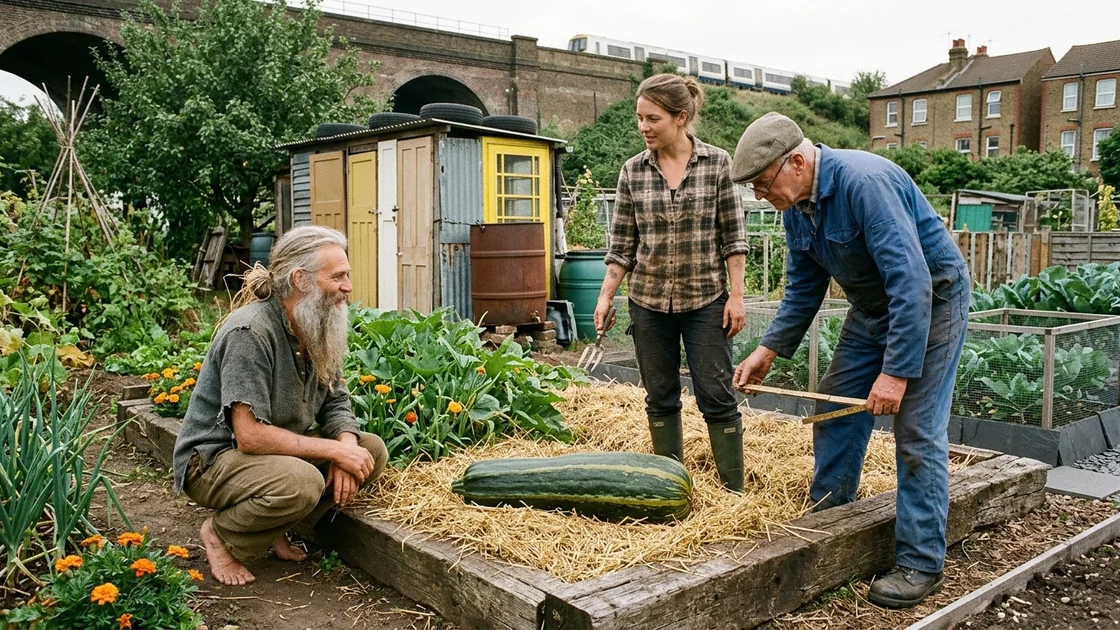
Miranda Finch took possession of Plot 14B at the Blackthorn Lane Allotments on a damp Tuesday in March, hoping that thirty feet of London clay might cure the restless numbness left behind by eight years in corporate graphic design. Instead of pastoral tranquility, she inherited a jungle of Himalayan blackberry bushes, a rusted iron mangle, and a front-row seat to a thirty-year war waged between two entrenched factions of elderly South London gardeners. Caught between a pedantic retired railway engineer who viewed straight rows as a moral imperative and an unwashed biodynamic mystic who planted according to the constellations, Miranda found that cultivating a simple row of carrots required navigating ancient grudges, midnight sabotage, and a forgotten underground drainage canal that held the fate of the entire hillside in its muddy hands.
I. The Handover
The key to the padlock on the main gate did not turn smoothly. It required what Mrs. Gedge, the acting allotment secretary, described as an ecclesiastical wiggle—two sharp nudges inward, a half-turn clockwise, and a firm hitch upward, as though lifting the latch of a reluctant tabernacle.
"Mind the rust," Mrs. Gedge muttered, not looking up from her clipboard. She was a woman constructed entirely of green quilted nylon, beige corduroy, and suspicion. A cigarette burned unattended in a tin sardine can resting on the bonnet of her rusted Nissan Micra. "If the key snaps in the barrel, the Council charges eighty-four pounds for an emergency locksmith, and they take it out of the communal manure fund. We lost three tons of well-rotted steer dung in ninety-eight because young Gary from Plot 4 twisted his wrist too briskly. We haven't forgiven him. He lives in Lewisham now."
"I'll be careful," Miranda said. She held her brand-new border spade in one hand, its ash-wood handle pale and virgin, the sticker from the garden centre in Camberwell still gleaming on the blade.
The gate swung inward with a high, rusted scream that caused three woodpigeons to clatter out of a nearby row of silver birches.
Blackthorn Lane Allotments occupied an improbable wedge of South London green space, caught in the armpit where two elevated Victorian railway viaducts diverged toward Peckham Rye and Herne Hill. To the north, the red-brick backs of terrace houses peered down like spectators in a steep amphitheatre; to the south, an embankment covered in brambles, elder shrubs, and sycamores rose sharply toward a rumbling commuter line. Between these urban battlements lay four acres of dark, undulating earth divided into forty rectangular plots, crisscrossed by narrow paths of cinder, crushed cockleshell, and rotted carpet runners.
A smell hung over the valley: a thick, primordial stew of woodsmoke, bruised comfrey, damp horse manure, decaying cabbages, and the faint, sweet tang of diesel exhaust carried on the damp Thames breeze.
"Plot 14B," Mrs. Gedge said, pointing a gnarled, wool-mittened finger down the central cinder path. "Half-plot. Ten rods, more or less. Left fallow for seven seasons since Arthur Pendelton went into the sheltered housing in Catford and subsequently passed. Rent is sixty-five per annum, water rates included, though if you use a hosepipe instead of a can, you will be summoned before the Disciplinary Committee. No livestock. No cockerels under any circumstances, though hens are permitted up to six in number provided they do not crow, which some do when they get confused by the streetlamps. No structures taller than eight feet. No conifers. No chemical defoliants unless certified by the Southwark Groundskeeper Accord of 1982."
Miranda nodded earnestly, attempting to appear like someone who knew what ten rods looked like and had an opinion on the Southwark Groundskeeper Accord. She had spent the last eight years in a glass-box agency near Old Street, moving vector shapes across two twenty-seven-inch monitors until her retinas felt like dried leaves and her soul resembled an unread inbox. When the tenancy had come up—via a waitlist she had joined during a midnight panic attack five years prior—she had paid the deposit instantly, imagining herself in linen overalls, eating sun-warmed strawberries while listening to the birds.
They arrived at Plot 14B. Miranda stopped.
It was not a garden; it was an archaeological dig that had been conquered by a barbarian horde of vegetation. A dome of brambles, six feet high and twenty paces across, sat in the center of the plot like a dead mammoth draped in barbed wire. Couch grass thick as twine speared through the ribs of an upturned shopping trolley. At the rear, half-submerged in nettles, stood a shed made from mismatched wooden wardrobe doors, an old yellow telephone kiosk panel, and corrugated iron held down by four waterlogged car tyres.
"Arthur let it slide toward the end," Mrs. Gedge conceded, tapping her pen against her teeth. "His knees went in the autumn of fifteen, and then the bindweed took the potting bench. Still. Good loam underneath. Dulwich Series loam. Silty clay over London blue clay. Holds water like a bucket, which is a blessing in July and an absolute sod in November."
Before Miranda could answer, a sharp clanking sound echoed from the adjacent plot to their right.
A man had appeared from behind a row of immaculate, six-foot-high sweet pea wigwams. He wore a crisp blue boiler suit, a flat cap worn with military precision, and steel-toed boots polished to the dull sheen of river pebbles. In his gloved hands he carried a brass-bound wooden ruler.
"Morning, Enid," the man said. His voice sounded like dry gravel being shifted with a spade.
"Hector," Mrs. Gedge acknowledged, her tone dropping three degrees. "This is Miranda Finch. New tenant for 14B."
Hector Vane did not smile. He adjusted his flat cap by the brim, stepped to the boundary wire—a taut, galvanized strand suspended exactly four inches above the soil—and looked Miranda up and down. He paused at her pale ash spade, lingered on her spotless hunter-green wellingtons, and finally met her eyes.
"You'll need a mattock," Hector said. "And a file. If you don't dig out the taproots of those docks down to eighteen inches, they’ll seed into my brassicas by May. Arthur let his thistle-down drift across the line in fourteen. I lost two prize Savoy cabbages to crown rot because the air circulation was compromised by his elder sucker."
"I... I intend to clear it immediately," Miranda said, extending a hand over the wire. "Nice to meet you, Hector. I'm Miranda."
Hector looked at her hand as though it were an invasive species of slug. He did not take it. "The rules state four weeks to bring an abandoned plot under seventy percent cultivation, or the allotment committee issues a Stage One Notice of Dereliction. Don't leave your plastic weed membrane loose. The wind comes down off the railway cut like an express train; it rips up cheap polythene and drops it across my parsnips."
"She’s only just arrived, Hector," Mrs. Gedge said, though she made a small, noncommittal mark on her clipboard that made Miranda’s stomach knot.
"I am merely stating the bylaws," Hector replied evenly. "Section 4, Paragraph B. Nuisance seed dispersal. We have an inspection on the twenty-fourth. We must maintain standards. If we don’t, the Council will rezone the lower terrace for mixed-income flats before you can say 'winter cabbage.' They’re already eyeing the scrubland by the signal box."
"The council won't touch us while the lease is held under the Small Holdings Act," a new voice drawled from the other side of the plot.
Miranda turned. Rising from what appeared to be an unkempt swamp of waist-high dandelions, wild garlic, and sprawling comfrey on her left was a figure who could have stepped out of an obscure seventeenth-century woodland rebellion. He was broad-shouldered, sixty-something, with a beard resembling an unraveled rope fender and silver hair bound into a loose knot with a strip of raffia. He wore a heavy woollen grandad shirt with the sleeves torn off, baggy corduroy trousers held up by baling twine, and no shoes whatsoever. His feet were the color of damp peat, the toenails thick as horn.
"Don't listen to the Iron Duke, sister," the barefoot man said, leaning over an untrimmed hazel hedge. He held a wooden bowl filled with strange, bruised purple leaves. "He’s been trying to pave the garden path with municipal tarmac since the Falklands War."
"Barnaby Cole," Hector spat, his eyes narrowing into two flinty slits. "Put some boots on. You're violating sanitary ordinance three-stroke-eight. And your bindweed is creeping under the hazel."
"Bindweed is a companion plant, Hector," Barnaby said serenely. He popped a purple leaf into his mouth and chewed with bovine deliberation. "Its roots break up the compacted hardpan your diesel rototiller created. It brings subsoil minerals to the light. It is an act of planetary healing."
"It's a botanical cancer," Hector retorted, stepping closer to the fence. "You haven't produced an edible onion in five seasons. That plot is a harbor for every gastropod between here and Crystal Palace. Your slug nursery is costing this community three stone of Maris Pipers a year."
"The gastropod is my brother," Barnaby said, smiling beatifically, though his jaw muscles clenched. "He only eats what is sick. If your potatoes had an active immune system instead of being pumped full of synthetic nitrogen and copper sulphate, Hector, the slugs would ignore them."
"That is utter, unscientific, superstitious codswallop!"
"Peace, little brother. Let the soil speak."
"Don't you 'little brother' me, Cole! I was on this committee when you were still throwing wet pots in an art school basement and living on government cheese! Mrs. Gedge, note the bindweed! Note the barefoot intrusion into the buffer corridor!"
Mrs. Gedge did not note anything. She took a deep, exhausted drag from her cigarette, ground the butt out with the toe of her boot, and dropped it into her pocket.
"The tap is twenty yards down the path," she told Miranda, completely ignoring the two men who were now glaring at each other across the bramble mountain with murderous, habitual hatred. "Water key is under the half-brick by the trough. Don't leave it dripping. If the trough overflows, the clay slides into the railway ditch and Network Rail sends nasty letters on thick paper."
She turned and marched back up the path, her nylon jacket whistling against her sleeves.
Miranda stood alone between the two men. On her right, Hector stood at rigid parade rest beside his plumb-line-straight rows of sprouting garlic, each clove spaced precisely six inches apart in raised beds edged with reclaimed Victorian slate. On her left, Barnaby stood ankle-deep in mud amidst an anarchic polyculture jungle of rotting wood, hazel poles, sprouting weeds, and half-buried clay amphorae.
Between them lay Plot 14B: thirty feet of choked, impenetrable brambles, containing a rusted mangle, a condemned shed, and Miranda Finch, who suddenly realized she had no idea how to kill a dock leaf.
"I have a spare mattock," Hector said stiffly, without looking at her. "English steel. Spear & Jackson, 1968. If you use it, wipe the head with an oily rag before you return it. Five o'clock sharp."
"Don't take his steel," Barnaby whispered, his voice warm with theatrical conspiratorial menace. "The iron disturbs the telluric currents. I have an ash-wood digging stick seasoned in sheep's whey. It works with the earth, not against it."
Miranda gripped her shop-bought spade until her knuckles turned white. "Thank you both," she said through a frozen smile. "I think I’ll start with my hands."
II. The Cartography of Grudges
It took Miranda four days to clear a space the size of a double bed.
Her fingers were punctured through her leather gloves by blackthorn spines that left her knuckles throbbing with dull, throbbing heat. Her shoulders burned; muscles she hadn't used since university rowing sessions shrieked in protest every time she bent down to heave on a root that seemed anchored to the core of the earth.
Yet, despite the agony, there was something intoxicating about the labor. In the agency, work vanished into the ether—a Figma link updated, an email acknowledged, a slide deck approved and forgotten. Here, by two o'clock on Saturday afternoon, there was a visible, undeniable square of dark, fragrant earth where there had previously been a wall of thorns. The soil was indeed Dulwich loam: heavy, greasy, cool to the touch, smelling faintly of ancient riverbeds and leaf mould.
As she worked, she began to map not just the geography of Blackthorn Lane, but its politics.
The allotments were divided down the center by the cinder path, which served as an ideological demilitarized zone.
The North Side was the domain of the Purists. Led by Hector Vane, they were mostly retired tradesmen, former civil servants, and several formidable ladies from the Dulwich Horticultural Society. Their plots were geometric masterpieces. Potatoes were earthed up in identical trapezoidal ridges; brassicas lived under heavy-gauge steel cages to repel the cabbage white butterfly; paths were kept weed-free with propane scorchers and scrupulous hoes. Their compost heaps were two-bin wooden pallets lined with tar paper, heating neatly to sixty-five degrees Celsius before being turned on the vernal equinox.
The South Side belonged to the Permaculture Rebels. Under Barnaby Cole’s barefoot guidance, they had abandoned all pretense of rectilinear order. They built hugelkultur mounds—giant graves of buried rotting logs covered in upside-down sod, leaf litter, and kitchen scraps—which they claimed stored heat and moisture through cosmic resonance. They planted 'guilds' of comfrey, horseradish, and dwarf apple trees in dizzying spirals. They brewed 'liquid gold'—fermented nettle and stinging-dock tea in fifty-gallon plastic barrels that smelled so profoundly of horse latrines and rotten eggs that Miranda had to breathe through her mouth whenever the wind came out of the south.
Plot 14B was the keystone. It sat smack in the middle of the North-South boundary, at the lowest point of the slope where the natural water drainage pooled before entering the railway culvert.
"Arthur kept the balance," a quiet voice said on Sunday afternoon.
Miranda was sitting on an upturned plastic milk crate, drinking lukewarm Earl Grey from a thermos and nursing a blister on her thumb that had taken on the dimensions of a quail’s egg.
The speaker was an elderly woman wearing a faded pink headscarf and three cardigans pinned together with a silver brooch in the shape of a leek. She was weeding the border of Plot 13, which belonged to the North Side. Her hands, deformed by arthritis into smooth, knobby roots, moved through the groundsel with hypnotic efficiency.
"I'm Miranda," Miranda said, glad for an interruption that didn't involve being lectured on soil pH or telluric energy.
"Gwen," the woman said. She didn't look up from her weeding. "Arthur was my cousin by marriage. He took this plot in seventy-two, when the council tried to turn the whole lane into a corporation depot for gritting lorries. Hector and Barnaby were friends then, you know. Hard to credit, but they were."
"Friends?" Miranda glanced over at Hector, who was currently measuring the distance between his broad bean canes with a steel surveyor's tape, and then at Barnaby, who was sitting cross-legged on a compost heap playing a bamboo nose flute to his runner beans.
"Joined at the hip," Gwen said softly. "Hector was the chief mechanical draughtsman at the locomotive sheds in New Cross. Barnaby was teaching ceramics at Goldsmiths. They used to share a pint of mild down at the Prince of Wales every Friday. Built that communal seed shed together out of old railway sleepers. Hector did the mortise and tenon joints; Barnaby carved the Celtic knotwork on the lintel."
"What happened?"
Gwen stopped weeding. She sat back on her heels, her rheumy blue eyes looking down toward the bottom of Miranda’s plot, where the yellow telephone-kiosk shed leaned precariously against a wild damson tree.
"The Great Marrow of ninety-four," Gwen whispered.
Miranda waited for a punchline, but none came. Gwen’s expression was solemn, even mournful.
"The Camberwell Centenary Show," Gwen explained. "The heaviest vegetable class. Hector had been breeding an Atlantic Giant cross for six years. Trench-manured with horse muck, watered with sheep-dung liquor he boiled on a Primus stove in his shed. He had a marrow that weighed ninety-eight pounds by the second week of August. You could hear it groaning in the night as the skin stretched. It was a sure thing. The first prize was fifty quid and a silver-plated salver presented by the Mayor of Southwark."
"Did Barnaby beat him?"
"Barnaby didn't enter," Gwen said. "Barnaby was experimenting with his early biodynamics. He’d buried a cow horn filled with quartz dust and nettle slurry right on the boundary between his plot and Arthur’s. He claimed it concentrated the astral ether. Well, three days before the weigh-in, there was a cloudburst. A proper South London deluge. The water came down off the embankment, hit the hardpan, and Barnaby’s cow-horn pit flooded. The liquid ran straight into Hector’s trench."
Miranda took a sip of her tea. "Did it kill the marrow?"
"Killed it?" Gwen shuddered. "It split it from stem to stern like an overripe watermelon. A clean fracture, four inches wide. Smelled like a brewery drain. And inside the split, Hector found sixty-five large, orange Spanish slugs having an orgy in the seed cavity."
Miranda blinked. "Oh dear."
"Hector claimed Barnaby had weaponized the slugs. Said the quartz dust had drawn them from three parishes like the Pied Piper. Barnaby claimed the marrow was a monument to bourgeois vanity and that the earth had rejected its hubris through natural decompression. They had a set-to by the water trough. Hector hit Barnaby with a Dutch hoe; Barnaby threw a bucket of fermented comfrey tea over Hector’s Sunday suit. The police came down Blackthorn Lane with their sirens going. Arthur had to step between them with an iron bar."
Gwen shook her head and resumed her weeding, flicking a dandelion root into her galvanized pail with a flick of her thumb.
"Arthur kept them apart for thirty years. He wouldn't let Hector spray his weedkiller near Barnaby’s hedge, and he wouldn't let Barnaby’s squash vines climb into Hector’s cages. He was a surveyor by trade, Arthur. He understood lines. But when Arthur died..." She gestured at the bramble fortress. "The buffer fell. Now they’re both waiting to see which way you jump."
"I don't want to jump either way," Miranda said, feeling an icy knot of dread form in her chest. "I just want to grow some heritage tomatoes and maybe some sweet peas."
Gwen gave a dry, rattling laugh that ended in a cough. "There are no neutral nations in Blackthorn Lane, my dear. Look down by your shed."
Miranda looked.
Tied to the rusty handle of the wardrobe door was a crisp white envelope with her name typed on it with an ancient typewriter: MISS M. FINCH (PLOT 14B).
And resting on the threshold, nestled inside a hollowed-out birch log, was a bunch of dried mugwort tied with a strip of raw sheep's wool.
III. The Archaeology of Arthur
The shed smelled of fifty years of paraffin, rotting wood, mouse droppings, and old tobacco.
Miranda managed to force the warped door open with a screech that sent two woodlice scurrying into the hinge. Sunlight filtered through the yellow perspex panel of the telephone kiosk, casting an amber, sepia glow over the interior.
It was packed to the ceiling rafters with the detritus of Arthur Pendelton’s long tenancy. There were bundles of bamboo canes tied with rotting garden string; terracotta pots stacked in precarious leaning towers, their rims encrusted with green lichen; half-empty tins of creosote; jars of rusty flat-head nails sorted by size into old Frank Cooper’s marmalade pots; and rows of glass bottles containing strange, discolored powders labeled in faded cursive: Bordeaux Mixture, 1974; Flowers of Sulphur; Dried Blood (Organic); Arthur’s Seed Treatment (Do Not Ingest).
On a workbench made from a railway sleeper sat an old tin biscuit box featuring the faded portraits of King George VI and Queen Elizabeth.
Miranda lifted the lid. The hinge squeaked.
Inside were Arthur’s plot diaries.
There were eight of them, small, black, cloth-bound notebooks with marbled edges, covering the years from 1972 to 2015. Miranda took out the top one, dated 1994, and opened it to August.
The handwriting was neat, mechanical, the script of a man trained with technical pens on tracing linen:
14th August. Heavy rain. The embankment drainage is failing again. The brick culvert under Plot 14 is silting up with Thames Water runoff from the new development on Grove Vale. If the main sluice under my potting shed isn't cleared by autumn, both Hector’s parsnips and Barnaby’s wilderness will be under three feet of black sludge.
16th August. Hector’s marrow has exploded. Dreadful business. Hector is screaming about quartz curses; Barnaby is chanting in the lane. Neither of them knows the culvert exists. Neither of them knows that the only reason this entire terrace doesn't slide into the railway cutting every November is the inverted siphon I built under the rhubarb patch in seventy-six.
If they find out, they’ll fight for control of the valve. Hector will use it to drain Barnaby’s marsh into the ditch; Barnaby will block it to create an eco-wetland for his damn crested newts. Must keep the key hidden.
Miranda let out a long, slow breath. The paper felt brittle between her fingers, carrying the faint, dry scent of sulfur and old cedar.
She opened the door wider to let the light in and sat on an upturned wooden crate.
Below the diary entry was an intricate hand-drawn schematic in red and black ink. It showed Blackthorn Lane Allotments not as a collection of individual vegetable plots, but as a complex hydrological machine.
Underneath the layer of Dulwich loam lay a forgotten spur of the Effra—one of London's lost subterranean rivers, forced into Victorian brick tunnels in the 1860s when the railways were carved through the hills. A tributary line, built from porous earthenware pipe and engineering brick, ran directly beneath Plot 14B. Arthur had tapped into it, creating an elaborate system of subterranean stone sumps, clay dams, and an iron control valve located "three paces south of the water butt, beneath the third flagstone."
By adjusting this valve, Arthur had spent thirty years quietly draining the excess water from Hector’s low-lying brassicas while secretly shunting moisture into Barnaby’s thirsty hugelkultur mounds, keeping both men reasonably dry and blissfully ignorant of why their plots behaved the way they did.
Arthur had not been a gardener; he had been the secret hydraulic governor of Blackthorn Lane.
A sudden knock on the yellow perspex door made Miranda jump, dropping the diary back into the tin box.
"Miss Finch?"
It was Hector. He stood in the doorway holding a galvanized metal bucket containing an oiled mattock, a wire brush, and a clipboard. Behind him, hovering on the path like an ethereal, mud-spattered ghost, was Barnaby, holding an earthenware crock covered with a piece of damp muslin.
"Mr. Vane," Miranda said, sliding her foot over the biscuit tin to nudge it back beneath the bench. "Mr. Cole. What can I do for you?"
"The Committee," Hector said, his eyes flicking over the interior of the shed with intense technical scrutiny, "requires your signature on the Boundary Declaration. We need to establish the perimeter trench before the spring plantings. The bylaws require a six-inch ditch on the northern flank to intercept grass rhizomes."
"A ditch is an act of division," Barnaby said, leaning against the doorpost, smelling powerfully of elderflowers and wood ash. "I brought you a starter culture of my sourdough-nettle ferment, Miranda. You pour it over the cleared soil. It activates the mycorrhizal fungi. It binds the earth in love."
"It smells like an open sewer," Hector said, without turning his head. "And it draws the rats. We had two brown rats behind the tool shed last November, Miss Finch. They don't respect love. They respect zinc phosphide and half-inch wire mesh."
"They were voles, Hector! Water voles! A protected species under the Wildlife and Countryside Act!"
"They were Rattus norvegicus," Hector snapped, "and one of them chewed through the cord of my hedge trimmer. That is not a protected activity."
Miranda stood up, brushing peat and rust flakes from her jeans. She felt the weight of Arthur’s secret beneath her boots.
"Gentlemen," she said, her voice rising with an authority she hadn't felt since she told an executive creative director that his neon gradient was aesthetically illiterate. "I appreciate the advice. Both of you. But right now, I have fifty square yards of bramble to clear, a shed that is five degrees off the vertical, and the Council inspection is in three weeks. I am going to clear the plot. I am not digging a trench, and I am not pouring fermented slurry over the ground until I know what’s under it."
Both men looked at her in stunned silence. Hector’s eyebrows twitched beneath the brim of his cap; Barnaby’s mouth hung slightly open in his beard.
"I will borrow the mattock," Miranda added, looking at Hector. "And I will accept the nettle ferment." She looked at Barnaby. "Provided you leave the crock outside by the damson tree and put a brick on the lid so the 'voles' don't fall in."
Hector gave a curt, almost imperceptible nod. He placed the mattock against the wall, took his clipboard, and turned on his heel. "Wipe the blade," he muttered, marching down the path toward his brassica cages.
Barnaby lingered for a moment. He winked at her through his silver fringe. "The old man would have liked you," he murmured. "Arthur was stubborn too. But watch the water, sister. The sky is turning violet. The moon is in Scorpio. The mud is coming."
He padded barefoot away, his dirty feet silent on the cinder path.
IV. The War of the Slugs
April arrived with deceptive softness. A week of brilliant, unseasonable warmth coaxed the blackthorn into clouds of white blossom, turned the weeds into an emerald sea, and woke every dormant pest in South London from its winter torpor.
Miranda worked every evening after logging off from her freelance work. She hacked, she dragged, she burned.
The brambles surrendered inch by inch. Beneath their tangled, thorny bellies she found strange, half-buried treasures: a 1983 silver twenty-pence coin; an intact Bovril jar from the 1940s; three identical left-footed gardening clogs; and a cast-iron sign that read SOUTHERN RAILWAY: TRESPASSERS WILL BE PROSECUTED TO THE UTMOST EXTENT OF THE LAW.
By the middle of the month, she had cleared three-quarters of the ground. She had built two neat compost heaps from discarded pallets she had dragged four blocks from a building site on Lordship Lane, carefully observing a compromise: one heap was turned according to Hector’s rectilinear principles; the other was left wild and aerated with sticks according to Barnaby’s instructions.
Then the rain began.
It was not a soft spring rain. It was a cold, unrelenting, grey deluge that swept up from the English Channel, turned the commuter trains into steaming, delayed hell-boxes, and soaked the clay of Blackthorn Lane until it reached the consistency of chocolate pudding.
On the third night of the storm, Miranda sat in her damp flat in Peckham, listening to the rain lashing her sash windows. She had spent the afternoon planting four rows of 'Ailsa Craig' onions and three precious rows of 'Gardener’s Delight' tomatoes in cold frames she had fashioned from old sash windows and Arthur’s scrap timber.
She could not sleep. A vision haunted her: tiny, soft, slimy bodies sliding over her tender shoots.
At dawn, she put on her waterproofs, grabbed her torch, and cycled down to the allotments.
The cinder path was a canal of orange water. The air was thick, heavy, and smelled of drowning worms and sulfur.
When she reached Plot 14B, she stopped in horror.
The battle had already begun.
On the North Side, Hector was out in a yellow oilskin sou'wester, patrolling his border like a sentry on the Maginot Line. In his hand was a large plastic shaker with a red cap. He was shaking blue pellets of metaldehyde onto the boundary wire with frantic, rhythmic sweeps of his arm. A chemical ring of death, bright turquoise and gleaming in the dawn light, separated his raised beds from Miranda’s plot.
"Take that, you bastards," he muttered through clenched teeth, his face pale and wet under his hat. "Come on, then. Cross the line."
On the South Side, Barnaby Cole stood naked to the waist in the pouring rain, his skin covered in goosebumps, his beard dripping. He was holding two large tin watering cans without roses, pouring a thick, greenish-white froth along the southern edge of Miranda’s plot.
"Nemalug!" Barnaby was shouting over the roar of the rain and the rumble of a passing diesel train. "Awaken the parasitic nematodes! Rise, microscopic warriors of the light! Consume them from within!"
Between them, crossing Miranda’s newly cleared soil, was an army.
They were not ordinary British garden slugs. They were Arion vulgaris—the Spanish slug. Massive, reddish-brown, glistening beasts the size of medium sausages, they had emerged from the overgrown embankment in their thousands, driven by the moisture and an insatiable hunger for cellulose. They moved across the black loam like a slow, glossy tide, their horn-like eye stalks sweeping the air.
Dozens of them had already bypassed Hector’s blue pellets by crawling over the corpse of an old railway sleeper. Hundreds more were completely ignoring Barnaby’s nematodes, which were being washed away by the torrents of rain into the lower ditch.
They were converging directly on Miranda’s cold frames.
"My tomatoes!" Miranda screamed, dropping her bicycle against the gate and splashing through the mud.
"Don't touch them with bare hands!" Hector barked. "They secrete an adhesive slime that contains toxic bacteria! Use the blue pellets! I have five pounds of industrial-strength metaldehyde in my locker! Say the word and I’ll carpet your whole plot!"
"Don't do it, Miranda!" Barnaby bellowed, rushing to the fence, his bare chest heaving. "The pellets will poison the hedgehogs! The song thrushes will eat the dead slugs and die of hepatic failure! You'll break the great chain of being! Use the beer traps! I have six gallons of out-of-date Newcastle Brown Ale behind the shed!"
"Your beer traps are drowning three slugs a night while three thousand march across the lawn!" Hector roared, stepping across the boundary wire and shaking his red tub violently. "You're running an all-you-can-eat pub for gastropods, you lunatic!"
"You're a poisoner, Hector! A chemical war criminal!"
"And you're an environmental hazard! Look at them! Look at them eating her onions!"
Miranda reached her cold frame. It was too late for the first row. The tender green shoots of her 'Ailsa Craig' onions had been rasped down to pale, bleeding nubs. Three fat, orange monsters were currently dragging their wet bodies across the glass of her tomato frames, leaving iridescent trails of slime.
Fury—pure, unadulterated, London-commuter rage—surged through Miranda’s veins. She had spent twelve years dealing with marketing directors who wanted logos made 'more punchy,' with landlords who claimed rising damp was a lifestyle choice, and with train conductors who announced cancellations with cheerful indifference.
She was not going to lose her tomatoes to a gang of Spanish molluscs and two squabbling octogenarians.
"Shut up!" she screamed.
Both men froze. Hector stopped with his shaker raised mid-air. Barnaby lowered his empty watering can.
"Both of you," Miranda hissed, her voice trembling with cold and fury, "shut your mouths."
She reached down, grabbed an empty galvanized bucket Arthur had left by the water butt, and picked up a rusted trowel.
Without hesitation, she began scooping the slugs up. Plop. Plop. Plop.
She moved down the rows like an executioner, flicking them into the bucket with merciless efficiency. When she found two copulating under a piece of rotting cardboard, she scooped them together. When she found one scaling the frame of her tomatoes, she peeled it off with a sickening wet snap and dropped it into the zinc.
"What... what are you going to do with them?" Barnaby asked, his voice suddenly small, horrified yet fascinated.
"I am going to drown them in salt water," Miranda said, her eyes wild, her wet fringe plastered across her forehead like seaweed. "And then I am going to bury them three feet under the compost heap. And if either of you throws blue pellets or fermented beer across my fence again, I am going to collect every single slug on this embankment and dump them through the letterboxes of your respective sheds. Am I understood?"
Hector stared at her. Slowly, his arm came down. The red shaker vanished into the pocket of his yellow coat.
"She has the Pendelton eye," he whispered to himself.
"It is... a valid biological intervention," Barnaby mumbled, looking down at his muddy feet. "Direct manual harvesting. Energetically neutral."
"Get off my plot," Miranda said quietly.
Both men retreated without another word, stepping backward across their respective borders like dogs who had discovered that the sheep was actually an electric fence.
V. The Secret of the Sluice
The slug slaughter had gained Miranda an uneasy peace, but it had not cured the real problem: the water.
By the second week of May, the rain had paused, but Plot 14B was not drying out. It was becoming a bog. The Dulwich loam had absorbed all the moisture it could hold; now the subsoil was regurgitating it. Every step Miranda took resulted in a squelching suction that threatened to pull her wellingtons clean off her feet.
Worse, Hector’s brassica cages were beginning to lean. The soil beneath his immaculate raised beds was turning into liquid pudding, causing his prize purple sprouting broccoli to tilt like the towers of San Gimignano.
On the other side, Barnaby was in despair. His hugelkultur mounds had become so waterlogged that the ancient oak logs buried within them were beginning to ferment anaerobically, bubbling up a grey, sulfurous gas that smelled of rotten eggs and made his runner bean seedlings wilt and turn yellow.
"It's the drainage," Gwen said one morning, leaning over her hoe. She looked worried. "Arthur always did something with a crowbar around this time of year. I don't know what it was. He’d disappear behind his shed for an hour with an oily rag and a bottle of paraffin, and by morning the water would be gone, running down into the railway ditch as sweet as you like. If we don't get it cleared, the Council inspection on Friday will fail the whole lower terrace. Enid Gedge has already got her red pen out."
Miranda waited until dusk.
When the last of the gardeners had packed their tools into their sheds, locked their padlocks, and headed up the path toward the station, Miranda slipped into Arthur’s shed.
She took out the 1976 notebook and a rusted mechanic’s flashlight.
Three paces south of the water butt, beneath the third flagstone. Brass valve head, three-quarter-inch square drive. Turn clockwise to divert to the culvert; anti-clockwise to flood the sump.
Miranda went behind the shed. The ground here was a dark, treacherous mire of nettles and rotting dock stalks. The water butt was a five-hundred-gallon iron tank that had once served as a tender on an 0-6-0 saddle tank engine.
She paced it out: one, two, three.
Her boot hit something solid beneath four inches of black mud.
Dropping to her knees, heedless of the filth soaking through her work trousers, she began scraping away the muck with Arthur’s trowel. Her fingers found the edge of a York stone flag. It was heavy, cracked across the middle, and held down by thirty years of accumulated grit.
She wedged the blade of the mattock under the edge, braced her feet against the base of the water butt, and heaved.
With a sucking, gasping sound, the stone rose.
Miranda shone the torch into the void.
Beneath the slab was an engineering marvel. It was a brick-lined chamber, eighteen inches square, lined with blue Staffordshire engineering bricks that had been pointed with hydraulic lime. Inside, clean and free of silt, sat an enormous cast-iron gate valve, its brass stem gleaming dully in the torchlight. Attached to the valve wheel was a brass plate with stamped lettering: LONDON, BRIGHTON & SOUTH COAST RAILWAY – HYDRAULIC DIVERSION NO. 4.
Beside the valve, resting on two iron hooks driven into the mortar, was an iron T-bar key, four feet long, painted with red lead.
The mechanism was choked with dead roots. A thick tangle of willow roots—creeping under the fence from Barnaby’s plot—had wrapped itself around the spindle like a nest of snakes, while Hector’s side was blocked by a wall of compacted ballast that had slipped from his trench border.
Miranda touched the valve. It was frozen fast.
She realized with sudden, terrifying clarity why the allotments were drowning. Arthur had died in December. The valve had spent six months unattended, strangled by the competing encroachments of Hector’s ballast and Barnaby’s willows.
If she opened it herself, she would reveal that she knew Arthur’s secret. If she did nothing, the terrace would flood, the Council would condemn the plots for structural instability, and the developers would have their mixed-income flats by Christmas.
She stood up. The evening sky was darkening into a bruise-like indigo. A freight train rumbled along the embankment, its diesel engine shaking the ground, sending tiny ripples across the black puddles of Plot 14B.
She couldn't fix it alone. She didn't have the leverage to turn a valve that had been set in 1976, and she didn't have the masonry tools to clear the brick flue.
She needed an engineer. And she needed someone who understood roots.
Miranda took a deep breath, wiped the mud from her face with the back of her sleeve, and walked up the central cinder path toward the road.
VI. The Midnight Council
Hector Vane lived in a tidy, double-fronted Victorian terrace on Danby Street, four hundred yards from the allotment gates. His front garden contained no flowers: only two miniature, cone-shaped box shrubs set in stone urns, flanking a path that looked as though it had been scrubbed with carbolic soap.
When Miranda knocked, Hector answered the door in a knitted cardigan, slippers with leather soles, and reading glasses perched on his nose. A copy of Railway Modeller lay on the small hall table behind him.
"Miss Finch," he said, blinking. He did not invite her in. "It is eight-thirty. If this is regarding the bindweed on the border—"
"Hector," Miranda said, leaning against the doorframe to catch her breath. "Arthur didn't use sheep-manure tea to grow his marrows."
Hector went very still. "What did you say?"
"And Barnaby didn't curse your marrow with quartz dust in ninety-four."
Hector took off his reading glasses. His eyes, stripped of the lenses, looked older, softer, and deeply tired. "What do you know about ninety-four?"
"I know where the water goes," she said. "I know about the Staffordshire blue bricks. I know about the London, Brighton and South Coast Railway diversion valve under the third flagstone."
Hector’s hand tightened on the edge of the door until the knuckles turned ivory. He looked up and down the quiet street as though expecting Council inspectors to drop from the plane trees.
"Come inside," he whispered.
"No," Miranda said. "Put your boots on. Bring an adjustable spanner, two pry bars, and a grease gun. And Hector?"
"What?"
"We have to stop at Barnaby’s house on the way."
Hector’s face turned the color of an undercooked beet. "I will not set foot in that charlatan’s commune! He lives in a squatted coach house behind the bakery! It smells of patchouli and dried goat hair!"
"His willow roots are choking the spindle, Hector," Miranda said coldly. "If you try to force that brass stem with a steel bar without cutting the taproots out first, the cast iron will shear off. And then thirty thousand gallons of embankment runoff will back up into your cellar before dawn. Do you want to save your parsnips or do you want to be right?"
Hector stared at her for five long seconds. A struggle played out across his lined, weathered face—the pride of a chief mechanical draughtsman battling the ancestral stubbornness of a South London gardener.
"Wait here," he said.
Three minutes later, Hector emerged. He wore his boiler suit, his steel-toed boots, and carried a canvas tool bag that clanked with heavy, well-oiled British steel.
Barnaby’s coach house did not smell of goat hair. It smelled of wood shavings, drying chamomile, and linseed oil.
When they found him, Barnaby was sitting by a small cast-iron woodstove, carving an ash spoon by the light of a beeswax candle. When he saw Hector standing on his threshold flanked by Miranda, he rose slowly, the carving knife still in his hand, his eyes wide with wild, defensive suspicion.
"Hector," Barnaby said, his voice dropping into a low, resonant rumble. "Have you come to spray defoliant on my lintel?"
"Shut up, Cole," Hector said, though there was no heat in it; his voice sounded thin, shaken. "The girl found the culvert."
Barnaby dropped the spoon. It hit the floorboards with a dull clatter.
"Arthur’s sluice?" Barnaby whispered. "It’s real? He told me... back in seventy-nine, he said there was a pulse in the stone. He said the water was crying out beneath the clay."
"It wasn't crying, you idiot, it was cavitating because the drop-inlet had a sixty-degree elbow," Hector muttered, though he adjusted his tool bag nervously. "The point is, the spindle is fouled. Your weeping willows have driven their taproots straight into the packing gland."
"And your engineering ballast has collapsed the entry weir," Barnaby shot back, his eyes flashing. "I told you that crushed limestone was too heavy for the silt bed! You crushed the veins of the earth!"
"Stop it!" Miranda stepped between them, her voice cracking like a whip in the small, candle-lit room. "The inspection is in thirty-six hours. If that valve isn't open and the terrace isn't draining by tomorrow morning, Mrs. Gedge is putting the lower plots into dereliction. We lose the land. Hector loses his brassicas. Barnaby loses his hugelkultur. And I lose my deposit and my tomatoes."
She looked at both of them.
"Now: Hector has the steel. Barnaby, you have the root-hooks and the herbal solvent you use to dissolve tree resin. We have three hours before the high tide on the Thames stops the outfall culvert from flowing. Are you coming, or am I going to let the whole damn place drown?"
The two old men looked at each other. Between them hung thirty years of exploded marrows, dead cabbages, blue pellets, comfrey stinks, police visits, and furious committee meetings.
Barnaby reached behind the door and grabbed an old pair of leather work boots—the first pair Miranda had ever seen him touch.
"Give me a minute," Barnaby said quietly. "I need to get my saw."
VII. The Operation
The Blackthorn Lane Allotments were pitch-black save for the sweeping beams of three torches.
The rain had held off, but the mist was rising from the railway cut, cold and thick as wool, wrapping the fruit trees in ghostly shrouds. In the distance, the London skyline was a dull, orange glow against the belly of the clouds, but down in the valley of Plot 14B, the world had shrunk to an eighteen-inch square hole in the mud.
Hector lay flat on his stomach on a piece of corrugated iron, his head and shoulders thrust into the brick chamber, holding a flashlight between his teeth.
"It's a two-inch rising stem," Hector’s muffled voice echoed from the pit. "LBSCR pattern, 1888. Phosphor-bronze nut. The packing gland is completely seized with calcium carbonate and... what is this muck?"
"Willow bast," Barnaby said. He was kneeling in the mud beside Hector, holding a small copper pot of hot pine resin and linseed oil he had heated over a camping stove. "Don't tear it, Hector! If you snap the taproot inside the collar, the fibers will swell when they touch water and lock the threads forever. Let me drop the oil in first."
"Hurry up, then! My shoulder is cramping, and this brickwork hasn't been repointed since the Blitz."
Barnaby dipped a slender goose-quill brush into the hot oil and reached past Hector’s shoulder into the darkness. With surgical, delicate care—the hands of a potter who had spent forty years centering spinning clay—he worked the oil into the microscopic spaces between the bronze spindle and the wood-hard roots.
"Easy," Barnaby whispered, almost crooning to the metal. "Easy now, old sister. Drink the oil. Let go of the iron."
"Stop talking to the valve, Cole, it’s a piece of non-ferrous engineering, not a badger," Hector grunted. But he kept the torch steady. "Now... give me the T-bar."
Miranda lifted the heavy red-lead key and passed it down to them.
Hector set the square socket of the key onto the valve head. It seated with a dull, heavy clunk.
"Right," Hector said, climbing out of the pit, his blue boiler suit coated in black, oily silt. He wiped his hands on a rag. "We need two men on the bar. Steady torque. No jerking. If we snap the stem, the whole chamber will fill from the artesian head, and we’ll be swimming to Peckham."
Hector took the left handle of the T-bar. Barnaby took the right.
Miranda held the torch, focusing the beam directly on the junction where the iron entered the brick chamber.
"On three," Hector said. "One. Two. Three."
The two old men leaned their weight into the iron. Their boots slipped in the mud. Hector’s face turned scarlet; the veins on Barnaby’s neck stood out like knotted hazel branches.
Nothing moved.
"The root-collar is holding," Barnaby gasped. "It’s... it won't yield!"
"Push, you old fraud!" Hector snarled. "Put some of that macrobiotic oatmeal into it!"
"I am pushing, you mechanical fossil!"
"Hold!" Miranda dropped to her knees. "Stop! You're canting the bar! It's twisting off-center!"
She looked at them. Hector, eighty years old, with his bad hip and his straight rows; Barnaby, sixty-eight, with his cracked heels and his cosmic dust. They were pushing against each other, their bodies leaning outward, their thirty-year-old feud translating into asymmetric torque that was threatening to snap the Victorian brass.
"Look at each other," Miranda commanded.
Both men blinked, panting, their breath pluming in the cold night air.
"Look at each other," she repeated. "Hector, drop your left shoulder two inches. Barnaby, step your right foot in toward the hub. You have to push together. Parallel. Like you built the seed shed. Do it."
Hector looked across the red iron bar at Barnaby. Barnaby looked back.
For a moment, the only sound was the distant clatter of an empty stock train moving down the viaduct toward the New Cross depots.
Barnaby shifted his foot two inches to the left. Hector dropped his shoulder.
"Together, then," Hector muttered.
"Together," Barnaby agreed.
"Heave."
They leaned in. Not against the bar, but into each other’s rhythm.
From deep within the brickwork came a sharp, metallic tink—like a rifle shot in a tunnel.
Miranda gasped. "Did it break?"
Hector didn't move. He kept the pressure steady. Then, with a slow, agonizing, groaning screech that sounded like an iron ship shifting against a wooden pier, the valve wheel turned a quarter of an inch.
"It’s moving," Barnaby whispered, his eyes wide. "The stone is speaking."
"It's not speaking, it's clearing its threads," Hector wheezed. "Again! Heave!"
Screeech. Another quarter turn. Then half a turn. Then, suddenly, the resistance melted away. The T-bar began to spin smoothly in their hands.
Deep beneath their feet, ten feet down in the belly of the London blue clay, there came a sound like a giant clearing his throat. A low, hollow, sucking roar echoed up through the flagstone chamber.
"Look at the ditch!" Miranda cried, swinging the torch toward the boundary of Plot 14B.
The stagnant, black water that had drowned Hector’s brassicas was moving. It had formed a slow, swirling whirlpool around the base of Arthur’s old water butt. The puddle around Miranda’s cold frames began to peel back from the soil like a carpet being rolled up.
Ten yards away, in the deep ditch that bordered the railway line, a gush of clear, silt-free water came roaring out of a hidden brick archway, cascading into the municipal storm drain with a triumphant, singing rush that echoed through the empty allotments.
Barnaby sat down hard in the mud, his chest heaving, his hands covered in black grease and pine oil. He looked at Hector.
Hector was leaning on the T-bar, his chest rattling with a deep, productive cough. His flat cap had fallen off, revealing his thin, silver hair plastered to his forehead with sweat.
He looked down at Barnaby. Then he looked at the water draining away from his prize parsnip bed, leaving the trapezoidal ridges intact, damp but safe.
Hector reached down into his canvas bag, pulled out a second clean cotton rag, and dropped it into Barnaby’s lap.
"Wipe your hands, Barnaby," Hector said softly. "You're getting grease on your beard."
Barnaby took the rag. He looked at it for a long moment, then dabbed at his forehead. A slow, wide grin broke through his silver whiskers.
"Ninety-four wasn't the quartz dust, Hector," Barnaby said quietly. "Arthur told me before he went into the home. He’d forgotten to clear the drop-inlet that August. The water had nowhere to go."
Hector sighed. He picked up his flat cap, dusted it against his knee, and placed it carefully back on his head.
"I know," Hector said. "I found Arthur’s duplicate key in the tool drawer three years ago. I just... I couldn't turn it without someone on the other side of the bar."
Miranda sat on her milk crate in the dark, watching the two old men. The water continued to sing in the culvert below, carrying thirty years of bile, pride, and London mud down into the lost reaches of the Effra, out to the wide, indifferent Thames.
VIII. The Inspection
On Friday morning at precisely ten o'clock, Mrs. Enid Gedge arrived at the gates of Blackthorn Lane Allotments. She was accompanied by Mr. Christopher Henderson, the Junior Assistant Officer for Parks and Leisure from the Southwark Borough Council.
Mr. Henderson wore a sharp charcoal suit that was entirely inappropriate for a Friday morning in May, patent-leather shoes protected by blue plastic disposable overshoes, and carried a digital tablet with a cracked screen.
"We have received several inquiries regarding the site's ongoing viability," Mr. Henderson was saying, his voice carrying the smooth, nasal detachment of local government. "Given the acute demand for community-led high-density residential developments in the SE15 corridor, any plots showing signs of persistent drainage failure or sub-standard agricultural utilization must be red-flagged for review under the 1908 Act."
"Quite," Mrs. Gedge said, her cigarette bobbing between her lips. "This way. Plot 14B was the primary concern. Arthur Pendelton left it an absolute tip, and the new girl is an advertising person from Camberwell. Probably wants to grow micro-greens for avocado toast."
They turned the corner by the sweet pea wigwams and stopped.
Mrs. Gedge’s cigarette dropped from her mouth, hitting her nylon chest before tumbling into the cinder path.
Plot 14B was unrecognizable.
The bramble mountain was gone. In its place, the plot had been laid out in a design that seemed to defy every known category of South London horticulture.
It was neither a North Side military parade ground nor a South Side chaotic wilderness.
In the center was an elliptical mandala of raised beds, constructed from Arthur’s reclaimed railway sleepers, their corners joined with Hector’s immaculate mortise joints. Inside the beds, the soil—dark, crumbly, and perfectly drained—was planted with alternating rows of Hector’s prize 'Ailsa Craig' onions and Barnaby’s companion marigolds, their orange heads blazing in the morning sun.
A perimeter path of crushed cockleshells curved gracefully around a newly painted shed—the yellow telephone panel polished until it gleamed like a buttercup, the wardrobe doors planed, squared, and oiled with boiled linseed.
Against the southern boundary, where the ground met Barnaby’s plot, stood a stunning, woven living fence of freshly coppiced willow withes, holding back the embankment soil while allowing the air to circulate freely around Miranda’s four rows of 'Gardener’s Delight' tomatoes, which were already reaching toward the sun, robust, deep green, and entirely slug-free.
Sitting on a bench outside the shed were Hector Vane and Barnaby Cole.
Hector was wearing his blue boiler suit; Barnaby was wearing his torn grandad shirt. Between them sat a wooden chess board resting on an upturned box. Hector was studying the board with severe, analytical concentration; Barnaby was sipping tea from an enamel mug, hummed a low, tuneless melody, and casually moving a wooden knight carved from apple wood.
Miranda emerged from the shed, wearing her hunter-green wellingtons—now pleasantly encrusted with authentic, working loam—and carrying a three-tined hand fork.
"Morning, Mrs. Gedge," Miranda said cheerfully. "Morning, Mr. Henderson."
The Council officer stared at his tablet. He tapped the cracked screen twice, looked at Hector’s parsnip beds—which were standing high, dry, and majestic in their rows—and then at Barnaby’s hugelkultur mounds, which were sprouting a healthy, lush carpet of clover and winter squash.
"There... there appears to be no evidence of the reported standing water," Mr. Henderson said, sounding distinctly disappointed. "Our hydrological maps indicated a catastrophic accumulation in the lower basin."
"The hydrological maps of Southwark Council," Hector said, without looking up from the chess board, "were drawn by clerks who don't know the difference between London clay and a jam roly-poly. Knight takes bishop, Barnaby. You're wide open on the queen’s side."
"Ah," Barnaby murmured, stroking his beard. "The material world is an illusion, Hector. The bishop was merely visiting this plane. Check."
Mr. Henderson cleared his throat. He looked at Miranda. "And the plot clearance? The seven-year accumulation of detritus?"
"Fully remediated," Mrs. Gedge said, her voice unusually gruff. She stepped forward, her sharp eyes scanning the neat edges, the perfectly tuned boundary lines, the absence of a single dock leaf, and the hidden stone slab behind the water butt, which had been neatly covered with a layer of clean pea gravel.
She took her red pen, clicked the top with her thumb, and made a single, decisive checkmark on her clipboard.
"Ten rods," Mrs. Gedge pronounced. "One hundred percent cultivation. No nuisance weeds. Boundary protocol observed."
She looked at Miranda. For a fraction of a second, the hard, leather-like lines around Mrs. Gedge’s mouth softened into something that might, in a dimmer light, have been mistaken for an approving grin.
"You'll need to stake those tomatoes by Tuesday, Miss Finch," she added. "The wind off the viaduct doesn't care about your design degree."
"I have the hazel poles ready, Mrs. Gedge," Miranda said.
"Good. Come along, Mr. Henderson. Plot 22 has an unauthorized pigeon loft that needs your attention. The man claims they’re decorative doves, but they’ve got racing rings on their shanks and they’re fouling the communal pump."
She marched away, her nylon jacket whistling, the bewildered Council officer trailing in her wake, his blue plastic overshoes rustling against the cinders.
IX. The Camberwell Giant
By late August, the heat had returned to South London.
The clay had set like brick, but beneath the surface of Plot 14B, the water moved in silence. Every Tuesday evening, Miranda would lift the small square of York stone beneath the gravel, take the red lead key, and give the bronze spindle a quarter-turn, feeling the ancient railway culvert pulse like a great, quiet artery beneath the earth.
The feud did not end. Such things are not cured by single midnight operations; they are too deeply rooted in the soil of human vanity.
Hector still complained that Barnaby’s comfrey tea was a biological hazard, and Barnaby still maintained that Hector’s straight rows reflected an authoritarian personality disorder. They still argued about slug pellets, municipal bylaws, lunar planting dates, and the correct way to cure shallots.
But they argued from across a clean, well-drained fence.
On the last Saturday before the Autumn Centenary Show, Miranda stood in the center of her plot, her skin tanned to the color of unrefined sugar, her hands calloused, her back strong and straight.
In the middle of her central bed, resting on a thick bed of clean barley straw, sat a vegetable.
It was not an Atlantic Giant, and it was not a biodynamic moon-squash. It was a marrow, grown from an unlabeled packet of seeds she had found in the back of Arthur Pendelton’s Frank Cooper marmalade jars, labeled simply: The Balance, 1989.
It was three feet long, ribbed like the vaulting of an early English parish church, and shaded in deep, lustrous bands of forest green and creamy gold. It did not groan in the night. It did not split. It simply sat in the sun, heavy, cool, and majestic, absorbing the water that flowed beneath it and the sun that beat down from above the railway cut.
Hector was standing at the boundary wire, his brass-bound ruler in his pocket.
Barnaby was standing on his side, his hands tucked into his rope belt.
"Skin is firm," Hector observed, his eyes gleaming behind his reading glasses. "Good longitudinal symmetry. Ribbing is consistent with an eighty-pound yield."
"The aura is harmonious," Barnaby murmured, smiling through his whiskers. "It holds the stillness of the stone."
Miranda walked over to the straw bed. She rested her hand on the smooth, cool skin of the marrow. She could feel the vibration of the 5:15 train from London Bridge passing overhead on the viaduct, the rumble traveling down through the brick piers, into the gravel beds, through the blue engineering bricks of Arthur’s sluice, and up through the dark Dulwich loam into the living heart of the garden.
"Will it win?" she asked them.
Hector looked at Barnaby. Barnaby looked at Hector.
"It will win," Hector said firmly.
"Without a doubt," Barnaby agreed. "We’ll need the wheelbarrow from the communal shed. The one with the pneumatic tyre."
"I'll grease the axle," said Hector.
"I'll weave the carrying sling," said Barnaby.
Miranda picked up her watering can, walked down to the iron tank, and filled it from the clear, running tap. As she walked back between her rows of tomatoes and onions, the late summer sun caught the yellow glass of the telephone kiosk, casting a warm, golden light across the black earth, where nothing was straight, nothing was wild, and everything, at long last, was growing.