The Brass Veins of Vienna
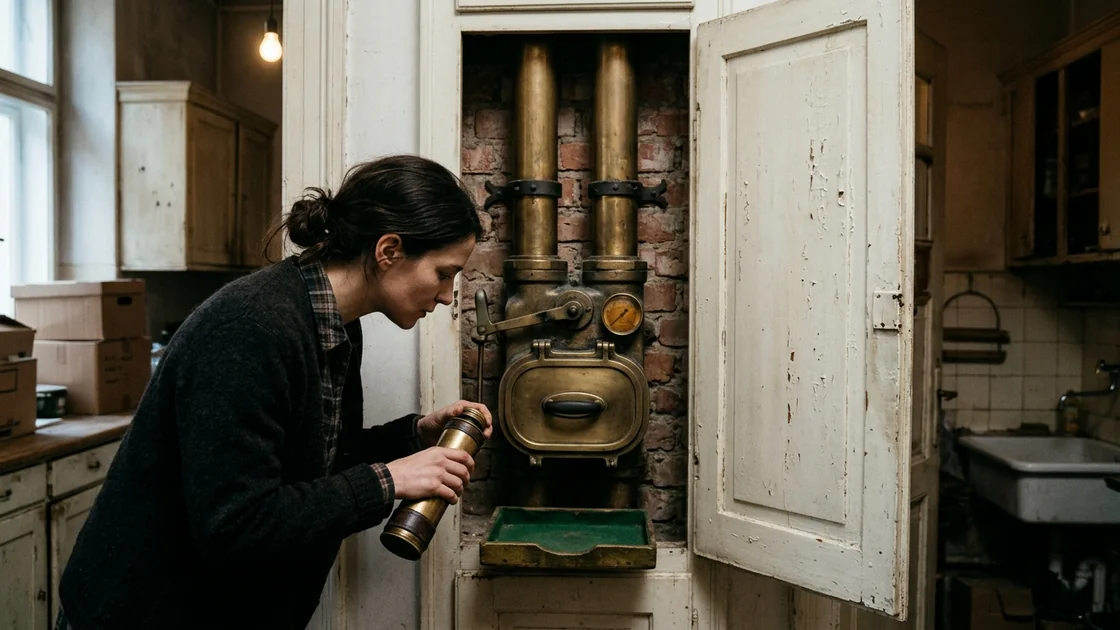
When an archivist named Clara relocates to a drafty late-nineteenth-century apartment in Vienna, she expects only the solitude required to nurse her bruised spirit and restore historic manuscripts. Instead, she uncovers an operational pneumatic tube terminal hidden inside an old service pantry, a relic of an era when wealthy families ran private air-driven conduits through their townhouses. Through this brass-and-leather pipeline arrives an acidic letter from Franziska von Kempen, the eighty-four-year-old widow living directly above her, who treats Clara as an insolent tenant in what was once her family home. What begins as an exchange of petty complaints and sharp rebuttals over radiator noise and drafty flues transforms across a freezing Austrian winter into a tenuous, ritualistic correspondence that unearths lost municipal histories, family grief, and the unexpected warmth of two solitary lives intertwined by air pressure and ink.
Chapter I: The Weight of High Ceilings
The keys did not look like keys; they looked like small, iron cudgels forged for a dwarf king. There were three of them, held together by a loop of tarnished wire, and when the estate agent—a young man named Schober whose cheap suit smelled violently of synthetic cedar—dropped them into Clara’s palm, the gravity of her decision settled between her knuckles.
"The building has certain eccentricities," Schober had said, twisting his mouth into a practiced smirk that attempted to rebrand architectural decay as aristocracy. "The Altbau charm, you see. High ceilings, original herringbone parquet, double casement windows. But the heating is district-steam, and the walls are thick enough to swallow an artillery barrage. You will have quiet here, Fräulein Weiss. In the Servitenviertel, people pay fortunes for quiet."
Clara had not paid a fortune, but she had spent the remaining dregs of her savings following the dissolution of her seven-year domestic arrangement in Graz. She wanted a place where her furniture would look small and insignificant, where the ceilings were four meters high, suspended so far above her bed that her nocturnal worries would dissipate in the cold air before reaching the plaster rosettes.
The apartment occupied the second floor of number twelve Porzellangasse. The façade was a neoclassical confection of grimacing cherubs, stone garlands, and peeling yellow distemper that shed fine, chalky flakes onto the pavement every time the Line D tram rumbled past toward the Ringstraße. The entrance hall smelled of wet stone, beeswax, and the faint, vegetal sourness of boiled cabbage from some subterranean concierge flat that had probably been uninhabited since the reign of Franz Joseph.
By mid-afternoon on a Saturday in late October, the moving men from the budget haulage firm had dumped forty-two cardboard boxes and an unassembled pine wardrobe into the center of the drawing room and vanished, leaving behind the muddy silhouettes of their work boots on the oiled oak floor.
Clara sat on an inverted crate of reference books, clutching a mug of tepid tap water. The apartment was immense and hollow. It consisted of a vast Vorzimmer—an entry hall that could have accommodated a modest village wedding—two grand rooms facing the street, and a long, dog-legged corridor leading to a series of smaller, functional chambers that had once housed scullery maids, dry larders, and sewing corners. The doors were tall, white-painted Flügeltüren with brass handles shaped like elongated tear drops, their enamel cracked in fine webbed patterns.
Above her, the ceiling was an expanse of lime plaster, scored with hairline fissures that resembled the river deltas in the ancient atlases she restored for a living at the municipal archive. As she sat listening to the settling silence, a dull, deliberate thump sounded from above.
Thump. Thump. Drag.
It was not the sound of a falling object. It was the rhythmic, territorial strike of a rubber-tipped walking stick, followed by the dragging shuffle of house slippers. Clara looked up. The plaster held its breath. The stick moved with excruciating slowness from what must have been the bedroom directly above her, across the floorboards, until it paused precisely over her head.
A brief pause ensued. Then, three sharp raps against the floorboards.
Clara frowned at the ceiling. She had not yet unpacked her kettle, let alone made any noise beyond the scuffle of stockinged feet. She considered raising her broom handle in return, an instinctive gesture learned from suburban student flats, but the dignity of the room seemed to forbid it. The cornices were heavy with acanthus leaves; one did not answer an unseen phantom through acanthus leaves with a broomstick.
Instead, Clara stood up, stretched her aching lumbar spine, and walked down the dog-legged corridor toward the kitchen.
The kitchen was an afterthought, installed in the 1970s within the footprint of an old scullery. It featured a rust-pitted stainless steel sink, two electric cooking rings that leaned slightly to the left, and a tall, narrow cupboard embedded in the masonry wall beside the flue. The cupboard door was swollen shut with decades of grease and humidity.
Clara worked her fingertips into the bevel and pulled. The wood shrieked in protest, shedding crumbs of white paint, before yielding with a sudden crack that sent her stumbling backward against the sink.
Inside, there were no shelves.
The space was a narrow, vertical recess, brick-lined and cold as an icehouse. Running down its core was a pair of heavy, seamless brass pipes, each about four inches in diameter, held against the brickwork by hand-forged iron brackets. One pipe rose vertically through the ceiling; the other descended into the floorboards. Where they met at chest height, they were joined to a polished cast-iron apparatus resembling a Victorian locomotive’s pressure regulator. There was a counterweighted brass lever, a pressure gauge whose glass face was clouded with amber varnish, and a heavy, hinged brass hatch with an oval handle wrapped in vulcanized rubber.
Clara reached out. Her fingers hovered over the cold metal. The brass was not tarnished; it was darkened by the natural patina of handling, its edges gleaming with the soft, greasy butter-color of old alloys that contained high proportions of copper.
Embossed on the hatch plate, in sharp Fraktur lettering, were the words:
Alois Geissler & Söhne – K.u.K. Hof-Pneumatik – Wien IX.
"A pneumatic tube," Clara murmured to the empty kitchen.
She had seen them in the basement of the central post office on the Postgasse, and once in the municipal hospital, but those were institutional monsters—vast, roaring networks powered by steam-driven vacuum pumps in the sub-basement, sucking leather cartridges between administrative clerks. She had never seen one inside a domestic dwelling.
She touched the oval handle. It was cool, solid, and entirely free of play. She gripped it, turned it thirty degrees to the right, and felt a hydraulic resistance give way with a soft, lubricated clack.
A faint current of air sighed against her knuckles.
It was not the damp, stagnant air of an abandoned chimney. It was dry, slightly warm, and carried with it a distinct constellation of odors: dried peppermint, camphor, roasted chicory, and the sharp, mineral trace of high-grade machine oil.
Clara leaned closer, peering into the oval throat of the pipe. The interior was mirror-smooth brass, vanishing into the darkness above.
Then, deep within the wall, several floors up, a pump began to breathe.
It was a low, rhythmic thrum—huff-chug, huff-chug, huff-chug—a sound felt in the molars rather than heard by the ears, like the idling engine of a river barge three streets away. The air current in the pipe suddenly reversed, pulling her bangs forward toward the orifice with an urgent, whistling hiss.
Clara gasped and jerked her hand back.
From the depths of the vertical shaft came a sound like a bowling ball dropped into a downspout: a hollow, descending whump-whump-whump-thud.
The counterweighted brass lever kicked upward. The hatch swung open two inches on its spring, snapped shut against its leather gasket, and then dropped open completely with an authoritative metallic sneeze.
A cylinder rolled out of the bronze sleeve and tumbled into the small, felt-lined receiving tray below the valve.
Clara did not move. Her heart hammered against her ribs like a trapped sparrow. Outside, the bells of the Votivkirche began their six o'clock tolling, heavy and muffled by the autumn mist, but inside the narrow pantry, the world had contracted to an eight-inch tube of polished metal resting in a nest of rotting green baize.
Chapter II: The Valve Behind the Pantry
The cylinder was made of spun brass, banded at either end with thick rings of boiled leather that had dried into the hardness of horn. One cap was threaded onto the body with a knurled ring.
Clara waited for three full minutes, half-expecting the object to tick, hiss, or perhaps be reclaimed by some invisible tether. When it remained motionless, she picked it up. It had the weight of an apple, cool to the skin, though the leather bands retained a faint residue of friction-heat.
She unscrewed the knurled cap. It turned smoothly on threads that had been greased with something that smelled faintly of tallow. Inside the hollow core lay a single slip of heavy, cream-colored rag paper, folded twice lengthwise.
Clara uncreased it on the laminate countertop.
The paper was watermarked with a crest—an anchor surmounted by a five-pointed coronet—and the text was written in iron gall ink that had aged from black to the dark, purplish brown of dried liver. The hand was not modern; it was an exquisite, furious Kurrentschrift, the spiky, gothic script that Clara spent her days deciphering in the library’s fourteenth-century cadastral registers.
To the Person currently disturbing the lower air rights of Flat 4:
It has not escaped my notice that the firm of low-grade stevedores you engaged to transport your veneer cabinetry has departed. One might have hoped that their departure would herald an era of relative tranquility. One would have been grievously mistaken.
Your radiator valve in the corner of the principal salon is air-locked. It produces a whistle that corresponds precisely to the pitch of F-sharp above middle C. At three-fifteen this afternoon, it whistled for fifty-two consecutive minutes. My father did not install the hot-water circulation system in this house in 1898 so that it might serve as an organ pipe for an uneducated ear.
Turn the brass square-headed bolt on the lower left flank of the column two quarter-turns counterclockwise. Use an eight-millimeter key. If you do not possess one, obtain one from the ironmonger on the Servitengasse—the elder Herr Trummer, not his nephew, who is a simpleton and sells Chinese pot-metal.
Do not allow this capsule to remain in your terminal. The return valve will not cycle until the receiver is cleared, and the auxiliary bellows in the attic do not appreciate an unbalanced column.
F. von Kempen (Frau) Third Floor.
Clara stared at the paper. The ink had a distinct, slightly raised bite into the fibers; it had been written with a steel dip-pen, the downstrokes slashed with such violent pressure that the nib had nearly cut through the linen rag.
"The auxiliary bellows," Clara whispered aloud.
She looked back into the open pantry. The brass hatch stood agape, its dark, felt-lined throat waiting.
Clara was thirty-four years old. She possessed a master’s degree in historical codicology, three certifications in the chemical deacidification of cellulose, and an ex-fiancé who had frequently accused her of being "pathologically incapable of normal human interaction." She was a creature of margins, of catalog numbers, of the cold silence that lived between the stacks of archive boxes where dead men’s laundry lists were preserved in archival mylar.
She did not own an eight-millimeter radiator key. She did, however, possess a pair of surgical needle-nosed pliers she used for unpicking the vellum backings of ledger bindings.
She went into the salon. The room was cold; the radiator, an immense, four-column monster of cast iron adorned with molded vines and fat-cheeked Bacchus heads, was indeed hissing. Now that her attention had been drawn to it, the sound was impossible to ignore: a shrill, petulant wheeeeee that vibrated through the plaster cornices and seemed to bore directly into the center of the sphenoid sinus.
Clara knelt before the radiator. The bleed screw was encrusted with generations of green copper carbonate and black lead paint. She clamped the pliers around the square lug, braced her shoulder against the cast iron, and heaved.
With a dry, snapping groan, the bolt gave.
A foul-smelling jet of black water and antique air hissed into her palm—air that had likely been trapped in the pipes since the Kreisky administration—followed by a gurgle, a heavy hydraulic clunk, and silence. A deep, radiating warmth immediately began to spread through the iron leaves, warming the face of Bacchus until he looked comfortably tipsy.
Clara looked at her blackened thumb. She looked toward the ceiling. The three raps did not return.
She walked back to the kitchen, retrieved her pencil case from her work satchel, and found a scrap of acid-free blotter paper. She uncapped her fountain pen—a modern German piston-filler with an extra-fine nib—and sat at the kitchen counter.
Frau von Kempen,
The radiator has ceased its musical performance. The tone was closer to G-flat, but the grievance was nonetheless legitimate.
I have not yet purchased furniture of sufficient weight to offend the house’s structural integrity. The veneer cabinetry you observed belongs to the haulage firm’s driver, who was merely dropping off my books.
I was unaware that this mechanism was functional. Where does the compressor derive its draft? And why is it linked to my larder?
Clara Weiss (Conservator) Second Floor.
She paused, blew on the ink, and rolled the blotter into a tight scroll. She slipped it into the brass cylinder, screwed the knurled cap home until the leather ring met the stop, and returned to the cupboard.
The apparatus was as still as an empty church. Clara placed the cylinder into the lower sleeve, pushed it in until she felt a faint spring resist her thumb, and then looked at the levers. There were two: the counterweighted brass arm and a smaller, vertical latch marked Absenden—Send.
She tripped the smaller latch.
A sharp, metallic ping echoed inside the pipe. For two seconds, nothing happened. Clara felt a sudden, foolish wave of embarrassment wash over her. She was thirty-four years old, playing post office in a pantry with a deranged widow who probably spent her days spying through floorboards with an otoscope.
Then, five stories above her, the beast in the attic inhaled.
The air column did not whistle this time; it roared. It was the sound of a train passing through a distant tunnel. The cylinder was yanked from her fingers with such violent vacuum force that her nail clicked against the brass lip. The counterweight slammed downward, the pressure gauge needle swung into the red zone with a frantic quiver, and the hatch slammed shut with the force of a bank vault door.
A muffled whump... whump... shink vibrated upward through the bricks, ascending toward the sky, and then the building was quiet again.
Clara stood in the dim pantry, her fingers smelling of tallow and seventy-year-old brass, her mouth slightly open.
"Good God," she whispered.
Chapter III: Pressure and Spite
Vienna does not wake up; it simply adjusts its muffler and permits the fog to thicken.
By Tuesday, Clara had established a rhythm that excluded nearly every living creature in the city. At seven in the morning, she walked through the grey drizzle to the tram stop on the Schlickgasse, her coat collar pulled up against the salt-laden wind coming off the Donaukanal. At eight, she badged into the sub-basement of the archive on the Minoritenplatz, where she spent seven hours under low-spectrum mercury lamps using hog-bristle brushes and wheat-starch paste to mend map sheets drawn during the Turkish Siege of 1683. At five, she bought two bread rolls and four slices of mountain cheese from the Billa on the corner of the Liechtensteinstraße, walked up the three flights of stone stairs to her flat, and listened to the pipes.
The pipes had become conversational.
They were not merely brass conduits; they were an acoustic spinal cord that ran through the masonry core of the building. Clara learned that when the third-floor resident was bathing, the pipes gave off a rhythmic, ticking hum that sounded like a dry clock being wound. When the widow was angry, she walked with her stick in the pattern of a waltz—one-two-three, one-two-three—the heavy downbeat landing with vicious emphasis on the knots in the parquet.
On Wednesday evening, the cylinder arrived while Clara was boiling an egg.
The delivery was preceded by no warning hiss. There was only the sudden, pneumatic thwump of the hatch falling open, the clatter of the brass cartridge into the tray, and the immediate cut-off of the vacuum motor.
Clara left the egg to harden and retrieved the capsule.
The paper this time was smaller, torn from the bottom of an invoice from an apothecary that had apparently gone out of business when the Schilling was still pegged to the gold standard.
To the 'Conservator' below:
The difference between an F-sharp and a G-flat is entirely theoretical and of interest only to Jews and modernists with twelve-tone tendencies. On an un-tempered radiator, they are identical.
The compressor is an Otto-type twin-cylinder displacement pump installed in 1904 by my father, Court Councilor August von Kempen, during the general renovation of the house. It is powered by a direct-current electric motor supplied by the Siemens-Schuckert works. It does not 'derive draft.' It operates on a closed pneumatic loop between the master study on the third floor, the housekeeper’s office (your present kitchen), and the carriage house in the courtyard, which was barbarously demolished by the municipality in 1956 to make room for four communal refuse bins.
Your fountain pen leaks at the feed. The ink contains too much surfactant; it feathers on rag paper. If you are truly a conservator of old documents, one wonders how your employers have avoided total ruin.
Furthermore: you walk on your heels. You may believe that your stockings insulate the floor, but you have the gait of an infantry lieutenant with flat feet. Walk on the balls of your feet. This is an Altbau, Fräulein Weiss, not a military parade ground in Wiener Neustadt.
F. v. K.
Clara read the note twice. Her face grew warm. She felt that strange, prickling mixture of outrage and perverse fascination that only the elderly Viennese can provoke—that absolute, monumental certainty that the entire universe is an unruly nursery requiring their immediate and merciless correction.
She sat down at the table. She did not use her modern fountain pen. Instead, she fetched her professional dipping pen—a bone-handled Gillott 303—and a bottle of traditional iron-gall drawing ink she kept for parchment retouching.
Frau von Kempen,
My ink does not leak. It was formulated according to the 1782 pharmacopoeia of the University of Padua, using oak galls from Styria and green vitriol. If it feathered, it is because your apothecary’s scrap paper is five parts potato starch and has not seen a sizing press since the dissolution of the Monarchy.
As for my heels: I weigh fifty-four kilograms. If my heels disrupt your solitude, it is because the lath and plaster beneath your floorboards has decayed into dry grit. Perhaps if you did not spend your evenings tracking my movements like an artillery spotter, you would find the city less burdensome.
Why did your father require an internal pneumatic line to his housekeeper? Did he lack legs?
C. W.
She inserted the note, walked to the pantry, and tripped the lever.
The return of the vacuum was instantaneous. Clara had barely let go of the brass handle before the Otto twin-cylinder pump in the roof spaces gave its deep, bronchitic cough. The line pulled hard. The canister vanished upward like an unholy soul sucked into the ether.
Clara stood by the open hatch. She did not leave the pantry. She leaned against the cold doorjamb, crossing her arms, her fingers tapping against her wool cardigan.
Two minutes passed. Five.
Then, from the vertical brass tube, came a sound Clara had never heard before: the clear, dry click of metal on metal, followed by a voice.
It was not loud, but it had the hollow, amplified clarity of an ear trumpet. The tube, it seemed, was not merely a transport chute; it was an acoustic speaking line.
"The Court Councilor," the voice said, vibrating down the brass throat with the dry rasp of winter reeds, "had exceptional legs. He climbed the Ortler twice before he was forty. What he lacked, Fräulein Weiss, was patience for women who ask questions about mechanisms they do not understand."
Clara jumped. She stared into the dark mouth of the hatch.
"Frau von Kempen?" she said, her voice dropping into the hole.
"Do not shriek into the tube," the voice snapped back instantly, sounding as though the old woman were sitting under the pantry shelves behind the salt pig. "It amplifies the sibilants. You sound like a wet hen. If you wish to address me, wait until the intake valve has settled. The leather gasket in your flat is perished; I can hear you breathing like a pug."
"My gasket is not perished," Clara said, leaning closer, her nose inches from the rim. "The seal has simply dried out. It requires neatsfoot oil."
A brief, icy silence fell inside the brass pipe.
"Neatsfoot oil," Frau von Kempen said, her voice dropping half an octave into something resembling grudging surprise. "Where did an archivist from Styria learn about neatsfoot oil?"
"I am from Graz, not Styria—that is, Graz is in Styria, but we are not all peasants with butter churns," Clara retorted, her cheeks burning. "And I spend forty hours a week restoring seventeenth-century calfskin bindings that have been stored in damp cellars by careless civil servants. I know more about animal fat than you do about radiators."
A dry, rustling sound traveled down the tube—the sound of an old woman adjusting a wool shawl over brittle shoulders.
"Graz," Frau von Kempen said with immense, imperial disdain. "A pleasant place for retired postmasters to die of apoplexy. Nothing has happened in Graz since the Archduke Karl was buried. Send the cylinder back up when you have finished inspecting your egg. It has boiled over, by the way. I can smell the sulphur through the service shaft."
A sharp thwack signaled the closure of the third-floor valve. The line died. The draft became a dead, cold whisper.
Clara turned around.
On the electric ring, the enamel saucepan had boiled dry. The egg had cracked, its white entrails carbonizing against the hot aluminum bottom with a hideous, sulfurous hiss.
Chapter IV: Footsteps on the Parquet Above
A week later, the first snow fell.
It was not the scenic, postcard snow of the Tyrolean Alps, but the grey, slushy grease of Vienna in November. It turned the stone steps of the Votivkirche into grease-traps, clogged the points of the streetcar lines along the Ring, and drove the population into their overcoats like turtles retreating into sodden shells.
In flat number two, the cold began to reveal the apartment’s true character. The rooms were not merely large; they were vast reservoirs of stationary atmosphere that resisted the feeble efforts of August von Kempen’s hot-water radiators. The corners of the ceiling grew dark and damp, the air smelled of freezing lime, and Clara found herself wearing two pairs of wool socks and her grandmother’s thick loden jacket while she sat at the drawing room table cataloging photographic plates from the 1920s.
The pneumatic tube had become an irregular clock.
It did not operate on any schedule that Clara could divine. Sometimes three days would pass in absolute silence, during which Clara would find herself pausing in the middle of a room, head cocked, listening for the tell-tale thud-drag of the rubber-tipped cane above. She would feel an irrational, childish irritation at the silence, followed by an equally irrational anxiety. Was the old woman dead? Had she slipped on the herringbone parquet and fractured her femur, lying there beneath four meters of icy lime plaster while Clara peacefully buttered her toast below?
Then, at two in the morning, the walls would shake with the bronchial roar of the Siemens-Schuckert motor, the counterweight would crash down, and the cylinder would arrive with the force of an artillery shell.
The notes had abandoned all pretense of civility, but they had also abandoned the pretense of radiator maintenance.
Why do you burn kerosene? one note read, written on the reverse of a concert program from the Gesellschaft der Musikfreunde dated March 1961. The soot rises through the chimney-breast into my linen press. My damask smells like an oil refinery. Only Galician refugees and students burn kerosene.
Clara had replied: It is not kerosene. It is an aromatic candle made of beeswax and cedar. It is intended to mask the odor of your dead cat, which I presume is rotting behind the wainscoting.
The reply had arrived forty minutes later: I have never owned a cat. Cats are treacherous, un-German creatures that defecate in flowerboxes. It was a dachshund. He died in 1984 and is buried in the garden behind the Liechtenstein Palace, under the third chestnut tree from the fountain, where he has the decency to remain.
One Sunday morning, Clara encountered the building’s other inhabitants for the first time.
She was carrying two heavy canvas bags of laundry down the stone staircase when she met Herr Preiss, the tenant from the first floor. He was a small, round man with greasy spectacles who worked as an auditor for the municipal gasworks and wore a track jacket that proclaimed him a member of a bowling club in Favoriten.
"Ah," Preiss said, squeezing himself against the cast-iron banister to let her pass. "The new one. Number two."
"Good morning," Clara said.
Preiss looked at her with a mixture of pity and morbid curiosity. "You haven’t had the visit yet?"
"The visit?"
"The witch upstairs," he said, dropping his voice to a conspiratorial wheeze that smelled of cold coffee and liverwurst. "Von Kempen. Eighty-five if she’s a day. Completely cracked. Her family used to own the whole pile—the whole block, nearly, before the grandfather went broke on the railway crash in 1873 and had to sell off the garden. She thinks she’s the Empress Maria Theresa. When the plumber came last spring to replace the downspouts, she dumped a pitcher of cold chicory water on his head from the third-floor balcony."
Clara shifted her laundry bags. "She seems... particular."
"Particular? She’s a monster," Preiss said cheerfully. "She hasn't left the flat since the winter of the big snow—five years ago, maybe six. A girl from the Caritas brings her groceries twice a week, leaves them on the landing. The old woman won’t even open the door until the girl is at the bottom of the stairs. If she hears so much as a radio after nine o'clock, she starts with that stick. Bang, bang, bang. Like living under an iron foundry."
"Has no one ever complained to the property management?" Clara asked.
Preiss laughed, a wet, rattling sound. "Management? The management is a bank in Linz that bought the mortgage in ninety-four. They want her out, of course. She has an ancient imperial lease—Friedenszins. She pays thirty-two euros a month for three hundred square meters. Thirty-two euros! They send lawyers twice a year with eviction notices about structural maintenance, but her father was a state councilor in the Ministry of Justice; she knows the housing law better than the judges. She writes them forty-page briefs on legal parchment that make the clerks weep. But she’ll die soon. She has that grey look about the nose. When she goes, they’ll carve the place into six studio flats and put in laminate flooring."
He smiled, showing two gold teeth, and continued his ascent.
Clara stood on the cold marble landing. The light coming through the stained-glass window—a faded representation of Saint Leopold holding a miniature church—was the color of dishwater.
She looked up the central well of the stairs. The banister spiraled upward in five graceful, geometric coils of black iron, terminating at the third-floor landing where a massive, double-leaved oak door stood behind an ornamental iron security gate. The door had no nameplate, only a small, oblong brass frame where a visiting card had once been slipped, now empty and blackened by time.
As Clara watched, she heard the faint, metallic clink of a latch.
High above, through the gap between the stair treads, a small white triangle appeared: the edge of an envelope being pushed under the security gate. Then, the heavy, dragging step of the walking stick retreated into the interior darkness of the flat, followed by the muffled, solid boom of an inner door closing.
Clara did not go down to the laundry.
She walked slowly up the stairs, her canvas bags bumping against her shins, until she stood before the gate of number four.
The air on the landing was different from the lower floors. It didn’t smell of damp wool or Preiss’s liverwurst. It smelled intensely of bitter orange peel, methylated spirits, and very old paper—the unmistakable scent of a private library that had been closed to the light for half a century.
On the mat lay a square envelope. It had not been sent through the pneumatic tube; it had been placed here by hand. On the front, in the same ferocious Kurrent script, was written:
To the Conservator. Personal.
Clara picked it up. The paper was heavy, crested, and cold as a stone from the river.
Chapter V: The Lexicon of Canisters
Inside her flat, with the laundry still dumped on the hall floor, Clara opened the envelope with a bone folder.
Fräulein Weiss,
The person Preiss is a sewer rat who steals lightbulbs from the communal chandeliers. I saw him unscrewing the forty-watt Osram from the second-floor landing on the third of September at twelve minutes past eleven at night. He puts margarine on his bread and speaks with an accent that suggests his mother was an itinerant washerwoman from Floridsdorf.
Do not converse with him on the stairs. It lowers the tone of the building, which is already perilously close to that of a socialist dormitory.
If you are truly in possession of neatsfoot oil, bring three ounces of it to your pneumatic terminal at five o'clock this evening. The piston leather in the roof-manifold is dry-rotting. If the seal fails, the vacuum will drop below two atmospheres, the lines will collect condensation, and the entire riser will rust from the inside out within three winters.
I have left a small measure of solvent in the cylinder.
F. v. K.
At five o'clock precisely, Clara stood before the open larder.
She had spent two hours in the conservation workshop that afternoon decanting high-grade, cold-pressed neatsfoot oil from the archive’s bulk container into an antique brown glass medicine bottle with a ground-glass stopper. She had wrapped the neck in waxed thread to prevent leakage under pressure.
The pneumatic tube was already hissing when she opened the cupboard door. It was a gentle, idling sound, like the purr of a well-fed cat.
The cylinder arrived with a soft, polite tap.
Clara unscrewed the cap. Inside, along with a small vial of cleaning spirits that smelled violently of petroleum ether, was a flat piece of cardboard. It was a photograph, printed on albumen paper and mounted on heavy grey card with gilded edges.
Clara carried it to the electric lamp on the kitchen counter.
The photograph showed a group of five men standing in what appeared to be the courtyard of twelve Porzellangasse, though the courtyard in the picture was twice the size of the current asphalt patch and contained a graceful stone arcade covered in Virginia creeper. In the center stood an immense man with mutton-chop whiskers and an iron-grey frock coat, his hand resting proudly on the flywheel of an industrial steam compressor that looked large enough to power an ocean liner. Beside him, dressed in a sailor suit with an enormous white lace collar, stood a little girl of perhaps six or seven.
The child was not smiling. She was staring directly into the lens with an expression of ferocious, unyielding hostility, her small hands clenched into fists at her sides, her dark eyes glittering with the exact same fury that currently animated the letters arriving through Clara’s wall.
On the reverse, written in pencil in a child's awkward, oversized hand:
Franziska and Papa with the Great Machine. 14 October 1904.
Clara looked at the child’s face. She looked at the tiny, determined chin, the high forehead that looked as though it could crack a walnut, and the strange, ornate brass capsule she held under her arm like a doll.
Clara took her pen.
Frau von Kempen,
The neatsfoot oil is enclosed. It is pure bone-fat, cold-rendered, without mineral adulterants. Do not use petroleum ether on the leather; it will dissolve the residual tannins and make the skin brittle.
You were very small for six.
Why did your father build it? Not the technical reason—not the Siemens motor or the air-rights. Why did a man build a pneumatic railway inside his own home?
C. W.
She placed the oil bottle, wrapped in felt, into the cylinder along with the note and the photograph. She hesitated, then added a small bar of high-cacao chocolate she had bought on the Herrengasse—bitter, dark chocolate with candied orange peel, the kind they sold in small, wooden boxes to old ladies who remembered the Empire.
She loaded the tube. She tripped the arm.
The machine did not roar this time; it engaged with a low, deep, rhythmic shuck-shuck-shuck that sounded almost musical. The cylinder was drawn up into the darkness with a stately, leisurely slide.
Clara waited.
She waited twenty minutes. The kitchen grew dark. The blue dusk of Vienna winter pressed against the casement windows, turning the glass into mirrors that reflected her own face—thin, pale, with dark circles under the eyes, looking far more like an archivist than she cared to admit.
Then the brass valve clicked.
The sound that came down the tube was not a voice; it was the slow, mechanical wheeze of an old woman clearing her throat through two floors of hollow metal.
"My brothers," the voice said, very quietly, without its usual metallic sharpness. "There were three of them. Leopold, August, and Maximilian."
Clara leaned her forehead against the cool edge of the open hatch.
"Max was the youngest," the voice continued. "He had a weak chest. The doctors said he must not run up and down the stairs. In the winter of ninety-six, he was confined to the nursery on the fourth floor for five months. He could not even go to the salon to hear the music when my mother had her Thursdays."
A pause. In the background, three floors up, Clara heard the distant, dry chime of a mantel clock striking the half-hour.
"My father was an engineer," Frau von Kempen said, her words spaced out with long, deliberate intakes of breath. "He was the Director of Hydraulic Works for the Danube Regulation Commission. He did not believe in illness. He believed in air pressure. He said that if the boy could not come down to the world, the world must be shot up to the boy."
Clara did not speak. She barely breathed.
"He spent eighteen months designing it," the old woman said. "He had the pipes cast at the Arsenal. The brass was sixty percent copper, forty percent zinc, drawn seamless through Swedish dies. He laid the risers inside the chimney-breasts so the frost would never chill the tubes. There were four stations: the kitchen, the study, Max’s nursery, and the carriage house where the groom stayed. Max had a capsule with a red leather ring. Every morning at ten, my father would send him the morning edition of the Neue Freie Presse, cut into four strips so it would roll into the sleeve, and two biscuits from Demel."
The voice stopped. A draft rattled the iron brackets behind the larder wall.
"And your other brothers?" Clara asked softly into the dark.
"Leopold died at the Isonzo in nineteen-fifteen," Frau von Kempen said, her tone flattening into that terrible, matter-of-fact numbness with which Central Europeans speak of the Great War. "August died of the Spanish influenza three days before the armistice. And Max... Max lived until nineteen-twenty-two. He was twenty-nine. His lungs simply turned to stone. In the end, he couldn't speak, so he used the tube to ask for water. He had a small wooden whistle he would blow into the mouthpiece. One whistle for ice, two for lemon."
The air in the pipe shuddered. The auxiliary pump gave a single, dying sigh and cut out.
"The chocolate," Frau von Kempen added, her voice suddenly regaining its barbed, suspicious edge, "is excessively sweet. The orange peel is imitation. They use glucose syrup instead of cane sugar nowadays; it leaves a film on the palate. One can tell you were raised in the provinces."
The valve slammed shut with a sharp, decisive thud.
Chapter VI: Winter in the Ninth District
December arrived with the temperament of a wet dog.
The rain froze on the tram lines, the streetlamps on the Porzellangasse were surrounded by haloes of dirty orange mist, and the archive basement smelled perpetually of wet wool and centuries-old administrative neglect. Clara’s work on the cadastral maps had ended; she was now assigned to the private papers of a defunct sugar manufacturing family from Moravia—thousands of letters written on tissue-thin paper, covered in cross-hatched handwriting that required a magnifying glass and infinite patience to transcribe.
Her life had narrowed to a triangle: the archive, the tram, and the pneumatic terminal.
The cylinder moved between the second and third floors two or three times a day now. It had ceased to be an emergency telegraph for domestic grievances; it had become an ongoing, rambling, bad-tempered dialogue that spanned eighty years of municipal history and domestic trivia.
Do not buy the butter with the silver wrapper, Frau von Kempen wrote on the back of an envelope from a pension fund. The dairy is in Lower Austria and their cows are fed on fermented silage. It tastes of turnips. Buy the butter from the woman with the wooden cart who stands outside the Servitenkirche on Friday mornings. Her name is Frau Hochegger. Tell her you are from the third floor of number twelve. If she attempts to give you the salted lot, tell her that Franziska remembers her grandmother’s pig-sty in Tulln. She will give you the sweet cream.
Clara had gone to the church square on Friday. The woman with the cart was there, eighty years old herself, with cheeks like dried apples and hands like ginger roots. When Clara mentioned the third floor of number twelve, the old woman had squinted through the frost, spat into the gutter, and reached into the bottom of her wooden box for a pale, unctuous slab wrapped in greaseproof paper.
"The von Kempen," Frau Hochegger had muttered. "She still breathes? My mother said that woman was born with vinegar in her veins instead of blood. Here. Take it. Don't let her drop it down the pipe; she’ll say it's turnip fat anyway."
In return, Clara sent up small fragments of her working day. She sent carbon rubbings of seventeenth-century printers' marks; she sent clippings from the current newspapers regarding the scandals in the city hall (which Frau von Kempen annotated with savage margins: Idiot! Robber! A Moravian idiot!); she sent three dried bay leaves from a bush she found in the park, which the widow claimed were not true Laurus nobilis but an ornamental substitute designed to poison dogs.
One evening, after three glasses of cheap Grüner Veltliner, Clara sat on the floor of her pantry and spoke into the brass throat without sending a cylinder.
"Why do you stay here alone?" she asked.
The pipe was silent for so long that Clara thought the old woman had turned off the listening valve. Then, the answer came, accompanied by the dry, rustling rattle of a cough.
"Where should I go, Fräulein Weiss? To a home in Baden with floral wallpaper where women who used to be shopkeepers’ wives play cards and discuss their artificial joints? This house was built with my grandfather’s timber. The parquet in my salon was laid by Italian joiners who were paid in silver thalers. Every board has shrunk to fit my feet. If I leave, the bank will send men with electric saws. They will pull out the brass pipes and sell them for scrap metal to buy television sets for people who don't know the difference between Gluck and an accordion."
"You could have someone in," Clara said. "A companion. A student."
"A student!" The pipe snorted with such violence that Clara felt the puff of air against her eyebrows. "A girl with unwashed hair who listens to negro music through little white wires in her ears and leaves tea-bags in the porcelain sink? I would rather die of gangrene in my own bed. At least the bed is mahogany."
"You are very stubborn," Clara said.
"I am not stubborn. I am merely permanent. It is the rest of the world that is temporary. You, for instance. You will stay here two years, perhaps three, until some assistant professor from the university offers you a semi-detached house in Mödling with a lawnmower and a small gravel path. Then you will pack your books into cardboard boxes again and leave the larder door open for the damp to rot the valve."
Clara leaned her head against the plaster. "There is no assistant professor."
"There was one," the old woman said, her voice dropping into an uncanny, predatory accuracy. "One can tell by the way you unpack. A woman who unpacks her kitchen first is looking to build a house; a woman who unpacks her books first and leaves her curtains in a heap on the floor has been abandoned by an academic who found someone with simpler opinions."
Clara felt a sharp, sudden tightening in her throat. She closed her eyes.
"His name was Martin," she said before she could stop herself.
"A modern name," Frau von Kempen said, the disdain absent now, replaced by a cold, dry diagnostic neutrality. "Thin wrists, I imagine. Wore spectacles with round frames and owned three different sweaters made of unbleached sheep’s wool. Men named Martin are invariably unreliable; they have no military background and spend their lives apologizing for their desires until they run off with a laboratory technician."
Clara gave a short, wet laugh that sounded dangerously like a sob. "She was a paleographer."
"Worse," the brass tube replied. "A woman who spends her life looking at other people's handwriting has no character of her own. Clean your radiator, Fräulein Weiss. It has begun to whistle in F-natural again."
Chapter VII: The Anatomy of a Townhouse
By mid-January, the frost had entered the bones of number twelve Porzellangasse.
The cold was not a draft; it was an architecture. It lived in the corners of the stone staircase, turned the water in the toilet cisterns into grey slush, and made the heavy brass handles of the Flügeltüren so cold that they stuck to the fingers like dry ice.
Clara had begun to spend her evenings sitting on a stool inside the service pantry with an electric radiator plugged into an extension cord behind her. It was the only part of the apartment that felt small enough to keep warm.
The pneumatic tube had become her study.
Through the cylinder arrived an astonishing series of documents. Frau von Kempen, it seemed, was conducting a systematic inventory of her family’s archives by means of vertical air pressure.
First came the blueprints.
They were large, blue-cyanotype sheets, smelling intensely of ammonia and Prussian blue, folded into intricate, accordion-pleated rectangles that just fit the interior diameter of the brass capsule. Clara unfolded them on her drawing room table under four heavy books.
They showed the building in its original 1888 configuration: a private palace for a family of seven, with twenty-two rooms, an interior stable, a wine vault that extended beneath the streetcar tracks, and an intricate, three-dimensional network of service flues, dumbwaiters, and pneumatic lines that honeycombed the masonry like the galleries of an ant farm.
Look at sheet four, the accompanying note instructed. The section through the central chimney-breast.
Clara looked.
There, drawn in carmine ink with an architect’s fine-line ruling pen, was the pneumatic system. It was far more extensive than she had imagined. It did not merely connect the second and third floors; it was an entire circulatory system. It rose from the pneumatic engine in the sub-cellar—an immense apparatus labeled Compresseur à double effet—branched at the mezzanine, served the private offices, the bedchambers, the butler’s pantry, and terminated in an atmospheric reservoir in the attic that looked like a miniature gasometer.
The lower lines were severed in nineteen-forty-four, Frau von Kempen explained via capsule. When the bomb hit the pharmacy on the corner, the cellar vaulted inwards. The city engineers, who were morons with party badges, filled the entire basement with concrete rubble from the ruins of the Heinrichshof. They choked the lower draft. Only the riser between your flat, my study, and the attic bellows survived, because it was encased in five-course brickwork behind the kitchen flue.
My father built the system so that he would never have to see his servants while he was thinking. A servant on the stairs is an interruption of the intellect. When he wanted the mail, he pulled the red lever; when he wanted his tea, he pulled the black. If a house is properly designed, Fräulein Weiss, it should function like an organism: the residents are the brain, the masonry is the skeleton, and the pipes are the nerves.
What does that make us? Clara wrote back. Two fleas living in the dried marrow of the femur?
The reply was instantaneous:
Speak for yourself. I am the legal owner of thirty-five percent of the masonry, sixteen meters of street-frontage, and three lime trees in the courtyard which your communal bins have systematically poisoned with detergent run-off. You are merely a lodger with a temporary license to clean my tubes.
Yet, two days later, the cylinder brought down something that contradicted the old woman’s venomous hierarchy.
It was an object, not a letter.
Wrapped in four layers of tissue paper was an exquisite, tiny ivory box, no larger than a walnut, carved with the image of a sleeping hound. Inside lay three brass pen nibs, their points fine as bee stings, stamped with the imperial eagle and the mark: Königlich Ungarische Hof-Schreibfedern-Fabrik, 1892.
Your modern pens are too blunt, the note said. You write like a clerk in a post office. Use these. They require an angle of forty-five degrees and a light hand. If you press them like a peasant with an iron spade, you will split the tines and I shall be extremely displeased.
Clara touched the ivory lid. The carved hound was worn smooth by eighty years of thumbs; the little indentation where the muzzle met the paws had collected a grey deposit of ancient skin and lavender soap.
She took the nib, inserted it into her bone holder, dipped it into the iron-gall ink, and wrote three words on a fresh scrap of paper:
Thank you, Franziska.
She did not use the title Frau von Kempen. She sent the cylinder up without waiting for the auxiliary motor to cool.
For an hour, there was no sound from above. No walking stick, no valve, no draft. Clara sat by the radiator in the salon, listening to the streetcar bells, feeling the cold air seep through the double casements like water through a leaking boat.
Then, from the ceiling directly above her armchair, came a single, deliberate tap of the rubber-tipped cane.
Not three. Just one.
Chapter VIII: The Scent of Chicory and Salt
In the first week of February, the temperature dropped to minus fourteen.
The city froze solid. The Danube Canal became an expanse of jagged, grey ice-plates that ground against the concrete quays with a sound like breaking crockery. The trams ran with short, sharp sparks of violet light at the overhead wires, their wheels shrieking against the frozen steel.
In the archives, the heating system failed.
Clara spent three days in the sub-basement wearing two coats, fingerless wool gloves, and a woolen cap, trying to consolidate water-damaged deeds from the reign of Leopold I while her breath formed small clouds of steam over the vellum. By Friday afternoon, her fingers were so stiff that she could no longer handle the micro-spatula. Her supervisor, an ancient Hofrat with ears like dried apricots who spent his days sleeping behind a barricade of directories, sent everyone home at three.
Clara walked back to the Porzellangasse through the gathering dusk.
The air was so cold it burned the back of her throat like vinegar. The streetlamps flickered feebly in the freezing fog, their gas jets whistling against the frost. As she turned into the doorway of number twelve, she noticed that the communal hallway was colder than the street; the high, vaulted stone was sweating a glaze of clear ice, and the smell of damp lime was overwhelming.
On the second-floor landing, outside her own door, she stopped.
The building was too quiet.
Usually, even in the depths of winter, the house had its acoustic life: the wet cough of Preiss on the first floor, the distant hum of the plumbing, the rattle of the sash windows when the Line D passed, and, above all, the rhythmic, territorial waltz of the walking stick on the third floor.
Now, there was nothing.
The air in the well of the stairs felt dead, stationary, and smelled faintly of something that did not belong: the thin, sharp scent of unburnt domestic gas.
Clara dropped her satchel. She did not enter her own flat. She took the stairs two at a time, her boots loud on the marble, until she reached the third-floor landing.
The heavy oak security door was shut, its brass escutcheon dark.
Clara pressed her ear against the wood.
Inside, there was a sound, but it was not the walking stick. It was a low, erratic, whistling breath—the sound of an old radiator with a failing valve, or an animal dying in a dry hedge.
Huff... wheeze... huff...
Clara gripped the iron bars of the outer gate and shook them. "Frau von Kempen!"
No answer. The sound of the breathing continued, broken by a short, dry click that Clara recognized with a shock of horror: it was the ignition click of an old gas heater attempting to catch, failing, and leaking its charge into the room.
"Franziska!"
She rattled the gate until the iron bolts groaned in their lead settings. The door remained dead oak, four inches thick, secured with two double-throw locks that had been fitted when the house was built to withstand the rioters of 1848.
Clara did not run down to Preiss. Preiss was an auditor who stole lightbulbs; he would spend twenty minutes looking for the superintendent's telephone number and another twenty arguing about the cost of the locksmith.
She turned, ran down the stairs to her own landing, burst into her flat, and slammed the door behind her.
She didn't take off her coat. She ran straight down the dog-legged corridor to the kitchen, lunged into the service pantry, and seized the brass handle of the pneumatic terminal.
She threw the lever.
The valve swung open. The air column did not roar; it gave a weak, sickening rattle, like a dry pump sucking gravel. The auxiliary motor in the attic was turning, but the pressure was dropping—the gauge needle was twitching in the yellow zone, falling toward zero.
Clara leaned her face into the brass throat.
"Franziska!" she shouted, her voice echoing up the four-inch metal tube with the volume of a foghorn. "Franziska, can you hear me?"
A long silence. The metal smelled intensely of gas now—the draft was drawing the air down from the third-floor study into her own kitchen. The old woman had left the valve open.
Then, from deep within the riser, came a faint, wet rattle.
"...the bolt," the voice whispered. It was barely human, a rasp of dried parchment over gravel. "...the salon... the service latch..."
"Where is the key?" Clara screamed into the tube.
"...the tube..." the voice faded, interrupted by a sharp, violent fit of coughing that sounded as though the woman’s lungs were tearing themselves from her ribs. "...the... capsule..."
The air column died.
Above, in the roof, the Siemens motor gave a final, screeching whine—the sound of a dry bearing seizing in its housing—followed by the sharp pop of an electrical fuse blowing. The draft ceased entirely. The air in the brass pipe became stationary, cold, and heavy with the sweet, sickening odor of propane.
Clara stared at the dead brass hatch.
The vacuum was gone. The auxiliary motor was dead. The system was nothing more than two hundred feet of hollow bronze trapped inside twenty tons of brickwork.
She looked at the brass lever. It hung loose, the counterweight resting at the bottom of its arc.
If there was no vacuum, there was no delivery. A cylinder placed in the third-floor terminal would simply sit in the throat of the pipe, held by nothing more than gravity and friction, sixty feet above her head.
Clara did not think. Her mind dropped into that cold, hyper-focused clarity that usually came to her when a seven-hundred-year-old manuscript began to tear under her fingers in the conservation bath.
She reached for her tool bag on the kitchen table.
She pulled out her brass inspection mirror—a long, telescoping rod with an angled dental mirror at the tip—and her halogen work-lamp. She thrust the lamp into the pantry terminal and angled the mirror up the dark, polished bore of the riser.
Twenty feet above her, at the level of the ceiling joists between the second and third floors, there was an obstruction.
A cylinder had been loaded into the third-floor hatch, but without the suction of the attic bellows to pull it over the crown of the riser, it had dropped into the vertical drop and jammed at the junction where August von Kempen had installed the diversion bypass in 1904.
It was stuck.
Clara ran to the hall. She seized the five-meter steel measuring tape she used for survey work, an old Swedish tool made of tempered, spring-tempered blue steel that could extend eight feet into the air without bending.
She returned to the larder. She knelt before the open brass hatch, shoved the end of the steel tape into the tube, and began to feed it upward.
The steel scraped against the bronze walls with an agonizing, screeching rattle: shrek... shrek... shrek.
Three meters. Four meters.
The tape grew heavy, vibrating in her hands, threatening to buckle and coil upon itself inside the dark shaft. She closed her eyes, feeling the resistance through the thin steel ribbon, imagining the interior of the wall: the Victorian bricks, the dried lime, the hand-soldered sleeves where the pipes joined.
Five meters.
The tip struck something solid.
Clink.
Metal on brass. The tape buckled. Clara held it firm, gritted her teeth, and shoved upward with all her weight, snapping the tape straight like a foil in a fencing match.
Above her, inside the chimney-breast, there was a muffled scrape, the sound of leather rings breaking free from fifty years of copper-verdigris, and then—
Whump.
The tape collapsed in her hands, snapping into three jagged loops, and a heavy, brass projectile dropped out of the dark throat of the tube like an iron plumb-bob, landing directly in the center of her palms with a bone-jarring impact that sent her sprawling onto the kitchen floorboards.
Chapter IX: Beyond the Double Doors
The cylinder did not contain a letter.
When Clara unscrewed the cap with her bruised fingers, a heavy, iron key fell onto the linoleum.
It was four inches long, its bit cut into seven intricate, stepped wards, its bow stamped with the number: 4. Attached to the bow by a loop of red telephone wire was a paper label:
Salon service door. Behind the wardrobe. Push.
Clara grabbed her halogen work-lamp and ran.
She didn't use the stairs. She ran down her own corridor, through her bedroom, into the small, unused storage room that occupied the space behind her wardrobe—the footprint that corresponded precisely to the service corridor of the third-floor flat above.
There was no door. Only the blank, yellow-painted wall, covered in cracked distemper.
Clara struck the plaster with the heel of her hand.
It sounded hollow. Not the deep, stony thud of brick masonry, but the dry, papery vibration of lath and lime over timber studs. In the late 1960s, when the large apartments had been partitioned into smaller rental units, the management had not built brick walls; they had simply nailed gypsum board over the old interior service doors that linked the floors for the housemaids.
Clara dropped the lamp. She seized her heavy iron pry-bar—the tool she used for opening bulk crates of parchment from Germany—braced her feet against the skirting board, and drove the chisel-edge into the seam where the plaster met the doorframe.
The dry lime exploded into a cloud of white dust that filled her mouth with the taste of chalk and dead centuries.
She heaved.
With a shriek of rusted nails, the partition tore open. Behind the gypsum board stood a narrow, four-panel pine door, its hinges painted over with six coats of brown enamel, secured with a massive, rim-mounted iron deadbolt.
Clara shoved the key into the keyhole.
It didn't fit. The key was crusted with blue verdigris and dry tallow.
She wiped it on the thigh of her trousers, spat into the keyhole to lubricate the ancient tumblers, and jammed it in again. She took the handle of the pry-bar, braced it through the bow of the key to give herself leverage, and turned.
The iron gave a dry, metallic scream that sounded like a pistol shot.
The bolt slid back.
Clara threw her shoulder against the wood. The door flew open, bursting through fifty years of wallpaper and dust, and she tumbled forward onto her hands and knees into the freezing, breathless dark of the third floor.
The air was thick with the grey, greasy odor of unburnt propane.
Clara scrambled to her feet, pulling her sweater up over her nose and mouth. The halogen lamp cut through the darkness, illuminating a world that had not seen a fresh coat of paint since the death of the Emperor.
The corridor was vast, high, and lined from floor to ceiling with glass-fronted walnut bookcases whose shelves sagged under the weight of thousands of leather-bound folios. The floor was covered in three layers of Persian rugs whose patterns had been trodden into a uniform, mossy grey by eighty years of pacing slippers.
"Franziska!"
Clara moved through the library into the salon.
The room was immense—twice the size of Clara’s drawing room below—its ceiling lost in the darkness above four-meter-high walls hung with dark, cracked oil portraits of men with severe beards and women with enormous pearl chokers. In the center of the room, beside a massive tiled stove of green-glazed majolica, lay an overturned wicker armchair.
Beside the chair, on the floorboards, lay Franziska von Kempen.
She was dressed in an astonishing costume: a high-collared dress of black silk that smelled violently of camphor, covered by an enormous, moth-eaten cardigan of violet wool held together at the throat by an imperial gold sovereign mounted as a brooch. Her hair, which Clara had imagined as a neat, severe bun, was an untamed halo of fine, silver-white wire that spread across the parquet like spilled milk.
Beside her, a portable gas heater was hissing—a small, blue cylinder with an infrared ceramic plaque that was leaking a steady, invisible plume of gas into the room.
Clara lunged forward. She did not touch the woman; she seized the brass knob on the regulator of the gas cylinder and twisted it clockwise until the thread bit home.
The hissing stopped.
Clara dropped the lamp, grabbed the two handles of the massive French casement windows facing the Porzellangasse, threw the brass bolts, and heaved.
The windows, swollen with decades of winter frost, resisted for two seconds, then burst open with a crash that shattered one of the small lower panes.
A torrent of freezing, sub-zero air rushed into the room, sweeping the gas away in a swirling eddy of snow-mist and curtain lace. The heavy velvet drapes, brittle with age, billowed into the salon like the sails of a black galleon.
Clara fell to her knees beside the old woman.
Franziska’s face was the color of skimmed milk, her lips a faint, bluish purple. Her eyes were half-open, the pupils small and cloudy, staring at the ceiling medallion with an expression of intense, irritated concentration.
Clara slipped her hand inside the violet cardigan.
The old woman’s chest was thin as a bird’s cage, the ribs prominent under the black silk like the hoops of a barrel. But beneath her palm, very faint and remarkably fast, her heart was beating: tick-tick-tick-tick, like an antique pocket watch that had been wound too tight.
"Franziska," Clara said, leaning down until her cheek almost touched the old woman’s nose.
The silver-white eyebrows twitched.
The cloudy eyes drifted down from the ceiling rosettes, wandered across the velvet drapes, and finally settled on Clara’s face.
The mouth moved. The dry, cracked lips parted with a faint, papery click.
"You... walk..." the old woman whispered, her voice so thin it was almost drowned by the roar of the wind through the broken window. "...on your... heels..."
Clara let out a breath that was half-laugh and half-sob, her forehead dropping onto the wool of the violet cardigan.
"I know," Clara said, her fingers tightening around the cold, brittle hand that lay on the parquet. "I’m an infantry lieutenant. Be quiet and breathe the cold air, you impossible old bat."
Chapter X: The Parlor of Echoes
The hospital was out of the question.
When the municipal ambulance crew—two burly men from the Floridsdorf station who smelled of tobacco and diesel—arrived forty minutes later, Franziska had already been hoisted into the high-backed mahogany armchair by Clara, wrapped in three feather duvets, and was clutching her rubber-tipped stick like a field marshal’s baton.
"If you touch me," she had said to the younger medic, her voice having regained nearly three-quarters of its normal sulfuric acidity, "I will have you indicted for trespass under the Imperial Penal Code of eighteen-hundred-and-fifty-two. I am suffering from mild carbon-monoxide cephalalgia, which is treated with cold tea and fresh air, not by being handled by two proletarians with rubber gloves."
The medics had looked at Clara.
Clara had looked at the ceiling. "She has ninety percent oxygen saturation now," Clara had said, reading the little plastic clip they had forced onto the old woman’s index finger. "And she is clearly capable of malicious prosecution. Leave us the oxygen bottle for two hours. I will sign the release."
They had left, shaking their heads, their boots clumping down the marble stairs with the heavy, rhythmic tread of men who were glad to return to the twentieth century.
By midnight, the salon was warm.
Clara had not used the gas heater. She had spent two hours carrying split birch logs up from the courtyard shed—three trips that left her shoulders aching and her knuckles raw—and had built a fire inside the green-glazed majolica stove. The tiles, which had been cold since the Carter administration, were now radiating a deep, fragrant, architectural heat that smelled of dry clay and birch sap.
The broken window pane had been patched with an archival mylar sheet and two rolls of linen tape from Clara’s work kit. It rattled against the north wind, but the room held its heat.
Franziska sat in the wing chair, her feet resting on an embroidered footstool depicting a stag being torn down by four hounds. She was sipping hot chicory from a Meissen cup whose gilded handle had been broken and mended with lead solder.
Clara sat on the floor, her back against the warm tiles of the stove, holding an identical cup.
The salon had ceased to be terrifying; it had simply become immense. Now that the halogen lamp was turned off, the light came entirely from the open iron door of the stove, casting long, leaping shadows of acanthus leaves across the ceiling and turning the gold frames of the ancestral portraits into ribbons of dull fire.
"The fuse in the attic," Franziska said, staring into her cup. "It was twenty amperes. I told the superintendent in nineteen-seventy-eight that the Siemens motor required twenty-five. He was a social democrat from Carinthia; he thought twenty amperes was egalitarian."
"I will replace the fuse tomorrow," Clara said. "I found a box of porcelain fuses in the service pantry."
The old woman gave a faint, dismissive click of her tongue. "Do not touch the distribution board yourself. You will burn your thumbs and your handwriting will become even more illegible than it is currently."
She paused, taking a slow, trembling sip of the chicory. Her hands were still shaking, the blue veins on the back of her skin standing out like the relief lines on an elevation map.
"The key," she said. "How did you find the service door?"
"The label on the wire," Clara said. "And the blueprints. Sheet four."
Franziska looked at her over the rim of the cup. The firelight caught her eyes, turning them into two dark, bottomless wells of ancient amber.
"My father," the old woman said softly, "had that door nailed shut in November nineteen-twenty-three. The week after Max died. He said that if the house was to be divided, it should be divided by iron and plaster, not by memory."
She reached out with her free hand. Her fingers, long and crooked as walnut twigs, hovered over the arm of the chair, then descended onto Clara’s shoulder. The touch was astonishingly light, having the weight of an owl’s wing settling on a fence post.
"You have very dirty trousers, Fräulein Weiss. You look like a stoker on a paddle-steamer."
"It's seventy years of your family’s dust, Frau von Kempen."
"Franziska," the old woman murmured, her eyes drifting toward the green tiles of the stove. "If you call me Frau von Kempen again, I will inform the archive that you are stealing their neatsfoot oil to grease your boots."
Chapter XI: Leather, Grease, and Ink
Spring does not arrive in Vienna with flowers; it arrives with dust.
In late March, the Föhn—the dry, hot wind from the south—blows down from the Alps, melting the last grey snowdrifts along the Gürtel and carrying with it the fine, red grit of the Sahara. It sets the nerves on edge, makes the horses of the Fiakers kick against their traces, and turns the high ceilings of the Altbauten into drums that vibrate with the changing atmospheric pressure.
In the flat on the second floor, the larder door stood wide open.
Clara was standing on a wooden stepladder, her head and shoulders inside the narrow vertical space behind the brickwork. She was wearing her working apron, her hair tied back with a blue handkerchief, her face smudged with graphite grease.
Above her, the brass riser gleamed like new gold.
She had spent three weekends cleaning the entire vertical run with vinegar, chalk, and whale-oil soap. She had replaced the perished leather gaskets with fresh disks cut from three-millimeter vegetable-tanned calfskin, soaked in neatsfoot oil until they were soft as flannel.
From the tube above came a sharp, rhythmic clack-clack-clack.
Clara did not use the speaking valve. She simply leaned back on the ladder and looked up into the darkness.
"The intake is clear!" she called up the shaft.
A moment later, the roof motor engaged.
It did not rattle; it did not cough. Clara had spent two days in the attic with an oil can, a wire brush, and six new copper-tipped fuses, cleaning seventy years of pigeon droppings from the cooling fins of the Siemens-Schuckert motor. The twin cylinders moved with a deep, silky thrum-thrum-thrum that sounded like the engine room of a luxury liner running at half-speed through a calm sea.
The vacuum took hold.
The air current hissed through the bronze orifice with a clean, cool draft that smelled of cedar shavings and oil.
Whump.
The brass cylinder dropped into the tray below the valve, its polished sides throwing a bright, circular reflection onto the white-painted pantry wall.
Clara climbed down from the ladder, wiped her hands on her apron, and unscrewed the cap.
Inside was a single slip of heavy, cream-colored rag paper. The ink was fresh, black, and had been applied with one of the imperial steel nibs from the ivory box.
To the Conservator on the Second Floor:
The elder Herr Trummer from the ironmongery has died. It was not apoplexy; it was his prostate, which he neglected for twenty years out of sheer provincial parsimony. His nephew—the simpleton—has taken over the shop. He has already replaced the wooden drawers with plastic bins that make a hideous clatter when opened.
If you require brass screws for the window latches, purchase them before Tuesday. After Tuesday, he intends to sell only drywall anchors and self-tapping screws from Taiwan.
Furthermore: the lilacs in the courtyard behind the Liechtenstein Palace have begun to bud. They are three weeks early. This is an obvious consequence of the municipality’s lunatic policy regarding motor-car exhaust on the Ringstraße.
I have prepared two cups of chicory. The sweet cream from the Hochegger woman has arrived; it does not taste of turnips today.
The service door is unbolted.
F.
Clara looked at the note. She smiled, her thumb tracing the deep, sharp bite of the steel nib into the fibers of the paper.
She did not reach for her pen.
She walked out of the kitchen, down the long corridor where her books were now neatly arranged in two tall pine bookcases, and entered the small storage room behind the bedroom.
The gypsum partition was gone. In its place, the old pine service door hung on its cleaned and greased hinges, its wood scrubbed with lye until it showed the pale, clean grain of Austrian spruce.
Clara walked through the door.
She climbed the narrow, wooden spiral stair that August von Kempen had built inside the chimney-breast in 1888—a staircase that had been forgotten for fifty years, now cleared of lime rubble and lit by two low-wattage bulbs that Clara had wired into the service circuit.
She emerged into the third-floor library.
The room was full of morning sun. The yellow light of April was streaming through the great double casements, illuminating forty thousand books, five hundred framed prints, and the green-tiled stove, where a small fire of fruitwood was crackling behind the brass screen.
At the small mahogany table near the window sat Franziska von Kempen.
She was wearing her black silk dress, but the moth-eaten violet cardigan had been replaced by a clean, cream-colored shawl of Shetland wool that Clara had found in a vintage shop on the Burggasse. On the table stood two Meissen cups, a small silver jug of cream, and a plate of dry, hard biscuits from Demel.
The old woman did not look up when the service door clicked shut.
"You are late," Franziska said, her spectacles perched on the tip of her thin, aristocratic nose as she read the morning edition of the Presse. "The Line D was delayed by seven minutes at the Schottentor. A streetcar driver with an earring, no doubt."
Clara pulled out the second chair—the one with the needlepoint seat depicting an anchor and a coronet—and sat down.
"The driver did not have an earring," Clara said, reaching for the silver cream jug. "A delivery truck from an organic bakery had broken an axle on the tracks."
"Organic," Franziska spat, without looking up from the feuilleton. "Another word for weed-seeds and dirt. Pour the cream before the chicory cools, Clara. You have no sense of domestic engineering."
Clara poured.
Outside, three floors below them, the Line D streetcar rumbled past toward the Ringstraße, its bell chiming two clear, silvery notes into the spring morning.
And deep within the wall behind the mahogany bookcase, the brass veins of the house rested in their brick beds—cool, empty, and perfectly pressurized—waiting for the next word to fall through the dark.