The Bitterness of the Green Fruit
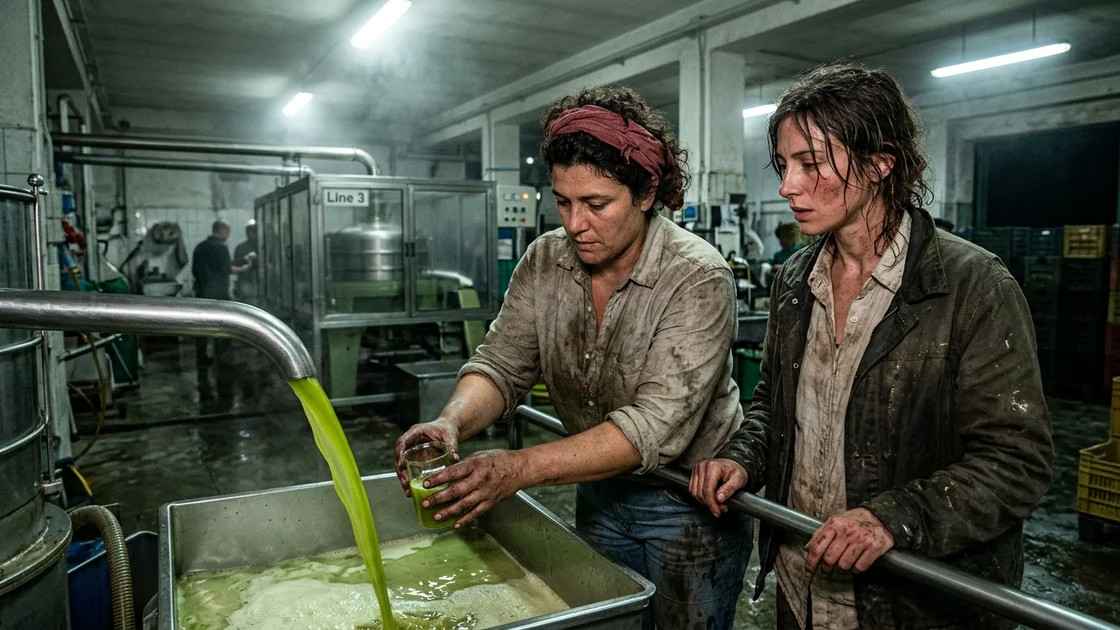
Allegra Vitucci returns to her ancestral estate in the sunbaked plains of Puglia after the catastrophic collapse of her New York business venture, seeking quiet refuge only to find her aging grandmother has ceded full control of the harvest to Marta De Santis, a fiercely obstinate local whose traditional methods clash violently with Allegra's corporate instincts until the brutal realities of the autumn picking force both women to reckon with what it truly means to preserve something fragile.
I. The Dust of the Strada Provinciale
The rental car, a tinny Fiat Panda with a groaning gearbox, shuddered as Allegra steered it off the asphalt and onto the unpaved lane leading toward Masseria Vitucci. Fine white dust rose behind the rear wheels in a chalky plume, coating the wild fennel and the low, sprawling brambles of caper bushes that choked the ditches. Through the cracked passenger window, the air tasted of baked limestone, dry rosemary, and the faint, unmistakable brine carried inland from the Adriatic, just six miles to the east.
It was October, yet the heat still clung to the earth like an iron weight.
Allegra rested her knuckles against the steering wheel, her thumbs tracing the smooth simulated leather. Her fingernails were manicured in a sheer, milky pink—the quiet, expensive sort of finish favored by women who spent their Tuesday mornings in minimalist co-working lofts in Dumbo. Two weeks ago, those nails had tapped out urgent, increasingly desperate emails to angel investors who had already stopped opening her attachments. One week ago, they had signed the final dissolution paperwork for Olea & Co., the boutique subscription platform she had spent four years, eight hundred thousand dollars of other people’s money, and eighteen hours a day attempting to build into a lifestyle empire.
The collapse had not been gentle. It had not been an orderly winding down accompanied by tasteful LinkedIn essays about the invaluable lessons of early-stage failure. It had been a sudden, ugly shearing: supply-chain defaults in Valencia, a catastrophic warehouse fire in New Jersey that invalidated her underinsured inventory, and an acrimonious split with a business partner whose family had hired litigators before the smoke had even settled. When the bank account finally zeroed out, Allegra had left her apartment on Bergen Street with three suitcases, a mountain of unresolved merchant debt, and a physical exhaustion so complete that her vision frequently blurred around the margins.
Puglia had seemed, from four thousand miles away, like an uninhabited painting. She had imagined her grandmother’s house as an empty, sun-bleached monastery where she might sleep twelve hours a night in a room with vaulted tufa ceilings, drinking strong espresso on the loggia and waiting for the low, hum of panic in her chest to subside.
Instead, as the Fiat cleared the final bend flanked by two leaning cypress trees, she saw that the masseria was not sleeping at all.
The wide gravel courtyard before the main whitewashed manor was choked with flatbed trailers, wooden crates stacked four high, rolls of heavy green synthetic netting, and three different tractors idling with a collective, diesel-choked roar that shook the dry air. Men and women in work boots and faded cotton shirts moved between the outbuildings like an army preparing for a siege.
Allegra killed the Fiat’s engine. The sudden silence inside the cabin was ringing and hollow.
She stepped out, her white leather sneakers sinking into the loose gravel. Immediately, the smell struck her—not the romantic, herbaceous fragrance of her childhood summers, but the pungent, fermented vinegar-and-crushed-grass tang of wet pomace and old grease.
"You're blocking the turning circle," a voice shouted in Italian from somewhere above her.
Allegra looked up, shielding her eyes against the glare.
Perched on the flat roof of the low tractor barn, holding a roll of black wire ties in one gloved hand, was a woman. She wore oil-stained denim trousers cut off at the mid-calf, heavy leather boots crusted with dry red soil, and a men's linen work shirt with the sleeves rolled past her forearms, revealing sinewy, sun-darkened skin. Her hair, thick and dark brown with curls pulled back haphazardly by a band of red cloth, was dusted with gray lichen flakes from the boughs.
"I asked you to move the Panda," the woman repeated, dropping from the flat roof onto the hood of a vintage red Massey Ferguson with an ease that suggested she did it twenty times a day. She hopped down into the dirt, landing light on her feet, and pulled off her work gloves. She was roughly Allegra’s age, perhaps a year or two older, with wide, flat cheekbones, deep-set hazel eyes, and a sharp, assessing mouth that seemed permanently braced against an insult. "The hydraulic truck from Montalbano is coming through that gate in ten minutes. If you leave that plastic toy there, he’ll take the door off."
Allegra cleared her throat, switching into the Italian of her childhood—fluent, but stiffened by years of English dominance and board meetings. "I’m Allegra Vitucci. This is my grandmother’s house."
The woman stopped five feet away. Her gaze swept over Allegra with clinical precision: the tailored linen trousers already collecting dust at the hems, the structured canvas tote bag, the oversized sunglasses resting on the bridge of her nose. There was no flicker of deference, nor even polite surprise.
"I know who you are," the woman said flatly. "Rosa said you were coming. She didn’t say you were coming today."
"The flight was early," Allegra said, her instincts bristling at the woman's posture. "And you are?"
"Marta," the woman said, tucking her gloves into her back pocket. "Marta De Santis. I run the harvest."
"My grandmother runs the harvest," Allegra corrected automatically. "She has for forty years."
Marta let out a single, humorless breath through her nose. "Your grandmother is seventy-nine years old, has fluid in her left knee, and can’t climb the stone steps to the attic without leaning on Cosimo. She hasn't run a harvest since the drought of twenty-twenty." She turned away, whistling sharply between two fingers toward a young man hauling a stack of crates toward the back terrace. "Gianni! Not under the fig tree! The sap will drip onto the mesh! Move them to the north wall!"
Allegra stood frozen in the glare. She had been prepared for sadness, for decay, perhaps even for the melancholic solitude of an aging relative. She had not been prepared to be dismissed in her own family’s courtyard by someone wearing trousers held up by a strip of nylon rope.
"Where is my grandmother?" Allegra asked, keeping her tone measured, the voice she had used when explaining to venture associates why their quarterly burn rate was perfectly under control.
"Inside. Sleeping," Marta said over her shoulder as she walked toward the tractor. "The doctor came from Fasano this morning to drain her joint. Leave your bags in the hall, move your car behind the sheep pen, and don't touch the crates under the portico. They’ve already been weighed."
II. The Ledger on the Kitchen Table
The interior of the masseria was ten degrees cooler than the courtyard, smelling of damp limestone, dried mint, and the lavender beeswax her grandmother had used on the walnut credenzas since the nineteen-sixties.
Allegra found Rosa in the small sitting room off the winter kitchen, her leg propped on a low stool covered with a frayed kilim cushion. A heavy bandage was wrapped from mid-calf to thigh beneath her floral housedress. On the low table beside her sat an untouched cup of chamomile tea and a thick, blue-covered notebook filled with cramped, spidery handwriting.
"Allegra," the old woman said, holding out two dry, liver-spotted hands. Her skin felt like tissue paper stretched over bird bones. "Look at you. You’re like an almond tree in January. Nothing on you."
Allegra knelt beside the chair, resting her cheek against her grandmother’s knee, inhaling the familiar scent of almond soap and camphor. For the first time in six months, the knot behind her ribs loosened slightly, though her eyes remained dry. In New York, she had mastered the art of not crying; tears were a physical expenditure of energy she could not afford.
"I'm fine, Nonna. Just tired."
"You lost the company," Rosa said plainly. It was not an accusation; it was merely a statement of weather, like noting the wind had turned north.
"Yes."
"And the money?"
"All of it. Most of mine, and all of theirs."
Rosa nodded slowly, her fingers stroking Allegra’s hair, untangling the knots left by the coastal wind. "Well. It is better to lose money than to lose your legs. Or your head. Or your name."
"My name isn't worth much in New York right now," Allegra murmured.
"New York is a fantasy made of glass," Rosa spat softly. "People who live in glass towers should expect the wind to break them. Here, the stones have stayed where my great-grandfather laid them. They don't blow away."
Allegra sat back on the floor, looking around the room. Through the high, narrow window, the relentless mechanical thrum of the harvest filtered in—the cough of a diesel engine, the shouting of men, the hollow thwack of plastic rakes hitting wooden boxes.
"Who is that girl outside?" Allegra asked. "Marta."
Rosa’s face shifted, the lines around her mouth deepening with a complex mixture of exhaustion and stubborn affection. "Marta is the granddaughter of old Pietro De Santis. You remember him? He had the three fingers on his left hand from the threshing accident in seventy-four."
"I remember the farm down the road. The one with the ruined trullo."
"That's them. When Pietro died, the land was split between four cousins who all lived in Turin and worked for Fiat. They didn't want the trees. They wanted to sell to the solar company to put down those black mirrors that boil the earth. Marta bought out their shares with a loan from the cooperative. Then she came to me three years ago, when my hip first went bad." Rosa tapped her knee with a knuckle. "She knows the trees, Allegra. She knows them better than I do now. She can tell if a branch has the fly before the leaf even turns yellow."
"She acts like she owns the place," Allegra said, unable to hide the irritation in her voice.
"She acts like someone who doesn't want to starve," Rosa replied, her sharp, dark eyes fixing on Allegra with sudden intensity. "She has twenty hectares of her own and thirty of ours to harvest in twenty days. If the rains come early from the mountains, the fruit drops. If the fruit drops, the acidity rises. If the acidity rises, we sell it to the refinery for lamp oil at forty cents a liter, and then I can't pay the taxes on this house, and she can't pay the interest to the bank. She doesn't have time to kiss your cheek and ask about the airplanes."
Allegra felt the blood rise to her ears. "I know how agriculture works, Nonna. I ran a food business."
"You ran a telephone business," Rosa said, dismissive. "You sat in an office and bought oil from Spain in metal cans and put pretty stickers on them for people who have more money than brains. That is not the harvest."
The old woman reached for the blue notebook on the table and pushed it into Allegra’s lap.
"Look at that," Rosa said. "Those are the weights from the south grove. Two years ago: four hundred quintals. Last year: two hundred and eighty. This year, if we get two hundred, we will light a candle to San Trifone."
Allegra opened the book. The numbers were written in blue ballpoint, scratched out, rewritten, smeared with grease. Her modern, analytical brain took over automatically. She saw the trajectory instantly: declining yield, erratic maintenance costs, an absurdly high labor-to-output ratio.
"Why are the costs up forty percent if the yield is down?" Allegra asked, pointing to a column.
"The blight," Rosa said, her voice dropping an octave, losing its brisk edge. "Not here yet, thanks to God and the wind. But it is in Gallipoli. It is in Lecce. Millions of trees, Allegra. Dead. Gray like skeletons. To keep it away, you have to spray the vector, you have to till the soil three times between May and August to kill the spittlebug nymphs, you have to prune every dry twig so the wood can breathe. Marta works twelve hours a day just cleaning the bark. If you want to help, do not sit in here feeling sorry for your empty pockets. Go out there and look at the books with her. She wants to take the south grove down to the wood."
"Down to the wood?" Allegra frowned. "Hard pruning? In an off-year?"
"She says they need light. I say she will kill them." Rosa leaned back against her pillows, closing her eyes. Her skin looked pale beneath the yellow cast of the incandescent lamp. "Fight it out between yourselves. I am tired of shouting at her, and she is too stubborn to listen to an old woman with one leg."
III. The Battle of the Crates
The south grove, known as Il Chiuso, was walled on all four sides by dry limestone rocks stacked without mortar—muretti a secco that had stood since the Bourbon kings ruled Naples. Inside the enclosure grew eighty trees, each one between three and six centuries old. Their trunks were not straight columns but gargantuan, contorted sculptures: hollowed out by time, braided like muscular ropes, leaning at impossible angles as if frozen mid-stride across the terra rossa.
Allegra walked along the stone path, her laptop tucked into an old leather shoulder bag, her high-end running shoes crunching on the fallen leaves and small, bitter wild figs.
The sound of the motorized shaking rakes was deafening here. Two workers, young men with dark skin and wool beanies despite the afternoon heat, were using long carbon-fiber poles tipped with vibrating plastic tines. They plunged the tines into the upper branches of an ancient tree. The leaves hissed violently, and a torrential hail of hard, purple-black and pale green olives rained down onto the vast expanse of nylon netting spread across the ground.
At the base of the tree, Marta was on her knees, rapidly separating snapped branches and clumps of leaves from the fallen fruit before dragging the net toward the center to funnel the olives into shallow, ventilated plastic crates.
Allegra stopped at the edge of the net. "You're harvesting too early."
Marta did not look up. Her hands, calloused and stained a dark, purplish-brown at the cuticles, moved with the speed of an industrial loom. "The Ogliarola variety starts dropping on Sunday. The wind is shifting to the scirocco. Warm and wet. If they stay on the branches three more days in that humidity, the olive fly will wake up and lay in every single drupe."
"The oil yield will be under twelve percent," Allegra said, stepping onto the clean ground just clear of the mesh. "I ran the numbers from the last three years in the masseria’s ledger. If you wait twelve days, until the end of the month, the fruit matures, the oil content rises to eighteen percent, and your total volume goes up by a third. We're losing thousands of liters of oil by picking green."
Marta paused. She sat back on her heels, resting her wrists on her knees. A streak of dry dirt ran across her forehead where she had wiped away sweat with her arm. She looked at Allegra with an expression of weary incredulity.
"You want volume," Marta said.
"Of course I want volume. Volume is what pays the amortized cost of the pickers and the pressing fees at the cooperative."
"The cooperative," Marta spat the word out like a cherry pit. "You think I take this fruit to the cooperative mill in Ostuni? To let them dump our Coratina and Ogliarola into the same pit as the rotten windfalls from the industrial farms in Cerignola? To let them pasteurize it and press it at thirty-five degrees so it smells like warm hay and cardboard?"
"The cooperative pays forty cents above the spot price for bulk organic certified," Allegra said, her New York tone hardening. "I looked at the invoices from last November. You sold sixty percent of the estate’s yield to a private mill in Cisternino for thirty percent less than the cooperative was offering."
Marta stood up slowly. She was half a head shorter than Allegra, but her shoulders were broad, her center of gravity low and immovable, anchored to the red earth like the roots of the trees around them.
"The mill in Cisternino has a two-phase continuous extraction system," Marta said, speaking slowly, as if addressing a child who had wandered into an engine room. "No added water. Cold extraction at twenty-three degrees. Nitrogen blankets over the malaxers so the paste never touches oxygen. It gives an oil with seven hundred milligrams of polyphenols per kilo. It burns your throat like black pepper when you swallow it. It stays green in the dark for two years."
"And nobody outside of four restaurants in Bari is willing to pay the price to cover that cost," Allegra countered, unzipping her bag and pulling out a tablet. "I looked at your accounts receivable. You have sixteen thousand euros in unpaid product sitting in a distributor’s warehouse in Monopoli because you refused to lower your wholesale bottle price to meet the market."
Marta’s eyes narrowed into slits. "Your grandmother told you to go through my books?"
"This isn't your books, Marta. This is Masseria Vitucci. My great-grandfather planted thirty of these trees. My grandfather died on that tractor over there. My family has carried the debt on this land through two wars and three recessions. You are a contractor."
A silence fell between them, so sudden that the rattle of the pneumatic rake thirty yards away sounded like an insect drumming against a windowpane. The two migrant workers stopped their machine, glancing nervously toward the two women before pretending to examine the fuel line of their compressor.
Marta did not flinch. Her face remained set in hard, dry lines, but Allegra caught a sudden, brief tightening around her jaw—the look of a person who had been hit precisely where she expected to be hit.
"Your grandfather," Marta said, her voice dangerously quiet, "was a good man. But he died twenty years ago. And since then, who pruned these limbs? Who spent five weeks every February in the freezing rain cutting out the dead wood with a handsaw so the heart rot wouldn't take them? Who came out here with copper sulfate at midnight to save the saplings when the hail shredded the bark?" She took two steps forward, closing the distance between them until Allegra could smell the sour work-sweat and the bitter resin of bruised leaves on her clothes. "You were in Milan. You were in London. You were in New York, drinking cocktails made of things that grow in South America and putting pictures of our landscape on your internet website to sell face cream."
"I was running an import business," Allegra said, her voice wavering despite her best efforts.
"You were running away," Marta said flatly. "And now you've run back because your play-money ran out. But you don't come into this grove and tell me to let my fruit rot on the branch so you can show a prettier number on your little television."
Marta turned her back on Allegra, bending down to seize the corners of the harvest net. "Gianni! Carmelo! Stop standing there like two statues of salt! Start the engine! We have twenty trees to strip before the sun hits the wall!"
The rake sputtered back to life, its vicious, rhythmic hammering drowning out anything Allegra might have said in reply. Allegra stood on the path for a long moment, the tablet heavy and useless in her hand, feeling ridiculous in her clean white shoes.
IV. The Anatomy of Terra Rossa
By the third day, the scirocco had arrived.
The sky over the Valle d'Itria was not blue, but a flat, suffocating yellow-white, thick with dust blown across the sea from the Libyan desert. The humidity hung like a wet wool blanket over the groves, making every breath taste of iron and grit. The ground, usually cracked and brittle, turned sticky underfoot—the red clay adhering to soles in thick, greasy cakes that doubled the weight of every step.
Allegra woke at five in the morning, her sleep broken by dreams of creditors standing outside her Brooklyn brownstone with clipboards.
She walked down to the kitchen in the dark. The house was cold, but the light over the stove was already on. Marta was sitting at the wooden table, a thick white ceramic bowl of black coffee between her hands. She wore the same patched denim trousers, but her eyes were bloodshot, the skin under them bruised with fatigue. Across from her, spread over the oilcloth, were three soil-testing kits and several plastic bags containing clipped branches.
Allegra stopped in the doorway. She had planned to avoid Marta entirely, intending to spend the day in the masseria’s small library reconciling the paper receipts from the local agricultural supply store against Rosa’s bank statements.
"If you're going to make tea, don't use the small copper kettle," Marta said without looking up from her papers. "The bottom has a pinhole. It will put out the flame and fill the kitchen with gas."
"Thank you," Allegra said stiffly. She pulled a ceramic mug from the shelf and filled it from the electric pot Rosa kept by the sink.
She stood against the counter, watching Marta. The younger woman was carefully examining a section of an olive twig under an illuminated jeweler's loupe. Her fingers were remarkably steady, despite their roughness.
"What is that?" Allegra asked, curiosity overcoming her pride.
"A cutting from the eastern boundary," Marta said. Her voice lacked the sharp combativeness of the day before; she sounded merely drained, the flat realism of dawn stripping away the posturing. "Near the road to Carovigno."
"Is it the bug?"
"Not the bug. The symptom." Marta slid the twig across the table toward Allegra, setting the loupe beside it. "Look at the junction between the leaf stem and the twig."
Allegra hesitated, then pulled a chair out and sat down. She pressed the loupe to her eye and leaned over the wood.
Under the magnified light, the bark looked like an elephant’s hide, gray and furrowed. But near the base of the leaf, there was a tiny, desiccated brown collar. The leaf itself was not whole; its tip was bleached of all chlorophyll, withered into the color of dried tobacco, while the base remained a sickly, mottled green.
"Desiccation," Allegra murmured. "The complesso del disseccamento rapido."
"Xylella," Marta said the name like a curse. "The bacteria blocks the xylem vessels. The tree thinks it's dying of thirst, even if its roots are sitting in water. It starts at the tips of the youngest shoots and works backward into the main scaffold. Within two years, a tree that has lived through the Venetian Republic and the unification of Italy is just a pile of dry firewood."
Allegra set the loupe down. The sight of the infected shoot produced a strange, cold sinking in her stomach—a sensation eerily similar to the moment her chief financial officer had handed her the audit report showing their third-party logistics provider had been fabricating shipping manifests for five months.
"Is the whole row like this?" Allegra asked.
"Just three trees so far. Near the highway. It comes with the wind from the cars, or the trucks carrying unwashed wood from the south." Marta rubbed her temples with both hands, leaving faint smudges of graphite on her skin. "If the agricultural inspectors see this, they’ll issue an eradication order. Not just for the three trees. For every host plant within a fifty-meter radius. That means twelve monumentals. Trees that were bearing fruit when Caravaggio was killing people in Rome."
"You can't hide it," Allegra said instinctively. "It's a quarantine disease. If you don't report it and it spreads into the valley—"
"I know the law," Marta snapped, her head coming up. "Do you think I’m an idiot? I’ve been to the conferences in Bari. I’ve read the papers from the agronomy institute. Eradication doesn't work once the vector is established. They cut down twenty thousand trees in Lecce, and the line still moved twenty kilometers north every spring. The only thing that saves the trees is grafting resistant scions—Leccino or Favolosa—onto the old trunks, or spraying with bio-deterrents and aggressive pruning to keep the bacterial load below the lethal threshold."
"That costs money," Allegra said. "Grafting eighty mature trees takes years. And specialized labor."
"Everything costs money," Marta said, her voice dropping into a hollow register. "Which brings us back to your little spreadsheet. If I don't pick this fruit today, before the storm breaks, there is no money. Not for grafting. Not for copper. Not for the taxes. Not for your grandmother's medicine."
Allegra looked at the cutting on the table. In New York, failure had meant embarrassment, broken contracts, the loss of an abstract digital footprint that could be erased by deleting an application from a server. It had been devastating to her ego, her status, her credit score.
Here, failure smelled of dead wood. It meant ancient, living things, quiet witnesses to five centuries of human smallness, being chopped down by men in white Tyvek suits and fed into industrial woodchippers to be burned in a ditch.
"How many people do you have today?" Allegra asked suddenly.
Marta blinked, taken aback by the shift in tone. "Six. Three on the nets, two on the rakes, one driving the tractor."
"Seven," Allegra said, standing up.
Marta looked at her, her expression shifting from surprise to open skepticism. "What?"
"Seven people. I’m coming with you."
Marta let out a short, dry bark of laughter. "You? In those clothes? Allegra, you have never pulled a net in your life."
"I was raised on this farm until I was twelve," Allegra said, her chin coming up. "I know how to drag a net. I know how to clear the stones so the mesh doesn't tear. And unlike you, I understand that if we lose this harvest, this house gets sold to a German dentist who will turn the oil cellar into an infinity pool."
Marta stared at her for five seconds, her hazel eyes searching Allegra’s face for any sign of hesitation. Allegra did not blink. She held the other woman's gaze with the cold, stubborn obstinacy she had inherited from the woman sleeping in the next room.
"Go find some of Rosa’s old boots in the cantina," Marta said finally, standing up and clearing the twigs from the table. "The red ones with the cracked heels. If you wear those white slippers into the red grove today, you won't have shoes by lunchtime."
V. The Weight of the Boughs
The physical reality of the harvest was nothing like Allegra remembered.
As a child, the harvest had been a festival: she had run through the fallen nets, gathering handfuls of cool, firm olives into wicker baskets, eating warm focaccia drenched in fresh oil brought to the fields in greaseproof paper by her aunts. It had seemed like an afternoon game played under a benevolent autumn sun.
At seven-thirty in the morning, under the sulfurous, suffocating yellow sky of the scirocco, it was manual warfare.
The ground in the Chiuso grove was not flat. It was an obstacle course of jagged limestone outcroppings, low stone walls, and deep holes dug by wild boars. The nets, each one forty meters long and eight meters wide, were made of heavy, woven polyethylene. When dry, they were awkward; soaked with the morning’s clammy condensation and dragged over the red clay, they weighed as much as wet carpets.
Allegra’s job was to work opposite Marta, hauling the heavy trailing edge of the net beneath each tree as the mechanical rakes moved ahead of them.
"Lift, don't drag!" Marta yelled over the roar of the compressor. She was thirty feet away, her body bent at a forty-five-degree angle as she seized the reinforced hem of the green fabric. "If you drag it over the tufa, you shred the fibers! Then the olives fall through the holes into the grass! Lift from your legs!"
Allegra hauled upward. The strain hit her lower back immediately, a sharp, hot needle between her vertebrae. Her palms, unaccustomed to anything rougher than a ceramic coffee cup or a laptop keyboard, burned through the thin canvas garden gloves she had found in the scullery.
The rake above her was an instrument of pure violence. Carmelo, a young man from the village with arms like ham hocks, thrust the vibrating carbon-fiber head deep into the canopy. The tree thrashed as if caught in a localized hurricane. Leaves, dry twigs, spiderwebs, dust, and thousands of hard, heavy little drupes rained down in a blinding, stinging torrent.
Olives struck Allegra’s face, bouncing off her cheekbones and forehead like hail. Dust coated her sweaty neck, turning into a gritty paste that chafed against her collar.
"Keep moving!" Marta barked. She was already knee-deep in the netting, her fingers working like pistons to scoop the fruit inward, her face expressionless, completely focused on the mechanical rhythm of the work. "The rake moves in two minutes! Funnel them!"
Allegra dropped to her knees on the red earth. She grabbed the edges of the net, pulling it into a V-shape, her fingers digging through the carpet of olives to flick away rotten wood, stones, and the heavy olive leaves that would choke the cleaning grate at the mill.
The smell was overwhelming: crushed green flesh, damp moss, the metallic tang of machinery, and the sweet, almost sickening rot of overripe windfalls from the previous week.
By ten o'clock, the heat was intolerable. The scirocco did not bring a breeze; it brought an airless, stagnant pressure that made Allegra’s temples throb with every heartbeat. Her shoulders were a solid knot of screaming muscle. The skin on her right heel had rubbed raw inside Rosa’s oversized rubber boots, the friction burning like an open flame with every step.
At noon, the compressor died.
The sudden cessation of the noise was like plunging underwater. The pickers—Gianni, Carmelo, and two older men from the neighboring village—collapsed immediately into the shade of the limestone wall, their chests heaving, their shirts black with sweat. They opened plastic bottles of mineral water, drinking in long, desperate gulps that spilled down their chins.
Allegra sat down on an overturned plastic crate. Her hands were shaking so violently she could barely untie the laces of her boots. When she pulled her right foot out, her sock was stained with a dark, circular patch of blood.
Marta walked over, carrying an aluminum jug of cold water and two tin cups. She handed one to Allegra without a word.
Allegra took it. Her throat felt as if it had been scrubbed with sandpaper. She drank the water too fast; it hit her stomach with an icy shock that made her gasp.
"Your hands are soft," Marta said, sitting down on the dry-stone wall three feet away. She was not looking at Allegra’s face; she was looking at her fingers, where the canvas gloves had worn through at the thumbs, revealing pale, blistered skin smeared with red mud.
"They'll get hard," Allegra said, her voice hoarse.
"No, they won't," Marta said casually, dipping a tin cup into the jug. "You'll be gone in two weeks. A person doesn't grow calluses in two weeks. They just get infections."
Allegra set the tin cup down on the ground. A sudden, vicious surge of anger flared through her fatigue, burning hotter than the blisters on her feet.
"Why do you hate me so much?" Allegra demanded, her voice cracking slightly. "I haven't done anything to you. I came back to my family's house because my life fell apart. Is that what you want to hear? I have no money. I have a court summons waiting for me in Manhattan. I failed. Does that make you feel better about breaking your back out here for forty euros a day?"
Marta stopped with the cup halfway to her mouth. She turned her head slowly, her hazel eyes cold and steady beneath the tangle of dust-covered curls.
"I don't hate you, Allegra," she said quietly. "I don't care enough about you to hate you."
"Then why every word? Why the sneer every time I open my mouth?"
"Because you think this is a choice," Marta said, gesturing with the tin cup toward the vast, silent expanse of ancient trees surrounding them. "You think you can come here and treat this place like a retirement home or a museum. You talk about business models and spreadsheets like the land is something you can balance on a balance sheet. You failed in New York? Fine. You go back to New York, you get another job, you find another idiot with a million dollars to invest in your ideas. But if this harvest fails, these trees don't get another job. They die. Rosa loses the farm. I lose the grove I spent seven years of my life paying the bank for."
Marta set the cup down on the limestone capstone of the wall. She leaned forward, her elbows on her knees, her voice dropping into a low, fierce murmur that did not carry to the men resting by the tractor.
"You look at these trees and you see your grandfather's romantic legacy," Marta continued. "I look at them and I see seventy thousand hours of work that can be wiped out in one season by a bacterium carried by a bug smaller than a grain of rice. We don't have room for people who are just 'resting.' If you are here, you pull the net. If you don't want to pull the net, get in your little car and go sit in a cafe in Lecce until the fruit is in the tanks."
Allegra stared at her. The anger in her chest did not dissipate, but it transformed, crystallizing into something colder, harder, and infinitely more dangerous: resolve.
She pulled her bleeding heel back into the damp rubber boot, grimacing as the rough interior scraped the raw flesh. She stood up, her legs trembling slightly under her weight, and grabbed her work gloves from the crate.
"The rake has been off for fifteen minutes," Allegra said, looking down at Marta. "Are we picking the west row, or are we going to sit here talking about how tragic your life is until the rain starts?"
For the first time since Allegra had arrived, the corner of Marta’s mouth twitched—not quite a smile, but an involuntary concession of ground.
She stood up, tossing the dregs of her cup onto the dry grass. "Carmelo! Start the compressor! The signorina from America wants to work!"
VI. The Breaking of the Press
The storm did not break gently. It hit at four in the afternoon with the sudden, violent fury characteristic of autumn on the Pugliese coast.
The scirocco collapsed under a wall of cold, black clouds rolling in from the north—the tramontana rushing down across the Adriatic from the Balkans. Within ten minutes, the temperature plunged fifteen degrees. The sky turned the color of bruised slate, and the wind began to scream through the crowns of the olive trees, tearing off leaves and sending showers of fruit crashing to the ground before the rakes could reach them.
"Pack the nets!" Marta screamed through the howling wind, her hair whipping wildly across her face. "Don't worry about the branches! Just get the fruit into the crates! Gianni, get the trailer into the path!"
The rain followed immediately: thick, icy, horizontal sheets that turned the dry red soil into slick, greasy mud within seconds.
Allegra threw herself onto the heavy netting, her fingers numb with cold, hauling the edges together to prevent the gathered olives from being swept away by the torrents of water beginning to carve channels through the earth. Her clothes were soaked through in an instant; her linen shirt clung to her ribs like ice water, her teeth chattering so hard she bit the inside of her lip.
"Lift!" she shouted at Carmelo, grabbing the heavy plastic crate already half-filled with fruit.
Together, slipping in the mud, they heaved the thirty-kilo crate onto the bed of the tractor trailer. Allegra’s arms felt as if they were being pulled from their sockets. Her knuckles were skinned and bleeding where she had scraped them against the rough plastic, but she barely felt the pain through the cold.
By five-thirty, eighty crates were loaded onto the two trailers, covered with heavy tarpaulins tied down with rope. The trees behind them stood stripped, their silver-green foliage battered by the downpour, standing like shivering ghosts in the gathering gloom.
"We go to the mill now," Marta shouted, wiping rain from her eyes as she stood on the hitch of the tractor.
"Now?" Allegra yelled back through the roar of the downpour. "It's almost six! The cooperative is closed!"
"I told you, we don't go to the cooperative!" Marta jumped down, her boots splashing into four inches of red soup. "We go to Frantoio San Vito in Cisternino. Gianfranco keeps the presses running all night during the storm. If we leave these wet olives in the crates until morning, they will ferment. The acidity will spike by midnight. We press them now, or we throw them away!"
"The Fiat won't make it up the hill to Cisternino in this rain!" Allegra said, pointing toward the flooded lane where her rental car sat half-submerged in mud.
"Then get in the tractor cabin!" Marta climbed into the small, glassed-in cab of the Massey Ferguson. "Move, Allegra! The engine is running!"
The tractor cab was built for one person. Allegra squeezed herself onto the narrow metal toolbox behind the driver’s seat, her knees pressed against the back of Marta’s shoulder, her wet hair dripping down her neck. The interior smelled intensely of damp wool, diesel fuel, stale tobacco, and the warm, sharp scent of their own exhausted bodies.
The engine roared, a deafening mechanical scream that vibrated directly through the steel floorboards into Allegra’s bones. The tractor lurched forward, its huge, cleated tires churning through the red mud, hauling the two heavy trailers out of the grove and onto the narrow provincial road that wound upward toward the white hill town of Cisternino.
Outside, the darkness was absolute, broken only by the two yellow beams of the tractor’s headlights cutting through the blinding deluge. The windshield wipers swept back and forth with a rhythmic, straining squeak, barely clearing the torrents of water cascading down the glass.
Marta drove with a grim, total concentration. Her hands on the large black steering wheel were constantly correcting, fighting the weight of the trailers as they threatened to slide on the rain-slicked asphalt.
"How much will Gianfranco charge?" Allegra asked, raising her voice above the engine’s shriek.
"Eighteen euros a quintal," Marta said, not taking her eyes off the road.
"You don't have eighteen euros a quintal," Allegra said. "I looked at the bank statement this morning before we went out. The balance on the harvest account is seven hundred euros. You have two hundred quintals on those trailers. That's thirty-six hundred euros."
Marta’s jaw tightened. A muscle jumped in her cheek. "I have four thousand liters of certified extra virgin from last year stored in the masseria’s stainless steel tanks. I’m trading him two thousand liters of bulk stock for the milling fees."
Allegra felt a cold shock that had nothing to do with the rain. "You can't do that. That bulk stock is the collateral for the seasonal loan Rosa took from the Banca di Credito Cooperativo in May. If the bank inspectors come to audit the cellar and find the tanks empty, they will call the loan immediately. They’ll seize the estate’s land."
Marta turned her head sharply, her eyes flashing in the dashboard light. "And what should I have done? Let the fruit drop? Let the pickers go home without their day's wages? Carmelo has two children, Allegra. Gianni’s father is in a home in Brindisi. If I don't pay them on Saturday, they don't eat. Do you understand that? The bank doesn't care about the rain. The bank doesn't care about the fly. The bank only cares about papers. I care about the people who are in the mud with me!"
"You're operating like a peasant in the nineteenth century!" Allegra shouted, leaning forward until her face was inches from Marta’s ear. "You think you’re being noble, sacrificing the reserves to keep the harvest going, but you’re just digging a deeper hole! If you lose the land, where do Carmelo and Gianni work next year? Who hires them then? The solar company? They’ll bring in Romanian contractors with excavators and pave the whole valley!"
Marta slammed her hand against the steering wheel. "Then tell me what to do, genius! You have the big degree! You have the fancy clothes! What is the solution? Where is the money?"
"You don't trade the bulk stock!" Allegra yelled back. "You sell the future! We bottle the new oil under our own label—Masseria Vitucci—tonight. We don't sell it in bulk to Gianfranco for four euros a liter so he can blend it with Tuscan oil and sell it for thirty. We sell the first-press, cold-extracted, high-polyphenol oil directly to the specialty importers in Germany and New York who are waiting for the novello!"
"The direct market takes six months to pay!" Marta barked. "We need cash on Monday!"
"I still have the distribution contacts," Allegra said, her voice dropping, steadying, taking on the crisp, precise authority that had once convinced Manhattan hedge-fund managers to write half-million-dollar checks. "The business failed, Marta, but the buyers didn't die. Dean & DeLuca is gone, but the high-end specialty houses in Tribeca, the private clubs in Mayfair, the specialty grocers in Zurich—they pay upfront for olio novello if the provenance is verified and the acidity is below zero-point-two. I can pre-sell thirty percent of this pressing by midnight on my phone."
Marta glanced at her in the dim light of the cabin, her expression a battleground between suspicion and desperate hope. "You're lying. You're trying to save your family's name with more ghost-money."
"I am not lying," Allegra said, her voice quiet now, cold as the tramontana wind beating against the glass. "I lost everything I had because I trusted people who didn't know what they were doing. But I know this market. I know what wealthy, bored people in cold cities will pay for something that tastes like it came from an ancient garden that survived the Roman Empire. Let me handle the commercialization. You handle the trees."
Marta looked back at the road. The tractor was beginning the steep ascent toward Cisternino, its tires slipping slightly on the wet cobblestones as they entered the outskirts of the town.
"Gianfranco won't press without a guarantee," Marta said softly.
"I have my mother’s watch in my bag," Allegra said. "A Cartier Tank. Solid gold. It was the only thing I didn't hand over to the bankruptcy liquidator. It’s worth six thousand euros at any pawnshop in Bari. I’ll leave it on his desk."
Marta stayed silent for a long time. The only sound was the roar of the tractor and the steady, rhythmic thump of the wipers.
"The watch is that important to you?" Marta asked finally.
"It was my mother's," Allegra said. "It's the only thing I have left that didn't come from a creditor."
Marta reached down to the gear lever, shifting into low range as the incline steepened. "Keep the watch. We will tell Gianfranco that if he doesn't press tonight, I will tell his wife who he was with in Monopoli during the feast of San Rocco."
Allegra blinked, stunned. Then, against every instinct of self-preservation, exhausted and soaked to the bone, she let out a short, hysterical laugh.
Marta looked at her, and this time, the smile was real—crooked, sharp, and fierce as a drawn blade.
VII. The Green Stream
Frantoio San Vito was a cavernous hall of corrugated steel and damp concrete, illuminated by flickering fluorescent tubes that hummed with a low, electrical buzz.
Despite the storm, the place was in the grip of a feverish, industrial frenzy. Four tractors were lined up outside the receiving bay, their engines rumbling, their trailers dripping red water onto the pavement. Inside, the noise was absolute: the rattle of conveyor belts carrying thousands of small green and black drupes into the de-leafing machines, the deafening roar of the washing baths, the deep, gut-shaking bass of the hammer crushers pulverizing fruit, pit, and flesh into a thick, purple-brown mash.
The air inside was so thick with the aerosolized mist of crushed olives that Allegra could feel a greasy film settling on her skin and eyelashes within five minutes. It was warm, sweet, pungent, and intensely green—the smell of a thousand crushed meadows concentrated into an industrial vapor.
Gianfranco, a round, bald man with a mustache that looked like a shoe brush and an apron soaked in brown oil-sludge, stood behind a high metal desk covered in clipboards and espresso cups.
"No," he said, waving his hands in the air before Marta had even cleared the door. "No, no, no. Marta, go home. Look at this floor! I have eight hundred quintals from the cooperative in Fasano waiting in the yard. The power flickered twice during the thunder. If the main transformer blows, the malaxers stop, and two tons of paste will go rancid inside the drums. I'm not taking any more fruit tonight."
Marta stepped up to the desk. She did not raise her voice; she leaned across the metal counter, her face inches from Gianfranco’s.
"Gianfranco," she said, her voice dropping into a dialect so thick and rapid Allegra could only catch every third word. "Look at me. Look at my hands. We picked the Chiuso today. Eighty crates of ancient Ogliarola and Coratina. Picked by hand in the storm. If they sit until morning, the water from the rain will start fermentation in the crates. You know what that fruit is. You pressed my father’s trees. You pressed my grandfather’s trees."
"Marta, the line is full—"
"You have line number three," Marta pointed toward a sleek, stainless steel series of enclosed tanks at the back of the hall—the modern cold-extraction system. "It's empty. You’re saving it for the organic crop from the Masseria San Domenico tomorrow morning."
"That is contracted!" Gianfranco yelled. "Ten thousand euros of certified oil!"
Allegra stepped forward. She pulled her phone from her pocket. The screen was cracked, but the battery held at twelve percent. She had found a spot of weak LTE signal near the receiving door.
"Signor Gianfranco," Allegra said, her voice carrying through the hall with the sharp, resonant clarity of a boardroom presentation.
Gianfranco blinked at her, his eyes taking in her mud-splattered linen trousers, her soaked shirt, and the unmistakably aristocratic line of her jaw. "And who is this? Another one of your cousins from Turin?"
"I am Allegra Vitucci," she said, stepping to the side of the desk. "My grandmother is Rosa Vitucci."
Gianfranco’s expression softened slightly, shifting into the guarded respect the older locals reserved for the old landowners. "Donna Rosa’s granddaughter. The one in America."
"The one in America," Allegra confirmed. She held out her phone. On the screen was an open email chain with a confirmation receipt from an import logistics brokerage in Frankfurt. "I have just closed a pre-harvest contract for eighteen hundred liters of single-estate, high-polyphenol monocultivar from Masseria Vitucci. At twenty-two euros a liter. Bottled and packaged at the source."
Gianfranco stared at the screen. His eyes squinted at the numbers. "Twenty-two euros? Nobody pays twenty-two euros for bulk."
"It's not bulk," Allegra said. "It's estate-bottled novello. We are using line three. We will run it cold—twenty-two degrees, nitrogen blanketed, forty-five minutes of malaxation maximum. We pay your premium milling fee: twenty-five euros a quintal. Cash transfer on Monday morning directly from Frankfurt into your company’s account at the Credito Agrario. I have the billing code right here."
Gianfranco looked between Allegra and Marta. Marta stood with her arms crossed, her face a mask of iron certainty, not revealing by so much as a twitch of an eyelid that Allegra was currently operating on pure, reckless bravado.
The mill owner let out a long, wheezing sigh, pulling a soiled rag from his apron to wipe his bald crown.
"The crates must be unloaded in fifteen minutes," he grunted, slamming an empty receipt pad onto the counter. "If your trailer blocks the bay when the truck from Pezze di Greco arrives, I will dump your olives into the compost pit. Line three. Go."
VIII. The Night at the Centrifuge
They worked until two in the morning.
While the mechanical de-leafer stripped the remaining foliage and twigs from the fruit, Allegra and Marta stood at the edge of the vibrating wash table, their hands plunging into the cold, churning water to pull out stones, pieces of snail shells, and stray boughs that could damage the stainless steel blades of the hammer crusher.
Allegra’s hands had long since passed the point of pain; they were numb, white, and pricked with dozens of tiny wood splinters. Her lower back was a dull, throbbing column of ache. Yet, as the hours wore on under the hum of the fluorescent tubes, the frantic, jagged anxiety that had lived behind her ribs for six months began to recede, replaced by a strange, hypnotic clarity.
There was no ambiguity here. There were no secondary metrics, no retention curves, no customer acquisition costs to be massaged for a pitch deck. There were only the olives, the water, the steel, and the oil.
Around midnight, their fruit reached the malaxers—horizontal stainless steel troughs where slowly rotating spiral blades kneaded the crushed olive paste, allowing the microscopic droplets of oil to coalesce into larger ribbons.
Marta stood by the digital control panel, her eyes fixed on the temperature readout: 21.8°C.
"If it goes over twenty-three, the aromatics burn off," she murmured, her voice barely audible above the machine's drone. "The polyphenols survive, but you lose the scent of green tomato leaf. You lose the fresh artichoke. It just becomes fat."
"It's holding," Allegra said, leaning against the steel railing beside her.
They stood shoulder to shoulder in the narrow walkway between the malaxer and the vertical centrifuge. The air was cold now, the dampness of the hall seeping through their wet clothes, but neither of them moved toward the small gas heater Gianfranco had set up near the office.
"Your mother's watch," Marta said suddenly, staring at the swirling brown paste through the glass inspection port. "Why did you keep it when everything else went?"
Allegra looked at her bare wrist, where a pale strip of skin showed where the gold bracelet had rested for ten years. "My mother died when I was nine. She was twenty-nine years old. Just younger than I am now."
Marta glanced at her, her eyes softened by the dim light.
"She hated the masseria," Allegra continued, surprised at the lack of bitterness in her own voice. "She thought Puglia was a trap. A place where women grew old at thirty, washing bedsheets in copper cauldrons and drying figs on wooden boards while their husbands sat in the piazza drinking bitter herb liqueur. She moved to Milan to work for a fashion house. She bought that watch with her first bonus check. To prove she didn't belong to the red dirt anymore."
"And you?" Marta asked.
"I thought she was right," Allegra said. "I went to London. I went to New York. I wanted to build something that didn't have mud on it. Something clean. Something made of numbers and design." She looked down at her hands, stained a deep, indelible purplish-brown at the knuckles. "It turns out numbers blow away just as fast as the dust."
Marta was silent for a long time. The machine hummed between them, a deep, resonant vibration that seemed to rise through the soles of their boots into their chests.
"My father," Marta said slowly, "tried to leave. In the nineties. He went to work at the steel plant in Taranto. The Ilva."
Allegra looked up. Every person in Puglia knew about the Ilva: the gargantuan, smoke-belching steelworks that had poisoned the air of the Ionian coast for fifty years, trading industrial employment for the highest pediatric cancer rates in Italy.
"He stayed four years," Marta continued, her voice devoid of self-pity, factual and flat. "Then he came back. He had a cough that never went away, and he couldn't stand the smell of the coke ovens. He told me that in Taranto, you work eight hours a day to make iron that goes to build bridges you will never see, for people who don't know your name, and when you die, the company hires your cousin the next morning. Here..." She gestured toward the enclosed centrifuge ahead of them. "The work is hard. Sometimes it breaks your back. Sometimes the bank takes your tractor. But when you make the oil, it is yours. It has your name on it. It goes into the blood of the people who eat it. You cannot be replaced by an algorithm."
The centrifuge gave a sudden, high-pitched mechanical whine as the separation cycle began.
The vertical drum, spinning at six thousand revolutions per minute, separated the heavy vegetable water and the solid pomace from the lighter, pure oil by centrifugal force.
Marta stepped down the metal stairs to the discharge spout, picking up a clean glass beaker from the rack. Allegra followed her, her breath catching in her throat.
For a moment, nothing happened. The machine shrieked, the pump shuddered, and then, from the curved stainless steel pipe, the oil emerged.
It did not look like the golden, translucent liquid sold in rectangular cans in Manhattan supermarkets. It was thick, opaque, and a brilliant, shocking, radioactive green—the color of crushed grass, of young wheat shoots in April, of emeralds beaten into a heavy cream. A pale, creamy froth rose to the surface as it cascaded into the stainless steel receiving vessel with a heavy, musical splash.
Marta held the beaker beneath the stream, catching three inches of the warm, fresh liquid.
She turned to Allegra. The fierce, combative woman of the courtyard was gone; in her place was someone transformed by a quiet, reverent intensity that bordered on the holy.
"Taste," Marta said, holding out the glass.
Allegra took it. The beaker was warm against her chilled palms. She brought it to her nose.
The fragrance rose instantly, striking her with the force of an actual blow: wild grass, raw green artichoke, tomato leaves crushed between fingers, green almonds, and the faint, stony mineral scent of limestone heated by the sun and then washed by the rain.
She took a small sip, drawing air through her teeth in the strippaggio technique her grandfather had taught her thirty years ago, spraying the oil across the palate and the back of her tongue.
The first sensation was sweet and unctuous, coating the mouth with a velvet thickness. Then came the bitterness—the intense, astringent, noble bitterness of green olives picked before their time, reminiscent of wild chicory and dandelion greens. And finally, as she swallowed, the pepper hit: a sharp, violent, burning kick at the back of her throat that made her cough three times, her eyes watering.
"Seven hundred polyphenols," Marta said, a fierce, triumphant grin breaking across her tired face. "Maybe eight hundred."
Allegra wiped a tear from the corner of her eye with the back of her stained wrist. The burn in her throat was hot, clean, and real. It felt like fire clearing away a field of dead grass.
"It's magnificent," Allegra whispered.
Marta took the glass from her hands and took a long sip herself, letting the oil coat her tongue, closing her eyes as she swallowed. She did not cough; her throat was seasoned to the bite.
"It's not magnificent," Marta said, opening her eyes, her gaze locking onto Allegra’s with a clarity that seemed to burn through the fluorescent gloom of the mill. "It's ours. It's Masseria Vitucci. Now go call your Germans before the market opens in Frankfurt."
IX. The Light on the Trullo
The morning after the harvest was silent.
The tramontana had swept the yellow dust from the sky, leaving the air washed, cold, and diamond-clear. The light that broke over the Valle d'Itria was the pure, pale gold of late autumn, casting long, sharp shadows from the dry-stone walls across the glistening red earth.
Allegra walked out onto the roof terrace of the masseria, carrying a thick white ceramic mug of black coffee.
Her body felt as if it had been beaten with wooden clubs. Every muscle in her thighs, her back, and her shoulders protested with each step. Her right heel was thickly bandaged with clean gauze, and her fingers were stiff and dark with tree-sap that would take three weeks of soap and lemon juice to completely fade.
Down in the courtyard, the trailers were parked neatly against the barn wall, their beds washed clean of mud, the synthetic nets hung over the stone balustrades to dry in the morning sun.
On the wooden table beneath the pergola sat three large, stainless steel jugs—the fiaschi containing the first pressing of the olio novello, sealed with wax and labeled by hand with Rosa’s spidery handwriting.
Beside them lay Allegra’s laptop.
On the screen was a confirmed wire transfer: four thousand eight hundred euros, an advance payment from an organic specialty consortium in Munich for the first four hundred bottles. It was not enough to pay off the bankruptcy debt in New York. It was not enough to buy a new tractor or build an automated bottling line.
It was enough to pay Carmelo and Gianni their wages on Saturday. It was enough to buy the copper sulfate to protect the eastern boundary against the fly. It was enough to pay the interest to the Banca di Credito Cooperativo for three more months.
The iron gate at the entrance to the courtyard creaked open.
Marta walked in, leading an old, sway-backed mule carrying two wooden panniers filled with pruning saws, heavy loppers, and a bundle of fresh scions wrapped in wet burlap. She had washed her face; her hair was pulled back neatly into a thick, dark plait, though she still wore the same patched denim trousers and the heavy, crusted leather boots.
She stopped in the center of the gravel circle and looked up at the terrace.
Allegra looked down at her, holding her coffee mug with both hands, the steam rising into the cold morning air.
For a long moment, neither of them spoke. The valley around them was waking up: the distant, hollow barking of a sheepdog from a farm two miles away, the church bells of Carovigno ringing eight times for morning mass, the rustle of the dry leaves in the fig tree by the wall.
"The agronomist is coming from Bari at ten," Marta called up, her voice clear and steady in the crisp air. "To look at the cuttings on the eastern road."
"I know," Allegra said. "I spoke to him on the phone at seven. He agrees with the Leccino grafting. He says the resistance is stable in the young wood."
Marta adjusted the strap of the pannier on the mule’s flank. "It's two weeks of work. We have to cut the old scaffolds down to four feet and notch the bark before the frost gets into the cambium."
"I have boots that fit," Allegra said. "Nonna found my grandfather’s old work shoes in the cellar. They're leather. No rubber."
Marta looked at her, her hazel eyes narrowing slightly against the horizontal glare of the morning sun. She did not smile, but the hard, guarded line of her shoulders relaxed, an imperceptible yielding of territory that had been fought for, yard by yard, through the red mud.
"The left heel on those old boots is loose," Marta said, turning the mule toward the path that led to the Chiuso. "Bring the hammer from the kitchen table before you come down. If you don't nail it before we hit the rocks, you'll walk like a cripple all day."
Allegra watched her walk down the lane, the mule’s iron shoes clicking rhythmically against the exposed limestone bedrock.
She took a sip of the coffee. It was bitter, hot, and strong.
She turned back toward the door of the terrace, leaving the laptop open on the table, where the little green light on the wireless card blinked steadily against the cold, ancient stones of the wall.