The Art of Inpainting
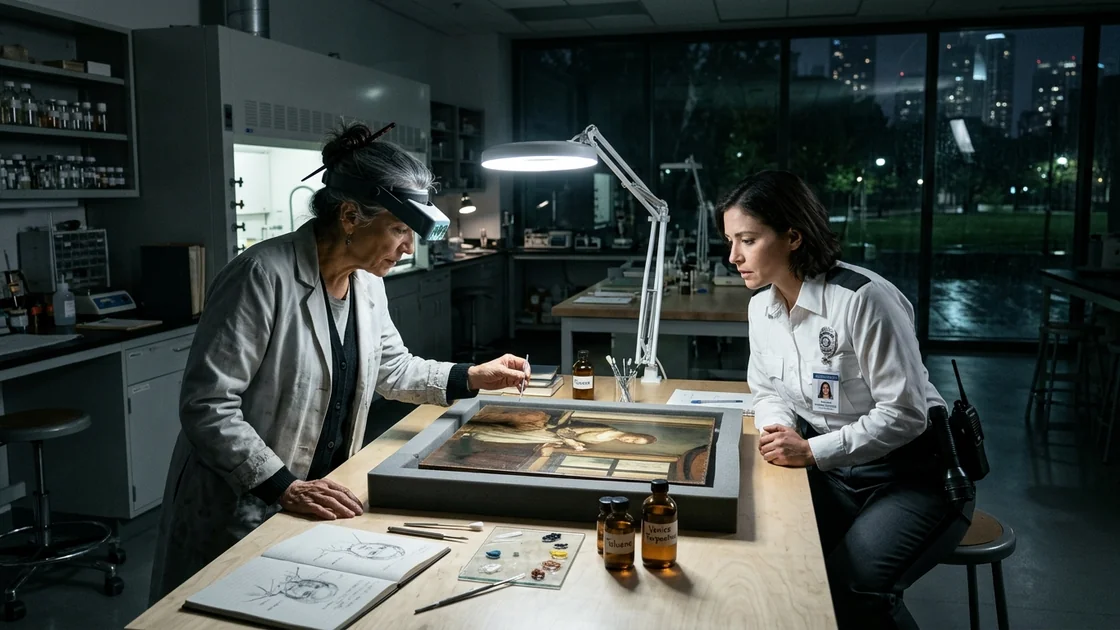
Following the bitter dissolution of her twelve-year marriage, Elena Vance retreats from her former social life and accepts an unglamorous night-shift post as a security guard at the St. Jude City Museum of Fine Arts. Wandering the cavernous, darkened galleries between midnight and dawn, she struggles with the silence left in the wake of her divorce until she encounters Dr. Martha Reyes, the museum head of paintings conservation who works through the night in an illuminated glass-walled lab. Over the course of a damp, quiet winter spent sharing thermos coffee, observing the delicate surgical restoration of centuries-old masterpieces, and weathering a severe storm that cuts power to the city, the two women forge an unexpected bond that teaches Elena to view her own life not as a ruin, but as a surface capable of patient, invisible repair.
I. The Architecture of Silence
The badge was laminated plastic with a dull nickel clip, and the photograph printed upon it was overexposed, rendering Elena Vance’s face the color of skim milk. Beneath the likeness, bold black lettering read: E. VANCE — SECURITY SERVICES.
Her uniform consisted of charcoal trousers woven from a stiff, unyielding blend of polyester and nylon, a white button-down shirt with reinforced epaulets that perpetually caught her chin when she turned her neck too quickly, and a pair of black rubber-soled oxfords chosen specifically for their ability to traverse polished terrazzo without squeaking. The soles made a low, dry whisper with every stride—shk, shk, shk—a sound that, within her first three weeks on the shift, had replaced the interior monologue that once governed her life.
Elena worked the graveyard rotation: eleven o’clock at night until seven o’clock in the morning, five nights a week, with Tuesdays and Wednesdays off.
In the daylight world she had abandoned, people assumed the shift was an act of desperation or penance. When the divorce papers had finally been stamped by the county clerk in mid-October—putting an end to fourteen months of contentious depositions regarding Julian’s equity partnerships, the equity in the Victorian brownstone they had renovated down to the lath, and the custody of an art collection Julian had insisted on assembling as an asset class—her friends from the neighborhood had spoken to her in hushed, convalescent tones. They brought her sourdough bread wrapped in tea towels; they offered her the guest rooms of their summer houses in the Berkshires; they suggested therapy, coastal retreats, and pottery classes.
None of them understood that what Elena craved was not restoration through sunlight and gentle inquiry, but complete, uncompromising disappearance.
The St. Jude City Museum of Fine Arts occupied four limestone city blocks on the edge of the public park. Designed in the late nineteenth century by an architect who believed that civic virtue could be coerced through neoclassical grandeur, it boasted thirty-foot vaulted ceilings, monolithic Corinthian columns carved from Indiana limestone, and sixty-two distinct galleries connected by archways so massive they felt like portals between centuries. At noon, the building was an echo chamber of school tours, tourist whispers, squealing strollers, and the low, collective shuffle of thousands of curious feet.
At 1:15 in the morning, it was an ocean trench.
Elena’s route began at the basement security desk, a windowless bunker lit by the bluish glare of sixteen monitor screens. From there, her key fob gave her access to the North Stairwell, where the air grew cooler and smelled faintly of floor wax, chilled stone, and the ozone emitted by the colossal air-handling systems hidden behind the faux-classical walls. She had to clock in at seventeen electronic checkpoints per round, touching her wand to brass sensor disks embedded flush into the plaster beside archways.
Her first round of the night took eighty minutes. She walked through the Flemish Masters, where heavy oak frames held scenes of frozen canals and bruised winter skies; through the Dutch Portraits, where merchants with starched ruffs stared into the gloom with eyes picked out in flecks of lead white; through the 18th-century French salons, where gilded chairs sat roped off on aubusson carpets, looking like exquisite, abandoned furniture from an aristocratic shipwreck.
The art did not terrify her in the dark, as she had feared it might during her first orientation shift. In daylight, paintings were assertions—they demanded attention, interpretation, money, and reverence. At night, without the track lighting focused on their varnished skins, they receded into their pigments. They became objects made of wood, linen, dried oil, and ground earth. They rested.
Julian had loved art only when someone else was looking at it with him. He had been a collector who memorized provenance records so he could recite them at dinner parties, casually dropping the names of dealers in Zurich and Basel while carving duck breast. Toward the end of their marriage, when the silence between them had hardened into something brittle and jagged, he had purchased a small, dark oil study by a minor Barbizon painter. He had spent forty thousand dollars on it, not because he loved the muddy twilight or the bent silhouette of the peasant gathering sticks, but because the dealer had told him an investment fund was buying up the artist’s work.
"It’s an anchor piece, Elena," Julian had told her, standing in the library with his whiskey glass reflecting the study’s gold frame. "A defensive hedge against the market."
She had looked at the peasant in the painting and thought only of the weight of the sticks on the woman’s back. Two months later, Elena had found the text messages on the family iPad—messages that proved Julian’s defensive hedges were not limited to the international art market, but extended to a junior associate in his private-equity firm who was young enough to have never heard of the Barbizon school.
Now, as her rubber soles moved across the gallery floor, Julian’s voice had shrunk to a faint, irrelevant buzzing, drowned out by the cavernous stillness of the museum.
She tapped her wand against checkpoint seven: the threshold of the Modern and Contemporary Wing.
Here, the architecture shifted violently. The nineteenth-century stone gave way to poured concrete, sheetrock, and steel. The ceilings soared higher, and the air felt different—drier, scrubbed clean by dedicated HEPA filters designed to prevent the off-gassing of modern adhesives and synthetic polymers from attacking fragile mixed-media installations.
At the far end of the mezzanine hung an enormous canvas by an abstract expressionist who had drowned himself in the Mediterranean in 1961. It was ten feet high and fourteen feet wide, covered in violent swathes of Prussian blue and soot black, interrupted only by a single, raw gash of raw-umber linen exposed by a drywall scraper. The label on the wall identified it as Lamentation No. 4.
Elena stood before it every night at 2:10 AM.
She did not know if she liked it, but she respected its lack of courtesy. It made no effort to be charming. It did not pretend that the world was composed of symmetrical gardens or women with pearl earrings peeling apples by leaded windows. It was simply five yards of heavy duck canvas that had survived someone’s nervous breakdown.
She raised her wand to the brass sensor near the fire exit, heard the soft, high-pitched chirp of verification, and turned toward the glass skybridge that connected the main exhibition halls to the administrative and scientific annex.
The skybridge was the only place in the museum where the outside world broke through. To her left, through floor-to-ceiling panes of plate glass, the city park lay stretched beneath a canopy of wet, bare maples, the streetlights reflecting in yellow splotches off the wet asphalt of the paths. Far beyond the trees, the skyline of the financial district rose like a grid of cold crystal, dotted with the sporadic red lights of antenna towers.
And there, forty feet across the courtyard in the third-floor annex, burned the only light in the entire complex that never went out.
It was the Conservation Laboratory.
Through the plate glass, Elena could see into the room as if looking into a brightly illuminated aquarium. The walls were painted a matte, clinical white. Suspended from the ceiling were articulating articulated armatures carrying massive daylight-balanced lamps, their hoods casting circles of pure, shadowless brilliance over broad tables made of birch and steel.
Bent over one of those tables, her silver-streaked hair tied into a loose knot with what appeared to be an ebony chopstick, was a woman in a pale gray lab coat.
Elena had seen her on the duty roster: Dr. M. Reyes, Head of Paintings Conservation.
While the rest of the museum staff departed at five in the afternoon, their departure marked by the chatter of the revolving doors and the clatter of umbrellas in the foyer, Dr. Reyes had an irregular, phantom schedule. Sometimes she was gone for three days; sometimes her car—a battered, forest-green Volvo wagon with a dented tailgate—remained in the loading dock for seventy-two hours straight.
Elena paused on the skybridge, her breath clouding slightly against the cold perimeter glass.
Inside the lab, Dr. Reyes was working. She held a long, slender instrument—perhaps an air-eraser, or a micro-scalpel—with the stillness of a vascular surgeon. She did not look up when the wind gusted against the exterior glass. She did not look at her watch. She was utterly subsumed by whatever microscopic square inch of history lay pinned beneath her lens.
Elena watched her for nearly two minutes. There was something profoundly restful about the scene: the solitary woman, the pool of pure light, the total suspension of frantic human urgency. In a world where Julian had spent every waking hour checking his portfolio, texting his broker, and measuring his life in basis points and billable units, this woman was spending the middle of the night measuring time in microns.
The radio on Elena’s hip gave a burst of static.
"Vance," crackled the voice of Frank, the desk sergeant downstairs. "You at Checkpoint Nine yet?"
Elena reached down and pressed the talk button. "Just crossing the bridge, Frank. Running two minutes behind. Paused to check the seal on the terrace doors."
"Don't linger on the bridge," Frank muttered, his voice thick with half-chewed sunflower seeds. "The glass makes you a target for every drunk in the park with a slingshot. Keep moving."
"Understood," Elena said. She took one last look at the woman in the gray coat, then stepped off the bridge and let the heavy, climate-controlled darkness of the annex corridor swallow her whole.
II. Solvents and Scapels
The encounter occurred on a Thursday in late November, the night after the first freezing rain had turned the limestone cornices into combs of ice.
Elena was on her second patrol, around 3:45 AM. The annex smelled sharply of something chemical—a dry, sweetish aroma that reminded her of almond paste mixed with turpentine. As she approached the frosted-glass double doors of the conservation department, she found the left-hand leaf propped open two inches with a rubber doorstop.
This was a violation of security protocol. All laboratory doors were to remain locked, latched, and armed with magnetic contacts during non-public hours.
Elena unclipped her heavy Maglite from her belt, not turning it on—the hall was dimly lit by emergency troffers—and approached the gap. She peered through.
The lab was immense, filled with equipment that seemed halfway between an artist's studio and a modern operating theater. Tall shelves held amber glass bottles with ground-glass stoppers, labeled in neat hand with black India ink: Cyclododecane, Toluene, Stoddard Solvent, Venice Turpentine, Dammar. Along the far wall stood a fume extraction hood with clear acrylic sashes, its motorized vents humming at a frequency so low it was felt in the solar plexus rather than heard.
At the central table, Dr. Reyes was not working. She was standing with her hands on her hips, swearing with quiet, devastating precision in Spanish.
"Maldita sea... el calor residual," she muttered. She reached for a pair of stainless-steel tweezers, stopped, rubbed the bridge of her nose where two deep red marks indicated she had just removed heavy magnifying loupes, and then cursed again.
Elena cleared her throat. She deliberately tapped the rubber tip of her Maglite against the doorframe to announce her presence without startling the woman.
"Dr. Reyes?"
The conservator turned with a start. Up close, without the magnifying lenses, her face was sharper than she had appeared through the bridge glass. She had high, angular cheekbones, olive skin mapped with fine lines around the eyes and mouth, and dark, hooded irises that took in Elena’s uniform, badge, and flashlight in a single, analytical sweep. She looked to be in her late fifties, with broad, competent shoulders and hands whose fingers were stained at the tips with faint yellow and violet smudges.
"Yes?" Martha’s voice was raspy, the product of decades around organic vapors and too many espresso pods. "Is the door supposed to be closed? Yes, I know. I kicked the wedge in. The exhaust trunk on the heating table is vibrating like an old blender. It’s rattling my fillings."
"It’s a security breach," Elena said gently, keeping her hands relaxed at her sides so as not to appear combative. "The contacts don't register on Frank’s board downstairs if the gap is more than an inch. He was about to send an alarm call."
Martha Reyes sighed, a sound like dry leaves scraping over concrete. "Frank thinks an unauthorized person is going to scale three stories of sheer limestone, break through double-pane laminated argon glass, and steal half a jar of rabbit-skin glue. Tell him I’m in here. Tell him I’m armed with a heated spatula."
Elena smiled despite herself. "I already logged it as an environmental check. But you should let me pull the door shut when I leave. You can keep it unlocked from the inside."
Martha looked at Elena more closely. The harsh daylight lamps made the younger woman’s cheekbones look hollow, the dark circles under her gray eyes prominent.
"You’re new," Martha said. "Not the usual boy with the earbud who listens to podcasts until his brain turns to porridge. What’s your name?"
"Elena Vance."
"Vance," Martha repeated, rolling the syllable around her mouth. "You walk differently than the others. They march like they’re trying to crush roaches. You glide. It’s annoying. I thought you were a ghost until you tapped the brass."
"I was told the terrazzo carries sound up into the administrative suites," Elena replied.
Martha scoffed. "The administrative suites are empty. The directors are all at their homes in the suburbs, sleeping under weighted blankets. Only the caretakers and the dead are here." She gestured toward the birch table. "Come here for a second, Vance. Look at this."
Protocol explicitly forbade security guards from approaching or handling conservation objects. If a conservator invited a guard to look, however, the line blurred. Elena hesitated for half a second, then unhooked her flashlight, clipped it back to her utility belt, and walked into the pool of clean, shadowless light.
On the table lay a wooden panel, perhaps twenty inches by thirty. It was cradled in a nest of gray, high-density polyethylene foam. The wood was oak, thick and dark, with the distinct, slightly bowed curve of an old panel split along its medullary rays. The painting depicted a woman seated beside an open casement window, her hands resting on a table draped in a thick Persian rug. Her face was half-turned toward the light, but the entire upper quadrant of the painting was covered in an ugly, milky, cataract-like veil.
"Sixteenth century," Martha said, pointing a stainless-steel micro-probe at the milky area. "Antwerp school. Not an important master—probably the shop of Joos van Cleve. But the wood... the wood came from the Baltic, felled around 1530. It’s survived five centuries of damp churches, Napoleonic looting, two world wars, and coal smoke."
"What’s wrong with it?" Elena asked. The sweet smell was stronger here.
"A butcher in the nineteen-fifties tried to clean it with an alkaline wash—probably ammonia mixed with linseed oil," Martha explained, her tone hardening with genuine, personal offense. "He stripped the glaze off her headdress, panicked, and then slathered the whole thing in polyurethane varnish. Polyurethane. The kind of resin you put on a bowling alley floor."
Elena leaned down slightly, keeping her arms behind her back, an instinctive posture she had developed while watching Julian arrange his precious modern ceramics on glass pedestals. "And the white cloud?"
"Moisture caught between the old oil layer and the synthetic resin. The varnish is cross-linking and pulling away from the ground, taking the paint with it. It’s choking." Martha picked up a tiny swab of cotton, wound so tightly around the end of a bamboo stick that it looked like a toothpick. "I’m using an ethanol-mineral spirit emulsion to soften the synthetic film without dissolving the original oil glazes beneath it. But the varnish has the constitution of cured tires. If I press too hard, I shear off her cheek."
Elena looked at the painted woman. Beneath the cloudy, yellowed skin of the ruined varnish, the woman’s eye was visible: a single, startling iris of deep olive-gray, rendered with three tiny dots of lead-tin yellow on the lower rim to signify tears, or perhaps simply the watery reflection of a Flemish winter sky.
"She looks patient," Elena remarked softly.
Martha glanced at her, her dark eyebrows rising slightly beneath the silver-streaked fringe of her hair. "She doesn't have a choice. She’s been sitting there since the Reformation. But patience isn't a virtue in conservation, Vance. It’s a mechanism. If you hurry, you take off five hundred years in five seconds. You can’t put it back. You can never put it back."
The word struck Elena like a small stone dropped into an empty cistern. You can never put it back.
"How long will it take?" Elena asked.
"To strip the varnish? Three months. Another two to consolidate the ground where it’s flaking along the oak joins. Then inpainting." Martha set the probe down on a porcelain tray with a sharp clink. "Do you drink coffee, Vance?"
"I have coffee in my locker," Elena said.
"That swill in the basement vending machine isn't coffee; it’s roasted chicory and boiler scale," Martha said, turning toward a small side-counter where a heavy chrome espresso machine sat beside an array of chemical-grade glassware. "Sit on that stool. Don't touch the foam cradle. If you touch the cradle, I will stab you with a number eleven scalpel."
Elena did not sit immediately. She looked back toward the frosted door. "I have eleven more checkpoints to log before 4:30."
"Frank won't die if you miss a cycle," Martha said, slamming a heavy brass portafilter into the machine with the authoritative motion of a machinist. "I’ll sign your duty log. I have more pull with the board than that retired transit cop does. Sit down."
Elena sat. The stool was high and had no back, forcing her into an upright, alert posture. For the first time since she had walked out of the domestic court three months ago with her signature dry on the decree of absolute divorce, someone was demanding her presence not for an explanation, an apology, or a legal settlement, but simply to share a room with an ancient, damaged piece of wood.
Martha set a small, heavy white ceramic cup before her. The espresso was thick, black, and carried a crema the color of roasted chestnuts.
"Drink," Martha said, leaning against the counter with her own cup. "Then tell me why a woman who uses words like 'environmental check' instead of 'the heat’s busted' is wearing fifty-dollar trousers and patrolling the floor with a seven-pound battery pack."
Elena held the cup in both hands. The porcelain was scalding, and she welcomed the pain in her palms.
"I needed the dark," Elena said.
Martha took a slow sip, her eyes narrowing as she studied Elena over the rim. "The dark is full of things that rot, Vance."
"No," Elena said, looking toward the Flemish woman on the table. "The dark is where things don't get used up."
Martha stared at her for a long moment, then gave a single, curt nod of her chin that might have been approval, or might simply have been an acknowledgment of a shared diagnostic truth.
"Fair enough," the conservator said. "Now finish your cup. You have six minutes before your patrol timer flags you as missing in action, and I have to take two millimeters of petroleum off a Dutchwoman’s forehead."
III. The Principle of Reversibility
December arrived with a sequence of dry, Siberian cold fronts that froze the city into brittle immobility. The museum was kept at a strict sixty-eight degrees Fahrenheit and fifty percent relative humidity, a microclimate maintained by enormous steam humidifiers that groaned through the ductwork like sleeping whales.
Elena’s routine changed, almost imperceptibly at first.
Her shift still began at eleven. She still took the log from Frank, who smelled increasingly of menthol lozenges and damp wool as the winter deepened. She still walked the four miles of galleries on her first round, her rubber soles whispering against the stone. But by 2:30 AM, she found herself timing her circuit so that her inspection of the third-floor annex coincided with Martha’s night break.
It was not a formal arrangement. Some nights, Martha was absent, her lab darkened, the oak panel shrouded beneath a sheet of anti-static silicone release paper. On those nights, Elena felt a sudden, hollow dropping in her stomach that she refused to name. She would stand before the glass for thirty seconds, log the checkpoint, and move on through the nineteenth-century portrait galleries, where the Victorian children with their hoops and collies seemed suddenly insipid, their painted faces slick and fraudulent.
Other nights, the light was on, and the heavy door was left unlatched by exactly half an inch.
Elena would enter, hang her flashlight on the wall peg beside the coats, and sit on the backless stool. Sometimes they spoke very little. Martha would work under the green shade of a binocular microscope, her right hand moving in micro-increments, cleaning away the yellowed degradation of time with tiny swabs dampened in solvent mixtures she mixed herself like an alchemist: isopropanol, deionized water, ammonium citrate.
"Smell this," Martha said one night in mid-December, holding out an amber vial toward Elena.
Elena leaned in and sniffed. It smelled like nothing she had ever encountered: damp earth, old honey, and something vaguely medicinal, like dried orange peel preserved in salt.
"What is it?"
"Venice turpentine," Martha said. "Larch resin. Gathered from Larix decidua in the Tyrol. It was used in varnishes four hundred years ago to give depth to glazes. It never really dries; it just thickens into a golden gel that catches the sun." She capped the vial. "Smells like a forest that died before the Industrial Revolution."
"Julian collected nineteenth-century landscapes," Elena found herself saying. It was the first time she had spoken his name aloud in the museum.
Martha didn't look up from her microscope. "Did he?"
"Barbizon. Corot disciples. Daubigny. He liked them because the appraisals kept pace with inflation."
"An idiot, then," Martha said flatly.
Elena let out a short, startled laugh. "He was a partner at a private equity firm. He wasn't an idiot."
"A financial technician, then," Martha amended, her scalpel scraping with a rhythmic shick-shick-shick against the panel edge. "It’s the same thing. People who look at paintings as financial instruments don't see them at all. They see a certificate of deposit made of flax. If you gave him a piece of raw titanium with a barcode that yielded eight percent annually, he would have hung it over the fireplace and told his guests it was profound."
Elena looked down at her hands. The skin around her cuticles was dry and split from the museum’s conditioned air. "He used to tell me I had no head for value."
"Value is an invention of people who want to sell things they didn't make," Martha replied. She leaned back from the microscope, took off her glasses, and let them dangle from a cord around her neck. "Look at this panel. The Antwerp master was paid forty guilders for it. That was about the price of two fat cows and a barrel of salt herring. Then it was owned by a guild, then an alderman, then a textile merchant in Ghent, then an English duke who went bankrupt on the railways, then an industrialist in Cleveland who gave it to this museum for a tax deduction. Who gave it value? The duke? The industrialist? Van Cleve gave it form; the rest just passed the receipt around."
She reached for a sketchbook on the table—a large, ledger-style book with heavy, off-white rag paper. She turned it toward Elena.
In it were meticulous technical drawings. Not artistic sketches, but forensic diagrams. Martha had mapped the Antwerp panel into a grid of one-centimeter squares. In each square, she had recorded the layer structure: Support (Baltic Oak), Ground (Chalk/Glue), Imprimatura (Lead White/Umber), Paint Film, Early Restoration Varnish, Secondary Varnish.
Beside certain squares, she had written notes in her tiny, spidery script: Loss of glazes due to past over-cleaning. Pentimento visible in lower drapery—artist originally drew the hand three inches higher, holding a pomander.
"A pentimento?" Elena asked, tracing the word with her finger, careful not to touch the ink.
"Italian for 'repentance,'" Martha said. "From pentirsi. It’s when the painter changes his mind. He paints out an arm, a dog, a hat, a doorway. He covers it with opaque color. But as oil paint ages, it oxidizes. It becomes more translucent with every century. The index of refraction changes. And after three or four hundred years, the under-drawing begins to ghost back through. The artist’s second thoughts become visible."
Elena looked from the drawing to the panel. "He changed his mind about what she was holding."
"Yes. A pomander was a scented ball used to ward off the plague. Maybe the client didn't want to be reminded of sickness. Or maybe the composition was too crowded. So he covered it with the Persian rug. But look there—" Martha pointed with a blunt finger at the dark fringe of the carpet. "Turn your head sideways against the raking light."
Elena stood and bent low, her eyes level with the surface of the painting.
Beneath the intricate, knotted pattern of the red and green wool, a faint, circular shadow was rising through the centuries like a drowned object surfacing in muddy water. It was the pomander: a small, spherical cage of silver, ghostly and unmistakable.
"It’s like a secret," Elena whispered.
"It’s not a secret; it’s an edit," Martha said. "We all have them. You think you’ve settled on a composition for your life. You paint over the parts that don't work with something solid—a husband, a four-story house, a series of dinner parties where people discuss municipal bonds. You think it’s opaque. But you get older, Vance. Your varnish thins out. And the thing you thought you buried comes right back up to the surface."
Elena stood up straight. Her uniform shirt felt stiff against her chest. "Julian hated changes. If an architect made a mistake on the crown moldings, he made them tear the whole room down to the studs."
"Julian sounds like a miserable bastard who should have lived in a Tupperware container," Martha said matter-of-factly, reaching for her teapot. "He would have lasted twenty minutes in conservation. Our first law is the Principle of Reversibility."
"Reversibility?"
"Everything we do must be undoable," Martha said, pouring hot water over a measure of loose oolong tea in a glass pot. "If I put an adhesive into a crack, it must be an adhesive that some conservator fifty years from now can dissolve with a solvent that won't harm the original paint. If I inpaint a missing eye, my paint must sit on top of an isolation varnish, soluble in something totally different from the original egg tempera or oil. We do not make permanent marks. We don't have the right."
Elena watched the dried tea leaves unfurl in the amber water, swirling as the heat penetrated their curled tissues.
"Why?"
"Because we are arrogant, but we aren't stupid," Martha said. "Every generation thinks it has the definitive taste, the ultimate science, the perfect technique. In the nineteenth century, they cleaned canvases with stale bread and sulfuric acid. In the nineteen-thirties, they ironed wax-resin mixtures into the backs of linen canvases with twelve-pound pressing irons, flattening the impasto until Rembrandt looked like linoleum. If those treatments weren't reversible, the paintings would be dead."
She pushed a mug across the counter toward Elena.
"You don't fix something by conquering it, Vance. You stabilize it. You give it a structural crutch that can be taken away when someone smarter than you comes along with better tools."
Elena wrapped her fingers around the warm glass. The wind was rising outside, rattling the heavy double glazing of the skybridge.
"Julian said our marriage wasn't fixable," she said, her voice dropping so low it was almost lost beneath the hum of the fume extractor. "He said it had suffered structural failure."
"Did he use those words?"
"Yes. In the mediator's office. He took out an ink pen—a Montblanc he bought in Munich—and drew a triangle on a yellow legal pad. He labeled the points: Financial Alignment, Intellectual Parity, Domestic Stability. Then he crossed out the line between parity and stability. He said, 'The geometry has collapsed, Elena. There’s no legal or emotional logic in reinforcing a bad frame.'"
Martha was silent for several beats. She picked up her tea, took a sip, and set the mug down with a deliberate, heavy thud.
"A triangle," Martha said, her tone dripping with venom. "A man who thinks human devotion is an exercise in basic Euclidean geometry. I’ll tell you what’s wrong with your husband, Vance. He was an amateur. An amateur looks at a cracked panel and sees firewood. A master looks at it and sees the tree it was cut from, the humidity that bent it, and the joinery that can hold it together for another two hundred years."
She reached across the table, grabbed Elena’s wrist, and pulled her hand forward.
Martha’s skin was rough, calloused from tools and dry from alcohol washes, but her grip was astonishingly strong. She turned Elena’s hand over so the palm faced upward toward the surgical daylight.
"You’re thirty-six? Thirty-seven?"
"Thirty-eight," Elena said.
"Thirty-eight," Martha repeated. "You have thirty years of work left before your hands start to shake like mine. Stop acting like you’re a fresco that fell off a wall in Pompeii. You’re just missing some varnish. Now go check your basement before Frank has an apoplexy."
IV. The Subterranean World
As December yielded to the bitter, gray freeze of January, Elena began to understand the museum not as a repository of finished masterworks, but as a hospital where hundreds of ancient patients were perpetually dying of slow, chemical diseases.
The public galleries were merely the waiting rooms. Below them lay three levels of vaults, workshops, and mechanical caverns that the visitors never imagined as they looked at the Monets.
On her Sunday shifts, when Martha was not in the laboratory, Elena explored the lower registers during her extended rounds.
Sub-basement Two held the frame shop, where a sixty-year-old Italian woodworker named Paolo spent forty hours a week carving replacement acanthus leaves out of seasoned basswood, his floor deep in curls of wood that smelled like clean pine shavings. Next to him was the gilding studio, where drafts were forbidden; a single sneeze could send fifty sheets of twenty-three-karat gold leaf—each beaten to four millionths of an inch—fluttering into the rafters like luminous moths.
Further down, in Sub-basement Three, was the "Morgue."
This was what the guards called the high-density storage bays. Massive steel racks, twenty feet high, hung from tracks in the concrete ceiling. Each rack was a grid of heavy wire mesh to which paintings were hooked by their hanging rings.
Here hung the failures, the disputed attributions, the unfashionable giants of the nineteenth-century academies. Heroic canvases of Roman gladiators, thirty feet long, that had not seen the light of day since 1914; endless portraits of forgotten Dutch burghers whose descendants had died out; sentimental Victorian scenes of children crying over dead canaries, consigned to the dark because modern curators found them embarrassing.
Elena liked the Morgue.
It was utterly silent, devoid of the forced reverence of the upper floors. Here, a canvas attributed to "Follower of Caravaggio" hung three inches away from an authentic Tiepolo sketch that was simply too dirty to hang upstairs without a half-million-dollar restoration. They hung together like coats in an overstuffed hall closet, indifferent to their status.
One night in mid-January, while Elena was checking the hygrometers in Storage Bay D, she heard footsteps behind her.
She turned quickly, her Maglite coming up automatically.
The beam caught Martha Reyes wearing an oversized alpaca cardigan over her lab coat, holding a clip-on battery lamp and a heavy ring of brass keys.
"Don't blind me, Vance. I don't have enough retinal cells left to spare."
Elena lowered the light. "What are you doing down here? It’s three in the morning."
"The Board of Trustees is having an acquisition meeting on Tuesday," Martha said, walking toward Bay D-4. "Some hedge-fund patron wants to donate an early Italian panel. A Madonna and Child. Late fourteenth century. Allegedly by Bernardo Daddi. The director wants me to sign off on the condition report so they can announce the gift with a champagne gala."
"Is it really Daddi?" Elena asked, falling into step beside her.
"Daddi’s shop, maybe. Or an exceptionally clever Sienese forger working in the nineteen-twenties with rabbit-skin glue and genuine trecento poplar planks." Martha stopped before rack forty-two, inserted a heavy key into the crank mechanism on the wall, and began to turn it.
The massive steel rack groaned, its rollers moving along the ceiling track with a heavy, metallic rattle that echoed through the concrete cavern. Slowly, the rack slid out from its bay, bringing twenty paintings into view.
Martha clipped her lamp to the wire mesh and pointed it at a small panel with an arched top, framed in a heavy, blackened shadow-box.
The painting was tiny—no larger than an octavo book. It showed the Virgin against a background of stamped, gilded gold leaf, holding a Child whose face was weirdly adult, with the solemn, omniscient stare characteristic of pre-Renaissance icons.
Martha reached into her cardigan pocket, pulled out an ultraviolet LED torch, and clicked it on.
The gold leaf went dull purple under the UV light. The Virgin’s blue mantle, which in ordinary light appeared a dark, murky navy, suddenly blossomed with violent, greenish-black blotches.
"Look there," Martha whispered, pointing with the tip of a stainless-steel spatula.
Elena leaned in. The blotches covered almost the entirety of the Virgin’s robe, her neck, and the Child’s right arm.
"Overpaint," Elena said, recognizing the diagnostic pattern Martha had shown her on the van Cleve.
"Not just overpaint," Martha said. "Modern synthetic resin. It flouresces with that distinctive sick lemon-yellow tint. The entire face of the child was repainted after 1940. Probably by a restorer named Van der Veken who worked in Brussels. He was notorious for turning damaged primitives into 'sweet' Renaissance masterpieces that American collectors would pay six figures for."
She clicked off the torch. In the dim halogen light of the aisle, the painting looked harmless again—an antique relic of medieval piety.
"What will you tell the board?" Elena asked.
"I’ll tell them the truth," Martha said, leaning her back against the adjacent rack. "I’ll tell them that forty percent of what they’re looking at was painted by an old Belgian with a cigarette hanging out of his mouth while Hitler was invading France. I’ll tell them that if they want a real Daddi, they’ll have to strip eighty percent of the panel down to bare wood and be satisfied with the three square inches of authentic drapery that’s left."
"They won't like that," Elena said.
"They will hate it," Martha replied cheerfully. "The patron will be furious. He already bought the frame. He already had his daughter write an essay about it for her private school newsletter. The director will look at me like I just spat on his cashmere coat."
"Doesn't that scare you?"
Martha turned her head, her dark eyes flashing under the industrial lights. "Vance, when you spend your life touching things that were made when the Black Death was killing half of Europe, the opinions of four men who made their money on short-term debt don't register as catastrophic. They are brief. The panel is old. My job is not to make the board feel generous. My job is to protect the timber."
She pulled the crank and began to wind the heavy rack back into its dark bay. The steel teeth engaged with a slow, grinding crunch.
"Why did you leave him?" Martha asked suddenly, her hands still turning the cast-iron wheel.
The question was so direct, so free of the tiptoeing hesitation Elena had endured from her family, that it felt like an incision rather than an interrogation.
Elena stood with her hands hooked into her utility belt.
"He stopped looking at me," Elena said simply. "He looked at the things around me. He looked at the house. He looked at the guest list. He looked at my dress to make sure the label was correct for the dinner. But when I spoke, he listened with that little pause people use when they’re waiting for an elevator. Just waiting for the door to open so they can step out and get to their business."
"And the associate?"
"The associate was just inventory," Elena said, surprised by how flat her own voice sounded. "A newer model with lower maintenance costs. He was terrified of becoming obsolete. He thought if he accumulated enough rare things, and young things, and expensive things, he wouldn't turn into a graying man with high blood pressure and an empty chest."
The rack hit the rubber stops at the back of the bay with a solid, echoing thump.
Martha locked the crank with her brass key.
"Men like that," the conservator said, wiping her fingers on her cardigan, "are like PVA glue. Cheap, quick to set, looks transparent for five years, and then turns yellow, shrinks, and splits the canvas right down the middle because it can't handle the weather."
She looked at Elena, her face softening just enough to let the warmth through the wrinkles.
"Come upstairs, Vance. I have some Spanish ham I smuggled through customs in my luggage, and some sheep’s milk cheese that smells like an uncleaned barn. We’ll eat it off the paper plates in the staff kitchenette and watch the snow fall on the roof."
V. The Great Blizzard
The storm that the meteorologists had been tracking across the Midwest arrived on the third Monday of February.
It began at nine in the morning as a dry, granular snow that drifted like sand across the park roads. By the time Elena clocked in at eleven that night, the city had entered a state of civil emergency. The subway lines had stopped running above ground; the plows had abandoned the secondary avenues; the wind was screaming through the suspension cables of the river bridges at sixty miles an hour.
The museum was closed, locked, and staffed by a skeleton crew: Frank at the main console, two junior guards stationed at the mechanical plant in the sub-basement, Elena on patrol, and Martha in the laboratory.
"You shouldn't have come in," Elena told Martha when she reached the third floor at midnight. The wind was hitting the glass skybridge with such violence that the plate glass was visibly flexing inward, shuddering against its neoprene gaskets.
"The humidity controls in the Early Netherlandish gallery are acting up," Martha said, without looking away from her hot table. She was wearing three sweaters under her lab coat and a woolen watch cap pulled down over her ears. "The boiler pressure is dropping. If the steam pressure fails, the relative humidity in Gallery 4 will drop to twenty percent in two hours. The panels will crack like biscuits."
"The city is shutting down," Elena said. "They declared a Level Three travel ban."
"Good. Then nobody will bother me."
At 1:40 AM, the lights flickered twice, turned amber, and went out entirely.
For three seconds, the museum was plunged into an absolute, suffocating darkness so total that Elena could hear the blood pumping through her own ears. Then, with a deep, subterranean roar that shook the floor plates, the auxiliary diesel generators in Sub-basement Four kicked on.
The emergency troffers along the baseboards hummed to life, casting a dim, reddish glow across the terrazzo. The main overhead lamps remained dead.
Elena’s radio crackled. "Vance! Elena!" Frank’s voice was borderline hysterical. "Generator Two didn't trip! We’ve only got forty percent power! The HVAC on the East Wing is completely down! The chiller pumps are offline!"
"Calm down, Frank," Elena said into the mic. "Are the alarms powered?"
"The perimeter is secure, but the environmental computers are rebooting! Everything’s resetting to default! You need to get down to the basement—"
"I’m with Dr. Reyes," Elena interrupted. "We’re going to secure the Netherlandish room first. Get the plant engineers on the phone."
She unclipped her heavy Maglite and twisted the bezel to full beam. A clean, blue-white spear of light cut through the gloom of the lab.
"Martha," Elena said.
Martha was already moving. She had abandoned her lab coat for a heavy down parka and was pulling on a pair of nitrile gloves. She held a crate of padded transport trays and several rolls of acid-free glassine.
"Gallery 4," Martha said, her voice stripped of all its usual sardonic leisure. "We have to take down the Memling and the van der Weyden study. If the dry air hits those thin poplar panels while the wind is blowing through the window joints, they’ll cup within forty minutes."
They ran.
There was no slow, deliberate gliding now. Their shoes pounded against the stone corridors. The museum in the near-total darkness of the emergency lights was a different continent. The paintings on the walls were shadows within shadows, their gilt frames catching the passing beam of Elena’s light like rows of gold teeth.
Gallery 4 was ice-cold.
The nineteenth-century windows facing the park were rattling in their frames, the old lead weights clattering within the jambs. A thin, powdery drift of snow was already sifting through the meeting rail of the center casement, piling in a miniature white dune on the oak parquet floor.
"Hold the light here," Martha commanded, dropping to her knees before a small triptych displayed in a freestanding glass case.
The case was locked with high-security tubular deadbolts. Elena pulled her master ring from her belt, found the brass barrel key with the blue notch, inserted it, and turned. The seal broke with a faint hiss of pressurized nitrogen.
"Careful," Martha muttered. "Take the left wing. Support the hinge with your fingers. Do not touch the painted surface. Wood only. The edges."
Elena reached into the case.
Her fingers, encased in thin cotton inspection gloves, touched the wood. It was extraordinarily light—much lighter than she had imagined. It felt like balsa, dry and ancient, vibrating faintly with the howling of the gale outside. The oak was five hundred years old. It had been carved with small gouges whose marks were still visible under her fingertips on the reverse: the marks of an apprentice’s chisel made in Bruges before Shakespeare was born.
She lifted the wing gently, taking the weight as Martha unscrewed the brass hinge pins with a magnetic driver.
"Got it," Elena said.
"Lay it in the foam. Face up. Don't let the glassine rub the varnish."
They worked in absolute synchrony, moving by the single pool of light cast by Elena’s flashlight, which she had propped upright on a gallery bench so it bounced off the plaster ceiling.
They took down the Memling: a portrait of a young man with folded hands, his face painted with such translucent clarity that even in the emergency gloom his gaze seemed more alive than anyone Elena had met that year. They took down a small, circular panel by an anonymous follower of Patinir, showing Saint Jerome in a landscape of impossible, crystalline blue mountains.
As they lifted the last panel—the central crucifixion scene of the Flemish triptych—a sudden, violent crack echoed through the room.
Elena flinched, her heart leaping into her throat.
"The window," Martha said, without looking up from her screwdriver. "The storm sash gave way."
The outer wooden shutter on the third window had broken its latch, swinging wild in the wind and smashing against the limestone exterior reveal. Glass showered into the heavy velvet drapes, and a blast of sub-zero air, thick with snow, poured into the gallery like a tidal wave of ice water.
The temperature in the room dropped ten degrees in five seconds.
"Get the triptych out!" Martha shouted over the roar of the blizzard. "Now, Elena! Move!"
Elena took the heavy central panel in her arms, pressing the wooden cradle against her chest, shielding the painted surface with her torso. The cold air hit her face like a slap, freezing the moisture in her eyelashes. She could smell the snow—metallic, pure, and terrifying—mixed with the ancient, dry smell of the oak panel.
They backed out through the gallery archway, kicking the heavy mahogany fire doors shut behind them to isolate the freezing draft.
Elena collapsed against the corridor wall, the painting held tight against her uniform shirt. Her breath was coming in ragged, white plumes.
Beside her, Martha sank to the floor, her back against the baseboard, her down parka covered in a fine skin of white crystals. She looked up at Elena, her face pale in the dim emergency light, and then, slowly, a wide, wicked grin broke across her weathered mouth.
"Well," Martha panted, pulling off her watch cap and shaking out her silver-streaked hair. "That beats the hell out of a Tuesday afternoon condition report."
Elena looked down at the panel in her arms.
Christ hung on the cross against a sky that was not black, but a deep, resonant lapis lazuli, surrounded by miniature angels whose wings were tipped with vermilion. The paint had survived the window. It had survived the draft. It had survived five hundred winters, and now it was resting against her ribs, warm from the heat of her own body through the wool and nylon of her security uniform.
She began to laugh.
She laughed until her ribs ached, until the absurdity of her former life—the mediation sessions, the divided furniture, Julian’s yellow legal pads, the polite pity of her neighbors—shriveled into something so small and ridiculous it blew away into the dark corridors of the museum.
Martha joined her, her raspy, smoke-cured laugh echoing off the marble arches until both women were sitting on the cold floor among the acid-free crates, shaking with exhaustion and hilarity while the city froze outside the limestone walls.
VI. The Anatomy of Inpainting
By March, the snow had begun to retreat, leaving the city park a gray expanse of mud, dead turf, and the sodden litter of winter.
The museum’s heating system had been repaired, the broken window in Gallery 4 replaced with triple-pane museum-grade glass, and the Antwerp panel of the woman by the window had finally shed its coat of yellowed polyurethane.
The lab was warm again.
Elena now spent the last two hours of every shift—between 5:00 and 7:00 AM—at the high birch table. Frank, who had developed a mysterious respect for Elena after the night of the blizzard when she had helped save the Memling from thermal shock, simply stopped looking at the annex logs.
"She’s with the doctor," he would tell the morning relief supervisor with a dismissive wave of his cruller. "They’re doing science."
On a Tuesday morning when the sky through the glass bridge was turning the pale, pearlescent gray of an oyster shell, Martha set a small palette before Elena.
It was a piece of plate glass, eight inches square, backed with white paper. On it were tiny mounds of dry pigment: raw umber, burnt sienna, yellow ochre, lapis lazuli, bone black, and zinc white. Beside them sat a porcelain dimple well containing an odorless, water-clear resin dissolved in mineral spirits: Paraloid B-72.
"Sit," Martha said.
Elena hung her badge on the corner of the task lamp. "You know I’m not a conservator, Martha. If the director walked in—"
"The director is at an espresso bar on Madison Avenue trying to charm eighty thousand dollars out of an heiress," Martha said. "Take this brush. It’s a triple-zero Kolinsky sable. The hair comes from the tail of a Siberian weasel. It costs more per ounce than gold."
Elena took the brush. It was lighter than an eyebrow pencil, perfectly balanced, the wooden handle worn smooth by Martha’s fingers.
"Conservation isn't magic, Elena," Martha said, standing behind her, her hand coming down firmly on Elena’s right shoulder. "It’s observation and restraint. Look at that void on the Antwerp woman’s bodice."
The polyurethane had been removed. The original paint film was now visible in all its cool, northern sobriety. But along the join of the two oak planks, where the wood had contracted and expanded over centuries, a narrow strip of paint had flaked away entirely, leaving a bare line of gray-white chalk ground about two inches long and no wider than a pencil lead.
"I’ve already isolated the loss with a coat of B-72," Martha said. "Whatever you put down can be wiped off with a single swab of petroleum benzine in thirty seconds. You can’t hurt it. Do you understand?"
"I don't want to ruin it," Elena whispered. Her fingers were trembling slightly.
"You won't ruin it. You’re going to inpaint the loss using the tratteggio technique."
"What is that?"
"Hatching," Martha explained, her voice dropping into the rhythmic, instructional cadences of a master mason. "You don't paint a solid flat stroke. You build up the color with tiny, vertical parallel lines. From four feet away—the viewing distance of a visitor—the eye mixes the lines together with the surrounding original color. The loss disappears. But if you walk up close, within six inches, the lines are immediately obvious. It shows the repair. It doesn't lie."
"Why not make it invisible?"
"Because an invisible restoration is a forgery," Martha said sharply. "We don't erase the trauma, Elena. We don't pretend the wood never split. We just restore the legibility of the image. We make it so the crack doesn't scream at you. We allow the painting to be seen again without the damage dominating the conversation."
Elena dipped the very tip of the sable brush into the resin, then touched it to the corner of the raw umber pigment. The brown powder dissolved instantly into a translucent glaze.
"Too dark," Martha corrected. "Touch it to the ochre. More. A breath of the white. Remember: dried resin has a higher refractive index than wet. It will dry slightly darker than it looks on the palette."
Elena mixed the colors on the glass plate. The gesture felt ancient, strange, and yet shockingly natural.
She held her breath. She rested the heel of her hand on a wooden bridge that Martha had placed across the painting so her skin would not touch the panel.
She brought the tip of the weasel hair down to the white line of exposed chalk ground.
One stroke. A tiny, vertical line, finer than an eyelash.
Then another, beside it.
And another.
The white gap began to soften. The harsh, jarring scar that had interrupted the deep olive-green of the woman’s velvet bodice was no longer an abyss; it was becoming a texture.
Elena’s heart, which had been hammering against her ribs, slowed its cadence. The world shrank until there was nothing in the universe except the three-millimeter tip of the brush, the wet gloss of the synthetic resin, and the grain of the Baltic oak beneath.
Julian was gone. The courtroom was gone. The legal documents, the spreadsheets, the bitter settlement meetings where they had argued over who would keep the French copper cookware and the subscription to the symphony—all of it had evaporated like volatile spirits.
There was only this tiny, damaged thing that had survived the Reformation, and the slow, infinitely patient work of bringing its surface back into balance.
"Good," Martha whispered behind her. Her hand tightened on Elena’s shoulder for an instant, warm and solid. "Keep the lines vertical. Don't cross them. Don't hurry. The shift ends at seven; the painting has five hundred years."
Elena painted.
She painted while the night guard on the floor below packed his thermos. She painted while the delivery trucks began to rumble down the avenue outside, delivering crates of milk and produce to the park cafes. She painted while the sun rose over the city skyline, its light hitting the plate glass of the skybridge and filling the laboratory with a clean, silver radiance that made the daylight lamps unnecessary.
When she finally pulled her hand back, her neck was stiff, her fingers were cramped into a claw, and the two-inch scar on the Antwerp woman’s chest was gone.
Seen from where she sat, the bodice was whole.
Elena leaned in close—inches away from the wood.
There they were: fifty tiny, precise vertical strokes of brown, gold, and white, singing in harmony with the sixteenth-century oil, distinct and proud of their own modern existence, but submissive to the whole.
Reversible. Honest. Stable.
Elena sat back on her stool and looked down at her hands. The smudges of umber on her thumb were the same color as the earth in the park.
"Look at that," Martha said, leaning over her shoulder and handing her an espresso cup that was steaming into the morning air. "You’re an inpainter, Vance."
Elena took the cup. She looked out through the glass walls toward the city, where the morning commuters were already beginning to pour out of the subway kiosks, their heads bent against the wind, their faces tight with hurry.
She was not going back to them. Not in the way she had lived before.
She had three years of night-shift differential pay saved. She had a bachelor's degree in art history that Julian had always referred to as an "ornamental qualification." And she had two hands that had learned how to hold a number-zero brush without shaking.
"Martha," Elena said.
"Yes?"
"Do they offer classes in paper conservation at the Institute across the park?"
Martha picked up a glass rod and stirred her own tea, a slow, knowing smile working its way into the corners of her eyes.
"They do," Martha said. "The tuition is outrageous, the prerequisite chemistry is brutal, and the professors are all pedantic lunatics who care more about watermarks than human souls."
"Good," Elena said, taking a sip of the scalding, dark coffee. "I think I’d like that very much."
VII. The Ground Layer
Spring arrived in the final week of April, not with gentle moderation, but with an explosive, humid greenness that broke through the city’s concrete like dandelions through asphalt.
Elena’s life had assumed a new, strange geometry.
She slept from eight in the morning until three in the afternoon in her small apartment on the fourth floor of a brick walk-up near the rail yards. The apartment was sparsely furnished: a bed, a table made from an old drafting board she had found at a salvage yard, two bookshelves filled with organic chemistry textbooks and treatises on early modern painting grounds, and a single, comfortable armchair positioned near the fire escape.
The apartment did not look like the home of Julian Vance’s former wife. There were no neutral linen curtains, no mid-century credenzas, no art chosen to impress guests.
On her walls hung three high-resolution macro-photographs Martha had printed for her on the conservation department’s large-format plotter: a cross-section of a paint chip from a Titian, showing the seven distinct strata of lead white, madder lake, and walnut oil like geological layers of the earth’s crust; a detail of craquelure from a fourteenth-century panel, resembling the dry mud of an ancient riverbed; and an infrared reflectograph of the Antwerp woman, showing the silver pomander ghosting beneath the Persian rug.
Her divorce was complete. The final check from the sale of the brownstone had been deposited into her account. She had taken fifty percent of it and established a modest, boring index fund that yielded enough to cover her rent; the rest she had set aside for tuition.
She had four weeks left on the security roster.
She had given Frank her notice in early April. The old sergeant had looked at her over his reading glasses, chewed his pencil for a long moment, and then nodded slowly.
"I figured," Frank had said. "You were never really a guard, Vance. You were just hiding out."
"I was doing my job, Frank," she had countered.
"You were," he admitted. "You were the best damn patrol I’ve had in five years. You didn't steal the museum coffee, and you never fell asleep in the modern art galleries. I’ll miss you. The guy they’re sending to replace you has three rings in his eyebrow and thinks the Renaissance was a band from New Jersey."
Now, on her penultimate shift, Elena walked the galleries with a sense of quiet leave-taking.
The museum was warm tonight. The summer air-conditioning had not yet been fully engaged, and the limestone walls held the heat of the day, smelling of ancient quarry stone and warmed wax.
She reached the Modern Wing at 2:00 AM.
She stood before Lamentation No. 4, the massive, brutal canvas that had once felt so indifferent to her existence.
It was still indifferent, she realized. But that was its gift. The Prussian blue didn't care about Julian’s new life in London with his young associate; it didn't care about Elena’s small apartment or her empty mailbox. It was simply itself: an uncompromising assertion of matter, color, and force.
She touched her wand to the brass sensor beside the frame. Chirp.
She crossed the glass bridge.
The park below was full of leaves now, a dense, dark ocean of oak and sycamore foliage that hid the paths and the benches. The city lights were softer through the spring haze.
In the lab, Martha was sitting at the low table, her back turned to the door.
Elena did not need to tap her Maglite anymore. She pushed the door open, stepped inside, and hung her heavy utility belt on the coat rack.
"You're late," Martha said without turning around.
"Checkpoint Eleven had a loose screw on the cover plate," Elena said. "I had to use my pocket tool to tighten it."
"Security guard to the end," Martha murmured.
On the table was not an oil painting, but an illuminated manuscript leaf from a French book of hours, circa 1420. It was vellum—calfskin—scraped until it was as thin and smooth as heavy ivory silk. On it was an initial 'D' containing a miniature of the Flight into Egypt. The Virgin, wrapped in a mantle of powdered ultramarine, rode a gray donkey whose ears were cocked backward as if listening to the angels singing in the gold-leaf margin.
Beside the vellum lay a bowl of dry, translucent flakes that looked like fish scales.
"What is that?" Elena asked, pulling up her usual stool.
"Isinglass," Martha said. "Collagen made from the dried swim bladders of the sturgeon. The monks used it to lay gold leaf on vellum because it’s clear, completely neutral, and stays flexible for eight hundred years."
She reached out and picked up a tiny flake, holding it up to the daylight lamp.
"A fish swam in the Volga four hundred years ago, Elena. Someone caught it, dried its air bladder on a board, and now it’s holding an angel's wing together in a basement in America."
Martha set the flake down and looked at Elena.
"Your papers came through from the registrar today. They accepted your application for the Master’s in Principles of Conservation."
Elena felt a strange, quiet expansion in her chest, like a room being unlocked after a long winter. "They did?"
"I wrote the recommendation, didn't I?" Martha snorted. "I told them that if they didn't take you, I’d pull my lectures on sixteenth-century binding media from their autumn symposium and leave them with that idiot from Yale who thinks you can clean egg tempera with saliva and spit-balls."
"Thank you, Martha."
"Don't thank me," Martha said, her face settling into its severe, beautiful lines. "The chemistry will make you cry. You’ll have to learn organic nomenclature, crystallography, and the physics of light refraction through cross-linked polymers. You’ll spend forty hours a week smelling like vinegar and ethyl lactate. Your friends will all buy vacation houses and talk about their investments, and you’ll be thirty-nine years old, living in an apartment that smells like fish glue, with seventy dollars in your checking account and dirt under your fingernails."
Elena smiled. She reached across the birch table and touched the glass jar containing the sturgeon scales.
"I had the other life, Martha," Elena said. "The one with the clean fingernails and the balanced portfolio. It looked like a museum from the street. But when you went inside, there wasn't any ground under the paint. It was just varnish painted over empty air."
Martha was quiet for a long time.
She stood up, walked over to the chrome espresso machine, and turned it on. The pump rattled—that familiar, domestic sound that had punctuated Elena’s long nights for seven months.
"The Antwerp woman left today," Martha said, her back to Elena as the espresso began to drip into the two small white cups.
"Did she?"
"The curatorial staff hung her in Gallery 6. Between the van Orley and the small Brueghel landscape. The track lighting is too bright—I told them to turn it down three notches, but the curator wants the gold on the frame to sparkle for the members' preview."
"How does she look?" Elena asked.
Martha turned around, holding the two white cups. She walked back to the table, set one before Elena, and looked down at her with eyes that were tired, sharp, and fiercely bright.
"She looks like someone who was broken," Martha said softly. "She looks like someone who had her face scraped by an idiot with a wire brush, who was choked by bad resin, who split along her grain, and who sat in the dark for forty years waiting for someone who knew the difference between damage and death."
Martha raised her cup.
"She looks like she’s going to last another five hundred years."
Elena picked up her cup, her fingers finding the warm, familiar circle of the porcelain.
Outside the lab windows, the first birds of the spring dawn began to sing in the high branches of the museum park, their small, urgent notes cutting through the blue-gray twilight. Below them, on the ground floor, the morning shift was arriving: keys clattering, doors unlocking, the world waking up to its frantic, noisy business.
Elena held her cup against Martha’s with a soft, clean clink that sounded like a chisel touching stone.
"To the Baltic oak," Elena said.
"To the Baltic oak," Martha agreed. "Now drink your coffee, Vance. The sun is coming up, and we have work to do."