The Architecture of Strangers
When Nora Sterling takes a commercial genetic test for her fortieth birthday she expects minor ancestral curiosities but instead discovers that her entire lineage is an accidental fiction. Just three miles from her front door across the river valley lives Daphne Miller the woman swapped with Nora in a chaotic county hospital nursery forty years ago. Over the course of an unsparing winter both women must confront their surviving mothers unpick decades of shared geography and near misses and discover whether a lifetime of love can survive the sudden intrusion of biological truth.
Act I: The Salt and the Saliva
The cardboard vial had sat on the sideboard between the brass mail tray and a bowl of dried rose hips for three weeks before Nora finally brought herself to spit into it.
It was a birthday present from her younger sister, Maeve. Maeve was thirty-seven, an illustrator who lived in Brooklyn and treated life as an open-source archive of aesthetic curiosities. For Nora’s fortieth, Maeve had wrapped the kit in hand-blocked marbled paper, tied with green raffia. "Because you spend your whole life dating nineteenth-century deed books and cataloging other people’s dead patriarchs," Maeve had scribbled on the card. "Time to find out which bog in County Clare your stubbornness actually crawled out of."
Nora was an architectural conservator. Her days were spent in the basement archives of the county historical society and in drafty, lime-washed cellars of stone farmhouses along the Delaware River. She understood provenance. She understood watermarks, the composition of iron gall ink, the shift from horsehair plaster to gypsum board, and the precise, telltale settle of a foundation built on shale versus limestone. She trusted the physical record because the physical record could not dissemble; stone either bore the load or cracked under the weight.
On a cold Sunday in late October, while the kettle boiled for tea, she had scraped her cheeks with the little plastic swab, spat until the saliva reached the black fill line, screwed the blue preservative cap into place until it cracked, and dropped the prepaid envelope into the collection box outside the Doylestown post office.
She forgot about it almost immediately. Forty was forty; it felt less like a threshold and more like a thickening of the air. She was unmarried, comfortably solitary, living in an 1840s stone tenant cottage whose roof she had re-shingled with her own calloused hands. Her father, Arthur Sterling, an orthopedic surgeon of severe habits and exquisite manners, had died eight years earlier of a cerebral aneurysm. Her mother, Clara, lived three miles up the ridge in an impeccably preserved Federal brick house shaded by ancient sugar maples, surrounded by four generations of Sterling silver, oil portraits of stern-chinned Philadelphia merchants, and an atmosphere of cool, immaculate disappointment.
The notification arrived on the second Tuesday of December, at six in the morning, while the river valley was blanketed in a freezing fog that rendered the world outside her mullioned windows colorless.
Her telephone buzzed on the nightstand. A clean, blue-and-white email banner: Your OriginDNA results are ready to explore.
Nora sat up, pulled her woolen cardigan around her shoulders, and propped her reading glasses on her nose. She clicked through the marketing screens: animations of rotating double helices, pastel world maps blinking with percentages. She expected what the family lore had always promised: seventy percent lowland Scottish, twenty percent English settler, perhaps a stray five percent of French Huguenot to explain the dark, unruly wave of her hair that had always baffled Clara’s taste for sleek pageboys.
Instead, the pie chart was nearly a solid wash of Mediterranean olive and Ashkenazi ink:
48.2% Eastern European Jewish (Galicia / Pale of
Settlement)
46.1% Southern Italian / Calabrian
5.7% Broadly Southern European
Nora stared at the screen. The glass of the phone was cold beneath her thumb. She blinked, took off her spectacles, wiped them on the sleeve of her cardigan, and put them back on. The numbers did not rearrange themselves.
"Nonsense," she whispered to the empty bedroom. "A lab mix-up. The bar code was swapped."
She tapped her finger against the screen to open the DNA Relatives tab, intending to submit an error report through the customer support portal. But the screen loaded a list of names, ranked by estimated relationship and percentage of shared DNA.
At the very top, marked with an icon indicating an immediate family member:
Parent/Child Match: Evelyn Miller (née
Rosetti)
Shared DNA: 49.8% across 23 chromosomes.
Predicted Relationship: Biological Mother.
Directly beneath it:
Full Sibling: Leo Miller
Shared DNA: 38.4% across 22 chromosomes.
Predicted Relationship: Brother.
And further down, nestled among second and third cousins with surnames she had never once heard uttered in her mother’s parlor—Goldstein, Moretti, Danzig, Cosenza—there was no mention of Arthur Sterling. No mention of Clara Vance. No mention of the Scotch-Irish pioneers who had supposedly hacked the Sterling homestead out of the Bucks County wilderness in 1792.
Nora did not scream. She did not drop the phone. She felt an abrupt, clinical vacuum open behind her ribs, as if all the warm blood in her organs had suddenly decanted into her boots.
She got out of bed, walked barefoot across the wide-plank pumpkin pine floors into her study, and sat at her desktop monitor. She logged in on the larger screen, thinking the handheld display had suffered a rendering glitch. The wide monitor showed the exact same names, the same percentages, the same merciless bar graphs.
She clicked on Evelyn Miller. The profile had been active two days ago. It had no photo, only an address locator: New Hope, Pennsylvania.
New Hope was across the ridge. It was eight minutes by car.
Nora got up, went to the sink, and vomited the water she had drunk before going to sleep.
Act II: The Paper Trail
By nine in the morning, Nora had done what any archivist does when confronted with an impossibility: she abandoned emotion in favor of primary documents.
She drove to her mother’s house.
The Federal brick sat behind its boxwood hedges like an austere judge. The gravel of the driveway crunched under Nora’s tires with a dry, familiar violence. Inside, the house smelled of beeswax, lemon oil, and the dry, paper scent of her mother’s endless collection of botanical monographs.
Clara Sterling was in the breakfast room, wearing a powder-blue boiled wool jacket, buttering a triangle of rye toast. At seventy-one, she possessed the straight, unforgiving posture of women who had played competitive field hockey at Bryn Mawr in the 1970s. Her hair was a smooth helmet of platinum white; her cheekbones were sharp, high, and completely unpadded by fat.
"You’re early, Nora," Clara said without looking up. She sliced an egg in half with surgical efficiency. "If you’re here about the gutter maintenance on the carriage house, I told the contractor that forty-two hundred dollars is an insult for copper flashing."
"Mother," Nora said. She stayed standing in the doorway, her winter coat buttoned to the chin, her leather satchel clutched against her stomach. "Where was I born?"
Clara paused, the butter knife arrested an inch above the porcelain plate. She looked at her daughter, her cool gray-blue eyes narrowing slightly. "What on earth kind of question is that?"
"Where was I delivered? Which room? Who was the attending?"
"Saint Jude’s Municipal," Clara said, her tone instantly defensive, the practiced irritation of a woman whose authority was rarely interrogated. "You know that perfectly well. Doylestown. Dr. Hallowell delivered you. It was June the fourteenth, nineteen eighty-four. It was ninety-four degrees outside and the air conditioning in the maternity wing had failed. You were five weeks early, though God knows why your father insisted on staying at that county hospital instead of taking me into the city. He had some stubborn loyalty to Saint Jude’s because he did his residency there."
Nora took a slow, deliberate breath. "Did they take me away after I was born?"
Clara’s face tightened. A shadow of old, buried anger passed over her features, gone so quickly Nora might have missed it had she not spent forty years studying the minute micro-expressions of Clara’s disapproval.
"You were jaundiced," Clara said stiffly. "And you were small. Five pounds, two ounces. They put you in an incubator in the transitional ward. Your father went down to see you twice, but then there was that dreadful business with the basement."
"What business?"
"The storm, Nora. The transformer blew on the river road. The auxiliary generator caught fire. They had to evacuate the ground floor and the nursery because of the smoke. It was utter chaos for four hours. Nurses running back and forth with basinets in the dark, the fire department in the hallways with axes. Your father was beside himself. They wouldn’t let him back into the ward until sunrise." Clara laid her knife down with a soft, decisive click. "Why are you dredging this up now? Is this some midlife indulgence Maeve has put into your head?"
Nora reached into her satchel and pulled out the Manila folder containing the printouts from the DNA database. She did not place them on the antique mahogany table; she held them out like a summons.
"Maeve bought me a kit," Nora said. Her voice sounded strange to her own ears—thin, dry, the voice of someone reading an obituary from a microfilm roll. "It came back this morning."
Clara did not take the papers. "I told your sister those commercial kits are an invasion of privacy. They sell your markers to pharmaceutical syndicates."
"Clara," Nora said. It was the first time in her life she had ever addressed her mother by her given name.
Clara flinched as if struck with an iron rod.
"I am not related to Arthur Sterling," Nora said. "And I am not related to you. Genetically, I am fifty percent Evelyn Miller, and fifty percent a man who was almost certainly named David Miller. I am forty-eight percent Ashkenazi Jew and forty-six percent Calabrian."
The silence in the breakfast room was not peaceful; it was the pressurized silence of a hull taking on water five hundred fathoms down.
Clara’s hands remained flat on either side of her linen place mat. Her knuckles were white, the blue veins standing out like cords on the backs of her thin wrists. She did not reach for the folder. She did not blink.
"That is impossible," Clara whispered. "You are Arthur’s child. You have his temperament. You have his silence."
"I have someone else’s blood," Nora said. "And if I am here, living in the tenant house on your road, eating your eggs and holding your silver—then where is the child who was supposed to be in that incubator when the smoke cleared?"
Clara did not answer. Her jaw worked once, twice, a dry, clicking swallow. For the first time in Nora’s existence, Clara Sterling looked old, brittle, and entirely hollowed out by fear.
Act III: The Nursery on Creek Road
The distance between Nora’s cottage and Miller’s Farm & Greenhouse was three point two miles.
Nora drove it at eleven o'clock that morning, the heater in her Subaru rattling as it blasted dry, lukewarm air against the windshield. She knew Creek Road intimately; she had bicycled it as a teenager, had driven it a thousand times on her way to the lumberyard or the stone quarry. It followed the serpentine curves of the Tohickon Creek, under limestone bluffs draped with hemlock and frozen waterfalls.
She had passed the hand-painted green sign—MILLER’S GREENHOUSES: PERENNIALS, NATIVE SHRUBS, POTTING SOILS—hundreds of times. She had bought a flat of winter pansies there three years ago from a teenage boy with acne. She had never paid attention to the woman who owned it.
Nora parked her car on the shoulder across from the hoop houses. The plastic sheeting on the arched frames flapped in the December wind with a rhythmic, snapping sound like sails in a gale. A yellow flat-coated retriever barked twice from a fenced enclosure near the barn, then settled back into its straw.
Nora sat behind the wheel with the engine idling, her hands shaking against the rim of the steering wheel.
Turn around, every instinct of self-preservation screamed at her. Go to a lawyer. File an injunction. Erase the account. Delete the data.
If she crossed that gravel road, the life she had inhabited for forty years—the daughter of the late Dr. Arthur Sterling, the quiet preservationist of Upper Makefield, the woman whose identity was anchored in two centuries of stone houses and Protestant reserve—would dissolve like salt in a bucket of ditchwater.
She opened the car door. The cold air struck her face like a wet towel.
She walked through the gravel yard, past rows of dormant fruit trees in five-gallon buckets, their bare branches clattering together like bones. A wooden shed with an overhanging porch served as the retail office. A small tin bell jingled above the door as she pushed it open.
The air inside was warm, thick with the smell of peat moss, wet cedar, damp earth, and woodsmoke from a cast-iron stove glowing in the corner.
"Be right there!" a voice called from behind a partition of cedar lattice. "Just finishing a soil mix!"
Nora stood by the display of hand-forged trowels and copper watering cans. Her heart was beating so violently in her ears that she could barely hear the wind outside.
A woman walked out from behind the lattice, wiping her hands on a coarse canvas apron.
"Sorry about that," the woman said, looking down as she untied the apron strings. "The compost delivery was late and the freeze is coming tonight, so if you’re looking for mulch, I’ve got about eight yards left of the hemlock—"
The woman looked up.
The sentence died in the air between them.
Nora felt the floor drop beneath her feet.
The woman was forty years old. She was tall—perhaps two inches taller than Nora—with broad, athletic shoulders and a straight, narrow back. Her hair was not dark and curly like Nora’s; it was a fine, straight, white-blonde, cut into a blunt bob that skimmed her jaw. Her eyes were not the deep, hooded hazel-brown that Nora saw in her bathroom mirror every morning; they were a cool, penetrating gray-blue, set beneath high, sharp, aristocratic cheekbones.
She was Arthur Sterling.
She was Arthur Sterling stripped of his neckties and his surgical scrubs, Arthur Sterling dressed in a faded flannel shirt and muddy Carhartt overalls, Arthur Sterling with dirt beneath her fingernails and a streak of charcoal across her forehead—but the jaw, the slight asymmetry of the right nostril, the way the upper lip flattened when she stopped speaking—it was an unmistakable, terrifying resurrection.
The woman stared at Nora. Her gray eyes drifted from Nora’s thick, dark brows down to her wide mouth, her round, olive chin, and the broad, Mediterranean span of her shoulders.
"Can I... help you?" the woman asked slowly. Her voice had the crisp, flat cadence of the upper valley, but there was a tremor running through the consonants.
Nora reached into her pocket. Her fingers found the folded piece of paper she had printed three hours earlier.
"My name is Nora Sterling," Nora said.
The woman did not move. But Nora saw the woman’s pupils dilate, swallowing the gray irises until her eyes looked almost black.
"Sterling," the woman repeated. It was barely a breath.
"You took an OriginDNA test," Nora said. "Two months ago."
The woman reached out and caught the edge of the wooden counter with one calloused hand. Her knuckles turned white. It was the exact gesture Clara had made an hour ago in the breakfast room.
"Daphne," the woman said, as if introducing herself to an apparition. "My name is Daphne Miller."
Act IV: The Parallel Orbit
They sat in the small, chaotic office behind the cedar lattice, on two mismatched folding chairs beside a desk piled high with seed catalogs, nursery invoices, and half-empty jars of dried lavender.
Between them sat a chipped enamel mug of black coffee that neither of them touched.
"I took it because Leo was sick," Daphne said. Her voice was lower than Nora’s, gravelly, the voice of someone who spent eight hours a day shouting over tractor engines and wind. "My brother. He’s thirty-eight. He was diagnosed with non-Hodgkin's lymphoma last spring. The doctors wanted a full genetic panel to see if there were familial markers, something with the Lynch syndrome or the BRCA mutations. My mother and I both sent our kits in. We were supposed to be looking for his matches. For bone marrow, if it came to that."
Daphne laughed—a short, bitter bark that sounded like wood splitting.
"The results came back on Friday," Daphne continued, staring down at her boots. "I thought the company was a fraud. I called their customer service line from the barn and screamed at some poor kid in Utah for twenty minutes. I told him he’d mixed up my sample with some stranger's. I told him my mother was Evelyn Rosetti from South Philly and my father was Dave Miller from the Trenton shipyards, and we’d been in this county since sixty-two."
"What did they say?" Nora asked.
"They said the lab uses double-blind barcoding. They said the margin of error for a parent-child mismatch across three thousand centimorgans was zero point zero zero zero one percent." Daphne looked up, her gray eyes locking onto Nora’s face with a ferocious, frightening intensity. "They told me the woman who gave birth to me was named Clara Vance Sterling."
Nora closed her eyes. Hearing Clara’s maiden name spoken in that drafty, dirt-scented office made the reality settle into her marrow like frost into fieldstone.
"She’s alive," Nora said softly. "She lives three miles from here. On the ridge above the river. The brick house with the sugar maples."
Daphne let out a slow, shaking breath. "I know the house. I did the foundation planting for the carriage house six years ago. For the historical trust tour."
Nora’s eyes snapped open. "You were there?"
"I brought two truckloads of boxwood," Daphne said. She was smiling, but her eyes were wild, glazed with a horrified amusement. "A woman in a blue sweater came out onto the porch. She told me I was planting the boxwoods two inches too deep. She had a silver measuring ruler in her pocket. She stood over me while I dug the holes and told me my spade technique was sloppy."
Nora felt a sound rise in her throat—half sob, half hysterical laugh. "That’s Clara. That’s exactly Clara."
"She didn’t look at my face," Daphne said. Her voice dropped, suddenly stripped of its defensiveness. "She never looked at my face once. She just looked at my hands in the dirt. And I remember thinking... what a miserable, cold old bird."
"She’s not miserable," Nora said instinctively, then stopped. Why was she defending Clara? Clara, who had spent forty years reminding Nora that her posture was inadequate, that her hair looked like an unkempt thicket, that her hands were too broad for her grandmother’s diamond rings?
"And your mother?" Nora asked, her throat aching. "Evelyn?"
Daphne leaned back in the folding chair. The metal frame groaned under her weight. "She’s seventy-two. She lives in the cottage down by the canal. She’s an artist. Or she was, before the arthritis took her wrists. She makes stained glass now, small things. Sun-catchers. She’s... she’s loud, Nora. She cooks with three kinds of garlic. She cries at television commercials. She’s had four husbands if you count Dave twice, which she does."
Daphne reached out and picked up the printout Nora had laid on the seed catalogs. Her thumb traced the name Evelyn Miller.
"When I was seven," Daphne whispered, "I got scarlet fever. My hair fell out in clumps. When it grew back in, it was this—" she tugged at her blonde bob. "It was straight and white-blonde, like corn silk. My mother used to brush it and weep. She’d say, Where did you come from, you little changeling? There hasn't been a blonde in the Rosetti family since the Normans invaded Sicily. We laughed about it. It was a family joke. The milkman, the postman, the blonde Viking who must have climbed over the back fence in Trenton."
Daphne looked across the desk at Nora.
"She didn't know," Daphne said, her voice cracking for the first time. "Nora, she didn't know. If she knew, she would have torn that hospital down brick by brick with her bare fingernails."
"My father was there," Nora said. Her voice was flat, hollow. "He was a doctor. A surgeon. He was in the building when the fire started. He walked into that nursery after the smoke cleared, and he picked me up out of the bassinet, and he carried me home."
"Did he love you?" Daphne asked. The question was blunt, raw, stripped of any social grace.
Nora looked at Daphne’s face—Arthur’s face, the long, straight bridge of Arthur’s nose, the mouth that had smiled so rarely and with such surgical precision.
"He taught me how to sharpen a chisel," Nora said, tears finally spilling over her lower lids, hot and stinging against her cold cheeks. "He taught me how to read an elevation map. When I was twelve, I broke my arm falling out of the hayloft, and he set the bone himself at the kitchen table because he didn’t trust the interns at the clinic. He held my hand until the ether took, and he said, You're a Sterling, Nora. Sterlings don't make a fuss."
Daphne turned her head toward the window, looking out at the bare trees rattling in the wind. A tear ran down the side of her long, aristocratic nose, catching in the dirt at the corner of her mouth.
"My father Dave," Daphne said quietly, "died when I was eleven. He had a heart attack on the forklift at the rail yard. He had forty-two dollars in his savings account and a collection of brass fishing lures. He smelled like Old Spice and salt mackerel. He called me his little princess, even when I had grease from my bicycle all over my shins." She wiped her face with the back of her wrist, leaving a smudge of peat across her cheekbone. "I don’t know how to be a Sterling. I don’t even know what the hell that means."
"It means," Nora said, "that you’re forty years late for dinner."
Act V: The Anatomy of a Night
They did not go to the authorities. Not yet. What would the authorities do with two forty-year-old women who had already paid their mortgages, buried their fathers, and settled into the grooves of their own solitary lives?
Instead, they met at the Delaware Valley Diner on Route 611 three nights later.
It was eight o'clock on a Thursday. The diner was nearly empty, illuminated by the harsh, humming neon of pink and turquoise tubing reflected in the rain-slicked tarmac outside. They sat in a corner booth of cracked red vinyl, sliding folders across the formica table between plates of cold fries and untouched tuna melts.
Daphne had brought Leo.
Leo Miller was thirty-eight, thin from chemotherapy, wearing a gray knit beanie pulled low over his bare brow. But under the beanie, his face was an astonishing, undeniable map of Nora’s own features. He had the same heavy, dark-amber eyes, the same wide, Mediterranean nose with its slight dip at the bridge, the same thick, expressive mouth that curved upward at the left corner when he was nervous.
When Nora had walked into the diner booth, Leo had stood up, looked at her for three unbroken seconds, and then reached out and wrapped his thin, bird-like arms around her neck.
He had smelled of hospital antiseptic, spearmint gum, and damp wool.
"Holy shit," he had whispered into her hair. "You’re Dave’s sister. You’ve got the Rosetti ears. The left one has that little notch at the top."
Nora had touched her left ear—the small, cartilaginous fold that Clara had spent twenty years telling her was a congenital defect from bad fetal positioning.
"Now look," Leo said, sitting down and spreading hospital records across the table. His hands were shaking slightly, but his voice was energetic, fueled by the manic curiosity of a man who had spent six months contemplating his own mortality and was suddenly confronted with a bizarre, living mystery. "I called my cousin in the county clerk’s office. He pulled the microfiche from Saint Jude’s for June fourteen, nineteen eighty-four."
Nora and Daphne leaned in, their heads nearly touching. Nora smelled the woodsmoke in Daphne’s hair; Daphne smelled the cedar oil on Nora’s sleeve.
"The storm hit at nine-fourteen p.m.," Leo said, tapping a grainy photocopy of the night shift log. "A lightning strike took out the sub-station on River Road. The hospital went dark. Auxiliary generator kicked on, but within twelve minutes, the wiring in the basement laundry room shorted out. Heavy smoke through the HVAC shafts. Code Red."
He pointed to a handwritten list of names.
"There were four babies in the transitional nursery," Leo said. "Two boys, two girls. Baby Girl Sterling, born five weeks premature, birth weight five pounds, two ounces, placed in incubator three for phototherapy. Baby Girl Miller, born full term, birth weight eight pounds, one ounce, placed in incubator four for observation following a precipitous delivery in the ambulance bay."
Daphne stared at the log. "Eight pounds? I was eight pounds?"
"No," Nora whispered, looking at her own broad, solid hands resting on the formica. "I was eight pounds. You were five pounds. You were the preemie."
"The evacuation order came at nine-thirty-eight," Leo continued, his finger moving down the page. "Two student nurses and one volunteer candy-striper evacuated the nursery. They didn't have power for the motorized lifts. They carried the infants out in plastic transport basins down the south fire stairwell to the physical therapy gym on the ground floor."
He turned the page.
"The identification bands," Leo said, his voice dropping. "In nineteen eighty-four, Saint Jude’s was using the blue-and-pink vinyl snap-bands with the insert cards. The ink on the insert cards was water-soluble ballpoint. The humidity in that stairwell, with forty people and three fire hoses going off in the basement..."
He didn't have to finish.
Nora saw it with the crystalline clarity of an archivist examining water damage on a colonial charter. Two plastic tubs set side by side on a rubber gym mat in the dark. Two newborn girls, one dark and robust, one pale and struggling for breath in the sweltering, smoke-tainted June heat. Two wristbands, loosened by sweat or slipped off tiny, newborn wrists during the scramble down the concrete stairs. A volunteer nurse, twenty years old, terrified, her eyes stinging with smoke, trying to match two naked, squalling infants to two smeared, handwritten index cards by the yellow beam of an emergency flashlight.
Sterling. Miller. Both two syllables. Both ending in liquid consonants. Both mothers on the third-floor recovery wing, separated by two doors and forty feet of linoleum.
"Arthur was there," Nora said again, the realization tasting like ashes in her mouth. "Why didn't he see?"
"Because he was a surgeon, Nora, not an obstetrician," Daphne said. Her voice was not angry; it was tired, flattened by three days of relentless, circular thought. "And men in nineteen eighty-four didn't sit in the delivery room taking forty pictures on an iPhone. They waited in the hall until someone handed them a bundle wrapped in a flannel blanket with an eyelet bonnet on its head. And when they handed him an eight-pound baby girl with dark hair, someone told him, Here is your daughter, Doctor. And he believed them. Why wouldn't he?"
Leo reached across the table and put his hand over Nora’s. His skin was dry and paper-thin, but his palm was warm.
"Evelyn wants to see you," Leo said.
Nora looked up from the hospital logs. Her heart gave a slow, heavy thud. "She knows?"
"I told her yesterday," Daphne said. She stared down at her cold french fries, her jaw tight. "I sat her down at the kitchen table. I had to give her two milligrams of Ativan before I even opened the manila envelope. She screamed, Nora. She threw an entire set of ceramic mixing bowls against the brick chimney. She called me a liar. She called the testing company fascists. And then she went into her bedroom, locked the door, and didn't come out for fourteen hours."
"And now?"
"Now," Daphne said, looking Nora dead in the eye, "she’s sitting in her kitchen with three pounds of ricotta and two boxes of manicotti shells, waiting for me to bring her daughter home."
Act VI: The Salt of the Earth
The cottage on the canal was everything the Sterling Federal house was not.
It was small, sagging slightly toward the towpath, its clapboards painted a faded, unapologetic turquoise. The porch was crowded with terracotta pots of dead geraniums, iron wind chimes that clattered discordantly in the winter breeze, and a half-repaired wicker loveseat piled with dry split oak for the stove.
Nora followed Daphne down the gravel path. Behind them, Leo walked slowly, his hands shoved deep into his coat pockets, his breath pluming white in the freezing air.
Nora’s knees felt like water. She had spent forty years being Clara Sterling’s daughter: she had learned to sit with her ankles crossed, to modulate her laughter so it never carried across a dining room, to conceal her grief behind an impenetrable wall of domestic competence. She had learned to exist in rooms where the furniture was worth more than the people sitting on it.
Daphne didn't knock. She pushed the kitchen door open, and the smell hit Nora like a physical blow: browned butter, crushed garlic, slow-simmered tomatoes, dry oregano, and cheap cigarette tobacco.
A woman was standing at the cast-iron stove, her back to the door.
She was short—barely five feet tall—with a wild, unruly halo of gray-and-black curls pinned up haphazardly with a plastic knitting needle. She wore a purple velour tracksuit, a faded denim apron stained with tomato oil, and thick sheepskin slippers.
She turned around.
The wooden spoon in her hand fell onto the linoleum with a wet, red slap.
Nora stopped three feet inside the door.
The resemblance was not subtle. It was not the ghostly, bone-deep echo Nora had seen between Daphne and Arthur Sterling. It was an outright, uncensored mirror.
Evelyn Miller had Nora’s face—forty years older, lined with deep, tobacco-cured grooves around the mouth and eyes, the skin looser under the jaw, but the architecture was identical. The broad, low forehead; the heavy, dramatic arch of the dark eyebrows; the slight, crooked bump on the bridge of the nose; the wide, generous mouth with its fleshy lower lip.
Even their hands were the same: broad-palmed, short-fingered, with strong, square nail beds.
Evelyn stared at Nora. Her chest rose and fell beneath the purple velour in rapid, shallow jerks. Her mouth opened, closed, and opened again.
"Jesus, Joseph, and Mary," Evelyn whispered. Her voice was thick, rasping, steeped in South Philadelphia vowels and five decades of Pall Malls.
She took two stumbling steps forward. She didn't look at Daphne. She didn't look at Leo. She looked only at Nora’s eyes.
Nora stood frozen, her arms pinned to her sides by a terror so profound she couldn't draw breath.
Evelyn reached out. Her fingers were hot, smelling of garlic and dish soap. She did not touch Nora’s clothes; she slid her hands up under Nora’s woolen scarf and cupped Nora’s cheeks in her bare palms.
The skin of Evelyn’s palms was rough, calloused from glass-cutting and gardening. It felt nothing like Clara’s cool, lotion-smoothed hands, which touched Nora only during formal greetings or when checking for a fever.
"Look at you," Evelyn sobbed, her face crumbling into a catastrophic, beautiful ruin of grief. "Look at you. You’re my girl. You’re my Dave’s girl. You’ve got his eyes, you’ve got his big stupid forehead."
She pulled Nora down. Nora was six inches taller, but she fell forward against the older woman’s shoulder as if her spine had simply dissolved.
Evelyn’s arms wrapped around Nora’s back with a desperate, crushing strength. She smelled of tomato paste, vanilla body spray, and old wool. She was rocking, her whole body swaying from side to side on the uneven linoleum, making small, animal noises into the collar of Nora’s coat.
"Forty years," Evelyn wailed into Nora’s neck. "Forty years in the dark. My baby. Where were you? Where did they keep you?"
Over Evelyn’s purple-velour shoulder, Nora looked at Daphne.
Daphne was leaning against the kitchen counter, beside the grease-splattered stove. She had her arms crossed over her chest, her Carhartt jacket still zipped to her chin. Her face was completely pale, her gray Sterling eyes wide, terrified, and utterly alienated.
She was watching her mother—the only mother she had ever known—hold a total stranger with an intimacy she had never seen directed at herself.
Nora tried to pull back, tried to make room for Daphne in the suffocating heat of the kitchen, but Evelyn’s fingers were knotted into the wool of her coat, holding her like an anchor in a squall.
"I’m sorry," Nora choked out, looking across the small room at Daphne. "I’m so sorry."
"Don't you be sorry," Evelyn hissed, pulling Nora’s face back to hers, her dark eyes flashing through her tears with sudden, terrifying fury. "You didn't do this! Those butcher doctors did this! Those rich bastards on the hill took my baby and gave me—"
Evelyn stopped.
The word hung in the garlic-scented air like a butcher's cleaver, suspended by a hair.
Daphne didn't flinch. She just stood there, her gray eyes narrowing, her jaw setting into the exact, rigid line that Arthur Sterling used to take before amputating a gangrenous foot.
"Gave you what, Ma?" Daphne asked. Her voice was barely above a whisper, but it cut through Evelyn’s hysteria like a frost-cracked branch. "Gave you me?"
Evelyn let go of Nora as if she had been scalded. She turned toward Daphne, her hands fluttering in the air, suddenly clumsy, suddenly guilty.
"Daphne," Evelyn stammered, her face mottled with red. "Daffy, you know I didn't mean—you know you’re my heart, you know that—"
"I’m going to check the woodstove in the shed," Daphne said.
She turned on her heel and walked out the back door, letting the screen slam shut behind her with a dry, wooden crack that sounded like a rifle shot across the frozen canal.
Act VII: The Crossing of the River
They spent three weeks in an unbearable suspension.
Christmas came and went like an unacknowledged disaster. Nora did not go to Clara’s house for Christmas Eve dinner; it was the first time in forty years she had missed the traditional rib roast and the formal opening of three small, sensible gifts beneath the Douglas fir.
Instead, she stayed in her stone cottage with the curtains drawn, drinking gin and tonic from a jelly glass, listening to the wind rattle the loose panes in the attic.
Clara had not called.
Maeve had called four times a day from Brooklyn, her voice escalating from bewildered curiosity to full-blown panic.
"Nora, what is happening?" Maeve had demanded on the day after Boxing Day. "Mother called me. She sounded... she sounded like someone had died, but she wouldn't tell me who. She just said you were 'entertaining delusions' and that I wasn't to come down for New Year’s. Did you two have a fight about the will? Is it the property?"
"Maeve," Nora had said, sitting at her kitchen table in the dark. "Take the test."
"What?"
"The DNA test you bought me. Buy one for yourself. Spit in the tube."
A long silence on the line. Then Maeve’s nervous, light laugh: "Why would I do that? I know who my parents are."
"Do you?" Nora whispered. "Because I’m not your sister, Maeve. Genetically, you have a sister who runs a perennial nursery three miles down the creek. She has Father’s chin. She has your exact gray eyes. And she can split four cords of oak without breaking a sweat."
Maeve had hung up. She hadn't called back.
On the fifth of January, Daphne showed up at Nora’s cottage at seven in the morning.
The ground was covered in four inches of crusty, refrozen snow. Daphne’s pickup truck was parked behind Nora’s Subaru, its engine ticking as it cooled. Daphne was wearing clean canvas trousers, a heavy shearling coat, and a wool scarf that had been knitted with expensive, fine gray yarn—an unmistakably Clara-esque shade of charcoal.
"Get your boots on," Daphne said when Nora opened the heavy wooden door.
"Where are we going?"
"To see our mother," Daphne said. The word our sounded like an iron wedge driven into a granite slab. "The other one. The one on the hill."
"Daphne, she won't see us. She’s locked the gate. She didn't even answer the door when the oil company came to fill the tank."
"She’ll answer it for me," Daphne said. Her face was set, grim, and entirely lacking in the emotional volatility that had wrecked Evelyn’s kitchen. "I’m the contractor. I’ve still got the gate code from the boxwood job."
They drove up the ridge in Daphne’s truck. The tires whined on the packed snow.
Neither of them spoke. The landscape outside was a study in Bucks County winter: black tree trunks against white hills, old fieldstone barns with collapsed slate roofs, the silver ribbon of the Delaware River frozen along its banks below the bluffs.
Daphne punched five numbers into the brass keypad at the entrance of the Sterling drive. The black wrought-iron gates groaned and swung inward through the snowdrifts.
They parked in the circular gravel turnaround.
The Federal house looked blind in the winter light, its dark green shutters closed against the north wind. But a thin curl of blue woodsmoke rose from the central chimney.
Daphne didn't wait. She marched up the brownstone steps, her heavy work boots leaving deep, waffle-patterned tracks in the virgin snow, and lifted the heavy brass knocker—a Medusa’s head that Nora had polished every spring of her childhood.
Clang. Clang. Clang.
The sound echoed through the hollow porch.
Two minutes passed. The wind whipped through the sugar maples, dropping pellets of ice onto Nora’s coat.
"She’s not going to—" Nora began.
The heavy oak door swung open six inches.
Clara Sterling stood in the vestibule. She was dressed in her uniform: a gray cashmere turtleneck, a dark pleated wool skirt, and low-heeled leather pumps. But her hair, usually lacquered into absolute immobility, was slightly disheveled at the crown, and she was not wearing her lipstick. Without it, her lips looked bloodless, thin as a pencil stroke.
She looked at Nora. Her eyes were stones.
"Nora," Clara said, her voice dry and brittle as dried leaves. "I told you on the telephone that I have nothing further to say about this morbid—"
She stopped.
Her eyes shifted from Nora to the woman standing half a step behind her.
Daphne had stepped forward into the full light of the morning sun. She had taken off her knit cap. Her fine, corn-silk blonde hair blew across her forehead in the wind.
Clara’s breath hitched. A sound came out of her throat—a tiny, strangled peep, like a mouse crushed under a boot.
She did not look at Daphne’s clothes. She did not look at her dirty fingernails or her work boots.
She looked at Daphne’s forehead. At the hairline, where Arthur Sterling’s distinctive, asymmetrical cowlick turned three degrees to the left before sweeping back over the temple.
Clara’s hand left the brass handle of the door. Her fingers rose toward her own throat, then hovered in the empty air between them, trembling violently.
"Arthur," Clara whispered. Her knees buckled.
She didn't fall to the floor; Daphne caught her.
Daphne moved with the instinctive, heavy-load agility of someone who spent her life catching five-hundred-pound root balls before they tipped off a truck bed. She stepped over the threshold, slid her right arm under Clara’s shoulders, and hauled the older woman upright against her chest before Clara’s knees could hit the parquet.
"Easy," Daphne muttered, her voice rough, practical, and entirely without tenderness. "I’ve got you. Don't go down on the floor; it’s drafty as hell in here."
Nora stepped in behind them, shutting the heavy door against the winter wind.
Act VIII: The Tea Service
They sat in the formal drawing room, beneath the oil portrait of Judge Thaddeus Sterling (1812–1889).
The room was freezing; Clara kept the radiators set to fifty-eight degrees to preserve the upholstery and the binding of her husband's leather-bound legal histories.
Clara sat on the striped silk settee, an embroidered wool blanket draped over her knees. She held a cup of Earl Grey tea in both hands, her fingers locked around the bone china as if it were the only warm object remaining in the hemisphere.
Daphne sat opposite her, on a high-backed Queen Anne chair that had belonged to Arthur’s grandmother. She looked ridiculous in it—her broad, muddy shoulders overflowing the delicate walnut frame, her boots planted firmly on an Aubusson carpet that Nora had never been allowed to walk on with shoes.
Nora sat between them on the piano bench, her hands folded in her lap.
"The hospital," Clara said. Her voice was steady now, but it had an artificial, glassy quality, like ice that had frozen too quickly over a pond. "The board of trustees was informed of the fire, of course. Arthur was on the executive committee. He assured me... he told me the records had been verified by the chief of pediatrics."
"Arthur was lying to you," Daphne said bluntly.
Clara’s head snapped up. Her gray eyes flashed with an ancient, proprietary fire. "Do not speak of my husband in that tone. You did not know him."
"He was my father," Daphne said.
The sentence hit the drawing room like an artillery shell.
Clara’s teacup rattled against its saucer with a sharp, ceramic chink. She set it down on the mahogany lowboy with exquisite, agonizing care.
"He was an honorable man," Clara said, her chin lifting. "He gave his life to this county. He was the chief of surgery for twenty-two years."
"And he made a mistake," Daphne said. Her voice didn't rise; it stayed low, heavy, relentless. "He was tired. It was three in the morning. The power was out, the basement was full of water, and he had a wife who expected a healthy child. He walked into that gym, he saw a baby that was breathing on its own, and he took her. And when the other child—his actual child, the five-pound preemie who was blue around the mouth—was handed to a twenty-two-year-old girl from South Philly whose husband worked on a dock, he didn't ask any questions. Because asking questions would have meant admitting that Saint Jude’s had lost control of the nursery."
"That is a slander," Clara whispered.
"It’s not a slander, Mother," Nora said gently.
Clara turned to Nora. The word Mother hung between them, hollowed out, stripped of its biological authority, leaving only the scar tissue of forty years of habit.
"You have been my daughter for forty years," Clara said to Nora. Her voice was not angry; it was pleading, a desperate, pathetic plea from a woman who had never begged for anything in her life. "I taught you your letters. I sat with you through your pleurisy when you were nine. I paid for your conservation school in London. You have your father’s library. You have his desk."
"I have his furniture," Nora said, her own voice breaking. "And she has his face."
Clara looked back at Daphne.
Really looked at her.
She took in the long, aristocratic lines of Daphne’s nose; the small, pale scar above her left eyebrow where Arthur had a matching scar from a childhood hockey stick; the broad, flat fingernails; the gray irises that were identical to the ones Clara saw in her silver-framed mirror every morning.
Clara reached out one hand. Her skin was spotted with liver spots, paper-thin, the blue veins prominent.
Daphne did not move away. She did not lean forward, either. She sat like an oak carving, her hands resting on her knees, letting Clara’s fingers touch her cheekbone.
Clara’s hand traced the jawline, moved down to the chin, and hovered over the corner of Daphne’s mouth.
"You look like my sister Eleanor," Clara murmured. Her eyes were wide, unfocused, staring forty years into the past. "Eleanor had that hair. We used to braid it with ribbons before the cotillion in nineteen sixty-one."
"I don't know who Eleanor is," Daphne said softly. "I know my Aunt Rosie. She runs a dry cleaner’s in Camden. She has a three-legged pit bull and she gives me twenty-dollar scratch-off tickets for my birthday."
Clara pulled her hand back as if she had touched an electric fence.
She leaned back against the silk cushions of the settee, closed her eyes, and let out a long, dry shudder of a breath.
"What do you want?" Clara asked the ceiling. "Do you want money? The estate is in trust, of course, but there are liquid assets—"
"I don't want your money," Daphne spat, her face hardening instantly. "I’ve got forty acres of nursery stock and a line of credit at the First National Bank. I pay my own bills."
"Then what do you want?" Clara cried, her composure finally shattering into jagged shards. "Why are you here? To tell me I’m an old fool? To tell me my husband was a coward? To tell me that my life... that the forty years I spent raising this girl—" she pointed a shaking finger at Nora "—was an administrative error?"
"No," Daphne said. She stood up. The Queen Anne chair scraped loudly across the floor. "I came here because I wanted to see if you had anything of him that I could keep."
Clara opened her eyes. "Keep?"
Daphne looked around the room—at the oil paintings, the silver tea service, the leather-bound books, the heavy mahogany bookcases.
"I have my father Dave’s fishing rod," Daphne said. "It’s fiberglass. It’s worth about four bucks at a yard sale. But it’s his. Did Arthur leave anything that wasn't... that wasn't brick and mortar?"
Clara stared at her.
Then, slowly, with great difficulty, Clara pushed the wool blanket off her knees and stood up. She walked across the drawing room into the small study behind the library—Arthur’s old consulting room.
Nora and Daphne stayed where they were, listening to the small, dry sounds of desk drawers opening and closing.
Clara returned two minutes later.
In her hand, she held a small wooden box lined with green velvet. She opened it.
Inside lay an old, brass-cased pocket compass, its glass scratched, its needle trembling slightly as it pointed north.
"His grandfather carried it at Antietam," Clara said. Her voice was flat again, but her eyes were red-rimmed. "Arthur carried it in his pocket every day of his surgical residency. He said it reminded him that there was always an absolute coordinate, no matter how confused the terrain became."
She held it out.
Not to Nora. To Daphne.
Daphne looked down at the brass box. Her broad, rough fingers hovered over the metal for three long seconds before she picked it up.
The weight of it settled into her calloused palm.
"Thank you," Daphne said.
She turned and walked out of the drawing room, her heavy boots thudding down the hall toward the front door.
Nora stayed behind.
She looked at Clara, who was standing in the center of the vast, cold Persian carpet, her arms wrapped tightly around her own ribs, looking smaller and more fragile than Nora had ever imagined possible.
"Mother," Nora said.
Clara did not look at her.
"You should go, Nora," Clara whispered. "I have a great deal of correspondence to attend to."
"Clara—"
"Go," the old woman said, her voice dropping into an icy, impenetrable register that Nora knew better than to challenge. "Please. Just... go."
Act IX: The Geometry of the Valley
January thawed into February, then froze again into an iron-hard March.
The legal reality was slow, bureaucratic, and entirely anticlimactic.
A lawyer in Doylestown—a discreet man who specialized in high-net-worth estate planning and whose family had played bridge with the Sterlings since the Hoover administration—drew up the papers.
There were no lawsuits. Saint Jude’s Municipal had been absorbed by a regional healthcare conglomerate in 1998; the original building was now a medical supply warehouse with broken windows and an asphalt parking lot full of weeds. The doctors were dead. The nurses were dead or living in dementia care facilities in Florida. There was no one left to punish except the survivors.
The birth certificates were amended by court order. A judge in Norristown signed a decree with a fountain pen while eating a pastrami sandwich at his desk.
Nora Sterling became, on paper: Nora Miller, daughter of David Miller and Evelyn Rosetti.
Daphne Miller became: Daphne Sterling, daughter of Arthur Sterling and Clara Vance.
They met once a week at the greenhouse office.
It became a habit, an unspoken treaty between the two women who shared a four-mile perimeter and an entire existence.
They did not become best friends. They were too old, too set in the concrete of their own temperaments, to slide easily into a sisterhood that had no childhood foundation.
Daphne was too blunt, too impatient with the delicate, historical abstractions that occupied Nora’s mind. Nora was too cautious, too terrified of the loud, chaotic, garlic-scented emotional violence that characterized the Miller family.
Yet they were drawn together by a weird, gravitational parallax.
One Tuesday in mid-March, when the first snowdrops were pushing their green snouts through the frozen mud along the Tohickon, Nora spent four hours helping Daphne rebuild the benches in Greenhouse Three.
Nora was good with a circular saw. Her father—Arthur—had taught her how to measure twice and cut once, how to account for the kerf of the blade, how to join two pieces of rough-sawn pine with a pocket screw so they would never pull apart under the weight of wet soil.
Daphne watched her work, leaning against a stack of cedar two-by-fours.
"You use your wrist too much," Daphne said. "Let the weight of the saw do the work."
"My wrist is fine," Nora said, not looking up as the saw screamed through the wet lumber, throwing a shower of fragrant, yellow sawdust over her boots. "Arthur taught me this cut."
"Arthur was an orthopedist, not a framer," Daphne replied, but there was no bite in it now. It was just a fact, like the moisture content of the soil or the direction of the wind.
When the bench was finished, they sat on the edge of it, their boots dangling over the gravel floor, sharing a thermos of hot cider Daphne had brought from the house.
"Evelyn wants to take you to Atlantic City," Daphne said, staring at the plastic ceiling where condensation was dripping in steady, rhythmic drops. "For your forty-first birthday. In June."
Nora smiled faintly. "What would I do in Atlantic City?"
"She wants to teach you how to play three-card poker," Daphne said. "She says you have a poker face like an undertaker’s clerk. She says you could take the Taj Mahal for six grand if you just let your eyebrows relax."
Nora took a sip of the cider. It was sweet, spiced with cinnamon and a splash of dark rum that burned pleasantly in the back of her throat.
"And Clara?" Nora asked.
Daphne pulled the Antietam compass from her pocket. She had carried it every day since January; the brass was already taking on a darker, oil-rubbed sheen from the sweat of her palms.
"She called me on Sunday," Daphne said.
Nora turned to look at her. "She did?"
"She asked me about the drainage on the south lawn," Daphne said. Her voice was quiet, colored by an emotion she clearly didn't have the vocabulary to name. "She said the meltwater was pooling near the foundation of the springhouse. She wanted to know if we should dig a French drain or put in a line of river birch to soak up the run-off."
"What did you tell her?"
"I told her river birch was a garbage tree," Daphne said, a tiny smile touching the corners of her thin, Arthur-like mouth. "I told her they drop branches every time the wind blows over twenty knots. I told her we’re digging a three-foot ditch and putting in four-inch perforated PVC with crushed limestone."
"And what did she say?"
"She said Arthur always hated river birch, too," Daphne whispered. "She said he thought they were untidy."
They sat in silence for a long time.
Above them, through the translucent plastic skin of the hoop house, the clouds parted for the first time in three weeks, letting down a shaft of pale, buttery late-winter sunlight that warmed the wet gravel at their feet.
Act X: The Dinner of the Mothers
The reconciliation—if it could be called that—happened not on the neutral ground of a restaurant, but in the large, drafty kitchen of Nora’s stone tenant cottage.
It was the first Saturday of May.
The apple trees along Creek Road were in full, furious blossom, their white petals drifting down onto the tarmac like warm snow. The Tohickon had dropped back into its banks, clear and brown over the shale ledges.
Nora had spent two days scrubbing the cottage until the pumpkin pine floors shone like polished amber. She had set the drop-leaf table with her own simple white earthenware, but she had used the Sterling linen napkins Clara had given her ten years ago for Christmas, and the heavy, silver-plated flatware Evelyn had brought her in a velvet-lined shoebox two weeks earlier—silverware that had belonged to Dave Miller’s grandmother in Newark.
They arrived at five o'clock.
Daphne drove Clara.
It was an extraordinary sight: Clara Sterling, wearing an apricot-colored linen tunic and cream trousers, climbing down from the high cab of Daphne’s mud-spattered Ford F-250, holding Daphne’s grease-stained hand for balance as her leather loafers hit the gravel.
Leo drove Evelyn.
Evelyn was dressed in an electric-blue silk caftan with gold embroidery around the neck, wearing three sets of turquoise beads and carrying a four-quart Le Creuset Dutch oven wrapped in a beach towel to keep the braciole hot.
Maeve had come down on the train from New York that morning. She sat on the window seat in the parlor, her sketchbook open on her knees, drawing furious, nervous charcoal sketches of the sugar maples outside, looking up every six seconds with the wide, terrified eyes of an anthropologist trapped in an active volcanic crater.
They gathered around the kitchen table.
For the first twenty minutes, the only sound was the clinking of forks against plates and the wind sighing through the lilacs outside the open kitchen window.
Clara sat at the head of the table. Evelyn sat at the foot.
Between them sat the daughters: the blonde woman with the aristocratic bone structure who smelled of potting soil, and the dark-haired woman with the broad shoulders who smelled of old paper and archival paste.
Evelyn watched Clara cut her braciole with a knife and fork.
"You need more garlic in your life, Clara," Evelyn said suddenly, her rasping South Philly voice breaking the silence like an anvil dropped on a glass table. "You look like you’re made out of skim milk. A woman your age needs iron. You need olive oil."
Maeve stopped her charcoal mid-stroke. Her jaw dropped.
Nora braced herself, her hands gripping the edge of the formica table, waiting for Clara to deliver the devastating, aristocratic evisceration she had used on forty years of socially inadequate acquaintances.
Clara laid her fork down.
She looked down the length of the table at Evelyn Miller—at the turquoise beads, the wild gray curls, the red-sauce stains on the blue silk caftan.
Then she looked at Nora.
Then she looked at Daphne.
"My husband," Clara said, her voice dry, precise, and completely devoid of its usual tremor, "used to insist on boiled mutton with caper sauce every second Tuesday. He believed garlic was an indulgence practiced exclusively by Mediterranean anarchists."
Evelyn stared at her.
Then Evelyn let out a bark of laughter—loud, obscene, rattling the windowpanes—and reached across the table with her wine glass.
"To Arthur," Evelyn shouted, her glass sloshing cheap Chianti onto the antique linen napkin. "The stupid son of a bitch who couldn't tell two babies apart in the dark!"
Clara did not flinch.
She looked at the red stain spreading across her grandmother’s monogrammed linen. She looked at Evelyn’s wild, dark, triumphant face.
And then, with an agonizing, slow dignity that made Nora’s heart stop behind her ribs, Clara Sterling lifted her water goblet of dry Sancerre.
"To Arthur," Clara said softly, her lips curving into a sharp, terrifying, and entirely genuine smile. "May he rest in peace. Because if he were here tonight, I would shoot him with his own pheasant gun."
The laughter that followed was not polite. It was not refined.
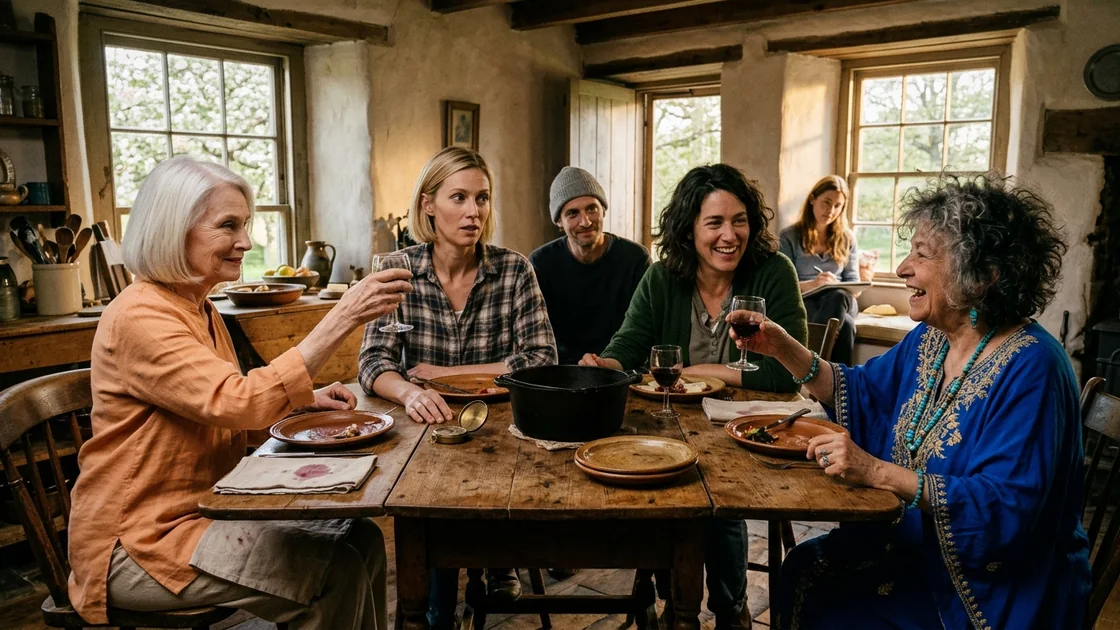
It was the hysterical, tearing, magnificent laughter of four women who had survived forty years of an impossible geography, who had lived three miles apart in the same river valley without ever seeing the sky through the other’s windows, and who were now, finally, looking across the wreckage of their own bloodlines and finding that the foundations, though built on shale, were still stubbornly holding the load.
Act XI: The Forty-First Year
In June, on the fourteenth day of the month, Nora woke at dawn.
The air was already warm, smelling of river mud and sweet clover. It was going to be ninety degrees before noon—the exact weather of June 14, 1984.
She walked out onto the stone porch of her cottage, barefoot, holding a mug of black coffee.
Down the road, three miles away, the greenhouses would be opening their vents to let the morning mist out. Daphne would be loading the flatbed with hydrangeas for a wedding in Solebury. Leo would be in the office, his hair growing back in fine, dark curls, checking the invoices for the hemlock mulch.
Up the ridge, three miles away, Clara would be in her breakfast room, slicing her rye toast into two equal triangles, her garden schedule laid out beside her silver plate, waiting for the blue Ford pickup to pull into the driveway with fifty bags of crushed limestone for the drainage ditch.
Nora looked down at her own hands.
They were broad. They were strong. They had Arthur’s patience for wood and stone, and they had Dave Miller’s thick, square wrists. They were hands that belonged to no single house, no single lineage, no single name.
Her phone buzzed in her pocket.
A text message from Daphne:
The compressor on the walk-in cooler just blew. The hydrangeas are
going to melt by noon. Bring your three-quarter drive socket set and get
your ass over here.
A second text message, directly beneath it, from Clara:
Nora. The wisteria on the carriage house requires pruning before the
heat becomes excessive. Daphne informed me that you possess the long
pole shears. Please bring them when you come for tea at four.
Nora looked at the screen.
She took a slow, deep breath of the river air, smiled into the rising sun, and went inside to find her boots.