The Architecture of Scent and Stone
This story follows Delphine Moreau, a celebrated Parisian perfumer who loses her sense of smell to a devastating viral illness and abandons her career to seek refuge at her family home in the Luberon valley of Provence. There, she encounters her estranged sister Mathilde, an earthy ceramicist who remained behind to care for their late father. Through shared labor, tactile exploration of earth and stone, and the painful unearthing of long-buried resentments, Mathilde guides Delphine to map the world anew through touch, weight, and memory, ultimately forging a fragile peace between them and transforming how both women understand loss, art, and love.
I. The Void in the Glass
The morning Delphine Moreau lost the world, it vanished not with a crash, but with a cup of black coffee that tasted of hot, meaningless water.
She had stood in her kitchen on the Boulevard Raspail with the radiator clicking its dull iron rhythm against the baseboard. Outside, the Parisian drizzle had silvered the zinc rooftops, turning the chimneys into rows of wet, sooty teeth. She had tipped the ceramic mug to her mouth, expecting the familiar, abrasive comfort of roasted chicory, dark cocoa nibs, and the sharp, oily punch of Ethiopian Yirgacheffe. Instead, her tongue met a scalding flatline. There was heat, the oily film across the palate, the bitter trace on the back of the throat—the mechanical signals of taste—but the vast, vaulted cathedral of flavor was absent.
She set the mug down on the Carrara marble. A drop fell from the rim, spreading in an amber circle.
Delphine did not panic immediately. She was forty-two years old, the principal nose for House of Vaneau, an artisan whose olfactory memory retained upwards of three thousand distinct volatile compounds, their boiling points, their vapor pressures, and their emotional coordinates. She had survived three bouts of influenza in her life, two childhood sinus infections, and a broken septum at seventeen when she had fallen from a hayloft in Saignon. A temporary dulling was common after the fever that had kept her bedridden for nine days. The virus, her physician had said, had burned through Paris like dry straw in late August. Her lungs were clear now; the fever had broken three nights earlier.
She walked into her private laboratory—a room papered in deep celadon, lined with tiered mahogany shelves known as an organ. On these tiers rested five hundred amber glass dropper bottles, each labeled in her small, disciplined script: cis-3-Hexenol, Hedione, Damascenone, Oakmoss absolute 50%, Atlas cedarwood, Civet tincture.
She drew a clean white paper blotter—a mouillette—from its tin box. She reached without looking, guided by the muscle memory of twenty years, for bottle forty-seven: Birch tar. Rectified. It was an aggressive, uncompromising beast of a material, smelling of Russian leather boots, smoldering hearths, and primeval pine forests choked with soot. She uncapped the vial, dipped the narrow end of the paper strip precisely eight millimeters into the dark liquid, and brought it to her nose.
She inhaled.
Air. Just the faint, cool passage of winter air moving through her turbinates. No leather. No smoke. No forest.
She lowered the strip, waited twenty seconds, and dipped another: Linalool. Clean, floral, bergamot-tinged airiness. She waved it beneath her nostrils. Nothing.
Her hand began to tremble, only slightly, at the wrist. She uncapped the Indole, a substance so fecal and suffocating at high concentrations that apprentices routinely gagged upon their first unmeasured exposure. She placed the open lip of the bottle directly under her septum and drew a violent breath.
Her lungs filled. Her brain received the physical volume of the oxygen, the temperature of the room, the slight drying of her mucous membranes. But the room was vacant. The universe had been wiped with bleach. It was as if she had stepped up to an altar she had served for decades, only to find the god had left, taking the murals, the incense, and the stone walls with him, leaving behind an infinite, featureless plane of gray ice.
The specialist on the Rue de Grenelle, a man whose silver cuff links caught the gray afternoon light with clinical precision, tapped the MRI scans against his desk.
"Post-viral anosmia," he said, his voice flat with the practiced neutrality of someone who gave terrible news three times a week. "The olfactory epithelium has suffered extensive damage. The neuroreceptors may regenerate. They may not. Nerves are stubborn, Mademoiselle Moreau. They do not take orders from our ambitions."
"A timeline," Delphine said. Her voice was too quiet, even to her own ears. It sounded like paper being folded in an empty hall.
"Six months. A year. If there is no return after two years, we consider it permanent." He looked at her over his half-moon spectacles. He knew who she was. His wife wore L’Ombre d’Hiver, the smoky iris perfume that had won Delphine her first Prix François Coty. "I would advise a leave of absence. Rest. Corticosteroids for the inflammation, though their efficacy is... modest."
She did not take a leave of absence. She resigned.
To remain in Paris as an unscented nose was an exercise in slow, public flaying. Her assistants whispered in the halls outside her atelier. Her director, a man named Baudrillard whose teeth were too white and whose scarves were always cashmere, took her into the courtyard and held her hands with moist, sympathetic theatricality. He spoke of "creative consultation," of "concept direction," of a life spent "guiding the younger noses through language."
Language. The word made her sick. Language was the shroud people wrapped around a corpse when they had forgotten the face. Perfume had never been language to her; it had been an unyielding, terrifyingly precise science of physical presence. It was the weight of molecules colliding with human tissue, an electric bridge between the soil of the earth and the mammalian brain. To sit in an air-conditioned office and tell twenty-six-year-old boys from Versailles that their accord lacked "audacity" while being unable to detect whether their shirts smelled of laundry soap or despair was a degradation she would not endure.
She packed two trunks. She took no scent bottles, no blotters, no notebooks filled with chemical ratios and dilution formulas. She took three sweaters, two pairs of corduroy trousers, her boots, and her father’s brass pocket watch, which had stopped ticking the night he died four years earlier.
She boarded the TGV at the Gare de Lyon. As the train slipped past the concrete suburbs and accelerated into the sodden, brown fields of Burgundy, Delphine rested her forehead against the double-paned window. The glass was cold. It offered no smell, only vibration—a low, rhythmic shudder that traveled through her skull bones, rattling her teeth in their sockets.
II. The Terrace of Bitter Stones
The bus from Avignon dropped her at the crossroads two kilometers below Saignon. The mistral had begun to blow down the valley, not with the dry heat of midsummer, but with the cold, scouring malice of late February. It tore at the dead thistle heads in the ditches, setting the dry stalks clicking like dry tongues.
Delphine dragged her heavier trunk down the gravel lane. The gravel gave off no dust she could detect, though the wind threw fine grit against her cheeks. She felt the prick of it on her skin—sharp, needle-point impacts. The world was beginning to speak exclusively in skin.
The Mas des Hirondelles sat on a shelf of limestone halfway up the northern slope of the Grand Luberon. It had belonged to their grandfather, then to their father, Pierre Moreau, who had spent fifty-two years of his life boiling down the essence of lavandin, clary sage, and wild thyme in a battered copper still that coughed steam like a dying horse. The house was built of dry-laid stone, the color of wet bone, with small, squinting windows designed to keep out the light of July and the wind of December.
Behind the low stone wall that bounded the kitchen garden, smoke was rising from an outbuilding.
Delphine stopped at the gate. The iron latch was rusted; it left an orange crust on her wool gloves. She looked at her palms. She expected the copper tang of rust, that sharp, bloody metallic sensation that usually accompanied an ungreased gate. There was nothing. Just cold yarn against cold skin.
The door to the outbuilding swung open, banging back against the exterior masonry.
Mathilde appeared in the opening. She wore a stained canvas apron over a faded navy sweater that had belonged to their father, the sleeves turned back twice to clear her wrists. Her hands were gray to the knuckles with wet slip, dried in pale scales up her forearms. Her hair, which had been the color of roasted chestnuts when Delphine had last seen her at the notary’s office in Cavaillon three years ago, was streaked with broad, unapologetic ribbons of silver at the temples.
The two sisters stood three paces apart, the wind whipping Delphine’s black wool scarf across her mouth like a gag.
"You didn't write," Mathilde said. Her voice was lower than Delphine remembered, rasping around the edges, salted by the climate.
"I didn't think you’d want a letter."
Mathilde wiped the back of her wrist across her forehead, leaving a smudge of gray clay between her eyebrows. She looked at the two trunks on the path, then at Delphine’s face—pale, hollowed beneath the cheekbones, the gray shadows under her eyes the color of bruised plums.
"You look like a drowned crow," Mathilde said. "Come inside before the wind takes the chimney."
The kitchen of the Mas was unchanged, which meant it was unbearable. The oak table, five feet long and deeply gouged by Pierre’s pocketknives where he had sliced saucisson for half a century, sat in the center of the terracotta floor. The tiles were uneven, some cracked from the winter frost of ’85, their surfaces worn slick by decades of felt slippers and work boots.
Delphine sat on the bench. She took off her gloves.
Mathilde went to the stove, took a chipped enamel pot, and poured two bowls of chicory soup. She set one before Delphine with a dull clatter. There was a loaf of dense sourdough, gray-crumbed and hard-crusted, and a wedge of goat cheese sweating slightly on a wooden board.
Delphine looked at the soup. Steam rose from it in lazy, curling plumes. To her eyes, it was an image of warmth, an illustration from a book. She bent her head.
Nothing. Not the earthy turnip, not the salted lard, not the sharp vinegar punch Mathilde always put in winter broths.
"Eat," Mathilde said, sitting opposite her. She broke bread with thick, square-nailed thumbs. "You’ve dropped two stone since Paris. They don't feed you up there? Only give you vapor to breathe?"
Delphine picked up the iron spoon. The metal felt cold against her lower lip, then suddenly hot as the liquid hit it. The soup entered her mouth: salty, thick, hot. But it had no soul. It was a texture—a warm mud sliding across her tongue. She swallowed with difficulty, her throat constricting.
"I can't smell it," Delphine said.
Mathilde stopped chewing. She had her bread halfway to her mouth. Her eyes, pale hazel like their father’s, fixed on Delphine’s face with a sudden, predatory sharpness.
"What did you say?"
"I have no smell. None. It was the virus. Three months ago." Delphine laid her hands flat on the oak table. The wood was cold, the grain rough under her palms where the spring growth had eroded faster than the winter rings. "The nerves are dead. The doctors don't know if they will return."
Mathilde stared at her. The wind hit the south wall of the house, rattling the heavy shutters against the stone. In the silence between gusts, the clock in the corner did not tick, because it had run down years ago, but the pendulum hung like a dead weight.
"The great Delphine Moreau," Mathilde whispered. There was no triumph in the voice, but there was no softness either. It was the tone she used when an entire firing in her kiln came out cracked from thermal shock. "The one whose nose was insured for half a million francs. The one who couldn't come home for the lavender harvest because Dior needed a new aldehyde."
"Mathilde. Please."
"Please what?" Mathilde dropped her bread onto the table. It made a dry thud. "You want me to weep for your nose? You haven't set foot in this valley since we buried him by the cypress trees. You sent a wire. You sent five thousand euros for the mason to repair the wall, as if money could lift a six-hundred-pound limestone slab."
"I was in Grasse," Delphine said, her voice rising, thin and brittle. "I had twenty-four people under contract. If I left the distillations—"
"You left him," Mathilde said simply. She reached out and took a spoonful of her soup, her hand steady, unaffected by the accusation she had just laid down. "And now you are here because the world in Paris is too loud when you cannot hear it with your nose. You think this house is an infirmary?"
"I have nowhere else to go," Delphine said. The admission cost her something physical; she felt a pain behind her breastbone, sharp and tearing, like dry parchment pulling away from a binding. "I don't know who I am without it, Mathilde. I look at an orange, and it is only an orange ball. I look at the earth, and it is only dirt. The world has stopped existing behind its pictures."
Mathilde looked at her sister for a long time. The anger in her face did not dissolve, but it sank deeper, settling into the lines around her mouth, becoming something heavier and older.
"The world hasn't gone anywhere," Mathilde said, standing up and clearing her bowl. "You were just too lazy to use your other skin."
III. The Weight of Silt
The bedroom under the eaves smelled—or so Delphine assumed—of the lavender sachets their grandmother had sewn into the ticking forty years ago. For Delphine, it felt only of damp down and cold linen.
She did not sleep. The mistral shrieked over the ridge of the Luberon, bending the pines until she could hear their branches dragging across the barrel tiles of the roof. Without scent, her ears had become unnervingly acute. She heard the house breathing: the contraction of the oak beams as the temperature fell, the scurrying of field mice between the double walls, the soft, abrasive tick of lime plaster flaking from the stones behind the wallpaper.
At five in the morning, the door swung open. A gray rectangle of dawn light spilled across the floorboards.
"Up," Mathilde said. She was dressed in heavy moleskin trousers, her work boots laced tightly to the ankle. She carried a bucket of lukewarm water and a coarse rag. "The red slip doesn't wait for your Parisian melancholia. I have six dozen jugs to coat before the mistral drops and the frost gets into the clay."
"I am not a ceramicist," Delphine muttered from beneath the down quilt.
"You have two arms and ten fingers," Mathilde replied, setting the bucket down with a splash that dampened Delphine’s wool socks on the chair. "And you have eaten my soup. Out."
Twenty minutes later, Delphine stood in Mathilde’s workshop.
The studio occupied the old sheepfold, a vaulted stone chamber with a low ceiling supported by square pillars. It was freezing. The heat from a small cast-iron stove in the corner reached no further than three feet into the room. On long plank tables stood hundreds of unfired vessels: jugs, bowls, shallow olive oil dishes, all in varying states of greenware—some dark and moist, others pale gray and bone-hard, waiting for the glaze.
Mathilde dragged a wooden trough filled with dark, reddish-brown mud toward the light.
"The clay from the ravine," Mathilde said. "It’s too coarse for throwing, but it makes the slip. We have to sieve it through the brass mesh three times to take out the shale. If a single pebble larger than a grain of wheat stays in, the vessel splits in the fire."
She pushed Delphine toward the trough.
"Stick your hands in."
Delphine hesitated. Her hands were her instruments. In Paris, she washed them with scent-free glycerin soap six times a day. She wore deerskin gloves to protect her fingertips from calluses; a perfumer’s skin must be smooth, sensitive to the slightest change in moisture, capable of picking up a single strip of paper without leaving a trace of sweat or tallow.
"Stick them in," Mathilde barked. "It won't eat you. It's only the hill."
Delphine plunged her hands into the trough.
A gasp caught in her throat. The cold was shocking, a liquid vice that clamped around her wrists. The mud was heavy, far denser than water, pressing against her palms with a thick, viscous inertia.
"Don't just stand there like a statue," Mathilde said, leaning over the trough beside her. "Push it against the screen. Feel for the teeth. The shale has edges. The limestone is round. You want the teeth out."
Delphine closed her eyes.
Without the scent of the mud—which she knew, from memory, should have smelled of stagnant rainwater, decayed pine needles, and the iron-rich rot of ancient leaves—her hands were forced to decode the mixture alone.
At first, it was only a freezing mass. But as her fingers moved, rhythmically pressing the slurry against the taut brass wires of the sieve, distinctions began to form.
There was the grain: fine, silty particles that slipped through her fingerprints like grease. Then, the resistance: small, angular fragments that snagged on the flesh of her thumb. She pinched one. It was flat, wafer-thin, with a sharp, razor-like periphery.
"Shale," she murmured.
"Drop it in the tin," Mathilde ordered.
Clink.
Delphine reached deeper. Her fingers plunged toward the bottom where the sediment was packed tight, solidifying under its own weight. She dug her knuckles into the cold paste, dragging it upward. She felt the transition: the surface was fluid, almost velvety; the middle was elastic, fighting her drag; the bottom was stubborn, gritty, clinging to the wooden planks with the suction of a swamp.
"You’re too fast," Mathilde said, her voice softer now, hovering just above Delphine’s ear. "You’re skimming. Perfumers are like birds—always darting through the air, catching the light things that float. Clay isn't in the air, Delphine. It’s been under sixty feet of limestone since the sea went away. You have to wait for it to wake up."
Mathilde’s large, scarred hand reached into the trough, closing over Delphine’s smaller fingers. Mathilde’s skin was rough as pumice, the palms ridged with thick yellow calluses from decades of turning the kick-wheel and splitting oak for the kiln.
She pressed Delphine’s hand down, down into the thickest silt.
"Feel that?" Mathilde asked.
Delphine felt a slow, thrumming coolness. It wasn't just temperature; it was density. The mud seemed to push back with an ancient, stubborn mass.
"That’s the grease," Mathilde said. "The fat of the mountain. That’s what keeps the water from running straight through to the core of the earth. When you smell your fancy bottles, Delphine, what do you think holds the flower? The flower is nothing. It dies in twenty minutes. It’s the dirt that gave it the iron to stand on."
Delphine didn't pull her hand away. For the first time in three months, the gray silence in her head was interrupted—not by a phantom scent, but by an overwhelming, indisputable presence. The silt did not care that she was anosmic. It offered its cold weight to her flesh with an impartiality that felt almost merciful.
They worked until noon, their hands stained the color of dried liver, the tin bucket beside them half-filled with sharp shards of shale and rounded pebbles of river quartz.
IV. The Anatomy of Cedar
In the afternoon, the mistral died, leaving the sky a pale, hard turquoise that seemed to have been scraped clean with a chisel. The cold remained, settling into the hollows of the terraces.
Delphine sat on the stone bench outside the sheepfold, her hands raw and red from the ice water she had used to rinse off the slip. Her joints ached—a dull, throbbing pain she had never known in Paris.
Mathilde came out carrying two wooden blocks and an old crosscut saw with rusty teeth.
"We need kindling for the pre-heating," Mathilde said, dropping the wood at Delphine’s feet with a heavy thud. "The cedar blew down by the washhouse during the November gales. Pierre planted it when you were born."
Delphine looked down at the logs. They were sections of a thick trunk, perhaps fourteen inches across, the bark gray and deeply fissured, like the skin of an elephant.
"I don't know how to use a crosscut," Delphine said.
"Then you’ll learn by ruining your knuckles," Mathilde said, straddling one end of the log and pointing to the other. "Take the peg. Don't push. A crosscut only works when you pull. If you push, the blade buckles and you look like an idiot."
Delphine took the wooden handle. The wood of the handle was beech, smooth as silk from years of sweat and use, oil-darkened where their father’s palm had gripped it.
"Ready?" Mathilde asked.
"No."
"Pull."
Delphine pulled. The blade bit into the bark with a dry, ripping shriek.
She pulled again. Mathilde pulled back. The long ribbon of steel began its rhythmic, sliding dance between them: zsh-shuk, zsh-shuk, zsh-shuk.
At first, Delphine could only think of the agony in her forearms. The motion required muscles she had never developed—the lats, the rhomboids, the deep stabilizers of the spine. Her breath came in short, frosty plumes.
Then, as the blade sank through the outer bark and entered the heartwood, the resistance changed.
The bark had been brittle, crumbly, offering a dry, chattering friction. But the heartwood was dense, oily, and resinous. The saw blade began to hum. A vibration traveled up the steel, through the ash-wood peg, and into Delphine’s palms—a deep, resonant singing that shook the small bones of her wrists.
"Feel that?" Mathilde shouted over the noise of the cut. "That’s the resin! It fights the steel!"
Delphine didn't answer. She was watching the dust gather on the log below the cut.
It was coming out not as powder, but as damp, fragrant flakes. In Paris, she had worked with Cedrus atlantica and Juniperus virginiana. She knew the chemistry by heart: alpha-cedrene, beta-cedrene, cedrol. She knew that cedarwood was a base note, a fixative, the skeleton upon which one hung the transient flesh of jasmine or the bright ribbons of bergamot. It smelled of pencil shavings, ancient libraries, dry heat, and mothballs.
She let go of the saw with one hand, letting Mathilde drag the blade alone for a stroke, and scooped up a handful of the warm sawdust.
She brought it to her nose.
Nothing.
She dropped her head, her eyes burning with sudden, unmanageable tears. She pressed the sawdust into her eyes, into her mouth, grinding the wood shavings against her lips. She tasted the bitter terpene, the woody astringency that dried the saliva on her tongue instantly. But the vast, dry cathedral of cedar was closed to her.
"Stop that," Mathilde said.
The saw stopped. Mathilde stood over her, breathing hard, her chest heaving under her father’s navy sweater.
"Stop sniffing it like a dog," Mathilde said, her voice hard. "You’re looking for a ghost. You think that wood is only its smell? Look at it."
Mathilde reached down, took Delphine’s wrist, and forced her fingers flat against the freshly cut cross-section of the stump.
"Touch it," Mathilde commanded. "Tell me what the tree did."
Delphine’s fingers moved across the wood.
The surface was warm—heated by the friction of the steel teeth. In the center, the heartwood was dense, almost glassy, the rings packed together so tightly they felt like the ridges on a seashell. As her fingers drifted outward toward the sapwood, the texture softened. The wood became more porous, the rings wider, spongy to the touch.
"Here," Delphine whispered, her finger stopping at a dark, irregular knot where the grain swirled like an eddy in a trout stream.
"The frost of ninety-six," Mathilde said, her voice dropping into the quiet cadence of someone reading a church register. "The branch snapped under the ice. The tree had to bleed resin for three years to seal the hole. Feel how hard it is? It’s like flint. You could strike a spark off that knot."
Delphine pressed the tip of her index finger into the resin-soaked whorl. It was sticky, clinging to her skin with a stubborn, gummy persistence. It did not yield. It had fossilized into an armor.
"Your nose made you lazy," Mathilde said, sitting back on the log. "You thought the smell was the whole thing. The smell is just the vapor the tree throws away because it has too much life to keep inside its skin. The tree is this. It’s the five hundred kilos of wood that had to stand against the mistral every winter since our mother ran off to Lyon."
Delphine looked down at her fingers. The golden resin had coated her whorls, filling the tiny valleys of her skin. She rubbed her thumb and forefinger together.
The friction was different now. It was no longer the slide of skin on skin; it was an adhesive pull, a slow, tacky resistance that generated heat between her fingers.
"It has weight," Delphine said.
"Everything has weight," Mathilde said. "Even the things that are gone. Now take the saw. We have three more logs before the sun drops behind the Petit Luberon, and the stove in the sheepfold is nearly dead."
V. The Cartography of Memory
They fell into a rhythm that was neither peace nor war, but an armed truce mediated by physical exhaustion.
In the mornings, they worked the clay. Delphine’s hands transformed. The pale, soft skin of her palms—the hands of a woman who worked with glass droppers and velvet-lined cases—cracked along the creases, the red lines filling with the dark, indelible iron of the Luberon earth. Her fingernails, once manicured into neat, translucent ovals, were worn down to the quick, rough and blunt.
In the afternoons, Mathilde took her into the hills.
They did not take the paths. Mathilde walked with the long, indifferent stride of a goat, scrambling up the dry limestone terraces where the olives had been abandoned after the great freeze of 1956. The trees had survived by sending up wild, tangled suckers from their roots, forming dense, silvery thickets that whipped at their clothes.
"Close your eyes," Mathilde would say, stopping abruptly on a ridge where the wind smelled of nothing at all to Delphine.
Delphine closed them.
"Reach out. Left hand."
Delphine reached. Her fingers encountered something dry and brittle.
"Break it."
She crushed the small, shrubby branch between her palm and fingers. She felt the leaves—tiny, curled inward like small canoes, their surfaces covered in a dense, felted wool. When she rolled them, they broke into a coarse, crumbly meal that felt oily against her skin.
"What is it?" Mathilde asked.
"Thyme," Delphine said.
"How do you know?"
"The leaves are rolled at the margins. The felt is on the underside to prevent transpiration. And... the oil is hot."
"Hot?"
"It leaves a prickle," Delphine said, focusing entirely on the skin of her fingertips. "It’s not like the mint. Mint is cold; it feels like wet stone even when it's dry. Thyme feels like iron that’s been sitting on a stove. It has a sting."
"Good," Mathilde said. "Now this. Right hand."
This time, the leaf was broad, leathery, and thick as harness leather. The edges were scalloped with sharp, stiff teeth that pricked her thumb.
"Cistus," Delphine said without opening her eyes.
"No," Mathilde countered. "Feel the surface again. Is it sticky?"
Delphine rubbed her thumb across the face of the leaf. It was dry, smooth as boxwood, almost waxy.
"Kermes oak," Delphine corrected herself. "The cistus would have left gum on my fingers. The ladanifer would have glued my skin together."
"You see?" Mathilde’s voice came from three paces away, dry and caustic. "You don't need your nose to tell the difference between a bush that burns like a candle and a tree that won't die for a century. You just need to stop behaving like a tourist."
They walked on. Delphine kept her eyes closed for stretches, her hand extended, brushing the tops of the vegetation like a blind woman navigating a corridor of bronze and wicker.
She began to construct a new map in the darkness behind her eyes.
In her old life, memory was an archive of scents, indexed by top, middle, and base notes. She had remembered her mother through the powdery, violet-edged sillage of L’Heure Bleue; she had remembered her father through the bitter, fermented steam of the copper still and the smell of coarse tobacco smoked in a briar pipe.
Now, her mother was the smooth, cold porcelain of the tea set she had left behind—translucent, fragile, incapable of holding heat for more than ten minutes.
And her father was the grain of the workbench: deeply pitted, smelling of nothing, but possessing a terrible, immovable density that resisted every attempt she made to smooth it over.
One evening, after the soup had been eaten and the dishes rinsed in water that turned their fingers purple, Mathilde set a wooden box on the table. It was lined with faded blue velvet, divided into twelve small square compartments.
In each compartment sat an object: a lump of dried pine gum; a piece of sheep’s wool, greasy and unwashed; a hunk of pumice from an old sea voyage; a piece of slag from an abandoned iron bloomery in Gignac; a dried fig, hard as a cobblestone; a sea-worn piece of glass from the beach at Saintes-Maries-de-la-Mer.
"This was his," Mathilde said.
Delphine looked at the box. "Pierre’s?"
"He made it when his eyes began to fail from the cataracts," Mathilde said, her face turned toward the dark window where their reflections floated like two ghosts against the black glass. "The last two years, he couldn't tell the lavender from the lavandin by sight. The blooms were just a purple fog to him. He kept this in his pocket. He would sit by the well and roll these things in his fingers for hours. He said every material had a heartbeat if you held it long enough for your own pulse to shut up."
Delphine reached out and touched the piece of wool.
It was greasy with lanolin—a heavy, waxy slickness that coated her fingerprints. Even without the barnyard smell, the animal was there: the coarse hair mixed with the fine down, the small bits of dried straw embedded in the locks, the burrs that caught on the whorls of her skin. It was hot, retaining the phantom temperature of the sheep’s flank.
"He asked for you," Mathilde said softly. The mistral had not returned, and the silence in the kitchen was massive, ancient, like the interior of a tomb. "Not at the end. At the end, he was only screaming at the horses that had been dead for thirty years. But in the spring, before the flowers came. He asked if you had made that perfume for the Americans yet."
"I was in New York," Delphine said, her eyes fixed on the fleece. "We were launching at Bergdorf. There were three hundred people in the atrium. They had built a mountain of white lilies that had cost forty thousand dollars. Baudrillard made me stand on a pedestal and talk about the 'poetry of the Provence hills.'"
She closed her hand around the wool, squeezing it until the lanolin worked its way into her cuticles.
"I felt like a whore," Delphine whispered. "I was selling them the smell of his shirts, and I hadn't seen him in two years."
Mathilde didn't contradict her. She reached into the box, picked up the lump of dried pine gum, and rolled it between her palms with a dry, clicking sound.
"He knew that," Mathilde said. "He said you were always like the alcohol he used for the wash—ninety-six percent pure, so clean it would burn your throat if you drank it, but completely useless until you watered it down with something that had grown in the dirt."
She dropped the gum back into its velvet nest.
"You’ve been watered down now, Delphine. The question is whether there’s anything left in the jug besides river water."
VI. The Vocabulary of Touch
By mid-March, the almond trees on the lower terraces had burst into bloom.
Delphine walked through them alone. The blossoms were clouds of pale, almost luminous white against the iron-gray limestone of the dry-stone walls. She stopped before a low-hanging branch, pulled a cluster of flowers to her face, and closed her eyes.
Nothing. Not the bitter-honey sweetness, not the faint, almond-skin trace of cyanide that always accompanied the petals.
She let the branch go. She did not weep now. The grief had moved from an acute, stabbing agony to a dull, architectural weight—a second skeleton she wore inside her ribs.
She reached up and plucked a single petal between her thumb and forefinger.
She closed her eyes and rubbed.
The petal was not smooth. Under the pressure of her sensitized pads, it revealed a micro-texture that was astonishingly intricate. It was cool—colder than the surrounding air by several degrees, an evaporative chill that lasted for three seconds. The upper surface was covered with microscopic, velvety papillations that felt like the skin of a three-day-old infant; the underside was ribbed with tiny, branching veins that had the stiff, springy resilience of horsehair.
She took another petal from an apricot tree fifty paces away.
She compared them, one in each hand, her eyes shut against the brilliant Provencal sun.
The apricot petal was thicker, more waxen, less elastic. It crushed easily, turning into a moist pulp that offered no resistance. The almond petal held its structure; it slipped between her fingers like silk twill, supple and stubborn.
She sat on the terrace wall, took her leather-bound notebook from her pocket, and opened it to the first blank page. She had not written a word since the day she left Paris.
She did not write formulas: Hedione 12.0, Benzyl Salicylate 8.0, Bergamot oil 5.0.
She wrote:
Prunus dulcis (Petal): Coolness: 4/10. Surface: Micro-velvet, non-linear. Resilience: High; returns to shape after three compressions. Moisture: Low oil, high structural water. Friction coefficient: Low, slipping to tacky at thirty seconds of shear.
Prunus armeniaca (Petal): Coolness: 2/10. Surface: Gloss-wax, planar. Resilience: Fragile; cellular collapse upon first shear. Moisture: High pulp, viscous.
She looked at the words. They were strange, dry, almost clinical. But as she read them, the image of the almond blossom in her mind ceased to be a flat photograph. It regained three dimensions. It acquired a body.
That night, she brought the notebook to the kitchen table.
Mathilde was cleaning the parts of her wheel: the heavy cast-iron flywheel, the leather belt, the wooden treadle. She looked up, her eyebrows raised at the sight of the open book.
"You’re writing recipes again?"
"Not recipes," Delphine said. She slid the notebook across the oak table.
Mathilde dried her hands on her apron and pulled the notebook toward her. She read the page slowly, her lips moving slightly as she parsed the technical, tactile vocabulary Delphine had invented.
"Friction coefficient," Mathilde muttered. "You sound like an engineer from the Ponts et Chaussées."
"It’s the only way to describe the difference," Delphine said. "The almond slips; the apricot catches. If I can't smell them, I have to know how they meet the skin. Perfume was always applied to the skin anyway. We forgot that in Paris. We made things for the air. We made things for the first five seconds after the paper strip leaves the bottle."
Mathilde turned the page. The rest of the book was empty.
"And what do you do with this?" Mathilde asked, looking up. "You build a perfume out of sand and wet silk?"
"I don't know," Delphine said honestly. "I don't know if I can ever make anything again. But I know that if I don't write down how the world feels against my palms, I will forget that it has an edge at all. I will become like one of those ghosts Pierre used to talk about—the ones who drink the steam from the soup because they don't have teeth to chew the meat."
Mathilde closed the notebook with a sharp snap.
"Tomorrow," she said, "we fire the big kiln."
VII. The Anagama
The kiln sat in a trench dug into the hill behind the sheepfold. It was an anagama—a long, single-chambered tunnel built of firebrick and covered with a thick mound of earth, resembling a burial mound or a dormant subterranean beast. Pierre had built it with an itinerant Japanese potter in the late seventies, using the red clay of the ravine mixed with sand and crushed firebrick.
It was fired only once a year, in early spring, before the dry season made the risk of sparks in the pine woods too great.
For four days, the two sisters loaded the chamber.
It was work that required a terrifying, silent intimacy. Delphine stood inside the low, arched tunnel, crouched on her haunches, her knees pressed into the cold sand floor, while Mathilde passed the vessels in from the entrance.
"The unglazed stoneware goes near the firebox," Mathilde instructed, her voice muffled by the low brick arch. "Where the ash will hit it directly. The wood ash melts at twelve hundred degrees; it turns into a glaze by itself. It flies through the chamber like green glass."
Delphine took a heavy, unglazed pitcher from Mathilde’s hands.
The greenware was delicate despite its weight; a clumsy thumb could crush the rim or knock the handle loose. Delphine had to gauge the center of gravity with her palms, balancing the cold, fragile mass as she positioned it on three small wads of refractory clay embedded with sea shells.
"Why the shells?" Delphine asked, her fingers tracing the ridged edge of a cockle shell beneath the foot of the pitcher.
"The calcium keeps the pot from fusing to the shelf when the ash runs," Mathilde said from the darkness of the entrance. "The shell turns to lime in the heat. When the kiln cools, it crumbles to powder. You tap the pot, and it comes away clean, with the mark of the ridges left in the belly."
Delphine set the pitcher down. She felt the tiny shell beneath the heavy foot—an ancient marine skeleton holding up twenty pounds of mountain earth, waiting to be incinerated so that the vessel could remain free.
"Sacrifice," Delphine murmured.
"Don't be poetic," Mathilde snapped. "It’s chemistry. Move the second bowl three inches to the left. The flame has to draft between them, or the back will stay cold and the glaze will look like boiled liver."
By the fifth day, the chamber was full: three hundred vessels—jugs, bowls, narrow-necked flasks, flat platters—arranged in a dense, calculated choreography of clay.
They walled up the entrance with firebricks, sealing the joints with a mortar of wet clay and sand that Delphine mixed with her bare feet in a wooden tub, treading the cold, gritty paste until her legs were numb to the knees.
At dusk, Mathilde lit the kindling in the firebox.
The firing of an anagama is not an industrial process; it is a siege. For sixty hours, the fire must be fed continuously, night and day, every seven to ten minutes, with split pine and oak. The temperature must rise in an unbroken, relentless curve from the cold damp of the spring earth to thirteen hundred degrees Celsius—the heat of the earth’s mantle, where stone liquefies and silica turns to glass.
They divided the shifts: four hours on, four hours off.
During her first shift, from midnight to four in the morning, Delphine sat on an upturned wooden crate before the firebox. The world had shrunk to the iron door, the pile of split pine behind her, and the roar of the draft through the chimney at the top of the hill.
The smell of the fire was, of course, absent.
There was no resinous tang of burning pine, no dry, alkaline bite of oak smoke, no soot to prick her nostrils. But the fire made itself known through every other channel of her senses.
It announced itself through radiation. When she opened the iron stoke-hole with a long-handled hook, the heat struck her face like an iron shovel. Her eyebrows crinkled; the skin of her forehead tightened until she felt her eyelids could not close. It was a physical wall, an invisible barrier that drove her back two paces every time she lifted a split log.
It announced itself through sound. The kiln was not silent; it had a voice that shifted with every hundred degrees of heat.
In the first eight hours, it had sounded hollow, wet, coughing with a dull, thumping rumble as the moisture was driven from the greenware and the brick walls. By the twentieth hour, the sound had sharpened—it had become a continuous, high-pitched hiss, like a locomotive standing at a platform, the draft sucking air through the side ports with a ravenous, predatory whistle.
And it announced itself through color.
Delphine watched the inspection ports. In the beginning, the interior was black, then a dull, cherry red that looked like dried blood. By the thirty-sixth hour, when Mathilde took the shift beside her, the interior had become a blinding, translucent orange-gold. The pots were no longer objects sitting on shelves; they had become soft, semi-luminous bodies that seemed to float in an atmosphere of liquid light.
"Oak now," Mathilde shouted over the roar of the chimney. Her face was black with soot, the sweat cutting white channels down her temples. "The pine burns too fast! We need the coal bed! Give me the heavy billets!"
Delphine hoisted a six-foot log of seasoned white oak. It weighed twenty kilos, the bark rough and moss-covered, cutting through her leather work gloves.
Together, the two sisters swung the timber into the open stoke-hole.
The kiln swallowed it. A gout of orange flame shot from the flue, licking the stone lintel above their heads. The draft reversed for a fraction of a second, blowing a wave of superheated gas across their chests.
Delphine did not step back. She stood shoulder-to-shoulder with Mathilde, their hips touching, their boots planted in the soot-blackened gravel.
She looked at Mathilde’s profile—illuminated by the glare of thirteen hundred degrees, the skin pulled taut over the cheekbones, her jaw set with a ferocious, stubborn concentration that was terrifyingly identical to the way their father had looked when the copper still began to run clear at four in the morning.
"Mathilde!" Delphine yelled over the roar.
"What?"
"I’m sorry!"
Mathilde didn't turn her head. She had her iron hook hooked into the next billet of oak.
"Don't waste your breath!" Mathilde yelled back, her voice cracked, raw from the heat. "The wood doesn't care about your sorrow! Lift!"
Delphine grabbed the butt end of the log. Her back muscles screamed; her blistered palms burned through the hide of her gloves. She lifted. They shoved the oak into the white heart of the furnace.
The door slammed shut.
In the sudden, dim red silence of the closed firebox, Mathilde dropped her hook. She stood leaning against the brick retaining wall, her head down, her breath coming in ragged, whistling sobs.
Delphine reached out. She did not take Mathilde’s hand—Mathilde would have pulled it away. Instead, she laid her palm flat against the back of Mathilde’s neck, beneath the silver-streaked hair, where the skin was slick with sweat and hot as an engine block.
Mathilde remained still for three heartbeats. Then, with a slow, heavy shudder that seemed to travel up from the limestone beneath their boots, she leaned her forehead against Delphine’s shoulder.
They stood there in the dark of the Luberon hillside, while beneath them the mountain of clay melted into glass, holding each other up like two burnt trees that had survived the same fire.
VIII. The Cooling of the Earth
The kiln took six days to cool.
To open an anagama too early is to invite catastrophe; the sudden entry of cold air will shatter every vessel inside with a sound like pistol shots. One must wait for the heat to bleed back into the earth, degree by degree, until the stone and the clay have settled into their new, permanent forms.
During those six days, Delphine did not leave the Mas.
She helped Mathilde clear the yard: stacking the unused kindling, sweeping the wood ash into the compost heap, oiling the saws and hooks with tallow. Her hands had ceased to hurt. The blisters had broken, dried, and hardened into yellow shields of callus across the pads of her fingers and the heels of her palms.
She could no longer slide a glass dropper into a rubber bulb with the effortless, feathery delicacy she had possessed in Paris. Her fingers were thicker now, more deliberate. When she picked up a water glass, she felt its weight first—the thickness of the rim, the density of the base, the balance of the fluid inside.
On the seventh morning, the mistral was gone, replaced by a soft, damp breeze from the Mediterranean that brought the first real warmth of April.
They took crowbars and cold chisels to the temporary brick wall of the kiln.
The mortar of sand and clay had baked into a hard, brittle crust. It flaked away under the chisels with a dry, ceramic pinging. Brick by brick, they dismantled the door, stacking the hot, soot-blackened rectangles on the gravel.
When the arch was clear, Delphine knelt at the opening.
The air that drifted from the dark interior was warm—perhaps forty degrees—and utterly devoid of smoke. The fire had consumed everything: soot, wood, carbon, water. What remained was the dry, sterile heat of an oven that had been turned off hours ago.
"Go in," Mathilde said, her voice quiet behind her. "You’re smaller. Bring out the front shelf."
Delphine crawled into the chamber.
The light from the opening caught the vessels nearest the firebox. Delphine stopped on her hands and knees, the breath catching in her throat.
They were unrecognizable.
The pale gray, fragile greenware had been transformed into stone. Where the pine ash had swept across the pots in the primary draft, a natural glaze had formed—not the smooth, even, chemical gloss of an electric kiln, but an organic, violent skin that shifted from olive-green to scorched amber, with patches of rough, orange-peel texture where the ash had settled in thick, unvitrified drifts.
She reached out and took the first vessel—the heavy pitcher she had set upon the cockle shells six days before.
It was warm to the touch, like a living body.
She turned it over in her hands. The side that had faced the furnace was encrusted with thick, glassy droplets of melted ash that had run down the belly like tears and frozen mid-fall. The opposite side, sheltered from the blast, remained matte, the clay scorched to a deep, iron red, the color of dried pomegranate skin.
She slid her bare fingers across the surface.
The narrative of the fire was written entirely in its texture.
Here was the smooth, cool slip of the green glass where the heat had been fiercest; here was the rough, sandpaper drag of the unrefined sand where the draft had slowed; here, at the base, was the sharp, perfect impression of the cockle shell—the calcium had powdered away, leaving a delicate, ribbed void that her fingertip fitted into with mathematical perfection.
She carried the pitcher out into the light and handed it to Mathilde.
Mathilde took it. She did not look at it with her eyes; she too closed her eyelids and passed her thick thumbs over the belly, feeling the run of the glaze, the thickness of the foot, the balance of the handle.
"It didn't split," Mathilde said softly.
"It didn't split," Delphine repeated.
They spent the morning emptying the chamber. Three hundred pots, carried one by one out into the spring grass, laid out in long, shimmering rows across the terrace.
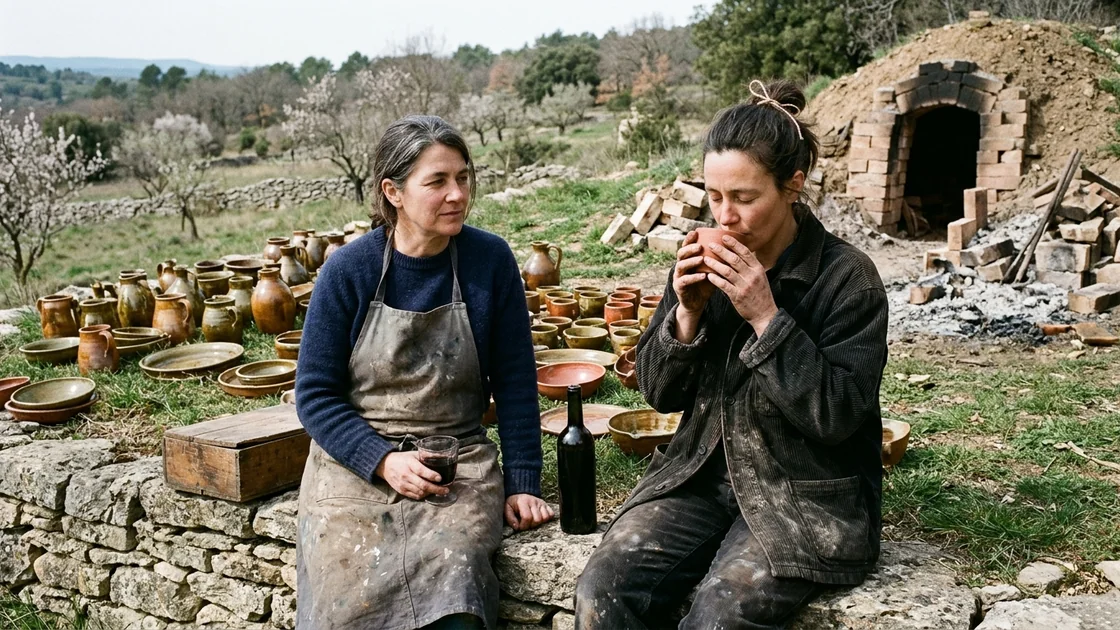
When the last bowl was placed on the grass, Delphine sat down on the stone wall. Her clothes were gray with wood ash; her hair was tied back with a piece of binder twine. She looked down at the valley.
The cherry trees were beginning to push pink tips through their green calyxes. The oak woods on the northern flank were turning from purple to a soft, mossy bronze.
She held a small, unglazed sake cup in her lap. It had been placed at the very back of the kiln, where the temperature had barely reached eleven hundred degrees. It had caught no ash; it was simply the red clay of the ravine, baked hard, with the thumbprints she had left in its base when she had lifted it from the wheel still visible in the vitrified earth.
She brought the rim of the cup to her lips.
The terracotta was dry, slightly porous, drinking the moisture from her lower lip with a gentle, clinging suction.
And then, deep within the bone of her skull—not in her nose, not in the fleshy chambers of her turbinates, but in the dark, forgotten vault at the base of her brain—something stirred.
It was not a scent. Not yet. It was the memory of an amplitude.
She felt the ghost of an odor: the faint, mineral sweetness of wet slate after an August storm. It was not in the air; it was in the friction between her lip and the baked clay. It was the idea of rain, held within the stone because the stone had once been mud that had fallen from the sky.
Delphine did not move. She did not breathe deeply, terrified that the sensation would shatter like greenware dropped on stone.
She held the cup against her mouth.
Mathilde walked over, carrying a bottle of the cheap, dark red wine from the cooperative in Goult and two heavy tumblers. She sat down on the wall beside Delphine, the stone groaning slightly beneath their combined weight.
She filled the tumblers without a word.
Delphine set the ceramic cup down on the wall between them. She took the wine glass. She did not sniff it. She held it up to the light, watching the thick, ruby meniscus cling to the glass, then she drank.
The wine was rough, sour, tasting of black currants that had grown in thin soil, with an astringent, chalky finish that coated her teeth. It was real. It took up space in her mouth. It had an architecture.
"Mathilde," Delphine said.
"Yes?"
"I am going to stay."
Mathilde took a slow sip from her glass. She looked out over the three hundred pots sitting in the new grass, their glazed bellies catching the noon sun like mirrors laid out on the hill.
"The roof of the sheepfold needs new battens before the autumn," Mathilde said, her voice flat, indifferent, though her shoulder leaned three inches closer until it pressed against Delphine’s sleeve. "And the lavender on the lower terrace has gone woody. It needs cutting back to the old wood with the billhook, or it’ll die out in two years."
"I have a billhook," Delphine said. "Pierre’s. I found it in the cellar."
"The edge is notched," Mathilde said. "You’ll have to spend half a day on the grindstone before it’ll cut butter."
"I have time," Delphine said.
She picked up the small clay cup again and closed her fingers around its circumference.
The clay was losing its heat slowly, giving it up to the air of the Luberon, but it remained warmer than her skin. She held it tightly, feeling the ridges of her own fingerprints pressed into the fired earth, an unbroken circuit between the mountain, the fire, and the hand that had held it into the light.