The Architecture of Forgetting
When brilliant urban planner Richard Hensley is diagnosed with early-onset dementia at forty-nine, his wife Clara watches the intricate scaffold of their shared intellectual life crumble into bewildering grief and isolation. Desperate to salvage Richard's unfinished architectural legacy and exhausted by the relentless demands of full-time caregiving, Clara finds herself crossing paths with Marcus Vance, the fiercely competitive former partner Richard drove away in a bitter corporate split fifteen years earlier. What begins as an uneasy confrontation over archival blueprints evolves into an anchor of mutual survival, forcing Clara to confront the man Richard truly was, redefine her own artistic identity beyond marriage, and forge a new life from the wreckage of forgotten memories.
Chapter One: The Drift
The first thing that went missing was not an object, but a coordinate.
They were sitting in the kitchen of their brick rowhouse in Hudson, the October sun cutting through the copper beech outside and laying amber ribs across the pine table. Clara was cataloging seventeenth-century Dutch masonry surveys for a monograph on Hudson Valley river settlements. Richard sat across from her, surrounded by vellum drafts of the riverfront promenade he had been designing for the municipal council of Newburgh. He had worked on the waterfront continuously for eighteen months, knowing every silt deposit, every crumbling wharf piling, every municipal easement by heart.
"Clara," he had said, his pencil suspended over the topographical lines. "Where does the railway cross the inlet?"
She had looked up, amused at first, expecting an architectural joke about industrial blight. "At the bridge, Richard. Behind the old brewery."
He didn't laugh. He tapped the lead against his lower lip, a habit from his student days at Cornell, but his eyes were flat, like leaded windowpanes on a winter afternoon. "There is no bridge behind the brewery," he said, his tone entirely reasonable, almost professorial. "The water carries straight through to the orchard."
"Richard, the CSX freight runs through there twice a night. You complained about the vibrations for three weeks when we did the site assessment."
He had frowned then, looking down at his own handwriting—sharp, legible, draftsman-perfect script—and for four seconds, something terrified and wild flared in his pupils before retreating beneath his habitual composure. "Right," he muttered, shaking his head. "Of course. Fatigue. The council has been running me ragged with these revisions."
Clara had accepted that explanation because the alternative was unthinkable. Richard was forty-eight. His mind was a vault of structural engineering, classical geometry, and regional botanical history. He was the man who could look at a cracked retaining wall from thirty paces and calculate the hydrostatic pressure of the earth behind it. Men like Richard did not lose bridges.
Six months later, he lost the car in an underground garage in Albany, wandering the subterranean concrete bays for four hours while his phone vibrated in his jacket pocket. Two months after that, he stood before the planning board of Kingston and presented a proposal for a project he had completed seven years prior, speaking with passionate, present-tense urgency about a pier that had already been built, weathered, and dedicated.
The clinical neurologist in Manhattan was named Dr. Aris Thorne. He had an office that smelled faintly of sterile paper and expensive leather, high above the frantic hum of First Avenue. He showed them MRI scans that looked to Clara like topographical cross-sections of a dying watershed.
"The cortical atrophy in the frontal and temporal lobes is pronounced, Clara," Dr. Thorne said gently, his eyes shifting between the glowing lightbox and Richard’s hands, which were calmly resting on his knees. "Given the rapid onset, the executive dysfunction, and the biomarker panels, we are looking at behavioral variant frontotemporal degeneration. It is early-onset. It is progressive."
Richard had smiled at the doctor. It was the same polite, slightly condescending smile he gave junior associates when they suggested using untreated cedar in high-moisture foundations. "My grandfather had tremors, Doctor. I am simply overextended. My wife worries. She has always been the archivist of the family."
"Richard," Clara had whispered, reaching for his fingers. His hand was warm, dry, and entirely unresponsive to her grip. He did not pull away, but he did not squeeze back. It was like holding a cast made of wax.
In the car ride home, crossing the Rip Van Winkle Bridge over the Hudson, the water below was swollen and brown with spring runoff. Richard turned on the radio, tuned it to a jazz station, and tapped his fingers against the dashboard in perfect syncopation. He never spoke of Dr. Thorne again.
For Clara, the diagnosis was not a singular blow, but an evacuation order issued for a home that had not yet fallen down. She was forty-six. For twenty-two years, her work had existed in symbiotic orbit around his. She was the researcher, the historian who unearthed the cultural context of riverfronts, the historic brickworks, the pre-industrial topography; Richard was the visionary who translated that historical memory into timber, steel, and stone. They had built an architectural consultancy that carried both their names on the masthead, though everyone in the state called it Hensley’s shop.
Within eight months of the diagnosis, the consultancy was gone. Clients noticed the missing calculations, the missed deadlines, the strange, erratic emails Richard sent at three in the morning detailing imaginary drainage crises. Contracts were terminated with sorrowful, awkward phone calls. Richard’s partner insurance paid out a modest sum, enough to clear the mortgage on the rowhouse, but not enough to sustain two decades of specialized medical care.
Clara closed the downtown office on a rainy Tuesday in November. She packed twenty years of competition models, graphite drawings, and zoning permits into cardboard cartons, stacking them in the damp basement of the rowhouse. When she returned home with the final box, she found Richard standing in the garden behind their kitchen. He had removed his shoes and socks in the forty-degree drizzle and was carefully burying his leather-bound appointment books in the compost pile.
"They need to settle," Richard told her, his teeth chattering, his expression radiant with quiet triumph. "If they don't settle into the loam, the foundations will slip toward the road."
Clara stood on the flagstone path, the cold rain soaking through her wool coat, watching the mud coat his pale, artistic feet. She did not scream. She did not weep. She took him by the elbow, guided him inside, ran a warm bath, and dried his feet with a clean white towel. It was the afternoon she realized that the man she had loved was gone, even though the body of him remained in her bathroom, humming a fragmented measure of Bach while the water ran cold.
Chapter Two: The Wreckage
By the following summer, the isolation had acquired its own specific geometry.
Caregiving at home was a sequence of low-level emergencies punctuated by devastating stillness. Richard could no longer dress himself without putting his trousers on backward; he had forgotten how to use a fork, preferring to scoop rice and vegetables with his bare palms. Sometimes he spent five hours arranging river stones on the dining table in an unbroken, concentric spiral; other days he paced the perimeter of the house, rattling the doorknobs until the brass loosened in their plates.
Clara’s world contracted to the four walls of the rowhouse, the pharmacy on Warren Street, and the aisles of the supermarket at six in the morning, where she went to avoid the well-meaning, agonizing pity of their neighbors.
"How is he doing, Clara?" they would ask, tilting their heads with that soft, mourning-dove expression reserved for widows whose husbands were not yet dead. "You're so strong. You're such an angel."
She hated the word angel. Angels were sexless, bloodless creatures without rage or fatigue. Angels did not want to smash porcelain plates against the cellar floor just to hear something break cleanly. Angels did not lie awake at four in the morning wishing for a catastrophic stroke to end the endless, agonizing drip-feed of their husband's mental decomposition.
To keep them solvent, Clara took remote indexing work from university presses, cataloging architectural textbooks and nineteenth-century municipal registries. She worked at the kitchen table late at night, her eyes burning from the glow of her laptop, while a baby monitor hissed on the placemat beside her. From the speaker came the dry, rustling sound of Richard turning over in the master bedroom, where he now slept behind a childproof gate to prevent him from wandering into the street.
The crisis arrived in August, during a week when the humidity hung over the valley like wet wool.
The city of Newburgh was finally moving forward with the revitalized waterfront promenade—the project Richard had been designing when the first signs appeared. Because the Hensley firm had defaulted on the delivery of the completed engineering schematics, the municipal development authority had reassigned the master contract.
The news arrived via a certified letter from the city attorney: all prior work, field surveys, and proprietary structural calculations prepared by Hensley-Vance & Associates between 2008 and 2014 were subject to an audit and archival release.
Clara stared at the letter on the counter, the legal language dry as kindling. Hensley-Vance & Associates.
The firm hadn't carried that name in fifteen years. Marcus Vance had been Richard’s partner, his classmate at Cornell, and his fiercest competitor. In the late nineties, they had been the golden boys of regional planning—Richard the poetic classicist, Marcus the razor-sharp pragmatist with a genius for structural steel and political backrooms. They had split in 2009 with catastrophic bitterness over the design of the Kingston Arts Center.
Richard had accused Marcus of mercenary compromise, claiming he had altered load calculations to save money for a corrupt developer; Marcus had countered that Richard was an arrogant prima donna whose refusal to adhere to budgets would drive the firm into bankruptcy. There had been lawsuits, settlement agreements, nondisclosure covenants, and a final, public shouting match in the lobby of the Dutchess County Courthouse that had become local architectural folklore.
Marcus had moved his operations downriver to Beacon, founded Vance Infrastructure Systems, and grown it into a regional powerhouse. He had taken the high-dollar commercial contracts; Richard had stayed in Hudson, winning awards, architectural prizes, and prestigious civic commissions that paid fifty cents on the dollar.
And now, according to the letter, the city of Newburgh had awarded the promenade completion to Vance Infrastructure Systems.
Clara felt a hot, metallic rage rise in her throat. Marcus Vance was coming to scavenge Richard’s bones. He was going to take the half-finished, sublime vision Richard had sketched before his brain began to rot, slap his own corporate logo on the title block, and take the ribbon-cutting bows in the local press.
Her phone rang ten minutes after she signed the certified receipt. The caller ID showed a Beacon area code.
She picked it up, her knuckles white against the receiver. "Clara Hensley."
"Clara. It’s Marcus Vance."
His voice was lower than she remembered, stripped of the manic, caffeinated swagger of his thirties, but carrying the same unyielding timber. It had been twelve years since she had heard it.
"If this is about the Newburgh documents, Marcus, you can send your process servers to the door. I have no obligation to make your piracy convenient."
A long silence hung on the line, so long Clara thought he might have hung up.
"I didn't call to posture, Clara," he said, his tone flat, drained of combat. "I was in the council meeting yesterday when the development director produced Richard’s preliminary drawings. The structural calculations for the retaining wall along the old industrial basin—they’re missing fifty pages of geotech data. And the cantilever loads don't make sense. They're mathematically impossible."
"Richard was working under extreme stress," Clara said coldly, her voice shaking despite herself.
"I know," Marcus said quietly.
The two words stopped her. There was no mockery in them.
"I saw the notice in the AIA journal three months ago," Marcus continued. "About the firm closing. And then I ran into Bob Lehman at the state board meeting. He told me Richard was sick."
Clara closed her eyes. The shame of public knowledge—the exposure of Richard’s vulnerability to the very men he had looked down upon—burned through her chest. "He is not sick, Marcus. He has frontotemporal dementia. He doesn't know what a retaining wall is anymore. Does that satisfy your curiosity?"
Another silence, thick and awkward.
"No," Marcus said. "It doesn't satisfy anything. Look, the city is threatening to discard his entire framework. They want to tear down the historic dry docks, pour a quarter-mile of generic concrete riprap, and put in chain-link fencing. It’ll destroy the waterfront. Richard’s original scheme—the terraced granite, the daylighting of the old creek—it was the best work he ever did. Even half-finished, it was brilliant."
Clara took a ragged breath, leaning against the kitchen sink. Outside, in the courtyard, Richard was sitting on an iron bench, staring intently at the palm of his left hand, turning it over and over as if discovering the mechanics of skin for the first time.
"Why do you care, Marcus? You hated him."
"We hated each other," Marcus corrected her, without heat. "That’s different. We spent ten years trying to out-design each other. You don't spend a decade fighting someone without learning the value of their pencil. I need the original CAD files and the 2011 hydrological surveys. They aren't in the city archive. If they're in your basement, I want to buy them from you. Not through the court. Directly from you. At full commercial rate."
Clara looked at the pile of bills beside the breadbox—two months of unpaid physical therapy assessments, an invoice for high-protein liquid supplements, a property tax adjustment notice.
"I won't let you butcher his work," she said, her voice catching.
"I don't want to butcher it," Marcus Vance said. "I want to make sure it gets built before the hacks on the city council turn it into a parking lot. Let me come up on Thursday. Let me look at the files."
Clara looked out the window. Richard had leaned forward, his forehead pressed against the cool bark of the apple tree, perfectly still, lost in some untranslatable silence.
"Bring a truck," she whispered. "And don't ring the doorbell. It agitates him."
Chapter Three: The Intruder
Marcus Vance arrived at ten o’clock on Thursday morning in a gray pickup that had seen its share of construction sites, its rocker panels dusty with river quarry silt. He had aged in the ways men with thick bone structures age: his black hair was heavily salted at the temples, the skin around his gray eyes grooved by sun and wind, his broad shoulders slightly hunched beneath a faded canvas chore jacket.
When he stepped onto the porch, he did not look like a corporate predator. He looked tired.
Clara opened the door before he could knock. She wore a dark blue linen shirt, sleeves rolled to the elbows, her hair pulled back into a severe knot. She had not slept more than three consecutive hours in six months. She felt translucent, like an insect shell after the living thing had crawled out.
"Clara," Marcus said, removing his work gloves and tucking them into a pocket.
"Marcus."
They stood on the threshold for a moment, the ghost of their last meeting—the courthouse steps, Richard screaming obscenities about intellectual theft while Clara tried to drag him toward their sedan—hanging between them like smoke.
"Where is he?" Marcus asked quietly.
"In the den. He has a carer, a home health aide named Elena, who comes three mornings a week. She’s giving him his breakfast."
Marcus nodded once, stiffly. "Show me the boxes."
She led him through the hallway, past the framed black-and-white photographs of nineteenth-century brick kilns and the sketches of the Hudson river bridges that Richard had collected during their honeymoon. As they passed the doorway of the den, Marcus stopped.
The room smelled of menthol ointment, cold tea, and old wool. Richard sat in a winged armchair near the window. He was dressed in clean corduroys and an ironed blue oxford shirt, but his eyes were milky with absence, fixed on a speck of dust floating in the morning light. Elena was sitting on a low stool beside him, patiently offering him spoonfuls of oatmeal.
"Come on, Mr. Hensley," Elena murmured in her soft, lilting Trinidadian accent. "Just a little swallow for me."
Richard blinked, his mouth slightly slack. A thin dribble of cereal ran down his chin. He did not wipe it away. He looked directly at Marcus Vance—the man he had spent a decade trying to ruin, the man whose name had once turned his face scarlet with fury—and his expression did not change by a single millimeter.
Marcus’s throat moved as he swallowed. His face, normally set in lines of hard skepticism, seemed to cave in around the mouth. It was the specific, horrifying shock of a man seeing his own mortality reflected in the ruin of his fiercest rival.
"Jesus," Marcus breathed under his breath.
"He doesn't know you, Marcus," Clara said, her voice deliberately flat, protective as armor. "He doesn't know me half the time. Last night he asked me if I was the lady who cleans the train cars."
Marcus stepped back from the doorway, his eyes darting to the floorboards. For all his commercial arrogance, he looked utterly defenseless. "I didn't... Lehman said he had memory trouble. He didn't tell me it was this."
"People use soft words because they don't want to smell the rot," Clara said, turning toward the basement stairs. "Down here."
The basement was cool and smelled of lime and damp earth. Clara had set up two trestle tables under the bare fluorescent tubes. Stacked around them were forty-two banker’s boxes, their sides labeled in Richard’s once-immaculate handwriting: Newburgh 2010, Newburgh Geotech, Riparian Rights 2008-2012, Waterfront Promenade CAD backups.
Marcus walked to the first table, his movements hesitant, almost reverent. He lifted the lid off a box of rolled vellum drawings. He pulled one out, unrolled it across the plywood table, and weighted the corners with two antique brick molds Clara kept on the shelf.
It was an elevation of the Newburgh river walk: a system of tiered stone revetments that allowed the high tide to wash into planted wetlands of sweetflag and cordgrass, anchored by an amphitheater constructed from the salvaged granite blocks of the demolished Erie Railroad ferry slips. The drafting was exquisite—every joint, every stone profile rendered with the delicacy of an etching.
Marcus stared at the drawing for three full minutes without speaking. His large hand, calloused and scarred near the thumb, traced the line of the water terrace.
"He solved it," Marcus whispered.
"Solved what?"
"The ice scour," Marcus said, looking up at her, his eyes dark with something that felt dangerously close to awe. "The Hudson freezes hard in Newburgh bay. The winter floes tear timber docks to pieces. I told him in 2008 that you couldn't put public boardwalks out past the bulkhead without fifty steel pilings that would ruin the view. Look what he did here. He used the old slipway foundations to deflect the flow, creating an eddy basin. The ice will hit the outer granite wedge and sheer off into the main channel. It’s self-clearing."
Clara leaned against the table, her shoulder touching his sleeve. Looking at the drawings through Marcus’s eyes was like hearing a dead language spoken by someone who still understood the grammar.
"He never built it," she said.
"Because the city council thought the granite was too expensive," Marcus said, his voice hardening with familiar, professional disgust. "They wanted pressure-treated southern pine and galvanized spikes. God, he must have fought them until his teeth rattled."
"He did," Clara said. "That was the year he stopped sleeping. That was the year he began shouting at the contractors."
Marcus rolled up the drawing, his touch remarkably gentle. "I can get this through the planning commission, Clara. The money is there now. The state has an environmental bond act with fifteen million dollars set aside for green infrastructure along the river. But I can't do it alone."
She looked at him sharply. "What are you talking about?"
"These drawings are twenty percent complete. The concepts are all here, but the hydraulic modeling isn't finished, and the historic preservation narrative is totally missing. The state won't release the bond funds without a full cultural survey of the ferry slips. You wrote the preliminary survey for the historic district in 2006, didn't you?"
"That was sixteen years ago, Marcus. I don't practice anymore."
"You don't practice because you're sitting in this house drowning," Marcus said, his voice dropping into a hard, clinical cadence that was brutal in its directness. "Look at you, Clara. You haven't left this cellar in eighteen months. You’re cataloging library books for twenty-five dollars an hour while Richard’s greatest project gets shredded by city clerks."
Clara stepped back, her face flaming. "Get out of my house."
"I’m not trying to insult you—"
"Get out!" she cried, the word tearing from her chest with a ferocity that surprised both of them. "You don't know anything about my life! You don't know what it takes to keep a man from choking on his own tongue! You don't know what it’s like to clean his urine off the hallway runner and then sit down to read zoning laws! Don't you dare come into my basement and tell me I am drowning!"
Marcus did not flinch. He stood among the boxes of his dead rival’s work, his arms hanging at his sides, watching her breathe in jagged, shallow gasps.
"You're right," he said softly. "I don't know. But I know what happens to the people who stay behind. My sister took care of our mother with ALS for six years. By the time my mother died, my sister didn't have a job, she didn't have a marriage, and she didn't know who she was when the room went quiet. She died of cancer three years later. She never came back."
Clara pressed her hands to her mouth. The basement smelled of wet stone and old ink. From upstairs came the muffled, heavy thud of Richard’s pacing—step, drag, turn; step, drag, turn—the rhythm of a prisoner measuring his cell.
"I can't leave him, Marcus," she whispered into her palms.
"I’m not asking you to leave him," Marcus said. "I’m asking you to work for me. Ten hours a week. At your kitchen table, or in my office in Beacon when you have coverage. You write the historical preservation narrative. You reconstruct his geotech notes from your field diaries. I’ll pay you fifty percent of the master design fee."
"Why?" she asked, looking at him through blurred eyes. "Why would you give me fifty percent of anything?"
Marcus looked back down at the rolled vellum of the river terrace, his face unreadable in the dim, humming light.
"Because he was Richard Hensley," Marcus said simply. "And because nobody else on this miserable river understands what he was trying to build."
Chapter Three: The Boundary Line
The work did not save her immediately; at first, it merely complicated her exhaustion.
Elena could only stay until one in the afternoon. After that, Clara was alone with Richard. She set up her work station at the far end of the dining table, where she could keep one eye on Richard while she decrypted his field notebooks from 2011.
The notebooks were terrifying artifacts. The front third of each volume was filled with Richard’s characteristic brilliance—meticulous ink diagrams, soil compaction formulas, Latin names of river grasses that could survive brackish inundation. But as the pages progressed toward 2013, the handwriting began to drift. The margins filled with repetitive, jagged doodles: spiral labyrinths, numbers crossed out and rewritten forty times, disjointed fragments of sentences: The stone is too cold for the water. The line must not touch the boundary. Tell Marcus he took the transit.
Seeing Marcus Vance’s name scrawled across Richard’s private descent made Clara’s stomach turn. Even as his mind was unraveling, the rivalry had remained an open, inflamed nerve.
On her fourth week of consulting, Marcus drove up to Hudson on a Tuesday afternoon. Instead of meeting in the basement, he walked straight into the kitchen carrying two cardboard boxes of take-out from an Indian restaurant in Kingston and a thick accordion file of structural engineering reviews.
"You look like hell," Marcus said, setting the food on the stove.
"Thank you, Marcus. Your social grace remains your most dazzling asset."
"I brought saag paneer. And the Newburgh geotechnical results from the core drillings we did on Friday." He looked toward the den. "Where is he?"
"Asleep. The doctor put him on low-dose quetiapine for the night terrors. He sleeps from noon until four now. Then the agitation starts."
Marcus pulled off his coat, hung it over the back of a kitchen chair without asking, and began unpacking plastic containers. "Let’s eat first. Then show me what you found on the ferry slip revetments."
They ate in silence at the scarred table. It was the first time in nine months Clara had eaten a meal that she hadn't prepared while leaning against the counter waiting for a kettle to boil. The food was hot, pungent with cumin and ginger. She found herself eating with an animal hunger that embarrassed her.
Marcus watched her, his face devoid of judgment. When she finished, he pushed a bottle of water toward her.
"Here," he said.
"Marcus," she said, wiping her mouth with a paper napkin. "Why did you two hate each other so much? Really."
Marcus leaned back, crossing his arms over his chest. He looked out into the small garden, where the autumn leaves were beginning to drift across the grass.
"Richard was a purist," Marcus said. "And purists are dangerous people to be in business with. He thought that if a building wasn't morally perfect, it had no right to exist. In 2008, when the financial crash hit, we had five projects cancel in three weeks. We had eight employees with mortgages. I wanted to take the commercial strip renovation in Wappingers Falls just to keep the lights on and the payroll running. Richard called it 'suburban vomit.' He refused to sign the insurance certificates. He told me that if I took the job, I was nothing more than an asphalt peddler."
Clara looked down at her hands. "That sounds like him."
"We didn't speak for two months," Marcus continued, his voice quiet, devoid of the old fury. "Then came the Kingston Arts Center. The developer wanted to cut the seismic bracing on the north wing to save eighty thousand dollars. Richard was right—the change was sloppy. But instead of negotiating a compromise, Richard walked into the board meeting, threw the developer’s contract onto the conference table, and told him he was an illiterate crook who shouldn't be trusted to build a doghouse."
Clara let out a short, startled laugh. It was a terrible memory, but it was so quintessentially Richard—the absolute, arrogant refusal to bend to stupidity.
"The developer sued us for defamation," Marcus said, though there was a faint, reluctant smile playing at the corners of his mouth now. "The firm cracked like an egg. We spent everything we had on lawyers. After that, every time I bid on a public project, I made sure my numbers were ten percent lower than his. I wanted to starve him out. I wanted him to come to my office and admit that you have to live in the world as it is, not the world as you draw it on vellum."
"And did he?"
"Never," Marcus said, looking at her directly. "Not once. He went broke winning design awards. And I made two million dollars building warehouse distribution hubs that make me want to throw up every time I drive past them."
Clara looked at this man—broad-shouldered, weathered, undeniably successful—and saw the hollow place behind his eyes. He had won the war, and the victory had left him empty-handed.
"The ferry slips," Clara said, clearing her throat and reaching for the accordion folder. "I found the 1884 hydrographic maps from the New York Central Railroad. Richard was right about the granite. They weren't using domestic stone; they used dark granite from the Quincy quarries in Massachusetts, brought down by schooner. That’s why it hasn't spalled after a hundred and forty years in the water. If you replace it with local gray granite, the salt will crack it in five seasons."
Marcus leaned in, his shoulder nearly touching hers as they bent over the yellowed survey map. For the next two hours, they were not a caregiver and an intruder; they were two architectural minds dissecting a problem of mass, water, and time.
Clara felt a strange, intoxicating warmth bloom in her chest. She hadn't used this part of her brain—the analytical, authoritative, historical intellect—since Richard had lost his speech. She had been living in a world of pure physical maintenance: urine, porridge, laundry, dosages. To argue about stone porosity and hydraulic shear was like taking a deep, freezing breath of alpine air after months in a mine shaft.
At three-thirty, a loud crash came from the den.
Clara was on her feet instantly, her chair screeching against the floorboards. Marcus followed her.
Richard had woken up. He had tried to get out of the armchair, become tangled in the wool blanket, and fallen sideways onto the floor, dragging a brass floor lamp with him. The lampshade was crushed beneath his ribs; his glasses had skittered across the rug.
He was lying on his side, his face pressed against the floorboards, breathing with harsh, rhythmic grunts.
"Richard!" Clara dropped to her knees, her hands checking his head, his hips, his wrists. "Richard, look at me. Are you hurt? Did you hit your head?"
Richard rolled his eyes toward her, but they were unseeing, fixed on the corner of the ceiling. He began to thrash, his heels drumming violently against the floor, his hands clawing at the carpet. "The line!" he bellowed, a hoarse, terrifying sound that didn't sound like human speech. "The line is broken! Put the stone back! Put the stone back!"
"Richard, please, you're safe, you're on the floor—"
He swung his arm wildly, his elbow catching Clara squarely across the cheekbone. The force of the blow knocked her backward against the base of the bookcase, stars exploding across her field of vision.
"Clara!" Marcus was there instantly.
"Don't touch him!" she screamed, her hand to her stinging face. "If you grab him, he’ll fight harder! Don't touch him!"
Marcus froze, his hands raised, his eyes wide with horror.
Richard was convulsing with panic, his hands tearing at his shirt, ripping the buttons away, his face turning an alarming purple. Clara crawled back to him on her hands and knees, ignoring the throbbing pain in her temple. She did not try to restrain him. She laid her body alongside his, pressing her chest against his back, wrapping her arms around his shoulders, pinning his head gently against her collarbone.
"I’m here," she whispered into his hair, which smelled of sweat and medicinal shampoo. "The line is holding, Richard. The revetment is built. The stone is in the ground. The river is clear. I’m here. Clara is here."
She repeated the phrases like a litany, over and over, rocking him against her body on the cold floor while Marcus Vance stood five feet away, paralyzed, his back pressed against the doorframe.
It took twenty minutes. Slowly, the rigidity left Richard’s muscles. His breathing slowed from a roar to a raspy rattle. His fingers uncurled from the carpet fibers. He let out a long, shuddering sigh, his cheek resting against Clara’s forearm, his eyes closing in utter, vegetative exhaustion.
Clara stayed on the floor, holding him, until she was certain he was asleep. Only then did she look up at Marcus.
Her hair was coming down in damp strands around her face. Her left cheek was already swelling, a dark, purplish bruise forming beneath the eye. She looked small, bruised, and unimaginably fierce.
"Now you know," she said, her voice barely a whisper. "Now you know what the days look like."
Marcus looked down at her. His eyes were wet. He reached out a hand, then withdrew it, realizing he had no right to touch her.
"Let me help you get him into bed," Marcus said, his voice cracked and raw.
Together, they lifted Richard Hensley. It was the first time Marcus Vance had ever touched his rival’s body. Richard was lighter than he looked, his bones sharp through his linen shirt, his head lolling against Marcus’s broad shoulder like an overgrown child’s. They carried him into the bedroom, laid him on the mattress, and pulled the quilt over him.
When they returned to the kitchen, Marcus walked to the sink, turned on the cold tap, took a clean dish towel from the rack, and soaked it with water.
He walked over to Clara, who sat at the table staring at her trembling hands.
"Hold this to your face," Marcus said gently, handing her the wet cloth.
She took it and pressed it against her cheek. The cold was a shock that made her wince, then brought an immense, throbbing relief.
Marcus pulled a chair up beside her. He didn't look at the drawings. He didn't look at his phone. He simply sat there, his large frame filling the empty space beside her, until the light in the kitchen turned from gray to twilight.
"I’m coming back on Friday," he said into the darkness.
Clara didn't answer, but she didn't tell him no.
Chapter Four: Load-Bearing Structures
November came with sleet that turned the streets of Hudson into troughs of gray grease.
The work on the Newburgh waterfront had entered the engineering review phase. Marcus had submitted Clara’s revised historical narrative and structural adaptations to the state preservation board, and the preliminary response had been ecstatic. The state had not only approved the restoration of the 1884 Quincy granite ferry slips; they had increased the environmental grant by another two million dollars to fund Clara’s plan for an educational tidal wetland along the southern basin.
For the first time in four years, Clara had money in her savings account. She hired an evening aide, an experienced nurse named David, who took over Richard’s care from four until nine p.m.
The house no longer felt like a tomb; it felt like an operational headquarters under siege.
Marcus came twice a week. He brought sets of structural calculations, lunch from Beacon, and the rough, abrasive energy of the outside world. He did not treat Clara like an invalid or a martyr. When her historical documentation was imprecise, he called it out with the same unsparing rigor he would have used with Richard.
"This masonry specification is too vague, Clara," he told her one afternoon, stabbing a blueprint with his pen. "You’re citing nineteenth-century mortar mixes. We can't use hydraulic lime on a modern public revetment; the DEC will fail it on freeze-thaw standards before the first barge ties up. Find me an ASTM-compliant modern blend that mimics the color of the original lime, or we drop the historical finish."
"If you use modern Portland cement, Marcus, the lime in the historic granite will react with the alkali and cause efflorescence within two winters," she shot back, leaning across the table, her pencil poised like a dart. "Read the 1998 preservation briefs on river masonry. You need a low-alkali pozzolanic additive. It meets the DEC standards and it won't rot the stone."
Marcus stared at her for a second, then scribbled a note on the margin. "Good. Write the specification clause by tomorrow morning."
It was during these skirmishes that Clara felt herself returning to life. It was not a return to who she had been before Richard’s illness—that woman, soft-spoken and content to work in her husband’s formidable shadow, was dead. This was a new creature, forged in the crucible of absolute survival, sharp-edged, decisive, and entirely aware of her own worth.
One Friday in mid-November, the first heavy snow fell.
David was in the den with Richard, reading aloud from an illustrated book of birds—the only thing that consistently held Richard’s attention now. Richard no longer spoke words; he made soft, cooing sounds when he saw the blue feathers of a jay or the red crown of a woodpecker, pointing with a crooked, trembling finger.
In the kitchen, Clara and Marcus were finishing the final permit application for the riverfront promenade.
Marcus capped his fountain pen, leaned back in his chair, and looked around the kitchen. The yellow paint on the walls was peeling near the radiator; the ceiling bore a water stain from an upstairs leak two winters ago.
"The planning board hearing is next Thursday in Newburgh," Marcus said.
"I know," Clara said. "You'll do well. You have the numbers locked down."
"I’m not presenting the historical narrative, Clara."
She looked up from her laptop. "What are you talking about? Of course you are. Vance Infrastructure is the lead contractor."
"The firm is the contractor," Marcus said calmly. "The design is Hensley and Vance. And the person who defended the historical framework before the state board was you. I want you at the podium."
A cold panic seized her chest. "No. Absolutely not. I haven't spoken in public in seven years. I don't leave this house for more than two hours at a time."
"David can stay for the day. I’ll pay his overtime."
"It’s not about David!" she said, her voice rising. "Look at me, Marcus! I wear the same three sweaters. I spend my mornings cleaning bedpans. I can't stand up in front of a municipal council and pretend I am a practicing architectural consultant!"
Marcus stood up. He walked to the window, looked out at the falling snow for a moment, and then turned back to face her.
"Do you know why Richard and I split up?" he asked quietly.
"You told me. The money, the developer in Kingston—"
"No," Marcus interrupted. "That was the excuse. That was the legal paperwork."
He walked back to the table, rested his knuckles on the edge of the wood, and looked down at her with an intensity that made the breath catch in her throat.
"The split happened because of you, Clara."
She froze, her fingers hovering over the keyboard. "What?"
"In 2008," Marcus said, his voice stripped of all its defensive iron, "when we won the design award for the Rhinebeck Library. We were at the dinner in Saratoga. Richard was holding court at the center table, drinking champagne, taking credit for the vaulted timber ceilings. And you were sitting in the corner, holding his coat, smiling like a polite graduate student."
Clara felt the blood drain from her face.
"I went out to the terrace to get away from him," Marcus continued. "And you came out to get some air. We stood by the railing for ten minutes. You started talking about the way the light fell through the clerestory windows—how the timber trusses weren't just structural, but an acoustic baffle for the rain on the copper roof. You had calculated the truss spacing yourself. You had spent three months in the archives studying Dutch barn framing to make those vaults work."
"Marcus, don't—"
"I looked at you," Marcus said, his gray eyes burning into hers, "and I realized that the best thing in our firm wasn't Richard’s ego. It was your mind. And Richard knew it. That’s why he kept you in the basement. That’s why he never put your name on the masthead. He was terrified that the moment people saw how much of his genius was actually yours, he would just be another arrogant guy with a drafting board."
"That is a lie," she whispered, though her whole body began to tremble. "Richard loved me. He respected my work."
"He loved you as an extension of himself," Marcus said, without cruelty, but with an absolute, terrifying certainty. "The next morning, I told him we needed to make you a full equity partner. I told him that if your name wasn't on the door next to ours, I was walking."
Clara stared at him, the silence in the kitchen suddenly deafening. The only sound was the muffled ticking of the old clock over the stove and the faint, rhythmic cooing of Richard from the den.
"He told me that if I ever mentioned your name in a partnership meeting again, he would burn the firm to the ground," Marcus said. "Two weeks later, the Kingston project blew up. I used it as a crowbar to pry the partnership apart. Because I couldn't sit in that office every day and watch him use you as his load-bearing wall while he took the light."
Clara closed her eyes. The tears came then, hot and silent, tracking down her cheeks and dripping onto the back of her hands.
It was the truth she had buried under twenty years of loyalty, under boxes of archived blueprints, under the overwhelming, smothering labor of his sickness. Richard had been brilliant, yes. But he had also been a thief of her life. He had built his monument on the foundation of her quiet, uncredited labor, and she had allowed it because she had loved the monument more than she had valued herself.
"He’s sick, Marcus," she sobbed, burying her face in her hands. "He’s dying. How can you say this to me now?"
Marcus knelt down beside her chair. He didn't touch her, but his presence was solid, immovable as Quincy granite.
"Because you're not dying, Clara," he said softly. "And he is going to leave you behind. When he does, I don't want you standing in the ruins of his firm with nothing in your hands. You built this project. Go to Newburgh and take what belongs to you."
Chapter Five: The Assembly
The Newburgh City Hall was an imposing Beaux-Arts limestone pile that smelled of wet overcoats, floor wax, and bureaucracy.
The council chamber on Thursday evening was packed with local residents, environmental activists, union dockworkers, and regional developers. The Newburgh riverfront had been a battleground for thirty years—an industrial scar that had resisted every attempt at revitalization.
Clara stood in the back of the chamber, wearing a tailored charcoal wool suit she hadn't worn since a conference in Chicago six years earlier. It was slightly loose at the waist, but it was crisp, professional, and armor-plated. Beside her stood Marcus, wearing a dark navy suit and an ironed white shirt, his tie knotted with corporate precision.
"Nervous?" he murmured, leaning down toward her ear.
"Terrified," she said.
"Good. It sharpens the delivery."
The council chairman, a portly man with thick glasses and the harried look of someone who had heard three hours of public complaints about potholes, tapped his gavel.
"Agenda item seven: Master Development Agreement for the Riverfront Promenade and Historic Ferry Slip Basin. Presentation by Vance Infrastructure Systems."
Marcus stepped forward into the aisle, but instead of walking to the podium, he turned and extended his arm toward Clara.
"Mr. Chairman," Marcus’s voice cut through the murmur of the room with effortless authority. "Presenting for the design team tonight is Clara Hensley, Principal Historical Consultant and Co-Director of the Newburgh Riverfront Master Plan."
A ripple went through the room. Several of the older council members leaned forward, whispering to one another. Hensley. The name still carried the sting of Richard’s abandonment three years ago.
Clara felt her heart slam against her ribs like a trapped bird. Her feet felt heavy, like lead weights. For a split second, she saw Richard’s face as it had been that morning—staring at a plastic cup of water, unable to find his mouth, his jaw slack, his existence reduced to the biological pulse of a plant.
If I don't walk, she thought, I will stay in that room with him forever.
She took a breath, stepped into the aisle, and walked to the podium.
Her hands shook as she opened her leather portfolio and adjusted the microphone. The glare of the fluorescent lights was blinding. She looked up and met the gaze of the council chairman.
"Members of the council," she began, her voice small, catching on the first syllable. She cleared her throat, gripped the sides of the podium, and remembered the Quincy granite—the stone that had endured a hundred and forty years of Hudson ice without cracking.
"For twelve decades," she said, her voice dropping into a lower, resonant register that carried to every corner of the high-ceilinged room, "Newburgh was defined by the ferry slips. They were not merely transit points; they were the industrial heart of the middle Hudson, the place where the rail lines from the anthracite mines met the river traffic of the Empire State."
She clicked the remote in her hand. The screen behind the council lit up with Richard’s original elevation—not the fragmented, hand-drawn sketch, but the complete, modern digital rendering she and Marcus had spent the last two months refining.
"Previous proposals have treated this riverfront as a problem to be paved over," Clara continued, her confidence rising with every sentence, her mind locking into the familiar, beautiful geometry of historic conservation. "They have proposed concrete bulkheads that will fail within twenty-five years when the spring ice sheets scour the bay. What you see before you is an adaptive design that works with the physics of the river rather than against them."
For twenty-five minutes, Clara dismantled every objection that had stalled the project for a decade. She spoke of soil mechanics, pozzolanic mortars, tidal wetland ecology, and public pedestrian access. When a skeptical councilman asked about the maintenance costs of the granite revetments, she didn't look at her notes; she quoted the municipal maintenance ledgers from 1892, proving that the original stone slips had required less than four hundred dollars in repairs over forty years of heavy industrial use.
When she finished, the chamber was completely silent.
The council chairman stared at her over his glasses, his pen hovering above his notepad. Then he looked at Marcus Vance, who was standing against the back wall, his arms crossed over his chest, a look of fierce, unvarnished pride on his face.
"Mrs. Hensley," the chairman said, his tone entirely changed. "That is the most coherent presentation this council has heard on the riverfront since the bicentennial."
The motion to approve the preliminary master contract passed unanimously, seven to zero.
When Clara stepped away from the podium, her legs were shaking so violently she had to catch the wooden railing to steady herself. Marcus was at her side instantly, his hand cupping her elbow—firm, supportive, but respectful.
"You took the light, Clara," he whispered.
They walked out of City Hall into the freezing November night. The air was sharp, smelling of river salt and wood smoke from the brick chimneys of the city. Clara stood at the top of the broad granite steps, looking down toward the dark, gleaming sweep of the Hudson below.
She began to laugh—a short, breathless sound that turned into a sob.
Marcus stood beside her, pulling his coat collar up against the wind. "You okay?"
"No," she said, wiping a tear from her cheek with her gloved finger. "I’m not okay at all. But I’m here."
"Yeah," Marcus said, looking down at the river with her. "You’re here."
Chapter Six: The Unraveling
The victory in Newburgh did not halt the clock in Hudson. If anything, the contrast between Clara’s professional rebirth and Richard’s physical collapse made the reality at home more unbearable.
By January, Richard had lost the ability to walk.
The frontotemporal degeneration had finally invaded the motor systems. He spent his days in a specialized reclining wheelchair, his body curved into an involuntary C-shape, his neck muscles too weak to support his head without a contoured foam collar. He was incontinent. He could no longer swallow solid food; Elena had to thicken his liquids with industrial starch so he wouldn't inhale water into his lungs.
Clara spent her mornings working on the construction drawings for the Newburgh promenade, her afternoons consulting with Marcus’s engineering team via video calls, and her nights changing Richard’s diapers, suctioning secretions from his throat, and repositioning his frail limbs every two hours to prevent pressure sores.
She was running on a reserve of energy that felt chemically unnatural, fueled by black coffee and the cold terror of what lay ahead.
One Thursday evening, while David was helping her roll Richard onto his side to change the bedding, Richard’s eyes suddenly focused.
It was a phenomenon Dr. Thorne had warned her about: terminal lucidity or transient neurological clarity, brief windows where the damaged circuits of the brain align for a few seconds before collapsing again.
Richard looked directly into Clara’s face. The milky haze was gone from his eyes. His gaze was sharp, terrified, and piercingly intelligent.
"Clara," he whispered.
David paused, holding the clean sheet, his eyes widening.
Clara froze, her hands on Richard’s shoulder. "Richard? I’m here. I’m right here."
A single tear leaked from the corner of his eye, running through the gray stubble on his sunken cheek. His lips trembled, trying to form the shapes of complex words, fighting against the dead weight of his paralyzed tongue.
"The... drawings," he managed, his voice a dry, rasping whistle. "Did Marcus... did he steal them?"
The question struck Clara like a physical blow to the heart. Even now, stripped of language, movement, and identity, the ancient, bitter poison of his rivalry with Marcus was the last thought clinging to the edge of his dying consciousness.
She looked down at this man—the man who had built monuments, who had held her in the dark when they were young architects sleeping on a mattress on the floor of their first loft, the man who had erased her name from his glory.
She leaned down, her lips brushing his hollow temple.
"No, Richard," she whispered softly, her voice steady and clear. "Marcus didn't steal them. We are building them together. And they are beautiful."
Richard’s eyes widened with a terrible, tragic confusion. He seemed to search her face for some sign of betrayal, some hint of an architectural joke. But he found only her calm, unyielding gaze.
"Together?" he breathed.
"Together," she said. "Your name is on the stone, Richard. Right where it belongs. And mine is next to it."
He stared at her for three seconds more. Then the light in his pupils flickered, wavered, and went out like a candle caught in a draft. His head slipped sideways against the foam collar; his jaw went slack; his eyes drifted back toward the ceiling, empty and dead to the world once more.
He never spoke again.
Two weeks later, on a bitter Tuesday morning in February, Richard’s breathing changed. It became rapid, shallow, rattling with the sound of pulmonary congestion. The hospice nurse arrived at eight; by ten, she had started him on continuous subcutaneous morphine.
Clara sat beside his bed, holding his dry, cold hand.
Marcus arrived at noon. He didn't say a word. He took off his coat, pulled up a wooden chair on the other side of the bed, and sat down.
For eight hours, the three of them remained in the room: the dying architect, the woman who had survived him, and the rival who had loved and hated him in equal measure.
The only sound was the harsh, rhythmic rattle of Richard’s breath and the ticking of the radiator. Outside, the Hudson was frozen from shore to shore, a vast, flat desert of white ice under a leaden winter sky.
At four-fifteen, the breathing slowed. The gaps between the rattles lengthened—ten seconds, twenty seconds, forty seconds.
Marcus leaned forward, his elbows on his knees, his head bowed, his hands clasped so tightly the knuckles were white.
Clara leaned over the bed, her hand smoothing the gray hair from Richard’s damp forehead.
"Go on, Richard," she whispered into the silence. "The foundations are set. You can let the stone go."
Richard Hensley took one last, long, shivering breath, and then the room went entirely still.
The hospice nurse stepped forward, checked the pulse in his carotid artery with two fingers, looked at her watch, and nodded gently at Clara.
"He’s gone, Clara."
Clara did not weep. She felt a sensation so vast and terrible it felt like vertigo—the sudden, violent removal of a gravity that had held her pinned to the earth for five agonizing years. She stood up, her joints cracking, walked to the window, and pressed her forehead against the freezing glass.
Behind her, she heard the sound of a man weeping.
She turned. Marcus Vance was sitting by the bed, his face buried in his hands, his broad shoulders shaking with silent, wracking sobs. He was mourning the boy he had drafted beside at Cornell, the competitor who had driven him to his greatest work, the enemy whose absence left him stranded in an architectural landscape populated only by businessmen.
Clara walked across the room, stood behind Marcus, and laid her hand gently on his neck, her fingers resting against the warm, rough wool of his collar.
"It’s over, Marcus," she said softly. "It’s finally over."
Chapter Seven: The Granite Revetment
The dedication of the Newburgh Riverfront Promenade took place eighteen months later, in the golden warmth of a late September afternoon.
The transformation was astonishing. The decaying, toxic industrial waterfront had been replaced by a terraced civic park that seemed to grow organically out of the river itself. The massive blocks of 1884 Quincy granite, salvaged, cleaned, and reset with pozzolanic mortar, formed a series of wide, sweeping steps that led down to the water’s edge. Between the stone terraces, dense beds of sweetflag, cordgrass, and pickerelweed filtered the tidal wash of the bay, their green fronds whispering in the afternoon breeze.
Hundreds of people had turned out from the city: families pushing strollers along the gravel paths, children climbing on the massive timber piers of the old ferry terminal, old men fishing for striped bass from the outer stone jetty.
Clara stood near the entrance of the public pavilion, holding a glass of sparkling cider. She wore a simple, elegant dark green linen dress. Her hair was cut short now, framing her face in clean, silver-streaked waves that emphasized the sharp, striking line of her jaw. She looked ten years younger than she had in the cellar in Hudson, but there was an immovable gravity in her eyes that had never left.
She was now a full partner at Hensley Vance Architects.
They had relocated the primary office to a renovated brick warehouse in Beacon, equidistant between Hudson and Newburgh. Clara led the historical preservation and urban ecology division; Marcus managed structural engineering and commercial delivery. They had five junior architects working under them, two state preservation awards on the wall, and more commissions than they could handle.
Their partnership was not a romance; it was something rarer and more durable—a shared survival, a mutual intellectual respect forged in the ruins of a mutual loss. They argued constantly about budgets, about materials, about design ethics, but the arguments were clean, devoid of the toxic poison of vanity that had destroyed Richard’s firm.
"You're hiding," a voice said behind her.
Marcus walked up, holding two small plates of local goat cheese and crackers. He was dressed in a sharp gray linen suit, his collar open, looking prosperous, relaxed, and genuinely happy.
"I’m not hiding," Clara said, smiling as she took a plate from him. "I’m observing. An architectural historian must maintain critical distance from the finished work."
"Bull," Marcus said, taking a bite of cheese. "You’re basking. And you should be. The governor’s regional director just told the paper that this promenade is the gold standard for Hudson River revitalization."
"He said that because you bought him two whiskeys at the pre-reception, Marcus."
"A detail," Marcus waved his hand dismissively, though his eyes crinkled with laughter. "The point is, the stone works. Look at the tidal basin. High tide was an hour ago. Not a single puddle of standing water on the pedestrian deck. The drainage is flawless."
They walked together down the gravel path, toward the water’s edge where the granite met the river.
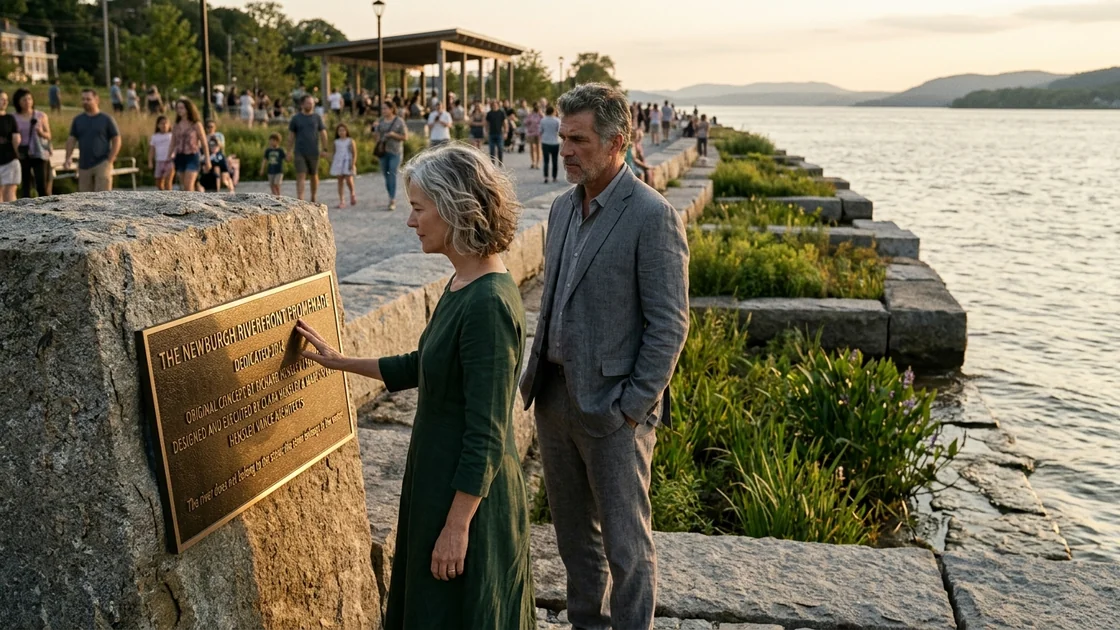
Near the central terrace, set into the face of a massive Quincy granite cornerstone that had once supported the 1884 ferry slip, was a bronze plaque.
The late afternoon sun struck the metal, setting the raised letters ablaze with warm, golden light:
THE NEWBURGH RIVERFRONT PROMENADE
Dedicated 2024
ORIGINAL CONCEPT BY
Richard Hensley (1970–2023)
DESIGNED AND EXECUTED BY
Clara Hensley & Marcus Vance
Hensley Vance Architects
"The river does not belong to the stone; the stone belongs to the water."
Clara stood before the plaque, her fingers reaching out to touch the cool, dark surface of the granite.
She remembered the winter morning Richard had died, the sound of the ice grinding against the bridge piers in Hudson, the terrifying vacuum of his absence. For a long time, she had believed that when Richard died, she would simply vanish—that she was merely a shadow cast by his monumental personality, destined to disappear the moment the light was extinguished.
She had been wrong.
The shadow had not vanished; it had condensed, hardened, taken on mass and density, until it became its own load-bearing structure. She was not Richard’s widow; she was Clara Hensley, the woman who had pulled this stone from the riverbed and taught it how to hold the weight of the city.
Marcus stood a pace behind her, quiet, his hands in his pockets, giving her the space she needed with the ghost who lived in the bronze letters.
"Marcus," she said, without turning around.
"Yeah?"
"The Kingston dock proposal that came in yesterday."
"What about it?"
"The developer wants to use pre-cast concrete panels along the historic bluestone bluffs."
Marcus sighed, stepping up beside her, his shoulder lightly brushing hers. "I know. It saves him four hundred thousand dollars."
Clara looked at him, her gray eyes clear, fierce, and entirely unyielding.
"Tell him no," Clara said. "Tell him that if he wants Hensley Vance, he uses the historic stone, or he finds someone else to pave his river."
Marcus looked at her for a long moment. A slow, broad grin spread across his weathered face—the grin of a man who had finally found a partner who would neither bend to his cynicism nor break under his weight.
"Understood, partner," Marcus said, raising his glass of cider to the stone. "We use the historic stone."
They turned together and walked back toward the pavilion, their shadows stretching out long and unbroken across the granite terraces, while below them, the ancient, indifferent river swept cleanly past the revetments, carrying the cold water out toward the sea.