The Architecture of Elsewhere
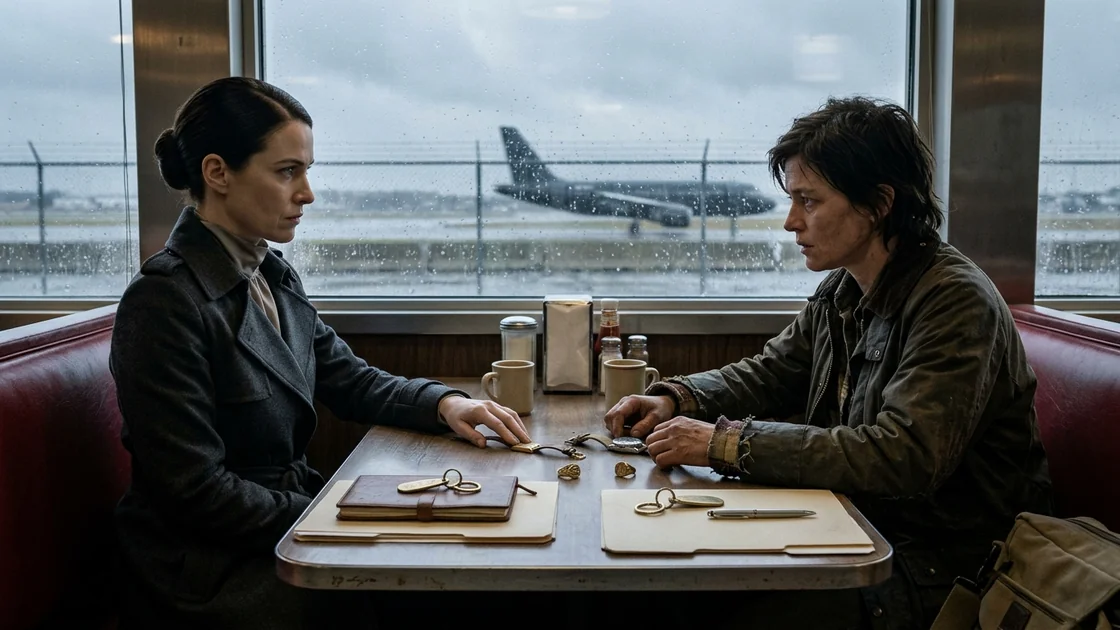
When their eccentric father suffers a debilitating stroke at his remote cottage in the Outer Hebrides, estranged twin sisters Nicole and Clara Vance find their antithetical lives violently disrupted. Nicole, the meticulous headmistress of a prestigious Connecticut preparatory academy on the eve of a decennial accreditation review, cannot abandon her post without forfeiting her career, while Clara, an itinerant documentary photographer bound by a punitive European heritage commission, cannot forfeit her assignment without financial ruin. Realizing Nicole must serve as their father's legal medical proxy in Scotland while Clara must keep the academy afloat during the inspectors' visit, the two women orchestrate a clandestine two-week identity swap, trading wool cardigans for weather-beaten field jackets and administrative spreadsheets for manual aperture rings, an exchange that forces both sisters to confront the buried grief, secrets, and silences that split them apart a decade before.
Chapter I: The Parallax Error
The call came through two separate networks at precisely six in the morning, Greenwich Mean Time.
In the master bedroom of the headmistress’s residence at Briar Hill Academy, Nicole Vance was already awake, seated before her vanity with an ivory-handled brush suspended midway through her hair. The bedroom smelled of dried lavender, starch, and the faint, mineral chill of early November in Connecticut. Her desk calendar, bound in navy calfskin, was marked in ten-minute increments from seven-fifteen until nine-thirty at night: breakfast with the chair of the board of trustees, an assembly on academic integrity, four classroom observations, and an evening dinner with the senior accreditation liaison from the New England Association of Schools and Colleges.
Her telephone vibrated against the polished cherry surface of the dressing table.
Six time zones away, in the drafty passenger lounge of the ferry terminal in Ullapool, Clara Vance was nursing her third lukewarm cup of chicory-heavy coffee. Her knees were drawn up against the canvas ribbing of her Billingham equipment bag. The soles of her boots were crusted with the dry red dirt of the Anatolian plateau, from which she had departed only thirty-six hours earlier, and her fingernails were stained with the faint yellow shadow of darkroom fixer from a brief stopover in London. When her sat-phone chirped, she did not look at the screen before pressing it to her ear.
"He was found in the garden behind the drystone wall," the Scottish solicitor said, his voice whistling through the crackle of a microwave relay. "Hypothermia, primarily, though the physician at Stornoway says the cerebral infarction occurred before the fall. He is alive, Miss Vance. But he is non-verbal, and the power of attorney paperwork drawn up in Edinburgh nine years ago names Nicole Vance as the sole proxy for medical intervention."
Clara closed her eyes. Outside the terminal window, the grey belly of the ferry Loch Seaforth groaned against the timber pilings of the pier, rising and falling on the black swell of the Minch.
"I am Clara," she said.
"Then you are twelve hours too late, Miss Vance," the solicitor replied, his voice indifferent to the distinction. "The Western Isles Health Board will not honor your signature on the vascular consent forms. Your father is eighty-two. If someone does not sign the authorization for the transfer to the mainland neurosurgical unit by Friday evening, he will simply remain in the ward at Western Isles Hospital until his heart gives out. And your sister is not answering her office line."
"She’s on her private line," Clara muttered. "Give me ten minutes."
She hung up, pulled up a number she had not dialed since the damp autumn afternoon of their mother’s memorial service seven years earlier, and pressed send.
In Connecticut, Nicole lowered the ivory brush. She looked at the display screen, her mouth setting into a thin, pale seam that matched the plaster mouldings above her head.
"Julian has had an infarction," Nicole said, before Clara could speak. "Mr. MacInnes reached my administrative assistant via emergency dispatch three minutes ago."
"Then you know he needs a surgical proxy," Clara said. Her voice was raspy from three days of Turkish tobacco and cold air. "You're the only one on the paper, Nicole. You made sure of that when you had him rewrite the estate in twenty-fourteen."
"I made sure of that because you were living in a yurt outside Ulaanbaatar and couldn't be reached for four months while he wandered into the canal behind the Kelvingrove," Nicole snapped. Her hand had not moved from the brush. "I cannot leave, Clara. The accreditation committee arrives on Monday morning. Henderson has spent three months building a faction on the board to dissolve my contract. If I am not at that opening convocation, if I am not at the endowment dinner on Thursday night, the school goes to Henderson's nephew, and my housing goes with it. I have five years until my pension vests. Everything I have built here collapses if I am absent for forty-eight hours."
"He will die, Nicole."
"Then go to Lewis and sit with him."
"They won't take my signature!" Clara’s voice rose, striking a raw note that caused an elderly couple three benches away in the ferry terminal to glance over their wool mufflers. Clara turned her back to them, hunching over her knees. "You know how the NHS Highland trusts operate. He signed the proxy to Nicole Vance, Head of School, Briar Hill, Connecticut. They want the passport that matches the legal filing. Furthermore, I have the Hebridean Heritage commission. If I break the contract with the Edinburgh Arts Trust, they forfeit my retainer and sue for the production advance. That advance is currently paying Julian’s nursing fees in Stornoway."
The silence between them was long, heavy with the specific weight of thirty-eight years of shared marrow and ten years of stubborn, deliberate divergence.
"How much luggage do you have?" Nicole asked. Her voice had dropped half an octave, entering the flat, terrifyingly practical register she used when expelling a student for a third drug infraction.
"Two Pelican cases, a canvas duffel, and a body bag full of wool socks," Clara said.
"Meet me at Logan," Nicole said. "Terminal E. Tomorrow at noon."
"Nicole, that’s insane. You have an ocean between you."
"The red-eye out of Glasgow lands in Boston at eleven-forty," Nicole said, the sound of her fountain pen scratching against her calendar suddenly audible over the cellular link. "I will inform the board that I have contracted a severe case of acute laryngitis and influenza, which requires me to remain quarantined in the headmistress's house until the opening dinner on Monday. You will be in my bed by four o'clock tomorrow afternoon. You have seventy-two hours to learn the names of eighty-four faculty members, eleven trustees, and the Latin motto of the school."
"I don't know Latin," Clara said.
"Then you had better learn how to nod while looking profoundly disappointed," Nicole replied, and hung up.
Chapter II: The Mechanics of Deception
The diner on the access road behind Logan International Airport smelled of griddle grease and industrial disinfectant. It was twenty-two minutes past one in the afternoon. Outside, a sleet storm was beginning to silver the asphalt, turning the yellow line-markings into smeared ribbons of light.
Clara sat in the corner booth, wearing a salt-stained waxed Barbour jacket with the cuffs turned back to reveal fraying flannel lining. On the table between them sat two manila folders, four leather-bound notebooks, and two identical key rings bearing brass fobs.
Nicole sat opposite her, wearing a charcoal wool trench coat that had been brushed so thoroughly not a single thread of lint clung to the lapels. Her hair was swept back into a chignon so tight it appeared to pull the skin at her temples taut.
"Your hair is shorter by two inches," Nicole said. She did not touch the black tea cooling in front of her.
"I cut it with sewing shears in an outhouse in Trabzon," Clara said. "Nobody in Connecticut is going to measure it with a surveyor's tape."
"Henderson will," Nicole said coldly. "Arthur Henderson noticed when the grounds crew changed the supplier for the lawn fertilizer from Kentucky bluegrass mix to fescue. He notices everything because he wants me out. If you tilt your head down when you speak to him, he assumes you are considering his financial proposals. Do not look him directly in the eye for more than three seconds at a time. He finds direct eye contact in women 'performatively confrontational.'"
"Charming," Clara said. She reached across the laminate table, picked up Nicole’s silver Montblanc pen, and rolled it between her fingers. The balance was exquisite, heavy and cold. "And Julian?"
"The hospital is Western Isles Hospital on Macaulay Road in Stornoway," Nicole said. She opened her folder. "He is in Ward Two. The attending physician is Dr. Torquil Macleod. He is seventy, stubborn, and suspects that Julian’s cognitive decline began three years ago, which is legally inaccurate. You—meaning I—will present the power of attorney document with the apostille stamp from the Secretary of the State of Connecticut. You will authorize the administration of intravenous tissue plasminogen activator if they are still within the therapeutic window, or the transfer by air ambulance to the Southern General in Glasgow if the occlusion requires a thrombectomy."
"And the camera?" Clara asked, gesturing toward the Pelican case resting against Nicole’s shins beneath the table.
Nicole looked down at the black polymer case as if it contained an unexploded ordnance.
"I haven't operated a camera with a manual shutter since our sophomore year at Vassar," Nicole said.
"It isn't a Vassar seminar, Nicole. It's an eighty-thousand-pound survey of the crofting communities on the machair for the Scottish National Trust. They don't want art. They want the light on the blackhouse ruins at Callanish at eight-fifteen in the morning, and they want the faces of three weavers in South Dell who speak Gaelic and don't look at the lens. The Leica is set to aperture priority. Keep the dial on F-eight, don't touch the ISO button under the thumb rest, and when the little red dot in the viewfinder stops blinking, press the shutter."
"And the focus?"
"The lens has a focus tab on the bottom," Clara said, leaning forward. She took Nicole’s right index finger and pressed it against the table. "You don't look at the numbers. You feel where the tab is. If it's pointing straight down at the ground, everything from six feet to fifteen feet is sharp. If it's pulled all the way back to the left, you're focused on your own eyelashes. If you drop the camera into a peat ditch, don't dry it by the fire. The balsam in the lens cement will melt and ruin the glass."
Nicole looked at Clara’s hands. The skin of Clara’s knuckles was rough, scarred near the thumb where an iron winch on a fishing boat in the Lofoten Islands had caught her five winters ago. Nicole drew her own hands back, smoothing the cuffs of her silk blouse over wrists that were pale, smooth, and marked only by the thin indentation of a Cartier tank watch.
"We switch the watches," Nicole said.
Clara unclasped her canvas-strapped Seiko diver’s watch—scratched across the mineral crystal, the bezel jammed with salt—and pushed it across the formica. Nicole removed the gold Cartier. The leather of its strap smelled of expensive iris perfume and dry paper.
"Your signet ring," Clara added.
"You don't wear jewelry," Nicole countered.
"The headmistress of Briar Hill does," Clara said. "The headmistress does not have a white circle of skin on her third finger where a ring used to be. Come on, Nikki. Hand it over."
The use of the childhood diminutive hung in the damp air between them like a challenge. Nicole hesitated, then twisted the heavy gold band—engraved with the Vance family crest, a heron holding an eel—off her knuckle. It was warm from her skin. Clara slipped it onto her own finger; it fit perfectly, an identical bone structure asserting itself across ten years of silence.
"You have a daughter," Clara said quietly, her tone shifting. "Chloe isn't going to be fooled by an aperture setting or an ivory hairbrush."
Nicole did not flinch, but her eyelids fluttered once.
"Chloe is sixteen," Nicole said. "She spends seventeen hours a day behind the closed door of her bedroom in the east wing of the house, listening to low-frequency electronica and revising her applications for summer internships in bioethics. She communicates via sticky notes left on the refrigerator door. If you knock, she will tell you she is busy. If you ask her about her day, she will assume you are preparing a lecture on time management. Do not attempt to be maternal, Clara. She will know instantly that something is wrong if you offer her a compliment that does not contain a constructive criticism."
"My God," Clara whispered. "You've turned the child into a department."
"I have raised her alone," Nicole said, her voice dropping into a register that was razor-sharp and deadly quiet. "While you were documenting the fall of the orange groves in Seville and sleeping on cargo barges, I was managing a household, an endowment of forty-two million dollars, and an adolescent who hasn't spoken to her father since he relocated to Singapore four years ago. You will not lecture me on maternal warmth from the passenger lounge of an airport diner."
Clara stared at the scarred laminate between them. Outside, the sleet was turning into heavy, wet snow, clinging to the tails of the Boeing 777s taxiing across the perimeter road.
"The keys," Clara said, holding out her palm.
Nicole dropped the brass key ring into her hand.
"The code to the security gate is nineteen-eighty-five," Nicole said. "The year we were born. Try not to forget it."
Chapter III: The Starch and the Peat
The transition was not a clean break; it was a slow, sickening inversion of gravity.
Clara drove the five-year-old Volvo wagon through the limestone gates of Briar Hill Academy just after twilight on Sunday evening. The campus was an exercise in aggressive symmetry: red-brick Georgian facades trimmed with white marble, quadrangle lawns rolled to within an inch of their lives, and hundred-year-old sugar maples whose remaining leaves clung to the branches like scraps of hammered copper.
The Headmistress’s House sat on a rise overlooking the chapel, its windows glowing with a soft, amber luminescence that suggested centuries of uninterrupted order.
Clara sat in the idling car for five minutes, her hands gripping the leather-wrapped steering wheel. Her left wrist felt strangely light under the slender gold weight of the Cartier; her right knuckles felt naked without the bulk of her camera strap. She looked at her reflection in the rearview mirror: the hair pinned back with eleven bobby pins she had bought at a gas station outside Hartford, the silk blouse buttoned up to the hollow of her throat, the touch of rose-colored lipstick that tasted of wax and synthetic berries.
"You are Nicole Vance," she whispered to the glass. "You believe in Latin, institutional longevity, and the endowment portfolio."
When she unlocked the heavy oak door of the house, the silence within was total, broken only by the rhythmic hum of a high-efficiency refrigerator and the distant, subterranean thrum of the oil furnace. On the hall table, precisely between an arrangement of dried hydrangeas and a silver letter tray, lay a pink square of adhesive paper.
Dean of Students called twice about the dress code petition. Left the syllabus for AP European History on your desk. I am at the library until nine. Do not order Thai food again; the smell lingers in the foyer.
The handwriting was small, vertical, and terrifyingly precise. Chloe.
Clara picked up the note, held it to her nose—it smelled of nothing, only paper—and tucked it into the pocket of her tailored trousers. She walked into Nicole’s study. The walls were lined with dark green buckram volumes: The Journal of Independent School Administration, thirty years of Briar Hill yearbooks, and eight shelves of classical literature in translation. On the massive mahogany desk sat a leather-bound folio containing the dossiers of the three visiting accreditation inspectors.
Clara sat down in the high-backed swivel chair. The leather was cool against her back. She opened the first folder: Dr. Alistair Finch, Head of Upper School, Phillips Exeter (Retired). Known for rigorous scrutiny of faculty-to-student ratios and library acquisition budgets. Weakness: single-malt Scotch and mid-twentieth-century naval history.
Clara let out a short, jagged bark of laughter. "All right, Nikki," she murmured. "Let's see what you’ve built."
At that same hour, the Twin Otter aircraft descended through five thousand feet of solid, slate-grey cloud over the Minch, its twin turboprops howling as the pilot fought the crosswinds rolling off the hills of Harris.
Nicole Vance was pressed against the small oval window, her knuckles white where she gripped the armrests of her seat. She was wearing Clara’s Barbour jacket, which smelled intensely of sheep dip, stale tobacco, and a cedar chest that had not been opened since nineteen-ninety-two. The jacket was two sizes too large across the shoulders, and the sleeves fell over her wrists like the molting skin of a reptile.
Below them, the island appeared not as land, but as an iron-colored plate tossed into a frothing sea. Lewis was all rock, water, and brown blanket bog, pocked with thousands of small, black lochans that looked like ink spills upon an ancient manuscript. There were no trees. None. The wind had shaved the landscape down to the granite bone.
When the wheels slammed onto the runway at Stornoway, the impact rattled Nicole’s teeth in her jaw.
She collected Clara’s Pelican cases from the luggage trolley—the aluminum latches were cold enough to burn her bare palms—and hauled them through the single-room terminal into the gale. The air struck her like a wet wool blanket thrown against her mouth and nostrils. It was not merely cold; it was predatory, smelling of rotting kelp, diesel fuel, and peat smoke.
A battered Land Rover Defender, painted an indeterminate shade of oxidized green, was parked against the chain-link fence. Behind the steering wheel sat a man with a beard the color of iron filings, wearing a yellow high-visibility vest over a greasy wool sweater. He rolled down the window two inches.
"You’re Vance?" he shouted over the wind.
"I am," Nicole said, her voice instantly snatched away by the gale. She cleared her throat, pitched her voice lower, and stepped closer to the door. "I am Clara Vance."
The man looked at her face, his pale blue eyes resting for a second on her cheeks, which were already turning a raw, wind-burned crimson.
"You don't look like your photographs on the dust jackets," he said.
"I haven't slept since Thursday," Nicole replied, remembering Clara’s instruction: Be rude if you have to. People in the Hebrides don't trust anyone who explains themselves twice. "Are the Pelican cases going in the back or on the sheep hurdles?"
The man grunted, stepped out into the mud, and hoisted the eighty-pound polymer cases as if they were cartons of eggs. "Your father's still breathing," he said, slamming the rear door. "Macleod says he recognized a nurse from Ness this morning, but he tried to bite her when she took his slippers. Get in. The tide's coming over the causeway at Barvas if we don't clear the moor before six."
Chapter IV: The Grammar of the Living
The first crisis at Briar Hill arrived at eight-fifteen on Monday morning in the form of a fourteen-year-old girl named Jesse Campbell.
Clara was standing at the entrance to the headmistress’s office, holding a porcelain teacup by the handle with two fingers—a posture she had practiced before the bathroom mirror for twenty minutes—when the girl was marched through the double doors by Mr. Arthur Henderson himself.
Henderson was sixty-two, with the thick, ruddy neck of a former collegiate oarsman and the small, wet eyes of a man who spent his weekends reviewing land deeds. He was wearing an expensive tweed sports coat that had clearly never seen a briar patch or a rainstorm.
"Nicole," Henderson said, his voice booming through the administrative suite with the manufactured authority of a man addressing a shareholder meeting. "We have a situation that needs resolution before the accreditation team completes their tour of the humanities wing."
Clara did not move. She remembered Nicole’s note: When Henderson approaches with an emergency, remain stationary. If you move toward him, he perceives it as defensive mobilization.
"Good morning, Arthur," Clara said. She took a slow, deliberate sip of the Earl Grey. It was bitter; she had forgotten to remove the tea infuser. "And good morning, Jesse."
The girl looked up. She was small, with dark circles under her eyes that Clara recognized with visceral clarity: the hollow, exhausted look of a student who had spent the night in an attic room listening to adults argue through the floorboards. Her school blazer was missing its top brass button, and her tie was knotted three inches too low, exposing an unironed collar.
"Miss Campbell was found in the boiler room beneath the science block," Henderson said, leaning his bulk over Clara’s desk. "Smoking clove cigarettes and defacing the electrical junction box with what appears to be Marxist political slogans. Under section four of the student handbook, this is an automatic three-day suspension. I’ve already informed her parents that she will not be present for the chapel service this morning."
Clara looked from Henderson’s manicured fingernails to the girl’s worn loafers. One of the soles was beginning to separate from the leather, held together by a neat wrap of black electrical tape.
"What were the slogans, Jesse?" Clara asked.
Henderson frowned. "Nicole, the content is irrelevant. The infraction is vandalism and tobacco possession on school grounds during an evaluation week."
"I asked the student a question, Arthur," Clara said. Her voice was quiet, but it had the sudden, gravelly rasp of someone who had shouted through shipboard megaphones off the coast of Greenland. It surprised Henderson enough that he took half a step backward, his mouth remaining slightly open.
The girl shifted her weight. "It wasn't a slogan," she said, her voice barely audible above the ticking of the mahogany grandfather clock in the corner. "It was a line from Walter Benjamin. About theses on the philosophy of history."
"The angel of history?" Clara asked.
Jesse blinked, her chin lifting slightly. "The angel looks at the past like a single catastrophe that keeps piling wreckage at his feet. That’s all. I didn't break the junction box. I wrote it in chalk."
Clara set the teacup down on the saucer with a sharp, ceramic clink.
"Arthur," Clara said, looking directly at the space between Henderson’s eyebrows. "Leave the file on Julianne’s desk. Jesse and I will discuss Walter Benjamin in my office."
"Nicole, this is completely outside the established disciplinary protocol—"
"The protocol, as outlined in the faculty handbook approved by the board in June," Clara said, quoting a line she had memorized from Nicole’s color-coded binder at three o'clock that morning, "reserves final discretionary authority regarding non-violent code infractions to the head of school. Good day, Arthur. The tea is getting cold."
When the door clicked shut behind Henderson’s stiff, tweed-clad shoulders, the girl did not move. She remained standing on the Persian rug, her fingers picking at the loose thread on her blazer cuff.
"Sit down, Jesse," Clara said, dropping into the leather swivel chair and kicking off Nicole’s patent-leather pumps beneath the desk. Her heels were blistered from the stiff counters. "Do you have any more of those clove cigarettes?"
Jesse stared at her, her eyes widening in horror. "No, Miss Vance."
"Pity," Clara said, leaning her elbows on the mahogany. "They smell better than Henderson’s aftershave. Sit down. Tell me why you're reading nineteen-forty German philosophy in a Connecticut basement on a Monday morning."
Across the desk, the girl slowly lowered herself into the wingback chair, looking at Clara not as a headmistress, but as an exotic, dangerous creature that had somehow escaped from the surrounding woods and occupied the administration building.
In the small, whitewashed side-room of Ward Two at Western Isles Hospital, the light was the color of a wet slate.
Nicole sat beside the high iron hospital bed, wearing Clara’s greasy Barbour jacket because the radiator in the corner was hissing steam that smelled of scalded paint without producing any perceptible heat.
Her father lay beneath a cellular cotton blanket. His face had always been narrow, but now the left side seemed to have slipped, like wet clay that had sagged before the kiln could fire it. His breathing was thick, wet, and rhythmic, rattling through his nostrils with the sound of gravel being turned over by an incoming tide.
"Julian," Nicole said.
The old man’s right eye flickered, the pupil clouding with the pale, milky ring of arcus senilis. He did not turn his head, but his right hand—the skin paper-thin and liver-spotted, the fingers long and spatulate like Clara’s—scratched at the rough weave of the sheet.
"The solicitor wants to sell the cottage at Ness," Nicole said. She spoke in her administrative voice, the voice that announced school closures and capital campaign targets. "The roof is leaking over the back scullery. He says the thatch hasn't been renewed in twelve years, and the water is coming through the turf into the room where you kept the botanical presses."
Julian’s throat clicked. A small drop of saliva formed at the corner of his paralyzed mouth.
"Clara is in Connecticut," Nicole continued, her fingers tightening around the strap of Clara’s Billingham bag, which rested on the floor between her boots. "She is wearing my clothes. She has already managed not to be arrested, though it has only been twenty-four hours. She thinks I don't understand why you stayed here. She thinks I chose the school because I am timid. Because I wanted a house with a lawn that someone else mows."
She looked out the window. Across the tarmac car park, three herring gulls were fighting over a discarded greaseproof wrapper from a fish-and-chip shop. Beyond them, the hills of South Lochs rose into the low, weeping sky, dark purple with dead heather.
"You left us with thirty-two thousand pounds of debt in the bank in Edinburgh," Nicole said to the quiet room. "And four thousand glass lantern slides of Scottish mosses. Did you think someone was going to eat the moss, Julian? Did you think the bank would accept an herbarium specimen as payment for the mortgage on the house in Morningside?"
The old man’s right hand moved. The fingers reached out, blindly sweeping across the coarse cotton until they touched the rough, oiled sleeve of the Barbour jacket.
His fingers curled into the fabric, gripping it with surprising, desperate strength.
"Clara," he wheezed. The sound was thick, mangled by the dead half of his tongue, but the vowels were unmistakable. "The... the light on the machair. Did you... get the tide?"
Nicole froze. The wool of the jacket felt heavy on her shoulders, stiff with the dried salt of voyages she had never taken, places she had only seen as postcard-sized proofs mailed to her office once every two years with no return address.
She looked down at the old man’s hand, clinging to her sleeve as if it were the only solid thing remaining in the grey Atlantic wash.
"Yes," Nicole said, her voice dropping into her sister’s low, careless cadence before she could stop herself. "The tide was out, Julian. The sand was white. I got the shot."
The old man’s eyelids settled, his breathing smoothing out into a slow, shallow sigh that seemed to draw the remaining heat out of the room. Nicole sat motionless for an hour, her hand resting beneath his rough, cold knuckles, terrified that if she moved an inch, the illusion would break and leave them both alone in the dark.
Chapter V: The Inverted Image
On Wednesday morning, Nicole stood on the headland at the Butt of Lewis, forty miles north of the hospital, with Clara’s Leica M6 suspended around her neck.
The wind here did not blow; it existed as an absolute pressure, an atmospheric wall that drove the North Atlantic against the four-hundred-foot cliffs with a sound like continuous artillery fire. The spray rose over the edge in long, ghostly banners, salting her lips, her eyelashes, and the small front element of the thirty-five-millimeter lens.
Beside her, Calum Macleod—the ghillie with the iron-colored beard—was leaning against the front bumper of the Land Rover, his hands shoved deep into his oilskin pockets, watching her with a squint that was half-amusement and half-contempt.
"You're standing on the wrong side of the dyke," he yelled over the roar of the surf. "The light’s coming from the south-east. If you stand there, your own shadow’s going to be in the foreground of every frame."
Nicole looked down at the black metal body of the camera.
She had spent three hours the previous night sitting on the lumpy mattress in her father’s damp stone cottage at Ness, reading Clara’s field notebooks by the light of a single kerosene lamp. The notebooks were not journals; they were ledgers of light and failure.
Port de Ness. November 4. Tri-X 400. Pushed to 1600. Shutter 1/125 at f/4. The salt mist eats two stops of contrast. Must underexpose the sea to keep the slate roofs from blowing out. The stone here isn't grey; it’s blue-green with lichen. If you expose for the shadow of the boat, you lose the texture of the herring scale on the pier. Don't be greedy with the sky.
Nicole adjusted the metal aperture ring. Her fingers were so cold she could not feel the click-stops; she had to look down at the small white numbers engraved on the barrel. F-five-point-six. She raised the camera to her right eye.
The world through the rangefinder was strange, fragmented by the bright rectangular framelines and the split-image patch in the center. She turned the focus tab on the underside of the lens. The two ghostly images of the stone lighthouse on the headland drifted toward each other, blurred, and then suddenly snapped into sharp, crystalline coincidence.
In that instant, the wind seemed to drop away from her ears.
Through the glass, the lighthouse was not an abstraction of Scottish maritime history or a point on a tourist map. It was a brutal, functional tower of granite, pitted by a century of sea-salt, its white paint peeling in long, scabby ribbons on the windward side. At its base, the ocean did not look blue; it was a boiling, jade-colored cauldron of foam that tore itself against the jagged teeth of the skerries.
She saw the composition Clara had sketched in the margin of the notebook: the dark diagonal of the turf wall cutting across the lower third of the frame, leading the eye not to the light, but to the small, rusty iron winch used by the lobster fishermen eighty years ago to haul their dinghies up the cliff face.
"Don't look at what’s pretty," Nicole whispered, repeating the note Clara had underlined three times in red ink. "Look at what works."
She pressed the shutter button.
The sound was remarkably small: a dry, metallic snick, like the latch of an antique pocket watch closing.
The film advance lever was cold against her thumb. She cranked it—the mechanical resistance of the spring, the sprockets engaging the perforations of the film—and raised the finder again. A wave hit the base of the skerry, throwing a plume of spray sixty feet into the air, backlit by the pale, watery winter sun that was struggling through the cloud deck over the Minch.
Snick.
Advance.
Snick.
"You're not checking the screen," Calum said, his voice closer now. He had walked over and was looking at her hands.
"There is no screen," Nicole said without lowering the camera.
"Aye," Calum said, and for the first time, his voice did not have the dry edge of mockery. "Your sister said that too. When she was twenty, she stood on that same rock until her stockings froze to her boots. We had to cut them off with a gutting knife by the peat fire in the kitchen."
Nicole lowered the camera slowly. Her thumb remained resting on the advance lever. She looked at Calum, whose beard was crusted with tiny beads of sea spray.
"Why didn't she come back?" Nicole asked. "Before this?"
Calum looked out toward the horizon, where a timber freighter was crawling south toward the Barra head, small as a water beetle on the grey expanse.
"Because your father told her she was a tourist," he said simply. "He told her that taking pictures of a place wasn't the same as belonging to it. He said she was just collecting skins to sell to people in London who had never smelled a sheep carcass."
Nicole felt a strange, cold flutter in the base of her throat. "And what did she say?"
"She told him that belonging to a place was just an excuse for people who were too frightened to see how small the world really was," Calum replied. He turned toward the truck. "We need to get to the weavers at South Dell. Donald’s eighty-four, and if he takes his tea before we get there, he won't start the loom again until tomorrow."
Chapter VI: The Board and the Blade
In Connecticut, the decennial accreditation dinner was being held in the Great Hall of the Schoolhouse, beneath the oil portraits of seven previous headmasters, all of whom had possessed large, mutton-chop whiskers and names like Increase or Ezekiel.
Clara Vance sat at the center of the high table, wearing Nicole’s pearl earrings and an emerald silk shift dress that pinched her across the shoulder blades whenever she reached for her water goblet.
To her left sat Dr. Alistair Finch, the Exeter grandee, whose silver hair had been trimmed with the precision of a topiary hedge. To her right sat Arthur Henderson, who had spent the last forty-five minutes systematically dismantling the proposed budget for the library’s digital archive.
"The issue, Nicole," Henderson said, slicing his dry prime rib with a vigor that caused his silver fork to squeak against the china, "is that we are spending twenty-four thousand dollars annually to maintain subscriptions to scholarly repositories that precisely seven students have accessed since September. That capital could be far more effectively deployed in upgrading the video review facilities for the varsity lacrosse program."
Clara took a deliberate sip of the cabernet. She had ignored Nicole’s warning about alcohol; after three days of administrative briefings and thirty-six hours of playing hostess to three octogenarians with clipboards, her nerves were singing like high-tension cables in an ice storm.
"Arthur," Clara said, her voice carrying through the sudden lull in the conversation between Dr. Finch and the chair of the English department. "Do you know what a cyanotype is?"
Henderson paused, his knife poised three inches above the beef. "A what?"
"A cyanotype," Clara said, leaning her chin on her hand—a posture that Nicole Vance had never assumed in public since her confirmation at St. John’s in nineteen-ninety-nine. "It’s a photographic printing process developed by Sir John Herschel in eighteen-forty-two. It uses iron salts instead of silver. It produces a Prussian blue image that lasts for three hundred years without fading, even if you expose it to direct sunlight."
Dr. Finch ceased chewing his dinner roll and looked across the centerpiece of white carnations.
"I am aware of Herschel's work," Finch murmured, his bushy eyebrows rising. "The botanical studies of Anna Atkins."
"Exactly," Clara said, flashing Finch a smile that was entirely lacking in suburban deference. "Anna Atkins produced British Algae: Cyanotype Impressions in eighteen-forty-three. It was the first book illustrated with photographs. There are only seventeen copies known to exist. One of them is in the Beinecke at Yale; another is in the British Library."
She turned back to Henderson, whose face had taken on the dull, congested color of an overripe plum.
"The students who access those repositories, Arthur, aren't looking at summaries of lacrosse rules. Jesse Campbell is currently using that twenty-four-thousand-dollar subscription to translate Walter Benjamin’s correspondence with Gershom Scholem from nineteen-thirty-seven, cross-referencing it with the original manuscripts preserved in Frankfurt. If we replace that repository with a high-definition monitor so the athletic director can watch seventeen-year-old boys drop plastic balls into nylon nets, we are not a school. We are a country club with an unusually high Latin requirement."
A dead, absolute silence fell over the high table.
The chair of the English department, an elderly woman who had spent forty years being ignored by the finance committee, let out a sound that was dangerously close to a snort of triumph into her linen napkin.
Dr. Finch reached for his wine glass, rotated the stem twice, and looked at Clara with an expression that had shifted from professional boredom to sharp, clinical delight.
"I was not aware, Headmistress Vance," Finch said, "that your curriculum had developed such an aggressive emphasis on primary source historiography in the lower forms."
"We believe in primary sources, Dr. Finch," Clara said, looking Henderson directly in the eyes for five full seconds without blinking. "We believe that if a student cannot touch the original error, they have no business memorizing the conclusion."
Henderson’s jaw worked silently for a moment, like an engine whose drive belt had slipped off the pulley. He dropped his knife onto the plate with a heavy, silver clatter.
"I see," Henderson muttered. "Well. We shall see how that aligns with the capital priorities in the executive session tomorrow afternoon."
He stood up, gave a curt, mechanical bow to the accreditation team, and walked out of the hall, his leather soles squeaking with every step against the parquet floor.
Clara felt a small, cold hand slip under the table and touch her knee.
She glanced down. Chloe had come into the hall from the side gallery, wearing her school uniform—which had been pressed so sharply the creases looked like knife edges—and was holding a folded piece of paper.
"Mother," the girl said, her voice low and tight. "There is a telephone call from the Western Isles. In the pantry. They say it cannot wait for the dessert service."
Chapter VII: The Shutter and the Suture
The service pantry behind the Great Hall smelled of commercial dishwashing detergent and lukewarm clam chowder.
Clara leaned against the stainless-steel prep table, holding the greasy plastic receiver of the landline to her ear with both hands. Her heart was hammering against the emerald silk of Nicole’s dress like a trapped crow.
"Nicole?"
"He’s through the procedure," Nicole’s voice came back. It sounded hollow, stripped of all resonance by the satellite relay, but it was steady. "The air ambulance took him to Aberdeen at four this morning. They performed an endovascular thrombectomy. The occlusion in the middle cerebral artery was removed with a stent retriever."
Clara let out a breath she felt she had been holding since Logan Airport. Her forehead hit the cool, brushed steel of the table.
"Is he... is he functional?"
"He has movement on the left side," Nicole said. There was a pause, filled only with the white hiss of the North Sea cable. "He spoke to me, Clara."
Clara lifted her head. "What did he say?"
"He thought I was you," Nicole replied quietly. "He asked about the light on the Butt. He asked if the sand was white."
Clara was silent. In the Great Hall, the waitstaff were clearing the china; she could hear the muffled, collective laughter of the accreditation committee and the clink of dessert spoons against crystal bowls.
"Did you take the pictures?" Clara asked.
"I shot fourteen rolls of Tri-X," Nicole said. "I sent them on the afternoon ferry to the lab in Inverness with Calum’s nephew. I don't know if they are sharp, Clara. My hands were shaking so hard I could barely screw the filters onto the mount."
"If the tab was down, they're sharp," Clara whispered.
"I ruined your boots," Nicole added. Her voice cracked slightly, a tiny fracture in the marble facade that Clara had never heard before, not even when their mother had died in the hospice in New Haven. "The left one filled with salt water when the wave broke over the pier at Ness. The leather is split across the instep."
"They were twelve years old," Clara said. "They needed to be retired."
"How is Chloe?" Nicole asked. The question was hesitant, almost shameful.
Clara looked through the wire-reinforced glass window of the pantry door. Chloe was standing in the corridor outside, her back against the white wainscoting, holding her school books against her chest like a breastplate.
"She’s brilliant," Clara said. "She’s terrifying, Nicole. She looks at me as if she can see the exact chemical composition of my blood. But she’s lonely. She’s so lonely she’s reading Benjamin in the boiler room with scholarship kids who smoke cloves."
A long silence followed. When Nicole spoke again, her voice was barely more than a whisper against the receiver.
"I don't know how to talk to her without being her headmistress," Nicole said. "I’ve forgotten where the school ends and the mother begins. If I let go of the calendar, Clara, I feel like the house will slide down the hill."
"It won't slide," Clara said, watching the girl in the hallway adjust the brass button on her blazer. "It’s built on granite, Nikki. You made sure of that. Now listen to me: Finch loves the primary source curriculum. Henderson is isolated on the finance subcommittee. If you walk in here on Monday morning and look like you're about to fire three trustees, they will give you the endowment for the next twenty years."
"I don't want the endowment for twenty years," Nicole said.
Clara frowned. "What did you say?"
"I don't want to live in the Headmistress's House until I am sixty-five," Nicole said, her voice gaining a strange, quiet clarity that sounded like the wind sweeping over the stones at Callanish. "I looked through the viewfinder today, Clara. I stood on the cliff and I looked through three inches of ground glass at a rock that has been beaten by the sea since the ice retreated ten thousand years ago. It doesn't care about the board of trustees. It doesn't care about my pension."
"Nicole—"
"I have to go," Nicole said. "The doctor in Aberdeen wants to review the post-operative CT scan. Send me the notes for the accreditation debriefing. And Clara?"
"Yeah?"
"Tell Chloe that the Thai food smells fine. Tell her she can order the green curry if she leaves the window open in the back pantry."
Chapter VIII: The Parallax Resolved
The exchange occurred in the international departures corridor at Newark Liberty International Airport nine days later, at four o'clock on a Tuesday morning.
The airport was virtually deserted, a cavern of grey linoleum, flickering fluorescent tubes, and closed duty-free shops behind rolling steel shutters. The air smelled of burnt jet fuel, floor wax, and the damp wool of two sisters who had crossed each other in the slipstream of the North Atlantic.
Clara was sitting on a plastic bench near Gate 84, wearing Nicole’s trench coat over a pair of clean denim jeans she had bought in the campus bookstore. On her lap sat the leather-bound appointment book, closed and tied with its blue silk ribbon.
The double doors from the international arrivals corridor swung open, and Nicole walked through.
She was wearing Clara’s Barbour jacket, which was now stiff with dried sea salt and stained with oil around the right pocket where a lens spanner had leaked. Her hair was not in a chignon; it was tied back with a piece of blue nylon twine she had found on the deck of the ferry. Her face was brown—wind-burned and raw around the cheekbones—and her eyes had lost the small, defensive squint that had defined them for twenty years.
She stopped three feet from the bench.
Clara stood up.
They did not embrace. They were Vance women, raised by a man who had classified three hundred species of alpine flora by their structural resistance to frost; they did not perform affection in airport terminals.
Nicole reached into the pocket of the Barbour jacket and pulled out the Cartier tank watch. The leather was salt-stained, but the gold face was unscratched.
Clara unstrapped the Seiko diver’s watch from her wrist. Its bezel was still jammed, but the second hand was sweeping with mechanical certainty.
They traded watches. The metal was cold from the night air.
"Henderson resigned from the board yesterday morning," Clara said, handing over the leather appointment book. "Finch wrote a personal letter to the regional commissioner stating that Briar Hill was the most intellectually rigorous independent school in the northeast. He mentioned the Benjamin curriculum twice. Henderson’s faction collapsed before the executive session could even reach the lacrosse budget."
Nicole took the book. Her fingers, which were rough now, their tips cross-hatched with small, dry cuts from the darkroom film reels, traced the gold lettering on the cover.
"The Scottish Arts Trust received the contact sheets," Nicole said.
Clara looked up, her pulse jumping. "And?"
"The director called the hospital in Aberdeen," Nicole said. She looked at her sister with an expression that was impossible to read—an expression that was half-grief, half-wonder. "He said the photographs were different from your previous work. He said they had... less bravura. Less performance. He said they looked like they had been taken by someone who lived inside the house, rather than someone looking through the kitchen window from the road."
Clara stared at her. "Did he accept them?"
"They’re printing a monograph in May," Nicole said. "They’re using the shot of the old winch on the Butt for the cover. They’ve already transferred the second half of the production advance to Julian’s account in Edinburgh."
Clara let out a long, shuddering sigh that seemed to empty her lungs completely. She sat back down on the plastic bench, her hands dropping between her knees.
"How is he?"
"He’s old," Nicole said, sitting down beside her. The Barbour jacket creaked as she leaned her shoulders against the wall. "He’s half-paralyzed, Clara. He’s never going to walk down to the pier at Ness again without two nurses and an aluminum frame. But he can hold a teacup with his right hand. And he asked when the girl with the big feet was coming back to fix the gutter."
Clara laughed, a sound that ended in a sharp, wet sniff. She wiped her nose on the sleeve of Nicole’s trench coat.
"She meant you," Nicole added softly. "He always called you that. Because you wouldn't wear shoes until November when we were seven."
They sat in the grey terminal light while the maintenance crew three gates down began to run an industrial floor polisher across the linoleum, its low, rhythmic drone filling the empty spaces between the departure screens.
"I spoke to Chloe," Clara said.
Nicole did not turn her head. "What did she say?"
"She told me that I was a terrible headmistress," Clara murmured. "She said I didn't know the difference between the AP European History syllabus and a collection of essays on the Weimar Republic. She said I was disorganized, that I left my tea bags in the sink, and that I didn't check her algebra homework once in fourteen days."
Nicole’s throat moved as she swallowed. "And?"
"And she said she didn't want you to wear your hair in the bun anymore," Clara said. "She said it made you look like you were trying to keep your skull from cracking open."
Nicole closed her eyes. Two tears, small and perfectly clear, ran down the wind-burned skin of her cheeks, tracking through the salt-dust that still clung to her pores from the Minch. She did not wipe them away.
"I don't think I can do another five years, Clara," she whispered.
"Then don't," Clara said. She reached out, took Nicole’s right hand, and twined her fingers with her sister’s. Their palms were the same now: rough, calloused, marked by work that had nothing to do with desks or ivory brushes. "Julian’s cottage has five rooms. The roof is fixed. Calum says the sheep hurdles on the lower pasture will hold sixty ewes if someone repairs the stone dyke before the spring lambing."
Nicole looked down at their joined hands—the gold signet ring still on Clara’s finger, the skin pale where it had been shielded from the sun.
"I don't know anything about sheep, Clara."
"You don't have to," Clara said, standing up and reaching for the two Pelican cases resting against the wall. "Calum does. You just have to hold the camera while the light is white."
Epilogue: The Architecture of the Frame
In May of the following year, the gallery of the Scottish National Trust on Charlotte Square in Edinburgh was quiet on a Wednesday afternoon.
On the north wall of the main exhibition room hung twenty-four black-and-white prints, each framed in simple, untreated oak. The silver gelatin surfaces were deep, rich, and dark, with the peculiar luminous quality that only comes from old lenses and cold Atlantic water.
The final image in the sequence was not a landscape.
It was an interior: a small, whitewashed room with a low timber ceiling, through which the rough stones of the chimney breast projected like exposed ribs. In the center of the frame, seated at a deal table upon which lay two brass lenses and three open herbarium folders, sat an old man whose left hand was curled into his lap like a sleeping bird.
Beside him, her back half-turned to the lens, stood a teenage girl with dark hair cut in a sharp, uneven bob. She was holding a sheet of heavy rag paper up to the small window, through which the pale, northern light fell across her cheekbones and the high collar of a wool sweater that was two sizes too large for her shoulders.
Beneath the print, the small white card bore an inscription that had not been written by the curator:
The Anatomy of Arrival. Nicole and Clara Vance. 2024.
Near the entrance to the gallery, two women stood together before the window overlooking the gardens below.
One of them wore an emerald silk scarf knotted loosely over a denim jacket, her hair falling around her ears in soft, irregular waves that caught the afternoon sun. The other wore a dark tweed blazer with the brass buttons removed and replaced with horn, her fingernails clean, her hands resting easily in her pockets.
"The focus is soft on the left corner," the woman in the denim jacket murmured, her shoulder leaning against her sister’s arm. "You were using the thirty-five at two-point-eight. The field curvature pulled the edge of the table out of the plane."
"The table doesn't matter," the headmistress replied, without turning her head from the glass. "Look at the light on the paper, Clara. It’s sharp enough to cut your thumb."