The Architecture of Echoes
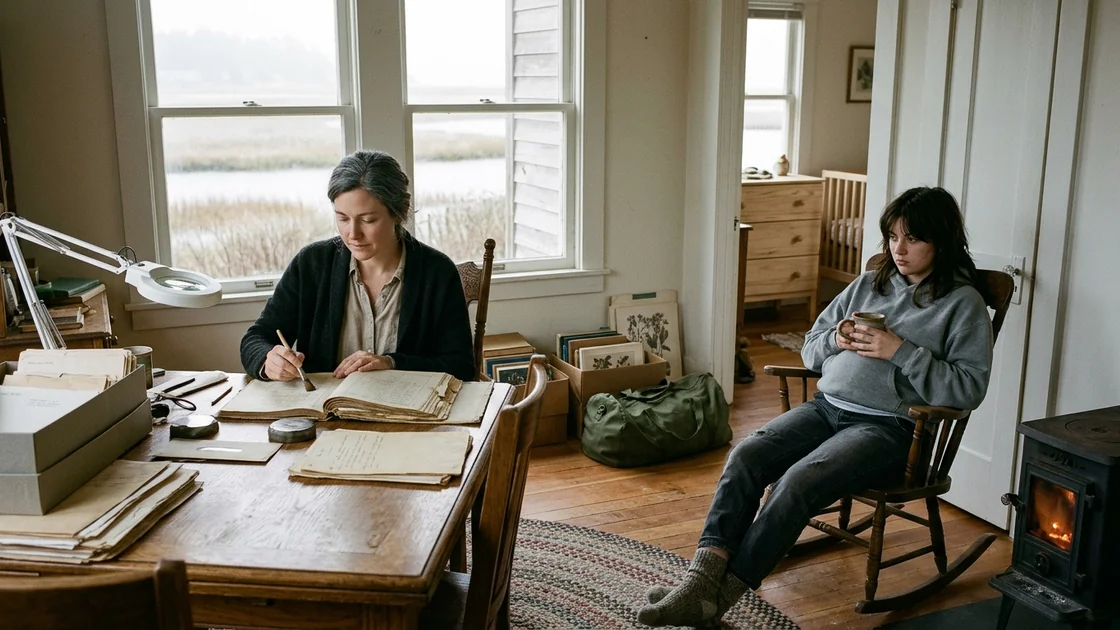
At thirty-eight years old, Clara Vance opens her quiet coastal home to seventeen-year-old Maya, an expectant mother in the foster care system with nowhere left to turn. As the weeks tick down toward the baby's arrival, the daily rhythms of shared meals, nursery preparations, and prenatal appointments force Clara to confront the silence she built around her own teenage pregnancy twenty years prior, when she surrendered her newborn daughter to strangers. Through the labor of caring for a frightened young woman on the cusp of motherhood, Clara navigates the long-repressed grief of her past, ultimately finding a fragile path toward forgiveness and healing for them both.
Chapter One: The Measuring Tape
The second bedroom smelled of primer and dried lavender. It was an honest room, square and uncomplaining, with two double-hung windows that looked east toward the marsh where the Nehalem River broadened out to meet the bay. For six years, ever since Clara bought the saltbox house with the small inheritance from her aunt, the room had served as a staging ground for half-completed domestic intentions: stacked cartons of botanical prints waiting for frames, a loom she had warped once and never threaded, and rows of wire shelving holding mason jars filled with buttons, sea glass, and brass cabinet hardware salvaged from regional demolition sites.
Now the shelves were gone. In their place stood a pine dresser Clara had bought at an estate sale in Tillamook and sanded down until the grain felt like flannel.
Clara knelt on the braided rag rug with a twenty-five-foot steel measuring tape pulled taut between her thumb and the baseboard.
"Thirty-six inches," she muttered to herself, the yellow blade shivering as she locked it. "Forty-two if you count the swing of the door."
Behind her, the floorboards groaned.
"You don't need to measure it again, Clara," Mrs. Hallowell said. Evelyn Hallowell was sixty-one, had worked for the county Department of Human Services through four governors and three reorganizations, and possessed the posture of a woman who had spent forty years sitting in metal folding chairs without ever leaning against the backrest. She held a manila folder against her cardigan like a breastplate. "A standard bassinet will fit. A full crib will fit once she's settled. The state doesn't require a clearance diagram down to the quarter-inch."
Clara pressed the thumb-release. The steel tape zipped back into its chrome housing with a sharp, metallic snap that made them both blink. Clara stood, smoothing her gray wool trousers. Her hands were always dry in November, chalky at the cuticles from handling dry architectural blueprints and cold cedar siding.
"I wanted to be sure there was room for the glider," Clara said. "If she needs to rock. In the middle of the night, people run into corners."
"Maya is seventeen," Evelyn said, looking around the room with eyes that missed neither the clean mattress pad nor the subtle patch of damp-repaired plaster near the sash. "At seventeen, you don't run into corners. You slam into them on purpose just to see if the wall breaks first."
Clara offered a faint, polite smile. She had been through eight weeks of classes, three fingerprinting appointments, a fire marshal inspection, and forty-five pages of questionnaires that asked, among other things, whether she had ever experienced an episode of severe emotional distress, whether her childhood home contained firearms, and whether she felt comfortable setting limits for non-biological minors.
She had answered every question with a steady, unadorned penmanship. To the question regarding emotional distress, she had written: No history of psychiatric hospitalization. Normal bereavement following parental deaths (2012, 2016).
It was not a lie. Bereavement was a wide canvas. It could hold many things without naming them.
"Her file says she is thirty-one weeks," Clara said, walking to the window. Outside, a flock of buffleheads dropped into the reeds, their black-and-white wings flickering against the gray water. "Is that confirmed by sonogram?"
"Roughly," Evelyn replied, opening the folder and leafing through carbonless forms. "She missed two appointments in Lincoln City before they transferred her up here. Her hemoglobin was low in September. She's small for seven months, but the clinic in Astoria listened to the heart tones on Tuesday. Steady. Maya was less cooperative than the baby was."
"What does she like to eat?"
Evelyn paused, looking over the top of her reading glasses. The lenses enlarged her pale blue irises, giving her the bewildered expression of an owl caught in daylight. "Clara, dear. She's been in three different temporary placements since June. The last one was an emergency shelter in Warrenton with eight boys and a night attendant who watched television in the kitchen. She eats whatever comes out of a cardboard box without having to ask permission for the fork. Don't buy organic squash and expect her to weep with gratitude."
"I bought oatmeal," Clara said quietly. "And apples."
"Apples are safe," Evelyn conceded. She closed the folder. "She has one bag. A green duffle bag from an army surplus store. It smells like damp laundry because the Warrenton dryer was broken. If you give her quarters for the laundromat, she’ll think you’re criticizing her hygiene. Wash them with your own things, don't make a ceremony of it, and don't ask about the father."
"Is the father involved?"
"The father is nineteen and currently residing in a state work camp near Prineville for vehicle theft," Evelyn said without inflection. "He writes letters on lined notebook paper that smell like cedar shavings and two-stroke oil. Maya carries them in the bottom of her boot. She does not discuss him with caseworkers, and I suggest you don't audition for the role of confidante during week one."
"I am an archive specialist, Evelyn," Clara said, turning from the window. "I spend eight hours a day handling nineteenth-century probate records and deeds written on vellum. I know how to let fragile paper sit in the dark until it’s ready to be touched."
Evelyn looked at Clara for a long moment. There was neither cruelty nor warmth in her gaze, only the heavy, weathered neutrality of someone who had seen dozens of good women try to fill silent houses with other people’s broken glass.
"A girl isn't a deed, Clara," she said softly. "A deed stays where you file it."
Chapter Two: The Green Duffle
Maya Lind arrived at four on a Thursday afternoon, just as the coastal fog was beginning to swallow the tops of the Sitka spruces.
She got out of Evelyn’s state-issued sedan with the stiff, uncooperative movement of someone whose center of gravity had shifted faster than her self-image could accommodate. She was wearing an oversized black nylon windbreaker, tight faded jeans with an elastic panel crudely stitched into the waistband, and black high-top sneakers with laces tied in double knots that looked permanent. Her dark hair was cut in blunt, uneven layers that fell across her cheekbones, hiding her eyes unless she tipped her chin up.
When she tipped it up, Clara saw that she had the sharp, pale chin of someone who hadn't spent enough time in the sun, and eyes the dark, clear color of river stones.
"Maya," Clara said, stepping off the low porch. She kept her hands in the pockets of her boiled-wool jacket so she wouldn't look like she was reaching out. "I'm Clara."
The girl looked past Clara’s shoulder, taking in the house—the weathered shingles, the rain gutters dripping rhythmically onto the gravel, the small stone chimney puffing thin birch smoke into the mist.
"It’s cold," Maya said. Her voice was lower than Clara expected, grainy around the edges, like a reed scraped against wood.
"The air comes right off the tidal flats," Clara said. "Come inside. We have the heat on."
Maya reached into the back seat of Evelyn's car, hauled out the green duffle bag with a grunt of effort that she tried immediately to swallow, and let the strap drop onto her shoulder. The weight of it pulled her slender frame sideways, exaggerating the hard, round mound under her nylon jacket.
Clara felt a sudden, sharp ache in the hollow of her own hips—a phantom twitch of ligaments, buried so deep beneath twenty years of scar tissue and calendar pages that she hadn't felt it since she was eighteen years old in an annex basement in Spokane. She did not reach for the bag. She turned and held the front door open wide.
The house was warm. The woodstove in the corner of the living room was humming, its cast-iron draft set low to burn a dry birch log down to red embers. The smell of cedar, toasted bread, and floor wax hung in the air.
Maya stopped in the narrow entry hall, her sneakers squeaking on the fir boards. She dropped the duffle bag on the floor. It landed with a dull, wet-sand thud.
"Bathroom's through there?" she asked, pointing toward the short hall.
"First door on the right," Clara said. "Clean towels are on the rack."
Maya didn't look at the towels. She disappeared into the bathroom, and the lock clicked with an aggressive, definitive snap.
In the hallway, Evelyn stood with her car keys hooked around her forefinger, jingling them once. "She didn't speak between Bay City and here," Evelyn whispered. "She threw up in a plastic bag outside Garibaldi. I left the motion-sickness wafers in the front seat. She wouldn't take them."
"She’s scared," Clara said.
"She’s pissed off," Evelyn corrected. "Scared comes later, when the water breaks. Right now, she’s just mad that she has to pee every twenty minutes in houses belonging to strangers. I’ll be back on Tuesday for the court progress report. Call the emergency line if she starts spotting or if she leaves the property."
"She won't leave," Clara said, though she had no basis for the claim.
"They always think about leaving," Evelyn said. She touched Clara’s forearm—a brief, uncharacteristic gesture that felt like a warning—and walked out into the falling dusk.
Clara remained in the hall. Through the hollow wood of the bathroom door, she heard the water running. Not the gentle trickle of handwashing, but the full, roaring gush of the cold tap, turned on to mask whatever sound the girl was making inside.
Clara knew that trick. She had used it herself in November of 2004, in the dormer bathroom of St. Jude’s Home for Unwed Mothers, turning both brass taps until the pipes shuddered in the drywall so the night sister wouldn't hear her retching into the porcelain bowl.
Clara stood motionless until the water stopped.
A moment later, the lock clicked back. Maya emerged, her face damp around the hairline, her lips pale. Her black windbreaker was unzipped now, revealing a gray hooded sweatshirt stretched drum-tight over her belly. Underneath the heathered cotton, Clara saw a sudden, sharp protrusion—a foot or an elbow—slide across the upper curve of the girl's abdomen, rippling the fabric before vanishing again.
Maya caught Clara looking. Her jaw set, her lower lip pushing out in an instinctive, defensive sneer.
"He does that when I drink cold water," Maya said, her voice hard. "He hates cold water."
"He?" Clara asked, keeping her tone light, almost disinterested.
"The doctor said boy. At the sixteen-week scan. Before everything got messed up." Maya looked at the living room, the braided rug, the small kitchen with its open shelves of earthenware bowls. "Where do I put my stuff?"
"Upstairs," Clara said. "Follow me."
Chapter Three: The Geometry of Silence
The first week was governed by the sound of floorboards.
Clara’s house was nearly ninety years old, built by a retired shipwright who had used clear-grain Douglas fir for the stringers and cedar for the ceiling beams. It had no acoustic secrets. Clara could track Maya’s progress from the upstairs bedroom down the hallway: three slow, heavy steps, a pause where the floor dipped near the linen press, the deliberate, soft-soled scuff of her shoes on the ninth stair tread, which always groaned in the key of G minor.
Maya did not come down before ten in the morning. When she did, she wore the same uniform: the gray sweatshirt, the tight jeans with the makeshift waist, and thick wool socks Clara had left in a basket by the dresser.
She would sit at the small oak table in the kitchen nook, her hands wrapped around a mug of warm milk with honey—the only thing she accepted without argument—and stare out through the window at the salt marsh.
Clara did not crowd her. She worked at the dining room table, surrounded by her current project: five boxes of ledger sheets from the Tillamook Lumber Company dating from 1898 to 1912. The paper was brittle, yellowed like old parchment, smelling faintly of sulfur and dried river silt. With a camel-hair brush and a bone folder, Clara gently lifted mold spores and smoothed folded corners, documenting the names of long-dead men who had lost fingers to circular saws or drowned under log booms.
"Why do you do that?" Maya asked on the fifth day.
It was the first question the girl had initiated that did not concern the location of the salt shaker or the laundry detergent.
Clara looked up from her magnifying lamp. Maya was leaning against the doorframe, her arms folded over the ledge of her pregnancy, her weight shifted onto her right hip. Her dark hair was pulled back with a rubber band, revealing the clean, severe line of her cheekbones and the dark hollows under her eyes that looked like thumbprints.
"If I don't clean them, the acid in the paper will eat through the ink," Clara said. "In another fifty years, they’d just be flakes of brown dust. The names would be gone."
"Who cares?" Maya shrugged, though she didn't look away. "They’re dead anyway."
"Their families care," Clara said. "Sometimes a great-granddaughter comes looking for proof that someone belonging to her lived here, that he worked, that he existed in a particular month in 1903."
Maya snorted. "Nobody’s going to look for these guys. If you’re dead, you’re dead."
"Perhaps," Clara said mildly. She laid the bone folder down on the blotting paper. "Would you like to try it? The brush is soft. It takes a light hand."
"No," Maya said quickly, pulling back into the kitchen. "I’m not touching that old junk. It smells like an attic."
Ten minutes later, Clara heard the refrigerator door open, the clink of a jar, and then the scrape of the heavy wooden chair. When Clara got up to make tea, she found Maya sitting at the table, eating cold applesauce directly from the quart jar with a soup spoon.
"Your doctor's appointment is tomorrow morning," Clara said, filling the kettle from the tap. "Ten-thirty in Astoria. Dr. Chen."
Maya’s spoon stopped halfway to her mouth. A shadow fell across her eyes, fast and dark as an osprey crossing the sun. "I don't need to go. Evelyn already took me to the clinic."
"Evelyn took you to the intake clinic," Clara said, keeping her back turned as she lit the gas ring. "Dr. Chen is an obstetrician. She’s going to deliver the baby at Columbia Memorial."
"I don't like her," Maya said to the applesauce.
"You haven't met her yet."
"I don't like doctors. They touch you like you’re an engine in a shop. They don't look at your face." Maya dropped the spoon into the jar with a hollow clack. She stood up, her breath catching slightly as the baby pressed against her diaphragm. She put one hand on the small of her back and leaned forward against the table. "I’m not having the baby in a hospital."
Clara turned slowly. The blue flame of the gas burner licked the underside of the kettle, making a faint singing sound.
"Where were you planning on having it, Maya?"
"I don't know," the girl muttered, looking at the linoleum. "Just not there. With the lights. And the paper on the tables. And all of them writing stuff down on clipboards to show the judge."
Clara watched the girl's fingers clench against the edge of the oak table. The knuckles were white, raw-looking. Clara knew that grip. She knew the particular terror of being seventeen years old and lying on a paper-covered table while three adults spoke over your bare knees as if you were an empty vessel that had briefly caused a legal inconvenience.
Clara walked across the small kitchen. She did not touch Maya—she had learned in her own youth that an uninvited touch during terror feels like an arrest—but she stood close enough that the girl could see the steady rise and fall of her shoulders.
"Dr. Chen doesn't report to a judge, Maya," Clara said, her voice dropping into a register she hadn't used in two decades: low, flat, entirely stripped of the performative cheerfulness adults use with frightened children. "She reports to you. You are the patient. The only person she is examining is you. If you don't want her to do something, you say 'stop,' and she stops. If she doesn't stop, I will make her stop."
Maya’s eyes lifted. They were wide, combative, but underneath the flint there was a sudden, dizzying drop into panic.
"You can't do that," Maya whispered. "You’re just the foster."
"I am the person driving the car," Clara said. "And I am the person who will be standing in the corner of the room with my arms crossed until you tell me to leave. You have the right to keep your socks on. You have the right to ask why she is touching you. And you don't have to look at the screen if you don't want to."
Maya looked at Clara for three long heartbeats. Her throat worked as she swallowed. Then she looked back down at the half-empty jar of applesauce, her thumb picking at a ragged edge of the label.
"I hate applesauce," Maya said, her voice small and vicious. "It tastes like baby food."
She turned and walked out of the kitchen, her wool-socked feet thumping heavily on the stairs. A second later, the bedroom door closed. It didn't slam. It simply clicked shut, a small wooden barrier placed between the past and whatever was coming next.
Chapter Four: Spokane, 2004
Clara sat at her dining table long after the tea kettle had boiled dry and she had turned off the flame.
In the silence of the house, the rain started again. It was a Pacific Northwest rain—fine, relentless, needle-soft, blowing off the bar to mist against the glass until the salt marsh became an impressionistic wash of charcoal and slate.
Clara reached out and touched the edge of the ledger from 1903. The paper was cool.
You have the right to keep your socks on.
She hadn't known that. In 2004, no one had told her she had the right to keep her socks on.
She had been eighteen, two months past her high school graduation, living in her parents’ cedar-sided split-level in south Spokane. Her father was an elder at the First Presbyterian Church; her mother arranged flowers for the altar guild and kept three separate scrapbooks of Clara’s ribbon-winning charcoal drawings from the regional youth fair.
When Clara’s period stopped in April, her mother had not shouted. That was the thing Clara remembered most clearly: the absence of noise. Her mother had simply closed the bathroom door, sat down on the lid of the toilet with her hands folded in her linen lap, and said, "We have to be practical, Clara. Your father’s heart cannot manage a scandal, and you have the scholarship to Portland State."
There had been no boy to take to task. Julian had been a summer technician with the parks department, nineteen years old, with calloused thumbs and a truck that smelled of pine needles and damp dogs. He had left for Alaska in August to work a purse seiner out of Petersburg, before the test strip had even turned pink. Clara had never written to him. Even then, she had understood that Julian belonged to the world of open water and clean air, and whatever was growing inside her belonged to the basement rooms of Spokane.
The home was called St. Jude’s, though it was run not by Catholics but by a private board of evangelical women who wore pastel cardigans and spoke in hushed, sorrowful murmurs about "godly restorations."
Clara had spent four months there, from August until December. The bedrooms held four iron cots each. The rules were written on the back of every door: No telephone calls after eight o'clock. No personal mail without inspection. Modest dress at all times. Gratitude in all circumstances.
She remembered the linoleum: gray with small yellow flecks that looked like kernels of corn. She remembered the sound of six girls retching in unison into the communal stalls at six in the morning, their swollen stomachs bumping against the cold porcelain.
And she remembered the couple.
Their names were David and Sarah Miller. David was an attorney with an office in Boise; Sarah was small, fair-haired, with skin so thin Clara could see the blue veins pulsing in her temples like delicate threads. They had come to the annex twice, sitting on the plaid davenport in the director’s office while Clara sat across from them on a low footstool, her knees pressed together under a smock her mother had bought at Sears.
Sarah had brought Clara cookies—sugar cookies with lemon zest, wrapped in white parchment paper tied with green ribbon.
"We have an orchard," Sarah had said, her voice shaking slightly, her fingers knotting into her handbag. "Six acres of plums and cherries. There’s a creek at the bottom of the hill where the water runs clear even in August. She’ll have a pony, Clara. My brother raises Welsh ponies."
Sarah had called the baby she before anyone else did.
Clara had looked at Sarah’s fingers, which were clean and manicured, without the charcoal smudges that Clara always wore beneath her nails. Clara had felt huge, monstrous, like an animal hauled out of the woods to be exhibited before people who lived in painted houses with polished spoons.
"Thank you," Clara had whispered. It was the only line she had rehearsed. Her father had made her practice it in the car on the way to the annex: Thank you for your Christian charity and your willingness to provide.
The delivery had lasted twenty-two hours in a county hospital where the staff treated the girls from St. Jude’s with a brisk, professional detachment that felt colder than cruelty. They had not allowed her to keep her socks on. Her feet had been cold in the metal stirrups, the leather straps biting into her calves.
When the baby came, she did not cry immediately. There was only the wet, suctioning sound of the doctor clearing the airway, and then a thin, reedy wail that sounded like a shorebird caught in a net.
"A girl," the nurse had said, not looking at Clara. "Six pounds, eight ounces."
"Let me see her," Clara had said, reaching up from the table, her fingernails scraping the damp sheet.
"Clara," the sister from the home had said, stepping between Clara’s face and the warming table where the infant lay. The sister’s cardigan was the color of a wet slate shingle. "We discussed this. It is much cleaner for the heart if you don't build a memory. The Millers are waiting in the second-floor lounge. They have the nursery ready."
Clara had caught only one glimpse: a flash of dark, wet hair, like the down of a loon, and a tiny, purplish fist punching the bright air under the heat lamp.
Then the door had swung shut.
The next morning, her father had arrived in his Buick. He had carried her small canvas suitcase to the trunk, paid the administrative fee with a cashier's check, and driven her four hundred miles west to Portland, where her dorm room was waiting for the winter term.
They had never spoken of it again. Not once. When her mother died of breast cancer eight years later, Clara had gone through every drawer in the cedar house in Spokane, looking for a slip of paper, a carbon copy of the surrender form, a name, an address in Boise.
She had found nothing. Her mother had filed the event under the category of things that had never happened.
Clara sat now in her quiet house in Oregon, her fingers flat against the Tillamook ledger. Beneath the floorboards, the tide was coming up the slough, the water pushing through the sedge with a low, whispering hiss that sounded like someone blowing out a candle.
Chapter Four: Cold Metal
The clinic in Astoria was located on the third floor of a brick building overlooking the docks. Through the waiting room window, Clara could see the big orange pilot boats cutting through the gray chop of the Columbia, heading out toward the graveyard of the Pacific.
Maya sat in the molded plastic chair with her knees pulled together, her hands jammed into the pockets of her windbreaker. She hadn't spoken since they crossed the bridge over the bay. Her hair was pulled forward like a curtain, hiding her profile.
"Maya Lind?"
A nurse with silver-rimmed glasses and green scrubs stood in the doorway, holding a plastic clipboard.
Maya didn't move. Clara stood up, her coat over her arm.
"Come on," Clara said gently.
Maya hesitated, then rose with that awkward, side-to-side heave that pregnant women use when their abdominal muscles have parted. She followed the nurse down the linoleum corridor, her sneakers squeaking. Clara walked three paces behind, her eyes on the narrow, vulnerable ridge of the girl's cervical spine where her dark hair parted.
The exam room was small, lit by buzzing fluorescent tubes. In the corner sat the ultrasound unit, its dark screen reflecting the gray sky outside.
"Strip from the waist down, honey," the nurse said, tossing a paper sheet onto the examination table. "Urine cup is in the little pass-through in the bathroom. Doctor Chen will be in after you’re settled."
The nurse shut the door.
Maya stood in the center of the room, staring at the crinkled white paper on the table. Her shoulders were shaking.
"I’m not doing it," she said. Her voice was thin, vibrating like a wire pulled too tight.
"You don't have to strip," Clara said.
Maya spun around, her face blotchy with red patches. "She just said I had to! They make you take your pants off and put your feet in those things. I’m not doing it, Clara. I’ll walk back to Tillamook. I will. I’ll walk on the highway."
"Maya. Look at me."
Clara stepped forward, her voice dropping into that deep, flat, immoveable register. She reached out and took Maya’s hands. The girl’s fingers were icy, wet with sweat. She tried to yank them away, but Clara held them—not with crushing force, but with the steady, anchored strength of an oak lintel.
"You do not have to take your pants off for an ultrasound," Clara said, looking directly into the girl's stone-colored eyes. "You only need to pull your waistband down three inches below your belly button. That is all Dr. Chen needs to see the baby."
"She’s going to look," Maya whispered, her teeth clicking together. "They always look. They did an internal in Warrenton. Some guy with hairy arms. He didn't even say excuse me."
A cold, white rage bloomed in Clara’s chest—not the hot fury that makes people shout, but the old, fossilized anger that had lived under her ribs since she was eighteen years old. She squeezed Maya’s hands once, firmly, then released them.
"No one is doing an internal exam today," Clara said. "I am going to stand right here by the door. If Dr. Chen asks you to take off your pants, I will tell her no. If she insists, we are walking out that door and going home. Do you understand me?"
Maya swallowed. A tear broke over the rim of her lower lid, tracing a clean path through the pale skin of her cheek. She didn't wipe it away.
"You swear?"
"I don't make promises I can't keep," Clara said. "Sit on the table. Leave your socks on. Just unbutton the waistband so she can put the gel on."
When Dr. Chen came in three minutes later, she didn't look like an engine mechanic. She was a compact, brisk woman in her forties with short salt-and-pepper hair and round, tortoise-shell spectacles. She looked at Maya, who was perched on the edge of the table with her knees pressed together and her windbreaker still zipped to the chin. Then she looked at Clara, who was standing against the wall with her arms crossed, her boots planted six inches apart.
"Good morning," Dr. Chen said, her eyes shifting back to Maya. "You must be Maya. I’m Elizabeth Chen."
She did not reach out to touch the girl. She sat down on the swivel stool and rolled it to a stop three feet away.
"Cold out there," Dr. Chen said, glancing toward the window where the gulls were hanging sideways in the wind. "The rain is turning to sleet up on the pass."
Maya didn't answer. Her knuckles were white where she gripped the paper sheet.
"Maya has had some uncomfortable exams in the past," Clara said from the wall, her voice even and polite. "We’ve agreed that today we are only doing abdominal palpation and the sonogram. No pelvic exam."
Dr. Chen didn't blink. She didn't look offended or defensive. She merely nodded, picking up a chart.
"Works for me," Dr. Chen said easily. "At thirty-two weeks, unless there’s bleeding or active contractions, a pelvic doesn't tell me anything the ultrasound can't see better anyway. Maya, is it okay if I put some warm jelly on your belly?"
Maya gave the barest nod of her chin.
"All right. You don't have to lie flat if it makes your breath short. Just lean back against the pillows."
Clara watched as Dr. Chen squirted the clear blue gel onto the plastic transducer. Maya flinched as the plastic touched her skin, her stomach muscles jumping inward, but Dr. Chen’s movements were smooth, practiced, completely devoid of hurry.
The machine let out a low, electronic chime, and then the dark screen filled with gray static.
Dr. Chen adjusted a dial. The static resolved into shadows—black spaces filled with fluid, white curved lines that Clara recognized, with a sudden clenching of her heart, as the delicate, bird-cage curve of human ribs.
Then came the sound.
Thump-thump-thump-thump-thump.
It filled the small room, rapid and rhythmic, like the beat of a small drum or the flutter of a grouse’s wings against dry leaves. One hundred and forty-two beats per minute.
Maya’s whole body went rigid. Her eyes flew to the screen.
"There he is," Dr. Chen said softly, her thumb moving a trackball. "Head down. That’s good. Spine is on your left side. Here’s the femur... measuring right at thirty-two weeks. Good amniotic fluid."
Maya didn't speak. Her mouth was open slightly, her breath hitching in her chest as the sound of the heart continued to fill the room—loud, impossible, undeniable.
"You want to see his face?" Dr. Chen asked.
Maya didn't answer with words, but she leaned forward, her elbows sinking into the crinkling paper.
Dr. Chen angled the transducer toward the girl's pelvic bone. The image shifted, slicing through shadow until it caught the profile: the blunt, rounded forehead, the tiny notch of the nose, and a miniature hand, its fingers curled into a loose fist, resting against the curve of the lower lip.
"He’s sucking his thumb," Dr. Chen said.
A sound came out of Maya—a small, broken squeak, neither a laugh nor a sob, but something torn from the center of her chest where she had kept everything locked behind her teeth.
Clara turned her face toward the window.
She could not look at the screen anymore. The sound of the heartbeat was too loud; it was vibrating in the roots of her teeth, in the old, hollow marrow of her pelvic bones. Twenty years ago, there had been no sound. The sisters at St. Jude’s had turned the monitor away, muttering that attachment only brought sorrow to the young mother. She had only heard the click of the machine and the hum of the cooling fan.
Clara looked out at the pilot boats on the river. The sleet was hitting the glass now, each tiny crystal shattering into a drop of water that ran down the pane like a track of tears.
"Clara."
It was Maya’s voice. It wasn't the hard, defensive rasp she used in the kitchen. It was thin and young.
Clara turned. Maya was reaching back with one hand, blindly, toward the wall where Clara stood.
Clara walked across the linoleum, took the girl's cold, jelly-smeared fingers in her own, and held them until the machine was turned off and the room went back to silence.
Chapter Five: The Hem of the Curtain
By the second week of December, the daylight had shrunk to a narrow gray slit between eight in the morning and four in the afternoon. The gales came in from the Gulf of Alaska, driving sheets of salt water across the Nehalem marshes until the garden gate was rimmed with white froth.
In the house, the woodstove burned night and day.
Maya’s belly had dropped. Clara noticed it on a Sunday morning when the girl came down the stairs without her windbreaker, wearing an old flannel shirt of Clara’s that hung open over a white tank top. Maya walked with her hands pressed against her sacrum, her belly projecting forward like the prow of a skiff, low and heavy.
"My ribs don't hurt as much," Maya said, dropping into the rocker Clara had placed by the stove. "Now it just feels like he’s trying to fall through the floor."
"He's engaging," Clara said, setting a bowl of peeled oranges on the small table beside the chair. "He’s getting into position."
Maya picked up a segment of orange and turned it over in her fingers. She didn't eat it.
"Evelyn called yesterday while you were at the hardware store," Maya said. Her tone was carefully neutral, the way teenagers speak when they are delivering news that they believe will detonate.
Clara paused with the iron poker in her hand. "What did Evelyn want?"
"She said the committee meets on the twentieth. To review my independent living plan." Maya looked into the mica window of the stove where the flames danced orange against the iron. "She said if I don't have a plan for where I’m going after I turn eighteen in March, the state will find a residential facility in Eugene for girls with infants. A group home."
Clara set the poker in its brass stand with a soft clack. She wiped her palms on her apron.
"You don't have to go to Eugene," Clara said.
"I don't have any money, Clara," Maya said, her voice rising slightly, picking up that familiar, defensive gravel. "I don't have a high school diploma. I have two hundred dollars that my grandmother left me in a credit union in Coos Bay that I can't even get out until I’m eighteen because my mother’s name is still on the account. You think I’m stupid? I know what happens. You get a room with three other girls who steal your diapers, and you work the counter at a Dairy Queen while some lady in an office tells you you’re doing it wrong."
"I did not say you were stupid," Clara said.
"Then stop acting like this is just... like this is just a visit!" Maya stood up suddenly, the wicker basket of oranges tumbling off the table and rolling across the braided rug. "You bought that crib. You think I don't see you in there? You go into that room and you stand there touching the railing like you’re waiting for something to happen. You don't even know me! You’re just... you’re doing some kind of penance, and I’m the person who got stuck with the bill!"
The words hit the cedar walls and bounced back, sharp and venomous.
Clara did not move. She looked at the oranges on the floor—bright orange against the muted blues and grays of the wool rug. One had split its skin against the leg of the cast-iron stove, smelling sharp and sweet in the dry heat.
"A penance," Clara repeated softly.
"Yeah!" Maya shouted, her face purple with blood, her chest heaving as she fought for air. "You’re thirty-eight years old. You live alone in a giant house on a swamp. You don't have a husband, you don't have friends over, you don't do anything except brush dust off dead people's papers! Why did you take me, Clara? Because nobody else wanted a seventeen-year-old with a stomach like a basketball? Did Evelyn give you a gold star?"
"Maya," Clara said.
"Shut up! Just shut up!"
The girl turned toward the stairs, but she moved too fast. Her foot caught the edge of the braided rug where the oranges were scattered. Her ankle twisted sideways with a sickening pop, and she went down hard on her hands and knees with a cry that ended in a flat, breathless grunt as her abdomen struck the pine floorboards.
"Maya!"
Clara was on her knees beside her before the sound had cleared the rafters.
Maya was lying on her side, her knees pulled up toward her chest, her hands clutching her belly. Her eyes were rolled back, the whites showing yellowish in the firelight. Her breath was coming in short, ragged whistling gasps.
"Don't move," Clara commanded, her hands already on the girl's shoulders, holding her firm against the floor so she wouldn't roll. "Maya. Look at me. Breathe. In through your nose. In."
Maya let out a long, ragged sob that sounded like dry gravel being dragged through a chute. "He hit... he hit the floor."
"Breathe," Clara said. She slipped her hand under Maya’s sweatshirt, pressing her palm flat against the hard, rounded wall of the girl's belly. The skin was hot, stretched tight as a drumhead.
Beneath Clara’s palm, there was silence.
For five terrifying seconds, the house was entirely still except for the ticking of the clock on the mantel and the wind outside rattling the cedar shingles. Clara felt her own heart stop—a sudden, cold cessation of everything she was, everything she had ever tried to be.
Please, she thought. It was not a Christian prayer; it was the ancient, animal cry of a woman on the floor of a cold house. Not again. Not this one.
Then, beneath her fingers, there was a violent, indignant shove.
A small heel, sharp and definite as a river pebble, drove itself upward against Clara’s palm, followed by a slow, rolling wave as the child turned within its water, resetting its position against its mother’s pelvis.
Maya let out a long, shuddering gasp, her forehead dropping against Clara’s wool-clad knee.
"He moved," Maya wept. "He kicked you."
"I felt him," Clara whispered, her forehead resting against the girl's dark hair. "I felt him, Maya. He’s fine. He’s just angry."
They stayed there on the floor for ten minutes, the girl weeping into Clara’s lap while Clara stroked the damp, knotted hair back from her temple. Clara did not speak of penance. She did not defend her house, her solitude, or her archives. She simply sat on the pine boards with the smell of spilled oranges around them, holding the girl’s shivering weight until the room grew dark and the fire burned down to ash.
Chapter Six: The Green Trunk
That night, Clara could not sleep.
The wind had died, leaving the bay under a heavy, suffocating ceiling of marine cloud that held the cold against the earth like a wool blanket. In the spare room, Maya was sleeping with the door open—an unspoken concession won from the afternoon’s terror. Her breathing was slow and rhythmic, punctuated occasionally by the dry, nasal snore of late pregnancy.
Clara walked down the hall in her bare feet, her gray nightgown trailing against her heels.
She did not go downstairs. She went to the back of the linen closet, behind the stacks of flannel sheets and the mothballed goose-down comforters she had inherited from her mother.
In the far corner, half-hidden by a cedar lath, sat a green metal footlocker.
It had no key. The lock had been pried open with a screwdriver fifteen years ago, its brass hasp bent and scarred.
Clara reached into the dark, pulled the trunk forward onto the hallway floor, and lifted the lid. The hinges let out a faint, dry squeal that sounded like an old gate.
Inside was the inventory of her nineteenth year.
A sketchbook with black spiral binding, its pages warped by the moisture of a Portland basement apartment. Drawings of trees: bare willows, Douglas firs with their skirts dragging in mud, the steel girders of the Hawthorne Bridge disappearing into river fog.
A silver ring with a turquoise stone Julian had bought her at a gas station outside Missoula.
And at the bottom, beneath a copy of her college transcript from 2005, a small, square cardboard box that had once held a bottle of lavender water.
Clara took the box out and sat on the floor with her back against the linen press. She lifted the lid.
Inside lay three objects.
The first was a white plastic hospital bracelet, its clear vinyl strap yellowed with age. The blue card insert had only six words, typed on an old IBM Selectric: INFANT FEMALE VANCE – DEC 04 2004.
The second was a scrap of lined paper, three inches square, torn from a nurse’s memo pad. On it was written, in a round, hasty hand: 6 lbs, 8 oz. 19.5 inches. Hair: Dark brown. Clara had bribed a seventeen-year-old candy striper with twenty dollars to go into the charting annex and copy those three lines off the state intake form before her father arrived to sign the releases.
The third object was a photograph.
It was not a proper photograph. It was a polaroid, three inches square, taken by the same candy striper through the glass of the nursery incubator while the head sister was in the chapel for morning prayers. The emulsion was failing now; the edges had oxidized into a sepia haze that was slowly creeping toward the center like mold on bread.
But in the center, still clear, was the baby’s face.
She was asleep. Her chin was tucked down against her chest, her dark hair standing up in damp, whorled tufts like the crown of an owl. Her left fist was pressed against her cheek, the thumb hooked over the lower lip in the exact, ancient posture of exhaustion.
Clara laid her finger against the image. The glossy paper was cold, dead to the touch.
"Sarah called you something else," Clara whispered into the empty hallway. "I don't even know what she named you."
For twenty years, Clara had kept the photograph locked in the dark because looking at it felt like pulling a hook through an old wound. She had believed that if she looked at it too often, she would become one of those women who stood outside schoolyard fences in distant towns, looking through the chain-link for a girl with Julian’s gray eyes and her own stubborn, square jaw.
She had told herself that silence was an act of mercy—that to leave the child entirely in Sarah’s orchard, among the Welsh ponies and the plum trees by the clear creek, was the only clean thing she had left to give.
Now, sitting outside the door of a seventeen-year-old girl who had been hauled through three emergency shelters with two hundred dollars in a locked credit union, Clara understood the lie.
The silence had not been for the child. The silence had been for her father’s heart. The silence had been for her mother’s altar guild. The silence had been the price Clara paid to be allowed back into the dining room, to sit at the table with the polished silver and pretend that her body had not once split open in the dark to let a life tumble out into the hands of strangers.
"Clara?"
Clara looked up.
Maya was standing in the doorway of the spare room, her hair tangled, her hands resting on the shelf of her belly. She was looking at the green metal trunk, at the open cardboard box, at the white hospital bracelet curled on Clara’s lap like a dead skin.
Maya’s eyes were wide, dark, entirely stripped of sleep.
"Whose is that?" Maya asked.
Clara did not close the box. She did not shove it back into the dark behind the flannel sheets. She kept her hands flat on the cardboard lid, her knuckles gray in the dim light of the hall bulb.
"Mine," Clara said.
Chapter Seven: The Tea on the Stove
They sat in the kitchen at two o'clock in the morning, the gas burner on low under an enamel saucepan of milk.
Maya had wrapped herself in an old wool quilt from the guest bed, its edges tucked around her bare feet like a cocoon. The photograph lay between them on the oak table, beside the jar of honey and a chipped stoneware mug.
Maya looked at the polaroid for five minutes without speaking. Her thumb, rough-skinned and bitten down at the nail, traced the white border of the film.
"She’s tiny," Maya said. Her voice had none of its usual edge. It was thin, transparent, like the skin of an onion.
"Six pounds," Clara said. "She came two weeks early."
"Where is she?"
"Idaho, I think. A town called Emmett, near the Snake River. Her father had an orchard."
"Her adoptive father," Maya corrected.
Clara looked at the girl. The word hung between them, heavy and precise.
"Yes," Clara said. "Her adoptive father."
"Did they let you hold her?"
"No," Clara said. "The rules were different then. At least, the rules my parents agreed to were different. They thought if you didn't hold them, you’d forget."
Maya let out a short, humorless bark of laughter that died in her throat. "Stupid."
"Yes," Clara said. "Very stupid."
Maya picked up the hospital bracelet, her finger sliding through the vinyl loop. "Did you want to keep her?"
Clara looked out into the black yard where the rain was starting again, drumming softly against the cedar shingles. "I wanted to keep her more than I wanted to breathe. But I had eighteen dollars in a checking account and no car, and my father told me that if I brought her home, he would take his name off the deed to the house and move to Arizona."
"My mother didn't even have a house," Maya said, staring at the salt cellar. "She had an apartment over a tire shop in North Bend. When I told her, she just looked at my stomach and said, 'Well, you better figure out how you’re going to pay for the electric, because I’m not buying your formula.' Then she moved to Reno with her boyfriend three weeks later."
Maya set the bracelet down. She touched her own belly through the layers of the quilt—a slow, protective circle that seemed entirely unconscious.
"I’m not giving him away, Clara," she whispered. Her voice was steady now, hard as granite. "I know Evelyn thinks I am. I know the judge thinks I’m going to sign the papers as soon as the diapers get expensive. But I’m not. He’s mine. He’s the only person who ever belonged to me."
Clara reached across the table. For the first time since Maya had arrived, Clara initiated the touch: she laid her hand over Maya’s, over the rough, bitten knuckles that were trembling against the wood.
"Then you keep him," Clara said.
Maya looked up, her dark eyes glittering with unshed water. "How? With what?"
"With this house," Clara said, her voice dropping into that deep, bedrock register that admitted no dispute. "With that crib upstairs. With the four hundred dollars a month the state pays me to foster you, which I have not spent and will not spend. You finish your GED at the community college in Astoria. I will watch the baby from eight until noon. You watch him from noon until night."
Maya stared at Clara as if the woman had begun to speak in a foreign tongue. "Why would you do that?"
"Because," Clara said, looking down at the fading polaroid of the girl who would be twenty years old this month, somewhere in the plum orchards of Idaho, "I have spent twenty years keeping papers from turning into dust. It’s time I took care of something that breathes."
Chapter Eight: The Breaking of Water
The labor began not with a dramatic cry, but with the sound of breaking glass.
It was December twenty-first—the winter solstice—at four in the morning. A great Pacific gale had come ashore during the night, bringing fifty-knot gusts that stripped the dead branches from the shore pines and sent them clattering across the cedar roof like stones thrown by a mob.
Clara was awake, listening to the house creak on its pilings, when she heard the thud from the kitchen below.
She threw on her robe and took the stairs two at a time.
Maya was standing beside the sink, an empty water glass shattered at her feet on the linoleum. She was wearing only her gray sweatshirt and an old pair of woolen long johns. The fabric of the long johns was soaked through from the knees to the cuffs, the water dripping steadily into the puddle of glass shards.
Maya was not looking at the glass. She was leaning forward with both hands flat against the porcelain sink, her head down, her neck corded with effort.
"Maya," Clara said, stopping at the threshold.
"It broke," the girl said through her teeth. Her voice was an octave lower than normal, guttural and thick. "The water broke. It’s... there’s a lot of it, Clara."
Clara crossed the room, carefully avoiding the green shards of glass. She laid her hand on Maya’s lower back. The sacrum was burning hot, the muscles bunched into two iron cables that did not soften even when the girl exhaled.
"Are you having a contraction?"
"It won't stop," Maya groaned, her knees buckling slightly. "It just... it started about twenty minutes ago upstairs, and it hasn't stopped. It feels like someone’s twisting my hips off with a wrench."
Clara knew that pain. It was the back labor—the baby’s skull grinding against the posterior sacrum, turning millimeter by millimeter against the bone.
"All right," Clara said, her voice clear, loud enough to cut through the roar of the wind against the kitchen window. "Lean on me. Step out of the glass. Slowly."
She hauled the girl back from the sink, supporting Maya’s weight under her armpits. Maya smelled of sleep, cold well-water, and the sharp, iron tang of amniotic fluid.
"The bridge," Maya gasped, her fingers clawing into Clara’s shoulder through the wool robe. "The bridge to Astoria. They close it when the wind gets over forty-five. Evelyn said they close it."
Clara felt a cold drop of lead land in her stomach.
Evelyn was right. The Megler Bridge—four miles of steel trestle spanning the mouth of the Columbia—closed to high-profile vehicles at forty knots and shut down entirely when the gusts topped fifty-five. If the bridge was closed, Astoria was cut off. The only other hospital was in Seaside, twenty miles south on a two-lane highway that wound through five miles of old-growth spruce that regularly dropped eighty-foot branches across the asphalt during a December blow.
Clara walked Maya to the rocking chair by the stove, settled her into the cushions, and went to the landline on the wall.
She picked up the receiver.
Silence.
No dial tone. Only the faint, hollow rushing sound of a severed wire swinging against a wet cedar pole somewhere out on the salt flats.
Clara hung up the receiver. She stood for five seconds with her eyes closed, her hand resting on the black plastic of the wall unit.
In 2004, there had been four nurses, two doctors, an orderly with a mop, and three sisters with clipboards. None of them had been her friend, but all of them had known how to stop a hemorrhage.
She opened her eyes. The kitchen was warm. The birch log was still glowing behind the glass door of the stove. On the table lay the clean linen towels she had folded the day before, smelling of the wind and the woodsmoke.
Clara turned around.
Maya was curled on her side in the rocker, her face gray, her knuckles white around the pine armrests. A thin line of blood-tinged mucous was running down her inner calf, bright red against the wet wool of her long johns.
"Clara," Maya whimpered. The anger was gone. The defiance was gone. There was only a child on a chair, surrounded by fifty miles of darkness and salt water. "Don't let me do this alone."
Clara walked across the room. She kicked the remaining shards of glass away from the chair, pulled up the low footstool, and sat down directly in front of the girl. She took Maya’s cold feet into her lap, stripped off the wet long johns with two quick, definitive movements, and wrapped the girl's legs in the dry wool quilt from the table.
"You are not alone," Clara Vance said, her eyes locked on Maya’s face with the fierce, absolute clarity of a lighthouse beam. "I am right here. I am not going anywhere."
Chapter Nine: The Threshold
Labor in a lonely house during a gale is measured not by clocks, but by the movement of wood and fire.
By six in the morning, the wind had veered to the northwest, bringing squalls of hail that rattled against the glass like birdshot. Clara had moved Maya to the floor in front of the woodstove, spreading three layers of clean wool blankets over two waterproof mattress pads she had brought down from the nursery.
The room smelled of hot iron, vinegar, and the heavy, sweet scent of opened flesh.
Maya was on her knees, her chest resting against the seat of the heavy armchair, her fingers buried in the upholstery. With every contraction—they were coming now every two minutes, with barely ninety seconds of shallow, trembling silence between them—she let out a low, descending moan that rose in pitch until her breath broke on a dry, ragged cough.
"Good," Clara murmured, her hands pressed with all her weight against the girl's lower back, using the heels of her palms to counteract the terrible, grinding pressure of the baby’s skull. "That’s good, Maya. Let the sound drop. Don't fight it up in your throat. Push it down into the floor."
"I can't," Maya wept, her hair plastered to her cheeks with sweat. "It’s too big. He’s too big, Clara. It’s going to split me."
"Your body knows how to open," Clara said, though her own knees were screaming with pain from hours of kneeling on the fir boards. "You were built for this. You have the room. Let your hips widen. Yes. Just like that."
Clara had found the old first-aid kit in the pantry: clean scissors, white cotton cord from her loom, two bottles of antiseptic wash, and a rubber bulb syringe she had bought three weeks ago at the pharmacy in Manzanita. She had set them on a clean pewter tray on the hearth, beside a pot of water kept at a low simmer on the back of the stove.
She had never delivered a child. But she had watched her own daughter come into the world between the cold steel stirrups of Spokane; she had felt the terrible, involuntary surge of the uterine wall when the body ceases to ask for permission and simply expels what it has carried.
At seven o'clock, the character of Maya’s moaning changed.
It was no longer a lament. It became a short, rhythmic grunt—three sharp expulsions of air followed by a long, breath-holding silence during which the veins in her neck stood out like thick cords under the pale skin.
"I need to poop," Maya gasped, her hands slipping from the chair.
"Don't move to the toilet," Clara commanded, her voice sharp with adrenaline. "Stay right there. Stay on your knees."
Clara shifted behind the girl, lifting the hem of the flannel nightgown she had put on Maya two hours earlier.
Between the girl's swollen, trembling thighs, the perineum was bulging, dark and thin as parchment. And there, deep within the labia, Clara saw a circle of dark, wet hair—the size of a silver dollar—gleaming in the firelight.
A wave of dizziness washed over Clara, so sudden and profound that she had to put one palm flat on the floorboards to keep from tilting sideways.
It was the same hair.
The same loon-down dark; the same wet, whorled circle she had seen for three seconds under the heat lamp in 2004 before the door swung shut.
INFANT FEMALE VANCE.
"Clara!" Maya screamed. The sound was wild, animal, stripped of everything human. Her hands clawed into the carpet. "He’s coming! He’s right there!"
The dizziness vanished, burned away by the cold, absolute necessity of the moment. Clara knelt upright, her hands cupped three inches beneath the crown of the child's head.
"Don't push with your face," Clara said, her voice dropping into that deep, rhythmic chant. "Short breaths, Maya. Blow them out like you’re blowing out a candle. Don't force him. Let him slide. Blow, Maya. Blow."
Maya let out three short, panting gasps: Hoo-hoo-hoo.
The head slipped forward two inches, the perineum stretching until Clara thought it must tear like old linen. Then, with a soft, wet sound, the head cleared the pubic bone—face down, the bluish forehead and tiny nose emerging into the firelit air.
"He’s here," Clara whispered, her fingers supporting the small, heavy jaw. "Stop pushing, Maya. Just breathe."
The baby rotated on his own—a smooth, quarter-turn toward Maya’s left thigh, his tiny, mottled face turning to look at Clara’s wrist. His eyes were squeezed shut, his lips purple, coated with white vernix that looked like cream cheese.
"One more," Clara said, tears blinding her now, running down her nose and dropping into her lap. "One more small push for the shoulders, sweetheart. Just a little one."
Maya gave a short, guttural grunt that sounded like a sob.
The shoulders slipped out—slick, narrow, glistening with fluid—and then the rest of him tumbled into Clara’s waiting hands: the bird-cage ribs, the tiny, perfect buttocks, the long, spindly legs ending in miniature feet that were already kicking against the cold air of the room.
He lay in Clara’s palms—heavy, wet, impossibly warm.
For three seconds, he was silent. Clara lifted him, turning him onto his side, and used the rubber bulb to clear his mouth with two quick, practiced squeezes.
Then he drew his first breath.
It was not a bird’s cry. It was a roar—a furious, indignant, full-throated yell that filled the cedar saltbox from the foundation pilings to the rafters, drowning out the roar of the wind and the hiss of the hail against the glass.
Maya collapsed forward against the seat of the chair, her arms dangling limp, her face buried in the cushions.
"He’s here," Clara said, her voice breaking into pieces she could not mend. She laid the baby directly onto Maya’s bare back, beneath the flannel nightgown, pulling the warm wool quilt up over both of them. "He’s here, Maya. He’s healthy. He’s strong."
Maya didn't move for a long moment. Then, slowly, with a trembling that came from the center of her bones, she reached back over her shoulder. Her rough, bitten fingers found the baby’s wet flank, her hand spreading wide to cover his small, pulsing ribcage.
"He's loud," Maya whispered into the cushion.
"He's very loud," Clara wept, sitting back on her heels on the bloody blankets, her hands covered in salt water and birth, looking out the east window where the storm was finally breaking, letting a long, thin spear of gold light cut through the clouds to strike the salt marsh below.
Chapter Ten: The Cord
By ten o'clock, the wind had fallen to a light breeze that smelled of washed pine and sea lettuce.
The bridge had reopened. Dr. Chen arrived in a four-wheel-drive truck with two emergency medical technicians from the volunteer fire department. They brought oxygen tanks, sterile packs, and a portable scale, their heavy rubber boots tracking mud across the entryway floor.
Dr. Chen took one look at Maya, who was lying in the rocker with the baby asleep against her bare chest under three clean blankets, and then looked at Clara, who was standing by the stove with a cup of black coffee, her eyes rimmed with red, her sweater stained with salt water.
"You delivered the placenta?" Dr. Chen asked, setting her kit on the table.
"Twenty minutes after the baby," Clara said. Her voice was hoarse. "Intact. Three vessels in the cord. I tied it with boiled linen twine two inches from his belly."
Dr. Chen lifted the blanket, checked the fundus with three firm prods of her fingers, and nodded. "Firm as a softball. You did good, Vance."
"Maya did it," Clara said.
"They both did it," Dr. Chen said. She picked up the baby, who let out a brief, sleepy whimper, and laid him on the portable sling scale suspended from her hand.
"Seven pounds, four ounces," the doctor announced. "A boy. Heart rate one-thirty. Lungs completely clear."
The two EMTs stood in the kitchen doorway with their helmets in their hands, looking awkwardly at the baby, at the woman by the stove, at the ancient ledgers still stacked on the dining room table.
"You want us to transport them to Astoria?" the younger one asked. "The road’s clear now. Tree crew cleared the slide at Hug Point."
Dr. Chen looked at Maya. The girl’s eyes were open now—dark, clear, steady as the river stones they resembled. She had one arm hooked around the baby’s blanket, her knuckles pink and clean.
"Maya?" Dr. Chen asked. "You want to ride in an ambulance to Astoria?"
Maya looked at Clara.
Clara did not nod. She did not shake her head. She merely stood by the birch-wood fire, her hands wrapped around the warm stoneware mug, waiting for the girl to file her own deed.
"No," Maya said. Her voice was firm, gravelly, but entirely without fear. "The crib’s upstairs. Clara has oatmeal."
Dr. Chen smiled—a brief, professional twitch of the lips that held more warmth than she usually permitted herself.
"All right," she said to the EMTs. "Pack it up, boys. We’ll do the outpatient charting from here. Give me the vitamin K shot and the eye ointment, and leave the newborn packet on the counter."
Chapter Eleven: The Garden Gate
Two weeks later, on a clear, freezing morning in early January, Evelyn Hallowell’s sedan came up the gravel drive.
The snow had melted, leaving the Nehalem marshes rimmed with hoarfrost that sparkled like sugar under a pale, white sun. The smoke from Clara’s chimney went straight up into the blue sky—a clean, vertical column that did not waver.
Evelyn walked into the kitchen without knocking, carrying her manila folder and a cardboard box containing three dozen cloth diapers donated by a church auxiliary in Seaside.
She stopped in the doorway.
Maya was sitting at the dining room table, a biology textbook open in front of her, taking notes with a yellow pencil. Beside her, in the wicker moses basket Clara had lined with flannel, the baby lay sleeping on his stomach, his dark head turned toward the light, his fist curled against his cheek.
Clara was at the other end of the table, working on the Tillamook Lumber ledger from 1904 with her camel-hair brush and her bone folder.
The room smelled of cedar smoke, drying diapers, and orange peel.
Evelyn set the box on the counter. She didn't open the folder. She stood with her hands in her cardigan pockets, looking from the girl to the baby, and then at Clara.
"The independent living committee met on Monday," Evelyn said.
Maya didn't look up from her notes, but the yellow pencil stopped moving across the blue-ruled paper.
"And?" Clara asked, laying down her brush.
"And," Evelyn said, her voice flat, "I informed them that Maya has secured private residential placement through her eighteenth birthday, with an educational plan that includes eighteen credits at Clatsop Community College by August."
Maya’s head came up slowly. "They approved it?"
"The state doesn't argue with people who don't cost them money, Maya," Evelyn said, though there was a faint, almost invisible softness around her pale eyes. "The foster allocation will continue until your birthday in March. After that, you are legally an adult. You can sign your own leases. You can make your own mistakes."
"I’m not making a mistake," Maya said.
"We’ll see," Evelyn said. She walked over to the basket, looked down at the child for five seconds, and touched the fringe of his dark hair with one dry forefinger. "What are you calling him?"
Maya looked at Clara.
Clara kept her eyes on the ledger. She did not look up. She had learned the discipline of the archives: you do not write your name on someone else’s history.
"Julian," Maya said.
Clara’s hand jerked slightly on the table, the bone folder making a faint, dry scrape against the hundred-year-old paper.
"Julian Vance Lind," Maya added, her voice clear and level across the quiet room. "So he has two names that belong to someone."
Evelyn looked at Clara. For the first time in all the months Clara had known her, Evelyn Hallowell looked neither like an owl nor a caseworker. She looked like a woman who had lived long enough to recognize the sound of an iron gate swinging open after twenty years of rust.
"Julian is an old-fashioned name," Evelyn said, turning toward the door. "Sounds like someone who works with wood."
She didn't stay for tea. She walked back down the gravel drive, her sedan doors slamming with that hollow, governmental thud, and drove away toward the highway.
Chapter Twelve: The Scent of Plums
That evening, after Maya had taken the baby upstairs to the quiet room with the pine dresser and the braided rug, Clara went out onto the front porch.
The frost was thickening on the cedar railing, cold and dry under her bare fingers. The tide was out, the Nehalem flats lying wide and gray under a sky so clear she could see the salt-white peaks of the Coast Range forty miles to the east.
From upstairs, through the open floorboards of the bedroom, came the sound of the glider.
Creak-creak. Creak-creak.
It was a slow, uneven rhythm—the rhythm of a seventeen-year-old girl who was learning how to rock without running into corners.
Clara reached into the pocket of her wool jacket.
Her fingers closed around the polaroid from 1904. The edges were cool, brittle.
She had carried it for twenty years like an unpaid debt—a small, square piece of evidence that she had once been empty, that she had once allowed strangers to carry her life away in a car she could not follow.
She looked down at the fading sepia face.
Somewhere in Idaho, beneath the snowy branches of the plum orchards near the Snake River, a twenty-year-old woman was living her life. Perhaps she was studying history. Perhaps she had Julian’s gray eyes and a laugh that scraped like a reed. Perhaps she had never once thought of the cold room in Spokane where her mother’s socks had been left on the floor.
Clara looked at the child in the photograph. Then she looked up at the east—toward the mountains, toward the great, silent interior of the continent where the rivers ran clear even in August.
"Sarah," Clara whispered to the mountain air. "Thank you for the plums."
She did not burn the photograph. She did not throw it into the salt marsh for the gulls to tear.
She walked inside, laid the small cardboard box on the mantelpiece beside the iron clock, and left the lid open to the warm, birch-lit air of the room.
Above her, the floorboards groaned once in G minor as Maya laid her son down to sleep, and the house, ancient and uncomplaining, held them both against the night.