The Architecture of Deceit
When an accomplished traveling architect dies suddenly on an isolated stretch of Northern California highway, his two wives—one an archivist from the damp fir forests of Oregon and the other a gallery manager from the arid hills of New Mexico—are shocked to meet across his hospital bed, only to discover that their shared husband spent a decade anchoring his grand designs to an intricate lattice of forged deeds, predatory bridge loans, and shell companies that now threaten to drag both of their homes into foreclosure unless they join forces to dismantle his empire before the banks seize everything.
Chapter One: The Mendocino Ledger
The rain in Mendocino County did not fall so much as it hovered, a heavy coastal brine that coated the windshield of Eleanor Vance’s station wagon in a greasy gray film. She had driven seven hours south from Portland without stopping for fuel until the yellow warning light flickered outside of Crescent City. Her hands, long-fingered and habitually chalked with the fine dust of archival paper, had gripped the steering wheel until her knuckles turned the color of lard.
Julian had suffered an acute coronary event. That was what the woman on the phone had said—a county coroner’s deputy whose voice carried the flat, practiced cadence of someone reading from a laminated intake card. A heart attack at forty-eight, behind the wheel of a rented Volvo station wagon on an unlit switchback of Highway 1. The vehicle had rolled twenty feet down an embankment of salal and poison oak, but the trauma was secondary. Julian’s heart had simply seized, bursting its own seams like an over-torqued beam.
Eleanor walked into the rural district hospital with her damp trench coat slung over her arm. Her wedding ring, a flat band of hand-hammered platinum that Julian had designed himself during their first year in the Rose City, felt cold against her knuckle.
"Julian Sterling," she said to the receptionist, an elderly woman in plum-colored scrubs. "I’m his wife. Eleanor."
The woman’s hand paused over a plastic rolodex. Her eyes, magnified behind thick bifocals, lifted slowly, flicking past Eleanor’s shoulder toward the waiting room, then back. "Mrs. Sterling?"
"Yes. I have his health card, our insurance papers, and his living will." Eleanor unzipped her leather satchel and set a neat manila folder on the linoleum counter. She was an archivist for the Oregon Historical Society; she did not navigate crises without documentation.
"Just a moment, please," the receptionist said, her tone suddenly dropping into an uneasy register. She picked up a desk receiver, punched two buttons, and spoke in a murmur Eleanor couldn't decipher over the hum of the ice machine in the corridor.
Three minutes later, a set of double swinging doors pushed open. A woman stepped through, followed by a physician whose lab coat was grayed at the cuffs.
The woman was not hospital staff. She wore a heavy alpaca wool cardigan over a dirt-smudged denim shirt, her coarse black hair pinned back with a carved bone needle. Her face was flushed, her lower eyelids swollen and dark with the kind of weeping that hollows out the cheekbones. She was clutching a green canvas duffel bag—Julian’s duffel bag, the one Eleanor had waxed with paraffin before he left for his coastal survey three weeks prior.
The two women looked at each other. Between them, the linoleum hallway stretched like an open expanse of low tide.
"Mrs. Sterling?" the doctor asked, looking between them.
"I’m Eleanor Sterling," Eleanor said clearly, stepping forward.
"I’m Clara Sterling," the other woman said, her voice hoarse, cutting through Eleanor’s sentence. She took half a step into the light, her hand tightening on the strap of the green duffel. "I’ve already identified him. He’s in the morgue unit downstairs."
Eleanor felt the room lose its ambient pressure, the sensation one gets when an elevator cable slips an inch in its shaft. "I beg your pardon?"
Clara looked at Eleanor’s manila folder, then down at the ring on Eleanor’s left hand. Clara’s own hand came up defensively to press against her breastbone, where another ring—identical in its brushed, square-edged platinum silhouette, but set with a small, uncut river garnet—hung from a silver chain around her neck.
"Who are you?" Clara asked.
"I am Julian’s wife," Eleanor said. The words sounded thin, like dry vellum tearing. "We’ve been married eleven years. In Multnomah County."
Clara stared at her, her jaw working soundlessly for two beats. Then she let out a dry, rattling breath that might have been a laugh had it contained any air. "Seven years," Clara said. "Santa Fe. San Miguel Mission." She reached into her pocket, pulled out a beaten leather billfold, and threw it onto the reception desk between them. It fell open. Tucked behind the plastic sleeve was a state driver’s license: Julian Vance Sterling, with an address on Camino del Monte Sol in Santa Fe.
Eleanor did not touch the wallet. She looked at the doctor, who stared at the floor tiles with the exhausted detachment of a man who had worked thirty-six consecutive hours and lacked the emotional vocabulary for an administrative nightmare.
"The body," Eleanor said, her voice dropping an octave into an unnatural, brittle stillness, "is my husband. There is no other Julian Sterling who builds timber-truss roofs between Mendocino and Puget Sound."
"He doesn't build roofs in Puget Sound," Clara hissed, stepping closer. She smelled of juniper smoke, stale espresso, and sea fog. "He restores adobe foundations and designs passive-solar structures in the high desert. He’s been in Taos since March."
"He was in Astoria on the fourteenth," Eleanor countered, her chin coming up. "He sent me a postcard of the column. He called me every Tuesday at eight."
"He called me every morning at seven," Clara said. "From his 'project trailer.'"
The word trailer hung between them, sour and absurd.
"Ladies," the doctor said, raising both hands like a referee between heavyweights who had arrived at the ring without gloves. "The sheriff’s department has been notified of the vehicle recovery. The coroner is holding the personal effects. If there is a dispute regarding next of kin, we cannot release the body until the county probate court clears the representation. I am very sorry for your loss, but neither of you can take his belongings from this facility until the paperwork is settled."
Clara didn't drop the duffel bag. Instead, she held it tighter against her ribs, her knuckles white. "I drove twelve hours from Nevada when the highway patrol called my cell phone. His phone had me down as 'Home.' Just 'Home.'"
"I was listed on his medical directive," Eleanor said, tapping her manila folder. "Which he updated when we bought our house on Alameda Ridge in 2016."
Clara looked at Eleanor’s graying chestnut hair, neatly braided and pinned to the back of her head, her pressed wool trousers, her leather driving gloves. "You look like his sister," Clara said, her voice cracking with pure venom. "He told me his family was dead."
"He told me he was an only child whose parents died in a plane crash outside of Zurich," Eleanor said.
Clara closed her eyes. Her shoulders slumped by two inches, the anger running out of her like water from a broken vessel, leaving only the raw, grayish clay beneath. "They died in an apartment fire in Cincinnati," she whispered. "He showed me the grave plot. It was next to an auto-body shop."
Eleanor stood frozen. The fluorescent lights overhead hummed at sixty cycles per second, a persistent, sickening vibration that seemed to crawl up through the soles of her shoes and rattle behind her teeth.
"We need a room," Eleanor said to the receptionist. "Not the morgue. A room with a door."
Chapter Two: Cantilevered Lives
The consultation room smelled of industrial orange oil and dried foam cups. Between them on the faux-wood table lay the spoils of Julian Sterling’s sudden extraction from the world: two cell phones—one an Oregon area code, the other New Mexico—a ring of thirty-four brass keys, an Italian leather sketchbook with its strap snapped, and three separate checkbooks bound with thick rubber bands.
Eleanor sat on the edge of her vinyl chair, her back as straight as a plumb line. Clara sat opposite, her boots crossed at the ankles, her thumbs relentlessly rubbing the edge of the garnet ring against her chest.
"He was an architect," Eleanor said, as if laying down the first stone of an argument that must be mathematically sound. "He had a master’s from the Rhode Island School of Design. He worked with heavy timber and steel. He took commissions that required him to spend ten to twelve days a month on-site. He told me the damp wood in Oregon required him to study curing methods in dry climates."
"He told me the desert dry-rot required him to study moisture-barrier applications in the Pacific Northwest," Clara said. Her voice was flat now, drained of its earlier theatrical fury. "He had an office in an old granary in Española. Two drafting tables, three laptops, a shelf of architectural monographs, and a cot. He spent two weeks there, then he’d say he had to go to the coast to supervise the framing on some tech billionaire’s compound in Bandon."
"He didn't have an office in Española," Eleanor said. "His firm was Sterling Vernacular LLC. Registered in Multnomah County. The office was in our basement. I filed his quarterly business tax returns myself."
Clara reached out, pulled the rubber band off the thickest checkbook, and flipped it open. She spun it across the table toward Eleanor.
The imprint on the top left corner read: Sterling-Reyes Design Consultants, 1420 Paseo de Peralta, Santa Fe, NM.
Eleanor looked at Julian’s signature on the last carbon copy: the sweeping, exaggerated J that looped back through the S like an infinity symbol, the precise, draughtsman’s crossbar on the t. It was the same stroke that appeared on their marriage certificate, on the mortgage for the Alameda bungalow, on the birthday cards tucked into the cedar box under her nightstand.
"He didn't make mistakes with his hands," Eleanor murmured, staring at the signature.
"No," Clara agreed bitterly. "He was very careful with his hands."
They sat in silence while outside the hospital, an ambulance backed into the bay, its diesel engine chugging rhythmically against the rain.
"How much did he tell you he made?" Clara asked suddenly.
Eleanor blinked. "What?"
"His income. What did he tell you he brought in?"
"Between one-eighty and two-twenty a year," Eleanor said automatically. "It varied depending on the retainers. Some years were leaner. We lived modestly. The house has a thirty-year fixed loan at three-point-two percent. We paid an extra five hundred toward the principal every month."
Clara let out another short, barking breath. She leaned forward, resting her forearms on the table. Her skin was olive, weathered around the eyes from the Southwestern sun, her fingernails cut short and rimmed with the faint, terracotta stain of low-fire earthenware. "Our house in Santa Fe has two mortgages. He told me the market dipped in 2021 and we had to take out a home equity line to cover the payroll for his framing crews in California. He told me it was sixty thousand dollars."
Eleanor felt a prickle of cold heat rise along her collarbones. "And was it?"
"I don't know," Clara said. "The bank sent a notice three weeks ago addressed to him. I didn't open it because he was insane about his mail. He had a post office box in Santa Fe and another one in Albuquerque. But I found an envelope in the recycling bin last Tuesday. It wasn't sixty thousand. It was three hundred and forty thousand. From a private lender in Salt Lake City."
Eleanor reached into her satchel. Her hands were steady now, driven by the professional instinct that took over when she was cataloging an archive damaged by black water or silverfish. She produced a small spiral-bound notebook and a mechanical pencil.
"What was the lender's name?" she asked.
"Apex Mountain Capital," Clara said, watching Eleanor’s pencil. "Why are you writing this down?"
"Because Julian’s name is on my deed," Eleanor said, not looking up. "And if he has three hundred and forty thousand dollars in personal guarantees out of New Mexico, they will look for assets. An archive does not protect you from a creditor who has a judgment against an estate."
"He doesn't have an estate," Clara said. "He has us."
"That," Eleanor said, pressing the lead until it clicked twice, "is precisely what I am afraid of."
The door opened, and a deputy sheriff with a wet rain slicker stepped inside, holding a plastic evidence bag containing Julian’s pocket items: his titanium pocketknife, a small brass plumb bob on a leather thong, two receipts for diesel fuel purchased forty miles apart on the same afternoon, and a silver ring set with three small keys on a flat brass tag stamped with the letters W-H-4.
"Mrs. Sterling?" the deputy asked, looking between them with an expression of profound rural misery. "The coroner needs one of you to sign the release for the transport to the county morgue in Ukiah. The state police want to know if there’s a local policy on the car. The tow yard won't hold it past forty-eight hours without a storage fee."
"Which one of us is legally his wife?" Clara asked the deputy. Her voice was flat, hard, and devoid of hope.
The deputy cleared his throat, shifting his belt. "Ma'am, that’s not something the Mendocino County Sheriff’s Department resolves. That’s for probate. But if you’re asking about the marriage license on file with the state database, the earlier one takes legal precedence unless there’s a dissolution decree on record."
Clara turned her head slowly to look at Eleanor. "When did you get married?"
"June 12, 2013," Eleanor said softly.
Clara closed her eyes. Her fingers dropped from the garnet ring, falling onto the table like dead weights. "October 4, 2017," she said to the wall. "We had an open-air dinner in the orchard. He cried when the guitarist played 'La Llorona.'"
Eleanor looked down at her notebook. The lead of the pencil had snapped under the pressure of her hand, leaving a jagged black scar across the cream-colored paper.
"He cried at our wedding too," Eleanor said. "He told my father that an archivist and an architect were the only people who truly understood that nothing lasts unless it is anchored to bedrock."
Chapter Three: The Middle Ground
Julian had rented a storage locker four miles north of Fort Bragg, in an industrial park tucked between an auto wrecking yard and a commercial fish smokehouse. The key was the smallest brass tooth on the ring with the tag marked W-H-4.
They drove there in Eleanor’s station wagon. Neither woman suggested taking Clara’s truck, which sat in the hospital parking lot with a layer of red desert dust turning to rust-colored mud on its fenders. Clara had climbed into the passenger seat without a word, sliding Julian’s green duffel between her feet like an unexploded mortar shell.
The wiper blades beat a steady, wet rhythm against the glass: shuck-shuck, shuck-shuck.
"He didn't smoke around you, did he?" Clara asked as they turned onto the gravel road leading to the storage units.
"Never," Eleanor said. "He claimed his mother died of emphysema and the smell of tobacco made him nauseous."
Clara pulled a crushed pack of unfiltered Camels from her pocket, looked at it, and shoved it back down. "He smoked three of these a day after dinner. Out behind the chicken coop. He said the cedar shavings smelled better with tobacco."
Eleanor didn't answer. She pulled up before Unit 42, a corrugated aluminum bay with a roll-up door painted the color of dried liver. The padlock was a heavy disc of hardened steel.
Eleanor stepped out into the rain, inserted the key, and turned it. The cylinder gave a dry, metallic pop.
"Wait," Clara said, coming up behind her, her coat collar turned up against the salt mist. "If there’s another woman in here, I’m setting the whole place on fire."
"If there were another woman in here," Eleanor said, grasping the handle of the roll-up door, "she would be frozen solid. Julian wouldn't pay for climate control unless he had blueprints to protect."
The door rolled upward with a shrieking rattle that echoed off the aluminum walls.
Inside, the space was twelve feet wide and twenty feet deep. It did not contain furniture or clothing. It was an operations center.
Along the left wall stood three four-drawer flat files—the kind used by map libraries and architectural firms to store oversized vellum drawings. Along the right wall was a bank of steel industrial shelving laden with white bankers' boxes, each labeled in Julian’s meticulous, all-caps drafting script: NORTH COAST 2018-2020, DESERT REACH LLC, VALLECITOS ESCROW, CROSS-VAULT HOLDINGS.
In the center of the concrete floor sat a single drafting table with a green vinyl cutting mat, a desk lamp with an articulated arm, and a vintage black Underwood typewriter with a sheet of paper still rolled into the platen.
Clara walked in first, her boots leaving damp oval prints on the dry gray dust. She reached the drafting table and looked at the sheet of paper in the typewriter.
"What is it?" Eleanor asked, lingering near the threshold, her archivist’s nose twitching at the scent of damp cellulose, machine oil, and cold iron.
"It’s a letter," Clara said. Her voice had the thin, whistling tone of someone who had just taken a punch to the diaphragm. "To a man named Sorenson. At the First Intermountain Bank in Provo."
Eleanor approached the table. She leaned over Clara’s shoulder and read the typed lines:
Dear Mr. Sorenson,
Regarding the construction draw for Phase II of the Elk Ridge Retreat: The foundation piers have been inspected and passed by the Mendocino County Department of Building Inspection as of October 12. Please find enclosed the signed draw request for $182,400. As previously noted, my co-guarantor, Eleanor Vance Sterling, has executed the attached power of attorney authorizing the transfer directly to our operating account at West Coast Commercial.
The load-bearing requirements for the cantilevered terrace have been recalculated to account for seismic shear. You may release the timber disbursement immediately.
Sincerely,
Julian V. Sterling, AIA
Attached to the letter with a rusted paperclip was a photocopied legal document: LIMITED SPECIAL POWER OF ATTORNEY.
At the bottom of the page was Eleanor’s signature.
Beside it was a notary stamp from Deschutes County, Oregon, dated two months prior.
Eleanor reached out. Her fingers hovered over the paper without touching it, as if it were a delicate specimen of mold. "I have never been to Deschutes County in my life," she said.
"That’s your handwriting," Clara said, her voice dropping into an accusatory growl.
"It’s an imitation of my handwriting," Eleanor said, her voice dropping lower still, steadying itself on the ledge of pure, professional certainty. "Look at the terminal loop on the V. I don't close the loop. I haven't closed the loop on my capital V since I was nineteen years old. Julian always told me my signature looked like a checkmark. He closed it because his sense of proportion couldn't stand an open apex."
She turned from the typewriter and walked toward the shelves. She grabbed the box marked DESERT REACH LLC and pulled it down. The cardboard was heavy, stuffed to the brim with manila folders and legal folios.
She set it on the floor, dropped to her knees, and began pulling files.
"What are you doing?" Clara demanded, coming to stand over her.
"I am determining whether I am bankrupt," Eleanor said. "And whether you are homeless."
Clara stared down at her for a moment, her breath rising in short, white puffs in the unheated locker. Then she dropped to her knees beside Eleanor, her denim trousers sinking into the dust, and grabbed a box marked CROSS-VAULT HOLDINGS.
"The Santa Fe house," Clara said, her fingers ripping through the first folder, "was bought under an LLC called 'Canyon Cantilever.' He told me it was for tax liability because of his public commissions."
Eleanor didn't look up from her stack. "The Alameda house in Portland is held in our personal names. But in 2019, he had me sign a quitclaim deed to transfer the title into a family trust. He said it was to avoid probate in case something happened to him while he was traveling."
"Did you sign it?"
"Yes," Eleanor said, her throat tightening around the syllable. "I signed it in front of our neighbor, who is a paralegal."
"And where did the trust go?"
Eleanor opened a blue legal folder titled STERLING FAMILY REVOCABLE ASSET TRUST. Inside was an addendum dated fourteen months later. Attached was a schedule of assets:
- The residential property at 3214 NE Alameda Terrace, Portland, OR.
- The residential property at 1104 Camino del Monte Sol, Santa Fe, NM.
- A 40-acre parcel on the Navarro River, Mendocino County, CA.
Beneath the schedule was a cross-collateralization agreement executed with a non-bank commercial lender out of Reno, Nevada: Trident Ridge Mezzanine Fund.
The principal amount of the loan was $1.85 million.
The interest rate was 11.5 percent, floating.
The default rate was 24 percent.
The maturity date was November 15—twelve days away.
Clara sat back on her heels. The air went out of her lungs with a wet, ragged sound. She looked around the concrete room, at the flat files containing hundreds of meticulously rendered drawings of houses that did not exist, of foundations poured on land he didn't own, of joints engineered to withstand earthquakes that would never come.
"He didn't have any money," Clara whispered. "None. He was building one house to borrow against the next house to pay the interest on the third house."
"He was running a structural Ponzi scheme," Eleanor said. She held the blue folder in her lap, her thumb tracing the embossed seal of the Reno lender. "He was using our houses as the footings."
Chapter Four: The Architecture of the Cantilever
They spent that night in a motel outside of Fort Bragg that had two double beds, an ancient electric baseboard heater that clicked like a cricket every twelve seconds, and a single low-wattage lamp between them.
They had bought two six-packs of Rainier from an all-night gas station, along with three yellow legal pads, four black pens, and a pocket calculator with a rubberized keypad. The floor between their beds was covered in concentric rings of paper: promissory notes, notices of default, construction draw authorizations, and copies of property deeds from four different counties across three states.
Clara sat cross-legged on her bed, her hair loose around her shoulders, smoking out the cracked bathroom window every forty minutes despite the motel’s laminated non-smoking policy.
"He met me at a gallery opening on Canyon Road," Clara said, looking down at a legal description of an easement in Rio Arriba County. "I was showing these raku-fired urns that had cracked in the kiln. I was trying to sell them as 'intentional fissures.' He stood in front of this one bowl for forty-five minutes. Then he came up to the desk and said, 'The failure isn't in the clay. It’s in the cooling rate. You’re letting the exterior shrink faster than the core can settle.'"
Eleanor, sitting at the small laminate desk with her reading glasses pushed up on her head, didn't look up from a spreadsheet she was constructing by hand. "He met me at the architectural archives in Eugene," she said. "I was restoring an 1890 portfolio of hand-drawn elevations by William Whidden. He leaned over my shoulder and told me that the ink I was using to consolidate the iron gall had too much acid. He said, 'You’re preserving the line, but you’re killing the substrate.'"
Clara let out a dry, hacking laugh. "He was so goddamn sure of himself. He had this way of looking at a room like he was mentally stripping the drywall off the studs to see if the contractor had cheated on the headers."
"He knew where the load went," Eleanor said. "That was his gift. He understood exactly how much weight a horizontal surface could carry before it had to transfer the stress down to the ground. That’s what a cantilever is, Clara. It’s an architectural lie. It looks like it’s floating in the air, defying gravity, but it’s only doing that because there is twice as much weight buried behind the fulcrum, holding it down by brute force."
She turned her yellow pad around so Clara could see it.
The page was divided into three columns: ASSETS, LIABILITIES, and IMMEDIATE EXPOSURES.
Under ASSETS, Eleanor had written three lines:
- Portland House: Estimated equity $420,000 (clouded).
- Santa Fe House: Estimated equity $210,000 (clouded).
- Navarro River Parcel: 40 acres, raw land, unpermitted construction: $350,000.
Total nominal assets: $980,000.
Under LIABILITIES, Eleanor had written seven lines:
- Trident Ridge Mezzanine Note: $1,850,000.
- Apex Mountain Capital Second: $340,000.
- First Intermountain Draw (Forged): $182,400.
- State of California Tax Liens: $64,200.
- Mechanic’s Liens (Framing/Foundations): $112,000.
- Unsecured Credit Lines (11 cards): $88,500.
Total liabilities: $2,637,100.
Under IMMEDIATE EXPOSURES, there was only one line:
- Net Deficiency: -$1,657,100.
Clara looked at the bottom number for a long time. The heater clicked: tink, tink, tink. Outside, the ocean rolled against the headlands, a muffled, rhythmic thud that sounded like distant artillery.
"If the Reno fund calls the note on the fifteenth," Clara said, "they foreclose on the Navarro land first, right?"
"They foreclose on the Navarro land," Eleanor said, "and then they execute on the cross-collateral agreements. Which means they serve a notice of trustee’s sale on your house in Santa Fe and my house in Portland simultaneously. Because Julian signed for both of us—or forged our signatures on the secondary guarantees—they don't have to wait. They take the houses. They sell them on the courthouse steps for seventy cents on the dollar. And because we are listed as general partners on three of these LLCs, they come after our personal accounts for the deficiency."
"I have forty-two hundred dollars in my checking account," Clara said. "And eight thousand dollars' worth of raw clay and a 2012 Toyota Tacoma with a bad transmission."
"I have seventy-four thousand dollars in an Oregon Public Employees Retirement Fund," Eleanor said. "Which they can attach the moment a judgment is entered against his estate, because he designated the estate as the contingent beneficiary."
Clara dropped her head back against the faux-wood headboard. "We have to let the body rot in the county cooler. We can't even afford to burn him."
"We can afford to burn him," Eleanor said, her voice dropping into a register that made Clara look back down. Eleanor’s eyes were cold, gray as the sea fog outside the window, completely devoid of the archival softness they had held six hours earlier. "A basic cremation in Mendocino County costs eight hundred and fifty dollars. The county will cover five hundred of it if the estate is declared indigent."
"Indigent?" Clara laughed, a wild, sharp sound. "He owned four hundred dollars' worth of Italian drafting pens."
"He was a pauper who lived inside a million-dollar illusion," Eleanor said. "And tomorrow morning at eight o'clock, we are going to look at the only piece of real estate he actually owned outright before he mortgaged it to the devil."
"The Navarro River land?"
"Yes," Eleanor said, closing her notebook with a crisp snap. "He spent his final three weeks there. I want to see what he thought was worth two lives."
Chapter Five: The Glass on the River
The Navarro River property was eight miles inland from the coast, accessed by a logging road that had decayed into two muddy ruts flanked by towering second-growth redwoods.
Eleanor drove with both hands low on the wheel, the station wagon’s undercarriage scraping against the high center crown of fern and shale. Clara sat with her window rolled down three inches, the cold, sweet smell of damp forest floor and rotting wood blowing into the car.
They came upon the gate without warning: two peeled fir logs set into stone pillars, with an unpainted iron chain padlocked between them.
Julian’s key ring held the key. It was a heavy square of brass with the number 12 stamped into its head. Clara reached out the window, turned the key in the padlock, and let the chain drop into the ferns with a dull clink.
They rounded a final curve, and the trees fell away.
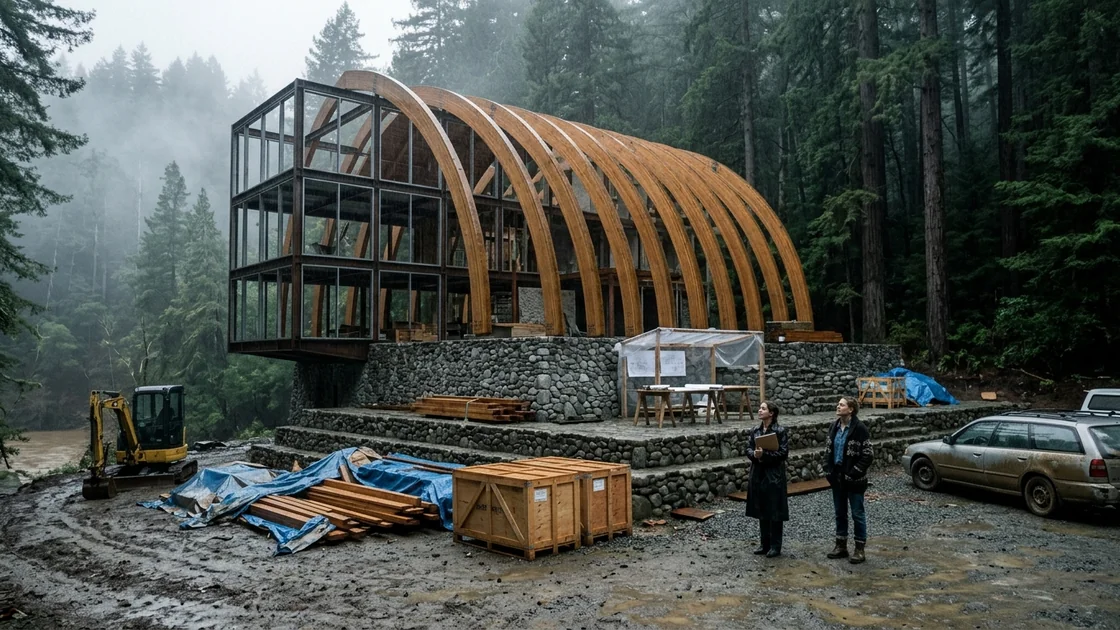
The clearing sat on a high, alluvial terrace eighty feet above the river, which ran coffee-colored and swollen with the autumn rains below. In the center of the terrace, framed against the dark curtain of the redwoods, stood Julian’s final project.
It was not a house. It was an unfinished cathedral of steel and glass.
The foundation was a massive, stepped plinth of gray river rock, laid with such precision that not a single mortar line exceeded a quarter of an inch. Rising from this stone footing were twelve monumental glulam timber arches—curved beams of Douglas fir eighteen inches thick, arching upward thirty feet to form a soaring, ribbed vault that resembled the overturned hull of an ancient ship.
The southern elevation was entirely framed for glass: three-story structural steel mullions that jutted out over the river canyon on a breathtaking cantilever, projecting twenty-two feet into open space with no visible supports beneath.
It was majestic. It was terrifying. It was half-finished.
Piles of untreated structural lumber lay under torn blue tarps, rotting into the mud. A small yellow excavator sat sunk to its axles in the loam near the generator shed, its hydraulic hoses cracked and weeping dark fluid. Two pallets of high-performance architectural glass—eight-foot-by-twelve-foot sheets of low-iron, argon-insulated glass manufactured in Germany—sat unopened in their wooden crates, their shipping manifests bleached illegible by the rain.
"My God," Clara whispered, stepping out of the car before the engine had died.
Eleanor joined her. The air here was still, sheltered from the coastal wind by the canyon walls, smelling of sawed fir, wet concrete, and the clean, mineral breath of the river.
"This is the Black Sands Retreat," Eleanor said, her voice barely louder than the water below. "He told me it was a commission for a Japanese software executive. He said he was just the project architect."
"He told me it was an eco-spiritual sanctuary funded by a foundation in Zurich," Clara said.
She walked toward the structure, her boots squelching in the mud. She climbed the temporary plywood steps onto the stone plinth and stood beneath the great vault of timber.
The floor was poured concrete, ground down to expose the river gravel within, then left unsealed. Rain had blown through the open western framing, pooling in the low spots like dark mirrors.
In the center of the vast space, sheltered under a temporary shelter of corrugated plastic, sat a folding table, an unrolled blueprint weighted down with pieces of quartz, and a portable propane heater with an empty tank.
Beside the blueprint was an empty coffee mug with the logo of the Santa Fe Clay Studio, and a pair of reading glasses identical to the ones Eleanor had in her purse.
Clara stood over the table. Her hand hovered over the blueprint. "Look at the title block," she called out.
Eleanor climbed the steps, her shoes clicking on the aggregate concrete.
The title block in the bottom right corner of the fifty-sheet drawing set did not list a software executive or a Swiss foundation.
PROJECT: THE STERLING RESIDENCE
LOCATION: PARCEL 014-220-11, NAVARRO RIVER, CA
ARCHITECT: JULIAN V. STERLING, AIA
OWNERS: ELEANOR VANCE STERLING & CLARA REYES STERLING
Eleanor stopped two feet from the table. The hair on her arms stood up.
"He put both of us on the drawings," Clara said. Her voice was not angry now; it was hollowed out by a strange, creeping horror. "Not on the deeds. Not on the loans. Just on the drawings."
Eleanor leaned down. The drawing was an elevation of the great hall. Beneath the cantilevered glass terrace, suspended over the eighty-foot drop to the river, Julian had drafted a secondary living space—two identical studio wings, mirrored across a central stone spine.
The north wing was labeled: CONSERVATOR’S ARCHIVE / CLIMATE-CONTROLLED STORAGE.
The south wing was labeled: CERAMIC STUDIO / HIGH-FIRE KILN FLUE.
Between them, connecting the two wings like a stone bridge, was a library with a single, massive fireplace and two drafting tables facing each other across an eight-foot expanse of walnut.
"He was going to bring us here," Clara said, turning to look at Eleanor with eyes that were wide and wild. "He was building a cage for both of us."
"No," Eleanor said, her voice trembling for the first time since she had arrived in California. She touched the title block, her fingertip tracing the crisp, black ink lines that Julian had drawn with his technical pens. "Not a cage. A synthesis. He couldn't choose. He couldn't bear the structural tension of choosing, so he tried to build a house that could hold both of his lies at the same time."
"He was crazy," Clara spat, stepping back from the table. "He was a lunatic."
"He was an architect," Eleanor said bitterly. "He believed that if the design was elegant enough, the laws of gravity would negotiate with him."
A sound broke the quiet—the wet, grinding rumble of a heavy diesel engine crawling up the logging road.
Both women turned.
A white Ford F-350 dually pickup with a commercial rack and a heavy steel bumper pulled into the clearing. The driver didn't park by the station wagon; he drove straight onto the gravel apron near the generator shed, his tires churning up a spray of yellow mud.
The door swung open, and a man in a grease-stained Carhartt jacket and a battered tin hat climbed down. He had a heavy red beard, shoulders like an ox, and a clipboard tucked under one arm.
He looked at the station wagon with its Oregon plates, then looked up at the two women standing on the concrete plinth.
"The gate was chained," the man said, his voice carrying easily through the open timber arches. "Who the hell are you?"
Eleanor stepped to the edge of the stone terrace. "I am Eleanor Sterling. This is Clara Sterling. Julian Sterling died on Tuesday."
The man stopped. He lowered the clipboard by an inch. His mouth set into a hard, sour line beneath his beard.
"Well," the man said, pulling a spit of dark tobacco juice into the dirt. "That explains why his second draw check bounced like a rubber ball yesterday morning. I’m Mack Hurlbut. Hurlbut Heavy Timber. And as of ten o'clock yesterday, ladies, this job has a two-hundred-and-forty-thousand-dollar mechanic’s lien sitting on the county recorder’s desk in Ukiah."
Chapter Six: The Forensic Balance
Mack Hurlbut did not care about bigamy. He cared about two hundred and forty thousand dollars of radio-frequency-dried Douglas fir timbers that had been custom-milled in Eugene and trucked south on four wide-load trailers.
"I’ve got forty tons of timber sitting up there in those arches," Hurlbut said, standing in the middle of the great hall with his boots planted wide, gesturing with his clipboard at the magnificent soaring ceiling. "I’ve got five framers who haven't been paid since September, and the crane rental outfit in Santa Rosa is threatening to attach my personal flatbeds if their invoice isn't cleared by Friday."
He looked at Clara, then at Eleanor, his small, sharp eyes sizing up their wool coats and the station wagon parked in the clearing.
"He told me his partner was coming down from Portland with the wire transfer," Hurlbut said. "Which one of you was the partner?"
"Neither of us," Eleanor said. "We are his surviving wives."
Hurlbut stared at them for five solid seconds. Then he looked up at the ceiling, shook his head, and let out a long, wet whistle. "That son of a bitch. He told me he was an eccentric bachelor who inherited a silver mine in Nevada."
"The silver mine is in Reno," Clara said, leaning against a steel column with her arms crossed over her chest. "It’s a predatory mezzanine fund that is going to foreclose on this entire mountain in eleven days."
Hurlbut’s jaw hardened. The rough, tradesman’s impatience in his face vanished, replaced by the acute, survivalist wariness of an independent contractor who smelled an imminent bankruptcy.
"If Trident Ridge forecloses," Hurlbut said, "my lien gets wiped out. I’m in third position behind the primary land mortgage and their construction note."
"Your lien gets wiped out," Eleanor agreed calmly. "Our houses get wiped out. The German glass sitting in those crates gets sold for scrap by a receiver, and this timber rots in the rain until the bank auctions the parcel for forty cents on the dollar to a vineyard developer."
Hurlbut took off his tin hat, rubbed his bald, scarred scalp, and looked at the great glass-framing jutting out over the river canyon. "It’s a masterwork," he muttered, almost to himself. "I’ve been framing heavy timber for thirty-two years from Humboldt to Monterey. There isn't another truss system like this in North America. The whole cantilever balances on a central steel pivot buried eighteen feet in that river bedrock. He engineered it so the house literally leans against its own weight."
"He leaned against our weight," Clara said. "And the footing just gave out."
Eleanor walked over to the folding table, pulled out the folding metal chair, and sat down. She opened her leather satchel and took out her yellow legal pad.
"Mr. Hurlbut," Eleanor said, her voice crisp and clear in the damp cathedral of wood. "Do you have the crane on site?"
Hurlbut looked at her warily. "The crane’s in Ukiah. But the rental company won't roll it without a ten-thousand-dollar deposit against the arrears."
"How long would it take to dismantle the German glass from its crates and set it into the steel mullions?"
"What?" Clara interrupted, stepping toward the table. "Eleanor, what are you talking about? We’re not finishing this house. We don't have twenty dollars, let alone the three million it would take to enclose it."
Eleanor looked up from her pad. Her eyes were bright, focused with the cold intensity of a curator who had just discovered that a rare manuscript was infested with mold and could only be saved by cutting the binding.
"We cannot finish the house," Eleanor said. "And we cannot pay the Reno note. But an unfinished frame on an open parcel is a total loss at an auction. A bank receiver will treat this as an abandoned building site with environmental liabilities. They will value the improvements at zero."
She turned to Hurlbut. "What is the replacement value of the timber trusses if they were unbolted and salvaged?"
Hurlbut blinked. He looked up at the arches, then back at Eleanor. "You can't just unbolt them. They’re tension-fitted with six-inch drift pins."
"Can they be removed without destroying their structural integrity?" Eleanor pressed.
"Yeah," Hurlbut said slowly. "We engineered them to be modular. We assembled them on the ground and hoisted them in sections. If you’ve got the forty-ton crane and three men who know how to drift a pin, you could take the whole frame down in four days. The timber alone is worth four hundred grand on the open market right now. Mass-timber construction is booming in Seattle and the Bay Area. Everyone wants old-growth-density fir with an engineering stamp."
"And the glass?" Eleanor asked.
"Custom-dimensioned triple-pane Schuco units," Hurlbut said. "Unopened in original crates. You couldn't get another set shipped from Hamburg in under eight months. An outfit building a high-end estate in Carmel or Tahoe would pay two hundred and fifty thousand tomorrow morning just to skip the supply-chain queue."
Clara stood very still, her head cocked to one side as she followed the line of Eleanor’s thinking.
"The Reno fund has a lien on the real property," Clara said, her voice dropping into a conspiratorial whisper. "The land. Parcel 014-220-11."
"They have a deed of trust securing the real estate and all improvements permanently affixed thereto," Eleanor said, quoting the standard language of the promissory note she had memorized the night before. "The timber trusses are bolted to steel baseplates set into the concrete plinth. Are they permanently affixed, Mr. Hurlbut?"
Hurlbut smiled—a slow, predatory showing of yellow teeth beneath his red beard. "The baseplates are anchored with high-tensile structural bolts that haven't had their threads torqued and tack-welded yet. County building inspector hasn't done the shear-wall inspection. Legally speaking, ma'am? Those trusses are stored building materials sitting on a foundation. They’re personal property."
"And the glass?"
"Sitting in wooden crates on pallets," Hurlbut said. "Not even unpacked."
Eleanor turned her pad back around. She drew two lines down the center.
"The Reno note gives Trident Ridge the right to inspect the collateral upon twenty-four hours' written notice," Eleanor said. "They don't even know Julian is dead yet. The coroner hasn't released the certificate, and the Mendocino County news doesn't run rural auto fatalities until the Thursday edition."
"We have forty-eight hours," Clara said.
"We have seventy-two if we don't answer the phone," Eleanor corrected.
"Wait a minute," Clara said, her hands coming up to her hips. "Even if we sell the timber and the glass, that money belongs to the estate. Julian’s estate. Which means the moment it hits an account, Trident Ridge and the tax people and the Santa Fe bank will slap a freeze on it. We’ll be doing all this work just to hand seven hundred thousand dollars to a collection agency in Reno."
Eleanor looked at Clara through her reading glasses. "Not if the material is sold by the contractor to satisfy a pre-existing, perfected mechanic’s lien for labor and materials furnished prior to the date of death."
She looked at Hurlbut.
Hurlbut’s smile vanished. He looked at Eleanor with a mixture of professional respect and genuine alarm. "Lady, you’re talking about a priority liquidation under a mechanic’s lien foreclosure. I’d have to file an emergency notice of intention to sell at public auction."
"Which you will file in Ukiah at eight-thirty tomorrow morning," Eleanor said. "You will post the statutory notice on the gatepost of this property at nine. You will hold the auction on this plinth at ten o'clock on Friday morning. Clara and I will be here with the buyers."
"What buyers?" Clara asked, her voice cracking. "Eleanor, where are you going to find someone to write a six-hundred-thousand-dollar cashier's check for twenty tons of curved Douglas fir and twelve crates of German glass in forty-eight hours?"
"You manage an art gallery in Santa Fe," Eleanor said. "You deal with people who buy three-hundred-thousand-dollar bronze sculptures to put in their sculpture gardens. And I am the senior archivist for a foundation whose board of trustees includes three of the largest commercial timber developers in the Pacific Northwest."
Clara stared at Eleanor. The rain had begun to fall again, drifting in through the open framework of the roof, fine as mist, settling on Eleanor’s graying hair and the collar of her wool coat like a dusting of salt.
"You’re terrifying," Clara said.
"I have spent twenty-two years cataloging the financial records of dead Oregon lumber barons," Eleanor said, rising from the folding chair and smoothing her trousers. "I know exactly how they stole their land, I know how they cheated their creditors, and I know how they hid their assets from their wives. Julian was an amateur compared to the men who built this state."
Chapter Six: The Forensic Balance (Continued)
The breakfast room of the motel was empty at five in the morning, save for a sputtering commercial urn of chicory coffee and two miniature plastic tubs of non-dairy creamer that had separated into layers of oil and water.
Clara sat at the round laminate table, three legal pads spread out around her like the petals of a decaying flower. Her cell phone was plugged into the wall with an extra-long cord, and she was speaking in the low, urgent voice of a dealer working a back-room consignment at an international art fair.
"I don't care if he’s in Sun Valley, Sarah. Call his assistant. Tell him that the glulam trusses from the Sterling project on the Navarro are available at sixty cents on the market. Yes, the ones featured in the Architectural Record preview last spring. The forty-foot continuous radius curves. They’re already milled, cured, and stress-tested. If he wants the timber package for the Sun Valley house, he has to have a representative at the site in Mendocino by Friday with an irrevocable letter of credit."
She listened, her thumb nervously shredding the corner of a paper napkin.
"No, Julian isn't available. He’s... he’s stepped away from the active management of the firm. The contractor is liquidating the staging site under a statutory lien. It’s clean. The title to the materials transfers directly from the fabricator with an indemnity bond. Just call him."
She hung up, looked at Eleanor, and picked up her cold coffee. "He’s calling the owner of an eco-resort in Big Sur. A guy who sold an enterprise software firm in April and has three hundred million dollars sitting in an offshore trust that he needs to deploy into physical assets before the tax year ends."
Eleanor was typing on a battered laptop she had retrieved from her station wagon. Her fingers moved with the relentless, unhesitating precision of a court reporter.
"I’ve reached Martin Vance," Eleanor said.
Clara stopped her mug halfway to her mouth. "Vance? Your brother?"
"My cousin," Eleanor said. "He’s a bankruptcy trustee in Seattle. He spent four years untangling the assets of that timber syndicate that collapsed in Coos Bay in 2018. He looked up the Trident Ridge mezzanine note on the Nevada registry."
"And?"
"The note has a fatal defect," Eleanor said, not looking up from the screen.
Clara set her mug down with a sharp clack. "What kind of defect?"
"Julian was lazy," Eleanor said, her voice dropping into that cool, analytical tone that sounded more like an autopsy report than a financial assessment. "He was so confident in his personal charm that he cut corners on the legal executions. To cross-collateralize our personal residences, the lender required an acknowledgment of the primary mortgages. In Oregon, a mortgage on residential real property held as a tenancy by the entirety cannot be encumbered without the contemporaneous written joinder of both spouses, executed before a licensed officer of the court."
"The Deschutes County notary," Clara said.
"The notary was a secretary at a title company in Bend who lost her license three years ago for signing off on fraudulent agricultural easements," Eleanor said. "Martin pulled her disciplinary record from the Secretary of State’s database. The acknowledgment on my Portland deed is legally void ab initio. It’s a nullity."
Clara leaned forward, her eyes narrowing. "What about my deed? In Santa Fe?"
Eleanor paused. Her fingers rested on the keyboard, motionless. She looked across the laminate table at Clara, whose face was illuminated by the harsh, bluish glare of the laptop screen.
"New Mexico is a community property state," Eleanor said softly.
Clara’s face went completely still. "Meaning?"
"Meaning Julian didn't need your signature to encumber his half of the property," Eleanor said. "And because he used an LLC where he was the sole managing member, he had the statutory authority to pledge the Santa Fe house as collateral for the commercial loan. Your signature wasn't forged, Clara. It wasn't even required."
Clara sat back. The color that had crept into her cheeks during her phone calls drained away, leaving her skin looking like parchment that had been scrubbed with pumice.
"So my house is gone," Clara said.
"If Trident Ridge forecloses, your house is sold," Eleanor confirmed. "Even if the Oregon property is excluded from the collateral pool, the Santa Fe property will be seized to satisfy the deficiency on the Navarro parcel."
Clara looked down at her hands. Her fingers were stained with red New Mexico dirt that had worked its way deep into the grain around her cuticles—dirt that forty-eight hours of coastal rain had failed to wash away.
"I spent six years rebuilding that adobe," Clara said, her voice dropping so low Eleanor had to lean forward to hear it over the hum of the refrigerator. "The south wall was melting into the mud when I bought it. I dug the trenches myself. I hauled two thousand pounds of straw and horse manure from the stables in Tesuque to mix the plaster. I laid every single floor tile with my own knees on the gravel."
She looked up at Eleanor, her eyes burning with an ancient, primal rage that was no longer directed at Julian, but at the sheer, indifferent geometry of the law.
"He told me that house was our anchor," Clara whispered. "He told me that no matter where he had to travel, no matter how heavy the work got, he could come back to Camino del Monte Sol and the walls would be cool and the floor would hold."
Eleanor reached out. For the first time, she crossed the invisible boundary that had separated them since the hospital hallway. She set her long, cool hand on top of Clara’s calloused fingers.
"The house is not gone," Eleanor said.
"You just said the deed is valid," Clara choked out.
"The deed is valid against the LLC," Eleanor said. "Which means Trident Ridge has a claim against the asset. But they don't have the cash. What lenders like Trident Ridge want is liquidity. They are a high-yield mezzanine fund with sixty-day reporting cycles to their European investors. They do not want to manage an adobe house in Santa Fe, they do not want to evict an artisan, and they certainly do not want to litigate a complex cross-border probate contest across three different federal circuits."
Eleanor leaned closer, her voice hardening into steel.
"We are going to give them a choice," Eleanor said. "We are going to sell the timber and the glass to Mack Hurlbut’s buyers for seven hundred thousand dollars cash. We are going to pay Hurlbut his two hundred and forty thousand, which clears the primary mechanic’s lien and gives him his profit. We are going to take the remaining four hundred and sixty thousand dollars and put it into an escrow account held by my cousin’s firm in Seattle."
"And then?" Clara asked.
"And then," Eleanor said, "we are going to call Trident Ridge’s managing director in Reno. We are going to inform him that Julian Vance Sterling is dead, that his estate is hopelessly insolvent, that the Oregon property is completely untouchable due to structural notary fraud, and that the Navarro property is now an empty concrete plinth with two hundred thousand dollars in environmental remediation liabilities."
"And then?"
"And then," Eleanor said, "we will offer them four hundred thousand dollars in immediate, cleared funds in exchange for a full, unconditional release of the Santa Fe deed of trust and a covenant not to sue either of us in any jurisdiction on earth."
Clara stared at her. "Will they take that? It’s seventy cents on their principal."
"They will take it," Eleanor said, a thin, triumphant smile touching the corners of her mouth, "because the only other option is to spend two hundred thousand dollars on lawyers to recover a pile of river rocks in a Mendocino canyon."
Chapter Seven: The Dismantling
The crane arrived on Thursday afternoon, an eighty-foot yellow insect that groaned as it crawled up the Navarro River logging road, its outriggers rattling like iron chains against its chassis.
Mack Hurlbut had not slept in thirty hours. His beard was wild, his eyes bloodshot, his tin hat tilted back on his head as he stood on the concrete plinth directing the three-man rigging crew with sharp, violent chops of his hand.
"Easy on the hoist!" Hurlbut roared through a battery-powered megaphone. "Catch the drift pin on the lower collar before you swing the boom! If you bind that timber on the shoe, it’ll splinter the whole damned joint!"
The engine of the crane roared, a deep, mechanical scream that echoed off the canyon walls and sent a flock of blue herons rising from the riverbanks in a flurry of gray wings.
High above the concrete plinth, suspended forty feet in the air by four nylon slings, the first great arched truss swung free of its steel baseplate. It moved with an eerie, floating grace—twenty-two hundred pounds of laminated Douglas fir, curved like the rib of a leviathan, sweeping through the damp air toward the waiting flatbed trailer on the gravel apron below.
Eleanor stood near the generator shed, her trench coat buttoned to the neck, her notebook open in her hand. She was checking off the serial numbers stamped into the heel of each timber against the structural manifest from the Eugene mill.
Clara was twenty feet away, working with two young men from the local glass-glazing cooperative in Point Arena. They were inspecting the wooden crates containing the German glass, using flat pry-bars to lift the lids just enough to verify that the vacuum seals on the argon chambers had not been breached during the rain.
"Seal’s intact!" one of the glaziers called out, shining an inspection light across the triple-glazed edge of a twelve-foot pane. "Zero moisture in the interstitial space. It’s perfect."
A black Lincoln Navigator with tinted windows and California commercial plates pulled into the clearing, parking next to Eleanor’s mud-spattered station wagon.
A man in a charcoal cashmere topcoat, tailored wool trousers, and Italian leather driving shoes stepped down onto the muddy gravel. He looked at the crane, at the swinging timber truss, and then at the muddy plinth with an expression of intense, proprietary disgust.
He walked over to Eleanor, stepping carefully around the puddles of yellow water.
"Are you Mrs. Sterling?" he asked. His voice was smooth, clipped, carrying the thin, nasal drawl of an executive who did not like leaving the 415 area code.
"I am Eleanor Sterling," she said, closing her notebook over her thumb.
"I’m Julian’s representative from the Big Sur venture," the man said, pulling a leather business card case from his topcoat. "Marcus Chen. My principal spoke with a woman named Clara yesterday morning regarding the timber package."
Clara walked over, wiping her mud-stained hands on a rag she pulled from her denim pocket. "I’m Clara."
Marcus Chen looked from Eleanor to Clara, his eyes flickering over their faces with the brief, clinical curiosity of a man who had seen strange things in the portfolios of eccentric architects.
"My principal has reviewed the structural calculations," Chen said. "The timber package meets the architectural specifications for our wellness pavilion in the Ventana wilderness. The price is acceptable: four hundred and ten thousand dollars for the twelve arches and the secondary purlins, delivered to our staging yard in Monterey."
He reached into his breast pocket and produced a certified cashier's check drawn on a commercial bank in San Francisco.
"Payable to Hurlbut Heavy Timber," Chen said, holding it between two manicured fingers. "Per the statutory lien release notice posted on the county registry this morning."
Eleanor took the check. She looked at the blue security ink, the watermarked signature, the crisp, machine-stamped numerals: $410,000.00.
"And the glass?" Clara asked.
"Our glazier has inspected the crates," Chen said, nodding toward a second vehicle—a heavy crew-cab pickup with an aluminum glass-rack—that was just turning into the lower clearing. "He has confirmed the integrity of the seals. We will take the entire Schuco inventory for two hundred and forty thousand dollars, payable directly to the escrow agent designated in your notice."
He produced a second check: $240,000.00, payable to Vance & Associates Client Trust Account.
Total: $650,000.
Eleanor handed the first check to Mack Hurlbut, who had walked up behind them, his face covered in grease and sawdust, his tin hat dripping rain onto his shoulders.
Hurlbut looked down at the four hundred and ten thousand dollars. His red beard twitched. He pulled a battered ballpoint pen from behind his ear, slapped the check against his clipboard, and signed the satisfaction of lien document that Eleanor had prepared for him at four that morning.
"Pleasure doing business with you, ladies," Hurlbut said. He looked at Marcus Chen. "Tell your boys in Monterey to use three-inch rigging straps when they offload those arches. If they use wire rope, they’ll chew the edges of the laminate and ruin the finish."
"They are professionals, Mr. Hurlbut," Chen said coldly.
"So was the guy who designed 'em," Hurlbut spat, looking up at the empty sky where the first truss had hung five minutes earlier. "And look where he ended up."
Chapter Eight: The Closing of Accounts
By Friday afternoon, the Navarro River terrace was empty.
The crane was gone, its heavy tracks leaving deep, water-filled trenches in the yellow clay. The yellow excavator had been winched onto a tilt-bed trailer and hauled back to Ukiah. The glass crates were strapped onto the glazier’s truck, rolling south toward the Golden Gate.
All that remained was the concrete plinth.
It sat in the clearing like a gray sarcophagus, eighty feet above the muddy river, stripped of every stick of timber, every sheet of glass, every line of steel. Only the twelve foundation shoes—massive blocks of galvanized steel bolted into the river stone—remained, jutting up from the surface like broken teeth.
Eleanor and Clara sat on the tailgate of Clara’s Toyota Tacoma, which they had retrieved from the hospital lot the previous night after paying sixty dollars to jump-start its frozen battery.
Between them sat a white cardboard box containing Julian’s ashes.
The county had cleared the body at noon on Thursday. The cremation had been performed in a cinder-block facility on the outskirts of Santa Rosa, a place that smelled of natural gas and dried chrysanthemums. The invoice—$850—had been paid with a check drawn on Julian’s last active credit line before the bank could freeze it.
Clara had the box between her thighs. She had taken off the alpaca wool cardigan; she was wearing an old denim jacket with the sleeves rolled up, her arms bare to the misty rain.
"Martin called," Eleanor said, looking down at her cell phone.
Clara didn't move. "What did the Reno people say?"
"They took the four hundred thousand," Eleanor said.
The words hung in the quiet canyon, clean and final as the sound of an iron gate latching shut.
"They took it?" Clara repeated, turning her head slowly.
"Martin threatened to file an adversary proceeding in federal bankruptcy court on Monday morning," Eleanor said. "He told them we had evidence of systematic wire fraud and notary forgery that would tie the title to this parcel up in litigation for six years. He told them they could have four hundred thousand dollars in cleared federal funds within two hours, or they could spend the next decade explaining to the Federal Reserve why their mezzanine fund was accepting forged powers of attorney from dead architects."
"And the release?"
"Executed," Eleanor said. "The reconveyance of the deed of trust on your Santa Fe house was filed electronically with the Santa Fe County Clerk forty-five minutes ago. You own Camino del Monte Sol free and clear of Trident Ridge."
Clara looked out over the river canyon. Her eyes were dry, but her lips were pressed together so hard they had lost all their color. She reached out, her fingers resting lightly on the lid of the cardboard box.
"And the Portland house?" Clara asked.
"The Alameda house is safe," Eleanor said. "Without the cross-collateral guarantee, the primary mortgage is current. The bank has no grounds to accelerate the debt. I’ll have to take five thousand dollars from my retirement fund to clear the title cloud from the bogus trust, but the house is mine."
She looked at the box between Clara’s legs.
"What do we do with him?" Clara asked.
"I don't care," Eleanor said. "You can throw him into the river. You can take him back to New Mexico and mix him into your clay. You can leave him here on this plinth for the raccoons."
Clara looked at the box for a long time. Then she pulled the plastic tab on the top, broke the paper seal, and lifted the lid.
Inside was a heavy clear plastic bag sealed with a zip-tie, filled with three pounds of gray, granular bone ash that looked remarkably like the crushed river gravel Julian had specified for the aggregate floor beneath their feet.
Clara reached inside, took a handful of the ash, and let it slip through her fingers.
It was coarse. It did not blow away in the mist; it fell straight down, landing on the wet concrete with a faint, gritty patter.
"He wasn't an architect," Clara said, her voice dropping into a register of profound, weary certainty. "He was a magician who ran out of mirrors."
"He was an architect," Eleanor corrected, her voice soft but immovable. "He designed structures that could not stand unless the people inside them were destroyed to pay for the materials. That is an ancient profession, Clara. It’s just not one they give awards for."
Clara picked up the box. She walked to the edge of the stone terrace, where the cantilevered steel mullions had once jutted out over the empty air.
She stood there for a moment, her boots balanced on the very edge of the eighty-foot drop. The river below ran brown and fast, carrying broken cedar branches and hemlock needles out toward the Pacific.
She did not make a speech. She did not say a prayer. She simply inverted the box, holding it by its cardboard bottom, and shook it twice.
The gray dust fell in a sudden, dense plume, drifting outward as the canyon updraft caught it, scattering the fine particles across the fir tops before the heavier bone chips dropped into the river and vanished beneath the brown water.
Clara threw the empty box into the bed of her truck, walked back to the tailgate, and picked up her pack of unfiltered Camels. She lit one with a wooden match that flared yellow against the damp gray afternoon.
"Where are you going?" Clara asked through a plume of blue smoke.
"Portland," Eleanor said. "I have seven boxes of nineteenth-century shipping manifests waiting for deacidification at the society. If I’m not there by Monday morning, my assistant will use the wrong buffering solution and ruin the paper."
Clara nodded. She pulled a folded piece of paper from her pocket and handed it to Eleanor.
It was a bill of lading from the Santa Rosa freight depot.
"What is this?" Eleanor asked.
"Two pallets of that German glass," Clara said, looking down at the tip of her cigarette. "I told the glazier that one of the crates was damaged so he wouldn't take it to Monterey. It’s at the rail yard in Richmond. It’s consigned to your name."
Eleanor looked at her, her eyebrows drawing together. "What am I going to do with sixty square meters of structural German architectural glass?"
"Sell it," Clara said, a faint, crooked smile breaking across her sun-weathered face. "Or build yourself a sunroom on Alameda Ridge that can withstand a category four hurricane. You paid for it."
Eleanor looked at the bill of lading, then folded it with precise, archival care and slipped it into her satchel.
"And you?" Eleanor asked. "What will you do in Santa Fe?"
"I’m going to clean the studio," Clara said. "I’m going to throw out his drafting tables, I’m going to sell his transit level to a surveyor in Albuquerque, and then I’m going to make twelve huge, ugly, lopsided earthenware pots that have no structural integrity whatsoever."
She held out her hand.
Eleanor looked at it—at the short, strong fingers, the chipped nails, the faint red stain of the high desert still clinging to the skin.
Eleanor took Clara’s hand in her own. Their wedding bands—the twin bands of hand-hammered platinum that Julian had forged from the same bar of metal—clicked together, a small, bright, metallic sound that sounded like two coins falling into an empty stone jar.
"Don't build anything you can't afford to tear down," Eleanor said.
"Don't preserve anything that’s already rotted through the floorboards," Clara answered.
They dropped their hands.
Eleanor walked to her station wagon, opened the door, and climbed inside. She turned the key; the engine started with a steady, quiet hum. She backed out of the clearing, turned around on the gravel apron, and began the long crawl down the logging road toward the highway, leaving Clara standing alone on the great gray stone plinth, smoking her cigarette in the quiet, persistent rain of the coast.