The Architecture of Company
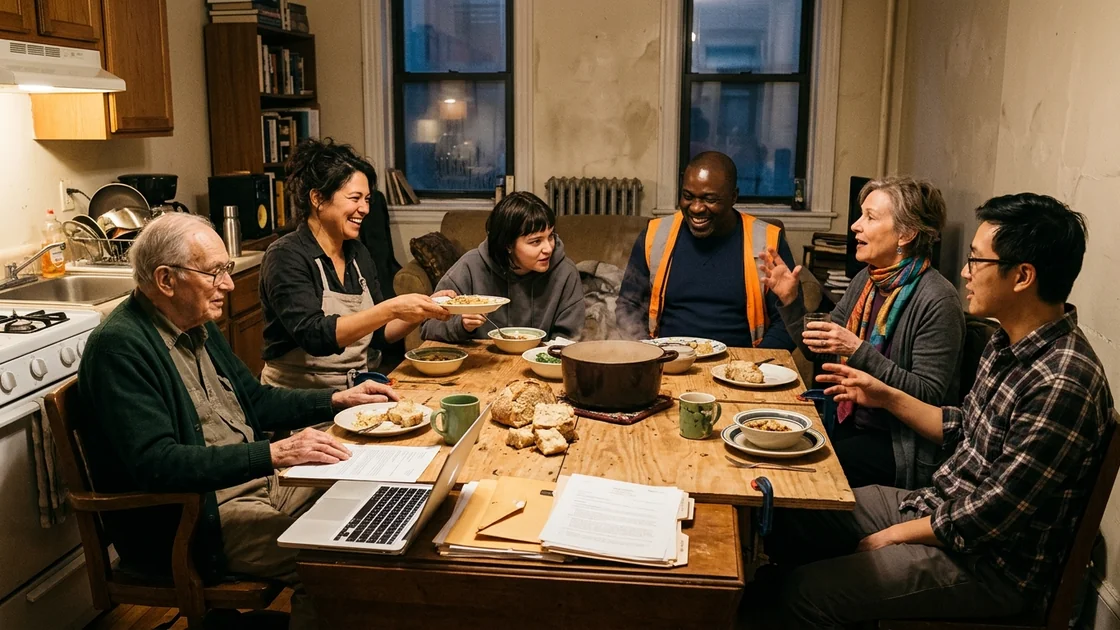
In an aging six-story brick apartment building on the northern fringe of the borough, Nora Reyes spent seven years learning how to live without making a sound. Like the five other solitary tenants who shared her landing and lightwell, she had perfected the private choreography of modern city life, purchasing groceries wrapped in cellophane for one and treating her neighbors as polite shadows in the stairwell. Everything changes during a bitter November when Nora tapes an invitation to the lobby radiator, offering a weekly home-cooked meal to anyone accustomed to eating over a sink. Over twenty-six Tuesdays, through braised stews, burnt flatbreads, and fragile confessions, the makeshift supper club slowly breaches the thick plaster walls of mutual indifference, dismantling decades of accumulated grief, phantom debts, and defensive pride until six isolated strangers discover that survival in the city is not a matter of endurance, but of communion.
Chapter One: The Geometry of One
The Marigold was built in 1924, an era when architects still believed that working people deserved terrazzo entryways and crown molding, even if the mortar between the bricks was cheap and the courtyard was narrow enough to touch both sides with outstretched broomsticks. It sat on the corner of Maple and 47th, five stops past the river, coated in ninety years of soot from the elevated line and diesel exhaust from delivery vans.
Nora Reyes lived in 4B. Her living room had two windows that faced the interior lightwell, a shaft of gray space where the only incoming weather was a vertical draft and the only light was the pallid reflection of someone else’s television flickering across cream-colored brick.
For Nora, forty-one years old and employed four days a week as an archivist of municipal tax maps, the apartment was an exercise in containment. Everything in 4B had been reduced to the singular. There was one Dutch oven, six quarts in volume, which she had inherited from her aunt and used almost exclusively to boil three-ounce portions of rigatoni. There was one heavy ceramic mug, moss green with a chip on the rim that sat comfortably against her lower lip. There was a single drop-leaf table tucked between the radiator and the bookshelf, its second wing permanently folded down against the wall to save twelve inches of floor space.
Living alone in the city was not an accident; it was an applied discipline. Nora had arrived at it gradually, following a gentle, unheralded dissolution of an engagement in her early thirties that had produced no villain, only a quiet mutual realization that neither she nor Julian wished to be perceived continuously by another person. Julian had moved to Seattle; Nora had signed the lease at the Marigold. In the decade since, she had mastered the protective arts: walking with headphones unplugged from any device so no one would ask for directions; sorting mail over the recycling bin in the vestibule so no unneeded envelope ever crossed her threshold; and, above all, cooking in quantities that could be accounted for by the human hand.
The problem with cooking for one was not the labor, which she enjoyed, but the logistics of the grocery store. The commercial world despised the solitary. Celery did not arrive by the rib; it arrived in sprawling bunches of twelve that liquefied into brown sludge in the bottom drawer before a third of it could be chopped. Broth came in thirty-two-ounce cartons that grew white molds along the inner foil cap while waiting for a second soup. Loaves of bakery bread dried into weapons unless sliced and frozen into gray, frost-bitten slabs.
Every Tuesday evening, the city’s sanitation department collected the building’s trash. If one stood in the alleyway by the service entrance, as Nora did on a drizzling night in early November, the evidence of the Marigold’s population was laid out in clear plastic bags.
Nora had taken her small bag down four flights of stairs because the trash chute had been rusted shut since the Carter administration. As she tossed her bag into the blue municipal bin, she paused. Through the semi-transparent polyethylene of the adjacent bags, the domestic habits of her neighbors were illuminated under the amber glow of the security light.
In the bag belonging to 2A—Arthur Vance, who had lived on the second floor since the building had a coal furnace—there were three identical tin cans of boneless sardines in oil, four individual microwaveable rice cups with the plastic peel-back lids curled like dried leaves, and seven small plastic bottles of ginger ale.
In the bag from 6F—the young woman with the sharp black bob and the perpetually frantic gait whom Nora had once heard weeping into an iPhone on the third-floor landing—there were four half-empty containers of takeout pad thai, two bags of pre-washed baby spinach that had turned to dark green slime without ever being unsealed, and a single cardboard sleeve from an individual microwaveable pizza.
In the bag from 3C—the night-shift transit worker whose steel-toed boots echoed on the stairs at 4:30 every afternoon—there were three rotisserie chicken carcasses stripped bare with surgical precision, six empty pint cartons of whole milk, and a dozen instant noodle bowls stacked like an accordion.
Six bags. Six households of one. Each kitchen in the Marigold was a tiny, sealed chamber producing the identical byproducts of lonely sustenance: single-serving plastics, half-eaten vegetables surrendered to rot, and the dull, salt-heavy preserves of convenience.
Nora walked back up the four flights. Her building contained twenty-four apartments. At least ten of them were occupied by people who lived entirely by themselves. They heard each other flush toilets; they knew the cadence of each other’s coughs through the thin lath-and-plaster walls; they smelled each other’s garlic and laundry detergent; yet they passed on the stairs with the averted gazes of prisoners exercising in a yard.
Inside 4B, Nora looked at her kitchen. It was six feet by seven, equipped with an enameled cast-iron sink with twin brass faucets that dripped in a syncopated meter. On the butcher block sat a head of Savoy cabbage she had bought on Saturday. It was already beginning to dry along the outer crinkles, its edges browning like old parchment. She would eat two leaves raw with a smear of mustard, perhaps braise three more with a splash of cider vinegar, and the rest would sit in the vegetable bin until next Tuesday’s trash bag claimed it.
She sat at her drop-leaf table, took a three-by-five index card from her desk drawer, and uncapped her fountain pen.
She wrote in the tight, upright cursive she had used for twenty years to catalog land deeds:
Tuesday Suppers. Apartment 4B. To anyone who eats alone: I am cooking a beef and root vegetable daube this Tuesday at 7:00 PM. There will be bread and a green salad. There is no charge, no agenda, and no requirement to talk if you do not feel like it. If you have a plate and a fork, please bring them, as I only have four of each. If you do not have them, come anyway. Nora Reyes (Apt 4B)
She looked at the card for ten minutes. It looked pathetic. It looked like an invitation to an ambush or a flyer for a fringe religious sect. She tapped the edge against her thumb until the blue ink dried into a dark, stony navy.
At 11:30 PM, when the radiator had begun its nightly death rattle and the building had settled into the quiet hum of twelve separate refrigerators, Nora crept down the stairs in her slippers. She did not use the elevator, whose iron cage shuddered loud enough to wake the heavy sleepers on the second floor. In the vestibule, beneath the row of twenty-four brass mailboxes whose little celluloid name windows were mostly blank or yellowed with age, she taped the card to the broad, cast-iron shelf of the disused parcel table with two strips of blue painter's tape.
She ran back up the stairs like a vandal.
Chapter Two: The First Tuesday
By 6:45 on Tuesday evening, Nora was sweating through her linen shirt.
She had spent forty-two dollars at the greenmarket on Saturday—an outrageous sum that represented her entire discretionary budget for two weeks. On the counter sat three loaves of sourdough bread she had bought from the bakery near the subway, their crusts blistered and dusting the counter with pale rye flour. On the four-burner stove, which tilted slightly toward the back wall, her aunt’s Dutch oven had been joined by a second, nine-quart enameled pan she had borrowed from her sister in New Jersey under the pretext of making plum jam.
Inside the two pots, three pounds of beef chuck, browned in salt pork fat until mahogany, were sinking into a dark, wine-heavy gravy thick with halved shallots, parsnips cut into thumb-sized wedges, and whole garlic cloves that had softened into sweet paste. The smell had escaped her apartment hours ago. It was an offensive, indiscreet smell; it permeated the hallway, heavy with bay leaf, thyme, and the sour warmth of cheap Burgundy.
She had pulled the drop-leaf table into the exact center of her twelve-by-fourteen living room. To make room for four chairs—her own wooden desk chair, two folding aluminum stools she had retrieved from the basement storage cage, and an upturned plastic milk crate cushioned with a folded wool blanket—she had been forced to push her sofa against her bookshelves, obscuring everything from Gibbon’s Decline and Fall to her field guides on urban lichen.
At 7:02, the knock came.
It was not a confident knock. It was three dry, hesitant raps, delivered with the middle knuckle, down low, near the brass keyhole.
Nora wiped her hands on her apron, took a shallow breath, and opened the door.
Arthur Vance stood on the doormat. He was wearing a cardigan of bottle-green wool, worn through at both elbows so that his gray cotton undershirt peeked through like lichen on tree bark. In his right hand, he held a blue stoneware dinner plate, completely clean, and a single stainless-steel fork wrapped in a paper napkin from a doughnut shop.
"Good evening," Arthur said. His voice was like dry leaves being shifted with a rake. "I saw the card."
"Mr. Vance," Nora said. "Please. Come in."
"I don't wish to intrude if you've got family," he said, peering past her shoulder into the empty room with pale, watery blue eyes that were slightly enlarged behind thick bifocals.
"There is no family," Nora said. "Just the beef. Come in. You get the desk chair; it’s the only one with actual lumbar support."
Arthur stepped inside. He moved with the careful, deliberate gait of a man who had fallen once and was determined never to repeat the experience. He set his plate on the bare table, looked at the folded milk crate with a twitch of his mustache, and then carefully sat down on the desk chair, placing his hands flat on his knees.
"I haven't smelled a daube since 1998," he said to the wall. "My late wife, Clara. She used to make it with orange peel."
"There is orange peel in this," Nora said from the kitchenette. "Just two strips. Dried."
Arthur nodded once, slowly. "Good. The oil cuts the tallow."
At 7:08, the door, which Nora had left cracked three inches, was pushed open by the tip of an umbrella.
Minna Lind stood in the hall. She was wearing an oversized gray hooded sweatshirt that smelled faintly of laundry damp and damp wool. Her eyes were shadowed with purple rings that made her look nineteen, though Nora knew from a package she had once accepted on her behalf that Minna was twenty-seven. She carried no plate. In her hands, she clutched an open plastic container of store-bought hummus and a sleeve of saltines.
"I didn't have a plate that wasn't dirty," Minna said without greeting. "And I don't know if this is weird. Is this weird? If this is a church thing, I'm going to leave."
"It's not a church thing," Nora said. "I have a spare bowl. It has a picture of a trout on the bottom. Put the hummus in the fridge."
Minna lingered on the threshold for five seconds, her weight shifting from sneaker to sneaker, before she stepped inside and let the door swing shut behind her. She did not sit. She drifted toward the bookshelf, reading the spines that weren't blocked by the sofa.
"You have the complete Rivers of America series?" she asked, her voice dropping into a register of genuine interest.
"Most of them," Nora called out, ladling the dark stew into a cracked white tureen. "Missing the Monongahela."
"My grandfather had the Hudson," Minna said. She sat down on the milk crate without checking its stability. "He never read it. He used it to press autumn leaves."
The third arrival did not knock at all. Samuel Osei simply appeared through the half-open door at 7:15, filling the narrow frame with his shoulders. He was wearing his orange transit authority vest over a navy thermal shirt, his heavy work boots clean but scuffed at the steel caps. He carried two two-liter bottles of club soda under one arm and a brown paper sack that smelled intensely of fried dough.
"Miss Reyes," he said, ducking his head as he entered. "The smell was at the third floor. It was not fair to leave it at the third floor."
"Samuel," Nora said. "You're off early."
"Split shift," he said. He placed the sodas on the small counter and set the paper sack beside the bread. "Bofrot. My sister made them yesterday. They are cold, but if you drop them in the gravy, they soak it up."
The four of them looked at the table.
There were four chairs. There was one tureen of beef, a bowl of red-leaf lettuce with a simple mustard vinaigrette, and three loaves of sourdough, already sliced into thick, jagged wedges.
No one sat down immediately. They stood in the five feet of space between the counter and the table, four bodies accustomed to an eight-foot radius of personal clearance, suddenly sharing an atmosphere heavy with steam and animal fat.
"Well," Nora said, her voice shaking slightly. "The spoons are in that jar. Take one and sit."
They sat.
The first five minutes were defined entirely by the mechanical sounds of eating. It was the specific, desperate sound of people who had forgotten how to eat in the presence of others: the scrape of stainless steel against stoneware; the wet, tearing sound of sourdough crust being pulled apart; the sharp hiss of a club soda bottle being unthreaded.
Arthur Vance ate with precision. He cut each cube of beef into two equal halves with the side of his fork, dipped a piece of carrot into the gravy, and chewed thirty times before swallowing. His hands, spotted with the pale brown freckles of old age, trembled slightly, but his grip on the fork was iron.
Minna ate hunched over her trout bowl, her hood still up, her left hand tucked into the pocket of her sweatshirt while her right shoveled stew with an efficiency that suggested she had not eaten a hot meal since Sunday.
Samuel sat on one of the folding aluminum stools, his knees nearly touching his chin. He took a piece of the cold Ghanaian doughnut, dropped it into the mahogany sauce, waited four seconds, and lifted it to his mouth with his fingers. He closed his eyes.
"Too much salt?" Nora asked, unable to stop herself.
Samuel opened his eyes. "Miss Reyes. It is not too much salt. It is proper."
"My wife," Arthur said, his voice cutting through the hum of the lightwell draft outside, "used to buy beef shin from the butcher on 8th Avenue. He gave her the marrow bones for five cents. She would roast them first until the grease was black. That was the secret. If the grease wasn't black, the stew was just water."
"My mother bought whatever was in the yellow tray with the red sticker," Minna muttered, her mouth half-full. "Usually pork chops that tasted like the refrigerator."
"Pork chops are treacherous," Arthur said, turning his pale gaze upon her. "They dry out if you look at them. An unforgiving cut."
"Everything my mother cooked was unforgiving," Minna said, but there was no venom in it; it was simply a field report from another country.
They finished the entire nine-quart pot.
Nora, who had spent seven years measuring her pasta into a four-ounce copper cup, watched three pounds of meat, four pounds of vegetables, and two whole boules of sourdough vanish into three human bodies in twenty-five minutes. There was something terrifying about it, and something so profoundly satisfying that a knot beneath her breastbone, tight since the previous winter, slipped loose by an inch.
When the bowls were scraped so clean that the trout on Minna’s dish was completely visible, Samuel stood up.
"I will wash," he said.
"No," Nora said, rising. "You're guests."
"Miss Reyes," Samuel said, his large hand already resting on the handle of the brass tap. "You have cooked for three men and a girl who eats like a wolf. You will sit down."
Minna did not offer to dry, but she did not leave. She leaned her chin on her hand, watching Samuel’s thick forearms move in the tiny porcelain sink. The sound of water running through the pipes was different when someone else was running it; it sounded less like a leak and more like an engine.
Arthur Vance sat in the desk chair until the last dish was in the wire rack. He reached into his cardigan pocket, withdrew a clean handkerchief, and wiped his mustache with two precise dabs.
"Next week," he said, rising stiffly.
It was not a question.
Nora looked at him. "Next week is chicken. With vinegar and tarragon."
"I have a jar of tarragon," Arthur said. "From 2014. It is probably dust, but I will look at it."
"Leave it as dust, Arthur," Nora said. "I'll get fresh."
"Yes," the old man said, opening the door into the dimly lit hallway. "That would be preferable."
Chapter Three: The Census of the Stairs
By the third Tuesday, the supper club had ceased to be an experiment and had become a structural load on Nora’s week.
She began to measure time not by the archival boxes she processed at the Department of Records—nineteenth-century maps of salt marshes in the Gowanus, surveyor logs from the consolidation of the five boroughs—but by the state of her pantry. On Thursdays she took inventory of onions and oil; on Saturdays she walked thirty blocks to the wholesale butcher on Atlantic Avenue where whole pork shoulders could be had for two dollars a pound if one didn't mind trimming the glands oneself; on Mondays she chopped.
The group did not stay at four.
The building, old as it was, had an acoustic life that made secrecy impossible. The smells travelled through the dumbwaiter shaft, which had been sealed with sheetrock in the 1960s but still leaked air like an old lung.
On the third Tuesday, while Nora was reducing four quarts of chicken stock with two cups of white wine vinegar, the door was knocked upon by Gillian Braithwaite from 1D.
Gillian was sixty-one, though she claimed fifty-four, and had spent forty years working as an assistant stage manager in the Broadway houses off 8th Avenue. She had knees that clicked when she climbed the stairs and wore silk scarves from long-closed revivals knotted tightly around her throat to conceal her thyroid scar. She carried a three-pound tin of Spanish olives stuffed with anchovies and an open bottle of dry vermouth that had lost its label.
"I can smell that vinegar in the basement," Gillian said, pushing her way through the door before Nora could speak. She dropped the olives onto the counter with a metallic clatter. "My landing smells like wet dog and boiled cabbage from the super's flat. This smells like the Russian Tea Room before they ruined the wallpaper. Who's here?"
Arthur, already seated in his desk chair with his hands on his knees, blinked at her. "Good evening, Gillian."
"Oh, Jesus, Arthur," she said, untying her magenta scarf. "They let you out of the freezer?"
"The food is hot," Arthur said mildy. "The company is quiet. Until now."
"Don't start with me, Vance. I spent eight hours today watching twenty-two-year-olds fail to memorize three lines of Stoppard. My soul is like an ashcan." She looked at Minna, who was curled on the floor with her back against the lower bookshelf, her laptop balanced on her shins. "Who's the child?"
"Minna," Minna said without looking up from her screen. "I'm twenty-seven. I edit instruction manuals for medical diagnostic equipment. Don't talk to me for ten minutes; someone translated 'defibrillator paddle' as 'meat tenderizer' in the Spanish edition and I have to fix it before Singapore wakes up."
"An editor," Gillian snorted, dropping into the milk crate with a dramatic sigh that rattled her earrings. "God preserve us from people who use red pencils. Where is the Negro gentleman who works the rails? I saw him coming up the stairs with a watermelon."
"It's a winter melon," Samuel said, stepping out of Nora’s tiny bathroom where he had been washing the grease of the 4-train yard from behind his fingernails. "And it is for next week. It must sit in salt."
The room, twelve by fourteen, was now full. Five adults in sixty square feet of clearance meant that every movement had to be negotiated. To reach the salt cellar, Nora had to say "pardon" to Gillian, who had to pull her knees to the left, which caused Arthur to shift his chair four inches toward the radiator, which caused the radiator’s air valve to hiss against his trousers.
Yet, as the chicken disappeared—the meat slipping from the thighs in long, tender ribbons saturated with the sour, herb-rich reduction—the friction of their physical proximity began to act like a tumbler on rough stones.
"The building is being sold," Gillian announced between mouthfuls of tarragon-coated skin.
The forks stopped.
Arthur lowered his piece of bread. "The Marigold has been owned by the Klein family since 1952. Sol Klein died, but the daughters are in Boca. They have no interest in the bricks."
"The daughters sold the corporation," Gillian said, her voice dropping into the low, theatrical rasp she used for stage gossip. "To an LLC called 'Blue Shingle Partners.' A kid in a three-thousand-dollar suit was in the basement on Thursday with an iPad. He was measuring the height of the boiler ceiling. You know what that means?"
"Capital improvement," Nora said, her fork suspended above her plate.
"Conversion," Gillian spat. "They put in three coats of gray paint, take the brass off the doors, call it 'The Heritage at Maple,' and double the rent. Arthur, you're rent-controlled. They can't touch you until you croak, which is probably why they're measuring the basement."
"I am eighty-one," Arthur said, his voice level. "I have buried two landlords, three dogs, and Clara. I do not intend to be dislodged by a partnership named after a roof."
"They don't dislodge you with the sheriff anymore, Arthur," Minna said, her fingers finally leaving the keyboard. Her voice was flat, modern, and terrifyingly practical. "They dislodge you by shutting off the hot water on Friday afternoon and not turning it back on until Tuesday morning. Then they lose your checks. Then they claim you have unauthorized subletters because your nephew stayed over for Thanksgiving. My last building in Bushwick did it to six families. Two of them were gone by March."
Silence fell over the table, thicker than the vinegar sauce.
It was the specific terror of the urban tenant: the knowledge that the four walls one had inhabited for ten, twenty, or fifty years were merely a temporary clerical error on a spreadsheet in an office three states away.
Samuel took a sip of his club soda. "My cousin is an organizer for the transport workers. He says the law is only as good as the paper it is written on, but a court date takes six months. In six months, a man can die of cold."
"Nobody is dying of cold," Nora said firmly. She stood up and took the empty chicken skillet to the sink. "Arthur has his lease. Gillian has her lease. Minna, what is your lease?"
"Month-to-month since August," Minna whispered. "The old guy just stopped sending the renewals."
Gillian reached over and, with an astonishingly tender gesture that seemed entirely foreign to her theatrical bluster, touched the back of Minna's wrist. "Then we don't let them see you, honey. You come in through the fire escape if you have to."
"I live on the sixth floor," Minna said.
"Then you’d better get good at climbing," said Gillian.
Chapter Four: Leo Chen and the Physics of Rising
In December, the temperatures dropped until the lightwell looked like an abandoned quarry, its brick walls glazed with ice that formed from the steam vents on the third floor. The radiator in 4B developed a rhythmic percussion that sounded like someone beating an iron pot with an axe every morning at 5:15.
The supper club had acquired a sixth member: Leo Chen from 5B.
Leo was thirty-three, taught eleventh-grade physics at a technical high school in Long Island City, and was the only person in the building who had lived there for less time than Minna. He had moved in seven months earlier following the sudden, catastrophic end of a six-year relationship that had left him with half a set of stainless cookware, an elderly gray cat named Newton, and forty boxes of textbooks he had never unpacked.
He had arrived not through an invitation, but through an emergency.
On the second Tuesday of December, while Nora was attempting to roll out forty-eight individual pelmeni—the Russian dumplings she had chosen because beef shin and pork belly were the only meats she could afford that week—her small kitchen drain had backed up with a terrifying, gurgling sound that brought gray, sudsy water from 5B’s laundry machine into her sink.
She had run up the stairs, flour up to her elbows, and pounded on 5B.
Leo had opened the door holding an adjustable wrench and an open bag of frozen peas he had been applying to his forehead.
"It's the trap," he had said, before she could scream. "The waste line has a thirty-degree elbow behind your stove that was installed by an idiot in 1974. Don't call the super; he’ll just pour caustic soda down it and eat through the lead. Give me four minutes."
He had come down with a tool bucket, cleared the trap with three turns of his wrist, extracted an ancient hairball that looked like a fossilized squirrel, and then, smelling the dough, had looked at her work table with the hollow, famished gaze of an abandoned hound.
Now he was the dumpling specialist.
"The surface tension of the dough is dependent on the hydration ratio," Leo said, his long, ink-stained fingers pinching the edges of a pelmeni into a tight, pleated crescent with the speed of an industrial loom. "You’re at sixty-two percent. In this humidity, with the steam from the pots, you should be at fifty-eight. Otherwise the seams weep when they hit the rolling boil."
"Just fold the meat, Leo," Gillian said from the sofa. She was drinking vermouth from an eggcup. "We’re not launching a satellite; we’re having supper."
"If the seam weeps," Leo said without looking up, "the broth inside dilutes into the cooking water. You lose forty percent of the glutamate. It’s an insult to the pig."
"He's right," Minna said from her corner. She was peeling garlic cloves with a butter knife, her fingers smelling permanently of the skins. "The ones he folded last week were better. They pop in your mouth like little balloons."
"They're dumplings, not munitions," Gillian muttered, but she watched Leo’s hands with an odd, sharp hunger. Her own hands were stiffening with the arthritis that had ended her career backstage, her knuckles swollen into shiny knots.
The table had grown. Samuel had found two three-foot planks of three-quarter-inch marine plywood in the scrap pile behind the rail yard. He had sanded the edges, sealed them with mineral oil, and brought them up four flights on his back. Now, on Tuesday afternoons, they laid the planks across Nora’s drop-leaf table, securing them with two C-clamps she had bought at the hardware store.
The table now seated six without anyone’s elbow being inside another person’s plate. It dominated the living room entirely. To walk from the kitchenette to the door, one had to slide sideways, like a crab along a reef.
"What did the Blue Shingle letter say, Arthur?" Leo asked suddenly. His fingers never stopped pleating.
The room went still, save for the kettle of salted water beginning to rumble on the rear burner.
Arthur pulled a white envelope from his cardigan pocket. It was not folded. It was pristine, as if he had carried it between two pieces of cardboard.
"They are offering twenty thousand dollars," Arthur said.
Gillian dropped her eggcup. It did not break on the rag rug, but a pale ring of vermouth soaked into the wool. "Twenty thousand? For a two-bedroom on the second floor with original parquet?"
"They say it is a 'relocation stipend,'" Arthur said. He adjusted his glasses with his thumb. "They give me sixty days to vacate. If I refuse, they state they will commence proceedings based on 'substantial rehabilitation' of the plumbing stack."
"They're lying," Leo said, his voice dropping into the flat, dangerous calm he used when his students insisted that velocity and acceleration were the same thing. "The stack is cast iron. It has another forty years in it. I looked at the cleanout in the basement when I was helping the super with the water pump. It’s solid."
"It doesn't matter if it's solid," Gillian said, her voice rising into an unsteady vibrato. "It matters who has the lawyer who can file twelve motions in an afternoon while you’re trying to find someone at legal aid who doesn't have sixty-four other cases on their desk. Twenty thousand dollars in this town doesn't pay for three years of a studio in an old folks' home in Jersey."
"I am not going to New Jersey," Arthur said. He did not raise his voice, but the paper in his hand remained perfectly flat. "Clara died in that bedroom. Her sister wanted her in the hospital, but she died in the bed by the window where she could see the el train. I am eighty-one. My knees are bad. I cannot carry my groceries up six flights, but I can carry them up two. I will not die in Jersey."
Nora stood at the stove, watching the water rise toward the boil. Small bubbles, the size of pinheads, were gathering on the bottom of the enameled pot, lifting off one by one to disappear into the gray surface.
She remembered her mother’s kitchen in Albuquerque—how her mother, when the family was about to fracture over her father’s gambling debts, would simply make more flour tortillas, slapping the raw dough between her palms with a sharp, rhythmic clack-clack-clack that drowned out the shouting from the front porch until the smell of smoking lard filled the house and everyone was forced to sit down because the lard would burn if they didn't.
She turned around.
"Leo," she said. "How many pelmeni are folded?"
"Thirty-six."
"We need forty-eight. Eight each. Keep folding."
She turned back to Arthur. "Give me the letter, Arthur."
Arthur hesitated, then extended the white sheet across the marine plywood.
Nora took it. She did not read it. She placed it beside the stove, beneath the wooden cutting board where the garlic skins lay. A circle of pork grease immediately darkened the bottom corner of the heavy bond paper, spreading toward the signature of an associate director named Tyler Vance-Clarke.
"Samuel," Nora said. "The sour cream is in the window. Go get it before it gets too cold to spread."
Chapter Four: The Winter of the Long Stoppage
The heat died on January 9th.
It did not die with a bang; it died with a long, whistling sigh that ended in two days of cold iron. The radiators throughout the Marigold turned the color of river slate and felt like gravestones.
In the hallway, the breath of the tenants hung in small, misty ghosts between the third and fourth floors. By Friday, the building was colder than the street, because the thick masonry walls, once they had lost their warmth, acted as an insulated icebox, holding the thirty-degree air trapped inside the stairwells.
Calls to the management number on the lobby plaque yielded a recorded voice with a cheerful midwestern lilt that explained that "representatives were currently assisting other residents" and suggested that non-emergency inquiries be directed to an email address that bounced back with a server error forty seconds later.
On Saturday morning, Nora found Arthur Vance sitting on the third-floor landing.
He was wearing his winter overcoat—a double-breasted navy wool coat that weighed twelve pounds and had been bought for his son’s college graduation in 1978—along with leather driving gloves and a woolen cap pulled down over his ears. He was holding an empty plastic milk jug.
"Arthur," she said, dropping her grocery bag. "What are you doing?"
"The tap in 2A is humming," he said. He did not look up. "When the pipes freeze, they hum first. Then they burst. I was going down to the street to get water from the hydrant, but the stairs are... my feet aren't entirely reliable today."
Nora took the jug from his hand. His leather gloves were stiff with cold.
"Come up," she said.
"It's four flights, Nora."
"I have two burners going on the stove," she said. "The oven door is down. It's fifty-five degrees in 4B. Come up."
It took twelve minutes to climb the three flights. She held him under the armpit, feeling the frail, bird-like cage of his ribs through the heavy wool of the overcoat. His breath was short, whistling through his nostrils with a dry, papery rattle that frightened her more than the ice on the windows.
Inside 4B, the room was small enough that the two cast-iron gas burners had created a pocket of survivable air. The blue flames hissed softly, heating two broad iron skillets Nora had placed upside-down over the rings to radiate the heat into the room.
Minna was already there. She was wrapped in three blankets on the sofa, her face barely visible, working on her laptop with fingerless gloves. Leo Chen sat at the table in his ski parka, his grading pen leaving frozen red tracks across a pile of exams.
"The stack in the back wall is frozen between three and four," Leo said without greeting. "If they don't get a salamander heater into the basement by tonight, the expansion will split the mains. Then the city will condemn the building."
"They want that," Minna’s muffled voice came from the sofa. "If the city condemns, they don't have to pay relocation. It's an act of God. It's in the standard rider."
Nora helped Arthur into the desk chair, which she had moved to within eighteen inches of the open oven door. She wrapped her aunt's wool shawl around his shoulders and took off his shoes. His socks were damp. She went into her bedroom, found a pair of thick gray hiking socks she had bought for a trip to Maine five years ago, and pulled them over his cold, pale feet. His skin was as white as paraffin wax.
"My feet are ugly," Arthur murmured, looking at the floorboards.
"They're fine feet," Nora said. "They're just eighty years old. Shut up, Arthur."
At 2:00 PM, Gillian arrived. She did not have her scarves; she had two heavy winter coats on, one over the other, and was dragging a wooden crate filled with canned goods.
"The super left," she said, slamming the door with her hip. "Packed his station wagon and drove off to his brother’s in Delaware. Left his keys on the radiator in the vestibule."
She held up a heavy brass ring with thirty keys attached.
"Where did you get those?" Leo asked, his eyes narrowing.
"Off the radiator, where I told you. You think I’m going to let some private equity toddler freeze me out of thirty-five years of equity? We have the keys to the boiler room."
"The boiler is dead, Gillian," Leo said. "The solenoid is shot. That's why the gas isn't feeding."
Leo stopped. He looked at the keys. He looked at his tool bucket in the corner.
"Leo," Nora said.
"I teach physics," Leo said slowly. "Physics is just engineering with better manners."
"A solenoid is just an electromagnet," Samuel’s voice came from the door. He was standing on the threshold, still in his orange MTA vest, his face gray with thirty-six hours of continuous emergency shift clearing snow from the third rails at Sunnyside. "We have twenty of them in the signal shack. They are the same size as the commercial burners from the fifties."
He looked at Leo. Leo looked at Samuel.
"Do you have a four-millimeter hex key?" Samuel asked.
"In the bucket," Leo said.
"Get your coat," Samuel said.
Chapter Five: The Subterranean Liturgy
The basement of the Marigold was a cavern of lime-washed stone that smelled of damp sand, sixty years of coal dust, and the sour oil of leaking drainpipes.
Nora went down with them, carrying a thermos of black tea with three tablespoons of sugar and a heavy Maglite flashlight she had found in her utility drawer. Behind them, Gillian remained on the first-floor landing like an artillery commander, leaning on her umbrella and listening for the sound of any vehicle that might belong to the city or the management company.
The boiler was a massive, horizontal cylinder of riveted iron, nicknamed the "Scotch Marine," installed in 1934. It sat in a pit three feet below the floor level, coated in silver paint that had flaked away like snake skin to reveal dark, rusted metal beneath.
Leo was lying on his back on a piece of cardboard, his upper half disappeared inside the burner housing. Samuel was crouched beside him, his massive hands holding a work light with the delicacy of an obstetrician.
"The plunger is seized," Leo’s voice echoed out of the iron box. "Corrosion on the shaft. It won't draw back to trip the valve."
"Hit it with the lead mallet," Samuel said.
"If I crack the brass casing, we have forty pounds of gas pressure dumping into the cellar."
"Do not crack it," Samuel advised. "Just persuade it."
Nora stood by the stairs, the cold rising through the soles of her boots. The light from her flashlight caught the spiderwebs hanging from the ceiling timbers—ancient webs, gray with coal soot, that moved slightly in the draft from the coal chute.
She thought of her building as she had known it for seven years: twenty-four cells, entirely independent, each tenant paying their three dollars for laundry, each tenant carrying their little plastic sacks of bread and individual chops, each tenant believing that their survival was an individual contract between themselves and their checking account.
It was a lie, of course. The building was a single machine. The steam that warmed her toes in 4B had to pass through Arthur's ceiling and Gillian’s floor; the waste that left her sink fell through the same four-inch pipe that carried the water from Minna’s shower. If the machine died, they died together, separate and frozen in their small wooden boxes.
"Samuel," Leo called. "Give me the signal wire."
There was an agonizing ten minutes of small, metallic clicks, the scrape of emery cloth against brass, and the pungent smell of WD-40 cutting through the damp cellar air.
"Nora," Leo said.
"Yes?"
"Go up to the landing. Tell Gillian to turn the emergency switch by the stairs to 'ON.' If it sparks, tell her to turn it off immediately and run."
Nora ran up the wooden cellar stairs. Gillian was there, her hand hovering over a square red box with a toggle switch that had been painted over nineteen times.
"Now?" Gillian whispered.
"Now," Nora said.
Gillian slammed the toggle down with the flat of her hand.
From the basement came a dull, rhythmic thwack-thwack-thwack—the sound of an electric spark igniting across a gap. Then, with a hollow, subterranean whoosh that shook the floorboards beneath their slippers, the burner took.
A pale blue light illuminated the cellar stairs, followed immediately by the low, roaring vibration of seventy gallons of water meeting twelve hundred degrees of gas flame.
In five minutes, the first pipe on the ceiling began to tick.
It was the most beautiful sound Nora had ever heard: the sharp, metallic clink... clink... clink of iron expanding in the cold.
By 8:00 that night, 4B was eighty-two degrees.
The windows were completely opaque with steam, their panes weeping streams of condensation that pooled on the sills and dripped onto the floor.
They sat around the plywood table with their coats off, their shirtsleeves rolled up, their faces flushed and shiny with sweat. Nora had made a restorative soup from everything that remained in the six pantries: Samuel’s salted winter melon, three cans of white beans from Gillian’s crate, four potatoes Leo had found sprouting in his dark cupboard, the remains of Arthur’s dried beef broth, and two handfuls of coarse salt.
It was thin, gray, and completely inelegant. It tasted of iron, starch, and survival.
Arthur Vance sat in his green cardigan, which he had finally unbuttoned at the neck. His cheeks, usually the color of skim milk, were two bright patches of scarlet. He was holding his green ceramic mug with both hands, letting the steam rise into his bifocals until he had to take them off and wipe them on his shirttail.
"The winter of 1947," Arthur said to the steam, "was worse than this. The el train froze to the rails at Queensboro Plaza. We had to walk across the bridge in the dark. Clara had on her sister’s galoshes; they were two sizes too large. She lost one in a drift on 59th Street."
He stopped, his fingers tracing the chip on Nora's mug.
"She cried," Arthur said softly. "Not because of the cold. Because it was her sister’s galosh, and her sister was particular. We went into a diner on 2nd Avenue. The man behind the counter gave her a pair of dry wool socks and a bowl of split pea soup that was so thick the spoon stood straight up in the middle. He wouldn't take a dime."
Arthur looked at Nora. His pale eyes were completely clear behind his clean lenses.
"I had forgotten that diner," he said. "For thirty years, I didn't think of it once."
Minna reached across the table and pushed the plate of bread toward him. "Eat your potato, Arthur. You’re talking too much."
Arthur took the bread. He did not argue.
Chapter Six: The Law of the Pot
By February, the Marigold was under siege, but it was an organized siege.
The letters from Blue Shingle Partners arrived three times a week, but they were no longer opened in private terror behind locked doors. They were brought directly to 4B on Tuesday nights, where Leo Chen, equipped with three different colors of highlighters and an astonishing knowledge of the New York City Housing Maintenance Code, dissected them over dinner.
"Notice of intent to inspect," Leo read, holding a letter in his left hand while his right hand navigated a forkful of shepherd’s pie. "They're citing Section 27-2005. They want to check the electrical panels in 1D and 2A on Thursday morning at 10:00 AM."
"I have an audition on Thursday," Gillian said, her fork poised. "A commercial for a denture adhesive. Two lines. 'My granddaughter says my smile looks like a sunrise.' I'd rather swallow glass, but it pays nine hundred dollars."
"You go to the audition, Gillian," Samuel said. He was sitting on the radiator cover, which was now so hot he had to use a folded copy of the Daily News as a pad. "My shift ends at 8:00 AM. I will sit in your living room with my tea. If they come with their clipboard, I will ask them for their city license. In New York, an inspector must have a brass badge or a laminated card from the Department of Buildings. If they have only the paper from Blue Shingle, I will close the door."
"You can't close the door on them, Samuel," Minna said. "They'll call the cops."
"Let them call," Samuel said with a smile that showed three gold fillings in the back of his mouth. "The transit police know me twenty years. The precinct commander on 4th Avenue was my captain when I worked the platform at Atlantic. If they call the cops, we will have tea together."
The food had changed.
It was no longer just Nora’s kitchen, though it remained Nora’s pots.
On the third Tuesday of February, Samuel had brought four pounds of salt cod and a gallon of red palm oil. He had spent three hours by Nora’s side, his large, scarred knuckles showing her how to desalt the fish through five changes of cold water, how to pound the boiled yams in a wooden mortar he had carried up from his apartment until they became fufu—smooth, elastic, and gleaming like ivory.
"You do not chew it," he instructed Minna, who was looking at her bowl with scientific suspicion. "If you chew it, you insult the yam. You swallow it with the soup. It must slide."
Minna had tried. She had gagged once, coughed, turned scarlet, and then swallowed.
"Oh," she had said, her eyes widening. "It's... it feels like a warm stone."
"A good stone," Samuel had said, nodding with satisfaction. "It stays in the belly twelve hours. You could work the yard in a blizzard with that stone."
The following week, Minna had cooked.
It had been a disaster that became a legend. She had attempted to make an authentic Swedish pyttipanna from her grandmother's recipe, which involved dicing three pounds of potatoes, two pounds of pork loin, and four onions into four-millimeter cubes. She had underestimated the heat of Nora’s front-right burner, which was either off or volcanic, and had produced a hash that was fifty percent charcoal and fifty percent raw potato.
They had eaten every scrap.
Gillian had drowned hers in Worcester sauce; Arthur had eaten his with three glasses of cold water; and Leo had analyzed the caramelization with the detachment of an organic chemist, pointing out that the bitter acrolein compounds in the burnt pork were actually a brilliant counterpoint to the sweetness of the raw shallot.
"Don't lie to me, Leo," Minna had said, though she was smiling for the first time since Nora had known her. "It tastes like a house fire."
"It tastes like work," Arthur had said. "A house fire is entirely different. A house fire smells of carpet. This smells of effort."
The building had begun to soften around the edges.
The heavy, spring-loaded doors that led from the apartments to the common landings, which had been slammed shut and triple-bolted for forty years, were now left on the latch. When Nora walked down to the lobby for the mail, she did not walk through a tomb; she walked through a corridor of small, domestic noises.
From 1D came the sound of Gillian practicing her sunrise smile, her theatrical voice booming through the transom: "A sunrise, darling! Not a sunset! A sunrise has hope!"
From 2A came the dry, scratchy sound of Arthur’s shortwave radio, which he had tuned to the BBC World Service so he could report on the rice harvest in Burma to Samuel during Tuesday’s salad course.
From 5B came the smell of Leo’s solder gun, where he was repairing the heating element from Minna’s electric kettle.
The solitary trash bags on Tuesday nights were gone.
Now there were two large, heavy-duty black contractor bags that Samuel carried down together, one in each hand, their weight balanced like water buckets on a yoke. Inside were the communal trimmings of twenty-four collective meals: the bones of three chickens, the peelings of twenty pounds of russet potatoes, the shells of fifty eggs, and the empty tins of anchovies that Gillian brought to every dinner as an offering to what she called "the god of salt."
Chapter Seven: The Notice of Inquest
In late March, the true blow fell.
It was not a notice of inspection. It was a formal petition for eviction, served by a process server who arrived at 7:30 on a Tuesday morning while the building was still gray with dawn.
Arthur Vance received the thickest packet.
Nora found him at 8:00 AM standing in the vestibule, still in his bathrobe, holding the papers with both hands. His glasses were missing, and he was holding the blue-backed legal document within four inches of his nose, his lips moving as he tried to decipher the dense, eight-point typography of the Housing Court.
"They say I don't live here," he whispered.
Nora took him by the elbow and led him back into 2A.
She had never been inside his apartment. In seven years, she had never seen past his front door, which had three separate deadbolts and a brass chain from the Second World War.
The flat was clean, but it was the cleanliness of a museum that had been closed to the public for a decade. The furniture was massive, dark mahogany from the late 1940s, its upholstery protected by yellowed plastic covers that crackled like dry grass when Nora touched them. On the sideboard sat twenty-two framed photographs of the same woman—Clara—at eighteen, at twenty-five, at thirty-two, her hair changing from victory rolls to a short, severe perm, but her small, sharp nose and wide, cautious smile remaining unchanged through forty years of black-and-white and Kodachrome.
The apartment smelled of camphor, peppermint tea, and the sour wool of an old man’s blankets.
"What does it mean, Nora?" he asked, sitting down on the edge of a horsehair sofa. He held the blue paper out to her like a child holding a broken toy. "They say I have my primary residence in... in Delray Beach, Florida. I have never been to Florida. I don't like the oranges. They make my stomach turn."
Nora skimmed the petition.
It was a standard, predatory "non-primary residence" holdover proceeding. Blue Shingle’s lawyers had found an Arthur Vance with the same middle initial who owned a two-bedroom condominium in Palm Beach County. Whether it was a deliberate lie or catastrophic negligence, the burden of proof was now on an eighty-one-year-old draftsman who had not kept an electric bill from 1994 to prove that he had slept in this specific room for one hundred and eighty-three nights of every year since the Korean War.
"We have thirty days to answer," Nora said, her voice dropping into the cool, administrative register she used when a municipal deed was contested by a title company. "Do you have your tax returns, Arthur?"
"The boy on the third floor... the one who moved to California... he did them on his machine," Arthur said, his voice trembling. "Five years ago. He didn't give me the papers. He just said it was done."
"Bank statements?"
"I have the passbook," he said, pointing with a shaking finger to a blue vinyl folder on the sideboard. "The Dime Savings Bank. But they changed the name three times. Now it’s an office with glass doors where they don't have pens."
Nora sat beside him on the crackling plastic cover.
She took his hand. It was the first time she had touched him without the mediation of a plate, a fork, or a heavy wool overcoat. His hand was dry, cool, and remarkably small. The skin was so thin that she could see the dark, purple course of the veins running between the metacarpals, branching like the rivers in her tax maps.
"Arthur," she said. "Look at me."
He looked up, his pale eyes swimming with the milky opacity of early cataracts.
"We have supper tonight," she said.
"I don't think I can eat, Nora. My throat feels... it feels like there is a dry cork in it."
"You will eat," she said. "We have short ribs. Leo bought them with his tutoring money. Samuel has been braising them since 6:00 AM with the dried orange peel you liked. If you don't come up, we will bring the pot down here and eat on your plastic covers."
A small, wet sound came from Arthur’s throat. It might have been a laugh, or it might have been the sound of forty years of solitary defense giving way.
"Clara hated these plastic covers," he whispered. "She bought them when her sister had the twins. She thought the boys would spill cherry soda on the brocade. The boys are fifty now. One of them is in Denver; he sells insurance. He hasn't called since the bicentennial."
"Then we’ll take the plastic off," Nora said.
She stood up, found the seam on the cushion, and pulled. The yellowed vinyl parted with a sharp, shrieking tear that sounded like a sail splitting in a squall.
Chapter Eight: The Feast of the Affidavits
That Tuesday, the supper club was not an assembly; it was a legal war room that smelled of garlic, red wine, and damp carbon paper.
Leo had brought a scanner from the physics lab, balanced precariously on the edge of the sink between the dish drainer and a bowl of soaking chicory. Minna was on her knees on the floor, her laptop surrounded by thirty years of Arthur’s life: church bulletins from St. Jude’s on 4th Avenue; receipts for shoe repairs from a cobbler who had been dead since 1989; a certificate of merit from the Board of Transportation dated June 12, 1968, commending Arthur Vance for "devotion to duty during the power failure of November 1965."
"We need continuity," Leo said, his glasses sliding down his nose as he scanned an invoice for three tons of anthracite coal delivered to 2A in November 1958. "Every year must have two points of contact with the address. A receipt, a doctor's bill, a voter registration card."
"I have the voter cards," Gillian said. She was sitting on the sofa with a shoebox in her lap. "Arthur never missed a primary. He voted for Stevenson twice. Who the hell votes for Stevenson twice?"
"He had a clean face," Arthur murmured from the desk chair. He was wearing a white shirt and a knit tie, as if he were attending his own trial. "And he spoke like a man who had read a book."
"Here," Minna shouted, lifting a blue slip of paper from between two copies of the Draftsman’s Gazette. "1994. A receipt for a prescription from the pharmacy that used to be where the dry cleaner is. Digoxin. 0.25 milligrams. Arthur Vance, Apartment 2A."
"Scan it," Leo said. "What about 2002?"
"2002 is the year Clara died," Arthur said quietly.
The room became very still.
Arthur reached into the breast pocket of his shirt and withdrew a small, square card. It was not paper; it was heavy cardstock with a black border, yellowed at the corners.
"The cemetery," he said. "The plot is in Queens. St. John’s. The perpetual care bill arrives every September. Twelve dollars. I pay it with a postal money order from the station on 7th Avenue. I keep the stubs in the tin under the sink."
Leo took the card. He looked at Arthur, then at Nora.
"That's twelve points of contact for every year since 2002," Leo said. "A postal money order has a serial number recorded by the federal government. It’s better than a deed."
Samuel came through the door, his shoulders wet with the spring rain that had begun to fall at dusk. He carried no food. He carried a heavy manila folder stamped with the seal of the Amalgamated Transit Union.
"My shop steward went to the hall," Samuel said, setting the folder on the table between the salad bowl and the scanner. "Arthur Vance was on the pension rolls from 1982 until the merger in 1999. The union maintains the physical signatures for all pension disbursements that were paid by hand before the direct deposit."
He opened the folder. Inside were twenty-four photostatic copies of monthly receipts, each bearing the shaky, upright signature: Arthur J. Vance, 47th Street, Brooklyn.
"They have sixty years of signatures," Samuel said. "The shop steward said if Blue Shingle wants to say Arthur lives in Florida, the union will bring forty men in uniform to the court on 4th Avenue and sit in the front three rows."
"Can they do that?" Minna asked, her eyes round.
"They have the vests," Samuel said simply. "A judge does not like forty men with orange vests sitting in the back of his room. It makes the air very tight."
Nora stood by the stove.
The short ribs had been braising for seven hours. The meat had pulled back from the gray ends of the bones, exposing two inches of smooth, white calcium that looked like ivory handles. The sauce was not French, not Ghanaian, not Swedish; it was the dark, dense product of six different kitchens: tomato paste from Gillian’s tins, Samuel’s dried peppers, Leo’s ginger root, and the sour red wine Nora had bought from the discount bin at the corner shop.
She did not ladle it into the tureen.
She picked up the heavy nine-quart pan, her thumbs protected by two dry dishcloths, and carried it to the center of the marine plywood table.
She set it down on an iron trivet.
"Eat," she said.
They did not wait to be served.
Leo, his hands still gray from the scanner’s roller, took a bone with his fingers and laid it onto Minna’s plate. Minna, without looking up from her screen, tore a piece of bread and dipped it into the black, glossy fat that had risen to the edge of the pot. Gillian reached across Arthur to pour the last four drops of vermouth into his water glass, while Samuel, sitting on the milk crate with his knees high, pulled the meat from a rib with two forks, his motion as rhythmic and steady as an engine.
Arthur Vance picked up his fork.
He looked at the sixty photostatic signatures of his own hand spread across the plywood between the salad and the salt cellar. He looked at Minna’s laptop, where his whole solitary life was being converted into megabytes of defiance. He looked at Nora, whose apron was spotted with the grease of twelve different Tuesdays.
He did not cut the meat into two equal halves.
He took a large, ragged piece, dragged it through the dark, orange-scented reduction until it was heavy with sauce, and put it into his mouth.
He chewed twice, closed his eyes, and swallowed.
"The orange peel," he said, his voice stronger than it had been since November, "was the right thickness, Nora."
"It was three millimeters, Arthur," she said, sitting down at the only remaining corner of the table. "Leo measured it with his calipers."
"A very precise fruit," Arthur said.
Chapter Nine: The Architecture of Company
The hearing in Room 402 of the Kings County Housing Court lasted eleven minutes.
It was held on a Tuesday in late April, a day when the air coming off the harbor was finally warm enough to smell of salt and diesel rather than wet coal.
The lawyer for Blue Shingle Partners was twenty-six years old, wore a gray suit with trousers that ended two inches above his suede loafers, and carried an iPad in a leather case.
He did not look at Arthur Vance. He looked at the judge, a fifty-year-old woman named Renwick whose reading glasses hung from a silver chain around her neck and whose desk was piled with four hundred identical blue-backed folders.
"The petitioner asserts," the boy in the suede shoes began, "that the tenant of record has abandoned the premises in favor of a secondary domicile in—"
"Counsel," Judge Renwick said, without looking up from the folder Leo had prepared.
"Yes, Your Honor?"
"Did you read the respondent’s answer?"
"We received the papers yesterday afternoon, Your Honor, but—"
"There are seventy-four exhibits," she said. Her voice was like an iron wheel turning in dry gravel. "There are thirty-six signed pension receipts from the Transit Workers Union. There are twelve cemetery maintenance slips from St. John’s in Middle Village. There are forty-eight grocery receipts from the Associated Supermarket on 5th Avenue, each showing the purchase of three cans of sardines and one head of escarole."
She looked over the top of her half-lenses at Arthur, who was sitting between Nora and Samuel in the second row of the gallery.
Arthur was wearing his three-piece wedding suit. The wool was shiny at the lapels and smelled intensely of cedar, but the trousers had been pressed by Gillian with three damp tea towels until the crease could have cut lard. Behind him, filling the entire third row, sat six transit dispatchers in their high-visibility orange vests, their helmets resting between their boots on the linoleum floor.
"Mr. Vance," the judge said.
Arthur rose. He did not use his cane. He held the mahogany rail with one hand and stood straight, his knit tie pulled tight against his collar.
"Yes, Madam."
"Do you live at 47th Street?"
"I have lived there since October 12, 1954," Arthur said. "My wife Clara was born in 3A. We moved to 2A when her father died. The light is better on the second floor. You can see the leaves on the maple tree in the yard if you stand near the radiator."
Judge Renwick looked back at the boy in the suede shoes.
"Petition dismissed with prejudice," she said. She slammed her wooden stamp down on the blue paper with a sound that echoed like a pistol shot in the small, tile-walled room. "If I see another non-primary petition from your office with a name pulled from an online database without a skip-trace verification, I will sanction your partners five thousand dollars per occurrence. Clear the well."
They walked out into the April sunshine on Adams Street.
The city was in the middle of its violent, noisy spring resurrection: yellow cabs honking at the turn onto Fulton; pigeons fighting over a crushed pretzel on the subway grate; the elevated train five blocks away sending a low, musical rumble through the soles of their shoes.
Minna was waiting on the broad granite steps of the courthouse, sitting on her backpack with two cardboard trays of coffee from a Greek cart.
"Did we win?" she asked, rising.
"We didn't win," Gillian said, her arm linked tightly through Arthur’s elbow. "We survived. In this town, that’s the same thing as a triumph."
Arthur did not take a coffee. He stood at the top of the steps, looking down at the street where six lanes of traffic were churning toward the bridge.
"I would like to walk," he said.
"It's forty blocks, Arthur," Nora said.
"Then we will walk twenty," he said. "And when my knees stop, Samuel will find a bus."
They walked.
They did not walk in a single file, like tenants dodging each other in a hallway. They walked three abreast, forcing the hurried paralegals and the messengers on their fixies to swerve around them into the gutter.
Arthur walked in the middle, his hand resting lightly on Nora’s forearm. His grip was no longer the desperate clutch of a drowning man on a landing; it was the steady, rhythmic touch of someone who knew the ground beneath his feet was legally, structurally, and spiritually his own.
Chapter Ten: The Solitary Table
The supper club did not end when the heating season closed.
By June, the windows of 4B were propped open with three-inch blocks of pine to let in whatever breeze could find its way down the five-story chimney of the lightwell. The draft brought with it the sound of someone three doors down playing a scratchy recording of the Goldberg Variations, the smell of lilacs from the small, neglected garden behind the church on the corner, and the sharp, oily scent of the el train’s brake pads.
The table remained in the center of Nora’s living room.
The marine plywood had acquired a dark, circular ring from Samuel’s palm oil pot and three small gouges where Leo’s calipers had slipped during a demonstration of planetary motion using three radishes and a plum. It was no longer an intrusion into her floor space; it was the spine of the apartment.
Nora stood by her enameled sink, shelling six pounds of English peas.
The pods made a dry, hollow pop when her thumb split the seam, and the peas rolled down the palm of her hand into a cracked yellow mixing bowl with a sound like summer hail on a tin roof.
She had sixty-two dollars in her checking account—more than she had had in November, because they now bought their dry beans by the twenty-five-pound sack from the wholesaler in Sunset Park and stored them in five-gallon pickle buckets in the basement storage cage.
The door to 4B was wide open.
From the hallway came the sound of Minna’s slippers coming up the stairs from the fifth floor.
"Leo has a girlfriend," Minna announced, dropping two bunches of fresh mint onto the counter without greeting.
Nora did not look up from her peas. "Pop. Who is she?"
"She teaches biology at the same school," Minna said, leaning her hip against the sink and stealing three raw peas from the bowl. "She has red hair and she told him his analysis of the school cafeteria’s steam table was 'pedantic.' He’s completely in love with her. He’s down in 5B right now trying to iron a linen shirt with a flatiron he heated on his gas stove."
"He’ll scorch it," Nora said.
"He already scorched the sleeve," Minna said with satisfaction. "It has a brown triangle on the cuff. He says it looks like a design choice from Antwerp."
"Tell him to wear the blue oxford," Nora said. "The one Arthur mended for him."
Gillian came up the stairs next, her breath whistling slightly, carrying a heavy glass bowl filled with chopped cucumbers and sour cream.
"The Blue Shingle sign came down today," she said, leaning against the doorframe to catch her breath. "A man with a crowbar took it off the brick. The building’s been bought by a community land trust out of Crown Heights. Arthur’s nephew’s friend from the union is on the board."
"Arthur doesn't have a nephew," Nora said, her thumbs moving rhythmically down a pod.
"He does now," Gillian said. "A boy named Marcus who works the dispatch in Queens. He calls him 'Uncle Artie' and brings him three bags of bagels every Saturday morning. Arthur gives him two dollars for his trouble. It’s disgusting. The man is eighty-one and he’s developing a family like other people develop damp rot."
At 6:45, Samuel arrived.
He was not in his orange vest; he was wearing a clean white shirt of crisp Ghanaian cotton patterned with small, geometric blue stars. He carried a heavy iron skillet he had seasoned with beef fat until it looked like black glass.
"Where is the old man?" he asked.
"He's coming," Nora said.
They heard him before they saw him.
It was the cadence of Arthur’s descent: two steps, a pause for the cane, two steps, the dry rattle of his knuckles against the iron handrail. He was not coming up; he was coming down from the roof, where he had spent the afternoon sitting on a folding aluminum chair behind the parapet, watching the swallows dive for gnats above the chimney pots.
He stepped into 4B.
He had on his green cardigan, despite the seventy-five-degree room, but he had left the top two buttons undone to reveal a bright yellow silk handkerchief that Gillian had given him for his eighty-second birthday.
"The peas are late," he said to the wall.
"The peas are not late, Arthur," Nora said, dumping the six pounds of green spheres into a pot of simmering butter and mint. "You're five minutes early."
"In draftsman's time," Arthur said, taking his place in the desk chair without being asked, "five minutes early is already an error. It indicates anxiety."
"Are you anxious, Arthur?" Minna asked, poking him in the shoulder with the stem of a mint sprig.
"I am hungry," the old man said. "There is a difference."
They sat down.
There were seven of them now—Leo had arrived with his scorched sleeve rolled up to the elbow, followed by the biology teacher with the red hair, whose name was Sarah and who had looked at the plywood table, the four mismatched chairs, the upturned milk crate, and the cracked trout bowl with the quiet, widening gaze of someone who had just discovered that the city was not composed entirely of glass, iron, and loneliness.
Nora sat at the head of the table, by the window that faced the lightwell.
The sun had finally reached the angle where, for twelve minutes in the middle of June, a ray of true, golden light penetrated the narrow shaft between the buildings. It struck the cream-colored bricks on the opposite wall, bounced down through the kitchen window, and illuminated the center of the table.
It lit the cracked tureen, the scarred plywood, the pile of sourdough crusts, the small bowl of sea salt, and the six faces turned toward each other over the rising steam of the peas.
Nora did not say a prayer; they had no common god among them except the boiler and the lease.
She reached out and took Arthur’s dry, scarred hand in her left, and Minna’s ink-stained, restless hand in her right.
Arthur did not pull away. His fingers, which had drawn six thousand municipal maps with three different weights of india ink, closed around hers with the firm, quiet geometry of a foundation that had finally found its stone.
"Pass the butter," Arthur said.
And Nora, looking around the small, crowded room where no one ate alone, passed the butter.