The Alchemist of Weavers Green
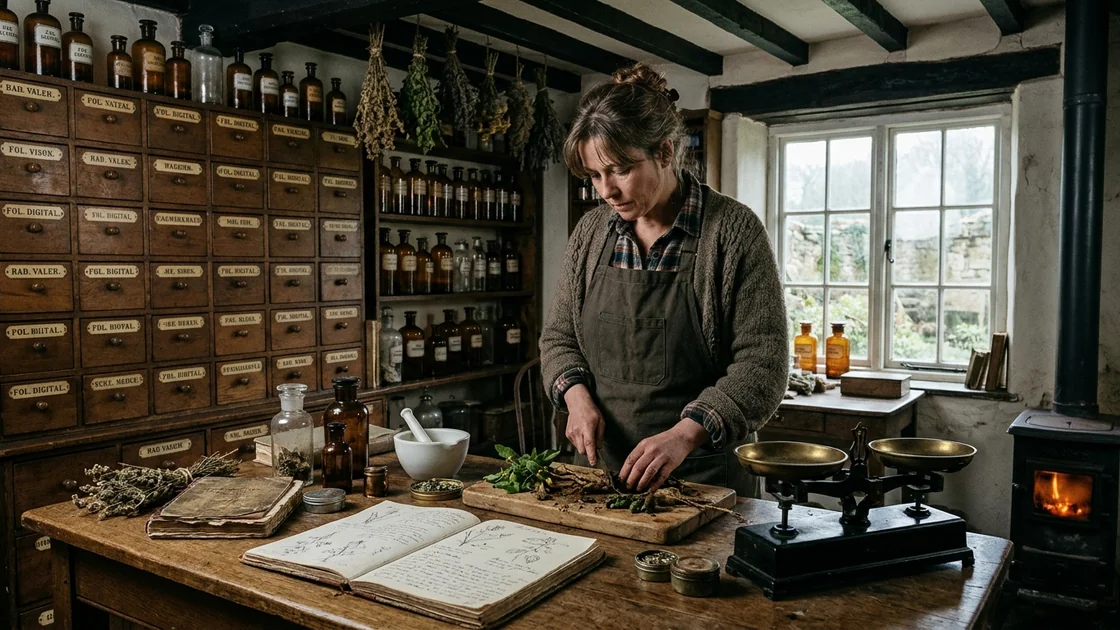
When forty-eight-year-old Clara Finch leaves behind her stifling office career in the city to purchase an ancient, debt-ridden apothecary in the historic market town of Weavers Green, she discovers that surviving the town's skepticism requires more than business acumen. Guided by the dense, idiosyncratic journals left behind by Malachi Vance, the shop's eccentric late proprietor, Clara immerses herself in the forgotten arts of roots, barks, and infusions. Over the course of a transformative year, she navigates financial ruin, local suspicion, and her own lingering grief, gradually restoring not only the shop to vitality but also mending the frayed bonds of the community and uncovering her own enduring strength.
Chapter I: The Key in the Iron Latch
The iron key did not want to turn. It had the weight of an unworked horseshoe and bore the pitting of two centuries of valley damp, its teeth ground down by generations of hands that had unlocked the narrow door at the foot of Crow Hill.
Clara Finch braced her shoulder against the damp oak, her boots slipping slightly on the wet cobblestones of Weavers Green. A light October rain fell through the canopy of copper beeches flanking the parish church, carrying with it the smell of cold river mud, chimney smoke, and rotting alder leaves. She twisted her wrist until the tendons in her forearm strained against the wool of her coat. Inside the lock, an ancient brass tumbler groaned, yielded, and fell.
The door swung inward with a chime from a brass bell mounted on a curled spring above the lintel—a sound not sharp or bright, but low and tarnished, like a small church bell muffled in felt.
Clara stepped inside and closed the door against the autumn wind, leaning back against the timber panel to catch her breath.
The silence that met her was architectural. It was not merely the absence of sound, but an accumulation of stillness, layered like sediment in a cellar. The air was cool, thick with a complex, medicinal sweetness that hit the roof of her mouth before it reached her lungs: dried chamomile, bitter gentian root, the oily resin of Scots pine, old book paper, and an undercurrent of dry elder pith.
"Well," she said aloud, her voice sounding thin and foreign against the dark wainscoting. "Here we are."
She was forty-eight years old, and her life had recently been reduced to whatever could fit into the back of an eight-year-old estate wagon parked three doors down outside the cooper’s cottage. A life previously cataloged in bank ledgers, mortgage slips, and the quiet, bloodless dissolution of a twenty-two-year marriage that had ended not with a scream, but with the dry rustle of duplicate keys left on a granite kitchen counter in suburban Leeds.
Her solicitor had called the purchase of Vance’s Apothecary an "erratic speculative risk." Her sister had called it an undignified collapse into madness. But Clara, who had spent twenty-five years as a medical transcriptionist—listening through heavy headphones to the clinical summaries of human decay, translating tumors, fractures, and failing hearts into tidy Latinate sentences—had seen the estate listing during an insomnia-ridden night in March. The listing had included only three photographs: the bowed shopfront with its twelve small glass panes; a long counter of pollard oak smoothed by two hundred years of elbows; and an arched doorway leading into an overgrown physic garden flanked by crumbling sandstone walls.
She had felt, with a certainty that defied all her training in clerical prudence, that the building was waiting for someone who understood how to be quiet with things that were broken.
She walked slowly through the front shop. The light from the market square was pale and watery, filtered through the thick cylinder glass of the bay window. To her left rose a wall of ninety-six small wooden drawers, each fitted with a pressed brass pull and an enameled plaque bearing abbreviated Latin script: RAD. VALER., SEM. ANISI, FOL. DIGITAL., CORT. SALICIS. To her right, shelves climbed to the twelve-foot ceiling, lined with heavy flint-glass stoppered bottles, their labels faded to the color of dry oats.
At the end of the counter stood the scales: a twin-pan balance of heavy lacquered brass, mounted on an ebony plinth containing weights from half a grain to two pounds. Beside them lay a ledger, closed, its calfskin binding scarred by ring marks from forgotten mugs of tea.
Clara touched the spine of the ledger. A fine veil of dust coated her fingertips.
Behind the counter, an arched opening without a door led into the back room—the dispensing laboratory. Here, the floor dropped down two worn stone steps. The ceiling was lower, crossed by rough-hewn oak joists from which hung bunches of dried herbs so black with age that they looked like mummified birds. A vast hearth occupied the back wall, fitted with an iron crane and an assortment of round-bottomed copper cauldrons green with verdigris.
On the long workbench beneath the window overlooking the wet garden lay the notebooks.
They were not stacked neatly. They lay scattered among pestles of white Wedgwood porcelain, horn spoons, and bundles of split willow twigs, as if their owner had merely stepped into the garden to fetch a sprig of mint and had been detained by the rain.
Malachi Vance had died in August, at the age of eighty-one, sitting in the high-backed Windsor chair by the cold hearth, with a cup of nettle tea half-drained on the table beside him. The town had regarded him as an eccentric relic—a man who refused to sell brand-name aspirin, who looked at modern pharmaceutical blister packs with pity, and who had spent forty years wandering the limestone ridges above Weavers Green with an ash-wood walking stick and an osier basket.
Clara approached the table. There were seven volumes in all, bound in oilcloth and mottled board, their edges swollen with damp. She drew the nearest one toward her. The cover was labeled in a fierce, spidery hand that used iron-gall ink:
OBSERVATIONS UPON THE VEGETABLE KINGDOM & ITS SECRET
COMPASS.
Begun this Lammas, 1988. M. Vance, M.P.S.
She opened it at random. The paper was heavy rag, foxed at the margins, covered in handwriting that slanted sharply to the left, interspersed with meticulous pen-and-ink drawings of roots, leaf margins, and seed cases.
14 October 1991. The comfrey along the mill race has taken the frost early. Let no fool tell you the root is inert once the foliage blackens. The marrow of the plant retreats into the earth like a snail into its shell; it is now, when the cold bites, that the mucilage is thickest and most sovereign for broken metatarsals. Dug six pounds before noon. Cleaned with river sand, peeled, sliced across the grain like parsnips. Note: Mrs. Gwatkin’s grandson fell from the hay-wain. Left clavicle splintered. Made a plaster of the root boiled in goats’ whey with two spoons of marsh mallow powder. The bone must be set true first by the surgeon, of course; our work is not to displace the mechanic, but to feed the lime back into the fracture before the marrow curdles.
Clara traced the words with her index finger. In her former life, she would have transcribed that entry as: Closed fracture, left clavicle. Conservative management indicated. The humanity of it had been bleached out by the cool neutrality of hospital software. Here, on this foxed page, Mrs. Gwatkin’s grandson lived, the cold river sand clung to the comfrey roots, and the bone was knit with whey and ancient weeds.
A knock at the front shop door shattered the stillness.
Clara jumped, the notebook slipping from her hand onto the table. The brass bell jangled erratically.
She smoothed her wool skirt, adjusted the collar of her shirt, and stepped up into the shop. A man stood on the threshold, framed by the grey drizzle of the square. He wore a heavy Barbour jacket crusted with dried sheep dip at the cuffs, flat tweed cap pulled low over small, bright, suspicious eyes.
"Shop’s closed," he said bluntly, peering past her into the dim interior.
"I’m the new owner," Clara said, stepping behind the oak counter. Her voice sounded firmer than she felt. "Clara Finch. We open next week, once I’ve taken inventory."
The man did not offer a hand. He smelled of wet fleece, tobacco, and stale diesel. "Old Malachi’s dead."
"Yes. I know. I bought the property from his estate."
The man looked at the rows of Latin-labeled drawers, then back at Clara. His eyes lingered on her neatly trimmed fingernails, her lack of wedding band, her soft town shoes. "He had a salve for the rot in sheep’s feet. Copper sulphate, wood tar, and something he boiled down from the hedgerows. Stank like the devil’s breeches, but it stayed on the hoof in the high bogs. My father used it. I use it. The chemist down by the bypass wants nine pounds a tube for grease that washes off in the first gutter."
Clara stood very still. The shop’s future hung on moments like this—moments she had anticipated in the abstract, but which now felt uncomfortably immediate.
"What was your name, sir?" she asked.
"Enoch Davies. Upper Cwm Farm."
"Mr. Davies, if you come back on Friday morning, I will have your salve."
Enoch Davies spat into the gutter outside the door and wiped his nose with the back of a sodden sleeve. "He didn't leave the receipt on a printed sheet, missus. It was in his head. Or in them mad books of his that the bailiffs couldn't read."
"Friday morning," Clara repeated quietly. "Nine o'clock."
He stared at her for five seconds, then gave a curt nod that was less an agreement than a challenge, turned his collar up, and vanished into the rain.
Chapter II: The Logic of Bitter Roots
The kitchen behind the dispensary was small, flagged with cold flags of Pennant sandstone, and possessed an ancient Rayburn stove that took three hours and half a bag of anthracite to coax into a sullen, smoking warmth.
By midnight, Clara had set up an iron cot in the small parlor above the shop. The room smelled of lavender wax and sixty years of bachelorhood, but the roof didn't leak, and the sound of the rain against the dormer window was a rhythm she found herself welcoming.
She did not sleep. At two in the morning, dressed in her heaviest cardigan and wool socks, she descended the narrow spiral stairs with a battery lantern, entered the dispensary, and sat down at Malachi Vance’s bench.
She dragged the seven notebooks toward her.
To an untrained eye, Vance’s handwriting was an impossible thicket of 18th-century abbreviations, botanical shorthand, and dialect terms. But Clara’s career had been built on deciphering the nearly illegible scrawls of fatigued consultants and hurried surgeons. She had spent decades looking at broken lines and guessing the word from the context of human misery.
She opened the smallest book, bound in calfskin that had turned the color of dry tobacco.
On the flyleaf, Vance had written in an unwavering copperplate hand:
The human frame is an orchard, not a machine. A machine may have a cog replaced with iron of identical gauge, and it runs again without remembrance of the change. An orchard cannot have a bough lopped without the roots trembling in the clay. When a man comes to you with a pain in his gut, look not to his stomach alone, but to the water he drinks, the work his father did, and the fear he keeps under his tongue. The bitter herb is the father of health; the sweet herb is its nurse.
Clara turned the pages until she found an index under the letter S.
Scab. Sciatica. Scrophula. Sheep.
Under Sheep, in a frantic, ink-blotted hand:
Davies’ Rot-Ointment (Upper Cwm). The grease of three mutton kidneys, rendered twice over sweet birch charcoal to clear the dross. To one pound of this fat, add four ounces of Stockholm tar while hot. When cooling, stir in two drams of pulverized blue vitriol [copper sulphate] and four fluid ounces of the strong decoction of Greater Celandine root (Chelidonium majus). The celandine must be dug while the moon is wane, or at least when the sap is not running to flower, else it is too watery to bite. Note: Enoch’s father was a stubborn brute, but the boy is worse. Use less vitriol if the hoof is split to the quick, or it will throw the ewe into a tremor.
Clara stared at the recipe. "Stockholm tar. Blue vitriol. Celandine."
She rose and lifted the lantern, illuminating the tall shelves along the south wall of the laboratory. Here stood the jars of mineral salts and bulk resins: raw sulphur like crushed canary feathers; heavy earthenware jars of black spruce pitch; crystals of alum; jars of dried roots labeled with parcel tags.
She found the Stockholm tar behind three carboys of cider vinegar—a two-gallon tin with a wooden bung, its black, sticky rim smelling powerfully of charred pine roots and turpentine. She found the copper sulphate in an earthen crock: deep, brilliant azure crystals that looked like crushed sapphires.
"Now," she whispered, "where is the celandine?"
She checked the ninety-six drawers in the front shop. There was Chelidonium in drawer forty-two, but when she pulled it out, the dried leaves crumbled into an odorless, yellow dust, grey with the web-silk of pantry moths. It was ten years old, perhaps twenty. Dead medicine.
She returned to the back room and unbolted the door that led into the walled garden.
The rain had stopped, replaced by a low, clinging mist that rose from the Weavers Green canal three streets away. The air was sharp, smelling of cold loam and wet moss.
Clara took a small hand trowel from the tool basket by the door and stepped out onto the gravel path.
The garden was a wild tangle of neglect. Angelica had bolted and dropped its vast umbels across the path; fennel fronds, brown and sodden, lay like wet hair over clumps of lemon balm. But along the base of the high sandstone wall, where the lime mortar had crumbled into the soil, she saw a rosette of deeply lobed, pale green leaves, blue-grey beneath, their stems covered in fine, bristly hairs.
She knelt in the cold mud, not caring that the knees of her trousers were soaking through.
She pinched a stem. It parted with a faint snap, exuding an immediate drop of thick, bright orange latex that stained her thumbnail like iodine. Greater Celandine. Chelidonium majus. The ancients had called it swallow-wort, believing it bloomed when the swallows arrived and withered when they departed.
The plant was alive. The sap was thick, acrid, and smelled intensely of bitter greens and metallic musk.
Clara dug her trowel into the rocky soil at the plant’s base, careful not to cut the central taproot. The earth gave way with a wet sucking sound. She worked her fingers into the hole, feeling the thick, branched root system, cold and fleshy as fingers. She pulled gently, freeing three large roots, each as thick as a thumb, encrusted with gritty red sandstone.
She carried them into the laboratory.
For the next four hours, working under the yellow pool of the lantern, Clara Finch was no longer an archivist of others’ illnesses.
She scrubbed the roots with a stiff bristle brush under cold well water until the yellow-brown skin gleamed. She sliced them into paper-thin rounds on an end-grain beech board; the orange juice ran out, staining the wood a dark ochre. She weighed them on the smaller brass balance: precisely four ounces.
She found mutton tallow in an earthenware crock in the larder—left by the estate liquidators, clean and white as candle wax. She placed an enameled iron skillet on the Rayburn’s hot-plate, melted the fat, and watched it turn clear as mountain water.
The copper sulphate had to be ground. She placed the blue stones into a deep mortar of heavy grey granite and took up the pestle. The work was hard; her shoulders, soft from years of keyboard work, began to burn within ten minutes. Crunch. Grind. Swirl. The crystal shattered into sand, then into an impalpable azure powder that drifted up in a faint cloud, tasting sweet and metallic on the back of her throat.
When the tallow had cooled to blood-warmth, she beat in the tar. It turned the mixture into an impenetrable, gleaming black cream that smelled like a shipyard. Then came the celandine decoction—simmered down from her fresh roots until it was as dark as stout—and finally the blue vitriol.
She stirred with a peeled ash stick, round and round, watching the emulsion take form. It did not want to combine at first; the watery juice fought the heavy sheep grease. But Vance had written in the margin: Stir clockwise until the arm aches, then stir twenty turns more. The fat will take the water if you force them to converse.
Clara stirred until the ash stick left deep furrows that did not fill in immediately.
The ointment cooled into a dense, oily paste, dark greenish-black with a strange peacock sheen under the lamp.
She spooned it into three wide-mouthed tin containers she found washed and dried in the larder, sealed them with waxed paper, and tied the lids with hemp twine.
Dawn was breaking over the slate roofs of Weavers Green when she finally washed her hands with pumice soap. Her skin was dyed yellow at the knuckles, her fingernails edged with Stockholm tar, and the small of her back felt as if it had been struck with a timber balk.
She looked at the three tins sitting on the scrubbed counter.
She had never made anything with her hands in her life, except for school knitting projects that had ended in lumpy scarves and dinners that came out of boxes.
She felt an absurd, trembling prickle behind her eyes.
Chapter III: The Ledger and the Bell
The shop opened on Friday morning at precisely eight o'clock.
Clara had spent two days scrubbing the front room. The oak counter now smelled of linseed oil and beeswax; the twelve panes of the bay window were clear, showing the wet market square where the weekly vegetable stalls were being assembled under canvas awnings.
She had arranged the shelves by system: modern certified herbal teas, simple dried herbs in clean glass kilner jars, pure essential oils, and horn-handled hairbrushes. But behind her, on the high shelves, remained Vance’s pharmacopoeia—the rows of Latinate jars that she had resolved not to touch until she understood their contents.
At nine o'clock, the tarnished bell clattered.
Enoch Davies entered, his boots leaving damp prints of red Shropshire clay upon the scrubbed boards. He stopped two feet from the counter, his eyes darting toward the shelves, then down to Clara’s hands.
Clara did not say good morning. She placed two tins on the oak between them.
"Sixteen ounces," she said. "Stockholm tar, sheep’s tallow, blue vitriol, and fresh celandine root dug from the north wall."
Davies stared at the tins. He reached out a dirty, calloused hand, unscrewed the lid of the top tin, and sniffed it.
He grimaced, his whiskers twitching. Then he took a pinch of the ointment between his thumb and forefinger, rubbing it vigorously to test the grain.
"The vitriol’s ground fine," he said grudgingly. "Old Malachi used to leave it gritty. Grit hurts the tender frogs."
"Grit does no good to an open ulcer," Clara said, leaning her hands on the counter. "It should be an ointment, not a sand-cast."
Davies looked up at her from under his low cap. "How much?"
Clara had spent the previous evening calculating. The copper sulphate had cost Vance pennies forty years ago; the celandine had cost her three blisters and a muddy apron; the tallow was five shillings’ worth of scrap fat.
"Seven pounds a tin," she said.
Davies blinked. The modern chemical grease at the agricultural cooperative cost nine-fifty.
He reached into his pocket and drew out a battered leather purse tied with a bootlace, counting out fourteen pound coins onto the counter with slow, deliberate clicks.
"You're not a local," he said as he gathered the tins into his coat pockets.
"I live here now," Clara replied.
"Town woman."
"I was."
"My ewes don't give a damn where you were," he said, turning toward the door. "If their feet heal, you'll see me again before the lambing. If they rot off, you'll hear from me sooner."
The door swung shut behind him, the bell ringing its hollow chime.
Clara took the fourteen pounds and dropped them into the cast-iron till drawer. The brass bell inside the drawer rang with a clear, sharp ting that seemed to confirm her presence in the world.
Half an hour later, the bell rang again.
This time it was not a farmer, but a woman of sixty-five or seventy, wearing a violet wool coat with an astrakhan collar, carrying an umbrella with a duck’s-head handle. Her silver hair was coiffed with terrifying rigidity, and her mouth was set in an expression of perpetual, forensic assessment.
"I am Millicent Cleary," the woman announced, closing her umbrella with a snap that sounded like a pistol shot. "Parish Council. And the Preservation Trust."
"Clara Finch," Clara said, coming around the counter. "How can I help you, Mrs. Cleary?"
Mrs. Cleary did not take Clara’s hand; she merely inspected it, her eyes settling on the pale yellow celandine stain across Clara’s right index finger.
"We were deeply concerned when the Vance property was sold out of the family," Mrs. Cleary said, walking toward the shelf of dried peppermint and fennel. "Mr. Vance was an impossible man, of course—completely deaf to the Planning Committee’s recommendations regarding the restoration of the bay window, and he insisted on burning garden refuse that smelled abominably of valerian—but he was a Vance. His great-grandfather built the Assembly Rooms in 1812."
"It's a beautiful building," Clara said. "I intend to keep it as it was."
"Yes. Well. Intention is an inexpensive commodity, Miss Finch. Or is it Mrs.?"
"Ms. Finch."
Mrs. Cleary’s eyebrows elevated an eighth of an inch. "Quite. The town has two pharmacies, you know. Boots down at the retail park, which is vulgar but carries everything one needs for dental hygiene, and Mr. Patel by the post office, who is a qualified chemist with a lovely line in French soaps. We were rather hoping a tearoom might take this site. High-end. Scones, perhaps some good linen."
"I am an apothecary," Clara said, her voice dropping into the cool, neutral register she had used for years when dealing with arrogant department heads. "Not a baker."
Mrs. Cleary turned her sharp, grey eyes upon her. "An apothecary requires a license, does it not? Under the 1968 Act?"
"I sell traditional herbal simples, tisanes, and external preparations," Clara said evenly. "Under the traditional exemptions. I do not dispense Schedule 1 poisons, nor do I write prescriptions. If you have an earache, Mrs. Cleary, I will tell you to see Dr. Evans at the surgery. If you cannot sleep because your joints ache when the rain comes off the Long Mynd, I will sell you willow bark and meadowsweet."
Mrs. Cleary smiled—a thin, tight movement of the lips that did not disturb the rest of her face.
"My joints are remarkably sound, Ms. Finch. However, my digestion has been a trial since Michaelmas. Dr. Evans gave me a white liquid that tastes of chalk and peppermint, which does nothing except turn my tongue the color of a flannel sheet."
Clara looked at her closely. She noted the slight yellow tinge at the inner canthi of the woman's eyes, the dry, crepe-like skin around her jaw, and the small, rhythmic grimace she made with her lower lip—a classic sign of acid reflux combined with biliary sluggishness.
In Vance’s second notebook, there was a passage she had read only that morning:
The ladies of the town are eaten up with white flour, dry sherry, and indignation. They come asking for peppermint to cool their bellies, which is the worst folly, for peppermint relaxes the esophageal sphincter and allows the acid to wash the throat like salt on raw beef. Give them gentian, dandelion root, and dried calamus. The bitter shock calls the stomach to order like a sergeant-major.
"Peppermint is the wrong herb for you," Clara said simply.
Mrs. Cleary stiffened. "Dr. Evans recommended it."
"Dr. Evans was treating your symptom, not your gastric valve," Clara said. She walked behind the counter, took down an empty brown paper bag, and moved to the bank of drawers.
From drawer twelve (RAD. TARAX.—dandelion root, roasted and chipped), she took two scoops. From drawer eight (RAD. GENT.—yellow gentian), she took half a scoop of the pale, yellow-grey flakes. From a glass jar on the middle shelf, she added a pinch of dried orange peel and three bruised pods of green cardamom.
"Boil a teaspoon of this in eight ounces of water for seven minutes," Clara said, folding the top of the bag with neat, sharp creases. "Drink it warm, twenty minutes before your luncheon. It will taste abominable."
"Abominable?"
"Intensely bitter," Clara said, meeting her eyes. "If it does not taste bitter, it will not work. It stimulates the vagus nerve and triggers the release of bile. Two pounds fifty, please."
Mrs. Cleary looked at the paper bag as if it might contain an unexploded grenade.
"I am not in the habit of drinking things that taste abominable, Ms. Finch."
"Then you may continue with the chalk water," Clara said mildly, reaching down to polish a speck of dust off the balance pan.
Mrs. Cleary hesitated. The silence in the shop stretched until the ticking of the grandfather clock in the corner sounded like small hammers.
With an irritated click of her tongue, Mrs. Cleary opened her crocodile-skin handbag, produced three pound coins, laid them on the wood, and picked up the bag.
"If this gives me palpitations, Ms. Finch, I shall have the Environmental Health department here before tea."
"It won't give you palpitations," Clara said. "It will make you burp, and then your lunch will sit where it belongs."
Mrs. Cleary gave a sound that was half-gasp, half-snort, turned on her heel, and marched out into the square, her duck’s-head umbrella swinging like a saber.
Clara picked up the coins. Her hands were shaking slightly. She dropped the money into the till, leaned her forehead against the cool, dark wood of the shelf, and began to laugh.
Chapter IV: The Ghost in the Margin
The weeks grew shorter as November set its teeth into the valley.
The market square emptied early in the afternoons. By four o'clock, the gas-style street lamps flickered to life, throwing yellow circles onto the greasy stones, and the mist from the river crept up the narrow alleys, smelling of iron and dead rushes.
Clara settled into an ascetic, monastic routine. She rose at six, built the fire in the Rayburn, drank black coffee, and spent two hours reading Vance’s notebooks before opening the shop at eight.
She discovered that Vance’s mind had been an extraordinary, erratic instrument. He had studied pharmacy at Edinburgh in the 1930s, served in North Africa during the war, and returned with a deep, silent revulsion for the industrial scale of modern medicine. He had returned to his family’s ancient shop, not to practice business, but to conduct an obsessive, lifelong inquiry into the boundary between plant chemistry and the human spirit.
His notebooks were filled with personal marginalia, often written in Greek or in a private code of astrological signs that Clara spent whole evenings unraveling.
22 November 1994. The mind does not grow old in years; it grows old in dried fluids. Melancholy is merely the silt of the spleen settling into the bloodstream when the liver lacks the fire to burn it off. Look at poor Arthur Preece: his wife died in May, and now his knees are locked like rusted hinges and his tongue is white. Evans gives him anti-inflammatories which have eaten a hole in his stomach lining. I gave him a syrup of rosemary flowers, wood betony, and mountain ash berries, steeped in port wine. Not to cure his grief—grief is not an infection to be purged with carbolic—but to keep his blood warm enough that he may carry it without freezing.
Underneath, in a smaller, shaky hand, Vance had added:
I could not save Martha. The digitalis was three hours too late. The heart simply ceased its work, like an engine whose fire has gone out. The house has been too quiet these thirty winters.
Clara stopped reading. She looked up at the high corner of the laboratory ceiling where the shadows gathered outside the circle of her lamp.
Martha. There were no photographs in the house. The drawers in the bedroom upstairs had been empty save for a single mother-of-pearl hair comb that Clara had found behind the washstand and placed on the mantelpiece.
She understood that quietness. She knew what it was to live in a room where the air was too still, where every object seemed to be remembering a voice that had stopped speaking.
Her own marriage had not ended in death, which carried its own clean, terrible finality; it had simply evaporated through twenty years of polite domestic compromise. Richard had been an actuary—a man whose entire existence was based on the statistical probability of disaster, who managed risk by reducing life to a narrow, grey corridor of mutual tolerance. When their only daughter, Eleanor, had graduated from university and taken a job in Toronto, the silence between Clara and Richard had expanded until there was nothing left to say across the breakfast table except: "Did you pay the council tax?"
"I am not dead," Clara whispered into the cold shadows of the dispensary. "I am only forty-eight."
A sudden sound from the garden startled her—a sharp, metallic rattle, followed by the wet thump of something heavy falling into the compost heap.
Clara stood up, taking the heavy brass poker from the hearth. She was not a timid woman; twenty-five years in medical transcription had exposed her to every horror the human body and mind could conceive, and she had long since lost the habit of fear.
She opened the back door into the garden.
The mist was thick, silvered by a gibbous moon that broke through the ragged clouds. Near the old apple tree, a dark figure was huddled among the frosted nettles, groaning softly.
"Get up," Clara said, holding the poker low and steady. "I have two dogs and an iron bar." (The dogs were a lie, but the iron bar was four pounds of solid Victorian scrap.)
The figure shifted. A face turned toward her in the moonlight—young, pale, with a smear of dark mud across the cheek and eyes that were dilated and wild with pain.
"I didn't... I wasn't stealing nothing," a boy’s voice said, cracked and breathless. He couldn't have been more than nineteen. He was wearing an oversized hooded sweatshirt, soaked through at the shoulders, and torn track pants. He was clutching his left forearm to his ribs.
"Who are you?" Clara asked, lowering the poker an inch.
"Callum," he muttered. "Callum Davies. Enoch’s lad."
Clara relaxed her grip. "Enoch Davies’ son? What are you doing over my garden wall at midnight?"
"The gate was locked," the boy gasped, his teeth chattering so hard she could hear them from six feet away. "My arm... I was coming home from the quarry road on the motorbike. Hit a patch of black ice by the lime kiln. The bike went into the ditch and... I heard it crack, missus. I couldn't go home. My dad... he’d kill me about the bike. He told me not to take it out."
Clara stepped forward, her boots crunching on the frost-stiffened gravel. She knelt beside him.
Even through the wet fleece of his sleeve, she could see the unnatural angle of the radius—the classic "dinner-fork" deformity of a Colles’ fracture. His skin was cold, clammy, and his breathing was shallow and rapid.
"Get up," she said, her voice dropping into the calm, authoritative tone she had heard hospital sisters use when a gurney rolled into emergency. "Up, Callum. Don't touch the arm. Use your right hand on my shoulder."
He leaned on her, groaning as she hauled him to his feet. He was thin, all bone and wet wool, smelling of cider and sour teenage sweat.
She guided him through the back door, up the two steps into the dispensary, and pushed him gently into Malachi Vance’s high-backed Windsor chair.
"Sit," she ordered.
She went to the Rayburn, threw on two shovels of anthracite, and opened the draft until the flue began to roar. She filled the copper kettle from the tap and set it on the iron top.
"Is it broken?" he whispered, staring at his wrist with terror. The hand hung limp, the fingers swollen and purplish.
"Yes," Clara said. "Both bones, I suspect. But the skin isn't broken."
"Don't call my dad," he pleaded. "Not yet. He’ll... he’ll sell the bike for scrap. It took me two years to buy that engine."
"Your father is the least of your concerns right now," Clara said. "If we don't get that swelling down and support that bone, the radial nerve could be compromised, and you won't have the use of those fingers to turn a throttle again."
She went to the workbench and pulled down the oilcloth-bound notebook from 1991.
She knew what a modern clinic would do: an X-ray, six hours on a plastic chair in the corridor at Shrewsbury Hospital, an injection of lidocaine, a brutal manual reduction by an exhausted junior doctor, and a heavy plaster cast.
She could not set the bone—she was not a bonesetter, and she had no intention of crippling the boy with arrogance. But Shrewsbury was twenty-two miles away over roads that were now freezing into black glass, and Callum was sliding into surgical shock.
She read Vance’s spidery lines by the lantern light:
For the primary agony of broken limbs, where the patient is in a cold sweat and the marrow is shaken: give five drops of the tincture of wild lettuce (Lactuca virosa) in warm elderberry wine. It dulls the edge of the iron without the sickness of the poppy. Then comfrey—the knit-bone. Not as a plaster yet—the skin is too hot and the internal bleeding must have room to declare itself. A cold compress of the fresh mucilage boiled with vinegar will prevent the vast hematoma from hardening like stone.
Clara moved with a speed that surprised her.
She had wild lettuce tincture in the poison cupboard—a locked mahogany box behind the prescription desk. She unlocked it with the small brass key on her ring. The bottle was labeled TINCT. LACTUC. VIR. 1:5.
She poured half a cup of hot water from the kettle, added two spoons of brown sugar from the larder, and counted out five dark green drops from the dropper. The liquid turned cloudy, smelling of bitter weed and honey.
"Drink this," she said, holding the cup to Callum’s lips. "Every drop."
He swallowed it, coughing slightly at the bitterness. "Tastes like ditch-water."
"It's wild lettuce. It will stop your teeth from rattling."
Next, she took down the bundle of comfrey root she had dried on strings above the Rayburn three weeks ago. She crushed four ounces in the stone mortar, not to powder, but to a coarse, fibered mash. She put it into a small saucepan with cider vinegar and water, bringing it to a swift boil until the room filled with the sharp, acidic, earthy smell of hot roots.
The mucilage came out instantly—a thick, slippery, grey-white gel that bound the crushed roots together.
She let it cool until it was comfortably warm to the back of her wrist, then spread it half an inch thick over a clean strip of unbleached linen.
"This is going to smell sour," she told Callum.
The boy was already slumping back into the chair, his eyelids drooping as the wild lettuce took hold of his central nervous system. "Don't care," he murmured. "Arm don't hurt as bad now. Just feels... heavy."
Clara laid the compress gently around the swollen wrist. The heat and the vinegar caused him to wince, but within thirty seconds, his breathing slowed. Comfrey contained allantoin—a cell proliferant that stimulated tissue repair—while the cold vinegar acted as an astringent, driving the congested blood out of the subcutaneous tissues.
She took two smooth ash-wood splints from Vance’s tool drawer—narrow, light boards shaped to the curve of the forearm—padded them with dry cotton wool, and laid them on either side of the limb. She bound them firmly, but not tightly, with herringbone cotton tape, tying the knots with a medical slip-loop that could be loosened in an instant if the pulse in his radial artery faded.
She took his right hand. His pulse was sixty-eight, steady and soft.
The grandfather clock struck three.
Clara pulled an old wool horse blanket off the settle, wrapped it around the boy’s shoulders, and sat down on the low stool opposite him.
She sat in the dark laboratory, watching the orange glow of the Rayburn’s grate flicker against the copper pans on the wall, her fingers resting lightly on the boy’s uninjured wrist, counting his breaths until the grey light of dawn began to wash the garden stones outside.
Chapter V: The Council and the Cure
At seven o'clock, the garden latch clicked.
Heavy footsteps crunched on the gravel. Clara did not move. She remained seated, her hand on Callum’s shoulder as the back door swung open with a bang.
Enoch Davies stood in the opening, his face grey with twenty-four hours of worry, his coat soaked with freezing fog. He held an iron flashlight in one hand and his walking stick in the other.
He saw his son. He saw the splinted arm resting on the boy’s lap, the clean linen bandage, the empty cup on the table, and Clara sitting quietly in the grey light.
His jaw worked, but for five seconds, no sound came out.
"He was in the ditch by the lime kiln," Clara said, her voice low so as not to wake the boy. "The motorbike slid. The radius is broken two inches above the joint."
Davies stepped into the room, bringing the smell of cold hill-wind with him. He looked down at his son’s face. Callum was sleeping deeply, his mouth open, color back in his cheeks.
"I thought he was under the wheels of a timber truck," the farmer said. His voice was hoarse, stripped of its habitual market-day gravel. "I found the bike in the hedge an hour ago. The frame's bent."
"The bike can be mended," Clara said. "And so can the boy. I’ve stabilized the wrist. The swelling is down by half because of the comfrey compress. But you must take him to the infirmary at Shrewsbury now. The bones must be pulled straight under gas before they begin to knit. Comfrey works fast—too fast, if the alignment is crooked."
Enoch leaned his walking stick against the table. He reached out and touched the ash splint with one rough finger.
"Old Malachi used ash wood," he muttered. "He said pine was too soft and oak was too proud."
He looked at Clara. There was a strange, raw expression in his eyes—the sudden, terrifying gratitude of an insular man who has been forced to accept mercy from a stranger.
"You sat with him all night?"
"I did."
"Why didn't you knock me up at the farm?"
"The roads were frozen," Clara said, rising to her feet. Her joints creaked, and she had to catch the edge of the table to steady herself. "And the boy was in shock. Moving him on the tractor would have made the fracture compound. He needed warmth, lettuce juice, and quiet."
Davies reached down, scooped his nineteen-year-old son out of the chair with an effortless, massive heave, and cradled him against his chest as if he were an eight-week-old lamb. Callum stirred, groaned once, and nestled his head against his father’s mackintosh.
"I have the Morris pickup in the lane," Enoch said, turning toward the door. He paused on the threshold, not looking back. "The council meets on Thursday, Ms. Finch. About the preservation order on this shop. Mrs. Cleary’s got six names on a petition to turn the ground floor into an heritage center with tea rooms."
Clara felt a cold knot form in her throat. "I know."
"My brother-in-law is the chairman," Davies said gruffly. "He don't drink tea. And he don't like Mrs. Cleary."
The door closed, and the pickup’s diesel engine rumbled down the lane into the morning mist.
Thursday evening brought an icy sleet that turned the market square into a sheet of grey slush.
The meeting of the Weavers Green Urban District Council was held in the small, wood-paneled courtroom above the Corn Exchange. The air was thick with the smell of wet gabardine, damp umbrellas, and ancient central heating radiators that clanked like chains in a dungeon.
Clara sat in the third row of benches, wearing her best dark wool coat, her hair pinned neatly at the nape of her neck. Beside her sat two volumes of Malachi Vance’s notebooks and the shop’s original 1842 indenture, which she had retrieved from the bank in Shrewsbury.
At the front table sat five councillors. In the center was Major Donald Gwatkin—a retired artillery officer with red cheeks, large white mustaches, and a tweed suit that looked as if it had been cut from a carpet. To his right sat Millicent Cleary, her lips pressed together so tightly they looked like a surgical incision.
"Item four," Major Gwatkin barked, rustling a stack of blue folders. "Application for Change of Use and Preservation Order, 14 St. Jude’s Lane, commonly known as Vance’s Shop. Mrs. Cleary, you have the floor."
Mrs. Cleary rose with the dignity of an empress addressing the senate.
"Thank you, Mr. Chairman. Fellow councillors. For over one hundred and fifty years, Vance’s Apothecary was an integral part of this town’s commercial fabric. However, we must face the reality of the present century. The late Mr. Vance, while an historic figure, allowed the premises to fall into scandalous disrepair. The roof is deteriorating; the interior is an unregulated fire hazard filled with dried vegetable matter and obsolete nostrums."
She turned her gaze toward Clara, her eyes shining with cold triumph.
"The purchaser, a newcomer to our district with no formal pharmaceutical qualifications recognized by the Royal Society, is currently operating an unregulated business that borders on charlatanism. She is dispensing folk preparations without retail licenses, creating an eyesore in our premier historic conservation area. The Weavers Green Heritage Trust has secured conditional backing from an heritage fund to acquire the lease, restore the 18th-century facade, and install an historical interpretation center with an ancillary tea facility. This would create four jobs and bring quality visitors into the town center, rather than... sheep farmers seeking hoof-grease."
Several members of the public gallery murmured. Mrs. Cleary smiled and sat down, smoothing her wool skirt over her knees.
Major Gwatkin cleared his throat. "Thank you, Mrs. Cleary. Ms. Finch? Do you wish to respond?"
Clara stood. Her heart was beating fast, but her hands, resting on the back of the pine bench in front of her, were perfectly steady.
"Mr. Chairman," Clara said, her voice clear and calm, carrying effortlessly through the vaulted room. "Mrs. Cleary is correct that I am not a registered pharmacist under the current NHS dispensing register. I have never claimed to be. I am an herbalist, trading under the protection of the Section 12 exemptions of the Medicines Act 1968, which permits the preparation and supply of herbal remedies on premises that can be inspected by the MHRA at any time."
She reached down, took one of Vance’s notebooks, and held it up.
"Mrs. Cleary refers to 'unregulated nostrums.' This building has contained an unbroken record of clinical botany since 1782. For eighty years, Malachi Vance recorded every plant gathered in this valley, the soil conditions that produced it, and its specific physiological effect on the people who work this land. This is not folk superstition. This is the accumulated empirical knowledge of five generations of observers."
"It's weeds, Ms. Finch!" Mrs. Cleary snapped from the committee table. "You are boiling weeds in an iron pot!"
"The digitalis that keeps your husband’s heart beating, Mrs. Cleary, was discovered in a foxglove leaf by William Withering forty miles from here," Clara said, not raising her voice by a fraction. "The aspirin your doctor prescribes was boiled from the bark of the white willow that grows along our own mill-race. When you came to my shop three weeks ago, you were suffering from severe biliary indigestion that three months of hospital-prescribed antacids had failed to touch. I gave you gentian, dandelion, and cardamom."
A sudden, sharp silence fell over the room.
Mrs. Cleary turned the color of an unripe plum. "That is... that is private medical information!"
"You spoke of charlatanism," Clara replied evenly. "Did the tea work, Mrs. Cleary?"
The councillor to the left of the Chairman—a small, bald man who ran the local hardware store—leaned forward, looking at Mrs. Cleary with intense interest. "Did it, Millicent? You haven't had one of your sour turns since the church bazaar."
"That is entirely beside the point!" Mrs. Cleary hissed.
"It is the only point," Clara said. "An apothecary shop is not a museum. A town that turns its living history into a tea room where tourists eat frozen scones off reproduction china is a town that has begun to embalm itself. This valley needs an apothecary. The hill farmers need hoof ointments that work in red clay; the weavers need comfrey for their wrists; the old people need elderberry and willow that don't cost half their pension at the bypass retail park. If you wish to declare my building unfit, do so. But do not call it useless."
Clara sat down.
The silence in the room lasted for three full ticks of the courtroom clock.
Then, from the back of the public gallery, a heavy figure stood up.
Enoch Davies was wearing his market suit—a thick, brown tweed that smelled powerfully of mothballs. Beside him sat his son Callum, his left arm encased from knuckles to elbow in a clean, white plaster cast, his sling pinned with a large brass safety pin.
"Mr. Chairman," Davies said. He did not remove his flat cap.
"Mr. Davies," Major Gwatkin said, his mustache twitching. "This is a council debate, not a livestock auction."
"I know what it is, Donald," Davies said. "My lad Callum went off the road on Monday night. Broke his wrist in two places. If Ms. Finch hadn't pulled him into her shop, cooled the swelling with knit-bone, and held him together till dawn, the surgeon at Shrewsbury said the bone would’ve burst through the skin when we moved him. He’d have had pins in his wrist for a year."
He pointed a thick, calloused finger at Mrs. Cleary.
"Millicent Cleary’s never dug a root in her life. She buys her parsley in plastic bags from the supermarket. Old Vance saved my father’s bull when the vet wanted to shoot it, and this woman here saved my lad’s hand. If this council tries to put a tea shop into that building, there won't be a sheep farmer between here and the Welsh border who’ll pay his market dues into your collection box."
Davies sat down, crossed his arms over his chest, and stared at the ceiling.
Major Gwatkin looked at the other councillors. He looked at Mrs. Cleary, whose neck was now mottled with crimson patches. He looked down at the blue folder.
"Well," the Major said, his voice dropping into a rumble. "It seems to me that the property is currently occupied by a viable commercial tenant providing a traditional service to the agricultural community. The structural condition of the roof is a matter between the freeholder and the building inspector, not the Heritage Trust. I move that the application for Change of Use be dismissed."
"Seconded," said the hardware merchant immediately.
"All in favor?"
Four hands went up. Mrs. Cleary’s hands remained clamped upon her crocodile handbag like vultures on a fence.
"Carried," Major Gwatkin said, bringing his small wooden gavel down with a sharp thwack. "Next item: the resurfacing of the sheep-dip lane behind the tannery."
Clara Finch gathered her notebooks, slipped them into her canvas satchel, and walked quietly out into the cold rain.
Chapter VI: The Winter Garden
Winter arrived in earnest three days before Christmas.
The river froze along its margins, the ice creeping out from the reeds until only a dark, swift ribbon of black water ran down the center of the valley. The roofs of Weavers Green were mantled in six inches of dry, powdery snow that muffled the clatter of carts and the engines of the delivery vans.
Inside the apothecary, the Rayburn burned night and day.
The shop had changed. It was no longer an empty monument to an eccentric old man; it had acquired the dense, lived-in clutter of a working workshop.
Hanging from the joists above the counter were dozens of small linen bags, each containing dried herbs Clara had gathered during the late autumn or purchased from organic growers in Herefordshire: valerian root, dried marsh mallow, lime flowers, elderberries, and meadowsweet. The oak counter bore a permanent, fragrant patina of crushed cloves, cinnamon bark, and lavender oil.
The town had begun to come.
They came cautiously at first, stepping through the door with an air of conspiratorial embarrassment.
Old Mrs. Gwatkin came for valerian tincture to help her sleep through the howling winter gales that blew down from the Mynd. Mr. Preece, the widower whose melancholy Vance had recorded years before, came every Tuesday morning for two ounces of Clara’s "Winter Cordial"—a dark, warming infusion of hawthorn berries, dried ginger, and rosemary that Clara brewed in a two-gallon copper kettle on the Rayburn.
"It doesn't bring her back, Ms. Finch," Preece said one morning, leaning against the counter, his rheumy blue eyes fixed on the snow outside. "But it stops the cold from settling behind my ribs."
"It's the ginger, Mr. Preece," Clara said gently, sliding a brown bottle across the counter. "And the hawthorn. It strengthens the heart muscle."
"Aye," the old man murmured. "Maybe it's the ginger. But Malachi used to say the rosemary was for remembrance. I like to think he knew what he was talking about."
One afternoon in mid-January, while the snow was falling in thick, silent curtains outside, Clara went down into the cellar.
The cellar was reached through a trapdoor behind the dispensing bench, down a flight of steep sandstone steps that were slick with moisture. It was a vaulted stone room that smelled of cold cider, wet slate, and limestone dust.
She was looking for empty bottles—she had run out of eight-ounce medicine flats for the cough syrup she was making from coltsfoot and wild thyme.
At the far end of the cellar, behind a stack of empty apple crates, she noticed an iron ring set into a heavy oak panel embedded in the wall.
She brought her lantern closer.
The wood was black with age, secured by two heavy iron straps. She took the ring with both hands and pulled. The wood creaked, protested, and swung open with a shower of dry mortar.
It was not a cupboard. It was a narrow stone recess, three feet square, cut into the natural sandstone bedrock beneath the street.
Inside lay three wooden boxes of dovetailed cedar, their lids secured with brass catches, and an old leather-bound volume that was twice the size of the notebooks upstairs.
Clara carried the box and the book up into the warmth of the laboratory.
She washed her hands, wiped the stone dust from the leather cover, and opened it beside the fire.
The flyleaf did not bear Malachi Vance’s hand. It was written in a formal, 18th-century script, the ink faded to the color of dry moss:
THE PHARMACOPOEIA WEAVERIENSIS.
Being the Collected Receipts, Observations, and Botanical Secrets of the House of Vance, Apothecaries at the Sign of the Thistle & Prow, Weavers Green.
Begun by Tobias Vance, Licentiate of the Society of Apothecaries, Anno Domini 1782.
Clara turned the pages with trembling fingers.
Here was the foundation of everything Malachi had known. Tobias Vance had lived through the enclosures of the common lands; he had recorded the names of the old herb-women who had been driven off the hills, transcribing their oral remedies before they died in the workhouse at Clun.
Here were receipts for "The King’s Evil," for "The Falling Sickness," for "The Green Sickness in Maidens." But mixed among the archaic terms were observations of extraordinary modern accuracy:
12 June 1794. The bark of the spindle tree (Euonymus), boiled with lard, purgeth the head of lice more surely than mercury, and leaves the child’s brain unclouded. Note: The common people use the root of the wild bryony for the pleurisy, but it is a violent poison. Let no man give more than three drops of the juice, or the bowels will slough off like rotten silk. Better to use the pleurisy-root (Asclepias), which we receive from the Virginia merchants.
Clara opened the first of the cedar boxes.
Inside, nestled in dry wood shavings, were dozens of small, square packets of folded parchment, each tied with flax thread and labeled in Tobias Vance’s brown ink.
Sem. Hyoscyami. 1798.
Rad. Aconiti. 1802.
Cortex Cinchonae. 1815.
They were the seeds and dried barks of the Napoleonic era—a time capsule of botanical medicine preserved in the dry cedar wood for two centuries.
She picked up a small glass phial that lay at the bottom of the second box. It was sealed with red wax bearing the impression of an owl.
The label read: Oleum Rosae Damascenae. Smyrna, 1824.
She held it up to the lantern light. The oil was no longer liquid; it had congealed into a golden, crystalline mass that clung to the sides of the glass.
Clara scraped the wax seal with her thumbnail and turned the glass stopper. It came free with a soft, dry squeak.
Instantly, the laboratory was filled with an aroma so intense, so pure, that Clara caught her breath. It was not the synthetic, sugary rose of modern soaps, nor the dry, dusty scent of potpourri; it was the deep, wild, animal sweetness of a thousand Persian roses blooming in the heat of a June morning two hundred years ago.
The scent seemed to obliterate the two centuries between Tobias Vance and herself. It was as if the room had suddenly opened out into sunlight, and the long line of hands that had tended the bottles, dug the roots, and turned the brass balance pans was standing behind her in the shadows, watching her with quiet, patient approval.
Clara put the stopper back into the phial.
She closed the leather book. She sat for a long time by the Rayburn, listening to the snow slide from the steep slate roof into the garden, her hand resting on the smooth cedar wood.
She realized then that she was no longer lonely.
The emptiness that had followed her from Leeds—the feeling that she was a spectator in her own life, a clerk recording the passage of other people’s vitalities—had vanished. Her skin was dry from the wood smoke; her fingertips were rough from scrubbing roots; her hair smelled of pine tar and dried betony.
She had found her work.
Chapter VII: The Red Sickness
In February, the damp cold of the valley turned malicious.
It was not the clean, sharp freeze of January, but a rotting, yellow thaw that brought low clouds down until they rested on the chimneypots of Weavers Green. The snow turned to grey mud in the square, and the river rose until the willows along the path were submerged to their lower forks in brown, swirling water.
Then came the influenza.
It began among the children at the parish school, then moved through the textile mill two miles down the valley, and finally settled into the cottages of the old market workers along the canal.
It was not a mild seasonal cold. It struck with a sudden, violent chill that threw people into delirium within six hours, accompanied by a harsh, barking cough that tore the throat until patients spat dark blood.
Dr. Evans’ surgery on the high street was overwhelmed. By the second week of February, the waiting room was packed with shivering people wrapped in blankets; the local chemist ran out of amoxicillin, paracetamol, and codeine linctus within three days.
On a Tuesday afternoon, Dr. Evans himself walked into the apothecary.
He was a man in his late fifties, with iron-grey hair cut close to the scalp, wearing a dark suit under an unbuttoned trench coat. His face was grey with exhaustion, his eyes bloodshot, and he smelled of hospital disinfectant and stale tobacco.
Clara was standing behind the counter, filling small amber bottles with an elderberry-and-thyme syrup she had spent three days brewing in the copper cauldron.
Dr. Evans did not introduce himself. He walked to the counter, took off his wire-rimmed spectacles, and rubbed the bridge of his nose with two fingers.
"Vance used to make an antipyretic," Evans said, his voice flat with fatigue. "A tea. He called it his 'Solstice Brew.' He gave it to the road workers during the Hong Kong flu in sixty-eight."
Clara looked at him steadily. "Equal parts boneset (Eupatorium perfoliatum), elderflower, peppermint, and meadowsweet. With two drams of dried yarrow to force the sweat."
Evans looked up. "Boneset tastes like horse dung."
"Worse than that," Clara said. "It's the most bitter herb in the garden. But it stimulates the peripheral circulation and drops a fever faster than paracetamol without taxing the liver."
"Have you got any?"
"I have six pounds of the dried leaf in the dispensary. Dug and dried in September."
"How fast can you make it up?"
"I can have thirty bags ready in an hour," Clara said.
Evans leaned against the counter, the leather of his medical bag creaking under his elbow. "The retail park chemist is out of everything. Boots says their delivery wagon is stuck on the M54 in the drifts. The district nurse has twelve bedridden cases on the lower canal, and their chests are filling with fluid. Modern pharmaceuticals are wonderful, Ms. Finch, until the logistics chain snaps. Then we're back in the nineteenth century."
"We've always been in the nineteenth century, Doctor," Clara said, taking down the large brown paper bags from the drawer. "The human lung hasn't changed its design since the Middle Ages."
"No," Evans muttered, watching her hands as she scooped the grey-green herbs onto the scales. "It hasn't. The boneset... does it really break the fever?"
"Tobias Vance used it in 1803 during the marsh ague," Clara said, her hands moving with swift, practiced economy. "Malachi Vance used it in 1968. If you drink it hot, three cups within four hours, the skin opens like a sluice. The fever breaks through the pores instead of cooking the brain."
"Make fifty bags," Evans said. "Send the bill to my surgery. I'll tell the district nurse to send the worst cases here for the tea."
He turned to leave, then stopped, his hand on the brass latch of the door.
"Mrs. Cleary came to see me last month," he said, not looking back. "She wanted me to report you to the Health Authority for practicing medicine without a register."
"I know," Clara said.
"I told her that if she didn't stop badgering my receptionist, I’d prescribe her an ounce of castor oil and a pint of warm water," Evans said, a ghost of a smile touching the corner of his grey mouth. "Your dandelion compound did her liver a world of good, Ms. Finch. She hasn't complained of her spleen since Christmas. Though she’d rather be burned at the stake than admit it."
He opened the door and vanished into the cold mist.
For the next ten days, the apothecary was transformed into an emergency dispensary.
Clara did not sleep more than four hours a night. The laboratory was an inferno of steam and herbal aromatics. She kept the Rayburn banked to maximum heat, three vast cauldrons boiling continuously: one with elderberry syrup thick with honey and cinnamon for the children’s coughs; one with boneset-and-yarrow tea; and a third with an inhalant made of eucalyptus oil, pine resin, and dried coltsfoot leaves that filled the front shop with a pungent, balsamic cloud that cleared the heads of everyone who stepped inside.
Callum Davies came every morning. His arm was out of the cast now, supported by a leather brace his father had fashioned from an old bridle. He hauled anthracite from the shed, chopped firewood for the hearth, and carried the heavy boxes of medicine bags through the slush to the cottages down by the canal.
"My dad says you're not to pay me," the boy said when Clara tried to press three ten-pound notes into his hand on the fifth day. "He says if I take a penny from you, he’ll set me to clearing the stone ditch on the high meadow."
"You need to eat, Callum," Clara said, pushing a bowl of hot mutton broth and two thick slices of rye bread toward him across the worktable.
"I eat at the farm," he said, but he sat down and tore into the bread with the ravenous appetite of a nineteen-year-old whose bones were healing. "The folk down by the basin are calling you the 'Herb Woman.' Old Jack Gwilliam says your black syrup brought him back from the graveyard."
"It was the thyme," Clara said, washing her iron ladle in hot water. "Thyme is an antiseptic. It keeps the lungs from breeding phlegm. Tell Jack Gwilliam that if he starts smoking his clay pipe again before the daffodils show, I won't give him another spoonful."
By the end of February, the epidemic had spent its fury.
The thaw finally completed its work; the river subsided into its banks, leaving grey lines of dried silt along the alder boughs; and the first pale green spikes of the snowdrops appeared in the shadow of the churchyard wall.
Not a single soul on the lower canal had died.
Chapter VIII: The Scent of Thyme and Iron
Spring came to Weavers Green not with a rush, but with a slow, luminous clarity.
In April, the physic garden behind the shop awoke. The comfrey thrust up thick, bristly crowns of dark green foliage; the angelica sent up vast, architectural stems that reached toward the sandstone coping of the wall; and the wild celandine covered the banks with thousands of brilliant, star-shaped yellow flowers that opened to the morning sun.
Clara sat at the table in the laboratory, her ledger open before her.
She had paid the winter’s anthracite bill. She had repaired the flashing on the north roof slope. She had settled the account with the medicinal herb cooperative in Bristol.
And the balance in the small iron safe under the floor was three thousand four hundred pounds.
She was not rich. She would never be rich. But the shop was hers. Not merely on the parchment deeds that lay in the cedar box, but in the mortar, the floorboards, and the memory of the town.
A light breeze blew through the open garden door, carrying the scent of damp loam, budding blackthorn, and the fresh, lemon-sharp resin of the young birch trees.
She heard the brass bell ring in the front shop.
Clara closed the ledger, stepped up the two stone steps, and walked behind the counter.
A young woman stood in the bay window, holding a little girl of three or four by the hand. The woman looked pale, thin, with the bruised, exhausted look that Clara remembered from her own early years of motherhood—the relentless, sleepless weight of caring for a frail body in an indifferent world.
"Ms. Finch?" the young woman asked timidly.
"Yes," Clara said, her voice warm and low.
"The health visitor told me to come. She said... she said you had something for skin that won't settle. My little girl... the eczema on her legs is so bad she cries all through the night. The steroid creams the clinic gives us... they thin her skin, and then it bleeds again."
Clara looked at the child. The little girl was hiding her face in her mother’s skirt, her small ankles bound in white cotton socks, the skin above them red, dry, and cross-hatched with scratch marks.
Clara remembered a recipe from the 18th-century volume—one that Tobias Vance had called The Weaver’s Child’s Comfort:
Take the flowers of the heartsease (Viola tricolor), which groweth everywhere in the fallow fields, and simmer them gently in sweet almond oil with the root of the wild burdock. It cooleth the fire in the blood and bindeth the weeping skin without any harshness.
"I have exactly what you need," Clara said softly.
She went to the wooden drawers, took down a clean, round earthenware jar, and brought it to the counter. It was filled with a pale, cream-colored salve she had made three days before from heartsease, chickweed, and cold-pressed oil, scented with a single drop of chamomile.
She knelt down so that her eyes were on a level with the little girl’s.
"Hello, sweetheart," Clara said.
The child peered out from behind the cotton skirt, her brown eyes wide and fearful.
Clara took a tiny dab of the cream on the tip of her finger and held it out. "Smells like green apples," she whispered. "It won't sting. It feels like cold water on a hot day."
The girl hesitated, then reached out a small, grubby finger, touched the salve, and rubbed it against the back of her own wrist.
A faint, wondrous smile touched the child’s lips.
"Cool," the little girl murmured.
"Yes," Clara said, looking up at the mother. "It's chickweed. It cools the heat in the skin. Rub it on her legs three times a day, and give her this tea—just two teaspoons in her apple juice every morning. It cleans the lymphatic vessels."
She handed the mother the jar and a small brown paper bag of dried wild pansy flowers.
"How much is it?" the woman asked, reaching for a thin plastic purse.
"Three pounds," Clara said. "And if she isn't sleeping by Friday, you bring her back to me, and we'll try the marshmallow root."
The woman looked at the jar, then at Clara. Her eyes suddenly filled with tears—the sudden, overwhelming tears of a tired mother who has finally found someone who will share the burden of her worry.
"Thank you," she whispered.
"Go on now," Clara said gently. "Get her into the sunshine. Sunshine is half the medicine."
When they had gone, the brass bell settled back into silence.
Clara stood by the window for a moment, watching the mother and child walk across the sunny square toward the churchyard.
She looked down at her own hands resting on the dark oak counter.
The skin was weathered, the veins across the back of her wrists distinct and blue, her nails short and practical. There was a faint, indelible brown trace of walnut hull under her left thumbnail, and a small white scar across her index finger where she had slipped with the root-knife in November.
They were not the hands of the medical transcriptionist in Leeds—hands that had hovered over grey plastic keys, recording the names of diseases they had never seen and never helped to heal.
They were an apothecary’s hands.
She turned and walked back into the dispensary.
The Rayburn was ticking softly as the iron expanded in the afternoon warmth. On the long table, the seven oilcloth notebooks lay stacked neatly beside Tobias Vance’s ancient pharmacopoeia.
Clara pulled an empty notebook toward her—a thick, blank volume bound in green buckram that she had bought from the stationer down by the bridge.
She picked up her steel-nibbed fountain pen, dipped it into the black ink, and opened the cover.
On the first page, beneath the date—24 April 2024—she wrote in a firm, steady hand:
The heartsease is prime along the sandstone wall. The chickweed must be gathered before noon, while the dew is gone but before the sun wilts the moisture from the stems. Note: A child was brought today with the hot dry scabs upon her joints. Remember that the skin is merely the mirror of the bowel; we must clear the heat from within while we soothe the bark from without. The work begins here.
She set the pen down, walked to the back door, and stepped out into the physic garden.
The sun was high above the old church tower, warming the red sandstone walls until they radiated a dry, comforting heat. The bees were already working among the blue blossoms of the rosemary, and from the valley below, the scent of the river came up on the wind, sweet and ancient, like fresh water running over stones that had been waiting there forever.