Salt, Fat, and the Art of Starting Over
When Eleanor and Chloe Vance found their marriages collapsing during the very same sweltering July, neither expected that their mutual salvation would be found under the fluorescent lights and screaming ventilation hoods of a university culinary hall. Left adrift by husbands who had walked away in fundamentally different yet equally devastating ways, the fifty-one-year-old former suburban homemaker and her twenty-six-year-old graphic designer daughter made the impulsive decision to spend their alimony and savings on tuition for the rigorous four-year degree at the Great Lakes Culinary Institute. Over the course of their studies, they shed the domestic identities that had defined and confined them, trading quiet living rooms for stainless steel stations, blistering burns, and relentless chef instructors. Across long semesters of mastering classical French technique, enduring the brutal rhythm of dinner services, and confronting their own buried resentments, mother and daughter learned to see each other not merely as extensions of a fractured family, but as women forging their own independent futures through the transformative power of food.
Act I: The Residue of July
The summer their lives came unstitched was the hottest Michigan had recorded in forty years. The asphalt along the suburban avenues of Grand Rapids turned tacky underfoot, and the leaves on the sugar maples hung limply, scorched around the margins.
Eleanor Vance had spent twenty-eight years in a pale yellow Dutch colonial, polishing slate countertops, wiping down the brass handles of custom cabinetry, and waiting for the sound of tires rolling over pea gravel. Her husband, Richard, an architectural engineer whose firm designed high-rise hospitals and corporate campuses, had perfected the craft of absence long before he formalized it. He did not yell; he did not throw things; he simply distilled himself down to a series of dry memos, late-night conference calls, and business trips to Frankfurt and Seoul from which he returned smelling of stale airplane upholstery and single-malt scotch. When he finally announced over an untouched bowl of chilled cucumber soup that he was moving into a high-rise condominium downtown with a twenty-nine-year-old landscape architect named Sarah, Eleanor had not wept. She had stood up, scraped the soup into the disposal, and run the cold water until her knuckles turned red.
Thirty miles away, in a renovated brick loft on the south side of Kalamazoo, Chloe was packing her own cardboard boxes. Her marriage to Julian had lasted three years—a manic, chaotic sprint with a man who founded craft cocktail pop-ups that perpetually lost money while he spent his afternoons curating his vinyl collection and preaching the gospel of emotional availability while remaining thoroughly unreachable. When the final tax lien arrived, pinned to the realization that Julian had drained their joint savings to invest in an artisanal vermouth venture in Portland without telling her, Chloe did not clean. She simply took a claw hammer, smashed the framed wedding portrait in the hallway, and called her mother.
They met at a nondescript diner halfway between their ruins, the kind of place where the vinyl booths smelled of ammonia and fry grease.
"I have sixteen thousand dollars left from my grandmother’s trust," Chloe said, her fingers shredded from packing tape, her mascara smudged into the dark purple crescents beneath her eyes. "And seven boxes of clothes in the back of my hatchback."
Eleanor looked down at her hands. The diamond eternity band was gone, leaving a pale, indentation-ringed ghost of skin on her fourth finger. "Richard offered to buy out my half of the house. He was very generous. He thinks guilt is a line item that can be balanced on a spreadsheet."
"Take it," Chloe said fiercely. "Take every single penny."
"I am fifty-one years old, Chloe. I have spent half my life making braised short ribs for dinner parties where men in linen shirts explained tax brackets to each other. I don’t even know what I eat when nobody else is in the room."
Chloe dragged a french fry through a smear of cold ketchup. "Then let’s find out."
The catalog for the Great Lakes Culinary Institute at Western Michigan University had arrived in Eleanor’s junk mail three days earlier—a thick, glossy booklet featuring students in crisp houndstooth trousers holding gleaming copper saucepans beneath copper-hooded ranges. It was not a weekend community college certificate; it was an intensive, accredited Bachelor of Science in Culinary Arts and Kitchen Management. It was eighty hours a week of butchery, chemistry, regional gastronomy, sanitation codes, and classical technique.
"It’s ridiculous," Eleanor had said that evening when Chloe sprawled on her mother’s guest room rug, looking at the page marked Course Requirements: Classical Techniques I & II. "Look at us. We look like a pair of drowned cats. You are an illustrator. I am a woman whose greatest accomplishment this decade was keeping a Meyer lemon tree alive through three blizzards."
"You make your own puff pastry, Mom," Chloe said, rolling onto her stomach. "You make demi-glace from roasted veal bones that you simmer for forty-eight hours until the house smells like heaven. When Dad forgot our anniversary dinner four years ago, you stayed up until three in the morning baking sixteen individual chocolate soufflés just to see if you could make every single one rise to the exact same millimeter."
"That wasn't passion, Chloe. That was pathology."
"Good," Chloe said, her eyes flashing with a dark, manic energy that Eleanor hadn't seen since her daughter was seventeen. "Kitchens love pathology. Let’s go."
Act II: The First Edge
The student locker room smelled of industrial floor stripper, bleach, and fear.
It was seven in the morning on the first Monday of September, and Eleanor stood before a gray steel locker, staring at her reflection in the small magnetic mirror she had pressed against the door. She looked absurd. The chef’s coat was a stiff, double-breasted canvas shield that smelled of warehouse sizing; it had twelve cloth-knot buttons that resisted her trembling fingers. Her silver-streaked ash-brown hair was tucked ruthlessly beneath a flat white skull cap. Beside her, Chloe was violently tugging at the drawstring of her black-and-white houndstooth trousers.
"These were cut for a middle-aged German butcher," Chloe hissed, cinching the waist so hard she gasped. "I have no hips anymore. I am a pillar of starch."
"Stand straight," Eleanor murmured, reaching out on instinct to smooth Chloe’s collar.
Chloe jerked back slightly, her jaw tightening. "Mom. Don't. Please. Out there, we aren't mother and daughter. We’re just Vance and Vance. If they think you’re mothering me, they will tear us apart."
Eleanor let her hand drop. "They don't care enough to tear us apart, Chloe. Look around."
The locker room was filled with nineteen-year-olds who had worked high-school fryer lines, twenty-something veterans with buzz cuts and forearm tattoos of crossed knives, and a few quiet, weary-looking line cooks trying to earn the paperwork that would finally lift them out of line wages. No one was looking at them; everyone was terrified of Chef Jean-Louis Henriksen.
The entrance to Kitchen Lab A was framed by thick, rubberized swinging doors that smelled faintly of sour dish towels and old bacon fat. Inside, the world was entirely gray and silver: eighteen stainless steel workstations arranged in three neat rows, each equipped with an induction burner, a maple butcher block cutting board, a sanitation bucket filled with pink quaternary sanitizer, and an empty magnetic strip.
Chef Henriksen sat on a high metal stool at the front of the room, an unlit cigar stub held between teeth that looked like weathered fence pickets. He was sixty, built like an oak cask, with forearms mapped by decades of grease spatters, sugar burns, and carbon scars.
"Jackets buttoned to the throat," Henriksen said. His voice was not loud, but it had the density of a cast-iron skillet dropping onto flagstone. The room instantly fell into a dead, suffocating silence. "Aprons tied in the front, clean tuck. Hair contained. If a single strand of hair touches my boards, that student spends four hours scraping the floor drains with a dental pick. Vance, E."
Eleanor jumped. "Yes, Chef?"
"You are fifty-one."
"Yes, Chef."
"Your knees will hurt by eleven o’clock. Your lower back will seize by three. If you drop a knife, do not try to catch it with your feet. Step back and let it hit the tile. Vance, C."
"Here, Chef," Chloe said, chin up.
"Your fingernails are painted navy blue."
Chloe blinked. "It’s... non-toxic gel, Chef."
"Go to the handwash sink. Take the scrub brush and the orange abrasive soap. You have ninety seconds to remove every molecule of polish, or you do not touch a blade in this room. The clock is running."
Chloe turned bright red, spun on her heel, and bolted toward the steel sinks. Eleanor fought the overwhelming, maternal urge to follow her, to hand her the brush, to explain to the chef that Chloe had spent three years holding together an apartment while her husband drank their rent money. She forced her eyes forward, staring at the small, square grain of her maple block until the wood blurred.
"Kit out," Henriksen barked.
Eleanor unzipped the heavy ballistic-nylon knife roll she had purchased at the campus bookstore for four hundred and eighty dollars. Inside lay the tools of her new existence: an eight-inch French chef’s knife, a six-inch boning knife with a flexible blade, a serrated bread knife, a bird’s-beak paring knife, a honing steel, a digital thermometer, and a pair of poultry shears. They were cold, factory-oiled, and utterly foreign.
Chloe returned, breathing hard, her cuticles raw and bleeding slightly where she had frantically scrubbed the lacquer away with pumice. She stood at the station directly across the aisle from Eleanor, her eyes bright with angry unshed tears.
"Today is the onion," Henriksen announced, picking up a yellow globe from a wire basket beside his stool. "The onion is the foundation of civilization. Without the onion, there is no stock. Without stock, there is no sauce. Without sauce, you are merely barbarians chewing on burned meat. You will produce four cuts today: brunoise, one-eighth of an inch; small dice, one-quarter of an inch; julienne, one-eighth by two inches; and emincé, razor thin. If your dice is uneven, your dish cooks unevenly. If your dish cooks unevenly, the guest knows you are a fraud."
He demonstrated. His thick, scarred hands moved with a horrifying, delicate speed. The knife didn't chop; it whispered against the wood—tick-tick-tick-tick-tick. In twelve seconds, half an onion collapsed into a geometric shower of translucent, perfect ivory cubes, every single one indistinguishable from the next.
"Fifty pounds per station," Henriksen said, stepping down from his stool. "You will work until five o'clock. You will not stop to blow your nose. You will not wipe your eyes with your sleeve; the sulfur will blind you. Begin."
For the next eight hours, Kitchen Lab A became an engine of quiet misery.
The air grew heavy and wet with the stinging mist of crushed allium cells. Within forty-five minutes, the entire class was weeping. Tears tracked through the flour dust and sweat on Eleanor’s cheeks, pooling under her chin. Her right thumb, pressed against the spine of the knife, grew numb, then raw, then began to throb with a deep, bone-level ache she had never known.
Across from her, Chloe was working with frantic, jagged energy. Her cuts were uneven—some chunks were half an inch thick, others paper-thin shavings.
"Slow down," Eleanor whispered under the roar of the exhaust hoods. "Chloe. Watch the heel of the blade. Don't push down; slide it."
"I know how to cut things, Mom," Chloe snapped, her voice trembling. She brought the knife down hard on an unpeeled root. The blade slipped on the slick outer skin, grazing her left index finger.
Chloe gasped, dropping the knife with a clatter. A bright, garnet bead of blood welled immediately across her knuckle.
"Finger!" someone yelled.
Henriksen was there in three strides. He didn't look at Chloe’s face; he looked at the board. "Contaminated," he said flatly. "Clear the board. Bleach the wood. Go to the first-aid station, wrap it, put on a finger cot, put on a blue glove, and come back. You’ve wasted six onions, Vance."
Chloe stood frozen, clutching her bleeding hand to her chest, her chest heaving against the stiff canvas jacket. For a second, Eleanor thought her daughter was going to walk out the door, get into her car, and drive back to Kalamazoo to beg Julian for forgiveness just to have a life where nobody screamed about root vegetables.
Eleanor caught Chloe’s eye across the stainless steel prep table. She didn't offer a gentle, soothing mother's smile. Instead, Eleanor straightened her spine, held up her own left hand—curled into the tight, claw-like grip Henriksen had shown them, the knuckles protecting the tender tips of the fingers—and nodded once.
Hold the line, the gesture said. Do not give this old bastard the satisfaction.
Chloe swallowed hard. She didn't cry. "Yes, Chef," she said to Henriksen’s back, and marched toward the sink.
When they finally staggered out into the cool September twilight at 5:30, their whites were gray with onion juice, their fingers stank of sulfur, and their legs felt as though they had been filled with wet concrete. They walked side by side toward Eleanor’s modest rental bungalow near campus, neither of them speaking until they reached the porch.
Eleanor sat down on the top step, pulled off her clogs, and stared at her swollen, blistered feet.
Chloe sat beside her, leaning her head against Eleanor’s shoulder. She still had the blue latex cot over her left index finger.
"Julian used to complain if I asked him to chop two shallots for an omelet," Chloe whispered into the dusk. "He said it made his hands smell too coarse to play the synthesizer."
Eleanor let out a sharp, ragged laugh that turned into a cough. "Richard once sent a steak back three times at the country club because he said the char had a 'pedestrian bitterness.'"
They sat together in the damp Michigan air, the smell of roasted earth and falling leaves mixing with the raw, pungent onion oil that had soaked deep into the pores of their skin. For the first time in three months, neither of them felt like an abandoned wife. They simply felt like two people who had survived the first day of the war.
Act III: The Clarification of Stocks
By mid-October, the trees along the Grand River had turned the color of dried pimento and burnt sugar. The leaves fell in heavy, sodden drifts, plastered against the sidewalks by an icy, horizontal rain that swept off Lake Michigan.
In Kitchen Lab B—Classical Foundations: Stocks, Souces, and Potages—the atmosphere had shifted from terror to a grim, mechanical endurance. Three students had already dropped out: a boy who had dropped a ten-gallon stockpot of boiling water onto his shins, and two girls who realized they did not want to spend their youth scrubbing burnt fond from the bottoms of aluminum kettles with pumice stones.
Eleanor and Chloe had developed a strange, wordless shorthand between their stations. They no longer spoke as mother and child; they were Vance-Senior and Vance-Junior, as Henriksen had begun calling them with a dry, Scandinavian malice.
"Vance-Senior," Henriksen said, pausing at Eleanor’s station.
Eleanor stood at attention, her hands folded over her apron string. On the burner before her sat a six-gallon stainless steel stockpot containing fifty pounds of roasted veal knuckle bones, roasted mirepoix, tomato paste, and cold water. It had been simmering at exactly one hundred and eighty-five degrees Fahrenheit for fourteen hours.
Henriksen took a silver tasting spoon from his breast pocket, skimmed a thin, amber layer of liquid from the surface, blew on it twice, and tasted it. He closed his eyes. Eleanor felt her ribcage tighten; she hadn't felt this level of social anxiety since her first dinner party for the managing partners of Richard's firm in 1998.
"The color is correct," Henriksen murmured, opening his pale eyes. "Mahogany. Not muddy. You roasted the bones properly; you did not burn the tomato paste. But the clarity, Vance. Look."
He dipped a white porcelain ramekin into the pot and held it up to the fluorescent light. The liquid was translucent, but tiny, microscopic flecks of coagulated protein drifted in the center like silt in river water.
"You let it boil," he said.
"It... it rolled for perhaps three minutes, Chef, while I was getting the cheesecloth," Eleanor admitted, her stomach dropping.
"A stock is not a bath for laundry, Vance. A stock is an extraction. When you boil, you emulsify the fat into the water. You marry what should remain divorced. You make it cloudy. A sauce made from cloudy stock will never have the nappe, never have the brilliance. It will always look like dishwater from a cheap diner. Again tomorrow."
He moved to Chloe’s station. Chloe had spent her morning attempting the nightmare of classical cuisine: a double beef consommé.
Consommé was the test that broke culinary students. You began with a rich, dark stock, and into it you whisked a "clearmeat"—a slurry of lean ground beef, egg whites, crushed eggshells, leeks, and carrots. As the cold pot heated slowly over a low flame, the egg whites and meat proteins coagulated, rising to the surface to form a thick, gray, repulsive-looking raft. This raft acted as a natural filter; the convection currents of the simmering stock drew the cloudy impurities up through the center of the raft, trapping them, leaving a liquid below that was as clear and bright as polished amber.
If the heat went too high, the raft would break, scattering gray sludge through the clarified liquid and ruining eight hours of work in four seconds.
Chloe was bent over her burner, her knuckles white on the edge of the table, her face bathed in steam. She was breathing with the slow, terrifying concentration of a bomb technician cutting a wire.
"Vance-Junior," Henriksen said, his shadow falling over her board.
"Chef."
"The chimney is stable?"
Chloe pointed with her tasting spoon to a neat, two-inch hole she had carved in the center of the bubbling gray raft. Through that hole, like water seen through ice on a frozen pond, a brilliant, clear, topaz broth bubbled gently, releasing a perfume of roasted marrow, thyme, and cracked black pepper that smelled like the concentrated essence of life itself.
Henriksen lowered a ladle down through the chimney, drew out two ounces of the liquid, and poured it into a shallow white bowl. He held it up. There was not a single speck of dust. It was luminous, glittering like liquid topaz under the harsh kitchen tubes.
He tasted it. He lingered. He swallowed.
"Salt is correct," he said, setting the bowl down. His tone was almost irritated by its lack of flaw. "The mirepoix was cut small enough that the sugars released without scorching. You have a delicate hand with the tarragon. Good."
He walked away toward the back walk-in cooler.
Chloe stood still for three seconds, then let out a breath so long and shuddering that her shoulders caved. She looked across the aisle at Eleanor.
Eleanor expected a triumphant grin—the look Chloe used to give her when she brought home an 'A' on a high school art project. But Chloe wasn't smiling. She looked shaken, pale, almost hollowed out.
"Are you all right?" Eleanor whispered.
"It’s insane," Chloe said, her voice shaking as she turned down her burner. "I just spent seven hours of my life staring at a pot of egg whites and dead cow so that an angry Danish man wouldn't call me a failure. What am I doing here, Mom? Julian is in San Francisco right now. He posted a photo yesterday of himself at a gallery opening in the Mission with some girl who designs modular furniture. They were eating oysters and drinking natural wine. And I am standing here smelling like a butcher's apron."
Eleanor set down her skimmer. She looked down at her own pot of cloudy, imperfect veal stock—the hours of roasting bones, the careful chopping of carrots, the heavy lifting that made her arthritic right wrist feel like it was filled with ground glass.
"Do you know why the raft works, Chloe?" Eleanor asked softly.
Chloe scowled, wiping her damp forehead with the back of her paper-sleeved arm. "Because of albumin coagulation."
"No," Eleanor said. "The raft works because it takes all the garbage—the blood, the grit, the broken bits that make everything murky and bitter—and it pulls it all to the top and binds it together so you can lift it out and throw it away. What’s left underneath is the only part that matters. It’s the part that has strength."
Chloe stared at her mother. The steam from their two pots rose between them, curling around the bill of Eleanor’s white skull cap.
"Richard called me last night," Eleanor said quietly. Her voice was flat, matter-of-fact, stripped of the old trembling grief that had haunted the house in August. "He wanted to know where the deed to the lake property in Charlevoix was. He said Sarah wanted to look at the lot to see if the zoning would allow for an infinity pool."
Chloe’s eyes darkened with sudden fury. "Did you tell him where to shove the deed?"
"No," Eleanor said, dipping her skimmer back into the cloudy stock to clear a stray bit of fat from the edge. "I told him that I was busy preparing fifty quarts of mirepoix, and that if he called me after eight o'clock again, I would hire the most ruthless forensic accountant in the state of Michigan to go through his offshore consulting retainers from 2014. Then I hung up."
Chloe let out a sudden, startled snort of laughter that echoed off the stainless steel splashbacks. Two students down the line turned to look at them.
"You didn't," Chloe whispered.
"I did," Eleanor said, a faint, razor-sharp smile touching the corner of her mouth. "Now ladle that consommé through a double layer of wet cheesecloth before the raft cools and collapses into your broth. You did the work, Chloe. Don't let it go cloudy now."
Act IV: The Sugar Cage
The winter semester brought sub-zero gales that swept off Lake Michigan, encasing the culinary building’s brick exterior in coats of dirty ice. Inside Kitchen Lab D—The Science of Patisserie and Confectionery—the heat was dry, sweet, and suffocating.
The instructor was Chef Grete Maren, an Austrian woman with hair the color of steel wool, cut into a severe bob that ended precisely at the level of her earlobes. Where Henriksen was a creature of blood, iron, and fire, Chef Maren was an architect of crystalline structures and thermal dynamics. She did not raise her voice; she simply stood with a digital scale and a stopwatch, docking letter grades for every gram that deviated from the formula.
"Baking is not an art," Chef Maren announced on the first morning of February, tapping a stainless steel ruler against the marble pastry slabs. "Cooking is where you hide your sloppy emotions behind butter and garlic. Patisserie is physics. It is the crystallization of sugar, the denaturation of albumin, the gelatinization of starch. If you are angry, your meringue will weep. If you are lazy, your lamination will shatter. You cannot charm sucrose. It does not care about your feelings."
The conflict between Eleanor and Chloe, which had been simmering beneath the shared misery of the fall semester, finally ruptured over a slab of cold butter and sixteen layers of puff pastry.
They had been assigned as table partners for the mid-term practical: a classic Gâteau Saint-Honoré—a puff pastry base ringed with caramelized cream puffs, filled with crème chiboust, and decorated with spun sugar. It was a baroque, terrifying assemblage of four distinct pastry disciplines that had to be completed in four hours.
Eleanor was in her element. Decades of baking holiday cookies and birthday tarts had given her an intuitive, patient feel for dough. She worked methodically, her rolling pin gliding over the flour-dusted marble with a steady, rhythmic cadence. Her butter block remained perfectly square, its temperature kept at precisely fifty-eight degrees by chilling her marble with bags of crushed ice before she began.
Chloe, on the other hand, was suffocating.
Her artistic background made her impatient with the rigid, mechanical repetition of classical French pastry. She wanted to play with flavors—she had brought ground cardamom, dried rose petals, and sumac in her kit, none of which were on Chef Maren’s approved ingredient list.
"Put the rose petals away, Chloe," Eleanor murmured, sliding her pastry sheet into the blast chiller to rest. "Maren will fail us before the cream even boils. The syllabus says vanilla bean and orange zest. Nothing else."
"It’s boring, Mom," Chloe whispered fiercely, slamming her rolling pin down onto her butter slab with too much force. The cold butter cracked beneath the dough, pushing through the delicate flour envelope in jagged, greasy lumps. "It’s dead. It’s what French aristocrats ate while they were starving the peasants. Why can't we make something that actually has a point of view?"
"Because the point of view right now is that you need a passing grade to keep your financial aid," Eleanor said sharply, stepping over to inspect Chloe’s torn dough. "Look at that. You’ve broken the lamination. The butter is going to leak all over the baking sheet and fry the pastry instead of lifting it."
"I can fix it," Chloe said, grabbing a handful of flour and throwing it over the tear.
"You can’t fix it by burying it in raw flour, Chloe! You’re going to make it tough as shoe leather. Scrape it down, cut away the blown butter, and re-fold it as a three-turn instead of a book-turn."
"Stop managing me!" Chloe’s voice cracked, rising above the low hum of the convection ovens.
Several students turned from their marble slabs. At the front of the room, Chef Maren’s head tilted up from her clipboard like a hawk spotting a field mouse.
Eleanor’s face hardened. She took a step closer, keeping her voice pitched low, but the suburban mother was gone; in her place was a woman who had spent four months with blisters on her palms and hot grease scars on her wrists.
"I am not managing you, Chloe," Eleanor said through her teeth. "I am trying to keep you from failing this station. This isn't your apartment in Kalamazoo where you can throw a fit, abandon the mess for three days, and wait for someone else to pay the electric bill. If you ruin that pastry, we fail. Both of us."
Chloe flinched as if she had been slapped with a hot sauté pan. Her eyes widened, dark with a sudden, venomous hurt.
"Is that what you think I did?" Chloe hissed, leaning across the marble slab until she was inches from Eleanor’s face. "You think I just gave up? You think I liked watching Julian drink away every dollar I made illustrating medical textbooks until three in the morning? You stayed with Dad for twenty-eight years while he treated you like a piece of high-end furniture! You think because you suffered longer, you’re better at it?"
"Silence at station four," Chef Maren said. Her voice was not loud, but it cut through the room like a wire cheese cutter through soft brie. She walked down the aisle, her shoes clicking with geometric precision on the gray floor tiles.
She stopped at their station, her gray eyes taking in Chloe’s torn, flour-choked pastry dough, Eleanor’s perfectly chilled, immaculate lamination resting in the open chiller, and the two women standing opposite each other, their chests heaving, their faces flushed bright red.
"You have two hours and twelve minutes remaining," Chef Maren said quietly. She did not ask about the argument. She did not care about Julian or Richard or twenty-eight years of polite suburban neglect. "If the Gâteau Saint-Honoré is not on the presentation table at twelve sharp, you both receive a zero for the practical. Vance-Junior, your dough is dead. Throw it in the compost."
Chloe stood frozen.
"Throw it out," Maren repeated. "Begin again. You have seventy minutes to make a rough puff, chill it, bake it, and construct your puffs. If you cannot do that, take off your apron and do not return to this kitchen."
Maren turned and walked back to her desk.
Chloe looked at the gray, flour-smeared lump on her board. Her hands began to shake. A single tear escaped her lash, falling directly into the center of the ruined butter. She reached for the strings of her apron, her fingers fumbling with the knot at her waist.
"Chloe," Eleanor said.
"I can't," Chloe choked out, her voice barely a whisper. "I don't have the hands for this, Mom. I don't have the discipline. He was right. Julian said I never finish anything. He said I just start projects so people will pay attention to me and then I quit when it gets hard."
"Julian is a small, stupid boy who lived off your talent because he didn't have any of his own," Eleanor said. Her voice was remarkably steady, stripped of all suburban gentility, cold and hard as the marble under their hands.
She reached across the table, grabbed Chloe’s hands, and stopped her from untying the apron.
"Look at me," Eleanor commanded.
Chloe looked up, her face streaked with tears and flour.
"You are going to take my lamination from the blast chiller," Eleanor said.
"What? No. Maren will—"
"Maren will see a completed Gâteau from station four. The syllabus says 'Station Practical.' It does not say individual. You take my puff dough. You roll it, dock it, and get it into the oven. While it bakes, you make the choux paste for the cream puffs. You have the best hands for choux in this room; your puffs always rise hollow and crisp. I will make the crème chiboust and cook the sugar for the caramel."
"Mom, that’s your dough. You spent an hour getting those turns perfect—"
"And now it’s our dough," Eleanor said. "Stop talking. Scrape your board. Sanitize. Move."
For the next seventy minutes, the two women worked not as mother and daughter, not as victims of two broken homes, but as two pistons in an engine running at the redline.
They didn't speak. They communicated through grunts, nods, and the sharp slide of copper pots across induction burners. Chloe took Eleanor’s cold pastry dough, rolled it to a flawless three millimeters, cut the twelve-inch circle, docked it with the spiked roller, and had it in the hearth oven within eight minutes. Her choux paste came together over the open flame with a smooth, glossy sheen, pulling away from the sides of the saucepan in a perfect, velvety ball. She piped forty-eight miniature profiteroles onto parchment sheets with the terrifying speed of an industrial machine, her hand never hesitating, each puff identical in size to a nickel.
Eleanor was at the stove, her candy thermometer clipped to the side of a heavy copper sugar pot. Sucrose and water bubbled furiously at three hundred degrees—the hard-crack stage. Beside it, her pastry cream was cooling over an ice bath, lightened with stiff Italian meringue to form the cloud-like chiboust.
"Caramel ready," Eleanor barked.
Chloe was there with a bowl of ice water. Together, they dipped the crown of each miniature cream puff into the molten, amber sugar, inverting them onto an oiled silicone mat so the tops flattened into glass-like discs of caramel. The sugar was three hundred and ten degrees; when a drop splashed onto Eleanor’s thumb, she didn't even flinch. She simply dipped her hand into the ice water, dried it on her side towel, and kept moving.
At 11:58, with two minutes on the clock, Chloe set the final puff onto the caramel-glazed ring, while Eleanor piped the towering, ridged rosettes of chiboust into the center using the special Saint-Honoré pastry tip.
"Spun sugar," Chloe whispered, her eyes wild.
Eleanor took two forks, dipped them into the remaining molten caramel, and began waving them violently back and forth between two broom handles Chloe held out over newspaper. Threads of golden sugar, finer than cobwebs, drifted down through the air, catching the light like spun amber. Chloe gathered the golden nest with her bare, heat-calloused fingers, shaped it into a delicate, shimmering halo, and set it atop the pastry.
"Time," Chef Maren called.
Eleanor and Chloe let go of the counter. They stepped back, their hands covered in caramel burns, their coats dusted in powdered sugar, their aprons gray with starch.
On the presentation table, their Gâteau Saint-Honoré sat beneath the cold white lights. It was absurdly beautiful. The puff pastry base was golden and flaked into a thousand distinct strata; the cream puffs were glossy as mahogany marbles; the cream held its sharp, fluted ridges without a hint of weeping; and the crown of spun sugar hovered above it like an amber cloud caught in a winter sunset.
Chef Maren approached the table with a long serrated knife. She did not smile. She cut through the pastry; the sound of the base shattering was a clean, sharp crack that echoed through the silent kitchen.
She lifted a slice onto a plate, inspected the lamination with a small magnifying loupe she carried in her coat pocket, and then took a single bite using a silver fork.
She chewed for ten seconds. She swallowed. She dabbed her lips with a paper napkin.
"The caramel is slightly too dark," Maren said, her voice dry. "Another three seconds on the heat and it would have been bitter."
She paused, looking up from the plate to Eleanor, then to Chloe.
"Ninety-four out of one hundred," Maren said. "Clean your station."
She turned and marched toward the next table.
Chloe dropped her head against the cool stainless steel shelf of the preparation table, her shoulders shaking. Eleanor stood beside her, her hands raw and sticky with sugar, her back throbbing with a dull, familiar ache. She reached down, took Chloe’s flour-dusted hand in her own caramel-burned one, and squeezed.
This time, Chloe didn't pull away.
Act V: The Line
By the spring of their third year, the theoretical kitchens had been left behind. The students were thrust into the belly of the beast: The Gilded Spoon, the university’s fully operational, eighty-seat public fine-dining restaurant.
Here, there were no grades based on rubrics. There were only tickets.
The ticket machine was an old, mechanical Epson dot-matrix printer mounted to the stainless steel overshelf above the pass. When an order was fired from the front of house, the machine screamed—a high, chattering, rhythmic screech that sounded like an angry metallic insect: ch-ch-ch-ch-ch-clack-zip.
It was 7:30 on a rainy Friday night in April, and the kitchen was drowning.
The dining room had been double-booked for an alumni trustees’ dinner. Outside, the rain beat against the frosted glass windows; inside, the temperature on the line had reached one hundred and twelve degrees. The air was thick with the smell of seared duck breast, truffle oil, clarified butter, and the sharp, coppery tang of charred ribeyes.
Chloe was working the sauté station—the most demanding, volatile position on the line. She had six copper pans on the open flame simultaneously: two pan-roasted halibuts with saffron emulsion, three duck breasts scoring through their fat caps, and a wild mushroom risotto that required constant, rhythmic agitation with a wooden paddle.
Her face was smeared with carbon; her white apron was soaked with stock and wine reductions; her eyes were wide, dilated, fixed on the row of twenty tickets lined up along the brass rail.
Eleanor was working the meat and roast station directly beside her, her hands moving with the steady, calm economy of a woman who had learned that panicking only made the pans heavier. She was carving twenty-four-hour braised lamb shanks, monitoring a row of dry-aged strip loins in the cast-iron skillets, and plating the vegetable purées with a small, offset spatula.
Chef Henriksen stood at the pass, acting as expeditor. He wore no apron, only his white jacket with the black cuffs. In his hand, he held a black Sharpie, ticking off courses with vicious, stabbing strokes.
"Order fire!" Henriksen bellowed over the roar of the fans and the sizzling pans. "Table twelve! Two duck, medium rare! One halibut, skin like glass, Vance-Junior, not soggy like your sneakers! One lamb shank, extra jus! Two ribeyes, medium! I need this in six minutes! Six minutes or I start throwing plates out into the alley!"
Ch-ch-ch-ch-ch-clack-zip. The ticket machine spat out three more orders.
"Behind!" a student yelled, carrying a smoking stockpot of blanching water.
"Corner!" another screamed, rounding the corner with a hotel pan of raw veal chops.
Chloe reached for her duck breasts. She flipped them; the fat had rendered beautifully, crisp and mahogany, but the skin was curling at the edges. "Risotto needs two minutes!" she shouted to Eleanor. "Mom—Senior! My saffron emulsion is breaking!"
Eleanor glanced sideways. Chloe’s sauce—a delicate butter emulsion flavored with shallots, white wine, and Iranian saffron—was sitting too close to the high heat of the salamander. The butterfat was separating from the liquid, turning into an oily yellow puddle.
If the sauce broke, the halibut couldn't go out. If the halibut didn't go out, Table Twelve stalled. If Table Twelve stalled, the entire dining room backed up like a blocked sewer main.
"Take the duck off the flame, let it rest on the rack," Eleanor said, her voice dropping into that quiet, unnerving calm she used to employ when Chloe had a hundred-and-four fever as a toddler. "Give me the emulsion."
"I can fix it with cream—"
"No cream! Cream makes it heavy," Eleanor barked. "Give it to me."
Eleanor grabbed a fresh stainless steel bowl from beneath her station, threw in half a teaspoon of cold Dijon mustard and a tablespoon of boiling stock from her steam table. With her left hand, she began whisking with terrifying, mechanical speed; with her right, she slowly drizzled the broken, separated saffron sauce into the bowl. The lecithin in the mustard caught the broken fat molecules, pulling them back into alignment. Within twenty seconds, the sauce transformed from an oily disaster into a pale gold, velvet ribbon that clung to the back of her spoon.
"Take it back," Eleanor shoved the bowl into Chloe’s hand. "Spoon it. Now."
"Table Twelve, where is my duck?" Henriksen roared from the pass, his face purple. "Vance! I have an emeritus professor out there who has been complaining about his water glass for forty minutes! If that duck isn't on the pass in thirty seconds, I am going to serve him your fingers on a bed of watercress!"
"Plating now, Chef!" Chloe yelled back.
Her movements were no longer the frantic, jerky motions of a terrified student. She sliced the duck breast on the bias—three perfect, ruby-red medallions, their edges crisp and dark. She laid them across the parsnip purée Eleanor had already swiped across the warm stoneware plates. She placed the seared halibut atop a bed of braised leeks, spooned the restored saffron emulsion around the perimeter in a flawless, unbroken golden ring, and wiped the rim of the plate with a vinegar-soaked towel in a single, fluid circle.
"Service!" Chloe shouted, slamming the hot plates onto the pass beneath the heat lamps.
Henriksen looked down at the plates. His sharp, predatory eyes searched for a flaw—a drip of sauce on the rim, a piece of duck cut too thick, an uneven sear on the fish skin.
He found nothing.
He dipped his thumb into the sauce on the edge of the cutting board, tasted it, wiped his fingers on his apron, and stabbed the ticket onto the brass spindle.
"Pick up, Table Twelve!" he screamed to the runners. "Table fourteen, fire! Let’s go, people, we are not running a retirement village!"
As the food runners swept the plates away into the dim, carpeted quiet of the dining room, Chloe caught Eleanor’s eye.
They were both drenched in sweat. A streak of black soot ran across Eleanor’s cheekbone like war paint; Chloe’s apron was spattered with duck blood and saffron oil. The ticket machine was already chattering again—ch-ch-ch-ch-ch-clack-zip—a relentless, indifferent demand for more life, more energy, more heat.
Chloe didn't say thank you. She didn't need to. She reached over, grabbed Eleanor’s tongs from her prep table, and flipped a strip loin that was about to burn on the cast iron while Eleanor was busy carving the lamb.
"Two minutes on the beef, Senior," Chloe said, her voice steady, cool, and commanding.
"Heard," Eleanor said, smiling through the heat. "Two minutes."
Act VI: The Capstone Tasting
The fourth and final year of the degree culminated in the Capstone Dinner: an individual, five-course tasting menu designed, budgeted, prepped, and executed by each graduating student, served to a panel consisting of the faculty, two invited Michelin-starred chefs from Chicago, and the student's invited guests.
It was held in late May. The Michigan spring had finally broken through the grey skies, filling the campus with the scent of wet lilacs, freshly mowed grass, and blooming dogwoods.
Eleanor and Chloe had drawn consecutive presentation times: Chloe at five o'clock, Eleanor at six-thirty.
For their guest table, they had invited no one from their old lives. There were no suburban friends from the tennis club who still called Eleanor to ask if she had heard about Richard’s new baby with Sarah. There were no graphic design colleagues who still thought Chloe was taking a "temporary break" from her digital career.
There was only Marcus, a former classmate who had graduated the year before and was now running the line at a high-end bistro in Saugatuck, and Mrs. Gable, the seventy-year-old neighbor who had watered Eleanor’s Meyer lemon tree during the darkest weeks of her divorce.
Chloe was on the line first.
Eleanor stood in the observation gallery behind the soundproof glass, watching her daughter work. Chloe was no longer the girl who had smashed a wedding frame with a hammer in a panic of ruined credit. She wore her chef’s whites with an easy, unforced authority. Her hair was braided tightly back; her knife roll lay open beside her like an operating tray; her movements were quiet, deliberate, economical.
Her menu was an audacious, modern rejection of classical French stuffiness: A Narrative of the Great Lakes Basin.
Her first course was a cold-smoked whitefish tartare, served with pickled ramps she had foraged herself from the woods along the Kalamazoo River, crisp rye tuiles, and an emerald-green ramp leaf oil that broke across a pool of cultured buttermilk.
The guest chefs leaned forward, murmuring to each other as they took their first bites.
"Look at the balance," Chef Henriksen’s voice came through the audio monitor in the observation room. He was sitting at the judging table, his reading glasses perched on the tip of his nose. "She didn't drown the fish in acid. The fat of the buttermilk carries the ramp wildness. It’s clean. It has a spine."
Her main course was roasted venison loin, crusted in cracked juniper berries and roasted coffee grounds, served with a velvety parsnip and bone marrow puree, charred baby cabbage, and a sauce made from reduced sour cherries and wild sumac.
It was bold, bloody, slightly feral, and utterly sophisticated.
When Chloe stepped out into the dining room for her critique, her face was composed, her hands clasped behind her back.
Chef Maren cleared her throat. "The sumac in the sauce was an unnecessary risk, Vance-Junior."
Chloe’s heart sank.
"However," Maren continued, her face remaining a stone mask, "the acidity cut through the iron of the venison with an accuracy that I found... unexpectedly persuasive. Your pastry work on the rye tuile was flawless. Ninety-six points."
Chloe exhaled slowly. She bowed her head once. "Thank you, Chef."
As she turned to leave the room, she looked up at the glass of the observation booth. She found Eleanor standing there. Chloe didn't raise her hand; she simply touched the left breast of her jacket—right over her embroidered name—and winked.
At six-thirty, the kitchen belonged to Eleanor.
Chloe went straight from the presentation floor into the scullery, stripped off her presentation coat, pulled on a work apron, and walked into the kitchen to act as Eleanor’s commis. In the capstone, students were allowed one assistant to manage the dish station and plate clearing.
"How are you feeling?" Chloe whispered as she tied her apron strings behind her.
"My knees hurt," Eleanor said, checking the temperature of her water bath. "My left shoulder is burning. And I have never felt more alive in my entire life."
Eleanor’s menu was the antithesis of Chloe’s wild, foraged modernity. It was a love letter to classical technique, refined through the lens of a woman who had spent thirty years learning what it meant to comfort someone with food: The Architecture of Renewal.
Her first course was a chilled velouté of sweet peas and mint, served with a single, perfectly seared Maine sea scallop and a quenelle of lemon-infused crème fraîche. It was deceptively simple, but the velouté was so smooth it had the texture of liquid silk, vibrant green, singing with the sweetness of spring peas that had been shelled less than four hours earlier.
Her fish course was a classic Dover sole à la meunière, but instead of the traditional heavy butter sauce, she had deconstructed the elements into a brown butter sabayon, light as seafoam, paired with paper-thin ribbons of pickled cucumber and caperberries.
Then came the centerpiece of her degree: a roasted squab, the breast cooked to a perfect rose, the tiny legs confited until the meat fell from the bone, encased in a delicate casing of savoy cabbage and puff pastry—a miniature Pithivier that sat beside a mirror-bright pool of five-day squab jus, clarified until it shone like black glass.
In the dining room, the visiting chef from Chicago—a man known for firing cooks who failed to salt their pasta water correctly—took three bites of the squab Pithivier in complete silence.
He laid his fork down. He looked at Henriksen.
"Who made this puff pastry?" the Chicago chef asked, his voice carrying clearly through the kitchen microphones.
Henriksen looked over his glasses. "The student. Vance-Senior."
"This is not student work," the chef said flatly. "This is third-generation Parisian bistro work. The layers are completely separated; there is no gumline at the bottom of the cabbage; the reduction has no starch added to it. It’s pure gelatin and bone marrow."
He picked up his wine glass, drank, and looked toward the kitchen doors.
When Eleanor walked out into the dining room to stand before the judges, her silver-streaked hair was neatly coiled under her cap, her white coat immaculate, her hands steady at her sides. She did not look like a woman who had been left behind in a yellow Dutch colonial with an empty bank account. She looked like an executive chef who had run a brigade through a hurricane and come out the other side without a smudge on her apron.
"Vance-Senior," Henriksen said, his voice unusually quiet.
"Yes, Chef."
"Four years ago, you could not cut an onion without crying."
"That is correct, Chef."
"Your stock was cloudy."
"Yes, Chef."
Henriksen looked down at the empty plate before him. There was not a crumb of the Pithivier left. There was not a drop of the jus remaining; he had used the last corner of the pastry crust to swipe the porcelain clean.
"You have mastered the foundation," Henriksen said, looking up at her. His eyes were not warm, but they held something Eleanor had never received from Richard Vance in twenty-eight years of marriage: absolute, unassailable respect between equals. "You do not cook like someone who is trying to prove she exists. You cook like someone who knows exactly who she is. Ninety-eight points."
The room erupted into applause. Marcus let out a piercing, two-finger whistle from the guest table; Mrs. Gable was weeping into her cloth napkin.
Eleanor stood beneath the lights, feeling the heat of the room, the familiar weight of the heavy canvas jacket against her chest, the dull ache in her knees that felt not like age, but like miles traveled on a road she had chosen for herself.
She turned toward the kitchen doors. Chloe was standing in the doorway, leaning against the steel frame, still wearing her dirty prep apron, her face split by a grin so wide and bright it looked like it could crack the world open.
Act VII: The New Table
The brick building on the corner of Cherry and Diamond in Grand Rapids had once been a neighborhood dry cleaner. It had high ceilings, exposed brick walls scarred by decades of pipework, and large, arched windows that looked out over the sidewalk where young couples walked their dogs under the shade of the honey locusts.
It was five o'clock on an afternoon in late August—four years to the day since Eleanor had dumped cucumber soup down the drain, and Chloe had smashed her wedding portrait.
The brass sign beside the heavy oak door read simply:
VANCE & VANCE
Provisions & Hearth
Inside, the room smelled of burning applewood, toasted fennel seed, fresh sourdough, and the rich, roasted foundation of a veal stock that had been simmering on the back range since six that morning.
There were forty seats. The kitchen was completely open, separated from the dining room only by a low, wide counter of polished white Carrera marble.
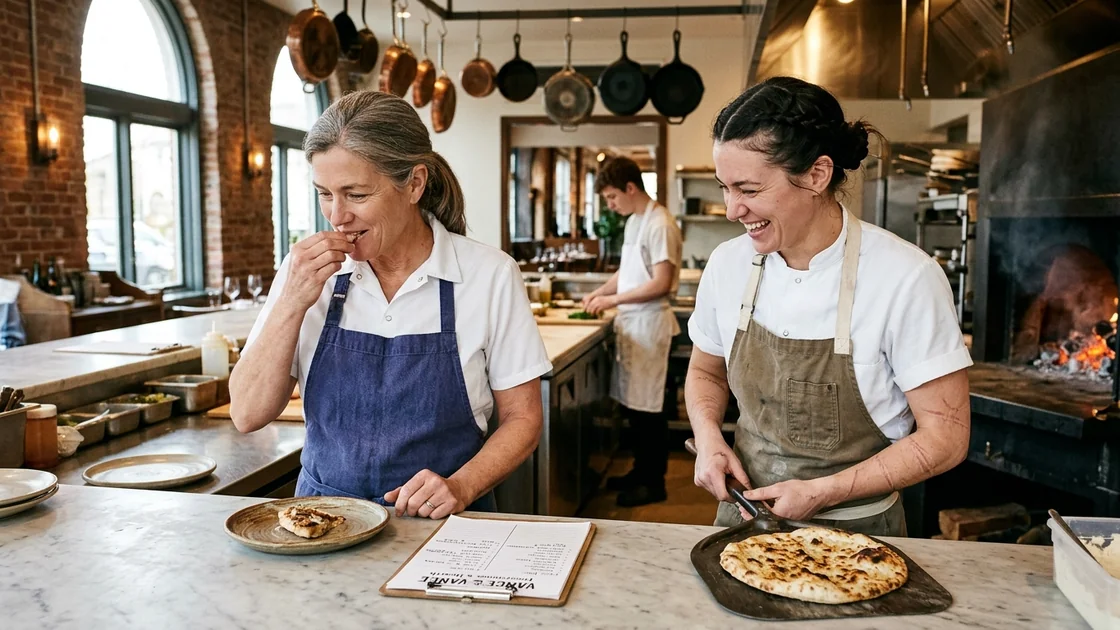
Chloe was at the wood-fired hearth at the back of the line, her face flushed with heat as she used long iron peels to turn flatbreads blistered with goat cheese, caramelized leeks, and wild mushrooms. Her arm was covered in light, cross-hatched scars—the badges of four years of fire and iron. On the shelf above her prep station sat a small, framed photo: not a wedding, not an art school degree, but a polaroid of her and Eleanor standing in the snow outside the culinary institute, holding their two knife rolls like weapons.
Eleanor stood at the marble pass, wearing an indigo linen apron over a crisp, white, short-sleeved chef’s shirt. In her hands was the night’s prep list, written in her own neat, architectural hand.
The front door clicked open.
A young man in a clean white cook’s apron walked in, looking nervous, his eyes darting around the gleaming copper pots hanging above the hearth, the neatly organized cambros in the reach-ins, the quiet, terrifying perfection of the mise en place.
"Chef Vance?" the boy asked, his voice trembling slightly.
Both Eleanor and Chloe turned their heads at the exact same instant.
"Which one?" Chloe asked, a slow, wicked grin spreading across her face as she leaned on her hearth peel.
The boy swallowed hard. "The... the executive chef. I’m the new stage. From the institute. Chef Henriksen sent me."
Eleanor set down her clipboard. She walked around the marble counter, her clogs clicking softly against the quarry tile floor. She looked the boy up and down—the starched, brand-new coat, the clean, unscarred hands, the slight, terrified quiver in his jaw.
"Your name?" Eleanor asked.
"David, Chef."
"Have you ever cut fifty pounds of yellow onions, David?"
The boy blinked. "In... in class, Chef. Once."
Eleanor pointed toward the prep table at the far end of the kitchen, where a fifty-pound burlap sack of alliums sat beside a heavy wooden block and an eight-inch carbon-steel knife.
"Wash your hands," Eleanor said, her voice warm, firm, and thoroughly impossible to disobey. "Take the scrub brush and the orange soap. Then begin with a small dice. One-quarter of an inch. If it’s uneven, the soup will know."
"Yes, Chef," the boy breathed, scrambling toward the sink.
Eleanor walked back to the marble pass. She stopped beside Chloe, who was pulling a blistered, golden flatbread from the mouth of the brick oven. The perfume of charred crust, thyme, and melting cheese filled the air between them, sweet and grounded, born of flour and water and heat.
Chloe reached over with a small paring knife, cut a triangular sliver from the edge of the flatbread, blew on it twice, and held it out to her mother.
Eleanor took it with her bare fingers, the crust hot enough to sting. She placed it in her mouth, closed her eyes, and tasted the salt, the fat, the yeast, and the clean, uncompromising edge of a world they had built with their own two hands.
She opened her eyes. "Needs salt," Eleanor said.
Chloe laughed—a loud, clear, joyful sound that echoed out through the open door and spilled into the warm summer street. "You always say that, Senior."
"Because it’s true, Junior," Eleanor said, reaching for the salt cellar. "Now fire the ovens. We have forty guests coming through that door in twenty minutes, and this kitchen isn't going to run itself."