Salt and Saffron
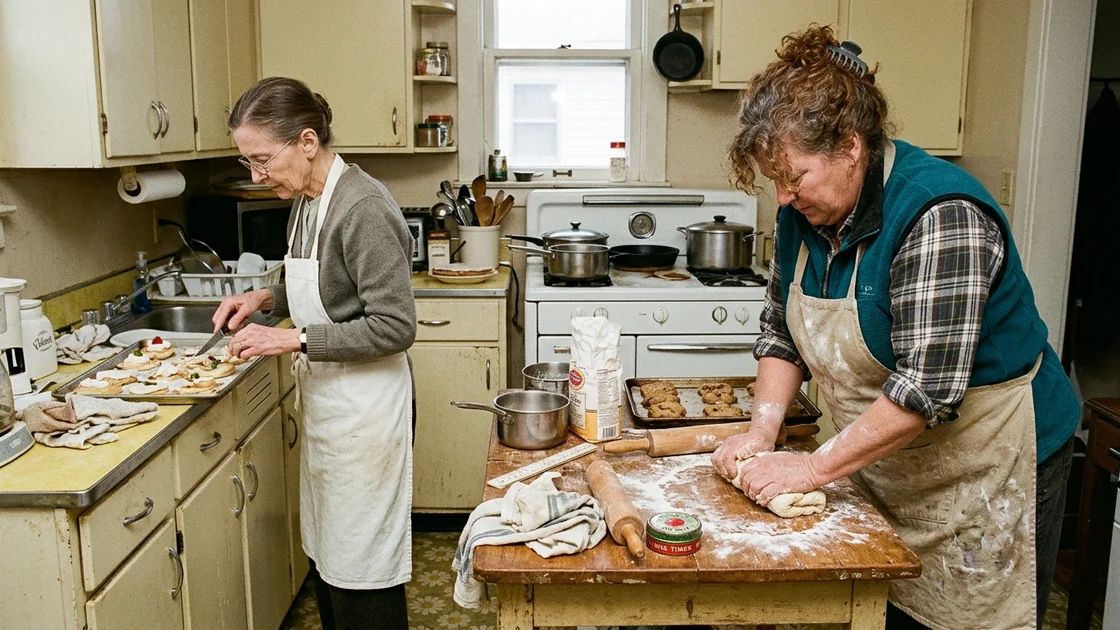
For thirty years, Eleanor and Beatrice Vance tolerated each other through tightly smiling holiday dinners, divided by social class, temperament, and an unspoken rivalry over the brothers they married. When a catastrophic financial collapse strips both families of their wealth, estates, and pride, the two women find themselves the sole owners of an aging, shared duplex in an unglamorous corner of the state. With their husbands emotionally broken and their bank accounts drained, Eleanor and Beatrice must swallow decades of mutual contempt to forge a joint catering business in a single cramped kitchen, discovering that survival requires them to blend Eleanor’s aristocratic precision with Beatrice’s soulful grit.
Chapter One: The Inventory of Loss
The gavel had not fallen with a grand, theatrical crash. That was the first thing Eleanor Vance realized about ruin: the legal system did not bother with cinematic flair when it dismantled a life. Instead, it sounded like the dry snap of a dead twig under a heavy winter boot. A clerk shuffled papers; an attorney with grease on his shirt collar murmured something into an iPad; and thirty-four years of Sterling-Vance social capital simply evaporated into a ledger of unsecured creditors.
By late October, the limestone manor in Shaker Heights had been emptied down to the brass escutcheons. The Persian runners, whose silk knots Eleanor had counted when migraines kept her awake at three in the morning, were rolled and tagged with yellow auction stickers. The Steinway baby grand, purchased for Julian’s fortieth birthday, went to an orthodontist from Columbus who remarked loudly on the front lawn that he might paint it matte black.
Eleanor had stood on the gravel turnaround wearing her second-best wool coat—the camel hair one from Max Mara, because the sable had been surrendered to the receiver—with her back completely straight. Her spine was an ancestral inheritance from five generations of Connecticut presbyterians who believed that tears shed in public were a form of poor hygiene.
Across town, in the leafy, sprawling enclave of Hunting Valley, Beatrice Vance had handled the eviction differently. She had cursed three separate bailiffs, packed four cardboard boxes full of cast-iron skillets, her grandmother’s ceramic pierogi press, and three dozen bottles of mid-tier Hungarian pinot noir, and then sat on her back terrace drinking cold tap water from a jam jar until the sheriff’s deputy personally took her house keys.
"Tell Julian," Beatrice had told the deputy, though Julian was miles away hiding in a hotel near the airport, "that if I ever see him near a hedge fund prospectus again, I will run him through a commercial meat grinder."
Now, they were here.
The duplex sat at 1414 Maple Street in a rust-belt borough south of Youngstown, where the air carried the faint, perennial sulfur tang of distant coke plants and the sweet rot of fallen wet sumac. The house was a squat, two-family bungalow built during the Coolidge administration, clad in aluminum siding the color of wet cardboard. A cracked concrete walk divided the patchy front yard, leading to a porch where the floorboards sagged toward the center like the belly of an old plow horse.
Eleanor sat in the passenger seat of her leased Subaru—the only vehicle the trustee had deemed exempt under the state’s personal property allowance—watching her husband, Julian, try to unlock the downstairs front door. Julian’s hands were shaking. His tailored houndstooth blazer hung off his shoulders now; he had lost twenty pounds in three months, his neck shrinking inside his shirts like a withered bulb in an onion sack. He looked less like an architect of private equity debt and more like a retired schoolteacher who had forgotten his spectacles.
Behind them, an ancient rental van with a rusted bumper shuddered to a halt at the curb. Arthur Vance, Julian’s younger brother, climbed out of the driver's side. Arthur had the same heavy Vance chin as Julian, but where Julian had carried himself with the languid posture of a man who had rowed crew at Dartmouth, Arthur had always carried himself like a foreman who had merely bought nicer suits. He did not look at Julian. He walked directly to the back of the van, hauled up the roll-top door, and began heaving out taped cartons.
Beatrice emerged from the passenger side of the truck. She wore faded jeans, a turquoise fleece vest that Eleanor had privately despised since Thanksgiving 2004, and a pair of scuffed leather work boots. Her curly auburn hair, liberally streaked with iron-gray, was pinned up with a plastic claw clip.
"Well," Beatrice said, slamming the truck door with a metallic bang that echoed off the neighboring aluminum houses. "It isn’t the Four Seasons, is it?"
Eleanor stepped out of the Subaru. She adjusted her silk scarf, smoothing the knot with two manicured fingers. "It has a roof, Beatrice. And according to the trustee’s deed, it has no liens. That makes it unique among our collective assets."
"Listen to you," Beatrice muttered, lifting a heavy rubber bin labeled BAKING - HEAVY GAUGE. "Always looking on the bright side of the liquidation."
"Someone must maintain a semblance of equilibrium," Eleanor replied, her voice cool and level as fresh milk. "Hysteria will hardly winterize the storm windows."
"I wasn’t hysterical," Beatrice shot back, trudging up the steps. "I was furious. There’s a distinct physiological difference, Eleanor. Hysteria is high-pitched. My rage is an octave lower and considerably more productive."
The duplex was divided vertically by a common stairwell that smelled of boiled onions, floor wax, and sixty years of radiator dust. Eleanor and Julian were to take the ground floor, which had a bay window looking out onto the cracked sidewalk and a kitchen that retained its 1950s metal cabinetry. Beatrice and Arthur took the second floor, which had lower ceilings, an attic access hatch that whistled when the wind rose from the lake, and an identical kitchen whose linoleum was patterned with faded yellow daisies.
For the first forty-eight hours, they avoided each other through sheer logistical choreography.
Eleanor unpacked her surviving wedgwood china—twelve place settings of wild strawberry that the bankruptcy auctioneer had bypassed as being too mundane for high-value collectors—and lined them along the dented enameled shelves. She washed the interior of the drawers with white vinegar and oil of lavender. She hung Julian’s remaining three suits in the solitary closet that smelled faintly of mothballs and damp plaster. Julian sat in an armchair by the radiator, staring through the sheer curtains at the telephone pole across the street, his hands resting motionless on his knees.
Upstairs, Beatrice was noisy. She drove nails into the plaster to hang copper molds; she dragged heavy oak chests across the pine floors; she ran the water until the pipes in the cellar shrieked like wounded seabirds.
When night fell, the floorboards between the two apartments proved to be completely porous. Eleanor lay in her narrow bed, her eyes fixed on the ceiling plaster medallion, listening to Arthur and Beatrice argue in the kitchen above her head.
"We can’t live on eighty dollars a week, Artie," Beatrice’s voice carried down through the heating vent with horrifying clarity. "The dispatch job doesn't cover the insulin, let alone the heating oil."
"I’m working sixty hours," Arthur’s voice was muffled, heavy with defeat. "They won’t give me overtime until the probationary ninety days are up. Talk to Julian."
"Talk to Julian?" Beatrice’s bark of laughter was dry and short. "Julian hasn't spoken a complete sentence that didn't include the words force majeure since August. Julian is a ghost in an eight-hundred-dollar pair of loafers."
Eleanor turned onto her side, pulling the coverlet up to her ears. Beside her, Julian gave a small, shuddering sigh in his sleep, his fingers twitching against the mattress.
Thirty years of family holidays played through Eleanor’s mind like a reel of damaged film. The Thanksgiving dinners at the club where Beatrice had pointedly refused the poached turbot and asked the waiter if they had anything with actual salt. The summer picnics at the lake house where Eleanor had brought chilled vichyssoise in crystal thermoses while Beatrice arrived with three five-gallon plastic buckets of slow-roasted Carolina pork shoulders and a cooler of beer, deliberately humiliating Eleanor’s linen-covered buffet table by causing a stampede among the teenage cousins.
They had been polite. Oh, they had been exquisitely polite. For three decades they had exchanged Christmas cards containing identical, tasteful signatures; they had kissed cheeks at weddings, their lips grazing cold air half an inch from the skin; they had sat on opposite ends of hospital waiting rooms when Julian and Arthur’s father had passed away, each managing her own faction of grief like rival ministers in a disputed territory.
Eleanor had considered Beatrice coarse, vulgar, and willfully theatrical.
Beatrice had considered Eleanor brittle, sterile, and terrified of any food that hadn't been filtered through cheesecloth.
Now, their lives were separated by three-quarters of an inch of tongue-and-groove white pine, and neither one of them had four hundred dollars in a checking account.
Chapter Two: The Pan of Scones
The truce ended, or rather transformed into an armistice of necessity, over thirty pounds of butter.
On a Tuesday morning in late November, the power failed on the upper floor of the duplex. A blown fuse in a box that had not been updated since the Eisenhower administration left Beatrice with an electric range that wouldn't heat and an order for five dozen cranberry-walnut scones that she had promised to the parish council of St. Luke’s down the road. It was her first paid commission since the crash: forty-five dollars, cash.
Eleanor was standing at her metal double-sink, rinsing a porcelain teacup with the meticulous care of an apothecary, when the back door flew open.
Beatrice stood on the threshold, carrying two commercial aluminum baking sheets covered with mounds of pale, unbaked dough. Her face was flushed, her apron strings tied so tight around her middle they looked like they might cleave her in two.
"Don't say a word," Beatrice panted, using her hip to shove the door shut behind her. "Just open your oven. My panel threw a breaker and Arthur took the truck with the fuse puller."
Eleanor set her teacup down on the rim of the sink with a soft clink. "Good morning, Beatrice. The latch on that door requires a gentler turn, or the strike plate slips."
"Eleanor, the baking powder is already hydrated. If these don't hit four hundred degrees in the next seven minutes, they’re going to be doorstops. Open the oven."
Eleanor took a measured breath, turned, and pulled down the enameled door of her Chambers gas range. It was the one piece of machinery in the house that worked with terrifying efficiency—an old, heavy cast-iron beast that Julian had curses-and-bruises dragged into the kitchen three days prior because it had been left in the basement by the previous tenant.
Beatrice slid the pans onto the middle racks with a practiced, violent grace. She stepped back, wiping her flour-whitened hands on her apron, and surveyed Eleanor’s kitchen.
The room was immaculate. There was not a crumb on the yellow Formica counter. A single copper sauté pan hung from a wall hook, polished to a pink mirror shine. On a small cutting board sat three lemons, an antique bone-handled paring knife, and a small glass jar containing grey salt.
"You're not cooking," Beatrice observed, her breathing gradually slowing.
"I am having Earl Grey," Eleanor said.
"Julian still hasn't come out of the den?"
"Julian has a headache."
"Julian has had a headache since July," Beatrice said, leaning back against the metal sink counter. She looked Eleanor up and down. "You’ve lost weight, Ellie."
Eleanor flinched slightly at the diminutive. "I am perfectly well, Beatrice."
"You look like a heron that got caught in a clothes dryer. Sit down before you blow away." Beatrice reached over, without asking, and picked up the bone-handled knife. She tested the edge with her thumb. "German steel. Solingen. At least you didn't let the liquidators have the cutlery."
"The liquidators were interested in our stock portfolio, our mutual funds, and Julian’s watch collection," Eleanor said, her voice dropping into a dry register. "They were remarkably indifferent to carbon steel and French copper."
Beatrice sniffed the air. The scent of the scones was beginning to fill the small room—warm butter, toasted nuts, the sour-sweet punch of dried cranberries.
"Your dough is too wet," Eleanor remarked, eyes fixed on the oven window.
Beatrice turned around, her eyebrows raised like twin briars. "Excuse me?"
"Your scones. They are spreading laterally instead of rising vertically. You overworked the butter with your hands instead of using two knives or a pastry blender, and your liquid-to-flour ratio is tilted toward buttermilk."
Beatrice laughed, but there was an edge like broken bottle-glass in the sound. "Those scones have won three blue ribbons at the Portage County Fair, Eleanor. People line up for them at the church bazaar until they wrap around the bingo tent."
"Portage County fairgoers," Eleanor said quietly, "are notoriously sentimental about lard and sugar. If you were serving them at a morning service at the Cleveland Museum of Art, they would be categorized as rock cakes."
"Well, thank God we aren't at the Cleveland Museum of Art, are we?" Beatrice took a step closer, pointing a floury finger toward the street. "We’re in Miller's Creek. Across from a dry cleaner that closed down because of dioxin in the well. The parish council at St. Luke’s doesn't want an architectural installation made of laminated pastry, Eleanor. They want something that tastes like their mother actually loved them."
"A well-made brioche," Eleanor replied, not moving an inch, "is not an architectural installation. It is an expression of self-respect."
They glared at each other. Between them, the Chambers range hummed, a low blue flame licking the bottom of the steel plates, radiating four hundred degrees of heat into the narrow room.
The kitchen timer—an old wind-up tin tomato that Beatrice had brought down with her—began to tick with a frantic, metallic pulse.
"You know," Beatrice said after a long, poisonous silence, "the parish ladies asked me if I could do lunch for the Bishop’s visitation next month. Forty people. Three courses."
Eleanor’s eyes moved slightly toward the window. "Did they?"
"Yes. Five hundred dollars budget. I told them I couldn't do it because I don't have the cold storage or the oven capacity upstairs." Beatrice looked down at the Chambers stove, then around at the expansive, albeit ugly, kitchen. "You have sixty square feet more prep space down here than I do. And that range could cook an entire steer if you took the racks out."
"No," Eleanor said immediately.
"I haven't asked you anything yet."
"I know what you are suggesting, Beatrice, and the answer is an unequivocal no. We are not turning this hovel into an industrial galley so you can produce pans of chicken-noodle casserole for regional prelates."
Beatrice crossed her arms. "The bank account has eleven dollars in it, Eleanor. Arthur’s entire paycheck from the trucking depot goes to the receiver on Friday to satisfy the restitution order on the junior debt. What are you and Julian going to eat next week? That Earl Grey tea?"
Eleanor’s hands tightened on the hem of her cardigan. Her knuckles turned the color of lard. "We have resources."
"You don't have a damn thing," Beatrice said, her voice suddenly dropping into a register that was almost gentle, and therefore ten times more brutal. "Neither do I. The boys are dead in the water. Arthur sits at that depot terminal at three in the morning checking shipping manifests until his eyes bleed, and Julian... Julian looks like he’s waiting for someone to give him permission to die."
Eleanor turned away, looking out the back door toward the small yard where dead goldenrod stood rigid in the frost. A muscle in her jaw jumped once, twice.
"Five hundred dollars is an absurdly low margin for forty covers," Eleanor said, her back still turned. "After raw ingredients, fuel, and paper supplies, your net return will barely cover twelve dollars an hour for labor. You would be operating at an effective loss."
Beatrice snorted. "Not if we buy the poultry wholesale from the Hungarian butcher on Tenth Street. And we don't use paper. We use real linen. People pay thirty percent more if the napkins don't tear when they wipe their chins."
"I have six dozen damask napkins," Eleanor whispered. "They were my mother’s. They have the Sterling monogram."
Beatrice was quiet for a second. "Can we bleach them?"
"They are Belgian linen, Beatrice. One does not bleach them. One launders them with Castile soap and blues them with Prussian dye."
"Fine," Beatrice said. "We blue them. Can you make that lemon-curd tart you used to bring to Easter? The one with the crust that practically evaporated when you looked at it?"
Eleanor paused. A flicker of something ancient and sharp—a cook's pride, long buried under the ash of dinner-party etiquette—stirred beneath her ribs.
"Pâte sablée," Eleanor said, correcting her. "And it requires real butter. Not that vegetable oil compound you keep in your larder."
"I'll buy butter," Beatrice said. "Even if I have to pawn my mother’s garnet earrings to get it."
The tin tomato timer went off with a shrill, buzzing rattle.
Eleanor reached for the oven mitts—thick, clean, grey quilted cotton. She pulled the door open. The heat rushed out, carrying with it the smell of toasted sugar and fat. The scones were brown on top, their edges crisp, their centers risen just enough to split along the equator.
Eleanor inspected them with the detached gaze of an art appraiser examining a suspect Dutch master.
"Well?" Beatrice demanded, hovering over her shoulder.
"They are acceptable," Eleanor said, setting the pan on the trivet. "A bit rustic around the edges. But... entirely acceptable."
Chapter Two: The First Service
The kitchen of St. Luke’s Episcopal Church smelled like floor polish and seventy years of parish coffee.
It was an undercroft space with low, white-washed stone walls, small hopper windows that opened at street level to reveal the tires of passing delivery vans, and a four-burner Vulcan range that had seen service during the Korean War.
Eleanor stood at the stainless-steel prep table with a ruler. It was a wooden drafting ruler she had found in Julian’s old desk box, and she was using it to ensure that the cucumber ribbons for the first-course terrines were exactly one and one-eighth inches wide.
"You're out of your mind," Beatrice said, hauling an eight-quart stockpot of poaching broth onto the stove. "They’re going to eat them in three bites, Ellie. Nobody is bringing calipers to the table."
"Proportion is the foundation of digestion," Eleanor said without looking up. Her knife—a six-inch carbon steel utility knife that she had honed on an oil stone that morning until it could shave hair—moved through the seedless cucumbers with a steady, rhythmic shuck-shuck-shuck. "If the cucumber is too wide, it overwhelms the delicate texture of the trout. If it is too narrow, the terrine collapses when the servers drop the plates. Have you clarified the butter for the watercress sauce?"
"It's clarifying," Beatrice said, waving an oven mitt dismissively toward the back burner. "And it's not trout terrine on the program, by the way. I told Father Andrew it was 'Chilled Lake Fish Loaf.' He seemed much more comfortable with that."
"If you refer to my ballotine of lake trout as fish loaf in the presence of the Bishop," Eleanor said, freezing her knife hand in mid-air, "I will take this cleaver and sever the fuel line to your truck."
Beatrice grinned. It was the first time Eleanor had seen her smile with all her teeth since the bankruptcy court judge had signed the final decree. "You’ve got a little blood in your veins after all, Sterling. I was worried you were entirely filled with embalming fluid."
The menu had been the subject of an eleven-day border war across the duplex’s common hall.
Beatrice had wanted stuffed cabbage rolls, roast chicken with paprika cream, and an apple sheet-cake with caramel glaze. "It’s November," she had argued, pounding a rolling pin onto Eleanor’s dining table. "The Bishop is seventy-two years old and has gout. He wants fat. He wants salt. He wants to feel like he’s at a family reunion where everybody survived the winter."
"The Bishop," Eleanor had replied with icy serenity, "was educated at Oxford and sits on the board of three seminaries. He does not want to spend the afternoon following his visitation dealing with the digestive consequences of lard-braised brassica. We will serve a ballotine of local trout with watercress emulsion, followed by guinea hen roasted with winter herbs and small glazed parsnips, and we will finish with a tarte tatin using the Northern Spy apples from the orchard behind the reservoir."
They had compromised on guinea hen (which Beatrice managed to acquire through a second cousin who raised poultry outside of Mercer) and Beatrice’s butter-braised small potatoes, but Eleanor had insisted on the ballotine and the tarte tatin.
At eleven-thirty, the first problem arrived.
Arthur Vance appeared in the kitchen doorway. He was wearing his work uniform—a dark blue twill shirt with A. VANCE embroidered in red script over the pocket—and his boots were coated in coarse gray slush. He looked exhausted, the skin under his eyes bagged and bluish.
"Artie," Beatrice said, wiping her hands on her apron. "What are you doing here? I thought you had the shift until four."
"Depot let eight of us go at ten," Arthur said. His voice was flat, hollowed out of any inflection. "Canadian freight line canceled the regional transfer contract. Company’s cutting third of the floor."
The kitchen fell dead quiet, save for the low, rhythmic simmer of the poaching liquid on the range.
Beatrice stood very still. The wooden spoon in her hand began to lower slowly until it touched the counter. "They laid you off?"
"They called it 'temporary operational suspension,'" Arthur said. He didn't look at his wife; he looked at the floor between his steel-toed boots. "No severance. Just the three days of accrued PTO."
Eleanor felt a cold prickle of fear at the base of her skull. If Arthur was out of work, their collective margin was gone. Her own monthly pension payout from the school board—where she had taught art history for eight years before marrying Julian—amounted to exactly four hundred and twelve dollars after the federal court took its levy.
From the hallway outside the undercroft kitchen, the sounds of voices began to drift down: the cheerful, hollow boom of churchwardens, the rustle of wool overcoats, the laughter of old women in good hats. The service was ending.
"Julian is in the car," Arthur added, his eyes lifting briefly to meet Eleanor’s. "I told him to stay there. He was... having one of his spells."
"He can't stay in the car," Eleanor said instantly, her voice sharper than she intended. "It’s thirty-two degrees outside and the heater in that vehicle does not work on idle."
"He won't come in, Ellie," Arthur said softly. "He saw Mrs. Henderson come in through the lych-gate. Her husband lost six hundred thousand in Julian’s fund. Julian tried to climb into the footwell."
Beatrice let out a long, ragged exhale that sounded almost like an animal's growl. She turned her back on her husband, grabbed a cast-iron skillet from the rack, and slammed it onto the iron grates of the front burner with a sound like a rifle shot.
"Get him," Beatrice said.
Eleanor blinked. "What?"
"Go get your husband, Eleanor. Drag him through the boiler room door in the alley. Put an apron on him. Give him the potato peeler. If he sits in that car and rots, we are going down with him."
"Julian does not peel potatoes," Eleanor said, her chin lifting instinctively. "He has never prepared a meal in his life."
"Well, he’s going to learn today," Beatrice snapped, her eyes blazing with an unholy, terrifying vitality. "Arthur, get those boots off and wash your hands. We have forty plates to drop in twenty-two minutes, and if the Bishop doesn't get his watercress sauce at fifty-eight degrees Celsius, Eleanor is going to stab me with a poultry needle. Move!"
It was the longest two hours of Eleanor Vance’s sixty-one years.
Julian was brought into the back pantry. He was shivering, his gray cashmere scarf knotted so tightly his neck looked pinched. His face was gray, his eyes wide and vacant like those of a soldier suffering from shell shock.
Eleanor did not speak to him with the gentle, pitying tones she had used for the last five months. She did not bring him his slippers or suggest he take a rest.
Instead, she stepped into his space, untied his scarf with three sharp jerks, and tied a white butcher’s apron around his waist with enough force to knock the breath out of him.
"You will slice the bread," Eleanor said into his ear, her voice a low, terrifying hiss. "Two slices per basket. Sliced on the bias, exactly half an inch thick. You will use the serrated knife with the rosewood handle. If you drop a loaf on the floor, Julian, I will make you eat it dry. Do you understand me?"
Julian blinked. For a second, his aristocratic jaw trembled; then, something in Eleanor’s face—something that had probably descended directly from the Connecticut puritans who burned down forests to plant maize—caught him.
"Half an inch?" he whispered.
"On the bias," Eleanor repeated. "Now pick up the knife."
Arthur was stationed at the rinse sink, his thick hands plunging into hot soapy water to clean the hotel pans as fast as Beatrice emptied them.
In the center of the kitchen, Eleanor and Beatrice moved around each other like two dancers who had trained in different hemispheres but were bound by the same violent choreography. There was no space to pass without touching; their shoulders bumped, their hips brushed against the corners of prep tables.
"Trout is plated," Eleanor called out. Her movements were surgical: three slices of the ballotine laid across a pool of emerald watercress purée, garnished with two paper-thin translucent discs of radish and a sprig of chervil.
"Plates are cold," Beatrice barked.
"They are supposed to be cold, Beatrice! It is a cold terrine!"
"The dining room is sixty-two degrees, Ellie! Put them on the lower warming shelf for forty seconds or the fat in the fish will congeal on their tongues like cold lard!"
"It is olive oil and lemon zest, there is no suet in that terrine!"
"Do it anyway!"
Eleanor ground her teeth until her fillings ached, but she slid the tray onto the lower shelf.
The plates went out.
The church ladies who were volunteering as servers—women who had known Beatrice since her girlhood and who had looked at Eleanor for thirty years with the wary deference reserved for bank executives' wives—carried the heavy oval trays up the wooden service stairs.
Down in the undercroft, the four of them stood in the steam and the smell of roasting poultry.
Julian was still slicing. He had sliced four loaves of sourdough with a precision that would have satisfied a laser-guided lathe.
"Stop, Julian," Eleanor said gently, laying her hand over his wrist. "That is enough bread."
Julian stopped. He looked at the mountain of uniform slices, then down at his hands, which were covered in white flour up to the cuffs of his shirt. A strange, small light flickered in his eyes—not joy, exactly, but the faint, miraculous spark of a man who had completed a task without causing a financial collapse.
"They ate it all," Arthur said, leaning through the pass-through from the dining room. He was holding three empty platters. "Every single bit. Old Mrs. Henderson asked if the fish was imported from France."
Beatrice looked at Eleanor across the prep table. Her apron was splattered with green herb purée and grease from the roasting pans; her hair was escaping her clip in wild, curly tendrils around her temples.
"What did you tell her, Artie?" Beatrice asked.
"I told her it was lake trout from Ashtabula," Arthur said, a slow, broad grin breaking across his heavy face. "And that the chef was private."
Eleanor took a clean linen towel from her bag and wiped the edge of her cutting board. Her fingers were stiff, her lower back throbbed with a rhythmic, dull fire, and her knees felt like dry hinges.
"The guinea hens require basting," Eleanor said, keeping her voice entirely matter-of-fact. "Beatrice, if you allow the skin to blister, the visual harmony of the platter will be ruined."
"Shut up, Eleanor," Beatrice said, reaching for the butter ladle with an enormous, triumphant grin. "And hand me the rosemary."
Chapter Three: The Partition
The money sat on Eleanor’s dining room table: five one-hundred-dollar bills, three twenties, and four singles.
It was nine o'clock at night. The duplex was quiet except for the wind rattling the bare branches of the crabapple tree outside the bay window. Julian had gone to bed immediately upon their return, falling into a deep, dreamless sleep that smelled of yeast and clean cotton. Upstairs, Arthur’s heavy footsteps had ceased an hour ago.
Beatrice sat in Eleanor’s high-backed armchair—the one good Queen Anne wingback that had escaped the appraisers because of an ink stain on the rear upholstery. She was wearing an old flannel nightgown and drinking tea out of Eleanor’s second-best porcelain cup.
"Three hundred and eighty dollars net profit," Beatrice said, tapping the edge of the five-hundred-dollar stack with her blunt fingernail. "After the poultry, the cream, and the forty dollars we gave the boys for dishwashing."
"Thirty-two dollars an hour," Eleanor noted, sitting across from her with a small ledger book open on her lap. Her penmanship was copperplate, small and sharp. "Assuming six hours of prep and three hours of service. It is modest, but it represents a four hundred percent improvement on our liquid reserves."
Beatrice took a sip of the tea. She grimaced slightly. "You don't put enough sugar in this stuff, Ellie."
"Sugar disguises the tannins, Beatrice. You might as well drink warm syrup."
"I like warm syrup." Beatrice set the cup down with a delicate rattle. She looked around the small living room, taking in the framed pencil sketches—Eleanor’s own drawings of Italian facades from her junior year in Florence—and the small, perfectly ordered bookshelves. "Julian looked better today."
Eleanor’s hand paused over the ledger. "He was occupied. That is all."
"He looked like he was alive. There’s a difference between being occupied and being present. When he was slicing that sourdough, he didn't look like he was waiting for the FBI to kick the door in."
Eleanor did not reply. She recorded the forty-four dollars spent on unsalted butter under the column marked DISBURSEMENTS - DAIRY.
"We need a name," Beatrice said.
"A name for what?"
"For the business. If we're going to do this, we need a business checking account. The parish treasurer told me that if we had an LLC with a state vendor number, the diocese could hire us for the regional retreat in January. That’s three hundred heads for four days."
Eleanor felt her pulse quicken—half terror, half calculation. "Three hundred people? In an off-site institutional kitchen?"
"We can rent the Grange Hall in Canfield. It has three commercial ovens and a twelve-burner Garland range. We’d need four grand in working capital to float the inventory, but if we get a thirty percent deposit on the contract..." Beatrice leaned forward, her elbows resting on her knees, her eyes fixed on Eleanor with an intensity that was almost predatory. "That’s eight thousand dollars clear profit in four days, Eleanor. That’s our property taxes paid for the year. That’s Arthur’s dental surgery. That’s your husband’s health insurance."
Eleanor stared at the figures in her ledger. The numbers were small, tidy, and cold. For thirty years, she had lived in a world where numbers were abstract—percentages on portfolio summaries delivered in embossed leather folders, basis points gained or lost on municipal utility bonds. She had never lived in a world where forty-four dollars of butter stood directly between her and the municipal tax lien sale.
"We cannot call it Vance Catering," Eleanor said quietly.
"Why not?"
"Because Julian and Arthur’s names are still radioactive in every newspaper between Erie and Akron. The moment an event coordinator searches the registry and sees Vance, they will think of the logistics fraud, the receivership, and the front-page photographs of our cars being towed."
Beatrice leaned back, a dark scowl settling over her features. "I spent thirty years being Beatrice Vance. I took that name when I was twenty-two, Eleanor. I worked in the parish kitchen with that name. I don't like hiding behind the door like a stray dog."
"Pride," Eleanor said softly, "is an expensive garnish, Beatrice. We cannot afford it."
They sat in silence for several minutes. From upstairs came the creak of an old floorboard as Arthur shifted in his bed.
"The two sisters," Beatrice muttered.
"We are not sisters."
"Sisters-in-law. It's the same difference to people who don't have to live with us."
"It is emphatically not the same difference," Eleanor said with a thin smile. "Sisters share DNA and a childhood. We share two brothers with catastrophic business judgment and a mortgage on a duplex that smells of parsnips."
Beatrice laughed—a short, explosive bark that made the porcelain on the tray vibrate. "God, you are an unbearable woman, Eleanor."
"So I have been told by experts."
"What about Two Vances Provisions?" Beatrice suggested. "No, you said no Vance. What about... The Hearth & The Whisk?"
Eleanor made a small, gagging noise in her throat. "That sounds like a gift shop in Vermont that sells overpriced lavender sachets and decorative potholders. Absolutely not."
"Well, what do you suggest, Madame Pompadour?"
Eleanor picked up her fountain pen. She drew a clean, straight line beneath the day’s totals.
"Our maiden names," Eleanor said.
Beatrice frowned. "Sterling and Kowalski?"
"It has balance," Eleanor said, her voice dry and steady. "The Anglo-Saxon precision of Sterling suggests accountability, linen, and cold silver. The Slavic earthiness of Kowalski suggests generous portions, deep seasoning, and an absolute refusal to let anyone leave the table hungry."
Beatrice stared at her. Her jaw went slack for a single second before she pulled it back into place. "Sterling and Kowalski," she repeated, testing the syllables in her mouth. "It sounds like a firm of personal injury lawyers from Detroit."
"It sounds," Eleanor corrected her, "like two women who do not owe anyone an explanation."
Beatrice looked at the five-hundred-dollar bills on the lace cloth. She reached out her hand, palm up, across the table.
Eleanor looked at the hand. Beatrice’s skin was rough, the knuckles thickened by thirty years of kneading, scrubbing, and carrying heavy cast-iron skillets. A pale crescent-shaped burn scar ran across the meat of her thumb—the souvenir of a hot oven rack from some long-forgotten Thanksgiving.
Eleanor reached out her own hand—pale, smooth, with thin, aristocratic fingers that still showed the faint indentation where her four-carat emerald-cut diamond ring had sat for three decades—and took Beatrice’s hand.
They shook once, firmly, without any warmth, but with the terrifying, unbreakable grip of two sailors who had discovered they were trapped in the same life raft.
Chapter Four: The High-Society Wake
By March, Sterling & Kowalski Provisions had ceased to be an experiment and had become an occupation.
They had painted the common basement a stark, clean white. Julian had built four eight-foot prep tables out of two-by-fours and birch-faced plywood, sanding the edges until they were as smooth as satin. Arthur had rigged a system of pulleys and counterweights to handle the heavy commercial soup kettles they bought from a defunct Greek diner in Warren.
The division of labor was absolute, ferocious, and maintained with the rigor of a demilitarized zone.
Beatrice ruled the range. She handled the stocks, the braises, the sauces that required twelve hours of reduction, the sausages she stuffed by hand into hog casings with Arthur turning the crank, and the vast, steaming pans of scalloped potatoes that became their calling card for funerals and political dinners.
Eleanor ruled the cold room and the pastry station. She handled the terrines, the aspics, the salads, the brioches, the petits fours, and the financial ledgers. She stood for seven hours at a time with a chef's scarf tied around her neck to catch the sweat, piping choux pastry with an accuracy that varied by less than two grams per éclair.
They did not become friendly. They did not confide in each other about their marriages, their regrets, or the humiliation of seeing their former friends at the grocery store.
When Beatrice was angry, she threw wooden spoons into the zinc sink with a clatter that could be heard on the sidewalk; when Eleanor was angry, she simply corrected Beatrice’s French pronunciation with an icy, devastating precision that made Beatrice want to drown her in a bucket of clarified lard.
Then came the Call.
It came from Mrs. Thaddeus Beaumont III.
Eleanor took the call on the downstairs landline. Mrs. Beaumont—formerly Bitsy Van Der Hoven—had been Eleanor’s sponsor for the Cleveland Botanical Garden Society. Her husband had been one of the lead investors in Julian’s primary mezzanine fund. When the fund collapsed, the Beaumonts had lost their winter home in Jupiter, Florida, though they still occupied their Georgian brick fortress in Gates Mills.
"Eleanor," Bitsy’s voice had come across the copper wire like dry grass rubbing together. "I understand you... that is, you and Arthur’s wife... are providing culinary services."
Eleanor did not flinch. "We operate a catering firm, Bitsy. Yes."
"Thaddeus’s sister has died. Constance. You remember Constance."
Eleanor remembered Constance Beaumont: a woman who had spent eighty-four years being rude to waiters and breeding overweight King Charles Spaniels.
"I remember her with clarity," Eleanor said.
"We are having two hundred people at the house after the interment on Friday. The usual firms... well, the quotes were simply extortionate given the current tax environment. Someone mentioned your name at the Colony Club. They said you did the Bishop’s luncheon." Bitsy paused, the sound of her cigarette lighter clicking through the receiver. "Can you handle two hundred? Finger foods, Eleanor. High-end. No hot dogs or whatever it is they eat down in Youngstown."
Eleanor looked at the wall calendar. It was Tuesday. They had forty-eight hours to source, prep, and execute a high-end funeral reception for people who had, until seven months ago, sat at Eleanor’s dinner table and gossiped about the vulgarity of the Kowalski family.
"Our rate," Eleanor said, her voice dropping into a register of sheer, crystalline ice, "is forty-five dollars per head. Plus staffing, linens, and ice. Fifty percent deposit by certified draft before the van arrives at your gates."
Bitsy hesitated. "Forty-five? Eleanor, really, given the... circumstances..."
"Forty-five, Bitsy. Or you may contact the firm from Beachwood that uses frozen phyllo cups and pre-cooked cocktail shrimp. I believe their fee is thirty-eight."
"Send the contract," Bitsy said, and hung up.
When Eleanor told Beatrice, Beatrice stopped chopping shallots. The knife remained embedded in the wooden block like an executioner’s axe.
"Gates Mills?" Beatrice said, her voice dropping into that low, dangerous octave. "You want us to go to Gates Mills and serve cold crab to the people who called Arthur a common thief in the Plain Dealer?"
"They did not call Arthur a thief," Eleanor said, methodically scrubbing a copper bowl with lemon juice and salt. "They called Julian a catastrophic incompetent. Arthur was merely referred to as 'an operational accessory.'"
"Oh, well, that’s so much better! That makes me feel like serving them little sandwiches with the crusts cut off!"
"We will serve them," Eleanor said, turning around to face Beatrice, "the finest afternoon collation that has been seen in that county in twenty-five years. We will take their nine thousand dollars. We will pay off the truck note. We will buy the three-phase Hobart mixer from the restaurant supply auction. And you will wear your black server’s dress, Beatrice, and you will look every one of those women in the eye until they are the ones who look down."
Beatrice stared at Eleanor. Slowly, a wicked, jagged grin began to spread across her face.
"You really are a vindictive, cold-blooded bitch, aren't you, Ellie?"
"I am a Sterling, Beatrice. We do not get angry. We present an invoice."
Chapter Five: The Battle of Gates Mills
The Beaumont residence smelled of lilies, beeswax, and generational money that had been safely insulated from Julian Vance’s speculative ventures by trust funds established during the McKinley administration.
The kitchen, however, was a battlefield.
It was a vast, commercial-grade space with a Traulsen four-door refrigerator, limestone counters that stained if you looked at them with a cut tomato, and a six-burner French bonnet range that had clearly never seen anything more violent than the heating of low-sodium broth.
Eleanor moved through the kitchen like an admiral on a flagship. She wore an immaculate white double-breasted chef’s jacket, black trousers, and her hair was swept back into a net so fine it was invisible.
Julian and Arthur were outside in the service court, managing the ice bins and the glassware crates. Julian was wearing his dark blue suit—brushed, pressed, his collar stiffened with spray starch. He had refused to come inside the house.
"I will handle the delivery, Eleanor," he had said that morning, his voice quiet but steady. "I will not be a spectacle for Thaddeus."
"You will not be a spectacle, Julian," Eleanor had replied. "You will be the logistics manager. There is a distinction."
In the kitchen, Beatrice was assembling the hot hors d'oeuvres: miniature wild mushroom tartlets with aged Gruyère, small skewers of duck confit with sour cherry glaze, and tiny potato pancakes topped with house-cured salmon and a speck of sour cream.
Eleanor was plating the cold station: endive leaves filled with blue cheese, toasted pecans, and poached pear; crab medallions with green apple remoulade; and forty-five individual ramekins of chicken liver mousse with Sauternes jelly.
At two-thirty, the swinging doors opened.
Bitsy Beaumont stepped into the kitchen. She was wearing an impeccably tailored black crepe dress and a triple strand of pearls that sat against her withered collarbones like rows of white teeth. She held an empty highball glass.
"Eleanor," Bitsy said, her eyes sweeping over the stainless counters, the sheet pans, and finally coming to rest on Beatrice, who was basting duck confit with a large pastry brush. "I see you’ve managed to get everything... organized."
"Good afternoon, Bitsy," Eleanor said, not stopping her work. Her spoon hovered over a ramekin of mousse, dropping a jewel-like cube of Sauternes jelly onto the center with absolute precision. "The service is running exactly on schedule. The cold savory station is set in the conservatory, and the hot items will begin circulating at fifteen minutes past the hour."
Bitsy took a step further into the room. She looked at Beatrice.
"And you must be... Arthur’s wife," Bitsy said, her voice dripping with an offensive, theatrical sweetness. "Beatrice, isn't it? From the valley?"
Beatrice turned. She did not wipe her hands. She stood with the dripping pastry brush held at forty-five degrees, like an officer holding a sabre at parade rest.
"Mrs. Beaumont," Beatrice said. "Sorry about Constance. She always seemed like she had a lot of opinions."
Bitsy’s mouth tightened until her lipstick bled into the tiny vertical wrinkles around her lips. "Constance was a woman of great discernment. As are our guests today. I hope that... well, I noticed the bread on the buffet is somewhat dark. We usually prefer a white French baguette. Some of the gentlemen find these whole-grain varieties a bit... heavy for a funeral."
"It's rye," Beatrice said, taking half a step forward. "Caraway rye. Sliced thin. My grandfather’s recipe from the bakery on East Sixty-Fifth. It holds the mousse without turning to wet cardboard under the jelly, Mrs. Beaumont. If you used French bread, your guests would have liver on their cuffs before they reached the library."
Bitsy stiffened. "I was merely remarking—"
"Bitsy," Eleanor interrupted, her voice dropping into a tone that was so soft, so aristocratic, and so completely lethal that both other women froze. "The menu was settled by contract on Wednesday. The caraway rye was selected specifically to complement the fat profile of the mousse. If you would prefer that your guests consume their refreshments from paper plates with plastic forks, you should have informed me before the deposit cleared. As it stands, you have hired Sterling & Kowalski. You will receive Sterling & Kowalski."
Bitsy Beaumont looked at Eleanor. She looked for a trace of the woman who used to pour tea at the garden club, the woman who had nodded politely when Bitsy complained about the cost of boarding horses in Wellington.
She found none. Eleanor’s eyes were the color of slate in November.
"The bar requires more tonic," Bitsy said coldly, and turned on her heel, the swinging doors flapping behind her with a dry, wooden slap.
The kitchen was dead silent for three beats.
Beatrice slowly lowered her pastry brush. She looked at Eleanor, whose hands were still working their way down the row of ramekins, never trembling, never missing a millimeter.
"You told her her bread would turn to wet cardboard," Beatrice said.
"Her bread would turn to wet cardboard," Eleanor said without looking up. "The woman has the palate of an asphalt roller. She wouldn't know a properly developed gluten structure if it struck her across the nose."
Beatrice let out a low snort, then a chuckle, then a full-bellied laugh that rattled the copper pots hanging above the bonnet range.
"Look at us," Beatrice wheezed, wiping tears of mirth from her eyes with the corner of her apron. "Look at the two of us! The grand ladies of Maple Street, telling Bitsy Beaumont how to eat liver!"
Eleanor stopped. She set the spoon down. She looked down at her hands, which were red at the knuckles from the ice bath she had used to shock the watercress, then over at Beatrice, whose cheeks were flushed from the heat of the ovens.
A small, dry smile touched the corners of Eleanor’s mouth.
"The mousse is thirty percent better than anything she ever served in this mausoleum," Eleanor said quietly.
"Forty percent," Beatrice corrected her, turning back to the duck. "At least forty percent. Now get those ramekins on the silver trays, Sterling. We have ninety minutes to milk these vultures for every nickel they’ve got."
Chapter Six: The Iron Radiator
The winter broke with a series of wet, violent thaws that turned the yard on Maple Street into a soup of brown clay and dead grass.
The success of the Beaumont funeral had done something strange and unexpected: it had established them not as ruined women playing at business, but as an exotic, formidable anomaly in regional society. There was a certain perverse thrill among the country club set in hiring the ruined Vances—to have Julian Vance’s wife and Arthur Vance’s wife serve duck ballotine and pierogi at a daughter’s engagement party was considered the height of dark, rust-belt chic.
They were booked through June.
They had hired two high school girls from down the street to wash dishes and prep root vegetables, and Arthur had formally taken over the delivery truck, which had been repainted a clean, dark navy with the small, elegant script: STERLING & KOWALSKI - PURVEYORS.
Julian had found his niche. He did not cook, and he did not speak to the clients, but he managed the dry storage and the accounts. He sat in the small back room of the duplex’s lower flat with a green shaded banker’s lamp, cross-referencing wholesale invoice prices from four different food purveyors between Cleveland and Pittsburgh. He had saved them fourteen hundred dollars in March simply by discovering that a poultry dealer in Mercer was overcharging on the freight weight of turkey necks.
Then, on an evening in late April, the truck’s transmission dropped its third gear on the return from a farm wedding in Canfield.
The truck sat in the driveway at Maple Street, leaking dark, foul-smelling fluid onto the gravel. Arthur was underneath it with a drop-light, swearing with a monotonous, rhythmic cadence that sounded like a low engine.
Inside the downstairs kitchen, Eleanor and Beatrice were sitting at the Formica table. The room was hot; the old radiators were hammering and hissing, stuck open by a broken valve that Julian had spent three hours trying to free with an adjustable wrench.
Between them sat a letter from the bankruptcy receiver.
"They want another twelve thousand," Beatrice said, her voice devoid of heat. "On the personal guarantees. Julian’s lawyer says if we don't satisfy the supplemental order by the fifteenth, they’re going to attach the duplex."
Eleanor was holding a teacup. Her hands were shaking—not with the polite, nervous tremor of an elderly woman, but with the violent, vibrating rage of an engine running without oil.
"We have nine thousand four hundred in the business reserve," Eleanor said.
"That's our inventory float for the summer weddings, Ellie," Beatrice said, leaning her head against her hand. "If we give them that, we can't buy the beef tenderloin for the Miller wedding. We can't put a deposit down on the rental tents for the Fourth of July. We’ll be dead by August."
"The duplex is the only thing we have," Eleanor whispered.
"The duplex is a dump!" Beatrice yelled, slamming both hands down on the table with enough force to make the tea jump out of the cup. "It’s a drafty, sulfur-smelling, sixty-year-old shoebox with bad wiring and an iron radiator that sounds like a dying boiler! I am sick of it, Eleanor! I am sick of washing lettuce in the basement! I am sick of smelling your lavender floor wash! I am sick of thirty years of pretending that you are better than me because your great-grandfather had an account at a bank that failed in 1929!"
The words hung in the hot, dry air of the kitchen like poison gas.
Eleanor sat perfectly still. A red spot bloomed on each of her cheekbones, bright as cochineal.
"My great-grandfather," Eleanor said, each syllable carved out of dry ice, "built a library in New Haven. He did not run a saloon behind a coal yard, which I believe was the primary cultural achievement of the Kowalski family until you married Arthur."
Beatrice stood up so fast her chair screeched against the linoleum and tipped over, landing on its side with a hollow plastic thump.
"My grandfather worked eighty hours a week so his sons could go to trade school!" Beatrice screamed into Eleanor’s face, leaning over the table, her eyes wide and wild. "He didn't gamble away other people’s pensions on paper that didn't exist! He didn't build his life on debt and country club memberships and lies! When a Kowalski promised a ham to a neighbor, there was an actual ham in the smokehouse! Your husband sold people smoke, Eleanor! He sold them smoke and mirrors and then he hid in the cellar like a sick dog while you and I cooked fish for his victims!"
Eleanor rose from her chair with a terrifying, unnatural slowness. She did not raise her voice. She leaned across the table until her face was three inches from Beatrice’s.
"Do not," Eleanor whispered, "speak of Julian."
"Why not?" Beatrice hissed, tears finally spilling over her lower lids and carving clear channels through the flour dust on her cheeks. "Because he was your prince? Because he was the handsome boy from Dartmouth with the white teeth and the boat? Look at him, Eleanor! Go into that back room and look at him! He is sixty-four years old and he is terrified of the mailman! He was never a prince! He was a weak, vain boy who let Arthur take the blame for the logistics filings because Arthur had grease under his fingernails and wouldn't be missed at the club!"
"Arthur," Eleanor spat, "signed those documents because Arthur was too lazy to read them! Arthur wanted the house in Hunting Valley! Arthur wanted the country club pool for his children! He wanted the life Julian had, but he didn't want the education, the labor, or the discipline it took to acquire it! He was Julian’s brother, Beatrice, but he was always Julian’s employee!"
Beatrice’s hand came up—fast, instinctive, wild—and struck Eleanor across the face.
The crack was loud as a dry pine board snapping.
Eleanor’s head jerked to the side. Her glasses flew off, skittering across the Formica and landing on the floor by the stove.
Silence descended on the kitchen—absolute, suffocating, and total.
Neither woman moved. Eleanor stood with her head turned, her right cheek blooming into a violent, angry crimson. Her breathing was shallow, rapid, like that of a bird that had flown into a plate-glass window.
Beatrice stood with her hand still raised in the air, her fingers hooked like claws. Her chest was heaving. Her face had gone from red to an ash-gray that looked almost green under the fluorescent tubes.
From the hallway, the door opened.
Julian stood there. He was holding his ledger book against his chest like a breastplate. His hair was disheveled, his reading glasses perched crookedly on the bridge of his nose. Behind him, Arthur stood in the vestibule, his face and arms streaked with black transmission fluid, his wrench dangling from his limp hand.
The two brothers looked at their wives.
No one spoke. The radiator hissed, a thin jet of white steam whistling from the air valve like a kettle that had been left too long on the fire.
Eleanor slowly turned her head back. She did not touch her cheek. She looked down at the floor, found her spectacles, stepped over, and picked them up. She wiped the lenses on the hem of her cardigan, her hands moving with that same terrifying, mechanical precision.
She put the glasses on.
"The inventory float," Eleanor said, her voice completely level, completely flat, "is non-negotiable. If we liquidate the reserve to satisfy the supplemental order, the business fails within forty-five days."
Beatrice’s hand dropped to her side. She looked at Eleanor’s cheek, where the red mark had begun to darken into the shape of four distinct fingers.
"We have the pierogi," Beatrice said, her voice shaking so hard the words could barely hold their form.
Eleanor looked at her. "What?"
"The Polish National Alliance," Beatrice whispered, not looking at Julian or Arthur, looking only at the linoleum between Eleanor’s shoes. "They’re having their centenary convention in Cleveland next month. Twelve hundred delegates. My cousin Stanislaus is on the executive board. He told me last week they hadn't signed the banquet contract with the hotel because the hotel wanted thirty dollars a head for frozen dumplings from a box."
Eleanor took a slow breath. Her hand reached up, almost unconsciously, and adjusted the knot of her silk scarf.
"Twelve hundred covers," Eleanor said.
"Three dozen per person," Beatrice said. "Hand-pinched. Potato and cheese. Sauerkraut and mushroom. Braised beef."
"That is forty-three thousand dumplings, Beatrice."
"Arthur and Julian can run the presses," Beatrice said, her voice rising slightly, gathering a desperate, frantic momentum. "We can rent the commercial steam kettles from the Ukrainian hall. We can buy the flour by the ton from the mill in Toledo. If we do it... if we do forty-three thousand... the gross contract is thirty-six thousand dollars. Cash on delivery."
Eleanor looked through the doorway at Julian. Julian was looking at her, his eyes wide, his lips slightly parted. For the first time in ten months, there was no shame in his face; there was only a desperate, naked plea.
Then she looked at Arthur, whose greasy hands were twitching against the handle of his wrench.
Eleanor turned back to Beatrice. The red mark on her cheek burned like a mustard plaster, hot and stinging.
"The dough," Eleanor said, "must be rolled to two millimeters. Not three. If the dough is three millimeters, the dumpling is leaden, Beatrice. It is an insult to the palate."
Beatrice let out a sob that was half laugh, half choking cough. She wiped her nose with the back of her sleeve, leaving a smudge of gray flour and black grease across her upper lip.
"Two millimeters," Beatrice whispered. "I swear to God, Eleanor. Two millimeters."
Chapter Seven: Forty-Three Thousand
They did not sleep for four days in the middle of May.
The basement of the Ukrainian Catholic Church of St. John the Baptist in Parma smelled like five hundred acres of boiled potatoes, sour cream, and rendered lard.
It was an operation that resembled an assembly line in a munitions factory during the blitz.
At the far end of the hall, Arthur and Julian operated the rolling machines. Arthur had modified two industrial dough rollers with electric motors salvaged from lawnmowers, running the belts through a series of bicycle gears to keep the speed constant. Julian sat on a metal stool, wearing a linen baker’s apron, his sleeves rolled to his elbows, feeding the pale rounds of dough through the chrome cylinders with the focused, dead-eyed concentration of an artilleryman loading shells into an anti-aircraft gun.
"Two millimeters, Artie," Julian would say, holding a small brass depth-gauge against the edge of the flattened sheet. "It’s tapering on the left. Adjust the tension screw a quarter-turn."
"I see it, Jules," Arthur would grunt, tapping the bolt with an open-end wrench. "Tension’s set. Feed the next one."
In the center of the hall, Eleanor and Beatrice stood across from each other at a twelve-foot zinc table.
Between them sat ten enormous aluminum tubs of filling: mashed Russet potatoes whipped with five-year-old Wisconsin cheddar and caramelized onions; fresh sauerkraut braised for six hours with pork belly, caraway, and juniper; and twice-ground beef chuck simmered with black pepper, allspice, and marrow.
They pinched.
Their fingers moved with an inhuman, rhythmic velocity.
Flour the palm. Drop the round. Thumb the filling into the center. Fold the crescent. Crimp the edge with five distinct, overlapping twists of the right thumb.
Drop into the tray. Repeat.
Eleanor’s fingers, which had spent fifty years writing invitations to charity galas, arranging tea roses in silver vases, and playing Chopin nocturnes on a Steinway, were now coated in a thick, dry crust of flour and potato starch. Her thumbnails were split; her right wrist was wrapped in three layers of beige elastic bandage to stave off the tendonitis that screamed from her forearm to her shoulder blade every time she completed a crimp.
Beatrice was beside her, moving with the heavy, tireless rhythm of a draft horse. She didn't use the bandage; she simply dipped her wrists into a bucket of ice water every two hours, shook the droplets off like a wet retriever, and went back to the table.
"Thirty-two thousand," Julian called out from the end of the room at three o'clock on Saturday morning. His voice was hoarse, shredded from the constant hum of the electric rollers and the roar of the three ten-gallon stockpots boiling on the gas ring behind them.
"How many on the beef?" Beatrice shouted without pausing her hands. Drop, thumb, fold, crimp.
"Seven thousand," Julian replied, consulting his clipboard. "We're short eight hundred on the sauerkraut."
"Eleanor," Beatrice barked. "More caraway in the cabbage. It tastes like wet hay."
"The caraway," Eleanor said, her voice dry and rasping as sand on paper, "is balanced to the acidity of the vinegar, Beatrice. If I add more caraway, it will taste like medicine."
"It's Polish people, Eleanor! They don't want balance! They want caraway and they want lard! Put another handful in the tub!"
Eleanor reached for the tin of caraway seeds. She did not argue. She threw two large handfuls into the steaming tub of cabbage, seized an oak mash paddle, and turned the mass over with three violent, groaning thrusts of her shoulders.
"Satisfied?" she gasped, leaning against the paddle.
Beatrice reached into the tub with a metal spoon, blew on the steaming cabbage, and shoved it into her mouth. She chewed, her eyes half-closed, her face glistening with sweat and lard grease.
She nodded once. "Acceptable."
At six o'clock on Sunday morning, the final tray was slid into the refrigerated truck.
Forty-three thousand two hundred dumplings sat in uniform rows of fifty, separated by parchment paper, chilled to three degrees Celsius.
Julian sat down on the bottom step of the church basement stairs. His white apron was gray with flour; his hands hung between his knees, swollen, red, and shaking.
Arthur leaned against the door of the truck, lighting a cigarette with fingers that were covered in dough paste. He took a long, deep drag, his head tilted back toward the gray morning sky where the first gulls from Lake Erie were circling over the chimneys.
Eleanor and Beatrice remained at the zinc table.
The hall was dead quiet now, except for the drip of a water tap and the distant hum of the refrigeration unit on the truck outside.
The zinc table was covered in a skin of dried white paste, thousands of small crescents of dough scraps, and three empty butter crates.
Eleanor looked down at her hands. The elastic bandage on her right wrist had turned gray. A blister on the side of her thumb had burst hours ago, its fluid mixing with the flour to form a small, hard scab that throbbed with a slow, heavy pulse.
Beatrice walked over to the three-bay sink. She turned on the cold water, stuck her entire head under the faucet, and held it there for thirty seconds.
She came up gasping, her hair plastered to her skull, water pouring down her neck and soaking the front of her apron. She grabbed a rough brown paper towel, scrubbed her face, and then walked back to the table.
She reached into her apron pocket and pulled out a pint bottle of blackberry brandy.
"Arthur’s cousin gave it to me," Beatrice said, her voice a low croak. "He distills it in his garage in Slavic Village. It tastes like diesel fuel and cough syrup."
She unscrewed the metal cap and held the bottle out to Eleanor.
Eleanor Vance looked at the bottle. She thought of her mother’s dining room in Hartford; she thought of the Waterford crystal decanters with the silver labels that said Port and Sherry; she thought of the three-course luncheons at the Colony Club where women drank half a glass of dry Riesling and left the rest to evaporate.
She reached out her flour-encrusted, bandaged hand, took the bottle from Beatrice, and put it to her lips.
The liquid hit her throat like a torch. It tasted of burnt sugar, grain alcohol, and rotten fruit. It scorched her esophagus and hit her empty stomach like a lead weight, blooming outward in a wave of terrifying, chemical heat.
Eleanor lowered the bottle. She did not cough. She took a slow, deep breath, her nostrils flaring.
"That," Eleanor said, her voice shaking slightly, "is an atrocious beverage."
"Have another," Beatrice said.
Eleanor looked at Beatrice. Beatrice’s face was white with exhaustion, her eyes rimmed with red, her wet hair sticking up in wild, ridiculous spikes around her ears.
Eleanor lifted the bottle and took a second, longer swallow.
She handed it back. "The balance on the contract is twenty-eight thousand dollars. Delivered in certified funds at the hall."
"I know," Beatrice said, taking a pull from the bottle.
"We will pay the supplemental order on the duplex."
"I know."
"And the truck," Eleanor continued, leaning her hip against the zinc table. "The truck requires a new clutch. We cannot continue to rely on Arthur’s temporary interventions with bicycle parts."
"Arthur’s good with bicycle parts," Beatrice said, but her voice was soft, devoid of its usual defensive bite.
They stood there in the gray morning light, the two of them, smelling of boiled cabbage, sour dough, and cheap brandy.
Eleanor looked at the mark on her own wrist where the bandage had slipped—a deep, purple bruise from the edge of the aluminum tub. Then she looked at Beatrice’s cheek, which bore a matching smear of flour and dried sweat.
"Beatrice," Eleanor said.
"Yeah?"
"If you ever strike me again," Eleanor said, her voice drop-dead steady, "I will put ground hemlock into your morning coffee, and you know as well as I do that you would not be able to identify it beneath the sugar."
Beatrice looked at her for three seconds. Then, slowly, a massive, exhausted grin split her wet face.
"Fair enough, Sterling," Beatrice said. "Fair enough."
Chapter Eight: The Two Sisters
By the following October, the duplex on Maple Street had changed.
It was still clad in aluminum siding, and the front walk was still cracked, but the porch had been leveled and painted a dark, slate gray. In the back yard, where the dead goldenrod had once stood, sat a brand-new eighteen-by-twenty-four-foot commercial kitchen annex, clad in corrugated steel with an eight-foot stainless exhaust hood that vented clean, savory air into the neighborhood.
A second-hand delivery van, freshly painted in dark navy, sat in the driveway. The letters on the door were slightly larger now: STERLING & KOWALSKI - PROVISIONS & CATERING.
It was seven o'clock on a Saturday evening. The first hard frost of the season had silvered the lawn, and inside the annex, the heat was glorious.
They had just finished prep for seventy covers: an eightieth birthday party for a retired steelworkers' union treasurer at the Slovenian Home.
The menu was a study in contradictory survival: Eleanor’s pheasant terrine with pickled chanterelles sat on the stainless tables next to Beatrice’s enormous enameled pans of stuffed cabbage with sweet-sour tomato reduction. On the pastry rack, twelve dozen of Eleanor’s tarte tatins, glistening with dark, bitter amber caramel, rested above four sheet pans of Beatrice’s walnut kolacky, dusted with a snowfall of powdered sugar an inch deep.
Julian sat at the small desk in the corner of the annex. He was wearing a clean gray wool sweater and a pair of dark corduroys. He was seventy pounds lighter than he had been in Shaker Heights, his face lined and brown from a summer spent managing the garden beds they had planted along the fence line. He was entering receipts into an Excel spreadsheet with a wireless mouse, his movements calm, fluid, and entirely untroubled.
Through the back window, Arthur could be seen in the garage, singing along to an old polka program on the radio while he pressure-washed the empty catering cambros.
Inside the kitchen, Eleanor stood at the three-bay sink, drying a copper sauté pan with a clean linen cloth. Her right hand was still wrapped in a light elastic sleeve, but she moved with the easy, athletic grace of an artisan who had long since stopped fighting her tools.
Beatrice was at the range, stirring a final pot of chicken bone broth with a large wooden spoon.
The back door opened, and Julian looked up from his screen. "Delivery van is loaded, Beatrice. Artie says he’s ready to roll when you are."
"Five minutes, Jules," Beatrice called out.
She turned off the gas ring. She took a clean tasting spoon from the crock, dipped it into the broth, tasted it, and smacking her lips, closed her eyes.
"Needs salt," Eleanor remarked, not looking around from her pan.
"It does not need salt," Beatrice said automatically. "It has three smoked ham hocks in it, Eleanor. It has enough salt to cure a side of beef."
"It has fat, Beatrice. Fat coats the papillae on the tongue and deadens the perception of sodium. A half-teaspoon of cider vinegar and three pinches of sea salt would lift the entire profile."
Beatrice stood by the stove, the spoon held in mid-air. She looked at the simmering broth. She looked at Eleanor’s back.
With a small, barely perceptible grunt, Beatrice reached for the jar of grey salt on the shelf, took two distinct pinches, dropped them into the pot, and added a splash of vinegar from the brown glass bottle.
She stirred it twice. She tasted it again.
Her eyebrows twitched once.
"It’s acceptable," Beatrice muttered, setting the spoon down.
Eleanor hung the copper pan on its hook. The metal was bright, pinkish-gold, reflecting the clean white fluorescent light of the annex.
She took off her white chef’s apron, folded it into a neat, perfect square, and laid it on the edge of the prep table. She picked up her camel-hair coat—the one surviving Max Mara coat, its cuffs now slightly frayed and bearing a tiny, indelible grease spot on the left lapel that no dry cleaner could remove.
She slipped her arms into the sleeves.
"I have verified the invoice for the Slovenian Home," Eleanor said, picking up her leather handbag. "Julian has already deposited the retainer. If they request additional cabbage rolls after the second hour, Beatrice, the surcharge is four dollars per unit. Do not give them away simply because the treasurer’s brother was your father’s mechanic."
"He was a good mechanic," Beatrice said, pulling on her turquoise fleece vest over her chef’s whites. "He kept my dad’s Dodge running for three hundred thousand miles."
"Four dollars," Eleanor repeated, her hand on the doorknob. "We are purveyors, Beatrice. Not the Little Sisters of the Poor."
"Yes, ma'am," Beatrice said, mock-saluting with her wooden spoon. "Whatever you say, Miss Sterling."
Eleanor opened the door. The cold night air rushed into the warm kitchen, smelling of fallen sumac leaves, lake damp, and distant chimney smoke.
She paused on the threshold. She looked back at Beatrice, who was wiping the front of her range with a wet rag, her broad shoulders moving with that rhythmic, unstoppable energy that had kept forty-three thousand dumplings from failing.
"Beatrice," Eleanor said.
Beatrice stopped. "What?"
"The kolacky," Eleanor said, her voice dropping into that quiet, measured register that no longer sounded like ice, but like something tempered, hard, and clean. "The pastry on the walnut kolacky was... remarkably light. What did you use for the shortening?"
Beatrice looked up. A slow, triumphant, wicked grin spread across her face, reaching all the way to the corners of her dark eyes.
"Lard, Eleanor," Beatrice said softly. "Leaf lard from the butcher in Mercer. Three times rendered."
Eleanor stood very still in the doorway for two seconds. Her mouth tightened, just a fraction; then, the corner of her lip twitched upward in what was, for Eleanor Vance, the equivalent of a brass fanfare.
"Do not," Eleanor said, stepping out onto the porch, "inform the ladies at the garden club."
"I won't," Beatrice called after her as the door swung shut. "See you at five, Ellie."
"Four-thirty," Eleanor’s voice drifted back through the glass, sharp and clear against the November frost. "We have seventy loaves of brioche to drop before the sun comes up."