Letters Written to the Sparrow
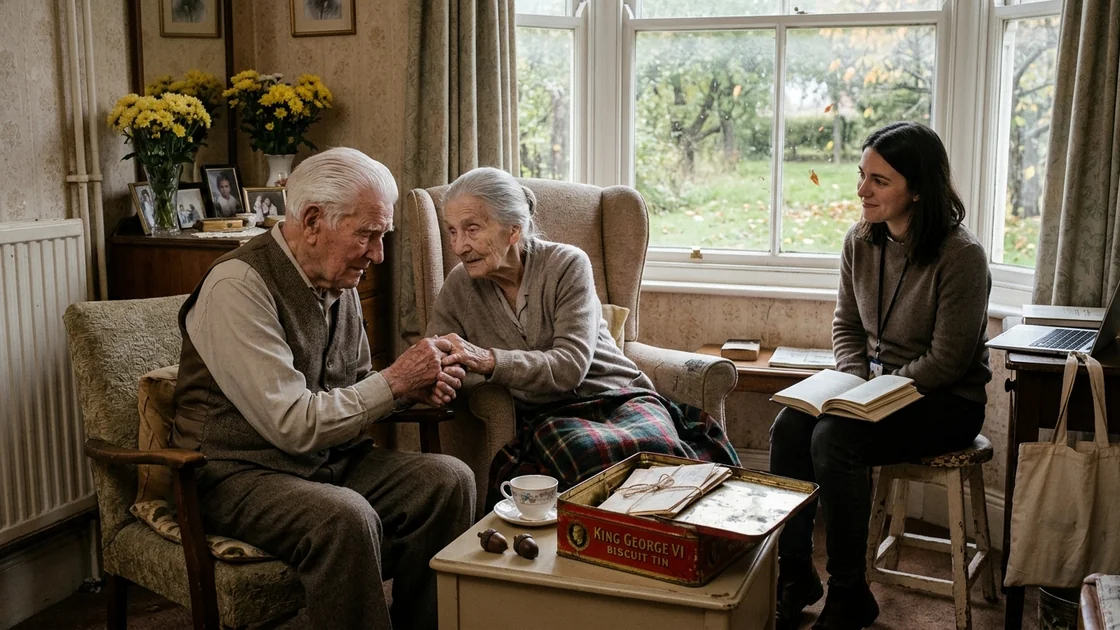
When thirty-two-year-old Clara Vance begins volunteering at the Whispering Elms retirement community to transcribe deteriorating wartime correspondence for visually impaired residents, she expects nothing more than quiet afternoons deciphering faded handwriting. Instead, while logging the fragile letters of a reclusive former infantry officer, she stumbles upon an eighty-year-old romance filled with missed connections and unhealed grief. As Clara pieces together the correspondence, she discovers that the woman mourned in the pages as dead is not only alive, but living down the hall in the memory care wing. Caught between the ethics of interference and the redemptive pull of the truth, Clara undertakes a gentle campaign to reunite two lovers before their fading senses steal their final chance to remember each other.
The transcription room at Whispering Elms smelled reliably of floor wax, chicory tea, and the sour green wool of damp cardigans. It was a tall, drafty salon on the ground floor of what had once been an Edwardian manor, converted forty years earlier into an assisted-living facility. Its bay windows overlooked an unpruned orchard where old apple trees dropped knotty, russet-skinned fruit into the clover.
Clara Vance came on Tuesdays and Thursdays at one o’clock, carrying a canvas tote bag containing a magnifying visor, a pair of cotton handling gloves, a legal pad, and her laptop. At thirty-two, she had found her world contracted to small, quiet tasks. Following her mother’s long illness and subsequent death six months prior, the silence of her own apartment felt too loose, like a coat that no longer fit. Transcribing for the blind was an enterprise that required precision, neutrality, and clean hands. The volunteer coordinator, a breathless woman named Mrs. Higgins who smelled of peppermint lozenges, had told her during orientation that the residents did not want pity; they wanted their correspondence saved before the ink gave up entirely.
"The paper rots from the inside out, you see," Mrs. Higgins had explained, gesturing vaguely at the metal filing cabinets lining the wall. "Acid in the pulp. The older generation kept everything in shoeboxes under radiators. Now the eyes are gone, and the paper is going too. You are the lens, Miss Vance. Just the lens."
For her first two weeks, Clara had been an obedient lens. She transcribed land deeds from the 1960s for an elderly surveyor whose cataracts made the world a greasy gray cloud. She read aloud dry, repetitive postcards sent from grandchildren touring Florence and Split, translating their cheerful shorthand into full, enunciated sentences for a retired schoolmistress who nodded asleep before the second paragraph.
Then, on a Tuesday in early October, Mrs. Higgins led Clara down the south corridor, past the sunroom where a muted television flickered with daytime gameshows, to Room 114.
"Mr. Arthur Finch," Mrs. Higgins whispered, tapping her clipboard. "Former captain, Royal Signals. Completely blind—late-onset glaucoma. Very private. He has four tins of airmail correspondence from the Second World War. Most are fragile onion-skin. He wants them digitized and read back to him so he can compile an audio memoir for his nephew in Bristol. Be gentle with him, Clara. He doesn't like fuss."
The door was unlocked. When Clara tapped lightly, a low, gravelled voice answered: "Enter."
Arthur Finch sat upright in a wingback chair upholstered in faded claret velvet. He wore a clean pressed collarless shirt under a tweed waistcoat, trousers with a sharp knife-crease, and polished brogues. His hair was thick, white as lime mortar, combed flat against a skull that seemed sculpted from flint. Across his lap lay a folded tartan blanket, and beside his hand, upon an oak lowboy, rested a battered biscuit tin bearing the dim, scratched likeness of King George VI.
His eyes were milk-filmed stones, unblinking, fixed somewhere three inches above Clara’s left shoulder.
"The volunteer?" he asked.
"Yes, Mr. Finch. Clara Vance. Good afternoon."
"Good afternoon, Miss Vance. You have young shoes. Rubber-soled. No clicking." He extended a dry, broad hand into the space between them. Clara took it; his grip was firm, his skin like old parchment that had weathered several seasons of frost. "Sit down, please. The rush-bottom chair near the desk is the most honest piece of furniture in here."
Clara took her seat at the narrow writing desk, unzipping her laptop bag. "Mrs. Higgins told me you have some letters you’d like transcribed and cataloged."
"Mrs. Higgins talks too much and listens with only half an ear," Arthur said, his voice level and without cruelty. "The letters are not merely to be transcribed. They must be cataloged by date, sender, and postmark where visible. Some have passed through field censors. Some are partially effaced. You will encounter tissue paper so thin you can see your own fingernails through it. Can you handle such things without tearing them?"
"I worked in the municipal archives during university," Clara said. "I have cotton gloves, and I can work as slowly as you need."
Arthur nodded once, a sharp tilt of his chin. "Very well. The tin on the table. Open it, please."
The lid of the biscuit tin resisted, sticking with eighty years of oxidization before giving way with a soft, hollow scrape. Inside lay neat bundles wrapped in narrow ribbons of faded blue grocer's twine. The smell that rose from the metal box was distinct: dry dust, lavender pomade, the paraffin tang of greaseproof paper, and the cold, metallic scent of damp basements.
"Start with the bundle tied with green thread," Arthur instructed, his knuckles resting against his knees. "That is 1943. North Africa, then Italy, then Sussex."
Clara lifted the top packet. The ribbon disintegrated under her touch, turning to pale fiber dust against the green baize of the blotter. She eased open the first folded sheet. It was written in blue ink—Parker Quink, probably—the strokes swift, masculine, and heavily sloped.
"Shall I read the header?" she asked.
"Read everything. Exactly as written. If there are crossed-out words, state that they are struck."
"August 14th, 1943," Clara began. "Field Post Office 214. Dearest Sparrow."
Arthur’s shoulders, which had been held with the brittle rigidity of a parade-ground soldier, dropped a fraction of an inch. His mouth softened, though his eyes remained fixed on the ceiling molding.
"Sparrow," he murmured. "Yes. Continue."
"The heat here turns the ink to paste in the nib," Clara read, her voice steadying as the rhythm of the prose took hold. "We are camped between two lemon groves that have been shelled until they look like broken umbrellas, yet the air still smells of crushed citrus whenever the transport lorries rumble past. The boys play cards with a deck so grease-stained you can only tell the Jack of Spades by the tear in his left shoulder. I think of the cool water in the river behind the mill at Rye. I think of the blue skirt you wore on the pier, the one that smelled of the wool mill and dry rain. If this reaches you before the post-corporal gets his ration of rum, know that I am keeping the compass safe in my tunic pocket, right next to the photograph of the gatehouse. Do not let your mother sell the cottage until we have seen the garden in spring. Yours in all seasons, A."
Clara paused. The room was dead quiet, save for the clicking of the radiator pipes and the muffled scrape of a gardener’s rake out in the orchard.
"Did she reply?" Clara asked quietly, stepping beyond the bounds of Mrs. Higgins's neutrality before she could stop herself.
Arthur did not answer immediately. He raised one hand, his fingers tracing the air as if searching for a thread hanging from an invisible loom. "She replied when she could. She was an auxiliary nurse at the military annex in Tunbridge Wells, later transferred to the civilian emergency ward near East Grinstead. She was busy with burns. Flying glass. Boys pulled from cockpits." He cleared his throat. "Her letters are in the lower half of the tin. Folded into squares. She had a small hand—very tight, very neat. Like bird tracks in snow."
"Sparrow," Clara said.
"Her name was Cecelia," Arthur said, his voice dropping into a register that felt almost private, an octave meant for an empty room. "Cecelia Laurent. Her father was French, a clockmaker from Rouen who settled in Kent. Her mother was English. She had her father’s hands—never dropped a bandage, never fumbled an ampoule. We were twenty-one. A very long time ago, Miss Vance. Two lifetimes, at least."
"Would you like me to find her letters first?"
"No," Arthur said firmly, reasserting the soldier. "Chronological order. We do not jump ahead to the artillery barrage before we have dug the trench. Read the next one. August 28th."
For three weeks, the work became Clara’s anchor. Her own apartment, with its unwashed coffee cups and half-unpacked boxes of her mother’s porcelain figurines, ceased to weigh on her as heavily. She spent her evenings researching the movements of the 5th Infantry Division and the field hospitals of Kent in the autumn of 1943, mapping Arthur’s letters against history.
The letters revealed a romance built in the margins of calamity. Arthur had met Cecelia on an August afternoon in 1942, on the shingle beach at Dungeness, while he was on forty-eight hours' leave before being posted to Scotland for commando training. She had been sitting on an upturned wooden dory, mending a fishing net for her uncle, her bare feet tucked into the pebbles. They had walked along the sea wall; he had bought her a lemonade with a cracked bottle-stopper; she had given him a small, carved wooden acorn she had found in a curiosity shop in Rye.
The letters that followed were marvels of restrained devotion. In 1943, Arthur wrote from Sicily, describing the dust that coated the soldiers' teeth and the astonishing white marble of a shattered temple against the blue sea. Cecelia wrote back from the hospital in East Grinstead, describing the spitfire pilots who had undergone reconstructive surgery under Archibald McIndoe—the 'Guinea Pig Club'—and how she taught them to hold cigarettes with reconstructed thumbs.
“They are so brave, Artie,” she wrote in September 1943, her handwriting indeed looking like tiny, deliberate bird tracks across gray utility paper. “They make jokes about their new faces, calling them 'Archie’s masterpieces.' But at night, when the ward goes quiet and the anti-aircraft guns are thumping away down near the coast, they ask for their mothers. I hold their hands until their fingers go slack. Sometimes I pretend my hand is your hand, and that I am holding you through the dark, keeping you down against the earth so the shrapnel passes over.”
Arthur sat motionless as Clara read these passages. Occasionally, his blind eyes would glisten, but no tears fell; age seemed to have dried the moisture from his grief, leaving only the hard, polished grain of memory.
"She had a laugh," Arthur said one Thursday, after Clara had finished reading a letter from November 1943 wherein Cecelia described dropping a tray of enamel bedpans down an iron staircase. "It wasn't a lady's laugh. It wasn't polite. It started in her ribs, like a dry cough, and then it became an engine. You could hear it across a crowded canteen. When she laughed, you couldn't believe anything would ever fall down again."
"Did you marry her?" Clara asked.
Arthur looked down at the tartan rug. His thumb rubbed the brass buckle of his wristwatch—an old military-issue Omega with a canvas strap.
"No," he said simply. "We never married."
He did not elaborate, and Clara, respecting the barrier, returned her fingers to the keyboard, the steady clacking of the plastic keys filling the silence between them like raindrops on slate.
Whispering Elms was divided into three wings: the Garden Wing for independent seniors who still kept their own kettles and potted geraniums; the Manor Wing for those needing moderate assistance with dressing and medication; and the Cedar Wing, a locked, single-story pavilion that circled a central interior courtyard. The Cedar Wing was where the residents with advanced memory impairment lived.
Clara rarely had business in the Cedar Wing, but on a Tuesday in mid-November, Mrs. Higgins caught her in the hallway by the laundry.
"Clara, dear, could you do a quick favor for the nursing team? We’ve an elderly lady in Cedar who had a small fall last week—nothing broken, thank heavens, but she’s terribly agitated. She used to have her daughter read to her every afternoon, but her daughter has come down with bronchitis. The lady refuses to go to the dining room. She sits by the window and pulls at her cardigan until the wool frays. Would you mind taking half an hour? Just read her something gentle. The local gazette, or a chapter of something bland. No thrillers."
"Of course," Clara said. "Who is she?"
"Evelyn," Mrs. Higgins said, checking her clipboard. "Evelyn Mercier. She’s ninety-nine. One of our oldest. Quite blind now, poor thing, and her memory drifts like smoke. Sometimes she thinks she’s in Sussex; sometimes she thinks she’s waiting for a train. Just speak clearly. She likes the sound of a voice."
The Cedar Wing had a different atmosphere from Arthur’s quiet, book-lined room. The air was warmer, smelling faintly of citrus cleanser and steamed carrots. Soft, repetitive music—big-band melodies from the 1940s—drifted from concealed ceiling speakers. In the corridor, an elderly man in striped pajamas was shuffling forward in slow, measured increments, accompanied by a care aide who was gently praising each step.
Room 204 was at the end of the corridor, where the wall curved around the courtyard glass.
The room was flooded with pale, pearlescent autumn light. Sitting in an armchair by the radiator was a woman whose frailty seemed almost architectural. Evelyn Mercier was small, her shoulders curved like the ribs of an upturned skiff. Her silver hair was brushed back into a neat chignon held by tortoiseshell combs. She had high, aristocratic cheekbones, skin as thin as wet rice paper, and blind, pale blue eyes that gazed placidly at the glass panes, where maple leaves were pasting themselves against the damp exterior.
On the table beside her sat an untouched cup of milky tea and a small, worn piece of wood, round and darkened by decades of oils from human skin.
"Mrs. Mercier?" Clara said softly, pausing at the threshold.
The old woman did not flinch, but her chin lifted slightly. "It isn't four o'clock yet," she said. Her voice was surprisingly clear, though it had a dry, whistling edge, like wind through river reeds. "The siren hasn't sounded."
"No, Mrs. Mercier. There are no sirens. My name is Clara. Mrs. Higgins asked if I might read to you for a little while. Your daughter Elizabeth asked me to check in on you while she’s unwell."
"Elizabeth has a cough," the old woman said, nodding once. "Too much damp in the cellar. I told her not to keep the potatoes down there. Come in, my dear. You have young shoes. No clicks."
Clara smiled, struck by the echo of Arthur’s words from weeks before. "Yes. Rubber soles."
She pulled a low wooden stool over to the armchair. "I have the parish newsletter, or I can read some poetry. Or the news."
"Not the news," Evelyn said, her fingers finding the small piece of wood on the table and turning it over. It was a carved acorn, polished until the grain was almost black, its cap cross-hatched with tiny, deliberate knife strokes. "The news is always about people quarreling over borders. Men are terrible about lines. They spend all their time drawing lines on dirt, and then they must bleed over them until the rain washes them out."
Clara glanced down at the wooden acorn. Her breath hitched. A prickle of cold awareness washed over the back of her neck.
A carved wooden acorn from a curiosity shop in Rye.
Clara stared at the woman’s hands. The knuckles were enlarged with arthritis, the veins swollen and purplish under the translucent skin, but the fingers were long, delicate, the nails neatly trimmed into clean ovals.
"Mrs. Mercier," Clara said, her voice dropping to a whisper. "May I ask where you were born?"
The old woman smiled, a faint, fleeting movement of her thin lips that brought a ghost of extraordinary beauty to her withered face. "Near the marsh. Rye. My father was a Frenchman. He came over with a bag of brass cogs and a lathe. He used to say that English clocks were always three minutes slow because the English were always trying to delay the evening."
Clara felt the floorboards beneath her sneakers seem to tilt. "Your maiden name. Was it Laurent?"
Evelyn turned her head toward Clara. The milky, useless eyes widened slightly. For a moment, the fog that hovered over the old mind seemed to part, blown aside by a sharp, sudden gale.
"Who told you that?" Evelyn asked, her voice dropping into an intense, fragile register. "Nobody here knows that name. I was Laurent before the fire. Before the station."
Clara leaned forward, her heart hammering against her ribs like a trapped bird. "Did you know an Arthur? Captain Arthur Finch?"
Evelyn went perfectly still. Her hand, which had been turning the wooden acorn, froze. The silence in Room 204 became absolute, swallowing the faint swing music from the corridor, swallowing the sound of the leaves against the glass.
"Artie," Evelyn whispered. The word was not a question; it was an artifact. "Artie was buried in France. In forty-four. The letter came from the War Office in August. On blue paper."
Clara sat in her parked car in the gravel lot of Whispering Elms for forty-five minutes after her shift ended, the heater blowing lukewarm air against her ankles while the windshield fogged with her breath.
Her mind was a spinning reel of dates, postmarks, and military designations.
Arthur Finch was in Room 114 of the Manor Wing. Evelyn Mercier was in Room 204 of the Cedar Wing. Between them lay ninety feet of carpeted hallway, two fire doors, and eighty years of absolute error.
How could two people who had loved each other in 1943, who had believed each other dead or lost, end up in the same three-acre retirement village on the outskirts of Winchester? It was monstrous; it was miraculous; it was a statistical impossibility that only the cruel, indifferent mathematics of old age could produce. Whispering Elms was the premier geriatric facility in the county; their respective families—Arthur’s nephew in Bristol, Evelyn’s daughter Elizabeth in town—had simply chosen the best-rated home with available nursing beds. Arthur had arrived three years ago after his vision failed completely; Evelyn had been moved to the Cedar Wing eighteen months later when her vascular dementia began to steal her names and her orientation.
They had been eating food prepared in the same kitchen, listening to the same sunday services broadcast in the common rooms, breathing the same air warmed by the same industrial boilers, separated only by their blindness and the locked fire doors of the memory unit.
Clara gripped the steering wheel until her knuckles turned white.
The lens, she thought. You are only the lens.
Mrs. Higgins's warning rang in her ears: Residents do not want fuss. You must not agitate them.
To walk into Room 114 and tell a ninety-nine-year-old man with a weak heart that the girl he had wept for through eighty years of solitary bachelorhood was sitting sixty yards away, muttering to herself about air raids and peeling cardigans, could be fatal. To walk into Room 204 and wrench Evelyn Mercier out of her gentle, protective dementia with the shock of a resurrected ghost could destroy whatever fragile peace the nurses had constructed for her.
And yet, how could she not?
Clara turned off the ignition. She took out her phone and searched the War Office casualty lists from the summer of 1944.
By Thursday morning, Clara had found the missing page of the story.
She had spent Wednesday evening at the county records office, digging through digitized copies of the Kentish Express and the service records of the 43rd (Wessex) Infantry Division.
In June 1944, during the bitter fighting around Hill 112 in Normandy, Arthur’s signals unit had been hit by an 88mm mortar barrage. His field radio had exploded; the sergeant beside him had been killed instantly, and Arthur had been thrown into a drainage ditch with severe head trauma, temporary blindness, and no dog tags. He had spent three months in an unlisted base hospital near Bayeux as an unidentified casualty—an "Unknown Officer"—before his identity was confirmed through his paybook, which had been recovered from his scorched kit bag days later.
In that three-month gap, the War Office had done what it routinely did during the chaos of the Normandy breakout: they had sent a standard telegram to his next of kin, and a notification to the emergency contact listed in his field diary—Miss Cecelia Laurent, Auxiliary Nurse, East Grinstead Emergency Hospital.
Missing, believed killed in action.
Two weeks later, the hospital in East Grinstead had been struck by a V-1 flying bomb.
The doodlebug had come down through the roof of the west ward at four in the morning. Twelve nurses and thirty-four patients had died. The hospital records were incinerated. Cecelia Laurent had survived because she had been down in the basement sluice room rinsing linen, but her name had been included on the initial provisional casualty list published in the local papers: Laurent, C., Nurse. Missing, presumed dead.
When Arthur had finally recovered his wits and his speech in late September 1944, he had sent three frantic cables to Sussex. All three had been returned with the purple postal stamp: Addressee Untraceable / Facility Destroyed.
He had returned to an England that had moved on. Cecelia’s French father had died of heart failure three months after the bomb; her mother had sold the cottage in Rye and moved to relatives in Canada. Cecelia, shattered by the news of Arthur’s death in France and the destruction of her hospital, had eventually taken a nursing post in a convalescent home in Yorkshire, changed her daily life entirely, and years later, in 1951, had married a quiet schoolteacher named Thomas Mercier, who had given her a daughter, a peaceful life, and forty years of gentle, unremarkable companionship before dying of a stroke in 1992.
Arthur had never married. He had worked as an electrical engineer for the General Post Office, lived in a small flat in Southsea with walls lined with historical biographies, and kept a biscuit tin under his bed.
They had each spent eighty years mourning a ghost.
When Clara entered Room 114 on Thursday afternoon, Arthur was waiting. The tin was open on the desk, the bundle for 1944 already laid out.
"You're four minutes late, Miss Vance," he said without turning his head.
"I apologize, Mr. Finch. The traffic near the ring road was slow."
"A modern plague," he said. "People going nowhere in a great hurry with engines far too large for their business. Sit down. We have reached June 1944. The landing has occurred. The letters are shorter now. I remember writing them on the tailgate of a Bedford truck with grease on my sleeves."
Clara did not sit. She stood beside the desk, her fingers resting lightly on the cold tin.
"Mr. Finch," she said, her voice shaking slightly despite her best efforts. "Before we read June, I want to ask you something about the Sparrow."
Arthur’s mouth tightened. "We do not need to invent biographical footnotes, Miss Vance. The letters speak for themselves."
"Did she ever give you something to keep?" Clara asked. "Something she made, or found?"
Arthur’s blind eyes moved toward her, his forehead furrowing into deep, weathered trenches. "Why do you ask that?"
"Please, Arthur." It was the first time she had used his Christian name. He caught the shift in tone, the sudden, urgent drop in formality.
He hesitated. Then, slowly, he reached inside his tweed waistcoat. From the small fob pocket where a pocket watch would normally reside, he drew out a small object suspended from a narrow loop of split leather.
He laid it on the palm of his hand.
It was a companion piece. A small, wooden acorn, carved from the same dark English oak, with the same cross-hatched cap, smoothed by eighty years of a lonely man's thumb.
"There were two," Arthur said, his voice dropping into a dry, dusty whisper. "She bought them from an old sailor in Rye who had carved them from a beam taken out of a wrecked galleon. She kept one. She gave me the other on the pier. She said an acorn was an oak tree that had the patience to wait for the storm to pass."
Clara let out a breath she hadn't realized she was holding. Her eyes burned with tears.
"Arthur," she said, pulling the chair closer and sitting down so her face was level with his. "I need you to listen to me very carefully. I am going to tell you something, and I need you to give me your word as an officer that you will not stand up or shout until I am finished."
Arthur’s posture did not slacken, but his jaw hardened. "Miss Vance, I am ninety-nine years old. I have had three shell fragments removed from my hip without anesthetic and I have lived through the rationing of tobacco. I am not in the habit of fainting."
"Cecelia Laurent did not die in the flying bomb attack on East Grinstead," Clara said, each word distinct, drop-forged, deliberate.
Arthur did not move. He did not blink. The skin around his mouth went the color of cold tallow.
"That is a cruel fiction," he said after a terrible, stretching pause. "The hospital was obliterated. I went there. In October of forty-four, when they finally let me out of the convalescent depot in Surrey, I took the train to East Grinstead. There was nothing there but a crater, some corrugated zinc sheeting, and lime spread over the rubble to keep the flies down. Her name was on the casualty list in the church hall."
"She was in the basement," Clara said, her voice rising with quiet authority. "She was in the linen room. She was pulled out alive with two broken ribs and smoke inhalation. Her father died. Her mother went to Canada. She was told you were killed at Hill 112 in June. She was given a War Office telegram with your name on it, Arthur."
Arthur’s chest rose and fell in a sudden, ragged heave. His hand, still resting on his knee, clenched into a fist so tight the old sinews stood out like ropes.
"How could you possibly know this?" he whispered, his voice cracking like dry timber. "Who gave you the right to dig up such bones?"
"She is here," Clara said.
The silence that followed was terrifying. A coal in the electric heater clicked as the element expanded. Out in the hallway, a food trolley rumbled past, its plastic trays rattling with afternoon cups of tea.
"Here?" Arthur whispered.
"In the Cedar Wing. Room 204. She has been here for eighteen months. Her married name is Evelyn Mercier. She is ninety-nine years old, Arthur. She is blind, like you. And on the table beside her bed, she keeps the other acorn."
Arthur Finch slowly raised his hands to his face. He did not sob; his body simply shook with a silent, tectonic shudder that seemed to shake the very foundations of his dignity. The white-haired soldier who had survived mortar fire, the destruction of his youth, and half a century of cold, orderly solitude bowed his head into his dry palms and remained there, trembling, while Clara sat beside him and placed her hand over his sleeve.
"Evelyn," he said, the name muffled by his fingers. "Her grandmother was Evelyn. She hated the name. She told me only the vicar called her Evelyn."
"She remembers the pier," Clara said softly. "She remembers the sirens. And she remembers Artie."
Arthur lowered his hands. His face was blotched with red, his milky eyes wide and staring into the infinite distance of Room 114.
"Take me to her," he said.
"Arthur, you have to understand. She has dementia. She doesn't always know what year it is. Sometimes she thinks the war is still going on. Sometimes she doesn't recognize her own daughter. If I take you in there and you expect the girl from the beach at Dungeness, your heart will break."
Arthur Finch straightened his spine. He reached for his walking stick—an old malacca cane with a brass ferrule—leaning on it as he rose from the claret armchair with an effort that cost him every ounce of his remaining strength.
"Miss Vance," he said, his voice regaining its steel, though it was now tempered with something wild and desperate. "My heart broke in August 1944. Everything since then has been salvage work. Take me to her."
The corridor between the Manor Wing and the Cedar Wing had never seemed so long.
Clara walked slowly, Arthur’s left hand resting upon her forearm. His grip was astonishingly strong, the fingers digging through her woolen cardigan into the muscle below. His cane tapped the floor with a rhythmic, military cadence: click-rest, click-rest, click-rest.
As they approached the double fire doors that separated the main house from the memory unit, Mrs. Higgins emerged from the staff room with a sheaf of menus in her hand.
"Oh! Mr. Finch," Mrs. Higgins said, her eyes widening in surprise. "Where are we off to? It’s almost time for the four o'clock medicine round, Clara, you know he shouldn't be wandering down toward Cedar—"
"I am not wandering, madam," Arthur barked, turning his sightless face directly toward the sound of her voice with such ferocious authority that Mrs. Higgins took an involuntary step backward. "I am paying a call on an old comrade. If you have an objection, you may enter it into your logbook and present it to the board of governors, but you will not stand in my way."
Mrs. Higgins looked at Clara, stunned. Clara simply shook her head slightly and said, "I'll take full responsibility, Gladys. Five minutes. Please."
Mrs. Higgins opened her mouth, closed it, and stepped aside, pressing the magnetic release button that clicked open the doors to the Cedar Wing.
The warm, citrus-scented air of the memory pavilion enveloped them. Arthur paused, his nostrils flaring as he sampled the environment like an old hound entering unfamiliar coverts.
"Gramophone," he muttered, hearing the distant, brassy strains of Glenn Miller drifting from the dayroom. "A dance band."
"Yes," Clara said. "They play music from the thirties and forties. It helps the residents stay calm."
"Bunkum," Arthur said, though his voice had lost its sharpness. His hand was trembling against Clara’s arm. "It’s the smell. Lavender and carbolic. Just like the annex at Tunbridge."
They stopped outside Room 204. The door was half-open.
Clara looked in. Evelyn Mercier was sitting in the same chair by the bay window. The afternoon light had shifted from pearlescent gray to a thin, lemon-colored winter gold. Her hands were folded over her lap, resting atop the tartan blanket that matched Arthur’s own with an irony so thick it made Clara’s throat tighten.
"Wait here for one second," Clara whispered to Arthur.
She stepped into the room. "Evelyn?"
The old woman did not turn her head, but her chin tilted. "Is that you, girl? Elizabeth hasn't come. I told them she wouldn't. The trains are stopped because of the raid down at the junction."
"Elizabeth isn't here, Evelyn," Clara said gently, crouching by her side. "But I’ve brought someone else to see you. An old friend from Kent."
Evelyn’s brow furrowed. "From Kent? The orchard is gone, you know. They cut down the trees to build the searchlight battery. Father was very cross about the plums."
Clara stood up and motioned toward the doorway.
Arthur stepped across the threshold. His cane made a sharp, distinct tack against the linoleum before finding the edge of the woven bedside rug.
He stopped three paces from her chair. He stood at attention, his white head held high, his shoulders pinned back, his malacca cane held strictly against his right seam.
The room was completely still, save for the hum of the radiator and the ticking of a small battery-operated clock on the wall.
Arthur did not speak Cecelia's name. He did not say it's me.
Instead, he cleared his throat—a dry, raspy sound—and recited, in a low, gravelled baritone that had once carried across artillery parks and sodden assembly trenches:
"If I should come upon you in the dark,
Without a lantern, without star or spark,
I’d know your breathing from a thousand men,
And turn my footsteps to the sea again."
Evelyn Mercier went rigid.
The milky eyes, which had been fixed on the cold glass of the window, drifted slowly, agonizingly, toward the sound of the voice. Her fingers, which had been resting motionless upon the blanket, began to flutter against the wool like the wings of a moth caught under a jar.
"That isn't on the wireless," she whispered. Her voice was no longer that of a ninety-nine-year-old woman in a nursing home; it was thin, sharp, and terrified with a joy that had no frame of reference. "Nobody knows that. He wrote that on the back of an envelope from Cairo."
Arthur dropped his malacca cane. It clattered against the floorboards, rolling against the skirt of the armchair.
He took two clumsy, unguided steps forward, his boots catching on the edge of the rug, until his knees struck the side of her chair. He sank down—not with the tidy dignity of a retired officer, but with the heavy, uncoordinated collapse of an old man whose legs could no longer bear the weight of his history.
His hands, broad and spotted with the liver marks of age, reached out into the empty air, searching, trembling, until they encountered the rough wool of her sleeve.
"Sparrow," he breathed.
Evelyn’s hands rose from her lap. They were tiny beside his, their skin paper-thin, blue-veined, twisted by a century of life, but they moved with an eerie, practiced precision. Her fingertips found his cuffs, slid up his wrists, touched the rough tweed of his waistcoat, and then rose to his face.
She touched his jawline—the square, stubborn bone that time had whittled but had not broken. She touched his lips, which were shaking uncontrollably. She touched the deep scars near his left temple where the German mortar casing had torn through his flesh eighty years before.
"You're late, Artie," she said.
A single tear spilled from Arthur’s blind left eye, tracing a slow, silver line down the deep trench of his cheek before dropping onto her woolen sleeve.
"The transport was delayed," he choked out, his voice breaking completely. "The roads were bad, Sparrow. The roads were very bad."
"I waited at the gate," she said, her fingers moving into his thick white hair, curling around the strands with the ancient, unforgotten authority of a girl who had once sat on an overturned dory in Rye. "I waited until the siren stopped. But then the fire came, Artie. The fire came and took the clocks."
"I know," he whispered, leaning his forehead against her knee, his broad shoulders shaking. "I know, my darling. But the storm has passed. The storm has finally passed."
Clara stood in the doorway, her knuckles pressed against her mouth to stifle her own weeping.
She saw Evelyn’s left hand reach across to the low table. Without looking, the old woman’s fingers found the carved wooden acorn that had sat there through all the years of her forgetting. She picked it up and pressed it into Arthur’s palm.
Arthur reached into his waistcoat fob, drew out his own acorn, and closed his large, scarred hand around them both. The two pieces of dark oak, carved by an unknown sailor before the Victorian age and separated by the greatest war in human history, clinked together with a dry, hollow tap that sounded like the ticking of an indestructible clock.
From down the corridor, the music shifted. The swing band gave way to a slower tune—an old recording of Vera Lynn, her voice scratchy and thin through the cheap ceiling speakers, singing about meeting again on some sunny day.
Clara did not stay to watch them speak of the decades they had lost. She knew that some rooms were too small for three people, especially when two of them were eighty years late for their tea.
She backed out into the corridor, quietly pulling the door shut until it was open only a hand’s breadth.
Mrs. Higgins was standing twenty feet away, her arms folded across her clipboard, her mouth slightly open. Her eyes were shiny with an emotion that she was clearly struggling to file away into an administrative category.
"Clara," Mrs. Higgins whispered as the younger woman approached. "Is that... was that really...?"
"His name is Captain Arthur Finch," Clara said, wiping her face with the sleeve of her coat. "And her name is Cecelia. If anyone tries to move him out of that room before seven o'clock, Mrs. Higgins, I will personally resign and write a letter to every newspaper from here to London."
Mrs. Higgins looked at the door of Room 204. She sniffed loudly, adjusted her spectacles, and tapped her clipboard twice.
"The four o'clock medicine round can be administered in Cedar," Mrs. Higgins said, her voice unusually thick. "I shall tell the nurses that Mr. Finch is assisting with Mrs. Mercier’s orientation therapy. It is... clinically beneficial for memory residents to have familiar voices from their youth."
"Thank you, Gladys," Clara said.
Arthur Finch did not return to Room 114 that evening, nor the next.
With the frantic, bewildered consent of Arthur’s nephew in Bristol and Evelyn’s daughter Elizabeth—who had arrived at Whispering Elms on Friday morning pale, wide-eyed, and clutching a box of old photographs her mother had never been able to explain—the administration had executed an unprecedented bureaucratic maneuver. A spare bed was moved into Room 204.
When Clara came in on the following Tuesday, the tin of letters was sitting on the dresser between two vases of fresh yellow chrysanthemums.
Arthur was sitting in the claret armchair, which had been hauled down the corridor by two grumbling but secretly sentimental groundskeepers. Evelyn was in her low wicker chair beside him. Their hands were joined across the space between the armrests, their fingers interlaced so tightly that their skin seemed to share a single pulse.
"Miss Vance," Arthur said as Clara’s rubber soles crossed the threshold.
"Good afternoon, Captain. Good afternoon, Evelyn."
Evelyn smiled. The fog was there, thick and rolling as the Romney Marsh in November, but she looked rested. The sharp, anxious tension in her shoulders had vanished; she sat back against the linen pillows like someone who had finally come home after an impossible journey through the rain.
"Clara," Evelyn said, her voice clear. "Artie was just telling me about the lemons. In Sicily. He says they were as big as tea kettles."
"They were," Arthur said with absolute gravity. "Miss Vance was there when I read the dispatch. She knows the truth of it."
Clara took her seat on the rush-bottom stool. She opened her laptop and lifted the bundle of letters for July 1944.
"Shall we continue the transcriptions, Mr. Finch?" she asked gently. "We have the Normandy dispatches to enter."
Arthur sat in silence for a long moment. He listened to the sound of Evelyn’s breathing—slow, steady, rhythmic—beside him. He felt the weight of the two acorns resting in the pocket of his waistcoat, nestled against his ribs.
Then, slowly, he shook his white head.
"No, Miss Vance," he said, his face softening into an expression that Clara had never seen on him before—a look of profound, unburdened peace. "The dispatches are complete. You may pack the tin."
"Are you sure?" Clara asked. "We haven't recorded the post-war years. Your engineering work. The letters from your brother."
Arthur turned his blind face toward Evelyn. He raised her hand to his lips, kissing the swollen, arthritic knuckles with the fierce, exquisite reverence of a twenty-one-year-old boy on a shingle beach.
"History has enough paper, Miss Vance," Arthur said quietly. "We have the afternoon. Read us something with a garden in it. Something where nothing explodes."
Clara smiled, closed the lid of the King George VI biscuit tin with a soft, final click, and opened an anthology of Keats. Outside, the cold November rain washed the last yellow leaves from the orchard boughs, but inside Room 204, the room was warm, the light was gold, and the clock was finally keeping the right time.