Keys to the Holy City
When Clara Finch inherited an iron box filled with seven unmarked antique keys from her late grandmother Helen, she left her quiet life in Boston to spend three sweltering months unraveling their origins along the cobblestone corridors of Charleston, South Carolina. Through hidden garden gates on Church Street, forgotten drawers in the Charleston Library Society, locked trunks in peeling French Quarter attics, and sunken lockboxes beneath marsh tides, Clara discovers that her grandmother did not just leave behind sentimental keepsakes, but a carefully woven map of atonement, secret alliances, and long-lost romances spanning half a century of the Holy City's quiet history.
Chapter I: The Iron Box on Tradd Street
The train south had smelled of diesel, stale chicory, and the damp green breath of Virginia pines, but Charleston greeted Clara with an entirely different perfume: pluff mud, sweet olive, sun-baked brick, and the faint, briny menace of incoming thunder.
It was mid-June when she arrived at the narrow, three-story single house on Tradd Street. The house had belonged to Helen Vance Finch for sixty-four years. To the preservation society, it was a pristine specimen of late-eighteenth-century Georgian vernacular, complete with a double-tiered piazza turned south toward the prevailing harbor breeze. To Clara, it had always been a fortress of decorum—a place where the floorboards groaned under heavy carpets, where tea was served with coin-silver spoons so worn their bowls were as thin as host wafers, and where her grandmother had ruled with an elegance so rigid it seemed forged in a foundry.
Helen had passed away in April, sitting upright in her wingback chair with a glass of dry sherry untouched on the side table. She left no debt, no sprawling family disputes, and remarkably few personal instructions. The will was brisk and clinical, drafted by an ancient firm on Broad Street whose offices still smelled of vellum and cigar smoke. The house was left in trust for Clara to sell or inhabit as she saw fit, along with the contents therein. But there had been one specific bequest, noted in an addendum typed on onion-skin paper:
To my granddaughter, Clara Elizabeth Finch, I leave the iron box kept beneath the floorboard of the linen press, together with the responsibility of returning what does not belong to me.
The box was waiting for her where Helen said it would be, wrapped in an oiled flannel cloth that smelled of wintergreen and kerosene. It was not ornamental. Forged from rough pig iron, heavy as a cannonball, it was secured by a simple brass toggle rather than a lock. When Clara set it on the mahogany dining table and peeled back the lid, she found no jewels, no deeds, and no currency.
Inside, resting on a bed of faded indigo velvet, lay seven antique keys.
They were entirely unalike. One was a massive wrought-iron skeleton key, its bow twisted into the likeness of intertwined oak branches bearing miniature acorns. Another was a slender sliver of silver, so delicate it might have operated a music box, its finial set with a chip of porcelain painted with a tiny blue heron. There was a salt-pitted bronze key that looked as though it had spent decades beneath seawater; a heavy, double-bitted ward key of blackened steel; a brass key whose bit was notched into distinct, rhythmic steps like musical notes; a long, hollow-barreled copper church key; and, finally, a strange, blank-faced key made of pale pewter, completely devoid of cuts or teeth, bearing only a single engraved word across its shank: Vigila.
Beside the keys lay a folded slip of parchment. On it, in Helen’s sharp, spidery hand, was written a single sentence: A city is only as true as the secrets it keeps from the sea; go find where I have hidden my debts.
Clara picked up the first key—the heavy iron one with the acorn bow. It was cool against her palm, carrying the weight of something designed to hold back a great deal of force. She looked around the cavernous dining room. Through the tall twelve-over-twelve windows, the late afternoon light cut through the live oaks in the garden, throwing long, barbed shadows across the heart-pine floor. Clara had taken a leave of absence from her work as an architectural draughtswoman in Boston, intending only to clear the house for probate. But looking at the brass, iron, and silver laid before her, she realized Helen had not offered an inheritance so much as issued a challenge.
Chapter II: The Gate of Wrought Acorns
The humidity of a Charleston morning was not an atmosphere; it was a physical presence that wrapped around Clara’s neck like a warm, wet towel. By eight o'clock, the cicadas in the crepe myrtles along Church Street were already screaming, an electric rattle that seemed to vibrate the wrought-iron balconies overhead.
Clara carried the acorn-topped key in her canvas tote bag, wrapped in a linen handkerchief to stop it from clinking against her sketchbook. For two days she had walked the South of Broad neighborhood, her draughtswoman’s eye scrutinizing every iron gate, garden grill, and alley transom between the Battery and Queen Street.
Charleston was an encyclopedia of iron. There was cast iron from the northern foundries that had arrived by schooner in the 1840s, brittle and ornate with palmettos and scrolls; and there was wrought iron, hammered out by enslaved craftsmen and later freedmen whose hammer-marks remained immortalized in every rivet and scroll. Clara knew the work of Christopher Werner and Philip Simmons by sight, having studied their iron lacework in university. But the key in her bag was older, rougher, and distinctly idiosyncratic.
"You’re staring at that gate like it owes you money, miss."
Clara blinked, stepping back from the brick garden wall of a private residence near the corner of Church and Stus Alley. An elderly man in a faded chambray shirt and a straw hat was trimming a confederate jasmine vine with a pair of shears that clicked like castanets.
"I’m looking for an acorn motif," Clara admitted, feeling slightly foolish. "Not cast iron. Hand-forged. Oak leaves, two acorns, slightly asymmetrical."
The man lowered his shears and looked at her beneath the brim of his hat. His skin was the color of roasted pecans, etched with deep lines around eyes that held an amused, penetrating intelligence. "Acorns and oak leaves? That would be old master work. Most folks here do the palmetto, or the lyre, or the pineapple for hospitality. Acorns are old English—or lowcountry plantation iron from before the fire of thirty-eight."
"My grandmother had a key," Clara said. She hesitated, then drew the iron piece from her bag and held it out.
The man wiped his palms on his trousers and took the key with two fingers, balancing its weight. He turned it over, bringing it close to his eyes to inspect the hand-hammered bit.
"Look at that warding," he murmured. "Two stepped cuts and a center clover. That wasn't made for a house. That was made for a heavy gate or a root cellar." He handed it back, tapping his chin. "You won't find it on Church Street. Try the cemetery behind the Huguenot Church, or go deeper into the alleyways off Chalmers. But if you ask me... that looks like the ironwork on the old Vanderhorst carriage gate back on St. Michael’s Alley. The one that was walled off after the earthquake."
"The earthquake of 1886?"
"The very one. The family sealed the carriageway with brick, but they left the pedestrian postern intact inside the garden. You can’t see it from the street. It opens off the rear of the carriage house."
Following his directions, Clara navigated the narrow labyrinth of St. Michael's Alley. The alley smelled of damp brick, moss, and sweet olive. High brick walls rose on either side, topped with broken bottle glass cemented into the crests—an archaic lowcountry defense against long-dead intruders.
She found the carriage house, now converted into a quiet law office whose brass plaque was polished to a buttery sheen. Clara walked through the open arched entrance into the courtyard. The lawyer was nowhere in sight; an old tabby fountain dribbled water into a shallow stone basin where two blackbirds bathed.
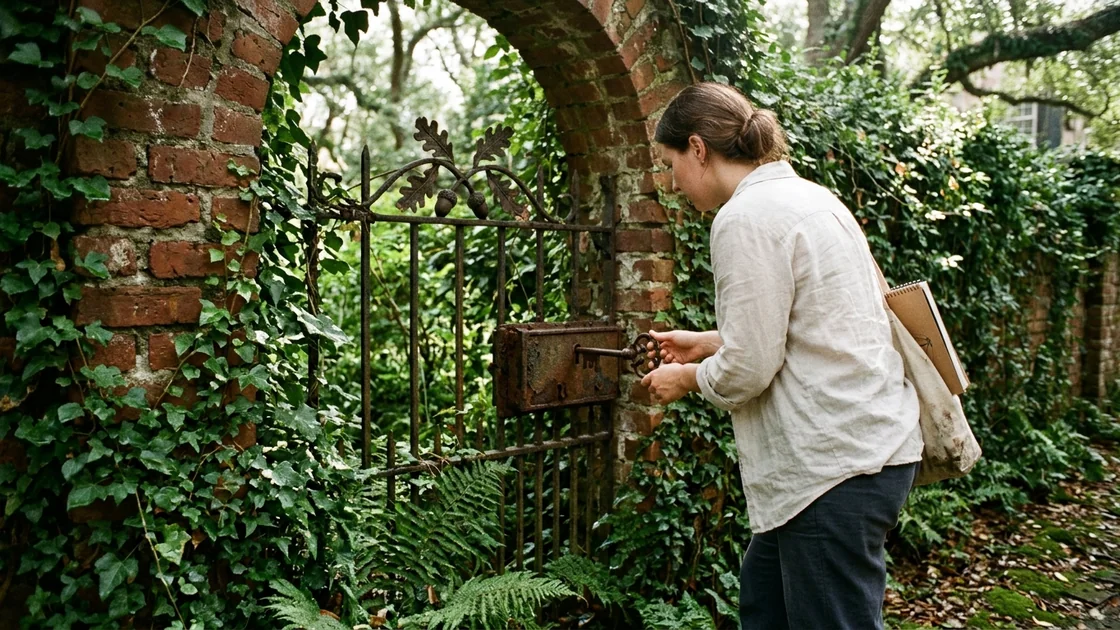
At the very back of the courtyard, almost swallowed by English ivy and climbing fig, stood a low iron gate set directly into a damp brick archway. Clara pushed the vines aside. The top rail was crested with wrought iron: two broad oak leaves flanking a pair of hammer-shaped acorns.
Her heart skipped. She pulled the key from her pocket. The lock was an enormous rim-box mounted directly to the iron frame, covered in decades of black scale and rust. She doubted the mechanism would turn, even if the key fit.
She took a small can of penetrating oil from her bag, sprayed the keyhole liberally, and waited three minutes while the oil fizzled against the old iron. Then she slid the key into the ward.
It entered smoothly, seating itself with a dull, heavy click.
Clara gripped the bow with both hands, took a breath, and turned. The metal resisted, groaned, and then, with a sharp crack like a small pistol shot, the heavy internal bolt slid back.
The gate creaked open an inch, tearing through years of clinging ivy tendrils.
Behind the gate lay not a manicured courtyard, but a forgotten, narrow sliver of earth trapped between two high brick party walls—a lightwell no more than four feet wide, choked with ferns and damp black soil. At the end of this brick corridor, half-buried under leaf litter, sat a small stone bench, and beside it, resting on a pedestal of weathered marble, was a lead-lined tin box, roughly the size of a cigar humidor.
Clara stepped through the gate, her shoes sinking into the spongy, decayed leaves. The air in the lightwell was cool and still, trapped between the ancient brick walls like water in a well. She knelt before the marble pedestal. The lead box had no lock; its heavy lid had merely been pushed shut and sealed with tallow wax, long since cracked and dried.
With shaking fingers, Clara lifted the lid.
Inside lay a bundle of letters tied with a black silk ribbon, and a small, leather-bound ledger. On the top envelope, written in a bold, masculine hand that was not her grandfather’s, was an address: Miss Helen Vance, Tradd Street.
Beneath the letters lay an object: a heavy silver medal from the 1925 Charleston Yacht Club Regatta, engraved with the name Arthur Rutledge Prioleau.
Clara untied the ribbon and opened the first letter. The paper was dry, brittle at the edges, but the ink was as black as the day it was pressed to the page:
Helen, If you are reading this, it means the storm has passed, and our silence has become permanent. You were right to keep the gate locked. Had your father discovered the correspondence, he would have ruined Arthur before the season ended. I leave this ledger here with the receipts of the trust. If the bank fails, as we all fear it must, the money we hid for the Jenkins Orphanage is secure beneath the floor of the stable loft. You hold the key to the gate; keep it until someone comes who understands that love is not a civic contract.
Clara sat back on her heels against the damp brick wall. Her grandfather’s name had not been Arthur Prioleau; it had been Thomas Finch, a stern, wealthy cotton broker whom Helen had married in the spring of 1928. Family lore had always painted Helen and Thomas as the ideal Charleston union—two old names, two vast plots of land, an uninterrupted lineage of high-society quietude.
Yet here was Arthur Prioleau. Clara flipped through the leather ledger. It was a private bookkeeping record: thousands of dollars, secretly funneled during the onset of the Great Depression into black churches, orphanages, and destitute waterfront families, all signed by Helen Vance and Arthur Prioleau under the pseudonym The Acorn Trust.
Helen had not just been an aloof grand dame pouring tea in a drawing room. She had been an outlaw philanthropist in a city that despised non-conformity.
Clara replaced the letters and the medal into her bag, relocked the iron gate with the acorn key, and pulled the ivy back over the lockbox. The key was warm in her hand now, no longer a mysterious oddity, but a piece of an armor her grandmother had worn for nearly a century.
Chapter III: The Music of the Library
The second key was the slender brass one whose wards were filed into stepped, melodic increments. It bore no maker's mark, but running her thumbnail along its length, Clara felt tiny, almost imperceptible notches along the brass spine—three, then two, then four.
She spent her second week at the Charleston Library Society on Meeting Street. Founded in 1748, it was one of the oldest cultural institutions in the South, an oasis of towering wooden bookcases, brass lamps with green glass shades, and the intoxicating, dry perfume of disintegrating leather bindings and rag paper.
Clara set up her workspace at one of the long oak tables on the second floor. Her draughtswoman's training made her methodical; she drew detailed diagrams of each remaining key in her sketchbook, noting the metallurgy, the beveling of the bits, and the estimated age of the blanks.
"That's a Bramah-style lock key, or at least an American interpretation of one," a voice whispered over her shoulder.
Clara turned to find a young woman with unruly auburn curls pinned haphazardly to the top of her head, peering through thick tortoiseshell spectacles. She carried an armful of archival folio folders and wore a canvas apron smeared with bookbinder’s paste.
"I’m sorry?" Clara said, keeping her voice low.
"The sketch you're making," the woman said, pointing a finger with ink-stained nails at the drawing of the brass key. "Those stepped cuts along the bit. That isn't for an ordinary tumbler. It’s for a slider lock, like the ones John Bramah patented in London, though by the late nineteenth century they were being adapted here for security drawers—particularly in bank cabinets, specialized secretary desks, and private library presses."
Clara introduced herself. The archivist’s eyes widened behind her spectacles. "Clara Finch? As in Helen Finch?"
"You knew my grandmother?"
"Everyone in the historic trust knew Miss Helen," the archivist smiled, extending a hand. "I’m Maeve Calhoun. Helen was on our acquisitions board for forty years. She used to come in every Tuesday at ten, sit in that exact chair you’re sitting in, and read the regional probate rolls. She was terrifyingly polite. If an intern misfiled an 1820 land plat, she wouldn't scold them; she'd just set the folder on their desk and look at them until they apologized to the paper."
Clara laughed, a genuine, startled sound that earned her a mild glare from a researcher three tables away. "That sounds like her. Maeve... did she have a desk here? A private space?"
Maeve set her folios down on the table and tilted her head, considering. "Board members don't have private desks. But Helen didn't do her research in the open reading room until about ten years ago. Before that, she practically lived in the Special Collections vault in the basement. She was cataloging the Izard family papers and the records of the St. Cecilia Society."
"Could we look down there?"
Maeve hesitated, glancing toward the librarian’s desk at the front of the hall. "The basement is technically restricted due to the humidity control retrofit. But... Miss Helen left an endowment that covers my salary. Come on. Bring your sketchbook."
They descended a spiral iron staircase that corkscrewed into the cool, silent bowels of the building. The air here was dehumidified, smelling faintly of ozone and archival cardboard. Long rows of steel shelving held thousands of gray boxes, interspersed with pieces of retired library furniture: broken globe stands, ladder-backed chairs, and ornate Victorian cabinetry pushed against the whitewashed brick foundation.
"Back here," Maeve murmured, leading Clara through a narrow aisle to a dark corner where a massive cylinder-top secretary desk of bird's-eye maple sat wrapped in protective plastic sheeting. "This belonged to the library's fifth head librarian. It was retired in 1974 because the roll-top track jammed, but Miss Helen insisted we keep it. She refused to let the trustees auction it."
Clara approached the desk. She peeled back the plastic. The maple was radiant beneath the dust, patterned with hundreds of swirling knots that looked like tiny eyes. The cylinder top was down, held in place by an oval brass escutcheon set below the writing lip.
Clara reached into her pocket and drew out the notched brass key.
"Is that it?" Maeve asked, her breath catching.
Clara aligned the key with the oval escutcheon. It was an exact match. The stepped bit slid into the brass channel without an inch of resistance. She pressed inward; the key sank an extra quarter of an inch, engaging a set of spring-loaded sliders.
One. Two. Three.
A rhythmic sequence of tiny mechanical clicks sounded from inside the wood. Clara turned the key ninety degrees to the right. A hollow thunk echoed through the bird's-eye maple frame.
"Good lord," Maeve breathed. "It wasn't jammed at all. It was locked with a custom cylinder bolt."
Clara lifted the tambour roll-top. It slid back smoothly on hidden canvas runners, disappearing into the belly of the desk to reveal an intricate nest of pigeonholes, ivory-handled miniature drawers, and central pilasters carved with acanthus leaves.
Every pigeonhole was empty, swept clean of dust. But Clara’s eye went immediately to the central compartment—the "tabernacle"—flanked by the two carved pilasters.
"Look at the proportions," Clara said, leaning in. "A desk of this period should have an interior depth of twelve inches. The pigeonholes are only eight inches deep."
She reached inside, placing her fingers against the back wall of the central compartment. It was solid maple, but when she applied pressure to the base, she felt the faint give of a concealed spring. Remembering the notches on the spine of the key—three, two, four—she looked closely at the carved pilasters.
On the left pilaster, she counted down three acanthus leaves and pressed. On the right, she pressed the second leaf. Then, returning to the left, she pressed the fourth.
With a soft mechanical sigh, the entire back panel of the desk sprang forward two inches.
Maeve clutched Clara’s arm. "You're like a cat burglar. An archival cat burglar."
Clara pulled the panel away. Behind it was a shallow cavity lined with faded green baize. Inside lay an old leather folio tied with marbled ribbon, and a small, velvet-lined jeweler’s box.
Clara opened the jeweler's box first. Inside lay a pair of gold cuff links, enameled with the crest of a palmetto tree entwined with a serpent, and an inscription inside the band: To A.P. from H.V. – 1927.
"Arthur Prioleau again," Clara whispered.
"Prioleau?" Maeve adjusted her spectacles. "Wait. Arthur Prioleau didn't stay in Charleston. He was an architect. He designed several of the municipal restorations after the 1930s, but he disappeared from the city registers around the start of the Second World War. People said he went to Europe and never came back."
Clara opened the leather folio. It contained architectural blue-line prints, drawn on linen-backed drafting paper. They were elevations of public buildings across Charleston—the City Market, the old Marine Hospital, the Custom House—but they were annotated in two different hands. One was an architect’s precise, technical block lettering; the other was Helen’s unmistakable, spidery script.
The notes were not about restoration. They were about voids.
Market Shed No. 3: Drainage conduit enlarged during WPA repairs; access through floor hatch beneath stall 14. Old Citadel Guard House: South wall cavity sealed with dry brick, 1939. Accessible via stable run. Custom House cellar: High-tide overflow tunnel connects to East Bay storm vault.
At the bottom of the folio lay a personal letter, dated October 14, 1941:
My dearest Helen, The Navy has accepted my commission. I ship out for the Atlantic fleet in three days. Everything we mapped is preserved here in the Society’s care, where nobody thinks to look for current truths among dead centuries. If I do not return, you will know where to find the three marine lockboxes. The sea is coming for this city, Helen, as it always does, but our work will remain dry until you choose to bring it to light. Always yours, Arthur.
Clara traced Arthur’s signature with the tip of her finger. Her grandmother had been married to Thomas Finch for thirteen years when this letter was written. She had lived in the fine house on Tradd Street, borne two children, attended St. Michael’s every Sunday morning, and poured tea from silver pots. And all the while, she was maintaining a hidden geography of the city with a man who was sailing off to war.
"Maeve," Clara asked quietly, "did Arthur Prioleau die in the war?"
Maeve took out her phone, her fingers flying across the screen as she accessed the South Carolina Historical Society archives. She scrolled for a long moment, the blue screen light washing over her face in the dim basement.
"USS Jacob Jones," Maeve said softly. "Torpedoed by a German U-boat off the coast of New Jersey, February 1942. No survivors recovered."
The basement fell completely silent, save for the hum of the dehumidifier. Clara looked at the two gold cuff links resting on their velvet bed. Helen had kept them here, locked behind three acanthus leaves and a melody of brass notches, for eighty-two years.
Chapter IV: The Salt-Pitted Key of Sullivan’s Island
The third key in the collection was made of heavy naval bronze, pitted and crusted with green verdigris that smelt unmistakably of salt and damp copper. Unlike the delicate library key, this one was utilitarian, blunt-nosed, and stamped with a three-digit number: 412.
Taking Maeve’s advice, Clara left the peninsula on a blindingly bright Saturday morning, driving across the Arthur Ravenel Jr. Bridge toward Mount Pleasant and out across the causeway to Sullivan’s Island.
Sullivan’s was a place where Charleston’s history met the raw, indifferent Atlantic. Here, the palmetto-log fort of William Moultrie had repelled the British fleet in 1776, and Edgar Allan Poe had served his military enlistment among the maritime myrtles and shifting sands, dreaming up "The Gold-Bug." The island was lined with classic beach cottages perched on wooden pilings, their screened porches wrapped around three sides to catch the southwest breeze.
Clara stopped at the public library, which was housed within the thick, bombproof brick casemates of Battery Gadsden.
"The number 412," an attendant at the Fort Moultrie visitors center told her after she showed him a photograph of the key. "That isn't a military stencil. That’s a maritime locker tag. Back before the modern marinas, the old Sullivan’s Island Yacht Club and the civilian skiff basin down at the cove used numbered bronze padlocks for their tackle lockers. The basin was torn down after Hurricane Hugo in eighty-nine, but the concrete piers and the old equipment sheds behind Station 12 are still standing—or what’s left of them."
Station 12 was a quiet sand lane shaded by wind-bent live oaks and red cedars. Clara parked her car under the trees and walked toward the intercoastal marsh along the back side of the island. The midday heat was fierce, shimmering off the white shell paths. Pluff mud exposed by the low tide gave off its sulfurous, vegetative perfume—the primordial scent of the lowcountry that locals called "the smell of home" and outsiders found nearly unbearable.
At the edge of the marsh, where the spartina grass swayed in the brackish water, sat an old cinder-block shed, its corrugated tin roof rusted to a deep, velvety mahogany. The wooden dock leading out to the creek had collapsed years ago, leaving only a row of green, barnacle-encrusted pilings marching into the tide like severed teeth.
The shed’s wooden door had long since rotted off its hinges, but inside, sheltered from the salt rain, stood a row of built-in lockers constructed from heavy yellow heart-pine, their iron hasps weeping rust down the wood.
Clara stepped into the dim, sweltering interior of the shed. Fiddler crabs scuttled across the concrete floor, clicking into the shadows. She walked along the row of lockers, wiping dust and spiderwebs from the painted numbers on the doors.
408... 409... 410... 411...
Locker 412 was closed. An enormous bronze padlock hung from its iron hasp, green-crusted and salt-fused, bearing the matching stamped number: 412.
Clara took the salt-pitted bronze key from her bag. It looked as though it belonged to the padlock—brothers forged from the same foundry pour. She slid the key into the cylinder. The bronze was stubborn, locked in a chemical embrace with sixty years of sea salt. Clara took out her penetrating oil, saturated the shackle, and waited.
She thought of Helen sitting on the Tradd Street piazza, embroidering linen napkins with small white monograms. Did she ever drive out here alone after 1942? Did she cross the old swing bridge in a summer dress, smell the marsh mud, and walk into this rotting shed to visit what was left of her life?
Clara gripped the key with a pair of pliers she had brought from the house’s tool shed and turned slowly, evenly, respecting the fatigue of the bronze.
The tumbler gave way with a sharp clack. The shackle popped open half an inch.
Clara unhooked the padlock and pulled open the heavy pine door. The hinges screeched.
Inside the locker sat a zinc-lined sailor’s ditty box and a pair of brass marine binoculars, green with age but intact in their cracked leather case. Beside them lay a nautical chart of Charleston Harbor and its approaches, published by the U.S. Coast and Geodetic Survey in 1938.
Clara pulled the chart down and unrolled it on the cleaner surface of an upturned wooden crate.
Red ink crisscrossed the waterways. Lines radiated from Fort Sumter, from the Sullivan’s Island light, and from the offshore shoals where the sand shifted with every hurricane. But the densest cluster of annotations was centered on a tiny spot in the marsh between James Island and Morris Island—an area marked Lighthouse Creek.
Written in the margin of the chart, in Helen’s hand, was a set of compass bearings and a date: August 17, 1945.
Below the date, three words: The war ends.
Clara opened the zinc ditty box. Inside lay an officer’s wristwatch with a canvas strap, its crystal cracked, its hands permanently stopped at 2:14. Beneath the watch was a stack of unopened V-mail envelopes addressed to Helen Vance, Charleston, from Lt. Arthur Prioleau, at sea.
Clara picked up the letters. They were dated throughout late 1941 and January 1942. The final letter was postmarked just four days before the Jacob Jones went down.
She did not open them. Some things, Clara knew, were not meant for granddaughters. They were meant for the sea, or for the silence of seventy years. But tucked behind the letters was a small slip of waterproof canvas containing another key—a heavy, double-bitted ward key of blackened steel.
It was the fourth key’s twin.
Clara pulled the fourth key from her canvas tote and laid it beside the one from the zinc box. They were identical, save for one detail: the key from Tradd Street had a single notch cut into the ring of its bow; this new key had two.
They were a pair. Left and right. Master and companion.
Clara folded the marine chart, locked the zinc box back into the pine locker, and snapped the bronze padlock shut. She walked out of the shed onto the shell path. The sun was beginning its long, golden descent toward the mainland, throwing the shadows of the marsh grass across the water like green copper wire.
She knew where the fourth key belonged. The double-bitted design was common to only one type of architecture in Charleston: the heavy, fireproof brick warehouses and bank vaults erected along the French Quarter after the Great Fire of 1861.
Chapter V: The Shadows of Chalmers Street
The French Quarter smelled of stone, wine cellars, and horse manure from the carriage tours that trundled over the round granite pavers of Chalmers Street. Chalmers was one of the few surviving cobblestone streets in the city, paved with ballast stones discarded by eighteenth-century sailing vessels arriving from Europe. Walking it was an ankle-turning exercise that forced a traveler to look down, to study the ground with every step.
Clara stood before a three-story stuccoed brick warehouse near the corner of State Street. The building had lived a dozen lives: a cotton factor's office, an import warehouse for Madeira wine, an artist’s print shop in the 1920s, and now an antique gallery specializing in English mahogany and Lowcountry silver.
The gallery was owned by a courtly, silver-haired gentleman named Julian Devereux, whom Clara had met two days earlier through Maeve Calhoun.
"Your grandmother Helen was my mother’s dearest friend," Julian had told Clara over sweet tea in his shop’s shaded rear courtyard. "They were part of the generation that saved this neighborhood from the wrecking ball. In the 1950s, the city wanted to tear down half these old warehouses for parking lots and modern civic offices. Your grandmother bought up leases through blind trusts to keep the bulldozers out. She used to say that once you tear down a brick wall in Charleston, you let out a ghost that can never find its way back home."
Now, Julian led Clara down a narrow flight of brick stairs into the warehouse basement. The ceiling was low, supported by heavy cypress timbers that rested on brick piers. The air was cool and still, insulated by the thick walls from the brutal July midday heat above.
"The building was partitioned in the late twenties," Julian explained, holding a brass flashlight ahead of them. "Upstairs was rented to painters—Alice Ravenel Huger Smith used to come by; Elizabeth O'Neill Verner was a regular. But the cellar was used by the Ladies' Benevolent Society and later, during the war, by an auxiliary group Helen organized."
At the far end of the cellar stood a massive double door made of heavy sheet iron, secured with two separate rim locks mounted one above the other. The iron was painted with black asphaltum to protect it from the cellar’s dampness.
"These doors sealed the old wine vault," Julian said. "When my father bought the building in sixty-eight, Helen asked him never to drill the locks. She said the room inside didn't contain anything of financial value, only civic obligations. My father respected her enough to leave it alone. The keys were lost—or so we thought."
Clara took the two blackened steel keys from her pocket. The key with one notch went into the upper lock; the key with two notches went into the lower.
"They have to be turned simultaneously," Clara murmured, studying the relationship between the two escutcheons. "Look at the warding. It’s a dual-custody lock. Like a bank depository."
Julian took the lower key. "On three, my dear?"
"On three."
They turned the keys together. The internal levers clicked in a deep, synchronized baritone that seemed to resonate through the cellar floor. Julian pulled the iron handle. The heavy door groaned, scraping across the brick floor, dislodging a shower of dry lime mortar from the lintel.
Julian swept his flashlight beam into the darkness.
It was not a wine vault. It was a clandestine archive.
Shelves of untreated heart-pine lined the walls, stacked with hundreds of cardboard file boxes, bundles of newspapers, and metal filing drawers. In the center of the room stood a simple wooden library table, upon which sat an old Underwood typewriter, a stack of blank mimeograph paper, and an oil lamp with a blackened chimney.
Clara approached the nearest shelf and lifted the lid of a file box.
Inside were records from 1955 to 1963: legal defense fund accounts, bail receipts, bus tickets, and correspondence between Helen Finch and the leaders of the Charleston civil rights movement—names that Clara recognized from history books: Septima Clark, Esau Jenkins, and members of the Avery Institute.
Julian stood beside her, his flashlight beam trembling slightly. "Good God. Look at these dates."
"She was funding them," Clara whispered.
"Not just funding them," Julian said, picking up a ledger of canceled checks drawn on various northern bank accounts under assumed corporate names. "She was running an underground logistical clearinghouse. In the fifties and sixties, if an old-family Charlestonian was caught openly financing civil rights workers or paying bail for student lunch-counter demonstrators, they would have been completely destroyed. Cast out of society, their husbands ruined at the banks, their homes vandalized."
Clara opened a folder containing hand-typed lists of safe houses, telephone trees, and bail bondsmen willing to take out-of-county paper. At the bottom of the stack was a note written on Helen’s distinctive linen stationery, dated April 1960:
To those who come after: A city that preserves its brickwork while chaining its people is nothing more than a decorated tomb. We have saved the houses; now we must save the conscience of those who live in them. What is recorded here must be preserved until the fear has passed, and our children are strong enough to know who stood where when the water rose.
Julian lowered his head, his hand resting on the back of the wooden chair. "All those years... we thought Miss Helen was merely the queen of the garden club. We thought she cared for nothing more than the correct placement of silver and the preservation of eighteenth-century cornices."
"She cared about preservation," Clara said softly, looking around the hidden room. "She just understood what was actually worth preserving."
Among the papers on the central table sat the fifth key.
It was the tiny silver one with the porcelain-headed finial painted with a blue heron. It lay resting on an index card upon which Helen had written three words: The Aiken Dependency.
Chapter VI: The Porcelain Heron
The Aiken-Rhett House on Elizabeth Street was different from the manicured museum mansions South of Broad. Maintained by the Historic Charleston Foundation in a state of "preserved as found," it had never been restored to an artificial, glittering perfection. Its rooms displayed peeling wallpaper that hung in melancholic ribbons, horsehair sofas whose upholstery was fraying into dust, and bare heart-pine floors that bore the actual scuffs and water stains of two centuries.
It was in the dependencies—the outbuildings behind the main mansion where the enslaved domestic staff had lived and worked—that the city's complex, painful truths were most palpable.
Clara met Maeve Calhoun at the carriage gate on a Tuesday morning when the house was closed to tourists. Maeve had arranged permission from the head curator, an old colleague of hers who was fascinated by Clara’s quest.
"The dependency has an attic workroom that was used as a sewing and storage space right up until the mid-twentieth century," Maeve explained as they climbed a set of narrow, unpainted wooden stairs in the rear quarters. The heat under the tin roof was staggering, the air smelling of aged cedar, dry lath, and historical dust. "After the Aiken descendants sold the house to the foundation in the seventies, Helen spent three weeks here helping catalog the domestic artifacts. She donated several pieces of nineteenth-century needlework from her own family."
The attic was filled with shadow, illuminated only by dust-mote beams streaming through a pair of lunette windows at the gable ends. Along the eaves sat wooden blanket chests, dress forms draped in crumbling muslin, and spinning wheels whose drive cords had snapped long ago.
Clara held the porcelain-headed key in the palm of her hand. The blue heron painted on the finial was tiny—no larger than her thumbnail—rendered with exquisite, miniature brushstrokes of cobalt and slate gray.
"Herons," Clara muttered. "Where would a heron be?"
"Helen had a summer home near the ACE Basin," Maeve offered. "She loved the marshes. But wait—look at that chest over there."
In the corner beneath the east lunette window sat a small, dome-topped chest covered in horsehair hide, studded with square-headed iron tacks. It was an eighteenth-century traveling trunk, small enough to be tied to the back of a coach. Mounted to its front face, beneath a decorative brass escutcheon, was an oval plaque made of white porcelain.
Clara approached the trunk and knelt down.
The porcelain plaque was painted with the exact same motif: a solitary blue heron standing among tall reeds against a pale dawn sky.
She slid the tiny silver key into the keyhole. It was so small, so delicate, she feared it would snap under the slightest pressure. But the mechanism inside was a masterpiece of eighteenth-century French locksmithing—a jewel-like tumbler that rotated with an almost silent, chime-like ring.
The trunk lid popped open against its leather stay straps.
Inside was a collection of textiles, carefully layered between sheets of acid-free tissue paper that Helen must have replaced during her cataloging work in the seventies.
Clara lifted the first layer of tissue. Beneath lay a stunning, hand-embroidered quilt.
It was not a traditional European-American patchwork pattern. The stitching formed bold, dynamic geometric fields interspersed with silhouetted figures: a river, a line of live oaks, a pair of crossed iron keys, and a solitary white bird rising into flight.
"A freedom quilt," Maeve whispered, leaning over Clara’s shoulder, her eyes wide with reverent awe. "Look at the stitching. That’s lowcountry Gullah handwork. Late nineteenth century. That’s not an antique bought at auction; that’s an heirloom."
Tucked into the folds of the quilt was an envelope, addressed simply: For Clara.
Clara’s hands trembled as she broke the wax seal. This letter was not from the 1930s or the 1960s. It had been written only five months ago, in January, shortly before Helen died.
My darling Clara, If you have followed my keys this far, you have seen the rooms I kept locked from the world. You have seen Arthur’s letters, the money we hid for those the city ignored, and the records of our quiet battles in the Quarter.
This trunk contains what I loved most. This quilt was made by Charlotte Small, whose mother was enslaved in this very yard. When Charlotte was an old woman and I was a young girl, she taught me that a house is not made of brick and mortar; it is made of the lives that were spent holding up its walls. She gave me this quilt when I was married to Thomas Finch, to remind me that my life of silk and silver was paid for by the sweat of women whose names were never written on the deeds.
The fifth key was hers. She gave it to me so that her story would not be sold off with the furniture when the house passed into strangers' hands. I return it now to you. Take this quilt to the Avery Research Center. Give Charlotte her name back in the public books.
There are two keys remaining. The church key belongs to the stones. The pewter key belongs to you. With all my love, Helen.
Clara pressed the letter to her chest. Tears, hot and sudden, spilled down her cheeks, dropping onto the faded horsehair hide of the trunk. She felt Maeve’s hand rest gently on her shoulder.
"She carried all of this alone," Clara whispered, her voice breaking. "All those decades. In that giant house, with all those quiet rooms."
"She wasn't alone," Maeve said softly. "She had the city. She was just waiting for you to come and help her set it down."
Chapter VI: The Church of the Tide
The sixth key was the long, hollow-barreled copper key, heavy and utilitarian, smelling faintly of sulfur and furnace scale.
Clara knew where it belonged the moment she reread Helen’s letter: The church key belongs to the stones.
Charleston was not called the Holy City solely because of its abundance of steeples, though its skyline was bristled with them—St. Michael’s, St. Philip’s, the Huguenot Church, the Unitarian Church with its fan-vaulted ceiling, the Cathedral of St. John the Baptist. It was called the Holy City because of the sanctuary laws established in its colonial charter, which offered religious refuge to French Huguenots, Sephardic Jews, German Lutherans, and English dissenters alike.
On a Sunday evening, after the church bells had ceased their clamor and the dusk light turned the harbor water from slate blue to hammered gold, Clara walked through the cemetery of St. Philip’s on Church Street.
The graveyard was split into two sections: the churchyard itself, wrapping around the majestic brick structure with its towering spire, and the "Western Cemetery" across the street, where strangers, non-parishioners, and historical titans like John C. Calhoun were interred.
Clara did not go to Calhoun’s monumental tomb. She went toward the back wall of the Western Cemetery, where ancient brick vaults—partially sunken into the soft, coastal soil—lay beneath a dense canopy of live oaks dripping with Spanish moss.
The air here was cooler, heavy with the perfume of damp earth and angelica. The city sounds—the distant horn of a container ship navigating the Cooper River channel, the clip-clop of a carriage horse returning to its stable—seemed muffled, as though filtered through centuries of wet cotton.
She was looking for an iron vault door.
Many of the older family tombs in St. Philip’s were subterranean, marked by horizontal slate slabs or low brick structures with arched iron doors that descended into the earth. Clara walked slowly along the brick path, comparing the shape of the copper key’s hollow barrel to the locks on the crypt faces.
Near the southern boundary wall, half-concealed behind an overgrown stand of sweet olive and cast-iron plants, stood a small brick mausoleum that had settled unevenly into the mud. Its marble pediment was blank, its inscription erased by two centuries of acid rain and salt air.
Mounted to its low arched opening was an iron plate door, its keyhole centered within a raised copper rosette.
Clara knelt in the damp clover. The copper rosette matched the key’s patina perfectly—both had oxidized into the same soft, turquoise-green hue.
She inserted the hollow barrel of the copper key over the central pin of the lock. It seated with a deep, oily smoothness. Unlike the other locks, this one had clearly been serviced regularly; the bolt moved without the slightest resistance, gliding back into the masonry with a whisper.
Clara pulled the heavy door open.
Inside the crypt, there were no coffins. The floor had been paved with dry river gravel, and on a low stone ledge sat a row of sealed glass jars, each containing a rolled slip of parchment.
Clara took the nearest jar and unscrewed the zinc lid. She carefully drew out the parchment.
It was an architectural record: a map of Charleston’s colonial waterworks, showing the underground brick drainage tunnels—known locally as the "water-courses"—that ran beneath the city from the old creek beds to the harbor. The map was annotated in red ink, showing which tunnels had been bricked off, which had collapsed during the 1886 earthquake, and which remained dry even during the highest spring tides.
At the bottom of the map was a signature: Arthur R. Prioleau, City Engineer’s Office, 1934.
Beside it, in Helen’s hand: Verified dry, 1979. A city cannot be saved from the water by walls alone; it must have paths to let the sea run through.
Clara looked at the other jars. They contained records of every historic cistern, every forgotten well, and every subterranean archway beneath the South of Broad district. It was an atlas of Charleston’s hidden vascular system—a secret civil defense archive against the city's greatest and most eternal enemy: the rising sea.
Helen and Arthur had known what modern planners were only now beginning to realize: that Charleston was a sponge, floating on salt water, and that its history was inextricably bound to the preservation of its forgotten voids.
Clara sat on the stone ledge inside the tomb, the cool air smelling of lime and clean earth. She realized then that Helen’s life had not been a series of discreet social rituals punctuated by secrets. It had been an integrated work of clandestine stewardship. She had protected the living, the dead, the buildings, and the earth beneath them, holding the keys to the city's invisible joints.
She carefully replaced the parchment, screwed the zinc lid back onto the jar, and closed the iron door of the vault. When she turned the copper key, locking the archive back into its century of stone, she felt a profound sense of completion.
Six keys had found their locks. Six debts had been paid.
Only the seventh key remained.
Chapter VII: The Pewter Blank
The seventh key had no teeth.
It lay on the mahogany dining table back on Tradd Street, catching the amber light of Clara’s reading lamp. It was cast from heavy, pale pewter, perfectly smooth along its bit, carrying no cuts, no notches, and no wards. Across its shank was that single Latin word: Vigila.
Watch. Be vigilant.
For three weeks, Clara had studied the pewter blank. She had measured its dimensions with calipers, checked its magnetism (it was non-magnetic), and examined it under a jeweler’s loupe for microscopic score lines. There was nothing. It was a key that could open no mechanical lock in existence.
August had arrived, bringing with it the suffocating, heavy doldrums of the late lowcountry summer. The afternoon thunderstorms were ferocious now, unleashing sheets of tropical water that flooded the gutters of Tradd Street within ten minutes, turning the intersections into mirrors of gray sky.
Clara had spent the month packing the house. The freedom quilt had been delivered to the Avery Research Center, where the archivists had received it with tears and reverent excitement. The civil rights records from the French Quarter cellar were being cataloged by the Historic Charleston Foundation, with Julian Devereux and Maeve Calhoun overseeing the collection's public transfer. The Acorn Trust ledger had been placed in the care of the preservation archives.
The house on Tradd Street felt different now. The heavy, oppressive silence that had greeted Clara in June had evaporated, replaced by a spacious, sunlit clarity. The ghosts were no longer hiding behind the baseboards; they had stepped out into the open air and found their peace.
Yet the pewter blank remained on the table, unresolved.
Clara sat in her grandmother’s wingback chair, sipping cold water with mint from the garden. She turned the pewter key over and over in her fingers.
The church key belongs to the stones. The pewter key belongs to you.
Why would Helen leave a key with no teeth to her only granddaughter? Clara was an architectural draughtswoman; her entire life was built on geometry, precision, angles, and fit. She understood how things locked together. A key with no teeth was not a tool; it was a symbol. Or was it?
She picked up the key and held it to the light. The single word—Vigila—was not engraved with a burin; it had been cast into the mold itself.
"Vigila," she whispered.
She stood up and walked into Helen’s library. The room was lined with floor-to-ceiling bookshelves, holding collections of southern history, classic literature, and architectural monographs. Clara walked over to the section on lowcountry folklore and regional history.
She pulled down an ancient, leather-bound Latin lexicon that had belonged to her great-grandfather. She flipped through the dog-eared pages to the V’s:
Vigila: Imperative of vigilare. To watch, to be awake, to keep guard.
She closed the book. As she did, her eye caught the tall grandfather clock standing in the corner of the library.
It was an eighteenth-century longcase clock made by Thomas Elfe of Charleston, its case constructed of rich, dark mahogany with a broken-pediment hood. The dial was brass, painted with the phases of the moon, and framed by four cast-pewter spandrels at the corners.
Clara’s breath hitched.
She walked across the room to the clock. The hood had a small door that accessed the brass movement, secured by a tiny, teardrop-shaped escutcheon. But that was for a winding key—a square-arbor crank.
Clara looked at the base of the clock.
The lower case had a long, arched door that allowed access to the swinging pendulum and the heavy lead weights. Centered on the door’s edge was a keyhole, completely flush with the mahogany, surrounded by no brass plate—only a smooth, narrow slit cut directly into the wood.
Clara pulled the pewter blank from her pocket.
She lined the smooth bit up with the slit in the clock door. It slid inside.
There was no internal tumbler to lift, no levers to align. But as the pewter shank sank fully into the wood, Clara felt a sudden, distinct resistance—not mechanical, but weight-based.
The bit of the key was a counterweight. Its precise mass and thickness engaged a balanced gravity latch hidden within the interior rail of the mahogany door.
She pushed the key down half an inch, using it as a lever.
A soft, muffled click sounded from the base of the clock. The long mahogany door swung forward.
The pendulum swung steadily inside—tick, tock, tick, tock—its heavy brass bob flashing in the dim light of the library. Behind the pendulum, mounted against the cedar backboard of the clock case, was a shallow vertical drawer, no wider than two inches, hidden within the case’s corner moulding.
Clara reached past the swinging pendulum, careful not to interrupt its rhythm, and pulled the drawer out.
Inside lay a single sheet of paper and an old, brass-cased pocket compass.
The paper was a deed.
It was not a historic document; it was a modern, recorded warranty deed for the house on Tradd Street, transferring the title entirely to Clara Elizabeth Finch, free of all trusts, encumbrances, and municipal liens.
Attached to the deed was a final note from Helen:
My dear Clara, If you have opened this door, you know that a key does not always need teeth to do its work. Sometimes, its only purpose is to bear the weight required to tip a balance.
This house is yours, not because you share my blood, but because you possess the patience to look at old things until you understand what they are trying to say. For eighty years, I kept the secrets of this city because I was afraid of what would happen if the doors were opened. I was afraid the light would show that our grandeur was built on sorrow, and that our traditions were masks for our debts.
You have opened the doors, Clara. You let the sun into the cellar on Chalmers Street, you gave Charlotte her quilt back, and you let Arthur’s voice be heard after eighty years of silence. You have done what I never had the courage to do: you did not merely guard the past; you redeemed it.
Charleston is yours now, if you want it. Not the city of tourist carriages and postcard piazzas, but the real city—the one that lives between the brick and the sea, waiting for someone to keep watch. Vigila, my darling girl. Keep watch.
Epilogue: The High Battery
The hurricane season of late August brought a swell into the harbor that set the shrimp boats rocking at their moorings along Shem Creek. The air was thick with the scent of ozone and incoming rain, the horizon to the southeast bruised with dark, plum-colored squall clouds.
Clara stood at the corner of the High Battery, where the seawall met the turn of East Bay Street. The harbor water was high, slapping against the massive granite blocks of the wall, sending fine sprays of salty mist into the warm air.
She wore a linen shirt with the sleeves rolled up, her sketchbook tucked securely into her leather messenger bag. Her hands were in her pockets. In her left palm, she held the pewter blank, its smooth, toothless edge warm against her skin.
Beside her walked Maeve Calhoun, carrying two paper cups of chicory coffee from a bakery on Broad Street.
"Julian says the city council is going to approve the historic marker for the Chalmers Street vault next month," Maeve said, leaning her elbows against the iron railing of the Battery, looking out toward Fort Sumter. "They want you to speak at the dedication."
Clara smiled, watching a pelican skim the crest of a gray wave thirty yards out. "I’m not a speaker, Maeve. I’m a draughtswoman."
"Not anymore, you're not," Maeve said, bumping her shoulder playfully. "You're the only person in this city who knows where all the water goes when the tide comes in. The municipal planning board wants your drawings of the old water-courses. They're saying those 1934 surveys might save the French Quarter from flooding during the next king tide."
"Arthur did that work," Clara said quietly. "Helen kept it safe. I just picked the locks."
"A lock doesn't pick itself," Maeve replied. She looked at Clara, her expression softening into something deep and earnest. "Are you going back to Boston?"
Clara looked down at the pewter key in her hand.
She thought of the cold, clean, linear streets of New England, where everything was planned, functional, and devoid of the heavy, intoxicating weight of the lowcountry. She thought of her drafting table in the architectural office, with its electric lamps and computerized elevations, so far removed from the smell of sweet olive, the creak of heart-pine floors, and the music of slider locks opening after seventy years of darkness.
She took the key from her pocket and held it out over the gray water of the harbor.
For a moment, she thought of dropping it in—letting the sea take the last piece of Helen’s puzzle, returning it to the tides that Arthur Prioleau had sailed into so long ago.
Then she looked back down the length of the Battery.
The gas lanterns were beginning to flicker on along the street, their soft, golden flames fighting against the gathering twilight. Behind the high brick walls, the gardens were exhaling their evening breath of jasmine and boxwood. The crepe myrtles were dropping their magenta blossoms onto the damp slate sidewalks, and from somewhere down on Tradd Street, the bells of St. Michael’s began to toll the hour: four slow, majestic quarters that rolled across the roofs like gentle thunder.
Clara pulled the key back and slid it into her breast pocket, directly over her heart.
"No," she said, looking out at the rising tide, her voice steady and clear against the wind. "I think I’ll stay. Someone has to keep watch."