Down to the Studs
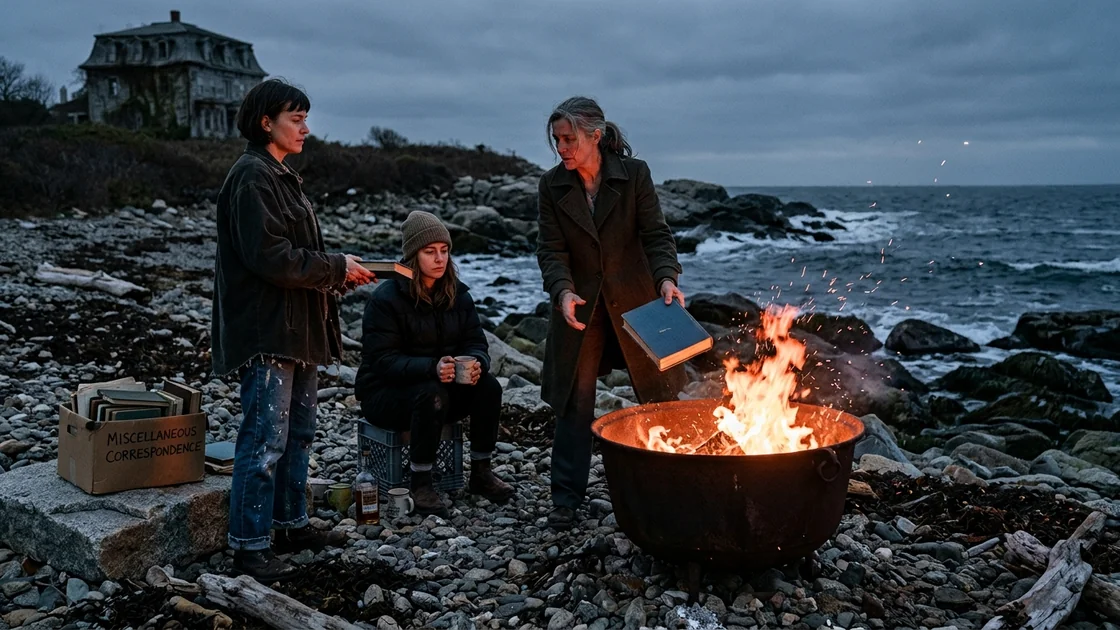
Five years after an explosive argument at their mother Margaret's funeral severed all communication between them, three estranged sisters reunite at their ancestral seaside home in Cape Ann, Massachusetts. Nora, the hyper-vigilant oldest sister who single-handedly managed their mother's estate, has sold the decaying Victorian house to a developer, leaving them exactly seven days to clear out four decades of accumulated possessions, artistic clutter, and unresolved trauma. Bea, an itinerant artist struggling with sobriety and shame over having abandoned their dying mother, arrives defensive and broke, while Chloe, the fragile youngest sister who fled to the West Coast to escape the family's smothering dysfunction, attempts to act as an unconvincing peacekeeper. Over the course of a week marked by sorting through relics, violent coastal squalls, and physical labor, the three women are forced to confront the secrets of their mother's private life, their individual guilt, and the brittle scaffolding of their shared childhood before the house is surrendered to the wrecking ball.
Day One: The Weight of Keys
The gravel of the driveway had not been raked in half a decade. When Nora turned her sedan off the state route and crested the small hill overlooking the inlet, the tires ground loudly against the invading crabgrass and sea-stone, the sound like dry bone splintering underfoot.
She cut the ignition and sat with both hands locked on the leather steering wheel at ten and two. Her knuckles were white. Through the salt-pitted windshield, Highfield House stood against the gray Massachusetts sky like an unrepentant monument. It was a three-story Queen Anne Victorian that had spent eighty years absorbing the Atlantic damp, its cedar shakes weathered to the exact color of an oyster shell, the wrap-around porch sagging slightly at the southeast corner where the foundation stones had settled into the peat.
Nora looked at the dashboard clock: 9:14 AM. She was fourteen minutes later than her self-imposed schedule, but she knew she was still the first to arrive. She was always the first.
She stepped out into the raw October wind. The air smelled of low tide, rotting kelp, and woodsmoke from someone else’s chimney down the cove. Walking up the front steps, she noticed the wisteria vines had completely overtaken the balustrade, thick as anacondas, their dead pods rattling like teeth in the gusts. She pulled a heavy brass ring from her trench coat pocket. There were four keys on it, though only the notched Yale key mattered. The deadbolt resisted, crusted with verdigris, before giving way with a sharp, metallic screech.
Inside, the house smelled of cold horsehair plaster, mouse droppings, and Margaret’s perfume—a heavy, resinous amber that seemed to have bonded with the varnish of the wainscoting.
Nora didn’t remove her coat. She walked directly into the foyer, where she unzipped a nylon tote bag and produced three clipboards, three rolls of heavy-duty packing tape, three black markers, and a box of neon-colored stickers: green for keep, blue for donate, red for disposal. She laid them out across the hall table with the geometric precision of a surgeon preparing a tray of scalpels.
A loud backfire echoed down the drive, followed by the distinctive, un-muffled rumble of an ancient Volvo wagon.
Nora closed her eyes, exhaled through her nose, and smoothed her wool slacks.
When Beatrice walked through the open front door, she didn't knock. She dragged a battered canvas duffel bag behind her across the oak parquet, leaving a faint gray trail of road dirt. She wore an oversized corduroy jacket with frayed cuffs, paint-splattered jeans that had seen too many solvents, and silver hoops in her ears that clattered against the phone tucked between her chin and shoulder.
"—yeah, I’m here. No, it’s fine, Leo, just send the draft to the gallery by Thursday and I’ll look at the proofs. I have to go," Beatrice said, dropping the phone into her pocket without looking at Nora. She stood in the center of the foyer, her dark hair cut into a severe, uneven bob that made her sharp cheekbones look almost skeletal. She took a deep, theatrical breath and let it out with a derisive snort. "Still smells like lavender and disappointed expectations."
"You're late," Nora said evenly.
"Good morning to you too, Eleanor. How are the spreadsheets? Did you budget for my emotional breakdown, or should I pencil that in between lunch and sorting out the basement?"
"We have seven days, Bea. The closing is next Monday at noon. The buyers are tearing down the interior framing to studs by Wednesday morning. If it isn't in a box by Sunday night, it goes into the dumpster out front."
Beatrice glanced at the neon stickers on the table. She picked up a red one, peeled it with a thumbnail, and stuck it directly onto the breast of Nora’s immaculate coat. "Let’s start with you, then."
Nora peeled the sticker off, stuck it methodically back onto its wax backing, and didn't blink. "You haven't changed."
"Neither have you," Beatrice said, her voice dropping into a register that had no humor in it. "You’ve just gotten more expensive."
Before Nora could reply, the crunch of a cab’s tires outside broke the silence. Both women turned toward the leaded glass sidelights of the front door. A yellow taxi had idled at the foot of the porch. A small figure emerged from the passenger side, wearing an oversized knit beanie, an enormous puffer jacket that seemed two sizes too large, and sneakers that appeared completely unsuited for the Maine-like chill of Cape Ann.
Chloe had flown in from Portland, Oregon. She spent three minutes fumbling with her wallet to pay the driver, dropped her canvas tote into a puddle, apologized to the driver twice, and then stood on the bottom step, looking up at the house as if it were a cliff she was being forced to climb barefoot.
When she reached the threshold and saw her sisters standing in the hall like two sentries on opposing sides of a border crossing, Chloe’s face broke into a fragile, overbright smile that didn't reach her wide, tired eyes.
"Hey," Chloe whispered, her voice cracking slightly. She cleared her throat. "Hi. Look at us. The gang's all here."
Neither Nora nor Beatrice moved toward her.
"Your flight was on time," Nora noted.
"I had a layover in Denver," Chloe said, clutching her wet tote bag against her stomach like a shield. "I brought sour candy. The kind Mom used to hide in the sewing basket."
"Mom hid gin in the sewing basket, Chloe," Beatrice said flatly. "The candy was to cover the smell."
Chloe’s smile didn't entirely vanish, but it froze, turning into something brittle and waxen. "Right. Well. It’s nice to see you both, too."
For a long moment, the only sound was the wind buffeting the high, decorative bargeboards along the roof and the rhythmic ticking of the grandfather clock in the corner—a clock that, despite having had no one to wind it for five years, was miraculously still running, its brass pendulum swinging in the shadows behind the dusty glass.
Day Two: The Excavation of the Pantry
The kitchen was Nora’s chosen starting point. It was a space that had seen little renovation since the mid-1970s: yellow linoleum worn down to the black backing in front of the sink, Formica countertops with burn marks shaped like the bottom of an electric kettle, and walls painted the color of bruised butter.
"Everything goes," Nora instructed, wearing yellow rubber gloves and holding a roll of thirty-gallon contractor bags. "The food in the pantry has been expired since the Obama administration. Don't bother checking dates. Just dump the contents into the trash bags and rinse the jars for the glass recycler."
"Some of these are antique Mason jars," Beatrice countered, leaning against the doorframe with a mug of black instant coffee she’d managed to scavenge from a tin she brought herself. "The aqua ones with the zinc lids are worth thirty dollars a pop on the antique trail."
"Then you clean them," Nora snapped. "You wash seventy years of botulism out of thirty jars, pack them in bubble wrap, and find a place for them in your station wagon. Otherwise, they go in the bag."
"You always did love the scorched-earth policy," Beatrice muttered, but she took a crate from the corner and began pulling jars from the deep, dark shelves of the walk-in pantry.
Chloe sat on an upturned wooden milk crate by the small kitchen table, an inventory pad on her knees. Her job was supposed to be cataloging, but she was mostly watching her sisters’ hands.
Nora moved with an aggressive, rhythmic competence. Rip, thud, scrape. Cans of stewed tomatoes with rusted rims fell into the contractor bag with dull, heavy plops. Box after box of yellow cornmeal, infested with tiny, desiccated weevils, followed.
"Look at this," Beatrice said, holding up a large glass cylinder filled with an amber fluid that had turned murky. Inside, suspended like a specimen in a natural history museum, was a pale, fibrous mass.
"Don't open it," Chloe said, instinctively pulling her knees to her chest. "Is that... what is that?"
"Preserved quinces," Beatrice said, her voice softening slightly. "From the tree that used to be behind the woodpile. She made them the year Dad left. Nineteen ninety-two."
Nora’s hand hovered over a box of tea bags for a fraction of a second before continuing its downward trajectory into the trash. "Nineteen ninety-one. And they weren't quinces, they were hard pears. She didn't know how to can properly. Half of them went sour in the cellar and burst their lids."
"You don't remember," Beatrice said, turning the jar so the pale, ghostly fruit caught the thin northern light from the window. "You were already at Smith, living in your dorm, pretending you didn't have an address out here in the salt marsh. Chloe and I were the ones who had to eat them on toast."
"I remember the smell," Chloe volunteered softly. Her voice was always too gentle for this room; it tended to dissipate against the hard linoleum. "It smelled like vinegar and burnt brown sugar. Mom told me it was how the French preserved things."
"Mom told you that so you wouldn't tell the school nurse that we were eating hard bread and preserves for dinner three nights a week while she locked herself in the greenhouse," Beatrice said. She set the jar down on the table next to Chloe with a heavy, purposeful clatter. "Tell her, Nora. Tell her how the heroic family finances worked back then."
Nora turned slowly. Her rubber-gloved hands were dripping with the brine of a cracked pickle jar. "Do you really want to litigate our adolescence before we’ve even finished the lower cabinets, Bea? Because if we’re going to talk about who abandoned this house and when, I can pull the receipts out of the bureau in the den. I have forty-two thousand dollars in credit card receipts from her last two years of home care that I took out against my own mortgage while you were living in a yurt in Taos making copper wire jewelry."
Beatrice’s mouth twitched. A dull flush of crimson rose from the collar of her shirt up her throat. "I didn't have money, Nora! I was sleeping on a floor!"
"You had hands," Nora said, her voice dropping to a terrifying, quiet clarity. "You had two working legs and an open invitation to sit by her bed and change the bags when she couldn't reach the commode. But that wasn't sufficiently cinematic for you, was it? It lacked artistic dignity."
"Stop," Chloe pleaded. She got off the milk crate, her hands outstretched, the ballpoint pen she was holding pointing between the two of them like a tiny, futile weapon. "Please. Can we just—we have so many rooms. There are nine rooms, Nora. We haven't even touched the upstairs."
"The upstairs is worse," Beatrice said, turning her back on Nora and ripping a strip of brown tape off the dispenser with her teeth. "The upstairs is where she kept the things she thought we were."
Day Three: The Parlor of Unspoken Debts
By Wednesday, the ground floor was a landscape of cardboard gorges. Towers of banker’s boxes lined the hallway, labeled in Nora’s precise, architectural block lettering: BOOKS - HISTORICAL, LINENS - GUEST ROOM, PEWTER/SILVERPLATE - APPRAISAL.
The parlor had always been the territory of their father’s ghost and their mother’s pretensions. Margaret had never allowed the girls to eat in the parlor, yet she had let her two half-wild Gordon Setters sleep on the velvet damask sofa until the cushions were stained with dog fat and smelling of stagnant swamp water.
Beatrice was on her knees before the small roll-top desk in the corner. It was made of veneer that had bubbled and peeled like sunburned skin near the radiator.
"Nora," Beatrice said. Her tone was different today—less defensive, more puzzled.
Nora was standing on a stepladder, taking down heavy velvet drapes that let loose clouds of gray dust that sparkled in the afternoon sunbeam. "What is it? If it’s old utility bills, throw them in the shredder pile."
Beatrice didn't throw it in the pile. She was holding a bundle of envelopes tied not with ribbon, but with green surveyor’s tape.
"These aren't utility bills," Beatrice said. "These are from St. Jude’s."
Chloe, who had been methodically wrapping small porcelain bird figurines in newsprint, stopped her work. "St. Jude’s? The children’s hospital?"
"The residential facility in Concord," Beatrice said. She glanced up at Nora, whose back had gone rigid on the third rung of the ladder. "Nora. What are these?"
Nora didn't turn around. She kept her arms raised, unhooking the heavy brass rings from the wooden pole with dry, rhythmic clicks. Tink. Tink. Tink.
"Nora," Beatrice repeated, her voice sharpening. "Why are there monthly statements from nineteen ninety-eight to two thousand and four made out to Margaret Vance for the care of an 'Arthur Vance'?"
Chloe stood up, dropping a porcelain wren onto the rug. It didn't break, but rolled pathetically against Nora’s sensible leather boots. "Uncle Arthur died in the eighties. Mom said he died of pneumonia in Portland."
"Arthur wasn't our uncle," Nora said. Her voice came from high up, near the cornices, muffled by the heavy velvet of the drape she was clutching.
The room seemed to drop ten degrees. The only sound was the wind off the marsh, whistling through the lead weights in the sash windows.
Beatrice stood up, the letters in her hand. "What did you say?"
Nora finally descended the ladder. She folded the dusty drape with practiced, mechanical movements, her chin tucked into her chest, before setting the bundle on top of a box marked FABRIC - SALVATION ARMY. Then she took off her work gloves, one finger at a time.
"Arthur was our brother," Nora said. "He was born between me and Bea. Nineteen seventy-four. He had severe hydrocephalus and anencephaly. He lived for thirty years in a bed thirty miles from where we went to middle school."
Chloe let out a small, choked gasp and sat down hard on the sofa, sending a plume of forgotten dog hair into the air around her. "A brother? We had a brother?"
"Mom couldn't look at him," Nora said. She looked directly at Beatrice now, her eyes clear and cold as well water. "And Dad couldn't forgive her for not being able to look at him. That was the big mystery, Bea. That was the tragic, poetic silence that you spent your entire twenties romanticizing. It wasn't that they were two grand, tormented intellectuals who just couldn't bear the vulgarity of modern marriage. It was that they had a child who couldn't swallow on his own, and our father wanted to keep him in the nursery, and our mother signed the committal papers while he was at a conference in Baltimore."
Beatrice’s hands began to shake slightly. She looked down at the surveyor’s tape holding the letters together. "You knew?"
"I found out when I was seventeen," Nora said. "I found the insurance statements in the glove compartment of the wagon. I confronted her. She told me if I ever told you two, she’d sell the house then and leave us with nothing."
"So you just... kept it?" Beatrice’s voice rose, vibrating with a rage that had no clear target. "You let me write those poems? You let me spend ten years believing Dad walked out because I was too loud, because I broke that stupid Chinese bowl, because we were too much for them?"
"You were always too much, Beatrice," Nora said without malice, which made the words ten times more lethal. "And you wouldn't have done anything with the truth except make it about yourself. Look at you right now. You’re forty-one years old, and your first instinct isn't to think about a boy who lived in a linoleum room for three decades without a visitor. Your first instinct is to wonder how it reflects on your childhood mythology."
"That’s not fair!" Beatrice shouted, throwing the bundle of letters onto the floor between them. The surveyor’s tape snapped, and the white envelopes fanned out across the faded roses of the Aubusson carpet. "You kept us in the dark! You made yourself the keeper of all the miserable secrets so you could stand over us like a martyr and pull the strings!"
"I kept the lights on!" Nora screamed back—a sound so rare, so jagged and ugly, that both Chloe and Beatrice flinched back from it as if she had pulled a blade from her apron. "I paid for his burial! When St. Jude’s closed their long-term ward in two thousand four and he caught sepsis from an infected shunt, who do you think took three days off from her firm in Boston to go identify the body? Mom wouldn't leave the garden. She was out back with a pair of shears cutting the dead heads off the hydrangeas while her son was being cremated in a state facility!"
Nora’s chest was heaving. Her hair, usually held in an immaculate French twist, had come half-unpinned, gray-streaked strands clinging to the sweat on her temples.
Chloe was crying now, silent, ugly tears that tracked through the dust on her cheeks. "Why didn't anyone tell me?" she whimpered, rocking slightly on the sofa. "Why am I always the last person to know what our family is?"
"Because you run, Chloe," Beatrice said, though the venom had drained out of her voice, leaving only a dry, bitter gravel. "The second anything gets heavy, you buy a one-way ticket to a coast where nobody has a past."
Day Four: The Geography of the Attic
The rain began on Thursday morning—not a drizzle, but an unrelenting, sideways coastal deluge that drummed against the third-floor dormers like buckshot.
The attic was the brain of Highfield House: uninsulated, smelling of dry pine rafters, bat guano, and paper that had begun to slowly acidify over fifty winters. It could only be reached by a narrow, ship-style staircase tucked behind the linen closet on the second-floor landing.
They worked in separate corners, a tense armistice having been declared after the explosion over Arthur. Chloe had claimed the steamer trunks beneath the eaves.
"Nora?" Chloe called out. Her voice was muffled by the rafters.
Nora was three yards away, sorting through cardboard boxes of old tax records with a headlamp strapped to her forehead. "Yes?"
"Did you know about this, too?"
Nora walked over, ducking her head to avoid the rusted roofing nails that protruded through the cedar shingles.
Chloe was sitting cross-legged before an open green leather trunk lined with marbled paper. Inside were dozens of small, flat packages wrapped in brown butcher paper and tied with hemp twine. One of them was open.
Inside the open package was a painting.
It was small—no larger than eight by ten inches—painted in gouache on heavy rag paper. It depicted a small, salt-bitten garden: three stalks of digitalis, their purple bells speckled with dark spots, and in the foreground, a girl’s hand holding a dead bumblebee. The technique was exquisite, obsessive, and instantly recognizable.
"These are Bea’s," Nora said quietly.
"Not just some of them," Chloe said. She reached into the trunk and lifted another package, then another. "There must be fifty of them. Look at the dates."
Nora took one of the packages. On the brown paper, written in Margaret’s spindly, copperplate script, were the words: Beatrice. Rhode Island School of Design application portfolio. Withheld, September 1999.
Beatrice had just come up the stairs, carrying a thermic flask of water and three mugs. She heard the name of her old art school and stopped on the top step, her head level with the floorboards.
"What did you say?" Beatrice asked.
Nora looked from the package to her sister. For the first time all week, Nora looked terrified. Not angry, not efficient, not defensive. She looked like a child who had found something dangerous in the tall grass.
"Bea," Nora said softly. "Don't come over here."
Beatrice set the mugs down on the floorboards with a small splash of hot water. She came across the attic floor, her boots sounding like thunder on the bare joists. She shoved Chloe aside—not roughly, but with the flat, irresistible momentum of someone walking into an oncoming wave—and dropped to her knees before the trunk.
She took the package from Nora’s hand. She tore the butcher paper with a single violent jerk of her forefinger.
The painting inside was an oil sketch of an old wooden dory upside down in the salt grass at low tide, the mud glistening with strokes of cadmium orange and Prussian blue. It had been Beatrice’s submission piece for the competitive full-tuition scholarship at RISD—the one she had believed, for twenty-three years, had been lost in the mail by the United States Postal Service.
"She told me they rejected me without an interview," Beatrice whispered. Her face had lost all color; her lips were a thin, bluish line. "She told me they must have lost the slides. She told me to go to the community college in Beverly and take secretarial classes."
"Bea," Chloe said, reaching out a hand to touch her sister’s shoulder.
Beatrice flinched as if she had been scalded. "Don't! Don't touch me!"
She began ripping into the other packages. Paper flew through the air in brown ribbons.
Beatrice. Figure studies, charcoal, 1998. Beatrice. Self-portrait with sea-holly, 2000. Beatrice. The marsh at evening, watercolor, 2001.
Every piece of work Beatrice had produced between her sixteenth and twenty-first years—work she had thought discarded, stolen, or lost during the chaotic moves between apartments—was here. Margaret had collected them from the trash, from Beatrice’s bedroom walls, from her old art lockers at school, and wrapped them like cuts of meat, hiding them in the dark beneath the roof nails.
"She didn't want you to leave," Nora said, her voice barely louder than the rain drumming six inches above their skulls. "She was terrified of being alone in this house with just Chloe."
"She didn't want me to have a life!" Beatrice shrieked. It wasn't the theatrical, sarcastic scream she had used in the kitchen. It was an animal noise—the sound of an engine throwing a rod, of wood snapping under the weight of wet snow. She held the dory painting against her ribs, her body curling around it until her forehead touched the dusty floorboards. "She stole it. She stole my whole fucking life."
Chloe crawled toward her, ignoring the splintered hemlock floor, and wrapped her arms around Beatrice’s shoulders. This time, Beatrice didn't push her away. She shook, her breath hitching in her throat with terrible, wet gasps that seemed to tear their way out of her chest.
Nora remained standing, the headlamp on her forehead casting a harsh, circular beam of white light onto the back of Beatrice’s neck. Nora looked down at her hands—her clean, capable hands that had balanced the checkbooks, paid the caretakers, signed the funeral programs, and prepared the house for destruction.
"I didn't know about this," Nora said. Her voice cracked, a tiny fissure in the stone wall she had lived behind for fifty years. "Bea. I swear to God. I didn't know she had these."
Beatrice didn't look up. She just clutched the scrap of canvas and let the dust of the attic cling to her tears until her face was a mask of gray paste.
Day Five: The Greenhouse and the Salt Marsh
The storm broke before dawn on Friday, leaving behind a clean, scouring wind that pulled the fog off the marsh in long, ghostly banners.
Behind Highfield House, half-hidden by a thicket of invasive sumac and wild blackberry brambles, sat the greenhouse. It was Margaret’s true home—a Victorian conservatory with an iron frame and hundreds of small, overlapping panes of glass, half of which were cracked or missing entirely, replaced by sheets of plastic that flapped like dying gulls in the sea wind.
Chloe was there alone. She had snuck out of the house while Nora was still cataloging the second-floor linen press and Beatrice was still locked in the guest room with her salvaged paintings.
Chloe wore a pair of their mother’s old muck boots, which were two sizes too large and smelled of sulfur. The interior of the greenhouse was a jungle gone to rot. Dried pelargoniums, long dead in their terracotta pots, hung from rusted chains. On the potting bench, bags of bone meal and perlite had burst, their contents mixed with decades of fallen leaves and the dry husks of cicadas.
In the center of the bench was an old galvanized wash tub. In it, against all reason, a single rosebush was still alive. It was a Rosa rugosa, the tough, prickly beach rose that grew wild along the dunes, but someone had grafted onto it a delicate, pale yellow tea rose. A single, ragged blossom hung from the stem, its petals tipped with brown from the morning frost.
Chloe reached out to touch the petal, but a hand caught her wrist before her fingers made contact.
She gasped and pulled back, but the grip was firm. It was Beatrice.
"Don't," Beatrice said. Her eyes were swollen, red-rimmed and sunken, but her grip was steady. "The thorns on the wild stock are poisonous if they go deep. Mom got blood poisoning from that bush twice."
"It's still alive," Chloe said, looking at the pale yellow petal.
"It's a weed grafted onto another weed," Beatrice said, though she didn't let go of Chloe’s wrist immediately; she held it for a beat longer than necessary, her thumb resting on the small, blue pulse point at the base of Chloe’s palm. "Nora wants to know what you want to do with the bedroom furniture."
"I don't want any of it," Chloe said. She looked around the broken glass dome. "I don't want anything from this place, Bea. I don't know why I came."
"You came because you’re terrified she’s going to haunt you if you don't say goodbye properly."
"Do you think she’s haunting us?"
Beatrice gave a short, humorless bark of laughter. "Margaret? No. Margaret wouldn't waste her post-mortem time on us. If she’s anywhere, she’s haunting some poor florist in Gloucester who used the wrong floral tape."
Chloe looked down at their mother’s boots on her feet. "I lied at the funeral."
Beatrice let go of her wrist. "Everyone lies at funerals, Chlo. Nora lied when she said Mom was a 'devoted matriarch.' The priest lied when he said she was in the arms of the Lord. The Lord would have thrown her out for criticizing the architecture of the pearly gates."
"Not that," Chloe said, her voice dropping so low Beatrice had to step closer to hear it over the wind rattling the remaining panes. "I told you both that I missed the hospice window because my flight from Seattle was canceled."
Beatrice was quiet for a moment. "And?"
"The flight wasn't canceled," Chloe said. A single tear broke over the rim of her eye and ran down her nose, dripping onto the dry perlite on the bench. "I was at Logan. I was at the gate in Boston. I had my bag. I had the rental car keys in my hand. I sat down on one of those gray vinyl seats by the baggage carousel, and I just... I couldn't stand up."
Beatrice didn't say anything.
"I sat there for six hours," Chloe sobbed, her small shoulders hitching inside the oversized puffer coat. "I watched three flights to Atlanta board and leave. I watched the janitors change the trash bags. Nora kept texting me: She’s at 40 bpm. She’s at 30 bpm. Her breathing is Cheyne-Stokes. And I just sat there eating stale pretzels from a vending machine because I knew... I knew if I came into that room, she would say something that would stay in my head for the rest of my life, and I wouldn't be able to get it out."
Beatrice looked out through the cracked glass toward the salt marsh, where a pair of snowy egrets were picking their way through the gray tide pools.
"Do you know what she actually said?" Beatrice asked quietly.
Chloe looked up, her face wet. "To you?"
"To Nora. I wasn't there either, remember? I was in Providence sitting in a diner trying to decide whether to drive up or take a handful of Valium." Beatrice turned back to her sister. "Nora told me she waited until five in the morning. Nora was holding her hand. Mom opened her eyes, looked right at Nora, and said: You’ve let the dust get into the piano again, Eleanor. And then she stopped breathing."
Chloe stared at her. A bizarre, choked sound came out of her throat—a laugh that sounded like a hiccup, followed by another, until she was laughing so hard she had to bend over, her hands on her knees, the muck boots slipping in the dead leaves.
Beatrice joined her—a sharp, ragged, desperate laughter that echoed off the surviving glass panes of the greenhouse, scaring the egrets out on the salt flats into flight, their wide white wings beating against the gray sky.
Day Six: The Pyre on the Shingle
Saturday was the day of the dumpster.
The heavy steel container had arrived at eight in the morning, dropped onto the gravel drive with an earth-shaking CLANG that rattled the crystal pendants on the parlor chandelier.
By four in the afternoon, it was three-quarters full. Decades of Margaret’s life were piled within its rusted walls: mildewed copies of Architectural Digest, broken wicker planters, cracked Victorian washbasins, three worn-out vacuum cleaners, and rugs whose wool had been eaten to the hemp backing by carpet beetles.
In the backyard, down on the gravelly shingle just above the high-tide line, Beatrice had started a fire in an old iron wash-cauldron.
"You can't burn treated wood," Nora said, appearing at the edge of the lawn with a cardboard box marked MISCELLANEOUS CORRESPONDENCE. Her hair was pulled back in a severe ponytail, and she had an ink smudge on her jawline that made her look like a soldier who had forgotten her camouflage.
"It’s not treated," Beatrice said, tossing an armful of dried pine stakes into the flames. "It’s forty years of dead nursery tags and birch logs from the storm three winters ago. Come here, Nora."
"I have to label the—"
"Come here," Beatrice repeated, her voice carrying an authority that Nora wasn't used to hearing from her.
Nora hesitated, then walked down the steep, grassy bank to the shingle. The tide was going out, leaving the seaweed slick and dark on the granite boulders. The fire crackled sharply, spitting sparks of cedar resin toward the gray clouds that hung low over the ocean.
Chloe was already there, sitting on an overturned plastic milk crate, holding three chipped ceramic mugs. A bottle of cheap bourbon—the only thing they had found in the back of the liquor cabinet that wasn't covered in a thick layer of dust—sat between her feet.
"We have twelve boxes of her journals," Beatrice said, nodding toward the stack of cardboard boxes Nora was carrying. "Are you planning on reading them, Nora?"
Nora looked down at the box in her hands. The top notebook was a blue canvas ledger with 1984–1987 written on the spine in Margaret’s hand.
"I thought... I thought we should keep an inventory," Nora said, but her voice lacked its usual crispness. It sounded tired. It sounded like an engine that had run out of oil miles back and was now just grinding metal against metal.
"Why?" Chloe asked softly. She held up one of the mugs toward Nora. "Do you really want to know what she thought about us in nineteen eighty-five? Don't you already know?"
Nora didn't take the mug. She set the heavy cardboard box down on a flat granite stone near the cauldron. "It’s evidence."
"Evidence for what trial, Nora?" Beatrice asked. She stepped up to the box, pulled out the blue ledger, and held it over the flames. "The court adjourned five years ago. The defendant is dead. The jury has already moved to Oregon and Chicago."
"Don't," Nora whispered.
Beatrice didn't drop it. She held it suspended, the heat from the fire curling the corners of the canvas binding, the gold foil lettering on the spine beginning to darken and blister.
"If you want to read it, take it back," Beatrice said. "Take all twelve boxes back to your apartment in Cambridge. Put them on the shelves next to your leather-bound legal dictionaries. Spend your evenings reading about how she thought you were too rigid, how she thought I was too loose, how she thought Chloe was too weak. Go ahead, Nora. Be the curator of the museum of why we’re broken."
Nora’s breath came in ragged, shallow gasps. She looked at the blue ledger. She remembered nineteen eighty-six: the year her father had stopped coming home on weekends, the year her mother had spent three weeks in bed with the curtains drawn while Nora, fourteen years old, had learned how to balance a household checking account and forge her mother’s signature on the school lunch forms.
She stepped forward.
She took the book from Beatrice’s hand.
Beatrice didn't resist; she let her fingers open.
Nora looked down at the cover. Her mother’s thumbprint was preserved in a dried smudge of black printer’s ink on the bottom right corner. With a sudden, violent heave of her shoulders, Nora threw the book not back into the box, but directly into the center of the cauldron.
The paper caught instantly. A flare of yellow flame licked across the blue canvas, turning it black, the edges of the pages curling inward like dying leaves before exploding into bright, white embers that rose into the salt air.
Chloe let out a small, terrified laugh that sounded like an exhalation of breath long held underwater.
Beatrice picked up another ledger—1991–1994—and handed it to Nora without a word.
Nora took it and dropped it into the flames.
Then another.
Then another.
They worked together now, not with the methodical, bureaucratic speed Nora had demanded in the kitchen, but with a rhythmic, urgent fury. The three of them fed the fire until the heat drove them back toward the water’s edge, their faces orange in the dusk, their hair whipping across their mouths in the wind.
Chloe picked up the bourbon bottle, poured a generous splash into each of the three chipped mugs, and handed one to Nora and one to Beatrice.
This time, Nora took it.
She didn't sip it; she drank it down in two long, burning gulps, the alcohol hitting her empty stomach like a fist. She coughed, the tears finally springing to her eyes from the smoke and the spirit, and wiped her mouth with the back of her dirty wool sleeve.
"The house is being knocked down," Nora said, her voice raw. "The developer isn't renovating. He’s putting up three cedar-shingle duplexes with two-car garages and composite decking."
Beatrice took a sip of her bourbon, staring into the heart of the embers where their mother’s handwriting was turning into gray, weightless ash. "Good," she said.
"They're going to pull out the wisteria," Chloe said.
"Good," Beatrice said again, louder this time. "It was rotting the porch anyway."
Nora looked at her sisters. In the failing light, with the orange glow of the pyre reflecting in their eyes, they looked terrifyingly like the three girls who used to hide under the overturned dory during the August squalls, waiting for their father’s car to come up the drive, waiting for someone to tell them that the storm had passed.
"I hated her," Nora whispered. The confession was small, dropped into the space between them like a lead sinker into deep water.
Beatrice reached out and caught Nora’s hand. Her palm was rough, calloused from paint scrapers and charcoal, smelling of linseed oil and woodsmoke.
"We know, Nora," Beatrice said softly. "We all did. That was the only thing we ever had in common."
Day Seven: Down to the Studs
On Sunday morning, the house was an empty ribcage.
The moving van had come and gone at dawn, taking the few pieces of furniture that Nora had managed to sell to a consignment shop in Salem and the eight boxes Beatrice had decided to keep: her salvaged paintings, three of the aqua Mason jars, and their father’s collection of nautical charts from the nineteen seventies.
Chloe had taken only one thing: a small, chipped silver spoon that had belonged to their grandmother, which she had slipped into the pocket of her puffer jacket without telling anyone.
The three sisters stood in the empty foyer. The grandfather clock was gone, sold to an antique dealer who had arrived in a flatbed truck at nine, leaving behind an oblong patch of unfaded, honey-colored oak where it had stood against the wallpaper for sixty years.
Without the furniture, the house had a different acoustic. Every footstep echoed like a shot; their voices bounced off the bare plaster walls with an icy, impersonal clarity.
"My car’s packed," Beatrice said. She stood near the open front door, her canvas duffel bag over her shoulder. Her ancient Volvo was idling in the drive, spitting gray exhaust into the damp morning air.
"I called a car for Chloe," Nora said. She was holding her small leather briefcase, her coat buttoned to the chin, her hair once again pinned into its neat, protective twist. "It should be here in ten minutes."
"I can take her to the airport," Beatrice said.
Nora looked at Beatrice, then at Chloe.
"It's three hours in traffic," Nora said, the old reflex of logistical interference rising in her throat before she choked it back down. She stopped. She looked at her feet, at the bare oak boards. "If you want to."
Chloe looked between them. The anxiety that had made her small and bird-like all week seemed to have settled into a strange, quiet calm. "I’d like that. If the heater in the wagon works."
"It works if you kick the glove box," Beatrice said.
They stood in a circle on the porch. The developer’s surveyor had already been by; four bright pink plastic ribbons were tied to the balustrade, fluttering in the salt breeze like celebration streamers for an event no one wanted to attend.
"Nora," Beatrice said.
Nora looked up from her keys.
Beatrice didn't offer a hug; they were not a family that had survived by embracing. Instead, she reached into her pocket and pulled out a small, flat object wrapped in a paper towel. She pressed it into Nora’s palm.
"Don't open it until you get home," Beatrice said.
Nora’s fingers closed over the hard, rectangular shape. She knew the dimensions without looking: eight by ten inches. Gouache on rag paper.
"Where are you going after this?" Nora asked.
"Providence," Beatrice said. "A friend has a studio over a garage in Pawtucket. I’m going to paint."
"You should get your teeth checked," Nora said, her voice dropping into that familiar, infuriatingly practical tone. "You’ve been chewing on the left side of your mouth all week. You probably have an abscess under that crown."
Beatrice stared at her for a long second, and then her face broke into the first real, unironic smile Nora had seen on her since they were girls on the beach. "You really are an unbearable person, Eleanor."
"Someone has to be," Nora said.
Chloe stepped forward and, with a quick, bird-like dart of her head, kissed Nora’s cheek. Nora smelled of cold cream and wool.
"Call me when your flight lands," Nora told Chloe.
"I will," Chloe said. "I promise."
The two younger sisters walked down the wooden steps, their shoes loud on the salt-pitted risers. They got into the Volvo. Beatrice had to turn the key three times before the starter caught, the engine catching with a wet, throaty cough that settled into a steady rattle. Chloe waved once through the mud-splattered glass of the passenger window as the station wagon backed down the long drive, its tailpipe scraping the gravel before turning south onto the state highway.
Nora stood on the porch until the sound of the engine had completely disappeared beneath the steady, rhythmic crash of the surf against the rocks at the point.
Then she turned back toward the house.
She didn't go inside. She pulled the heavy oak door shut until she heard the latch drop into the strike plate with a definitive, hollow click. She took the four brass keys off the ring—the Yale key, the skeleton key for the cellar, the small nickel key for the attic, and the padlock key for the greenhouse—and laid them in a neat row on the top step of the porch, directly beneath the pink surveyor’s ribbon.
She walked down the gravel drive to her sedan, her boots steady on the stones.
She got into the driver’s seat, set her briefcase on the passenger side, and looked at the package Beatrice had given her.
She peeled back the gray paper towel.
It was not the digitalis, and it was not the dory. It was a painting Beatrice must have done by the light of the fire on Friday night, using charcoal from the cauldron and dirty sea water mixed with gouache on the back of an old legal pad cover.
It showed three figures, seen from behind, standing on a ridge of dark stones before an enormous, roaring tower of white flame. The figures were small, their edges blurred by the smoke, their shoulders touching. In the top corner, written in Beatrice’s jagged, charcoal-smudged hand, were three words:
We were there.
Nora sat in the silence of the car for five minutes, watching the pink ribbons on the porch flutter in the wind from the sea. Then she placed the painting face-down on the leather seat beside her, put the car into gear, and drove away without looking in the rearview mirror.