Across the Pale Green Divide
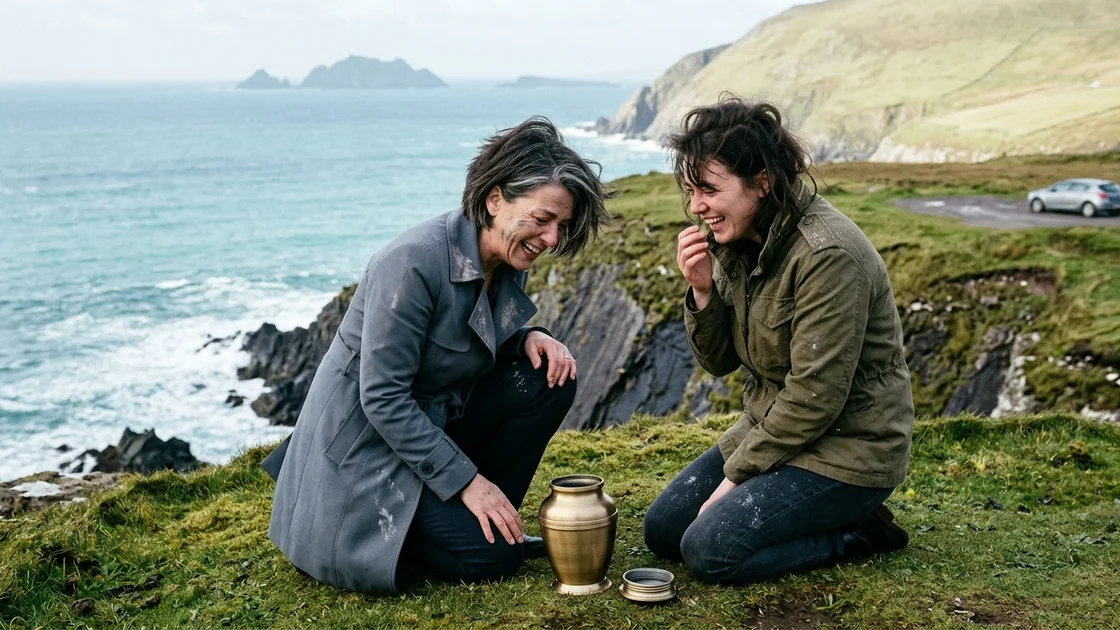
When Malachi Henderson died of an unexpected heart attack in his garden shed in Sussex, he left behind a messy estate, a garden half-tilled, and a handwritten codicil requesting that his cremated remains be scattered into the Atlantic from the westernmost headland of County Kerry. To carry out this final wish, his widow, Nora, and his only child, Maeve, must set aside twelve years of barbed silence, mutual suspicion, and competing claims on his memory. Flying into Dublin with his brass urn packed between jumpers, the two women embark on a five-day journey across the midlands, through the limestone barrens of the Burren, and down to the jagged cliffs of the Dingle Peninsula. Along the way, forced into the close quarters of a rented hatchback on narrow boreens, they confront the private versions of the man they both loved, unearthing the grief, jealousy, and unexpected common ground that will either break their fragile truce or bind them together after his absence.
Chapter One: The Baggage Hall
The urn did not look like Malachi. It was spun brass, cold and geometrically precise, with a threaded lid that sealed with a dry, metallic squeak. Nora had wrapped it in three layers of tissue paper and stuffed it into the center of an oversized canvas tote bag, wedged between a spare cardigan and a cosmetic pouch, but whenever Maeve looked at the bag, she could see the heavy, unyielding cylinder pushing against the fabric like a crooked knee.
"You could have put him in a cardboard box," Maeve said. She stood by the carousel in Terminal 2 at Dublin Airport, her hands shoved deep into the pockets of an olive-drab army surplus jacket that her father had bought her when she was nineteen. "A bio-urn. Something made of compressed salt or willow. That thing looks like an artillery shell. They’re going to search us."
"They didn't search us at Heathrow," Nora replied smoothly. She did not look at Maeve; she kept her eyes fixed on the black rubber flaps from which luggage occasionally tumbled with a dull, rubbery thud. Nora was fifty-six, eight years younger than Malachi had been, and her hair was cut into a sharp, chin-length bob that had remained stubbornly immune to the damp gale howling outside the terminal glass. Her trench coat was tailored, slate grey, and belted with military discipline. "And he is not an artillery shell. He is your father. I wasn't going to carry him across an international border in an egg carton."
"It’s not an egg carton. It dissolves in seawater. That was the whole point of his note."
"His note," Nora said, turning her head just enough to offer Maeve the cool edge of her profile, "was three lines scrawled on the back of an invoice for cedar mulch. It said Slea Head, Maeve. It didn't specify the vessel. Now watch for the blue case. The one with the yellow ribbon."
Maeve looked away, her jaw aching with the familiar, dull pressure that had accompanied every interaction with Nora Vance-Henderson since Maeve was sixteen years old. Twelve years of polite holiday dinners, twelve years of Nora rearranging Malachi’s book collections by spine height and subject matter, twelve years of Maeve walking into her childhood home in Lewes and feeling like a slightly disreputable tenant who had overstayed her welcome.
When the blue case finally heaved through the rubber curtains, Maeve lunged forward, hoisted it by the handle before Nora could reach for it, and set it down with an unnecessary clatter on the linoleum.
"I’ve got the car voucher," Maeve said. "Let’s just get it over with."
The rental lot was an expanse of wet tarmac smelled of jet fuel and sea spray. The car allocated to them was a silver Renault Clio with three hubcaps and forty thousand kilometers on the clock. It smelled faintly of stale peppermint and industrial disinfectant. When Nora went to put the canvas bag in the boot, Maeve stopped her arm.
"No," Maeve said.
"Maeve, really. It’s safer in the trunk."
"He hated the boot. He got carsick if he wasn't looking at the road."
"He isn't carsick now, darling. He’s carbon."
Nora’s voice was clipped, delivered with that brisk, south-London rationality that had always sounded to Maeve like a set of garden shears clipping through dry stalks. Yet as Nora said it, her fingers hesitated on the strap of the tote bag. She looked at the boot—dark, lined with cheap grey carpet—and then looked down at her own neat leather boots, wet with Irish rain.
"Fine," Nora said, stepping back. "Put him in the footwell behind your seat. If we stop quickly, he won't roll."
Maeve took the bag. It was surprisingly heavy. Malachi had been a big man, broad-shouldered and thick-wristed, the sort of man who filled doorways and took up more than his share of any sofa he sat on. It seemed an affront of physics that all that lumbering warmth, that habit of clearing his throat before telling an unprovoked story about a canal lock, could be reduced to four and a half pounds of mineral dust. She buckled the canvas bag into the rear passenger seat using the center lap belt, pulling the nylon strap until it cut deep into the canvas.
"Right," Nora said, climbing into the driver’s seat. She adjusted the mirrors with quick, bird-like snaps of her wrists. "Do you have the map?"
"We have GPS on my phone."
"The battery will die. Or we’ll lose signal in the hills. Your father always kept an OS map in the glove compartment."
"My father got lost between Limerick and Ennis in nineteen-ninety-four and spent the night in a tractor showroom," Maeve said, sliding into the passenger side and slamming the door. "He didn't have an instinct for geography. He had an instinct for drift."
"Well," Nora said, turning the key. The small engine whined, caught, and settled into a rough, vibrating idle. "We aren't drifting. We have a booking in Kinvara tonight, and the cottage in Ventry starts on Thursday. We have three days to get him to the edge of the world, and I intend to do it without consulting a parish priest for directions."
She put the car into gear, found the clutch with an experienced, unyielding foot, and steered them out into the grey slipstream of the M50.
Chapter Two: The Plain of the Middle
The rain came down not in drops, but in a fine, pervasive drift that rendered the windshield wipers useless on intermittent and screechingly loud on low. Dublin slid away behind them—a smudge of cranes, grey brick housing estates, and industrial parks—giving way to the low, green swell of Kildare.
Malachi had loved this country with the sentimental, slightly inaccurate fervor common to English men whose grandmothers had left County Mayo during the famine. He had owned three flat caps, none of which suited his round, florid face, and a collection of Irish folk records on vinyl that he only played when he had drunk more than two glasses of mid-shelf whiskey.
"Did he ever tell you why Slea Head?" Maeve asked after forty miles of silence broken only by the hum of the tires on wet macadam.
Nora kept both hands at ten and two. Her posture was textbook. "He said it was the last parish before Boston. He thought it sounded poetic."
"He spent a summer there," Maeve said. "In the seventies. Before he met my mother. He worked on a dairy farm near Dunquin. He used to tell me about the light. How the sun didn't set until eleven o’clock in June, and the ocean looked like hammered tin."
"He told me he went there to hide from a creditor," Nora said.
Maeve turned her head sharply. "That wasn't Kerry. That was Cornwall."
"No, Cornwall was eighty-one, after his print shop folded. Kerry was seventy-six. He owed five hundred pounds to an uncle in Kilburn for a van he’d wrecked." Nora glanced in the rearview mirror, checking the lane behind them before passing a milk tanker. "Your father was many things, Maeve, but he was never an exile of the spirit. He was usually an exile from an overdraft."
"You always do that," Maeve muttered, looking out at the endless hedge-lined pastures. "You flatten him out. You turn him into an accountant’s balance sheet."
"Somebody had to keep the accounts," Nora said, her voice dropping an octave, losing its brisk efficiency and hardening into slate. "Do you know what was in the bureau drawer when I started clearing the Lewes house? Seven final notices from the water board. Seven. He’d used them as scrap paper to sketch plans for an aviary he never built."
"He had ideas. He wasn't small-minded."
"He was disorganized to the point of cruelty, Maeve."
"Cruelty?" Maeve laughed, a harsh, humorless sound that died against the condensation on the passenger window. "He was the gentlest man alive. When my mother was sick, he sat by her bed for nine months. He didn't miss an afternoon. Not one."
Nora’s fingers tightened on the steering wheel until her knuckles went the color of lard. For several miles, she said nothing. The road widened into the M6 motorway, cutting straight across the Bog of Allen. The turf lay black and exposed under the weeping sky, cut into long, sodden trenches that looked like ancient earthworks.
"I know how long he sat by her bed," Nora said quietly. "He told me."
"He told you about her?"
"He talked about Sarah all the time. In the beginning."
Maeve felt a strange, cold flutter in her stomach. She had spent twelve years imagining that Nora had systematically scrubbed Sarah Henderson from the house—the framed watercolours replaced by Nora’s minimalist Danish prints, the copper saucepans polished until they lost their dark, historic patina, the rose garden pruned back to bare stalks. "He didn't have the right to talk about her to you."
"He had every right," Nora said, her voice steady again, frighteningly reasonable. "A man doesn't arrive at forty-eight as a blank slate. He came with twenty years of grief and a daughter who refused to look me in the eye when I passed her the butter. If he hadn't talked about Sarah, we would have had nothing to listen to in that house except the sound of you slamming your bedroom door."
"I was sixteen, Nora."
"And I was forty-four, and I was terrified of you."
Maeve looked over at her. Nora’s face was smooth, guarded, her chin held high as she overtook a cattle truck. There was no tremor in her jaw, no tear at the rim of her mascara.
"You weren't terrified of anything," Maeve said. "You were an executive at a publishing house. You looked at our house like a manuscript with too many typos that needed aggressive editing."
"Perhaps," Nora whispered. "Perhaps that was the only way I knew how to survive the mess he made."
They stopped outside Tullamore for petrol. The forecourt was slick with diesel. While Nora went inside to pay and use the facilities, Maeve got out and opened the rear door. She looked down at the canvas bag.
She reached out and unzipped the top. Inside, nestled between Nora’s lavender-colored knitwear, the brass cylinder sat like an unexploded shell. Maeve laid her palm against the top of the lid. The brass had taken on the chill of the car’s interior; it was cold as an iron gate in January.
"Why did you make me bring her, Dad?" she murmured to the empty seat.
There was no answer, only the sound of the rain rattling against the corrugated plastic awning of the petrol station and the rhythmic thump-thump of a tire compressor against the wall.
When Nora returned, she was carrying two paper cups of tea and a brown paper bag containing two soda-bread scones wrapped in greaseproof paper. She handed one cup to Maeve across the roof of the car. The tea was the color of a wet horse, strong and scalding.
"The girl behind the counter said the bridge at Athlone has roadworks," Nora said, her eyes fixed on the distant line of the bypass. "It will add an hour."
Maeve took the cup. The heat soaked through the thin cardboard into her cold fingers. "We’ve got time. Kinvara isn't going anywhere."
"No," Nora said, tossing the scones onto the dashboard. "Nothing in this country ever appears to be in a hurry. It’s a miracle anyone ever dies here; the paperwork must take decades."
Chapter Three: The Seven Churches
They left the motorway at Ballinasloe, Nora yielding to Maeve’s sudden, stubborn insistence that they visit Clonmacnoise.
"It’s an hour out of the way," Nora had argued, tapping the steering wheel. "The light will fail by four."
"He brought me here when I was nine," Maeve said. "We stayed in a caravan in Shannonbridge. He bought me a wooden cross with an interlaced knot carved into it. He told me the monks here kept civilization alive while the rest of Europe was burning itself down."
Nora sighed, a long, controlled exhalation through her nostrils. "Very well. But if we end up driving through the Burren in the dark, you’re navigating."
The road to the monastery ran along the Shannon, a brown, muscular river swollen with autumn rain that had spilled over its banks into the low callows on either side. Willow trees stood knee-deep in the grey flood, their yellow leaves trailing in the current like drowned hair.
The ruins appeared suddenly round a bend: a cluster of roofless stone gables, two round towers with conical caps pointing into the soft mist, and a forest of lichen-crusted headstones tilting at crazy angles on the green slope above the river.
There were only three other cars in the gravel car park. The visitor center was empty save for an elderly man in an OPW uniform who stamped their tickets with a mechanical clack and warned them that the grass was treacherous near the river wall.
They walked down the gravel path together, their macs rustling. The air smelled of wet earth, peat smoke from a nearby cottage chimney, and the faint, sweet decay of waterlogged grass.
Maeve walked quickly toward the Temple Finghín, its round tower built directly into the chancel wall, its Romanesque doorway scarred by centuries of damp wind. She touched the sandstone. It was gritty, wet, pitted like pumice.
"He stood right here," Maeve said, her back to Nora. "He had an old Canon SLR with a broken light meter. He took fifty pictures of this arch because he said the chevron carvings looked like fish bones."
Nora stopped a few paces behind her. She had her hands buried in the pockets of her trench coat, her shoulders hunched slightly against the cold. She looked small against the vast, horizontal sweep of the Shannon meadows.
"He did that everywhere," Nora said softly. "In Florence, he spent three days taking photographs of boot scrapers outside renaissance palazzos. He had five hundred slides of wrought-iron dogs and rusted blades. He never showed them to anyone. He just liked knowing they were there."
Maeve looked back. "You remember that?"
"Of course I remember. I was the one who had to pack the slide carousels into the attic when we moved to Lewes. There were twelve boxes of them. Half were labeled Details of No Importance."
A faint smile touched Nora’s mouth—the first genuine smile Maeve had seen on her stepmother’s face since the paramedics had wheeled the gurney down the narrow gravel path of the Sussex cottage three weeks ago. It was not a happy smile; it was private, wry, bruised by exhaustion.
"He wasn't an easy man to live with, Maeve," Nora continued, stepping closer to the arch, her eyes wandering over the weathered limestone graves. "You knew him as a father, which means you knew him as an event. A holiday. A presence that swept in with greasy fish and chips and grand plans to build a sailboat in the drive."
"He was my father," Maeve said defensively.
"Yes. And he was my domestic partner for thirteen years. Do you know what that means? It means I was the one who found out he hadn't paid his national insurance contributions for seven years. I was the one who had to tell him that his heart wasn't 'just a bit tired,' that he had severe aortic stenosis, and that he had to stop digging post holes in the middle of November."
"He hated being managed," Maeve snapped.
"He needed to be managed! If he hadn't been managed, he would have died ten years ago in an unheated flat in Hove, surrounded by dead batteries and waterlogged books." Nora’s voice rose, vibrating against the stone walls of the ruin. A pair of rooks launched themselves from the upper windows of the round tower, their black wings clicking against the damp air as they banked toward the river.
Maeve felt the blood surge to her ears. "He was happy in Hove. Before you met him."
"He was miserable in Hove," Nora said, turning to face her fully, her grey eyes wide and unusually bright. "He was lonely, he was drinking three glasses of gin before lunch, and he had twelve thousand pounds of credit card debt from an antique furniture scheme that never got off the ground. He didn't tell you that, did he? No. He told you he was writing a history of the Sussex ironworks."
"He was writing it," Maeve whispered. "I saw the manuscript."
"It was sixty pages of notes, darling! Sixty pages! Written on napkins, the backs of envelopes, and old receipts from the off-license!"
Nora stopped. She pulled her hands from her pockets and pressed them against her temples, taking three slow, deliberate breaths through her nose. The drizzle was gathering in the fine hairs at her temples, turning the grey strands dark.
"I shouldn't have said that," Nora said, her voice dropping back into its customary register of polite restraint. "It was unnecessary."
"No," Maeve said, her throat tight. "You’ve wanted to say it since two thousand and twelve. Go on. Tell me how much of a burden he was."
"He was never a burden," Nora whispered. Her hands dropped to her sides. She looked down at the mud clinging to the toes of her expensive Italian leather boots. "He was the only person who ever looked at me and didn't see an efficient woman who could handle things. He saw someone... he saw someone who was tired. And he made me laugh. Even when he was ruining my life, he made me laugh."
She turned and began walking back toward the visitor center, her boots squelching in the waterlogged grass. Maeve stood beneath the Romanesque arch, watching the slate-grey back of the woman her father had chosen, feeling the cold rain seep through her army jacket until it reached her skin.
Chapter Four: The Stones of Kinvara
They reached Kinvara after dark. The village sat on the southern inlet of Galway Bay, its hooker boats moored in the mud of the low tide, their black hulls tilted toward the grey stone quays.
The bed and breakfast was a three-story Victorian house with a pink door and a plastic shamrock hanging in the fanlight. The proprietress, Mrs. Conroy, was a woman of vast proportions and alarming cheerfulness who smelled of baking powder and lavender soap.
"Ah, the English ladies," Mrs. Conroy boomed, ushering them into a hallway dominated by a grandfather clock that ticked with the resonance of an anvil. "Dreadful road from Loughrea, isn't it? The potholes would swallow a Mini. You’ll be wanting the twin room on the first floor. Sea view, if the fog lifts, which it won't."
The room was clean, cold, and smelled faintly of damp wool and paraffin. It contained two narrow iron bedsteads separated by an oak nightstand upon which sat a single brass lamp with a fringed shade.
Maeve set the canvas bag on the dressing table. In the harsh light of the forty-watt bulb, the brass urn seemed to take up half the room.
"I’m going for a walk," Maeve announced. She hadn't taken off her jacket.
Nora was already unbuckling her blue suitcase. She had laid out a silk dressing gown across the foot of one bed and was methodically setting a row of small, amber-colored pharmaceutical bottles on the nightstand. "It’s nearly eight o’clock. Most things will be closed."
"The pub won't be."
"Don't drink too much stout, Maeve. Your stomach was always delicate when you traveled."
Maeve didn't answer. She pulled the door shut behind her, the heavy latch clicking into place like a lock on a cell.
The village street was nearly empty. A salt-tinged mist had rolled in off the bay, blurring the streetlamps into greasy yellow halos. Maeve walked past the butcher’s shop with its scrubbed block visible through the dark window, past a chemist displaying hot water bottles and boxes of liver salts, until she reached the red door of a pub called the Pier Head.
Inside, the air was warm, thick with the smell of pipe tobacco, turf, and frying onions. Four old men in peaked caps sat at the counter, their elbows resting on the worn mahogany, their glasses of dark beer half-empty. In the corner, an open hearth burned square sods of brown turf, sending a thread of sweet, ancient-smelling smoke into the low rafters.
Maeve sat at a small table by the window, her back to the bar. She ordered a pint of Guinness and a bowl of stew from a girl with freckles and a Galway accent that rose at the end of every sentence like a question.
When the pint came, Maeve let it settle. She watched the black liquid clear from the bottom up, the tiny bubbles cascading downward like silt in an estuary.
Malachi had taught her how to drink Guinness in an old pub in Lewes when she turned eighteen. You don't sip it like tea, May-bug, he’d said, his mustache already tipped with white foam. You drink through the head. The cream takes the bitterness out of the roast.
She closed her eyes. If she concentrated, she could conjure his hands: the square nails with the small white flecks in the lunula, the scar on his left thumb where he’d slipped with a drawknife while restoring an elm bench, the gold signet ring on his pinky that had belonged to his father and was so worn down the crest was merely a ghost of a bird.
Those hands were dust now. They were sitting three hundred yards away on Mrs. Conroy’s veneer dressing table, between a box of tissues and an electric kettle.
The latch of the pub door clicked. A gust of wet sea air swept through the bar, making the turf fire flicker.
Maeve didn't turn around, but she knew the sound of those footsteps. Nora had a particular way of walking—deliberate, heel-first, with none of the scuffing or hesitation that characterized Maeve’s own stride.
Nora slid into the bench seat opposite Maeve. She had changed into a navy-blue wool jumper and a pair of dark slacks, but she still wore her silk scarf knotted around her neck with chic, geometric precision.
"They don't have white wine," Nora said, looking at the small blackboard behind the bar. "Or rather, they have something in a screw-top bottle called 'Country White' that looks like brake fluid."
Maeve took a long drink from her pint. The cream was cool, the stout underneath dark and metallic. "Get a gin and tonic. They’ll have Gordon’s. Dad said you could find Gordon’s in every ditch between Belfast and Skibbereen."
Nora went to the bar. She returned with a tumbler containing three ice cubes, an inch of clear liquid, and a small yellow bottle of Schweppes. She sat down, poured the tonic with a steady hand, and set the bottle down on a cardboard coaster.
"The bed is lumpy," Nora remarked.
"They’re all lumpy. This isn't the Shelbourne."
"I didn't expect the Shelbourne. But I did hope for a mattress that hadn't been retired from an asylum." Nora took a sip of her drink. Her eyes swept over the low ceiling, the black-and-white photographs of fishermen holding vast cod by the gills, the turf fire crumbling in the grate. "He would have loved this place. He would have started an argument about Parnell with those poor men at the bar within five minutes."
"He didn't argue," Maeve said. "He had conversations."
"Darling, when your father entered a public house, it wasn't a conversation. It was a town hall meeting."
Maeve looked down at her pint. A small bead of foam was sliding down the outside of the glass. "Why didn't you let me take his watch?"
The question fell between them like a dropped coin.
Nora set her glass down. The ice clinked. "What?"
"His watch. The Omega. His father gave it to him for his twenty-first. I asked you for it the morning after he died, and you told me it was 'in probate.' It wasn't in probate. You took it off his nightstand and put it in your handbag."
"It had to be valued, Maeve. For inheritance tax."
"It wasn't worth five hundred pounds! The mainspring was broken; he had to shake his wrist every morning just to get the second hand to move! You didn't want it valued. You just didn't want me to have it."
Nora’s face did not shift, but her neck flushed a dull, patchy red. "I was his wife. Everything in that house was my responsibility."
"I was his daughter!"
"And what did you do with the things he gave you, Maeve?" Nora’s voice was very low, perfectly modulated, designed not to carry to the four men at the bar. "Where is the watercolor of the Ouse he bought you for your graduation? You sold it at a car boot sale when you were short on your rent in Brighton."
Maeve felt as though she had been slapped. "How do you know about that?"
"Because Malachi bought it back," Nora said. "He drove down to Brighton on a Sunday morning, found the man who had bought it from you for twenty pounds, and paid him eighty pounds to get it back. Then he drove it home and put it in the attic because he couldn't bear to let you know he knew."
The noise of the pub seemed to recede, leaving only the dull roar of the blood in Maeve’s ears. "He never said..."
"Of course he didn't say. He protected you. He protected you from your own carelessness, Maeve. He did it your entire life. And while he was protecting you from the reality of your own debts, your own failures, your own cruel little dismissals of him, I was the one who had to watch him sit at the kitchen table with his head in his hands, wondering why his daughter only called when she needed two hundred pounds for a car repair."
Maeve gripped the edge of the table. Her knuckles were white. "That’s a lie."
"It is not a lie," Nora whispered. Her eyes were hard as flints. "You thought he was an endless resource of eccentric goodwill. You thought he was a character in a children’s book. You never saw the man who couldn't sleep because his chest felt tight, the man who was terrified that he had made a total mess of his life, his work, and his first family."
"Don't you talk about my family," Maeve hissed.
"I am your family, you wretched girl!" Nora’s voice broke on the final word, just enough for the man nearest them at the bar to turn his head and cast a slow, incurious glance over his shoulder.
Nora stood up. She did not look at Maeve. She took her small leather handbag from the bench, smoothed the front of her navy jumper with two quick strokes of her palms, and walked out into the rain.
Maeve sat alone. The stew arrived, thick and brown in a white ceramic bowl, steam rising from the chunks of boiled potato and gristle. She didn't touch it. She watched the turf fire settle into a heap of white ash, its glow fading from orange to a dull, bruised crimson.
Chapter Four: The Karst
They crossed the Burren the next morning under a sky that had cleared to the color of wet slate.
Neither of them had spoken since leaving the bed and breakfast. Nora had appeared at the breakfast table at eight precisely, her hair combed into its immaculate helmet, her face powdered, her silver earrings reflecting the grey morning light. She had eaten half a grapefruit with a serrated spoon, folded her napkin into a triangle, and walked out to the car.
Maeve drove. She had taken the keys from the hall table without asking, and Nora had climbed into the passenger seat without a word, staring straight ahead through the sweep of the windshield wipers.
The road rose out of the green pastures of Ballyvaughan onto the limestone pavement. The earth seemed to have died here, stripped of its soil by glaciers ten thousand years ago, leaving miles of bare, terraced rock that tumbled down to the Atlantic like giant, cracked steps. In the fissures between the stones—the grikes—ferns grew in secret, protected from the salt gale: hart’s-tongue, wild thyme, and small, unnatural-looking blue gentians.
"Stop here," Nora said suddenly.
Maeve glanced at her. "There’s nothing here."
"Stop the car, Maeve."
Maeve pulled onto a narrow strip of gravel where the road curved around a grey shoulder of mountain. The engine died, and the silence that rushed into the cabin was total—no trees to rustle, no cattle to low, only the distant, rhythmic boom of the ocean hitting the Black Head cliffs two miles to the west.
Nora opened her door and stepped out onto the rock. The wind was fierce, coming straight off the open water, tearing at the hem of her trench coat. She walked three paces onto the limestone, then stopped, her hands in her pockets, her head tilted back to look at the vast, terraced hill that rose above them like an ancient fortress.
Maeve got out, too. The cold was shocking; it smelled of salt, wet stone, and nothing else.
"He told me about this place," Nora said. She didn't look back; she spoke into the wind, her voice carried away in shreds. "When we were first together. We went to an exhibition of landscape photographs at the Hayward. There was a print of the Burren. He stood in front of it for twenty minutes. He said it was the only place in the world that looked like the surface of the moon after the water had gone."
Maeve walked up behind her, carefully placing her sneakers on the flat clints of limestone, avoiding the deep, mossy crevices. "He told me it looked like God had forgotten to paint it."
"Yes," Nora said. "He had two metaphors for everything. One for you, and one for me."
She turned around. Her eyes were red-rimmed from the wind, her nose tipped with pink. She looked older this morning; the grey light was merciless to the lines around her mouth, the slight slackening of her jawline.
"I brought something," Nora said.
She reached into her coat pocket and pulled out a small, flat object wrapped in tissue paper. She unwrapped it with cold-stiffened fingers.
It was the Omega watch.
The gold plating on the lugs was worn away, revealing the grey steel beneath. The crystal was scratched with a constellation of tiny, crescent-shaped marks. The strap was old brown leather, cracked and dark around the buckle holes.
"Take it," Nora said, holding it out.
Maeve didn't reach for it. Her arms felt heavy, pinned to her sides by the wind. "You said it was in probate."
"I was being spiteful," Nora said, her voice flat, devoid of self-pity or defense. "I wanted something that belonged to him that you couldn't touch. I wanted one piece of his life that hadn't been shared with Sarah, or with you, or with your memories of Lewes before I arrived. But it was his father’s, and it should be yours."
She pressed the watch into Maeve’s hand. The leather was cold, but the metal of the case back retained a faint trace of the warmth from Nora’s coat pocket.
Maeve looked down at it. She turned it over. On the back, almost worn smooth by forty years against her father’s wrist, were the initials: M.H. 1968.
"He loved you, Nora," Maeve said. The words tasted strange in her mouth, like a language she had studied in school but had never spoken aloud.
Nora looked away, out toward the grey horizon where the Aran Islands lay like three long, blue whalebacks in the mouth of the bay. "He loved that I didn't fall apart," she whispered. "He was so frightened of women who fell apart. After your mother died, he thought sadness was an infection. He thought if he let himself feel it, it would liquefy him."
"Did he fall apart with you?"
"Once," Nora said. "The year after we were married. We were in a garden center in Haywards Heath. He was looking at climbing roses—he wanted an 'Albertine,' because your mother had planted one over the woodshed in the old house. The girl working there told him they were out of stock. She was very young, sixteen or seventeen, with braces on her teeth. And Malachi just... he sat down on a bag of compost and started to cry. He wept until his shirt was soaked. People were walking past with plastic watering cans, trying not to look at him."
Maeve’s throat tightened. "What did you do?"
"I bought him a cup of terrible tea in the café. And then I went back and found the manager and made him check the trade nursery in Surrey until he found an 'Albertine.' We drove two hours to collect it. We planted it by the kitchen window." Nora drew her trench coat tighter around herself. "He never pruned it. It grew halfway up the drainpipe and choked the gutter. I had to hire a boy to cut it back every September."
A small, ragged breath escaped Maeve’s lips—half a laugh, half a sob. "He was useless with roses. He always used bypass pruners when he should have used an anvil."
"He was useless with everything that had thorns," Nora said. "He preferred things that simply grew until they fell down."
They stood on the rock together for several minutes, the wind howling around their ankles, the Atlantic swell breaking white against the cliffs below. For the first time since Malachi had died, they did not look like an argument in progress; they looked like two travelers who had run out of road.
Chapter Five: The Shannon Ferry
They crossed the Shannon Estuary from Killimer to Tarbert on the midday ferry.
The boat was a broad, flat-bottomed vessel called the Shannon Dolphin. It smelled of marine diesel, wet rust, and frying fat from the galley below deck. The crossing took twenty minutes, the boat churning through the brown, tide-ripped water where the great river met the sea.
Maeve leaned against the salt-encrusted railing of the upper deck, her face turned into the spray. Nora stayed in the car below, sitting with her hands in her lap, her eyes fixed on the tailgate of a refrigerated truck carrying Kerry pork.
Maeve went down the iron companionway, her boots clanging on the tread, and tapped on the passenger window. Nora rolled it down two inches.
"Come up," Maeve said. "You can see the mouth of the river."
"It’s freezing up there."
"It’s not freezing. It’s windy. Come on. He’d be furious if we sat in the hold like sacks of potatoes."
Nora hesitated, then reached for her bag, pulled her silk scarf higher around her neck, and opened the door.
On the upper deck, the wind was even fiercer than it had been on the Burren. It blew the hair back from Nora’s face, exposing the high, pale forehead that she usually kept concealed beneath her fringe. She looked younger without the hair framing her face—sharper, more vulnerable, like an adolescent girl who had grown too fast.
"There," Maeve said, pointing west.
Between two low, green headlands, the estuary opened out into the vast, grey plains of the Atlantic. The water changed color as it left the river—from the brown silt of the midlands to a deep, bruising indigo, tipped with white horses that marched in endless, disciplined ranks toward the Kerry shore.
"It’s very big, isn't it?" Nora said. Her voice was small against the thrum of the ferry’s engines.
"That’s where he’s going," Maeve said. "Once we let him go at Slea Head, he’ll drift south with the current. Down past the Skelligs. Maybe out into the Gulf Stream."
Nora rested her hands on the green railing. Her fingernails were painted a pale, tasteful shell-pink, but one of them was broken at the quick—a rough, jagged edge she must have gotten while hauling the heavy blue case at the airport.
"I didn't want him scattered," Nora said suddenly.
Maeve looked at her. "What?"
"I wanted a plot. In the churchyard at Iford. Under the yew tree." Nora did not look at Maeve; she kept her eyes on the line where the river met the sea. "I wanted a stone. With his name on it, and the years, and a space underneath for me. I wanted to be able to take three daffodils in March and put them in a green plastic cone. I wanted... I wanted somewhere to go when I was angry with him."
"You can't be angry with the Atlantic," Maeve said.
"No," Nora whispered. "You can’t. It doesn't care whether you forgive it or not. It just keeps hitting the rocks."
She took a handkerchief from her pocket—white linen with a lace border, another relic of her orderly, southern-English life—and dabbed at the corners of her eyes, where the salt spray had mixed with her tears.
"He chose Kerry because he didn't want to be owned," Nora said. "Not by me. Not by you. Not by the memory of Sarah. He wanted to end up somewhere where nobody could claim to have had the best of him."
"Do you really think that?"
"I know it," Nora said. "Malachi was a coward about being remembered. He knew he’d let us all down in different ways. He thought if he dissolved into the sea, we’d only remember the grand, sweeping parts of him. The parts that told stories and bought drinks."
The ferry’s horn blew—a single, mournful blast that vibrated through the steel deck into the soles of their boots. The boat was slowing, drifting toward the concrete slipway at Tarbert.
"We have two hours to Dingle," Maeve said, checking her phone. "We can be at the headland before sunset."
Nora tucked the handkerchief back into her sleeve. "No," she said, her voice recovering its crisp, familiar certainty. "Not tonight. We’ll sleep in Ventry. We’ll do it tomorrow morning, when the light is right. He spent seventy-six years getting to this edge; he can wait twelve more hours in the footwell."
Chapter Six: The Road to the End
The Dingle Peninsula was a spine of mountains shoved forty miles into the sea, its sides scarred by ancient field walls that ran straight up into the mist like seams in an old coat.
They stayed in a low, white-washed cottage in Ventry, three miles west of Dingle town. The owner had left a fire set in the grate, a loaf of brown soda bread on the table, and a note written on the back of an envelope: Key under the third flowerpot. Mind the latch on the back scullery; the wind catches it.
That night, they did not go to a pub. They sat at the pine table in the kitchen, eating toasted soda bread with salty Kerry butter and drinking tea from thick earthenware mugs. Between them, on the oilcloth tablecloth, sat the brass urn.
Nora had taken off her shoes. She had wrapped her feet in a thick pair of grey wool socks that had belonged to Malachi—huge, shapeless things knitted from unwashed fleece that smelled faintly of lanolin and peat.
"He bought these at a fair in Kenmare," Nora said, wiggling her toes. "He said they’d keep the frost out of his marrow. He wore them to bed in Sussex, and they made the sheets smell like a sheep dip."
"He had terrible circulation," Maeve said, smiling into her tea. "When I was little, if I had a nightmare, he’d let me sleep in their bed, but he’d put his feet on my shins to warm them up. They were like two frozen cod."
"He did that to me until the week before he died," Nora murmured. "I’d spend twenty minutes trying to edge away to my side of the mattress, and he’d just follow me across the crease, grunting like a walrus."
The wind hit the cottage then—not a steady blow, but a massive, rhythmic fist that shook the small sash windows in their frames and sent a puff of grey peat smoke billowing out into the room.
Maeve reached out and touched the lid of the urn. "Are you scared?"
"Of what?"
"Tomorrow."
Nora stared at the brass cylinder. Her face was relaxed now, stripped of the defensive tension that had held it rigid for three days. "I’m scared of what comes after tomorrow. When I go back to that house, and his slippers are still by the range, but there aren't any more forms to fill out. No more certificates. No more errands."
"You could move," Maeve suggested gently. "Back to London. You always preferred the theater to his vegetable patch."
"I used to think that," Nora said. "When he was alive, I used to complain that Sussex was an enormous compost heap with nothing to do after eight o’clock. But now... I walk down to the bottom of the garden, where he kept those ridiculous beehives. And it’s so quiet, Maeve. The bees don't know he’s gone. They just keep going in and out of the boxes, carrying their little yellow balls of pollen. I stood there for an hour yesterday before we left, just watching them. I thought: if I leave, who’s going to tell them when the frost comes?"
Maeve looked at her stepmother. For twelve years, she had seen Nora as an intruder—a trim, critical woman who had walked into their ramshackle home, brought order where there had been comfortable chaos, and made her father feel small.
Now, looking at the grey wool socks, the broken fingernail, the lines of exhaustion etched around the pale mouth, Maeve saw something else: a woman who had stood between Malachi Henderson and the consequences of his own life, who had loved him not because he was a romantic figure, but in spite of the fact that he was an exhausting one.
"You can come to Brighton," Maeve said. "On weekends. If it gets too quiet."
Nora looked up, her grey eyes searching Maeve’s face for sarcasm or pity. Finding neither, she gave a single, slow nod.
"I’d like that," Nora whispered. "We could go to that car boot sale. See if anyone is trying to sell your father’s books."
Chapter Seven: Slea Head
The morning arrived clear, cold, and luminous.
The wind had dropped during the night, leaving the air washed clean of salt haze. The Blasket Islands sat on the western horizon like black ships carved out of basalt, their cliffs dropping sheer into a sea that was the pale, milky turquoise of winter shallows.
They drove the Slea Head loop in second gear, the road clinging to the side of Mount Eagle, a stone wall two feet high the only thing separating the tires from a two-hundred-foot drop into the Atlantic.
At Dunmore Head, the westernmost point of the Irish mainland, they parked the Clio in a dirt pull-in beside a white statue of the Virgin Mary facing out toward the ocean.
Maeve took the urn out of the canvas bag. Without its wrapping, the brass caught the morning sun, reflecting the brilliant, pale green of the headland and the vast blue sweep of the sky.
"It’s heavy," Maeve said, holding it against her ribs.
"Give it to me for a bit," Nora said.
They walked out along the sheep track that led toward the point. The grass was short, nibbled down to the roots by mountain sheep that scattered before them with dull, metallic clangs of their ear-tags. Below them, on the Coumeenoole strand, the breakers rolled in—long, smooth cylinders of green water that shattered into white lace against the black rocks.
They reached the end of the headland, where the turf ended in a jagged, vertical edge of dark slate. Below them, forty feet down, the sea surged into a narrow blowhole with a hollow, sucking roar, then exploded upward in a fine spray of rainbow-colored mist.
Nora took the urn. She knelt down on the damp turf, her tailored trousers sinking into the moss, uncaring of the mud.
"Do you want to say something?" Maeve asked, standing over her, the wind whipping her hair across her mouth.
"No," Nora said. "He talked enough for three lifetimes. Let him go in silence."
She set the urn between her knees and twisted the threaded brass lid. It resisted for a moment, stuck with Sussex grime, then gave way with a dry, screeching turn.
Inside, the ashes were not white or grey; they were a mixture of pale bone-dust, fine charcoal grit, and small, porcelain-like fragments that looked like crushed seashells.
Nora looked up at Maeve. Her eyes were bright, fierce, completely dry. "Together?"
Maeve knelt beside her. Her knee pressed against Nora’s hip, their wool coats overlapping, their hands meeting on the cold rim of the brass cylinder.
"On three," Maeve whispered.
"No," Nora said. "Now."
They tipped the urn together over the slate edge.
For a second, the ash hung together in a dense, pale cloud, catching the full glare of the Atlantic sun. Then the updraft caught it.
Instead of falling down into the green water of the blowhole, the cloud billowed upward, exploding into a hundred thousand tiny, glittering particles that swept back over their heads, over the sheep tracks, over the white statue of the Virgin, scattering inland across the pale green slopes of Mount Eagle.
A fine, gritty dust settled on Nora’s trench coat, on Maeve’s army jacket, and into the wet strands of their hair.
Maeve opened her mouth to gasp, then tasted him: a dry, alkaline mineral trace, salty as seawater, bitter as wood ash.
Nora was covered in it. Her lapels were grey with him; a smear of his dust was across her right cheekbone where she had brushed her hair back from her eyes.
She looked at her sleeve, then looked at Maeve.
"The old bastard," Nora said, her voice shaking. "He always did have to get the last word."
Maeve looked at Nora’s grey-dusted face, at the small cloud of Malachi still drifting east toward the mountains, and then she began to laugh.
It started in her chest—a low, bubbling sound that she couldn't stop—and then it broke through her teeth, loud and wild and clear, echoing off the slate cliffs.
Nora looked shocked for a second, her hand frozen near her face. Then her mouth twitched. A snort escaped her nose, and then she, too, was laughing—doubled over on the wet turf, her forehead almost touching the empty brass urn, laughing until the tears cut two clean, pale tracks through the ash on her cheeks.
They sat on the edge of the continent for a long time, the wind dying down, the sun climbing into a sky that was too blue for November.
Below them, the Blasket Sound ran like a millrace, cold and ancient and deep, carrying whatever had fallen into the water out toward the open sea, while the rest of Malachi Henderson remained behind them, caught forever in the gorse and the sheep-bitten grass of the Kerry hills.
When they finally stood up, their limbs were stiff. Nora brushed down her coat, but the grey smudge remained, ground into the fine weave of the wool.
"We’ll have to leave the urn," Maeve said, looking down at the brass cylinder sitting empty on the grass.
"We will not," Nora said, picking it up by the rim. "It cost eighty pounds. I’m going to put an amaryllis in it."
She tucked the urn under her arm like a rugby ball and began walking back along the sheep track toward the car.
Maeve lingered for a moment at the edge. She reached into her pocket, felt the cold, scratched face of the Omega watch, and wound the small brass crown three times until she felt the mainspring catch. She held it to her ear.
Through the boom of the Atlantic swell and the cry of the gulls wheeling over Dunmore Head, she could hear it: a faint, steady, stubborn tick-tick-tick, keeping time against the end of the world.
She turned and followed her stepmother back toward the road.